INTERNATIONA
L FINANCIAL
MANAGEMENT
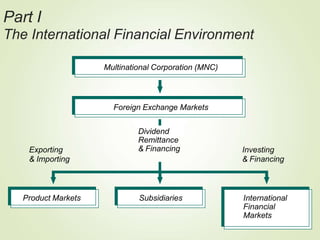
Multinational Corporation (MNC)
Foreign Exchange Markets
Product Markets Subsidiaries International
Financial
Markets
Dividend
Remittance
& Financing
Exporting
& Importing
Investing
& Financing
Part I
The International Financial Environment
Multinational Financial Management: An
Overview
By: Hesniati, SE.,MM.
1
Chapter
Chapter Objectives



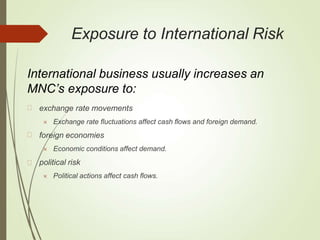
To identify the main goal of the multinational
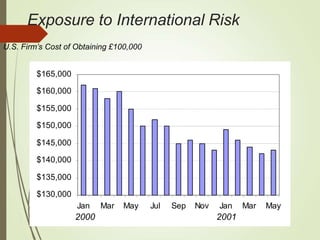
corporation (MNC) and conflicts with that goal;
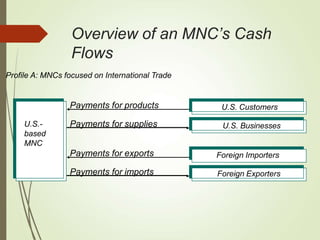
To describe the key theories that justify international
business; and
To explain the common methods used to conduct
international business.
Goal of the MNC


The commonly accepted goal of an MNC is to
maximize shareholder wealth.
We will focus on MNCs that are based in the United
States and that wholly own their foreign subsidiaries.
Conflicts Against the MNC
Goal


For corporations with shareholders who differ from their managers, a
conflict of goals can exist - the agency problem.
Agency costs are normally larger for MNCs than for purely
domestic firms.




The sheer size of the MNC.
The scattering of distant subsidiaries.
The culture of foreign managers.
Subsidiary value versus overall MNC value.
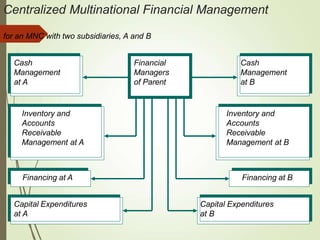
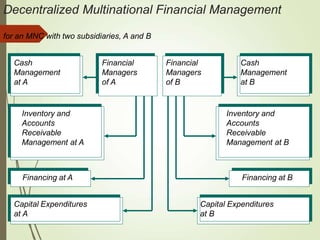
Impact of Management Control
 The magnitude of agency costs can vary with the
management style of the MNC.
 A centralized management style reduces agency
costs. However, a decentralized style gives more
control to those managers who are closer to the
subsidiary’s operations and environment.
Centralized Multinational Financial Management
for an MNC with two subsidiaries, A and B
Financial
Managers
of Parent
Capital Expenditures
at A
Inventory and
Accounts
Receivable
Management at A
Cash
Management
at A
Financing at A
Capital Expenditures
at B
Inventory and
Accounts
Receivable
Management at B
Cash
Management
at B
Financing at B
Decentralized Multinational Financial Management
for an MNC with two subsidiaries, A and B
Financial
Managers
of A
Capital Expenditures
at A
Inventory and
Accounts
Receivable
Management at A
Cash
Management
at A
Financing at A
Capital Expenditures
at B
Inventory and
Accounts
Receivable
Management at B
Cash
Management
at B
Financing at B
Financial
Managers
of B
Impact of Management Control
 Some MNCs attempt to strike a balance - they allow
subsidiary managers to make the key decisions for their
respective operations, but the decisions are monitored
by the parent’s management.
Impact of Management Control

 Electronic networks make it easier for the parent to
monitor the actions and performance of foreign
subsidiaries.
For example, corporate intranet or internet email facilitates
communication. Financial reports and other documents can

be sent electronically too.
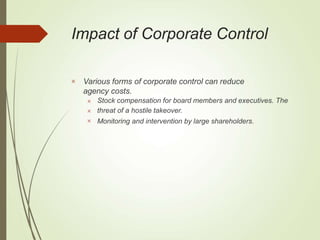
Impact of Corporate Control
 Various forms of corporate control can reduce
agency costs.



Stock compensation for board members and executives. The
threat of a hostile takeover.
Monitoring and intervention by large shareholders.
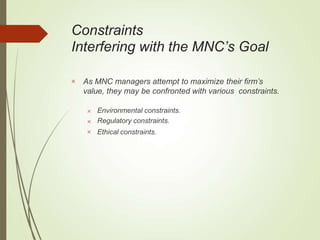
Constraints
Interfering with the MNC’s Goal
 As MNC managers attempt to maximize their firm’s
value, they may be confronted with various constraints.



Environmental constraints.
Regulatory constraints.
Ethical constraints.
Theories of International
Business
Why are firms motivated to expand
their business internationally?
 Theory of Comparative Advantage
 Specialization by countries can increase production efficiency.
 Imperfect Markets Theory
 The markets for the various resources used in production are
“imperfect.”
Theories of International
Business
Why are firms motivated to expand
their business internationally?
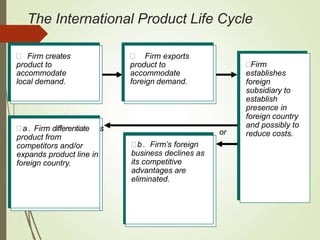
 Product Cycle Theory
 As a firm matures, it may recognize additional opportunities outside its
home country.
 Firm exports
product to
accommodate
foreign demand.
 Firm creates
product to
accommodate
local demand.
The International Product Life Cycle
Firm
establishes
foreign
subsidiary to
establish
presence in
foreign country
and possibly to
reduce costs.
s
 a . Firm differentiate
product from
competitors and/or
expands product line in
foreign country.
 b . Firm’s foreign
business declines as
its competitive
advantages are
eliminated.
or
International
Business Methods
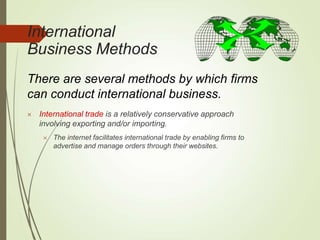
There are several methods by which firms
can conduct international business.
 International trade is a relatively conservative approach
involving exporting and/or importing.
 The internet facilitates international trade by enabling firms to
advertise and manage orders through their websites.
International
Business Methods


Licensing allows a firm to provide its technology in
exchange for fees or some other benefits.
Franchising obligates a firm to provide a specialized sales or
service strategy, support assistance, and possibly an initial
investment in the franchise in exchange for periodic fees.
International
Business Methods


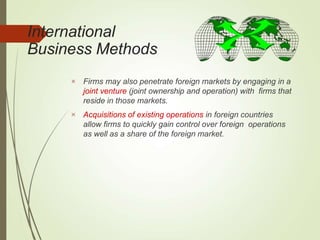
Firms may also penetrate foreign markets by engaging in a
joint venture (joint ownership and operation) with firms that
reside in those markets.
Acquisitions of existing operations in foreign countries
allow firms to quickly gain control over foreign operations
as well as a share of the foreign market.
International
Business Methods


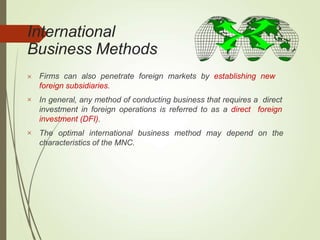
 Firms can also penetrate foreign markets by establishing new
foreign subsidiaries.
In general, any method of conducting business that requires a direct
investment in foreign operations is referred to as a direct foreign
investment (DFI).
The optimal international business method may depend on the
characteristics of the MNC.
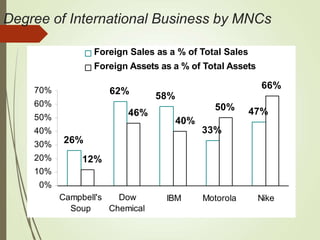
Degree of International Business by MNCs
26%
62%
58%
33%
47%
50%
66%
12%
46%
40%
70%
60%
50%
40%
30%
20%
10%
0%
Campbell's
Soup
Dow
Chemical
IBM Motorola Nike
Foreign Sales as a % of Total Sales
Foreign Assets as a % of Total Assets
International Opportunities


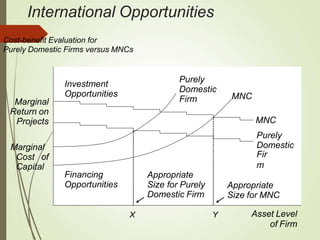
Investment opportunities - The marginal return on
projects for an MNC is above that of a purely domestic
firm because of the expanded opportunity set of possible
projects from which to select.
Financing opportunities - An MNC is also able to obtain
capital funding at a lower cost due to its larger opportunity
set of funding sources around the world.
Marginal
Return on
Projects
Fir
m
MNC
Purely
Domestic
Asset Level
of Firm
Investment
Opportunities
International Opportunities
Cost-benefit Evaluation for
Purely Domestic Firms versus MNCs
Appropriate
Size for Purely
Domestic Firm
Appropriate
Size for MNC
X Y
Marginal
Cost of
Capital
Purely
Domestic
Firm MNC
Financing
Opportunities
International Opportunities
 Opportunities in Europe



The Single European Act of 1987.
The removal of the Berlin Wall in 1989.
The inception of the euro in 1999.
 Opportunities in Latin America
 The North American Free Trade Agreement (NAFTA) of
1993.
 The General Agreement on Tariffs and Trade (GATT)
accord.
International Opportunities
 Opportunities in Asia
 The reduction of investment restrictions by many Asian
countries during the 1990s.
 China’s potential for growth.
 The Asian economic crisis in 1997-1998.
Exposure to International Risk
International business usually increases an
MNC’s exposure to:
 exchange rate movements
 Exchange rate fluctuations affect cash flows and foreign demand.
 foreign economies
 Economic conditions affect demand.
 political risk
 Political actions affect cash flows.
Exposure to International Risk
U.S. Firm’s Cost of Obtaining £100,000
$165,000
$160,000
$155,000
$150,000
$145,000
$140,000
$135,000
$130,000
Jan Mar May Jul Sep Nov Jan Mar May
2000 2001
Overview of an MNC’s Cash
Flows
Profile A: MNCs focused on International Trade
U.S. Businesses
Foreign Importers
U.S. Customers
Foreign Exporters
U.S.-
based
MNC
Payments for products
Payments for supplies
Payments for exports
Payments for imports
Overview of an MNC’s Cash
Flows
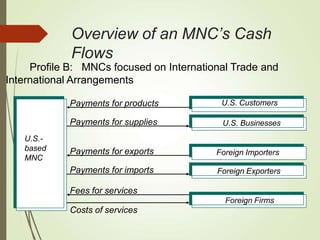
Profile B: MNCs focused on International Trade and
International Arrangements
U.S. Businesses
Foreign Importers
U.S. Customers
Foreign Exporters
Foreign Firms
U.S.-
based
MNC
Fees for services
Costs of services
Payments for products
Payments for supplies
Payments for exports
Payments for imports
Overview of an MNC’s Cash Flows
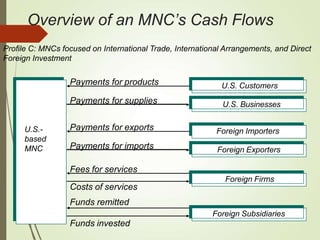
Profile C: MNCs focused on International Trade, International Arrangements, and Direct
Foreign Investment
U.S. Businesses
Foreign Importers
U.S. Customers
Foreign Exporters
Foreign Firms
Foreign Subsidiaries
U.S.-
based
MNC
Funds invested
Fees for services
Costs of services
Funds remitted
Payments for products
Payments for supplies
Payments for exports
Payments for imports
Managing for Value


Like domestic projects, foreign projects involve an
investment decision and a financing decision.
When managers make multinational finance decisions that
maximize the overall present value of future cash flows,
they maximize the firm’s value, and hence shareholder
wealth.
n
t

t=1 1 k
E CF$, t 
Value =
E (CF$,t ) = expected cash flows to be
received at the end of period t
n = the number of periods into the
future in which cash flows are received
k = the required rate of return by
investors
Valuation Model for an MNC
 Domestic Model
 






n
t
m
t=1 


j,t
j,t
1 k
E ER 

E CF
Value = 
j 1
E (CFj,t ) = expected cash flows denominated in
currency j to be received by the U.S. parent at the
end of period t
E (ERj,t ) = expected exchange rate at which
currency j can be converted to dollars at the end of
period t
k = the weighted average cost of capital of the
U.S. parent company
Valuation Model for an MNC
 Valuing International Cash Flows
Valuation Model for an MNC
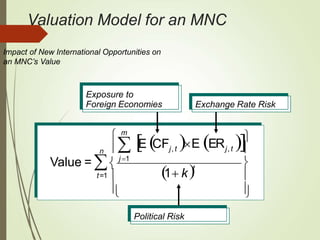


An MNC’s financial decisions include how much business to
conduct in each country and how much financing to obtain
in each currency.
Its financial decisions determine its exposure to the
international environment.
Valuation Model for an MNC
Impact of New International Opportunities on
an MNC’s Value
Exchange Rate Risk
 






n
t
m
t=1 


j,t
j,t
1 k
E ER 

E CF
Value = 
j 1
Political Risk
Exposure to
Foreign Economies
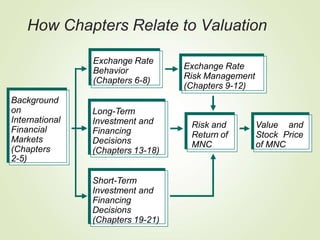
How Chapters Relate to Valuation
Background
on
International
Financial
Markets
(Chapters
2-5)
Exchange Rate
Behavior
(Chapters 6-8)
Long-Term
Investment and
Financing
Decisions
(Chapters 13-18)
Short-Term
Investment and
Financing
Decisions
(Chapters 19-21)
Exchange Rate
Risk Management
(Chapters 9-12)
Risk and
Return of
MNC
Value and
Stock Price
of MNC
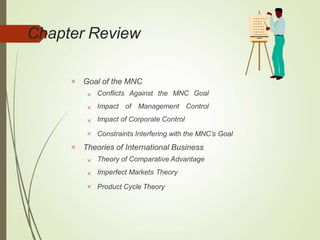
Chapter Review
 Goal of the MNC




Conflicts Against the MNC Goal
Impact of Management Control
Impact of Corporate Control
Constraints Interfering with the MNC’s Goal
 Theories of International Business



Theory of Comparative Advantage
Imperfect Markets Theory
Product Cycle Theory
Chapter Review
 International Business Methods






International Trade
Licensing
Franchising
Joint Ventures
Acquisitions of Existing Operations
Establishing New Foreign Subsidiaries
Chapter Review
 International Opportunities





Investment Opportunities
Financing Opportunities
Opportunities in Europe
Opportunities in Latin America
Opportunities in Asia
Chapter Review
 Exposure to International Risk



Exposure to Exchange Rate Movements
Exposure to Foreign Economies Exposure
to Political Risk


Overview of an MNC’s Cash Flows
Managing for Value
Chapter Review
 Valuation Model for an MNC




Domestic Model
Valuing International Cash Flows
Impact of Financial Management and International
Conditions on Value
How Chapters Relate to Valuation

Multinational Financial Management: An Overview

  • 1.
  • 2.
    Multinational Corporation (MNC) ForeignExchange Markets Product Markets Subsidiaries International Financial Markets Dividend Remittance & Financing Exporting & Importing Investing & Financing Part I The International Financial Environment
  • 3.
    Multinational Financial Management:An Overview By: Hesniati, SE.,MM. 1 Chapter
  • 4.
    Chapter Objectives    To identifythe main goal of the multinational corporation (MNC) and conflicts with that goal; To describe the key theories that justify international business; and To explain the common methods used to conduct international business.
  • 5.
    Goal of theMNC   The commonly accepted goal of an MNC is to maximize shareholder wealth. We will focus on MNCs that are based in the United States and that wholly own their foreign subsidiaries.
  • 6.
    Conflicts Against theMNC Goal   For corporations with shareholders who differ from their managers, a conflict of goals can exist - the agency problem. Agency costs are normally larger for MNCs than for purely domestic firms.     The sheer size of the MNC. The scattering of distant subsidiaries. The culture of foreign managers. Subsidiary value versus overall MNC value.
  • 7.
    Impact of ManagementControl  The magnitude of agency costs can vary with the management style of the MNC.  A centralized management style reduces agency costs. However, a decentralized style gives more control to those managers who are closer to the subsidiary’s operations and environment.
  • 8.
    Centralized Multinational FinancialManagement for an MNC with two subsidiaries, A and B Financial Managers of Parent Capital Expenditures at A Inventory and Accounts Receivable Management at A Cash Management at A Financing at A Capital Expenditures at B Inventory and Accounts Receivable Management at B Cash Management at B Financing at B
  • 9.
    Decentralized Multinational FinancialManagement for an MNC with two subsidiaries, A and B Financial Managers of A Capital Expenditures at A Inventory and Accounts Receivable Management at A Cash Management at A Financing at A Capital Expenditures at B Inventory and Accounts Receivable Management at B Cash Management at B Financing at B Financial Managers of B
  • 10.
    Impact of ManagementControl  Some MNCs attempt to strike a balance - they allow subsidiary managers to make the key decisions for their respective operations, but the decisions are monitored by the parent’s management.
  • 11.
    Impact of ManagementControl   Electronic networks make it easier for the parent to monitor the actions and performance of foreign subsidiaries. For example, corporate intranet or internet email facilitates communication. Financial reports and other documents can be sent electronically too.

  • 12.
    Impact of CorporateControl  Various forms of corporate control can reduce agency costs.    Stock compensation for board members and executives. The threat of a hostile takeover. Monitoring and intervention by large shareholders.
  • 13.
    Constraints Interfering with theMNC’s Goal  As MNC managers attempt to maximize their firm’s value, they may be confronted with various constraints.    Environmental constraints. Regulatory constraints. Ethical constraints.
  • 14.
    Theories of International Business Whyare firms motivated to expand their business internationally?  Theory of Comparative Advantage  Specialization by countries can increase production efficiency.  Imperfect Markets Theory  The markets for the various resources used in production are “imperfect.”
  • 15.
    Theories of International Business Whyare firms motivated to expand their business internationally?  Product Cycle Theory  As a firm matures, it may recognize additional opportunities outside its home country.
  • 16.
     Firm exports productto accommodate foreign demand.  Firm creates product to accommodate local demand. The International Product Life Cycle Firm establishes foreign subsidiary to establish presence in foreign country and possibly to reduce costs. s  a . Firm differentiate product from competitors and/or expands product line in foreign country.  b . Firm’s foreign business declines as its competitive advantages are eliminated. or
  • 17.
    International Business Methods There areseveral methods by which firms can conduct international business.  International trade is a relatively conservative approach involving exporting and/or importing.  The internet facilitates international trade by enabling firms to advertise and manage orders through their websites.
  • 18.
    International Business Methods   Licensing allowsa firm to provide its technology in exchange for fees or some other benefits. Franchising obligates a firm to provide a specialized sales or service strategy, support assistance, and possibly an initial investment in the franchise in exchange for periodic fees.
  • 19.
    International Business Methods   Firms mayalso penetrate foreign markets by engaging in a joint venture (joint ownership and operation) with firms that reside in those markets. Acquisitions of existing operations in foreign countries allow firms to quickly gain control over foreign operations as well as a share of the foreign market.
  • 20.
    International Business Methods    Firmscan also penetrate foreign markets by establishing new foreign subsidiaries. In general, any method of conducting business that requires a direct investment in foreign operations is referred to as a direct foreign investment (DFI). The optimal international business method may depend on the characteristics of the MNC.
  • 21.
    Degree of InternationalBusiness by MNCs 26% 62% 58% 33% 47% 50% 66% 12% 46% 40% 70% 60% 50% 40% 30% 20% 10% 0% Campbell's Soup Dow Chemical IBM Motorola Nike Foreign Sales as a % of Total Sales Foreign Assets as a % of Total Assets
  • 22.
    International Opportunities   Investment opportunities- The marginal return on projects for an MNC is above that of a purely domestic firm because of the expanded opportunity set of possible projects from which to select. Financing opportunities - An MNC is also able to obtain capital funding at a lower cost due to its larger opportunity set of funding sources around the world.
  • 23.
    Marginal Return on Projects Fir m MNC Purely Domestic Asset Level ofFirm Investment Opportunities International Opportunities Cost-benefit Evaluation for Purely Domestic Firms versus MNCs Appropriate Size for Purely Domestic Firm Appropriate Size for MNC X Y Marginal Cost of Capital Purely Domestic Firm MNC Financing Opportunities
  • 24.
    International Opportunities  Opportunitiesin Europe    The Single European Act of 1987. The removal of the Berlin Wall in 1989. The inception of the euro in 1999.  Opportunities in Latin America  The North American Free Trade Agreement (NAFTA) of 1993.  The General Agreement on Tariffs and Trade (GATT) accord.
  • 25.
    International Opportunities  Opportunitiesin Asia  The reduction of investment restrictions by many Asian countries during the 1990s.  China’s potential for growth.  The Asian economic crisis in 1997-1998.
  • 26.
    Exposure to InternationalRisk International business usually increases an MNC’s exposure to:  exchange rate movements  Exchange rate fluctuations affect cash flows and foreign demand.  foreign economies  Economic conditions affect demand.  political risk  Political actions affect cash flows.
  • 27.
    Exposure to InternationalRisk U.S. Firm’s Cost of Obtaining £100,000 $165,000 $160,000 $155,000 $150,000 $145,000 $140,000 $135,000 $130,000 Jan Mar May Jul Sep Nov Jan Mar May 2000 2001
  • 28.
    Overview of anMNC’s Cash Flows Profile A: MNCs focused on International Trade U.S. Businesses Foreign Importers U.S. Customers Foreign Exporters U.S.- based MNC Payments for products Payments for supplies Payments for exports Payments for imports
  • 29.
    Overview of anMNC’s Cash Flows Profile B: MNCs focused on International Trade and International Arrangements U.S. Businesses Foreign Importers U.S. Customers Foreign Exporters Foreign Firms U.S.- based MNC Fees for services Costs of services Payments for products Payments for supplies Payments for exports Payments for imports
  • 30.
    Overview of anMNC’s Cash Flows Profile C: MNCs focused on International Trade, International Arrangements, and Direct Foreign Investment U.S. Businesses Foreign Importers U.S. Customers Foreign Exporters Foreign Firms Foreign Subsidiaries U.S.- based MNC Funds invested Fees for services Costs of services Funds remitted Payments for products Payments for supplies Payments for exports Payments for imports
  • 31.
    Managing for Value   Likedomestic projects, foreign projects involve an investment decision and a financing decision. When managers make multinational finance decisions that maximize the overall present value of future cash flows, they maximize the firm’s value, and hence shareholder wealth.
  • 32.
    n t  t=1 1 k ECF$, t  Value = E (CF$,t ) = expected cash flows to be received at the end of period t n = the number of periods into the future in which cash flows are received k = the required rate of return by investors Valuation Model for an MNC  Domestic Model
  • 33.
            n t m t=1    j,t j,t 1k E ER   E CF Value =  j 1 E (CFj,t ) = expected cash flows denominated in currency j to be received by the U.S. parent at the end of period t E (ERj,t ) = expected exchange rate at which currency j can be converted to dollars at the end of period t k = the weighted average cost of capital of the U.S. parent company Valuation Model for an MNC  Valuing International Cash Flows
  • 34.
    Valuation Model foran MNC   An MNC’s financial decisions include how much business to conduct in each country and how much financing to obtain in each currency. Its financial decisions determine its exposure to the international environment.
  • 35.
    Valuation Model foran MNC Impact of New International Opportunities on an MNC’s Value Exchange Rate Risk         n t m t=1    j,t j,t 1 k E ER   E CF Value =  j 1 Political Risk Exposure to Foreign Economies
  • 36.
    How Chapters Relateto Valuation Background on International Financial Markets (Chapters 2-5) Exchange Rate Behavior (Chapters 6-8) Long-Term Investment and Financing Decisions (Chapters 13-18) Short-Term Investment and Financing Decisions (Chapters 19-21) Exchange Rate Risk Management (Chapters 9-12) Risk and Return of MNC Value and Stock Price of MNC
  • 37.
    Chapter Review  Goalof the MNC     Conflicts Against the MNC Goal Impact of Management Control Impact of Corporate Control Constraints Interfering with the MNC’s Goal  Theories of International Business    Theory of Comparative Advantage Imperfect Markets Theory Product Cycle Theory
  • 38.
    Chapter Review  InternationalBusiness Methods       International Trade Licensing Franchising Joint Ventures Acquisitions of Existing Operations Establishing New Foreign Subsidiaries
  • 39.
    Chapter Review  InternationalOpportunities      Investment Opportunities Financing Opportunities Opportunities in Europe Opportunities in Latin America Opportunities in Asia
  • 40.
    Chapter Review  Exposureto International Risk    Exposure to Exchange Rate Movements Exposure to Foreign Economies Exposure to Political Risk   Overview of an MNC’s Cash Flows Managing for Value
  • 41.
    Chapter Review  ValuationModel for an MNC     Domestic Model Valuing International Cash Flows Impact of Financial Management and International Conditions on Value How Chapters Relate to Valuation