£5
Lynd Seagull did in the book
Jonathan Livingston Seagull
by Richard Bach. I was doing
things that helped other good
birds wanting to fly like me,
take the step forward.
Only courageous birds could
take the leap of faith. In
December 2010, we began a
flight journey together that has
redefined our present and shall
redefine the industry’s future.
	 Welcome to reading
stories of tests that were never
before documented. I wish I
could play for you the appro-
priate soft background music
while you read them. It would
just make the experience better.
I trust your brains are capable
of introducing background mu-
sic or you can pull out a mobile
device and play something to
enhance the experience.
Test of the Vision
Moolya was a garage start-up.
We didn’t do a garage venture
just because every other one
we had heard of became suc-
cessful. Our budget was small
or should I say we hardly had
any money to call it a budget.
So the garage came looking
our way. We needed more than
just office space though. We
needed birds that could fly and
inspire the world. I decided to
hire an exceptional flock of
Continued on page 5
By Paul Gerrard
Testing is Long Overdue for a Change
Rumours of the death of testing
were greatly exaggerated, but even
so, the changes we predict will be
dramatic. My own company has been
heralding the demise of the ‘plain old
functional tester’ (POFT) for years
and we’ve predicted both good and
bad outcomes of the technological
and economic change that is going on
right now. Some time ago, I posted a
blog, ‘Testing is in a Mess’1
where I
suggested that there’s complacency,
self-delusion and over capacity in
the testing business; there is too little
agreement about what testing is, what
it’s for or how it should be done.
	 But there are also some
significant forces at play in the
IT industry and I think the testing
community, will be coming under
extreme pressure. I summarise this
change as ‘redistributed testing’: users,
analysts, developers and testers will
redistribute responsibility for testing
by, wait for it, collaborating more
effectively. Testers probably won’t drive
this transition, and they may be caught
out if they ignore the winds of change.
	 In this article, I’ll suggest what
we need from the leaders in our
Continued on page 2
ALSO IN THE NEWS
Teachers,Children,
TestersandLeaders
“A tester is someone
who knows things can
be different” ...
Continued on page 11
How are your leadership skills?
Will the Test Leaders Stand Up?
March 2013 | www.thetestingplanet.com | No: 10
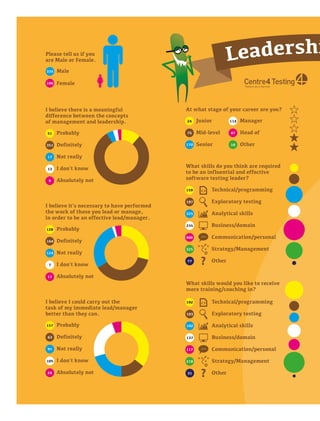
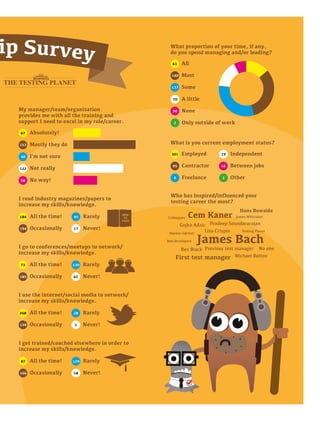
The Leadership Survey results have been given the infographic treatment - see pages 16-17
Tester Tested!
Whenmyleadershipskills
wereputtothetest
By Pradeep Soundararajan
Over the last two years, the
education forced upon me is
leadership, especially when
I thought I knew what it was
meant to be. I was in for
some tests. After becoming an
independent test consultant in
2006, I did a bunch of things.
I flew the way I wanted to
and also flew away from bad
birds, just like how Fletcher
LEADERSHIP CHEAT
SHEET
The most important
piece of advice I give
testers about...
Continued on page 21
HIGHLY INEFFECTIVE
LEADERSHIP TIPS
Some people want to
know how to be a good
or even a great leader...
Continued on page 19
TheEvilTester’s
Influences
When I read Sun Tzu’s
The Art of War, I tend to
relate it to testing...
Continued on page 18
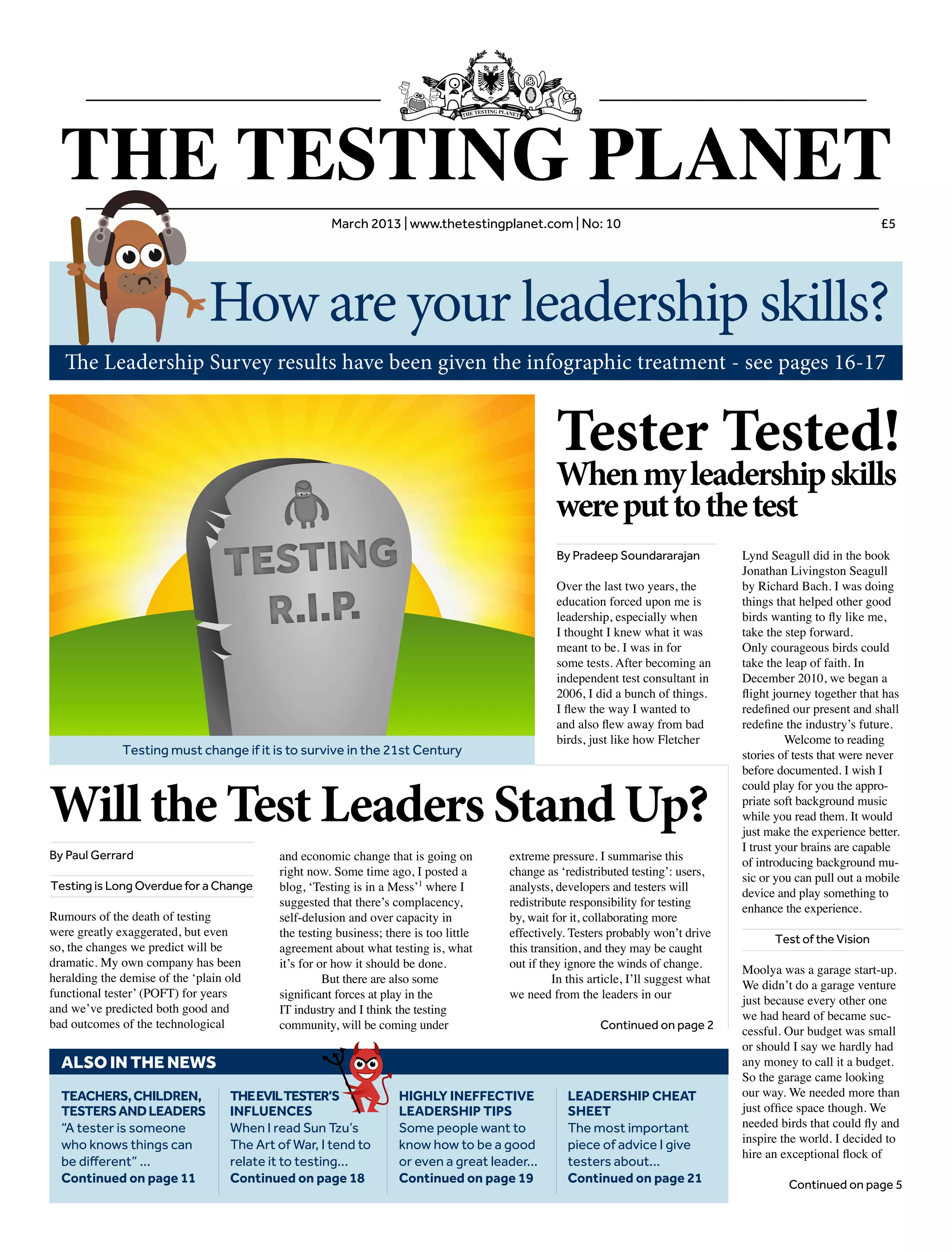
Testing must change if it is to survive in the 21st Century
2 March 2013 | www.thetestingplanet.com | Use #testingplanet hashtag
Main story continued from page 1
industry, the market and our organisations. Of
course, some responsibility will fall on your
shoulders. Whether you are a manager or technical
specialist, there will be an opportunity for you to
lead the change.
New Architectures, new Approaches
Much of the software development activity in the
next five years or so will be driven by the need for
system users and service vendors to move to new
business models based on new architectures. One
reason SaaS is attractive is that the route to market
is so simple that tiny boutique software shops can
compete on the same playing field as the huge
independent software vendors.
	 SaaS works as an enabler for very rapid
deployment of new functionality and deployment
onto a range of devices. A bright idea in
marketing in the morning can be deployed as new
functionality in the afternoon and an increasing
number of companies are succeeding with
‘continuous delivery’. This is the promise of SaaS.
	 Most organisations will have to come
to terms with the new architectures and a more
streamlined approach to development. The push
and pull of these forces will make you rethink how
software available through the Internet is created,
delivered and managed. The impacts on testing are
significant. If you take an optimistic view, testing
and the role of testers can perhaps, at last, mature to
what they should be.
The Testing Business has Matured, but Bloated
Over the last twenty years or so there has been a
dramatic growth in the number of people who test
and call themselves testers and test managers. It’s
not that more testing happens. I think it’s because
the people who do it are now recruited into teams,
having managers who plan, resource and control
sizable budgets in software projects to perform
project test stages. There is no question that people
are much more willing to call themselves a tester.
There are now a huge number of career testers
across the globe; many have done nothing but
testing in their professional lives. The problem is
that there may now be too many of them.
	 In many ways, in promoting the testing
discipline as some of us have done for more
than twenty years, we have been too successful.
There is now a sizable testing industry. We have
certification schemes, but the schemes that were a
step forwards fifteen years ago, haven’t advanced.
As a consequence, there are many thousands of
professional testers, certified only to a foundation
level who have not developed their skills much
beyond test script writing, execution and incident
logging. Much of what these people do are basically
‘checking’ as Michael Bolton has called it.
	 Most checking could be automated and
some could be avoided. In the meantime, we have
seen (at last) developer testing begin to improve
through their adoption of test-driven and behaviour-
driven approaches. Of course, most of the testing
they do is checking at a unit level. But this is
similar to what many POFTs spend much of their
time doing manually. Given that most companies
are looking to save money, it’s easy to see why
many organisations see an opportunity to reduce
the number of POFTs if they get their developers
to incorporate automated checking into their work
through TDD and BDD approaches.
	 As the developers have adopted the
disciplines and (mostly free) tools of TDD and
BDD, the testers have not advanced so far. I would
say, that test innovation tends to be focused on the
testers’ struggle to keep pace with new technologies
rather than insights and inventions that move the
testers’ discipline forward. Most testing is still
manual, and the automated tests created by test
teams (usually with expensive, proprietary tools)
might be better done by developers anyway.
	 In the test management space, one can
argue that test management is a non-discipline, that
is, there is no such thing as test management, there’s
just management. If you take the management
away from test management – what’s left? Mostly
challenges in test logistics – or just logistics – and
that’s just another management discipline isn’t it?
	 What about the fantastic advances in
automation? Well, test execution robots are still,
well, just robots. The advances in these have
tracked the technologies used to build and deliver
functionality – but pretty much that’s all. Today’s
patterns of test automation are pretty much the
same as those used twenty or more years ago. Free
test automation frameworks are becoming more
commonly used, especially for unit testing. Free
BDD tools have emerged in the last few years, and
these are still developer focused but expect them to
mature in the next few years. Tools to perform end-
to-end functional tests are still mostly proprietary,
expensive and difficult to succeed with.
	 The test management tools that are out
there are sophisticated, but they perform only
the most basic record keeping. Most people still
use Excel and survive without test management
products that only support the clerical test activities
and logistics and do little to support the intellectual
effort of testers.
	 The test certification schemes have gone
global. As Dorothy Graham says on her blog2
the
Foundation met its main objective of “removing the
bottom layer of ignorance” about software testing.
Fifteen years and 150,000+ certificate awards later,
it does no more than that. For many people, it
seems that this ‘bottom layer of knowledge’ is all
they may ever need to get a job in the industry. The
industry has been dumbed-down.
Agile: a Stepping Stone to Continuous Delivery
There is an on-going methodological shift from
staged, structured projects to iterative and Agile
and now, towards ‘continuous delivery’. Just as
companies seem to be coming to terms with Agile
– it’s all going to change again. They are now being
invited to consider continuous ‘Specification by
Example’ approaches. Specification by example
promotes a continual process of specification,
exampling, test-first, and continuous integration.
Continued on page 3
Leadershipisallaboutcharacter.It’snot
aboutwhatyousay,orevenwhatyou
do.It’saboutwhoyouare,whereyou’ve
beenandwhatyoulearntonyourjourney.
	 IpresenttoyoutheLeadership
editionofTheTestingPlanet.Aseries
ofarticlesthatwillcarryyousomeway
alongtheroadtosoftwaretesting
enlightenment.Travelwithusforawhile,
sharetheexperiencesandlessons
learnt,reflectupontheconclusions
drawnandconsiderhowyoumightbe
abletoapplytheminyourorganisation
orteam.
	 Ifthat’snotenough,watchout
fortheaccompanyinge-bookwith
leadershipstoriesandaspecialinterview
withJamesBachandMichaelBolton.
	 Andasyouread,please
remember-we’reona journeytoo.We
valueyourfeedback.Letusknowwhat
youlikedordidn’tlikeat
http://thetestingplanet.com/feedback
Thanks!
Letter from the Editor
Simon Knight
KK
Thomas Harvey
Rosie Sherry
Mike Talks
David Greenlees
Anna Baik
Helena Jeret-Mäe
Craig Earl
Vipin Jain
The team
It’s hard to lead a cavalry charge if you think you look funny on a horse. - Adlai Stevenson
Brief
HistorY
OF
Time
a
FrenchEdition
NEWSIN
BRIEF
SummerQAmpEmbarkson
ItsSecondYeartoCreate
InternshipsatLeadingTechnol-
ogyCompaniesinEightU.S.Cities.
http://bit.ly/astsummerqamp
3Follow us at www.twitter.com/testingclub
The leadership instinct you are born with is the backbone. You develop the funny bone and the wishbone that go with it. -
Dwight Eisenhower
Brief
HistorY
OF
Time
a
FrenchEdition
Continued from page 2
CI and Delivery is the heartbeat, the test, life-
support and early warning system. The demands
for better testing in development are being met.
A growing number of developers have known
no other way. If this trend continues, we will get
better, stable software sooner and much of the late
functional checking done by system testers may
not be required. Will this reduce the need for POFT
testers? You bet.
	 But, continuous delivery is a machine that
consumes requirements. For the rapid output of
continuous delivery to be acceptable, the quality of
requirement going into that machine must be very
high. We argue that requirements must be trusted,
but not perfect.
Testers are Being Squeezed
Developers are increasingly taking on the
automated checking. Some business analysts
are taking their chance and absorbing critical
disciplines into analysis and are taking over the
acceptance process too. Combined, the forces above
are squeezing testers from the ‘low-value’ unskilled,
downstream role. To survive, testers will have to
up-skill to upstream, business-savvy, workflow-
oriented, UX-aware testing specialists with new
tools or specialise in automation, technical testing
or become business domain experts.
So how do Testers take Advantage
of Redistribution?
I set out my top 10 predictions for the next five
years in my blog “On the Redistribution of
Testing”3
and I won’t labour those points here.
Rather, I’ll explore some leadership issues that arise
from the pressures I mentioned above and potential
shifts in the software development and more
particularly, testing business.
	 The core of the redistribution idea is
that the checking that occupies much of the time
of testing teams (who usually get involved late
in projects) can be better done by developers.
Relieving the testers of this burden gives them time
to get involved earlier and to improve the definition
of software before it is built. Our proposal is that
testers apply their critical skills to the creation of
examples that illustrate the behaviour of software
in use in the requirements phase. Examples
(we use the term business stories) provide
feedback to stakeholders and business analysts to
validate business rules defined in requirements.
The outcome of this is what we call trusted
requirements.
	 In the Business Story Pocketbook4
, we
define a trusted requirement as “… one that, at
this moment in time, is believed to accurately
represent the users’ need and is sufficiently detailed
to be developed and tested.” Trusted requirements
are specified collaboratively with stakeholders,
business analysts, developers and testers involved.
	 Developers, on receipt of validated
requirements and business stories can use the
stories to drive their TDD approach. Some (if
not all) of these automated checks form the bulk
of regression tests that are implemented in a
Continuous Integration regime. These checks
can then be trusted to signal a broken build. As
software evolves, requirements change; stories
and automated checks change too. This approach,
sometimes-called Specification by Example
depends on accurate specifications (enforced by test
automation) for the lifetime of the software product.
Later (and fewer) system testers have reduced time
to focus on the more subtle types of problem, end to
end and user experience testing.
	 The deal is this: testers get involved earlier
to create scenarios that validate requirements,
and that developers can automate. Improving the
quality of requirements means the target is more
stable, developers produce better code, protected
by regression tests. Test teams, relieved of much
of the checking and re-testing are smaller and can
concentrate on the more subtle aspects of testing.
	 With regards to the late testing in
continuously delivering environments, testers are
required to perform some form of ‘health check’
prior to deployment, but the days of teams spending
weeks to do this are diminishing fast. We need
fewer, much smarter testers working up-front and in
the short time between deployment and release.
Where are the Opportunities?
The software development and Agile thought
leaders are very forcefully arguing for continuous
delivery, collaborative specification, better
development practices (TDD, BDD), continuous
integration, and testing in production using A/B
testing, dark releases and analytics and big data.
The stampede towards mobile computing continues
apace and for organisations that have a web
presence, the strategy is becoming clearer.
	 The pace of technical change is so high that
the old way of testing just won’t cut it. Some teams
are discovering they can deliver without testers at
all. The challenge of testing is perceived (rightly or
wrongly) to be one of speed and cost (even though
it’s more subtle than that of course). Testers aren’t
being asked to address this challenge because
it seems more prone to a technical solution and
POFTs are not technical.
	 But the opportunities are there: to get
involved earlier in the requirements phase; to
support developers in their testing and automation;
to refocus testing away from manual checking
towards exploratory testing; to report progress and
achievement against business goals and risks, rather
than test cases and bug reports.
Testers Need a New Mindset; so do Vendors
We need the testing thought-leaders to step up and
describe how testing, if it truly is an information
provision service, helps stakeholders and business
analysts to create trusted requirements, support
developers in creating meaningful, automatable,
functional tests. And to be there at the end to
perform the testing (in production, or production-
like environments) to ensure there are no subtle
flaws in the delivered system.
	 Some of the clichés of testing need to be
swept away. The old thinking is no longer relevant
and may be career limiting. To change will take
some courage, persistence and leadership.
	 Developers write code; testers test
because developers can’t: this mentality has got to
go. Testing can no longer be thought of as distinct
from development. The vast majority of checking
can be implemented and managed by development.
One potential role of a tester is to create functional
tests for developers to implement. The developers,
being fluent in test automation, implement lower
level functional and structural tests using the same
test automation. Where developers need coaching
in test design, then testers should be prepared to
provide it.
	 Testers don’t own testing: testing is part
of everyone’s job from stakeholder, to users, to
business analysts, developers and operations staff.
The role of a tester could be that of ‘Testmaster’. A
testmaster provides assurance that testing is done
well through test strategy, coaching, mentoring and
where appropriate, audit and review.
	 Testing doesn’t just apply to existing
software, at the end: testing is an information
provision service. Test activity and design is driven
by a project’s need to measure achievement, to
explore the capabilities, strengths and weaknesses
so decisions can be made. The discipline of test
applies to all artefacts of a project, from business
plans, goals, risks, requirements and design. We
coined the term ‘Project Intelligence’ some years
ago to identify the information testers provide.
	 Testing is about measuring achievement,
rather than quality: Testing has much more to
say to stakeholders when its output describes
achievement against some meaningful goal, than
alignment to a fallible, out of date, untrusted
document. The Agile community have learnt that
demonstrating value is much more powerful than
reporting test pass/fails. They haven’t figured how
Continued on page 4
PaulGerrardisaconsultant,teacher,author,webmaster,developer,tester,conferencespeaker,
rowingcoachandapublisher.Hehasconductedconsultingassignmentsinallaspectsofsoft-
waretestingandqualityassurance,specialisingintestassurance.Hehaspresentedkeynote
talksandtutorialsattestingconferencesacrossEurope,theUSA,Australia,SouthAfricaand
occasionallywonawardsforthem.EducatedattheuniversitiesofOxfordandImperialCol-
legeLondon,in2010,PaulwontheEurostarEuropeanTestingexcellenceAward.In2012,with
SusanWindsor,Paulrecentlyco-authored“TheBusinessStoryPocketbook”.HeisPrincipal
ofGerrardConsultingLimitedandisthehostoftheUKTestManagementForumandtheUK
BusinessAnalysisForum.
AUTHOR PROFILE - PAUL GERRARD
4 March 2013 | www.thetestingplanet.com | Use #testingplanet hashtag
Continued from page 3
to do it of course, but the pressure to align Agile
projects with business goals and risks is very pro-
nounced.
Whither the Test Manager?
You are test manager or a test lead now. Where will
you be in five years? In six months? It seems to me
there are five broad choices for you to take (other
than getting out of testing and IT altogether).
1.	 Providing testing and assurance skills to
business: moving up the food chain towards
your stakeholders, your role could be to provide
advice to business leaders wishing to take
control of their IT projects. As an independent
agent, you understand business concerns and
communicate them to projects. You advise
and cajole project leadership, review their
performance and achievement and interpret
outputs and advise your stakeholders.
2.	 Managing Requirements knowledge: In this
role, you take control of the knowledge required
to define and build systems. Your critical skills
demand clarity and precision in requirements
and the examples that illustrate features in use.
You help business and developers to decide
when requirements can be trusted to the degree
that software can reasonably be built and tested.
You manage the requirements and glossary
and dictionary of usage of business concepts
and data items. You provide a business impact
analysis service.
3.	 Testmaster – Providing an assurance function
to teams, projects and stakeholders: A similar
role to 1 above – but for more Agile-oriented
environments. You are a specialist test and
assurance practitioner that keeps Agile
projects honest. You work closely with on-
site customers and product owners. You help
projects to recognise and react to risk, coach
and mentor the team and manage their testing
activities and maybe do some testing yourself.
4.	 Managing the information flow to/from the
CI process: in a Specification by Example
environment, if requirements are validated
with business stories and these stories are used
directly to generate automated tests which are
run on a CI environment, the information flows
between analysts, developers, testers and the CI
system is critical. You define and oversee the
processes used to manage the information flow
between these key groups and the CI system
that provides the control mechanism for change,
testing and delivery.
5.	 Managing outsourced/offshore teams: In this
case, you relinquish your onsite test team and
manage the transfer of work to an outsourced
or offshore supplier. You are expert in the
management of information flow to/from your
software and testing suppliers. You manage
the relationship with the outsourced test team,
monitor their performance and assure the
outputs and analyses from them.
Summary
The recent history and the current state of the
testing business, the pressures that drive the
testers out of testing and the pull of testing into
development and analysis will force a dramatic re-
distribution of test activity in some or perhaps most
organisations.
	 Henry Kissinger said, “A leader does not
deserve the name unless he is willing occasionally
to stand alone”. You might have to stand alone
for a while to get your view across. Dwight D
Eisenhower gave this definition: “Leadership is the
art of getting someone else to do something you
want done because he wants to do it”.
	 Getting that someone else to want to do it
might yet be your biggest challenge. □
REFERENCES
1.	 TestingisinaMesshttp://gerrardconsulting.
com/index.php?q=node/591
2.	 CertificationSchemesdonotAssessTes-
terSkill?http://dorothygraham.blogspot.
co.uk/2011/02/part-3-certification-schemes-
do-not.html
3.	 OntheRedistributionofTestinghttp://gerrard-
consulting.com/index.php?q=node/602
4.	 Downloadablefromhttp://businessstory-
method.com
A SMARTER
SIMPLER
AND MORE ELEGANT
TEST MANAGEMENT TOOL
5 EASY FREE
TO USE TO TRY
MINUTE
TO SET UP
5Follow us at www.twitter.com/testingclub
Leadership is the art of getting someone else to do something you want done because he wants to do it. -Dwight Eisenhower
Brief
HistorY
OF
Time
a
FrenchEdition
Second story continued from page 1
testers including Dhansekar Subramaniam, Parima-
la Hariprasad, Sunil Kumar T and Santhosh Tuppad
to start with.
	 The first reaction James Bach had when
I told him I hired DS and Parimala was, “Really?
How could you afford their pay checks?” Why can’t
I? They came for the pleasure of flying and not for
the money. They do need to run a family but they
believed in my leadership and believed that I could
start paying them before their savings are depleted.
If my mission is to create a flight journey for all birds
who want to fly, fly together, I need to take care of
the logistics. The primary logistics here is – money.
	 DS was a part of our second testing project.
He came to me one day and said something like,
“We claim we won’t do scripted testing but I guess
on this project we are slowly leaning towards it.
Our customer is failing to understand the value of
exploratory testing and I thought I could get rid of
the scripted approach when I came over to Moolya”
	 This project was earning us money to
take care of our operation costs and give us a little
cushion to do a bunch of other things. So, should I
say to our customer, “we can go hungry but not do
this kind of testing!” or behave the way I have seen
(and cursed) other people do and surrender to the
customers’ expectations over our vision.
	 I bought time from DS to fix the problem. I
was officially a consultant to this project, so I tried
helping our customer understand why we are less
valuable to them if we were to operate on scripted
testing mode but sadly they failed to understand
the value of our proposition. Maybe I failed to help
them see the value. One of our reasons for failure
was because we did a stupendous job that made
them want cool work to first be repeatable before
doing new things.
	 I motivated DS and our other colleague to
keep re-iterating the point that we can be of more
value. Somehow, repeatability of our superb work
stood in front of anything else. I could sense that
DS and his colleague had lost motivation. I can sac-
rifice money but not kill the motivation of a highly
capable bird that wants to fly. So we stopped work-
ing on that project. DS came out of the project. He
knew this meant loss of revenue for the company.
However, this helped regain his confidence on me
as a leader and how serious I am about the vision.
	 What happened after that is a great story.
This bird setup the mobile testing division in
Moolya and came with some awesome work on
COP FLUNG GUN1
mnemonic for mobile app
testing. We now have top customers for our mo-
bile division, a great team of highly skilled mobile
app testers and revenue multiple times of what we
would have earned from that other project, flowing
in from the mobile app testing business.
	 As of today, Dhanasekar is Commander
– Mobile for Moolya. He is a respected leader in
Moolya and even outside of it. Our mutual respect
has risen to great heights ever since.
Test of Money
Money tests people. I actually had passed through
the money tests during my independent consulting
days. There were months I made a lot of money and
there were months that were dry. There were mo-
ments where my wife spent without having to ask
if I was okay with it and there were months where
she knew my answer if she did ask. I am very bad
at saving money. I have a bad reputation when it
comes to saving money within my family.
	 However, after Moolya and the first year
and two months – I borrowed as much as I could
from my brother and my father. They helped me run
my family. My wife supported me very well.
	 Here is an interesting thing – Moolya had
money and I could have afforded for myself a pay
check that could help me run my family without
having to borrow but I looked at people who came
to me trusting that I can help them grow by fuel-
ling Moolya’s growth. The more money I could let
Moolya have, the better decisions I could make for
its growth. It definitely fuelled our growth. I did
hire more testers and I did get more customers with
the money I saved. The best way I learnt to save
money was to not take it.
	 There were definitely moments where I
thought I was being stupid to have lots of money
in the bank (understand the context of the word
lot there) and not take it. My wife did question if
the business was doing good because I told her
about new customers we got and yet did not bring
money home so that she could run our household.
With our first child’s birth, our household expens-
es simply doubled. I never knew that diapers were
so expensive! I never knew that a child can give
so much joy that I would forget the world. I also
never knew that I would be reminded of money
when changing diapers.
	 When I shared my concern with Moolya’s
auditors they advised me to take a pay check that
could meet my household requirements. The ques-
tion I put back to them was, “Can my folks do it,
too?” We all took an equal hike in our pay checks
and yet had good cushion of money for Moolya’s
growth.
	 The team, who reports to me, probably
observed what I was doing and they showered more
respect for how I was handling things. They simply
believe they no longer need to worry about their
pay checks because I am there to take care of it.
Test of Passing on the Leadership
Even before I started Moolya, I knew that creat-
ing leaders was the important first step to change
the world. I just knew it but creating leaders is not
as simple as saying it. The most important blocker
to creating leaders in Moolya was none other than
– yours truly – Pradeep Soundararajan. I was the
decision maker for anything in Moolya. For more
than a year and half, people did not make decisions.
I was a strong alpha male overriding every decision
that they wanted to make. I was not power hungry
but didn’t see the trap coming. On a reflection, I
decided to distance myself with things that could be
handled by the team reporting to me. Let me be a
little more honest, it didn’t emerge out of pure self
retrospection. I was stressed and was wondering
what am I doing wrong? There emerged a light.
People need to be trained to use their powers.
Michael Bolton helped me recognize this. I was a
rookie test manager in 2007 and was talking to Mi-
chael on the challenges I had. One of the questions
he asked me, while he jiggled with the problem
was, “Have you used the power you have that
Continued on page 6
PradeepSoundararajanhashadagreatjourneysofar.Startinghis
careerasatester,hemovedtobecominganindependentconsultant
andthentostartingMoolya(www.moolya.com)travellingaroundthe
worldwhiledoingit.Hisjourneywasn’tsmooth;healsowentbankrupt
manytimesbutnevergaveuponthemissiontochangetheworld
ofsoftwaretesting.HejustbecametheKungFuPandaofMoolya
whereheHeadstheMarketingandSales.HethinkswithhisMarketing
andSalesrole,hecanbringtherightcustomerstoMoolyawhoalso
wanttochangetheworldoftesting.Heblogsathttp://testertested.
blogspot.inandhttp://moolya.com/blogNeverbeforehasaPanda
beensofearedandsoloved.Shashaboyee!
AUTHOR PROFILE - Pradeep Soundararajan
a community for software testers
WWW.SOFTWARETESTINGCLUB.COM
6 March 2013 | www.thetestingplanet.com | Use #testingplanet hashtag
Ten soldiers wisely led will beat a hundred without a head. - Euripides
Brief
HistorY
OF
Time
a
FrenchEdition
Continued from page 5
comes with you at your position?” and I guess what
happened to me was, “Ah, I have powers with this
job? I didn’t know that!”
	 Helping my team learn how to use their
powers wisely is an important responsibility I carry.
Oh, let me explain that. I made a conscious decision
to make the team that reports to me fully respon-
sible for the testers who report to them and make
decisions independently. Earlier, I used to act like a
super hero doing a whole bunch of things. I still do
care for those who work in Moolya but most of my
caring time is spent with my team.
	 If you give someone a power, they’d at
times or when needed show the power to you. That
is what happened to me and I loved them when
they did that. So, my respect and love for them
increased. I must admit that I was nervous initially.
After some new alpha fighting old alpha, I called
them to a meeting and requested just one thing – be
polite when you hit me hard!
	 I have known these people for a long time
now and I trust them so I have nothing to worry.
They are the best team I could work with for making
Moolya what it is today and the potential it has for
the future. Someday, they would empower their own
team with more powers and get to know how I felt.
Closing Notes
It was not my intention in writing this to set out a
path of advice or a formula to follow. I just wanted
to capture the Moolya experience report and get
it published. However, I could suggest looking at
people around more carefully, what they do. For
instance, Rosie Sherry has beautifully revolution-
ized the way online communities in testing can be
built. Weekend Testing has revolutionized the way
in which people can practice testing and learn from
other testers. Lets Test conference has revolution-
ized the idea of a testing conference. Andy Glover
revolutionized testing cartoons. The Context Driven
Testing community is revolutionizing the sapient
(ahem, Brainual) testing.
	 In 2006, I was intimidated by any good tes-
ter I met. I was very nervous. I felt inferior to many
whom I met in CAST 2008. I did the mistake every-
body else probably have done or are doing – that is
- I wanted to be good at everything in testing. Right
from doing conferences, doing online communities,
doing test consulting, testing, mentoring testers,
blogging and everything under the radar of testing.
The moment I recognized I live in an eco system
and I am not THE eco system, I have been living in
it beautifully. My role is to build Moolya to a com-
pany that will change the way the world tests. You
too have a role in the eco system. When you realize
your role, you would learn to live a more beautiful
life. Just like how I did and am doing.
	 I wish you get as good leaders as I have in
my life. I shall always be grateful to James, Mi-
chael, Vipul and Mohan who have been my consul-
tant leaders and have helped me evolve. Thanks to
Simon Knight and Mike Talks who considered this
editing worthy of their time. □
Leadership in Testing - What Really Matters
By Keith Klain
I’ve hired lots of testers. I’ve hired some great
ones, and some well, not so great ones. Some that
exceeded all my expectations for them, and some
that I thought were bound for “greatness” and fell
short of the mark. Consistently, the one quality
that I see distinguishing the ones who reach their
full potential from the ones who don’t: leadership.
I prefer to think of leaders using the definitional
term “guide” when describing them. They play
different roles under different contexts, but always
guiding the organisation, whether it be a team or an
individual towards the goal.
	 Now, it is a very common mistake to
conflate leadership with management. A leader
can be a manager as well, but as we all know,
being a manager does not mean you are a leader.
We’ve all struggled under managers who didn’t
have a leadership bone in their body, so to avoid
inflicting that terror on my teams, the following are
characteristics I am looking for in either hiring or
promoting leaders:
1.	 Honesty - I speak a lot about honesty because
it’s so important to leading with integrity. It
resonates into every aspect of how others see
you, and how you see yourself. People want
to know that their leaders are telling them the
truth to trust them to act as a co-steward of their
career. And that trust is built with a healthy
dose of self-reflection. Admitting you made
mistakes, sharing information, apologizing
when you’re wrong - good leaders have no fear
of the truth. Honesty is the building block on
which you’ll build great teams, and it has to
Keith Klain is the head of Barclays Global Test Centre, which provides functional and non-
functional testing services to the investment banking and wealth management businesses.
With more than fifteen years of multinational experience, Keith has built and managed global
test teams for financial services and IT consulting firms in the US, UK, and Asia Pacific. Keith
is also a member of the board of directors for the Association for Software Testing. Visit his
blog at qualityremarks.com
AUTHOR PROFILE - Keith klain
start with its leaders.
2.	 Communication - All great communicators
are not leaders, but all leaders are great
communicators. Setting the context for the
mission is essential to keep people motivated
and aligned with the business, and that means
you have to be able to relate goals to tasks.
People who tell stories that find common
threads in our shared experiences are typically
the ones who get the most from their teams. In
order to propagate an idea, it must be relatable
to something we value ourselves.
3.	 Humility - History is full of examples of leaders
with tremendous egos. In order to even want
to be in a leadership position, you must have a
healthy sense of self-worth. But I think the best
leaders can drive organisational change, not
as programmatic coercion, but as Dwight D.
Eisenhower called “the art of getting someone
else to do something you want done because
he wants to do it.” That kind of leadership
demands humility. A great tell on whether
someone has a humble spirit is if they use “I”
and “we” interchangeably when they speak
about earlier teams, or give a pat answer when
you ask them about their last mistake. I want
my teams to take ALL the credit because they
are the ones doing all the work!
4.	 Passion - People look to their leaders to keep
their foot upon the accelerator, setting the pace
for the organisation or team. Passion is what
inspires people, and inspired people can do
amazing things. I am extremely fortunate that
I love my job. But what exactly is my job? My
job is helping organisations and people improve
themselves through great software testing. I tell
my teams that we are not only responsible for
improving testing on our projects, but also in the
industry. Nothing less! If you’re not passionate
about what you are doing, trust me, no one is
going to follow you - regardless of your title.
In my experience the best leaders are honest with
themselves and others, can speak in stories that tie
things together, approach life with humility and
their passion inspires those around them. I’ve failed
more than I’ve succeeded in finding leaders, but
when I have been successful, they’ve met those
marks. Best of luck and happy hunting! □
REFERENCES
1.	 http://moolya.com/blog/2012/04/18/test-mo-
bile-applications-with-cop-who-flung-gun/
7Follow us at www.twitter.com/testingclub
The question, ‘Who ought to be boss?’ is like asking, ‘Who ought to be the tenor in the quartet?’ Obviously, the man who
can sing tenor. - Henry Ford
Brief
HistorY
OF
Time
a
FrenchEdition
From “Fractal How” to
Emergent Empowerment
By Neil Thompson
Are you a “born leader”? Do you want to learn to
become a leader? Does leading people make you
happy and fulfilled? Are you a reluctant leader,
because it seems to be the only way to earn more
money? Or do you wish the people who lead
you could be better at it? And here’s yet another
question: is leading software testers any different
from leading soldiers, or politicians, or sales forces?
My reason for asking all this: even within a
magazine on software testing, I must be mindful
of a diverse readership. But I am intrigued by
different attitudes to leadership, different styles, and
I wonder if and how the whole subject could be de-
stressed and re-invigorated. So I am taking a wide
yet rather personal approach to this topic:
•	 First, I will outline a troubling phenomenon
I have sometimes encountered in my own
experiences of leading teams – the curse of the
Fractal How;
•	 Then I will make a confession – I am an
introvert – but I will explore the implications of
that for leadership, and try to surprise you with
the positive aspects; and
•	 I will outline some of my reactions from my
recent attendance at the legendary Problem
Solving Leadership course run by Esther Derby,
Jerry Weinberg & Johanna Rothman.
•	 And to summarise: what do I think all this
means for the future of testing leadership
(including my own participation)?
Fractal How
I have worked in IT / information systems for
35 years so far, and I have specialised mostly in
software testing for about the latest 20 of these.
So it’s inevitable that I get asked to lead stuff.
Do I think I know more about software testing
than the people I lead? Usually yes – but is that
always an advantage? Do I prefer leading to doing?
Sometimes...
	 The more one knows, the wider the
possibilities for moving forward in any given
situation. “What shall we do now, boss?” “Hmm,
well, that depends...” In my experience this often
spooks team members, and clients don’t seem to
much like it either. At the very least people want
specific options and a recommendation, right? In
testing, I suspect a little knowledge is a dangerous
thing. Many testers seem to have taken ISEB/ISTQB
Foundation (only), have a few years’ job experience
(maybe in a single business sector), and they think
they know everything! “What do you mean Neil, `it
depends’? What kind of leader are you?”
	 On other occasions, team members seem to
be looking for too much guidance – how to do test
planning, analysis, design, execution, exploratory
testing, progress reporting, bug reporting? And
I would respond, maybe by writing templates,
guidelines, procedures. But it seemed that whatever
I said or wrote, it was never enough; more detail
and specifics were wanted. “Yes but how do I do
that? I need you as leader, Neil, to do x before I
can proceed.” I read recently a claim that whereas
bosses “tell” their team how to do things, “leaders”
show them. But if the leader is working at an
overview level and the “leadees” are working on
the details, how does this showing work?
	 Here’s another approach to leadership:
set out the main purpose and objectives / goals,
then encourage team members to derive their own
detailed approaches – invite them to contribute
ideas, and express preferences. But sometimes the
response seems to be “that’s your job – when will
your Test Strategy be signed off? I don’t want to
rely on it until it’s signed off.”
	 Perhaps this is systems thinking at work –
if one starts telling people how to do things, it turns
into a vicious circle of increasing detail wanted
– the Fractal How. But if one starts leading just by
objective, does that become a virtuous circle or just
a different kind of vicious circle? Can too much
diversity lead to disorder? It certainly wouldn’t
win you a CMMi / TMMi level 5 certificate, but
perhaps surprisingly in its special manifestations
of chaos and complexity, diversity can catalyse the
emergence of order!
	 So I wonder: do the personalities of leaders
and leadees affect the outcomes?
The Power of Introverts in a Noisy World
There have been many attempts to define and
classify human personalities, but the two which
I choose to illuminate my argument here are
the Myers-Briggs Type Indicator (MBTI) and
the Belbin Team Role Model (BTRM). By a
fortunate coincidence, both these were described
in a recent edition of Testing Planet1
. I have taken
tests of MBTI and BTRM on several occasions
over the years, and what struck me most is that
my MBTI seems fixed (or nearly so), regardless
of circumstances or mood, whereas my answers
to BTRM depend on whether I am in business
or leisure mode, how energetic I feel, and other
context factors. Since then I have read 2,4
that this
difference is real and deliberate.
	 In BTRM, a key principle is that an
effective and efficient team should have all the
roles represented (even if, especially in a small
team, each individual can have two or three roles
combined). A team with one or more of the roles
absent will be unbalanced. The Co-ordinator
role seems an obvious leader, with Shaper and
Implementer also candidates. The other roles
(Plant, Resource Investigator, Monitor- Evaluator,
Completer-Finisher, Team Worker and Specialist)
are arguably more suited to team membership than
being a leader.
	 Because MBTI is about personality and
BTRM is about context-influenced contribution to
teams, the two are not directly linked, although it
seems obvious that some correlations should exist,
and some authors 2,3,4
have tentatively attempted
to map relationships. Although these all differ in
details, there is a tendency for “leading” Belbin
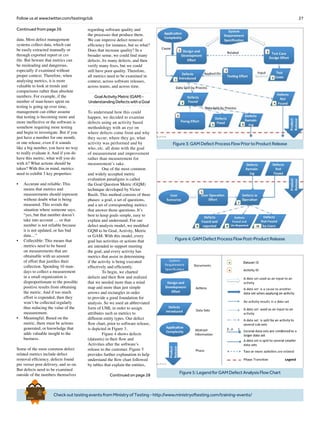
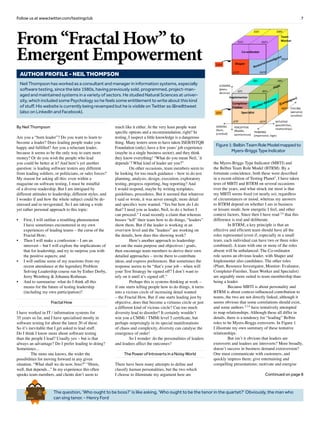
roles to be Myers-Briggs extroverts. In Figure 1
I illustrate my own summary of these tentative
relationships.
	 But isn’t it obvious that leaders are
extroverts and leadees are introverts? More broadly,
doesn’t success in business demand extraversion?
One must communicate with customers, and
quickly impress them; give entertaining and
compelling presentations; motivate and energise
Continued on page 8
Neil Thompson has worked as a consultant and manager in information systems, especially
software testing, since the late 1980s, having previously sold, programmed, project-man-
aged and maintained systems in a variety of sectors. He studied Natural Sciences at univer-
sity, which included some Psychology so he feels some entitlement to write about this kind
of stuff. His website is currently being revamped but he is visible on Twitter as @neilttweet
(also on LinkedIn and Facebook).
AUTHOR PROFILE - Neil thompson
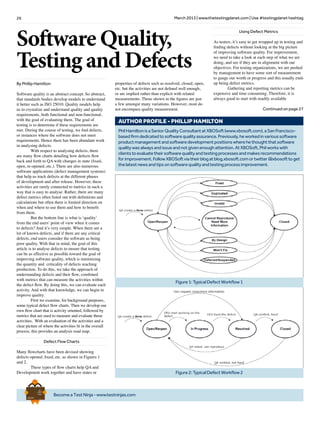
Figure1:BelbinTeamRoleModelmappedto
Myers-BriggsTypeIndicator
8 March 2013 | www.thetestingplanet.com | Use #testingplanet hashtag
Continued from page 7
one’s team. An introvert can tell the team what to
do, but to show them, to help them over obstacles
day-by-day, hour-by-hour, minute-by-minute, needs
an aptitude and appetite for human interaction.
No, it isn’t that obvious, and it should not be seen
as such.
	 In a recent book 5
Susan Cain (a self-
declared introvert) analyses critically the rise of the
extravert in the modern world, but particularly in
the business culture of the USA and its followers.
Some other cultures value introversion more, and
this might help to explain the rise to global success
of some Asian business cultures. There is some
evidence that introverts make better problem-
solvers – and better leaders in some situations. But
in other situations, for more traditional types of
leadership (especially “command-and-control”), the
extrovert is king (or queen). Working environments
have changed over recent years to favour extroverts
(e.g. open plan offices), although there are now
some moves towards more flexible arrangements.
The most obvious response for an introverted
leader, and one which several authors have
recommended, is for the introvert merely to behave
like an extrovert. But this involves the person
operating for most of the business week outside his/
her comfort zone, leading to lots of stress. There
are however other ways for introverts to maximise
their leadership potential (for example, managing
/ overcoming fear of public speaking, forming
powerful partnerships with extrovert “front men/
women”, using the internet as a primary mechanism
for influencing others).
	 So, one of my objectives as an introvert is
to improve the signal-to-noise ratio in testing, the
business world and society as a whole (depending
on how far I can influence!). Winning friends and
influencing people, insisting that all problems
are solved in group situations, equating creativity
with verbosity, “groupthink” conformity, style
over substance... these trends have become
too pervasive, and are arguably a hindrance to
innovation.
Problem-Solving Leadership?
A couple of years ago I attended the Problem
Solving Leadership course, run in the USA by the
revered Derby-Rothman-Weinberg team.
	 One of PSL’s many strengths is that it
asks each attender to do some formal preparation,
including mapping out personal objectives for
the course – both for his/her benefit and for the
information of the facilitators. Although obviously
much of this is personal, I am willing to share
here that I wondered what kind of a leader I really
wanted to be best at, or to do most of – my project
management days are probably over, but I often
work as a programme or project test manager,
and for fun I write presentations and papers
for conferences. I enjoy much less the public-
speaking part of delivering the presentations, but
it seems a price worth paying for claiming to be
a “thought leader” (and for sometimes getting a
free conference ticket). Although my personality
is more suited to process improvement and
I am more afraid of an army of 100 sheep led by a lion than an army of 100 lions led by a sheep. - Talleyrand
Brief
HistorY
OF
Time
a
FrenchEdition
similar consultancy work, I typically alternate
such engagements with delivery-focussed project
assignments, which I find helps maintain all-round
credibility!
	 A large part of PSL consists of
“experiential” exercises, conducted in various
groupings of the attenders, and involving some
role-play. Some people choose to stay within their
comfort zones, while others deliberately (or maybe
accidentally) experiment with what happens when
one goes outside the usual boundaries.
	 Of course Jerry Weinberg has written many
books, and one in particular 6
closely covers this
subject. Although it was written over 25 years ago,
Jerry’s view remains that problems in our industry
are much more human than technical. Two points he
particularly emphasised back then: people can and
should contribute as “leaders” without necessarily
being labelled as such by a job title in a threat-
reward culture; and academic psychology seems
irritatingly (surprisingly?) dogmatic.
	 Since taking the course I have pursued
several lines of further enquiry:
•	 In my own presentation “Testing as Value Flow
Management: Organise your toolbox...” 7
I
explained how use of psychological models
should be treated as a scientific hypotheses and
experiments (not dogma);
•	 Steve Myers 8
distinguishes eight leadership
styles (ideological, theorist, visionary, goal-
oriented, change-oriented, executive, action-
oriented and participative), suggests alignments
to MBTI, and considers their variable
suitabilities and tailoring to different contexts
such as computing, engineering, academia,
research, project management, administration,
accountancy, education, human resources,
entrepreneurship, marketing and sales (all of
which I could argue have some relevance to
software testing);
•	 Susan Cain’s book explores the ways introverts
have contributed to leadership in history,
currently contribute, and could lead better in
future (introversion aligns to Steve Myers’
ideological, theorist, visionary, goal-oriented
leadership styles).
Cain makes several assertions, backed up by
selected evidence and stories:
•	 Many introverts started life as “high-reactive”
babies – very sensitive to adverse stimuli and
conditions, but conversely capable of great
things when appropriately nurtured (the orchid
hypothesis);
•	 Introversion persists into adulthood but people
can learn ways to manage the symptoms and
turn the situation to their advantage (as outlined
in the previous section);
•	 The results achieved by introverted leaders are
often in excess of others perception of their
success – in other words, there exists cultural
bias against introverted leaders;
•	 People can learn and manage to operate outside
their comfort zone for periods of time and
under specific conditions, particularly when
they understand the factors and forces involved
– an “elastic” model of personality.
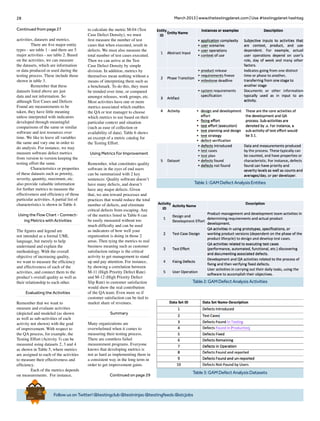
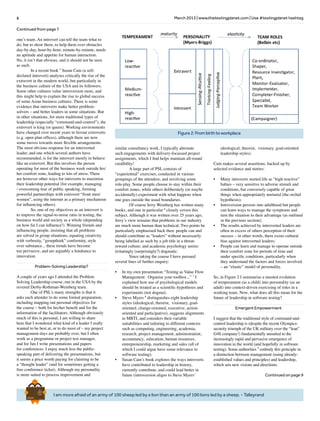
So, in Figure 2 I summarise a mooted evolution
of temperament (as a child) into personality (as an
adult) into context-driven exercising of roles in a
working team. Now, what does all this mean for the
future of leadership in software testing?
Emergent Empowerment
I suggest that the traditional style of command-and-
control leadership is (despite the recent Olympics-
security triumph of the UK military over the “lean”
G4S company!) fundamentally unsuited to the
increasingly rapid and pervasive emergence of
innovation in the world (and hopefully in software
testing). Some authorities 9
embody this principle in
a distinction between management (using already-
established values and principles) and leadership,
which sets new visions and directions.
Continued on page 9
Figure2:Frombirthtoworkplace
9Follow us at www.twitter.com/testingclub
Continued from page 8
In Susan Cain’s book 5, she quotes some new
research by Adam Grant, which offers evidence that:
•	 Extravert leaders enhance performance when
employees are passive; but
•	 Introvert leaders are more effective with
proactive employees.
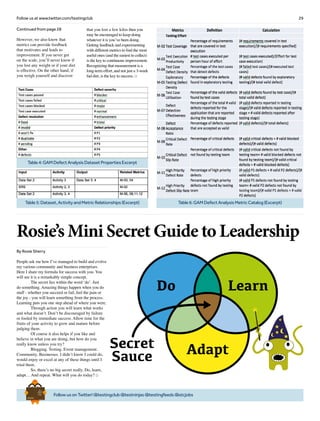
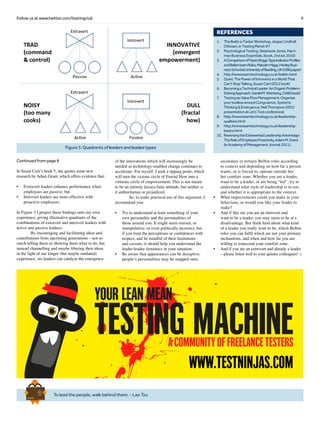
In Figure 3 I project these findings onto my own
experience, giving illustrative quadrants of the
combinations of extravert and introvert leaders with
active and passive leadees.
	 By encouraging and facilitating ideas and
contributions from upcoming generations – not so
much telling them or showing them what to do, but
instead channelling and maybe filtering their ideas
in the light of our longer (but maybe outdated)
experience, we leaders can catalyse the emergence
of the innovations which will increasingly be
needed as technology-enabled change continues to
accelerate. For myself, I seek a tipping point, which
will turn the vicious circle of Fractal How into a
virtuous circle of empowerment. This is not meant
to be an entirely laissez-faire attitude, but neither is
it authoritarian or prejudiced.
	 So, to make practical use of this argument, I
recommend you:
•	 Try to understand at least something of your
own personality and the personalities of
those around you. It might seem sinister, or
manipulative, or even politically incorrect, but
if you treat the perceptions or confidences with
respect, and be mindful of their limitations
and caveats, it should help you understand the
leader-leadee dynamics in your situation.
•	 Be aware that appearances can be deceptive:
people’s personalities may be mapped onto
secondary or tertiary Belbin roles according
to context and depending on how far a person
wants, or is forced to, operate outside his/
her comfort zone. Whether you are a leader,
want to be a leader, or are being “led”, try to
understand what style of leadership is in use,
and whether it is appropriate to the context.
•	 What improvements could you make in your
behaviour, or would you like your leader to
make?
•	 And if like me you are an introvert and
want to be a leader, you may seem to be at a
disadvantage. But think hard about what kind
of a leader you really want to be, which Belbin
roles you can fulfil which are not your primary
inclinations, and when and how far you are
willing to transcend your comfort zone.
•	 And if you are an extrovert and already a leader
– please listen well to your quieter colleagues! □
To lead the people, walk behind them. - Lao Tzu
Brief
HistorY
OF
Time
a
FrenchEdition
REFERENCES
1.	 TheBuild-a-TesterWorkshop,JesperLindholt
Ottosen,inTestingPlanet#7
2.	 PsychologicalTesting,StephanieJones,Harri-
manBusinessEssentials,(book,2nded.2010)
3.	 AComparisonofMyersBriggsTypeIndicatorProfiles
andBelbinteamRoles,MalcolmHiggs,HenleyBusi-
nessSchoolatUniversityofReading,UK(1996paper)
4.	 http://www.teamtechnology.co.uk/belbin.html
5.	 Quiet:ThePowerofIntrovertsinaWorldThat
Can’tStopTalking,SusanCain(2012book)
6.	 BecomingaTechnicalLeader:AnOrganicProblem-
SolvingApproach,GeraldM.Weinberg,(1986book)
7.	 TestingasValueFlowManagement:Organise
yourtoolboxaroundCongruence,Systems
Thinking&Emergence,NeilThompson(2012
presentationatLet’sTestconference)
8.	 http://www.teamtechnology.co.uk/leadership-
qualities.html
9.	 http://www.teamtechnology.co.uk/leadership-
basics.html
10.	 ReversingtheExtravertedLeadershipAdvantage:
TheRoleofEmployeeProactivity,AdamM.Grant
(inAcademyofManagementJournal,2011).
Figure3:Quadrantsofleadersandleadeetypes
www.testninjas.com
10 March 2013 | www.thetestingplanet.com | Use #testingplanet hashtag
A real leader faces the music, even when he doesn’t like the tune. - Anonymous
Brief
HistorY
OF
Time
a
FrenchEdition
It Takes a Village: Training, Leading,
and Inspiring a Young Testing Team
DevonTooleyisaSoftwareProductConsultantforSiemensPLMSoftwareandanMBAstudent
atSUNYITwithafocusinTechnologyManagement.Previousworkexperienceincludestesting
softwareforSunMicrosystemsaswellassettingupandleadingtheSQAteamatAgoraGames/
MLG.ShereceivedherbachelorsfromtheUniversityofWashingtoninSeattle.Inhersparetime,
shewritesEverydayQA.com(http://www.everydayqa.com/).Devoniscurrentlylivingandwork-
inginNewYork.
AUTHOR PROFILE - DEVON TOOLEY
By Devon Tooley
Four years ago I was tasked with setting up a QA
team at a small firm in New York. The company
was young, with enthusiastic developers and
dedicated project managers. In skinny jeans and
t-shirts (and the occasional mohawk), they had
experimented with programming languages,
development methodologies, and open workspaces
filled with beanbag chairs and whiteboard walls.
More San Francisco than Big Apple, they cultivated
a flexible and optimistic vibe populated with
talented, successful employees. The one thing that
had not fully taken root was a solid QA department.
That was my job.
	 I needed to grow an effective QA team that
fit in with the current development process. This
meant training new hires to be as good at identifying
bugs as they were at dreaming up better ways to hunt
for them, and developing a QA culture that jived
with the other passionate and engaged groups of the
company.
	 The lack of a “why?” was the biggest plague
to traditional training programs I tried in the past.
New-hires were inundated with information but not
yet sure how to put it together. This was especially
apparent because most new team members were also
new to testing. The problem was that on a busy team
we needed people to ramp up quickly.
	 With my first hires there was no formal
training. We limped along with documentation
and job shadowing, but the results were not
great. I had one member with a computer science
background who saw this job as a stepping-stone
to a future development job. Another stumbled on
small tasks because the details got lost without the
bigger picture.
	 I knew something had to change to get
the strong cohesive team I envisioned. What was
missing? Ability? No - everyone was more than
qualified. Culture? Doubtful – we had a relaxed,
and supportive working environment. It was
something less tangible than experience or relational
shortcomings. The newest members, many of whom
were in their first real job, simply lacked the vision
to see their role in context of the whole. I set about
trying to provide that big picture for them.
	 I had new hires help developers with unit
tests and sit with more experienced testers while
debugging. They even went over documentation
with project managers. They were treated like more
senior employees – responsible for their section of
the code, although they started with a smaller set of
functionality – and they had an opportunity to soak
up experience from all aspects of the team. I let them
see their role at the start of the project, and feel their
role at the end when test-escapes came back. I tried
to constantly provide ways for them to expand their
impact to all parts of the development cycle.
	 What results did I see? A better
understanding of what they needed to do led to more
initiative on their part. Giving them responsibility
encouraged them to seek even more responsibility.
But the most surprising thing, which I noticed almost
without exception, was passion. When they saw the
“why” of what they were doing – the effects their
work had upon the entire company, the QA function
became not just about the result, but also the process.
I saw computer science students become excited
about testing because they understood that technical
ability could be applied to their tests; humanities
majors dug into the requirements to see how all the
functional components fit together. They saw the
impact they could make, and their passion awoke.
	 There are few better places to develop
passion for your work than in a start-up, but I
believe the methods could be the same no matter
the company size. I was able to see who was good
at what, and assign projects that matched their
strengths. However, this was not always a fool-proof
system.
	 I recall one new tester in particular who
never moved beyond the wall, failing to get involved,
and eventually moved on. Despite the stumbling
blocks, the majority of people made progress. I
gave one new-recruit the ownership of a project and
watched with suspicion as he fumbled, fudged, and
failed to engage. I knew I could not let the project
fail but, at the same time, I needed him to step up.
	 I had him schedule a meeting to present
his test plan and progress to the developers. I was
worried and asked for progress reports and continued
to struggle with conveying the importance of his
work. The meeting rolled around and I was tempted
to intervene and prepare something myself, but I
held back: knowing that this internal deadline might
be my only chance to turn things around before the
external deadline. He came in, as I feared, totally
unprepared. The developers asked questions, raised
concerns, made suggestions, and left disappointed. I
met with him afterwards to go over expectations and
debrief. I saw something change in him. He wanted
to get his test plan in place; not because it was a job
task, but because he saw the direct consequences of
inaction. He felt personally responsible for correcting
the weakness of his tests. His whole approach was
transformed. Suddenly he asked questions, dug in,
and worked hard to hold up his end of the project.
The product launched successfully.
	 A later new-hire also benefited from this
integrated method. He came in as a freshly minted
computer science major that felt he needed some
experience before jumping out of testing and into full
development. Without much background in the field,
he was not initially excited about his new role. Like
the others, I let him get to know the team and see the
depth to which testing could be taken. He took to
automated testing right away, particularly enjoying
the ability to code integrated tests. Soon he started
asking questions about our test harness – the system
we used to track, run, and monitor our automation.
He started looking at ways we could run tests more
efficiently and integrate with some great open source
software options. Over time, he became a contributor
to open-source testing code for a variety of projects.
He and I went to a conference to present on our test
infrastructure. The team was soon using his solution
full-time. He has gone on to take more advanced jobs
in QA and still works in the field.
	 Passion isn’t developed because of beanbag
chairs and white board walls, but because of the
environment a company fosters. If testing is to be
an integrated effort, training should include all team
members as early as possible. Each tester may have
an area of interest or a special skill, and a “cookie
cutter” ramp up approach might train them on process
but does little to inspire. Those of us who love testing
know that it is passion for the intricacy of the job that
makes it rewarding, challenging, and worthwhile.
	 Testing is often lumped together as part of
developer tasks, but an engaged test team can help
guide a project and keep the whole team striving for
quality. Growing an engaged test team takes engaged
co-workers to help QA engineers – at all stages of
their career – find passion in testing.
	 It takes a group effort to make great
software, and it takes a village to raise new testers. □
11Follow us at www.twitter.com/testingclub
Teachers, Children,
Testers and Leaders
By James Christie
“A tester is someone who knows things can be
different” – Gerald Weinberg
	 Leaders aren’t necessarily people who
do things, or order other people about. To me the
important thing about leaders is that they enable
other people to do better, whether by inspiration, by
example or just by telling them how things can be
different – and better. The difference between a leader
and a manager is like the difference between a great
teacher and, well, the driver of the school bus. Both
take children places, but a teacher can take children on
a journey that will transform their whole life.
	 My first year or so in working life after
I left university was spent in a fog of confusion.
I struggled to make sense of the way companies
worked; I must be more stupid than I’d always
thought! All these people were charging around,
briskly getting stuff done, making money and
keeping the world turning; they understood what
they were doing and what was going on. They must
be smarter than me.
	 Gradually it dawned on me that very many
of them hadn’t a clue. They were no wiser than me.
They didn’t really know what was going on either.
They thought they did. They had their heads down,
working hard, convinced they were contributing to
company profits, or at least keeping the losses down.
	 The trouble was their efforts often
didn’t have much to do with the objectives of the
organisation, or the true goals of the users and the
project in the case of IT. Being busy was confused
with being useful. Few people were capable of sitting
back, looking at what was going on and seeing what
was valuable as opposed to mere work creation.
	 I saw endless cases of poor work, sloppy
service and misplaced focus. I became convinced
that we were all working hard doing unnecessary,
and even harmful, things for users who quite rightly
were distinctly ungrateful.
	 It wasn’t a case of the end justifying the
means; it was almost the reverse. The means were
only loosely connected to the ends, and we were
focussing obsessively on the means without realising
that our efforts were doing little to help us achieve
our ends.
	 Formal processes didn’t provide a clear route
to our goal. Following the process had become the
goal itself. I’m not arguing against processes; just the
attitude we often bring to them, confusing the process
with the destination, the map with the territory.
	 The quote from Gerald Weinberg absolutely
nails the right attitude for testers to bring to their
work. There are twin meanings. Testers should know
there is a difference between what people expect, or
assume, and what really is. They should also know
that there is a difference between what is, and what
could be.
	 Testers usually focus on the first sort of
difference; seeing the product for what it really is
and comparing that to what the users and developers
expected. However, the second sort of difference
should follow on naturally. What could the product
be? What could we be doing better?
	 Testers have to tell a story, to communicate
not just the reality to the stakeholders, but also a
glimpse of what could be. Organisations need people
who can bring clear headed thinking to confusion,
standing up and pointing out that something is
wrong, that people are charging around doing the
wrong things, that things could be better.
	 Good testers are well-suited by instinct
to seeing what positive changes are possible.
Communicating these possibilities, dispelling the
fog, shining a light on things that others would
prefer to remain in darkness; these are all things that
testers can and should do. And that too is a form of
leadership, every bit as much as standing up in front
of the troops and giving a rousing speech.
	 In Hans Christian’s Andersen’s story, the
Emperor’s New Clothes, who showed a glimpse
of leadership? Not the emperor, not his courtiers;
it was the young boy who called out the truth,
that the Emperor was wearing no clothes at all. If
testers are not prepared to tell it like it is, to explain
why things are different from what others are
pretending, to explain how they could be better then
we diminish and demean our profession. Leaders
do not have to be all-powerful figures. They can be
anyone who makes a difference; teachers, children.
Or even testers. □
JamesChristieisasoftwaretestingconsultantbasedinPerth,Scotland.Hiswebsiteishttp://
clarotesting.com/andblogishttp://clarotesting.wordpress.com/.Hecanalsobefollowedon
Twitter,@james_christie.With27yearscommercialITexperience,inadditiontotestinghehas
workedininformationsecuritymanagement,projectmanagement,ITaudit,systemsanalysis
andprogramming.Thisexperiencehasbeenlargelyinfinancialservices,buthascoveredawide
rangeofclients,throughouttheUK,andalsoinFinland.
AUTHOR PROFILE - James Christie
FollowusonTwitter!@testingclub@testninjas@testingfeeds@stcjobs
Brief
HistorY
OF
Time
a
FrenchEdition
WWW.MINISTRYOFTESTING.COM
CO-CREATING
SMARTER TESTERS
EDUCATION • COLLABORATION
EVENTS
12 March 2013 | www.thetestingplanet.com | Use #testingplanet hashtag
Becomingaleaderissynonymouswithbecomingyourself.Itispreciselythatsimple,anditisalsothatdifficult.-WarrenBennis
Brief
HistorY
OF
Time
a
FrenchEdition
So You
Want
to be a
Leader,
Huh?
By Bill Matthews
“If we call a tail a leg, how many legs does a dog
have? Four! Calling a tail a leg doesn’t make it a
leg” - Abraham Lincoln
	 The above quote is one that comes to mind
when I meet people with the word Leader in their
job title or worst still they are a self proclaimed
Thought Leader or Industry Leader. Culturally we
think of leaders as being the person in charge so
having the word leader or manager in your job title
is one kind of leader. However there is another
perspective we can take where a leader is someone
who takes actions that resonates with others such
that they recognise you as a leader.
	 In this sense, being a manager or having the
word leader in your title is not a pre-requisite to being
seen as a leader; anyone can be a leader. To be seen as
a leader you need to take a conscious decision to take
the lead at times that need leadership.
	 Whether you aspire to be a leader at work
or in the testing community or both it all starts with
taking action. However it’s not about taking any
action or taking action all the time; instead you
have to choose when action is actually needed and
how best to lead that change. It’s a subtle art and
timing is often the difference between being viewed
as a leader or a meddler. Here are some ideas to
help you get started on the road to leadership.
Be a Problem Solver
Solving problems is a hallmark of leaders across all
contexts; however it is not about solving any problem,
only those that are important for people who are
important to you. You can solve as many problems as
you want but if no one cares about the problem then
you are unlikely to be perceived a leader.
	 Problems occur when people have a
reaction to an actual or potential event; if those
people are important to you, you should consider it
to be an important problem regardless of whether
you perceive it to be a problem. Remember, being a
leader is a relationship between you and others that
is determined by your actions.
	 Developing the ability to observe a
situation, formulate and communicate a plan and
then delivering that plan is a key to being a leader.
How do you know if you’ve solved a problem?
Well you solve a problem when those that are
important to you no longer perceive the event as
being a problem. In reality you are not changing
the event, only the perception and reactions to that
event. Not convinced? Consider:
•	 If the event has already occurred and you are
dealing with the aftermath you can’t change the
event but you can change how others perceive the
consequences of the event. The actions we take to
reduce the immediate and potential consequences,
and to reduce the likelihood the problem will occur
again in the future, all strive towards ensuring the
event is no longer perceived as a problem.
•	 If the event has not yet happened, it may never
happen even if you don’t take action, but by
taking action to minimise the chances of this
event happening then you are changing people’s
perception of that potential event so it is no
longer perceived as a problem.
The challenge with solving problems is that, just
because we have solved the problem for one group,
it might still be a problem for others. Additionally
your actions might introduce or uncover further
problems for those that matter.
Be a Problem Finder
Being a problem solver is important but can lead to the
development of a Hero Culture where problems are
left until they become BIG PROBLEMS and the Hero
arrives to save the day. It’s one way to solve problems,
but constant fire-fighting isn’t really leadership.
	 One idea is to be alert for signs of potential
problems and proactively act to resolve them before
they become actual or even worse, big problems.
However this is a difficult and subtle art because we
cannot predict how a potential problem will develop:
•	 Some are just illusions.
•	 Some will not grow into anything significant.
•	 Some will develop into something beneficial.
•	 Some will become problems that few people
care about.
•	 Some will become significant problems.
Leaders should focus on identifying those potential
problems that are likely to become significant
problems for the people that matter. If you spot
such a potential problem you may sometimes be
in a position to take action directly. At other times
however you might need to consult with others to
decide how best to avoid the potential problem.
Leaders need to be able to consider each situation
on its own merit and decide how best to take action
and indeed whether to take any action at all.
Accept Failure
Sometimes as a leader your actions will not have
the effect you expected and you will feel like you
have failed; dealing with the consequences of
failure is part of leadership.
	 The first step is to take responsibility for
your actions – leadership is a choice and if you
choose to lead then you need to be prepared to take
personal responsibility for your actions whether you
are personally accountable for them or not.
	 The second step is to learn from the
situation; asking yourself (or others) questions such
as the following are helpful:
•	 How do you know it was a failure?
•	 What have been the consequences, both
positive and negative?
•	 Were there specific signals that you missed or
ignored that might have changed your actions?
•	 In hindsight, could you have acted differently?
The last step to accepting failure is quite simply to
move on; nothing you can do now will change what
has already happened but the actions you take next
can change what might happen in the future.
Become a Student of People and Communication
Warren G Bennis, a pioneer in the field of
leadership studies, said “the basis of leadership is
the capacity of the leader to change the mind-set,
the framework of the other.” People are at the heart
Continued on page 13
team
leader
13Follow us at www.twitter.com/testingclub
Themanwhosmileswhenthingsgowronghasthoughtofsomeonetoblameiton.-RobertBloch
Brief
HistorY
OF
Time
a
FrenchEdition
Bill Matthews has been a professional tester for 18 years and is the owner and principal test
consultant at www.TargetTesting.co.uk; most of his time is spent consulting and leading
the delivering testing projects for companies with particular focus on the more technical
elements of testing such as systems integration, security and performance. He has start-
ed blogging at www.rethink-testing.co.uk
AUTHOR PROFILE - BILL MATTHEWS
Continued from page 12
of leadership and to be a good leader you
must become a student of people and how to
communicate effectively with them.
The challenge with people is that while there
are similarities there are also differences; these
mean that they don’t all respond in the same way
to the same motivations and stimulus. To further
complicate matters, people will often respond
differently in different contexts.
	 A good leader should recognise these
differences and similarities and adapt to the
people and context. A leader who can’t adapt
may find success in certain contexts with certain
types of people but seem ineffective in others. As
Bernard Baruch said “If all you have is a hammer,
everything looks like a nail.” So:
•	 Develop your rapport and empathy skills – if
you can’t engage or empathise with others then
leading will be difficult and probably limited to
specific contexts.
•	 Learn to be flexible in your style of
communication - practice or role-play
communicating with different levels of
formality, authority, softness. Learn to match
your style to the people and the context.
•	 Learn to be flexible in your use of language –
language is based on shared experience so consider
that the language you may be using is part of the
problem. This can come in many ways, overuse of
clichés, technical jargon or even sticking to specific
definitions of words. Be prepared to accept the
shared experience of others rather than force them
to accept yours; but also be prepared to expand
their shared experience to include yours.
•	 Be flexible in your thoughts – it’s easy to be caught
up with your own ideas and plans and ignore or
dismiss those put forward by others. Learn to accept
that someone else might have a better idea; being a
leader is not about delivering only your ideas.
Observe Other Leaders at Work
There is no single model of a leader; sure there are
many books on leadership that identify specific
characteristics, skills, processes and attitudes but
these are just the symptoms of leadership not the
leader themselves. A good way to understand a leader
and leadership is to observe them or it in action. The
intention here is not to imitate or emulate another
leader only to understand how leadership works.
	 Think of someone you consider as a leader;
what is it that they do that makes you regard them
as a leader? At what point did you begin to regard
them as a leader? How do their actions impact you?
Do you think you have changed as a result of that
leader, if so how and in what way? Is there anything
about them that you don’t like? Are they perceived
as a leader by others? How do they differ from
others you perceive as leaders?
	 Observing from afar is a good start but
why not reach out to your leaders and ask them for
advice and guidance? Many leaders I’ve known are
very generous with their time and knowledge.
Be Yourself
It’s a common misconception that you need to
be popular or well liked to be a leader but this is
not the case. A more likely scenario is that people
become popular because they are leaders.
	 A number of the people I perceive as leaders
have qualities that, in different contexts, would
prevent them from being popular or even liked;
many are grouchy, cantankerous, argumentative or
just plain rude. By the same token, many are open,
warm, friendly and generous. These characteristics
are not what make them a leader; it is their actions
and how these resonate with others that make them a
leader. It’s true however that some characteristics can
make their leadership easier to see or accept but the
presence or absence of these does not mean they are
not leaders.
	 So an important point about being a leader
is to be yourself and accept who you are. Learn
from others but don’t try to imitate them since
what works for them may not work for you. When
talking about martial arts, Bruce Lee said “Absorb
what is useful, reject what is not, add what is
specifically your own”; this is very apt for your
development as a leader.
	 One last point, the actions you take must be
congruent with who you are, your beliefs, values and
ethics. Without this you will lack the passion and
conviction needed to be a good leader and this will
be evident to those you are hoping to lead. Action
without congruence is not the path of a leader. □
NEWSIN
BRIEF
AnnouncingAppiumon
Sauce:Native&HybridiOS
AppTestingintheCloud
SauceLabreleases AppiumonSauce,
anewwaytoautomaticallytestyour
nativeandmobilewebhybridiOSapps
inthecloud.
http://bit.ly/saucelabsappium 
a community for software testers
WWW.SOFTWARETESTINGCLUB.COM
14 March 2013 | www.thetestingplanet.com | Use #testingplanet hashtag
Whentroublearisesandthingslookbad,thereisalwaysoneindividualwhoperceivesasolutionandiswillingtotakecommand.
Veryoften,thatpersoniscrazy.-DaveBarry
Brief
HistorY
OF
Time
a
FrenchEdition
Trent Peterson is a founder at AppThwack, a company focused
on making app testing fast, painless, and easy via automated
testing on real devices. Prior to AppThwack, Trent spent seven
years leading the design, development, and deployment of
the automation framework used for testing all of Intel’s wire-
less products. Trent has a B.S. in Software Engineering from
Oregon Institute of Technology and studied data mining and
visualization at Stanford. Besides automated testing, he enjoys
running, playing guitar, and drawing pictures.
AUTHOR PROFILE - TRENT PETERSON
So you guys started AppThwack about a
year ago. Can you tell us a bit more about
the early days?
Q1.
What were you both doing before you
founded AppThwack?
Q2.
We started with the same basic problem AppThwack
addresses today: Allow developers and QA teams
to quickly test apps on real, physical devices. In the
beginning, early development was on completely
emulated devices. We received a couple of old,
broken phones from a friend and those were the first
real devices we used, tethered to the same laptop that
ran AppThwack, the database, and our automation
platform. Our earliest demos to potential investors
and customers were on that setup.
Pawel and I both worked at Intel for nine and
seven years respectively. During that time we led
the design, development, and deployment of the
automation framework used to test all of Intel’s
wireless products (Wi-Fi, WiMAX, Bluetooth, etc.).
Whatmadeyoudecidetostartyourown
thing?
Q3.
At Intel, we had taken a product from the early
conceptual stages to widespread distribution,
effectively working as a small company-within-a-
company. For a long time we had kicked around
various business ideas, and in the beginning of 2012
we were ready for a new challenge and became
aware of the complexities of mobile testing. All
of those years working with large-scale system
automation and testing gave us an interesting
perspective to a popular problem, so we jumped
ship to work on mobile testing and QA, starting
with Android fragmentation.
Yoursolutionsoundsawesome.Canyou
tellussomemoreabouthowitallworks?
Q4.
We maintain an ever-growing collection of phones,
tablets, and other devices in our lab. Developers
and QA teams upload their apps to our site and we
automatically test it in parallel on their selected
devices very quickly. In 5-10 minutes we install,
launch, explore, stress, and uninstall a given app,
gathering screenshots, performance data, and low-
level logs along the way. A report is generated in real
time that makes solving issues and analysing the data
easy. AppThwack can also run custom scripts using
a handful of popular frameworks like Robotium and
Calabash, so as a developer’s testing becomes more
sophisticated we can easily accommodate it.
	 All of the devices are controlled over USB
and sit on a Wi-Fi connection so apps can interact with
the outside world. The backend of AppThwack is a
distributed automation platform we developed using
our knowledge of large-scale system automation. This
has allowed us to grow extremely fast and spread
beyond just native Android tests. We now support
testing responsive web designs in actual browsers on
real phones, and iOS support is coming soon.
Whatwerethemainchallengesyoufaced
technically?
Q5.
Development was surprisingly smooth and scaling
has been straightforward as well. Most of our
up-front time was spent building the automation
platform AppThwack uses. Our background
in system automation and building large-scale
automation platforms definitely helped us avoid
some common issues and pitfalls.
Whatdoyouthinkthefutureholdsin
respectofmobiletesting?Doyouseeany
majorchangesonthehorizon?
Q6.
I think the line between “mobile” testing and
software testing in general will continue to blur.
Phones, tablets, televisions, cars, laptops, desktops,
and on and on - there’s an expectation that our
digital experiences will span all of these in one way
or another, and a testing strategy and tool-set for
each simply doesn’t scale. Tools and methodologies
will mature to ensure our increasingly complex
world works the way we expect and the way
developers intend.
Continued on page 15
“...the line between “mobile” testing and soft-
ware testing in general will continue to blur”
15Follow us at www.twitter.com/testingclub
Youdonotleadbyhittingpeopleoverthehead-that’sassault,notleadership.-DwightEisenhower
Brief
HistorY
OF
Time
a
FrenchEdition
Whatkindofchallengesareyoufacingnow?
Q7.
Our challenges are largely business-related, and
run-of-the-mill young company issues. Things like
who and when to hire, how much to charge for
our product, and how to get in front of the right
developers and QA organizations. On the technical
side it’s just prioritizing new features. We have way
more ideas than we have time to implement them,
and we’re extremely picky about what we decide to
work on. Our service is extremely powerful but also
really simple to use; it’s a constant struggle to keep
that balance.
Yourwebsitehasaverydistinctdesign/
logo.Whoseideawasthatandwhatwas
theinspirationbehindit?
Q8.
We were part of PIE (Portland Incubator
Experiment), an accelerator run by
Wieden+Kennedy, from July-October. We were
lucky to work with a great team at W+K on the
branding. We wanted to accomplish two things.
First, we make a boring, painful, and complicated
task easier and fun and the branding should reflect
that, and second, we’re not like every other QA,
automation, or run-of-the-mill technology company
so our branding should differentiate us.
Anyotherwordsforbuddingtestinglead-
ers/entrepreneursoutthere?
Q9.
Testing is a science and should be treated as such.
It’s very easy to get sloppy and test without regard
to the environment, or, even worse, working
chance into an official part of the test process.
By all means, include randomized testing if you
so wish, but it pains me to see “random” as the
foundation for a test plan. Also, I’m biased, but
work testing and automation into development. The
most successful test teams I’ve seen were almost
indistinguishable from the development team.
	 For entrepreneurs, trust your judgement
when it comes to your product. If you think
it’s great and useful, chances are it is. Listen to
feedback and suggestions, but at the end of the day
if you feel differently don’t be afraid to say “no.”
Also, people always say to release early and release
often. I can tell you it’s much easier said than done,
but you should definitely strive for it. Lastly, start
experimenting with pricing as soon as possible.
We started playing with pricing models before we
were entirely comfortable with taking money for
our product, but it turns out we could have had
happily paying customers much earlier, and, more
importantly, learned much earlier what works and
what doesn’t. □
Continued from page 14
TESTING
TIPS
Need to know what browsers are being
used? Stats Counter is a very useful tool
that shows you, in bar chart or line graph
format, the most popular browsers,
operating systems, search engines,
screen resolutions and social media
sites. You can view stats globally or select
stats by a region/country to see how it
affects where you are. A great source of
information that goes back to early 2008.
Findoutmoreathttp://gs.statcounter.com
----------------------------------------
WorkingwithAndroid?Keepaneyeon
whichversionsarebeingusedbycustomers
themost.http://developer.android.com/
about/dashboards/index.html
---------------------------------------
Translating your whiteboard into Visio
diagrams can be a time consuming task.
If you are only creating them to share a
daily update or a one-time visual aid, stop
doing it! Save tons of time and effort; take
a photograph of the board instead. You
could snap it on your phone, email it to
yourself and then share it with others in
just 2 minutes. Easy!
---------------------------------------
Found a bug? Want to quickly add your
browser details to your defect? Give
‘Support Details’ a try. Just open a new
tab in your browser, pop in the link (add
it to your favourites for even speedier
access) and the page will instantly display
your browser, version, operating system,
IP address, screen resolution, browser
size, JavaScript status, cookies status,
colour depth and flash version. Oh, and
it lets you download this information
in a handy .csv or .pdf format for quick
attachment to your defects.
Findoutmoreathttp://supportdetails.com/
---------------------------------------
Does it pay to be promiscuous?
Promiscuous Pairing is an effective means
of knowledge transfer. While two people
are paired, they share knowledge. When
the pair splits for a promiscuous pair
swap, the knowledge then spreads to all
four participants. In this way, knowledge
will slowly but automatically spread
around the group.
Read more at http://tinyurl.com/bwjarme
---------------------------------------
Areyoujusteatingsandwichesonyour
lunch? Why not help your team learn
something new by organising a learning
lunch session? Take turns in your team
so that everyone has a chance to share
some knowledge and effectively grow
the team’s capability. Share some useful
SQL statements, discuss Session Based
Testing or even teach someone how
to build a computer. Get your thirst for
knowledge flowing and start one today!
Read more at http://goo.gl/ktZjZ
---------------------------------------
Too many emails? Not enough time
for testing? We can spend far too much
time checking our emails and this can
distract us from actually getting on. Try
separating your emails into 4 folders;
Inbox, Needs Reply, Follow Up and Trash.
Then use these tips to keep your inbox
from getting on top of you:
•	 If you can reply immediately do it!
•	 If the message needs a longer
response, or more information to get
before replying to it, put it in the Needs
Reply folder.
•	 Ifthemessagecontainsinformationyou
mayneedinthefollowinghours/days/
weeks,putitintheFollowUpfolder.
•	 If you have read it and don’t need it or it
just is of no relevance to you, delete it!
If you use a Mac you can even set up
smart folders, which will do this for you
automagically. Find out how at http://
goo.gl/cAFnK
Probably
Definitely
Not really
I don't know
Absolutely not
I believe there is a meaningful
difference between the concepts
of management and leadership.
351
51
17
12
9
Probably
Definitely
Not really
I don't know
Absolutely not
I believe it's necessary to have performed
the work of those you lead or manage,
in order to be an effective lead/manager.
164
128
124
7
17
Probably
Definitely
Not really
I don't know
Absolutely not
I believe I could carry out the
task of my immediate lead/manager
better than they can.
63
157
91
105
24
Please tell us if you
are Male or Female.
Male335
106 Female
Technical/programming
Exploratory testing
Analytical skills
Business/domain
Communication/personal
Strategy/Management
Other
197
159
325
235
406
325
77
What skills do you think are required
to be an influential and effective
software testing leader?
Technical/programming
Exploratory testing
Analytical skills
Business/domain
Communication/personal
Strategy/Management
Other
103
192
102
137
117
218
31
What skills would you like to receive
more training/coaching in?
At what stage of your career are you?
Junior
Mid-level
Senior
75
24
170
114
47
10
Manager
Head of
Other
Absolutely!
Mostly they do
I'm not sure
Not really
No way!
My manager/team/organisation
provides me with all the training and
support I need to excel in my role/career.
153
67
40
122
58
I use the internet/social media to network/
increase my skills/knowledge.
All the time!
Occasionally139
268 28
5
Rarely
Never!
I go to conferences/meetups to network/
increase my skills/knowledge.
All the time!
Occasionally185
73 120
62
Rarely
Never!
I get trained/coached elsewhere in order to
increase my skills/knowledge.
All the time!
Occasionally166
87 129
58
Rarely
Never!
I read industry magazines/papers to
increase my skills/knowledge.
All the time!
Occasionally194
184 45
17
Rarely
Never!
All
Most
Some
A little
None
Only outside of work
What proportion of your time, if any,
do you spend managing and/or leading?
140
61
137
70
30
2
What is you current employment status?
Employed
Contractor
Freelance
95
301
6
19
16
3
Independent
Between jobs
Other
Who has inspired/influenced your
testing career the most?
Hans Buwalda
James Bach
Cem Kaner
First test manager
Rex Black
Michael Bolton
Lisa Crispin
Gojko Adzic Pradeep Soundararajan
No onePrevious test manager
Markus Gärtner
James Whittaker
Bad developers
Testing Planet
Colleagues
18 March 2013 | www.thetestingplanet.com | Use #testingplanet hashtag
Beingpowerfulislikebeingalady.Ifyouhavetotellpeopleyouare,youaren’t!-MargaretThatcher
Brief
HistorY
OF
Time
a
FrenchEdition
ByAlanRichardson
When I read Sun Tzu’s TheArt of War, I tend to
relate it to testing. Particularly Chapter 13, The Use
of Spies. For those of you without TheArt of War
on your bookshelf, you can find a variety of online
translations1,2
.
	 In Chapter 13, of TheArt Of War, Sun Tzu lists
“foreknowledge” as one of the key elements that allows
enlightened rulers and good generals to achieve success.
Foreknowledge not from spirits, or spooky stuff.And
not from experience, or plans. Instead from observation
based knowledge of the enemy, gained by using spies.
	 The kind of things testers do. Looking at the
system, using the system, probing its weaknesses and
reporting back on its capabilities and flaws. Providing
information back to the project so that subsequent
decisions can use the observations as a basis, rather
than speculation.
	 Sun Tzu provides sage warnings on how to
deal with, and manage, spies. Which we as testers
take should pay attention to. For instance Sun Tzu
cautions against trusting the spies implicitly and
encourages questioning the scope and accuracy of their
observations.And then I watch “Burn Notice” on TV.
	 “You know spies; bunch of bitchy little girls” -
SamAxe, Burn Notice.
	 Sadly SamAxe’s statement resonates, because
sometimes it seems like a whole mass of testers acts as
the whiny, moaning, subservient person in the corner.
	 Sometimes I accidentally stumble on a LinkedIn
post that triggers a “just count to 10” moment, or a
“semantic pause”. These posts tend to involve someone
in a leadership or management position, who doesn’t
seem to know what to do, hasn’t taken any action, wants
everyone to do a ‘proper’process, and instead makes
catty statements about their position in the world.
	 I moan too, about things that aren’t working.
But I try to do it supported by evidence.And I take
action (within the limits that I can take it) to change the
things I can change. But I don’t expect everyone else
around me to change to fit my process. Take this lesson
from prison.
	 I didn’t learn this from direct experience.
I was reading the Gary Halbert “Boron Letters”.A
series of letters he wrote to his son Bond (see spies
get everywhere). He wrote the letters from prison to
distil some life experience and his ‘secrets of direct
The Evil Tester’s
Unconventional Influences
AlanRichardsonworkedhiswayupthroughtheranksoftheSoftwareTestingRolehierarchy,
fromTestertoHeadofTesting.Despitethishehasmaintainedhishands-ontechnicalskillsand
stillenjoystesting.Alancurrentlyworksasanindependentconsultant,helpingpeoplewithauto-
mation,strategy,andmanualexploratory&technicaltesting.Hehascreatedonlinetrainingfor
WebDriver,whichyoucanaccessviaUdemy.com,andwrotethebook“SeleniumSimplified”.He
blogsonAutomationatseleniumsimplified.comandontestingatblog.eviltester.com.Youcan
finddetailsofhisconferencetalksandpresentationsatcompendiumdev.co.uk
AUTHOR PROFILE - ALAN RICHARDSON
the
cartoon
corner
marketing’.And much as I want to relate Sun Tzu and
James Bond to the world of
Software Testing, sometimes I find the ‘nice old guy’in
the Boron Letters a good fit for a lot of the tester attitude
in the real world.
	 I’ll let Gary explain: “Defensive Behaviour
InvitesAggressiveAction! ... in life in general (and in
prison in particular) there is very little sympathy for a
weakling.” In the letters, Gary describes an old man who
in prison becomes overly obsequious, and irritatingly
fawning. “...I am a very non-violent person, and if this
guy... can irritate me, just think how some hard vicious
hard-nosed jerk in a real prison would be affected by
him...You see, this guy is sending out signals and those
signals are saying, ‘I’m scared... I’m Vulnerable’“
	 We don’t want to be that ‘nice old guy’on
the project. We learn from spies, certainly in the films
and books that I absorb, that because they work alone,
they develop a toughness. Using Gary Halbert’s words
“Rely on your own strength instead of somebody
else’s compassion!”
	 Spies become tough enough to allow
them to pass on hard information, work in stressful
circumstances, rely on their own decisions, know
when to take risks and back away. They can stand their
ground supported by observations on the ground.
	 And the last advice from Gary Halbert that
we can all take on board? “Big strong arms. Start
developing them right now. There are no drawbacks
and many benefits.” □
REFERENCES
1.	 http://www.sonshi.com/sun13.html
2.	 http://suntzusaid.com/book/13
19Follow us at www.twitter.com/testingclub
Lifeislikeadogsledteam.Ifyouain’ttheleaddog,thesceneryneverchanges.-LewisGrizzard
Brief
HistorY
OF
Time
a
FrenchEdition
S
ome people want to know how to be a good or even a great leader. Being a good leader is hard however,
so let us go down the opposite road - how to be the most terrible leader possible. I will give you ten
simple steps to becoming the worst leader you can be!
The
Habits of
a Highly
Ineffective
Leader
10
1
Tell everyone on your team they need to follow
certain procedures. If they’re not using the
system correctly, they’ll catch hell for it. You,
as their leader, don’t need to follow those,
however. You’re above them, anyway. If they
can’t figure out that you’re the exception to all
of the rules, you don’t need them.
EnforcePolicyforEveryone
ButYourself
2
Do your best at every turn to make your
subordinates extremely uncomfortable, ideally
to the point of crying. Get openly angry with
them, especially if they don’t follow those
policies and procedures they should be (see
Step One). If you don’t make at least one
employee cry per week, you’re not being
effective enough. Try harder! They need to get
it out, anyway - you’re offering a service here!
MakeYourSubordinatesCry
3 NeverReplytoEmails
Email is below you, after all. If they can come
into your secluded office, then they shouldn’t be
bothering with a silly email. Besides, if they don’t
come to you in person, you can’t make them cry.
Lure them to you by not answering their emails.
If they don’t respond to your emails, that’s a
different matter entirely (see Step One).
4 MakeThemdoalltheWork
If you have leaders below you asking for
help on personnel issues, it’s best to say “I
don’t know what to do” and stare at them
blankly. This will make them a better leader.
It’s like “whatever doesn’t kill you makes you
stronger;” only it’s really - “whatever I don’t
want to deal with, you get to do instead”.
	 You can also accomplish the task of
making others do your work by confusing them
with (non-) decisions. For instance, they say,
“I need you to decide what I should do for The
Smith Contract.” You respond, “Ok, but for
me to know what you should do for The Smith
Contract, I need to know what you will do for
The Smith Contract”.
	 This generally puts them in a state of
confusion such that you can walk away, and
the decision is now on them. If they don’t want
to disappoint you, they’ll do their work. You’ll
probably be disappointed anyway (see Step Six)...
5 BecomeInvisible
Offer an “open door policy” but don’t show up
in the office. “Work from home” for weeks at a
time, being available via email only (see Step
Three). You know you’ve done well when your
employees don’t recognize you once you’ve
decided to come back to the office. To be even
more effective, ensure the “working from
home” policy to allows only you that privilege
(see Step One).
6 ExpectTelepathy
Make huge decisions but don’t tell anyone,
and then yell at the team (after the deadline, of
course, or it won’t be effective) for not doing
what you decided. They should know what you
want. It was on a sheet of paper in your office
for weeks. It’s their own fault for not seeing it!
	 Also, shouldn’t they know what you
expect of them? It was in the job description 10
years ago when they sent in their resume, right?
	 Whiners, wanting your “expectations”
spelled out for them...
Continued on page 20
A
Dummy’s
Guide
to
Ineffective
Leadership
20 March 2013 | www.thetestingplanet.com | Use #testingplanet hashtag
Continued from page 19
Hilary Weaver is a lead QA Engineer, currently trying not to be a terrible leader to her own
team. She blogs at http://g33klady.posterous.com and tweets as @g33klady
AUTHOR PROFILE - Hilary Weaver
That’saboutit–tensure-firestepstobecomingabadleader.Theyallkindofboildowntoalways
beingright,beinganexceptiontoanyrules,andexpectingpeopletoknowwhatyou’rethinking.
Ifyoufollowthesetensteps,itisalmostcertainthatyou’llbeaveryineffectiveleader!□
7 Lie Your Butt Off
Be completely dishonest with everyone.
Play the “he said/she said” game with your
employees. It’s best if your employees feel
like they’re in 6th grade again - those kids
tend to be more productive and scared of their
superiors. Also, if they met the requirements of
Step Six, they’d know the truth anyway.
8 Undercut Authority
Those leaders you’ve added to your team? Meh,
they don’t know their jobs better than you do.
	 Frequently “teach” them their job,
especially in front of their subordinates. Anger
and frustration breeds better leaders!
9
StepNine:RemindEveryoneThat
You’reAlwaysRight.AlltheTime
You are a genius, or you wouldn’t be
where you are, right? Remind your
subordinates constantly, especially
if a decision is questioned, that you
are nigh a god, and should be treated
as such. You are even more infallible
than the Pope, and they should be
reminded of this daily.
10 PlayFavorites
If you can hire your friends or family, do it.
They already know you’re a genius, meaning
you can skip step nine! Also, they’ll inform you
of any wrongdoing (real or imagined) by your
other employees. You can answer their e-mails,
since they don’t need to cry by your hand every
week. They can also adhere to Step One, since
they don’t have to follow the rules either.
Don’t work yourself to death. Manage
your testing effort with TestTrack TCM.
TestTrack TCM puts you in control of test planning and tracking, providing better visibility
over the testing effort and giving you more time to manage your team.
IMMEDIATE OPENING:
QUALITY ASSURANCE
MANAGER
• Know instantly which test cases have been executed,
what your coverage is, and how much testing remains.
• Manage suites of platform-specific compliance tests,
functional tests, and performance tests in one
central location.
• Assign tests to your QA team, track results, and report
on performance and workload.
• Use test variants to target multiple platforms with the
same test case for more efficient test case management.
• Link defects to failed test runs and improve test coverage
by creating test cases based on existing defects with
seamless TestTrack Pro integration.
• Schedule automated tests to run 24x7.
Visit www.seapine.com/tplanet
to learn more.
© 2013 Seapine Software, Inc. All rights reserved.
Free
30-Day Trial
www.testninjas.com WWW.MINISTRYOFTESTING.COM
CO-CREATING
SMARTER TESTERS
EDUCATION • COLLABORATION
EVENTS
21Follow us at www.twitter.com/testingclub
Peopleaskthedifferencebetweenaleaderandaboss.Theleaderleads,andthebossdrives.-TheodoreRoosevelt
Brief
HistorY
OF
Time
a
FrenchEdition
Leadership Cheat Sheet
Nilanjan Bhattacharya manages a test team in the R&D lab of IBM Security Systems in
Singapore. He has 18 years experience working with software development and test-
ing teams across the U.S., India and Singapore, working on both consumer and enterprise
products. His experience includes CAD/3D, enterprise security software and text analytics
software. He strongly believes in the principles of context-driven testing. He has an MBA
from National University of Singapore.
AUTHOR PROFILE - Nilanjan Bhattacharya
By Nilanjan Bhattacharya
The most important piece of advice I give testers
about leadership is this – if you ever hear a manager
about to start talking about leadership, leave
everything you own and run out of the building.
Try to put as much distance as you can between
yourself and the manager. If you are in Singapore,
take the first cab to Malaysia, in Seattle, drive
across to Vancouver, in Bengaluru, run to Chennai
and swim across to Sri Lanka. Only when you
reach another country should you contact your
family and let them know your whereabouts.
	 Nothing is more painful than to hear a
manager talk about leadership. In many cases, I
have seen managers become teary-eyed, since they
are overcome with emotion about this profound
subject. In other cases, they are full of one-liners
from the latest management book they purchased at
the airport bookstore.
	 I’ve spent a lot of time reading books on
leadership. However, I always wished there was a
cheat-sheet since the subject is so abstract. I came
across such a cheat-sheet, when I applied for an
MBA, a few years back.
	 When you apply for an MBA, you need
to write essays in response to questions asked in
the application. The purpose is to determine your
potential to succeed in a management career. 	
Will you be the next Steve Jobs? In many cases
candidates apply for MBAs after working for a few
years. Writing these essays, after being exposed to
the real world, requires a lot of soul searching and
hard work. When I applied for an MBA, I wished
someone had shown me these questions when I
graduated from high school.
	 I’ve listed some of the questions from the top
MBA schools. I would recommend you try to answer
these questions or think about how you might answer
these questions in five years time. In my opinion, there
is no better way to understand leadership.
Leadership = Doing, Acting
Leadership is about doing more than what was
assigned to you. The first theme is about what you did
differently. How did you stand out from others? Did
you influence the larger organisation that you work
for? The more radical the action you took, the better.
•	 Describe a time when you went beyond what
was defined, expected, established, or popular.
•	 Describe a time when you questioned an
established practice or thought within an
organisation. How did your actions create
positive change?
•	 The riskiest personal or professional decision I
ever made was?
Influencing Others
Leadership is about influencing others. It’s about
getting others to see your point of view. It’s also
about changing their point of view. The second
theme is about how you influenced others.
•	 Describe a time you had to inspire a reluctant
individual or group.
•	 Describe a time when you convinced an
individual or group to accept one of your ideas.
•	 Describe a time when you led by inspiring or
motivating others toward a shared goal.
As in the first theme, there are some situations that
are more challenging. Did you get your boss to
change his point of view? Did you get the whole
organisation to rally behind you?
	 In the current landscape of software
development and testing, there are plenty of issues/
challenges to work on.
•	 Does everyone in your organisation understand
testing? Do you? How about agile?
•	 Should you use metrics?
•	 How does your organisation evaluate testers?
•	 Do testers get along well with developers?
•	 How much automation should you implement?
•	 Does the organisation struggle with managing
costs? How does that impact you?
•	 How does the organisation conduct
performance reviews? Are reviews fair?
All of these questions and many more are great
opportunities to challenge the status quo as well as
to try to influence others.
Learning From Your Experiences
Both the previous themes, doing more than
expected and influencing others, are not easy. Most
people will have faced more disappointment and
failure and maybe only a few successes. However,
success in itself is not the most significant
factor that demonstrates your leadership. What
is important is what you learned from your
experiences. Note that to make this response
meaningful you need to be genuine about what you
learned from your experience. It isn’t easy to come
up with the ‘right answer’.
•	 Describe a life experience that has shaped you.
•	 Describe a time when you were a student of
your own failure. What specific insight from
this experience has shaped your development?
•	 Describe a personal challenge or obstacle and
why you view it as such. How have you dealt
with it? What have you learned from it?
•	 Describe a time in your career when you were
frustrated or disappointed. What did you learn
from that experience?
•	 What is the most difficult feedback you have
received from another person or the most
significant weakness you have perceived in
yourself? What steps have you taken to address it?
•	 Describe a circumstance in your life in which
you faced adversity, failure, or setback. What
actions did you take as a result and what did
you learn from this experience?
Another way to think about how your experiences
Continued on page 22
leadership
cheatsheet
22 March 2013 | www.thetestingplanet.com | Use #testingplanet hashtag
Neverforgetthatonlydeadfishswimwiththestream.-MalcolmMuggeridge
Brief
HistorY
OF
Time
a
FrenchEdition
Continued from page 21
influenced you, is to apply the first two themes to
yourself:
1.	 While you took action to change external
situations, did you take similar initiative to
change yourself (for the better)?
2.	 While you influenced others, how did others
influence you?
Who are You?
The final set of questions is about who you
are. What shaped your character? What are
your values? What makes you different? More
importantly, how does all of this result in your
unique perspective? What will this unique
perspective contribute to a group? How will this
benefit others? The following questions were asked
in admissions:
•	 What brings you the greatest joy? How does
this make you distinctive?
•	 What events or people have had the greatest
influence in shaping your character and why?
•	 How will your unique personal history, values,
and/or life experiences contribute to the culture
at [company name]?
•	 How will your background, values, and non-
work activities enhance the experience of other
[company name] students and add value to
[company name]’s diverse culture?
•	 How has your family, culture and/or
environment influenced you as a leader?
Other Than Work
In addition to the four general themes, most
business schools will want to know:
•	 Projects that you did at work, which were in
addition to those assigned to you.
•	 How did you give back to the community?
•	 Your hobbies and outside interests.
If your time is mostly spent on work, it may be a
good idea to examine if you want to spend time
on something else. At work, you also have the
option to get involved in something other than your
project. Outside work do you want to get involved
in a project that will help your community? Do you
want to revisit your old hobbies or interests?
	 Although this is a cheat sheet, you really can’t
cram for something like leadership. The only way to
learn leadership or get opportunities to demonstrate
leadership is to broaden your exposure to a bigger
world. Working on things that are not related to your
assigned work, community projects, general hobbies
and interests might give you such opportunities.
A Manager’s (Definitely Misty Eyed by Now)
Call to Action
Leadership is not about intellect. Unfortunately,
in the world of business/software/testing, people
in leadership roles are often the most experienced
or highly skilled or knowledgeable. As a result,
it seems that leadership requires knowledge and
authority. I don’t believe that is true.
	 Leadership starts with your worldview,
your beliefs and how you want to make a
difference. It starts and ends with you. Leadership
is challenging yourself to see how you can
better your work and the environment to make a
difference to others and yourself. It’s also about
exposing yourself to a variety of opportunities.
Leadership is about character. □
annual conference and exhibition
Register now with the special member code!
As a reader of TheTesting Planet, you’ll get a € 100,- discount.
Register with the code: TAD13-TP100 on www.testautomationday.com
and pay only € 195,- (excl.VAT) forTest Automation Day!
Keynote speakers of the 2013 edition (among others - from left to right):
Matthew Heusser
Principal Consultant, Excelon Development
Lionel C. Briand
Professor and FNR PEARL Chair in software
verification and validation, SnT centre
for Security, Reliability
3rd edition, June 20th 2013, World Trade Center - Rotterdam, The Netherlands
MORE INFORMATION AND REGISTRATION AT WWW.TESTAUTOMATIONDAY.COM
€100,‐discount for readers of
After two very successful editions ofTest Automation Day, CKC Seminars
will organize the third edition on June 20th 2013, at theWTC in Rotterdam.
The 2013 event expands with a series of pre-conference workshops on
June 19th. An inspiring 2-day program is guaranteed! Developed by, and
for the InternationalTest Community.
Worldclass in the Netherlands
®
Ranorex
FOUNDING
PARTNER
EXHIBITORS
PARASOFT B.V.
REMAIN SOFTWARE
CONFERENCE
ORGANIZATION
SUPPORTER
PRAEGUS
PARTICIPANTS KNOWN FEBRUARI 18TH 2013
SPONSORS
23Follow us at www.twitter.com/testingclub
Managementisdoingthingsright;leadershipisdoingtherightthings.-PeterF.Drucker
Brief
HistorY
OF
Time
a
FrenchEdition
By Bram Bonnenberg
Do you sometimes feel you aren’t being listened to
even if you are the subject-matter expert? And then
the exact thing you wanted to address goes down
the drain and you are the one picking up the pieces
because you’re the expert. There is a secret to change
this… Leadership! I think that only a few testers
are really viewed as a crucial part of a scrum team.
I single out testing as a specialty but it could well
be programming or interaction design. But why do
I think this… I have worked in and with dozens of
scrum teams over the years and have seen it time and
time again. Testing is often viewed as a limitation or
as a final phase that can be skipped but all of them
emphasize the negative. And this is truly a shame,
especially because I believe leadership can fix this.
	 Yes, leadership in Scrum is the answer!
But… But… But isn’t Scrum all about being a
team with no formal hierarchy? A team without a
leader? Does that imply that leadership has no part
in Scrum? I say leadership is essential in Scrum!
	 The first thing that will jump into
people’s minds when they hear Leadership is the
personification of it in a Leader. A person, but not
just any person; a special person. Names come
to mind immediately off course - Julius Caesar,
Alexander the Great, Muhammad, Jesus Christ,
George Patton, Erwin Rommel, Bill Gates, Steve
Jobs, Mahatma Gandhi, Kofi Annan, Nelson
Mandela and so on. All examples of great leaders
in one form or another. Some of religion, some of
battles, some of businesses, some of nations. But I
want to talk about leadership, not leaders.
	 So why are these leaders good examples of
leadership? To put it simply, they give direction to
something. They inspire and incite! Leadership is
often defined as getting a group working towards
a common goal. And that is exactly what we do
within Scrum. We as a team, work towards a
common goal - getting the sprint done. And we
need a form of Leadership in Scrum to accomplish
that. Scrum needs leadership but without a leader.
	 There are theories around leadership that
go beyond the focus on one single leader. They go
under names as Shared-, Horizontal-, Collective-,
Distributed- or Collaborative-Leadership. Most
definitions come down to something like a structure
in which multiple individuals or groups influence
each other to reach a common goal. After doing
some research I was surprised to find that there was
very little available. Leadership studies seemed to
have been focused on individual leadership. But
I did find just enough to enable me to finish this
article with some scientific foundation. Ancient
Rome, for instance, successfully used co-leadership
for over four centuries.
	 So back to the ... for Scrummies part.
What do I want to make you realise? What do I
want you to think about? I want you all to realise
that Leadership is an important part in a successful
Leadership for Scrummies
Bram Bronneberg leads a team of a dozen consultants in the field of Project, Test and
Quality management. Not only developing the members in the team but also their respec-
tive professions. He is a Quality Management Consultant who helps his clients improve
their projects and programs. He does this by first assessing and then implementing im-
provements with workshops, training, reviews and interim management. Bram speaks
on(inter)national conferences from his experiences and ideas, publishes in testing and QA
literature and keeps a blog on brambronneberg.nl.
AUTHOR PROFILE - BRAM Bonnenberg
Scrum team. Why? Think about it. Where are we
going if there is no direction? Why do we do the
work if we aren’t inspired? And I don’t mean the
Product Owner that gives direction in scope. Or the
Scrum Master that gives direction to the process.
I’m talking about Team Members inspiring each
other in enticing the best from every single member.
A good example close to home is the team member
with analytical skills that also understands risk and
quality. He or she needs to get everybody thinking
about quality so the team will end up with a good
solution. We often call these people testers.
	 I think that a scrum team needs a type of
group leadership where every member becomes
the leader so their specific qualities have a positive
effect on the team itself and with that on reaching
the common goal. How often do I hear that testers
complain that their warnings are being thrown in
the wind by the team or the PO. Why is it that a
lot of them can’t entice people to understand the
risks involved and the need for testing. I think that
this exemplifies a lack of leadership on the testers
part in this example. And I know that this isn’t
something that you just do from one day to the next.
Becoming adept at taking on this leadership role
must be a dot on the horizon of every team member.
The path you can take is different for everyone.
	 I can give you some tips to help you choose
your path. Be confident – trust your skills and your
specialties. If you think you lack some knowledge,
brush up on it. If you think you lack some
experience, go to tester gatherings, take on extra
projects on the side. Be proud – Stand behind your
work and your specialty. Don’t let anyone tell you
otherwise, especially “Management” outside your
team. Be exemplar – Don’t be the guy that only
talks and doesn’t deliver. If you as a tester expect
programmers to deliver proof of their testing, you
better have your own stuff in order. Walk the talk
so to say. Being exemplar, proud and confident will
make people see you as a leader.
	 So to conclude: People who are seen as
leaders will be heard even if they are not a vertical
or hierarchical leader. Every team member needs to
be able to be a leader to the team in their respective
specialty. They can be this by truly believing in
their knowledge and radiating that feeling. This will
be seen by the team as a form of leadership in that
specialty and they will follow the judgment of this
leader. This will also entice the other team members
to learn more about each other’s specialties. Win
win win so to say.
	 So start leading your team, but stay open to
being led. □
Hello!?
Is anybody
listening?
No!
24 March 2013 | www.thetestingplanet.com | Use #testingplanet hashtag
FollowusonTwitter!@testingclub@testninjas@testingfeeds@stcjobs
Brief
HistorY
OF
Time
a
FrenchEdition
High-Visibility Testing
By Lisa Crispin
Back when I was a baby programmer, my
manager, Lewis, gave me some valuable advice.
To paraphrase him, he said, “Leadership is making
sure others see what you and your team contributed.
It might seem like tooting your own horn, but you
need to show your value, so that you get what you
need to be successful”.
	 At first I didn’t equate his definition
to my own view of “leadership”, but he was a
great manager and developer, so I followed his
suggestion. I think we women have even more
trouble showcasing our own contributions than
men. However, every place I’ve worked over the
years, I took steps to make my contributions visible.
How did I help?
I didn’t make lists of accomplishments. Rather, I
tried to show how my actions helped others. If I
learned a new testing technique at a conference, I
tried it out back at work. If it seemed valuable for
our context, I shared it with coworkers, and made
sure business stakeholders also saw the benefits.
Visibility helps drive innovation
I worked in technical support for a software
company back in the days before most people
thought about “testing”. My teammates and I
started proactively testing new software before
it was released so that we could put helpful
information (including known bugs that we had
identified) into the release notes. This resulted in
our managers deciding to start a more formal testing
process. I can’t say that I came up with new and
original ideas, but I worked hard to implement the
good ideas of other people, and make sure people
learned about the resulting benefits.
	 When I managed a team, I made sure
everyone outside our team recognized how we had
helped make the business successful. I sent out
short weekly summaries of our team’s activities,
noting risks we had identified and steps we took
to mitigate those risks, ways we’d collaborated
with programmers to keep development on track
such as load testing an early architecture spike,
and regression failures identified by automated
regression tests.
	 Once, our testing team held an “open
house” with refreshments where we showed people
from other departments how we collaborated with
development to improve software quality. We
enjoyed the respect and appreciation we earned, and
we got more help in overcoming many obstacles in
our way.
Leading through experiments
Though I haven’t managed a team for more than
12 years, I continue to follow Lewis’ advice. For
example, at tomorrow’s standup, I’ll mention
how a programmer and I paired on writing some
“specification by example” tests for some upcoming
stories, how this will help programmers better
understand what code they will need to write, and
that we welcome others’ input. Our teammates will
be interested to take a look at the tests and give
us feedback and suggestions, or update the tests
directly. If I just kept quiet, or if I said something
like “Jeff and I wrote some tests” without any
context, people might not take much notice. I’m not
looking for pats on the back. I’m motivated to help
our team overcome problems we’ve identified in
our retrospectives.
Consider your “audience”
It’s not easy to effectively convey one’s
contributions. People are busy and overwhelmed
with communications. I’ve experimented and
practiced with the best ways to show this kind of
leadership. This led me to share my experiences
on a larger stage. I volunteered to present at a
local testing user group. I started submitting
papers to testing conferences, so that I’d be able
to go to some, and eventually succeeded. Because
I was keen to share what my team had learned
and accomplished, I started writing articles, and
eventually, a book. These are things that the world
may see as “leadership”, but they’re a product of
practicing Lewis’ brand of leadership.
Leading by example
It’s nice to be recognized for contributions, of
course. But my main goal has always been helping
my team and other teams succeed, both for the
intrinsic reward of achieving goals, and to increase
my chances that I’ll always have work that I love
to do. By some traditional definitions, I’m not a
“leader”. I don’t manage anyone or run a company.
Instead, I try to lead by example, and if my
teammates do the same, we’ll deliver a better and
more valuable software product.
	 Maybe you’ve shied away from the thought
of “leadership” because you don’t want to be a team
lead or manager. No matter what your role on a
team, you should embrace this aspect of leadership.
Make your contributions visible in a way that people
outside your team can understand. Show the value
you and your team already bring to the party. Talk to
stakeholders and customers to find out ways you can
help them even more. If you’d like your team to try
a new experiment, start it off yourself, and share the
results as you go. Ask for feedback; ask a teammate
to pair with you. Help nurture a learning culture on
your team, where failure is just another stepping-
stone to improvement and innovation.
	 Leadership is one essential component in
your toolbox of thinking skills. Make your efforts
visible, so you and your teammates can keep
improving and enjoying your work.
	 I really enjoyed that piece (indeed it
reminds me of the challenges ahead for me in
2013) – I have just a few points at the end with the
summing up.
	 I am going to provide the following
feedback just in case Lisa thinks she’d like to
expand on it. Making what you do “visible” or
reporting is a powerful tool for in part an easier life
(people don’t tend to pester you for status if there’s
a regular reporting scheme in place). But there’s
potentially a feedback loop within this kind of
reporting – find out the things that people respond
well to (or respond at all to) – this probably means
when you are touching or providing information
which someone feels is important. This helps to
make the reporting you’re doing more targeted to
your audience. □
NEWSIN
BRIEF
FrictionlessMindMapping
ToolisReleased
InJanuaryGojkoAdzicreleasedMind-
Mup-africtionlessonlinemindmap-
pingtool.It’sawesome!
Seewww.mindmup.com
Lisa Crispin is the co-author, with Janet Gregory, of Agile Testing: A Practical Guide for
Testers and Agile Teams (Addison-Wesley, 2009), co-author with Tip House of Extreme
Testing (Addison-Wesley, 2002), and a contributor to Experiences of Test Automation by
Dorothy Graham and Mark Fewster (Addison-Wesley, 2011), DevOps for Developers by Mi-
chael Huetterman (Apress 2012), and Beautiful Testing (O’Reilly, 2009). She enjoys sharing
her experiences via writing, presenting, teaching and participating in agile testing com-
munities around the world. She also enjoys learning better ways to deliver quality software
working as a tester on the Pivotal Tracker team. For more about Lisa’s work, visit www.
lisacrispin.com. @lisacrispin on Twitter, entaggle.com/lisacrispin
AUTHOR PROFILE - LISA CRISPIN
25Follow us at www.twitter.com/testingclub
NEW
BOOKS
Collaboration
Games - from the
Growing Agile
Toolbox
By Growing Agile
https://leanpub.com/Col-
laborationGamesToolbox
Hiring Geeks That Fit
By Johanna Rothman
https://leanpub.com/
hiringgeeks
Quiet - the power of
introverts
By Susan Cain
http://www.amazon.
co.uk/Quiet-power-
introverts-world-talking/
dp/0670916765
Brief
HistorY
OF
Time
a
FrenchEdition
By Phil Kirkham
You’ve worked on your testing skills, developed a
reputation as a good tester - and the next thing you
know you’re asked to be the Test Lead or Test Manager.
	 But you know nothing about leadership, so
what do you do? Two options:
1.	 Turn down the opportunity.
2.	 Buy this book, read it, re-read it and learn from it.
Jerry starts off with his own story about how he was
a reluctant leader. In fact he tried not to be a leader,
but because he was good at his job he earned the
respect of his co-workers who started to look to him
for leadership. The more he shied away from being
a leader and did his own things the more his co-
workers looked to him for leadership.
	 How can you go wrong with a book that
uses Jerry’s youth spent playing pinball to illustrate
the dips and plateaus that occur during learning?
And how the bonus and high score system on
pinball is a motivator?
	 This could be why I liked the book so much
as I also spent many hours in my own youth playing
pinball - but really the book produces so many aha!
moments that even non-pinball players will like it.
	 He presents a test of your motivation -
“Starting now, and continuing for three months, spend
five minutes each day writing in a personal journal“
	 Sounds easy? I’ve tried it and not managed
to keep it going even though I’ve been able to see the
benefits and how powerful a tool this can be. This
was just one page and one exercise from the book.
	 Are you wondering how to motivate the
people you are managing? Want to know what
the 3 main obstacles to innovation are and how
to overcome them? And the 2 great obstacles to
motivating others? Want to know what sort of
manager you are? All of this is covered - not in
a dry ‘do this’ manner but with anecdotes from
Jerry’s long career. Each chapter also ends with
some exercises - and these exercises really make
you think and reflect.
	 Do you understand congruence? Before
reading this book I hadn’t even heard of the word,
never mind knew what I meant. After reading, and
re-reading, this book I am getting an idea of what it
is and it’s importance.
	 If you are a solo lone gun tester who never
interacts with anyone, this might not be the book for
you. For anyone else this is yet another Weinberg book
that should belong on your bookshelf. I’ve taken it down
from mine many times and lent it out more than once. □
Becoming A
Technical Leader
An Organic Problem-Solving Approach
by Gerald M. Weinberg
Phil Kirkham migrated to Grand Rapids, MI, USA to be the exploratory tester for Atomic
Object. In addition to working there he attends the regular GR Tester Meetup’s, is help-
ing to organize a Michigan Testers Meetup, moderates the Software Testing Club, tries to
answer questions on SQA StackExchange, blogs at www.expectedresults.blogspot.com
and can be found on Twitter as @pkirkham. His Amazon Wish List is stupidly long but he is
trying to work his way through it and will post regular book reviews as he progresses.
AUTHOR PROFILE - phil kirkham
a community for software testers
WWW.SOFTWARETESTINGCLUB.COM
26 March 2013 | www.thetestingplanet.com | Use #testingplanet hashtag
BecomeaTestNinja-www.testninjas.com
Brief
HistorY
OF
Time
a
FrenchEdition
Software Quality,
Testing and Defects
By Phillip Hamilton
Software quality is an abstract concept. So abstract,
that standards bodies develop models to understand
it better such as ISO 25010. Quality models help
us to crystalize and understand quality and quality
requirements, both functional and non-functional,
with the goal of evaluating them. The goal of
testing is to determine if these requirements are
met. During the course of testing, we find defects,
or instances where the software does not meet
requirements. Hence there has been abundant work
in analysing defects.
	 With respect to analysing defects, there
are many flow charts detailing how defects flow
back and forth to QA with changes in state (fixed,
open, re-opened, etc.). There are also numerous
software applications (defect management systems)
that help us track defects at the different phases
of development and after release. However, these
activities are rarely connected to metrics in such a
way that is easy to analyse. Rather, there are many
defect metrics often listed out with definitions and
calculations but often there is limited direction on
when and where to use them and how to benefit
from them.
	 But the bottom line is what is ‘quality’
from the end users’ point of view when it comes
to defects? And it’s very simple. When there are a
lot of known defects, and if there are any critical
defects, end users consider the software as being
poor quality. With that in mind, the goal of this
article is to analyse defects to ensure that testing
can be as effective as possible toward the goal of
improving software quality, which is minimizing
the quantity and criticality of defects reaching
production. To do this, we take the approach of
understanding defects and their flow, combined
with metrics that can measure the activities within
the defect flow. By doing this, we can evaluate each
activity. And with that knowledge, we can begin to
improve quality.
	 First we examine, for background purposes,
some typical defect flow charts. Then we develop our
own flow chart that is activity oriented, followed by
metrics that are used to measure and evaluate those
activities. With an evaluation of the activities and a
clear picture of where the activities fit in the overall
process, this provides an analysis road map.
Defect Flow Charts
Many flowcharts have been devised showing
defects opened, fixed, etc. as shown in Figures 1
and 2.
	 These types of flow charts help QA and
Development work together and have states or
Using Defect Metrics
As testers, it’s easy to get wrapped up in testing and
finding defects without looking at the big picture
of improving software quality. For improvement,
we need to take a look at each step of what we are
doing, and see if they are in alignment with our
objectives. For testing organizations, we are pushed
by management to have some sort of measurement
to gauge our worth or progress and this usually ends
up being defect metrics.
	 Gathering and reporting metrics can be
expensive and time consuming. Therefore, it is
always good to start with readily available
Continued on page 27
properties of defects such as resolved, closed, open,
etc. but the activities are not defined well enough,
or are implied rather than explicit with related
measurements. Those shown in the figures are just
a few amongst many variations. However, most do
not encompass quality measurement.
Figure1:TypicalDefectWorkflow1
Figure2:TypicalDefectWorkflow2
PhilHamiltonisaSeniorQualityConsultantatXBOSoft(www.xbosoft.com),aSanFrancisco-
basedfirmdedicatedtosoftwarequalityassurance.Previously,heworkedinvarioussoftware
productmanagementandsoftwaredevelopmentpositionswherehethoughtthatsoftware
qualitywasalwaysandissueandnotgivenenoughattention.AtXBOSoft,Philworkswith
clientstoevaluatetheirsoftwarequalityandtestingprocessesandmakesrecommendations
forimprovement.FollowXBOSoftviatheirblogatblog.xbosoft.comortwitter@xbosofttoget
thelatestnewsandtipsonsoftwarequalityandtestingprocessimprovement.
AUTHOR PROFILE - phillip hamilton
27Follow us at www.twitter.com/testingclub
CheckouttestingeventsfromMinistryofTesting-http://www.ministryoftesting.com/training-events/
Brief
HistorY
OF
Time
a
FrenchEdition
Continued from page 26
data. Most defect management
systems collect data, which can
be easily extracted manually or
through exported report or csv
file. But beware that metrics can
be misleading and dangerous,
especially if examined without
proper context. Therefore, when
analysing metrics, it is more
valuable to look at trends and
comparisons rather than absolute
numbers. For example, if the
number of man-hours spent on
testing is going up over time,
management can either assume
that testing is becoming more and
more ineffective or the software is
somehow requiring more testing
and begin to investigate. But if you
just have a number for one month,
or one release, even if it sounds
like a big number, you have no way
to really evaluate it. And if you do
have this metric, what will you do
with it? What actions should be
taken? With this in mind, metrics
need to exhibit 3 key properties:
•	 Accurate and reliable: This
means that metrics and
measurements should represent
without doubt what is being
measured. This avoids the
situation where someone says,
“yes, but that number doesn’t
take into account … or that
number is not reliable because
it is not updated, or has bad
data…”
•	 Collectible: This means that
metrics need to be based
on measurements that are
obtainable with an amount
of effort that justifies their
collection. Spending 10 man-
days to collect a measurement
in a small organization is
disproportionate to the possible
positive results from obtaining
the metric. And if too much
effort is expended, then they
won’t be collected regularly
thus reducing the value of the
measurement.
•	 Meaningful: Based on the
metric, there must be actions
generated, or knowledge that
adds valuable insight to the
business.
Some of the most common defect
related metrics include defect
removal efficiency, defects found
pre versus post delivery, and so on.
But defects need to be examined
outside of the numbers themselves
regarding software quality and
the processes that produce them.
We can improve defect removal
efficiency for instance, but so what?
Does that increase quality? In a
broader sense, we could find many
defects, fix many defects, and then
verify many fixes, but we could
still have poor quality. Therefore,
all metrics need to be examined in
context, across software releases,
across teams, and across time.
GoalActivityMetric(GAM)-
UnderstandingDefectswithaGoal
To understand how this could
happen, we decided to examine
defects using an activity based
methodology with an eye on
where defects come from and why
they occur, where they go, what
activity was performed and by
who, etc. all done with the goal
of measurement and improvement
rather than measurement for
measurement’s sake.
	 One of the most common
and widely accepted metric
evaluation paradigms is called
the Goal Question Metric (GQM)
technique developed by Victor
Basili. This method consists of three
phases: a goal, a set of questions,
and a set of corresponding metrics
that answer those questions. It’s
best to keep goals simple, easy to
explain and understand. For our
defect analysis model, we modified
GQM to be Goal, Activity, Metric
or GAM. With this model, every
goal has activities or actions that
are intended to support meeting
the goal, and every activity has
metrics that assist in determining
if the activity is being executed
effectively and efficiently.
	 To begin, we charted
defects and their flow and realized
that we needed more than a mind
map and more than just simple
arrows and rectangles in order
to provide a good foundation for
analysis. So we used an abbreviated
form of UML in order to assign
attributes such as metrics to
different entity types. Our defect
flow chart, prior to software release,
is depicted in Figure 3.
	 Figure 4 shows defects
(datasets) in their flow and
Activities after the software’s
release to the customer. Figure 5
provides further explanation to help
understand the flow chart followed
by tables that explain the entities,
Continued on page 28
Figure3:GAMDefectProcessFlowPriortoProductRelease
Figure4:GAMDefectProcessFlowPost-ProductRelease
Figure5:LegendforGAMDefectAnalysisFlowChart
28 March 2013 | www.thetestingplanet.com | Use #testingplanet hashtag
FollowusonTwitter!@testingclub@testninjas@testingfeeds@stcjobs
Brief
HistorY
OF
Time
a
FrenchEdition
Continued from page 27
activities, datasets and metrics.
	 There are five major entity
types - see table 1 - and there are 5
major activities - see table 2. Based
on the activities, we can measure
the datasets, which are information
or data produced or used during the
testing process. These include those
shown in table 3.
	 Remember that these
datasets listed above are just
data and not information. So
although Test Cases and Defects
Found are measurements to be
taken, they have little meaning
unless interpreted with indicators
developed through meaningful
comparisons of the same or similar
software and test resources over
time. We like to leave all variables
the same and vary one in order to
do analysis. For instance, we may
measure software defect metrics
from version to version keeping the
testing effort the same.
	 Characteristics or properties
of these datasets such as priority,
severity, quantity, maximum, etc.
also provide valuable information
for further metrics to measure the
effectiveness and efficiency of those
particular activities. A partial list of
characteristics is shown in Table 4.
Using the Flow Chart - Connect-
ing Metrics with Activities
The figures and legend are
not intended as a formal UML
language, but merely to help
understand and explain the
methodology. With the overall
objective of increasing quality,
we want to measure the efficiency
and effectiveness of each of the
activities, and connect them to the
product’s overall quality as well as
their relationship to each other.
Evaluating the Activities
Remember that we want to
measure and evaluate activities
(depicted and modeled (as shown
as well as sub-activities of each
activity not shown) with the goal
of improvement. With respect to
the QA process, for example, the
Testing Effort (Activity 3) can be
measured using datasets 2, 3 and 4
as shown in Table 5, where metrics
are assigned to each of the activities
to measure their effectiveness and
efficiency.
	 Each of the metrics depends
on measurements. For instance,
to calculate the metric M-04 (Test
Case Defect Density), we must
first measure the number of test
cases that when executed, result in
defects. We must also measure the
total number of test cases executed.
Then we can arrive at the Test
Case Defect Density by simple
division. In addition, metrics by
themselves mean nothing without a
means of interpreting them such as
a benchmark. To do this, they must
be trended over time, or compared
amongst releases, work groups, etc.
Most activities have one or more
metrics associated which enables
the QA or test manager to choose
which metrics to use based on their
particular context and situation
(such as ease of collection or
availability of data). Table 6 shows
an excerpt of a metric catalog for
the Testing Effort.
Using Metrics For Improvement
Remember, what constitutes quality
software in the eyes of end users
can be summarized with 2 key
sentences: Quality software doesn’t
have many defects, and doesn’t
have any major defects. Given
that, we aim toward processes and
practices that would reduce the total
number of defects, and eliminate
critical defects from escaping. Any
of the metrics listed in Table 6 can
be easily measured without too
much difficulty and can be used
as indicators of how well your
organization is doing in those 2
areas. Then tying the metrics to real
business meaning such as customer
satisfaction ratings is the critical
activity to get management to stand
up and pay attention. For instance,
by showing a correlation between
M-11 (High Priority Defect Rate)
and M-12 (High Priority Defect
Slip Rate) to customer satisfaction
would show the real contribution
of the QA team. Even more so if
customer satisfaction can be tied to
market share of revenues.
Summary
Many organizations are
overwhelmed when it comes to
measuring their testing process.
There are countless failed
measurement programs. Everyone
knows that developing metrics is
not as hard as implementing them in
a consistent way in the long term in
order to get improvement gains.
Continued on page 29
Table1:GAMDefectAnalysisEntities
Table2:GAMDefectAnalysisActivities
Table3:GAMDefectAnalysisDatasets
29Follow us at www.twitter.com/testingclub
Table4:GAMDefectAnalysisDatasetPropertiesExcerpt
Table5:Dataset,ActivityandMetricRelationships(Excerpt) Table6:GAMDefectAnalysisMetricCatalog(Excerpt)
Continued from page 28
However, we also know that
metrics can provide feedback
that motivates and leads to
improvement. If you never get
on the scale, you’ll never know if
you lost any weight or if your diet
is effective. On the other hand, if
you weigh yourself and discover
that you lost a few kilos then you
may be encouraged to keep doing
whatever it is you’ve been doing.
Getting feedback and experimenting
with different metrics to find the most
useful ones (and the easiest to collect)
is the key to continuous improvement.
Recognizing that measurement is a
long-term effort, and not just a 3-week
fad diet, is the key to success. □
By Rosie Sherry
People ask me how I’ve managed to build and evolve
my various community and business enterprises.
Here I share my formula for success with you. You
will see it is a remarkably simple concept.
	 The secret lies within the word ‘do’. Just
do something. Amazing things happen when you do
stuff - whether you succeed or fail, feel the pain or
the joy - you will learn something from the process.
Learning puts you one step ahead of where you were.
	 Through action you will learn what works
and what doesn’t. Don’t be discouraged by failure
or fooled by immediate success. Allow time for the
fruits of your activity to grow and mature before
judging them.
	 Of course it also helps if you like and
believe in what you are doing, but how do you
really know unless you try?
	 Blogging. Testing. Event management.
Community. Businesses. I didn’t know I could do,
would enjoy or excel at any of these things until I
tried them.
	 So, there’s no big secret really. Do, learn,
adapt… And repeat. What will you do today? □
FollowusonTwitter!@testingclub@testninjas@testingfeeds@stcjobs
Brief
HistorY
OF
Time
a
FrenchEdition
Rosie’s Mini Secret Guide to Leadership
30 March 2013 | www.thetestingplanet.com | Use #testingplanet hashtag
TEST TOOLS & SOFTWARE
THETESTINGPLANETDIRECTORY-GETLISTEDWITHTHESEAWESOMECOMPANIES-thetestingplanet.com/directory
AgileLoadtesttheend-to-endperformance
behaviorofawiderangeofapplication(from
legacytomobileandweb2.0).AgileLoad
generateloadbydistributedremoteinjectors
fromaprivatenetworkorfromthecloud.It
useautomaticmodelingforfasttestscenarios
creation.Itdiscoverandanalyzeperformance
anomaliesinreal-timeandgivesyouadiag-
nosticforbottlenecksresolution.Itisentirely
freeforsmalltestandhasaflexiblelicensing
ontestrunsbydaybasis.
TestLodgeisahostedtoolthatisdesignedto
bealotsimplerthantraditionalsoftwarebyonly
providingtheessentialstogetthejobdonewell.
Thesystemfocusesonhelpingyoucreateyour
testplans,inputyourrequirements,createand
manageyourtestsuitesandcasesalongwith
allowingyoutoeasilyperformmultipletestruns
andgeneratereports.
	 Testlodge also integrates with exist-
ing bug trackers to automatically create
tickets when a test fails. The ticket includes
all relevant details to allow your team to repli-
cate and fix the issue.
EnterpriseTester|Award-winningtestman-
agementplatformofferinggreatfeatures,
support,andpricing.EnterpriseTesterpro-
videsaflexibletestmanagementandexecu-
tionfeatureset,fullcoveragefromrequire-
mentstodefects,dashboardsandreporting,
TQL,andaRESTAPI.ItintegrateswithJIRA,
TFS,EnterpriseArchitect,Seleniumandmore.
Plus,ifyouareaNot-for-Profitorrunningan
OpenSourceprojectyoucanaskforaFREE
communitylicense.
www.agileload.com
Zephyrisaleadingproviderofreal-timetest
managementsolutions.Enterprisesrelyon
Zephyrtogetinstantupdatesregardingthe
qualityandstatusoftheirsoftwareprojects.
Zephyr’ssolutionsintegratewithAtlassian
toolsandvariousautomationframeworks,giv-
ingprojectteamscompletetraceabilityover
theirrequirementsanddefects.
	 TestdriveZephyrtodaytoseewhy
ZephyrEnterpriseEditionisthepreferredJIRA
integratedtestmanagementsolutionforover
200oftheGlobal2000andwhyZephyrfor
JIRAisthe#1TopGrossingJIRAadd-oninthe
AtlassianMarketplace.
SquishGUITesteristhecross-platformdesktop,
embedded,mobileandwebGUItestautomation
toolthatcantestapplicationsbasedonavariety
ofGUItechnologies,includingtheQtGUItoolkit,
JavaSWT/EclipseRCP,JavaAWT/Swing,JavaFX,
WindowsMFC,.NETWindowsFormsandWPF,
MacOSXCarbon/Cocoa,iOSCocoaTouch,
Android,andWeb/HTML5/AJAX/Flex.
	 SquishstandsoutfromotherGUI
testingtoolsbygivingtestengineersthefree-
domtorecordandwritetestsusingfamiliar
scriptinglanguagessuchasJavaScript,Perl,
Python,Tcl,andRuby.
Geminibringsversatiletestmanagement,bug
andissuetrackingtoyourteam.Signuptoour
cloud-basedofferingorinstalllocally.Jointhe
newgenerationinsoftwareprojectmanagement
withGemini–nohiddenextrasorcrazypricing.3
UsersFREE–NoGimmicks–FullEdition.
PractiTestisanIntelligentTestandQAMan-
agementsolutionthatimprovestheplanning,
designandexecutionoperationsofyourteam.
Easytouseandcustomise,PractiTestpro-
videsfullend-to-endcoverageofrequire-
ments,tests,andissues.
	 Thesystemalsointegrateswithexternal
bugtrackerssuchasJira,Redmine,Bugzillaand
more,aswellasautomationandversioncontrol
tools,extendingthecoverageofyourentireALM
process.WithPractiTestadvancedviewsand
dashboardyouareabletoprovidevisibilityto
managers,developersandtestersalike.
Kalistickgivestestersanewsolutiontodesign
efficientteststrategiesfocusingonbusiness
risks.Ouruniquetechnologyanalyzestest
casesfootprintsandfunctionalchangestose-
lectthemostrelevanttestcases.Discoverhow
tomoveonestepaheadintestingefficiency.
ParasoftSOAtestautomateswebapplication
testing,message/protocoltesting,cloudtest-
ingandsecuritytesting.ParasoftSOAtestand
ParasoftLoadTest(packagedtogether)en-
suresecure,reliable,compliantbusinesspro-
cessesandseamlesslyintegratewithParasoft
languageproducts(e.g.,ParasoftJtest)tohelp
teamspreventanddetectapplication-layer
defectsfromthestartoftheSDLC.Moreover,
ParasoftSOAtestintegrateswithParasoft
Virtualizetoprovidecomprehensiveaccess
totraditionallydifficultorexpensivetoaccess
developmentandtestenvironments.Parasoft
SOAtestprovides
Model-baseddata-driventestdesignandtest
automationtoimprovetestcoverage,enable
rapidresponsetochangesandreducetest
maintenancecost.
www.testlodge.com
www.getzephyr.com
www.froglogic.com
www.geminiplatform.com
www.testoptimal.com
www.kalistick.com
www.practitest.com
www.enterprisetester.com
www.parasoft.com
31Follow us at www.twitter.com/testingclub
COMMUNITIES,CONFERENCES
ANDNEWS
SOFTWARETESTINGSOLUTIONS
THETESTINGPLANETDIRECTORY-GETLISTEDWITHTHESEAWESOMECOMPANIES-thetestingplanet.com/directory
WhetheryouneedtoloadtestasingleURL,
simulaterealisticuserscenarioswithJMeter,
orexecuteextremelylargeconcurrencyand
volumeswithGatling,Gridinitprovidesasim-
pleandaffordableplatformforall.Gridinitisa
simpleandaffordabledistributedloadtesting
platform.Gridinittakesthepainoutofsetting
upandmaintainingtestinfrastructure.Start
loadtestingonyourowngridin5minutes.
Thelowestcostandeasiestcloudloadtesting
tool.Freeaccountfor25users.Testupto100k
vusers.Real-timegraphswithkeyperfor-
mancemetrics.
QAWizardoffersasuiteofintelligenttesting
toolsthathelptestersanddevelopersworkmore
efficiently,anddeliverqualitysoftwarefaster.Our
toolsincludeautomatedfunctional,stress,and
loadtestingwithQAWizardPro;desktopap-
plicationstresstestingwithResourceThief;and
manualexploratorytestingwithDefectScribe.
EuroSTARisEurope’spremiersoftwaretesting
conferenceandhasgrowntobecomethelarg-
estandmostprestigiouseventonthesoft-
waretestingcalendar.Conferenceattendees
canchoosefromnumerousthought-provok-
ingpresentations,intensivetutorials,interac-
tivesessionsandinspirationalkeynotes.Plus,
visitEurope’slargestsoftwaretestingexhibi-
tionwhichshowcasestheleadingcompanies
intheindustry.Wehopeyoucanjoinusfor
EuroSTAR2013inGothenburg,Swedenfrom
4-7Novemberforour21stannualtesting
conference!
TestWaveisanextgenerationtestmanage-
menttoolimplementedasSoftwareasaService
(SaaS).Itcanbedeployedinstantlyandyouonly
payforwhatyouuse.TestWaveisdesignedfor
bothTestManagersandTesters,andprovides
requirements,testplanning,testexecutionand
defecttracking.Intuitivegraphsreporttesting
datainrealtime.Reduceyourcostsandunleash
thepowerofSaaSwiththecloud’sfirstfully
extensibletestmanagementtool.
KualitatemInc.isanindependentSoftware
TestingCompany,ISSecurityandAudit-
ingCompanyprovidingservicestoaglobal
clientele.Ourcoresoftwarequalityassurance
servicescovertheentiretestinglifecyclefo-
cusedonsoftwareautomationtesting,manual
functionaltesting,applicationperformance,
securityandpenetrationtesting,usability
testing,codereviews,.Softwaretesting
servicescoverenterpriseapplicationtesting,
mobileapplicationtesting,healthcareapplica-
tions,andwebapplicationtesting.
PASSGroupofferscrowdsourcedsoftware
testingservicesthroughtheirrapidlygrow-
ingcrowdsourcingplatformpassbrains.com,
wherecustomersgaininstantaccesstothe
skillsofthousandsofqualifiedtestingprofes-
sionalsworldwide,allowingforon-demand
testingofweb,mobileandenterpriseapplica-
tions,coveringmostmajortestconfigurations
andlanguageversions.Thepassbrainsman-
agedcrowdtestingprocessenablescustom-
erstoimprovetheiroveralltestingefficiency
andeffectiveness,leadingtohigherproduct
quality,shortenedtimetomarketandin-
creasedcompetitiveness.
RevolutionITistheleadingQualityAssurance
andTesting,managementconsultingfirmin
AsiaPacific.WehelpourclientsdeliverITproj-
ectsandhavecoreofferingsacrossProject
Management,RequirementsManagement
andApplicationTesting.Wehaveover250
staffandofficesinMelbourne,Sydney,Bris-
bane,Canberra,AdelaideandSingapore.Our
offeringincludesdeliveryconsulting,method-
ologies,toolsolutionsandtraining.Wehave
strategicpartnershipswithHPsoftware,IBM
Rational,Oracle,AgileAcademyandSAP.
TestHatsareanindependentsoftwaretest-
ingservicesprovider,withofficesintheUKand
Spain.Weprovideafullrangeoftestingservices
includingSystem,PerformanceandSecurity
testingalongwithspecialisedConsultancyand
Training.Fornear-shoretestingourTestLabis
fullyequippedwitharangeofdesktopandmobile
platforms,testingsoftwareandtools,allowingus
toprovideaqualityserviceatacompetitiveprice.
VisitourwebsitetolearnmoreaboutTestHats
andourservices.Getintouchtodaytotalkabout
howwecanhelptestyourprojects.
TheTestPeopledeliversthebest,mostinnova-
tive,highlytechnicalandcompetitiveperfor-
manceengineeringandtestserviceavailable
today.Baseduponourextensiveexperience,
TTPcandelivertailoredservicestoaddressall
aspectsofthefunctionalandnon-functional
testlifecycle,includinghighlyspecialised
performanceengineeringandtestautomation
servicesincludingautomatedbuildandcon-
tinuousintegrationsolutions.TTPareatthe
forefrontofutilisingthecloudfortestandload
environments,withsignificantexperiencein
opensourceandthemajorcommercialtoolsets
www.gridinit.com
www.testwave.co.uk
www.qawizard.com
www.loadstorm.com
www.kualitatem.com
www.passbrains.com
www.revolutionit.com.au
www.testhats.com
www.thetestpeople.com
www.eurostarconferences.com
The Testing Planet Issue 10

The Testing Planet Issue 10

  • 1.
    £5 Lynd Seagull didin the book Jonathan Livingston Seagull by Richard Bach. I was doing things that helped other good birds wanting to fly like me, take the step forward. Only courageous birds could take the leap of faith. In December 2010, we began a flight journey together that has redefined our present and shall redefine the industry’s future. Welcome to reading stories of tests that were never before documented. I wish I could play for you the appro- priate soft background music while you read them. It would just make the experience better. I trust your brains are capable of introducing background mu- sic or you can pull out a mobile device and play something to enhance the experience. Test of the Vision Moolya was a garage start-up. We didn’t do a garage venture just because every other one we had heard of became suc- cessful. Our budget was small or should I say we hardly had any money to call it a budget. So the garage came looking our way. We needed more than just office space though. We needed birds that could fly and inspire the world. I decided to hire an exceptional flock of Continued on page 5 By Paul Gerrard Testing is Long Overdue for a Change Rumours of the death of testing were greatly exaggerated, but even so, the changes we predict will be dramatic. My own company has been heralding the demise of the ‘plain old functional tester’ (POFT) for years and we’ve predicted both good and bad outcomes of the technological and economic change that is going on right now. Some time ago, I posted a blog, ‘Testing is in a Mess’1 where I suggested that there’s complacency, self-delusion and over capacity in the testing business; there is too little agreement about what testing is, what it’s for or how it should be done. But there are also some significant forces at play in the IT industry and I think the testing community, will be coming under extreme pressure. I summarise this change as ‘redistributed testing’: users, analysts, developers and testers will redistribute responsibility for testing by, wait for it, collaborating more effectively. Testers probably won’t drive this transition, and they may be caught out if they ignore the winds of change. In this article, I’ll suggest what we need from the leaders in our Continued on page 2 ALSO IN THE NEWS Teachers,Children, TestersandLeaders “A tester is someone who knows things can be different” ... Continued on page 11 How are your leadership skills? Will the Test Leaders Stand Up? March 2013 | www.thetestingplanet.com | No: 10 The Leadership Survey results have been given the infographic treatment - see pages 16-17 Tester Tested! Whenmyleadershipskills wereputtothetest By Pradeep Soundararajan Over the last two years, the education forced upon me is leadership, especially when I thought I knew what it was meant to be. I was in for some tests. After becoming an independent test consultant in 2006, I did a bunch of things. I flew the way I wanted to and also flew away from bad birds, just like how Fletcher LEADERSHIP CHEAT SHEET The most important piece of advice I give testers about... Continued on page 21 HIGHLY INEFFECTIVE LEADERSHIP TIPS Some people want to know how to be a good or even a great leader... Continued on page 19 TheEvilTester’s Influences When I read Sun Tzu’s The Art of War, I tend to relate it to testing... Continued on page 18 Testing must change if it is to survive in the 21st Century
  • 2.
    2 March 2013| www.thetestingplanet.com | Use #testingplanet hashtag Main story continued from page 1 industry, the market and our organisations. Of course, some responsibility will fall on your shoulders. Whether you are a manager or technical specialist, there will be an opportunity for you to lead the change. New Architectures, new Approaches Much of the software development activity in the next five years or so will be driven by the need for system users and service vendors to move to new business models based on new architectures. One reason SaaS is attractive is that the route to market is so simple that tiny boutique software shops can compete on the same playing field as the huge independent software vendors. SaaS works as an enabler for very rapid deployment of new functionality and deployment onto a range of devices. A bright idea in marketing in the morning can be deployed as new functionality in the afternoon and an increasing number of companies are succeeding with ‘continuous delivery’. This is the promise of SaaS. Most organisations will have to come to terms with the new architectures and a more streamlined approach to development. The push and pull of these forces will make you rethink how software available through the Internet is created, delivered and managed. The impacts on testing are significant. If you take an optimistic view, testing and the role of testers can perhaps, at last, mature to what they should be. The Testing Business has Matured, but Bloated Over the last twenty years or so there has been a dramatic growth in the number of people who test and call themselves testers and test managers. It’s not that more testing happens. I think it’s because the people who do it are now recruited into teams, having managers who plan, resource and control sizable budgets in software projects to perform project test stages. There is no question that people are much more willing to call themselves a tester. There are now a huge number of career testers across the globe; many have done nothing but testing in their professional lives. The problem is that there may now be too many of them. In many ways, in promoting the testing discipline as some of us have done for more than twenty years, we have been too successful. There is now a sizable testing industry. We have certification schemes, but the schemes that were a step forwards fifteen years ago, haven’t advanced. As a consequence, there are many thousands of professional testers, certified only to a foundation level who have not developed their skills much beyond test script writing, execution and incident logging. Much of what these people do are basically ‘checking’ as Michael Bolton has called it. Most checking could be automated and some could be avoided. In the meantime, we have seen (at last) developer testing begin to improve through their adoption of test-driven and behaviour- driven approaches. Of course, most of the testing they do is checking at a unit level. But this is similar to what many POFTs spend much of their time doing manually. Given that most companies are looking to save money, it’s easy to see why many organisations see an opportunity to reduce the number of POFTs if they get their developers to incorporate automated checking into their work through TDD and BDD approaches. As the developers have adopted the disciplines and (mostly free) tools of TDD and BDD, the testers have not advanced so far. I would say, that test innovation tends to be focused on the testers’ struggle to keep pace with new technologies rather than insights and inventions that move the testers’ discipline forward. Most testing is still manual, and the automated tests created by test teams (usually with expensive, proprietary tools) might be better done by developers anyway. In the test management space, one can argue that test management is a non-discipline, that is, there is no such thing as test management, there’s just management. If you take the management away from test management – what’s left? Mostly challenges in test logistics – or just logistics – and that’s just another management discipline isn’t it? What about the fantastic advances in automation? Well, test execution robots are still, well, just robots. The advances in these have tracked the technologies used to build and deliver functionality – but pretty much that’s all. Today’s patterns of test automation are pretty much the same as those used twenty or more years ago. Free test automation frameworks are becoming more commonly used, especially for unit testing. Free BDD tools have emerged in the last few years, and these are still developer focused but expect them to mature in the next few years. Tools to perform end- to-end functional tests are still mostly proprietary, expensive and difficult to succeed with. The test management tools that are out there are sophisticated, but they perform only the most basic record keeping. Most people still use Excel and survive without test management products that only support the clerical test activities and logistics and do little to support the intellectual effort of testers. The test certification schemes have gone global. As Dorothy Graham says on her blog2 the Foundation met its main objective of “removing the bottom layer of ignorance” about software testing. Fifteen years and 150,000+ certificate awards later, it does no more than that. For many people, it seems that this ‘bottom layer of knowledge’ is all they may ever need to get a job in the industry. The industry has been dumbed-down. Agile: a Stepping Stone to Continuous Delivery There is an on-going methodological shift from staged, structured projects to iterative and Agile and now, towards ‘continuous delivery’. Just as companies seem to be coming to terms with Agile – it’s all going to change again. They are now being invited to consider continuous ‘Specification by Example’ approaches. Specification by example promotes a continual process of specification, exampling, test-first, and continuous integration. Continued on page 3 Leadershipisallaboutcharacter.It’snot aboutwhatyousay,orevenwhatyou do.It’saboutwhoyouare,whereyou’ve beenandwhatyoulearntonyourjourney. IpresenttoyoutheLeadership editionofTheTestingPlanet.Aseries ofarticlesthatwillcarryyousomeway alongtheroadtosoftwaretesting enlightenment.Travelwithusforawhile, sharetheexperiencesandlessons learnt,reflectupontheconclusions drawnandconsiderhowyoumightbe abletoapplytheminyourorganisation orteam. Ifthat’snotenough,watchout fortheaccompanyinge-bookwith leadershipstoriesandaspecialinterview withJamesBachandMichaelBolton. Andasyouread,please remember-we’reona journeytoo.We valueyourfeedback.Letusknowwhat youlikedordidn’tlikeat http://thetestingplanet.com/feedback Thanks! Letter from the Editor Simon Knight KK Thomas Harvey Rosie Sherry Mike Talks David Greenlees Anna Baik Helena Jeret-Mäe Craig Earl Vipin Jain The team It’s hard to lead a cavalry charge if you think you look funny on a horse. - Adlai Stevenson Brief HistorY OF Time a FrenchEdition NEWSIN BRIEF SummerQAmpEmbarkson ItsSecondYeartoCreate InternshipsatLeadingTechnol- ogyCompaniesinEightU.S.Cities. http://bit.ly/astsummerqamp
  • 3.
    3Follow us atwww.twitter.com/testingclub The leadership instinct you are born with is the backbone. You develop the funny bone and the wishbone that go with it. - Dwight Eisenhower Brief HistorY OF Time a FrenchEdition Continued from page 2 CI and Delivery is the heartbeat, the test, life- support and early warning system. The demands for better testing in development are being met. A growing number of developers have known no other way. If this trend continues, we will get better, stable software sooner and much of the late functional checking done by system testers may not be required. Will this reduce the need for POFT testers? You bet. But, continuous delivery is a machine that consumes requirements. For the rapid output of continuous delivery to be acceptable, the quality of requirement going into that machine must be very high. We argue that requirements must be trusted, but not perfect. Testers are Being Squeezed Developers are increasingly taking on the automated checking. Some business analysts are taking their chance and absorbing critical disciplines into analysis and are taking over the acceptance process too. Combined, the forces above are squeezing testers from the ‘low-value’ unskilled, downstream role. To survive, testers will have to up-skill to upstream, business-savvy, workflow- oriented, UX-aware testing specialists with new tools or specialise in automation, technical testing or become business domain experts. So how do Testers take Advantage of Redistribution? I set out my top 10 predictions for the next five years in my blog “On the Redistribution of Testing”3 and I won’t labour those points here. Rather, I’ll explore some leadership issues that arise from the pressures I mentioned above and potential shifts in the software development and more particularly, testing business. The core of the redistribution idea is that the checking that occupies much of the time of testing teams (who usually get involved late in projects) can be better done by developers. Relieving the testers of this burden gives them time to get involved earlier and to improve the definition of software before it is built. Our proposal is that testers apply their critical skills to the creation of examples that illustrate the behaviour of software in use in the requirements phase. Examples (we use the term business stories) provide feedback to stakeholders and business analysts to validate business rules defined in requirements. The outcome of this is what we call trusted requirements. In the Business Story Pocketbook4 , we define a trusted requirement as “… one that, at this moment in time, is believed to accurately represent the users’ need and is sufficiently detailed to be developed and tested.” Trusted requirements are specified collaboratively with stakeholders, business analysts, developers and testers involved. Developers, on receipt of validated requirements and business stories can use the stories to drive their TDD approach. Some (if not all) of these automated checks form the bulk of regression tests that are implemented in a Continuous Integration regime. These checks can then be trusted to signal a broken build. As software evolves, requirements change; stories and automated checks change too. This approach, sometimes-called Specification by Example depends on accurate specifications (enforced by test automation) for the lifetime of the software product. Later (and fewer) system testers have reduced time to focus on the more subtle types of problem, end to end and user experience testing. The deal is this: testers get involved earlier to create scenarios that validate requirements, and that developers can automate. Improving the quality of requirements means the target is more stable, developers produce better code, protected by regression tests. Test teams, relieved of much of the checking and re-testing are smaller and can concentrate on the more subtle aspects of testing. With regards to the late testing in continuously delivering environments, testers are required to perform some form of ‘health check’ prior to deployment, but the days of teams spending weeks to do this are diminishing fast. We need fewer, much smarter testers working up-front and in the short time between deployment and release. Where are the Opportunities? The software development and Agile thought leaders are very forcefully arguing for continuous delivery, collaborative specification, better development practices (TDD, BDD), continuous integration, and testing in production using A/B testing, dark releases and analytics and big data. The stampede towards mobile computing continues apace and for organisations that have a web presence, the strategy is becoming clearer. The pace of technical change is so high that the old way of testing just won’t cut it. Some teams are discovering they can deliver without testers at all. The challenge of testing is perceived (rightly or wrongly) to be one of speed and cost (even though it’s more subtle than that of course). Testers aren’t being asked to address this challenge because it seems more prone to a technical solution and POFTs are not technical. But the opportunities are there: to get involved earlier in the requirements phase; to support developers in their testing and automation; to refocus testing away from manual checking towards exploratory testing; to report progress and achievement against business goals and risks, rather than test cases and bug reports. Testers Need a New Mindset; so do Vendors We need the testing thought-leaders to step up and describe how testing, if it truly is an information provision service, helps stakeholders and business analysts to create trusted requirements, support developers in creating meaningful, automatable, functional tests. And to be there at the end to perform the testing (in production, or production- like environments) to ensure there are no subtle flaws in the delivered system. Some of the clichés of testing need to be swept away. The old thinking is no longer relevant and may be career limiting. To change will take some courage, persistence and leadership. Developers write code; testers test because developers can’t: this mentality has got to go. Testing can no longer be thought of as distinct from development. The vast majority of checking can be implemented and managed by development. One potential role of a tester is to create functional tests for developers to implement. The developers, being fluent in test automation, implement lower level functional and structural tests using the same test automation. Where developers need coaching in test design, then testers should be prepared to provide it. Testers don’t own testing: testing is part of everyone’s job from stakeholder, to users, to business analysts, developers and operations staff. The role of a tester could be that of ‘Testmaster’. A testmaster provides assurance that testing is done well through test strategy, coaching, mentoring and where appropriate, audit and review. Testing doesn’t just apply to existing software, at the end: testing is an information provision service. Test activity and design is driven by a project’s need to measure achievement, to explore the capabilities, strengths and weaknesses so decisions can be made. The discipline of test applies to all artefacts of a project, from business plans, goals, risks, requirements and design. We coined the term ‘Project Intelligence’ some years ago to identify the information testers provide. Testing is about measuring achievement, rather than quality: Testing has much more to say to stakeholders when its output describes achievement against some meaningful goal, than alignment to a fallible, out of date, untrusted document. The Agile community have learnt that demonstrating value is much more powerful than reporting test pass/fails. They haven’t figured how Continued on page 4 PaulGerrardisaconsultant,teacher,author,webmaster,developer,tester,conferencespeaker, rowingcoachandapublisher.Hehasconductedconsultingassignmentsinallaspectsofsoft- waretestingandqualityassurance,specialisingintestassurance.Hehaspresentedkeynote talksandtutorialsattestingconferencesacrossEurope,theUSA,Australia,SouthAfricaand occasionallywonawardsforthem.EducatedattheuniversitiesofOxfordandImperialCol- legeLondon,in2010,PaulwontheEurostarEuropeanTestingexcellenceAward.In2012,with SusanWindsor,Paulrecentlyco-authored“TheBusinessStoryPocketbook”.HeisPrincipal ofGerrardConsultingLimitedandisthehostoftheUKTestManagementForumandtheUK BusinessAnalysisForum. AUTHOR PROFILE - PAUL GERRARD
  • 4.
    4 March 2013| www.thetestingplanet.com | Use #testingplanet hashtag Continued from page 3 to do it of course, but the pressure to align Agile projects with business goals and risks is very pro- nounced. Whither the Test Manager? You are test manager or a test lead now. Where will you be in five years? In six months? It seems to me there are five broad choices for you to take (other than getting out of testing and IT altogether). 1. Providing testing and assurance skills to business: moving up the food chain towards your stakeholders, your role could be to provide advice to business leaders wishing to take control of their IT projects. As an independent agent, you understand business concerns and communicate them to projects. You advise and cajole project leadership, review their performance and achievement and interpret outputs and advise your stakeholders. 2. Managing Requirements knowledge: In this role, you take control of the knowledge required to define and build systems. Your critical skills demand clarity and precision in requirements and the examples that illustrate features in use. You help business and developers to decide when requirements can be trusted to the degree that software can reasonably be built and tested. You manage the requirements and glossary and dictionary of usage of business concepts and data items. You provide a business impact analysis service. 3. Testmaster – Providing an assurance function to teams, projects and stakeholders: A similar role to 1 above – but for more Agile-oriented environments. You are a specialist test and assurance practitioner that keeps Agile projects honest. You work closely with on- site customers and product owners. You help projects to recognise and react to risk, coach and mentor the team and manage their testing activities and maybe do some testing yourself. 4. Managing the information flow to/from the CI process: in a Specification by Example environment, if requirements are validated with business stories and these stories are used directly to generate automated tests which are run on a CI environment, the information flows between analysts, developers, testers and the CI system is critical. You define and oversee the processes used to manage the information flow between these key groups and the CI system that provides the control mechanism for change, testing and delivery. 5. Managing outsourced/offshore teams: In this case, you relinquish your onsite test team and manage the transfer of work to an outsourced or offshore supplier. You are expert in the management of information flow to/from your software and testing suppliers. You manage the relationship with the outsourced test team, monitor their performance and assure the outputs and analyses from them. Summary The recent history and the current state of the testing business, the pressures that drive the testers out of testing and the pull of testing into development and analysis will force a dramatic re- distribution of test activity in some or perhaps most organisations. Henry Kissinger said, “A leader does not deserve the name unless he is willing occasionally to stand alone”. You might have to stand alone for a while to get your view across. Dwight D Eisenhower gave this definition: “Leadership is the art of getting someone else to do something you want done because he wants to do it”. Getting that someone else to want to do it might yet be your biggest challenge. □ REFERENCES 1. TestingisinaMesshttp://gerrardconsulting. com/index.php?q=node/591 2. CertificationSchemesdonotAssessTes- terSkill?http://dorothygraham.blogspot. co.uk/2011/02/part-3-certification-schemes- do-not.html 3. OntheRedistributionofTestinghttp://gerrard- consulting.com/index.php?q=node/602 4. Downloadablefromhttp://businessstory- method.com A SMARTER SIMPLER AND MORE ELEGANT TEST MANAGEMENT TOOL 5 EASY FREE TO USE TO TRY MINUTE TO SET UP
  • 5.
    5Follow us atwww.twitter.com/testingclub Leadership is the art of getting someone else to do something you want done because he wants to do it. -Dwight Eisenhower Brief HistorY OF Time a FrenchEdition Second story continued from page 1 testers including Dhansekar Subramaniam, Parima- la Hariprasad, Sunil Kumar T and Santhosh Tuppad to start with. The first reaction James Bach had when I told him I hired DS and Parimala was, “Really? How could you afford their pay checks?” Why can’t I? They came for the pleasure of flying and not for the money. They do need to run a family but they believed in my leadership and believed that I could start paying them before their savings are depleted. If my mission is to create a flight journey for all birds who want to fly, fly together, I need to take care of the logistics. The primary logistics here is – money. DS was a part of our second testing project. He came to me one day and said something like, “We claim we won’t do scripted testing but I guess on this project we are slowly leaning towards it. Our customer is failing to understand the value of exploratory testing and I thought I could get rid of the scripted approach when I came over to Moolya” This project was earning us money to take care of our operation costs and give us a little cushion to do a bunch of other things. So, should I say to our customer, “we can go hungry but not do this kind of testing!” or behave the way I have seen (and cursed) other people do and surrender to the customers’ expectations over our vision. I bought time from DS to fix the problem. I was officially a consultant to this project, so I tried helping our customer understand why we are less valuable to them if we were to operate on scripted testing mode but sadly they failed to understand the value of our proposition. Maybe I failed to help them see the value. One of our reasons for failure was because we did a stupendous job that made them want cool work to first be repeatable before doing new things. I motivated DS and our other colleague to keep re-iterating the point that we can be of more value. Somehow, repeatability of our superb work stood in front of anything else. I could sense that DS and his colleague had lost motivation. I can sac- rifice money but not kill the motivation of a highly capable bird that wants to fly. So we stopped work- ing on that project. DS came out of the project. He knew this meant loss of revenue for the company. However, this helped regain his confidence on me as a leader and how serious I am about the vision. What happened after that is a great story. This bird setup the mobile testing division in Moolya and came with some awesome work on COP FLUNG GUN1 mnemonic for mobile app testing. We now have top customers for our mo- bile division, a great team of highly skilled mobile app testers and revenue multiple times of what we would have earned from that other project, flowing in from the mobile app testing business. As of today, Dhanasekar is Commander – Mobile for Moolya. He is a respected leader in Moolya and even outside of it. Our mutual respect has risen to great heights ever since. Test of Money Money tests people. I actually had passed through the money tests during my independent consulting days. There were months I made a lot of money and there were months that were dry. There were mo- ments where my wife spent without having to ask if I was okay with it and there were months where she knew my answer if she did ask. I am very bad at saving money. I have a bad reputation when it comes to saving money within my family. However, after Moolya and the first year and two months – I borrowed as much as I could from my brother and my father. They helped me run my family. My wife supported me very well. Here is an interesting thing – Moolya had money and I could have afforded for myself a pay check that could help me run my family without having to borrow but I looked at people who came to me trusting that I can help them grow by fuel- ling Moolya’s growth. The more money I could let Moolya have, the better decisions I could make for its growth. It definitely fuelled our growth. I did hire more testers and I did get more customers with the money I saved. The best way I learnt to save money was to not take it. There were definitely moments where I thought I was being stupid to have lots of money in the bank (understand the context of the word lot there) and not take it. My wife did question if the business was doing good because I told her about new customers we got and yet did not bring money home so that she could run our household. With our first child’s birth, our household expens- es simply doubled. I never knew that diapers were so expensive! I never knew that a child can give so much joy that I would forget the world. I also never knew that I would be reminded of money when changing diapers. When I shared my concern with Moolya’s auditors they advised me to take a pay check that could meet my household requirements. The ques- tion I put back to them was, “Can my folks do it, too?” We all took an equal hike in our pay checks and yet had good cushion of money for Moolya’s growth. The team, who reports to me, probably observed what I was doing and they showered more respect for how I was handling things. They simply believe they no longer need to worry about their pay checks because I am there to take care of it. Test of Passing on the Leadership Even before I started Moolya, I knew that creat- ing leaders was the important first step to change the world. I just knew it but creating leaders is not as simple as saying it. The most important blocker to creating leaders in Moolya was none other than – yours truly – Pradeep Soundararajan. I was the decision maker for anything in Moolya. For more than a year and half, people did not make decisions. I was a strong alpha male overriding every decision that they wanted to make. I was not power hungry but didn’t see the trap coming. On a reflection, I decided to distance myself with things that could be handled by the team reporting to me. Let me be a little more honest, it didn’t emerge out of pure self retrospection. I was stressed and was wondering what am I doing wrong? There emerged a light. People need to be trained to use their powers. Michael Bolton helped me recognize this. I was a rookie test manager in 2007 and was talking to Mi- chael on the challenges I had. One of the questions he asked me, while he jiggled with the problem was, “Have you used the power you have that Continued on page 6 PradeepSoundararajanhashadagreatjourneysofar.Startinghis careerasatester,hemovedtobecominganindependentconsultant andthentostartingMoolya(www.moolya.com)travellingaroundthe worldwhiledoingit.Hisjourneywasn’tsmooth;healsowentbankrupt manytimesbutnevergaveuponthemissiontochangetheworld ofsoftwaretesting.HejustbecametheKungFuPandaofMoolya whereheHeadstheMarketingandSales.HethinkswithhisMarketing andSalesrole,hecanbringtherightcustomerstoMoolyawhoalso wanttochangetheworldoftesting.Heblogsathttp://testertested. blogspot.inandhttp://moolya.com/blogNeverbeforehasaPanda beensofearedandsoloved.Shashaboyee! AUTHOR PROFILE - Pradeep Soundararajan a community for software testers WWW.SOFTWARETESTINGCLUB.COM
  • 6.
    6 March 2013| www.thetestingplanet.com | Use #testingplanet hashtag Ten soldiers wisely led will beat a hundred without a head. - Euripides Brief HistorY OF Time a FrenchEdition Continued from page 5 comes with you at your position?” and I guess what happened to me was, “Ah, I have powers with this job? I didn’t know that!” Helping my team learn how to use their powers wisely is an important responsibility I carry. Oh, let me explain that. I made a conscious decision to make the team that reports to me fully respon- sible for the testers who report to them and make decisions independently. Earlier, I used to act like a super hero doing a whole bunch of things. I still do care for those who work in Moolya but most of my caring time is spent with my team. If you give someone a power, they’d at times or when needed show the power to you. That is what happened to me and I loved them when they did that. So, my respect and love for them increased. I must admit that I was nervous initially. After some new alpha fighting old alpha, I called them to a meeting and requested just one thing – be polite when you hit me hard! I have known these people for a long time now and I trust them so I have nothing to worry. They are the best team I could work with for making Moolya what it is today and the potential it has for the future. Someday, they would empower their own team with more powers and get to know how I felt. Closing Notes It was not my intention in writing this to set out a path of advice or a formula to follow. I just wanted to capture the Moolya experience report and get it published. However, I could suggest looking at people around more carefully, what they do. For instance, Rosie Sherry has beautifully revolution- ized the way online communities in testing can be built. Weekend Testing has revolutionized the way in which people can practice testing and learn from other testers. Lets Test conference has revolution- ized the idea of a testing conference. Andy Glover revolutionized testing cartoons. The Context Driven Testing community is revolutionizing the sapient (ahem, Brainual) testing. In 2006, I was intimidated by any good tes- ter I met. I was very nervous. I felt inferior to many whom I met in CAST 2008. I did the mistake every- body else probably have done or are doing – that is - I wanted to be good at everything in testing. Right from doing conferences, doing online communities, doing test consulting, testing, mentoring testers, blogging and everything under the radar of testing. The moment I recognized I live in an eco system and I am not THE eco system, I have been living in it beautifully. My role is to build Moolya to a com- pany that will change the way the world tests. You too have a role in the eco system. When you realize your role, you would learn to live a more beautiful life. Just like how I did and am doing. I wish you get as good leaders as I have in my life. I shall always be grateful to James, Mi- chael, Vipul and Mohan who have been my consul- tant leaders and have helped me evolve. Thanks to Simon Knight and Mike Talks who considered this editing worthy of their time. □ Leadership in Testing - What Really Matters By Keith Klain I’ve hired lots of testers. I’ve hired some great ones, and some well, not so great ones. Some that exceeded all my expectations for them, and some that I thought were bound for “greatness” and fell short of the mark. Consistently, the one quality that I see distinguishing the ones who reach their full potential from the ones who don’t: leadership. I prefer to think of leaders using the definitional term “guide” when describing them. They play different roles under different contexts, but always guiding the organisation, whether it be a team or an individual towards the goal. Now, it is a very common mistake to conflate leadership with management. A leader can be a manager as well, but as we all know, being a manager does not mean you are a leader. We’ve all struggled under managers who didn’t have a leadership bone in their body, so to avoid inflicting that terror on my teams, the following are characteristics I am looking for in either hiring or promoting leaders: 1. Honesty - I speak a lot about honesty because it’s so important to leading with integrity. It resonates into every aspect of how others see you, and how you see yourself. People want to know that their leaders are telling them the truth to trust them to act as a co-steward of their career. And that trust is built with a healthy dose of self-reflection. Admitting you made mistakes, sharing information, apologizing when you’re wrong - good leaders have no fear of the truth. Honesty is the building block on which you’ll build great teams, and it has to Keith Klain is the head of Barclays Global Test Centre, which provides functional and non- functional testing services to the investment banking and wealth management businesses. With more than fifteen years of multinational experience, Keith has built and managed global test teams for financial services and IT consulting firms in the US, UK, and Asia Pacific. Keith is also a member of the board of directors for the Association for Software Testing. Visit his blog at qualityremarks.com AUTHOR PROFILE - Keith klain start with its leaders. 2. Communication - All great communicators are not leaders, but all leaders are great communicators. Setting the context for the mission is essential to keep people motivated and aligned with the business, and that means you have to be able to relate goals to tasks. People who tell stories that find common threads in our shared experiences are typically the ones who get the most from their teams. In order to propagate an idea, it must be relatable to something we value ourselves. 3. Humility - History is full of examples of leaders with tremendous egos. In order to even want to be in a leadership position, you must have a healthy sense of self-worth. But I think the best leaders can drive organisational change, not as programmatic coercion, but as Dwight D. Eisenhower called “the art of getting someone else to do something you want done because he wants to do it.” That kind of leadership demands humility. A great tell on whether someone has a humble spirit is if they use “I” and “we” interchangeably when they speak about earlier teams, or give a pat answer when you ask them about their last mistake. I want my teams to take ALL the credit because they are the ones doing all the work! 4. Passion - People look to their leaders to keep their foot upon the accelerator, setting the pace for the organisation or team. Passion is what inspires people, and inspired people can do amazing things. I am extremely fortunate that I love my job. But what exactly is my job? My job is helping organisations and people improve themselves through great software testing. I tell my teams that we are not only responsible for improving testing on our projects, but also in the industry. Nothing less! If you’re not passionate about what you are doing, trust me, no one is going to follow you - regardless of your title. In my experience the best leaders are honest with themselves and others, can speak in stories that tie things together, approach life with humility and their passion inspires those around them. I’ve failed more than I’ve succeeded in finding leaders, but when I have been successful, they’ve met those marks. Best of luck and happy hunting! □ REFERENCES 1. http://moolya.com/blog/2012/04/18/test-mo- bile-applications-with-cop-who-flung-gun/
  • 7.
    7Follow us atwww.twitter.com/testingclub The question, ‘Who ought to be boss?’ is like asking, ‘Who ought to be the tenor in the quartet?’ Obviously, the man who can sing tenor. - Henry Ford Brief HistorY OF Time a FrenchEdition From “Fractal How” to Emergent Empowerment By Neil Thompson Are you a “born leader”? Do you want to learn to become a leader? Does leading people make you happy and fulfilled? Are you a reluctant leader, because it seems to be the only way to earn more money? Or do you wish the people who lead you could be better at it? And here’s yet another question: is leading software testers any different from leading soldiers, or politicians, or sales forces? My reason for asking all this: even within a magazine on software testing, I must be mindful of a diverse readership. But I am intrigued by different attitudes to leadership, different styles, and I wonder if and how the whole subject could be de- stressed and re-invigorated. So I am taking a wide yet rather personal approach to this topic: • First, I will outline a troubling phenomenon I have sometimes encountered in my own experiences of leading teams – the curse of the Fractal How; • Then I will make a confession – I am an introvert – but I will explore the implications of that for leadership, and try to surprise you with the positive aspects; and • I will outline some of my reactions from my recent attendance at the legendary Problem Solving Leadership course run by Esther Derby, Jerry Weinberg & Johanna Rothman. • And to summarise: what do I think all this means for the future of testing leadership (including my own participation)? Fractal How I have worked in IT / information systems for 35 years so far, and I have specialised mostly in software testing for about the latest 20 of these. So it’s inevitable that I get asked to lead stuff. Do I think I know more about software testing than the people I lead? Usually yes – but is that always an advantage? Do I prefer leading to doing? Sometimes... The more one knows, the wider the possibilities for moving forward in any given situation. “What shall we do now, boss?” “Hmm, well, that depends...” In my experience this often spooks team members, and clients don’t seem to much like it either. At the very least people want specific options and a recommendation, right? In testing, I suspect a little knowledge is a dangerous thing. Many testers seem to have taken ISEB/ISTQB Foundation (only), have a few years’ job experience (maybe in a single business sector), and they think they know everything! “What do you mean Neil, `it depends’? What kind of leader are you?” On other occasions, team members seem to be looking for too much guidance – how to do test planning, analysis, design, execution, exploratory testing, progress reporting, bug reporting? And I would respond, maybe by writing templates, guidelines, procedures. But it seemed that whatever I said or wrote, it was never enough; more detail and specifics were wanted. “Yes but how do I do that? I need you as leader, Neil, to do x before I can proceed.” I read recently a claim that whereas bosses “tell” their team how to do things, “leaders” show them. But if the leader is working at an overview level and the “leadees” are working on the details, how does this showing work? Here’s another approach to leadership: set out the main purpose and objectives / goals, then encourage team members to derive their own detailed approaches – invite them to contribute ideas, and express preferences. But sometimes the response seems to be “that’s your job – when will your Test Strategy be signed off? I don’t want to rely on it until it’s signed off.” Perhaps this is systems thinking at work – if one starts telling people how to do things, it turns into a vicious circle of increasing detail wanted – the Fractal How. But if one starts leading just by objective, does that become a virtuous circle or just a different kind of vicious circle? Can too much diversity lead to disorder? It certainly wouldn’t win you a CMMi / TMMi level 5 certificate, but perhaps surprisingly in its special manifestations of chaos and complexity, diversity can catalyse the emergence of order! So I wonder: do the personalities of leaders and leadees affect the outcomes? The Power of Introverts in a Noisy World There have been many attempts to define and classify human personalities, but the two which I choose to illuminate my argument here are the Myers-Briggs Type Indicator (MBTI) and the Belbin Team Role Model (BTRM). By a fortunate coincidence, both these were described in a recent edition of Testing Planet1 . I have taken tests of MBTI and BTRM on several occasions over the years, and what struck me most is that my MBTI seems fixed (or nearly so), regardless of circumstances or mood, whereas my answers to BTRM depend on whether I am in business or leisure mode, how energetic I feel, and other context factors. Since then I have read 2,4 that this difference is real and deliberate. In BTRM, a key principle is that an effective and efficient team should have all the roles represented (even if, especially in a small team, each individual can have two or three roles combined). A team with one or more of the roles absent will be unbalanced. The Co-ordinator role seems an obvious leader, with Shaper and Implementer also candidates. The other roles (Plant, Resource Investigator, Monitor- Evaluator, Completer-Finisher, Team Worker and Specialist) are arguably more suited to team membership than being a leader. Because MBTI is about personality and BTRM is about context-influenced contribution to teams, the two are not directly linked, although it seems obvious that some correlations should exist, and some authors 2,3,4 have tentatively attempted to map relationships. Although these all differ in details, there is a tendency for “leading” Belbin roles to be Myers-Briggs extroverts. In Figure 1 I illustrate my own summary of these tentative relationships. But isn’t it obvious that leaders are extroverts and leadees are introverts? More broadly, doesn’t success in business demand extraversion? One must communicate with customers, and quickly impress them; give entertaining and compelling presentations; motivate and energise Continued on page 8 Neil Thompson has worked as a consultant and manager in information systems, especially software testing, since the late 1980s, having previously sold, programmed, project-man- aged and maintained systems in a variety of sectors. He studied Natural Sciences at univer- sity, which included some Psychology so he feels some entitlement to write about this kind of stuff. His website is currently being revamped but he is visible on Twitter as @neilttweet (also on LinkedIn and Facebook). AUTHOR PROFILE - Neil thompson Figure1:BelbinTeamRoleModelmappedto Myers-BriggsTypeIndicator
  • 8.
    8 March 2013| www.thetestingplanet.com | Use #testingplanet hashtag Continued from page 7 one’s team. An introvert can tell the team what to do, but to show them, to help them over obstacles day-by-day, hour-by-hour, minute-by-minute, needs an aptitude and appetite for human interaction. No, it isn’t that obvious, and it should not be seen as such. In a recent book 5 Susan Cain (a self- declared introvert) analyses critically the rise of the extravert in the modern world, but particularly in the business culture of the USA and its followers. Some other cultures value introversion more, and this might help to explain the rise to global success of some Asian business cultures. There is some evidence that introverts make better problem- solvers – and better leaders in some situations. But in other situations, for more traditional types of leadership (especially “command-and-control”), the extrovert is king (or queen). Working environments have changed over recent years to favour extroverts (e.g. open plan offices), although there are now some moves towards more flexible arrangements. The most obvious response for an introverted leader, and one which several authors have recommended, is for the introvert merely to behave like an extrovert. But this involves the person operating for most of the business week outside his/ her comfort zone, leading to lots of stress. There are however other ways for introverts to maximise their leadership potential (for example, managing / overcoming fear of public speaking, forming powerful partnerships with extrovert “front men/ women”, using the internet as a primary mechanism for influencing others). So, one of my objectives as an introvert is to improve the signal-to-noise ratio in testing, the business world and society as a whole (depending on how far I can influence!). Winning friends and influencing people, insisting that all problems are solved in group situations, equating creativity with verbosity, “groupthink” conformity, style over substance... these trends have become too pervasive, and are arguably a hindrance to innovation. Problem-Solving Leadership? A couple of years ago I attended the Problem Solving Leadership course, run in the USA by the revered Derby-Rothman-Weinberg team. One of PSL’s many strengths is that it asks each attender to do some formal preparation, including mapping out personal objectives for the course – both for his/her benefit and for the information of the facilitators. Although obviously much of this is personal, I am willing to share here that I wondered what kind of a leader I really wanted to be best at, or to do most of – my project management days are probably over, but I often work as a programme or project test manager, and for fun I write presentations and papers for conferences. I enjoy much less the public- speaking part of delivering the presentations, but it seems a price worth paying for claiming to be a “thought leader” (and for sometimes getting a free conference ticket). Although my personality is more suited to process improvement and I am more afraid of an army of 100 sheep led by a lion than an army of 100 lions led by a sheep. - Talleyrand Brief HistorY OF Time a FrenchEdition similar consultancy work, I typically alternate such engagements with delivery-focussed project assignments, which I find helps maintain all-round credibility! A large part of PSL consists of “experiential” exercises, conducted in various groupings of the attenders, and involving some role-play. Some people choose to stay within their comfort zones, while others deliberately (or maybe accidentally) experiment with what happens when one goes outside the usual boundaries. Of course Jerry Weinberg has written many books, and one in particular 6 closely covers this subject. Although it was written over 25 years ago, Jerry’s view remains that problems in our industry are much more human than technical. Two points he particularly emphasised back then: people can and should contribute as “leaders” without necessarily being labelled as such by a job title in a threat- reward culture; and academic psychology seems irritatingly (surprisingly?) dogmatic. Since taking the course I have pursued several lines of further enquiry: • In my own presentation “Testing as Value Flow Management: Organise your toolbox...” 7 I explained how use of psychological models should be treated as a scientific hypotheses and experiments (not dogma); • Steve Myers 8 distinguishes eight leadership styles (ideological, theorist, visionary, goal- oriented, change-oriented, executive, action- oriented and participative), suggests alignments to MBTI, and considers their variable suitabilities and tailoring to different contexts such as computing, engineering, academia, research, project management, administration, accountancy, education, human resources, entrepreneurship, marketing and sales (all of which I could argue have some relevance to software testing); • Susan Cain’s book explores the ways introverts have contributed to leadership in history, currently contribute, and could lead better in future (introversion aligns to Steve Myers’ ideological, theorist, visionary, goal-oriented leadership styles). Cain makes several assertions, backed up by selected evidence and stories: • Many introverts started life as “high-reactive” babies – very sensitive to adverse stimuli and conditions, but conversely capable of great things when appropriately nurtured (the orchid hypothesis); • Introversion persists into adulthood but people can learn ways to manage the symptoms and turn the situation to their advantage (as outlined in the previous section); • The results achieved by introverted leaders are often in excess of others perception of their success – in other words, there exists cultural bias against introverted leaders; • People can learn and manage to operate outside their comfort zone for periods of time and under specific conditions, particularly when they understand the factors and forces involved – an “elastic” model of personality. So, in Figure 2 I summarise a mooted evolution of temperament (as a child) into personality (as an adult) into context-driven exercising of roles in a working team. Now, what does all this mean for the future of leadership in software testing? Emergent Empowerment I suggest that the traditional style of command-and- control leadership is (despite the recent Olympics- security triumph of the UK military over the “lean” G4S company!) fundamentally unsuited to the increasingly rapid and pervasive emergence of innovation in the world (and hopefully in software testing). Some authorities 9 embody this principle in a distinction between management (using already- established values and principles) and leadership, which sets new visions and directions. Continued on page 9 Figure2:Frombirthtoworkplace
  • 9.
    9Follow us atwww.twitter.com/testingclub Continued from page 8 In Susan Cain’s book 5, she quotes some new research by Adam Grant, which offers evidence that: • Extravert leaders enhance performance when employees are passive; but • Introvert leaders are more effective with proactive employees. In Figure 3 I project these findings onto my own experience, giving illustrative quadrants of the combinations of extravert and introvert leaders with active and passive leadees. By encouraging and facilitating ideas and contributions from upcoming generations – not so much telling them or showing them what to do, but instead channelling and maybe filtering their ideas in the light of our longer (but maybe outdated) experience, we leaders can catalyse the emergence of the innovations which will increasingly be needed as technology-enabled change continues to accelerate. For myself, I seek a tipping point, which will turn the vicious circle of Fractal How into a virtuous circle of empowerment. This is not meant to be an entirely laissez-faire attitude, but neither is it authoritarian or prejudiced. So, to make practical use of this argument, I recommend you: • Try to understand at least something of your own personality and the personalities of those around you. It might seem sinister, or manipulative, or even politically incorrect, but if you treat the perceptions or confidences with respect, and be mindful of their limitations and caveats, it should help you understand the leader-leadee dynamics in your situation. • Be aware that appearances can be deceptive: people’s personalities may be mapped onto secondary or tertiary Belbin roles according to context and depending on how far a person wants, or is forced to, operate outside his/ her comfort zone. Whether you are a leader, want to be a leader, or are being “led”, try to understand what style of leadership is in use, and whether it is appropriate to the context. • What improvements could you make in your behaviour, or would you like your leader to make? • And if like me you are an introvert and want to be a leader, you may seem to be at a disadvantage. But think hard about what kind of a leader you really want to be, which Belbin roles you can fulfil which are not your primary inclinations, and when and how far you are willing to transcend your comfort zone. • And if you are an extrovert and already a leader – please listen well to your quieter colleagues! □ To lead the people, walk behind them. - Lao Tzu Brief HistorY OF Time a FrenchEdition REFERENCES 1. TheBuild-a-TesterWorkshop,JesperLindholt Ottosen,inTestingPlanet#7 2. PsychologicalTesting,StephanieJones,Harri- manBusinessEssentials,(book,2nded.2010) 3. AComparisonofMyersBriggsTypeIndicatorProfiles andBelbinteamRoles,MalcolmHiggs,HenleyBusi- nessSchoolatUniversityofReading,UK(1996paper) 4. http://www.teamtechnology.co.uk/belbin.html 5. Quiet:ThePowerofIntrovertsinaWorldThat Can’tStopTalking,SusanCain(2012book) 6. BecomingaTechnicalLeader:AnOrganicProblem- SolvingApproach,GeraldM.Weinberg,(1986book) 7. TestingasValueFlowManagement:Organise yourtoolboxaroundCongruence,Systems Thinking&Emergence,NeilThompson(2012 presentationatLet’sTestconference) 8. http://www.teamtechnology.co.uk/leadership- qualities.html 9. http://www.teamtechnology.co.uk/leadership- basics.html 10. ReversingtheExtravertedLeadershipAdvantage: TheRoleofEmployeeProactivity,AdamM.Grant (inAcademyofManagementJournal,2011). Figure3:Quadrantsofleadersandleadeetypes www.testninjas.com
  • 10.
    10 March 2013| www.thetestingplanet.com | Use #testingplanet hashtag A real leader faces the music, even when he doesn’t like the tune. - Anonymous Brief HistorY OF Time a FrenchEdition It Takes a Village: Training, Leading, and Inspiring a Young Testing Team DevonTooleyisaSoftwareProductConsultantforSiemensPLMSoftwareandanMBAstudent atSUNYITwithafocusinTechnologyManagement.Previousworkexperienceincludestesting softwareforSunMicrosystemsaswellassettingupandleadingtheSQAteamatAgoraGames/ MLG.ShereceivedherbachelorsfromtheUniversityofWashingtoninSeattle.Inhersparetime, shewritesEverydayQA.com(http://www.everydayqa.com/).Devoniscurrentlylivingandwork- inginNewYork. AUTHOR PROFILE - DEVON TOOLEY By Devon Tooley Four years ago I was tasked with setting up a QA team at a small firm in New York. The company was young, with enthusiastic developers and dedicated project managers. In skinny jeans and t-shirts (and the occasional mohawk), they had experimented with programming languages, development methodologies, and open workspaces filled with beanbag chairs and whiteboard walls. More San Francisco than Big Apple, they cultivated a flexible and optimistic vibe populated with talented, successful employees. The one thing that had not fully taken root was a solid QA department. That was my job. I needed to grow an effective QA team that fit in with the current development process. This meant training new hires to be as good at identifying bugs as they were at dreaming up better ways to hunt for them, and developing a QA culture that jived with the other passionate and engaged groups of the company. The lack of a “why?” was the biggest plague to traditional training programs I tried in the past. New-hires were inundated with information but not yet sure how to put it together. This was especially apparent because most new team members were also new to testing. The problem was that on a busy team we needed people to ramp up quickly. With my first hires there was no formal training. We limped along with documentation and job shadowing, but the results were not great. I had one member with a computer science background who saw this job as a stepping-stone to a future development job. Another stumbled on small tasks because the details got lost without the bigger picture. I knew something had to change to get the strong cohesive team I envisioned. What was missing? Ability? No - everyone was more than qualified. Culture? Doubtful – we had a relaxed, and supportive working environment. It was something less tangible than experience or relational shortcomings. The newest members, many of whom were in their first real job, simply lacked the vision to see their role in context of the whole. I set about trying to provide that big picture for them. I had new hires help developers with unit tests and sit with more experienced testers while debugging. They even went over documentation with project managers. They were treated like more senior employees – responsible for their section of the code, although they started with a smaller set of functionality – and they had an opportunity to soak up experience from all aspects of the team. I let them see their role at the start of the project, and feel their role at the end when test-escapes came back. I tried to constantly provide ways for them to expand their impact to all parts of the development cycle. What results did I see? A better understanding of what they needed to do led to more initiative on their part. Giving them responsibility encouraged them to seek even more responsibility. But the most surprising thing, which I noticed almost without exception, was passion. When they saw the “why” of what they were doing – the effects their work had upon the entire company, the QA function became not just about the result, but also the process. I saw computer science students become excited about testing because they understood that technical ability could be applied to their tests; humanities majors dug into the requirements to see how all the functional components fit together. They saw the impact they could make, and their passion awoke. There are few better places to develop passion for your work than in a start-up, but I believe the methods could be the same no matter the company size. I was able to see who was good at what, and assign projects that matched their strengths. However, this was not always a fool-proof system. I recall one new tester in particular who never moved beyond the wall, failing to get involved, and eventually moved on. Despite the stumbling blocks, the majority of people made progress. I gave one new-recruit the ownership of a project and watched with suspicion as he fumbled, fudged, and failed to engage. I knew I could not let the project fail but, at the same time, I needed him to step up. I had him schedule a meeting to present his test plan and progress to the developers. I was worried and asked for progress reports and continued to struggle with conveying the importance of his work. The meeting rolled around and I was tempted to intervene and prepare something myself, but I held back: knowing that this internal deadline might be my only chance to turn things around before the external deadline. He came in, as I feared, totally unprepared. The developers asked questions, raised concerns, made suggestions, and left disappointed. I met with him afterwards to go over expectations and debrief. I saw something change in him. He wanted to get his test plan in place; not because it was a job task, but because he saw the direct consequences of inaction. He felt personally responsible for correcting the weakness of his tests. His whole approach was transformed. Suddenly he asked questions, dug in, and worked hard to hold up his end of the project. The product launched successfully. A later new-hire also benefited from this integrated method. He came in as a freshly minted computer science major that felt he needed some experience before jumping out of testing and into full development. Without much background in the field, he was not initially excited about his new role. Like the others, I let him get to know the team and see the depth to which testing could be taken. He took to automated testing right away, particularly enjoying the ability to code integrated tests. Soon he started asking questions about our test harness – the system we used to track, run, and monitor our automation. He started looking at ways we could run tests more efficiently and integrate with some great open source software options. Over time, he became a contributor to open-source testing code for a variety of projects. He and I went to a conference to present on our test infrastructure. The team was soon using his solution full-time. He has gone on to take more advanced jobs in QA and still works in the field. Passion isn’t developed because of beanbag chairs and white board walls, but because of the environment a company fosters. If testing is to be an integrated effort, training should include all team members as early as possible. Each tester may have an area of interest or a special skill, and a “cookie cutter” ramp up approach might train them on process but does little to inspire. Those of us who love testing know that it is passion for the intricacy of the job that makes it rewarding, challenging, and worthwhile. Testing is often lumped together as part of developer tasks, but an engaged test team can help guide a project and keep the whole team striving for quality. Growing an engaged test team takes engaged co-workers to help QA engineers – at all stages of their career – find passion in testing. It takes a group effort to make great software, and it takes a village to raise new testers. □
  • 11.
    11Follow us atwww.twitter.com/testingclub Teachers, Children, Testers and Leaders By James Christie “A tester is someone who knows things can be different” – Gerald Weinberg Leaders aren’t necessarily people who do things, or order other people about. To me the important thing about leaders is that they enable other people to do better, whether by inspiration, by example or just by telling them how things can be different – and better. The difference between a leader and a manager is like the difference between a great teacher and, well, the driver of the school bus. Both take children places, but a teacher can take children on a journey that will transform their whole life. My first year or so in working life after I left university was spent in a fog of confusion. I struggled to make sense of the way companies worked; I must be more stupid than I’d always thought! All these people were charging around, briskly getting stuff done, making money and keeping the world turning; they understood what they were doing and what was going on. They must be smarter than me. Gradually it dawned on me that very many of them hadn’t a clue. They were no wiser than me. They didn’t really know what was going on either. They thought they did. They had their heads down, working hard, convinced they were contributing to company profits, or at least keeping the losses down. The trouble was their efforts often didn’t have much to do with the objectives of the organisation, or the true goals of the users and the project in the case of IT. Being busy was confused with being useful. Few people were capable of sitting back, looking at what was going on and seeing what was valuable as opposed to mere work creation. I saw endless cases of poor work, sloppy service and misplaced focus. I became convinced that we were all working hard doing unnecessary, and even harmful, things for users who quite rightly were distinctly ungrateful. It wasn’t a case of the end justifying the means; it was almost the reverse. The means were only loosely connected to the ends, and we were focussing obsessively on the means without realising that our efforts were doing little to help us achieve our ends. Formal processes didn’t provide a clear route to our goal. Following the process had become the goal itself. I’m not arguing against processes; just the attitude we often bring to them, confusing the process with the destination, the map with the territory. The quote from Gerald Weinberg absolutely nails the right attitude for testers to bring to their work. There are twin meanings. Testers should know there is a difference between what people expect, or assume, and what really is. They should also know that there is a difference between what is, and what could be. Testers usually focus on the first sort of difference; seeing the product for what it really is and comparing that to what the users and developers expected. However, the second sort of difference should follow on naturally. What could the product be? What could we be doing better? Testers have to tell a story, to communicate not just the reality to the stakeholders, but also a glimpse of what could be. Organisations need people who can bring clear headed thinking to confusion, standing up and pointing out that something is wrong, that people are charging around doing the wrong things, that things could be better. Good testers are well-suited by instinct to seeing what positive changes are possible. Communicating these possibilities, dispelling the fog, shining a light on things that others would prefer to remain in darkness; these are all things that testers can and should do. And that too is a form of leadership, every bit as much as standing up in front of the troops and giving a rousing speech. In Hans Christian’s Andersen’s story, the Emperor’s New Clothes, who showed a glimpse of leadership? Not the emperor, not his courtiers; it was the young boy who called out the truth, that the Emperor was wearing no clothes at all. If testers are not prepared to tell it like it is, to explain why things are different from what others are pretending, to explain how they could be better then we diminish and demean our profession. Leaders do not have to be all-powerful figures. They can be anyone who makes a difference; teachers, children. Or even testers. □ JamesChristieisasoftwaretestingconsultantbasedinPerth,Scotland.Hiswebsiteishttp:// clarotesting.com/andblogishttp://clarotesting.wordpress.com/.Hecanalsobefollowedon Twitter,@james_christie.With27yearscommercialITexperience,inadditiontotestinghehas workedininformationsecuritymanagement,projectmanagement,ITaudit,systemsanalysis andprogramming.Thisexperiencehasbeenlargelyinfinancialservices,buthascoveredawide rangeofclients,throughouttheUK,andalsoinFinland. AUTHOR PROFILE - James Christie FollowusonTwitter!@testingclub@testninjas@testingfeeds@stcjobs Brief HistorY OF Time a FrenchEdition WWW.MINISTRYOFTESTING.COM CO-CREATING SMARTER TESTERS EDUCATION • COLLABORATION EVENTS
  • 12.
    12 March 2013| www.thetestingplanet.com | Use #testingplanet hashtag Becomingaleaderissynonymouswithbecomingyourself.Itispreciselythatsimple,anditisalsothatdifficult.-WarrenBennis Brief HistorY OF Time a FrenchEdition So You Want to be a Leader, Huh? By Bill Matthews “If we call a tail a leg, how many legs does a dog have? Four! Calling a tail a leg doesn’t make it a leg” - Abraham Lincoln The above quote is one that comes to mind when I meet people with the word Leader in their job title or worst still they are a self proclaimed Thought Leader or Industry Leader. Culturally we think of leaders as being the person in charge so having the word leader or manager in your job title is one kind of leader. However there is another perspective we can take where a leader is someone who takes actions that resonates with others such that they recognise you as a leader. In this sense, being a manager or having the word leader in your title is not a pre-requisite to being seen as a leader; anyone can be a leader. To be seen as a leader you need to take a conscious decision to take the lead at times that need leadership. Whether you aspire to be a leader at work or in the testing community or both it all starts with taking action. However it’s not about taking any action or taking action all the time; instead you have to choose when action is actually needed and how best to lead that change. It’s a subtle art and timing is often the difference between being viewed as a leader or a meddler. Here are some ideas to help you get started on the road to leadership. Be a Problem Solver Solving problems is a hallmark of leaders across all contexts; however it is not about solving any problem, only those that are important for people who are important to you. You can solve as many problems as you want but if no one cares about the problem then you are unlikely to be perceived a leader. Problems occur when people have a reaction to an actual or potential event; if those people are important to you, you should consider it to be an important problem regardless of whether you perceive it to be a problem. Remember, being a leader is a relationship between you and others that is determined by your actions. Developing the ability to observe a situation, formulate and communicate a plan and then delivering that plan is a key to being a leader. How do you know if you’ve solved a problem? Well you solve a problem when those that are important to you no longer perceive the event as being a problem. In reality you are not changing the event, only the perception and reactions to that event. Not convinced? Consider: • If the event has already occurred and you are dealing with the aftermath you can’t change the event but you can change how others perceive the consequences of the event. The actions we take to reduce the immediate and potential consequences, and to reduce the likelihood the problem will occur again in the future, all strive towards ensuring the event is no longer perceived as a problem. • If the event has not yet happened, it may never happen even if you don’t take action, but by taking action to minimise the chances of this event happening then you are changing people’s perception of that potential event so it is no longer perceived as a problem. The challenge with solving problems is that, just because we have solved the problem for one group, it might still be a problem for others. Additionally your actions might introduce or uncover further problems for those that matter. Be a Problem Finder Being a problem solver is important but can lead to the development of a Hero Culture where problems are left until they become BIG PROBLEMS and the Hero arrives to save the day. It’s one way to solve problems, but constant fire-fighting isn’t really leadership. One idea is to be alert for signs of potential problems and proactively act to resolve them before they become actual or even worse, big problems. However this is a difficult and subtle art because we cannot predict how a potential problem will develop: • Some are just illusions. • Some will not grow into anything significant. • Some will develop into something beneficial. • Some will become problems that few people care about. • Some will become significant problems. Leaders should focus on identifying those potential problems that are likely to become significant problems for the people that matter. If you spot such a potential problem you may sometimes be in a position to take action directly. At other times however you might need to consult with others to decide how best to avoid the potential problem. Leaders need to be able to consider each situation on its own merit and decide how best to take action and indeed whether to take any action at all. Accept Failure Sometimes as a leader your actions will not have the effect you expected and you will feel like you have failed; dealing with the consequences of failure is part of leadership. The first step is to take responsibility for your actions – leadership is a choice and if you choose to lead then you need to be prepared to take personal responsibility for your actions whether you are personally accountable for them or not. The second step is to learn from the situation; asking yourself (or others) questions such as the following are helpful: • How do you know it was a failure? • What have been the consequences, both positive and negative? • Were there specific signals that you missed or ignored that might have changed your actions? • In hindsight, could you have acted differently? The last step to accepting failure is quite simply to move on; nothing you can do now will change what has already happened but the actions you take next can change what might happen in the future. Become a Student of People and Communication Warren G Bennis, a pioneer in the field of leadership studies, said “the basis of leadership is the capacity of the leader to change the mind-set, the framework of the other.” People are at the heart Continued on page 13 team leader
  • 13.
    13Follow us atwww.twitter.com/testingclub Themanwhosmileswhenthingsgowronghasthoughtofsomeonetoblameiton.-RobertBloch Brief HistorY OF Time a FrenchEdition Bill Matthews has been a professional tester for 18 years and is the owner and principal test consultant at www.TargetTesting.co.uk; most of his time is spent consulting and leading the delivering testing projects for companies with particular focus on the more technical elements of testing such as systems integration, security and performance. He has start- ed blogging at www.rethink-testing.co.uk AUTHOR PROFILE - BILL MATTHEWS Continued from page 12 of leadership and to be a good leader you must become a student of people and how to communicate effectively with them. The challenge with people is that while there are similarities there are also differences; these mean that they don’t all respond in the same way to the same motivations and stimulus. To further complicate matters, people will often respond differently in different contexts. A good leader should recognise these differences and similarities and adapt to the people and context. A leader who can’t adapt may find success in certain contexts with certain types of people but seem ineffective in others. As Bernard Baruch said “If all you have is a hammer, everything looks like a nail.” So: • Develop your rapport and empathy skills – if you can’t engage or empathise with others then leading will be difficult and probably limited to specific contexts. • Learn to be flexible in your style of communication - practice or role-play communicating with different levels of formality, authority, softness. Learn to match your style to the people and the context. • Learn to be flexible in your use of language – language is based on shared experience so consider that the language you may be using is part of the problem. This can come in many ways, overuse of clichés, technical jargon or even sticking to specific definitions of words. Be prepared to accept the shared experience of others rather than force them to accept yours; but also be prepared to expand their shared experience to include yours. • Be flexible in your thoughts – it’s easy to be caught up with your own ideas and plans and ignore or dismiss those put forward by others. Learn to accept that someone else might have a better idea; being a leader is not about delivering only your ideas. Observe Other Leaders at Work There is no single model of a leader; sure there are many books on leadership that identify specific characteristics, skills, processes and attitudes but these are just the symptoms of leadership not the leader themselves. A good way to understand a leader and leadership is to observe them or it in action. The intention here is not to imitate or emulate another leader only to understand how leadership works. Think of someone you consider as a leader; what is it that they do that makes you regard them as a leader? At what point did you begin to regard them as a leader? How do their actions impact you? Do you think you have changed as a result of that leader, if so how and in what way? Is there anything about them that you don’t like? Are they perceived as a leader by others? How do they differ from others you perceive as leaders? Observing from afar is a good start but why not reach out to your leaders and ask them for advice and guidance? Many leaders I’ve known are very generous with their time and knowledge. Be Yourself It’s a common misconception that you need to be popular or well liked to be a leader but this is not the case. A more likely scenario is that people become popular because they are leaders. A number of the people I perceive as leaders have qualities that, in different contexts, would prevent them from being popular or even liked; many are grouchy, cantankerous, argumentative or just plain rude. By the same token, many are open, warm, friendly and generous. These characteristics are not what make them a leader; it is their actions and how these resonate with others that make them a leader. It’s true however that some characteristics can make their leadership easier to see or accept but the presence or absence of these does not mean they are not leaders. So an important point about being a leader is to be yourself and accept who you are. Learn from others but don’t try to imitate them since what works for them may not work for you. When talking about martial arts, Bruce Lee said “Absorb what is useful, reject what is not, add what is specifically your own”; this is very apt for your development as a leader. One last point, the actions you take must be congruent with who you are, your beliefs, values and ethics. Without this you will lack the passion and conviction needed to be a good leader and this will be evident to those you are hoping to lead. Action without congruence is not the path of a leader. □ NEWSIN BRIEF AnnouncingAppiumon Sauce:Native&HybridiOS AppTestingintheCloud SauceLabreleases AppiumonSauce, anewwaytoautomaticallytestyour nativeandmobilewebhybridiOSapps inthecloud. http://bit.ly/saucelabsappium  a community for software testers WWW.SOFTWARETESTINGCLUB.COM
  • 14.
    14 March 2013| www.thetestingplanet.com | Use #testingplanet hashtag Whentroublearisesandthingslookbad,thereisalwaysoneindividualwhoperceivesasolutionandiswillingtotakecommand. Veryoften,thatpersoniscrazy.-DaveBarry Brief HistorY OF Time a FrenchEdition Trent Peterson is a founder at AppThwack, a company focused on making app testing fast, painless, and easy via automated testing on real devices. Prior to AppThwack, Trent spent seven years leading the design, development, and deployment of the automation framework used for testing all of Intel’s wire- less products. Trent has a B.S. in Software Engineering from Oregon Institute of Technology and studied data mining and visualization at Stanford. Besides automated testing, he enjoys running, playing guitar, and drawing pictures. AUTHOR PROFILE - TRENT PETERSON So you guys started AppThwack about a year ago. Can you tell us a bit more about the early days? Q1. What were you both doing before you founded AppThwack? Q2. We started with the same basic problem AppThwack addresses today: Allow developers and QA teams to quickly test apps on real, physical devices. In the beginning, early development was on completely emulated devices. We received a couple of old, broken phones from a friend and those were the first real devices we used, tethered to the same laptop that ran AppThwack, the database, and our automation platform. Our earliest demos to potential investors and customers were on that setup. Pawel and I both worked at Intel for nine and seven years respectively. During that time we led the design, development, and deployment of the automation framework used to test all of Intel’s wireless products (Wi-Fi, WiMAX, Bluetooth, etc.). Whatmadeyoudecidetostartyourown thing? Q3. At Intel, we had taken a product from the early conceptual stages to widespread distribution, effectively working as a small company-within-a- company. For a long time we had kicked around various business ideas, and in the beginning of 2012 we were ready for a new challenge and became aware of the complexities of mobile testing. All of those years working with large-scale system automation and testing gave us an interesting perspective to a popular problem, so we jumped ship to work on mobile testing and QA, starting with Android fragmentation. Yoursolutionsoundsawesome.Canyou tellussomemoreabouthowitallworks? Q4. We maintain an ever-growing collection of phones, tablets, and other devices in our lab. Developers and QA teams upload their apps to our site and we automatically test it in parallel on their selected devices very quickly. In 5-10 minutes we install, launch, explore, stress, and uninstall a given app, gathering screenshots, performance data, and low- level logs along the way. A report is generated in real time that makes solving issues and analysing the data easy. AppThwack can also run custom scripts using a handful of popular frameworks like Robotium and Calabash, so as a developer’s testing becomes more sophisticated we can easily accommodate it. All of the devices are controlled over USB and sit on a Wi-Fi connection so apps can interact with the outside world. The backend of AppThwack is a distributed automation platform we developed using our knowledge of large-scale system automation. This has allowed us to grow extremely fast and spread beyond just native Android tests. We now support testing responsive web designs in actual browsers on real phones, and iOS support is coming soon. Whatwerethemainchallengesyoufaced technically? Q5. Development was surprisingly smooth and scaling has been straightforward as well. Most of our up-front time was spent building the automation platform AppThwack uses. Our background in system automation and building large-scale automation platforms definitely helped us avoid some common issues and pitfalls. Whatdoyouthinkthefutureholdsin respectofmobiletesting?Doyouseeany majorchangesonthehorizon? Q6. I think the line between “mobile” testing and software testing in general will continue to blur. Phones, tablets, televisions, cars, laptops, desktops, and on and on - there’s an expectation that our digital experiences will span all of these in one way or another, and a testing strategy and tool-set for each simply doesn’t scale. Tools and methodologies will mature to ensure our increasingly complex world works the way we expect and the way developers intend. Continued on page 15 “...the line between “mobile” testing and soft- ware testing in general will continue to blur”
  • 15.
    15Follow us atwww.twitter.com/testingclub Youdonotleadbyhittingpeopleoverthehead-that’sassault,notleadership.-DwightEisenhower Brief HistorY OF Time a FrenchEdition Whatkindofchallengesareyoufacingnow? Q7. Our challenges are largely business-related, and run-of-the-mill young company issues. Things like who and when to hire, how much to charge for our product, and how to get in front of the right developers and QA organizations. On the technical side it’s just prioritizing new features. We have way more ideas than we have time to implement them, and we’re extremely picky about what we decide to work on. Our service is extremely powerful but also really simple to use; it’s a constant struggle to keep that balance. Yourwebsitehasaverydistinctdesign/ logo.Whoseideawasthatandwhatwas theinspirationbehindit? Q8. We were part of PIE (Portland Incubator Experiment), an accelerator run by Wieden+Kennedy, from July-October. We were lucky to work with a great team at W+K on the branding. We wanted to accomplish two things. First, we make a boring, painful, and complicated task easier and fun and the branding should reflect that, and second, we’re not like every other QA, automation, or run-of-the-mill technology company so our branding should differentiate us. Anyotherwordsforbuddingtestinglead- ers/entrepreneursoutthere? Q9. Testing is a science and should be treated as such. It’s very easy to get sloppy and test without regard to the environment, or, even worse, working chance into an official part of the test process. By all means, include randomized testing if you so wish, but it pains me to see “random” as the foundation for a test plan. Also, I’m biased, but work testing and automation into development. The most successful test teams I’ve seen were almost indistinguishable from the development team. For entrepreneurs, trust your judgement when it comes to your product. If you think it’s great and useful, chances are it is. Listen to feedback and suggestions, but at the end of the day if you feel differently don’t be afraid to say “no.” Also, people always say to release early and release often. I can tell you it’s much easier said than done, but you should definitely strive for it. Lastly, start experimenting with pricing as soon as possible. We started playing with pricing models before we were entirely comfortable with taking money for our product, but it turns out we could have had happily paying customers much earlier, and, more importantly, learned much earlier what works and what doesn’t. □ Continued from page 14 TESTING TIPS Need to know what browsers are being used? Stats Counter is a very useful tool that shows you, in bar chart or line graph format, the most popular browsers, operating systems, search engines, screen resolutions and social media sites. You can view stats globally or select stats by a region/country to see how it affects where you are. A great source of information that goes back to early 2008. Findoutmoreathttp://gs.statcounter.com ---------------------------------------- WorkingwithAndroid?Keepaneyeon whichversionsarebeingusedbycustomers themost.http://developer.android.com/ about/dashboards/index.html --------------------------------------- Translating your whiteboard into Visio diagrams can be a time consuming task. If you are only creating them to share a daily update or a one-time visual aid, stop doing it! Save tons of time and effort; take a photograph of the board instead. You could snap it on your phone, email it to yourself and then share it with others in just 2 minutes. Easy! --------------------------------------- Found a bug? Want to quickly add your browser details to your defect? Give ‘Support Details’ a try. Just open a new tab in your browser, pop in the link (add it to your favourites for even speedier access) and the page will instantly display your browser, version, operating system, IP address, screen resolution, browser size, JavaScript status, cookies status, colour depth and flash version. Oh, and it lets you download this information in a handy .csv or .pdf format for quick attachment to your defects. Findoutmoreathttp://supportdetails.com/ --------------------------------------- Does it pay to be promiscuous? Promiscuous Pairing is an effective means of knowledge transfer. While two people are paired, they share knowledge. When the pair splits for a promiscuous pair swap, the knowledge then spreads to all four participants. In this way, knowledge will slowly but automatically spread around the group. Read more at http://tinyurl.com/bwjarme --------------------------------------- Areyoujusteatingsandwichesonyour lunch? Why not help your team learn something new by organising a learning lunch session? Take turns in your team so that everyone has a chance to share some knowledge and effectively grow the team’s capability. Share some useful SQL statements, discuss Session Based Testing or even teach someone how to build a computer. Get your thirst for knowledge flowing and start one today! Read more at http://goo.gl/ktZjZ --------------------------------------- Too many emails? Not enough time for testing? We can spend far too much time checking our emails and this can distract us from actually getting on. Try separating your emails into 4 folders; Inbox, Needs Reply, Follow Up and Trash. Then use these tips to keep your inbox from getting on top of you: • If you can reply immediately do it! • If the message needs a longer response, or more information to get before replying to it, put it in the Needs Reply folder. • Ifthemessagecontainsinformationyou mayneedinthefollowinghours/days/ weeks,putitintheFollowUpfolder. • If you have read it and don’t need it or it just is of no relevance to you, delete it! If you use a Mac you can even set up smart folders, which will do this for you automagically. Find out how at http:// goo.gl/cAFnK
  • 16.
    Probably Definitely Not really I don'tknow Absolutely not I believe there is a meaningful difference between the concepts of management and leadership. 351 51 17 12 9 Probably Definitely Not really I don't know Absolutely not I believe it's necessary to have performed the work of those you lead or manage, in order to be an effective lead/manager. 164 128 124 7 17 Probably Definitely Not really I don't know Absolutely not I believe I could carry out the task of my immediate lead/manager better than they can. 63 157 91 105 24 Please tell us if you are Male or Female. Male335 106 Female Technical/programming Exploratory testing Analytical skills Business/domain Communication/personal Strategy/Management Other 197 159 325 235 406 325 77 What skills do you think are required to be an influential and effective software testing leader? Technical/programming Exploratory testing Analytical skills Business/domain Communication/personal Strategy/Management Other 103 192 102 137 117 218 31 What skills would you like to receive more training/coaching in? At what stage of your career are you? Junior Mid-level Senior 75 24 170 114 47 10 Manager Head of Other
  • 17.
    Absolutely! Mostly they do I'mnot sure Not really No way! My manager/team/organisation provides me with all the training and support I need to excel in my role/career. 153 67 40 122 58 I use the internet/social media to network/ increase my skills/knowledge. All the time! Occasionally139 268 28 5 Rarely Never! I go to conferences/meetups to network/ increase my skills/knowledge. All the time! Occasionally185 73 120 62 Rarely Never! I get trained/coached elsewhere in order to increase my skills/knowledge. All the time! Occasionally166 87 129 58 Rarely Never! I read industry magazines/papers to increase my skills/knowledge. All the time! Occasionally194 184 45 17 Rarely Never! All Most Some A little None Only outside of work What proportion of your time, if any, do you spend managing and/or leading? 140 61 137 70 30 2 What is you current employment status? Employed Contractor Freelance 95 301 6 19 16 3 Independent Between jobs Other Who has inspired/influenced your testing career the most? Hans Buwalda James Bach Cem Kaner First test manager Rex Black Michael Bolton Lisa Crispin Gojko Adzic Pradeep Soundararajan No onePrevious test manager Markus Gärtner James Whittaker Bad developers Testing Planet Colleagues
  • 18.
    18 March 2013| www.thetestingplanet.com | Use #testingplanet hashtag Beingpowerfulislikebeingalady.Ifyouhavetotellpeopleyouare,youaren’t!-MargaretThatcher Brief HistorY OF Time a FrenchEdition ByAlanRichardson When I read Sun Tzu’s TheArt of War, I tend to relate it to testing. Particularly Chapter 13, The Use of Spies. For those of you without TheArt of War on your bookshelf, you can find a variety of online translations1,2 . In Chapter 13, of TheArt Of War, Sun Tzu lists “foreknowledge” as one of the key elements that allows enlightened rulers and good generals to achieve success. Foreknowledge not from spirits, or spooky stuff.And not from experience, or plans. Instead from observation based knowledge of the enemy, gained by using spies. The kind of things testers do. Looking at the system, using the system, probing its weaknesses and reporting back on its capabilities and flaws. Providing information back to the project so that subsequent decisions can use the observations as a basis, rather than speculation. Sun Tzu provides sage warnings on how to deal with, and manage, spies. Which we as testers take should pay attention to. For instance Sun Tzu cautions against trusting the spies implicitly and encourages questioning the scope and accuracy of their observations.And then I watch “Burn Notice” on TV. “You know spies; bunch of bitchy little girls” - SamAxe, Burn Notice. Sadly SamAxe’s statement resonates, because sometimes it seems like a whole mass of testers acts as the whiny, moaning, subservient person in the corner. Sometimes I accidentally stumble on a LinkedIn post that triggers a “just count to 10” moment, or a “semantic pause”. These posts tend to involve someone in a leadership or management position, who doesn’t seem to know what to do, hasn’t taken any action, wants everyone to do a ‘proper’process, and instead makes catty statements about their position in the world. I moan too, about things that aren’t working. But I try to do it supported by evidence.And I take action (within the limits that I can take it) to change the things I can change. But I don’t expect everyone else around me to change to fit my process. Take this lesson from prison. I didn’t learn this from direct experience. I was reading the Gary Halbert “Boron Letters”.A series of letters he wrote to his son Bond (see spies get everywhere). He wrote the letters from prison to distil some life experience and his ‘secrets of direct The Evil Tester’s Unconventional Influences AlanRichardsonworkedhiswayupthroughtheranksoftheSoftwareTestingRolehierarchy, fromTestertoHeadofTesting.Despitethishehasmaintainedhishands-ontechnicalskillsand stillenjoystesting.Alancurrentlyworksasanindependentconsultant,helpingpeoplewithauto- mation,strategy,andmanualexploratory&technicaltesting.Hehascreatedonlinetrainingfor WebDriver,whichyoucanaccessviaUdemy.com,andwrotethebook“SeleniumSimplified”.He blogsonAutomationatseleniumsimplified.comandontestingatblog.eviltester.com.Youcan finddetailsofhisconferencetalksandpresentationsatcompendiumdev.co.uk AUTHOR PROFILE - ALAN RICHARDSON the cartoon corner marketing’.And much as I want to relate Sun Tzu and James Bond to the world of Software Testing, sometimes I find the ‘nice old guy’in the Boron Letters a good fit for a lot of the tester attitude in the real world. I’ll let Gary explain: “Defensive Behaviour InvitesAggressiveAction! ... in life in general (and in prison in particular) there is very little sympathy for a weakling.” In the letters, Gary describes an old man who in prison becomes overly obsequious, and irritatingly fawning. “...I am a very non-violent person, and if this guy... can irritate me, just think how some hard vicious hard-nosed jerk in a real prison would be affected by him...You see, this guy is sending out signals and those signals are saying, ‘I’m scared... I’m Vulnerable’“ We don’t want to be that ‘nice old guy’on the project. We learn from spies, certainly in the films and books that I absorb, that because they work alone, they develop a toughness. Using Gary Halbert’s words “Rely on your own strength instead of somebody else’s compassion!” Spies become tough enough to allow them to pass on hard information, work in stressful circumstances, rely on their own decisions, know when to take risks and back away. They can stand their ground supported by observations on the ground. And the last advice from Gary Halbert that we can all take on board? “Big strong arms. Start developing them right now. There are no drawbacks and many benefits.” □ REFERENCES 1. http://www.sonshi.com/sun13.html 2. http://suntzusaid.com/book/13
  • 19.
    19Follow us atwww.twitter.com/testingclub Lifeislikeadogsledteam.Ifyouain’ttheleaddog,thesceneryneverchanges.-LewisGrizzard Brief HistorY OF Time a FrenchEdition S ome people want to know how to be a good or even a great leader. Being a good leader is hard however, so let us go down the opposite road - how to be the most terrible leader possible. I will give you ten simple steps to becoming the worst leader you can be! The Habits of a Highly Ineffective Leader 10 1 Tell everyone on your team they need to follow certain procedures. If they’re not using the system correctly, they’ll catch hell for it. You, as their leader, don’t need to follow those, however. You’re above them, anyway. If they can’t figure out that you’re the exception to all of the rules, you don’t need them. EnforcePolicyforEveryone ButYourself 2 Do your best at every turn to make your subordinates extremely uncomfortable, ideally to the point of crying. Get openly angry with them, especially if they don’t follow those policies and procedures they should be (see Step One). If you don’t make at least one employee cry per week, you’re not being effective enough. Try harder! They need to get it out, anyway - you’re offering a service here! MakeYourSubordinatesCry 3 NeverReplytoEmails Email is below you, after all. If they can come into your secluded office, then they shouldn’t be bothering with a silly email. Besides, if they don’t come to you in person, you can’t make them cry. Lure them to you by not answering their emails. If they don’t respond to your emails, that’s a different matter entirely (see Step One). 4 MakeThemdoalltheWork If you have leaders below you asking for help on personnel issues, it’s best to say “I don’t know what to do” and stare at them blankly. This will make them a better leader. It’s like “whatever doesn’t kill you makes you stronger;” only it’s really - “whatever I don’t want to deal with, you get to do instead”. You can also accomplish the task of making others do your work by confusing them with (non-) decisions. For instance, they say, “I need you to decide what I should do for The Smith Contract.” You respond, “Ok, but for me to know what you should do for The Smith Contract, I need to know what you will do for The Smith Contract”. This generally puts them in a state of confusion such that you can walk away, and the decision is now on them. If they don’t want to disappoint you, they’ll do their work. You’ll probably be disappointed anyway (see Step Six)... 5 BecomeInvisible Offer an “open door policy” but don’t show up in the office. “Work from home” for weeks at a time, being available via email only (see Step Three). You know you’ve done well when your employees don’t recognize you once you’ve decided to come back to the office. To be even more effective, ensure the “working from home” policy to allows only you that privilege (see Step One). 6 ExpectTelepathy Make huge decisions but don’t tell anyone, and then yell at the team (after the deadline, of course, or it won’t be effective) for not doing what you decided. They should know what you want. It was on a sheet of paper in your office for weeks. It’s their own fault for not seeing it! Also, shouldn’t they know what you expect of them? It was in the job description 10 years ago when they sent in their resume, right? Whiners, wanting your “expectations” spelled out for them... Continued on page 20 A Dummy’s Guide to Ineffective Leadership
  • 20.
    20 March 2013| www.thetestingplanet.com | Use #testingplanet hashtag Continued from page 19 Hilary Weaver is a lead QA Engineer, currently trying not to be a terrible leader to her own team. She blogs at http://g33klady.posterous.com and tweets as @g33klady AUTHOR PROFILE - Hilary Weaver That’saboutit–tensure-firestepstobecomingabadleader.Theyallkindofboildowntoalways beingright,beinganexceptiontoanyrules,andexpectingpeopletoknowwhatyou’rethinking. Ifyoufollowthesetensteps,itisalmostcertainthatyou’llbeaveryineffectiveleader!□ 7 Lie Your Butt Off Be completely dishonest with everyone. Play the “he said/she said” game with your employees. It’s best if your employees feel like they’re in 6th grade again - those kids tend to be more productive and scared of their superiors. Also, if they met the requirements of Step Six, they’d know the truth anyway. 8 Undercut Authority Those leaders you’ve added to your team? Meh, they don’t know their jobs better than you do. Frequently “teach” them their job, especially in front of their subordinates. Anger and frustration breeds better leaders! 9 StepNine:RemindEveryoneThat You’reAlwaysRight.AlltheTime You are a genius, or you wouldn’t be where you are, right? Remind your subordinates constantly, especially if a decision is questioned, that you are nigh a god, and should be treated as such. You are even more infallible than the Pope, and they should be reminded of this daily. 10 PlayFavorites If you can hire your friends or family, do it. They already know you’re a genius, meaning you can skip step nine! Also, they’ll inform you of any wrongdoing (real or imagined) by your other employees. You can answer their e-mails, since they don’t need to cry by your hand every week. They can also adhere to Step One, since they don’t have to follow the rules either. Don’t work yourself to death. Manage your testing effort with TestTrack TCM. TestTrack TCM puts you in control of test planning and tracking, providing better visibility over the testing effort and giving you more time to manage your team. IMMEDIATE OPENING: QUALITY ASSURANCE MANAGER • Know instantly which test cases have been executed, what your coverage is, and how much testing remains. • Manage suites of platform-specific compliance tests, functional tests, and performance tests in one central location. • Assign tests to your QA team, track results, and report on performance and workload. • Use test variants to target multiple platforms with the same test case for more efficient test case management. • Link defects to failed test runs and improve test coverage by creating test cases based on existing defects with seamless TestTrack Pro integration. • Schedule automated tests to run 24x7. Visit www.seapine.com/tplanet to learn more. © 2013 Seapine Software, Inc. All rights reserved. Free 30-Day Trial www.testninjas.com WWW.MINISTRYOFTESTING.COM CO-CREATING SMARTER TESTERS EDUCATION • COLLABORATION EVENTS
  • 21.
    21Follow us atwww.twitter.com/testingclub Peopleaskthedifferencebetweenaleaderandaboss.Theleaderleads,andthebossdrives.-TheodoreRoosevelt Brief HistorY OF Time a FrenchEdition Leadership Cheat Sheet Nilanjan Bhattacharya manages a test team in the R&D lab of IBM Security Systems in Singapore. He has 18 years experience working with software development and test- ing teams across the U.S., India and Singapore, working on both consumer and enterprise products. His experience includes CAD/3D, enterprise security software and text analytics software. He strongly believes in the principles of context-driven testing. He has an MBA from National University of Singapore. AUTHOR PROFILE - Nilanjan Bhattacharya By Nilanjan Bhattacharya The most important piece of advice I give testers about leadership is this – if you ever hear a manager about to start talking about leadership, leave everything you own and run out of the building. Try to put as much distance as you can between yourself and the manager. If you are in Singapore, take the first cab to Malaysia, in Seattle, drive across to Vancouver, in Bengaluru, run to Chennai and swim across to Sri Lanka. Only when you reach another country should you contact your family and let them know your whereabouts. Nothing is more painful than to hear a manager talk about leadership. In many cases, I have seen managers become teary-eyed, since they are overcome with emotion about this profound subject. In other cases, they are full of one-liners from the latest management book they purchased at the airport bookstore. I’ve spent a lot of time reading books on leadership. However, I always wished there was a cheat-sheet since the subject is so abstract. I came across such a cheat-sheet, when I applied for an MBA, a few years back. When you apply for an MBA, you need to write essays in response to questions asked in the application. The purpose is to determine your potential to succeed in a management career. Will you be the next Steve Jobs? In many cases candidates apply for MBAs after working for a few years. Writing these essays, after being exposed to the real world, requires a lot of soul searching and hard work. When I applied for an MBA, I wished someone had shown me these questions when I graduated from high school. I’ve listed some of the questions from the top MBA schools. I would recommend you try to answer these questions or think about how you might answer these questions in five years time. In my opinion, there is no better way to understand leadership. Leadership = Doing, Acting Leadership is about doing more than what was assigned to you. The first theme is about what you did differently. How did you stand out from others? Did you influence the larger organisation that you work for? The more radical the action you took, the better. • Describe a time when you went beyond what was defined, expected, established, or popular. • Describe a time when you questioned an established practice or thought within an organisation. How did your actions create positive change? • The riskiest personal or professional decision I ever made was? Influencing Others Leadership is about influencing others. It’s about getting others to see your point of view. It’s also about changing their point of view. The second theme is about how you influenced others. • Describe a time you had to inspire a reluctant individual or group. • Describe a time when you convinced an individual or group to accept one of your ideas. • Describe a time when you led by inspiring or motivating others toward a shared goal. As in the first theme, there are some situations that are more challenging. Did you get your boss to change his point of view? Did you get the whole organisation to rally behind you? In the current landscape of software development and testing, there are plenty of issues/ challenges to work on. • Does everyone in your organisation understand testing? Do you? How about agile? • Should you use metrics? • How does your organisation evaluate testers? • Do testers get along well with developers? • How much automation should you implement? • Does the organisation struggle with managing costs? How does that impact you? • How does the organisation conduct performance reviews? Are reviews fair? All of these questions and many more are great opportunities to challenge the status quo as well as to try to influence others. Learning From Your Experiences Both the previous themes, doing more than expected and influencing others, are not easy. Most people will have faced more disappointment and failure and maybe only a few successes. However, success in itself is not the most significant factor that demonstrates your leadership. What is important is what you learned from your experiences. Note that to make this response meaningful you need to be genuine about what you learned from your experience. It isn’t easy to come up with the ‘right answer’. • Describe a life experience that has shaped you. • Describe a time when you were a student of your own failure. What specific insight from this experience has shaped your development? • Describe a personal challenge or obstacle and why you view it as such. How have you dealt with it? What have you learned from it? • Describe a time in your career when you were frustrated or disappointed. What did you learn from that experience? • What is the most difficult feedback you have received from another person or the most significant weakness you have perceived in yourself? What steps have you taken to address it? • Describe a circumstance in your life in which you faced adversity, failure, or setback. What actions did you take as a result and what did you learn from this experience? Another way to think about how your experiences Continued on page 22 leadership cheatsheet
  • 22.
    22 March 2013| www.thetestingplanet.com | Use #testingplanet hashtag Neverforgetthatonlydeadfishswimwiththestream.-MalcolmMuggeridge Brief HistorY OF Time a FrenchEdition Continued from page 21 influenced you, is to apply the first two themes to yourself: 1. While you took action to change external situations, did you take similar initiative to change yourself (for the better)? 2. While you influenced others, how did others influence you? Who are You? The final set of questions is about who you are. What shaped your character? What are your values? What makes you different? More importantly, how does all of this result in your unique perspective? What will this unique perspective contribute to a group? How will this benefit others? The following questions were asked in admissions: • What brings you the greatest joy? How does this make you distinctive? • What events or people have had the greatest influence in shaping your character and why? • How will your unique personal history, values, and/or life experiences contribute to the culture at [company name]? • How will your background, values, and non- work activities enhance the experience of other [company name] students and add value to [company name]’s diverse culture? • How has your family, culture and/or environment influenced you as a leader? Other Than Work In addition to the four general themes, most business schools will want to know: • Projects that you did at work, which were in addition to those assigned to you. • How did you give back to the community? • Your hobbies and outside interests. If your time is mostly spent on work, it may be a good idea to examine if you want to spend time on something else. At work, you also have the option to get involved in something other than your project. Outside work do you want to get involved in a project that will help your community? Do you want to revisit your old hobbies or interests? Although this is a cheat sheet, you really can’t cram for something like leadership. The only way to learn leadership or get opportunities to demonstrate leadership is to broaden your exposure to a bigger world. Working on things that are not related to your assigned work, community projects, general hobbies and interests might give you such opportunities. A Manager’s (Definitely Misty Eyed by Now) Call to Action Leadership is not about intellect. Unfortunately, in the world of business/software/testing, people in leadership roles are often the most experienced or highly skilled or knowledgeable. As a result, it seems that leadership requires knowledge and authority. I don’t believe that is true. Leadership starts with your worldview, your beliefs and how you want to make a difference. It starts and ends with you. Leadership is challenging yourself to see how you can better your work and the environment to make a difference to others and yourself. It’s also about exposing yourself to a variety of opportunities. Leadership is about character. □ annual conference and exhibition Register now with the special member code! As a reader of TheTesting Planet, you’ll get a € 100,- discount. Register with the code: TAD13-TP100 on www.testautomationday.com and pay only € 195,- (excl.VAT) forTest Automation Day! Keynote speakers of the 2013 edition (among others - from left to right): Matthew Heusser Principal Consultant, Excelon Development Lionel C. Briand Professor and FNR PEARL Chair in software verification and validation, SnT centre for Security, Reliability 3rd edition, June 20th 2013, World Trade Center - Rotterdam, The Netherlands MORE INFORMATION AND REGISTRATION AT WWW.TESTAUTOMATIONDAY.COM €100,‐discount for readers of After two very successful editions ofTest Automation Day, CKC Seminars will organize the third edition on June 20th 2013, at theWTC in Rotterdam. The 2013 event expands with a series of pre-conference workshops on June 19th. An inspiring 2-day program is guaranteed! Developed by, and for the InternationalTest Community. Worldclass in the Netherlands ® Ranorex FOUNDING PARTNER EXHIBITORS PARASOFT B.V. REMAIN SOFTWARE CONFERENCE ORGANIZATION SUPPORTER PRAEGUS PARTICIPANTS KNOWN FEBRUARI 18TH 2013 SPONSORS
  • 23.
    23Follow us atwww.twitter.com/testingclub Managementisdoingthingsright;leadershipisdoingtherightthings.-PeterF.Drucker Brief HistorY OF Time a FrenchEdition By Bram Bonnenberg Do you sometimes feel you aren’t being listened to even if you are the subject-matter expert? And then the exact thing you wanted to address goes down the drain and you are the one picking up the pieces because you’re the expert. There is a secret to change this… Leadership! I think that only a few testers are really viewed as a crucial part of a scrum team. I single out testing as a specialty but it could well be programming or interaction design. But why do I think this… I have worked in and with dozens of scrum teams over the years and have seen it time and time again. Testing is often viewed as a limitation or as a final phase that can be skipped but all of them emphasize the negative. And this is truly a shame, especially because I believe leadership can fix this. Yes, leadership in Scrum is the answer! But… But… But isn’t Scrum all about being a team with no formal hierarchy? A team without a leader? Does that imply that leadership has no part in Scrum? I say leadership is essential in Scrum! The first thing that will jump into people’s minds when they hear Leadership is the personification of it in a Leader. A person, but not just any person; a special person. Names come to mind immediately off course - Julius Caesar, Alexander the Great, Muhammad, Jesus Christ, George Patton, Erwin Rommel, Bill Gates, Steve Jobs, Mahatma Gandhi, Kofi Annan, Nelson Mandela and so on. All examples of great leaders in one form or another. Some of religion, some of battles, some of businesses, some of nations. But I want to talk about leadership, not leaders. So why are these leaders good examples of leadership? To put it simply, they give direction to something. They inspire and incite! Leadership is often defined as getting a group working towards a common goal. And that is exactly what we do within Scrum. We as a team, work towards a common goal - getting the sprint done. And we need a form of Leadership in Scrum to accomplish that. Scrum needs leadership but without a leader. There are theories around leadership that go beyond the focus on one single leader. They go under names as Shared-, Horizontal-, Collective-, Distributed- or Collaborative-Leadership. Most definitions come down to something like a structure in which multiple individuals or groups influence each other to reach a common goal. After doing some research I was surprised to find that there was very little available. Leadership studies seemed to have been focused on individual leadership. But I did find just enough to enable me to finish this article with some scientific foundation. Ancient Rome, for instance, successfully used co-leadership for over four centuries. So back to the ... for Scrummies part. What do I want to make you realise? What do I want you to think about? I want you all to realise that Leadership is an important part in a successful Leadership for Scrummies Bram Bronneberg leads a team of a dozen consultants in the field of Project, Test and Quality management. Not only developing the members in the team but also their respec- tive professions. He is a Quality Management Consultant who helps his clients improve their projects and programs. He does this by first assessing and then implementing im- provements with workshops, training, reviews and interim management. Bram speaks on(inter)national conferences from his experiences and ideas, publishes in testing and QA literature and keeps a blog on brambronneberg.nl. AUTHOR PROFILE - BRAM Bonnenberg Scrum team. Why? Think about it. Where are we going if there is no direction? Why do we do the work if we aren’t inspired? And I don’t mean the Product Owner that gives direction in scope. Or the Scrum Master that gives direction to the process. I’m talking about Team Members inspiring each other in enticing the best from every single member. A good example close to home is the team member with analytical skills that also understands risk and quality. He or she needs to get everybody thinking about quality so the team will end up with a good solution. We often call these people testers. I think that a scrum team needs a type of group leadership where every member becomes the leader so their specific qualities have a positive effect on the team itself and with that on reaching the common goal. How often do I hear that testers complain that their warnings are being thrown in the wind by the team or the PO. Why is it that a lot of them can’t entice people to understand the risks involved and the need for testing. I think that this exemplifies a lack of leadership on the testers part in this example. And I know that this isn’t something that you just do from one day to the next. Becoming adept at taking on this leadership role must be a dot on the horizon of every team member. The path you can take is different for everyone. I can give you some tips to help you choose your path. Be confident – trust your skills and your specialties. If you think you lack some knowledge, brush up on it. If you think you lack some experience, go to tester gatherings, take on extra projects on the side. Be proud – Stand behind your work and your specialty. Don’t let anyone tell you otherwise, especially “Management” outside your team. Be exemplar – Don’t be the guy that only talks and doesn’t deliver. If you as a tester expect programmers to deliver proof of their testing, you better have your own stuff in order. Walk the talk so to say. Being exemplar, proud and confident will make people see you as a leader. So to conclude: People who are seen as leaders will be heard even if they are not a vertical or hierarchical leader. Every team member needs to be able to be a leader to the team in their respective specialty. They can be this by truly believing in their knowledge and radiating that feeling. This will be seen by the team as a form of leadership in that specialty and they will follow the judgment of this leader. This will also entice the other team members to learn more about each other’s specialties. Win win win so to say. So start leading your team, but stay open to being led. □ Hello!? Is anybody listening? No!
  • 24.
    24 March 2013| www.thetestingplanet.com | Use #testingplanet hashtag FollowusonTwitter!@testingclub@testninjas@testingfeeds@stcjobs Brief HistorY OF Time a FrenchEdition High-Visibility Testing By Lisa Crispin Back when I was a baby programmer, my manager, Lewis, gave me some valuable advice. To paraphrase him, he said, “Leadership is making sure others see what you and your team contributed. It might seem like tooting your own horn, but you need to show your value, so that you get what you need to be successful”. At first I didn’t equate his definition to my own view of “leadership”, but he was a great manager and developer, so I followed his suggestion. I think we women have even more trouble showcasing our own contributions than men. However, every place I’ve worked over the years, I took steps to make my contributions visible. How did I help? I didn’t make lists of accomplishments. Rather, I tried to show how my actions helped others. If I learned a new testing technique at a conference, I tried it out back at work. If it seemed valuable for our context, I shared it with coworkers, and made sure business stakeholders also saw the benefits. Visibility helps drive innovation I worked in technical support for a software company back in the days before most people thought about “testing”. My teammates and I started proactively testing new software before it was released so that we could put helpful information (including known bugs that we had identified) into the release notes. This resulted in our managers deciding to start a more formal testing process. I can’t say that I came up with new and original ideas, but I worked hard to implement the good ideas of other people, and make sure people learned about the resulting benefits. When I managed a team, I made sure everyone outside our team recognized how we had helped make the business successful. I sent out short weekly summaries of our team’s activities, noting risks we had identified and steps we took to mitigate those risks, ways we’d collaborated with programmers to keep development on track such as load testing an early architecture spike, and regression failures identified by automated regression tests. Once, our testing team held an “open house” with refreshments where we showed people from other departments how we collaborated with development to improve software quality. We enjoyed the respect and appreciation we earned, and we got more help in overcoming many obstacles in our way. Leading through experiments Though I haven’t managed a team for more than 12 years, I continue to follow Lewis’ advice. For example, at tomorrow’s standup, I’ll mention how a programmer and I paired on writing some “specification by example” tests for some upcoming stories, how this will help programmers better understand what code they will need to write, and that we welcome others’ input. Our teammates will be interested to take a look at the tests and give us feedback and suggestions, or update the tests directly. If I just kept quiet, or if I said something like “Jeff and I wrote some tests” without any context, people might not take much notice. I’m not looking for pats on the back. I’m motivated to help our team overcome problems we’ve identified in our retrospectives. Consider your “audience” It’s not easy to effectively convey one’s contributions. People are busy and overwhelmed with communications. I’ve experimented and practiced with the best ways to show this kind of leadership. This led me to share my experiences on a larger stage. I volunteered to present at a local testing user group. I started submitting papers to testing conferences, so that I’d be able to go to some, and eventually succeeded. Because I was keen to share what my team had learned and accomplished, I started writing articles, and eventually, a book. These are things that the world may see as “leadership”, but they’re a product of practicing Lewis’ brand of leadership. Leading by example It’s nice to be recognized for contributions, of course. But my main goal has always been helping my team and other teams succeed, both for the intrinsic reward of achieving goals, and to increase my chances that I’ll always have work that I love to do. By some traditional definitions, I’m not a “leader”. I don’t manage anyone or run a company. Instead, I try to lead by example, and if my teammates do the same, we’ll deliver a better and more valuable software product. Maybe you’ve shied away from the thought of “leadership” because you don’t want to be a team lead or manager. No matter what your role on a team, you should embrace this aspect of leadership. Make your contributions visible in a way that people outside your team can understand. Show the value you and your team already bring to the party. Talk to stakeholders and customers to find out ways you can help them even more. If you’d like your team to try a new experiment, start it off yourself, and share the results as you go. Ask for feedback; ask a teammate to pair with you. Help nurture a learning culture on your team, where failure is just another stepping- stone to improvement and innovation. Leadership is one essential component in your toolbox of thinking skills. Make your efforts visible, so you and your teammates can keep improving and enjoying your work. I really enjoyed that piece (indeed it reminds me of the challenges ahead for me in 2013) – I have just a few points at the end with the summing up. I am going to provide the following feedback just in case Lisa thinks she’d like to expand on it. Making what you do “visible” or reporting is a powerful tool for in part an easier life (people don’t tend to pester you for status if there’s a regular reporting scheme in place). But there’s potentially a feedback loop within this kind of reporting – find out the things that people respond well to (or respond at all to) – this probably means when you are touching or providing information which someone feels is important. This helps to make the reporting you’re doing more targeted to your audience. □ NEWSIN BRIEF FrictionlessMindMapping ToolisReleased InJanuaryGojkoAdzicreleasedMind- Mup-africtionlessonlinemindmap- pingtool.It’sawesome! Seewww.mindmup.com Lisa Crispin is the co-author, with Janet Gregory, of Agile Testing: A Practical Guide for Testers and Agile Teams (Addison-Wesley, 2009), co-author with Tip House of Extreme Testing (Addison-Wesley, 2002), and a contributor to Experiences of Test Automation by Dorothy Graham and Mark Fewster (Addison-Wesley, 2011), DevOps for Developers by Mi- chael Huetterman (Apress 2012), and Beautiful Testing (O’Reilly, 2009). She enjoys sharing her experiences via writing, presenting, teaching and participating in agile testing com- munities around the world. She also enjoys learning better ways to deliver quality software working as a tester on the Pivotal Tracker team. For more about Lisa’s work, visit www. lisacrispin.com. @lisacrispin on Twitter, entaggle.com/lisacrispin AUTHOR PROFILE - LISA CRISPIN
  • 25.
    25Follow us atwww.twitter.com/testingclub NEW BOOKS Collaboration Games - from the Growing Agile Toolbox By Growing Agile https://leanpub.com/Col- laborationGamesToolbox Hiring Geeks That Fit By Johanna Rothman https://leanpub.com/ hiringgeeks Quiet - the power of introverts By Susan Cain http://www.amazon. co.uk/Quiet-power- introverts-world-talking/ dp/0670916765 Brief HistorY OF Time a FrenchEdition By Phil Kirkham You’ve worked on your testing skills, developed a reputation as a good tester - and the next thing you know you’re asked to be the Test Lead or Test Manager. But you know nothing about leadership, so what do you do? Two options: 1. Turn down the opportunity. 2. Buy this book, read it, re-read it and learn from it. Jerry starts off with his own story about how he was a reluctant leader. In fact he tried not to be a leader, but because he was good at his job he earned the respect of his co-workers who started to look to him for leadership. The more he shied away from being a leader and did his own things the more his co- workers looked to him for leadership. How can you go wrong with a book that uses Jerry’s youth spent playing pinball to illustrate the dips and plateaus that occur during learning? And how the bonus and high score system on pinball is a motivator? This could be why I liked the book so much as I also spent many hours in my own youth playing pinball - but really the book produces so many aha! moments that even non-pinball players will like it. He presents a test of your motivation - “Starting now, and continuing for three months, spend five minutes each day writing in a personal journal“ Sounds easy? I’ve tried it and not managed to keep it going even though I’ve been able to see the benefits and how powerful a tool this can be. This was just one page and one exercise from the book. Are you wondering how to motivate the people you are managing? Want to know what the 3 main obstacles to innovation are and how to overcome them? And the 2 great obstacles to motivating others? Want to know what sort of manager you are? All of this is covered - not in a dry ‘do this’ manner but with anecdotes from Jerry’s long career. Each chapter also ends with some exercises - and these exercises really make you think and reflect. Do you understand congruence? Before reading this book I hadn’t even heard of the word, never mind knew what I meant. After reading, and re-reading, this book I am getting an idea of what it is and it’s importance. If you are a solo lone gun tester who never interacts with anyone, this might not be the book for you. For anyone else this is yet another Weinberg book that should belong on your bookshelf. I’ve taken it down from mine many times and lent it out more than once. □ Becoming A Technical Leader An Organic Problem-Solving Approach by Gerald M. Weinberg Phil Kirkham migrated to Grand Rapids, MI, USA to be the exploratory tester for Atomic Object. In addition to working there he attends the regular GR Tester Meetup’s, is help- ing to organize a Michigan Testers Meetup, moderates the Software Testing Club, tries to answer questions on SQA StackExchange, blogs at www.expectedresults.blogspot.com and can be found on Twitter as @pkirkham. His Amazon Wish List is stupidly long but he is trying to work his way through it and will post regular book reviews as he progresses. AUTHOR PROFILE - phil kirkham a community for software testers WWW.SOFTWARETESTINGCLUB.COM
  • 26.
    26 March 2013| www.thetestingplanet.com | Use #testingplanet hashtag BecomeaTestNinja-www.testninjas.com Brief HistorY OF Time a FrenchEdition Software Quality, Testing and Defects By Phillip Hamilton Software quality is an abstract concept. So abstract, that standards bodies develop models to understand it better such as ISO 25010. Quality models help us to crystalize and understand quality and quality requirements, both functional and non-functional, with the goal of evaluating them. The goal of testing is to determine if these requirements are met. During the course of testing, we find defects, or instances where the software does not meet requirements. Hence there has been abundant work in analysing defects. With respect to analysing defects, there are many flow charts detailing how defects flow back and forth to QA with changes in state (fixed, open, re-opened, etc.). There are also numerous software applications (defect management systems) that help us track defects at the different phases of development and after release. However, these activities are rarely connected to metrics in such a way that is easy to analyse. Rather, there are many defect metrics often listed out with definitions and calculations but often there is limited direction on when and where to use them and how to benefit from them. But the bottom line is what is ‘quality’ from the end users’ point of view when it comes to defects? And it’s very simple. When there are a lot of known defects, and if there are any critical defects, end users consider the software as being poor quality. With that in mind, the goal of this article is to analyse defects to ensure that testing can be as effective as possible toward the goal of improving software quality, which is minimizing the quantity and criticality of defects reaching production. To do this, we take the approach of understanding defects and their flow, combined with metrics that can measure the activities within the defect flow. By doing this, we can evaluate each activity. And with that knowledge, we can begin to improve quality. First we examine, for background purposes, some typical defect flow charts. Then we develop our own flow chart that is activity oriented, followed by metrics that are used to measure and evaluate those activities. With an evaluation of the activities and a clear picture of where the activities fit in the overall process, this provides an analysis road map. Defect Flow Charts Many flowcharts have been devised showing defects opened, fixed, etc. as shown in Figures 1 and 2. These types of flow charts help QA and Development work together and have states or Using Defect Metrics As testers, it’s easy to get wrapped up in testing and finding defects without looking at the big picture of improving software quality. For improvement, we need to take a look at each step of what we are doing, and see if they are in alignment with our objectives. For testing organizations, we are pushed by management to have some sort of measurement to gauge our worth or progress and this usually ends up being defect metrics. Gathering and reporting metrics can be expensive and time consuming. Therefore, it is always good to start with readily available Continued on page 27 properties of defects such as resolved, closed, open, etc. but the activities are not defined well enough, or are implied rather than explicit with related measurements. Those shown in the figures are just a few amongst many variations. However, most do not encompass quality measurement. Figure1:TypicalDefectWorkflow1 Figure2:TypicalDefectWorkflow2 PhilHamiltonisaSeniorQualityConsultantatXBOSoft(www.xbosoft.com),aSanFrancisco- basedfirmdedicatedtosoftwarequalityassurance.Previously,heworkedinvarioussoftware productmanagementandsoftwaredevelopmentpositionswherehethoughtthatsoftware qualitywasalwaysandissueandnotgivenenoughattention.AtXBOSoft,Philworkswith clientstoevaluatetheirsoftwarequalityandtestingprocessesandmakesrecommendations forimprovement.FollowXBOSoftviatheirblogatblog.xbosoft.comortwitter@xbosofttoget thelatestnewsandtipsonsoftwarequalityandtestingprocessimprovement. AUTHOR PROFILE - phillip hamilton
  • 27.
    27Follow us atwww.twitter.com/testingclub CheckouttestingeventsfromMinistryofTesting-http://www.ministryoftesting.com/training-events/ Brief HistorY OF Time a FrenchEdition Continued from page 26 data. Most defect management systems collect data, which can be easily extracted manually or through exported report or csv file. But beware that metrics can be misleading and dangerous, especially if examined without proper context. Therefore, when analysing metrics, it is more valuable to look at trends and comparisons rather than absolute numbers. For example, if the number of man-hours spent on testing is going up over time, management can either assume that testing is becoming more and more ineffective or the software is somehow requiring more testing and begin to investigate. But if you just have a number for one month, or one release, even if it sounds like a big number, you have no way to really evaluate it. And if you do have this metric, what will you do with it? What actions should be taken? With this in mind, metrics need to exhibit 3 key properties: • Accurate and reliable: This means that metrics and measurements should represent without doubt what is being measured. This avoids the situation where someone says, “yes, but that number doesn’t take into account … or that number is not reliable because it is not updated, or has bad data…” • Collectible: This means that metrics need to be based on measurements that are obtainable with an amount of effort that justifies their collection. Spending 10 man- days to collect a measurement in a small organization is disproportionate to the possible positive results from obtaining the metric. And if too much effort is expended, then they won’t be collected regularly thus reducing the value of the measurement. • Meaningful: Based on the metric, there must be actions generated, or knowledge that adds valuable insight to the business. Some of the most common defect related metrics include defect removal efficiency, defects found pre versus post delivery, and so on. But defects need to be examined outside of the numbers themselves regarding software quality and the processes that produce them. We can improve defect removal efficiency for instance, but so what? Does that increase quality? In a broader sense, we could find many defects, fix many defects, and then verify many fixes, but we could still have poor quality. Therefore, all metrics need to be examined in context, across software releases, across teams, and across time. GoalActivityMetric(GAM)- UnderstandingDefectswithaGoal To understand how this could happen, we decided to examine defects using an activity based methodology with an eye on where defects come from and why they occur, where they go, what activity was performed and by who, etc. all done with the goal of measurement and improvement rather than measurement for measurement’s sake. One of the most common and widely accepted metric evaluation paradigms is called the Goal Question Metric (GQM) technique developed by Victor Basili. This method consists of three phases: a goal, a set of questions, and a set of corresponding metrics that answer those questions. It’s best to keep goals simple, easy to explain and understand. For our defect analysis model, we modified GQM to be Goal, Activity, Metric or GAM. With this model, every goal has activities or actions that are intended to support meeting the goal, and every activity has metrics that assist in determining if the activity is being executed effectively and efficiently. To begin, we charted defects and their flow and realized that we needed more than a mind map and more than just simple arrows and rectangles in order to provide a good foundation for analysis. So we used an abbreviated form of UML in order to assign attributes such as metrics to different entity types. Our defect flow chart, prior to software release, is depicted in Figure 3. Figure 4 shows defects (datasets) in their flow and Activities after the software’s release to the customer. Figure 5 provides further explanation to help understand the flow chart followed by tables that explain the entities, Continued on page 28 Figure3:GAMDefectProcessFlowPriortoProductRelease Figure4:GAMDefectProcessFlowPost-ProductRelease Figure5:LegendforGAMDefectAnalysisFlowChart
  • 28.
    28 March 2013| www.thetestingplanet.com | Use #testingplanet hashtag FollowusonTwitter!@testingclub@testninjas@testingfeeds@stcjobs Brief HistorY OF Time a FrenchEdition Continued from page 27 activities, datasets and metrics. There are five major entity types - see table 1 - and there are 5 major activities - see table 2. Based on the activities, we can measure the datasets, which are information or data produced or used during the testing process. These include those shown in table 3. Remember that these datasets listed above are just data and not information. So although Test Cases and Defects Found are measurements to be taken, they have little meaning unless interpreted with indicators developed through meaningful comparisons of the same or similar software and test resources over time. We like to leave all variables the same and vary one in order to do analysis. For instance, we may measure software defect metrics from version to version keeping the testing effort the same. Characteristics or properties of these datasets such as priority, severity, quantity, maximum, etc. also provide valuable information for further metrics to measure the effectiveness and efficiency of those particular activities. A partial list of characteristics is shown in Table 4. Using the Flow Chart - Connect- ing Metrics with Activities The figures and legend are not intended as a formal UML language, but merely to help understand and explain the methodology. With the overall objective of increasing quality, we want to measure the efficiency and effectiveness of each of the activities, and connect them to the product’s overall quality as well as their relationship to each other. Evaluating the Activities Remember that we want to measure and evaluate activities (depicted and modeled (as shown as well as sub-activities of each activity not shown) with the goal of improvement. With respect to the QA process, for example, the Testing Effort (Activity 3) can be measured using datasets 2, 3 and 4 as shown in Table 5, where metrics are assigned to each of the activities to measure their effectiveness and efficiency. Each of the metrics depends on measurements. For instance, to calculate the metric M-04 (Test Case Defect Density), we must first measure the number of test cases that when executed, result in defects. We must also measure the total number of test cases executed. Then we can arrive at the Test Case Defect Density by simple division. In addition, metrics by themselves mean nothing without a means of interpreting them such as a benchmark. To do this, they must be trended over time, or compared amongst releases, work groups, etc. Most activities have one or more metrics associated which enables the QA or test manager to choose which metrics to use based on their particular context and situation (such as ease of collection or availability of data). Table 6 shows an excerpt of a metric catalog for the Testing Effort. Using Metrics For Improvement Remember, what constitutes quality software in the eyes of end users can be summarized with 2 key sentences: Quality software doesn’t have many defects, and doesn’t have any major defects. Given that, we aim toward processes and practices that would reduce the total number of defects, and eliminate critical defects from escaping. Any of the metrics listed in Table 6 can be easily measured without too much difficulty and can be used as indicators of how well your organization is doing in those 2 areas. Then tying the metrics to real business meaning such as customer satisfaction ratings is the critical activity to get management to stand up and pay attention. For instance, by showing a correlation between M-11 (High Priority Defect Rate) and M-12 (High Priority Defect Slip Rate) to customer satisfaction would show the real contribution of the QA team. Even more so if customer satisfaction can be tied to market share of revenues. Summary Many organizations are overwhelmed when it comes to measuring their testing process. There are countless failed measurement programs. Everyone knows that developing metrics is not as hard as implementing them in a consistent way in the long term in order to get improvement gains. Continued on page 29 Table1:GAMDefectAnalysisEntities Table2:GAMDefectAnalysisActivities Table3:GAMDefectAnalysisDatasets
  • 29.
    29Follow us atwww.twitter.com/testingclub Table4:GAMDefectAnalysisDatasetPropertiesExcerpt Table5:Dataset,ActivityandMetricRelationships(Excerpt) Table6:GAMDefectAnalysisMetricCatalog(Excerpt) Continued from page 28 However, we also know that metrics can provide feedback that motivates and leads to improvement. If you never get on the scale, you’ll never know if you lost any weight or if your diet is effective. On the other hand, if you weigh yourself and discover that you lost a few kilos then you may be encouraged to keep doing whatever it is you’ve been doing. Getting feedback and experimenting with different metrics to find the most useful ones (and the easiest to collect) is the key to continuous improvement. Recognizing that measurement is a long-term effort, and not just a 3-week fad diet, is the key to success. □ By Rosie Sherry People ask me how I’ve managed to build and evolve my various community and business enterprises. Here I share my formula for success with you. You will see it is a remarkably simple concept. The secret lies within the word ‘do’. Just do something. Amazing things happen when you do stuff - whether you succeed or fail, feel the pain or the joy - you will learn something from the process. Learning puts you one step ahead of where you were. Through action you will learn what works and what doesn’t. Don’t be discouraged by failure or fooled by immediate success. Allow time for the fruits of your activity to grow and mature before judging them. Of course it also helps if you like and believe in what you are doing, but how do you really know unless you try? Blogging. Testing. Event management. Community. Businesses. I didn’t know I could do, would enjoy or excel at any of these things until I tried them. So, there’s no big secret really. Do, learn, adapt… And repeat. What will you do today? □ FollowusonTwitter!@testingclub@testninjas@testingfeeds@stcjobs Brief HistorY OF Time a FrenchEdition Rosie’s Mini Secret Guide to Leadership
  • 30.
    30 March 2013| www.thetestingplanet.com | Use #testingplanet hashtag TEST TOOLS & SOFTWARE THETESTINGPLANETDIRECTORY-GETLISTEDWITHTHESEAWESOMECOMPANIES-thetestingplanet.com/directory AgileLoadtesttheend-to-endperformance behaviorofawiderangeofapplication(from legacytomobileandweb2.0).AgileLoad generateloadbydistributedremoteinjectors fromaprivatenetworkorfromthecloud.It useautomaticmodelingforfasttestscenarios creation.Itdiscoverandanalyzeperformance anomaliesinreal-timeandgivesyouadiag- nosticforbottlenecksresolution.Itisentirely freeforsmalltestandhasaflexiblelicensing ontestrunsbydaybasis. TestLodgeisahostedtoolthatisdesignedto bealotsimplerthantraditionalsoftwarebyonly providingtheessentialstogetthejobdonewell. Thesystemfocusesonhelpingyoucreateyour testplans,inputyourrequirements,createand manageyourtestsuitesandcasesalongwith allowingyoutoeasilyperformmultipletestruns andgeneratereports. Testlodge also integrates with exist- ing bug trackers to automatically create tickets when a test fails. The ticket includes all relevant details to allow your team to repli- cate and fix the issue. EnterpriseTester|Award-winningtestman- agementplatformofferinggreatfeatures, support,andpricing.EnterpriseTesterpro- videsaflexibletestmanagementandexecu- tionfeatureset,fullcoveragefromrequire- mentstodefects,dashboardsandreporting, TQL,andaRESTAPI.ItintegrateswithJIRA, TFS,EnterpriseArchitect,Seleniumandmore. Plus,ifyouareaNot-for-Profitorrunningan OpenSourceprojectyoucanaskforaFREE communitylicense. www.agileload.com Zephyrisaleadingproviderofreal-timetest managementsolutions.Enterprisesrelyon Zephyrtogetinstantupdatesregardingthe qualityandstatusoftheirsoftwareprojects. Zephyr’ssolutionsintegratewithAtlassian toolsandvariousautomationframeworks,giv- ingprojectteamscompletetraceabilityover theirrequirementsanddefects. TestdriveZephyrtodaytoseewhy ZephyrEnterpriseEditionisthepreferredJIRA integratedtestmanagementsolutionforover 200oftheGlobal2000andwhyZephyrfor JIRAisthe#1TopGrossingJIRAadd-oninthe AtlassianMarketplace. SquishGUITesteristhecross-platformdesktop, embedded,mobileandwebGUItestautomation toolthatcantestapplicationsbasedonavariety ofGUItechnologies,includingtheQtGUItoolkit, JavaSWT/EclipseRCP,JavaAWT/Swing,JavaFX, WindowsMFC,.NETWindowsFormsandWPF, MacOSXCarbon/Cocoa,iOSCocoaTouch, Android,andWeb/HTML5/AJAX/Flex. SquishstandsoutfromotherGUI testingtoolsbygivingtestengineersthefree- domtorecordandwritetestsusingfamiliar scriptinglanguagessuchasJavaScript,Perl, Python,Tcl,andRuby. Geminibringsversatiletestmanagement,bug andissuetrackingtoyourteam.Signuptoour cloud-basedofferingorinstalllocally.Jointhe newgenerationinsoftwareprojectmanagement withGemini–nohiddenextrasorcrazypricing.3 UsersFREE–NoGimmicks–FullEdition. PractiTestisanIntelligentTestandQAMan- agementsolutionthatimprovestheplanning, designandexecutionoperationsofyourteam. Easytouseandcustomise,PractiTestpro- videsfullend-to-endcoverageofrequire- ments,tests,andissues. Thesystemalsointegrateswithexternal bugtrackerssuchasJira,Redmine,Bugzillaand more,aswellasautomationandversioncontrol tools,extendingthecoverageofyourentireALM process.WithPractiTestadvancedviewsand dashboardyouareabletoprovidevisibilityto managers,developersandtestersalike. Kalistickgivestestersanewsolutiontodesign efficientteststrategiesfocusingonbusiness risks.Ouruniquetechnologyanalyzestest casesfootprintsandfunctionalchangestose- lectthemostrelevanttestcases.Discoverhow tomoveonestepaheadintestingefficiency. ParasoftSOAtestautomateswebapplication testing,message/protocoltesting,cloudtest- ingandsecuritytesting.ParasoftSOAtestand ParasoftLoadTest(packagedtogether)en- suresecure,reliable,compliantbusinesspro- cessesandseamlesslyintegratewithParasoft languageproducts(e.g.,ParasoftJtest)tohelp teamspreventanddetectapplication-layer defectsfromthestartoftheSDLC.Moreover, ParasoftSOAtestintegrateswithParasoft Virtualizetoprovidecomprehensiveaccess totraditionallydifficultorexpensivetoaccess developmentandtestenvironments.Parasoft SOAtestprovides Model-baseddata-driventestdesignandtest automationtoimprovetestcoverage,enable rapidresponsetochangesandreducetest maintenancecost. www.testlodge.com www.getzephyr.com www.froglogic.com www.geminiplatform.com www.testoptimal.com www.kalistick.com www.practitest.com www.enterprisetester.com www.parasoft.com
  • 31.
    31Follow us atwww.twitter.com/testingclub COMMUNITIES,CONFERENCES ANDNEWS SOFTWARETESTINGSOLUTIONS THETESTINGPLANETDIRECTORY-GETLISTEDWITHTHESEAWESOMECOMPANIES-thetestingplanet.com/directory WhetheryouneedtoloadtestasingleURL, simulaterealisticuserscenarioswithJMeter, orexecuteextremelylargeconcurrencyand volumeswithGatling,Gridinitprovidesasim- pleandaffordableplatformforall.Gridinitisa simpleandaffordabledistributedloadtesting platform.Gridinittakesthepainoutofsetting upandmaintainingtestinfrastructure.Start loadtestingonyourowngridin5minutes. Thelowestcostandeasiestcloudloadtesting tool.Freeaccountfor25users.Testupto100k vusers.Real-timegraphswithkeyperfor- mancemetrics. QAWizardoffersasuiteofintelligenttesting toolsthathelptestersanddevelopersworkmore efficiently,anddeliverqualitysoftwarefaster.Our toolsincludeautomatedfunctional,stress,and loadtestingwithQAWizardPro;desktopap- plicationstresstestingwithResourceThief;and manualexploratorytestingwithDefectScribe. EuroSTARisEurope’spremiersoftwaretesting conferenceandhasgrowntobecomethelarg- estandmostprestigiouseventonthesoft- waretestingcalendar.Conferenceattendees canchoosefromnumerousthought-provok- ingpresentations,intensivetutorials,interac- tivesessionsandinspirationalkeynotes.Plus, visitEurope’slargestsoftwaretestingexhibi- tionwhichshowcasestheleadingcompanies intheindustry.Wehopeyoucanjoinusfor EuroSTAR2013inGothenburg,Swedenfrom 4-7Novemberforour21stannualtesting conference! TestWaveisanextgenerationtestmanage- menttoolimplementedasSoftwareasaService (SaaS).Itcanbedeployedinstantlyandyouonly payforwhatyouuse.TestWaveisdesignedfor bothTestManagersandTesters,andprovides requirements,testplanning,testexecutionand defecttracking.Intuitivegraphsreporttesting datainrealtime.Reduceyourcostsandunleash thepowerofSaaSwiththecloud’sfirstfully extensibletestmanagementtool. KualitatemInc.isanindependentSoftware TestingCompany,ISSecurityandAudit- ingCompanyprovidingservicestoaglobal clientele.Ourcoresoftwarequalityassurance servicescovertheentiretestinglifecyclefo- cusedonsoftwareautomationtesting,manual functionaltesting,applicationperformance, securityandpenetrationtesting,usability testing,codereviews,.Softwaretesting servicescoverenterpriseapplicationtesting, mobileapplicationtesting,healthcareapplica- tions,andwebapplicationtesting. PASSGroupofferscrowdsourcedsoftware testingservicesthroughtheirrapidlygrow- ingcrowdsourcingplatformpassbrains.com, wherecustomersgaininstantaccesstothe skillsofthousandsofqualifiedtestingprofes- sionalsworldwide,allowingforon-demand testingofweb,mobileandenterpriseapplica- tions,coveringmostmajortestconfigurations andlanguageversions.Thepassbrainsman- agedcrowdtestingprocessenablescustom- erstoimprovetheiroveralltestingefficiency andeffectiveness,leadingtohigherproduct quality,shortenedtimetomarketandin- creasedcompetitiveness. RevolutionITistheleadingQualityAssurance andTesting,managementconsultingfirmin AsiaPacific.WehelpourclientsdeliverITproj- ectsandhavecoreofferingsacrossProject Management,RequirementsManagement andApplicationTesting.Wehaveover250 staffandofficesinMelbourne,Sydney,Bris- bane,Canberra,AdelaideandSingapore.Our offeringincludesdeliveryconsulting,method- ologies,toolsolutionsandtraining.Wehave strategicpartnershipswithHPsoftware,IBM Rational,Oracle,AgileAcademyandSAP. TestHatsareanindependentsoftwaretest- ingservicesprovider,withofficesintheUKand Spain.Weprovideafullrangeoftestingservices includingSystem,PerformanceandSecurity testingalongwithspecialisedConsultancyand Training.Fornear-shoretestingourTestLabis fullyequippedwitharangeofdesktopandmobile platforms,testingsoftwareandtools,allowingus toprovideaqualityserviceatacompetitiveprice. VisitourwebsitetolearnmoreaboutTestHats andourservices.Getintouchtodaytotalkabout howwecanhelptestyourprojects. TheTestPeopledeliversthebest,mostinnova- tive,highlytechnicalandcompetitiveperfor- manceengineeringandtestserviceavailable today.Baseduponourextensiveexperience, TTPcandelivertailoredservicestoaddressall aspectsofthefunctionalandnon-functional testlifecycle,includinghighlyspecialised performanceengineeringandtestautomation servicesincludingautomatedbuildandcon- tinuousintegrationsolutions.TTPareatthe forefrontofutilisingthecloudfortestandload environments,withsignificantexperiencein opensourceandthemajorcommercialtoolsets www.gridinit.com www.testwave.co.uk www.qawizard.com www.loadstorm.com www.kualitatem.com www.passbrains.com www.revolutionit.com.au www.testhats.com www.thetestpeople.com www.eurostarconferences.com