The Sentence Patterns
of Language
By: Steffany Villanueva
SYNTAX
Grammar
 Mental representation of a speaker’s
linguistical competence
 What a speaker knows about the
language, including its phonology,
morphology, syntax, semantics and
lexicon
BEFORE YOU GET CONFUSED…
Syntax
 The rules of sentence formation.
 The component of the mental grammar
that represents speakers’ knowledge of
the structure of phrases and sentence.
BEFORE YOU GET CONFUSED…
σύν syn, "together", and τάξις táxis, "an ordering“
arrangement
Refer directly to the rules and principles that govern the
sentence structure of any individual language
structure (word order)
SYNTAX
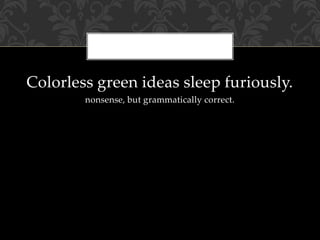
Colorless green ideas sleep furiously.
nonsense, but grammatically correct.
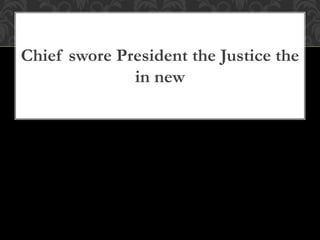
Chief swore President the Justice the
in new
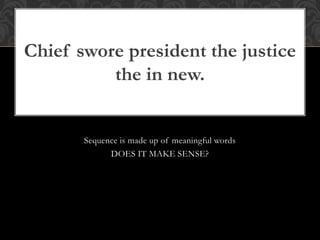
Sequence is made up of meaningful words
DOES IT MAKE SENSE?
Chief swore president the justice
the in new.
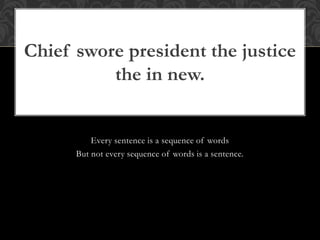
Every sentence is a sequence of words
But not every sequence of words is a sentence.
Chief swore president the justice
the in new.
Determined by rules shared by the speakers of a language
Example:
WHAT GRAMMATICALITY IS
BASED ON
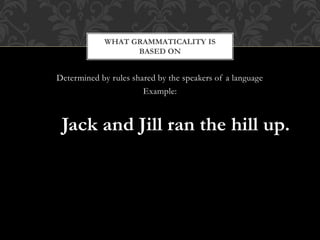
Determined by rules shared by the speakers of a language
Example:
Jack and Jill ran the hill up.
WHAT GRAMMATICALITY IS
BASED ON
I am proud to be my mother
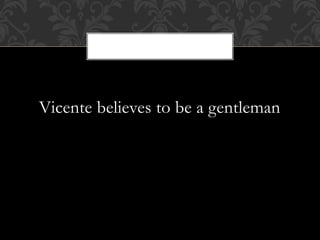
Vicente believes to be a gentleman
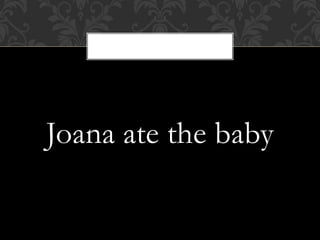
Joana ate the baby
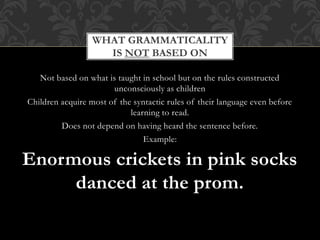
Not based on what is taught in school but on the rules constructed
unconsciously as children
Children acquire most of the syntactic rules of their language even before
learning to read.
Does not depend on having heard the sentence before.
Example:
Enormous crickets in pink socks
danced at the prom.
WHAT GRAMMATICALITY
IS NOT BASED ON
Does not depend on the truth of the sentence
If it did, lying would be impossible.
Example:
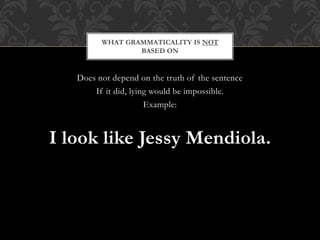
Does not depend on the truth of the sentence
If it did, lying would be impossible.
Example:
I look like Jessy Mendiola.
WHAT GRAMMATICALITY IS NOT
BASED ON
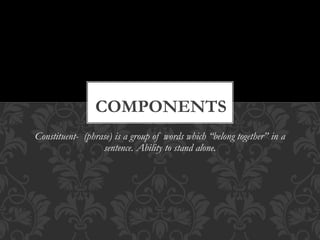
Constituent- (phrase) is a group of words which “belong together” in a
sentence. Ability to stand alone.
COMPONENTS
String – group of words is constituent or not
A. Proform test- stands for contituents already mentioned.
E.g. pronouns (which replace NPs; she/him/they etc). Other
proforms: somewhere, do so, there).
Examples:
a. The lady running the group handed in her resignation at noon.
b. She handed in her resignation. [→ The lady running the group
is a constituent]
CONSTITUENTS
TESTS
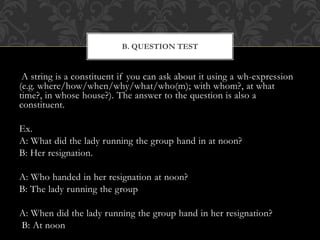
A string is a constituent if you can ask about it using a wh-expression
(e.g. where/how/when/why/what/who(m); with whom?, at what
time?, in whose house?). The answer to the question is also a
constituent.
Ex.
A: What did the lady running the group hand in at noon?
B: Her resignation.
A: Who handed in her resignation at noon?
B: The lady running the group
A: When did the lady running the group hand in her resignation?
B: At noon
B. QUESTION TEST
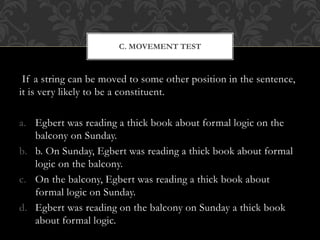
If a string can be moved to some other position in the sentence,
it is very likely to be a constituent.
a. Egbert was reading a thick book about formal logic on the
balcony on Sunday.
b. b. On Sunday, Egbert was reading a thick book about formal
logic on the balcony.
c. On the balcony, Egbert was reading a thick book about
formal logic on Sunday.
d. Egbert was reading on the balcony on Sunday a thick book
about formal logic.
C. MOVEMENT TEST
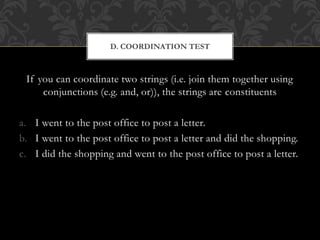
If you can coordinate two strings (i.e. join them together using
conjunctions (e.g. and, or)), the strings are constituents
a. I went to the post office to post a letter.
b. I went to the post office to post a letter and did the shopping.
c. I did the shopping and went to the post office to post a letter.
D. COORDINATION TEST
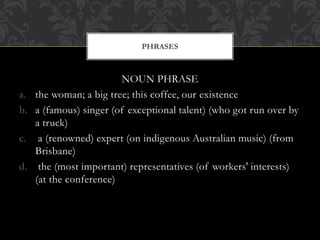
NOUN PHRASE
a. the woman; a big tree; this coffee, our existence
b. a (famous) singer (of exceptional talent) (who got run over by
a truck)
c. a (renowned) expert (on indigenous Australian music) (from
Brisbane)
d. the (most important) representatives (of workers' interests)
(at the conference)
PHRASES
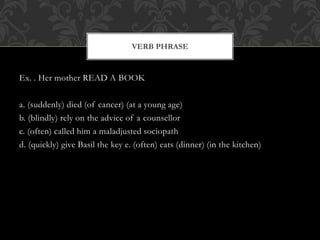
Ex. . Her mother READ A BOOK
a. (suddenly) died (of cancer) (at a young age)
b. (blindly) rely on the advice of a counsellor
c. (often) called him a maladjusted sociopath
d. (quickly) give Basil the key e. (often) eats (dinner) (in the kitchen)
VERB PHRASE
The three main types: spatial PPs (expressing places or directions, as in ),
temporal PPs (expressing times,) and other PPs expressing more abstract
meanings
a. [PP near [NP the fireplace]]
b. [PP towards [NP the building]]
c. [PP after [NP the discussion]]
d. [PP in [NP the evening]]
e. [PP of [NP her parents]]
f. [PP despite [NP the situation]]
PREPOSITIONAL PHRASE
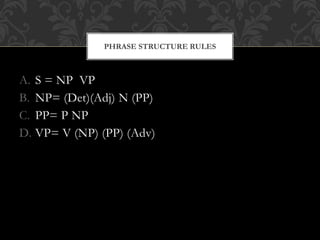
A. S = NP VP
B. NP= (Det)(Adj) N (PP)
C. PP= P NP
D. VP= V (NP) (PP) (Adv)
PHRASE STRUCTURE RULES
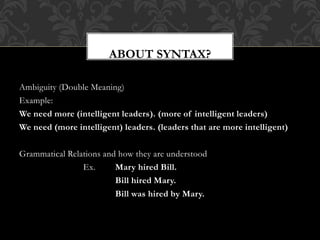
Ambiguity (Double Meaning)
Example:
We need more (intelligent leaders). (more of intelligent leaders)
We need (more intelligent) leaders. (leaders that are more intelligent)
Grammatical Relations and how they are understood
Ex. Mary hired Bill.
Bill hired Mary.
Bill was hired by Mary.
ABOUT SYNTAX?
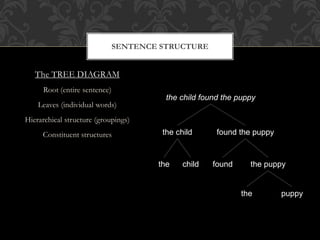
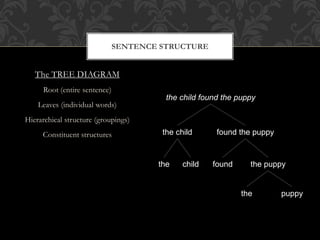
The TREE DIAGRAM
Root (entire sentence)
Leaves (individual words)
Hierarchical structure (groupings)
Constituent structures
SENTENCE STRUCTURE
the child found the puppy
the puppy
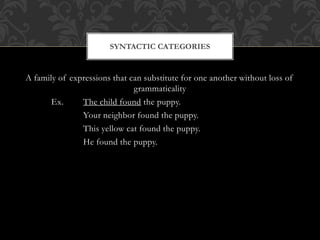
A family of expressions that can substitute for one another without loss of
grammaticality
Ex. The child found the puppy.
Your neighbor found the puppy.
This yellow cat found the puppy.
He found the puppy.
SYNTACTIC CATEGORIES
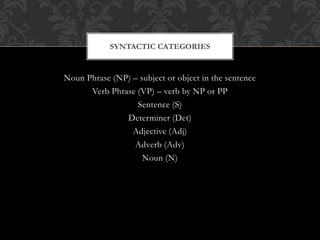
Noun Phrase (NP) – subject or object in the sentence
Verb Phrase (VP) – verb by NP or PP
Sentence (S)
Determiner (Det)
Adjective (Adj)
Adverb (Adv)
Noun (N)
SYNTACTIC CATEGORIES
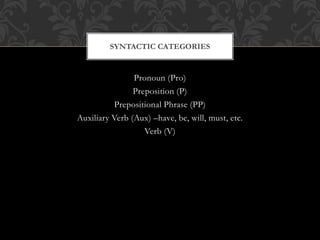
Pronoun (Pro)
Preposition (P)
Prepositional Phrase (PP)
Auxiliary Verb (Aux) –have, be, will, must, etc.
Verb (V)
SYNTACTIC CATEGORIES
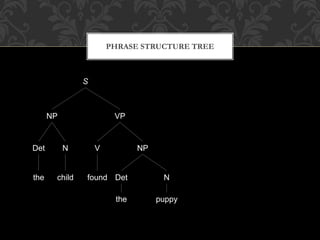
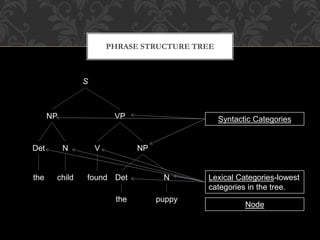
A tree diagram with syntactic category information provided (syntactic labels)
Constituent structure tree
PHRASE STRUCTURE TREES
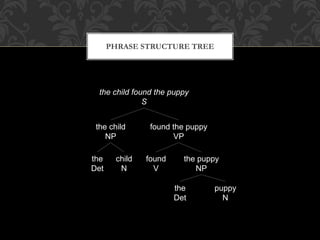
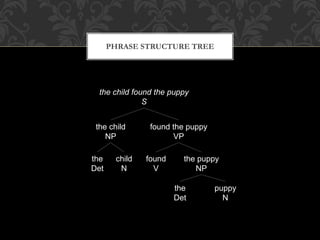
PHRASE STRUCTURE TREE
the child found the puppy
S
the child
NP
found the puppy
VP
the
Det
child
N
found
V
the puppy
NP
the
Det
puppy
N
The TREE DIAGRAM
Root (entire sentence)
Leaves (individual words)
Hierarchical structure (groupings)
Constituent structures
SENTENCE STRUCTURE
the child found the puppy
the puppy
PHRASE STRUCTURE TREE
the child found the puppy
S
the child
NP
found the puppy
VP
the
Det
child
N
found
V
the puppy
NP
the
Det
puppy
N
PHRASE STRUCTURE TREE
S
NP VP
Det N V NP
Det N
the puppy
foundchildthe
PHRASE STRUCTURE TREE
S
NP VP
Det N V NP
Det N
the puppy
foundchildthe Lexical Categories-lowest
categories in the tree.
Syntactic Categories
Node
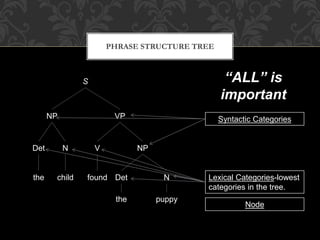
PHRASE STRUCTURE TREE
S
NP VP
Det N V NP
Det N
the puppy
foundchildthe Lexical Categories-lowest
categories in the tree.
Syntactic Categories
Node
“ALL” is
important
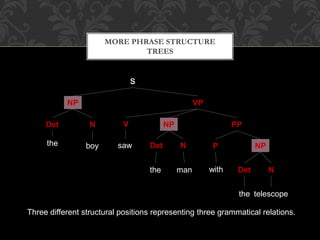
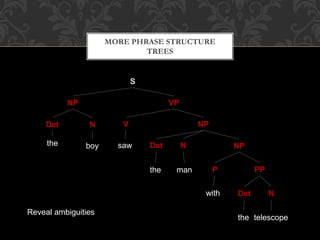
MORE PHRASE STRUCTURE
TREES
S
NP VP
Det NPN PP
the boy
V
saw P NPDet N
the man Det Nwith
the telescope
Three different structural positions representing three grammatical relations.
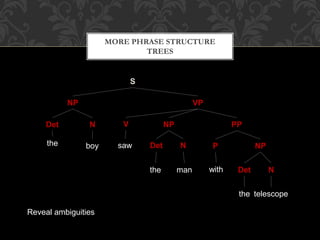
MORE PHRASE STRUCTURE
TREES
S
NP VP
Det NPN PP
the boy
V
saw P NPDet N
the man Det Nwith
the telescope
Reveal ambiguities
MORE PHRASE STRUCTURE
TREES
S
NP VP
Det NPN
the boy
V
saw
P PP
Det N
the man
Det Nwith
the telescope
NP
Reveal ambiguities
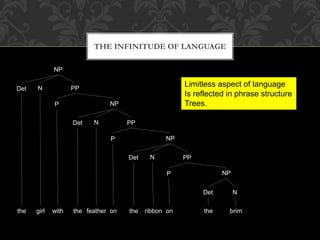
There is no longest sentence in any language
Speakers can lengthen any sentence by various means
Adding adjectives, clauses, etc.
THE INFINITUDE OF LANGUAGE
NP
Det N PP
P NP
Det N PP
P NP
Det N PP
P NP
Det N
the girl with the feather on the ribbon on the brim
Limitless aspect of language
Is reflected in phrase structure
Trees.
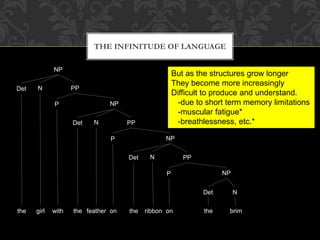
THE INFINITUDE OF LANGUAGE
NP
Det N PP
P NP
Det N PP
P NP
Det N PP
P NP
Det N
the girl with the feather on the ribbon on the brim
But as the structures grow longer
They become more increasingly
Difficult to produce and understand.
-due to short term memory limitations
-muscular fatigue*
-breathlessness, etc.*
ANY
QUESTION?
Find the VPs in the following sentences.
1. She wrote several books on British history.
2. She apparently believes the stories about the aliens.
3. She read a book and went to bed.
4. They emptied and refilled the tank.
Find the NPs in the following sentences.
1. People from the mainland often forget Tasmania when they draw maps
of Australia.
2. 2. At the next meeting, the president of the committee called in an expert
on environmental
TEST
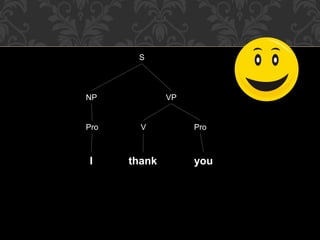
S
NP VP
Pro V Pro
I thank you

Linguistics -Syntax

  • 1.
    The Sentence Patterns ofLanguage By: Steffany Villanueva SYNTAX
  • 2.
    Grammar  Mental representationof a speaker’s linguistical competence  What a speaker knows about the language, including its phonology, morphology, syntax, semantics and lexicon BEFORE YOU GET CONFUSED…
  • 3.
    Syntax  The rulesof sentence formation.  The component of the mental grammar that represents speakers’ knowledge of the structure of phrases and sentence. BEFORE YOU GET CONFUSED…
  • 4.
    σύν syn, "together",and τάξις táxis, "an ordering“ arrangement Refer directly to the rules and principles that govern the sentence structure of any individual language structure (word order) SYNTAX
  • 5.
    Colorless green ideassleep furiously. nonsense, but grammatically correct.
  • 6.
    Chief swore Presidentthe Justice the in new
  • 7.
    Sequence is madeup of meaningful words DOES IT MAKE SENSE? Chief swore president the justice the in new.
  • 8.
    Every sentence isa sequence of words But not every sequence of words is a sentence. Chief swore president the justice the in new.
  • 9.
    Determined by rulesshared by the speakers of a language Example: WHAT GRAMMATICALITY IS BASED ON
  • 10.
    Determined by rulesshared by the speakers of a language Example: Jack and Jill ran the hill up. WHAT GRAMMATICALITY IS BASED ON
  • 11.
    I am proudto be my mother
  • 12.
    Vicente believes tobe a gentleman
  • 13.
  • 14.
    Not based onwhat is taught in school but on the rules constructed unconsciously as children Children acquire most of the syntactic rules of their language even before learning to read. Does not depend on having heard the sentence before. Example: Enormous crickets in pink socks danced at the prom. WHAT GRAMMATICALITY IS NOT BASED ON
  • 15.
    Does not dependon the truth of the sentence If it did, lying would be impossible. Example:
  • 16.
    Does not dependon the truth of the sentence If it did, lying would be impossible. Example: I look like Jessy Mendiola. WHAT GRAMMATICALITY IS NOT BASED ON
  • 17.
    Constituent- (phrase) isa group of words which “belong together” in a sentence. Ability to stand alone. COMPONENTS
  • 18.
    String – groupof words is constituent or not A. Proform test- stands for contituents already mentioned. E.g. pronouns (which replace NPs; she/him/they etc). Other proforms: somewhere, do so, there). Examples: a. The lady running the group handed in her resignation at noon. b. She handed in her resignation. [→ The lady running the group is a constituent] CONSTITUENTS TESTS
  • 19.
    A string isa constituent if you can ask about it using a wh-expression (e.g. where/how/when/why/what/who(m); with whom?, at what time?, in whose house?). The answer to the question is also a constituent. Ex. A: What did the lady running the group hand in at noon? B: Her resignation. A: Who handed in her resignation at noon? B: The lady running the group A: When did the lady running the group hand in her resignation? B: At noon B. QUESTION TEST
  • 20.
    If a stringcan be moved to some other position in the sentence, it is very likely to be a constituent. a. Egbert was reading a thick book about formal logic on the balcony on Sunday. b. b. On Sunday, Egbert was reading a thick book about formal logic on the balcony. c. On the balcony, Egbert was reading a thick book about formal logic on Sunday. d. Egbert was reading on the balcony on Sunday a thick book about formal logic. C. MOVEMENT TEST
  • 21.
    If you cancoordinate two strings (i.e. join them together using conjunctions (e.g. and, or)), the strings are constituents a. I went to the post office to post a letter. b. I went to the post office to post a letter and did the shopping. c. I did the shopping and went to the post office to post a letter. D. COORDINATION TEST
  • 22.
    NOUN PHRASE a. thewoman; a big tree; this coffee, our existence b. a (famous) singer (of exceptional talent) (who got run over by a truck) c. a (renowned) expert (on indigenous Australian music) (from Brisbane) d. the (most important) representatives (of workers' interests) (at the conference) PHRASES
  • 23.
    Ex. . Hermother READ A BOOK a. (suddenly) died (of cancer) (at a young age) b. (blindly) rely on the advice of a counsellor c. (often) called him a maladjusted sociopath d. (quickly) give Basil the key e. (often) eats (dinner) (in the kitchen) VERB PHRASE
  • 24.
    The three maintypes: spatial PPs (expressing places or directions, as in ), temporal PPs (expressing times,) and other PPs expressing more abstract meanings a. [PP near [NP the fireplace]] b. [PP towards [NP the building]] c. [PP after [NP the discussion]] d. [PP in [NP the evening]] e. [PP of [NP her parents]] f. [PP despite [NP the situation]] PREPOSITIONAL PHRASE
  • 25.
    A. S =NP VP B. NP= (Det)(Adj) N (PP) C. PP= P NP D. VP= V (NP) (PP) (Adv) PHRASE STRUCTURE RULES
  • 26.
    Ambiguity (Double Meaning) Example: Weneed more (intelligent leaders). (more of intelligent leaders) We need (more intelligent) leaders. (leaders that are more intelligent) Grammatical Relations and how they are understood Ex. Mary hired Bill. Bill hired Mary. Bill was hired by Mary. ABOUT SYNTAX?
  • 27.
    The TREE DIAGRAM Root(entire sentence) Leaves (individual words) Hierarchical structure (groupings) Constituent structures SENTENCE STRUCTURE the child found the puppy the child found the puppy the child found the puppy the puppy
  • 28.
    A family ofexpressions that can substitute for one another without loss of grammaticality Ex. The child found the puppy. Your neighbor found the puppy. This yellow cat found the puppy. He found the puppy. SYNTACTIC CATEGORIES
  • 29.
    Noun Phrase (NP)– subject or object in the sentence Verb Phrase (VP) – verb by NP or PP Sentence (S) Determiner (Det) Adjective (Adj) Adverb (Adv) Noun (N) SYNTACTIC CATEGORIES
  • 30.
    Pronoun (Pro) Preposition (P) PrepositionalPhrase (PP) Auxiliary Verb (Aux) –have, be, will, must, etc. Verb (V) SYNTACTIC CATEGORIES
  • 31.
    A tree diagramwith syntactic category information provided (syntactic labels) Constituent structure tree PHRASE STRUCTURE TREES
  • 32.
    PHRASE STRUCTURE TREE thechild found the puppy S the child NP found the puppy VP the Det child N found V the puppy NP the Det puppy N
  • 33.
    The TREE DIAGRAM Root(entire sentence) Leaves (individual words) Hierarchical structure (groupings) Constituent structures SENTENCE STRUCTURE the child found the puppy the child found the puppy the child found the puppy the puppy
  • 34.
    PHRASE STRUCTURE TREE thechild found the puppy S the child NP found the puppy VP the Det child N found V the puppy NP the Det puppy N
  • 35.
    PHRASE STRUCTURE TREE S NPVP Det N V NP Det N the puppy foundchildthe
  • 36.
    PHRASE STRUCTURE TREE S NPVP Det N V NP Det N the puppy foundchildthe Lexical Categories-lowest categories in the tree. Syntactic Categories Node
  • 37.
    PHRASE STRUCTURE TREE S NPVP Det N V NP Det N the puppy foundchildthe Lexical Categories-lowest categories in the tree. Syntactic Categories Node “ALL” is important
  • 38.
    MORE PHRASE STRUCTURE TREES S NPVP Det NPN PP the boy V saw P NPDet N the man Det Nwith the telescope Three different structural positions representing three grammatical relations.
  • 39.
    MORE PHRASE STRUCTURE TREES S NPVP Det NPN PP the boy V saw P NPDet N the man Det Nwith the telescope Reveal ambiguities
  • 40.
    MORE PHRASE STRUCTURE TREES S NPVP Det NPN the boy V saw P PP Det N the man Det Nwith the telescope NP Reveal ambiguities
  • 41.
    There is nolongest sentence in any language Speakers can lengthen any sentence by various means Adding adjectives, clauses, etc. THE INFINITUDE OF LANGUAGE
  • 42.
    THE INFINITUDE OFLANGUAGE NP Det N PP P NP Det N PP P NP Det N PP P NP Det N the girl with the feather on the ribbon on the brim Limitless aspect of language Is reflected in phrase structure Trees.
  • 43.
    THE INFINITUDE OFLANGUAGE NP Det N PP P NP Det N PP P NP Det N PP P NP Det N the girl with the feather on the ribbon on the brim But as the structures grow longer They become more increasingly Difficult to produce and understand. -due to short term memory limitations -muscular fatigue* -breathlessness, etc.*
  • 44.
  • 45.
    Find the VPsin the following sentences. 1. She wrote several books on British history. 2. She apparently believes the stories about the aliens. 3. She read a book and went to bed. 4. They emptied and refilled the tank. Find the NPs in the following sentences. 1. People from the mainland often forget Tasmania when they draw maps of Australia. 2. 2. At the next meeting, the president of the committee called in an expert on environmental TEST
  • 46.
    S NP VP Pro VPro I thank you