Rational Equations, Functions and
Inequalities: Solving Problems
General Mathematics
Pre-Test)
Instructions: Choose the letter of the correct answer and write them on a separate sheet of paper.
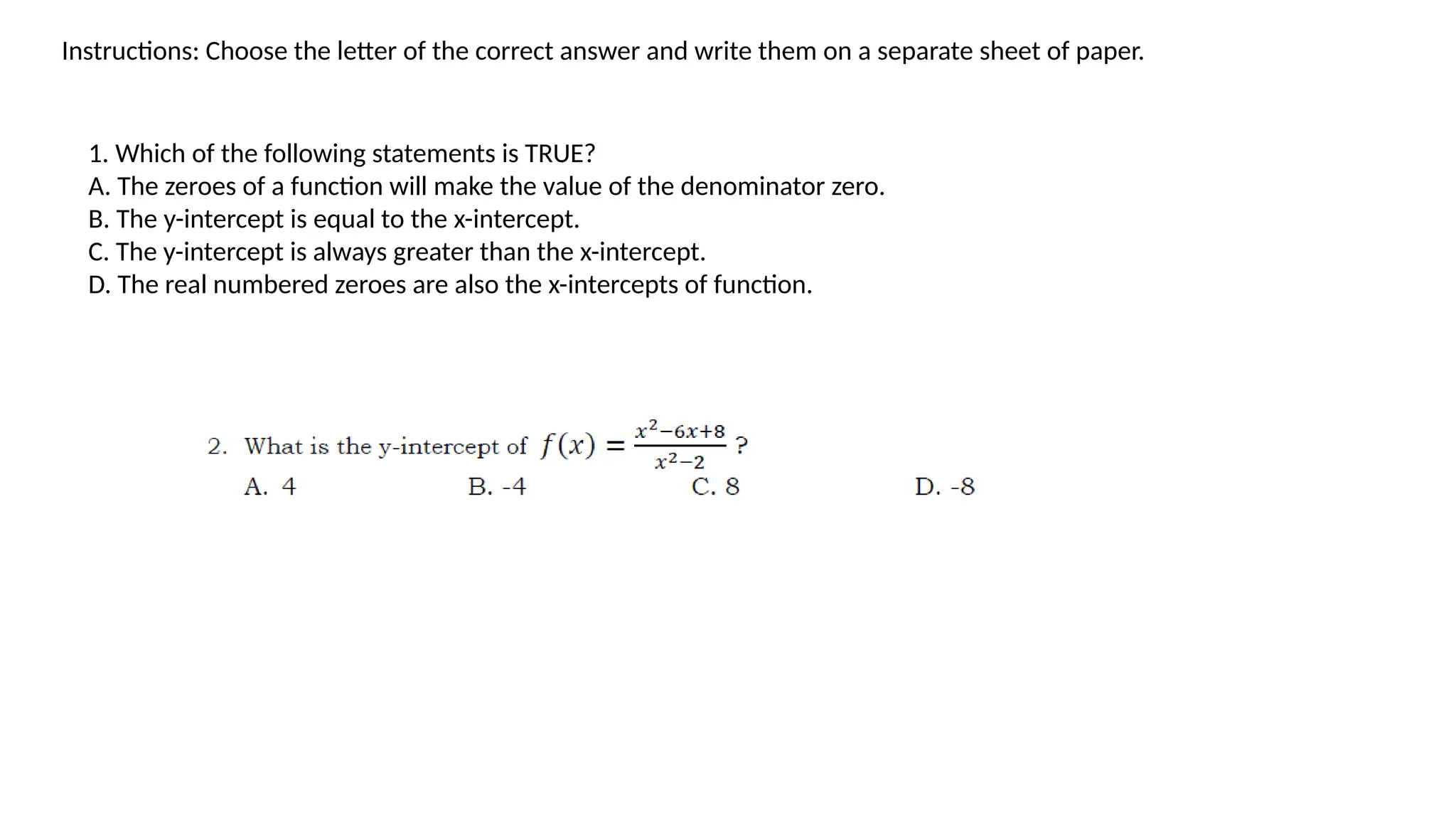
1. Which of the following statements is TRUE?
A. The zeroes of a function will make the value of the denominator zero.
B. The y-intercept is equal to the x-intercept.
C. The y-intercept is always greater than the x-intercept.
D. The real numbered zeroes are also the x-intercepts of function.
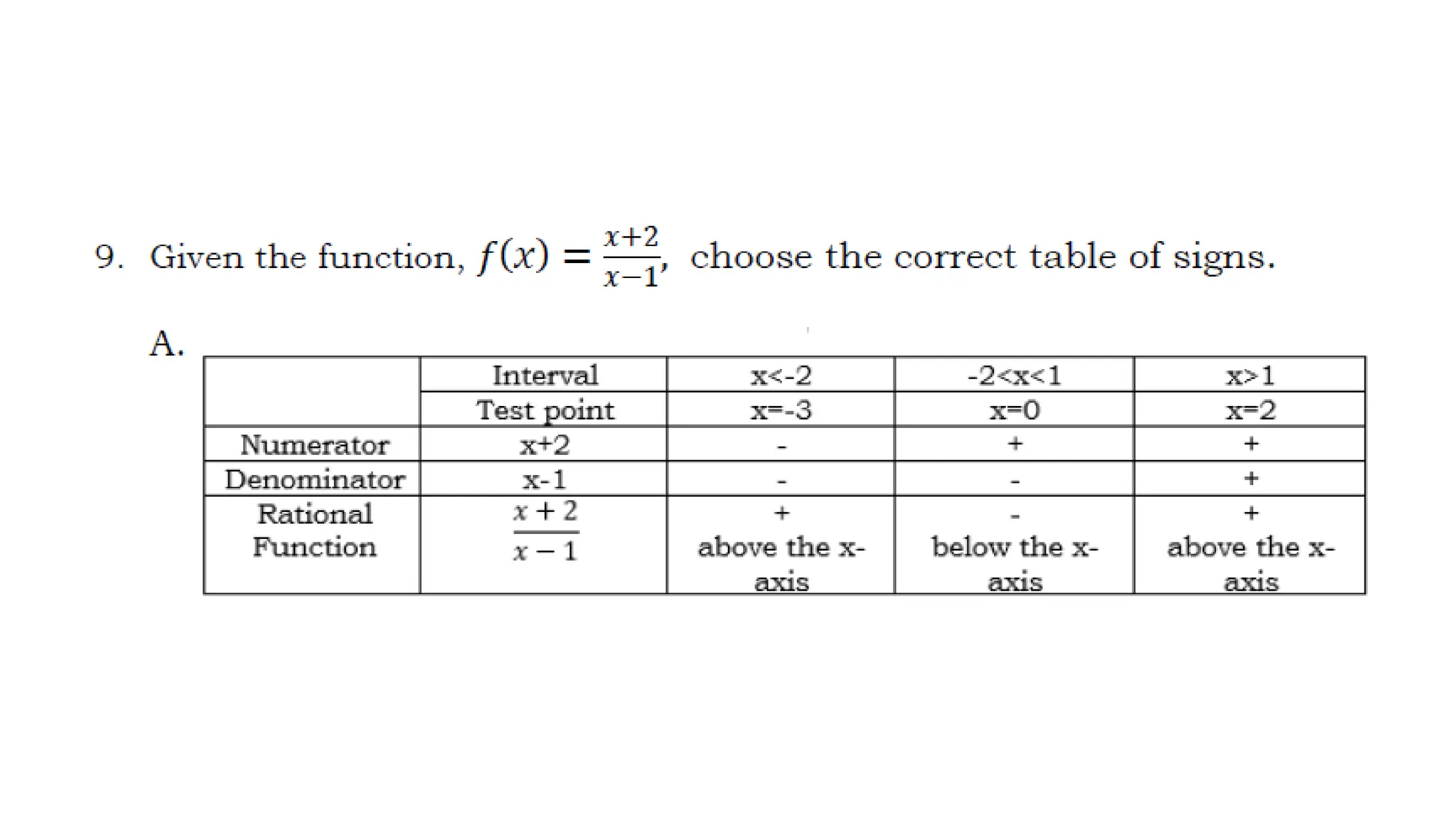
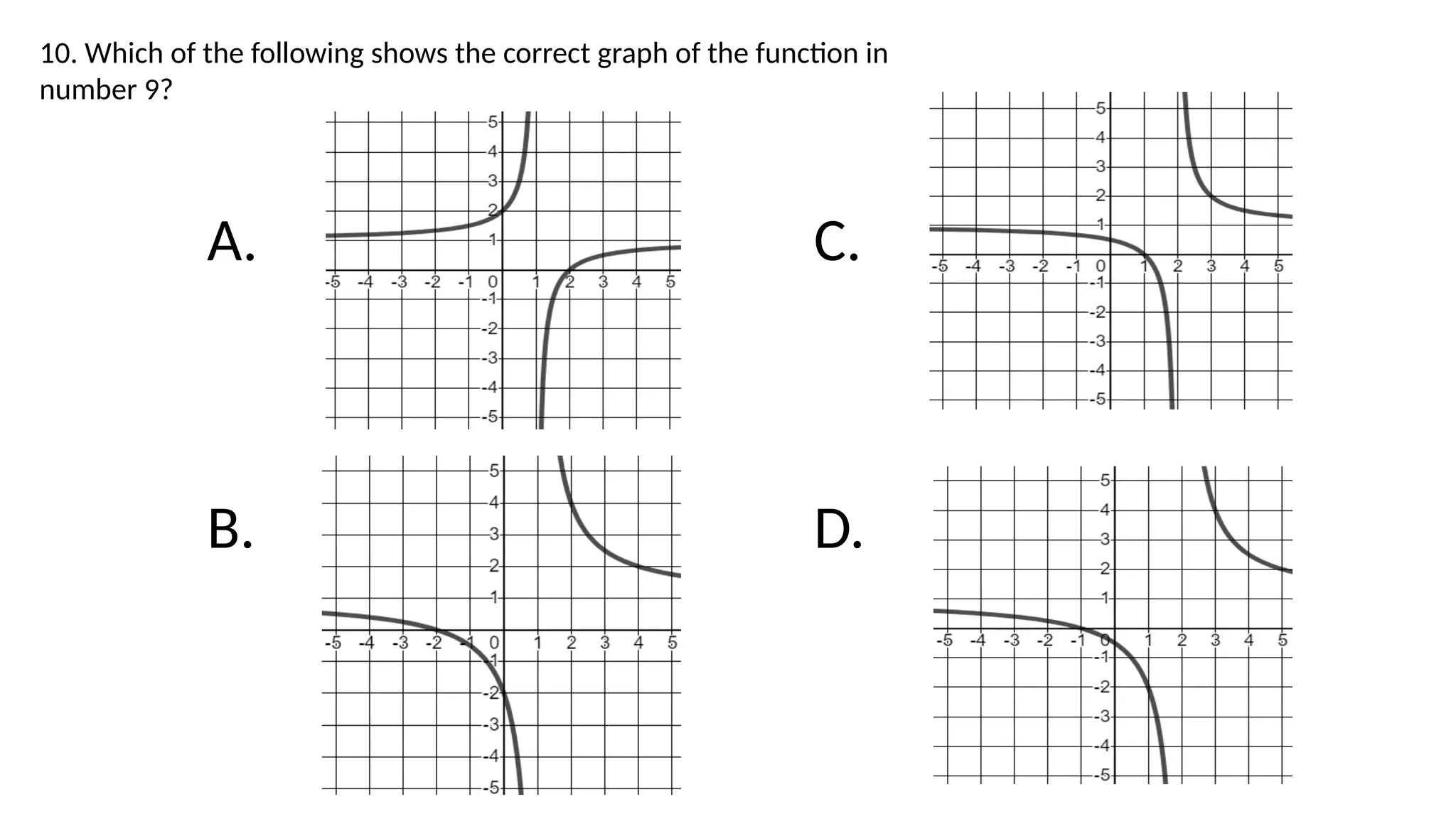
10. Which of the following shows the correct graph of the function in
number 9?
B.
A. C.
D.
•15. Which of the following statement is TRUE?
•A. Horizontal asymptotes are always equal to the vertical
asymptotes.
•B. Vertical asymptotes are equal to the value of the x-intercepts.
•C. Horizontal asymptotes depend on the degrees of the leading
coefficient.
•D. Vertical asymptotes are always equal to zero.
Lesson
10
•Zeroes and y-
Intercepts of
Rational
Functions
•At the end of this lesson, you are expected to:
•o represent real life situations using rational
functions; and
•o determine the zeroes and y-intercepts of
rational functions.
•Let’s start
with a review
about rational
function.
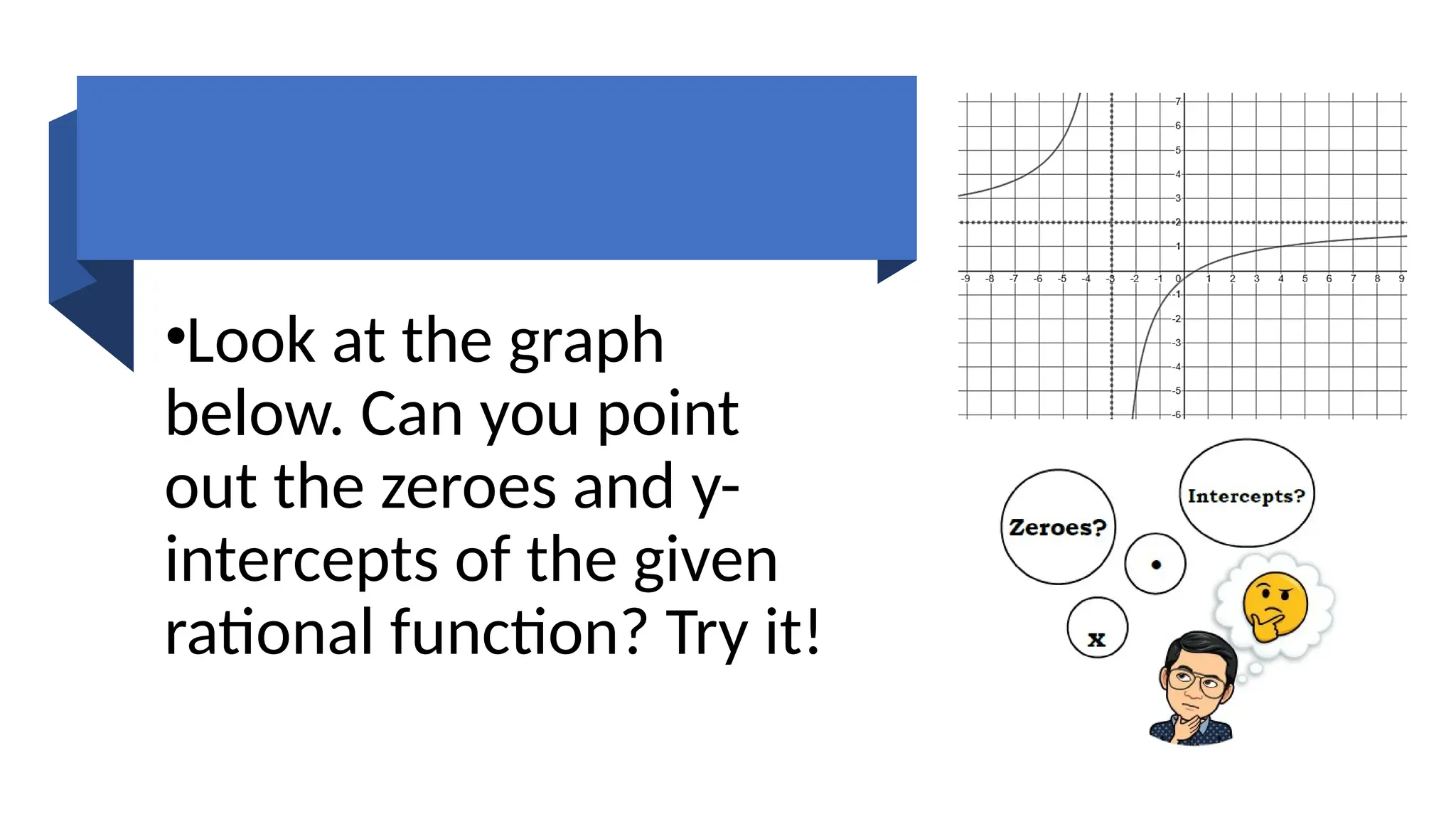
•Look at the graph
below. Can you point
out the zeroes and y-
intercepts of the given
rational function? Try it!
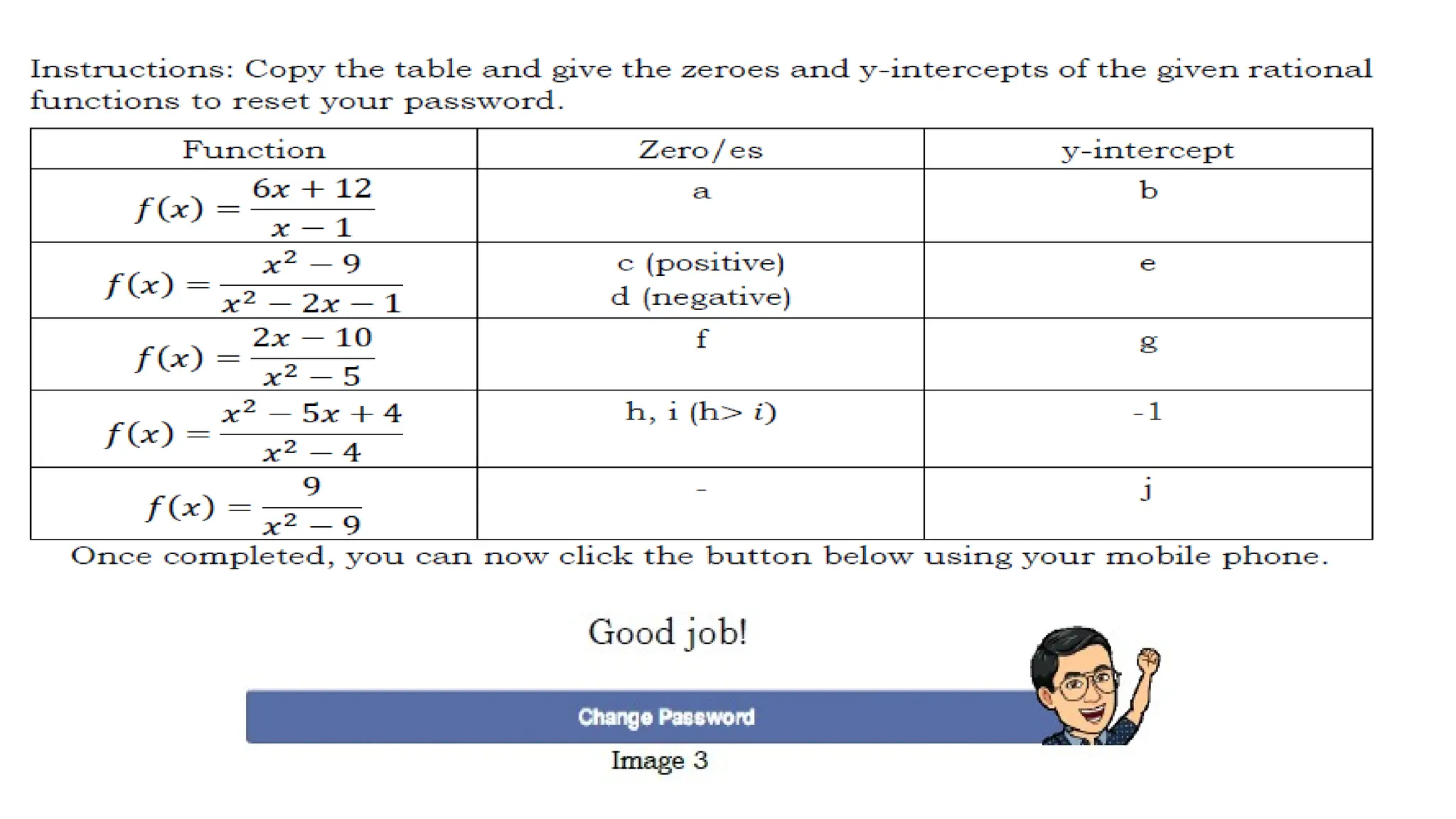
•What are ZEROES
and y-INTERCEPTS
of a Function?
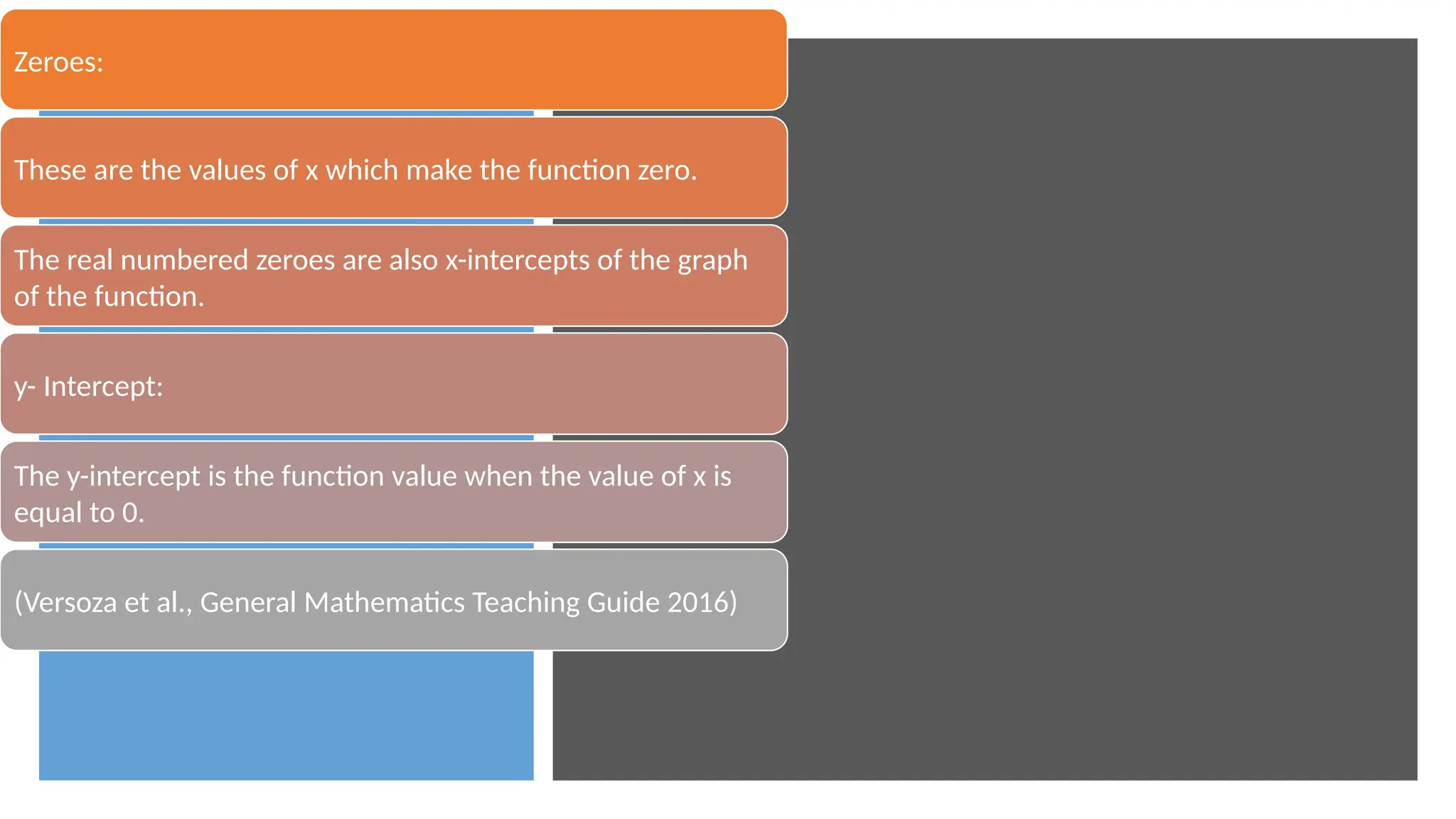
Zeroes:
These are the values of x which make the function zero.
The real numbered zeroes are also x-intercepts of the graph
of the function.
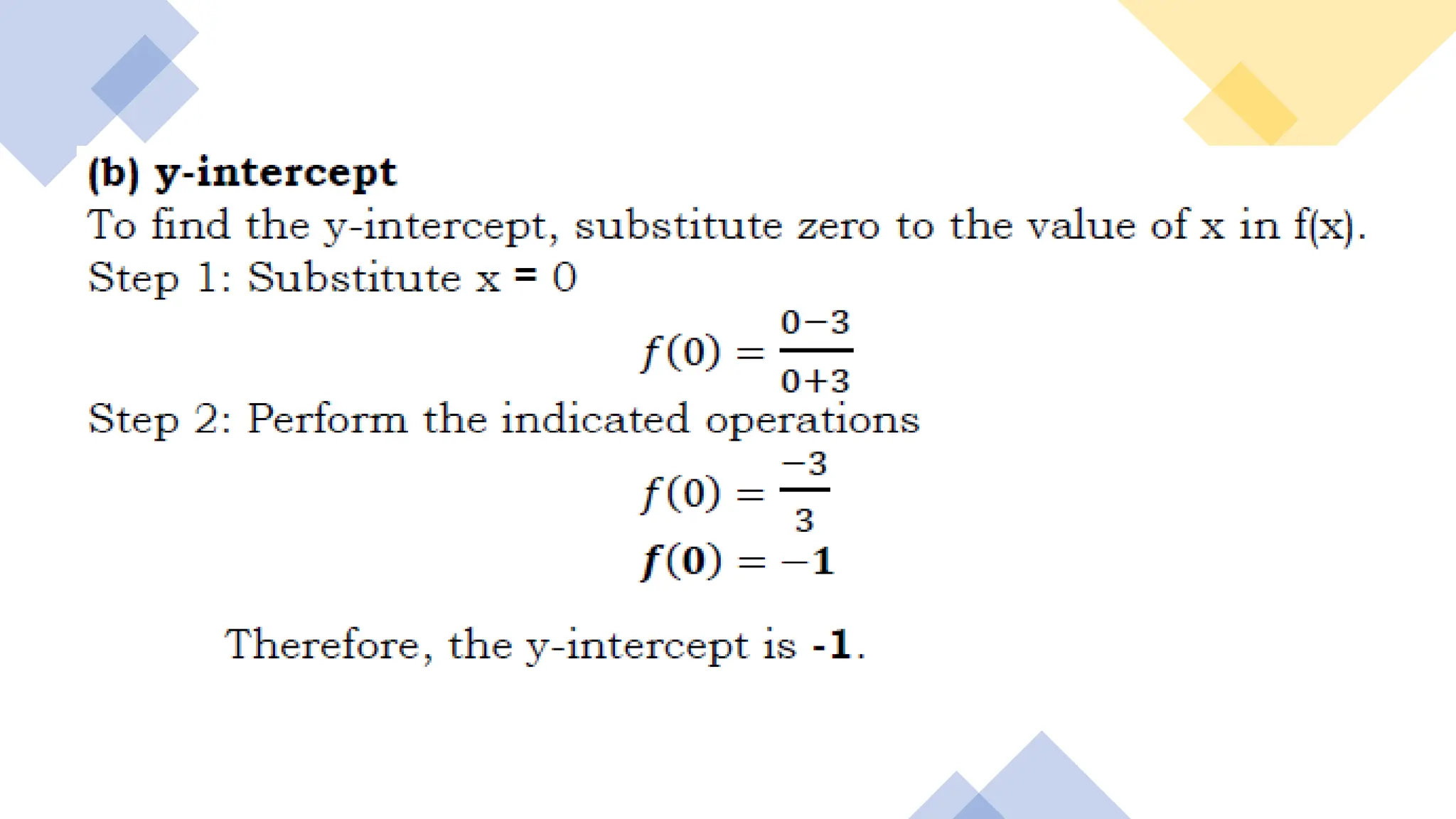
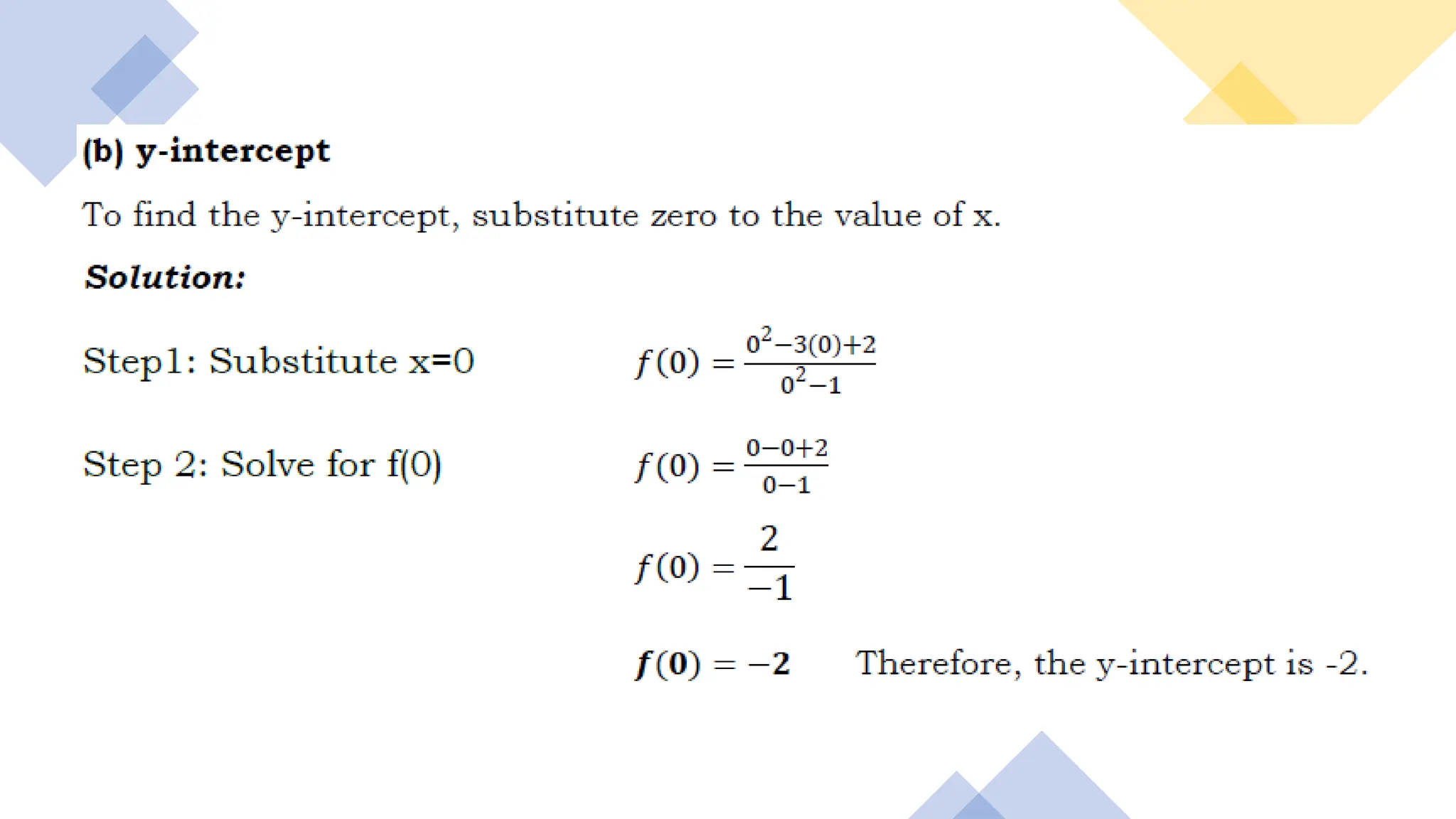
y- Intercept:
The y-intercept is the function value when the value of x is
equal to 0.
(Versoza et al., General Mathematics Teaching Guide 2016)
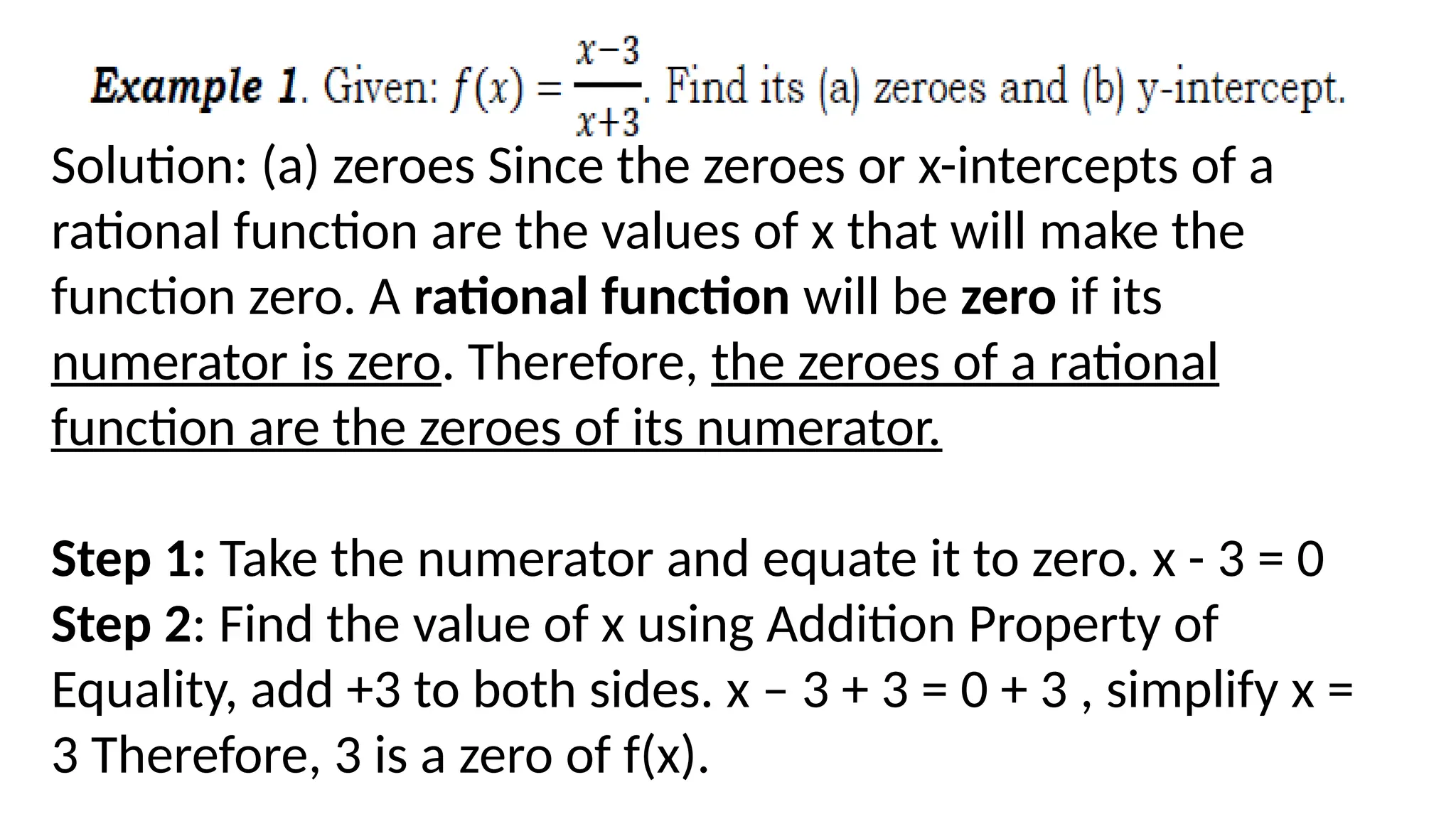
Solution: (a) zeroes Since the zeroes or x-intercepts of a
rational function are the values of x that will make the
function zero. A rational function will be zero if its
numerator is zero. Therefore, the zeroes of a rational
function are the zeroes of its numerator.
Step 1: Take the numerator and equate it to zero. x - 3 = 0
Step 2: Find the value of x using Addition Property of
Equality, add +3 to both sides. x – 3 + 3 = 0 + 3 , simplify x =
3 Therefore, 3 is a zero of f(x).
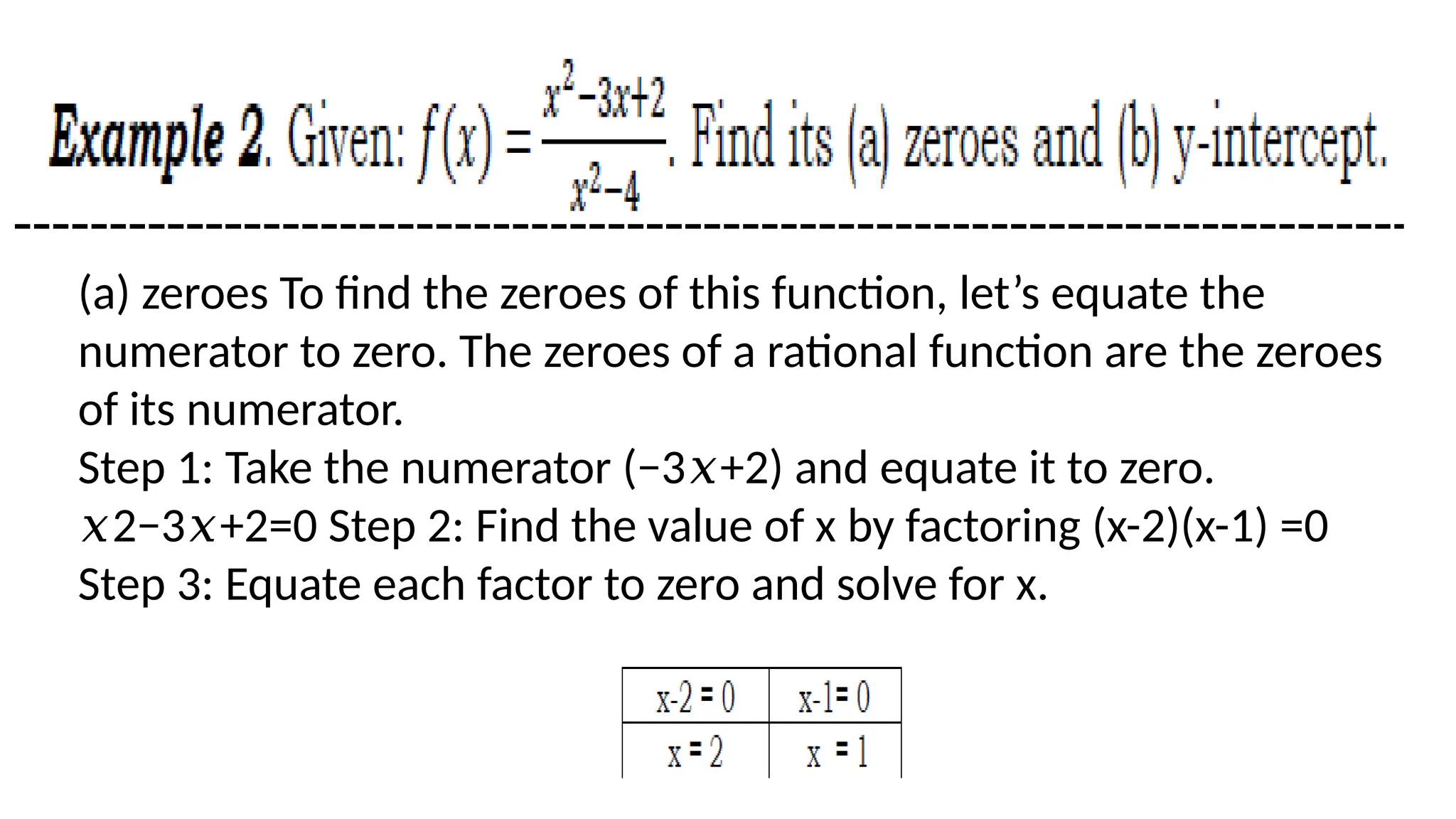
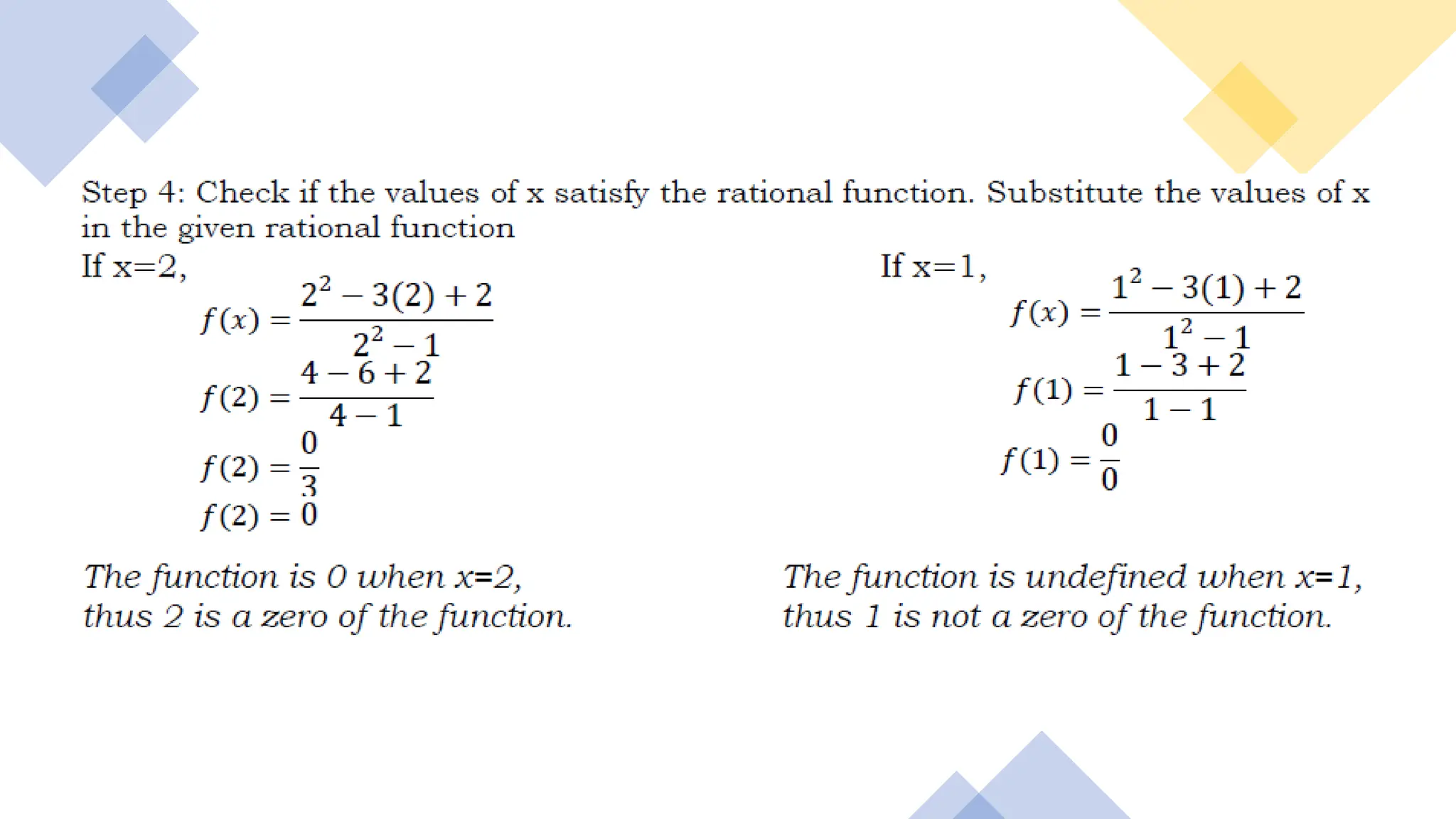
(a) zeroes To find the zeroes of this function, let’s equate the
numerator to zero. The zeroes of a rational function are the zeroes
of its numerator.
Step 1: Take the numerator (−3 +2) and equate it to zero.
𝑥
2−3 +2=0 Step 2: Find the value of x by factoring (x-2)(x-1) =0
𝑥 𝑥
Step 3: Equate each factor to zero and solve for x.
NOW IT’S YOUR TURN!
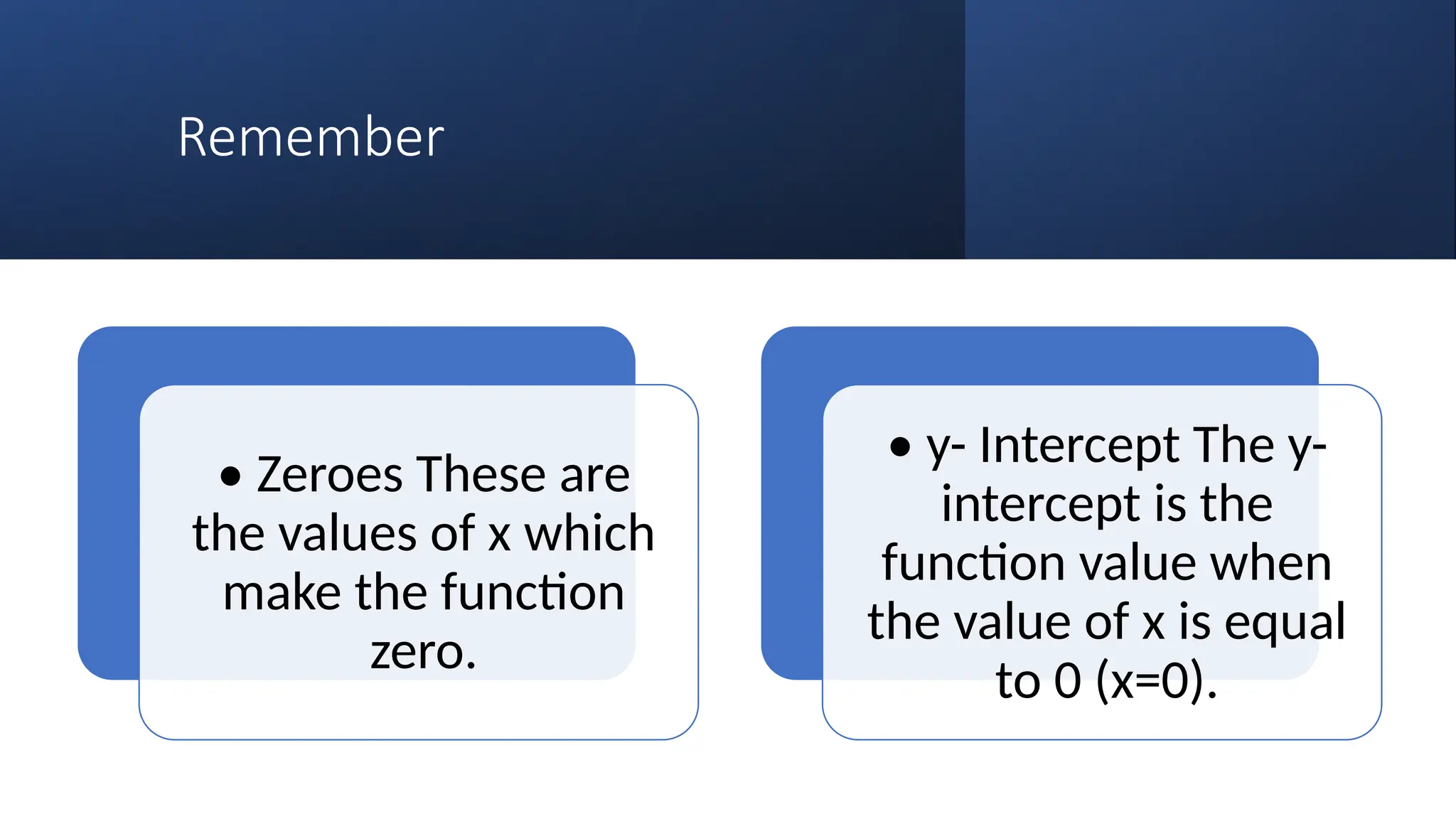
Remember
• Zeroes These are
the values of x which
make the function
zero.
• y- Intercept The y-
intercept is the
function value when
the value of x is equal
to 0 (x=0).
Lesson 11
Asymptotes
of Rational
Functions
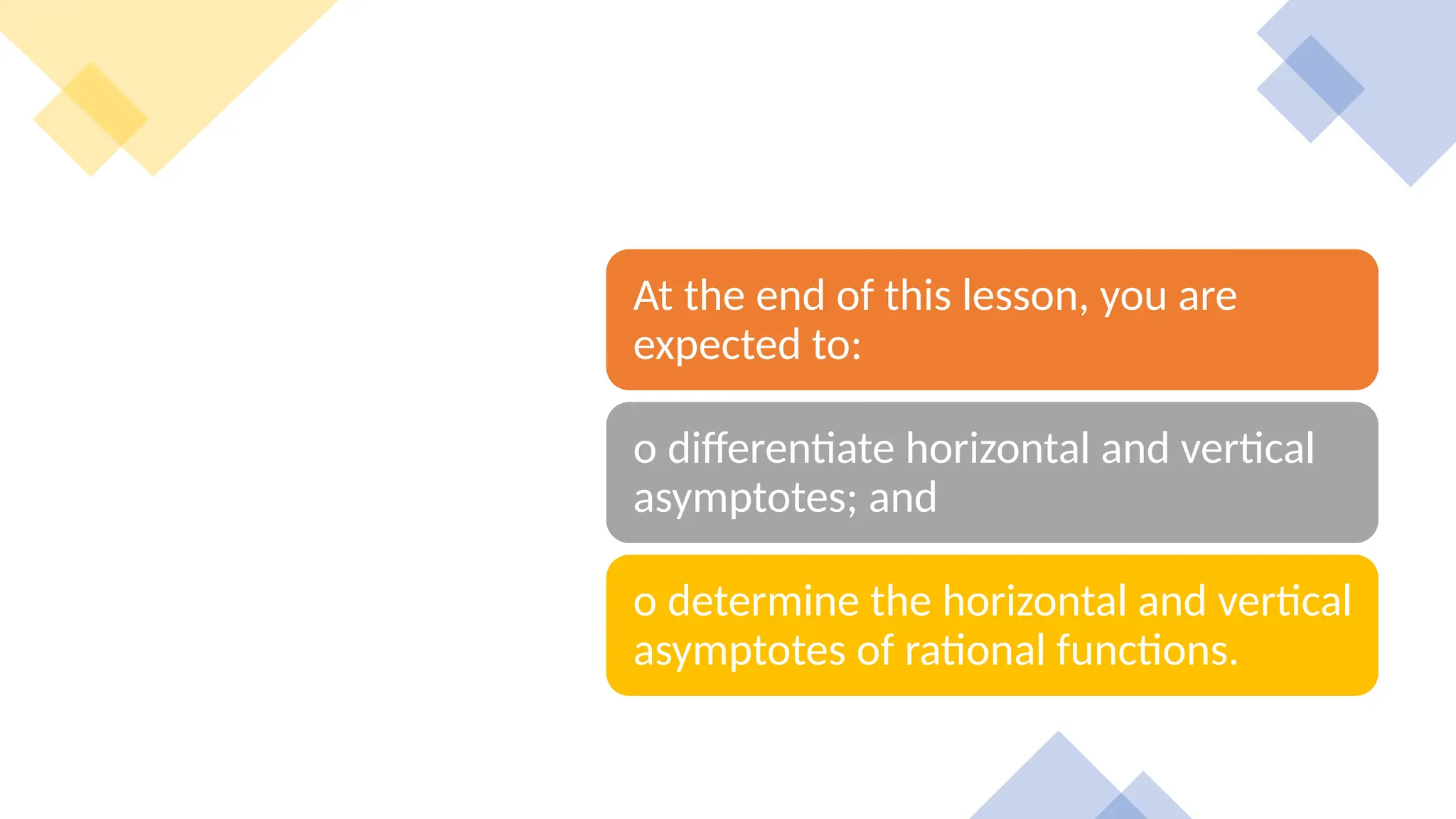
At the end of this lesson, you are
expected to:
o differentiate horizontal and vertical
asymptotes; and
o determine the horizontal and vertical
asymptotes of rational functions.
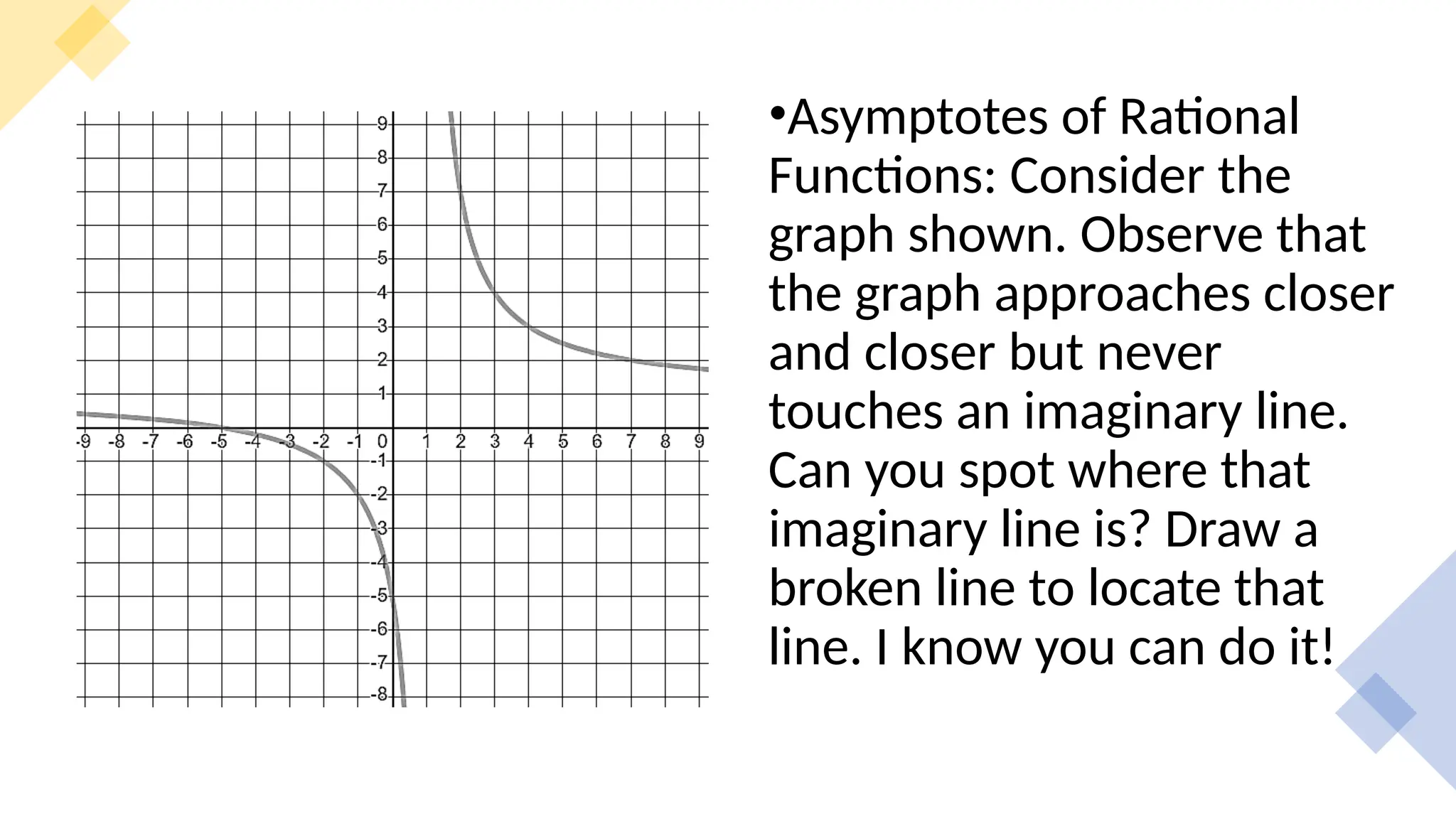
•Asymptotes of Rational
Functions: Consider the
graph shown. Observe that
the graph approaches closer
and closer but never
touches an imaginary line.
Can you spot where that
imaginary line is? Draw a
broken line to locate that
line. I know you can do it!
What is an ASYMPTOTE?
•An asymptote is a line that a curve approaches or gets
closer and closer to but never touches. It could be a
horizontal, vertical, or slanted line (Math is Fun 2020).
Vertical
Asymptotes
•Definition:
•The vertical line x = a is a vertical
asymptote of a function f if the
graph of f either increases or
decreases without a bound as
the x-values approach a from the
right or left (Versoza et al.,
General Mathematics Teaching
Guide 2016).
Finding the
Vertical
Asymptotes
of a Rational
Function
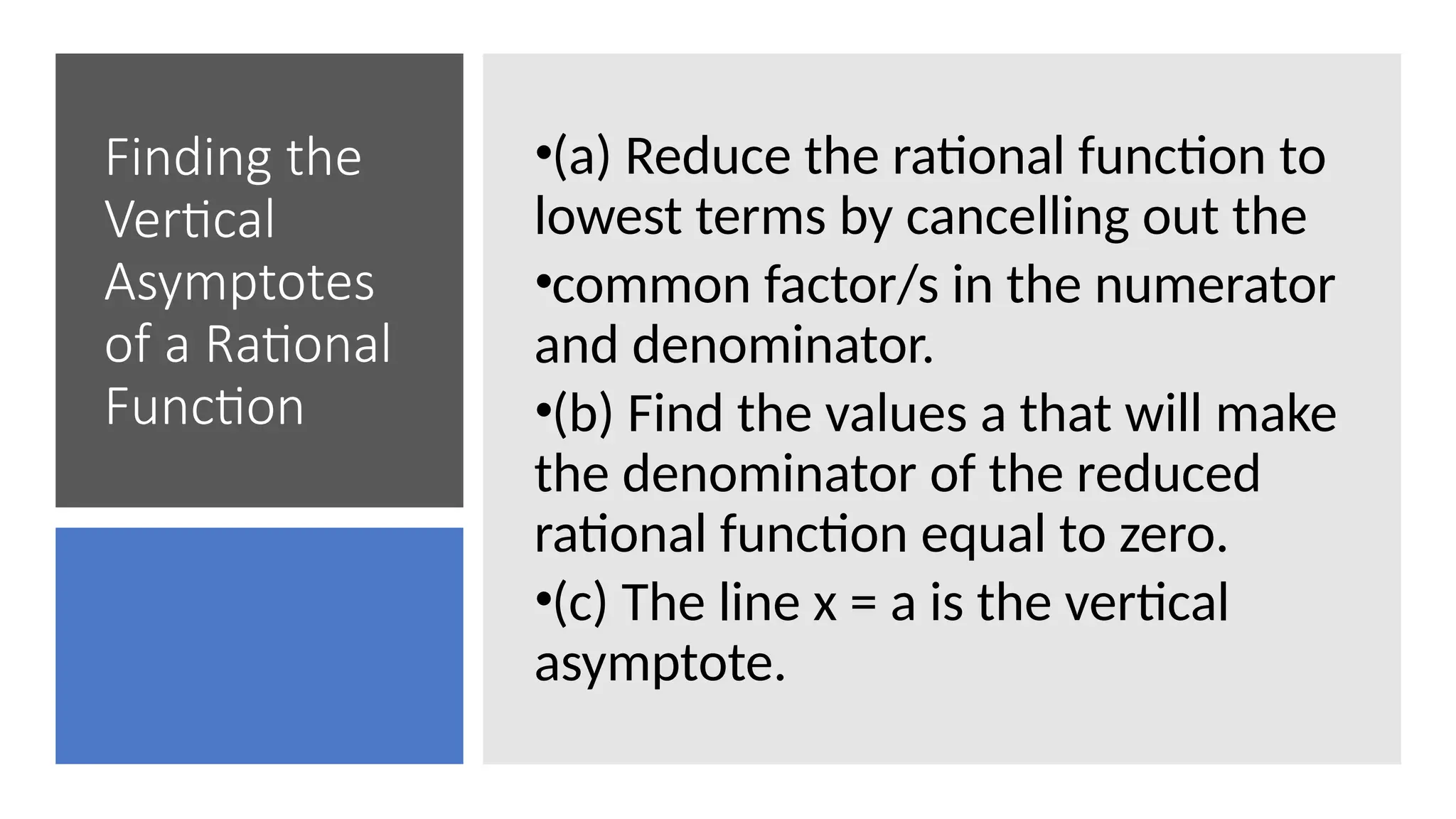
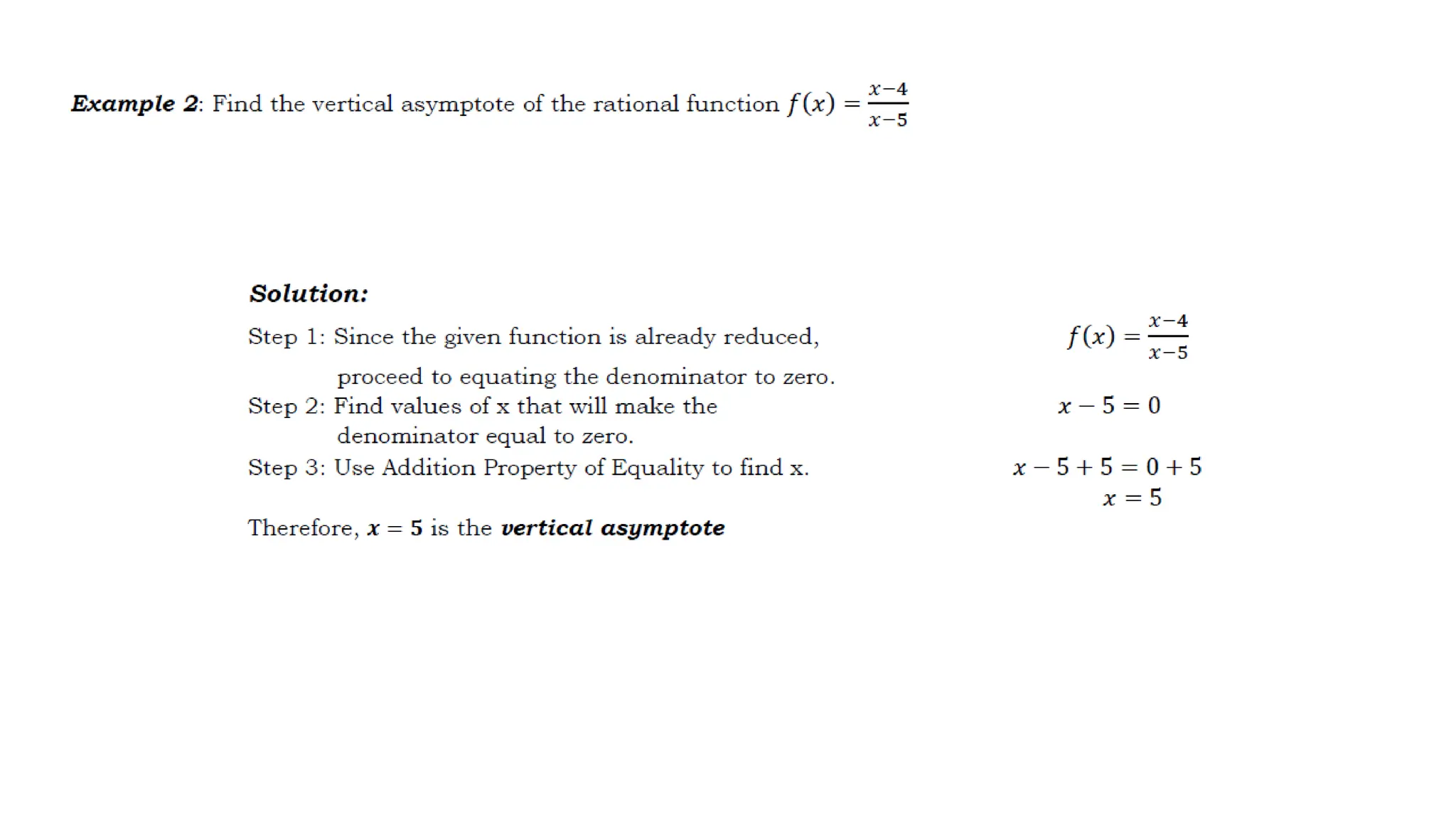
•(a) Reduce the rational function to
lowest terms by cancelling out the
•common factor/s in the numerator
and denominator.
•(b) Find the values a that will make
the denominator of the reduced
rational function equal to zero.
•(c) The line x = a is the vertical
asymptote.
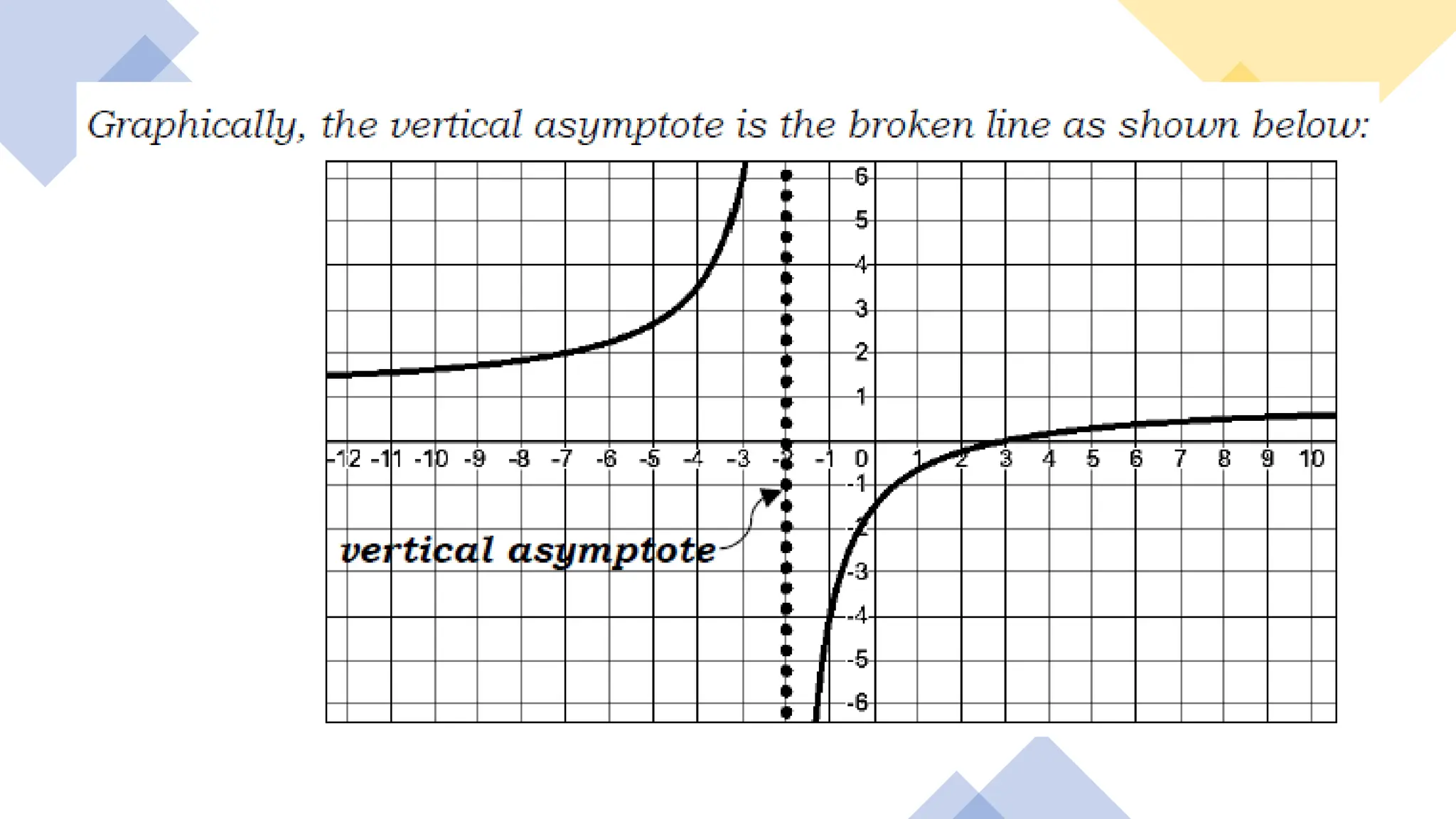
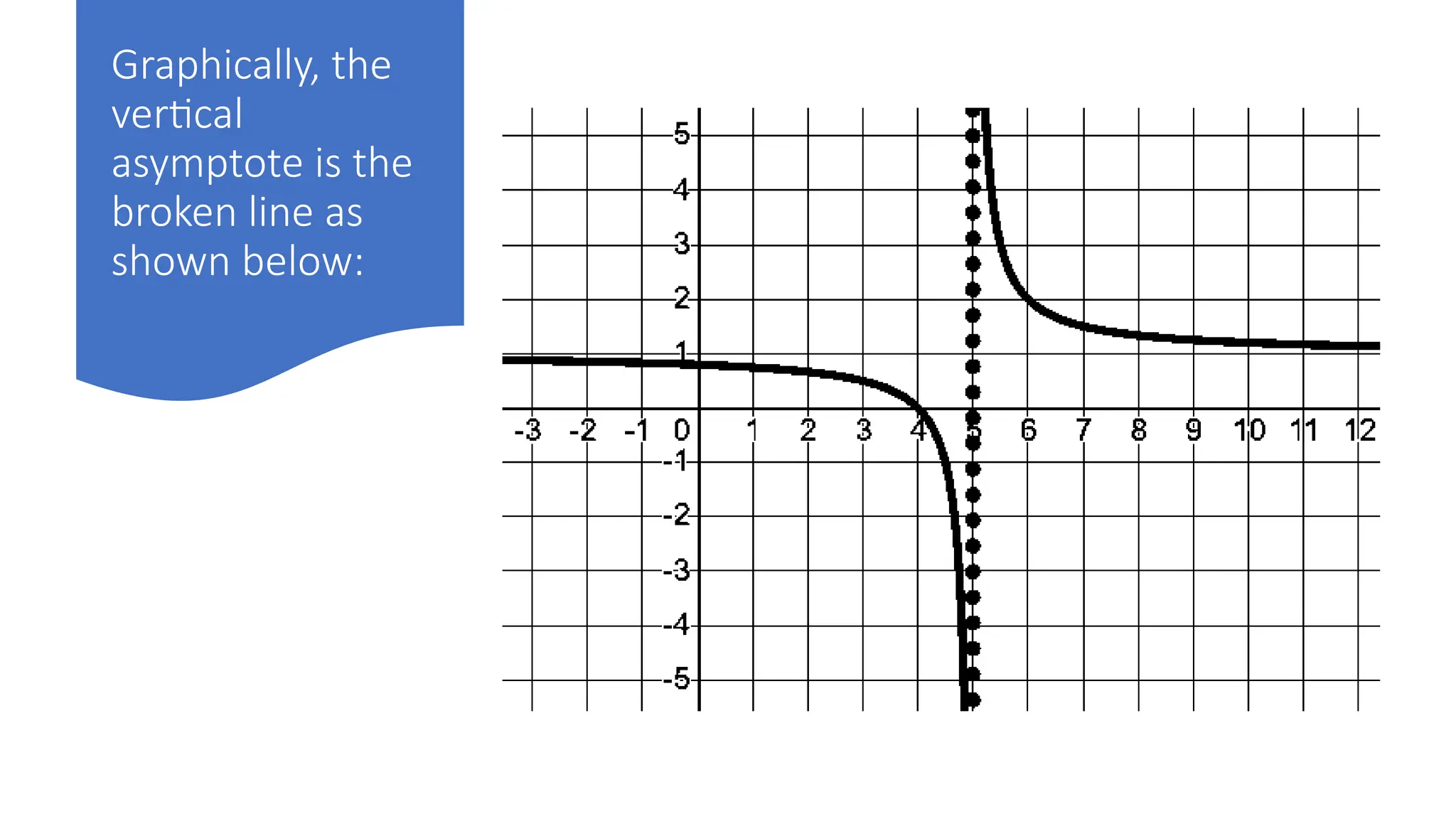
Graphically, the
vertical
asymptote is the
broken line as
shown below:
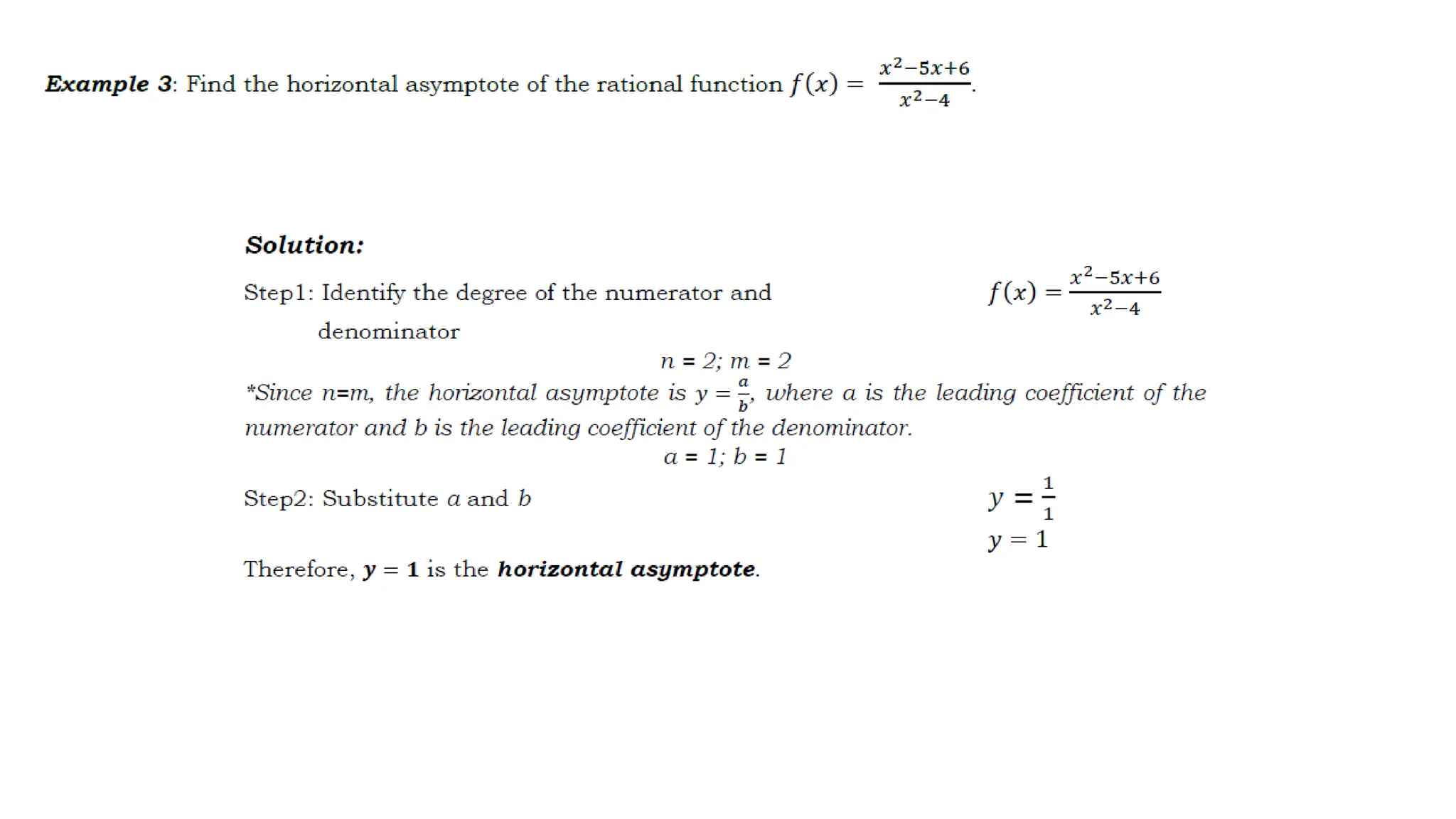
Horizontal
Asymptotes
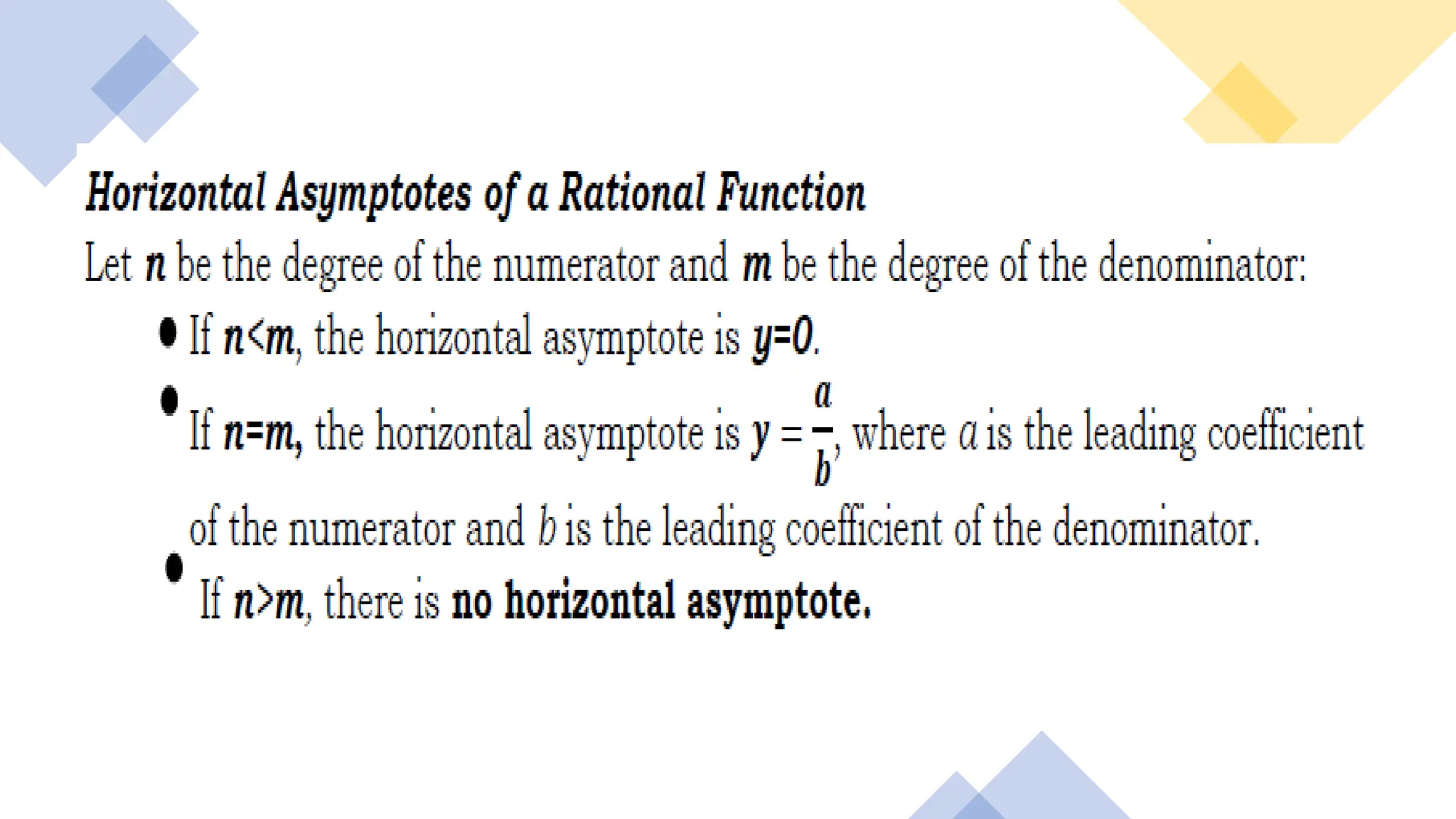
•Definition:
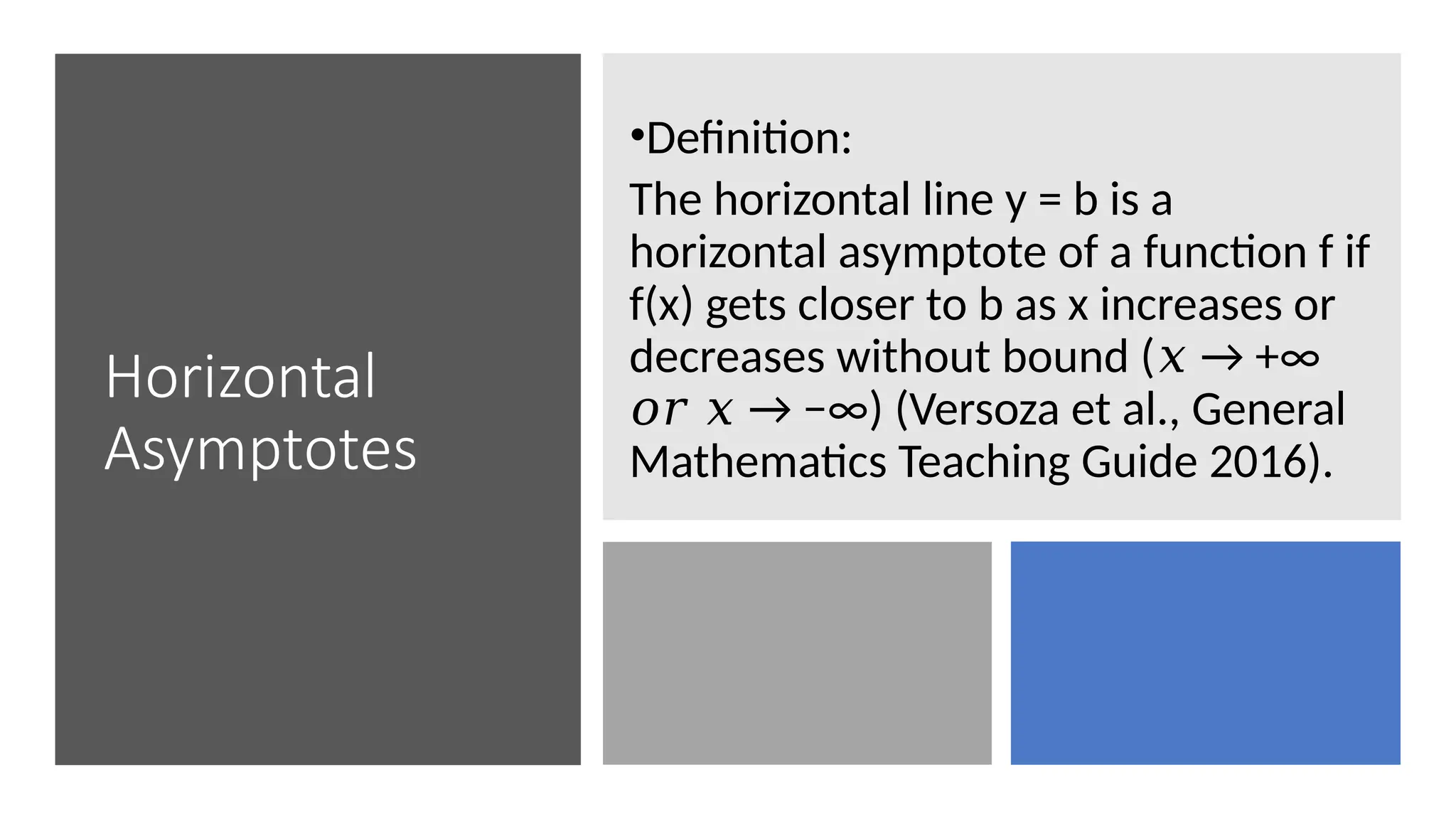
The horizontal line y = b is a
horizontal asymptote of a function f if
f(x) gets closer to b as x increases or
decreases without bound ( → +∞
𝑥
→ −∞) (Versoza et al., General
𝑜𝑟 𝑥
Mathematics Teaching Guide 2016).
•*A rational function may or may not cross
its horizontal asymptote. If the function
does not cross the horizontal asymptote
y=b, then b is not part of the range of the
rational function.
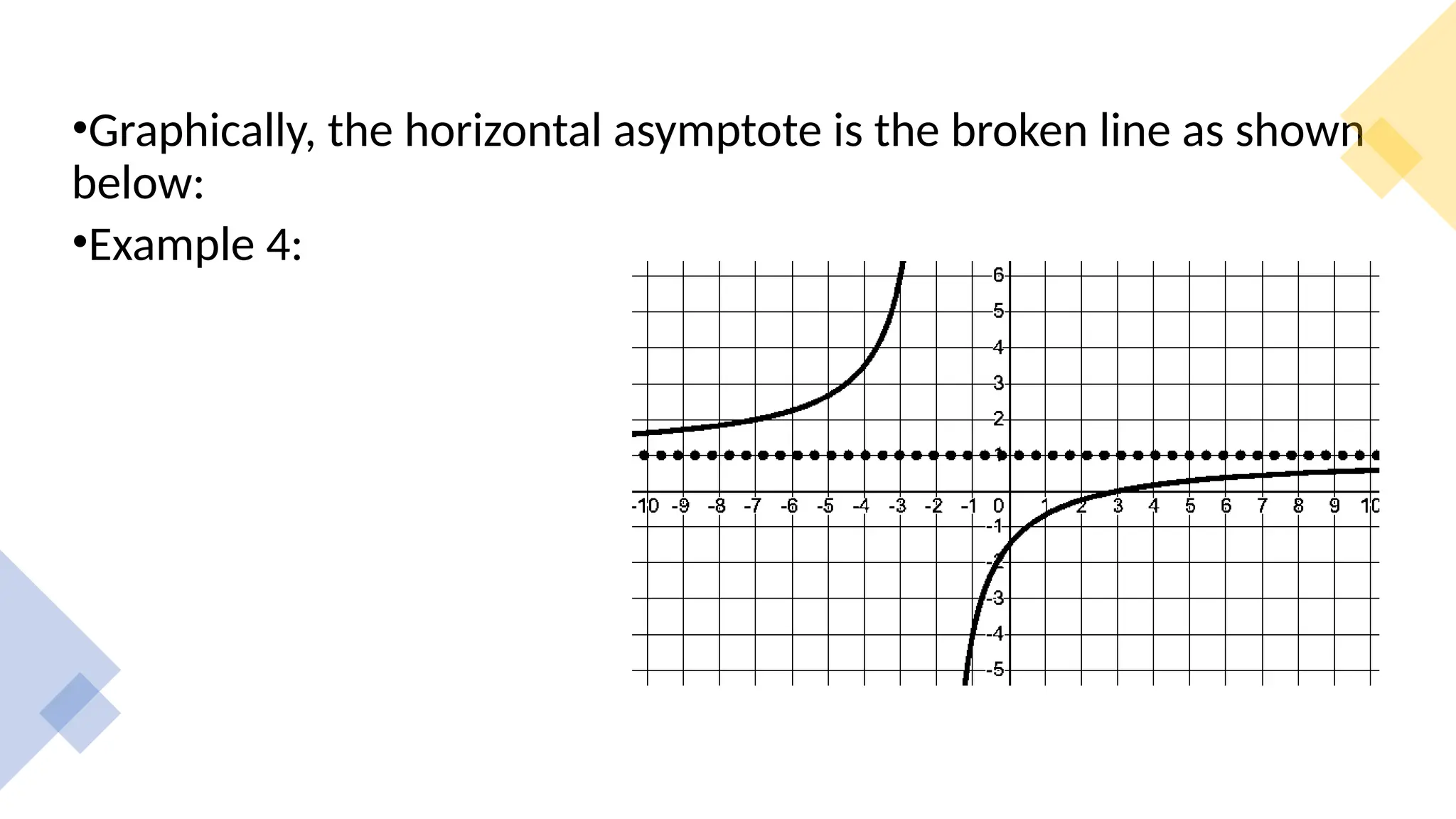
•Graphically, the horizontal asymptote is the broken line as shown
below:
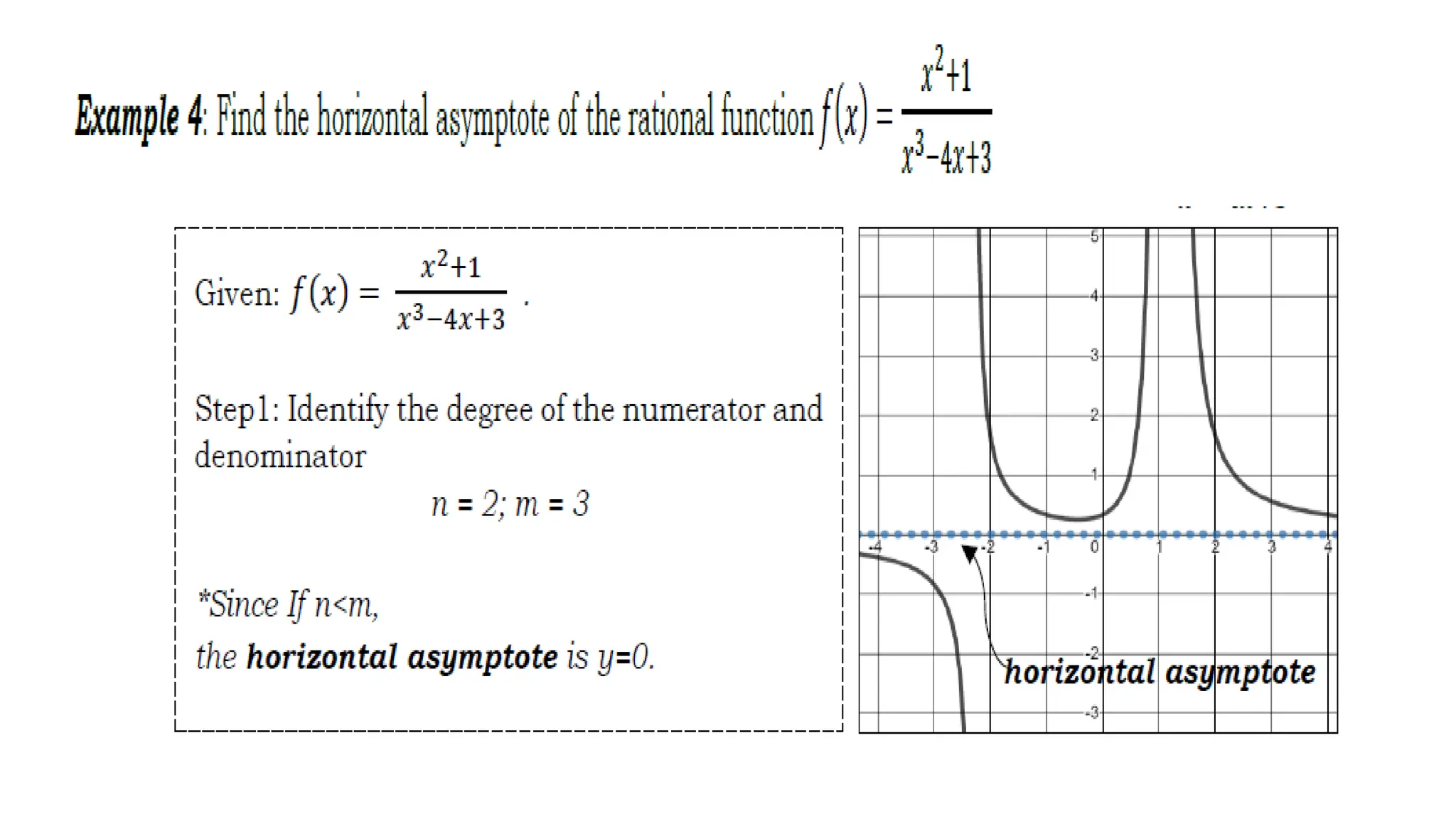
•Example 4:
NOW IT’S YOUR TURN!
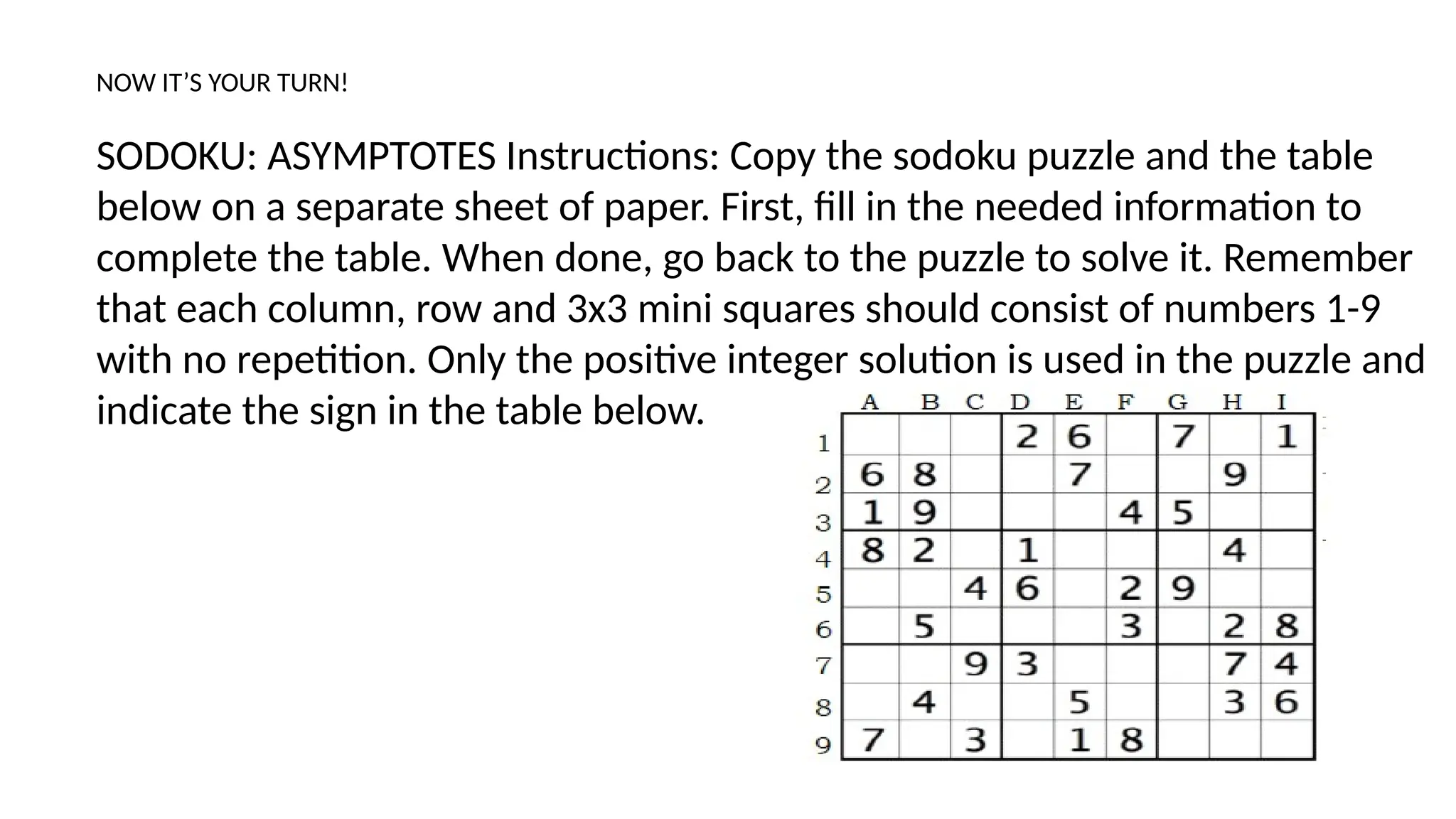
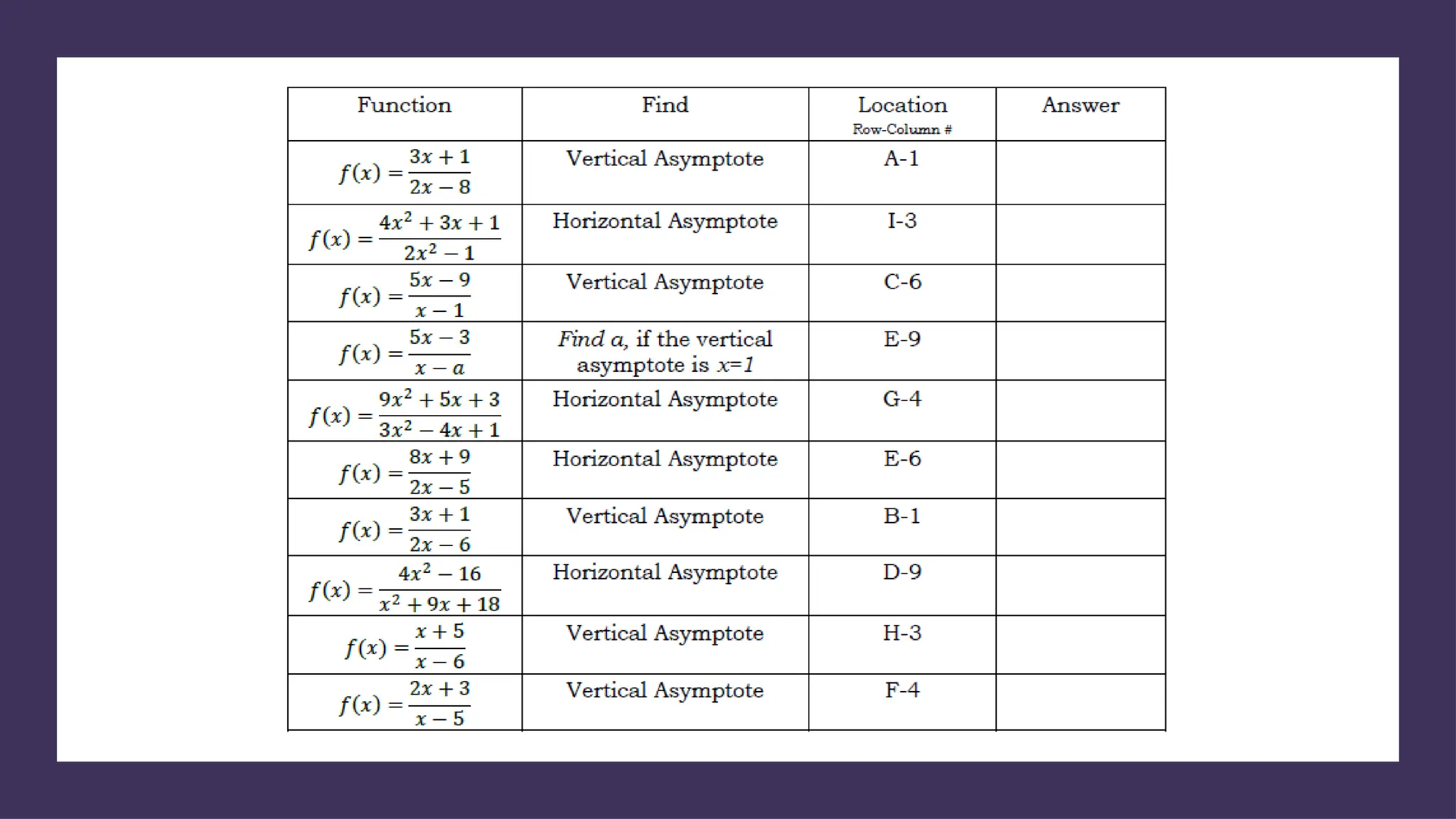
SODOKU: ASYMPTOTES Instructions: Copy the sodoku puzzle and the table
below on a separate sheet of paper. First, fill in the needed information to
complete the table. When done, go back to the puzzle to solve it. Remember
that each column, row and 3x3 mini squares should consist of numbers 1-9
with no repetition. Only the positive integer solution is used in the puzzle and
indicate the sign in the table below.
Remember
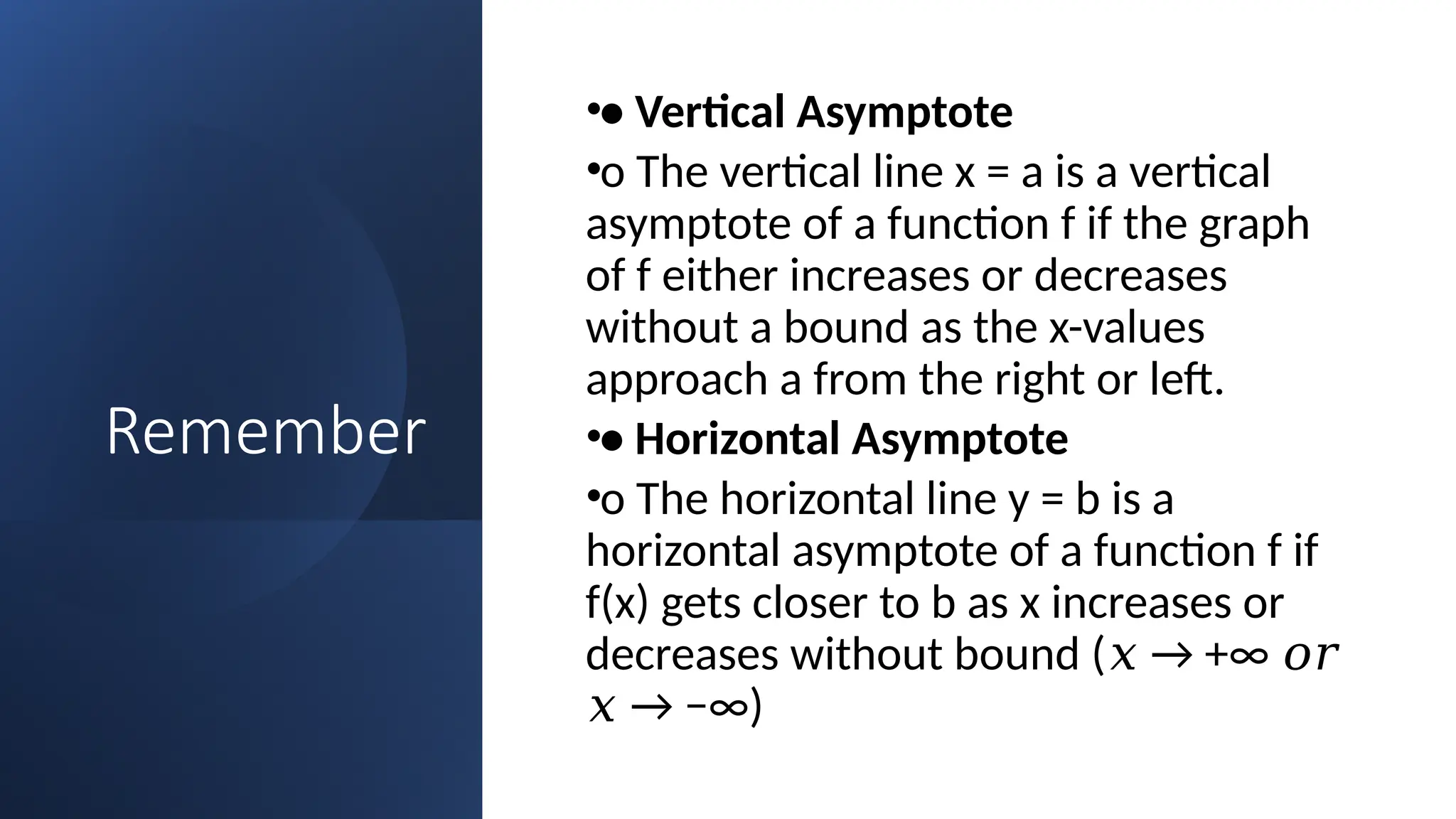
•• Vertical Asymptote
•o The vertical line x = a is a vertical
asymptote of a function f if the graph
of f either increases or decreases
without a bound as the x-values
approach a from the right or left.
•• Horizontal Asymptote
•o The horizontal line y = b is a
horizontal asymptote of a function f if
f(x) gets closer to b as x increases or
decreases without bound ( → +∞
𝑥 𝑜𝑟
→ −∞)
𝑥
Lesson 12
Solving Problems Involving Rational
Functions, Equations and Inequalities
At the end of this lesson,
you are expected to:
o solve problems involving
Rational Functions,
Equations and Inequalities
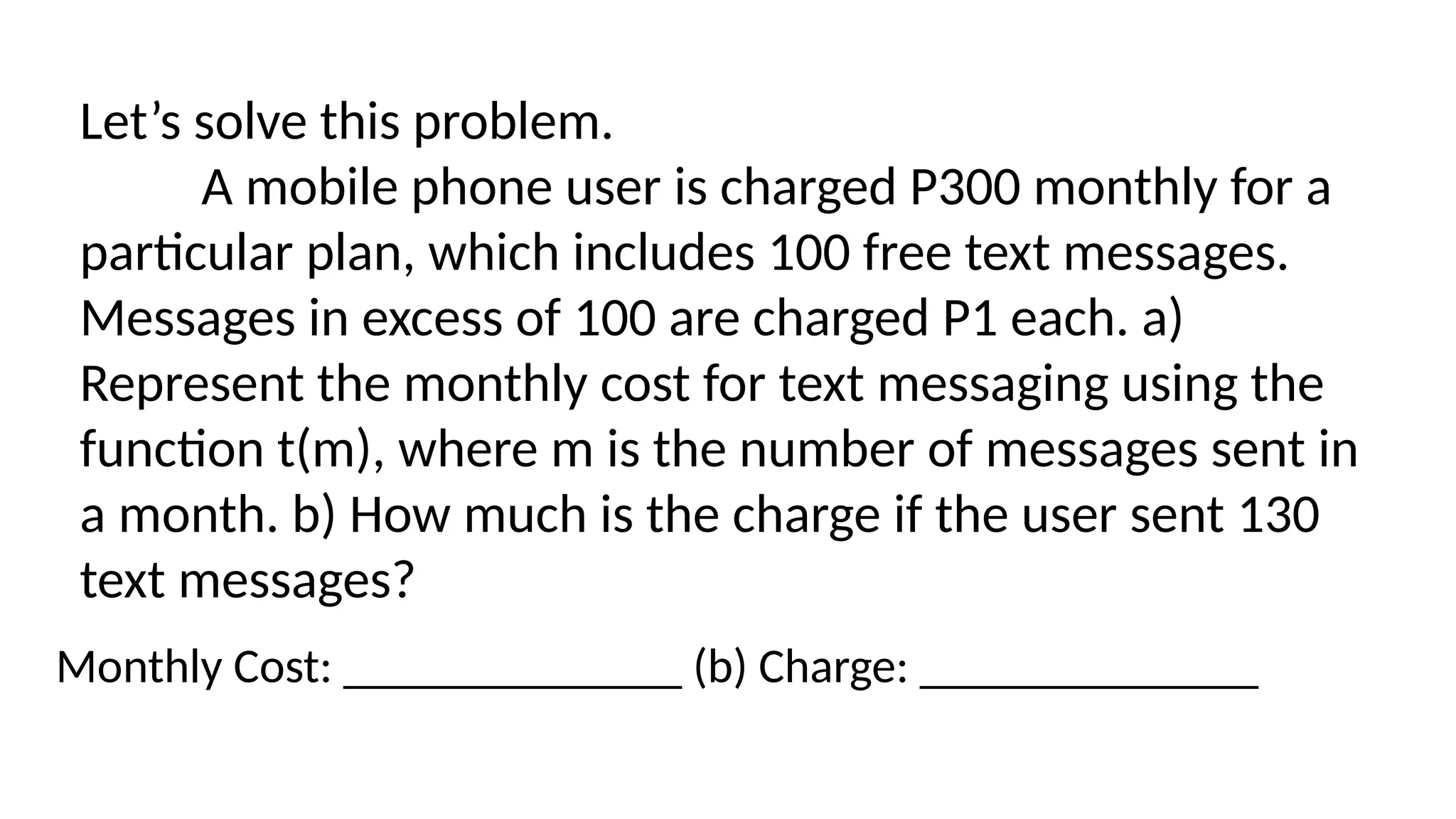
Let’s solve this problem.
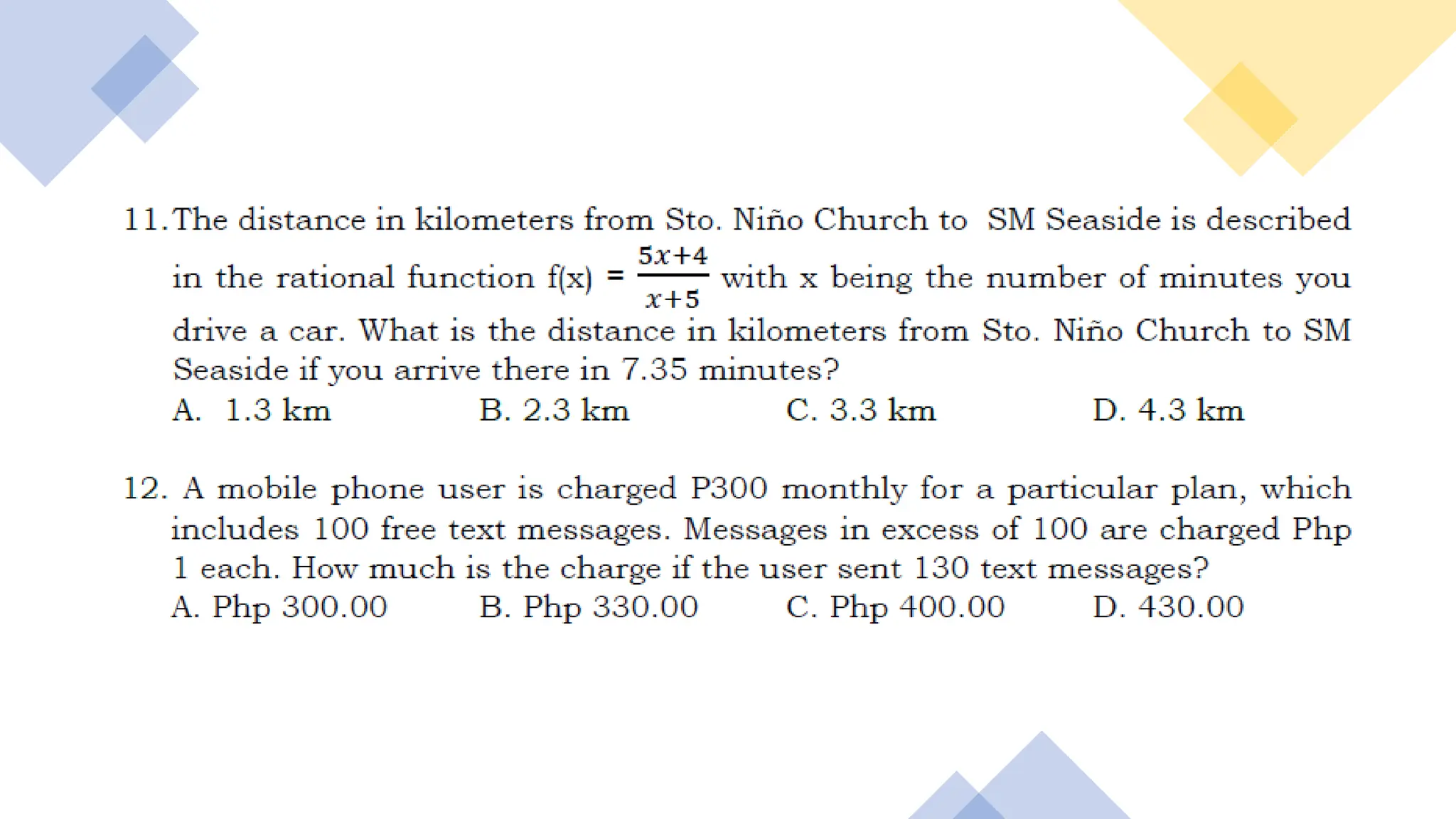
A mobile phone user is charged P300 monthly for a
particular plan, which includes 100 free text messages.
Messages in excess of 100 are charged P1 each. a)
Represent the monthly cost for text messaging using the
function t(m), where m is the number of messages sent in
a month. b) How much is the charge if the user sent 130
text messages?
Monthly Cost: ______________ (b) Charge: ______________
PROBLEM SOLVING
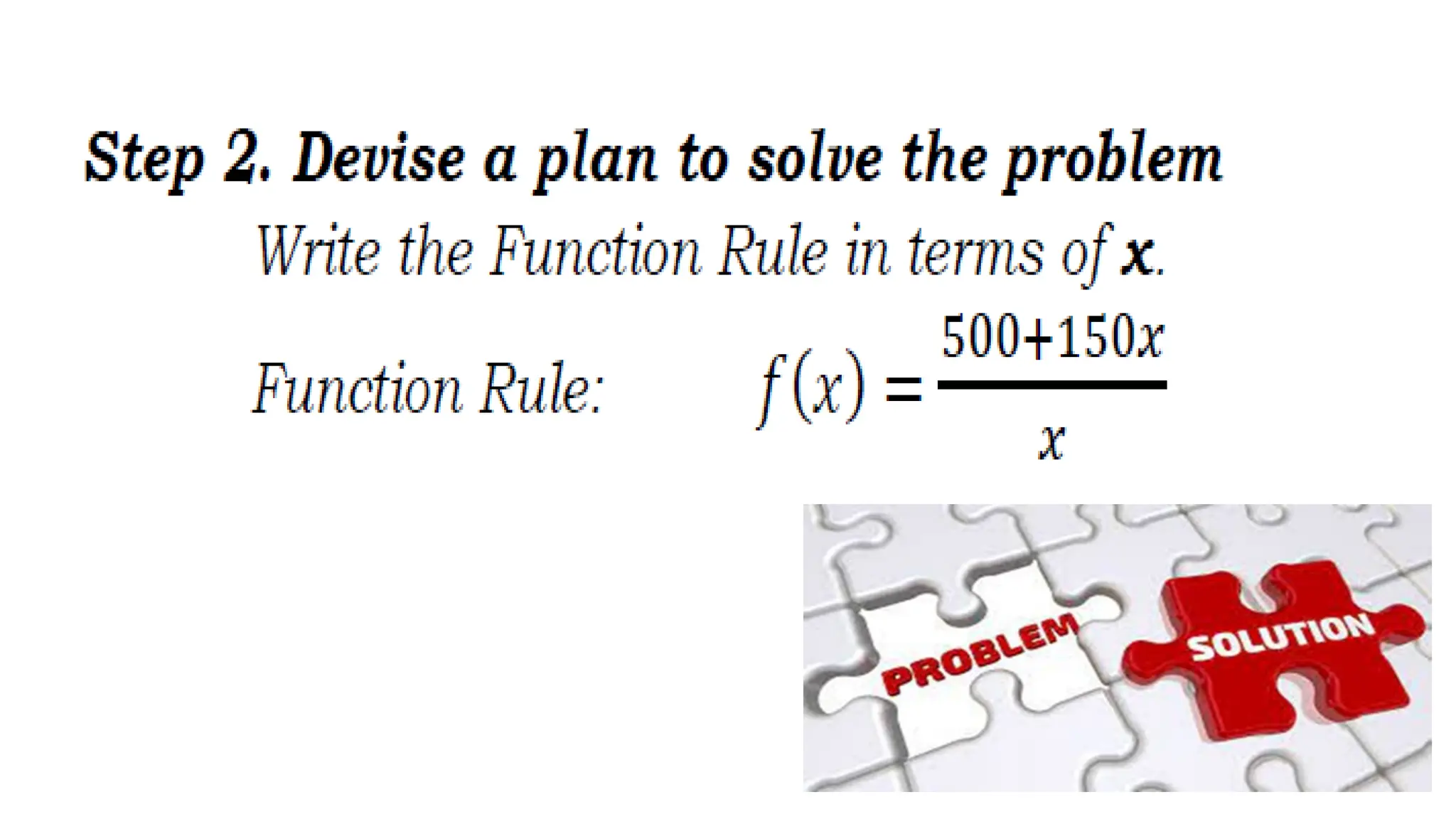
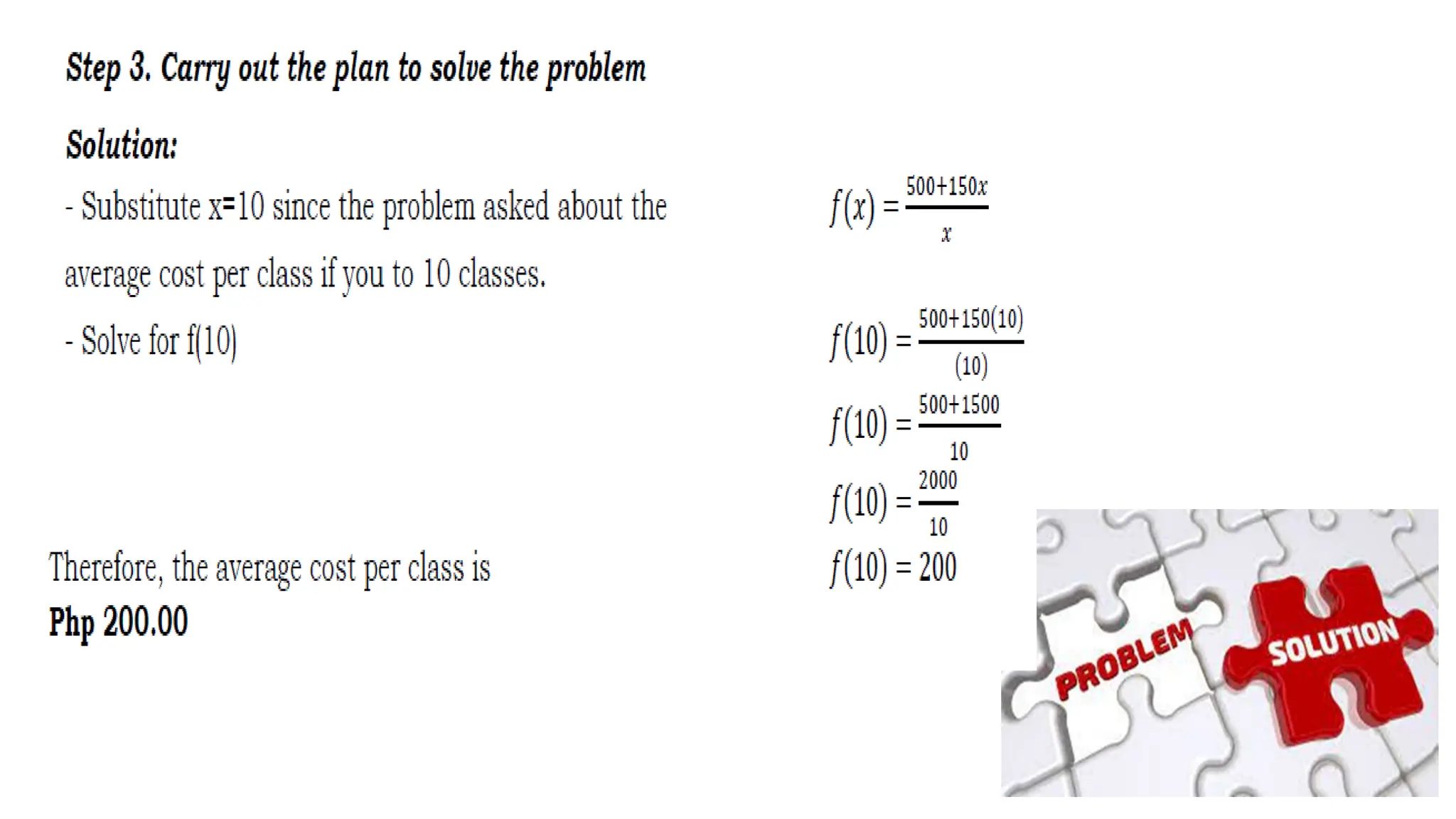
Example 1: You want to join an
online calligraphy class. You will pay
an annual membership fee of Php
500.00, then Php 150.00 for each
class you go to. What is the average
cost per class if you go to 10 classes?
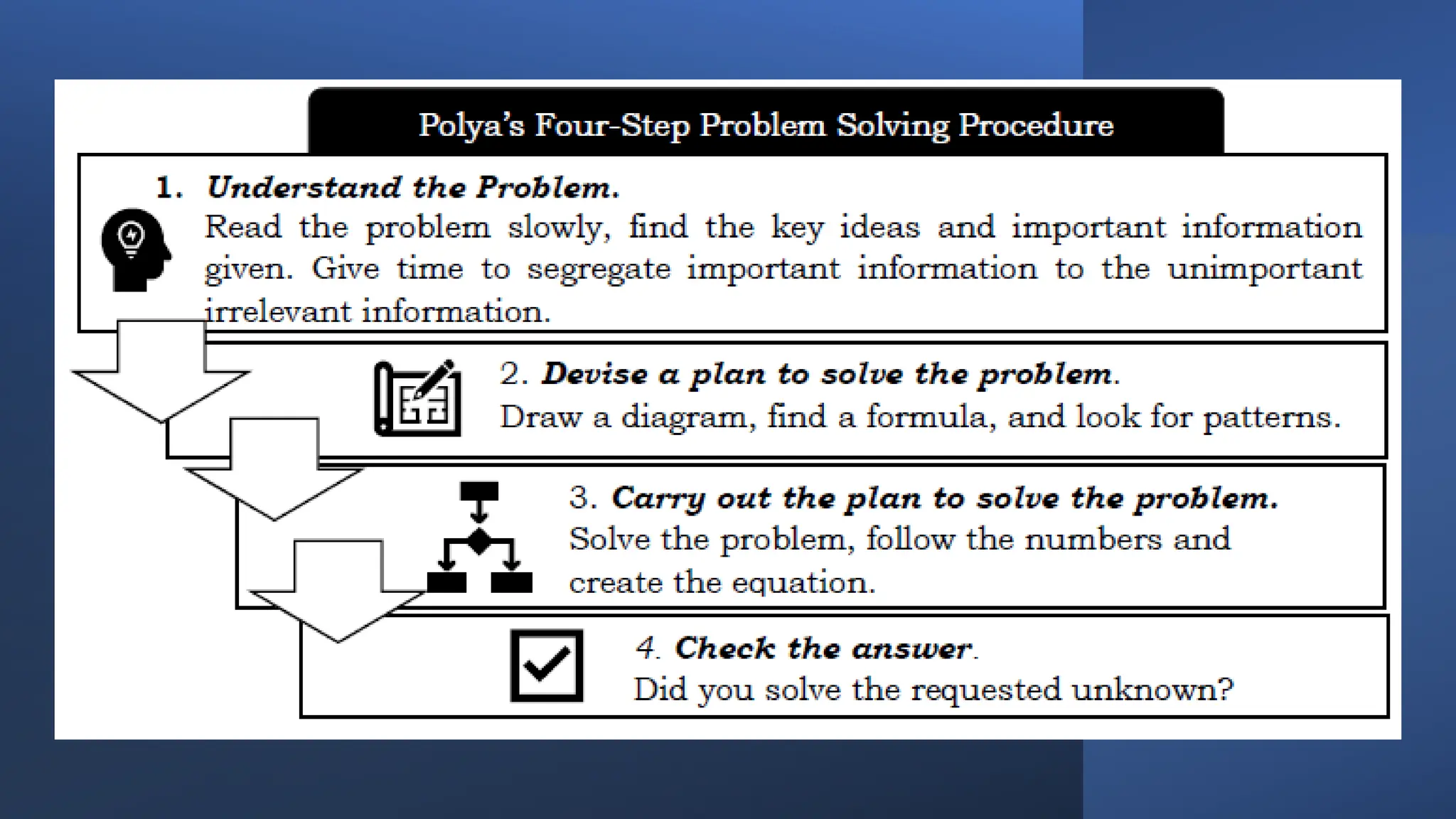
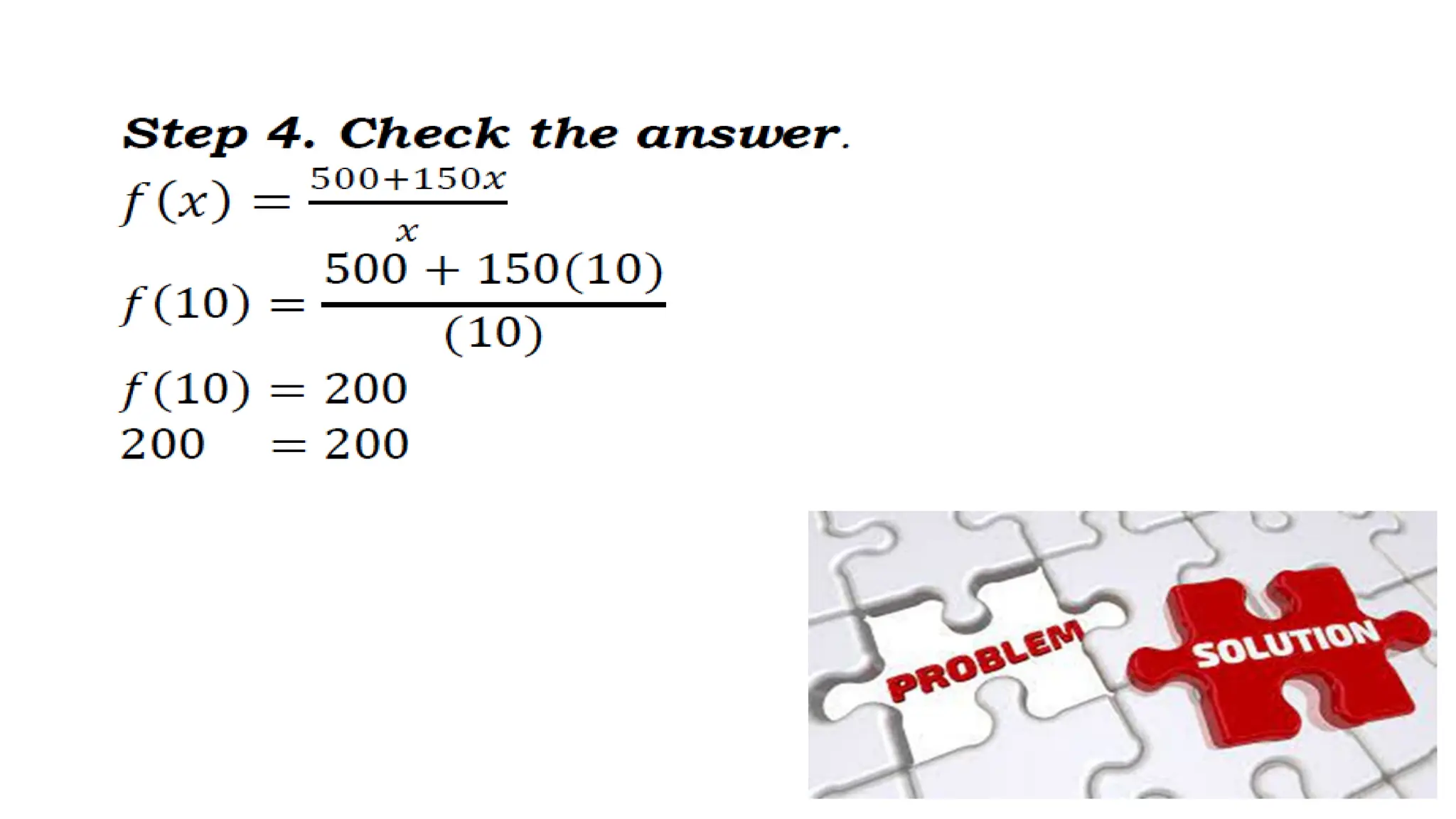
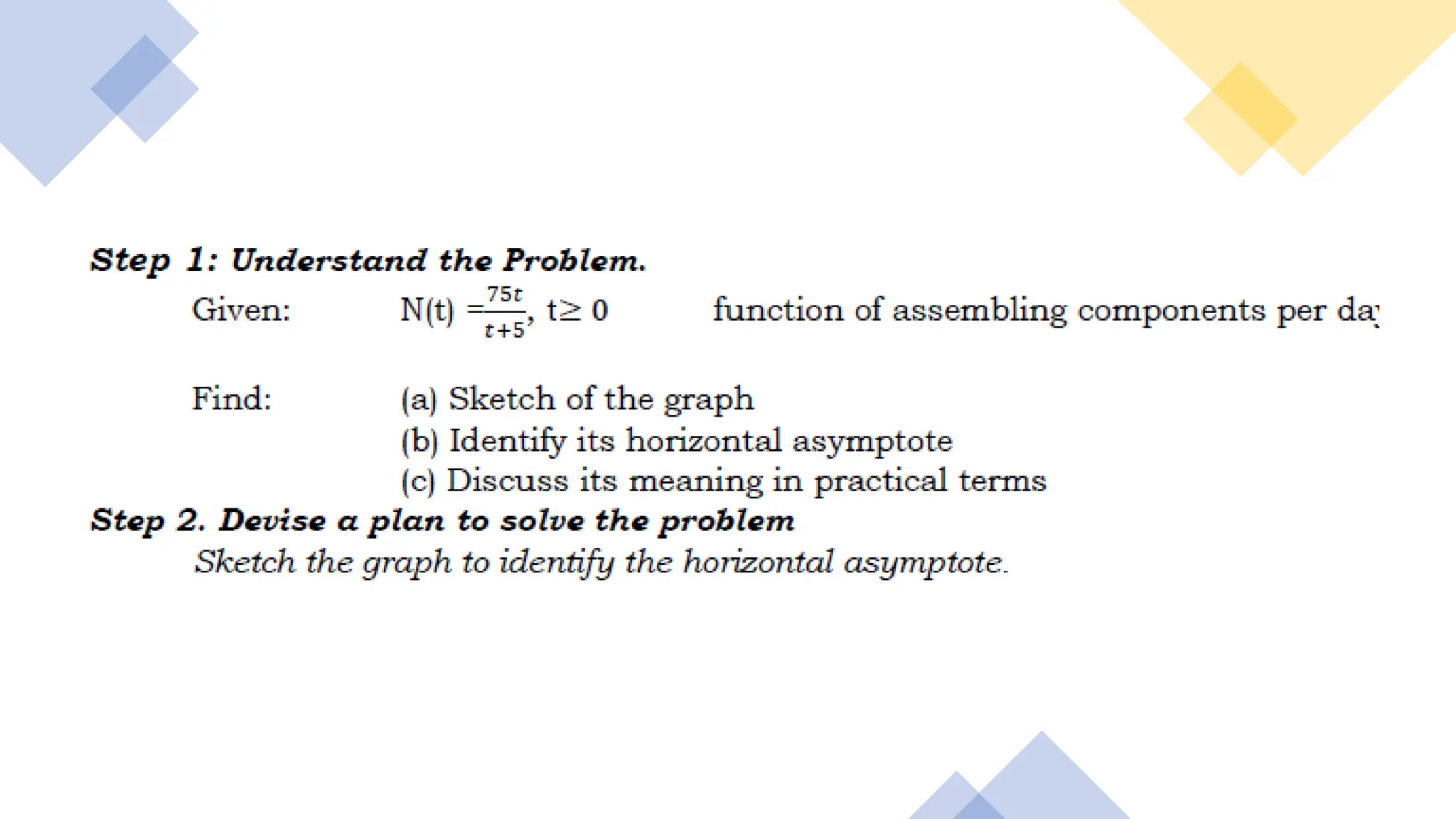
Step 1: Understand the Problem. Given: Php
500.00 - annual membership fee Php 150.00 -
payment per class you attend 10 classes -
number of classes Find: What is the average
cost per class if you go to 10 classes?
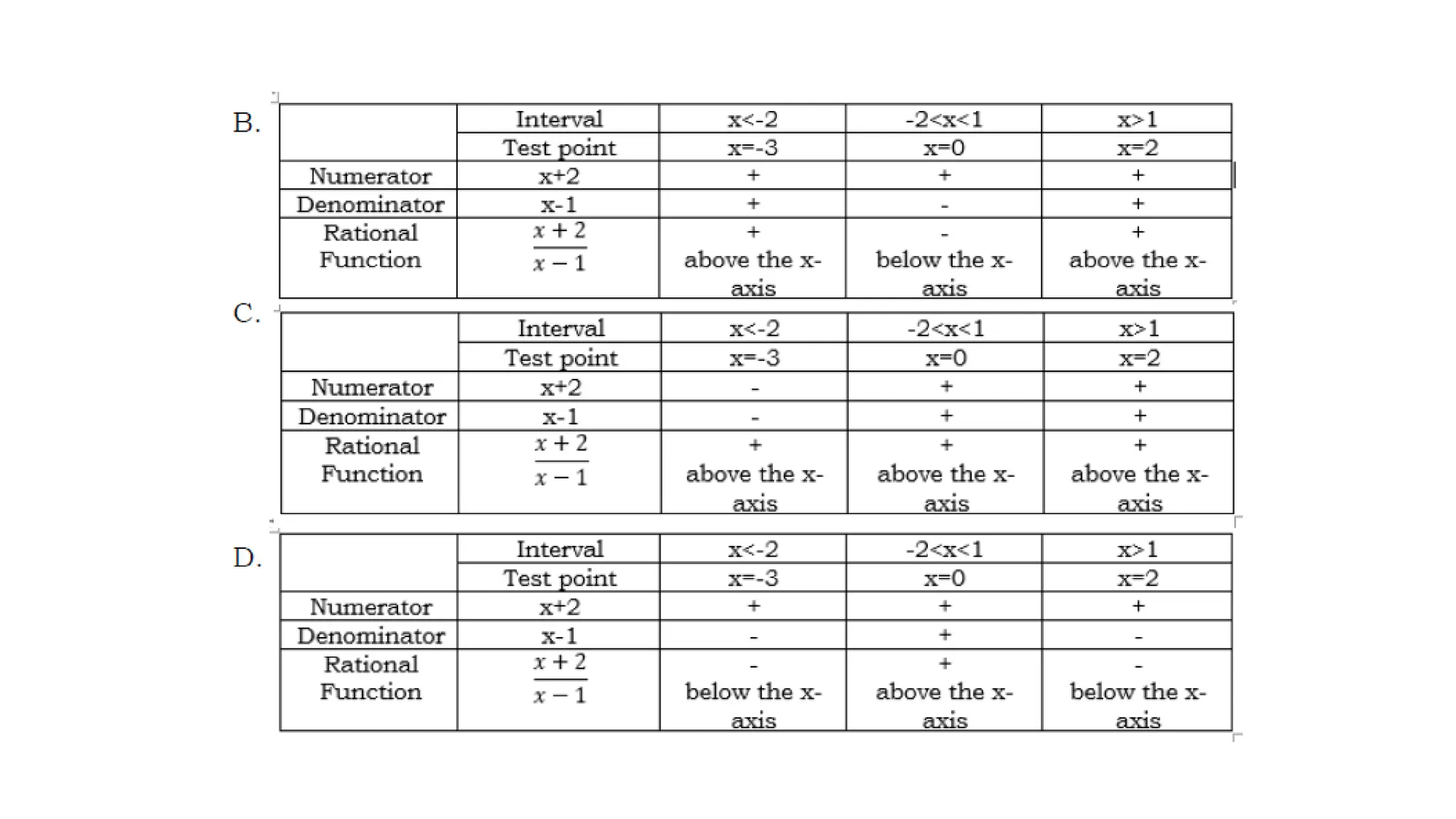
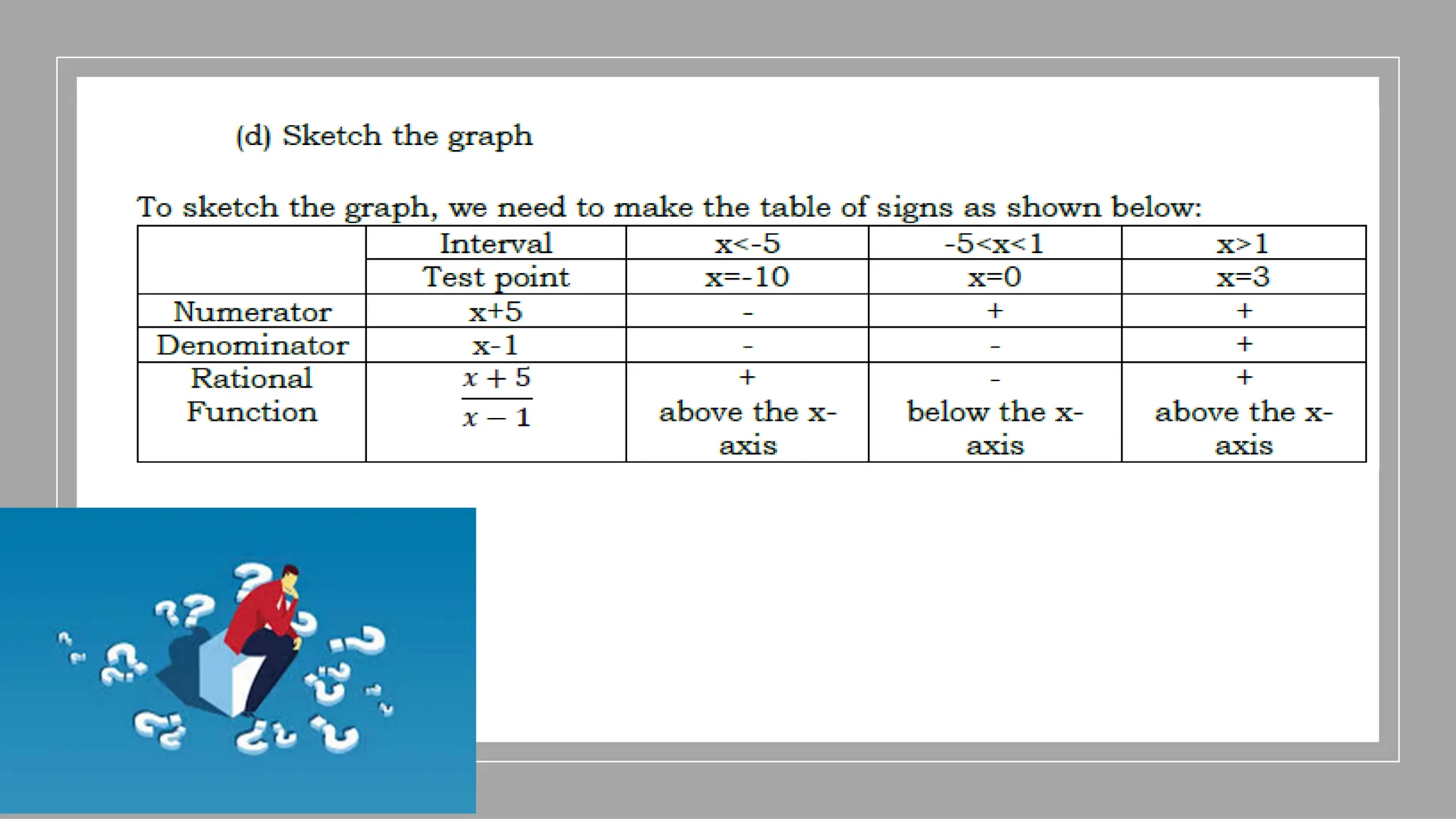
To get the table of signs, just substitute the
values of the test point to the numerator,
denominator, and the whole rational function.
The sign of the answer will be written in the
table of signs as shown in the in the previous
From (a) to (c) and table of signs,
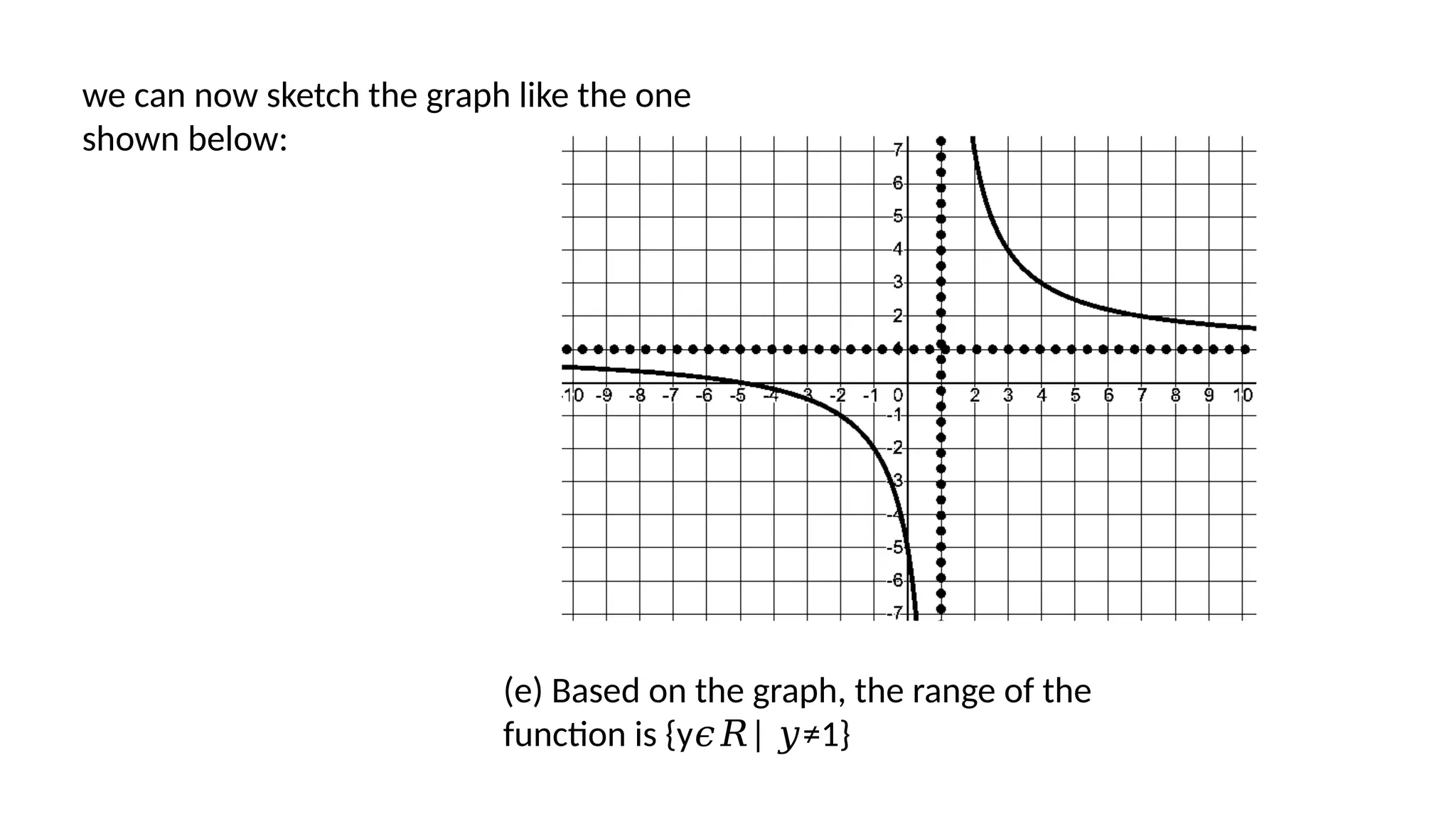
we can now sketch the graph like the one
shown below:
(e) Based on the graph, the range of the
function is {y | ≠1}
𝜖𝑅 𝑦
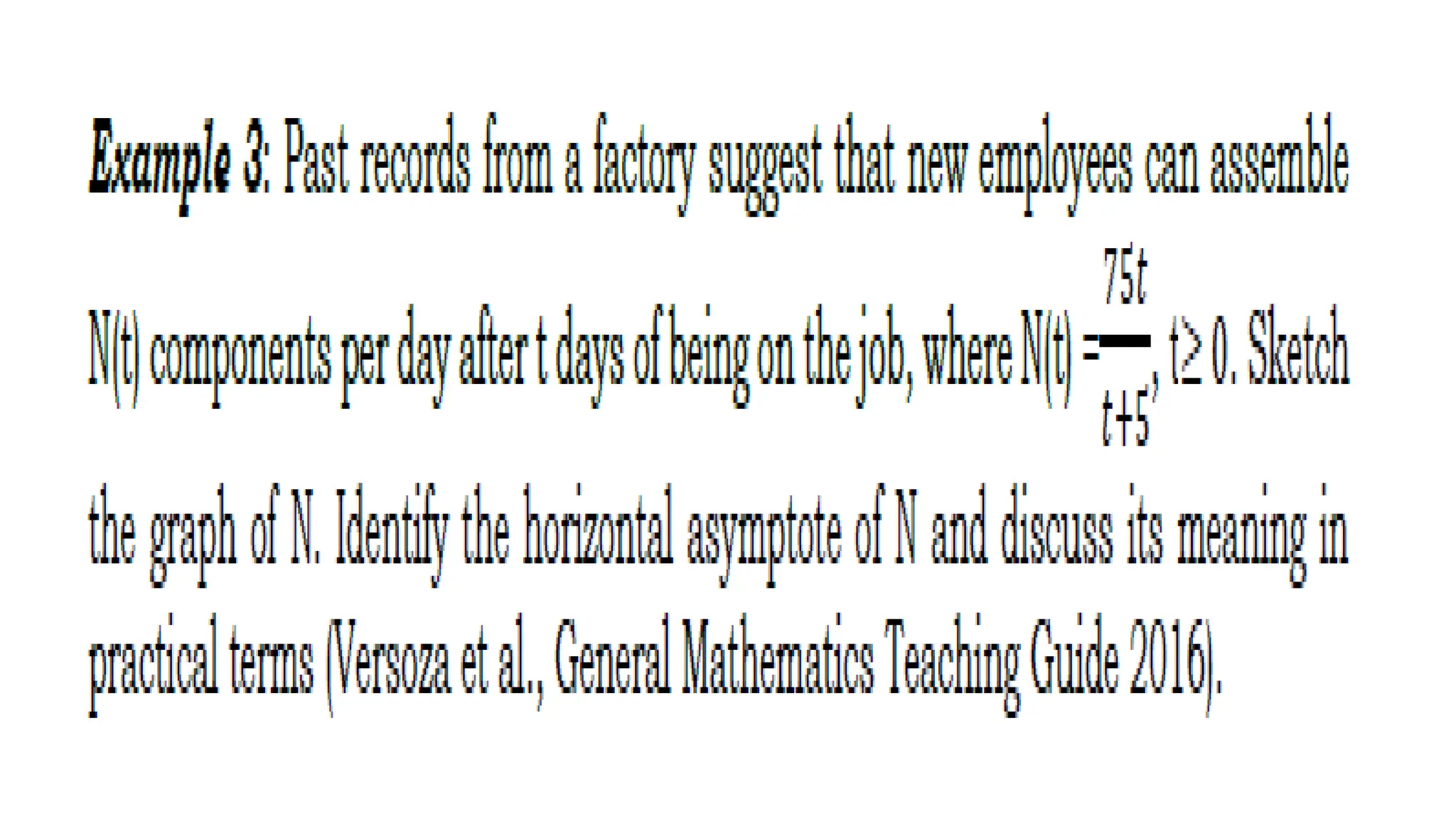
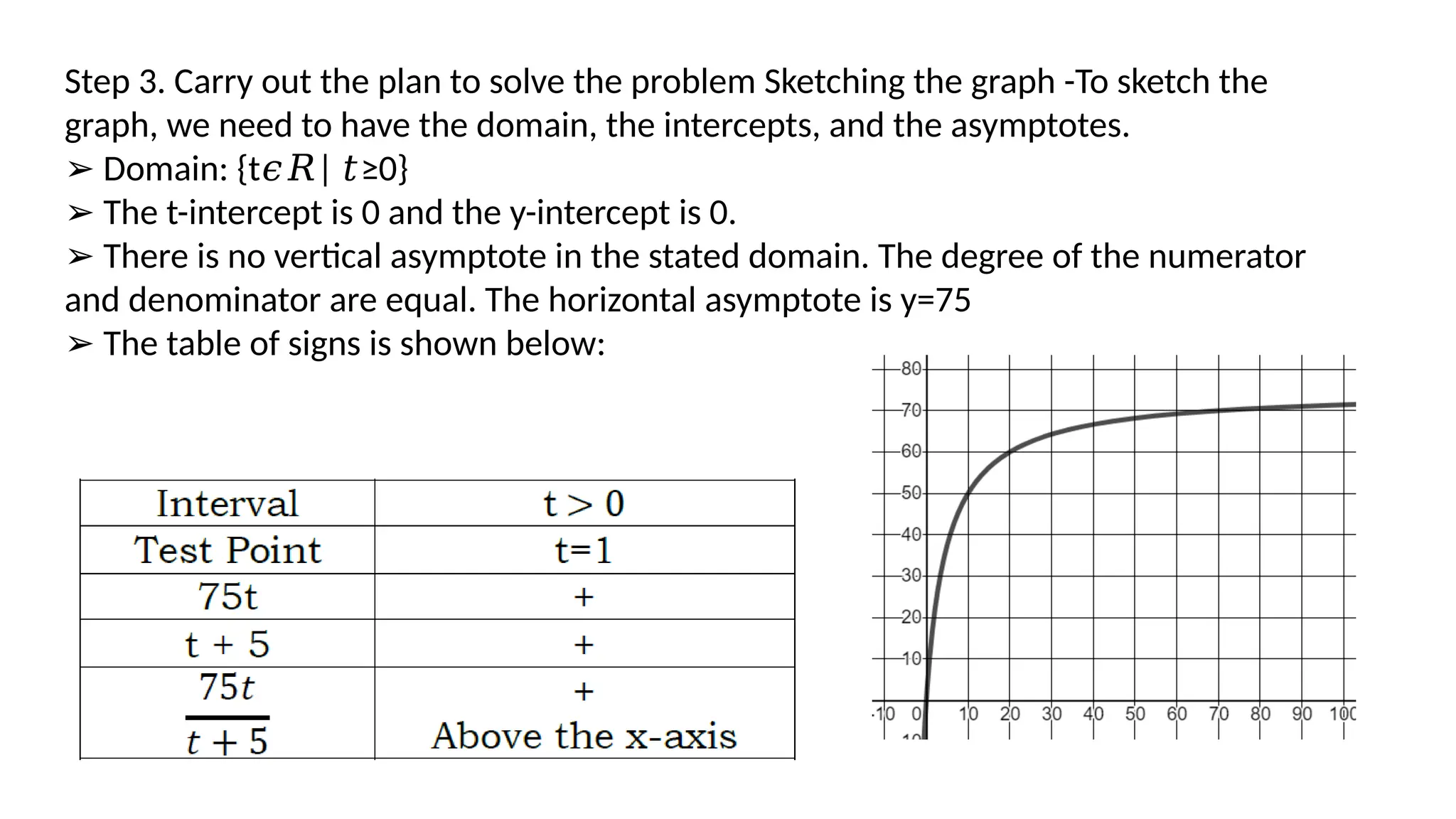
Step 3. Carry out the plan to solve the problem Sketching the graph -To sketch the
graph, we need to have the domain, the intercepts, and the asymptotes.
➢ Domain: {t | ≥0}
𝜖𝑅 𝑡
➢ The t-intercept is 0 and the y-intercept is 0.
➢ There is no vertical asymptote in the stated domain. The degree of the numerator
and denominator are equal. The horizontal asymptote is y=75
➢ The table of signs is shown below:
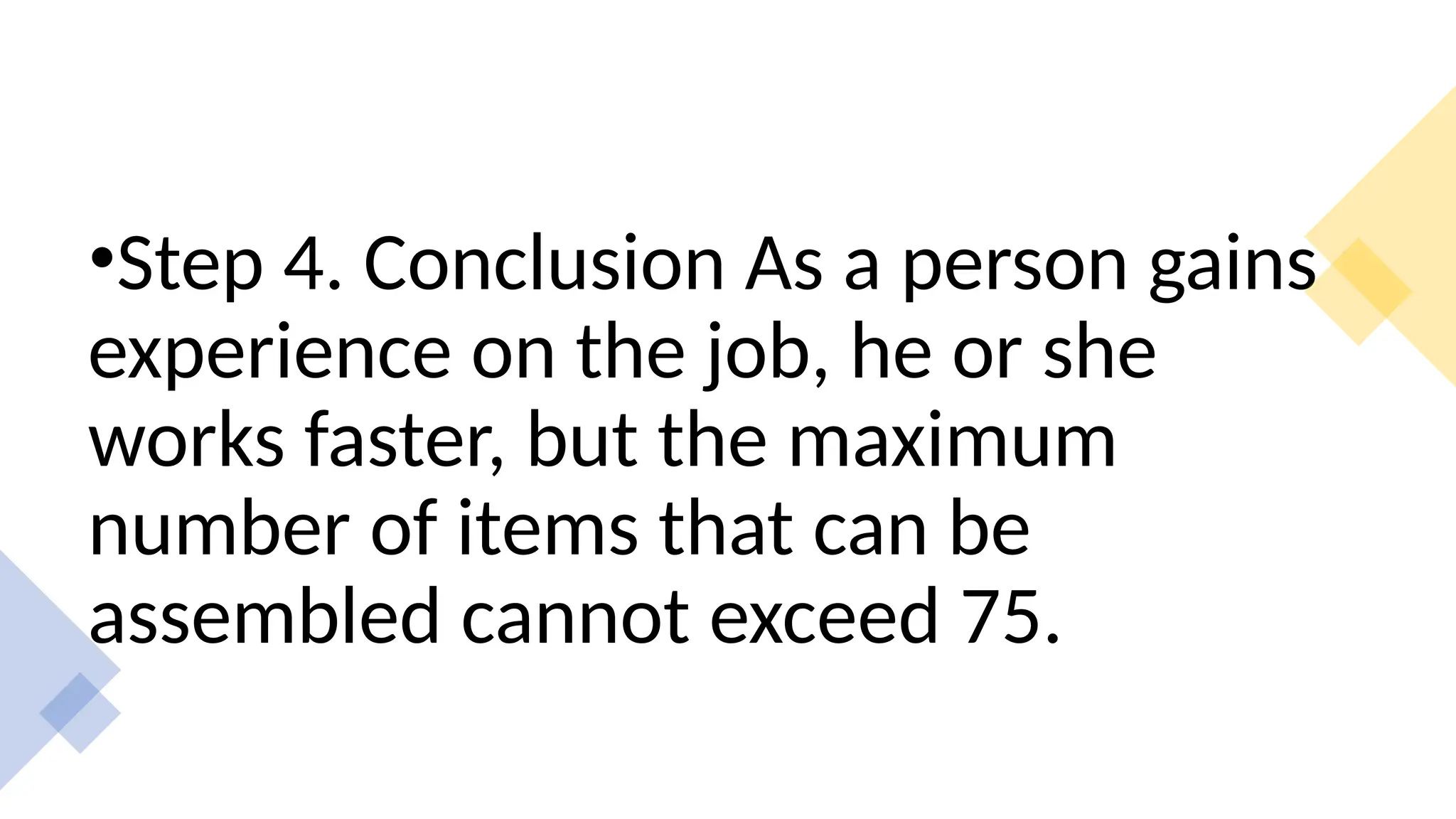
•Step 4. Conclusion As a person gains
experience on the job, he or she
works faster, but the maximum
number of items that can be
assembled cannot exceed 75.
NOW IT’S YOUR TURN!
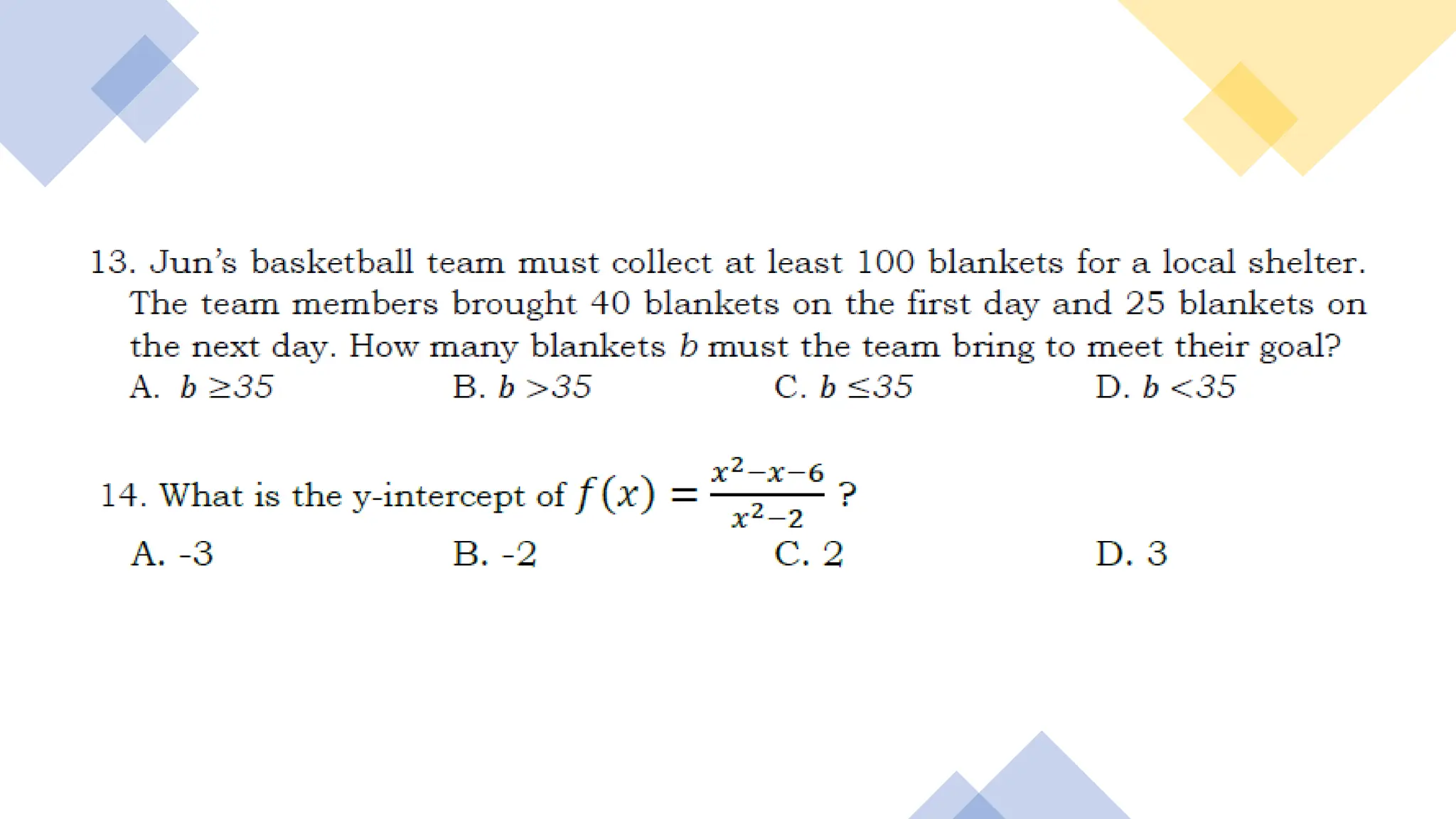
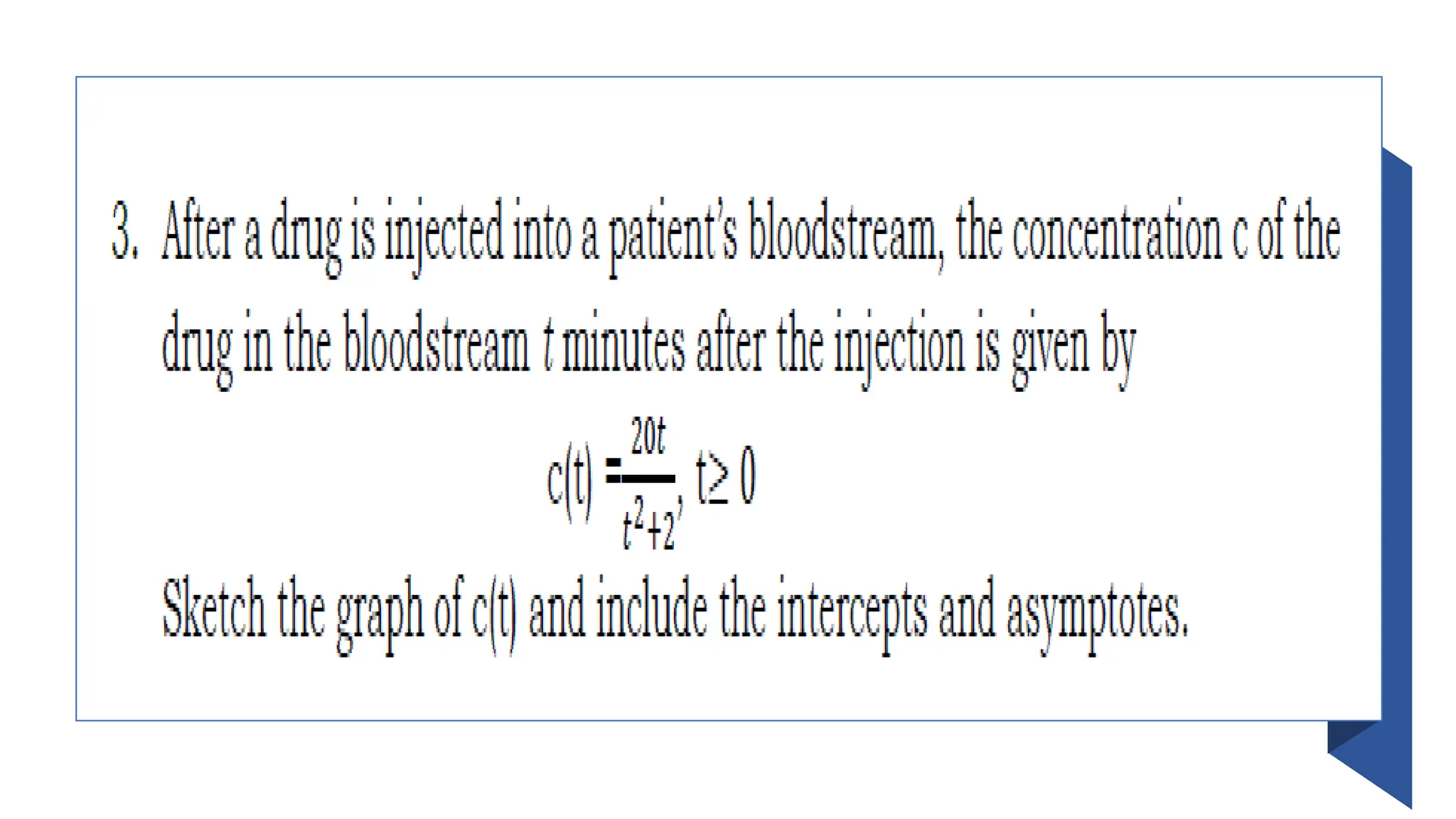
•2. Jonathan’s badminton team must collect at
least 160 shuttlecocks for their practices in
preparation for Palarong Pambansa. The team
members brought 42 shuttlecocks on Monday
and 65 shuttle cocks on Wednesday. How many
more shuttlecocks must the team bring to
meet their goal?
Remember
•• In solving problems, follow the steps to
have a systematic way of answering.
•• In sketching a rational inequality, identify
the (a) domain, (b) intercepts, (c)
asymptotes and (d) table of signs of the
given inequality.

2.1 RATIONAL EQUATIONS, FUNCTIONS, INEQUALITIES SOLVING PROBLEMS.pptx

  • 1.
    Rational Equations, Functionsand Inequalities: Solving Problems General Mathematics
  • 2.
  • 3.
    Instructions: Choose theletter of the correct answer and write them on a separate sheet of paper. 1. Which of the following statements is TRUE? A. The zeroes of a function will make the value of the denominator zero. B. The y-intercept is equal to the x-intercept. C. The y-intercept is always greater than the x-intercept. D. The real numbered zeroes are also the x-intercepts of function.
  • 8.
    10. Which ofthe following shows the correct graph of the function in number 9? B. A. C. D.
  • 11.
    •15. Which ofthe following statement is TRUE? •A. Horizontal asymptotes are always equal to the vertical asymptotes. •B. Vertical asymptotes are equal to the value of the x-intercepts. •C. Horizontal asymptotes depend on the degrees of the leading coefficient. •D. Vertical asymptotes are always equal to zero.
  • 12.
  • 13.
    •At the endof this lesson, you are expected to: •o represent real life situations using rational functions; and •o determine the zeroes and y-intercepts of rational functions.
  • 14.
    •Let’s start with areview about rational function.
  • 16.
    •Look at thegraph below. Can you point out the zeroes and y- intercepts of the given rational function? Try it!
  • 17.
    •What are ZEROES andy-INTERCEPTS of a Function?
  • 18.
    Zeroes: These are thevalues of x which make the function zero. The real numbered zeroes are also x-intercepts of the graph of the function. y- Intercept: The y-intercept is the function value when the value of x is equal to 0. (Versoza et al., General Mathematics Teaching Guide 2016)
  • 19.
    Solution: (a) zeroesSince the zeroes or x-intercepts of a rational function are the values of x that will make the function zero. A rational function will be zero if its numerator is zero. Therefore, the zeroes of a rational function are the zeroes of its numerator. Step 1: Take the numerator and equate it to zero. x - 3 = 0 Step 2: Find the value of x using Addition Property of Equality, add +3 to both sides. x – 3 + 3 = 0 + 3 , simplify x = 3 Therefore, 3 is a zero of f(x).
  • 21.
    (a) zeroes Tofind the zeroes of this function, let’s equate the numerator to zero. The zeroes of a rational function are the zeroes of its numerator. Step 1: Take the numerator (−3 +2) and equate it to zero. 𝑥 2−3 +2=0 Step 2: Find the value of x by factoring (x-2)(x-1) =0 𝑥 𝑥 Step 3: Equate each factor to zero and solve for x.
  • 24.
  • 26.
    Remember • Zeroes Theseare the values of x which make the function zero. • y- Intercept The y- intercept is the function value when the value of x is equal to 0 (x=0).
  • 27.
  • 28.
    At the endof this lesson, you are expected to: o differentiate horizontal and vertical asymptotes; and o determine the horizontal and vertical asymptotes of rational functions.
  • 29.
    •Asymptotes of Rational Functions:Consider the graph shown. Observe that the graph approaches closer and closer but never touches an imaginary line. Can you spot where that imaginary line is? Draw a broken line to locate that line. I know you can do it!
  • 30.
    What is anASYMPTOTE?
  • 31.
    •An asymptote isa line that a curve approaches or gets closer and closer to but never touches. It could be a horizontal, vertical, or slanted line (Math is Fun 2020).
  • 32.
    Vertical Asymptotes •Definition: •The vertical linex = a is a vertical asymptote of a function f if the graph of f either increases or decreases without a bound as the x-values approach a from the right or left (Versoza et al., General Mathematics Teaching Guide 2016).
  • 33.
    Finding the Vertical Asymptotes of aRational Function •(a) Reduce the rational function to lowest terms by cancelling out the •common factor/s in the numerator and denominator. •(b) Find the values a that will make the denominator of the reduced rational function equal to zero. •(c) The line x = a is the vertical asymptote.
  • 37.
    Graphically, the vertical asymptote isthe broken line as shown below:
  • 38.
    Horizontal Asymptotes •Definition: The horizontal liney = b is a horizontal asymptote of a function f if f(x) gets closer to b as x increases or decreases without bound ( → +∞ 𝑥 → −∞) (Versoza et al., General 𝑜𝑟 𝑥 Mathematics Teaching Guide 2016).
  • 39.
    •*A rational functionmay or may not cross its horizontal asymptote. If the function does not cross the horizontal asymptote y=b, then b is not part of the range of the rational function.
  • 42.
    •Graphically, the horizontalasymptote is the broken line as shown below: •Example 4:
  • 44.
    NOW IT’S YOURTURN! SODOKU: ASYMPTOTES Instructions: Copy the sodoku puzzle and the table below on a separate sheet of paper. First, fill in the needed information to complete the table. When done, go back to the puzzle to solve it. Remember that each column, row and 3x3 mini squares should consist of numbers 1-9 with no repetition. Only the positive integer solution is used in the puzzle and indicate the sign in the table below.
  • 46.
    Remember •• Vertical Asymptote •oThe vertical line x = a is a vertical asymptote of a function f if the graph of f either increases or decreases without a bound as the x-values approach a from the right or left. •• Horizontal Asymptote •o The horizontal line y = b is a horizontal asymptote of a function f if f(x) gets closer to b as x increases or decreases without bound ( → +∞ 𝑥 𝑜𝑟 → −∞) 𝑥
  • 47.
    Lesson 12 Solving ProblemsInvolving Rational Functions, Equations and Inequalities
  • 48.
    At the endof this lesson, you are expected to: o solve problems involving Rational Functions, Equations and Inequalities
  • 50.
    Let’s solve thisproblem. A mobile phone user is charged P300 monthly for a particular plan, which includes 100 free text messages. Messages in excess of 100 are charged P1 each. a) Represent the monthly cost for text messaging using the function t(m), where m is the number of messages sent in a month. b) How much is the charge if the user sent 130 text messages? Monthly Cost: ______________ (b) Charge: ______________
  • 51.
    PROBLEM SOLVING Example 1:You want to join an online calligraphy class. You will pay an annual membership fee of Php 500.00, then Php 150.00 for each class you go to. What is the average cost per class if you go to 10 classes?
  • 52.
    Step 1: Understandthe Problem. Given: Php 500.00 - annual membership fee Php 150.00 - payment per class you attend 10 classes - number of classes Find: What is the average cost per class if you go to 10 classes?
  • 60.
    To get thetable of signs, just substitute the values of the test point to the numerator, denominator, and the whole rational function. The sign of the answer will be written in the table of signs as shown in the in the previous From (a) to (c) and table of signs,
  • 61.
    we can nowsketch the graph like the one shown below: (e) Based on the graph, the range of the function is {y | ≠1} 𝜖𝑅 𝑦
  • 64.
    Step 3. Carryout the plan to solve the problem Sketching the graph -To sketch the graph, we need to have the domain, the intercepts, and the asymptotes. ➢ Domain: {t | ≥0} 𝜖𝑅 𝑡 ➢ The t-intercept is 0 and the y-intercept is 0. ➢ There is no vertical asymptote in the stated domain. The degree of the numerator and denominator are equal. The horizontal asymptote is y=75 ➢ The table of signs is shown below:
  • 65.
    •Step 4. ConclusionAs a person gains experience on the job, he or she works faster, but the maximum number of items that can be assembled cannot exceed 75.
  • 66.
  • 67.
    •2. Jonathan’s badmintonteam must collect at least 160 shuttlecocks for their practices in preparation for Palarong Pambansa. The team members brought 42 shuttlecocks on Monday and 65 shuttle cocks on Wednesday. How many more shuttlecocks must the team bring to meet their goal?
  • 69.
    Remember •• In solvingproblems, follow the steps to have a systematic way of answering. •• In sketching a rational inequality, identify the (a) domain, (b) intercepts, (c) asymptotes and (d) table of signs of the given inequality.