Oral Environment
CHAPTER 2
Oral Environment and
Patient Considerations
To understand why we manipulate materials the
way that we do – first must understand the
challenges of the oral environment
Factors of oral environment:
Moisture
differing stresses
Temperatures
acid levels
2
Oral Environment and
Patient Considerations
 Materials to be used must be:
Biocompatible
Durable
Nonreactive in acid or alkaline conditions
Compatible with other materials
Esthetically acceptable
 Limitations regarding what can and cannot be used safely
vary from patient to patient.
Classification of Dental Materials
 Preventive/therapeutic materials
 used to prevent disease or trauma or for their therapeutic action on the teeth
or oral tissues.
 Examples are mouth guards, pit and fissure sealants, glass ionomer, and fluoride.
 Why is glass ionomer placed in the therapeutic materials category?
 Restorative materials
 materials used to repair or replace tooth structure lost to oral disease or
trauma or to change the appearance of the teeth.
 Auxiliary materials
 materials used to fabricate and maintain restorations.
 Examples are impression materials, gypsum, dental waxes, and finishing and polishing
materials.
4
Biocompatibility
 The study of dental biomaterials must include a thorough
understanding of each material’s biological properties; all materials
contain potentially irritating ingredients.
 A material may be acceptable for use on hard tissues, whereas it may
not be acceptable for use on soft tissues.
 Some materials may be therapeutic in small quantities or if in contact
with tissues for short periods of time, but also may be irritating or toxic
with longer contact or in larger doses.
The figure shows an allergic reaction to nickel.
 Materials must benefit the patient
 Must not adversely affect living tissue
 Adverse responses
 A patient’s adverse response may be due to the material itself or due to a breakdown of
its components in the oral environment.
 The use of multiple materials makes adverse responses more difficult to evaluate.
 Adverse responses may include postoperative sensitivity, toxicity, and hypersensitivity.
 Postoperative sensitivity is often associated with dental operative procedures.
 Why is postoperative sensitivity associated with operative procedures?
 This may be due to the toxicity of the restorative, preventive, or therapeutic material or bacterial
invasion into or near the pulp tissues
 Biocompatibility along with short-term and long-term functionality must be
considered when new dental materials are developed
 All professions using biocompatible materials must consider the short-term and long-term
functional and biocompatible responses of any material.
Biocompatibility
Biomechanics
 Application of engineering principles to biological systems
 Function of a material:
 Dependent on the properties of the material as well as what the material
is being asked to do
 Excessive wear of a material:
 May be due to variations in forces applied by stronger to weaker
antagonists
 The success or failure of a restoration may also be related to its
performance in any given situation.
 Dentists must consider the performance of a material based on a thorough
knowledge of the material’s properties, the intended application of the
material, and the particulars of each patient’s oral environment.
7
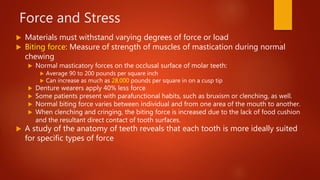
Force and Stress
 Materials must withstand varying degrees of force or load
 Biting force: Measure of strength of muscles of mastication during normal
chewing
 Normal masticatory forces on the occlusal surface of molar teeth:
 Average 90 to 200 pounds per square inch
 Can increase as much as 28,000 pounds per square in on a cusp tip
 Denture wearers apply 40% less force
 Some patients present with parafunctional habits, such as bruxism or clenching, as well.
 Normal biting force varies between individual and from one area of the mouth to another.
 When clenching and cringing, the biting force is increased due to the lack of food cushion
and the resultant direct contact of tooth surfaces.
 A study of the anatomy of teeth reveals that each tooth is more ideally suited
for specific types of force
8
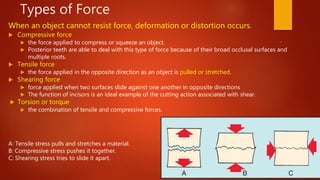
Types of Force
When an object cannot resist force, deformation or distortion occurs.
 Compressive force
 the force applied to compress or squeeze an object.
 Posterior teeth are able to deal with this type of force because of their broad occlusal surfaces and
multiple roots.
 Tensile force
 the force applied in the opposite direction as an object is pulled or stretched.
 Shearing force
 force applied when two surfaces slide against one another in opposite directions
 The function of incisors is an ideal example of the cutting action associated with shear.
 Torsion or torque
 the combination of tensile and compressive forces.
9
A: Tensile stress pulls and stretches a material.
B: Compressive stress pushes it together.
C: Shearing stress tries to slide it apart.
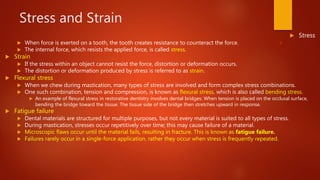
Stress and Strain
 Stress
 When force is exerted on a tooth, the tooth creates resistance to counteract the force.
 The internal force, which resists the applied force, is called stress.
 Strain
 If the stress within an object cannot resist the force, distortion or deformation occurs.
 The distortion or deformation produced by stress is referred to as strain.
 Flexural stress
 When we chew during mastication, many types of stress are involved and form complex stress combinations.
 One such combination, tension and compression, is known as flexural stress, which is also called bending stress.
 An example of flexural stress in restorative dentistry involves dental bridges: When tension is placed on the occlusal surface,
bending the bridge toward the tissue. The tissue side of the bridge then stretches upward in response.
 Fatigue failure
 Dental materials are structured for multiple purposes, but not every material is suited to all types of stress.
 During mastication, stresses occur repetitively over time; this may cause failure of a material.
 Microscopic flaws occur until the material fails, resulting in fracture. This is known as fatigue failure.
 Failures rarely occur in a single-force application, rather they occur when stress is frequently repeated.
10
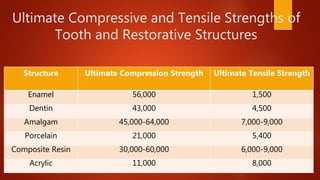
Ultimate Compressive and Tensile Strengths of
Tooth and Restorative Structures
Structure Ultimate Compression Strength Ultimate Tensile Strength
Enamel 56,000 1,500
Dentin 43,000 4,500
Amalgam 45,000-64,000 7,000-9,000
Porcelain 21,000 5,400
Composite Resin 30,000-60,000 6,000-9,000
Acrylic 11,000 8,000
Moisture and Acid Levels
 The breakdown of most dental materials is brought about by moisture, acid, and stress. Materials that are
needed to last a long time must withstand this hostile environment.
 Normal pH of saliva
 The oral cavity is continually in contact with moisture that varies from acid to alkaline.
 The type of moisture in our mouths depends on what we eat or drink, what medications we take, and what
quantity of acid-producing bacteria is present.
 The normal pH of saliva is 6.2 to 7.0 (neutral); this is fairly neutral but fluctuates during the day.
 Many materials that are compatible with a neutral environment are not compatible in an acidic one.
 Solubility of materials
 A soluble material dissolves in fluid.
 In the case of the oral environment, saliva is the main solvent.
 Desirable materials should have a low solubility.
 Gold and porcelain are retained in the oral environment for many years, because they are insoluble.
 Materials that are tooth-colored are more soluble; therefore they do not last as long.
 Water sorption
 Water sorption is the ability to absorb moisture.
 During placement or over time, most materials react adversely to moisture.
 Some materials have the undesirable characteristic of water sorption.
 This absorption of moisture may result in staining or slight enlargement of the material.
 Some materials stain as the result of water sorption caused by repeated exposure to coffee, tea, cola, and foods
that contain dyes.
Moisture and Acid Levels
 Metals: Metals (with the exception of noble metals, such as
gold) suffer the effects of moisture and acidity
Corrosion
Many metals corrode because of their continued contact with an acidic
environment.
Corrosion is the deterioration or dissolution of the metal to a chemical attack
(acid) or electrochemical reaction with other metals due to the moisture and
acid present in the oral environment.
Tarnish
Others discolor as the result of oxidation of metal surfaces. This is known as
tarnish.
Dental amalgam is highly susceptible to both corrosion and tarnish.
Amalgam polishing has been suggested to delay formation of surface
tarnish.
Galvanism
 Phenomenon of electric current being transmitted between two dissimilar metals
 An environment that contains moisture, acidity, and dissimilar metals makes the
generation of electrical current possible.
 This is known as galvanism.
 The salts of the saliva facilitate the movement of electrical current from one type of metal to
another.
 Galvanic stimulation will decrease with time as oxides form on the surface of the metal.
 The current may result in stimulation of the pulp, called galvanic shock.
 The classic example is of a metal fork touching a metal restoration.
 Dissimilar metals may also create a metallic taste in the mouth.
 Insulation of the restoration with a base or liner may help to decrease the effects of galvanic
shock.
Temperature
 Dimensional change
 With few exceptions, all forms of matter expand and contract with temperature changes.
 These changes result in dimensional change within the restoration.
 Ingestion of foods and beverages and smoking may alter the temperature of the oral cavity.
 Dental materials should have expansion and contraction rates similar to those of teeth.
 Excessive expansion may result in the fracture of cusps
 Excessive contraction may result in leakage of fluids and bacteria into the open gaps, resulting
in sensitivity.
 Coefficient of thermal expansion (CTE)
 CTE is the measurement of change in volume or length in relationship to change in
temperature.
 Materials (such as, composites or amalgams) should be similar to tooth structure so that
marginal integrity can be maintained.
15
Temperature
 Percolation
 If the CTE is significant, then repeated shrinkage and expansion of the material within a
tooth opens gaps in the interface between the restoration and the tooth.
 This action, known as percolation, allows bacteria and oral fluids to breach the
interface, causing recurrent caries, staining, and pulpal irritation.
Temperature
 Thermal conductivity
 The rate that heat flows through a material over time
 Metals (such as, gold and amalgam) are good conductors of temperature;
nonmetals are poor conductors of temperature.
 Nonmetal materials may be used alone to restore tooth structure, because the
dentin is a natural insulator.
 Insulators
 Should be used with metal materials because they are good conductors of temperature, which
may cause stimulation and sensitivity to the pulp.
 Examples of insulators are zinc oxide eugenol and calcium hydroxide.
 Exothermic reaction
 Aside from the temperature changes associated with food and drink, one must consider chemical
reactions within the material itself.
 Some materials produce heat when mixed.
 This exothermic reaction must be minimized to protect tooth structures from excessive heat, which
may cause sensitivity or pulpal damage.
Thermal Properties of Tooth and
Restorative Structures
Structure Coefficient of Thermal
Expansion (x 𝟏𝟎−𝟔/ºC)
Thermal Conductivity
(k [mcal cm]/𝒄𝒎 𝟐secºC)
Enamel 11 2.0
Dentin 8 1.30
Amalgam 20-28 54
Gold 15 350
*Porcelain 15 2.50
*Composite
Resin
26-40 2.60
Retention
 One important factor related to the selection of materials is how they will be
retained in the preparation or on the tooth surface.
 Retention may be mechanical or chemical through adhesion or bonding, or it may
reflect a combination of the two.
 Ability to maintain position without displacement under stress
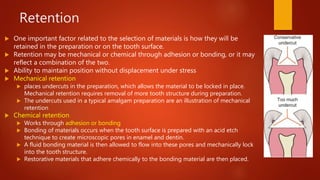
 Mechanical retention
 places undercuts in the preparation, which allows the material to be locked in place.
Mechanical retention requires removal of more tooth structure during preparation.
 The undercuts used in a typical amalgam preparation are an illustration of mechanical
retention
 Chemical retention
 Works through adhesion or bonding
 Bonding of materials occurs when the tooth surface is prepared with an acid etch
technique to create microscopic pores in enamel and dentin.
 A fluid bonding material is then allowed to flow into these pores and mechanically lock
into the tooth structure.
 Restorative materials that adhere chemically to the bonding material are then placed.
19
Retention
 The technique of chemical bonding, rather than
mechanical means to produce retention requires less
removal of tooth structure and produces a stronger
retentive force between tooth and restoration.
Retention
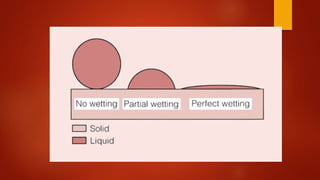
 Wetting is the degree to which a liquid adhesive is able to spread over
the surface of the tooth and the restorative material (see figure on next
slide).
 The better the adhesive is able to coat the surface, the better the
retention will be.
 Viscosity
 Most of today’s dental materials use a combination of mechanical and chemical retention. This
may be helped or hindered by the viscosity of the material. Viscosity is a material’s ability to
flow. The thicker the material, the harder it is for the material to flow.
 Film thickness
 The minimum thickness attainable, is important when dental cements are used.
 A thin film of dental cement is desirable to cement crowns to allow the cement to completely
wet the surface, and for excess cement material to flow from under the crown when seated
under pressure during cementation.
 When cementing a crown, if the film thickness of the cement is too great, it may keep the
crown from seating properly.
Retention
 Surface energy
 Another consideration that affects retention is the condition of the tooth or restoration
surface. Moisture contamination, surface texture, and energy affect how well the two bond.
 Even slight contamination of moisture or debris compromise the integrity of the process.
 Surface irregularities may prevent complete wetting of the surface.
 Microscopic irregularities trap air as the adhesive flows over them.
 This diminishes the surface energy and the numbers of atoms attracted to the bonding
surface.
 The surface has low surface energy, such as on wax or many plastics, when liquid beads up
on the surface.
 Liquids generally wet or spread over high energy surfaces better
 Metals, ceramics, and enamel have high surface energies.
 The Teflon surface of cooking equipment exhibits poor wettability, because the liquid beads
up on the surface, rather than spreading out.
Microleakage
 Interface
The space between the walls of the
preparation and the preparation
 Microleakage
If the interface is not sealed, fluids and
microorganisms can penetrate between
the tooth surface and the restorative
material.
This seepage of harmful materials, or
microleakage, results in tooth sensitivity,
recurrent decay, and marginal staining.
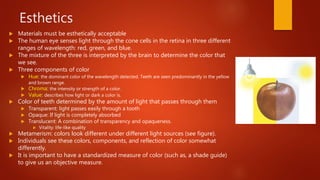
Esthetics
 Materials must be esthetically acceptable
 The human eye senses light through the cone cells in the retina in three different
ranges of wavelength: red, green, and blue.
 The mixture of the three is interpreted by the brain to determine the color that
we see.
 Three components of color
 Hue: the dominant color of the wavelength detected. Teeth are seen predominantly in the yellow
and brown range.
 Chroma: the intensity or strength of a color.
 Value: describes how light or dark a color is.
 Color of teeth determined by the amount of light that passes through them
 Transparent: light passes easily through a tooth
 Opaque: If light is completely absorbed
 Translucent: A combination of transparency and opaqueness.
 Vitality: life-like quality
 Metamerism: colors look different under different light sources (see figure).
 Individuals see these colors, components, and reflection of color somewhat
differently.
 It is important to have a standardized measure of color (such as, a shade guide)
to give us an objective measure.
Detection of Restorative Materials
 It is important that oral health care professionals are able to identify restorative materials within
the oral cavity.
 Heavy pressure during scaling and polishing may damage the surface of some restorations (for
example, porcelain and composite); therefore it is vital that the restoration is identified before
patient care is provided.
 Metal restorations are easier to identify than esthetic restorations.
 When tooth color is well matched, it can be difficult to identify restorations.
 This may be accomplished by using location, tactile sensitivity, and radiographs, as well as air,
magnification, and adequate illumination of the areas in question.
Detection of Restorative Materials
 Obvious identification
 Difficult identification
 Tactile evaluation
 To perform tactile evaluation, trace the enamel surface onto the restoration with the sharp tip of
an explorer.
 The clinician detects a smooth surface on the enamel and a "scratchy" surface on the
restoration.
 Adequate illumination and transillumination with the mouth mirror is helpful for the detection
of many anterior restorations.
 Most reliable means of clinical assessment of composite and glass ionomer restorations.
 Visual evaluation
 Radiographic evaluation
 For most difficult to detect restorations, it is necessary to use a combination of the
evaluation methods.
Summary
 Materials must:
 Be biocompatible
 Exhibit long-term clinical durability
 Be esthetically acceptable
 The allied oral health care practitioner must have an understanding of the
limitations as well as the criteria for selection of materials
 The oral environment is hostile, and the materials that we use must be compatible,
last for the intended length of time, and be of the highest esthetic and functional
quality.
 Materials are constantly changing, improving, and evolving.
 Keeping well-informed of these changes allows dental professionals to educate
their patients and provide the highest quality of care.
28

Chapter 2: Oral Environment

  • 1.
  • 2.
    Oral Environment and PatientConsiderations To understand why we manipulate materials the way that we do – first must understand the challenges of the oral environment Factors of oral environment: Moisture differing stresses Temperatures acid levels 2
  • 3.
    Oral Environment and PatientConsiderations  Materials to be used must be: Biocompatible Durable Nonreactive in acid or alkaline conditions Compatible with other materials Esthetically acceptable  Limitations regarding what can and cannot be used safely vary from patient to patient.
  • 4.
    Classification of DentalMaterials  Preventive/therapeutic materials  used to prevent disease or trauma or for their therapeutic action on the teeth or oral tissues.  Examples are mouth guards, pit and fissure sealants, glass ionomer, and fluoride.  Why is glass ionomer placed in the therapeutic materials category?  Restorative materials  materials used to repair or replace tooth structure lost to oral disease or trauma or to change the appearance of the teeth.  Auxiliary materials  materials used to fabricate and maintain restorations.  Examples are impression materials, gypsum, dental waxes, and finishing and polishing materials. 4
  • 5.
    Biocompatibility  The studyof dental biomaterials must include a thorough understanding of each material’s biological properties; all materials contain potentially irritating ingredients.  A material may be acceptable for use on hard tissues, whereas it may not be acceptable for use on soft tissues.  Some materials may be therapeutic in small quantities or if in contact with tissues for short periods of time, but also may be irritating or toxic with longer contact or in larger doses. The figure shows an allergic reaction to nickel.
  • 6.
     Materials mustbenefit the patient  Must not adversely affect living tissue  Adverse responses  A patient’s adverse response may be due to the material itself or due to a breakdown of its components in the oral environment.  The use of multiple materials makes adverse responses more difficult to evaluate.  Adverse responses may include postoperative sensitivity, toxicity, and hypersensitivity.  Postoperative sensitivity is often associated with dental operative procedures.  Why is postoperative sensitivity associated with operative procedures?  This may be due to the toxicity of the restorative, preventive, or therapeutic material or bacterial invasion into or near the pulp tissues  Biocompatibility along with short-term and long-term functionality must be considered when new dental materials are developed  All professions using biocompatible materials must consider the short-term and long-term functional and biocompatible responses of any material. Biocompatibility
  • 7.
    Biomechanics  Application ofengineering principles to biological systems  Function of a material:  Dependent on the properties of the material as well as what the material is being asked to do  Excessive wear of a material:  May be due to variations in forces applied by stronger to weaker antagonists  The success or failure of a restoration may also be related to its performance in any given situation.  Dentists must consider the performance of a material based on a thorough knowledge of the material’s properties, the intended application of the material, and the particulars of each patient’s oral environment. 7
  • 8.
    Force and Stress Materials must withstand varying degrees of force or load  Biting force: Measure of strength of muscles of mastication during normal chewing  Normal masticatory forces on the occlusal surface of molar teeth:  Average 90 to 200 pounds per square inch  Can increase as much as 28,000 pounds per square in on a cusp tip  Denture wearers apply 40% less force  Some patients present with parafunctional habits, such as bruxism or clenching, as well.  Normal biting force varies between individual and from one area of the mouth to another.  When clenching and cringing, the biting force is increased due to the lack of food cushion and the resultant direct contact of tooth surfaces.  A study of the anatomy of teeth reveals that each tooth is more ideally suited for specific types of force 8
  • 9.
    Types of Force Whenan object cannot resist force, deformation or distortion occurs.  Compressive force  the force applied to compress or squeeze an object.  Posterior teeth are able to deal with this type of force because of their broad occlusal surfaces and multiple roots.  Tensile force  the force applied in the opposite direction as an object is pulled or stretched.  Shearing force  force applied when two surfaces slide against one another in opposite directions  The function of incisors is an ideal example of the cutting action associated with shear.  Torsion or torque  the combination of tensile and compressive forces. 9 A: Tensile stress pulls and stretches a material. B: Compressive stress pushes it together. C: Shearing stress tries to slide it apart.
  • 10.
    Stress and Strain Stress  When force is exerted on a tooth, the tooth creates resistance to counteract the force.  The internal force, which resists the applied force, is called stress.  Strain  If the stress within an object cannot resist the force, distortion or deformation occurs.  The distortion or deformation produced by stress is referred to as strain.  Flexural stress  When we chew during mastication, many types of stress are involved and form complex stress combinations.  One such combination, tension and compression, is known as flexural stress, which is also called bending stress.  An example of flexural stress in restorative dentistry involves dental bridges: When tension is placed on the occlusal surface, bending the bridge toward the tissue. The tissue side of the bridge then stretches upward in response.  Fatigue failure  Dental materials are structured for multiple purposes, but not every material is suited to all types of stress.  During mastication, stresses occur repetitively over time; this may cause failure of a material.  Microscopic flaws occur until the material fails, resulting in fracture. This is known as fatigue failure.  Failures rarely occur in a single-force application, rather they occur when stress is frequently repeated. 10
  • 11.
    Ultimate Compressive andTensile Strengths of Tooth and Restorative Structures Structure Ultimate Compression Strength Ultimate Tensile Strength Enamel 56,000 1,500 Dentin 43,000 4,500 Amalgam 45,000-64,000 7,000-9,000 Porcelain 21,000 5,400 Composite Resin 30,000-60,000 6,000-9,000 Acrylic 11,000 8,000
  • 12.
    Moisture and AcidLevels  The breakdown of most dental materials is brought about by moisture, acid, and stress. Materials that are needed to last a long time must withstand this hostile environment.  Normal pH of saliva  The oral cavity is continually in contact with moisture that varies from acid to alkaline.  The type of moisture in our mouths depends on what we eat or drink, what medications we take, and what quantity of acid-producing bacteria is present.  The normal pH of saliva is 6.2 to 7.0 (neutral); this is fairly neutral but fluctuates during the day.  Many materials that are compatible with a neutral environment are not compatible in an acidic one.  Solubility of materials  A soluble material dissolves in fluid.  In the case of the oral environment, saliva is the main solvent.  Desirable materials should have a low solubility.  Gold and porcelain are retained in the oral environment for many years, because they are insoluble.  Materials that are tooth-colored are more soluble; therefore they do not last as long.  Water sorption  Water sorption is the ability to absorb moisture.  During placement or over time, most materials react adversely to moisture.  Some materials have the undesirable characteristic of water sorption.  This absorption of moisture may result in staining or slight enlargement of the material.  Some materials stain as the result of water sorption caused by repeated exposure to coffee, tea, cola, and foods that contain dyes.
  • 13.
    Moisture and AcidLevels  Metals: Metals (with the exception of noble metals, such as gold) suffer the effects of moisture and acidity Corrosion Many metals corrode because of their continued contact with an acidic environment. Corrosion is the deterioration or dissolution of the metal to a chemical attack (acid) or electrochemical reaction with other metals due to the moisture and acid present in the oral environment. Tarnish Others discolor as the result of oxidation of metal surfaces. This is known as tarnish. Dental amalgam is highly susceptible to both corrosion and tarnish. Amalgam polishing has been suggested to delay formation of surface tarnish.
  • 14.
    Galvanism  Phenomenon ofelectric current being transmitted between two dissimilar metals  An environment that contains moisture, acidity, and dissimilar metals makes the generation of electrical current possible.  This is known as galvanism.  The salts of the saliva facilitate the movement of electrical current from one type of metal to another.  Galvanic stimulation will decrease with time as oxides form on the surface of the metal.  The current may result in stimulation of the pulp, called galvanic shock.  The classic example is of a metal fork touching a metal restoration.  Dissimilar metals may also create a metallic taste in the mouth.  Insulation of the restoration with a base or liner may help to decrease the effects of galvanic shock.
  • 15.
    Temperature  Dimensional change With few exceptions, all forms of matter expand and contract with temperature changes.  These changes result in dimensional change within the restoration.  Ingestion of foods and beverages and smoking may alter the temperature of the oral cavity.  Dental materials should have expansion and contraction rates similar to those of teeth.  Excessive expansion may result in the fracture of cusps  Excessive contraction may result in leakage of fluids and bacteria into the open gaps, resulting in sensitivity.  Coefficient of thermal expansion (CTE)  CTE is the measurement of change in volume or length in relationship to change in temperature.  Materials (such as, composites or amalgams) should be similar to tooth structure so that marginal integrity can be maintained. 15
  • 16.
    Temperature  Percolation  Ifthe CTE is significant, then repeated shrinkage and expansion of the material within a tooth opens gaps in the interface between the restoration and the tooth.  This action, known as percolation, allows bacteria and oral fluids to breach the interface, causing recurrent caries, staining, and pulpal irritation.
  • 17.
    Temperature  Thermal conductivity The rate that heat flows through a material over time  Metals (such as, gold and amalgam) are good conductors of temperature; nonmetals are poor conductors of temperature.  Nonmetal materials may be used alone to restore tooth structure, because the dentin is a natural insulator.  Insulators  Should be used with metal materials because they are good conductors of temperature, which may cause stimulation and sensitivity to the pulp.  Examples of insulators are zinc oxide eugenol and calcium hydroxide.  Exothermic reaction  Aside from the temperature changes associated with food and drink, one must consider chemical reactions within the material itself.  Some materials produce heat when mixed.  This exothermic reaction must be minimized to protect tooth structures from excessive heat, which may cause sensitivity or pulpal damage.
  • 18.
    Thermal Properties ofTooth and Restorative Structures Structure Coefficient of Thermal Expansion (x 𝟏𝟎−𝟔/ºC) Thermal Conductivity (k [mcal cm]/𝒄𝒎 𝟐secºC) Enamel 11 2.0 Dentin 8 1.30 Amalgam 20-28 54 Gold 15 350 *Porcelain 15 2.50 *Composite Resin 26-40 2.60
  • 19.
    Retention  One importantfactor related to the selection of materials is how they will be retained in the preparation or on the tooth surface.  Retention may be mechanical or chemical through adhesion or bonding, or it may reflect a combination of the two.  Ability to maintain position without displacement under stress  Mechanical retention  places undercuts in the preparation, which allows the material to be locked in place. Mechanical retention requires removal of more tooth structure during preparation.  The undercuts used in a typical amalgam preparation are an illustration of mechanical retention  Chemical retention  Works through adhesion or bonding  Bonding of materials occurs when the tooth surface is prepared with an acid etch technique to create microscopic pores in enamel and dentin.  A fluid bonding material is then allowed to flow into these pores and mechanically lock into the tooth structure.  Restorative materials that adhere chemically to the bonding material are then placed. 19
  • 20.
    Retention  The techniqueof chemical bonding, rather than mechanical means to produce retention requires less removal of tooth structure and produces a stronger retentive force between tooth and restoration.
  • 21.
    Retention  Wetting isthe degree to which a liquid adhesive is able to spread over the surface of the tooth and the restorative material (see figure on next slide).  The better the adhesive is able to coat the surface, the better the retention will be.  Viscosity  Most of today’s dental materials use a combination of mechanical and chemical retention. This may be helped or hindered by the viscosity of the material. Viscosity is a material’s ability to flow. The thicker the material, the harder it is for the material to flow.  Film thickness  The minimum thickness attainable, is important when dental cements are used.  A thin film of dental cement is desirable to cement crowns to allow the cement to completely wet the surface, and for excess cement material to flow from under the crown when seated under pressure during cementation.  When cementing a crown, if the film thickness of the cement is too great, it may keep the crown from seating properly.
  • 23.
    Retention  Surface energy Another consideration that affects retention is the condition of the tooth or restoration surface. Moisture contamination, surface texture, and energy affect how well the two bond.  Even slight contamination of moisture or debris compromise the integrity of the process.  Surface irregularities may prevent complete wetting of the surface.  Microscopic irregularities trap air as the adhesive flows over them.  This diminishes the surface energy and the numbers of atoms attracted to the bonding surface.  The surface has low surface energy, such as on wax or many plastics, when liquid beads up on the surface.  Liquids generally wet or spread over high energy surfaces better  Metals, ceramics, and enamel have high surface energies.  The Teflon surface of cooking equipment exhibits poor wettability, because the liquid beads up on the surface, rather than spreading out.
  • 24.
    Microleakage  Interface The spacebetween the walls of the preparation and the preparation  Microleakage If the interface is not sealed, fluids and microorganisms can penetrate between the tooth surface and the restorative material. This seepage of harmful materials, or microleakage, results in tooth sensitivity, recurrent decay, and marginal staining.
  • 25.
    Esthetics  Materials mustbe esthetically acceptable  The human eye senses light through the cone cells in the retina in three different ranges of wavelength: red, green, and blue.  The mixture of the three is interpreted by the brain to determine the color that we see.  Three components of color  Hue: the dominant color of the wavelength detected. Teeth are seen predominantly in the yellow and brown range.  Chroma: the intensity or strength of a color.  Value: describes how light or dark a color is.  Color of teeth determined by the amount of light that passes through them  Transparent: light passes easily through a tooth  Opaque: If light is completely absorbed  Translucent: A combination of transparency and opaqueness.  Vitality: life-like quality  Metamerism: colors look different under different light sources (see figure).  Individuals see these colors, components, and reflection of color somewhat differently.  It is important to have a standardized measure of color (such as, a shade guide) to give us an objective measure.
  • 26.
    Detection of RestorativeMaterials  It is important that oral health care professionals are able to identify restorative materials within the oral cavity.  Heavy pressure during scaling and polishing may damage the surface of some restorations (for example, porcelain and composite); therefore it is vital that the restoration is identified before patient care is provided.  Metal restorations are easier to identify than esthetic restorations.  When tooth color is well matched, it can be difficult to identify restorations.  This may be accomplished by using location, tactile sensitivity, and radiographs, as well as air, magnification, and adequate illumination of the areas in question.
  • 27.
    Detection of RestorativeMaterials  Obvious identification  Difficult identification  Tactile evaluation  To perform tactile evaluation, trace the enamel surface onto the restoration with the sharp tip of an explorer.  The clinician detects a smooth surface on the enamel and a "scratchy" surface on the restoration.  Adequate illumination and transillumination with the mouth mirror is helpful for the detection of many anterior restorations.  Most reliable means of clinical assessment of composite and glass ionomer restorations.  Visual evaluation  Radiographic evaluation  For most difficult to detect restorations, it is necessary to use a combination of the evaluation methods.
  • 28.
    Summary  Materials must: Be biocompatible  Exhibit long-term clinical durability  Be esthetically acceptable  The allied oral health care practitioner must have an understanding of the limitations as well as the criteria for selection of materials  The oral environment is hostile, and the materials that we use must be compatible, last for the intended length of time, and be of the highest esthetic and functional quality.  Materials are constantly changing, improving, and evolving.  Keeping well-informed of these changes allows dental professionals to educate their patients and provide the highest quality of care. 28

Editor's Notes

  • #9 .
  • #13 .
  • #16 Insulators
  • #19 Porcelain has highest CTE and best thermal conductor Composite resin is not a good conductor of temperature Gold is a great conductor of heat
  • #20 Chemical retention.
  • #25 is called the interface.