Dr.Sivaranjani Gali MDS, PhD
Dept of Prosthodontics
Faculty of Dental Sciences
M.S. Ramaiah University of Applied Sciences
Bangalore
Master Class for Post Graduates
Recent Advances of Materials in Fixed Partial
Dentures (Emphasis on Connector Designs)
20-3-21
Mind Martians-Advances in Materials in FPD-
Dr.Gali
Learning Objectives......to be able to
Discuss Current Problems in Fixed
Partial Dentures (FPD)
Describe Recent Advances In Materials
in FPD
Provide Evidence Based Performance of
the Materials in FPD
20-3-21
Mind Martians-Advances in Materials in FPD-
Dr.Gali
Contents
Background of Existing Materials in Fixed Partial
Dentures (FPD)
Connecting Problems with Recent Advances in
Materials in FPD
Evidence Based Status of the Recent Advances
in Materials
Emphasis on Connector Designs
20-3-21
Mind Martians-Advances in Materials in FPD-
Dr.Gali
Timeline of Dental Ceramics
20-3-21
Mind Martians-Advances in Materials in FPD-
Dr.Gali
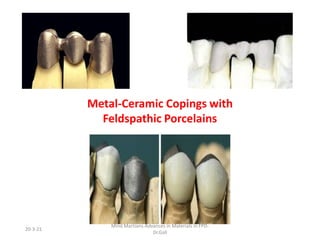
Metal-Ceramic Copings with
Feldspathic Porcelains
20-3-21
Mind Martians-Advances in Materials in FPD-
Dr.Gali
Dental Ceramics
Oxide Ceramics
Low glass content
SilicateCeramics
Glass & Crystalline
Glass Infiltrated
Ex: Infiltrated
Alumina/Zirconia
Polycrystalline
Ex: Zirconia
Alumina
Feldspathic Porcelain
Ex: Feldspar
Glass-Ceramics
Ex: Leucite
Lithium disilicate
Flourapatite
20-3-21
Mind Martians-Advances in Materials in FPD-
Dr.Gali
Lithium Disilicate Glass-Ceramics (Pressed)
20-3-21
Mind Martians-Advances in Materials in FPD-
Dr.Gali
Lithium Disilicate Glass-Ceramics (Milled)
20-3-21
Mind Martians-Advances in Materials in FPD-
Dr.Gali
Zirconia (Milled)
20-3-21
Mind Martians-Advances in Materials in FPD-
Dr.Gali
Mechanical Properties of All-Ceramic
Systems
Material Modulus
GPa
Hardness
GPa
Toughness
MPa/m1/2
Strength
MPa
Glass Ceramics
Empress esthetic (Leucite)
65 6.2 1.3 160
IPS e.max Press
(lithium disilicate)
95 5.8 2.75 400
IPS e.max CAD
(lithium disilicate)
95 5.8 2.25 360
Alumina
Procera
In ceram Alumina
340
280
17
20
3.2
3.5
695
500
Zirconia
Lava
ZirCAD
210
210
14
13
5.9
5.5
1048
900
Dental Clinics of North America 2011;55:2
20-3-21
Mind Martians-Advances in Materials in FPD-
Dr.Gali
Layered & Monolithic Ceramics
Layered Ceramic
Monolithic Ceramic
https://www.sciencedirect.com/scie
nce/article/pii/S0022391315006800
20-3-21
Mind Martians-Advances in Materials in FPD-
Dr.Gali
Framework Designs
 Bi-layered: Adequate Esthetics
Inadequate Strength
 Monolithic: Adequate Strength
Inadequate Esthetics
http://sci-hub.tw/10.1155/2015/418641
20-3-21
Mind Martians-Advances in Materials in FPD-
Dr.Gali
Material Survival Rates
Crowns Bridges
Lithium DisilicateGlass-Ceramics
IPS Empress 2
(Pressable Layered)
95.5 % 70 %
IPS e.max Press with
Apatite Glass Ceramic Veneer
(Pressable Layered)
96.6%
(3 yrs)
Monolithic
Inlays
100% (4 yrs)
Full Crown Retained
FDP
93% (8 yrs)
88% (10 yrs)
IPS e.max CAD (Milled)
Monolithic/ Bi-layered
Pressable Veneer
Core & Veneers
100% (2 yrs)
Journal of American Dental Assoc 2012;143:234-240
Clinical Oral Investigations 2013;1:275-284
Journal of Oral Rehabilitation 2005 ;32:747
https://onlinelibrary.wiley.com/doi/full/10.1111/j.1600-0722.2010.00767.x
20-3-21
Mind Martians-Advances in
Materials in FPD-Dr.Gali
Material Survival Rates
Crowns Bridges
Zirconia
1. Cercon /Cercon Ceram
(Layered)
2. Lava /Lava Ceram (Layered)
3. Monolithic
• 98% for 2 years
(9 % veneer
fracture)
• 100% for 3
years ( 5%
veneer
fracture)
• 100% survival
rate (3 yrs)
• 86.7% for
crowns (2 yrs)
• 91 % for 5 years with
13 % veneer fracture
• 100 % for 1 year with
3 % veneer fracture
• Connector fractures
• Debonding
• 92% (2yrs)
• 97.4% ( 5 yrs)
Journal of American Dental Assoc 2012;143:234-240
Clinical Oral Investigations 2013;1:275-284
Journal of Oral Rehabilitation 2005 ;32:747
https://onlinelibrary.wiley.com/doi/full/10.1111/j.1600-0722.2010.00767.x
. Dent J (Basel). 2019 Sep 2;7(3):90
20-3-21 Mind Martians-Advances in Materials in FPD-
Dr.Gali
Moisture Assisted Crack Growth
of Zirconia
Ceramic fractures
Opacity of Zirconia
Difficult Etching
of Zirconia
20-3-21
Mind Martians-Advances in Materials in FPD-
Dr.Gali
Contents
Background of Existing Materials in Fixed Partial
Dentures (FPD)
Connecting Problems with Recent
Advances in Materials in FPD
Evidence Based Status of the Recent Advances
in Materials
Emphasis on Connector Designs
20-3-21
Mind Martians-Advances in Materials in FPD-
Dr.Gali
Addressing Problems
with
Innovations
20-3-21
Mind Martians-Advances in Materials in FPD-
Dr.Gali
Zirconia Ceramics
20-3-21
Mind Martians-Advances in Materials in FPD-
Dr.Gali
Problem
Ceramic Fractures in Zirconia
20-3-21
Mind Martians-Advances in Materials in FPD-
Dr.Gali
Veneer Fractures Core
Veneer
13 % incidence of veneer
fractures in all- ceramic
bilayered restorations in a 3
year follow up
15 % of veneer fractures in a 5
year follow up
Quintessence Int. 2006 Oct;37(9):685-93
Int J Prosthodont. 2007 Jul-Aug;20(4):383-
8
20-3-21
Mind Martians-Advances in Materials in FPD-
Dr.Gali
Why Veneer Fractures?
Inadequate support of
veneer from the core
Non-uniform thickness of
veneer
Low thermal conductivity of
cores
Low flexural strength of
veneer
20-3-21
Mind Martians-Advances in Materials in FPD-
Dr.Gali
Low-temperature degradation of Y-TZP ceramics: A
systematic review and meta-analysis. J. Mech. Behav.
Biomed. Mater., 55, 151–163.
Problems of Layering Technique
https://id.cdeworld.com/courses/4663-Classification_of_Dental_Ceramics
Layering technique (Sintering)
Thermal gradients due to
sintering process
Heating and cooling rates
Low thermal conductivity of
zirconia
Presence of residual stresses
20-3-21
Mind Martians-Advances in Materials in FPD-
Dr.Gali
Veneering Techniques
Layering Technique
Pressing Technique
CAD-on Technique
Rapid Layer
Technology
20-3-21 Mind Martians-Advances in Materials in FPD-
Dr.Gali
https://id.cdeworld.com/courses/4663-Classification_of_Dental_Ceramics
https://www.ivoclarvivadent.us/explore/ips-emax-cad/VITA Rapid Layer Technology
Layering technique( Sintering) CAD-on technique (Low fusing glass)
Rapid Layer Technology ( Adhesively Bonded technique)
CAD CAM Milled Veneers
Core
Veneer
20-3-21
Mind Martians-Advances in Materials in FPD-
Dr.Gali
Advances in Veneering Techniques
https://www.ivoclarvivadent.us/explore/ips-emax-cad/VITA Rapid Layer Technology
CAD-on technique (Low fusing glass)
CAD on technique uses
a low fusing glass
between core-veneer
Rapid Layer Technology
is based on adhesive
bonded structures with
resin cement
Rapid Layer Technology
( Adhesively Bonded technique)
20-3-21
Advances in Veneering Techniques
https://www.ivoclarvivadent.us/explore/ips-emax-cad/VITA Rapid Layer Technology
CAD-on technique (Low fusing glass)
Minimise the thermal
and associated residual
stresses of the sintering
technique
Core and Veneer are
CAD CAM milled
Offer uniform thickness
of core-veneer
Rapid Layer Technology
( Adhesively Bonded technique)
20-3-21
Rapid Layer Technology
(Adhesively Bonded Technique)
Cleaning zirconia
core
Etching veneer with
HF gel
Silanising the veneer
Applying resin to veneer
Adhesive bonding
Core-veneer
Adhesively bonded
Core-veneer
VITA_1740_VITA_1740GB, Rapid Layer Technology
20-3-21
Mind Martians-Advances in Materials in FPD-
Dr.Gali
Composite Veneers for
Zirconia
Frameworks
20-3-21
Mind Martians-Advances in Materials in FPD-
Dr.Gali
Problem
Opacity of Zirconia
20-3-21
Mind Martians-Advances in Materials in FPD-
Dr.Gali
Birefringence of Zirconia
https://glidewelldental.com/education/inclusive-dental-implant-magazine/volume-2-
issue-4/understanding-zirconia-crown-esthetics-and-optical-properties/
20-3-21
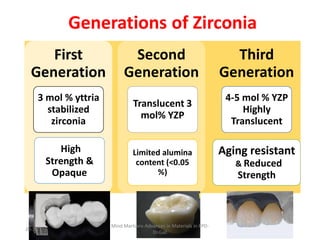
Generations of Zirconia
First
Generation
3 mol % yttria
stabilized
zirconia
High
Strength &
Opaque
Second
Generation
Translucent 3
mol% YZP
Limited alumina
content (<0.05
%)
Third
Generation
4-5 mol % YZP
Highly
Translucent
Aging resistant
& Reduced
Strength
20-3-21
Mind Martians-Advances in Materials in FPD-
Dr.Gali
First Generation Zirconia
Staining / Dipping Technique
Three generations of zirconia: 
From veneered to monolithic. Part I and Part II. Quintessence Int. 2017;48(6):441-450
20-3-21
Mind Martians-Advances in Materials in FPD-
Dr.Gali
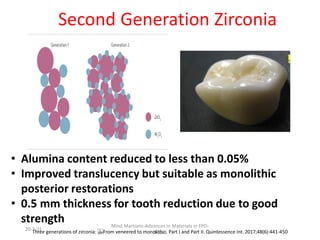
Second Generation Zirconia
• Alumina content reduced to less than 0.05%
• Improved translucency but suitable as monolithic
posterior restorations
• 0.5 mm thickness for tooth reduction due to good
strength
Three generations of zirconia: 
From veneered to monolithic. Part I and Part II. Quintessence Int. 2017;48(6):441-450
20-3-21
Mind Martians-Advances in Materials in FPD-
Dr.Gali
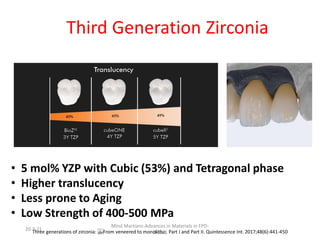
Third Generation Zirconia
• 5 mol% YZP with Cubic (53%) and Tetragonal phase
• Higher translucency
• Less prone to Aging
• Low Strength of 400-500 MPa
Three generations of zirconia: 
From veneered to monolithic. Part I and Part II. Quintessence Int. 2017;48(6):441-450
20-3-21
Mind Martians-Advances in Materials in FPD-
Dr.Gali
Translucent Zirconia
GENERAL DENTISTRY January/February 2017
20-3-21
Mind Martians-Advances in Materials in FPD-
Dr.Gali
20-3-21
Mind Martians-Advances in Materials in FPD-
Dr.Gali
Gradient Technology in Zirconia
20-3-21
Mind Martians-Advances in Materials in FPD-
Dr.Gali
Gradient Technology in Zirconia
• Larger Particles
• More 3Y Zirconia
• Low Translucency
• High Strength
• Small Particles
• More 5Y Zirconia
• High Translucency
• Low Strength
20-3-21
Mind Martians-Advances in Materials in FPD-
Dr.Gali
Problem
Moisture Assisted Crack Growth
(Aging/Low Temperature Degradation)
20-3-21
Mind Martians-Advances in Materials in FPD-
Dr.Gali
Aging of Zirconia
(Low Temperature Degradation)
Chevalier J. What future for zirconia as a biomaterial? Biomaterials. 2006
Feb;27(4):535-43. doi: 10.1016/j.biomaterials.2005.07.034.
20-3-21 Mind Martians-Advances in Materials in FPD-
Dr.Gali
Chevalier J. What future for zirconia as a
biomaterial? Biomaterials. 2006 Feb;27(4):535-
43. doi: 10.1016/j.biomaterials.2005.07.034.
Moisture Assisted
Degradation
20-3-21
Mind Martians-Advances in Materials in FPD-Dr.Gali
Third Generation Zirconia
• 5 mol% YZP with Cubic (53%) and Tetragonal phase
• Higher translucency
• Less prone to Aging
• Low Strength of 400-500 MPa
20-3-21
Mind Martians-Advances in Materials in FPD-
Dr.Gali
Zirconia Cementation
20-3-21
Mind Martians-Advances in Materials in FPD-
Dr.Gali
Dental Ceramics
Acid Sensitive
Ex: Glass-ceramics,
Feldspathics
Acid Resistant
Ex: Zirconia/Alumina
oxide ceramics
20-3-21
Mind Martians-Advances in Materials in FPD-
Dr.Gali
Adhesion to Zirconia: A Systematic Review of Current Conditioning Methods and Bonding
Materials. Dentistry journal, 7(3), 74.
20-3-21
Tribo-Chemical Silica Coating
3M ESPE Rocatec Bonding
20-3-21
The Magic of MDP to Zirconia
Nagaoka, N. et al. “Chemical interaction mechanism of 10-MDP with zirconia.” Scientific Reports 7 (2017)
20-3-21
Chemistry of Adhesion
http://www.rjor.ro/wp-content/uploads/2011/10/Adhesive-Cementation-Protocol-of-Zirconia-
Restorations.pdf
20-3-21
Mind Martians-Advances in Materials in FPD-
Dr.Gali
When Should Zirconia Be Bonded?
Suitable for Cementation with Self Adhesive Resin Cement:
• Tooth Preparation with adequate cervical –occlusal height:
h > 3mm
• Tooth Preparation with adequate taper, 2-5 degrees
Guide to Zirconia Bonding Essentials: John M Powers
20-3-21
Mind Martians-Advances in Materials in FPD-
Dr.Gali
When Should Zirconia Be Bonded?
• Suitable for Cementation with MDP based Adhesive Resin
Cement
• Tooth with short clinical crown h < 3mm
• Tooth with overprepared taper > 5
Guide to Zirconia Bonding Essentials: John M Powers
20-3-21
Mind Martians-Advances in Materials in FPD-
Dr.Gali
Glass-Ceramics
20-3-21
Mind Martians-Advances in Materials in FPD-
Dr.Gali
Toughening Glass Ceramics
Celtra DuoTM-Zirconia reinforced lithium silicate
20-3-21
Mind Martians-Advances in Materials in FPD-
Dr.Gali
Wet Firing Technique
Mill Stain and Glaze Fire Seat
20-3-21
Mind Martians-Advances in Materials in FPD-
Dr.Gali
Dry Firing Technique
Mill Polish Fire Seat
20-3-21
Mind Martians-Advances in Materials in FPD-
Dr.Gali
Vita Supranity DC
Zirconia reinforced Lithium
Silicate Glass-Ceramic
0.5 µm
1.5 µm
20-3-21
Mind Martians-Advances in Materials in FPD-Dr.Gali
Polishable Glass-Ceramics
20-3-21
Mind Martians-Advances in Materials in FPD-
Dr.Gali
Alternative Materials
to
Dental Ceramics
20-3-21
Mind Martians-Advances in Materials in FPD-
Dr.Gali
Polymer Infiltrated Ceramic
Network
20-3-21
Mind Martians-Advances in Materials in FPD-
Dr.Gali
Composite Veneers for
Zirconia
Frameworks
20-3-21
Mind Martians-Advances in Materials in FPD-
Dr.Gali
20-3-21
Mind Martians-Advances in Materials in FPD-
Dr.Gali
20-3-21
Mind Martians-Advances in Materials in FPD-
Dr.Gali
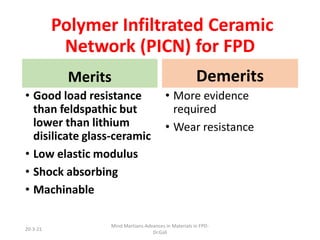
Polymer Infiltrated Ceramic
Network (PICN) for FPD
Merits
• Good load resistance
than feldspathic but
lower than lithium
disilicate glass-ceramic
• Low elastic modulus
• Shock absorbing
• Machinable
Demerits
• More evidence
required
• Wear resistance
20-3-21
Mind Martians-Advances in Materials in FPD-
Dr.Gali
Polyether Ether Ketone (PEEK)
20-3-21
Mind Martians-Advances in Materials in FPD-
Dr.Gali
20-3-21
Mind Martians-Advances in Materials in FPD-
Dr.Gali
20-3-21
Mind Martians-Advances in Materials in FPD-
Dr.Gali
PEEK as a FPD Framework
Merits
• Good load resistance
• Low elastic modulus
• Comfort to patient
Demerits
• Low translucency
• Low surface energy
• Inadequate bonding to
veneer
• Requires chemical
treatment with sulfuric
acid
20-3-21
Mind Martians-Advances in Materials in FPD-
Dr.Gali
Selective Laser Sintering Alloys
20-3-21
Mind Martians-Advances in Materials in FPD-
Dr.Gali
Selective Laser Sintering for FPD
Merits
• Similar marginal fit
with casting
• Reduced technical
errors
• Reduces time and long
term cost
• Co-Cr alloys
Demerits
• Expensive Machine
• Training
20-3-21
Mind Martians-Advances in Materials in FPD-
Dr.Gali
Digital Impressions
20-3-21
Mind Martians-Advances in Materials in FPD-
Dr.Gali
Contents
Background of Existing Materials in Fixed
Partial Dentures (FPD)
Connecting Problems with Recent Advances
in Materials in FPD
Emphasis on Connector Designs
Evidence Based Status of the Recent
Advances in Materials
20-3-21
Mind Martians-Advances in Materials in FPD-
Dr.Gali
Problems of Connector Fractures
Connector Height
(h) & Width (w)
Radius of
Curvature (r)
r
h/w
h x w = Area of Connector Size (mm2)
r = Radius of curvature (Round or Sharp)
e = Embrasures
Embrasures (e)
20-3-21
Mind Martians-Advances in Materials in FPD-
Dr.Gali
Problems of Connector Fractures
• Why connectors fracture?
• How to prevent connector fractures?
• What is the minimum dimensions of connectors for
all-ceramics to achieve esthetics and strength?
20-3-21
Mind Martians-Advances in Materials in FPD-
Dr.Gali
Why Connectors Fracture?
• Insufficient connector dimensions
• Framework Grinding caused Damage
• Positioning of Connectors Outside the Arch
20-3-21
Mind Martians-Advances in Materials in FPD-
Dr.Gali
Pathogenesis of Connector
Fractures
• Origin of fracture at the
Gingival Embrasure
(Junction between the Core
and the Veneer)
• Connectors are the most
loaded parts with tensile
stresses
20-3-21
Mind Martians-Advances in Materials in FPD-
Dr.Gali
That Radius of Curvature.....
20-3-21
Mind Martians-Advances in Materials in FPD-
Dr.Gali
That Radius of Curvature.....
Influence of radius of curvature at gingival embrasure in connector designs
J Int Soc Prevent Communit Dent 2019;9:338-48
20-3-21
Preventing Connector Fractures
• A gingival embrasure
with a broader radius of
curvature reduces stress
concentration under
loading and improves
fracture resistance
Influence of radius of curvature at gingival embrasure in connector designs
J Int Soc Prevent Communit Dent 2019;9:338-48
20-3-21
Mind Martians-Advances in Materials in FPD-
Dr.Gali
Preventing Connector Fractures
Location & Indication Connector Cross Section
Anterior 2 or 3 unit bridges 7 mm2 or more
More than 4 unit
bridges
9 mm2 or more
Posterior 2 or 3 unit bridges 9 mm2 or more
More than 4 unit
bridges
9 mm2 or more
Between Two Pontics 12 mm2
Cantilever Bridge to One Pontic 12 mm2
20-3-21
Mind Martians-Advances in Materials in FPD-
Dr.Gali
The Future....
• Chair side milling of Dental Zirconia with
Rapid Sintering
• Nano-Zirconia with Better Translucency
• 3D printed Zirconia using Lithography based
Ceramic Manufacturing (LCM) Technology
https://www.aegisdentalnetwork.com/cced/special-issues/2018/10/zirconia-the-
material-its-evolution-and-composition
20-3-21
Mind Martians-Advances in Materials in FPD-
Dr.Gali
What’s the Evidence?
20-3-21
Mind Martians-Advances in Materials in FPD-
Dr.Gali
Hierarchy of Evidence
20-3-21
Mind Martians-Advances in Materials in FPD-
Dr.Gali
Based on PICO
Problem (P)
Intervention (I)
Comparison (C)
Outcome (O)
What’s the Current Problem ?
What are the Innovations ?
Traditional/ Status Quo
What’s the Outcome?
20-3-21
Mind Martians-Advances in Materials in FPD-
Dr.Gali
Anatomy of a Forest Plot
20-3-21
Mind Martians-Advances in Materials in FPD-
Dr.Gali
Anatomy of a Forest Plot
20-3-21
Mind Martians-Advances in Materials in FPD-
Dr.Gali
Are Advances in Veneering
Techniques
(CAD-on/RLT technique)
better for
Bi-layered Zirconia?
20-3-21
Mind Martians-Advances in Materials in FPD-
Dr.Gali
20-3-21
Mind Martians-Advances in Materials in FPD-
Dr.Gali
20-3-21
Mind Martians-Advances in Materials in FPD-
Dr.Gali
Clinical Implications...
• Fused veneering (CAD-on) appears to be an
appropriate alternative to Y-TZP bilayers
• Pressed veneers on Y-TZP had a failure load and
flexural strength values similar to those of the
hand-layered veneers.
20-3-21
Mind Martians-Advances in Materials in FPD-
Dr.Gali
Does Aging affect Translucency of
Zirconia?
20-3-21
Mind Martians-Advances in Materials in FPD-
Dr.Gali
20-3-21
Mind Martians-Advances in Materials in FPD-
Dr.Gali
Clinical Implications..
• Meta-analysis on translucency showed no
significant difference in the TP value (Translucency
Parameter) between the non-aged and aged Y-TZP
(P = :73; mean difference ðMDÞ = 0:46; 95%
Confidence Interval (C.I) 2:12 to 3.05)
20-3-21
Mind Martians-Advances in Materials in FPD-
Dr.Gali
Which is the Effective Method of
Bonding Zirconia?
20-3-21
Mind Martians-Advances in Materials in FPD-
Dr.Gali
20-3-21
20-3-21
Mind Martians-Advances in Materials in FPD-
Dr.Gali
Clinical Implications...
• The combination of mechanical and chemical
zirconia surface pre-treatments contributed to the
durability of the bond of composite cements to
zirconia ceramics.
• The cement choice appeared less critical, as long as
a composite cement was used for adhesive luting of
zirconia ceramics.
20-3-21
Mind Martians-Advances in Materials in FPD-
Dr.Gali
Which fares Better?
Zirconia or Metal-Ceramic in
Ceramic Chipping
20-3-21
Mind Martians-Advances in Materials in FPD-
Dr.Gali
20-3-21
Mind Martians-Advances in Materials in FPD-
Dr.Gali
Clinical Implications...
• Metal-ceramic fares better than zirconia in ceramic
chipping
20-3-21
Mind Martians-Advances in Materials in FPD-
Dr.Gali
No Evidence on Effectiveness of...X !
• Gradient Zirconia
• Zirconia reinforced lithium silicate ceramics
• PEEK as Fixed Partial Prosthesis
• Polymer Infiltrated Ceramic Network (PICN)
• No meta-analysis studies on comparing zirconia
with lithium glass-ceramics
• No meta-analysis on Connector fractures
20-3-21
Mind Martians-Advances in Materials in FPD-
Dr.Gali
Contents
Background of Existing Materials in Fixed Partial
Dentures (FPD)
Connecting Problems with Recent Advances in
Materials in FPD
Evidence Based Status of the Recent Advances
in Materials
Emphasis on Connector Designs
20-3-21
Mind Martians-Advances in Materials in FPD-
Dr.Gali
Thank You
20-3-21
Mind Martians-Advances in Materials in FPD-
Dr.Gali

Advances in Materials in Fixed Partial Dentures

  • 1.
    Dr.Sivaranjani Gali MDS,PhD Dept of Prosthodontics Faculty of Dental Sciences M.S. Ramaiah University of Applied Sciences Bangalore Master Class for Post Graduates Recent Advances of Materials in Fixed Partial Dentures (Emphasis on Connector Designs) 20-3-21 Mind Martians-Advances in Materials in FPD- Dr.Gali
  • 2.
    Learning Objectives......to beable to Discuss Current Problems in Fixed Partial Dentures (FPD) Describe Recent Advances In Materials in FPD Provide Evidence Based Performance of the Materials in FPD 20-3-21 Mind Martians-Advances in Materials in FPD- Dr.Gali
  • 3.
    Contents Background of ExistingMaterials in Fixed Partial Dentures (FPD) Connecting Problems with Recent Advances in Materials in FPD Evidence Based Status of the Recent Advances in Materials Emphasis on Connector Designs 20-3-21 Mind Martians-Advances in Materials in FPD- Dr.Gali
  • 4.
    Timeline of DentalCeramics 20-3-21 Mind Martians-Advances in Materials in FPD- Dr.Gali
  • 5.
    Metal-Ceramic Copings with FeldspathicPorcelains 20-3-21 Mind Martians-Advances in Materials in FPD- Dr.Gali
  • 6.
    Dental Ceramics Oxide Ceramics Lowglass content SilicateCeramics Glass & Crystalline Glass Infiltrated Ex: Infiltrated Alumina/Zirconia Polycrystalline Ex: Zirconia Alumina Feldspathic Porcelain Ex: Feldspar Glass-Ceramics Ex: Leucite Lithium disilicate Flourapatite 20-3-21 Mind Martians-Advances in Materials in FPD- Dr.Gali
  • 7.
    Lithium Disilicate Glass-Ceramics(Pressed) 20-3-21 Mind Martians-Advances in Materials in FPD- Dr.Gali
  • 8.
    Lithium Disilicate Glass-Ceramics(Milled) 20-3-21 Mind Martians-Advances in Materials in FPD- Dr.Gali
  • 9.
  • 10.
    Mechanical Properties ofAll-Ceramic Systems Material Modulus GPa Hardness GPa Toughness MPa/m1/2 Strength MPa Glass Ceramics Empress esthetic (Leucite) 65 6.2 1.3 160 IPS e.max Press (lithium disilicate) 95 5.8 2.75 400 IPS e.max CAD (lithium disilicate) 95 5.8 2.25 360 Alumina Procera In ceram Alumina 340 280 17 20 3.2 3.5 695 500 Zirconia Lava ZirCAD 210 210 14 13 5.9 5.5 1048 900 Dental Clinics of North America 2011;55:2 20-3-21 Mind Martians-Advances in Materials in FPD- Dr.Gali
  • 11.
    Layered & MonolithicCeramics Layered Ceramic Monolithic Ceramic https://www.sciencedirect.com/scie nce/article/pii/S0022391315006800 20-3-21 Mind Martians-Advances in Materials in FPD- Dr.Gali
  • 12.
    Framework Designs  Bi-layered:Adequate Esthetics Inadequate Strength  Monolithic: Adequate Strength Inadequate Esthetics http://sci-hub.tw/10.1155/2015/418641 20-3-21 Mind Martians-Advances in Materials in FPD- Dr.Gali
  • 13.
    Material Survival Rates CrownsBridges Lithium DisilicateGlass-Ceramics IPS Empress 2 (Pressable Layered) 95.5 % 70 % IPS e.max Press with Apatite Glass Ceramic Veneer (Pressable Layered) 96.6% (3 yrs) Monolithic Inlays 100% (4 yrs) Full Crown Retained FDP 93% (8 yrs) 88% (10 yrs) IPS e.max CAD (Milled) Monolithic/ Bi-layered Pressable Veneer Core & Veneers 100% (2 yrs) Journal of American Dental Assoc 2012;143:234-240 Clinical Oral Investigations 2013;1:275-284 Journal of Oral Rehabilitation 2005 ;32:747 https://onlinelibrary.wiley.com/doi/full/10.1111/j.1600-0722.2010.00767.x 20-3-21 Mind Martians-Advances in Materials in FPD-Dr.Gali
  • 14.
    Material Survival Rates CrownsBridges Zirconia 1. Cercon /Cercon Ceram (Layered) 2. Lava /Lava Ceram (Layered) 3. Monolithic • 98% for 2 years (9 % veneer fracture) • 100% for 3 years ( 5% veneer fracture) • 100% survival rate (3 yrs) • 86.7% for crowns (2 yrs) • 91 % for 5 years with 13 % veneer fracture • 100 % for 1 year with 3 % veneer fracture • Connector fractures • Debonding • 92% (2yrs) • 97.4% ( 5 yrs) Journal of American Dental Assoc 2012;143:234-240 Clinical Oral Investigations 2013;1:275-284 Journal of Oral Rehabilitation 2005 ;32:747 https://onlinelibrary.wiley.com/doi/full/10.1111/j.1600-0722.2010.00767.x . Dent J (Basel). 2019 Sep 2;7(3):90 20-3-21 Mind Martians-Advances in Materials in FPD- Dr.Gali
  • 15.
    Moisture Assisted CrackGrowth of Zirconia Ceramic fractures Opacity of Zirconia Difficult Etching of Zirconia 20-3-21 Mind Martians-Advances in Materials in FPD- Dr.Gali
  • 16.
    Contents Background of ExistingMaterials in Fixed Partial Dentures (FPD) Connecting Problems with Recent Advances in Materials in FPD Evidence Based Status of the Recent Advances in Materials Emphasis on Connector Designs 20-3-21 Mind Martians-Advances in Materials in FPD- Dr.Gali
  • 17.
  • 18.
  • 19.
    Problem Ceramic Fractures inZirconia 20-3-21 Mind Martians-Advances in Materials in FPD- Dr.Gali
  • 20.
    Veneer Fractures Core Veneer 13% incidence of veneer fractures in all- ceramic bilayered restorations in a 3 year follow up 15 % of veneer fractures in a 5 year follow up Quintessence Int. 2006 Oct;37(9):685-93 Int J Prosthodont. 2007 Jul-Aug;20(4):383- 8 20-3-21 Mind Martians-Advances in Materials in FPD- Dr.Gali
  • 21.
    Why Veneer Fractures? Inadequatesupport of veneer from the core Non-uniform thickness of veneer Low thermal conductivity of cores Low flexural strength of veneer 20-3-21 Mind Martians-Advances in Materials in FPD- Dr.Gali Low-temperature degradation of Y-TZP ceramics: A systematic review and meta-analysis. J. Mech. Behav. Biomed. Mater., 55, 151–163.
  • 22.
    Problems of LayeringTechnique https://id.cdeworld.com/courses/4663-Classification_of_Dental_Ceramics Layering technique (Sintering) Thermal gradients due to sintering process Heating and cooling rates Low thermal conductivity of zirconia Presence of residual stresses 20-3-21 Mind Martians-Advances in Materials in FPD- Dr.Gali
  • 23.
    Veneering Techniques Layering Technique PressingTechnique CAD-on Technique Rapid Layer Technology 20-3-21 Mind Martians-Advances in Materials in FPD- Dr.Gali
  • 24.
    https://id.cdeworld.com/courses/4663-Classification_of_Dental_Ceramics https://www.ivoclarvivadent.us/explore/ips-emax-cad/VITA Rapid LayerTechnology Layering technique( Sintering) CAD-on technique (Low fusing glass) Rapid Layer Technology ( Adhesively Bonded technique)
  • 25.
    CAD CAM MilledVeneers Core Veneer 20-3-21 Mind Martians-Advances in Materials in FPD- Dr.Gali
  • 26.
    Advances in VeneeringTechniques https://www.ivoclarvivadent.us/explore/ips-emax-cad/VITA Rapid Layer Technology CAD-on technique (Low fusing glass) CAD on technique uses a low fusing glass between core-veneer Rapid Layer Technology is based on adhesive bonded structures with resin cement Rapid Layer Technology ( Adhesively Bonded technique) 20-3-21
  • 27.
    Advances in VeneeringTechniques https://www.ivoclarvivadent.us/explore/ips-emax-cad/VITA Rapid Layer Technology CAD-on technique (Low fusing glass) Minimise the thermal and associated residual stresses of the sintering technique Core and Veneer are CAD CAM milled Offer uniform thickness of core-veneer Rapid Layer Technology ( Adhesively Bonded technique) 20-3-21
  • 28.
    Rapid Layer Technology (AdhesivelyBonded Technique) Cleaning zirconia core Etching veneer with HF gel Silanising the veneer Applying resin to veneer Adhesive bonding Core-veneer Adhesively bonded Core-veneer VITA_1740_VITA_1740GB, Rapid Layer Technology 20-3-21 Mind Martians-Advances in Materials in FPD- Dr.Gali
  • 29.
    Composite Veneers for Zirconia Frameworks 20-3-21 MindMartians-Advances in Materials in FPD- Dr.Gali
  • 30.
    Problem Opacity of Zirconia 20-3-21 MindMartians-Advances in Materials in FPD- Dr.Gali
  • 31.
  • 32.
    Generations of Zirconia First Generation 3mol % yttria stabilized zirconia High Strength & Opaque Second Generation Translucent 3 mol% YZP Limited alumina content (<0.05 %) Third Generation 4-5 mol % YZP Highly Translucent Aging resistant & Reduced Strength 20-3-21 Mind Martians-Advances in Materials in FPD- Dr.Gali
  • 33.
    First Generation Zirconia Staining/ Dipping Technique Three generations of zirconia: 
From veneered to monolithic. Part I and Part II. Quintessence Int. 2017;48(6):441-450 20-3-21 Mind Martians-Advances in Materials in FPD- Dr.Gali
  • 34.
    Second Generation Zirconia •Alumina content reduced to less than 0.05% • Improved translucency but suitable as monolithic posterior restorations • 0.5 mm thickness for tooth reduction due to good strength Three generations of zirconia: 
From veneered to monolithic. Part I and Part II. Quintessence Int. 2017;48(6):441-450 20-3-21 Mind Martians-Advances in Materials in FPD- Dr.Gali
  • 35.
    Third Generation Zirconia •5 mol% YZP with Cubic (53%) and Tetragonal phase • Higher translucency • Less prone to Aging • Low Strength of 400-500 MPa Three generations of zirconia: 
From veneered to monolithic. Part I and Part II. Quintessence Int. 2017;48(6):441-450 20-3-21 Mind Martians-Advances in Materials in FPD- Dr.Gali
  • 36.
    Translucent Zirconia GENERAL DENTISTRYJanuary/February 2017 20-3-21 Mind Martians-Advances in Materials in FPD- Dr.Gali
  • 37.
    20-3-21 Mind Martians-Advances inMaterials in FPD- Dr.Gali
  • 38.
    Gradient Technology inZirconia 20-3-21 Mind Martians-Advances in Materials in FPD- Dr.Gali
  • 39.
    Gradient Technology inZirconia • Larger Particles • More 3Y Zirconia • Low Translucency • High Strength • Small Particles • More 5Y Zirconia • High Translucency • Low Strength 20-3-21 Mind Martians-Advances in Materials in FPD- Dr.Gali
  • 40.
    Problem Moisture Assisted CrackGrowth (Aging/Low Temperature Degradation) 20-3-21 Mind Martians-Advances in Materials in FPD- Dr.Gali
  • 41.
    Aging of Zirconia (LowTemperature Degradation) Chevalier J. What future for zirconia as a biomaterial? Biomaterials. 2006 Feb;27(4):535-43. doi: 10.1016/j.biomaterials.2005.07.034. 20-3-21 Mind Martians-Advances in Materials in FPD- Dr.Gali
  • 42.
    Chevalier J. Whatfuture for zirconia as a biomaterial? Biomaterials. 2006 Feb;27(4):535- 43. doi: 10.1016/j.biomaterials.2005.07.034. Moisture Assisted Degradation 20-3-21 Mind Martians-Advances in Materials in FPD-Dr.Gali
  • 43.
    Third Generation Zirconia •5 mol% YZP with Cubic (53%) and Tetragonal phase • Higher translucency • Less prone to Aging • Low Strength of 400-500 MPa 20-3-21 Mind Martians-Advances in Materials in FPD- Dr.Gali
  • 44.
  • 45.
    Dental Ceramics Acid Sensitive Ex:Glass-ceramics, Feldspathics Acid Resistant Ex: Zirconia/Alumina oxide ceramics 20-3-21 Mind Martians-Advances in Materials in FPD- Dr.Gali
  • 46.
    Adhesion to Zirconia:A Systematic Review of Current Conditioning Methods and Bonding Materials. Dentistry journal, 7(3), 74. 20-3-21
  • 47.
    Tribo-Chemical Silica Coating 3MESPE Rocatec Bonding 20-3-21
  • 48.
    The Magic ofMDP to Zirconia Nagaoka, N. et al. “Chemical interaction mechanism of 10-MDP with zirconia.” Scientific Reports 7 (2017) 20-3-21
  • 49.
  • 50.
    When Should ZirconiaBe Bonded? Suitable for Cementation with Self Adhesive Resin Cement: • Tooth Preparation with adequate cervical –occlusal height: h > 3mm • Tooth Preparation with adequate taper, 2-5 degrees Guide to Zirconia Bonding Essentials: John M Powers 20-3-21 Mind Martians-Advances in Materials in FPD- Dr.Gali
  • 51.
    When Should ZirconiaBe Bonded? • Suitable for Cementation with MDP based Adhesive Resin Cement • Tooth with short clinical crown h < 3mm • Tooth with overprepared taper > 5 Guide to Zirconia Bonding Essentials: John M Powers 20-3-21 Mind Martians-Advances in Materials in FPD- Dr.Gali
  • 52.
  • 53.
    Toughening Glass Ceramics CeltraDuoTM-Zirconia reinforced lithium silicate 20-3-21 Mind Martians-Advances in Materials in FPD- Dr.Gali
  • 54.
    Wet Firing Technique MillStain and Glaze Fire Seat 20-3-21 Mind Martians-Advances in Materials in FPD- Dr.Gali
  • 55.
    Dry Firing Technique MillPolish Fire Seat 20-3-21 Mind Martians-Advances in Materials in FPD- Dr.Gali
  • 56.
    Vita Supranity DC Zirconiareinforced Lithium Silicate Glass-Ceramic 0.5 µm 1.5 µm 20-3-21 Mind Martians-Advances in Materials in FPD-Dr.Gali
  • 57.
  • 58.
    Alternative Materials to Dental Ceramics 20-3-21 MindMartians-Advances in Materials in FPD- Dr.Gali
  • 59.
    Polymer Infiltrated Ceramic Network 20-3-21 MindMartians-Advances in Materials in FPD- Dr.Gali
  • 60.
    Composite Veneers for Zirconia Frameworks 20-3-21 MindMartians-Advances in Materials in FPD- Dr.Gali
  • 61.
    20-3-21 Mind Martians-Advances inMaterials in FPD- Dr.Gali
  • 62.
    20-3-21 Mind Martians-Advances inMaterials in FPD- Dr.Gali
  • 63.
    Polymer Infiltrated Ceramic Network(PICN) for FPD Merits • Good load resistance than feldspathic but lower than lithium disilicate glass-ceramic • Low elastic modulus • Shock absorbing • Machinable Demerits • More evidence required • Wear resistance 20-3-21 Mind Martians-Advances in Materials in FPD- Dr.Gali
  • 64.
    Polyether Ether Ketone(PEEK) 20-3-21 Mind Martians-Advances in Materials in FPD- Dr.Gali
  • 65.
    20-3-21 Mind Martians-Advances inMaterials in FPD- Dr.Gali
  • 66.
    20-3-21 Mind Martians-Advances inMaterials in FPD- Dr.Gali
  • 67.
    PEEK as aFPD Framework Merits • Good load resistance • Low elastic modulus • Comfort to patient Demerits • Low translucency • Low surface energy • Inadequate bonding to veneer • Requires chemical treatment with sulfuric acid 20-3-21 Mind Martians-Advances in Materials in FPD- Dr.Gali
  • 68.
    Selective Laser SinteringAlloys 20-3-21 Mind Martians-Advances in Materials in FPD- Dr.Gali
  • 69.
    Selective Laser Sinteringfor FPD Merits • Similar marginal fit with casting • Reduced technical errors • Reduces time and long term cost • Co-Cr alloys Demerits • Expensive Machine • Training 20-3-21 Mind Martians-Advances in Materials in FPD- Dr.Gali
  • 70.
  • 71.
    Contents Background of ExistingMaterials in Fixed Partial Dentures (FPD) Connecting Problems with Recent Advances in Materials in FPD Emphasis on Connector Designs Evidence Based Status of the Recent Advances in Materials 20-3-21 Mind Martians-Advances in Materials in FPD- Dr.Gali
  • 72.
    Problems of ConnectorFractures Connector Height (h) & Width (w) Radius of Curvature (r) r h/w h x w = Area of Connector Size (mm2) r = Radius of curvature (Round or Sharp) e = Embrasures Embrasures (e) 20-3-21 Mind Martians-Advances in Materials in FPD- Dr.Gali
  • 73.
    Problems of ConnectorFractures • Why connectors fracture? • How to prevent connector fractures? • What is the minimum dimensions of connectors for all-ceramics to achieve esthetics and strength? 20-3-21 Mind Martians-Advances in Materials in FPD- Dr.Gali
  • 74.
    Why Connectors Fracture? •Insufficient connector dimensions • Framework Grinding caused Damage • Positioning of Connectors Outside the Arch 20-3-21 Mind Martians-Advances in Materials in FPD- Dr.Gali
  • 75.
    Pathogenesis of Connector Fractures •Origin of fracture at the Gingival Embrasure (Junction between the Core and the Veneer) • Connectors are the most loaded parts with tensile stresses 20-3-21 Mind Martians-Advances in Materials in FPD- Dr.Gali
  • 76.
    That Radius ofCurvature..... 20-3-21 Mind Martians-Advances in Materials in FPD- Dr.Gali
  • 77.
    That Radius ofCurvature..... Influence of radius of curvature at gingival embrasure in connector designs J Int Soc Prevent Communit Dent 2019;9:338-48 20-3-21
  • 78.
    Preventing Connector Fractures •A gingival embrasure with a broader radius of curvature reduces stress concentration under loading and improves fracture resistance Influence of radius of curvature at gingival embrasure in connector designs J Int Soc Prevent Communit Dent 2019;9:338-48 20-3-21 Mind Martians-Advances in Materials in FPD- Dr.Gali
  • 79.
    Preventing Connector Fractures Location& Indication Connector Cross Section Anterior 2 or 3 unit bridges 7 mm2 or more More than 4 unit bridges 9 mm2 or more Posterior 2 or 3 unit bridges 9 mm2 or more More than 4 unit bridges 9 mm2 or more Between Two Pontics 12 mm2 Cantilever Bridge to One Pontic 12 mm2 20-3-21 Mind Martians-Advances in Materials in FPD- Dr.Gali
  • 80.
    The Future.... • Chairside milling of Dental Zirconia with Rapid Sintering • Nano-Zirconia with Better Translucency • 3D printed Zirconia using Lithography based Ceramic Manufacturing (LCM) Technology https://www.aegisdentalnetwork.com/cced/special-issues/2018/10/zirconia-the- material-its-evolution-and-composition 20-3-21 Mind Martians-Advances in Materials in FPD- Dr.Gali
  • 81.
    What’s the Evidence? 20-3-21 MindMartians-Advances in Materials in FPD- Dr.Gali
  • 82.
    Hierarchy of Evidence 20-3-21 MindMartians-Advances in Materials in FPD- Dr.Gali
  • 83.
    Based on PICO Problem(P) Intervention (I) Comparison (C) Outcome (O) What’s the Current Problem ? What are the Innovations ? Traditional/ Status Quo What’s the Outcome? 20-3-21 Mind Martians-Advances in Materials in FPD- Dr.Gali
  • 84.
    Anatomy of aForest Plot 20-3-21 Mind Martians-Advances in Materials in FPD- Dr.Gali
  • 85.
    Anatomy of aForest Plot 20-3-21 Mind Martians-Advances in Materials in FPD- Dr.Gali
  • 86.
    Are Advances inVeneering Techniques (CAD-on/RLT technique) better for Bi-layered Zirconia? 20-3-21 Mind Martians-Advances in Materials in FPD- Dr.Gali
  • 87.
    20-3-21 Mind Martians-Advances inMaterials in FPD- Dr.Gali
  • 88.
    20-3-21 Mind Martians-Advances inMaterials in FPD- Dr.Gali
  • 89.
    Clinical Implications... • Fusedveneering (CAD-on) appears to be an appropriate alternative to Y-TZP bilayers • Pressed veneers on Y-TZP had a failure load and flexural strength values similar to those of the hand-layered veneers. 20-3-21 Mind Martians-Advances in Materials in FPD- Dr.Gali
  • 90.
    Does Aging affectTranslucency of Zirconia? 20-3-21 Mind Martians-Advances in Materials in FPD- Dr.Gali
  • 91.
    20-3-21 Mind Martians-Advances inMaterials in FPD- Dr.Gali
  • 92.
    Clinical Implications.. • Meta-analysison translucency showed no significant difference in the TP value (Translucency Parameter) between the non-aged and aged Y-TZP (P = :73; mean difference ðMDÞ = 0:46; 95% Confidence Interval (C.I) 2:12 to 3.05) 20-3-21 Mind Martians-Advances in Materials in FPD- Dr.Gali
  • 93.
    Which is theEffective Method of Bonding Zirconia? 20-3-21 Mind Martians-Advances in Materials in FPD- Dr.Gali
  • 94.
  • 95.
    20-3-21 Mind Martians-Advances inMaterials in FPD- Dr.Gali
  • 96.
    Clinical Implications... • Thecombination of mechanical and chemical zirconia surface pre-treatments contributed to the durability of the bond of composite cements to zirconia ceramics. • The cement choice appeared less critical, as long as a composite cement was used for adhesive luting of zirconia ceramics. 20-3-21 Mind Martians-Advances in Materials in FPD- Dr.Gali
  • 97.
    Which fares Better? Zirconiaor Metal-Ceramic in Ceramic Chipping 20-3-21 Mind Martians-Advances in Materials in FPD- Dr.Gali
  • 98.
    20-3-21 Mind Martians-Advances inMaterials in FPD- Dr.Gali
  • 99.
    Clinical Implications... • Metal-ceramicfares better than zirconia in ceramic chipping 20-3-21 Mind Martians-Advances in Materials in FPD- Dr.Gali
  • 100.
    No Evidence onEffectiveness of...X ! • Gradient Zirconia • Zirconia reinforced lithium silicate ceramics • PEEK as Fixed Partial Prosthesis • Polymer Infiltrated Ceramic Network (PICN) • No meta-analysis studies on comparing zirconia with lithium glass-ceramics • No meta-analysis on Connector fractures 20-3-21 Mind Martians-Advances in Materials in FPD- Dr.Gali
  • 101.
    Contents Background of ExistingMaterials in Fixed Partial Dentures (FPD) Connecting Problems with Recent Advances in Materials in FPD Evidence Based Status of the Recent Advances in Materials Emphasis on Connector Designs 20-3-21 Mind Martians-Advances in Materials in FPD- Dr.Gali
  • 102.
    Thank You 20-3-21 Mind Martians-Advancesin Materials in FPD- Dr.Gali