3- FORCES ACTING ON
REMOVABLE PARTIAL DENTURES
FORCES ACTING ON REMOVABLE
PARTIAL DENTURES
Dr. Amal Fathy Kaddah
Professor of Prosthodontic,
Faculty of Dentistry,
Cairo University
When you realize you've made a mistake, take
immediate steps to correct it.
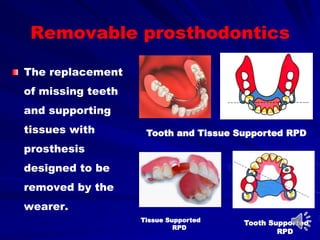
Tissue Supported
RPD
Tooth and Tissue Supported RPD
Tooth Supported
RPD
The replacement
of missing teeth
and supporting
tissues with
prosthesis
designed to be
removed by the
wearer.
Removable prosthodontics
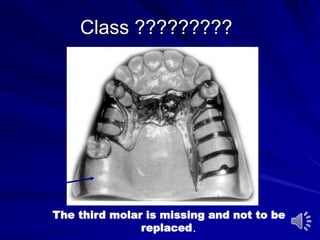
Class ?????????
The third molar is missing and not to be
replaced.
Consequences of loss of teeth and
distribution of forces in the oral cavity
• Drifting, overeruption and inclination of the teeth
• Disturbed occlusion and loss of vertical dimension.
• Disabilities associated with appearance.
• Speech disabilities.
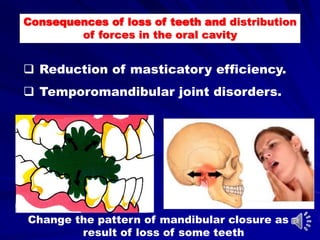
• Reduction of masticatory efficiency.
• Temporomandibular joint disorders.
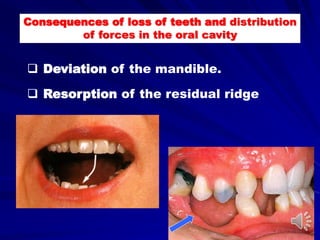
• Deviation of the mandible.
• Resorption of the residual ridge
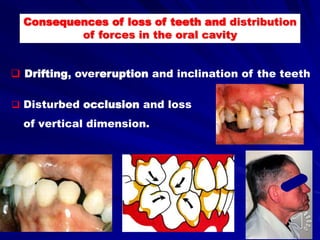
 Disturbed occlusion and loss
of vertical dimension.
Consequences of loss of teeth and distribution
of forces in the oral cavity
 Drifting, overeruption and inclination of the teeth
Consequences of loss of teeth and distribution
of forces in the oral cavity
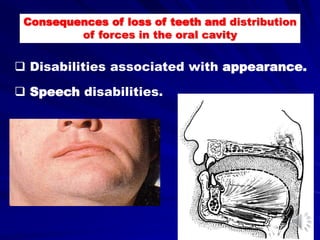
 Disabilities associated with appearance.
 Speech disabilities.
Consequences of loss of teeth and distribution
of forces in the oral cavity
Change the pattern of mandibular closure as a
result of loss of some teeth
 Reduction of masticatory efficiency.
 Temporomandibular joint disorders.
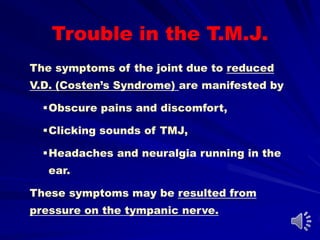
Trouble in the T.M.J.
The symptoms of the joint due to reduced
V.D. (Costen’s Syndrome) are manifested by
Obscure pains and discomfort,
Clicking sounds of TMJ,
Headaches and neuralgia running in the
ear.
These symptoms may be resulted from
pressure on the tympanic nerve.
Consequences of loss of teeth and distribution
of forces in the oral cavity
 Deviation of the mandible.
 Resorption of the residual ridge
OBJECTIVES OF REMOVABLE PARTIAL
DENTURES
Preservation of the Remaining Tissues
Improvement of Esthetics
Improve Masticatory Function
Restoration of Impaired speech
Enhance psychological comfort
OBJECTIVES OF REMOVABLE PARTIAL
DENTURES
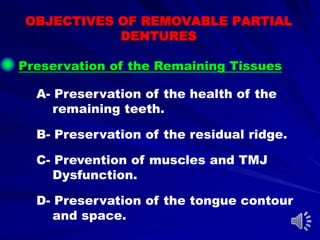
Preservation of the Remaining Tissues
A- Preservation of the health of the
remaining teeth.
B- Preservation of the residual ridge.
C- Prevention of muscles and TMJ
Dysfunction.
D- Preservation of the tongue contour
and space.
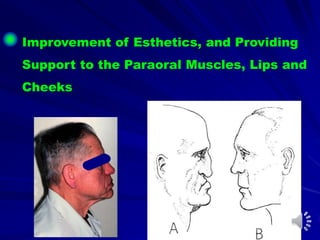
Improvement of Esthetics, and Providing
Support to the Paraoral Muscles, Lips and
Cheeks
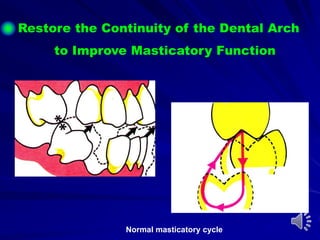
Normal masticatory cycle
Restore the Continuity of the Dental Arch
to Improve Masticatory Function
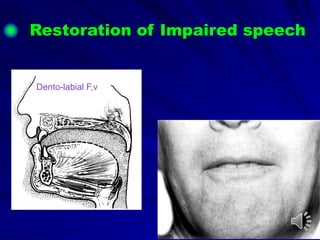
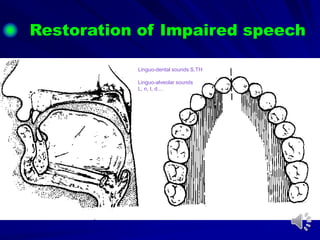
Restoration of Impaired speech
Dento-labial F,v
Linguo-dental sounds S,TH
Linguo-alveolar sounds
L, n, t, d....
Restoration of Impaired speech
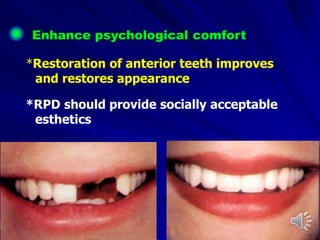
Enhance psychological comfort
*Restoration of anterior teeth improves
and restores appearance
*RPD should provide socially acceptable
esthetics
Retention
Reciprocation
Support
Indirect Retention (Stabilization)
RPD REQUIREMENTS
Bracing and Stabilization
A properly constructed partial denture must achieve
All should be within the physiological
limits of the tissues involved
• Forces acting on RPD and factors that
influence the magnitude of stresses
transmitted to the tissues.
Is the Planning of the form and extent of
RPD, after studying all the factors involved
• Controlling the stresses by RPD
• Design concepts
Removable Partial Denture Design
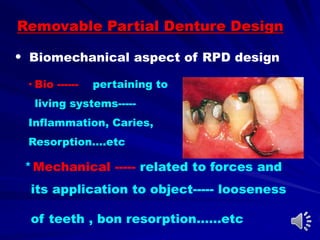
• Biomechanical aspect of RPD design
* Mechanical ----- related to forces and
its application to object----- looseness
of teeth , bon resorption……etc
Removable Partial Denture Design
• Biomechanical aspect of RPD design
• Bio ------ pertaining to
living systems-----
Inflammation, Caries,
Resorption….etc
FORCES ACTING ON
REMOVABLE PARTIAL
DENTURES
The magnitude and intensity
The duration
The direction
The frequency
of these forces
The Ability Of living tissues
To Tolerate Forces Is Largely Dependent Upon
Maxfield
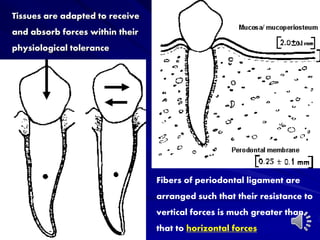
Fibers of periodontal ligament are
arranged such that their resistance to
vertical forces is much greater than
that to horizontal forces
Tissues are adapted to receive
and absorb forces within their
physiological tolerance
POSSIBLE
MOVEMENTS OF THE
PARTIAL DENTURE
I- Vertical Tissue-ward movements
II- Vertical Tissue-away movements
III- Horizontal movements:
A) Lateral movements
B) Antero-posterior movements.
IV- Rotational movements
At least four possible movements of
the partial dentures exist
I- Type of movement
II- Causes
III- Function of the partial denture that
resist this movement
IV- Components of PD that provide this
function
Four possible movements of PD
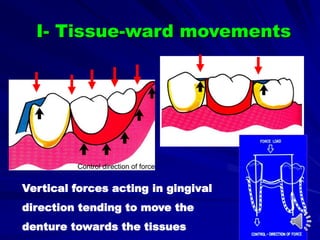
Vertical forces acting in gingival
direction tending to move the
denture towards the tissues
I- Tissue-ward movements
Control direction of force
• Mastication, swallowing and aimless
tooth contact, biting forces.
They occur during
• P.D. should be designed to resist this
movement by providing adequate
supporting components
•This function of the partial denture is called
“Support”
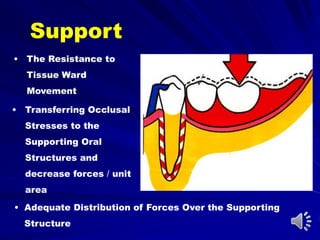
• The Resistance to
Tissue Ward
Movement
Support
• Adequate Distribution of Forces Over the Supporting
Structure
• Transferring Occlusal
Stresses to the
Supporting Oral
Structures and
decrease forces / unit
area
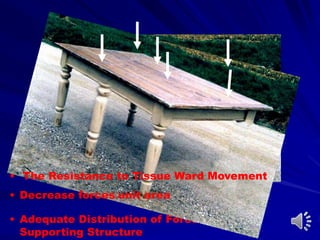
• Adequate Distribution of Forces Over the
Supporting Structure
• Decrease forces/unit area
• The Resistance to Tissue Ward Movement
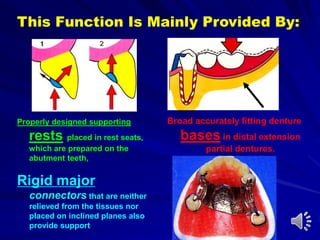
This Function Is Mainly Provided By:
Properly designed supporting
rests placed in rest seats,
which are prepared on the
abutment teeth,
Broad accurately fitting denture
bases in distal extension
partial dentures.
Rigid major
connectors that are neither
relieved from the tissues nor
placed on inclined planes also
provide support
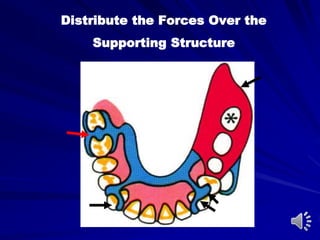
Distribute the Forces Over the
Supporting Structure
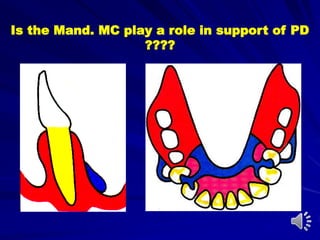
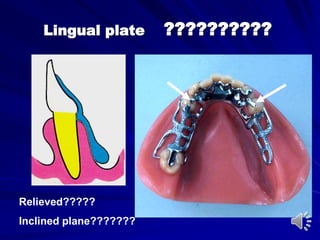
Is the Mand. MC play a role in support of PD
????
Lingual plate ??????????
Relieved?????
Inclined plane???????
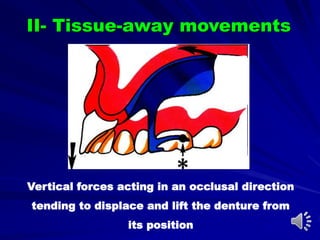
II- Tissue-away movements
Vertical forces acting in an occlusal direction
tending to displace and lift the denture from
its position
Tissue-away forces occur due to
•This function of the partial denture is called
“Retention”
The action of muscles acting along the
periphery of the denture
Gravity acting on upper dentures or by
Sticky food adhering to the artificial
teeth or to the denture base.
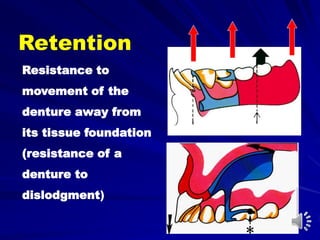
Resistance to
movement of the
denture away from
its tissue foundation
(resistance of a
denture to
dislodgment)
Retention
The function of partial denture
which prevents the denture from
being displaced in an occlusal
direction (away from the tissues)
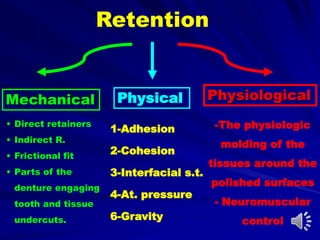
Retention
1-Adhesion
2-Cohesion
3-Interfacial s.t.
4-At. pressure
6-Gravity
Mechanical
Retention
PhysiologicalPhysical
-The physiologic
molding of the
tissues around the
polished surfaces
- Neuromuscular
control
• Direct retainers
• Indirect R.
• Frictional fit
• Parts of the
denture engaging
tooth and tissue
undercuts.
• Frictional fit
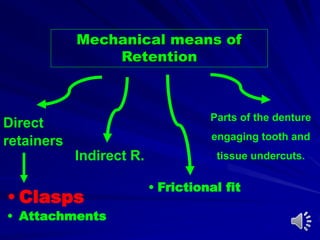
Mechanical means of
Retention
Indirect R.
Direct
retainers
Parts of the denture
engaging tooth and
tissue undercuts.
• Clasps
• Attachments
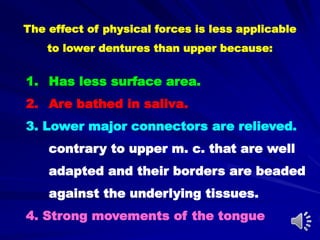
1. Has less surface area.
2. Are bathed in saliva.
3. Lower major connectors are relieved.
contrary to upper m. c. that are well
adapted and their borders are beaded
against the underlying tissues.
4. Strong movements of the tongue
The effect of physical forces is less applicable
to lower dentures than upper because:
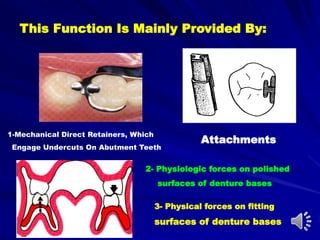
This Function Is Mainly Provided By:
1-Mechanical Direct Retainers, Which
Engage Undercuts On Abutment Teeth
Attachments
2- Physiologic forces on polished
surfaces of denture bases
3- Physical forces on fitting
surfaces of denture bases
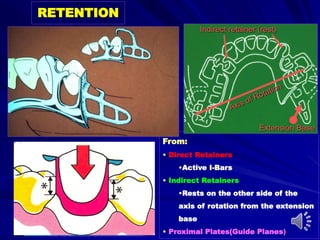
RETENTION
From:
• Direct Retainers
•Active I-Bars
• Indirect Retainers
•Rests on the other side of the
axis of rotation from the extension
base
• Proximal Plates(Guide Planes)
Indirect retainer (rest)
Extension Base
???
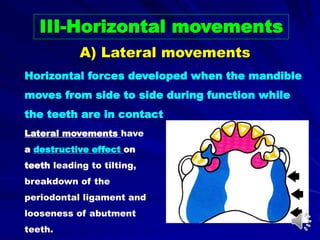
III-Horizontal movements
Horizontal forces developed when the mandible
moves from side to side during function while
the teeth are in contact
Lateral movements have
a destructive effect on
teeth leading to tilting,
breakdown of the
periodontal ligament and
looseness of abutment
teeth.
A) Lateral movements
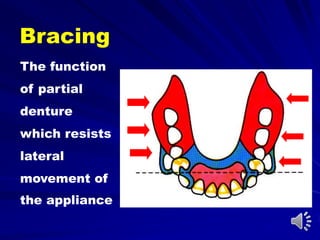
Bracing
The function
of partial
denture
which resists
lateral
movement of
the appliance
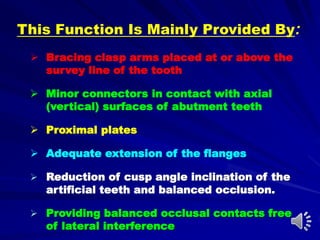
This Function Is Mainly Provided By:
 Bracing clasp arms placed at or above the
survey line of the tooth
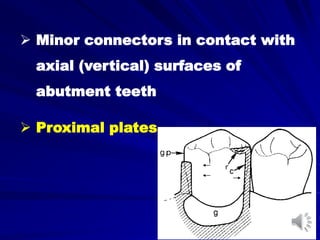
 Minor connectors in contact with axial
(vertical) surfaces of abutment teeth
 Proximal plates
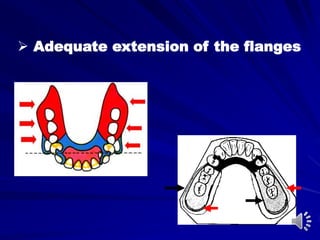
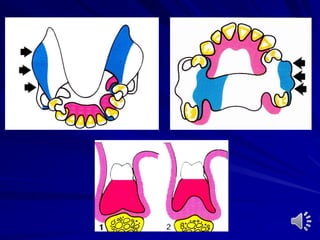
 Adequate extension of the flanges
 Reduction of cusp angle inclination of the
artificial teeth and balanced occlusion.
 Providing balanced occlusal contacts free
of lateral interference
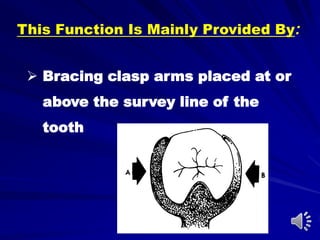
This Function Is Mainly Provided By:
 Bracing clasp arms placed at or
above the survey line of the
tooth
 Minor connectors in contact with
axial (vertical) surfaces of
abutment teeth
 Proximal plates
 Adequate extension of the flanges
III-Horizontal movements
Horizontal forces which occur during
forward and backward movement of the
mandible during function while the teeth
are in contact
There is natural tendency for the upper
denture to move forward and for the
lower to move backward.
B) Antero-posterior movements
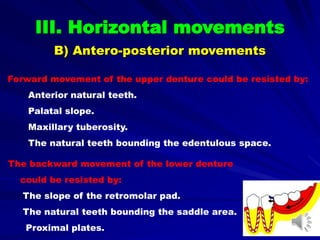
Forward movement of the upper denture could be resisted by:
Anterior natural teeth.
Palatal slope.
Maxillary tuberosity.
The natural teeth bounding the edentulous space.
The backward movement of the lower denture
could be resisted by:
The slope of the retromolar pad.
The natural teeth bounding the saddle area.
Proximal plates.
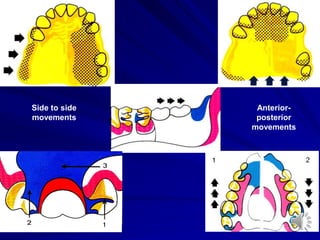
III. Horizontal movements
B) Antero-posterior movements
Anterior-
posterior
movements
Side to side
movements
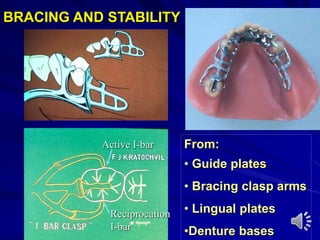
From:
• Guide plates
• Bracing clasp arms
• Lingual plates
•Denture bases
Active I-bar
Reciprocation
I-bar
BRACING AND STABILITY
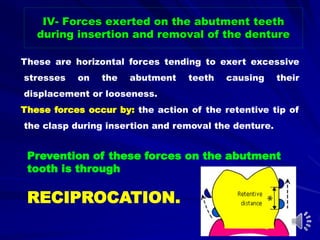
These are horizontal forces tending to exert excessive
stresses on the abutment teeth causing their
displacement or looseness.
These forces occur by: the action of the retentive tip of
the clasp during insertion and removal the denture.
Prevention of these forces on the abutment
tooth is through
RECIPROCATION.
IV- Forces exerted on the abutment teeth
during insertion and removal of the denture
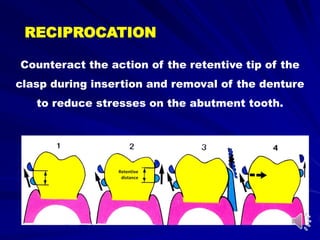
Counteract the action of the retentive tip of the
clasp during insertion and removal of the denture
to reduce stresses on the abutment tooth.
RECIPROCATION
Retentive
distance
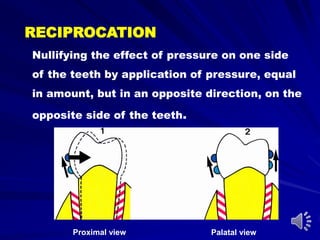
Palatal viewProximal view
RECIPROCATION
Nullifying the effect of pressure on one side
of the teeth by application of pressure, equal
in amount, but in an opposite direction, on the
opposite side of the teeth.
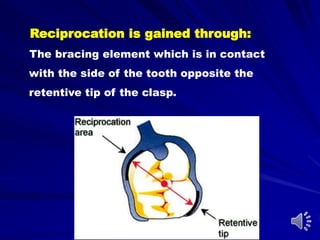
Reciprocation is gained through:
The bracing element which is in contact
with the side of the tooth opposite the
retentive tip of the clasp.
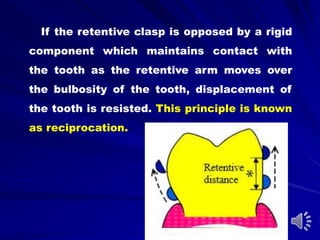
If the retentive clasp is opposed by a rigid
component which maintains contact with
the tooth as the retentive arm moves over
the bulbosity of the tooth, displacement of
the tooth is resisted. This principle is known
as reciprocation.
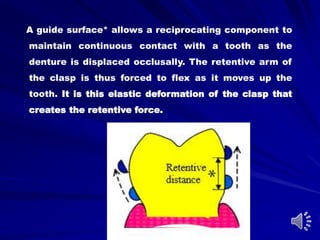
A guide surface* allows a reciprocating component to
maintain continuous contact with a tooth as the
denture is displaced occlusally. The retentive arm of
the clasp is thus forced to flex as it moves up the
tooth. It is this elastic deformation of the clasp that
creates the retentive force.
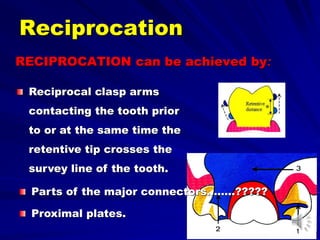
RECIPROCATION can be achieved by:
Reciprocal clasp arms
contacting the tooth prior
to or at the same time the
retentive tip crosses the
survey line of the tooth.
Reciprocation
Parts of the major connectors……..?????
Proximal plates.
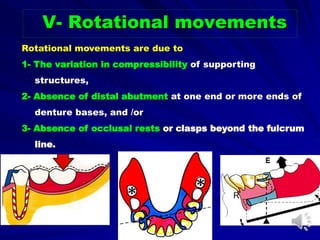
V- Rotational movements
Rotational movements are due to
1- The variation in compressibility of supporting
structures,
2- Absence of distal abutment at one end or more ends of
denture bases, and /or
3- Absence of occlusal rests or clasps beyond the fulcrum
line.
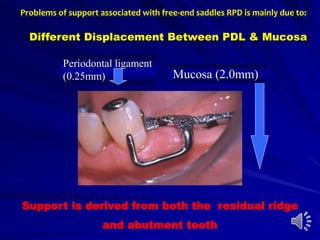
Periodontal ligament
(0.25mm) Mucosa (2.0mm)
Different Displacement Between PDL & Mucosa
Support is derived from both the residual ridge
and abutment teeth
Problems of support associated with free-end saddles RPD is mainly due to:
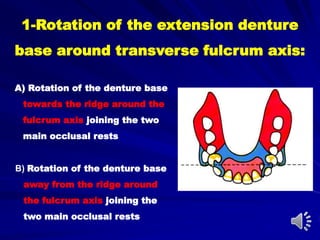
1-Rotation of the extension denture
base around transverse fulcrum axis:
A) Rotation of the denture base
towards the ridge around the
fulcrum axis joining the two
main occlusal rests
B) Rotation of the denture base
away from the ridge around
the fulcrum axis joining the
two main occlusal rests
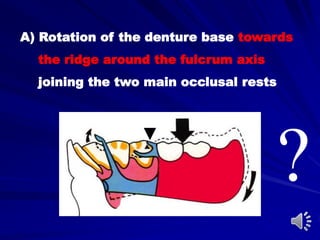
A) Rotation of the denture base towards
the ridge around the fulcrum axis
joining the two main occlusal rests
?
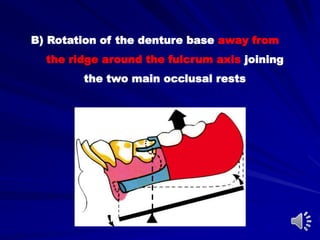
B) Rotation of the denture base away from
the ridge around the fulcrum axis joining
the two main occlusal rests
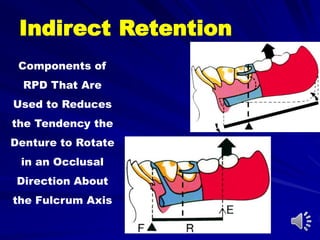
Components of
RPD That Are
Used to Reduces
the Tendency the
Denture to Rotate
in an Occlusal
Direction About
the Fulcrum Axis
Indirect Retention
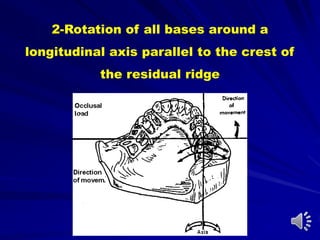
2-Rotation of all bases around a
longitudinal axis parallel to the crest of
the residual ridge
F
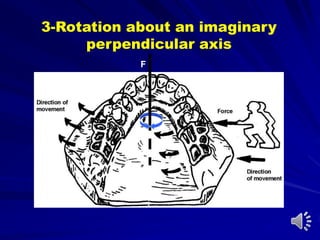
3-Rotation about an imaginary
perpendicular axis
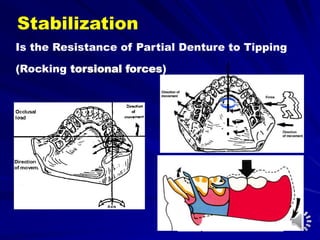
Stabilization
Is the Resistance of Partial Denture to Tipping
(Rocking torsional forces)
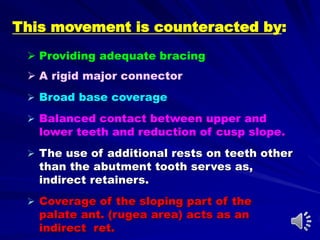
This movement is counteracted by:
 Providing adequate bracing
 A rigid major connector
 Broad base coverage
 Balanced contact between upper and
lower teeth and reduction of cusp slope.
 The use of additional rests on teeth other
than the abutment tooth serves as,
indirect retainers.
 Coverage of the sloping part of the
palate ant. (rugea area) acts as an
indirect ret.
Never laugh at anyone's dreams.
People who don't have dreams don't have much
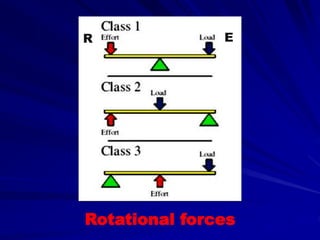
Rotational forces
R E
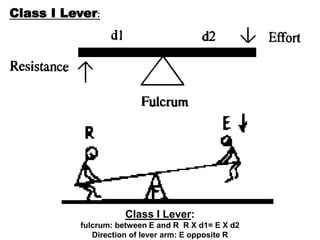
Class I Lever:
fulcrum: between E and R R X d1= E X d2
Direction of lever arm: E opposite R
Class I Lever:
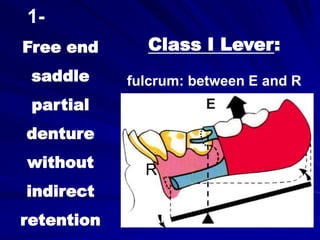
Class I Lever:
fulcrum: between E and R
R
Free end
saddle
partial
denture
without
indirect
retention
1-
E
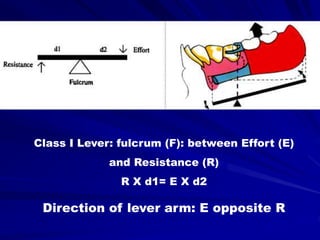
Class I Lever: fulcrum (F): between Effort (E)
and Resistance (R)
R X d1= E X d2
Direction of lever arm: E opposite R
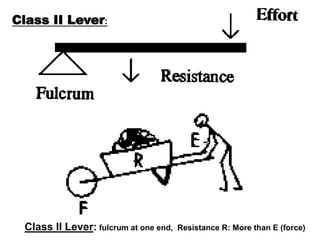
Class II Lever: fulcrum at one end, Resistance R: More than E (force)
Class II Lever:
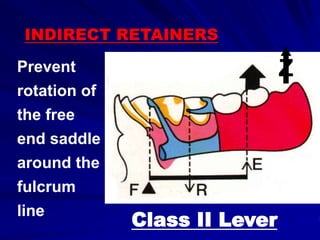
Prevent
rotation of
the free
end saddle
around the
fulcrum
line
INDIRECT RETAINERS
Z
Class II Lever
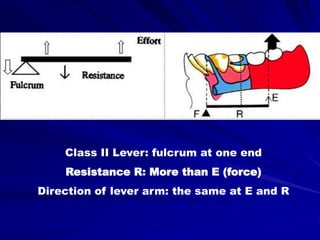
Class II Lever: fulcrum at one end
Resistance R: More than E (force)
Direction of lever arm: the same at E and R
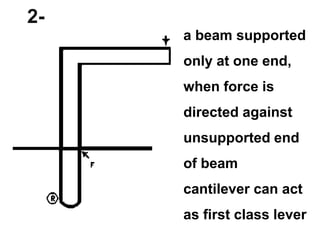
a beam supported
only at one end,
when force is
directed against
unsupported end
of beam
cantilever can act
as first class lever
2-
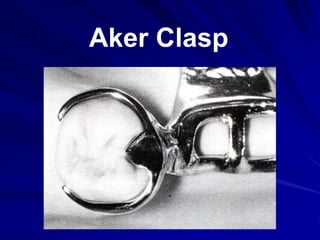
Aker Clasp
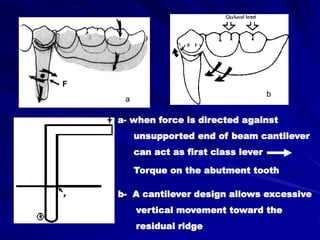
a- when force is directed against
unsupported end of beam cantilever
can act as first class lever
Torque on the abutment tooth
F
b- A cantilever design allows excessive
vertical movement toward the
residual ridge
a
b
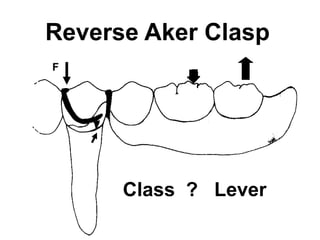
Reverse Aker Clasp
F
Class ? Lever
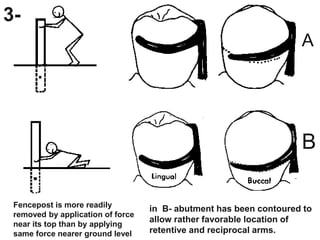
Fencepost is more readily
removed by application of force
near its top than by applying
same force nearer ground level
in B- abutment has been contoured to
allow rather favorable location of
retentive and reciprocal arms.
A
B
3-
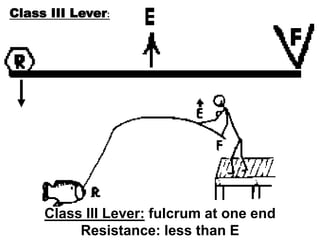
Class III Lever: fulcrum at one end
Resistance: less than E
Class III Lever:
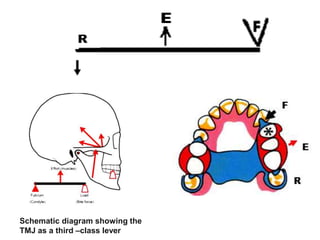
Schematic diagram showing the
TMJ as a third –class lever
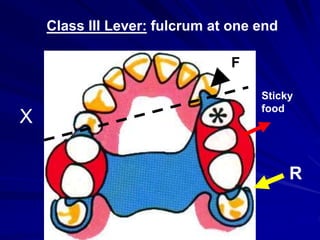
Class III Lever: fulcrum at one end
Sticky
food
X
F
R

Forces acting on Removable Partial Denture

  • 1.
    3- FORCES ACTINGON REMOVABLE PARTIAL DENTURES
  • 3.
    FORCES ACTING ONREMOVABLE PARTIAL DENTURES Dr. Amal Fathy Kaddah Professor of Prosthodontic, Faculty of Dentistry, Cairo University
  • 4.
    When you realizeyou've made a mistake, take immediate steps to correct it.
  • 5.
    Tissue Supported RPD Tooth andTissue Supported RPD Tooth Supported RPD The replacement of missing teeth and supporting tissues with prosthesis designed to be removed by the wearer. Removable prosthodontics
  • 6.
    Class ????????? The thirdmolar is missing and not to be replaced.
  • 7.
    Consequences of lossof teeth and distribution of forces in the oral cavity • Drifting, overeruption and inclination of the teeth • Disturbed occlusion and loss of vertical dimension. • Disabilities associated with appearance. • Speech disabilities. • Reduction of masticatory efficiency. • Temporomandibular joint disorders. • Deviation of the mandible. • Resorption of the residual ridge
  • 8.
     Disturbed occlusionand loss of vertical dimension. Consequences of loss of teeth and distribution of forces in the oral cavity  Drifting, overeruption and inclination of the teeth
  • 9.
    Consequences of lossof teeth and distribution of forces in the oral cavity  Disabilities associated with appearance.  Speech disabilities.
  • 10.
    Consequences of lossof teeth and distribution of forces in the oral cavity Change the pattern of mandibular closure as a result of loss of some teeth  Reduction of masticatory efficiency.  Temporomandibular joint disorders.
  • 11.
    Trouble in theT.M.J. The symptoms of the joint due to reduced V.D. (Costen’s Syndrome) are manifested by Obscure pains and discomfort, Clicking sounds of TMJ, Headaches and neuralgia running in the ear. These symptoms may be resulted from pressure on the tympanic nerve.
  • 12.
    Consequences of lossof teeth and distribution of forces in the oral cavity  Deviation of the mandible.  Resorption of the residual ridge
  • 13.
    OBJECTIVES OF REMOVABLEPARTIAL DENTURES Preservation of the Remaining Tissues Improvement of Esthetics Improve Masticatory Function Restoration of Impaired speech Enhance psychological comfort
  • 14.
    OBJECTIVES OF REMOVABLEPARTIAL DENTURES Preservation of the Remaining Tissues A- Preservation of the health of the remaining teeth. B- Preservation of the residual ridge. C- Prevention of muscles and TMJ Dysfunction. D- Preservation of the tongue contour and space.
  • 15.
    Improvement of Esthetics,and Providing Support to the Paraoral Muscles, Lips and Cheeks
  • 16.
    Normal masticatory cycle Restorethe Continuity of the Dental Arch to Improve Masticatory Function
  • 17.
    Restoration of Impairedspeech Dento-labial F,v
  • 18.
    Linguo-dental sounds S,TH Linguo-alveolarsounds L, n, t, d.... Restoration of Impaired speech
  • 19.
    Enhance psychological comfort *Restorationof anterior teeth improves and restores appearance *RPD should provide socially acceptable esthetics
  • 20.
    Retention Reciprocation Support Indirect Retention (Stabilization) RPDREQUIREMENTS Bracing and Stabilization A properly constructed partial denture must achieve All should be within the physiological limits of the tissues involved
  • 22.
    • Forces actingon RPD and factors that influence the magnitude of stresses transmitted to the tissues. Is the Planning of the form and extent of RPD, after studying all the factors involved • Controlling the stresses by RPD • Design concepts Removable Partial Denture Design • Biomechanical aspect of RPD design
  • 23.
    * Mechanical -----related to forces and its application to object----- looseness of teeth , bon resorption……etc Removable Partial Denture Design • Biomechanical aspect of RPD design • Bio ------ pertaining to living systems----- Inflammation, Caries, Resorption….etc
  • 24.
  • 25.
    The magnitude andintensity The duration The direction The frequency of these forces The Ability Of living tissues To Tolerate Forces Is Largely Dependent Upon Maxfield
  • 26.
    Fibers of periodontalligament are arranged such that their resistance to vertical forces is much greater than that to horizontal forces Tissues are adapted to receive and absorb forces within their physiological tolerance
  • 27.
  • 28.
    I- Vertical Tissue-wardmovements II- Vertical Tissue-away movements III- Horizontal movements: A) Lateral movements B) Antero-posterior movements. IV- Rotational movements At least four possible movements of the partial dentures exist
  • 29.
    I- Type ofmovement II- Causes III- Function of the partial denture that resist this movement IV- Components of PD that provide this function Four possible movements of PD
  • 30.
    Vertical forces actingin gingival direction tending to move the denture towards the tissues I- Tissue-ward movements Control direction of force
  • 31.
    • Mastication, swallowingand aimless tooth contact, biting forces. They occur during • P.D. should be designed to resist this movement by providing adequate supporting components •This function of the partial denture is called “Support”
  • 32.
    • The Resistanceto Tissue Ward Movement Support • Adequate Distribution of Forces Over the Supporting Structure • Transferring Occlusal Stresses to the Supporting Oral Structures and decrease forces / unit area
  • 33.
    • Adequate Distributionof Forces Over the Supporting Structure • Decrease forces/unit area • The Resistance to Tissue Ward Movement
  • 34.
    This Function IsMainly Provided By: Properly designed supporting rests placed in rest seats, which are prepared on the abutment teeth, Broad accurately fitting denture bases in distal extension partial dentures. Rigid major connectors that are neither relieved from the tissues nor placed on inclined planes also provide support
  • 35.
    Distribute the ForcesOver the Supporting Structure
  • 36.
    Is the Mand.MC play a role in support of PD ????
  • 37.
  • 38.
    II- Tissue-away movements Verticalforces acting in an occlusal direction tending to displace and lift the denture from its position
  • 39.
    Tissue-away forces occurdue to •This function of the partial denture is called “Retention” The action of muscles acting along the periphery of the denture Gravity acting on upper dentures or by Sticky food adhering to the artificial teeth or to the denture base.
  • 40.
    Resistance to movement ofthe denture away from its tissue foundation (resistance of a denture to dislodgment) Retention
  • 41.
    The function ofpartial denture which prevents the denture from being displaced in an occlusal direction (away from the tissues) Retention
  • 42.
    1-Adhesion 2-Cohesion 3-Interfacial s.t. 4-At. pressure 6-Gravity Mechanical Retention PhysiologicalPhysical -Thephysiologic molding of the tissues around the polished surfaces - Neuromuscular control • Direct retainers • Indirect R. • Frictional fit • Parts of the denture engaging tooth and tissue undercuts.
  • 43.
    • Frictional fit Mechanicalmeans of Retention Indirect R. Direct retainers Parts of the denture engaging tooth and tissue undercuts. • Clasps • Attachments
  • 44.
    1. Has lesssurface area. 2. Are bathed in saliva. 3. Lower major connectors are relieved. contrary to upper m. c. that are well adapted and their borders are beaded against the underlying tissues. 4. Strong movements of the tongue The effect of physical forces is less applicable to lower dentures than upper because:
  • 45.
    This Function IsMainly Provided By: 1-Mechanical Direct Retainers, Which Engage Undercuts On Abutment Teeth Attachments 2- Physiologic forces on polished surfaces of denture bases 3- Physical forces on fitting surfaces of denture bases
  • 46.
    RETENTION From: • Direct Retainers •ActiveI-Bars • Indirect Retainers •Rests on the other side of the axis of rotation from the extension base • Proximal Plates(Guide Planes) Indirect retainer (rest) Extension Base ???
  • 47.
    III-Horizontal movements Horizontal forcesdeveloped when the mandible moves from side to side during function while the teeth are in contact Lateral movements have a destructive effect on teeth leading to tilting, breakdown of the periodontal ligament and looseness of abutment teeth. A) Lateral movements
  • 48.
    Bracing The function of partial denture whichresists lateral movement of the appliance
  • 49.
    This Function IsMainly Provided By:  Bracing clasp arms placed at or above the survey line of the tooth  Minor connectors in contact with axial (vertical) surfaces of abutment teeth  Proximal plates  Adequate extension of the flanges  Reduction of cusp angle inclination of the artificial teeth and balanced occlusion.  Providing balanced occlusal contacts free of lateral interference
  • 50.
    This Function IsMainly Provided By:  Bracing clasp arms placed at or above the survey line of the tooth
  • 51.
     Minor connectorsin contact with axial (vertical) surfaces of abutment teeth  Proximal plates
  • 52.
     Adequate extensionof the flanges
  • 54.
    III-Horizontal movements Horizontal forceswhich occur during forward and backward movement of the mandible during function while the teeth are in contact There is natural tendency for the upper denture to move forward and for the lower to move backward. B) Antero-posterior movements
  • 55.
    Forward movement ofthe upper denture could be resisted by: Anterior natural teeth. Palatal slope. Maxillary tuberosity. The natural teeth bounding the edentulous space. The backward movement of the lower denture could be resisted by: The slope of the retromolar pad. The natural teeth bounding the saddle area. Proximal plates. III. Horizontal movements B) Antero-posterior movements
  • 56.
  • 57.
    From: • Guide plates •Bracing clasp arms • Lingual plates •Denture bases Active I-bar Reciprocation I-bar BRACING AND STABILITY
  • 58.
    These are horizontalforces tending to exert excessive stresses on the abutment teeth causing their displacement or looseness. These forces occur by: the action of the retentive tip of the clasp during insertion and removal the denture. Prevention of these forces on the abutment tooth is through RECIPROCATION. IV- Forces exerted on the abutment teeth during insertion and removal of the denture
  • 59.
    Counteract the actionof the retentive tip of the clasp during insertion and removal of the denture to reduce stresses on the abutment tooth. RECIPROCATION Retentive distance
  • 60.
    Palatal viewProximal view RECIPROCATION Nullifyingthe effect of pressure on one side of the teeth by application of pressure, equal in amount, but in an opposite direction, on the opposite side of the teeth.
  • 61.
    Reciprocation is gainedthrough: The bracing element which is in contact with the side of the tooth opposite the retentive tip of the clasp.
  • 62.
    If the retentiveclasp is opposed by a rigid component which maintains contact with the tooth as the retentive arm moves over the bulbosity of the tooth, displacement of the tooth is resisted. This principle is known as reciprocation.
  • 63.
    A guide surface*allows a reciprocating component to maintain continuous contact with a tooth as the denture is displaced occlusally. The retentive arm of the clasp is thus forced to flex as it moves up the tooth. It is this elastic deformation of the clasp that creates the retentive force.
  • 64.
    RECIPROCATION can beachieved by: Reciprocal clasp arms contacting the tooth prior to or at the same time the retentive tip crosses the survey line of the tooth. Reciprocation Parts of the major connectors……..????? Proximal plates.
  • 65.
    V- Rotational movements Rotationalmovements are due to 1- The variation in compressibility of supporting structures, 2- Absence of distal abutment at one end or more ends of denture bases, and /or 3- Absence of occlusal rests or clasps beyond the fulcrum line.
  • 66.
    Periodontal ligament (0.25mm) Mucosa(2.0mm) Different Displacement Between PDL & Mucosa Support is derived from both the residual ridge and abutment teeth Problems of support associated with free-end saddles RPD is mainly due to:
  • 67.
    1-Rotation of theextension denture base around transverse fulcrum axis: A) Rotation of the denture base towards the ridge around the fulcrum axis joining the two main occlusal rests B) Rotation of the denture base away from the ridge around the fulcrum axis joining the two main occlusal rests
  • 68.
    A) Rotation ofthe denture base towards the ridge around the fulcrum axis joining the two main occlusal rests ?
  • 69.
    B) Rotation ofthe denture base away from the ridge around the fulcrum axis joining the two main occlusal rests
  • 70.
    Components of RPD ThatAre Used to Reduces the Tendency the Denture to Rotate in an Occlusal Direction About the Fulcrum Axis Indirect Retention
  • 71.
    2-Rotation of allbases around a longitudinal axis parallel to the crest of the residual ridge
  • 72.
    F 3-Rotation about animaginary perpendicular axis
  • 73.
    Stabilization Is the Resistanceof Partial Denture to Tipping (Rocking torsional forces)
  • 75.
    This movement iscounteracted by:  Providing adequate bracing  A rigid major connector  Broad base coverage  Balanced contact between upper and lower teeth and reduction of cusp slope.  The use of additional rests on teeth other than the abutment tooth serves as, indirect retainers.  Coverage of the sloping part of the palate ant. (rugea area) acts as an indirect ret.
  • 76.
    Never laugh atanyone's dreams. People who don't have dreams don't have much
  • 78.
  • 79.
    Class I Lever: fulcrum:between E and R R X d1= E X d2 Direction of lever arm: E opposite R Class I Lever:
  • 80.
    Class I Lever: fulcrum:between E and R R Free end saddle partial denture without indirect retention 1- E
  • 81.
    Class I Lever:fulcrum (F): between Effort (E) and Resistance (R) R X d1= E X d2 Direction of lever arm: E opposite R
  • 82.
    Class II Lever:fulcrum at one end, Resistance R: More than E (force) Class II Lever:
  • 83.
    Prevent rotation of the free endsaddle around the fulcrum line INDIRECT RETAINERS Z Class II Lever
  • 84.
    Class II Lever:fulcrum at one end Resistance R: More than E (force) Direction of lever arm: the same at E and R
  • 85.
    a beam supported onlyat one end, when force is directed against unsupported end of beam cantilever can act as first class lever 2-
  • 86.
  • 87.
    a- when forceis directed against unsupported end of beam cantilever can act as first class lever Torque on the abutment tooth F b- A cantilever design allows excessive vertical movement toward the residual ridge a b
  • 88.
  • 89.
    Fencepost is morereadily removed by application of force near its top than by applying same force nearer ground level in B- abutment has been contoured to allow rather favorable location of retentive and reciprocal arms. A B 3-
  • 90.
    Class III Lever:fulcrum at one end Resistance: less than E Class III Lever:
  • 91.
    Schematic diagram showingthe TMJ as a third –class lever
  • 92.
    Class III Lever:fulcrum at one end Sticky food X F R