
Functional Areas
of Management
• Human Resource Management
• Marketing Management
• Operations Management
• Financial Management
• ICT Management
Human Resource
Management
the process of
attracting, training,
developing, and
maintaining an excellent
workforce.
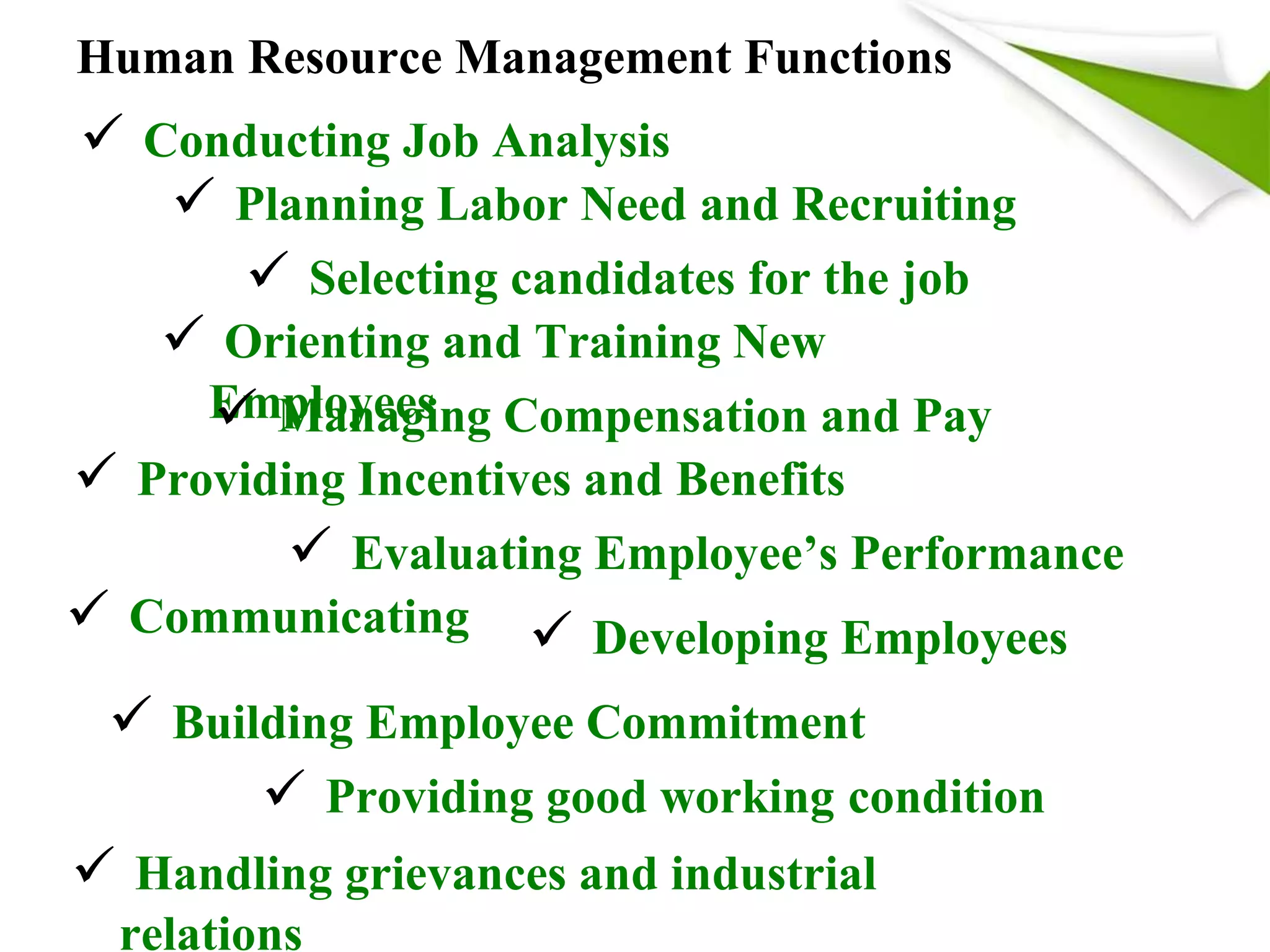
Human Resource Management Functions
 Conducting Job Analysis
 Planning Labor Need and Recruiting
 Selecting candidates for the job
 Orienting and Training New
Employees Managing Compensation and Pay
 Providing Incentives and Benefits
 Evaluating Employee’s Performance
 Communicating  Developing Employees
 Building Employee Commitment
 Providing good working condition
 Handling grievances and industrial
relations
Importance of
Human Resource Management
Human resource management deals with the
study of people – the most important business
resource. Money, materials, and information
resources are not capable of moving the
business activities without the aid of the primary
performance drivers, the human resources,
therefore, mastering the activities involve in
human resource management is a must since all
the management functions could be done easily
if the organization managers practice proper
human resource management.
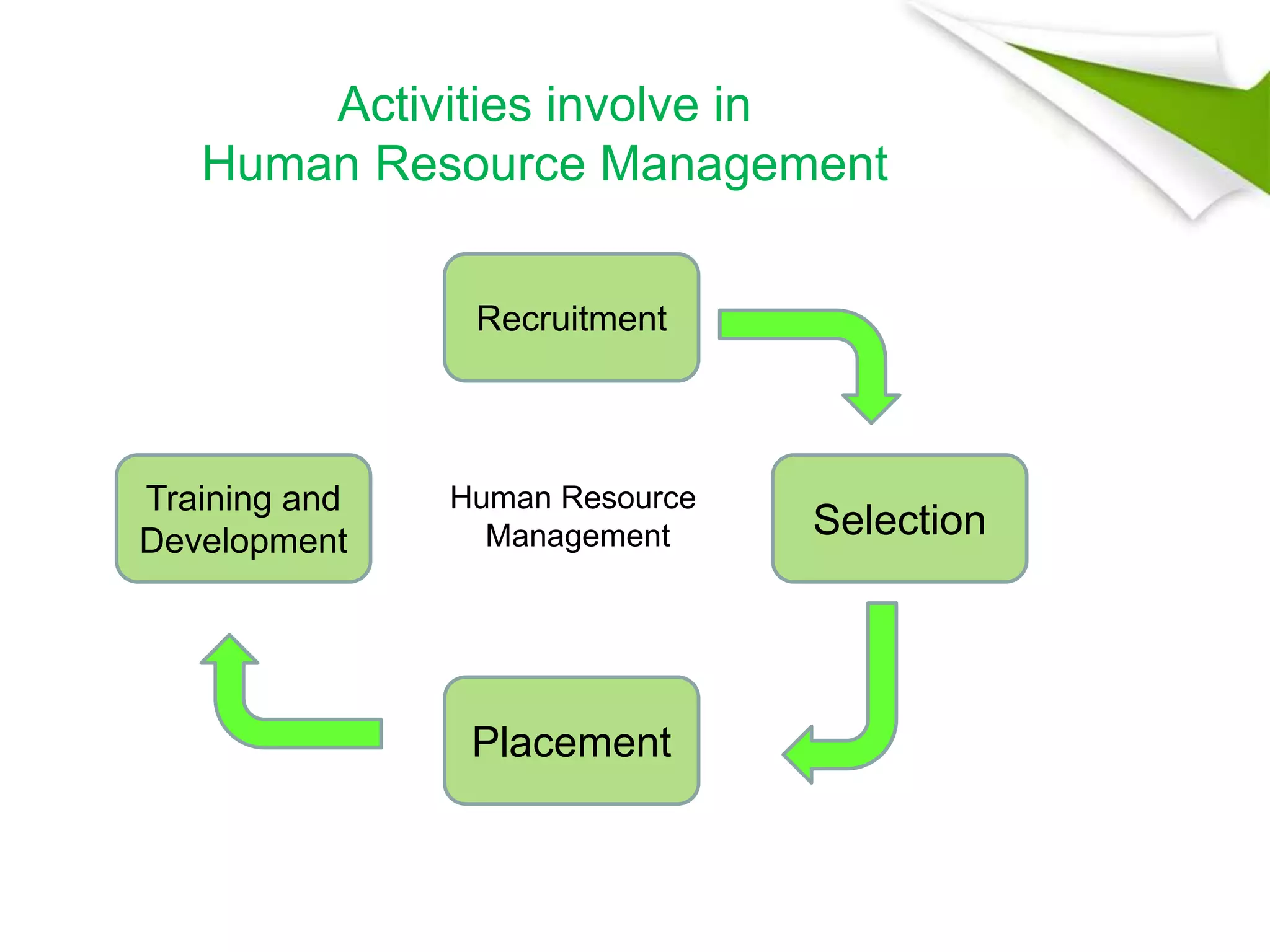
Activities involve in
Human Resource Management
Human Resource
Management
Recruitment
Selection
Placement
Training and
Development
Marketing Management
the process of managerial
planning and carrying out of the
conception, pricing, promotion,
and distribution of goods and
services in order to bring about
exchanges to satisfy individual
and organizational goals.
Marketing Management Functions
 Analysis, planning, implementing, and
controlling of goods, services and ideas to create
exchanges that satisfy customer needs and
company goals.
 Management of marketing resources
 Analyze , plan, and implement marketing programs
that aim to bring about an expected level and mix of
business deals with target markets.
 Stimulate demand for the product of the company.
 Make crucial decisions that will ensure the
company’s competitiveness.
 Make sure that the marketing techniques employed
are efficient, effective, and socially responsible or
ethical.
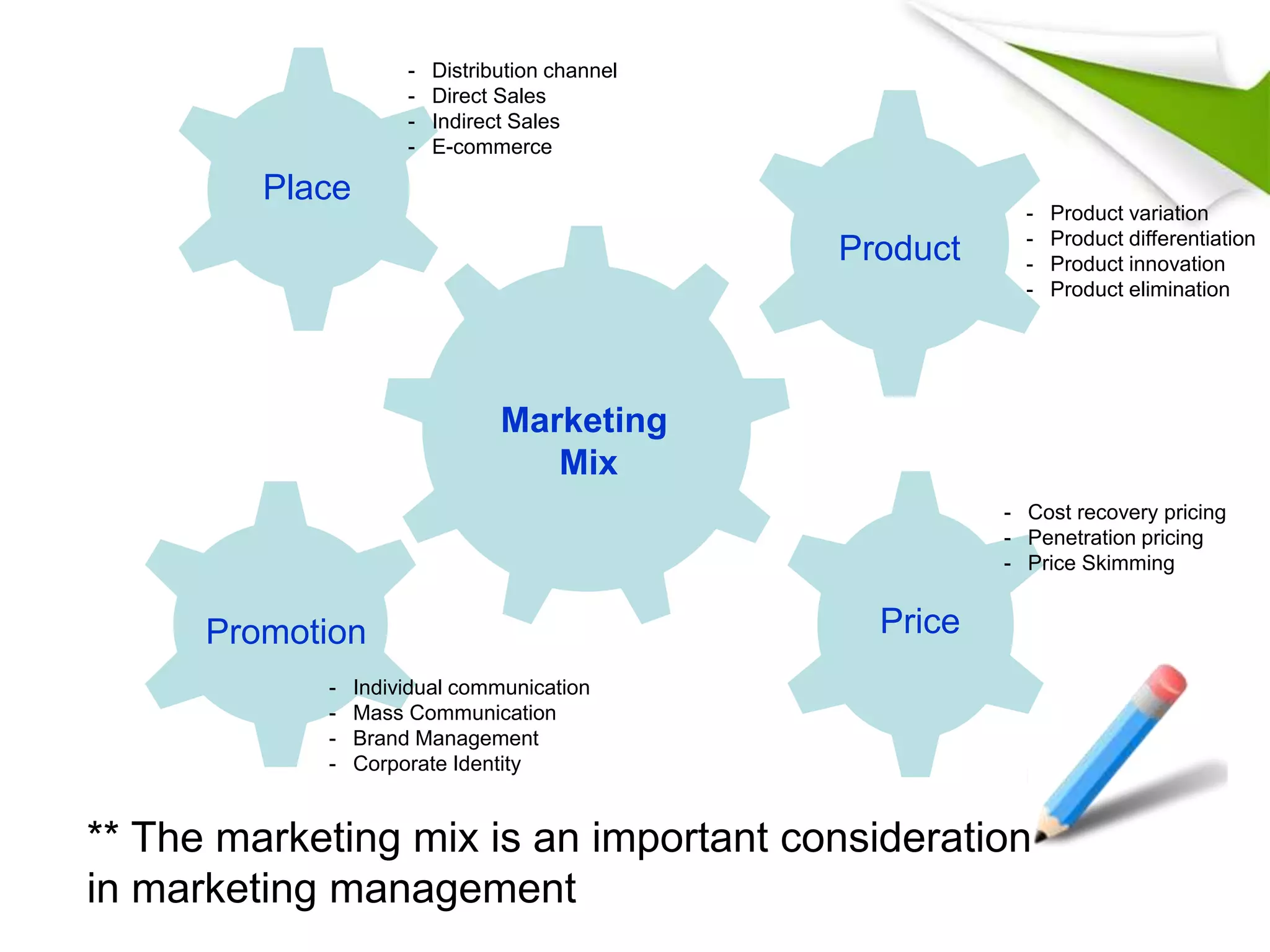
Marketing
Mix
Product
PricePromotion
Place
** The marketing mix is an important consideration
in marketing management
- Product variation
- Product differentiation
- Product innovation
- Product elimination
- Distribution channel
- Direct Sales
- Indirect Sales
- E-commerce
- Cost recovery pricing
- Penetration pricing
- Price Skimming
- Individual communication
- Mass Communication
- Brand Management
- Corporate Identity
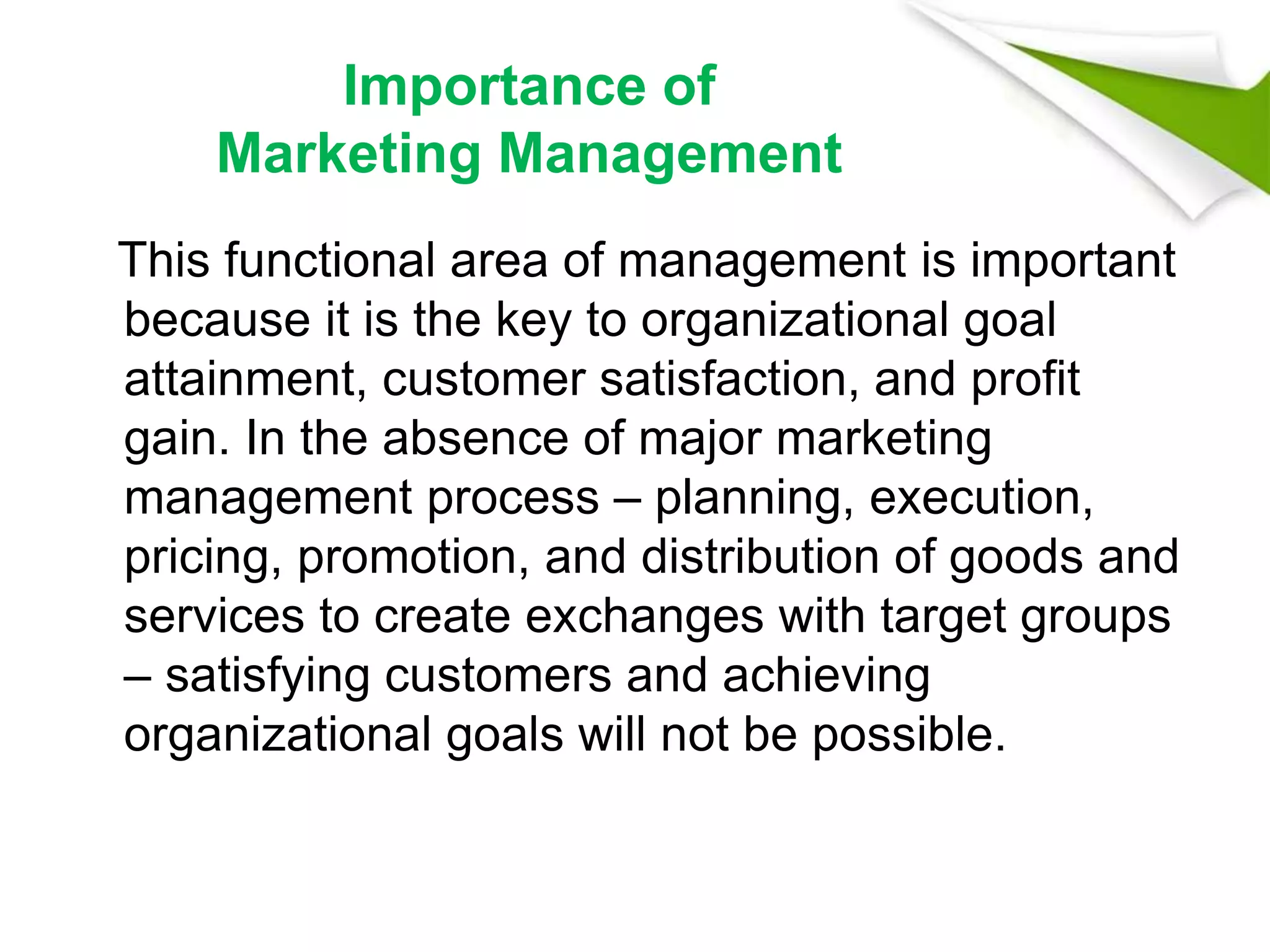
Importance of
Marketing Management
This functional area of management is important
because it is the key to organizational goal
attainment, customer satisfaction, and profit
gain. In the absence of major marketing
management process – planning, execution,
pricing, promotion, and distribution of goods and
services to create exchanges with target groups
– satisfying customers and achieving
organizational goals will not be possible.
Operations Management
the study of how
goods and services
are produced in
organizations.
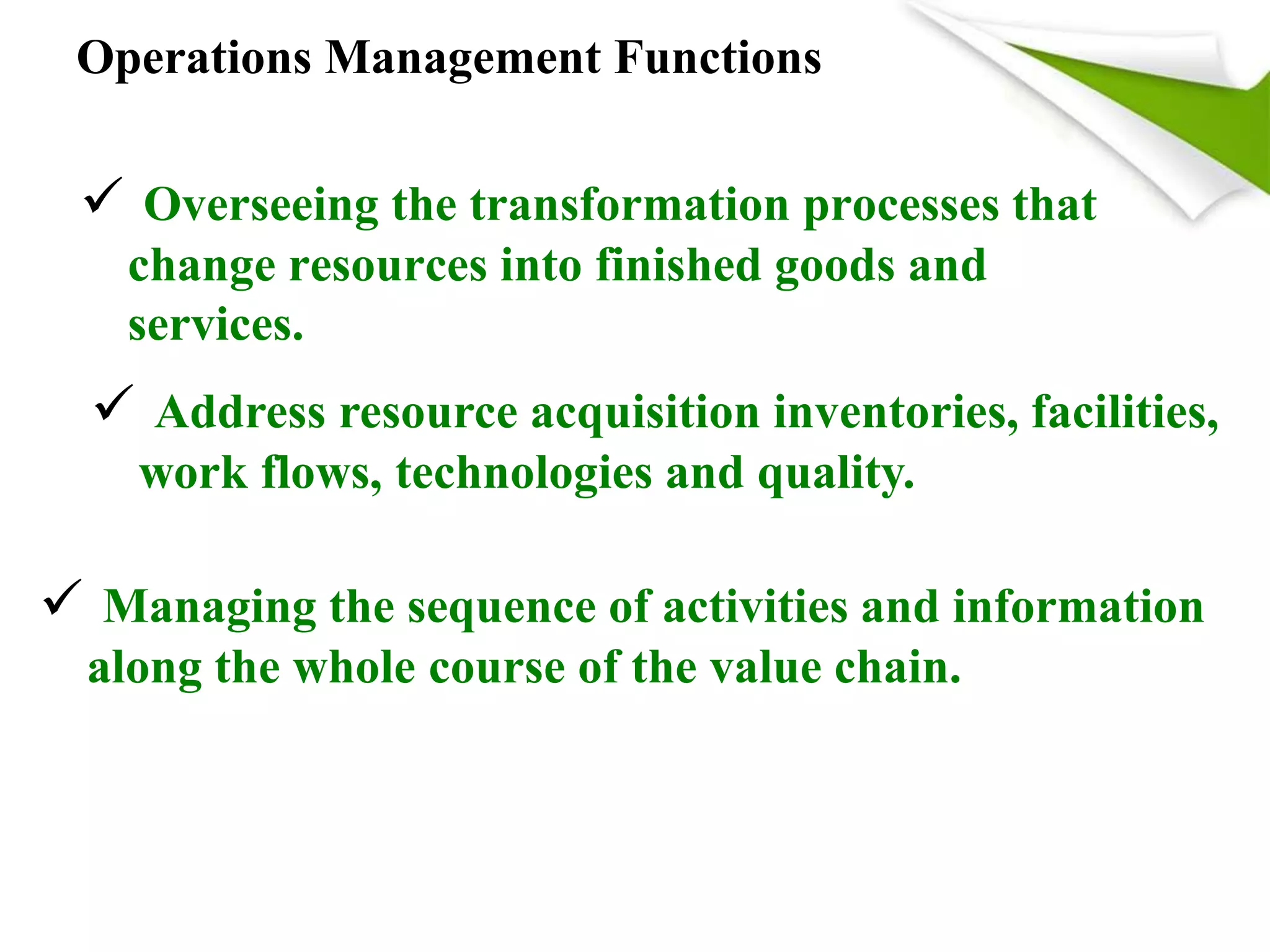
Operations Management Functions
 Overseeing the transformation processes that
change resources into finished goods and
services.
 Address resource acquisition inventories, facilities,
work flows, technologies and quality.
 Managing the sequence of activities and information
along the whole course of the value chain.
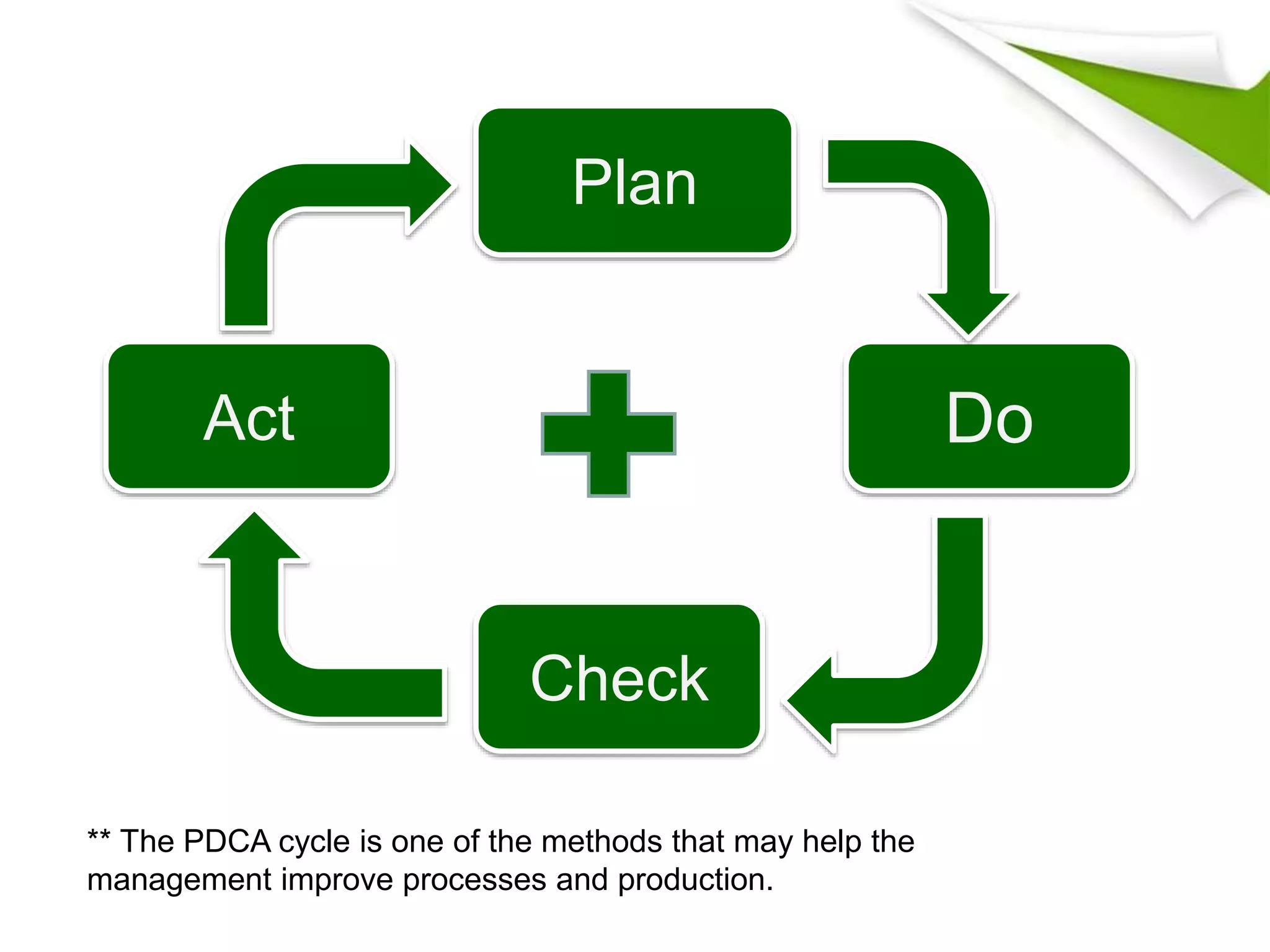
Plan
Do
Check
Act
** The PDCA cycle is one of the methods that may help the
management improve processes and production.
© 2011 Pearson Education, Inc.
publishing as Prentice Hall
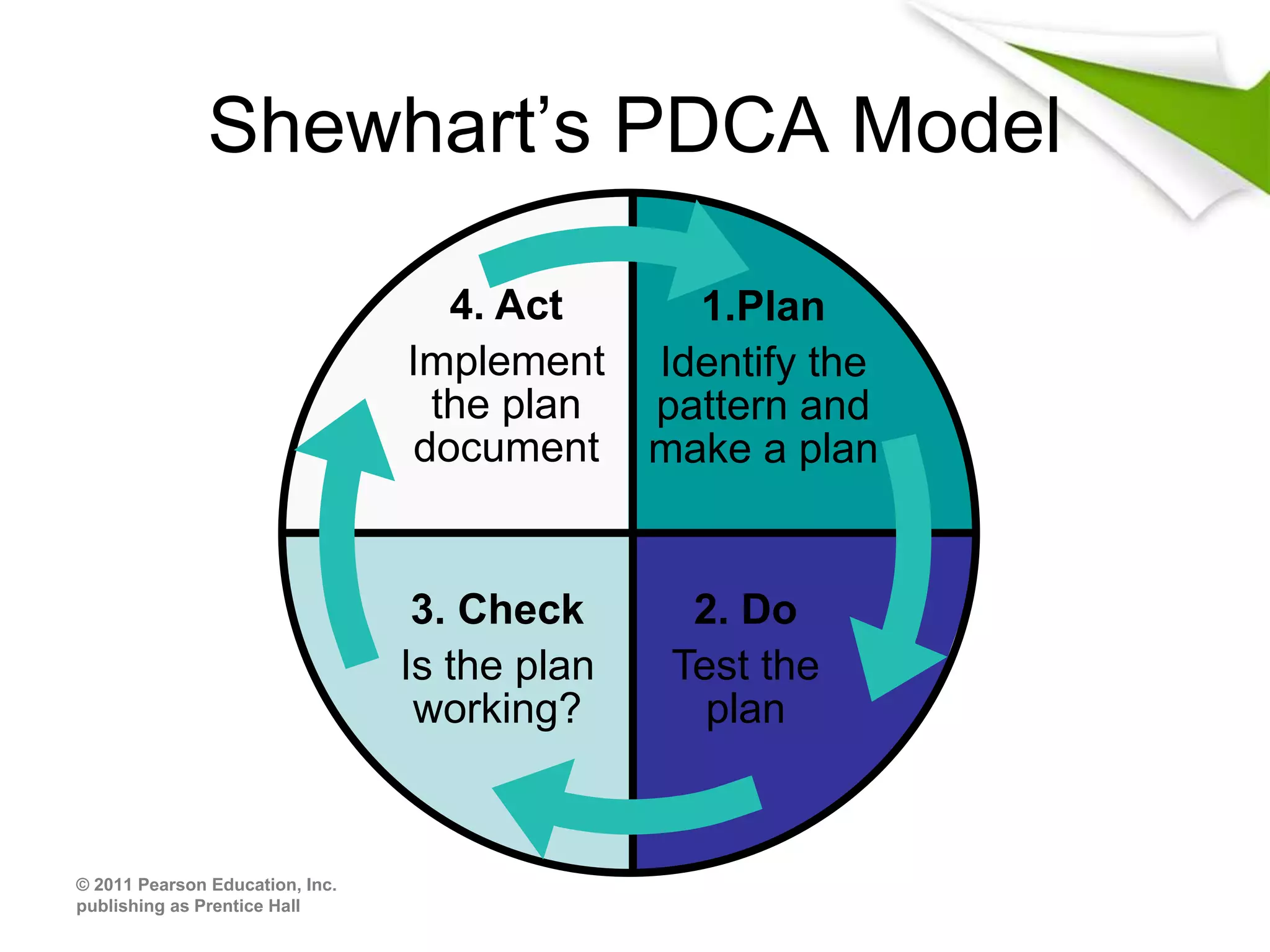
4. Act
Implement
the plan
document
2. Do
Test the
plan
3. Check
Is the plan
working?
1.Plan
Identify the
pattern and
make a plan
Shewhart’s PDCA Model
Importance of
Operations Management
Though the study of the essentials of
operations management, businesses of
different types and sizes may increase
their chances for survival and success in
today’s business environment which is
characterized by intensive competition and
desire for innovative quality products and
services.
Financial Management
the management and custody of
the organization’s funds, seeing
to it that these are effectively and
efficiently utilized in order to
provide for all the needs of the
organization’s various operating
unit.
Financial Management Functions
 Taking charge of the company’s financial
policies and strategies, investments, capital
structures, and dividend policies.
 Financial management and control.
 Financial Planning or the process of setting financial
objectives and determining what should be done to
accomplish them. This includes financial forecasting,
financial analysis, and financial performance
evaluation.
Importance of
Financial Management
Financial management facilitates the choice
of investments, financial policies, and
operating mechanism of the organization in
order to effectively achieve its goals and
objectives, which includes maximizing its
profits, as well as those of its shareholders
and stockholders. In doing so, the managers
are able to: maximize the wealth of the
organization, minimizing bankruptcy risks,
among others.
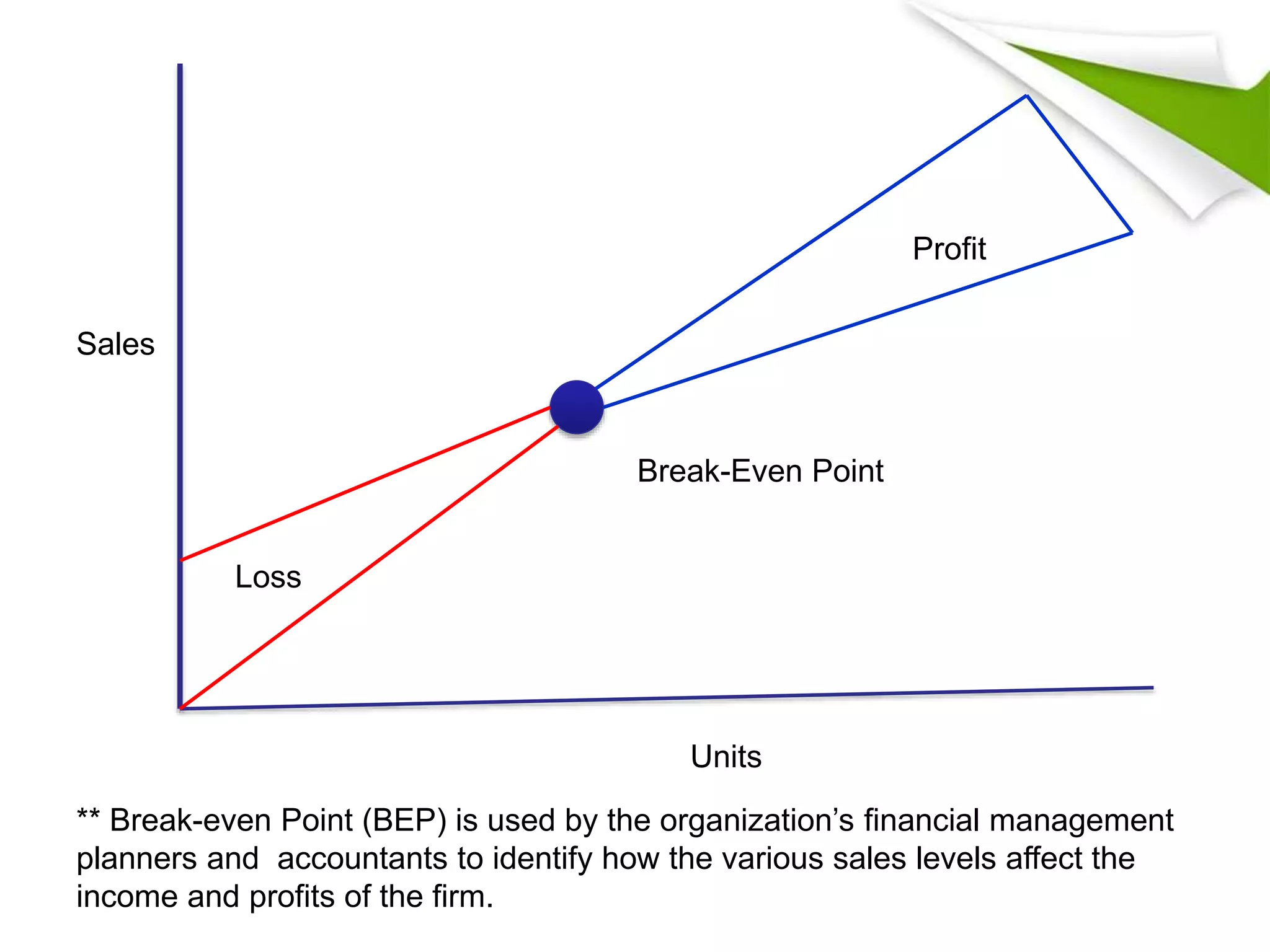
Break-Even Point
Profit
Loss
Sales
Units
** Break-even Point (BEP) is used by the organization’s financial management
planners and accountants to identify how the various sales levels affect the
income and profits of the firm.
Information & Communication
Technology (ICT) Management
the management of information
and communication technology
that collect, organize, and
distribute data for use in the
organization’s decision-making
functions.
ICT Management Functions
 Developing the organization’s hardware,
software, and other computing and
communicating technology.
 Developing the organization’s management
information system (MIS) tailored to the
needs of the firm’s units.
 Encouraging e-commerce through Internet use.
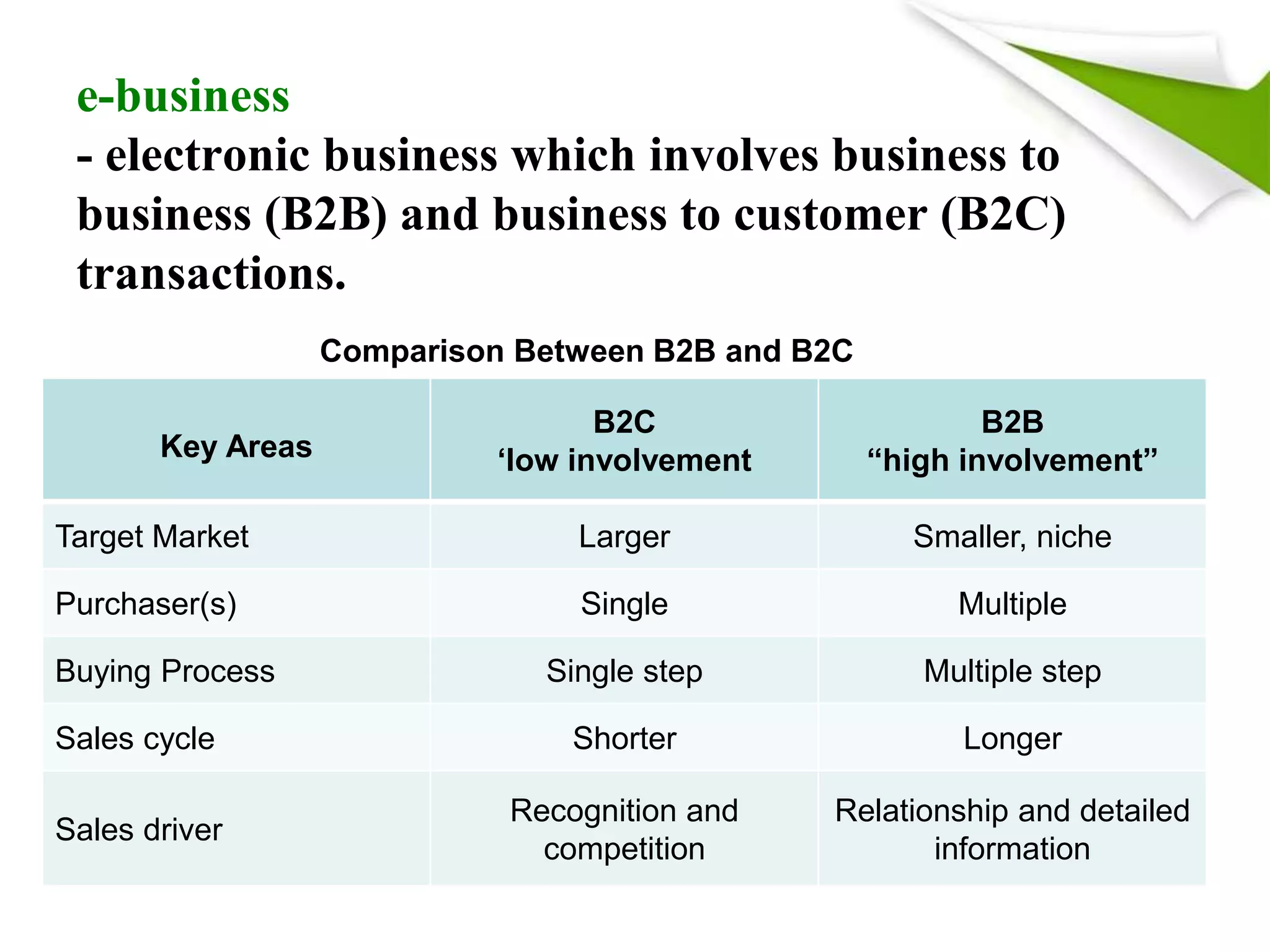
e-business
- electronic business which involves business to
business (B2B) and business to customer (B2C)
transactions.
Key Areas
B2C
‘low involvement
B2B
“high involvement”
Target Market Larger Smaller, niche
Purchaser(s) Single Multiple
Buying Process Single step Multiple step
Sales cycle Shorter Longer
Sales driver
Recognition and
competition
Relationship and detailed
information
Comparison Between B2B and B2C
Importance of Information and
Communication Technology (ICT)
Management
The widespread use of ICT has brought about the
emergence of a “knowledge society” due to easy access to
information at low costs through the internet. Management
may use it for its different managerial functions. It may be
used for scenario planning or identifying the future scenario
in the business environment, which may need careful
planning; decision making through the use of the
information generated by IT; aiding team-work, facilitating
productivity measurement, easy and low cost
communication, worldwide selling through the internet, and
many others. It may be said, therefore, that ICT has
revolutionized the business world.
Thank You!

Functional Areas of Management

  • 1.
  • 2.
    • Human ResourceManagement • Marketing Management • Operations Management • Financial Management • ICT Management
  • 3.
    Human Resource Management the processof attracting, training, developing, and maintaining an excellent workforce.
  • 4.
    Human Resource ManagementFunctions  Conducting Job Analysis  Planning Labor Need and Recruiting  Selecting candidates for the job  Orienting and Training New Employees Managing Compensation and Pay  Providing Incentives and Benefits  Evaluating Employee’s Performance  Communicating  Developing Employees  Building Employee Commitment  Providing good working condition  Handling grievances and industrial relations
  • 5.
    Importance of Human ResourceManagement Human resource management deals with the study of people – the most important business resource. Money, materials, and information resources are not capable of moving the business activities without the aid of the primary performance drivers, the human resources, therefore, mastering the activities involve in human resource management is a must since all the management functions could be done easily if the organization managers practice proper human resource management.
  • 6.
    Activities involve in HumanResource Management Human Resource Management Recruitment Selection Placement Training and Development
  • 7.
    Marketing Management the processof managerial planning and carrying out of the conception, pricing, promotion, and distribution of goods and services in order to bring about exchanges to satisfy individual and organizational goals.
  • 8.
    Marketing Management Functions Analysis, planning, implementing, and controlling of goods, services and ideas to create exchanges that satisfy customer needs and company goals.  Management of marketing resources  Analyze , plan, and implement marketing programs that aim to bring about an expected level and mix of business deals with target markets.  Stimulate demand for the product of the company.  Make crucial decisions that will ensure the company’s competitiveness.  Make sure that the marketing techniques employed are efficient, effective, and socially responsible or ethical.
  • 9.
    Marketing Mix Product PricePromotion Place ** The marketingmix is an important consideration in marketing management - Product variation - Product differentiation - Product innovation - Product elimination - Distribution channel - Direct Sales - Indirect Sales - E-commerce - Cost recovery pricing - Penetration pricing - Price Skimming - Individual communication - Mass Communication - Brand Management - Corporate Identity
  • 10.
    Importance of Marketing Management Thisfunctional area of management is important because it is the key to organizational goal attainment, customer satisfaction, and profit gain. In the absence of major marketing management process – planning, execution, pricing, promotion, and distribution of goods and services to create exchanges with target groups – satisfying customers and achieving organizational goals will not be possible.
  • 11.
    Operations Management the studyof how goods and services are produced in organizations.
  • 12.
    Operations Management Functions Overseeing the transformation processes that change resources into finished goods and services.  Address resource acquisition inventories, facilities, work flows, technologies and quality.  Managing the sequence of activities and information along the whole course of the value chain.
  • 13.
    Plan Do Check Act ** The PDCAcycle is one of the methods that may help the management improve processes and production.
  • 14.
    © 2011 PearsonEducation, Inc. publishing as Prentice Hall 4. Act Implement the plan document 2. Do Test the plan 3. Check Is the plan working? 1.Plan Identify the pattern and make a plan Shewhart’s PDCA Model
  • 15.
    Importance of Operations Management Thoughthe study of the essentials of operations management, businesses of different types and sizes may increase their chances for survival and success in today’s business environment which is characterized by intensive competition and desire for innovative quality products and services.
  • 16.
    Financial Management the managementand custody of the organization’s funds, seeing to it that these are effectively and efficiently utilized in order to provide for all the needs of the organization’s various operating unit.
  • 17.
    Financial Management Functions Taking charge of the company’s financial policies and strategies, investments, capital structures, and dividend policies.  Financial management and control.  Financial Planning or the process of setting financial objectives and determining what should be done to accomplish them. This includes financial forecasting, financial analysis, and financial performance evaluation.
  • 18.
    Importance of Financial Management Financialmanagement facilitates the choice of investments, financial policies, and operating mechanism of the organization in order to effectively achieve its goals and objectives, which includes maximizing its profits, as well as those of its shareholders and stockholders. In doing so, the managers are able to: maximize the wealth of the organization, minimizing bankruptcy risks, among others.
  • 19.
    Break-Even Point Profit Loss Sales Units ** Break-evenPoint (BEP) is used by the organization’s financial management planners and accountants to identify how the various sales levels affect the income and profits of the firm.
  • 20.
    Information & Communication Technology(ICT) Management the management of information and communication technology that collect, organize, and distribute data for use in the organization’s decision-making functions.
  • 21.
    ICT Management Functions Developing the organization’s hardware, software, and other computing and communicating technology.  Developing the organization’s management information system (MIS) tailored to the needs of the firm’s units.  Encouraging e-commerce through Internet use.
  • 22.
    e-business - electronic businesswhich involves business to business (B2B) and business to customer (B2C) transactions. Key Areas B2C ‘low involvement B2B “high involvement” Target Market Larger Smaller, niche Purchaser(s) Single Multiple Buying Process Single step Multiple step Sales cycle Shorter Longer Sales driver Recognition and competition Relationship and detailed information Comparison Between B2B and B2C
  • 23.
    Importance of Informationand Communication Technology (ICT) Management The widespread use of ICT has brought about the emergence of a “knowledge society” due to easy access to information at low costs through the internet. Management may use it for its different managerial functions. It may be used for scenario planning or identifying the future scenario in the business environment, which may need careful planning; decision making through the use of the information generated by IT; aiding team-work, facilitating productivity measurement, easy and low cost communication, worldwide selling through the internet, and many others. It may be said, therefore, that ICT has revolutionized the business world.
  • 24.