Lecture Notes 3:
Biochemistry
Biology ABiology A
Eaton Rapids High SchoolEaton Rapids High School
K.CoppinsK.Coppins
I. Basics of Chemistry
 A. The AtomA. The Atom
1. ______________________________1. ______________________________
2. Made of a __________________2. Made of a __________________
surrounded by a cloud of negativesurrounded by a cloud of negative
particles called ____________.particles called ____________.
3. All elements are listed on the3. All elements are listed on the
_____________._____________.Periodic TablePeriodic Table
positive nucleuspositive nucleus
electronselectrons
Smallest unit of any elementSmallest unit of any element
I. Basics of Chemistry
 A. The AtomA. The Atom
 4. Elements in the body:4. Elements in the body:
 Oxygen (65%)Oxygen (65%)
 Carbon (18%)Carbon (18%)
 Hydrogen (10%)Hydrogen (10%)
 Nitrogen (3%)Nitrogen (3%)
 Calcium (1.5%)Calcium (1.5%)
 Phosphorus (1.0%)Phosphorus (1.0%)
 Potassium (0.35%)Potassium (0.35%)
 Sulfur (0.25%)Sulfur (0.25%)
 Sodium (0.15%)Sodium (0.15%)
 Magnesium (0.05%)Magnesium (0.05%)
 Copper, Zinc, Selenium,Copper, Zinc, Selenium,
Molybdenum, Fluorine,Molybdenum, Fluorine,
Chlorine, Iodine,Chlorine, Iodine,
Manganese, Cobalt, IronManganese, Cobalt, Iron
(0.70%)(0.70%)
 Lithium, Strontium,Lithium, Strontium,
Aluminum, Silicon, Lead,Aluminum, Silicon, Lead,
Vanadium, Arsenic,Vanadium, Arsenic,
Bromine (trace amounts)Bromine (trace amounts)
 Reference: H. A. Harper, V. W.Reference: H. A. Harper, V. W.
Rodwell, P. A. Mayes, ReviewRodwell, P. A. Mayes, Review
of Physiological Chemistry,of Physiological Chemistry,
16th ed., Lange Medical16th ed., Lange Medical
Publications, Los Altos,Publications, Los Altos,
California 1977.California 1977.
I. Basics of Chemistry
 B. MoleculesB. Molecules
1. When two or more atoms join1. When two or more atoms join
together, they form a ___________.together, they form a ___________.
2. These are called _______________,2. These are called _______________,
and are based on interactions betweenand are based on interactions between
the _________.the _________.
3. If a bond joins different elements, the3. If a bond joins different elements, the
new substance is a __________.new substance is a __________.
moleculemolecule
chemicalchemical
bondsbonds
electronelectron
ss
compoundcompound
I. Basics of Chemistry
 C. Types of BondsC. Types of Bonds
1. _____________1. _____________
a. Electrons move from one atom toa. Electrons move from one atom to
the other.the other.
b. Atoms become positively orb. Atoms become positively or
negatively charged; called ____.negatively charged; called ____.
c. Charges attract or repel.c. Charges attract or repel.
d. Good for __________________.d. Good for __________________.
Ionic bondsIonic bonds
ionsions
conducting electricityconducting electricity
I. Basics of Chemistry
 C. Types of BondsC. Types of Bonds
2. _______________2. _______________
a. Electrons are shared between twoa. Electrons are shared between two
atoms.atoms.
b. Atoms must remain togetherb. Atoms must remain together
c. Bonds are flexiblec. Bonds are flexible
d. Good for ________________.d. Good for ________________.
Covalent bondsCovalent bonds
large structureslarge structures
I. Basics of Chemistry
 C. Types of BondsC. Types of Bonds
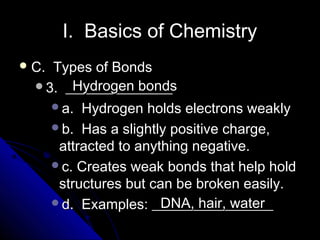
3. _______________3. _______________
a. Hydrogen holds electrons weaklya. Hydrogen holds electrons weakly
b. Has a slightly positive charge,b. Has a slightly positive charge,
attracted to anything negative.attracted to anything negative.
c. Creates weak bonds that help holdc. Creates weak bonds that help hold
structures but can be broken easily.structures but can be broken easily.
d. Examples: _________________d. Examples: _________________
Hydrogen bondsHydrogen bonds
DNA, hair, waterDNA, hair, water
I. Basics of Chemistry
 D. Molecules and EnergyD. Molecules and Energy
1. Energy is stored in the bonds1. Energy is stored in the bonds
between atoms. Energy is required tobetween atoms. Energy is required to
______________ bonds.______________ bonds.
2. The amount of energy varies with the2. The amount of energy varies with the
type of bond. Some bonds (hydrogen)type of bond. Some bonds (hydrogen)
are easily broken while others (tripleare easily broken while others (triple
covalent) are very hard.covalent) are very hard.
make or break
II. Water Chemistry
 A. ________ is the most abundantA. ________ is the most abundant
chemical in the body.chemical in the body.
 B. Water has many characteristics thatB. Water has many characteristics that
make it vital to our bodies.make it vital to our bodies.
1. _____—water is a very small1. _____—water is a very small
molecule, so it moves fast and canmolecule, so it moves fast and can
squeeze into tiny crevasses betweensqueeze into tiny crevasses between
other molecules.other molecules.
Water
Size
II. Water Chemistry
 B. Water has manyB. Water has many
characteristics that make itcharacteristics that make it
vital to our bodies.vital to our bodies.
2. _________--Hydrogen2. _________--Hydrogen
has a slightly positivehas a slightly positive
charge while oxygen has acharge while oxygen has a
slightly negative charge.slightly negative charge.
This makes it easy forThis makes it easy for
water to pry apart otherwater to pry apart other
charged molecules,charged molecules,
dissolving them. Called adissolving them. Called a
__________________.__________________.
Polarity
Universal Solvent
II. Water Chemistry
 B. Water has many characteristics thatB. Water has many characteristics that
make it vital to our bodies.make it vital to our bodies.
3. _______________--Due to polarity,3. _______________--Due to polarity,
water forms a crystal structure that iswater forms a crystal structure that is
less dense than liquid water.less dense than liquid water.
Crystal structure
II. Water Chemistry
 B. Water has many characteristics thatB. Water has many characteristics that
make it vital to our bodies.make it vital to our bodies.
4. _____________--water absorbs and4. _____________--water absorbs and
releases heat energy slowly, and canreleases heat energy slowly, and can
hold a great deal of heat energy. Thishold a great deal of heat energy. This
helps organisms maintain their bodyhelps organisms maintain their body
temperature in the safe range.temperature in the safe range.
Heat capacity
II. Water Chemistry
 B. Water has manyB. Water has many
characteristics that make itcharacteristics that make it
vital to our bodies.vital to our bodies.
5. __________________--5. __________________--
Polarity allows water toPolarity allows water to
stick to itself (cohesion)stick to itself (cohesion)
and to any chargedand to any charged
material (adhesion).material (adhesion).
Water can glue materialsWater can glue materials
together.together.
Cohesion &
Adhesion
II. Water Chemistry
 B. Water has manyB. Water has many
characteristics thatcharacteristics that
make it vital to ourmake it vital to our
bodies.bodies.
6. _______--Water6. _______--Water
can act as either ancan act as either an
acid or a base,acid or a base,
maintaining a stablemaintaining a stable
pH in our bodies.pH in our bodies.
Buffer
III. Macromolecules
 A. What are they?A. What are they?
1.1. ____________________________________________________________________
______________________________________________________________________________
2. Made of smaller pieces called2. Made of smaller pieces called
__________ that can be assembled like__________ that can be assembled like
legos to form a variety of structures. Alegos to form a variety of structures. A
large chain of monomers is called alarge chain of monomers is called a
_________._________.
Very large molecules that makeVery large molecules that make
most of the structure of the bodymost of the structure of the body
monomers
polymer
III. Macromolecules
 B. CarbohydratesB. Carbohydrates
1. Monomer: ____________________1. Monomer: ____________________
2. Polymer: _____________________2. Polymer: _____________________
3. Structure:______________________3. Structure:______________________
________________________________________________________________
4. Uses: ___________________4. Uses: ___________________
5. Examples: ________________5. Examples: ________________
monosaccharide (sugar)
polysaccharide (starch)
rings of carbon with
oxygen and hydrogen attached; CH2O
energy, plant structure
sucrose, cellullose
Examples of Carbohydrates
III. Macromolecules
 C. LipidsC. Lipids
1. Monomer: __________1. Monomer: __________
2. Polymer: ___________2. Polymer: ___________
3. Structure:______________________3. Structure:______________________
________________________________________________________________
4. Uses: ________________________4. Uses: ________________________
5. Examples: ____________________5. Examples: ____________________
fatty acid
lipid or fat
3 long chains of carbon
hydrogen on a glycerol molecule
energy, structure, warmth
fat, oil, cholesterol
Examples of Lipids
III. Macromolecules
 D. ProteinD. Protein
1. Monomer: _______________1. Monomer: _______________
2. Polymer: _____________________2. Polymer: _____________________
3. Structure:______________________3. Structure:______________________
________________________________________________________________
4. Uses: ________________________4. Uses: ________________________
5. Examples: ____________________5. Examples: ____________________
amino acid (20)
protein or polypeptide
central carbon atom with
hydrogen, amine, carboxyl, & R groups
structure, emergency energy
skin, insulin, enzymes
Examples of Proteins
III. Macromolecules
 E. Nucleic AcidsE. Nucleic Acids
1. Monomer: _______________1. Monomer: _______________
2. Polymer: ___________2. Polymer: ___________
3. Structure:______________________3. Structure:______________________
________________________________________________________________
4. Uses: ___________________4. Uses: ___________________
5. Examples: _______________5. Examples: _______________
nucleotide (5)
nucleic acid
5-carbon sugar attached
to nitrogen base and phosphate group
stores genetic code
DNA and RNA
Examples of Nucleic Acids
IV. ATP
 A. ATP stands for _____________________A. ATP stands for _____________________
 B. Cells use ATP as a __________________B. Cells use ATP as a __________________
 C. Made of adenine with ___ phosphatesC. Made of adenine with ___ phosphates
 D. Lots of energy is stored in the bondD. Lots of energy is stored in the bond
between _____________________________between _____________________________
 E. When this bond is broken, tremendousE. When this bond is broken, tremendous
energy is released.energy is released.
 F. The pieces are then reassembled, storingF. The pieces are then reassembled, storing
more energy for another use.more energy for another use.
adenosine triphosphate
the second and third phosphates
3
rechargeable battery
Examples of ATP
V. Enzymes
 A. Special proteins thatA. Special proteins that
speed chemical reactionsspeed chemical reactions
1. Chemical reactions1. Chemical reactions
require a certainrequire a certain
_______________ to get_______________ to get
started.started.
2. Enzymes decrease2. Enzymes decrease
this energy, makingthis energy, making
reactions occur faster.reactions occur faster.
activation energy
V. Enzymes
 B. Lock-and-Key ModelB. Lock-and-Key Model
1. Enzymes are not used up by the1. Enzymes are not used up by the
reaction, but each can only work on onereaction, but each can only work on one
reaction (________________).reaction (________________).
2. This is called the lock-and-key model2. This is called the lock-and-key model
of enzymes. An enzyme is like a _____of enzymes. An enzyme is like a _____
which can open exactly one _____. Ifwhich can open exactly one _____. If
you want to “unlock” another reaction,you want to “unlock” another reaction,
you need a different enzyme.you need a different enzyme.
enzyme specificity
key
lock
V. Enzymes
V. Enzymes
 C. Factors which affect enzymesC. Factors which affect enzymes
1. _____________--enzymes, like all1. _____________--enzymes, like all
proteins, change shape when exposedproteins, change shape when exposed
to heat or cold. Each has an optimalto heat or cold. Each has an optimal
temperature range.temperature range.
2. ____--all enzymes have an optimal2. ____--all enzymes have an optimal
range of pH. Example: stomachrange of pH. Example: stomach
3. _____________--having more3. _____________--having more
enzymes makes the reaction faster.enzymes makes the reaction faster.
Temperature
pH
Concentration
Images used in this presentation
were obtained from:
 Atom: PowerPoint clipartAtom: PowerPoint clipart
 Water molecule and Water attraction:Water molecule and Water attraction:
stainsfile.info/StainsFile/jindex.htmlstainsfile.info/StainsFile/jindex.html
 Bohr water molecule: ghs.gresham.k12.or.usBohr water molecule: ghs.gresham.k12.or.us
 Spoon on nose: statweb.calpoly.eduSpoon on nose: statweb.calpoly.edu
 pH scale: bcn.boulder.co.uspH scale: bcn.boulder.co.us
 Glucose and Cellulose: www.greenspirit.org.ukGlucose and Cellulose: www.greenspirit.org.uk
 Sucrose: encarta.msn.comSucrose: encarta.msn.com
Images, continued
 Saturated and unsaturated fatty acids, cis andSaturated and unsaturated fatty acids, cis and
trans fat, and lipid molecule: biology.clc.uc.edutrans fat, and lipid molecule: biology.clc.uc.edu
 Generic Amino acid: ffden-2.phys.uaf.eduGeneric Amino acid: ffden-2.phys.uaf.edu
 Peptide bond: www.rothamsted.bbsrc.ac.ukPeptide bond: www.rothamsted.bbsrc.ac.uk
 Nucleotide: faculty.uca.eduNucleotide: faculty.uca.edu
 DNA helix: www.biologycorner.comDNA helix: www.biologycorner.com
 ATP: textbookofbacteriology.netATP: textbookofbacteriology.net
 Activation energy: faculty.clintocc.suny.eduActivation energy: faculty.clintocc.suny.edu
 Enzyme lock-and-key: www.celltech.comEnzyme lock-and-key: www.celltech.com

biochemistry basics

  • 1.
    Lecture Notes 3: Biochemistry BiologyABiology A Eaton Rapids High SchoolEaton Rapids High School K.CoppinsK.Coppins
  • 2.
    I. Basics ofChemistry  A. The AtomA. The Atom 1. ______________________________1. ______________________________ 2. Made of a __________________2. Made of a __________________ surrounded by a cloud of negativesurrounded by a cloud of negative particles called ____________.particles called ____________. 3. All elements are listed on the3. All elements are listed on the _____________._____________.Periodic TablePeriodic Table positive nucleuspositive nucleus electronselectrons Smallest unit of any elementSmallest unit of any element
  • 3.
    I. Basics ofChemistry  A. The AtomA. The Atom  4. Elements in the body:4. Elements in the body:  Oxygen (65%)Oxygen (65%)  Carbon (18%)Carbon (18%)  Hydrogen (10%)Hydrogen (10%)  Nitrogen (3%)Nitrogen (3%)  Calcium (1.5%)Calcium (1.5%)  Phosphorus (1.0%)Phosphorus (1.0%)  Potassium (0.35%)Potassium (0.35%)  Sulfur (0.25%)Sulfur (0.25%)  Sodium (0.15%)Sodium (0.15%)  Magnesium (0.05%)Magnesium (0.05%)  Copper, Zinc, Selenium,Copper, Zinc, Selenium, Molybdenum, Fluorine,Molybdenum, Fluorine, Chlorine, Iodine,Chlorine, Iodine, Manganese, Cobalt, IronManganese, Cobalt, Iron (0.70%)(0.70%)  Lithium, Strontium,Lithium, Strontium, Aluminum, Silicon, Lead,Aluminum, Silicon, Lead, Vanadium, Arsenic,Vanadium, Arsenic, Bromine (trace amounts)Bromine (trace amounts)  Reference: H. A. Harper, V. W.Reference: H. A. Harper, V. W. Rodwell, P. A. Mayes, ReviewRodwell, P. A. Mayes, Review of Physiological Chemistry,of Physiological Chemistry, 16th ed., Lange Medical16th ed., Lange Medical Publications, Los Altos,Publications, Los Altos, California 1977.California 1977.
  • 4.
    I. Basics ofChemistry  B. MoleculesB. Molecules 1. When two or more atoms join1. When two or more atoms join together, they form a ___________.together, they form a ___________. 2. These are called _______________,2. These are called _______________, and are based on interactions betweenand are based on interactions between the _________.the _________. 3. If a bond joins different elements, the3. If a bond joins different elements, the new substance is a __________.new substance is a __________. moleculemolecule chemicalchemical bondsbonds electronelectron ss compoundcompound
  • 5.
    I. Basics ofChemistry  C. Types of BondsC. Types of Bonds 1. _____________1. _____________ a. Electrons move from one atom toa. Electrons move from one atom to the other.the other. b. Atoms become positively orb. Atoms become positively or negatively charged; called ____.negatively charged; called ____. c. Charges attract or repel.c. Charges attract or repel. d. Good for __________________.d. Good for __________________. Ionic bondsIonic bonds ionsions conducting electricityconducting electricity
  • 6.
    I. Basics ofChemistry  C. Types of BondsC. Types of Bonds 2. _______________2. _______________ a. Electrons are shared between twoa. Electrons are shared between two atoms.atoms. b. Atoms must remain togetherb. Atoms must remain together c. Bonds are flexiblec. Bonds are flexible d. Good for ________________.d. Good for ________________. Covalent bondsCovalent bonds large structureslarge structures
  • 7.
    I. Basics ofChemistry  C. Types of BondsC. Types of Bonds 3. _______________3. _______________ a. Hydrogen holds electrons weaklya. Hydrogen holds electrons weakly b. Has a slightly positive charge,b. Has a slightly positive charge, attracted to anything negative.attracted to anything negative. c. Creates weak bonds that help holdc. Creates weak bonds that help hold structures but can be broken easily.structures but can be broken easily. d. Examples: _________________d. Examples: _________________ Hydrogen bondsHydrogen bonds DNA, hair, waterDNA, hair, water
  • 8.
    I. Basics ofChemistry  D. Molecules and EnergyD. Molecules and Energy 1. Energy is stored in the bonds1. Energy is stored in the bonds between atoms. Energy is required tobetween atoms. Energy is required to ______________ bonds.______________ bonds. 2. The amount of energy varies with the2. The amount of energy varies with the type of bond. Some bonds (hydrogen)type of bond. Some bonds (hydrogen) are easily broken while others (tripleare easily broken while others (triple covalent) are very hard.covalent) are very hard. make or break
  • 9.
    II. Water Chemistry A. ________ is the most abundantA. ________ is the most abundant chemical in the body.chemical in the body.  B. Water has many characteristics thatB. Water has many characteristics that make it vital to our bodies.make it vital to our bodies. 1. _____—water is a very small1. _____—water is a very small molecule, so it moves fast and canmolecule, so it moves fast and can squeeze into tiny crevasses betweensqueeze into tiny crevasses between other molecules.other molecules. Water Size
  • 10.
    II. Water Chemistry B. Water has manyB. Water has many characteristics that make itcharacteristics that make it vital to our bodies.vital to our bodies. 2. _________--Hydrogen2. _________--Hydrogen has a slightly positivehas a slightly positive charge while oxygen has acharge while oxygen has a slightly negative charge.slightly negative charge. This makes it easy forThis makes it easy for water to pry apart otherwater to pry apart other charged molecules,charged molecules, dissolving them. Called adissolving them. Called a __________________.__________________. Polarity Universal Solvent
  • 11.
    II. Water Chemistry B. Water has many characteristics thatB. Water has many characteristics that make it vital to our bodies.make it vital to our bodies. 3. _______________--Due to polarity,3. _______________--Due to polarity, water forms a crystal structure that iswater forms a crystal structure that is less dense than liquid water.less dense than liquid water. Crystal structure
  • 12.
    II. Water Chemistry B. Water has many characteristics thatB. Water has many characteristics that make it vital to our bodies.make it vital to our bodies. 4. _____________--water absorbs and4. _____________--water absorbs and releases heat energy slowly, and canreleases heat energy slowly, and can hold a great deal of heat energy. Thishold a great deal of heat energy. This helps organisms maintain their bodyhelps organisms maintain their body temperature in the safe range.temperature in the safe range. Heat capacity
  • 13.
    II. Water Chemistry B. Water has manyB. Water has many characteristics that make itcharacteristics that make it vital to our bodies.vital to our bodies. 5. __________________--5. __________________-- Polarity allows water toPolarity allows water to stick to itself (cohesion)stick to itself (cohesion) and to any chargedand to any charged material (adhesion).material (adhesion). Water can glue materialsWater can glue materials together.together. Cohesion & Adhesion
  • 14.
    II. Water Chemistry B. Water has manyB. Water has many characteristics thatcharacteristics that make it vital to ourmake it vital to our bodies.bodies. 6. _______--Water6. _______--Water can act as either ancan act as either an acid or a base,acid or a base, maintaining a stablemaintaining a stable pH in our bodies.pH in our bodies. Buffer
  • 15.
    III. Macromolecules  A.What are they?A. What are they? 1.1. ____________________________________________________________________ ______________________________________________________________________________ 2. Made of smaller pieces called2. Made of smaller pieces called __________ that can be assembled like__________ that can be assembled like legos to form a variety of structures. Alegos to form a variety of structures. A large chain of monomers is called alarge chain of monomers is called a _________._________. Very large molecules that makeVery large molecules that make most of the structure of the bodymost of the structure of the body monomers polymer
  • 16.
    III. Macromolecules  B.CarbohydratesB. Carbohydrates 1. Monomer: ____________________1. Monomer: ____________________ 2. Polymer: _____________________2. Polymer: _____________________ 3. Structure:______________________3. Structure:______________________ ________________________________________________________________ 4. Uses: ___________________4. Uses: ___________________ 5. Examples: ________________5. Examples: ________________ monosaccharide (sugar) polysaccharide (starch) rings of carbon with oxygen and hydrogen attached; CH2O energy, plant structure sucrose, cellullose
  • 17.
  • 18.
    III. Macromolecules  C.LipidsC. Lipids 1. Monomer: __________1. Monomer: __________ 2. Polymer: ___________2. Polymer: ___________ 3. Structure:______________________3. Structure:______________________ ________________________________________________________________ 4. Uses: ________________________4. Uses: ________________________ 5. Examples: ____________________5. Examples: ____________________ fatty acid lipid or fat 3 long chains of carbon hydrogen on a glycerol molecule energy, structure, warmth fat, oil, cholesterol
  • 19.
  • 20.
    III. Macromolecules  D.ProteinD. Protein 1. Monomer: _______________1. Monomer: _______________ 2. Polymer: _____________________2. Polymer: _____________________ 3. Structure:______________________3. Structure:______________________ ________________________________________________________________ 4. Uses: ________________________4. Uses: ________________________ 5. Examples: ____________________5. Examples: ____________________ amino acid (20) protein or polypeptide central carbon atom with hydrogen, amine, carboxyl, & R groups structure, emergency energy skin, insulin, enzymes
  • 21.
  • 22.
    III. Macromolecules  E.Nucleic AcidsE. Nucleic Acids 1. Monomer: _______________1. Monomer: _______________ 2. Polymer: ___________2. Polymer: ___________ 3. Structure:______________________3. Structure:______________________ ________________________________________________________________ 4. Uses: ___________________4. Uses: ___________________ 5. Examples: _______________5. Examples: _______________ nucleotide (5) nucleic acid 5-carbon sugar attached to nitrogen base and phosphate group stores genetic code DNA and RNA
  • 23.
  • 24.
    IV. ATP  A.ATP stands for _____________________A. ATP stands for _____________________  B. Cells use ATP as a __________________B. Cells use ATP as a __________________  C. Made of adenine with ___ phosphatesC. Made of adenine with ___ phosphates  D. Lots of energy is stored in the bondD. Lots of energy is stored in the bond between _____________________________between _____________________________  E. When this bond is broken, tremendousE. When this bond is broken, tremendous energy is released.energy is released.  F. The pieces are then reassembled, storingF. The pieces are then reassembled, storing more energy for another use.more energy for another use. adenosine triphosphate the second and third phosphates 3 rechargeable battery
  • 25.
  • 26.
    V. Enzymes  A.Special proteins thatA. Special proteins that speed chemical reactionsspeed chemical reactions 1. Chemical reactions1. Chemical reactions require a certainrequire a certain _______________ to get_______________ to get started.started. 2. Enzymes decrease2. Enzymes decrease this energy, makingthis energy, making reactions occur faster.reactions occur faster. activation energy
  • 27.
    V. Enzymes  B.Lock-and-Key ModelB. Lock-and-Key Model 1. Enzymes are not used up by the1. Enzymes are not used up by the reaction, but each can only work on onereaction, but each can only work on one reaction (________________).reaction (________________). 2. This is called the lock-and-key model2. This is called the lock-and-key model of enzymes. An enzyme is like a _____of enzymes. An enzyme is like a _____ which can open exactly one _____. Ifwhich can open exactly one _____. If you want to “unlock” another reaction,you want to “unlock” another reaction, you need a different enzyme.you need a different enzyme. enzyme specificity key lock
  • 28.
  • 29.
    V. Enzymes  C.Factors which affect enzymesC. Factors which affect enzymes 1. _____________--enzymes, like all1. _____________--enzymes, like all proteins, change shape when exposedproteins, change shape when exposed to heat or cold. Each has an optimalto heat or cold. Each has an optimal temperature range.temperature range. 2. ____--all enzymes have an optimal2. ____--all enzymes have an optimal range of pH. Example: stomachrange of pH. Example: stomach 3. _____________--having more3. _____________--having more enzymes makes the reaction faster.enzymes makes the reaction faster. Temperature pH Concentration
  • 30.
    Images used inthis presentation were obtained from:  Atom: PowerPoint clipartAtom: PowerPoint clipart  Water molecule and Water attraction:Water molecule and Water attraction: stainsfile.info/StainsFile/jindex.htmlstainsfile.info/StainsFile/jindex.html  Bohr water molecule: ghs.gresham.k12.or.usBohr water molecule: ghs.gresham.k12.or.us  Spoon on nose: statweb.calpoly.eduSpoon on nose: statweb.calpoly.edu  pH scale: bcn.boulder.co.uspH scale: bcn.boulder.co.us  Glucose and Cellulose: www.greenspirit.org.ukGlucose and Cellulose: www.greenspirit.org.uk  Sucrose: encarta.msn.comSucrose: encarta.msn.com
  • 31.
    Images, continued  Saturatedand unsaturated fatty acids, cis andSaturated and unsaturated fatty acids, cis and trans fat, and lipid molecule: biology.clc.uc.edutrans fat, and lipid molecule: biology.clc.uc.edu  Generic Amino acid: ffden-2.phys.uaf.eduGeneric Amino acid: ffden-2.phys.uaf.edu  Peptide bond: www.rothamsted.bbsrc.ac.ukPeptide bond: www.rothamsted.bbsrc.ac.uk  Nucleotide: faculty.uca.eduNucleotide: faculty.uca.edu  DNA helix: www.biologycorner.comDNA helix: www.biologycorner.com  ATP: textbookofbacteriology.netATP: textbookofbacteriology.net  Activation energy: faculty.clintocc.suny.eduActivation energy: faculty.clintocc.suny.edu  Enzyme lock-and-key: www.celltech.comEnzyme lock-and-key: www.celltech.com