CHAPTER 1
INTRODUCTION TO
PARASITOLOGY
BT1092 PARASITOLOGY
DIPLOMA IN MEDICAL LABORATORY TECHNOLOGY
MDM SITI BAINUN BINTI MOHD DALI
LEARNING
OUTCOME
01 Define parasite, host,
vector, zoonozis
02
Defines types of
organism relationships
03
Discuss the life
cycles of parasites
04
Explain modes of
infection
At the end of this lecture,
students should be able to:
INTRODUCTION
01
Fields In Medical Microbiology
Bacteriology
Virology
Parasitology
Mycology
The study of bacteria
The study of viruses
The study of parasites
The study of fungi
● Parasitology is the branch of microbiology concerned with the
phenomenon of dependence of one living organism on another.
 Medical parasitology deals with
 the parasites which infect man,
 the disease they produce,
 the response generated by our body against the parasite
 various methods of diagnosis and prevention.
PARASITOLOGY
● Parasite: a living organism which receives nourishment and shelter from another
organism where it lives
● Host: an organism which harbours the parasites
● Vector: a vector is an agent, usually an insect, that transmits an infection from
one human host to another
● Zoonosis: it means a disease of animals. Leishmaniasis, trypanosomiasis,
trichinelliasis and echinococcosis
TERMINOLOGY
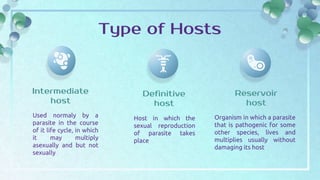
Type of Hosts
Definitive
host
Host in which the
sexual reproduction
of parasite takes
place
Reservoir
host
Organism in which a parasite
that is pathogenic for some
other species, lives and
multiplies usually without
damaging its host
Intermediate
host
Used normaly by a
parasite in the course
of it life cycle, in which
it may multiply
asexually and but not
sexually
1. PREPATENCY
● The phase of the disease between infection and the
appearance of diagnosable parasite stages
○ The appearance of tape worm eggs in the faeces
○ Malaria parasites in a routine blood smear
● This time frame can change with improvements in the
sensitivity of diagnostic assays
● A patent infection is thus at an established diagnosable
stage.
DISEASE TERMINOLOGY
2. Incubation period:
○ time between infection and the development of symptoms (signs of
disease like fever, pain or discomfort)
3. Acute disease
○ Have relatively quick onset and short duration
○ Symptoms worsen into a crisis and then the disease resolve
spontaneously into healing, results in the death of the patient or
transforms into chronic disease.
4. Chronic disease
○ Develop slowly, persistent and might show no symptoms
○ The parasite survives or persists over time (can be the rest of the life
of the patient)
DISEASE TERMINOLOGY
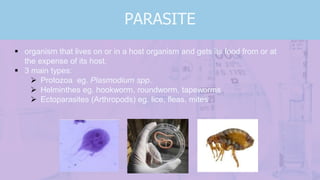
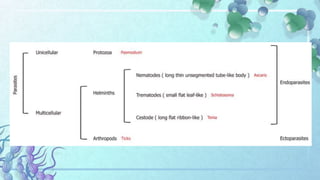
PARASITE
 organism that lives on or in a host organism and gets its food from or at
the expense of its host.
 3 main types:
 Protozoa eg. Plasmodium spp.
 Helminthes eg. hookworm, roundworm, tapeworms
 Ectoparasites (Arthropods) eg. lice, fleas, mites
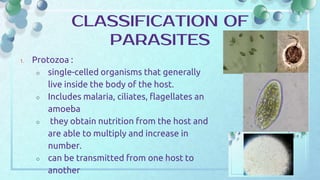
1. Protozoa :
○ single-celled organisms that generally
live inside the body of the host.
○ Includes malaria, ciliates, flagellates an
amoeba
○ they obtain nutrition from the host and
are able to multiply and increase in
number.
○ can be transmitted from one host to
another
CLASSIFICATION OF
PARASITES
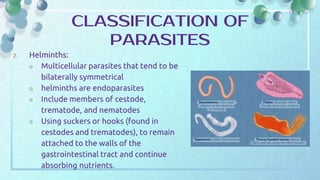
2. Helminths:
○ Multicellular parasites that tend to be
bilaterally symmetrical
○ helminths are endoparasites
○ Include members of cestode,
trematode, and nematodes
○ Using suckers or hooks (found in
cestodes and trematodes), to remain
attached to the walls of the
gastrointestinal tract and continue
absorbing nutrients.
CLASSIFICATION OF
PARASITES
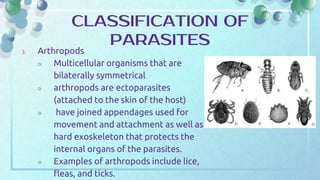
3. Arthropods
○ Multicellular organisms that are
bilaterally symmetrical
○ arthropods are ectoparasites
(attached to the skin of the host)
○ have joined appendages used for
movement and attachment as well as
hard exoskeleton that protects the
internal organs of the parasites.
○ Examples of arthropods include lice,
fleas, and ticks.
CLASSIFICATION OF
PARASITES
PROTOZOAN
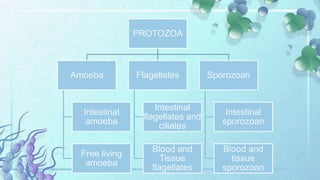
PROTOZOA
Amoeba
Intestinal
amoeba
Free living
amoeba
Flagellates
Intestinal
flagellates and
ciliates
Blood and
Tissue
flagellates
Sporozoan
Intestinal
sporozoan
Blood and
tissue
sporozoan
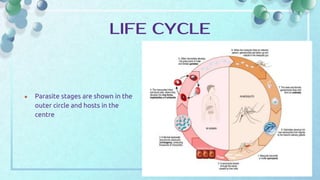
LIFE CYCLE
● Parasite stages are shown in the
outer circle and hosts in the
centre
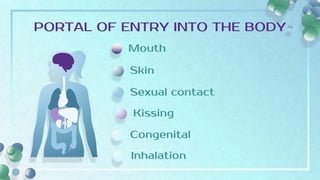
PORTAL OF ENTRY INTO THE BODY
Mouth
Sexual contact
Congenital
Kissing
Skin
Inhalation
1. Direct contact: transmitted from an infected site to another site
2. Congenital: some parasite can cross the placental barrier from
mother’s blood to the unborn fetus. Eg: malaria and toxoplasmosis
3. Ingestion: food and water contaminated with ova or larvae
4. Arthropod-borne: arthropods serve as vectors
5. Active penetration: larval stage may have the capability of
penetrating the host tissues
6. Transfusion: certain blood and tissue parasites.
MODE OF INFECTION
● The individual, as well as the community, must get involved in the
prevention of parasitic infections
● Life cycles of parasites may be interrupted by eradication of the
vectors
● Education about hygiene, eating habits and disposal of human and
animal wastes can also be used in combating parasites
● Treatment of diseased individuals not only relieves the suffering,
but also prevents the spread of the disease
PREVENTIVE MEASURES
THANK YOU!

TOPIC 1 INTRODUCTION TO PARASITOLOGY.pptx

  • 1.
    CHAPTER 1 INTRODUCTION TO PARASITOLOGY BT1092PARASITOLOGY DIPLOMA IN MEDICAL LABORATORY TECHNOLOGY MDM SITI BAINUN BINTI MOHD DALI
  • 2.
    LEARNING OUTCOME 01 Define parasite,host, vector, zoonozis 02 Defines types of organism relationships 03 Discuss the life cycles of parasites 04 Explain modes of infection At the end of this lecture, students should be able to:
  • 3.
  • 4.
    Fields In MedicalMicrobiology Bacteriology Virology Parasitology Mycology The study of bacteria The study of viruses The study of parasites The study of fungi
  • 5.
    ● Parasitology isthe branch of microbiology concerned with the phenomenon of dependence of one living organism on another.  Medical parasitology deals with  the parasites which infect man,  the disease they produce,  the response generated by our body against the parasite  various methods of diagnosis and prevention. PARASITOLOGY
  • 6.
    ● Parasite: aliving organism which receives nourishment and shelter from another organism where it lives ● Host: an organism which harbours the parasites ● Vector: a vector is an agent, usually an insect, that transmits an infection from one human host to another ● Zoonosis: it means a disease of animals. Leishmaniasis, trypanosomiasis, trichinelliasis and echinococcosis TERMINOLOGY
  • 7.
    Type of Hosts Definitive host Hostin which the sexual reproduction of parasite takes place Reservoir host Organism in which a parasite that is pathogenic for some other species, lives and multiplies usually without damaging its host Intermediate host Used normaly by a parasite in the course of it life cycle, in which it may multiply asexually and but not sexually
  • 8.
    1. PREPATENCY ● Thephase of the disease between infection and the appearance of diagnosable parasite stages ○ The appearance of tape worm eggs in the faeces ○ Malaria parasites in a routine blood smear ● This time frame can change with improvements in the sensitivity of diagnostic assays ● A patent infection is thus at an established diagnosable stage. DISEASE TERMINOLOGY
  • 9.
    2. Incubation period: ○time between infection and the development of symptoms (signs of disease like fever, pain or discomfort) 3. Acute disease ○ Have relatively quick onset and short duration ○ Symptoms worsen into a crisis and then the disease resolve spontaneously into healing, results in the death of the patient or transforms into chronic disease. 4. Chronic disease ○ Develop slowly, persistent and might show no symptoms ○ The parasite survives or persists over time (can be the rest of the life of the patient) DISEASE TERMINOLOGY
  • 10.
    PARASITE  organism thatlives on or in a host organism and gets its food from or at the expense of its host.  3 main types:  Protozoa eg. Plasmodium spp.  Helminthes eg. hookworm, roundworm, tapeworms  Ectoparasites (Arthropods) eg. lice, fleas, mites
  • 11.
    1. Protozoa : ○single-celled organisms that generally live inside the body of the host. ○ Includes malaria, ciliates, flagellates an amoeba ○ they obtain nutrition from the host and are able to multiply and increase in number. ○ can be transmitted from one host to another CLASSIFICATION OF PARASITES
  • 13.
    2. Helminths: ○ Multicellularparasites that tend to be bilaterally symmetrical ○ helminths are endoparasites ○ Include members of cestode, trematode, and nematodes ○ Using suckers or hooks (found in cestodes and trematodes), to remain attached to the walls of the gastrointestinal tract and continue absorbing nutrients. CLASSIFICATION OF PARASITES
  • 14.
    3. Arthropods ○ Multicellularorganisms that are bilaterally symmetrical ○ arthropods are ectoparasites (attached to the skin of the host) ○ have joined appendages used for movement and attachment as well as hard exoskeleton that protects the internal organs of the parasites. ○ Examples of arthropods include lice, fleas, and ticks. CLASSIFICATION OF PARASITES
  • 16.
  • 17.
    PROTOZOA Amoeba Intestinal amoeba Free living amoeba Flagellates Intestinal flagellates and ciliates Bloodand Tissue flagellates Sporozoan Intestinal sporozoan Blood and tissue sporozoan
  • 18.
    LIFE CYCLE ● Parasitestages are shown in the outer circle and hosts in the centre
  • 19.
    PORTAL OF ENTRYINTO THE BODY Mouth Sexual contact Congenital Kissing Skin Inhalation
  • 20.
    1. Direct contact:transmitted from an infected site to another site 2. Congenital: some parasite can cross the placental barrier from mother’s blood to the unborn fetus. Eg: malaria and toxoplasmosis 3. Ingestion: food and water contaminated with ova or larvae 4. Arthropod-borne: arthropods serve as vectors 5. Active penetration: larval stage may have the capability of penetrating the host tissues 6. Transfusion: certain blood and tissue parasites. MODE OF INFECTION
  • 21.
    ● The individual,as well as the community, must get involved in the prevention of parasitic infections ● Life cycles of parasites may be interrupted by eradication of the vectors ● Education about hygiene, eating habits and disposal of human and animal wastes can also be used in combating parasites ● Treatment of diseased individuals not only relieves the suffering, but also prevents the spread of the disease PREVENTIVE MEASURES
  • 22.