MAPPING OF OUM OUTCOME BASED
EDUCATION (OBE) SYSTEM
AhmadZulkarnian Ramli
Hii Yah Mee
Objectives
• Identify the relevant information necessary to
close the loop in the OBE cycle
• Illustrate the assessment tools required in the
development of the OBE System
Outcome based approach
to education ….
Clearly specifies what students are expected
to learn and arranges the curriculum such
that these intended outcomes are achieved -
Harden, 2007.
Moving forward with OBE
• Superior on the quality of our learning
environment
• Committed to OBE and Quality Assurance
Statutory and
Regulatory
Requirements
• Continue to design and engage in many
innovative initiatives to enhance students’
learning experiences
Requirements
MQA
Standards & COPs
OUM
Standards
Act 555
MOE Requirements
Are we new to Learning Outcomes?
• LOs have long been established and deeply set
in as a feature of the delivery and assessment
at OUM
• Lecturers are engaged in articulating and
assessing learning outcomes to account for
and ensure quality in our educational
programs
Our focus …
• Each individual in the academic unit express
learning outcomes that are appropriate to the
discipline
• Consistent with OUM’s mission, degree level
expectations and academic plans
• Curriculum becomes coherent, aligned and
evidenced.
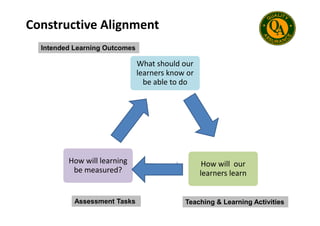
Constructive Alignment
What should our
learners know or
be able to do
Intended Learning Outcomes
How will our
learners learn
How will learning
be measured?
Teaching & Learning Activities
Assessment Tasks
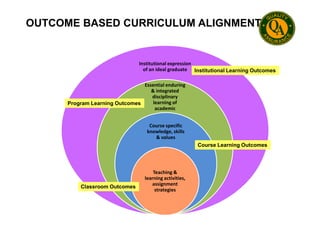
Institutional expression
of an ideal graduate
Essential enduring
& integrated
disciplinary
learning of
academic
program
Institutional Learning Outcomes
Program Learning Outcomes
OUTCOME BASED CURRICULUM ALIGNMENT
program
Course specific
knowledge, skills
& values
Teaching &
learning activities,
assignment
strategies
Classroom Outcomes
Course Learning Outcomes
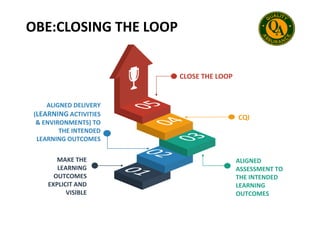
ALIGNED DELIVERY
(LEARNING ACTIVITIES
CLOSE THE LOOP
CQI
OBE:CLOSING THE LOOP
MAKE THE
LEARNING
OUTCOMES
EXPLICIT AND
VISIBLE
(LEARNING ACTIVITIES
& ENVIRONMENTS) TO
THE INTENDED
LEARNING OUTCOMES
CQI
ALIGNED
ASSESSMENT TO
THE INTENDED
LEARNING
OUTCOMES
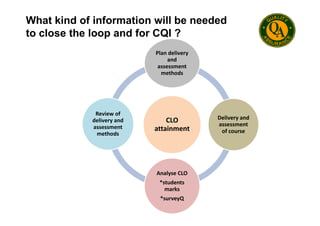
What kind of information will be needed
to close the loop and for CQI ?
Plan delivery
and
assessment
methods
Review of
CLO
attainment
Delivery and
assessment
of course
Analyse CLO
*students
marks
*surveyQ
Review of
delivery and
assessment
methods
Current Practices
• Analysis of CLOs, PLOs and CQI have been
conducted manually by the PDs and CLs at the
various clusters
• Each programme is offered three times per
year.
• Practices are tedious and time consuming.
The need to have the OBE System
• OBE System is proposed to automate the task
of CLs and PDs.
of CLs and PDs.
• Ease the documentation work for the
programme.
• Allow proper and systematic CQI of the
programme at PEO, PLO and CLO levels
Two types of measurement
• Direct measures- measuring level of
achievement of student learning on specific
outcomes
• Usually through exam/tests, projects,
presentations, portfolios
• Indirect measures include self reports,
surveys, interviews, reports on retention,
graduation and placement.
COURSE LEARNING OUTCOME TOOLS
CLOs are designed to specify skills or domains
required to be achieved by students at the end
of the course
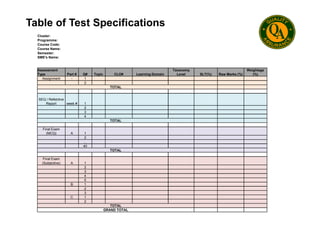
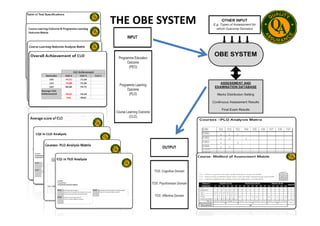
• Table of Test Specification
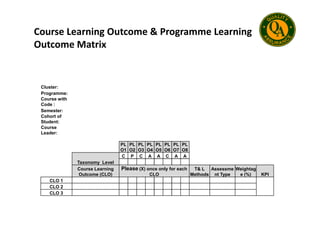
• CLO-PLO Matrix
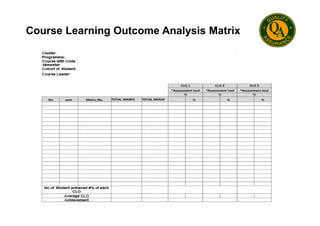
• CLO Analysis Matrix
• CQI Analysis tools
Cluster:
Programme:
Course Code:
Course Name:
Semester:
SME's Name:
Assessment
Type Part # Q# Topic CLO# Learning Domain
Taxanomy
Level SLT(%) Raw Marks (%)
Weightage
(%)
Assignment - 1
2
TOTAL
SEQ / Refelctive
Report week # 1
2
3
Table of Test Specifications
3
4
TOTAL
Final Exam
(MCQ) A 1
2
…
40
TOTAL
Final Exam
(Subjective) A 1
2
3
4
5
B 1
2
3
C 1
2
TOTAL
GRAND TOTAL
Course Learning Outcome & Programme Learning
Outcome Matrix
Cluster:
Programme:
Course with
Code :
Semester:
Semester:
Cohort of
Student:
Course
Leader:
PL
O1
PL
O2
PL
O3
PL
O4
PL
O5
PL
O6
PL
O7
PL
O8
Taxonomy Level
C P C A A C A A
Course Learning
Outcome (CLO)
Please (X) once only for each
CLO
T& L
Methods
Assessme
nt Type
Weightag
e (%) KPI
CLO 1
CLO 2
CLO 3
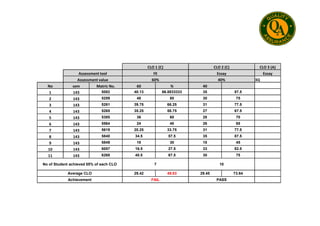
Course Learning Outcome Analysis Matrix
CLO 1 (C) CLO 2 (C) CLO 3 (A)
Assessment tool FE Essay Essay
Assessment value 60% 40% 3Q
No sem Matric No. 60 % 40
1 143 5082 40.13 66.8833333 35 87.5
2 143 5259 48 80 30 75
3 143 5261 39.75 66.25 31 77.5
4 143 5265 35.25 58.75 27 67.5
4 143
5 143 5385 36 60 28 70
6 143 5564 24 40 26 65
7 143 5619 20.25 33.75 31 77.5
8 143 5840 34.5 57.5 35 87.5
9 143 5849 18 30 18 45
10 143 6057 16.5 27.5 33 82.5
11 143 6268 40.5 67.5 30 75
No of Student achieved 55% of each CLO 7 10
Average CLO 29.42 49.03 29.45 73.64
Achievement FAIL PASS
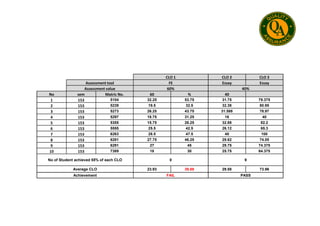
CLO 1 CLO 2 CLO 3
Assessment tool FE Essay Essay
Assessment value 60% 40%
No sem Matric No. 60 % 40
1 153 5104 32.25 53.75 31.75 79.375
2 153 5239 19.5 32.5 32.38 80.95
3 153 5273 26.25 43.75 31.588 78.97
3 153 5273 26.25 43.75 31.588 78.97
4 153 5297 18.75 31.25 16 40
5 153 5355 15.75 26.25 32.88 82.2
6 153 5555 25.5 42.5 26.12 65.3
7 153 6263 28.5 47.5 40 100
8 153 6281 27.75 46.25 29.62 74.05
9 153 6291 27 45 29.75 74.375
10 153 7389 18 30 25.75 64.375
No of Student achieved 55% of each CLO 0 9
Average CLO 23.93 39.88 29.58 73.96
Achievement FAIL PASS
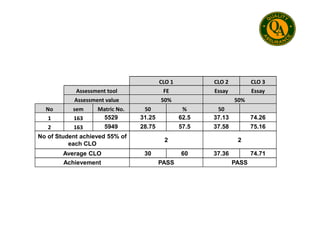
CLO 1 CLO 2 CLO 3
Assessment tool FE Essay Essay
Assessment value 50% 50%
No sem Matric No. 50 % 50
1 163 5529 31.25 62.5 37.13 74.26
2 163 5949 28.75 57.5 37.58 75.16
No of Student achieved 55% of
each CLO
2 2
Average CLO 30 60 37.36 74.71
Achievement PASS PASS
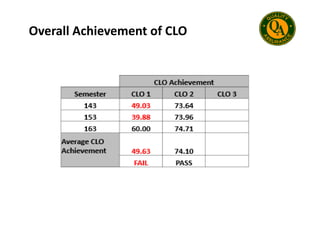
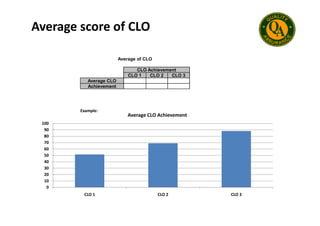
Overall Achievement of CLO
Average score of CLO
Average of CLO
CLO Achievement
CLO 1 CLO 2 CLO 3
Average CLO
Achievement
Example:
Average CLO Achievement
Example:
0
10
20
30
40
50
60
70
80
90
100
CLO 1 CLO 2 CLO 3
Average CLO Achievement
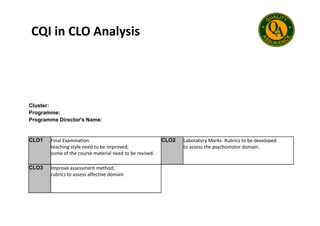
CQI in CLO Analysis
Cluster:
Programme:
Programme:
Programme Director's Name:
CLO1 Final Examination
teaching style need to be improved;
some of the course material need to be revised.
CLO2 Laboratory Marks- Rubrics to be developed
to assess the psychomotor domain.
CLO3 Improve assessment method;
rubrics to assess affective domain
PROGRAMME LEARNING OUTCOME
TOOLS
• PLOs are statements that describe what
students are expected to know and able to
perform or attain by the time they graduate
(Cognitive, Psychomotor and Affective
Domains).
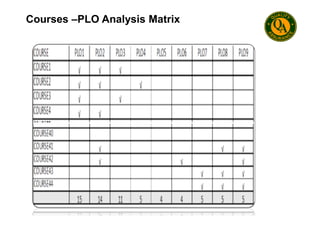
• Courses –PLO Analysis Matrix
• CQI
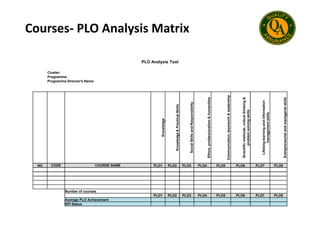
Courses- PLO Analysis Matrix
PLO Analysis Tool
Cluster:
Programme:
Programme Director's Name:
Knowledge
&
Practical
Skills
Social
Skills
and
Responsibility
Ethics,
professionalism
&
humanities
Communication,
teamwork
&
leadership
Scientific
methods,
critical
thinking
&
problem
solving
skills
Lifelong
learning
and
information
management
skills
Entrepreneurial
and
managerial
skills
Knowledge
Knowledge
&
Practical
Skills
Social
Skills
and
Responsibility
Ethics,
professionalism
&
humanities
Communication,
teamwork
&
leadership
Scientific
methods,
critical
thinking
&
problem
solving
skills
Lifelong
learning
and
information
management
skills
Entrepreneurial
and
managerial
skills
NO CODE COURSE NAME PLO1 PLO2 PLO3 PLO4 PLO5 PLO6 PLO7 PLO8
Number of courses
PLO1 PLO2 PLO3 PLO4 PLO5 PLO6 PLO7 PLO8
Average PLO Achievement
KPI Status
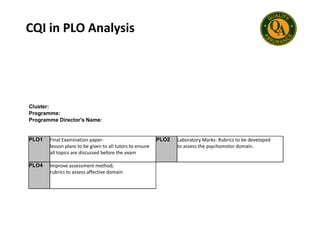
CQI in PLO Analysis
Cluster:
Programme:
Programme:
Programme Director's Name:
PLO1 Final Examination paper-
lesson plans to be given to all tutors to ensure
all topics are discussed before the exam
PLO2 Laboratory Marks- Rubrics to be developed
to assess the psychomotor domain.
PLO4 Improve assessment method;
rubrics to assess affective domain
Courses –PLO Analysis Matrix
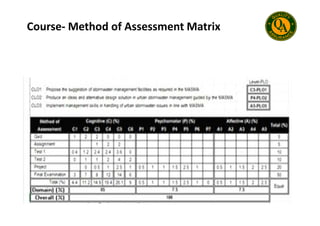
Course- Method of Assessment Matrix
THE OBE SYSTEM
Work in progress; first
things first …
• Identification and communication of clearly
defined learning outcomes
• Articulation of meaningful and measurable
learning outcomes that are contextualised
within the discipline of the program
• Constantly plan for feedback strategies for the
purpose of CQI of the programme (CLOs, PLOs
& PEOs)
library-document-1149.pdf OUTCOME BASED EDUCTAIO

library-document-1149.pdf OUTCOME BASED EDUCTAIO

  • 1.
    MAPPING OF OUMOUTCOME BASED EDUCATION (OBE) SYSTEM AhmadZulkarnian Ramli Hii Yah Mee
  • 2.
    Objectives • Identify therelevant information necessary to close the loop in the OBE cycle • Illustrate the assessment tools required in the • Illustrate the assessment tools required in the development of the OBE System
  • 3.
    Outcome based approach toeducation …. Clearly specifies what students are expected Clearly specifies what students are expected to learn and arranges the curriculum such that these intended outcomes are achieved - Harden, 2007.
  • 4.
    Moving forward withOBE • Superior on the quality of our learning environment • Committed to OBE and Quality Assurance Statutory and Regulatory Requirements • Continue to design and engage in many innovative initiatives to enhance students’ learning experiences Requirements MQA Standards & COPs OUM Standards Act 555 MOE Requirements
  • 5.
    Are we newto Learning Outcomes? • LOs have long been established and deeply set in as a feature of the delivery and assessment at OUM • Lecturers are engaged in articulating and assessing learning outcomes to account for and ensure quality in our educational programs
  • 6.
    Our focus … •Each individual in the academic unit express learning outcomes that are appropriate to the discipline • Consistent with OUM’s mission, degree level • Consistent with OUM’s mission, degree level expectations and academic plans • Curriculum becomes coherent, aligned and evidenced.
  • 7.
    Constructive Alignment What shouldour learners know or be able to do Intended Learning Outcomes How will our learners learn How will learning be measured? Teaching & Learning Activities Assessment Tasks
  • 8.
    Institutional expression of anideal graduate Essential enduring & integrated disciplinary learning of academic program Institutional Learning Outcomes Program Learning Outcomes OUTCOME BASED CURRICULUM ALIGNMENT program Course specific knowledge, skills & values Teaching & learning activities, assignment strategies Classroom Outcomes Course Learning Outcomes
  • 9.
    ALIGNED DELIVERY (LEARNING ACTIVITIES CLOSETHE LOOP CQI OBE:CLOSING THE LOOP MAKE THE LEARNING OUTCOMES EXPLICIT AND VISIBLE (LEARNING ACTIVITIES & ENVIRONMENTS) TO THE INTENDED LEARNING OUTCOMES CQI ALIGNED ASSESSMENT TO THE INTENDED LEARNING OUTCOMES
  • 10.
    What kind ofinformation will be needed to close the loop and for CQI ? Plan delivery and assessment methods Review of CLO attainment Delivery and assessment of course Analyse CLO *students marks *surveyQ Review of delivery and assessment methods
  • 14.
    Current Practices • Analysisof CLOs, PLOs and CQI have been conducted manually by the PDs and CLs at the various clusters • Each programme is offered three times per • Each programme is offered three times per year. • Practices are tedious and time consuming.
  • 15.
    The need tohave the OBE System • OBE System is proposed to automate the task of CLs and PDs. of CLs and PDs. • Ease the documentation work for the programme. • Allow proper and systematic CQI of the programme at PEO, PLO and CLO levels
  • 16.
    Two types ofmeasurement • Direct measures- measuring level of achievement of student learning on specific outcomes • Usually through exam/tests, projects, • Usually through exam/tests, projects, presentations, portfolios • Indirect measures include self reports, surveys, interviews, reports on retention, graduation and placement.
  • 17.
    COURSE LEARNING OUTCOMETOOLS CLOs are designed to specify skills or domains required to be achieved by students at the end of the course • Table of Test Specification • CLO-PLO Matrix • CLO Analysis Matrix • CQI Analysis tools
  • 18.
    Cluster: Programme: Course Code: Course Name: Semester: SME'sName: Assessment Type Part # Q# Topic CLO# Learning Domain Taxanomy Level SLT(%) Raw Marks (%) Weightage (%) Assignment - 1 2 TOTAL SEQ / Refelctive Report week # 1 2 3 Table of Test Specifications 3 4 TOTAL Final Exam (MCQ) A 1 2 … 40 TOTAL Final Exam (Subjective) A 1 2 3 4 5 B 1 2 3 C 1 2 TOTAL GRAND TOTAL
  • 19.
    Course Learning Outcome& Programme Learning Outcome Matrix Cluster: Programme: Course with Code : Semester: Semester: Cohort of Student: Course Leader: PL O1 PL O2 PL O3 PL O4 PL O5 PL O6 PL O7 PL O8 Taxonomy Level C P C A A C A A Course Learning Outcome (CLO) Please (X) once only for each CLO T& L Methods Assessme nt Type Weightag e (%) KPI CLO 1 CLO 2 CLO 3
  • 20.
    Course Learning OutcomeAnalysis Matrix
  • 21.
    CLO 1 (C)CLO 2 (C) CLO 3 (A) Assessment tool FE Essay Essay Assessment value 60% 40% 3Q No sem Matric No. 60 % 40 1 143 5082 40.13 66.8833333 35 87.5 2 143 5259 48 80 30 75 3 143 5261 39.75 66.25 31 77.5 4 143 5265 35.25 58.75 27 67.5 4 143 5 143 5385 36 60 28 70 6 143 5564 24 40 26 65 7 143 5619 20.25 33.75 31 77.5 8 143 5840 34.5 57.5 35 87.5 9 143 5849 18 30 18 45 10 143 6057 16.5 27.5 33 82.5 11 143 6268 40.5 67.5 30 75 No of Student achieved 55% of each CLO 7 10 Average CLO 29.42 49.03 29.45 73.64 Achievement FAIL PASS
  • 22.
    CLO 1 CLO2 CLO 3 Assessment tool FE Essay Essay Assessment value 60% 40% No sem Matric No. 60 % 40 1 153 5104 32.25 53.75 31.75 79.375 2 153 5239 19.5 32.5 32.38 80.95 3 153 5273 26.25 43.75 31.588 78.97 3 153 5273 26.25 43.75 31.588 78.97 4 153 5297 18.75 31.25 16 40 5 153 5355 15.75 26.25 32.88 82.2 6 153 5555 25.5 42.5 26.12 65.3 7 153 6263 28.5 47.5 40 100 8 153 6281 27.75 46.25 29.62 74.05 9 153 6291 27 45 29.75 74.375 10 153 7389 18 30 25.75 64.375 No of Student achieved 55% of each CLO 0 9 Average CLO 23.93 39.88 29.58 73.96 Achievement FAIL PASS
  • 23.
    CLO 1 CLO2 CLO 3 Assessment tool FE Essay Essay Assessment value 50% 50% No sem Matric No. 50 % 50 1 163 5529 31.25 62.5 37.13 74.26 2 163 5949 28.75 57.5 37.58 75.16 No of Student achieved 55% of each CLO 2 2 Average CLO 30 60 37.36 74.71 Achievement PASS PASS
  • 24.
  • 25.
    Average score ofCLO Average of CLO CLO Achievement CLO 1 CLO 2 CLO 3 Average CLO Achievement Example: Average CLO Achievement Example: 0 10 20 30 40 50 60 70 80 90 100 CLO 1 CLO 2 CLO 3 Average CLO Achievement
  • 26.
    CQI in CLOAnalysis Cluster: Programme: Programme: Programme Director's Name: CLO1 Final Examination teaching style need to be improved; some of the course material need to be revised. CLO2 Laboratory Marks- Rubrics to be developed to assess the psychomotor domain. CLO3 Improve assessment method; rubrics to assess affective domain
  • 27.
    PROGRAMME LEARNING OUTCOME TOOLS •PLOs are statements that describe what students are expected to know and able to perform or attain by the time they graduate (Cognitive, Psychomotor and Affective (Cognitive, Psychomotor and Affective Domains). • Courses –PLO Analysis Matrix • CQI
  • 28.
    Courses- PLO AnalysisMatrix PLO Analysis Tool Cluster: Programme: Programme Director's Name: Knowledge & Practical Skills Social Skills and Responsibility Ethics, professionalism & humanities Communication, teamwork & leadership Scientific methods, critical thinking & problem solving skills Lifelong learning and information management skills Entrepreneurial and managerial skills Knowledge Knowledge & Practical Skills Social Skills and Responsibility Ethics, professionalism & humanities Communication, teamwork & leadership Scientific methods, critical thinking & problem solving skills Lifelong learning and information management skills Entrepreneurial and managerial skills NO CODE COURSE NAME PLO1 PLO2 PLO3 PLO4 PLO5 PLO6 PLO7 PLO8 Number of courses PLO1 PLO2 PLO3 PLO4 PLO5 PLO6 PLO7 PLO8 Average PLO Achievement KPI Status
  • 29.
    CQI in PLOAnalysis Cluster: Programme: Programme: Programme Director's Name: PLO1 Final Examination paper- lesson plans to be given to all tutors to ensure all topics are discussed before the exam PLO2 Laboratory Marks- Rubrics to be developed to assess the psychomotor domain. PLO4 Improve assessment method; rubrics to assess affective domain
  • 30.
  • 31.
    Course- Method ofAssessment Matrix
  • 33.
  • 34.
    Work in progress;first things first … • Identification and communication of clearly defined learning outcomes • Articulation of meaningful and measurable learning outcomes that are contextualised learning outcomes that are contextualised within the discipline of the program • Constantly plan for feedback strategies for the purpose of CQI of the programme (CLOs, PLOs & PEOs)