INDUSTRY COMES OF AGE,
1865-1900
Chapter 24
The Iron Colt Becomes An Iron Horse








RR building exploded after the Civil War.
US government subsidized the first two
transcontinental RR
How land-grants worked
Why subsidies were necessary.
In all RR got over 200 Mill acres from
Feds and states—area larger than the
state of Texas.
Benefits of Subsidies


US benefited from giving land to
RR. How?






RRs promoted immigration
promoted of westward migration.
RR gave the government a break
on mail and military transport.

Free land a cheap way to
subsidize.


Why?
Spanning The Continent With Rails









After secession, Congress Commissioned
a transcontinental RR.
Union Pacific and Central Pacific.
20 square miles of land for each mile of
track laid
Building began in earnest in 1865 after the
Civil War.
Credit Mobiler scandal
Completion of transcontinental Railroad

CP was led by "The Associates," familiarly known as the "Big Four," who pushed the project to
completion with its share of rancor and scandal.
Leland Stanford became president and later served as California governor and U.S. senator. He
founded
Stanford University in honor of his son, who died at 16.
Collis Huntington , vice president, secured suppliers for the railroad and attracted investors to fund it.
Charles Crocker was head of construction and got the railroad built through torturous terrain.
Mark Hopkins handled the railroad's accounts and maintained harmony among the three younger men
Building the Railroads


On both lines mostly poor
immigrants did the work.








Irish were predominant on
the UP line
Chinese on the Central
Pacific line. Often beset
by Indians.

Moving tent cities
Hundreds of labors died.
Significance of
transcontinental RR
Binding The Country With Railroads






Four other Transcontinental lines were
built. None received cash grants, but
three received land grants.
Many other RR went bankrupt and fleeced
investors.
Towns competed with bribes to RR
promoters to get the RR to come to their
town. Many of these RR took the money
and ran.
Federal Land Grants to Railroads






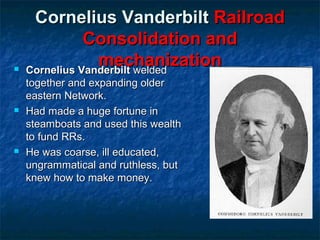
Cornelius Vanderbilt Railroad
Consolidation and
mechanization
Cornelius Vanderbilt welded
together and expanding older
eastern Network.
Had made a huge fortune in
steamboats and used this wealth
to fund RRs.
He was coarse, ill educated,
ungrammatical and ruthless, but
knew how to make money.
Railroad Consolidation and
Mechanization


Significant Improvements to RR facilitated
growth of railroads:







Steel rail
Standard gauge track:
Westinghouse brake
Pullman sleeping cars: made travel more
comfortable for passengers—1860s.

Trains still dangerous.
Revolution By Railways


Transcontinental RR caused many changes:










Stimulated American economy
Stimulated manufacturing and industrialization
Westward expansion of agriculture
Stimulated immigration
Bigger cities
Settlement of the unsettled areas
Time zones
Created Millionaires
Changed Western ecology
Wrongdoing in Railroading









The railroads were
rife with corruption
Jay Gould
Stock Watering
Bribery
Trusts and Pooling
Agreements
Rebates
Government Bridles The Iron Horse


Farmers resented the RR




Generally, the country was slow to respond to
abuses of RR.








Why?

Laissez faire

Depression of 1870 spurred the government into
action.
Grange put pressure on many Midwestern
legislatures to regulate the RR monopoly.
State laws held unconstitutional in the famous
Wabash case. Why?


Interstate commerce could not be regulated by states
Interstate Commerce Act


Interstate Commerce Act in 1887.










Prohibited rebates and pools
Required RR to publish their rates openly
Outlawed discrimination against shippers
outlawed charging more for short hauls than for long
ones
Set up the Interstate Commerce Commission to
administer and enforce

Was not a revolutionary victory; simply modest
regulation
Did provide an orderly forum.
water-shed in establishing the power of
government to regulate business
Miracles of Mechanization



1865-1895 saw a huge industrial boom.
Reasons:





Much more liquid capital
natural resources started to be exploited
Massive immigration provided cheap unskilled labor
American inventions made businesses and factories
more efficient.






telegraph, mass production, cash register, stock ticker .

Telephone (1876) and expanded telegraph;
communications revolution. “Telephoniacs”
Edison and Electric Light
Thoma s Alva Edis on

“Wizard of Menlo Park”
The Trust Titan Emerges



Businesses, left alone, hate competition.
Ways to avoid competition.







Vertical Integration--Andrew Carnegie’s Steel
operations. More effeciant
Horizontal Integration, wipe out competiation
—Rockefeller and Standard Oil
Trusts—Rockefeller “ Let us Prey”
Interlocking Directorates—J.P. Morgan put
bank managers on all board of directors
The Supremacy Of Steel








Steel became King after the Civil War.
Foundation for much of the industrial
expansion
Bessemer process.
America biggest Steel producer by 1900.
Produced 1/3 of the world’s steel.
Why America dominant.
Carnegie And Other Sultans Of Steel




Andrew Carnegie—US
Steel
King of American Steel








Produced ¼

Carnegie cleared 25 Mil.
a year. Huge fortune
Sold out to J.P. Morgan
for 400 Million.
Spent the rest of his life
giving money away
Rockefeller and Standard Oil











Oil industry emerges after the
Civil War.
Rockefeller and Standard Oil.
ruthless.
Big believer in commercial
Darwinism.
By 1877 controlled 95% of all
the old refineries in the
country.
Benefits.
Standard Oil—The Octopus
The Gospel of Wealth




Social obligations of new
super-rich?
Charles Graham Sumner




“Social Darwinism”






Get richer; none to poor
Rich deserve to be rich;
poor deserve to be poor
Contempt for poor who had
“earned” their own poverty

Russell Conwell

Charles

Graham Sumner
Carnegie’s Gospel of Wealth










Inequality is inevitable and
good.
Wealthy should act as
“trustees” for their “poorer
brethren.”
Wealthy had to prove they
deserved their wealth.
Give back to the community
as a whole, not to individuals
Carnegie gave away millions
Government Tackles The Trust Evil



Sherman Anti Trust Act of 1890.
Forbids combinations in restraint of trade.








Did not prove very effective because went after
bigness and not badness.
Not very effective because penalties weak and
loopholes
Biggest effect was unintended--Was used against
unions.

Importance of the law was not its immediate
effect but the shift in thinking that it represented.
The South In The Age Of Industry






South did not benefit much
Produced smaller % of Manufacturing
goods than pre-Civil War
James Duke—Cigarettes
Barriers to Southern development




Railroad rate discrimination

Textile Mills


Pros and Cons
The Impact Of Industrialization











Increased wealth of nation
Standard of living rose sharply
Workers enjoyed many more physical comforts
Urban centers mushroomed
Jeffersonian Ideal of nation of small farmers died
Concept of time changed.
Many more women in the workforce
Delayed marriages and smaller families
New class system
Workers becoming more dependent and more
vulnerable.
In Unions There is Strength




Surplus of unskilled labor.
Individual workers were powerless to bargain
Early Unions had little power, as well.









strike-breakers, lawyers and thugs (“Oh my!”)

Courts issued injunctions against strikes based
on Anti-Trust laws.
Yellow-dog contracts
Black-lists
Company stores
Middle-class was largely unsympathetic.
Labor Limps Along



Unions strengthened after the Civil War.
National Labor Union organized in 1866
and did well,






600,000 members, both skilled and unskilled
Did not recruit women or blacks
Goals: arbitration of industrial disputes, 8-hour
day
damaged by the depression in the 1870s.
Knights of Labor


Knights of Labor took over
where the National Labor Union
had left off.








Terence V.
Powderly

Sought to include all labor in one
big Union.
They stayed out of politics, but
campaigned hard for economic and
social reform.
Their biggest issue was the 8-hour
work day.
Won that fight from a number of
industries and their ranks swelled.

An injury to one is the concern of all!
Unhorsing The Knights Of Labor



Knights of Labor riding for a fall
Problems:








The Haymarket Square incident in Chicago in
1886
Fusion of both skilled and unskilled labor.

Skilled workers abandoned the Knights for
the American Federation of Labor.
This dealt the Knights a death blow, and
the union slowly withered.
Haymarket Riot
(1886)

McCormick Harvesting Machine Co.
The AF Of L To The Fore










AF of L --1886
Brain child of Samuel Gompers.
President of the union every year
for 38 years but one.
Confederation of self-governing
independent unions for skilled
laborers.
Gompers political strategy.
Major goal was closed shop.
Weapons were walk-outs and
boycotts.
The AF Of L To The Fore








Let unskilled workers,
blacks and woman fend
for themselves.
500,000 members by
1900.
1881-1900 over 23,000
strikes
By 1900, increased but
fragile support
1894—Labor Day holiday.
Most employers still
fought labor aggressively.
Management vs. Labor
“Tools” of
Management

“Tools” of
Labor



“scabs”



boycotts



P. R. campaign





Pinkertons

sympathy
demonstrations



informational
picketing



lockout



blacklisting





yellow-dog contracts

closed shops





court injunctions

organized
strikes



open shop



“wildcat” strikes

LOAPUSH 24

  • 1.
    INDUSTRY COMES OFAGE, 1865-1900 Chapter 24
  • 2.
    The Iron ColtBecomes An Iron Horse      RR building exploded after the Civil War. US government subsidized the first two transcontinental RR How land-grants worked Why subsidies were necessary. In all RR got over 200 Mill acres from Feds and states—area larger than the state of Texas.
  • 3.
    Benefits of Subsidies  USbenefited from giving land to RR. How?     RRs promoted immigration promoted of westward migration. RR gave the government a break on mail and military transport. Free land a cheap way to subsidize.  Why?
  • 4.
    Spanning The ContinentWith Rails      After secession, Congress Commissioned a transcontinental RR. Union Pacific and Central Pacific. 20 square miles of land for each mile of track laid Building began in earnest in 1865 after the Civil War. Credit Mobiler scandal
  • 5.
    Completion of transcontinentalRailroad CP was led by "The Associates," familiarly known as the "Big Four," who pushed the project to completion with its share of rancor and scandal. Leland Stanford became president and later served as California governor and U.S. senator. He founded Stanford University in honor of his son, who died at 16. Collis Huntington , vice president, secured suppliers for the railroad and attracted investors to fund it. Charles Crocker was head of construction and got the railroad built through torturous terrain. Mark Hopkins handled the railroad's accounts and maintained harmony among the three younger men
  • 6.
    Building the Railroads  Onboth lines mostly poor immigrants did the work.      Irish were predominant on the UP line Chinese on the Central Pacific line. Often beset by Indians. Moving tent cities Hundreds of labors died. Significance of transcontinental RR
  • 7.
    Binding The CountryWith Railroads    Four other Transcontinental lines were built. None received cash grants, but three received land grants. Many other RR went bankrupt and fleeced investors. Towns competed with bribes to RR promoters to get the RR to come to their town. Many of these RR took the money and ran.
  • 8.
    Federal Land Grantsto Railroads
  • 9.
       Cornelius Vanderbilt Railroad Consolidationand mechanization Cornelius Vanderbilt welded together and expanding older eastern Network. Had made a huge fortune in steamboats and used this wealth to fund RRs. He was coarse, ill educated, ungrammatical and ruthless, but knew how to make money.
  • 10.
    Railroad Consolidation and Mechanization  SignificantImprovements to RR facilitated growth of railroads:      Steel rail Standard gauge track: Westinghouse brake Pullman sleeping cars: made travel more comfortable for passengers—1860s. Trains still dangerous.
  • 11.
    Revolution By Railways  TranscontinentalRR caused many changes:          Stimulated American economy Stimulated manufacturing and industrialization Westward expansion of agriculture Stimulated immigration Bigger cities Settlement of the unsettled areas Time zones Created Millionaires Changed Western ecology
  • 12.
    Wrongdoing in Railroading       Therailroads were rife with corruption Jay Gould Stock Watering Bribery Trusts and Pooling Agreements Rebates
  • 13.
    Government Bridles TheIron Horse  Farmers resented the RR   Generally, the country was slow to respond to abuses of RR.     Why? Laissez faire Depression of 1870 spurred the government into action. Grange put pressure on many Midwestern legislatures to regulate the RR monopoly. State laws held unconstitutional in the famous Wabash case. Why?  Interstate commerce could not be regulated by states
  • 14.
    Interstate Commerce Act  InterstateCommerce Act in 1887.         Prohibited rebates and pools Required RR to publish their rates openly Outlawed discrimination against shippers outlawed charging more for short hauls than for long ones Set up the Interstate Commerce Commission to administer and enforce Was not a revolutionary victory; simply modest regulation Did provide an orderly forum. water-shed in establishing the power of government to regulate business
  • 15.
    Miracles of Mechanization   1865-1895saw a huge industrial boom. Reasons:     Much more liquid capital natural resources started to be exploited Massive immigration provided cheap unskilled labor American inventions made businesses and factories more efficient.    telegraph, mass production, cash register, stock ticker . Telephone (1876) and expanded telegraph; communications revolution. “Telephoniacs” Edison and Electric Light
  • 16.
    Thoma s AlvaEdis on “Wizard of Menlo Park”
  • 17.
    The Trust TitanEmerges   Businesses, left alone, hate competition. Ways to avoid competition.     Vertical Integration--Andrew Carnegie’s Steel operations. More effeciant Horizontal Integration, wipe out competiation —Rockefeller and Standard Oil Trusts—Rockefeller “ Let us Prey” Interlocking Directorates—J.P. Morgan put bank managers on all board of directors
  • 18.
    The Supremacy OfSteel      Steel became King after the Civil War. Foundation for much of the industrial expansion Bessemer process. America biggest Steel producer by 1900. Produced 1/3 of the world’s steel. Why America dominant.
  • 19.
    Carnegie And OtherSultans Of Steel   Andrew Carnegie—US Steel King of American Steel     Produced ¼ Carnegie cleared 25 Mil. a year. Huge fortune Sold out to J.P. Morgan for 400 Million. Spent the rest of his life giving money away
  • 20.
    Rockefeller and StandardOil       Oil industry emerges after the Civil War. Rockefeller and Standard Oil. ruthless. Big believer in commercial Darwinism. By 1877 controlled 95% of all the old refineries in the country. Benefits.
  • 21.
  • 22.
    The Gospel ofWealth   Social obligations of new super-rich? Charles Graham Sumner   “Social Darwinism”    Get richer; none to poor Rich deserve to be rich; poor deserve to be poor Contempt for poor who had “earned” their own poverty Russell Conwell Charles Graham Sumner
  • 23.
    Carnegie’s Gospel ofWealth      Inequality is inevitable and good. Wealthy should act as “trustees” for their “poorer brethren.” Wealthy had to prove they deserved their wealth. Give back to the community as a whole, not to individuals Carnegie gave away millions
  • 24.
    Government Tackles TheTrust Evil   Sherman Anti Trust Act of 1890. Forbids combinations in restraint of trade.     Did not prove very effective because went after bigness and not badness. Not very effective because penalties weak and loopholes Biggest effect was unintended--Was used against unions. Importance of the law was not its immediate effect but the shift in thinking that it represented.
  • 25.
    The South InThe Age Of Industry     South did not benefit much Produced smaller % of Manufacturing goods than pre-Civil War James Duke—Cigarettes Barriers to Southern development   Railroad rate discrimination Textile Mills  Pros and Cons
  • 26.
    The Impact OfIndustrialization           Increased wealth of nation Standard of living rose sharply Workers enjoyed many more physical comforts Urban centers mushroomed Jeffersonian Ideal of nation of small farmers died Concept of time changed. Many more women in the workforce Delayed marriages and smaller families New class system Workers becoming more dependent and more vulnerable.
  • 27.
    In Unions Thereis Strength    Surplus of unskilled labor. Individual workers were powerless to bargain Early Unions had little power, as well.       strike-breakers, lawyers and thugs (“Oh my!”) Courts issued injunctions against strikes based on Anti-Trust laws. Yellow-dog contracts Black-lists Company stores Middle-class was largely unsympathetic.
  • 28.
    Labor Limps Along   Unionsstrengthened after the Civil War. National Labor Union organized in 1866 and did well,     600,000 members, both skilled and unskilled Did not recruit women or blacks Goals: arbitration of industrial disputes, 8-hour day damaged by the depression in the 1870s.
  • 29.
    Knights of Labor  Knightsof Labor took over where the National Labor Union had left off.     Terence V. Powderly Sought to include all labor in one big Union. They stayed out of politics, but campaigned hard for economic and social reform. Their biggest issue was the 8-hour work day. Won that fight from a number of industries and their ranks swelled. An injury to one is the concern of all!
  • 30.
    Unhorsing The KnightsOf Labor   Knights of Labor riding for a fall Problems:     The Haymarket Square incident in Chicago in 1886 Fusion of both skilled and unskilled labor. Skilled workers abandoned the Knights for the American Federation of Labor. This dealt the Knights a death blow, and the union slowly withered.
  • 31.
  • 32.
    The AF OfL To The Fore        AF of L --1886 Brain child of Samuel Gompers. President of the union every year for 38 years but one. Confederation of self-governing independent unions for skilled laborers. Gompers political strategy. Major goal was closed shop. Weapons were walk-outs and boycotts.
  • 33.
    The AF OfL To The Fore       Let unskilled workers, blacks and woman fend for themselves. 500,000 members by 1900. 1881-1900 over 23,000 strikes By 1900, increased but fragile support 1894—Labor Day holiday. Most employers still fought labor aggressively.
  • 34.
    Management vs. Labor “Tools”of Management “Tools” of Labor  “scabs”  boycotts  P. R. campaign   Pinkertons sympathy demonstrations  informational picketing  lockout  blacklisting   yellow-dog contracts closed shops   court injunctions organized strikes  open shop  “wildcat” strikes