REMINDER:
Westward Expansion
Project Due TOMORROW
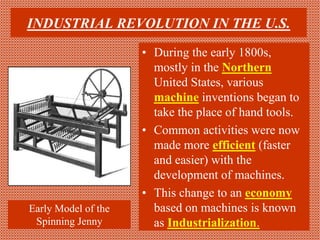
INDUSTRIAL REVOLUTION IN THE U.S.
• During the early 1800s,
mostly in the Northern
United States, various
machine inventions began to
take the place of hand tools.
• Common activities were now
made more efficient (faster
and easier) with the
development of machines.
• This change to an economy
based on machines is known
as Industrialization.
Early Model of the
Spinning Jenny
Textile Mills in the North
• The Industrial Revolution started in England with the textile
industry, then spread to the United States.
Textiles are types of cloth and woven fabric.
• Samuel Slater breaks the law!
He builds a cloth spinning
machine from plans he
memorized while working in a
textile mill in Britain.
• He comes to America, builds
textile mills (factory the
produces fabric), and factories
begin to spring up in New
England.
Economic Effects of Factories
• The supply of goods went up because
fabrics (called textiles) and manufactured
goods could be made more easily and
more quickly than ever before.
• The cost of making a product went down
(not as many people needed to make the
product).
• The price of goods went down because it
was cheaper to make.
• Then the demand for the product went up
(more people could afford to buy it).
$
$
Why did industrialization start in north?
Industrialization
in the
North
The center
for trade and
shipping in
the United
States
Many fast
flowing rivers
to power the
factories
Thin rocky soil
prevented large
scale farms
(plantations)
A large
population
of willing
workers
THE FACTORY SYSTEM
Industrialization brought workers and machines together
under one roof to form factories in the Northern U.S.
•The climate and conditions of the North made farming
difficult, and many people felt they could depend on a
factory job more than farming.
•People began to move away from rural life on the
countryside in favor of city living. The migration of people
toward cities is known as urbanization.
This Presentation accompanies 8th Grade U.S. History Textbook: From Chapter 14 – A
New Spirit of Change, 1820 – 1860.
URBANIZATION
The size and pure numbers of the people in the cities
of the United States, especially in the North, grew
dramatically in the early 1800s for several reasons:
1. War of 1812 brought on increased industrialization
2. Inventions and technology brought about rapid
industrialization in the U.S., increasing factories.
3. Job opportunities brought on by industrialization and
the factory system drew people to cities.
4. New types of transportation systems led to further
urbanization and growth of cities.
• Immigration in America began to increase toward the
middle of the 19th Century as people from all walks of life
came for different reasons to this new land of opportunity.
• Some had come because they had no money or because of
famine (a food shortage) and needed a new start on life,
like those from Ireland.
• There were even well educated and wealthy immigrants
such as many from Germany who just wanted a fresh start
to their lives.
• Some immigrants came in groups make money for their
family like the Chinese.
• There were push-pull factors of immigration. These forces
push people out of their native lands and pull them towards
a new place.
Push – Pull Factors of
Immigration
1.Population growth
2.Agricultural changes
3.Crop Failures
4.Industrial Revolution
5.Religious and political
problems
Push – Pull Factors of
Immigration
1.Freedom
2.Economic opportunity
3.Abundant land
• Some of these new Americans
became very successful such as Levi
Strauss. He started a clothing
factory and became the first person
in America to sell “Blue Jeans”
• Still other Americans, especially
those in the cities struggled to find
great success in this Country.
• Even though many native born
Americans, Nativists, resented all of
the immigrants and did NOT accept
them, America as a nation benefited
greatly from the large immigration
movement.
• New ideas and talents began to
spread and American Culture was
changed forever.

Industrializationurbanimmig

  • 1.
  • 2.
    INDUSTRIAL REVOLUTION INTHE U.S. • During the early 1800s, mostly in the Northern United States, various machine inventions began to take the place of hand tools. • Common activities were now made more efficient (faster and easier) with the development of machines. • This change to an economy based on machines is known as Industrialization. Early Model of the Spinning Jenny
  • 3.
    Textile Mills inthe North • The Industrial Revolution started in England with the textile industry, then spread to the United States. Textiles are types of cloth and woven fabric. • Samuel Slater breaks the law! He builds a cloth spinning machine from plans he memorized while working in a textile mill in Britain. • He comes to America, builds textile mills (factory the produces fabric), and factories begin to spring up in New England.
  • 4.
    Economic Effects ofFactories • The supply of goods went up because fabrics (called textiles) and manufactured goods could be made more easily and more quickly than ever before. • The cost of making a product went down (not as many people needed to make the product). • The price of goods went down because it was cheaper to make. • Then the demand for the product went up (more people could afford to buy it). $ $
  • 5.
    Why did industrializationstart in north? Industrialization in the North The center for trade and shipping in the United States Many fast flowing rivers to power the factories Thin rocky soil prevented large scale farms (plantations) A large population of willing workers
  • 6.
    THE FACTORY SYSTEM Industrializationbrought workers and machines together under one roof to form factories in the Northern U.S. •The climate and conditions of the North made farming difficult, and many people felt they could depend on a factory job more than farming. •People began to move away from rural life on the countryside in favor of city living. The migration of people toward cities is known as urbanization.
  • 7.
    This Presentation accompanies8th Grade U.S. History Textbook: From Chapter 14 – A New Spirit of Change, 1820 – 1860.
  • 8.
    URBANIZATION The size andpure numbers of the people in the cities of the United States, especially in the North, grew dramatically in the early 1800s for several reasons: 1. War of 1812 brought on increased industrialization 2. Inventions and technology brought about rapid industrialization in the U.S., increasing factories. 3. Job opportunities brought on by industrialization and the factory system drew people to cities. 4. New types of transportation systems led to further urbanization and growth of cities.
  • 9.
    • Immigration inAmerica began to increase toward the middle of the 19th Century as people from all walks of life came for different reasons to this new land of opportunity. • Some had come because they had no money or because of famine (a food shortage) and needed a new start on life, like those from Ireland. • There were even well educated and wealthy immigrants such as many from Germany who just wanted a fresh start to their lives. • Some immigrants came in groups make money for their family like the Chinese. • There were push-pull factors of immigration. These forces push people out of their native lands and pull them towards a new place.
  • 10.
    Push – PullFactors of Immigration 1.Population growth 2.Agricultural changes 3.Crop Failures 4.Industrial Revolution 5.Religious and political problems
  • 11.
    Push – PullFactors of Immigration 1.Freedom 2.Economic opportunity 3.Abundant land
  • 12.
    • Some ofthese new Americans became very successful such as Levi Strauss. He started a clothing factory and became the first person in America to sell “Blue Jeans” • Still other Americans, especially those in the cities struggled to find great success in this Country. • Even though many native born Americans, Nativists, resented all of the immigrants and did NOT accept them, America as a nation benefited greatly from the large immigration movement. • New ideas and talents began to spread and American Culture was changed forever.