Forging theForging the
NationalNational
EconomyEconomy
1790-1860
QUICKWRITEQUICKWRITE::
How did TWO of the followingHow did TWO of the following
contribute to the reemergencecontribute to the reemergence
of the two-party system in theof the two-party system in the
period 1820 to 1840?period 1820 to 1840?
Major political personalitiesMajor political personalities
States’ rightsStates’ rights
Economic issuesEconomic issues
Creating theCreating the
AmericanAmerican
CharacterCharacter
Westward movement
continued
1850 – population
center located west of
Alleghenies
Effects of the Wilderness
Young population
constantly in motion
Importance of wealth &
the constant pursuit of
wealth
American pioneers
Rough characters
Wilderness required hard
work & left little time for
slacking
Self-centered, provincial,
& isolationist
“self-reliance”
Contrasted with the need
to work together
log-rolling & barn raising
American tall-tales &
exaggeration
Boasting & bluffing (poker
playing)
Gambling, drinking &
fighting
Effects on the
Wilderness
Kentucky cane fields
burned off & planted with
bluegrass
Mountain men began to
“trap out” the beaver in
the Rocky Mountains
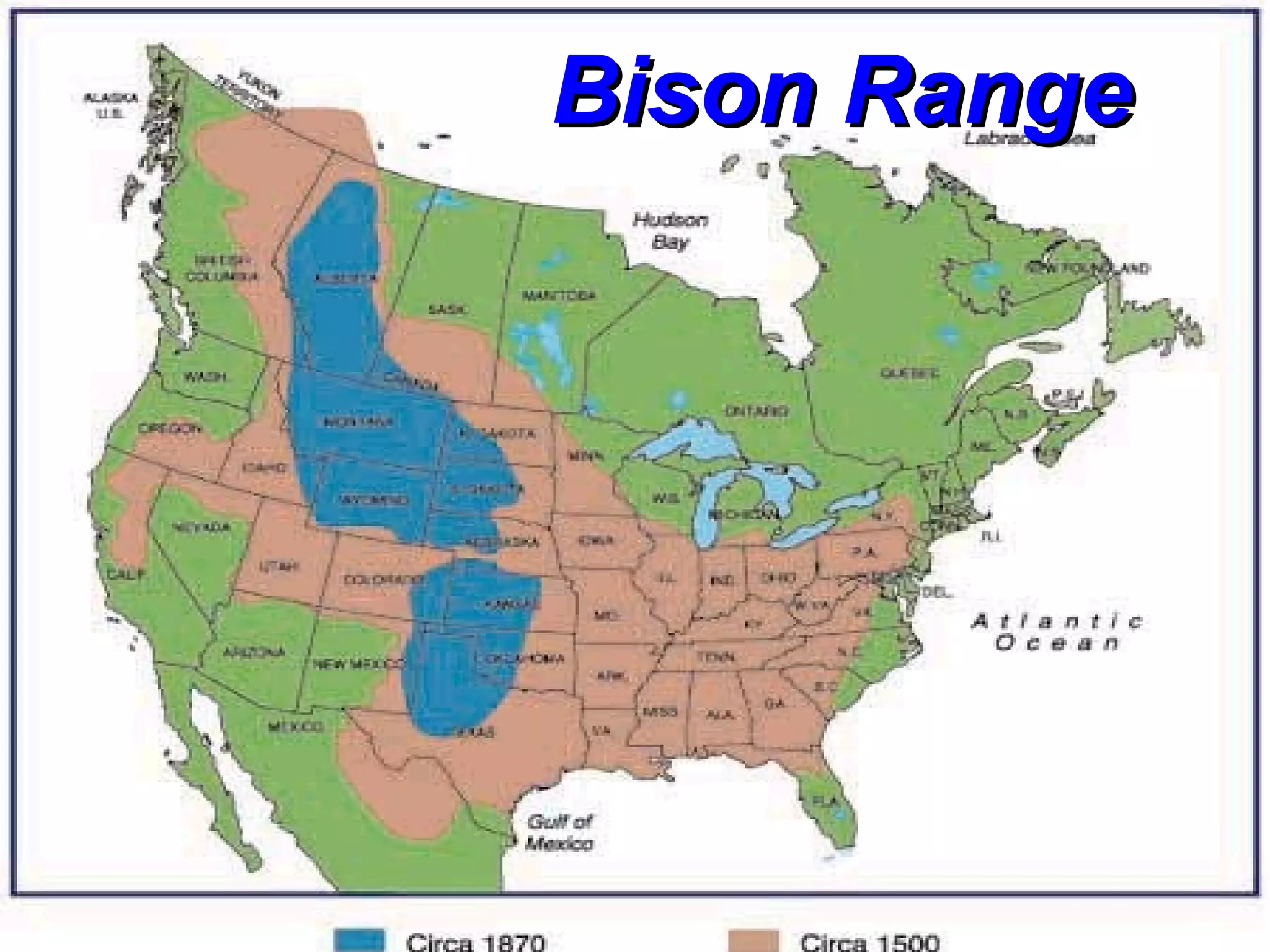
The Buffalo
Vast herds of American
Bison covered the Great
Plains
Estimated pre-European
herd size:
30,000,000 to 70,000,000
Buffalo hunters, trading in
furs and tongues, began to
kill off the great herds
Unregulated killing of
bison led to the reduction
of the herds to no more
than 1500 individuals in the
mid to late 1800
Bison RangeBison Range
California Otter
Highly prized pelts of
the Pacific Sea Otter
led trappers to hunt
the animals to near
extinction
American’s love of the
Wild
Praised the unspoiled
wilderness & the beauty
of nature
This ideal of the idyllic
came to be expressed in
arts & literature
George CatlinGeorge Catlin
Painter & student of
the Native Americans
Wished to preserve
the natural beauty of
the west
Proposed the creation
of National Parks
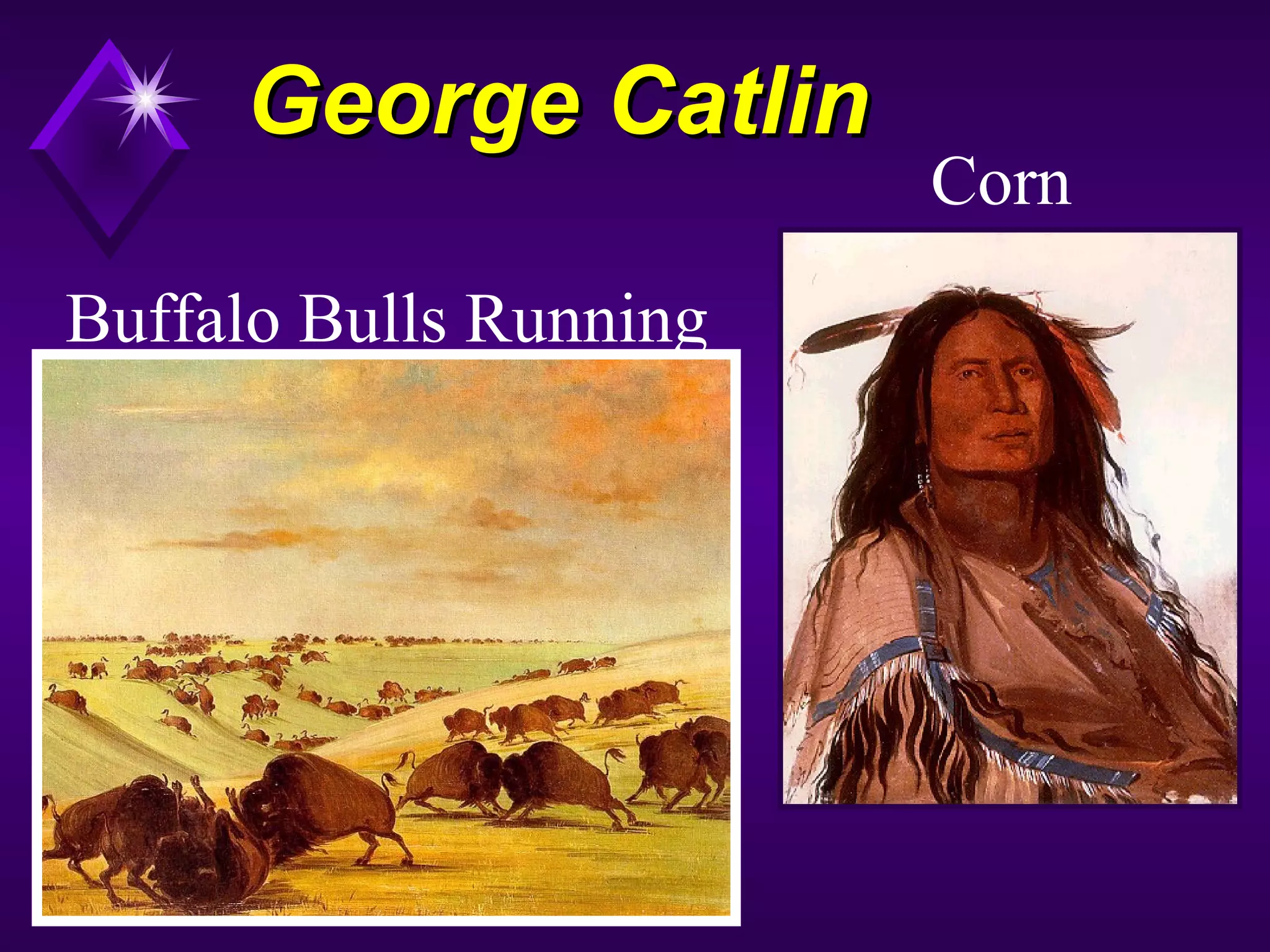
George CatlinGeorge Catlin
Corn
Buffalo Bulls Running
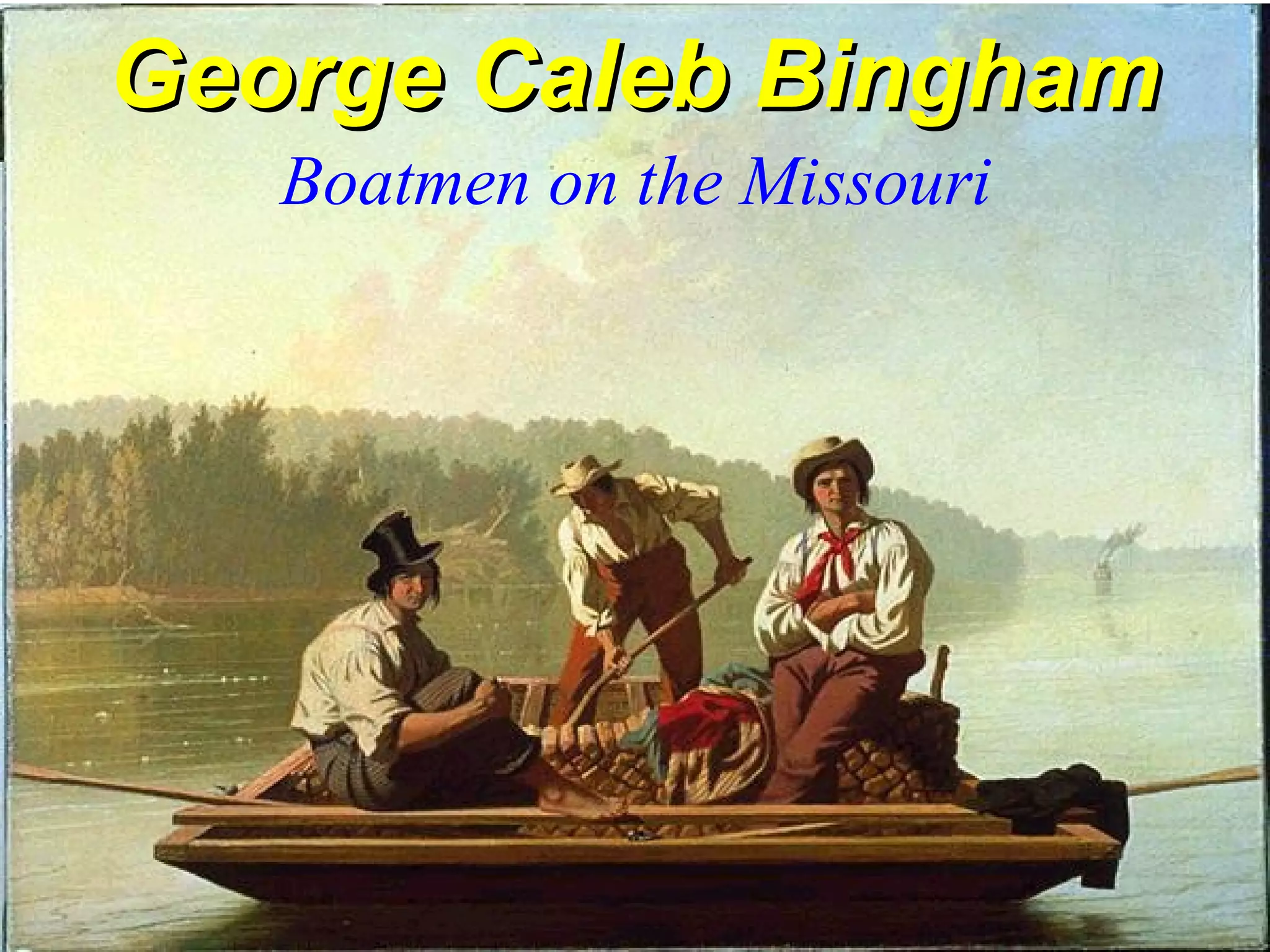
George Caleb BinghamGeorge Caleb Bingham
Boatmen on the Missouri
Fur Traders Descending on the Missouri
The Hudson River SchoolThe Hudson River School
by Thomas Cole
Demographic ChangesDemographic Changes
Population doubling
every 25 years
Population moving
farther west every 10
years
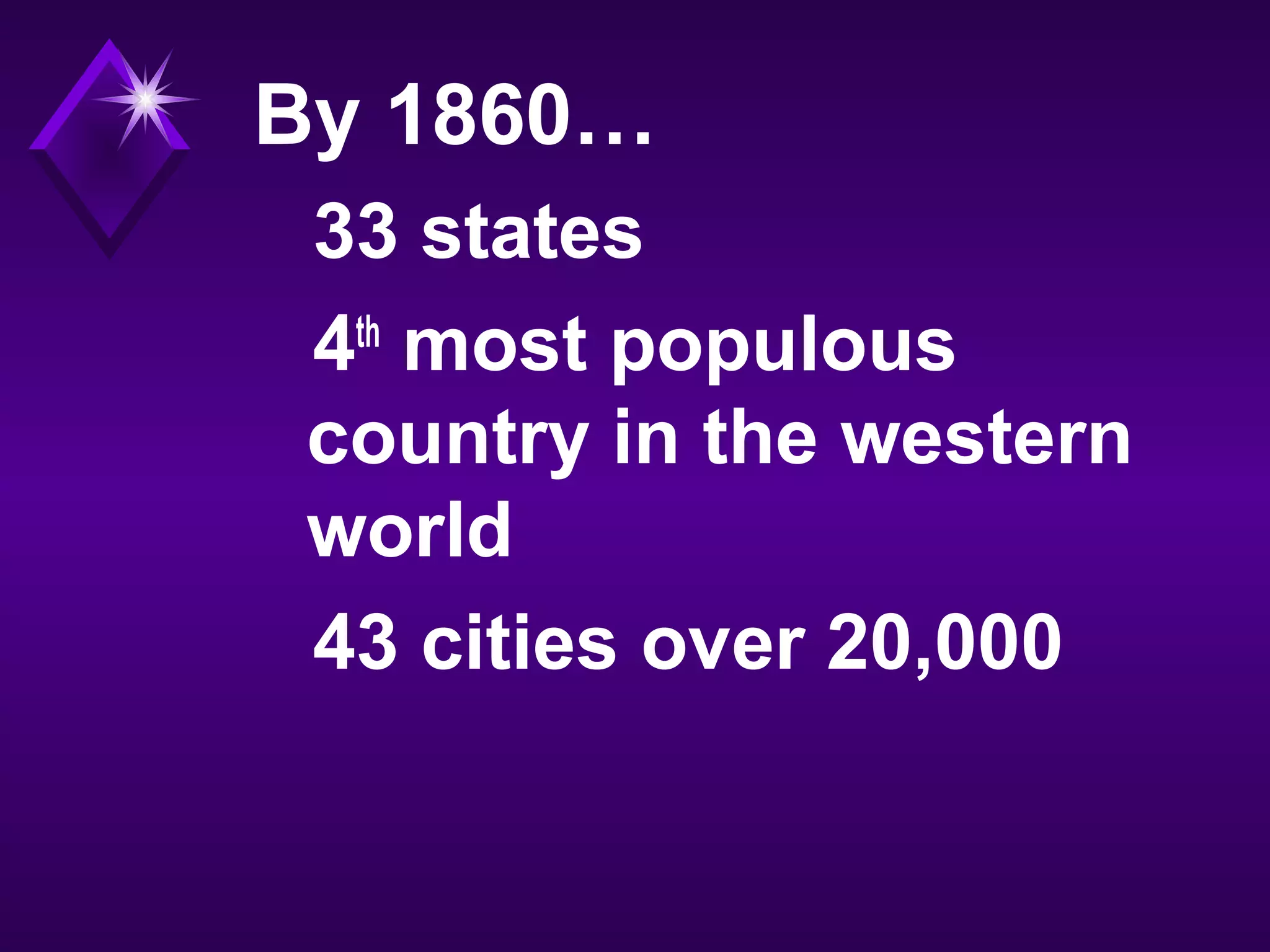
By 1860…
33 states
4th
most populous
country in the western
world
43 cities over 20,000
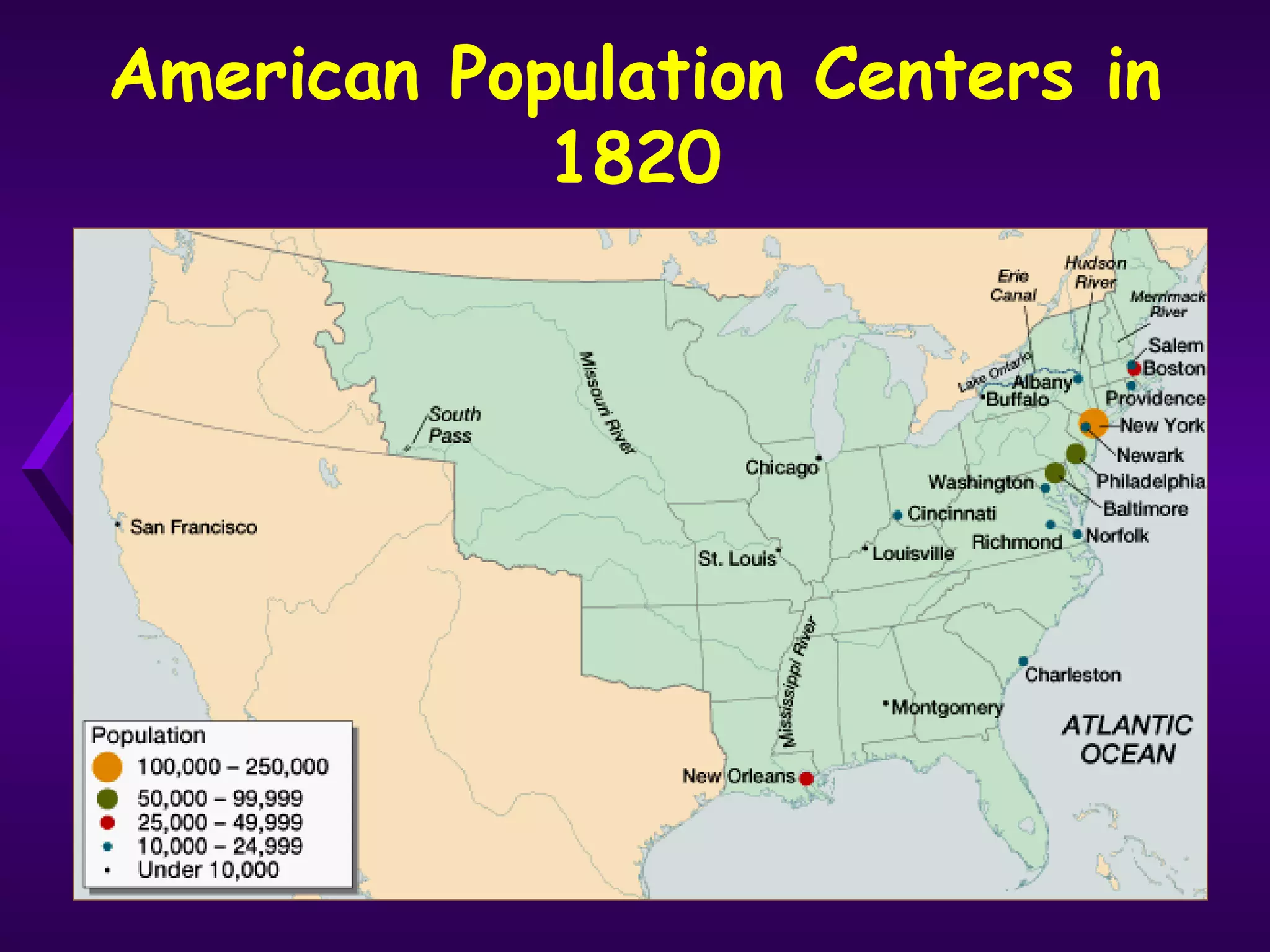
American Population Centers in
1820
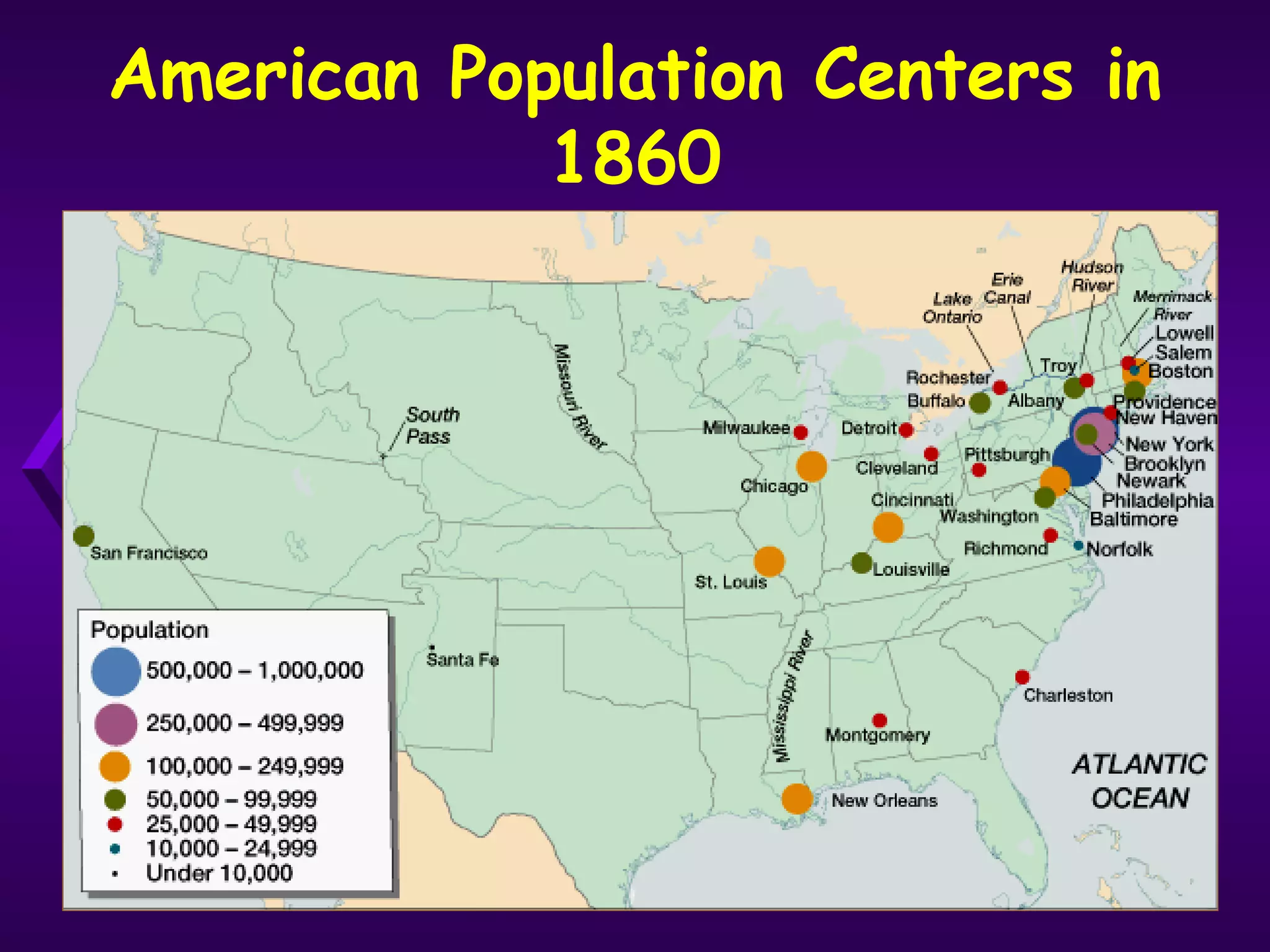
American Population Centers in
1860
Rapid urbanization led
to many problems
Slums, filth, & crime
Cities slowly began to
build water & sewer
services
Immigration tripled in
the 1840’s &
quadrupled in the
1850’s
Many push & pull
factors brought
immigrants to America
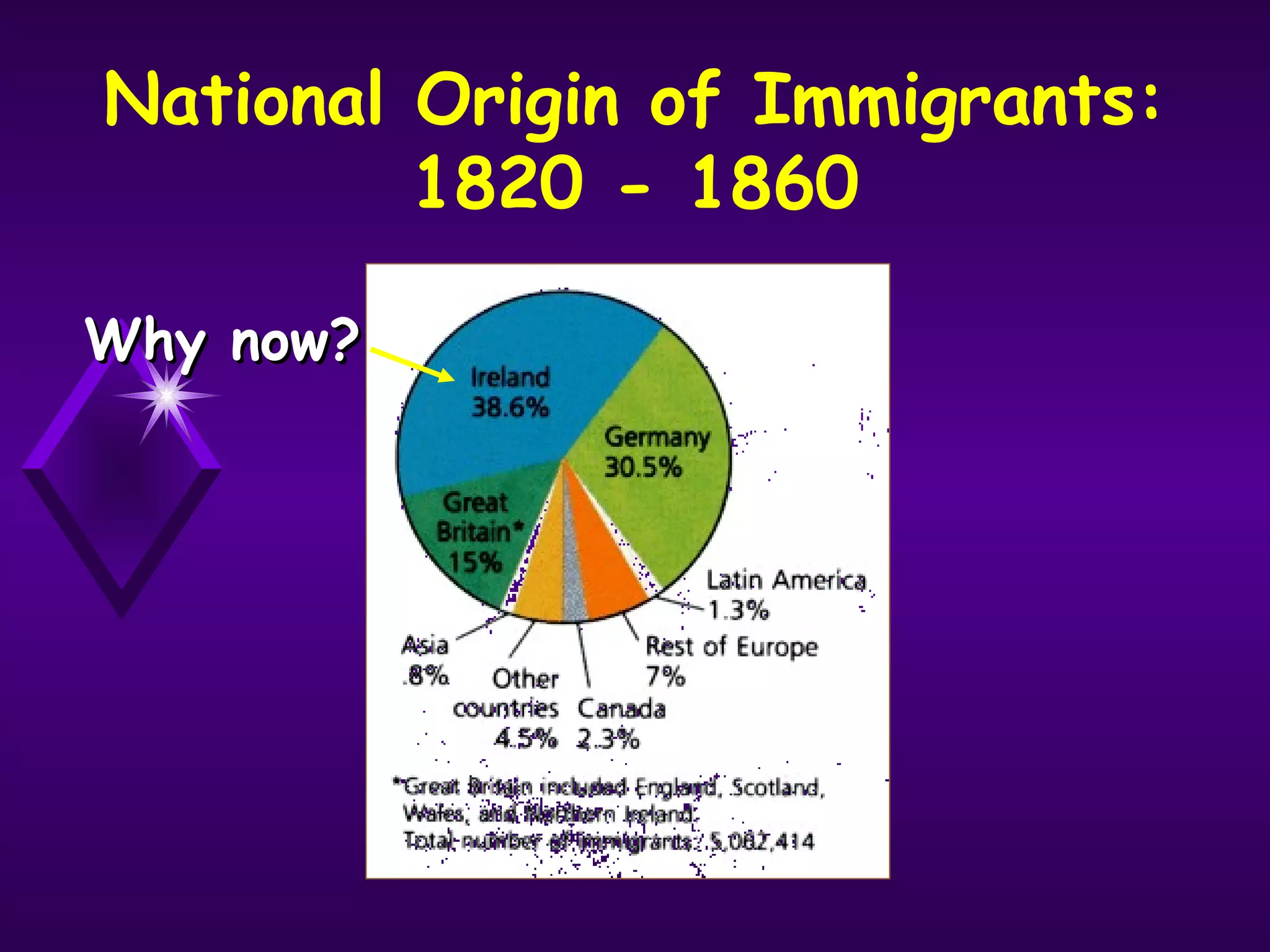
National Origin of Immigrants:
1820 - 1860
Why now?Why now?
Irish ImmigrantsIrish Immigrants
1844 – The Potato Famine
Potato blight in Ireland led
to famine & massive
emigration
1830-1860: Largest
immigrant group
2 million
Irish Catholics moved to
the large cities
New York & Boston
Anti-Irish prejudice
NINA: “No Irish Need
Apply”
Catholic & poor
Anti-Catholic riots in
Philadelphia & Boston
Black & Irish relations bad
Ancient Order of
Hibernians helped to get
better conditions
Irish votes gained power
Tammany Hall
Many became policemen
GermansGermans
1830-1860: 1.5 million
came to America
Middle class farmers &
political refugees
Moved to the Mid-West
Many isolationists
Most better educated
Often abolitionists
Kindergarten, beer, &
the hot dog
NativismNativism
“Hatred of foreigners”
Anti-Catholic prejudice
led to the creation of
Catholic parochial
schools
1849 - Order of the Star-
Spangled Banner formed
Led to the creation of the
American Party
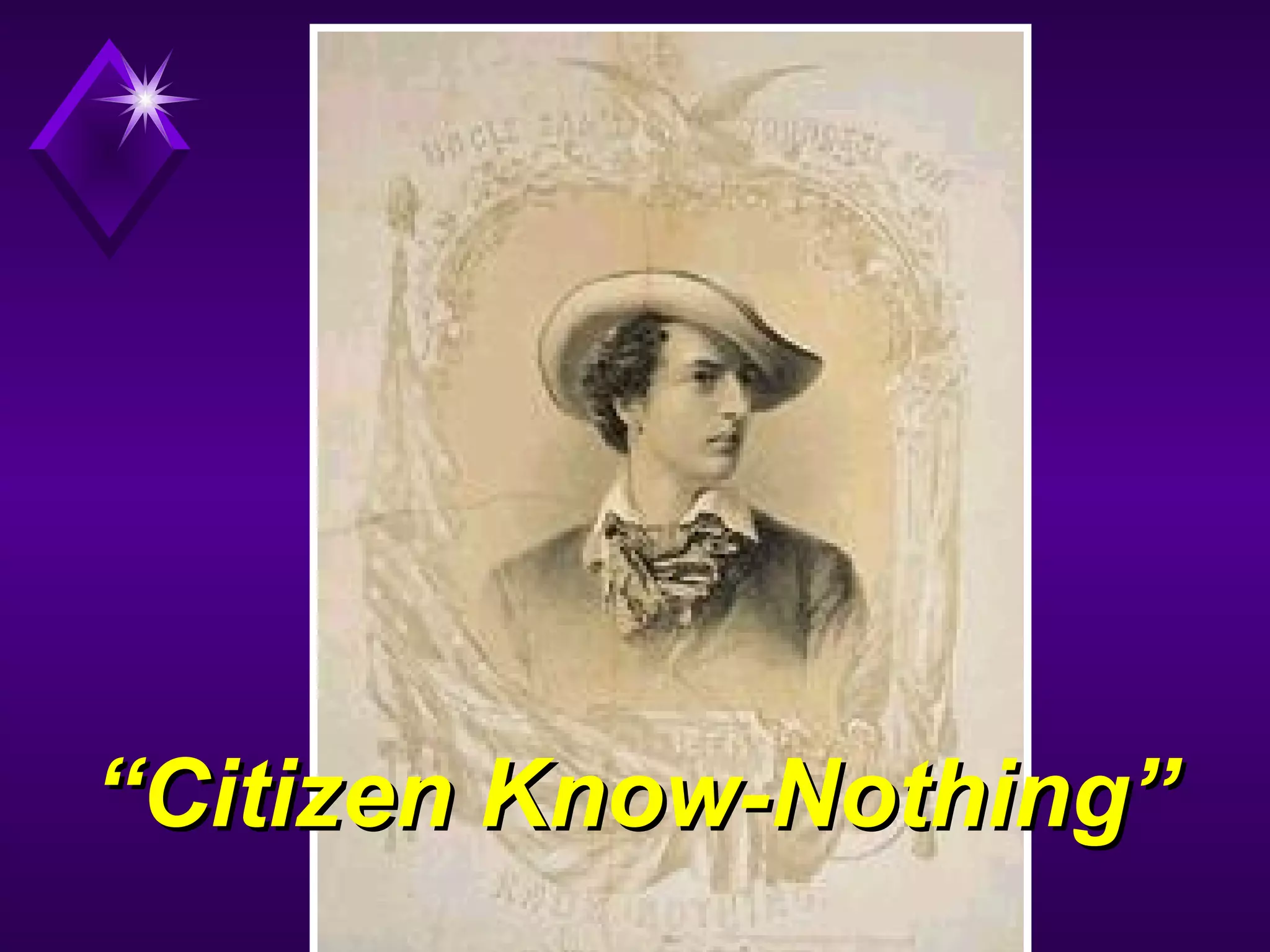
“Know-Nothings”
Wanted immigration &
naturalization restrictions
““Citizen Know-Nothing”Citizen Know-Nothing”
The IndustrialThe Industrial
RevolutionRevolution
1750 – Industrial
Revolution begins in
Britain
Slow to arrive in America
because:
Land cheap
Labor scarce
Capital investment not
plentiful
Raw materials
undiscovered
Consumers scarce
Long established British
factories more competitive
Britain had a monopoly on
textile machinery
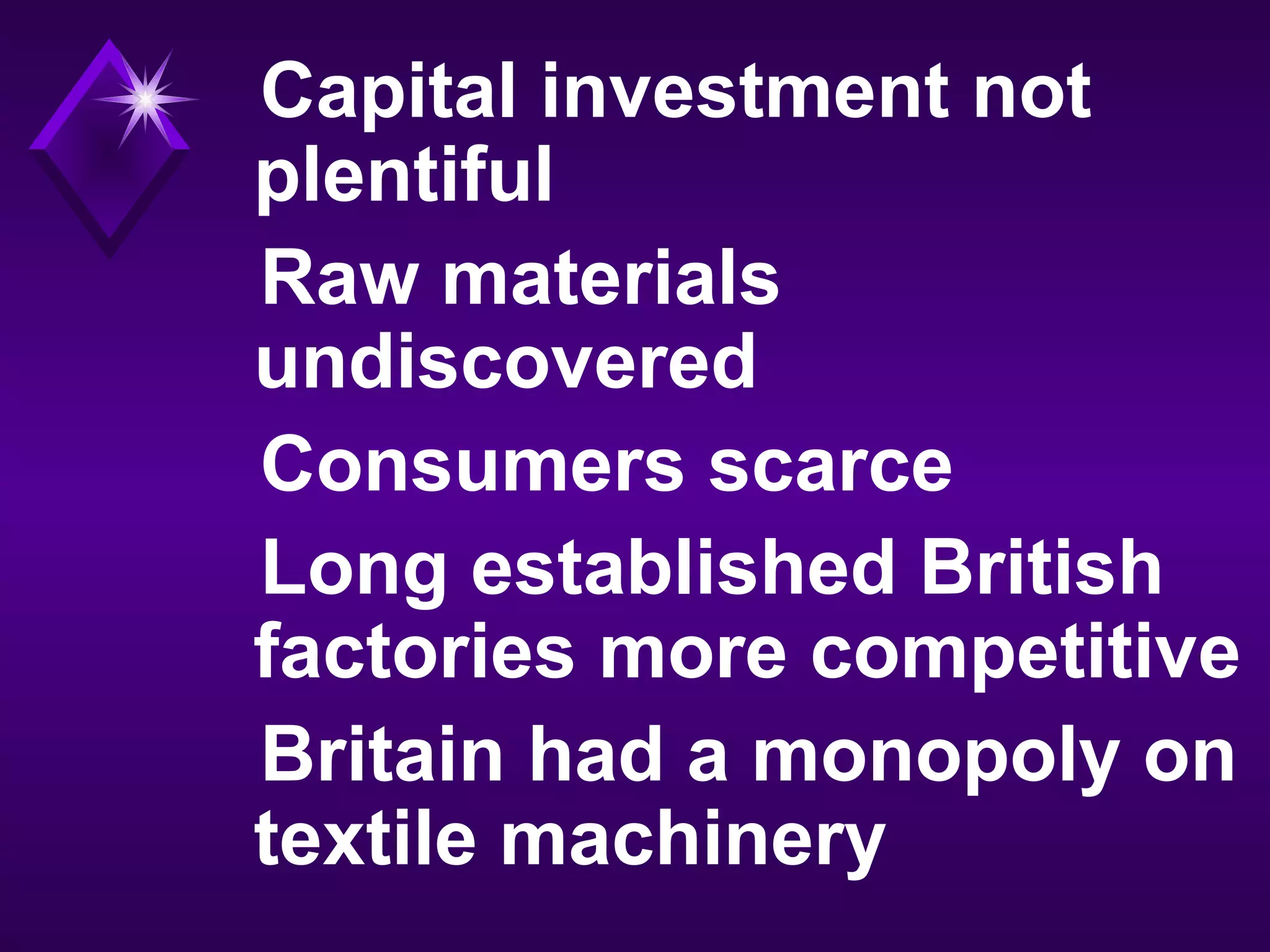
Samuel Slater (1791)
“Father of the
American Factory
System”
Built first U.S.
factory - a Textile
mill in Rhode Island
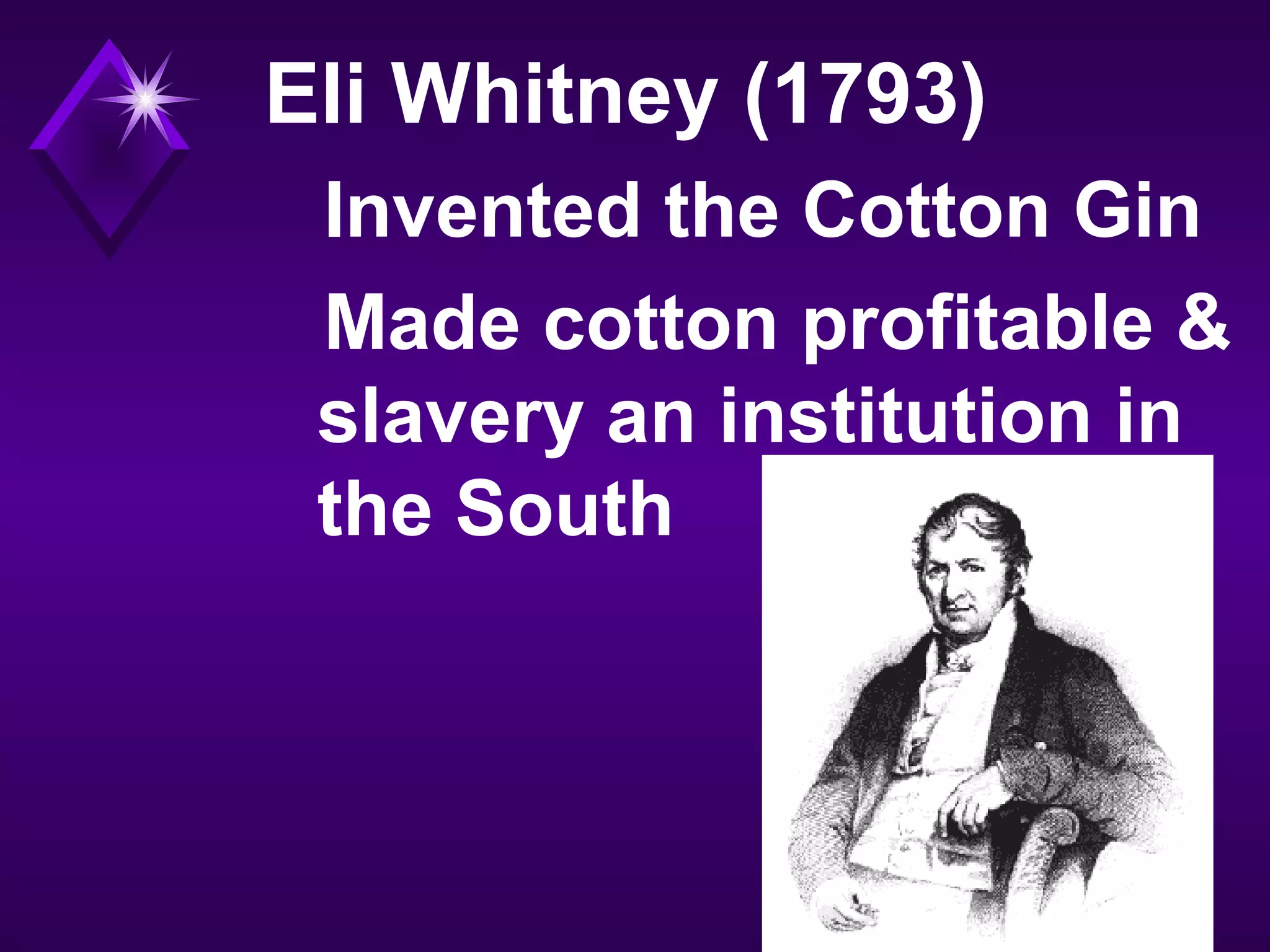
Eli Whitney (1793)
Invented the Cotton Gin
Made cotton profitable &
slavery an institution in
the South
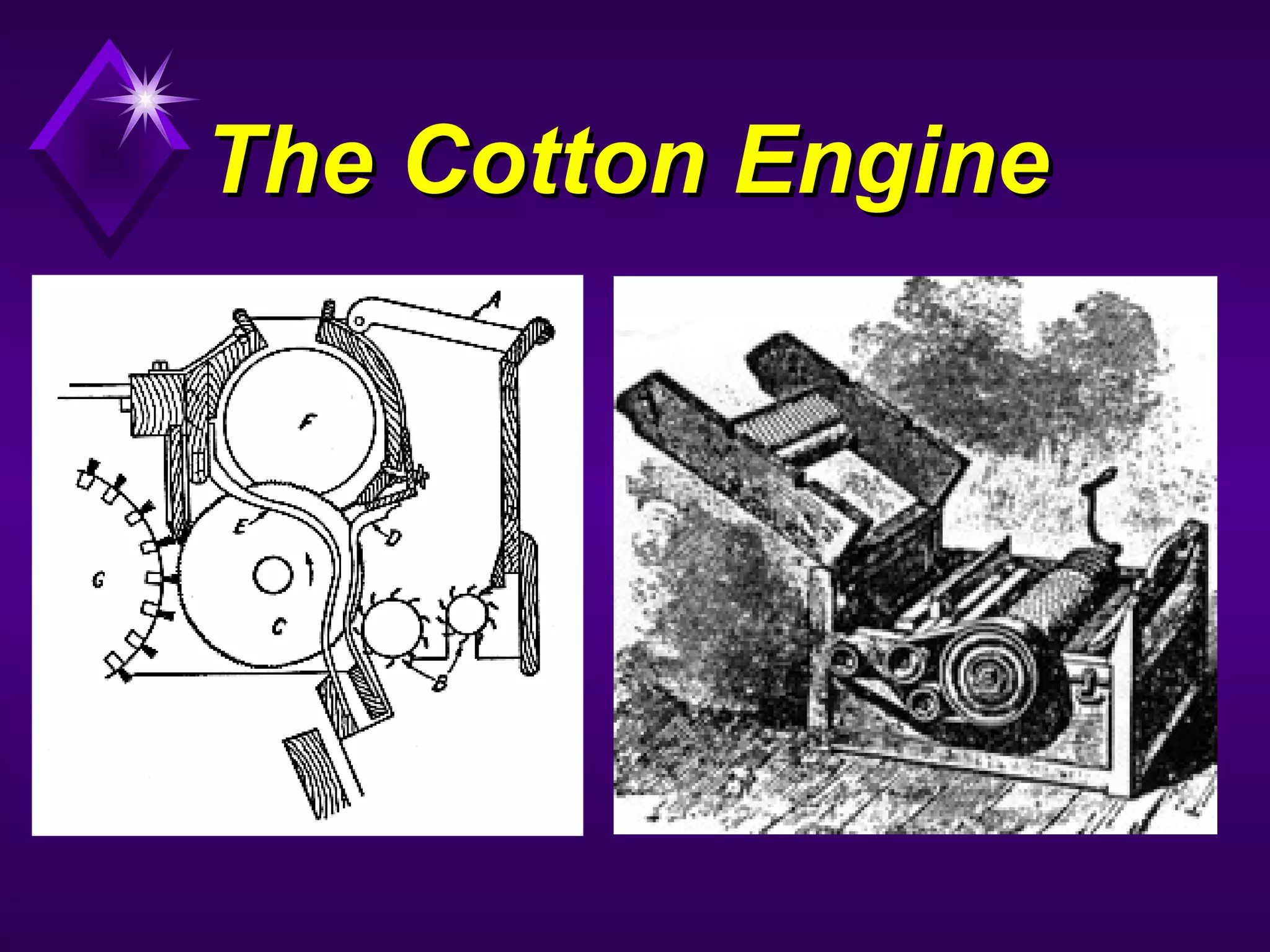
The Cotton EngineThe Cotton Engine
1798 – Whitney later
develops the idea of
interchangeable parts
which leads to mass
production
Rise of nationalism
increased the call to
“buy American”
Embargo, Non-
Intercourse, & the War of
1812 increased need for
American made goods
Treaty of Ghent
Britain began dumping its
products into America
Led to many US mills
closing down
US reacts with the Tariff
of 1816 & beginnings of
protectionism
1814 – 1st
Spinning-
Weaving cloth factory
built in Waltham, Mass.
Manufacturing goes from
home to factory
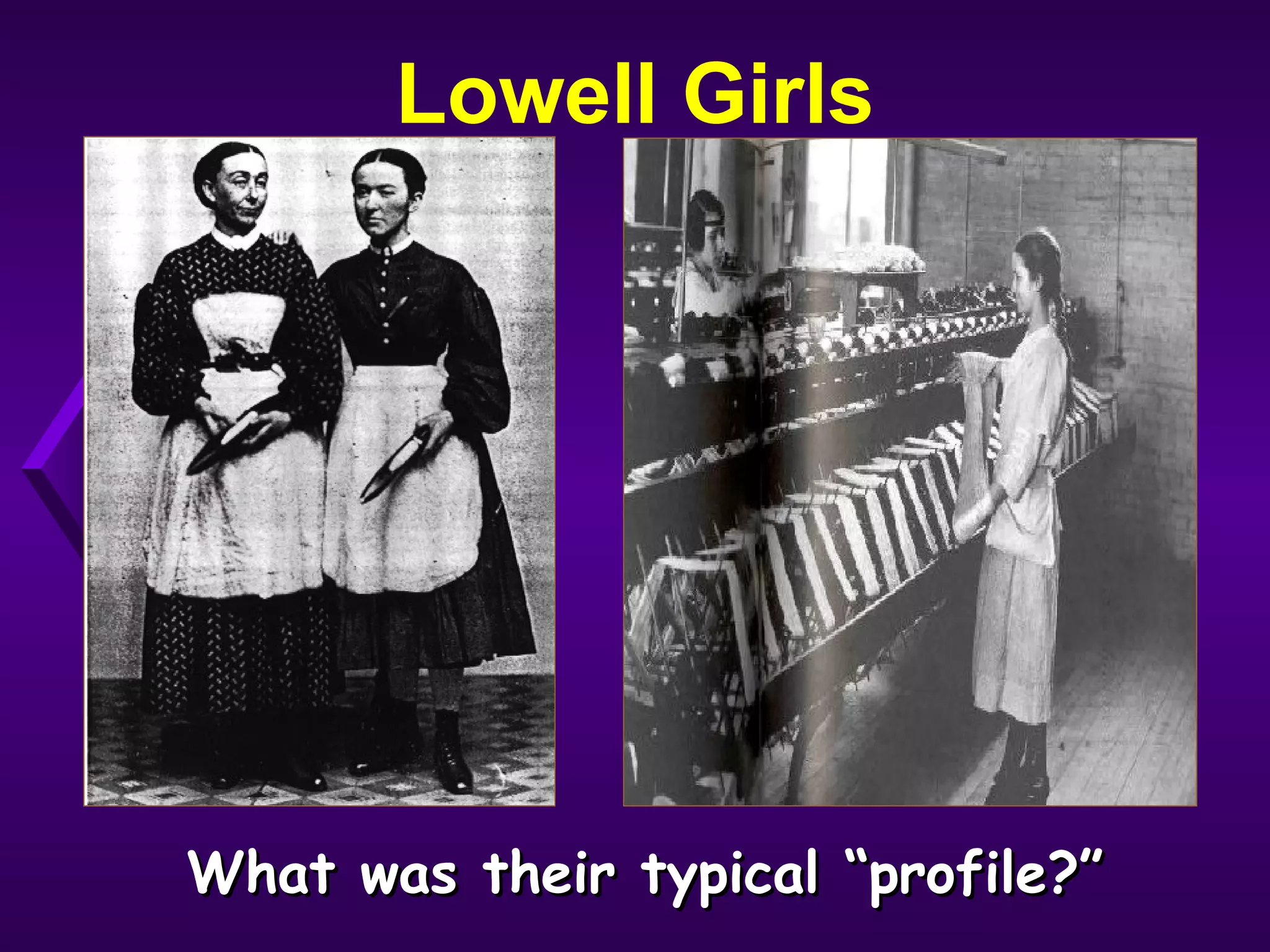
Lowell Girls
Boston Associates
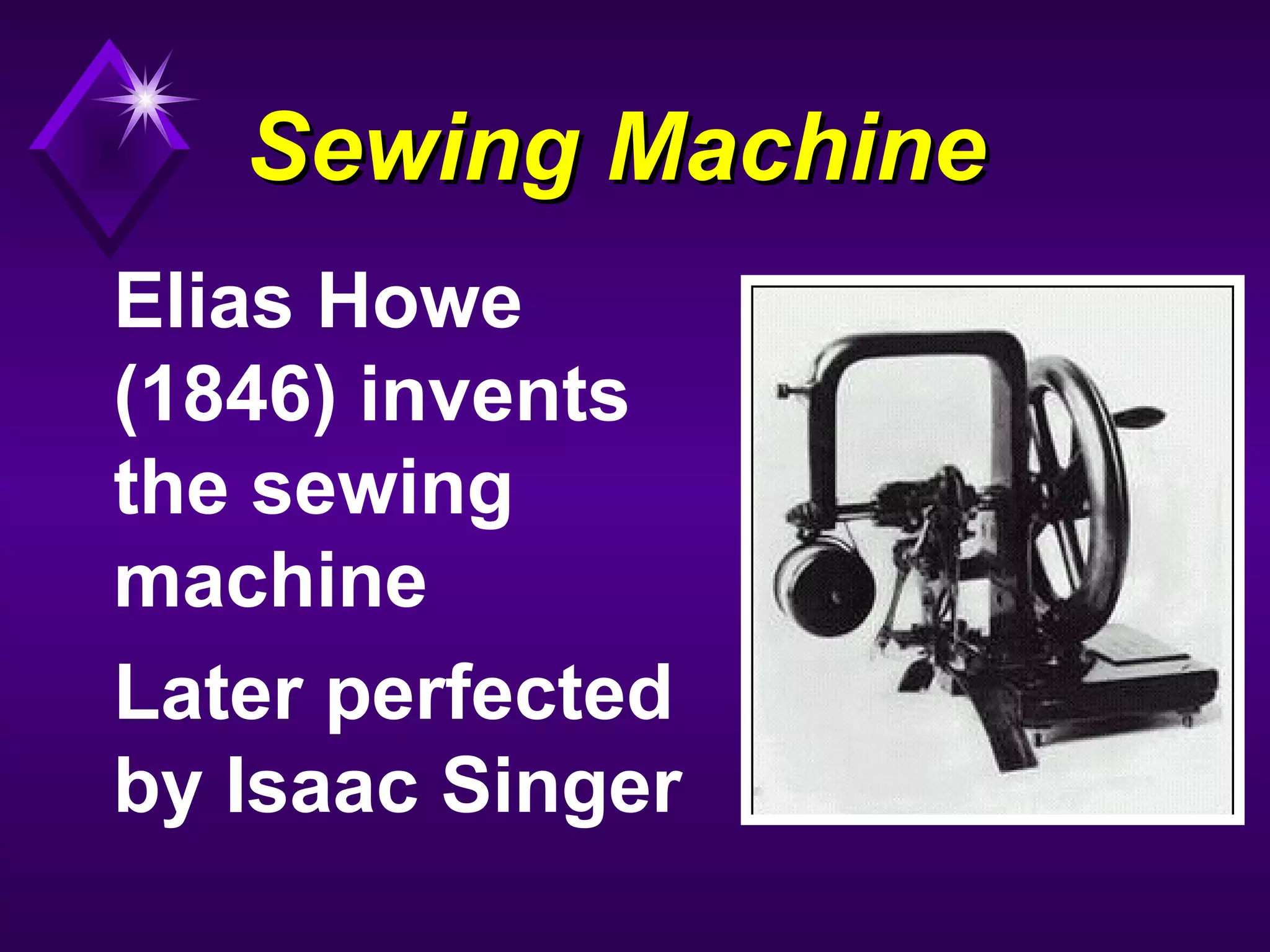
Sewing MachineSewing Machine
Elias Howe
(1846) invents
the sewing
machine
Later perfected
by Isaac Singer
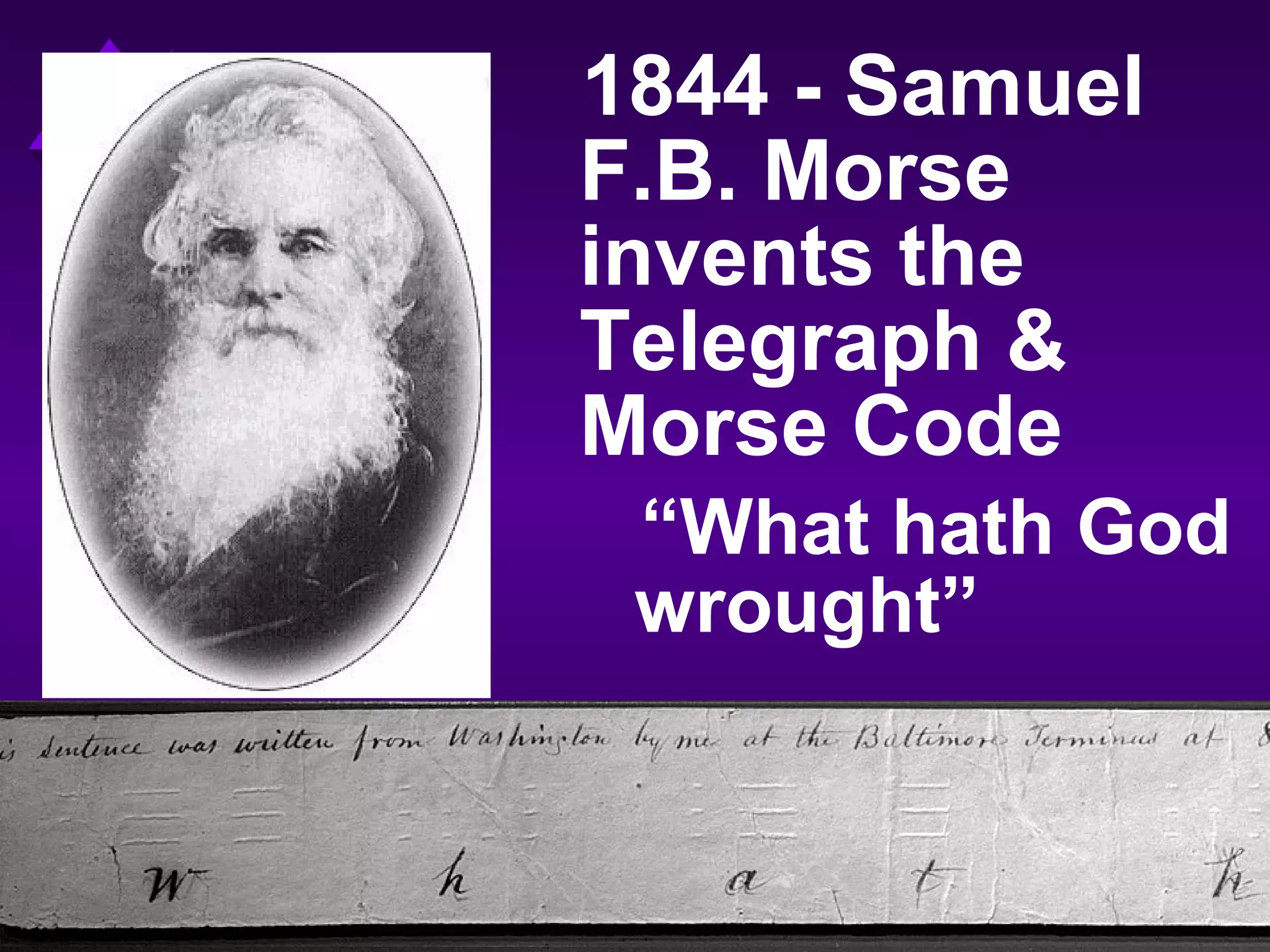
1844 - Samuel
F.B. Morse
invents the
Telegraph &
Morse Code
“What hath God
wrought”
The Single CurrentThe Single Current
Morse KeyMorse Key
Why New England?Why New England?
Poor, rocky soil
Dense population
Shipping & seaports made
importing raw materials
practical
Water power from rivers
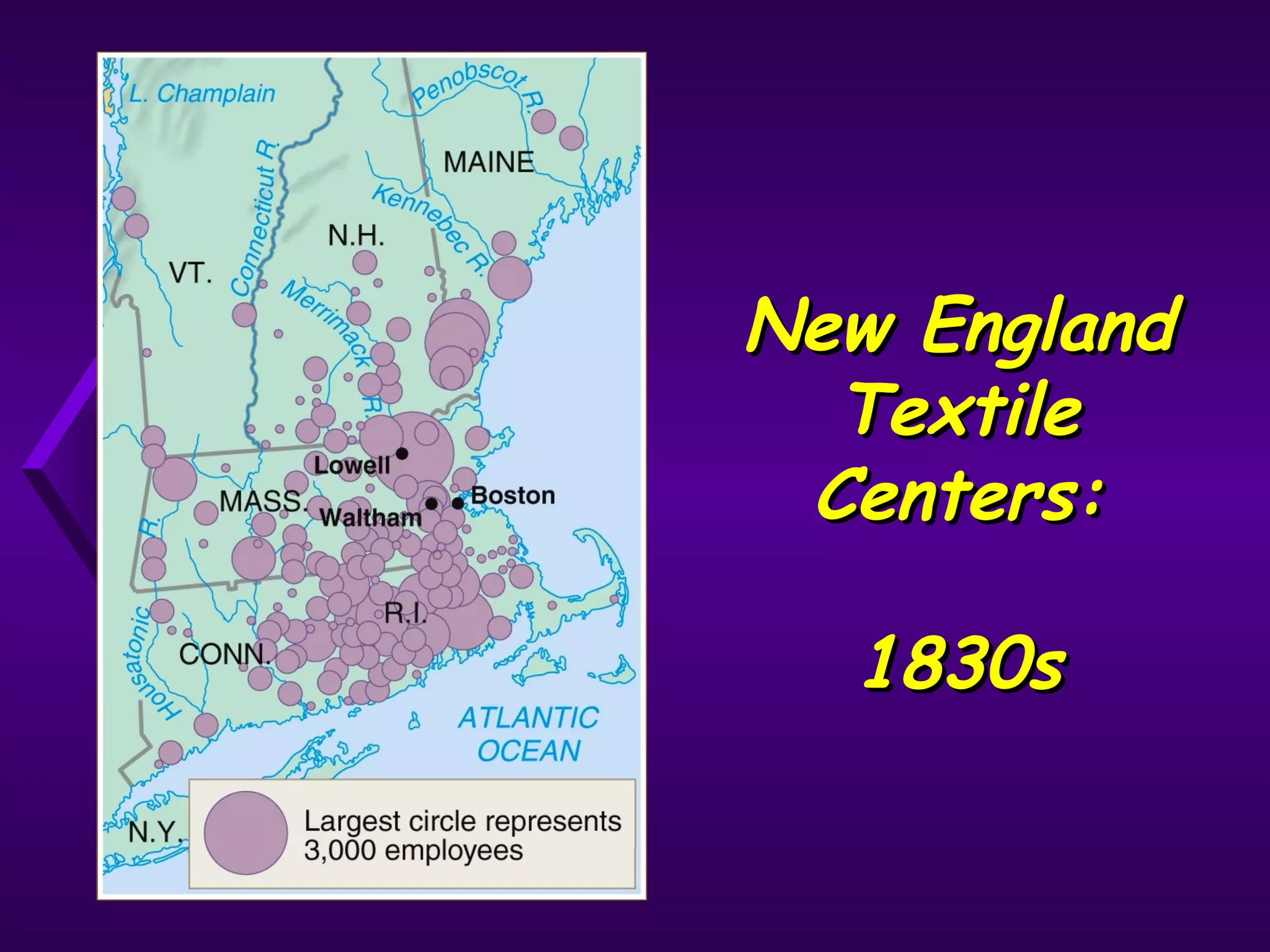
New EnglandNew England
TextileTextile
Centers:Centers:
1830s1830s
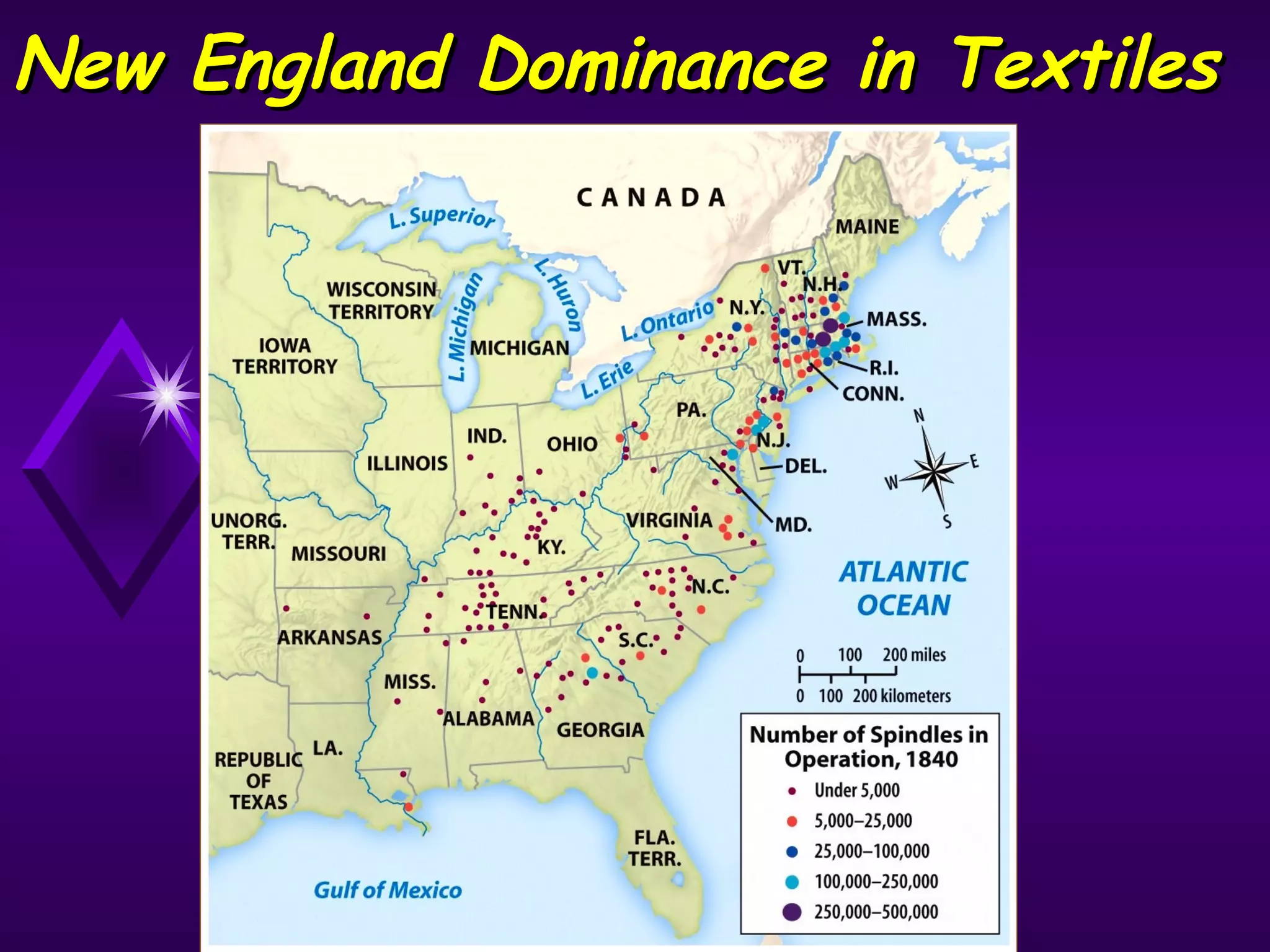
New England Dominance in TextilesNew England Dominance in Textiles
CorporationsCorporations
“Limited Liability”
More people risk capital
1848 – 1st
General
Incorporation Law in NY
Creating a corporation
became easier
Creating a Business-Friendly ClimateCreating a Business-Friendly Climate
Supreme Court Rulings:Supreme Court Rulings:
** Fletcher v. PeckFletcher v. Peck (1810)(1810)
** Dartmouth v. WoodwardDartmouth v. Woodward (1819)(1819)
** McCulloch v. MarylandMcCulloch v. Maryland (1819)(1819)
** Gibbons v. OgdenGibbons v. Ogden (1824)(1824)
** Charles Rivers Bridge v. WarrenCharles Rivers Bridge v. Warren
BridgeBridge (1835)(1835)
General Incorporation LawGeneral Incorporation Law  passed inpassed in
New York,New York,
1848.1848.
Laissez faireLaissez faire  BUT, govt. did much toBUT, govt. did much to
assist capitalism!assist capitalism!
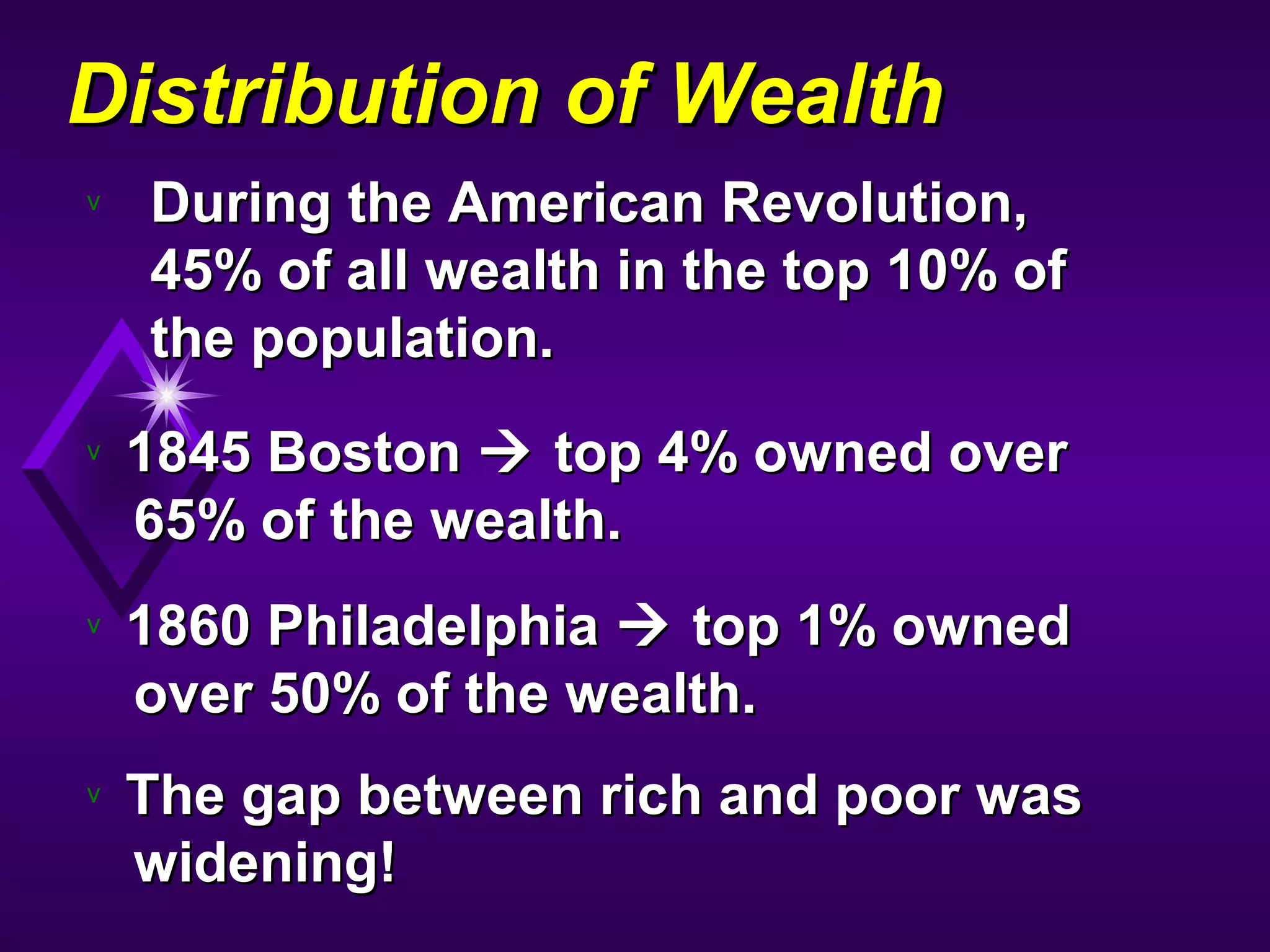
Distribution of WealthDistribution of Wealth
v During the American Revolution,During the American Revolution,
45% of all wealth in the top 10% of45% of all wealth in the top 10% of
the population.the population.
v 1845 Boston1845 Boston  top 4% owned overtop 4% owned over
65% of the wealth.65% of the wealth.
v 1860 Philadelphia1860 Philadelphia  top 1% ownedtop 1% owned
over 50% of the wealth.over 50% of the wealth.
v The gap between rich and poor wasThe gap between rich and poor was
widening!widening!
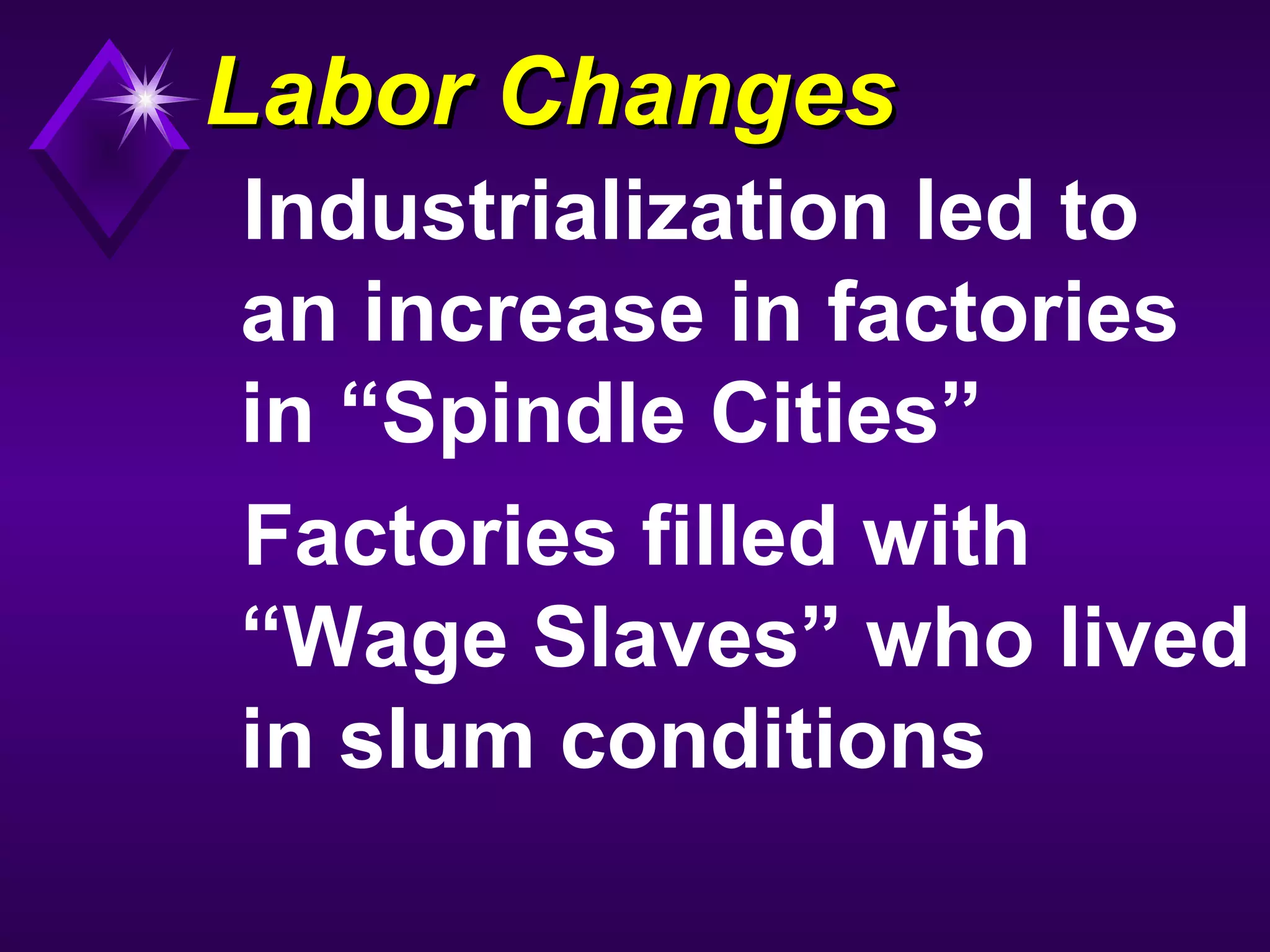
Labor ChangesLabor Changes
Industrialization led to
an increase in factories
in “Spindle Cities”
Factories filled with
“Wage Slaves” who lived
in slum conditions
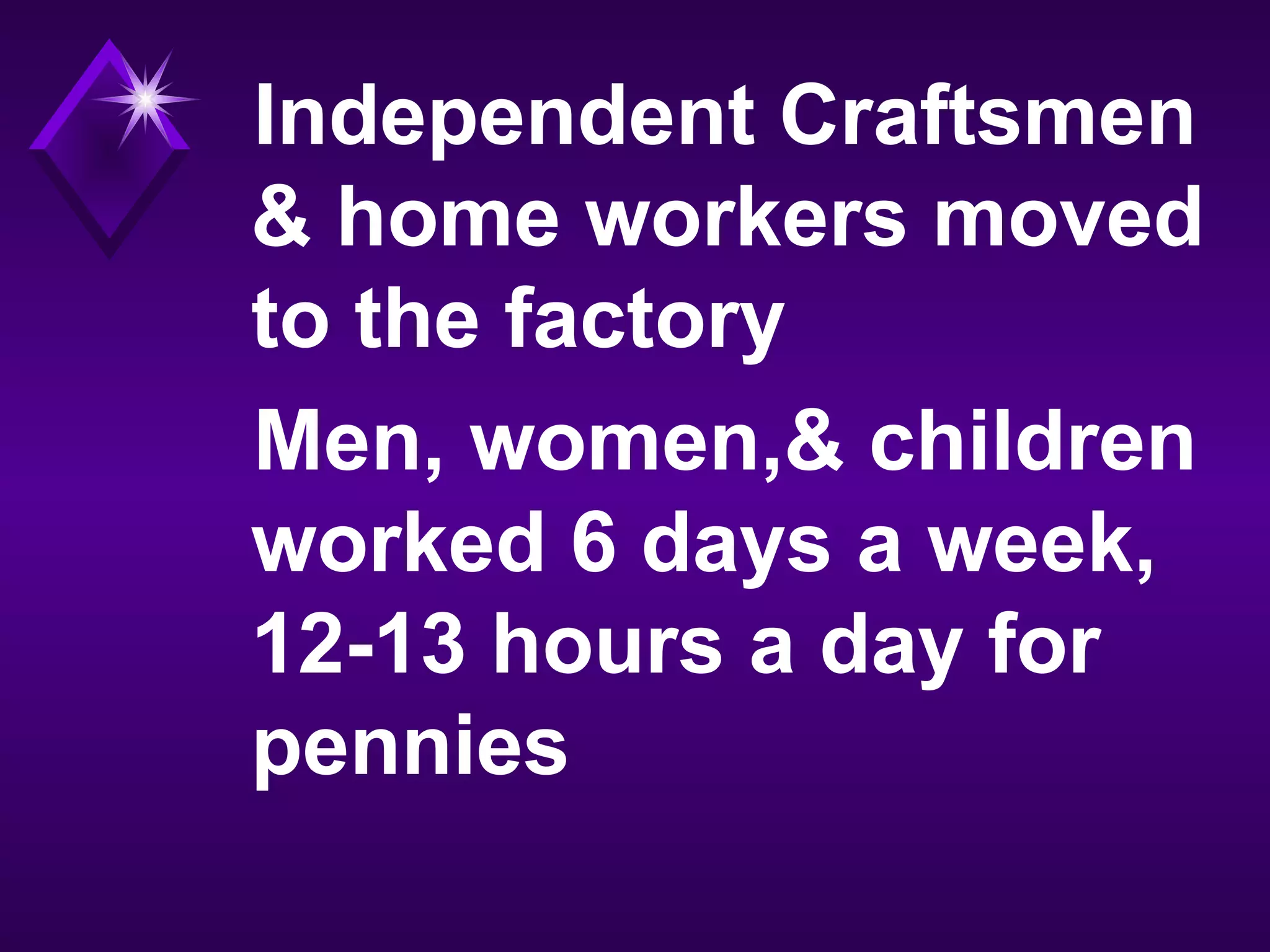
Independent Craftsmen
& home workers moved
to the factory
Men, women,& children
worked 6 days a week,
12-13 hours a day for
pennies
Labor Unions forbidden
by law
Strikes uncommon
before 1830’s
1830’s & 1840’s saw
increase in labor Unions
& Trade organization for
higher wages & the 10-
hour day
1840 - President Van
Buren establishes the
10-hour day for
federal employees
Commonwealth v.
Hunt (1842)
declares labor unions
legal
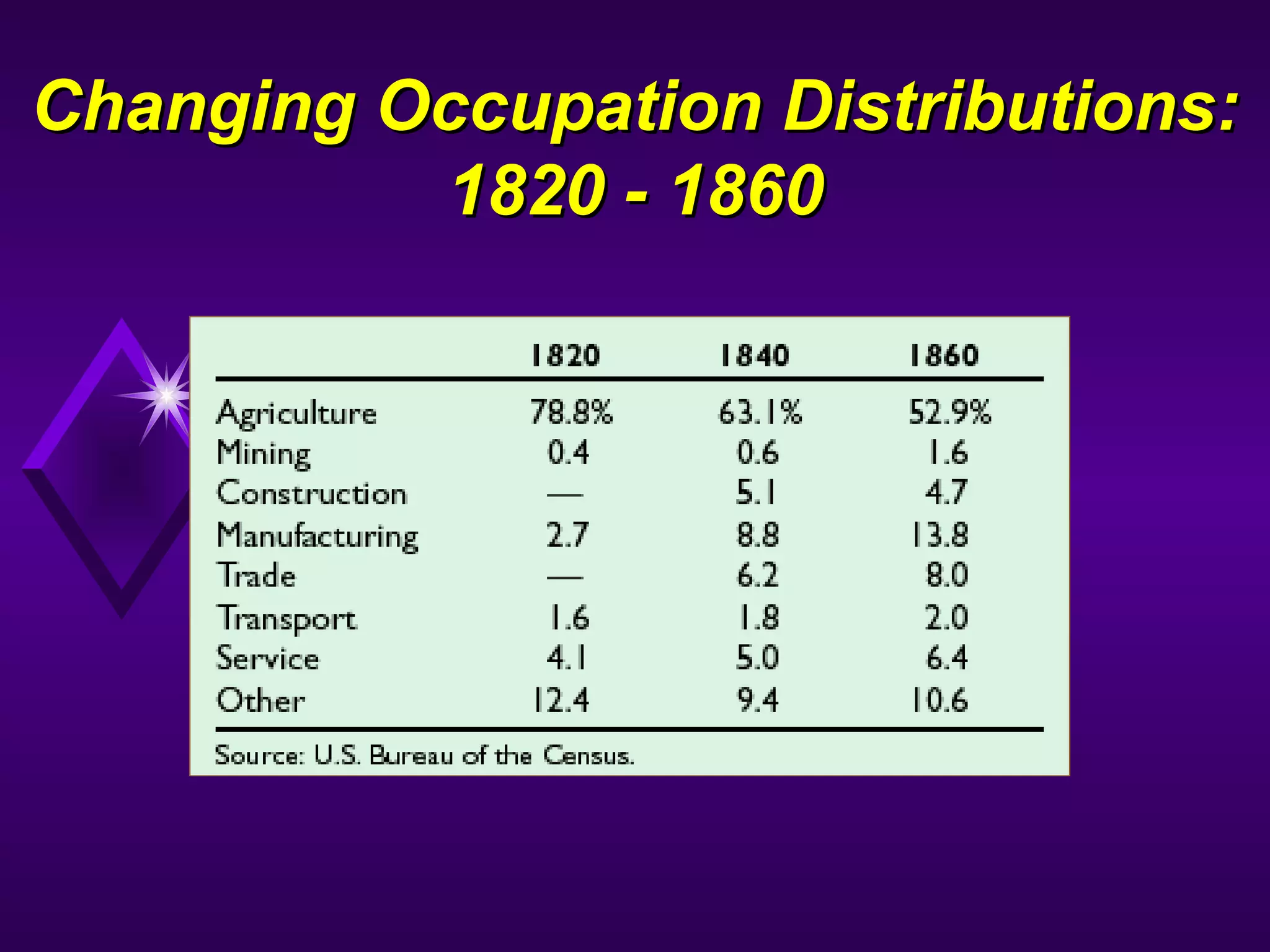
Changing Occupation Distributions:Changing Occupation Distributions:
1820 - 18601820 - 1860
Women in the WorkforceWomen in the Workforce
Lowell factory system
in Mass. considered to
be a showcase
Factory girls lived &
worked under
supervision
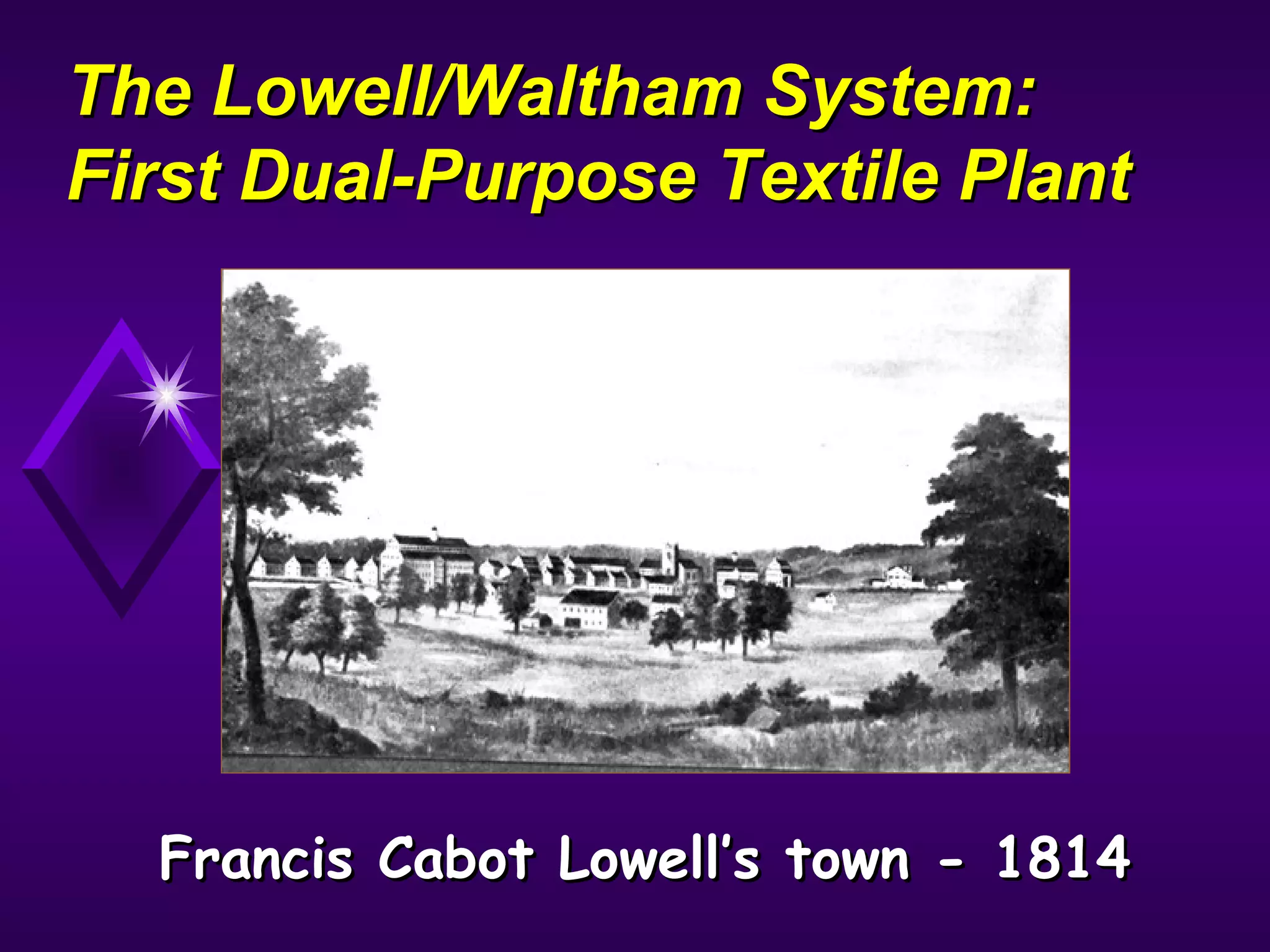
The Lowell/Waltham System:The Lowell/Waltham System:
First Dual-Purpose Textile PlantFirst Dual-Purpose Textile Plant
Francis Cabot Lowell’s town - 1814Francis Cabot Lowell’s town - 1814
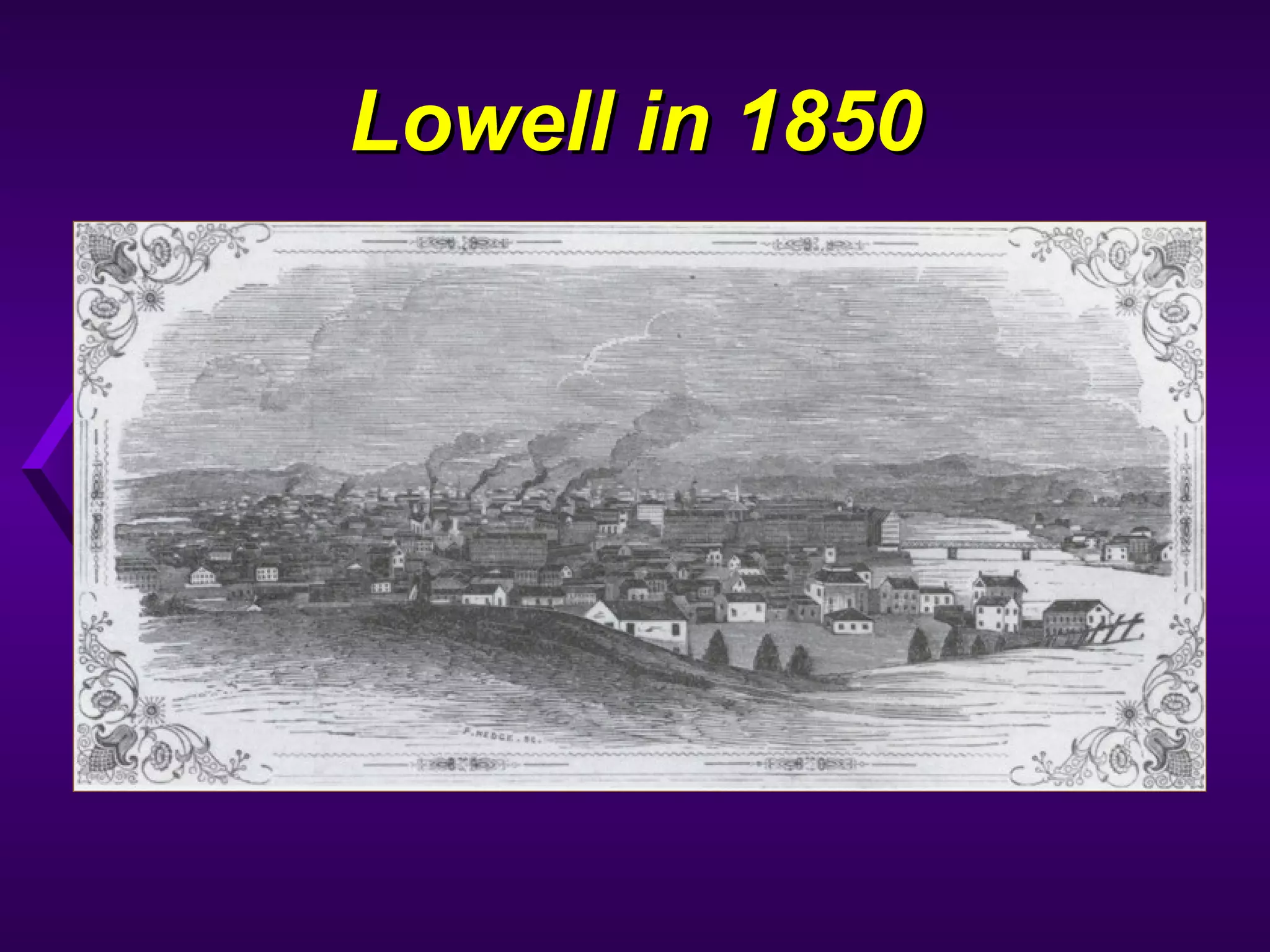
Lowell in 1850Lowell in 1850
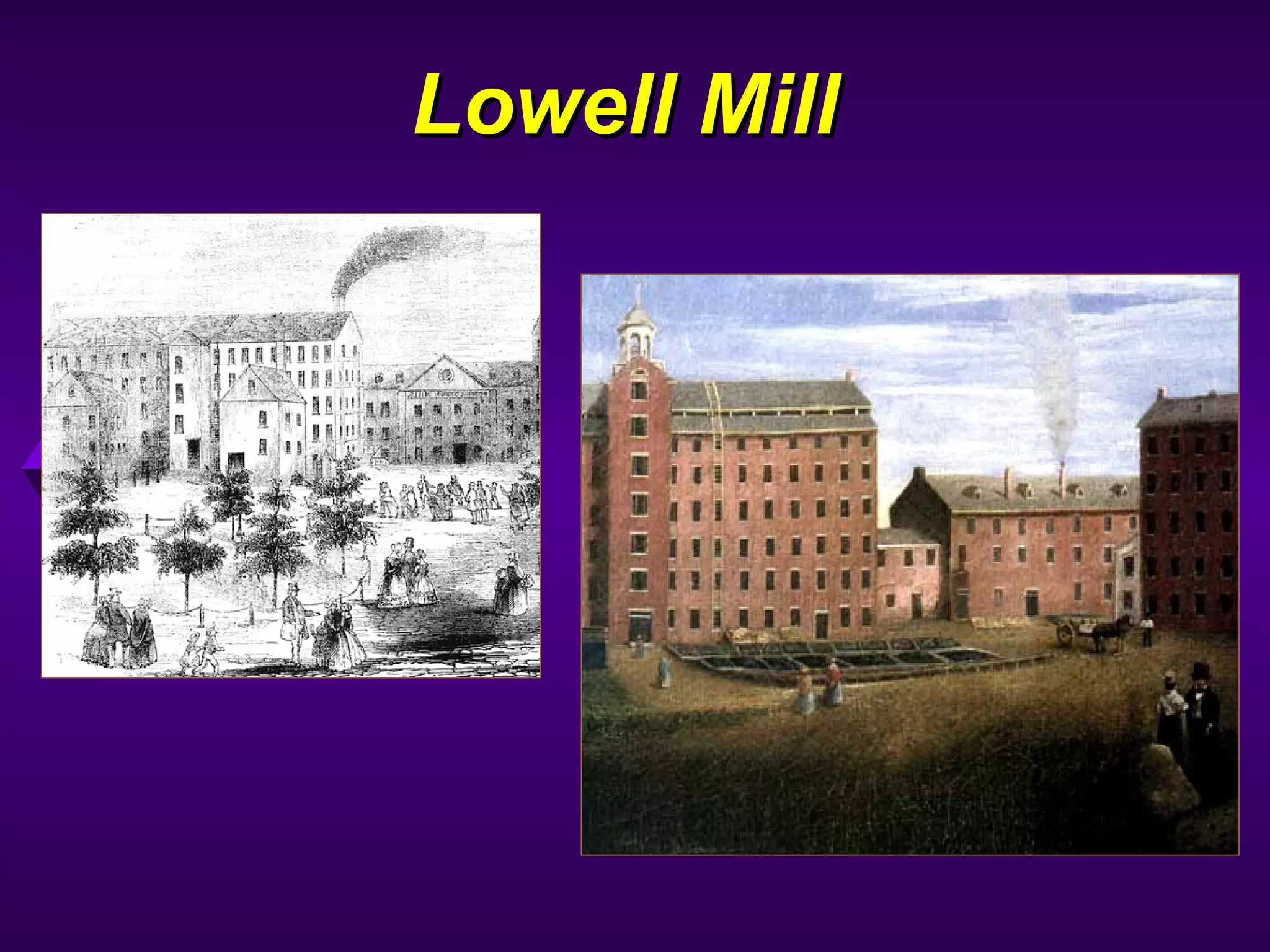
Lowell MillLowell Mill
Lowell Girls
What was their typical “profile?”What was their typical “profile?”
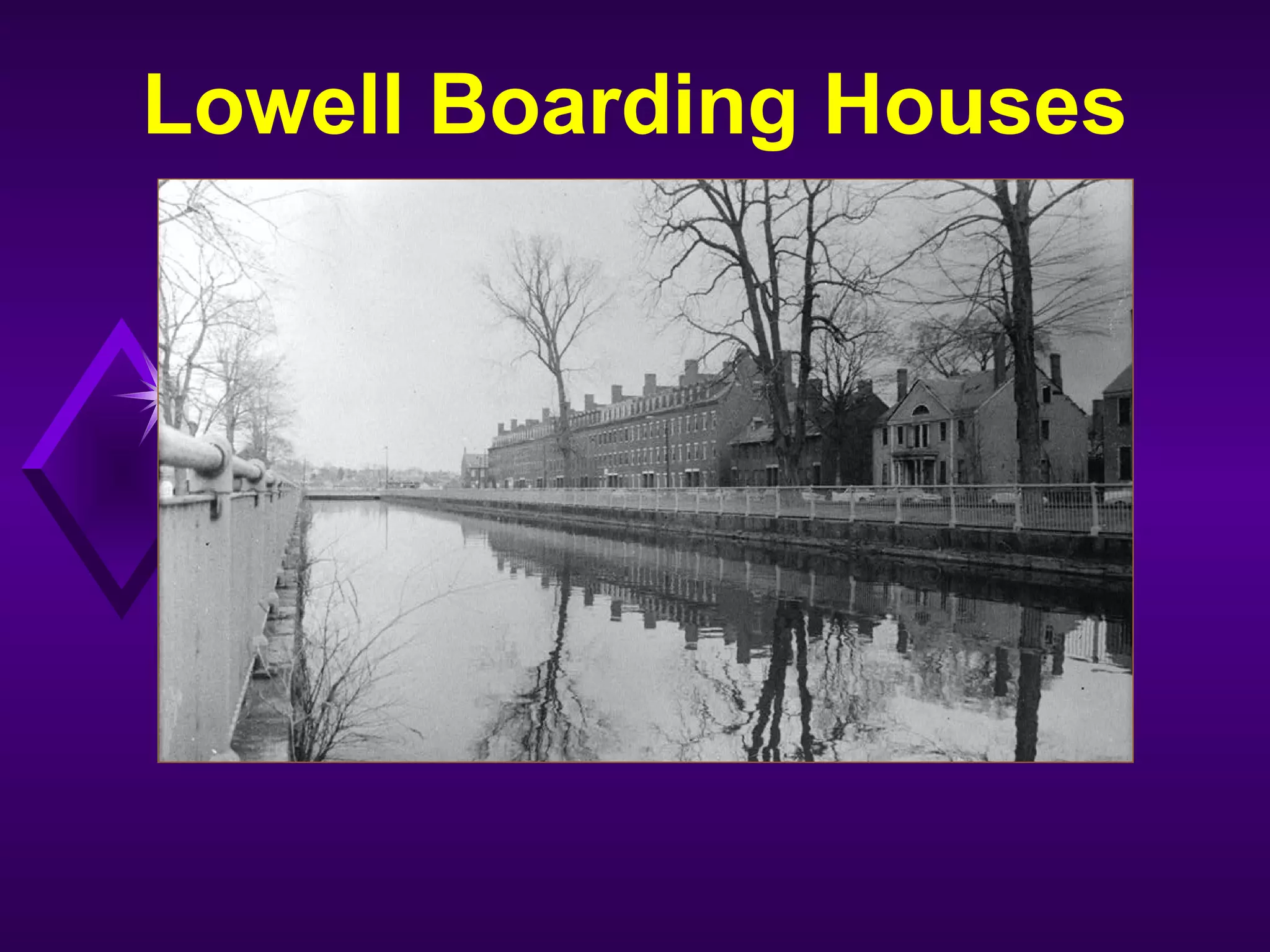
Lowell Boarding Houses
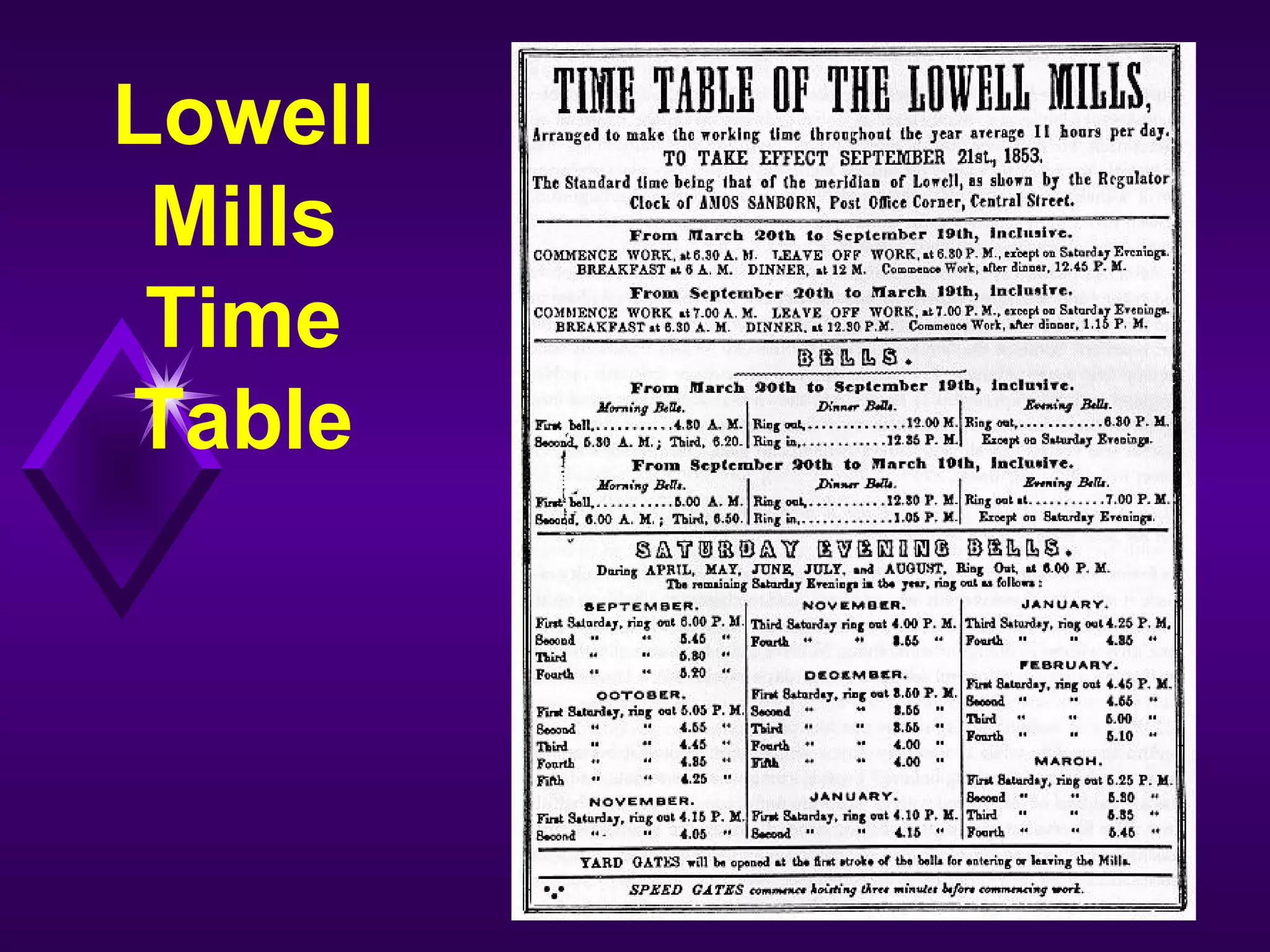
Lowell
Mills
Time
Table
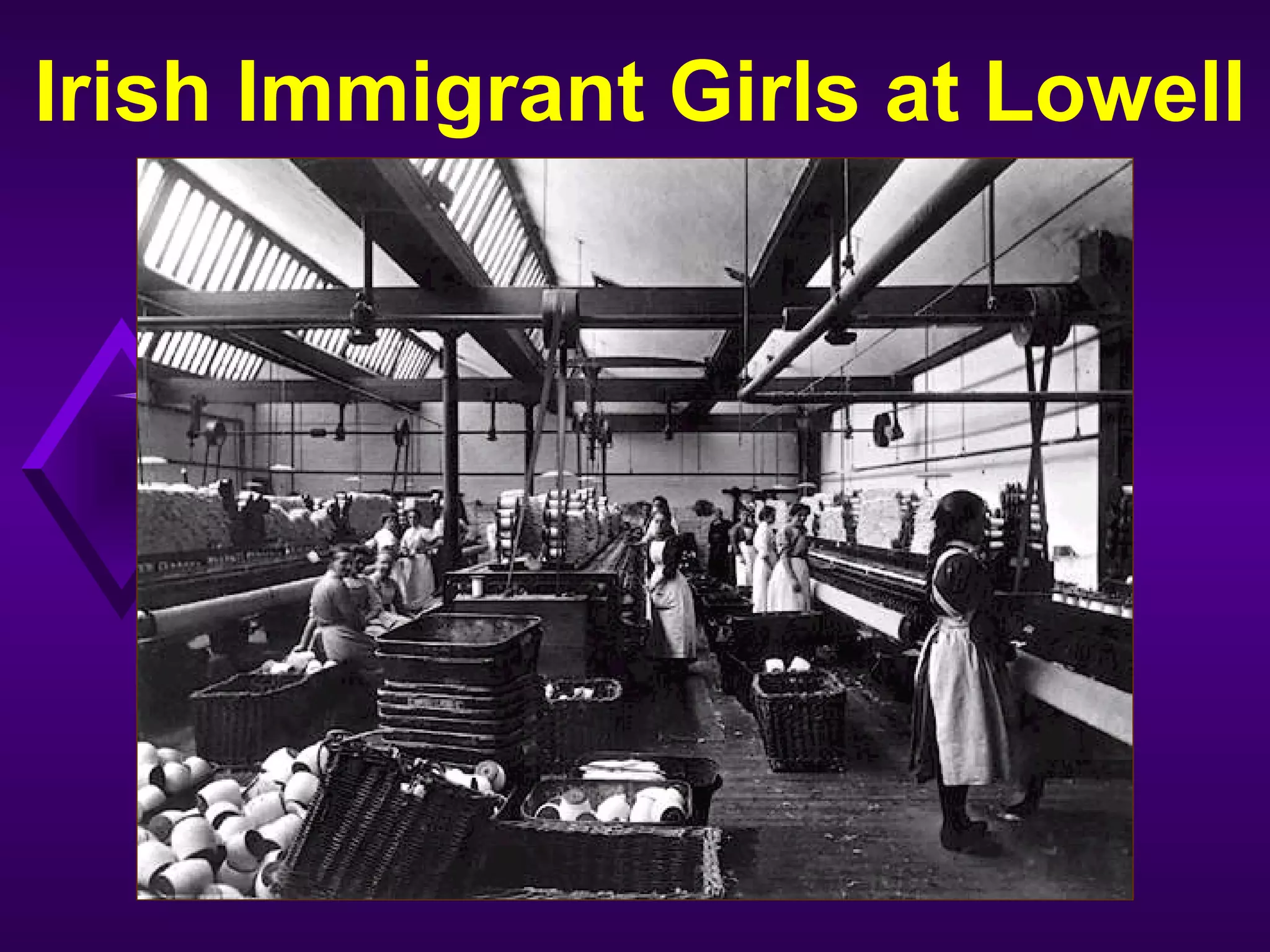
Irish Immigrant Girls at Lowell
Role of Women
“the submerged sex”
Considered perpetual
minors & under the
control of father or
husband
Few jobs available for
women
factory, nurse, & teacher
Catherine Beecher
encouraged women to
become teachers & the
occupation became
“feminized”
Women also found work
as domestics &
nursemaids
“The Cult of Domesticity”
Glorified traditional roles
of women
Gave women immense
moral power over the
family & society
FamiliesFamilies
Families became smaller
Marriage for love not
arrangement
Fertility rates dropped
Rise of “domestic
feminism”
Became more “child
centered”
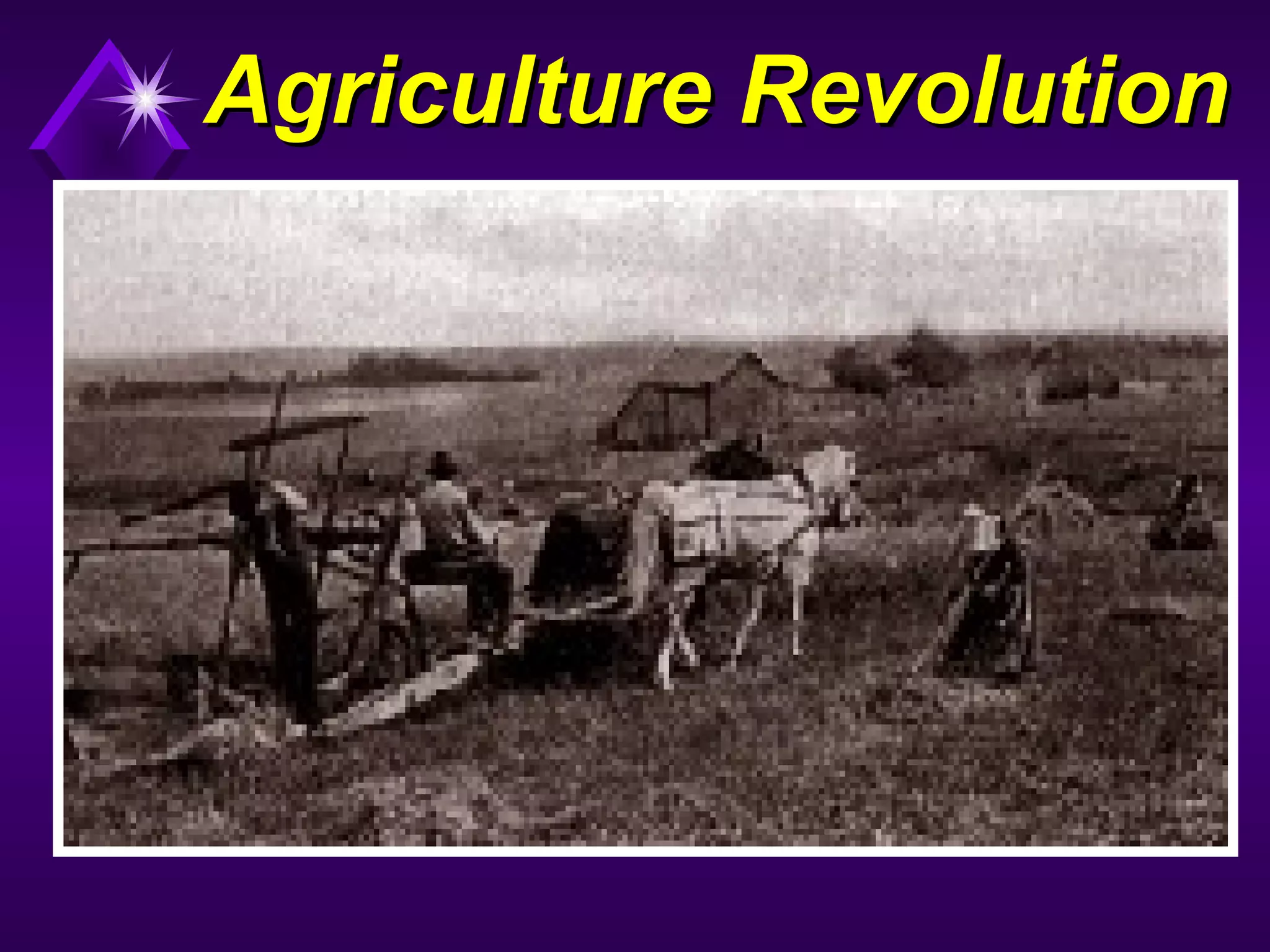
Agriculture RevolutionAgriculture Revolution
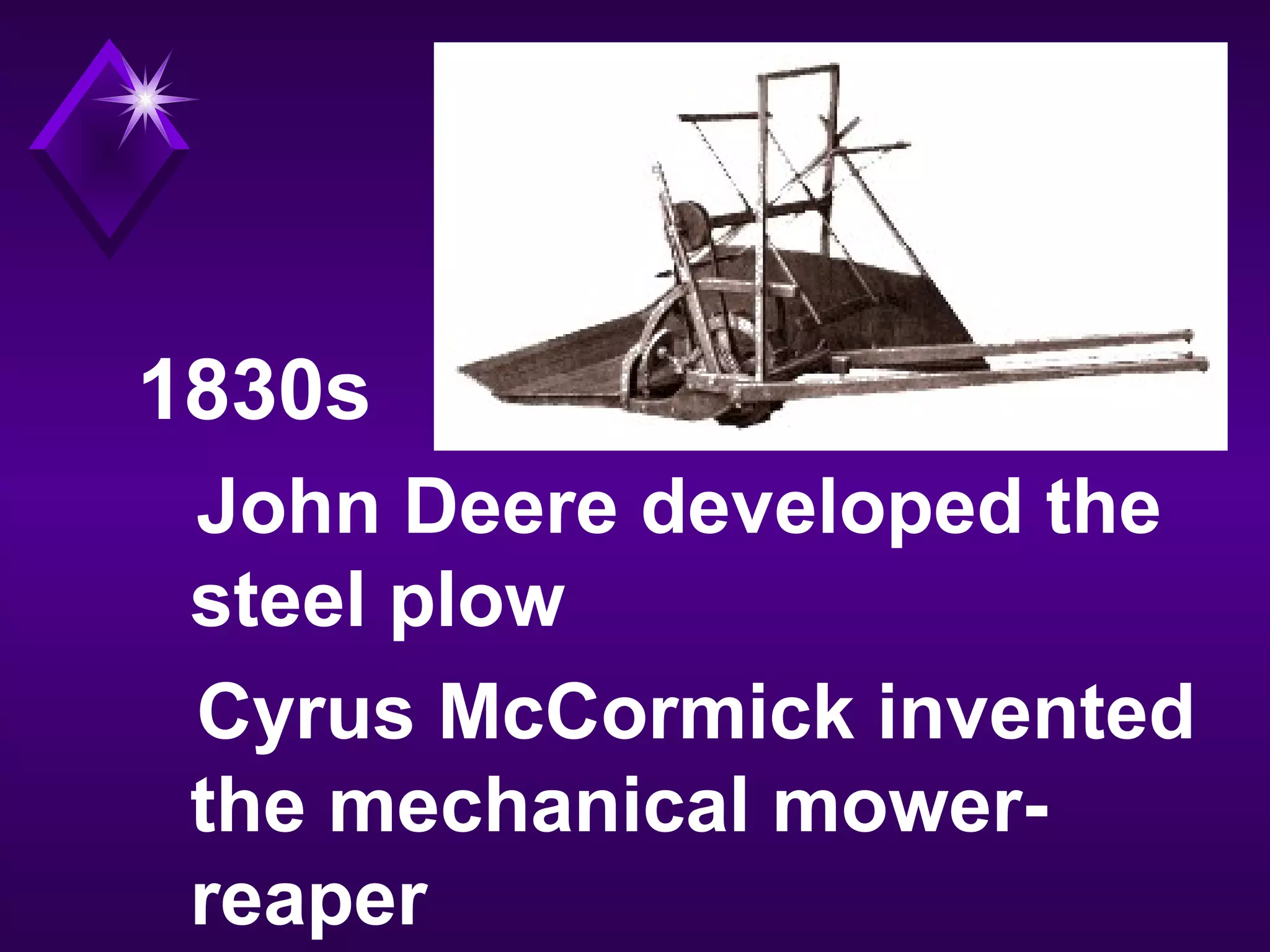
1830s
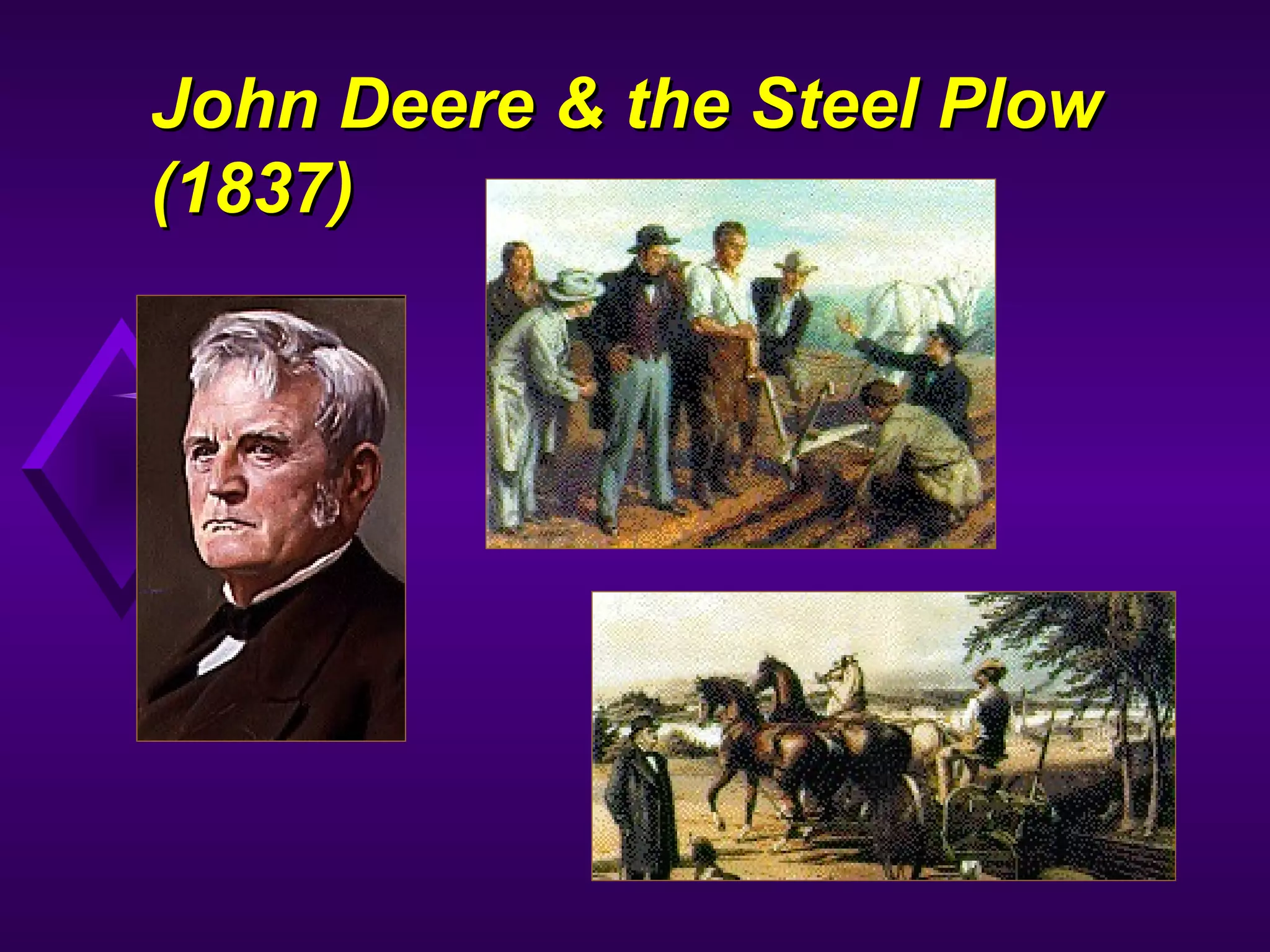
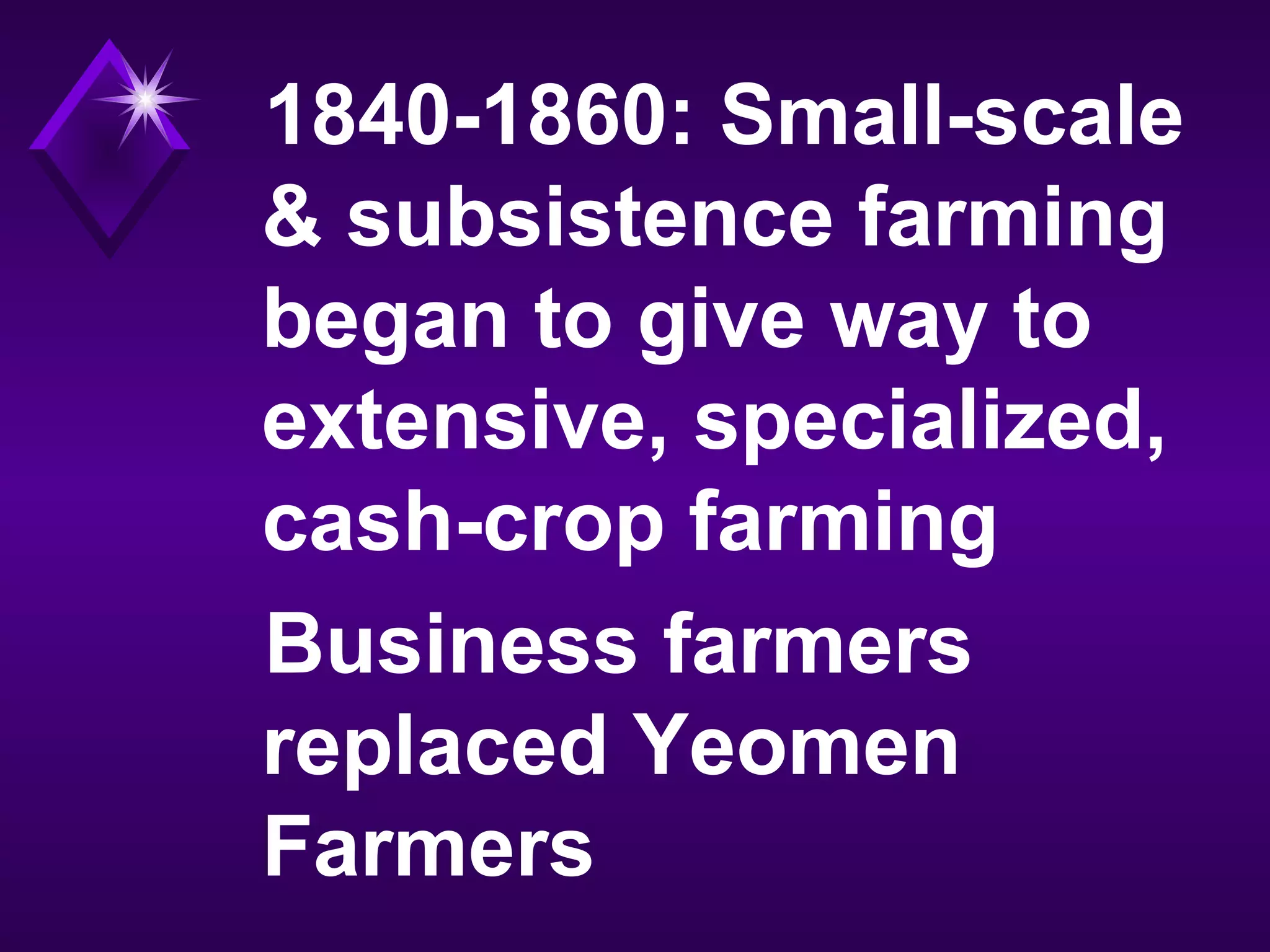
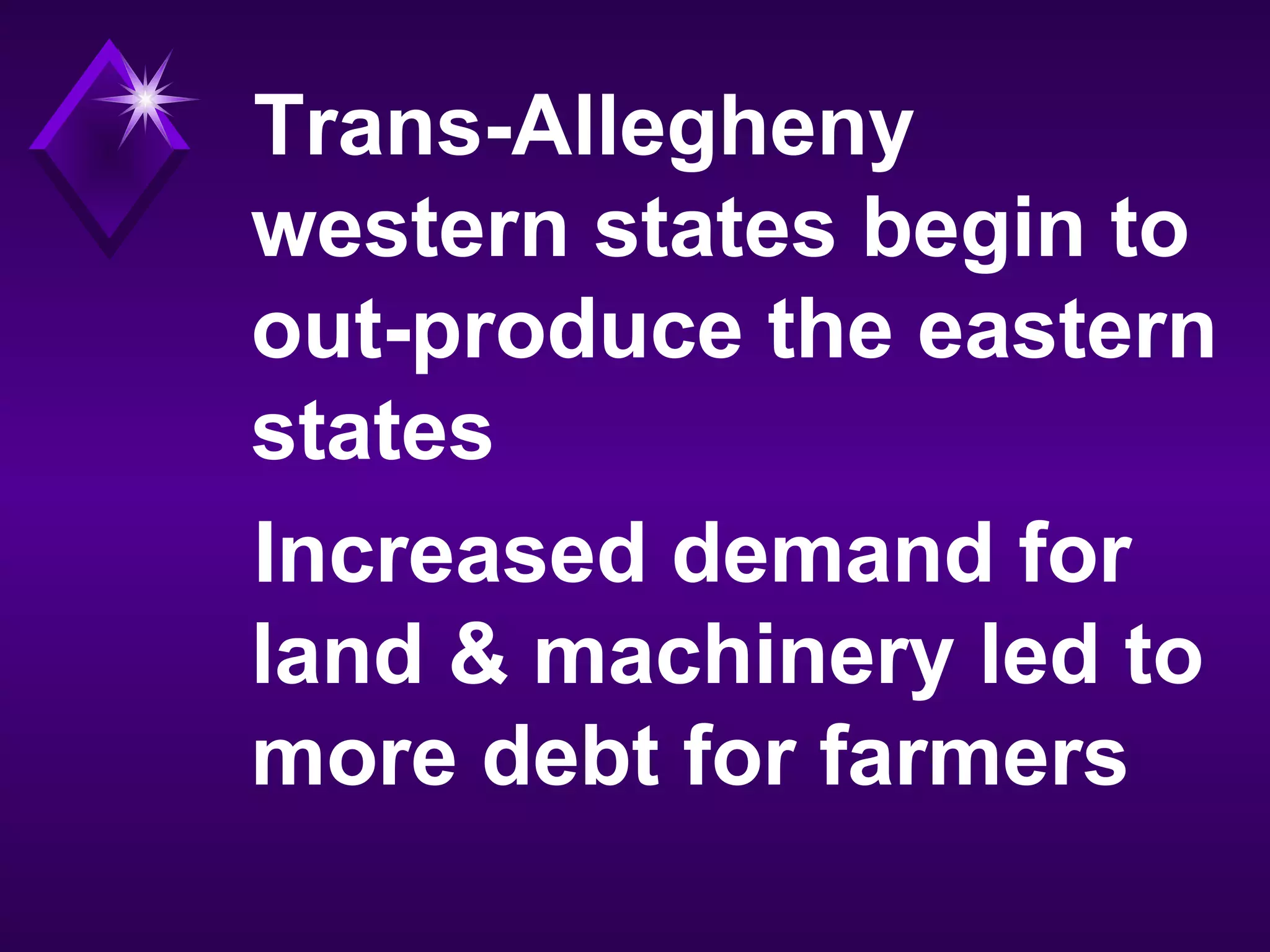
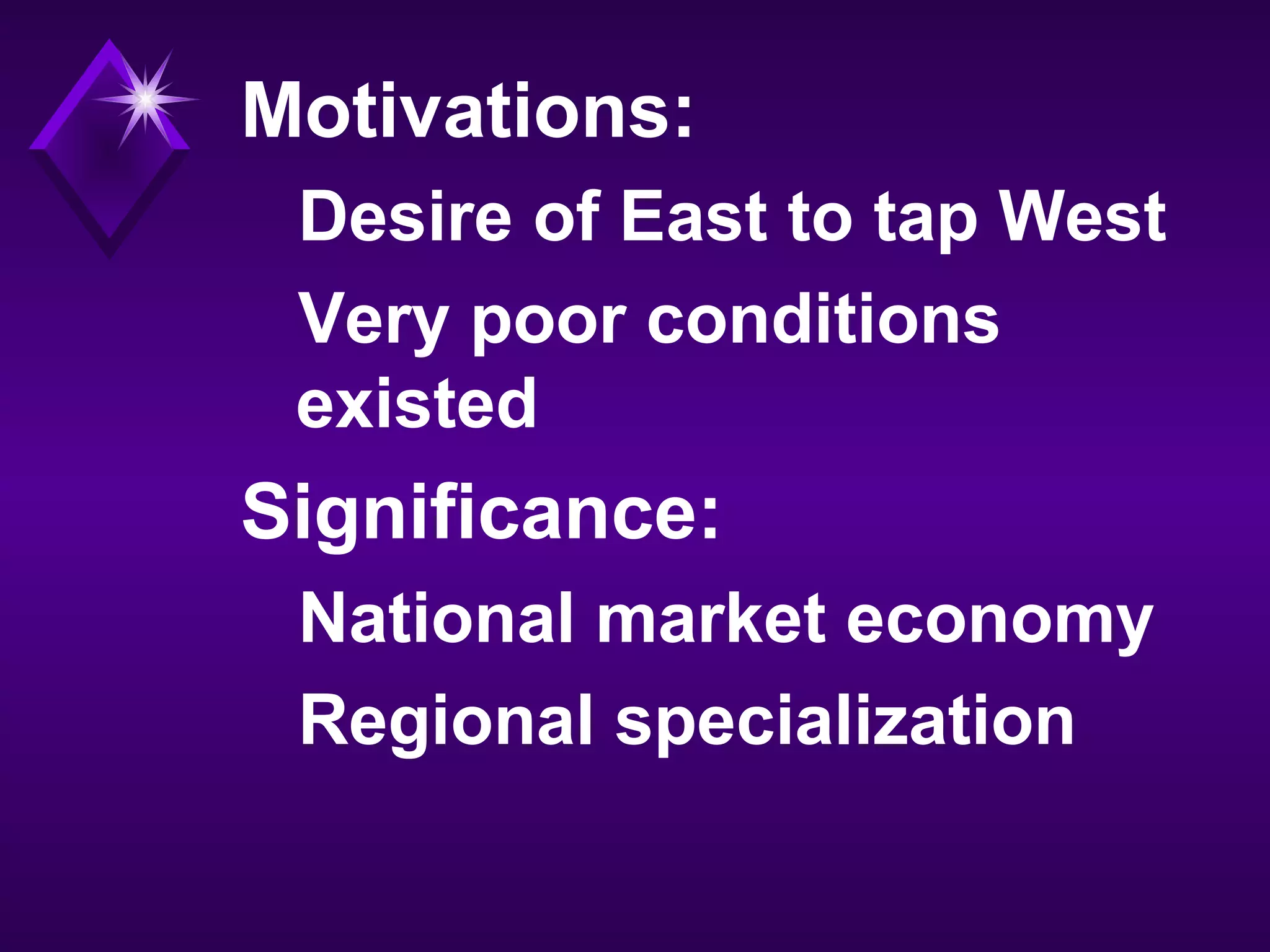
John Deere developed the
steel plow
Cyrus McCormick invented
the mechanical mower-
reaper
John Deere & the Steel PlowJohn Deere & the Steel Plow
(1837)(1837)
Cyrus McCormickCyrus McCormick
& the Mechanical Reaper: 1831& the Mechanical Reaper: 1831
1840-1860: Small-scale
& subsistence farming
began to give way to
extensive, specialized,
cash-crop farming
Business farmers
replaced Yeomen
Farmers
Trans-Allegheny
western states begin to
out-produce the eastern
states
Increased demand for
land & machinery led to
more debt for farmers
Transportation &Transportation &
CommunicationCommunication
RevolutionRevolution
Motivations:
Desire of East to tap West
Very poor conditions
existed
Significance:
National market economy
Regional specialization
TurnpikesTurnpikes
1790’s – Completion of
Lancaster Turnpike
sparked boom in
turnpike construction
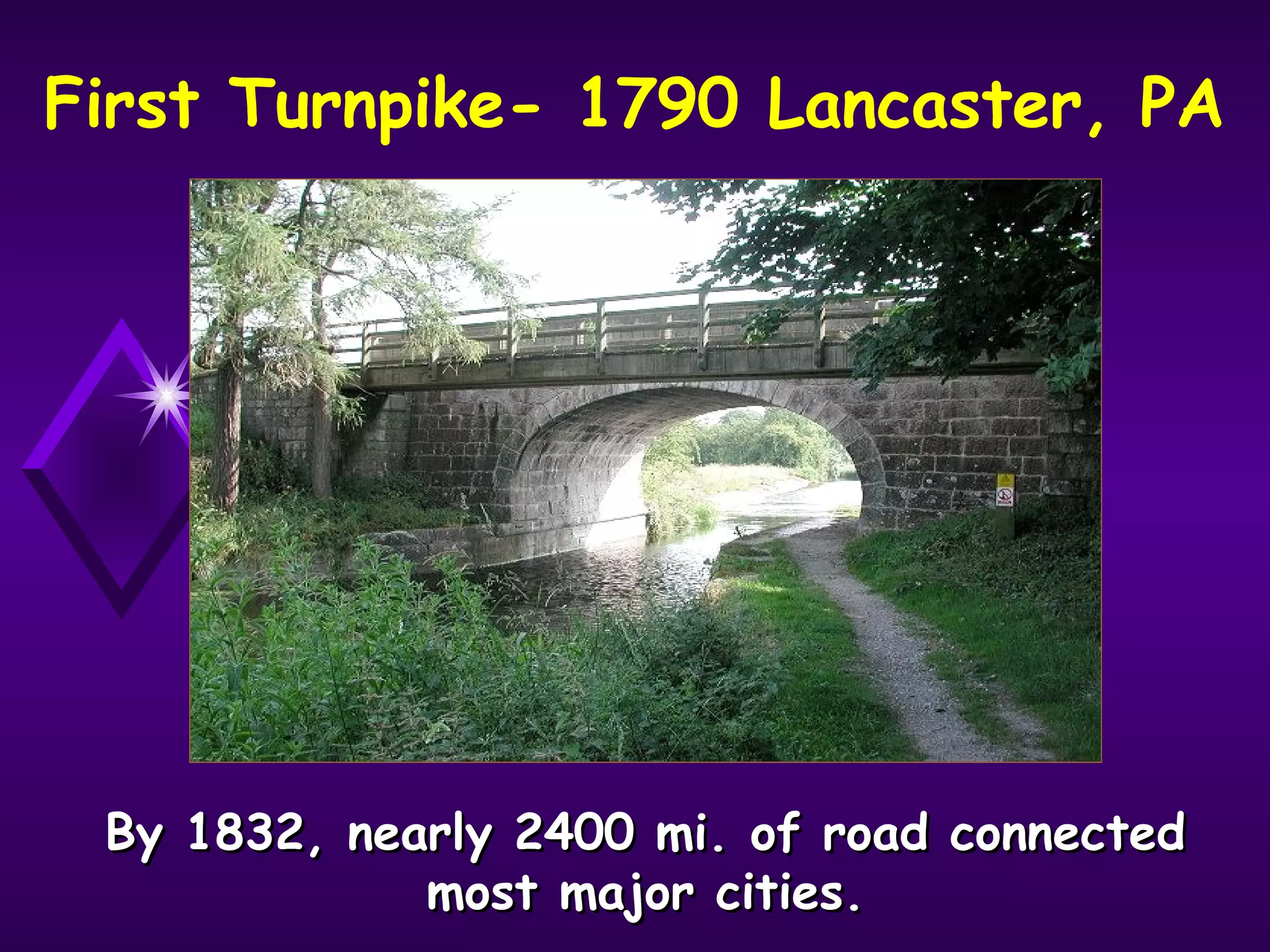
First Turnpike- 1790 Lancaster, PA
By 1832, nearly 2400 mi. of road connectedBy 1832, nearly 2400 mi. of road connected
most major cities.most major cities.
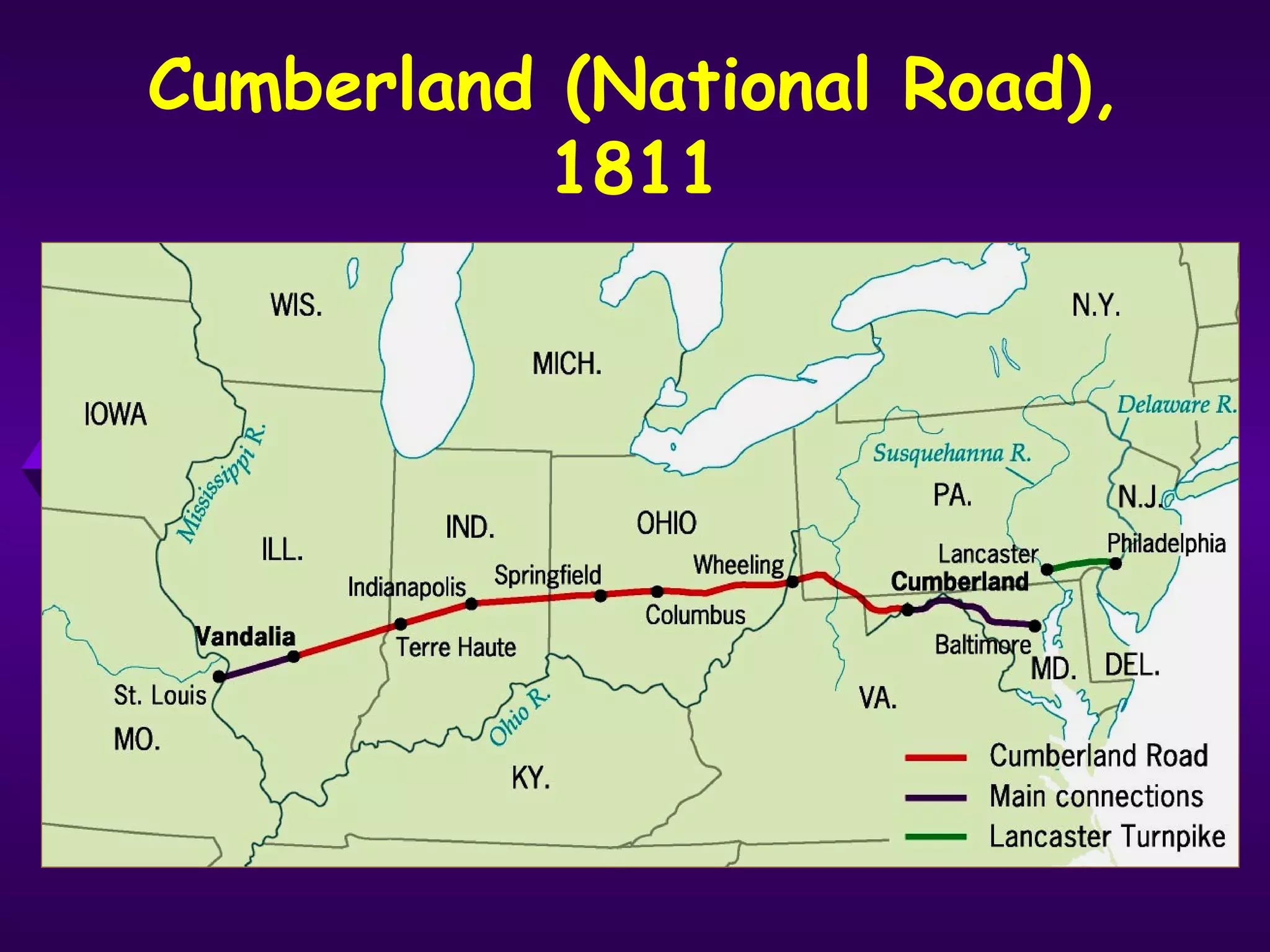
1811 – Cumberland
Road (National Road)
begun
Eventually stretches
from Cumberland, MD to
Vandalia, Il – connecting
Baltimore to St. Louis
Cumberland (National Road),
1811
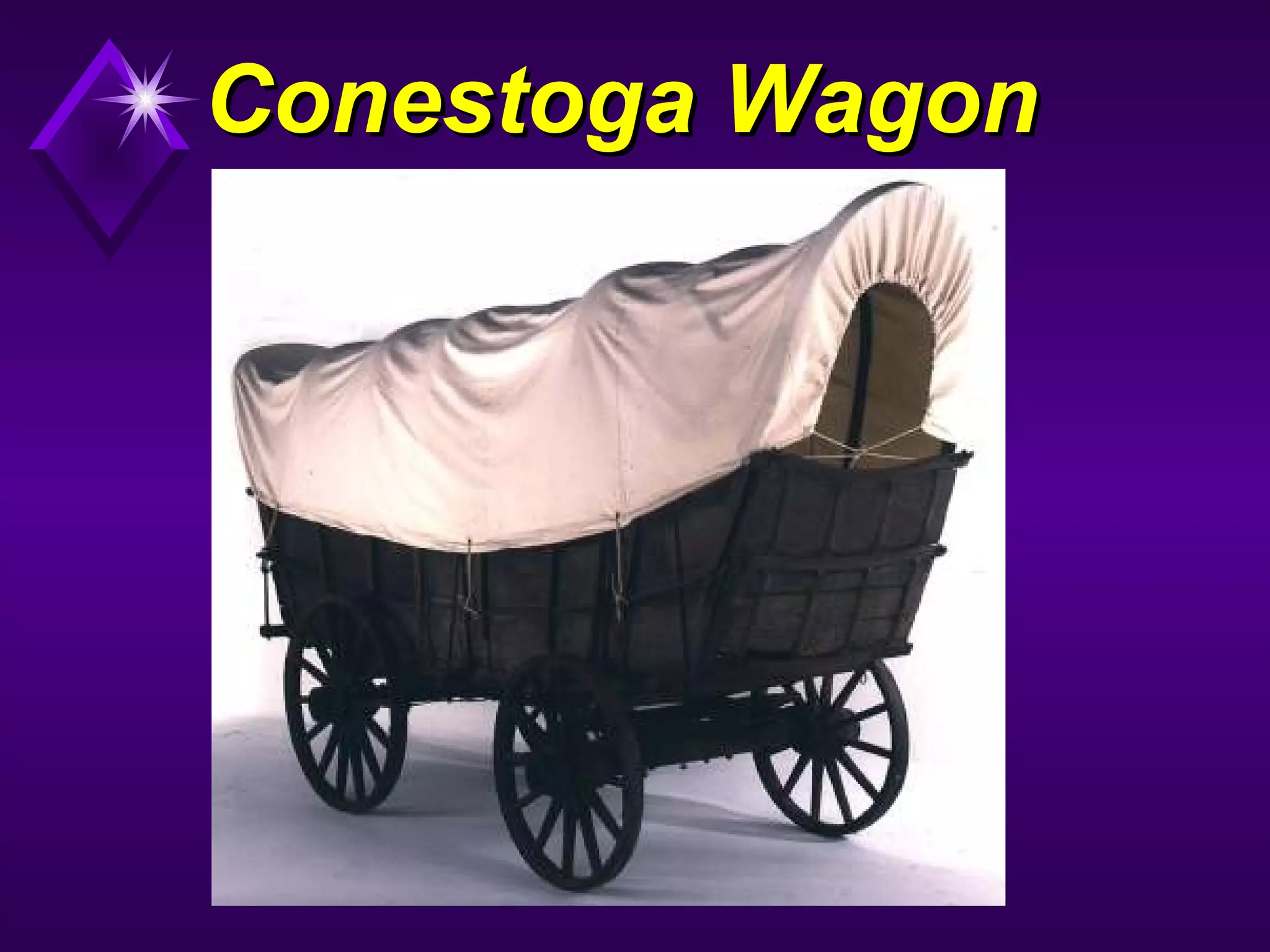
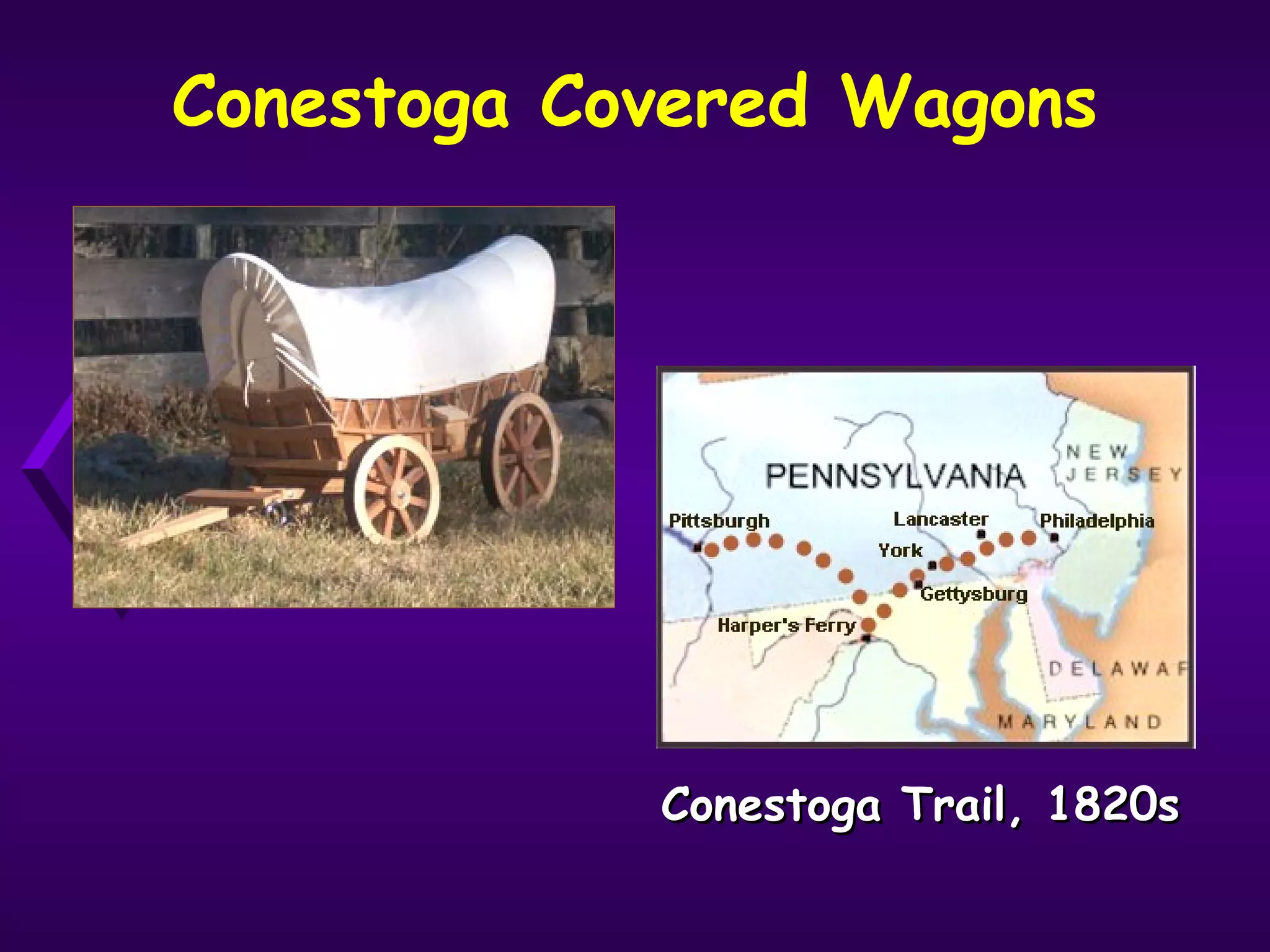
Conestoga WagonConestoga Wagon
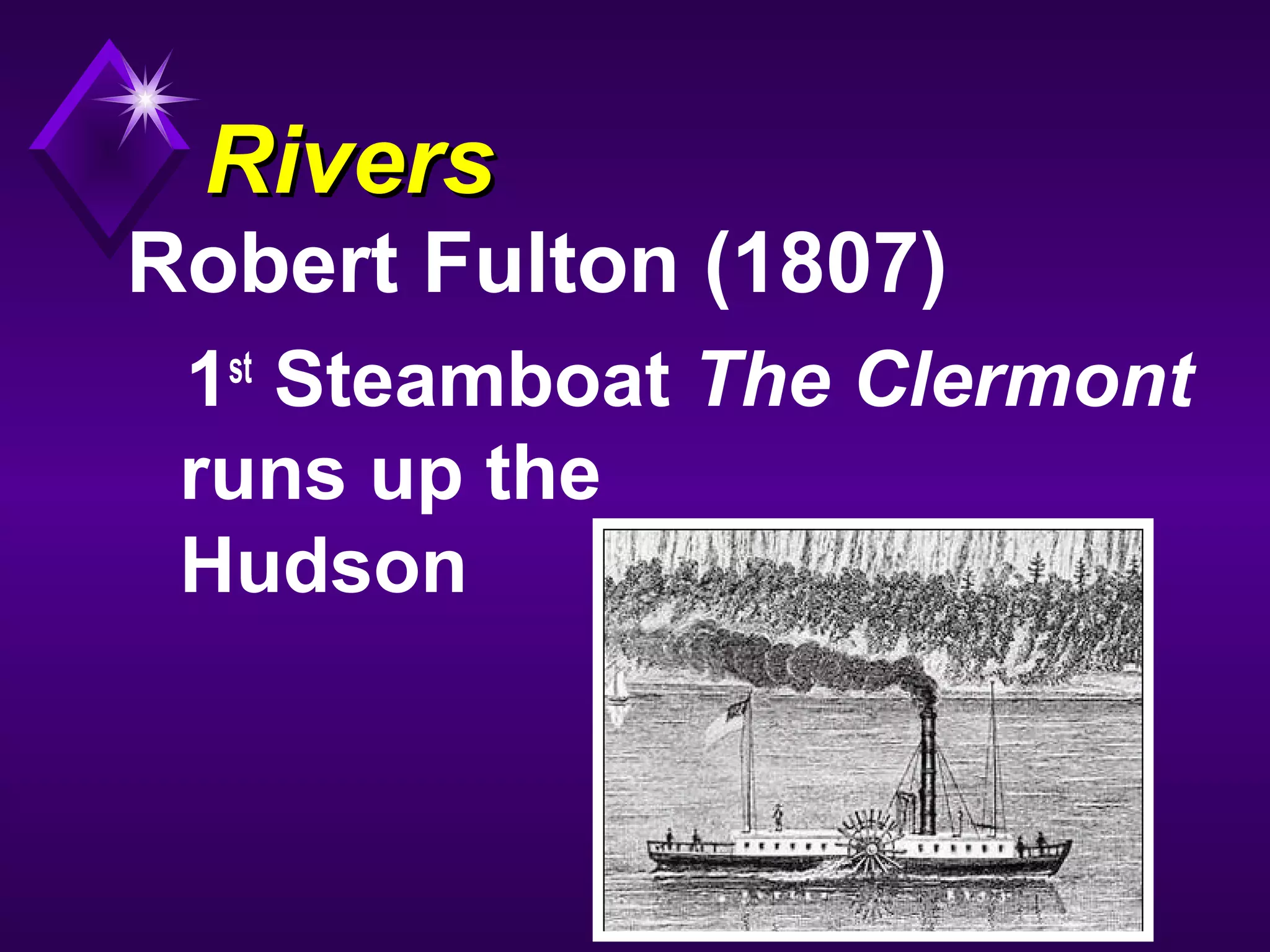
Conestoga Covered Wagons
Conestoga Trail, 1820sConestoga Trail, 1820s
RiversRivers
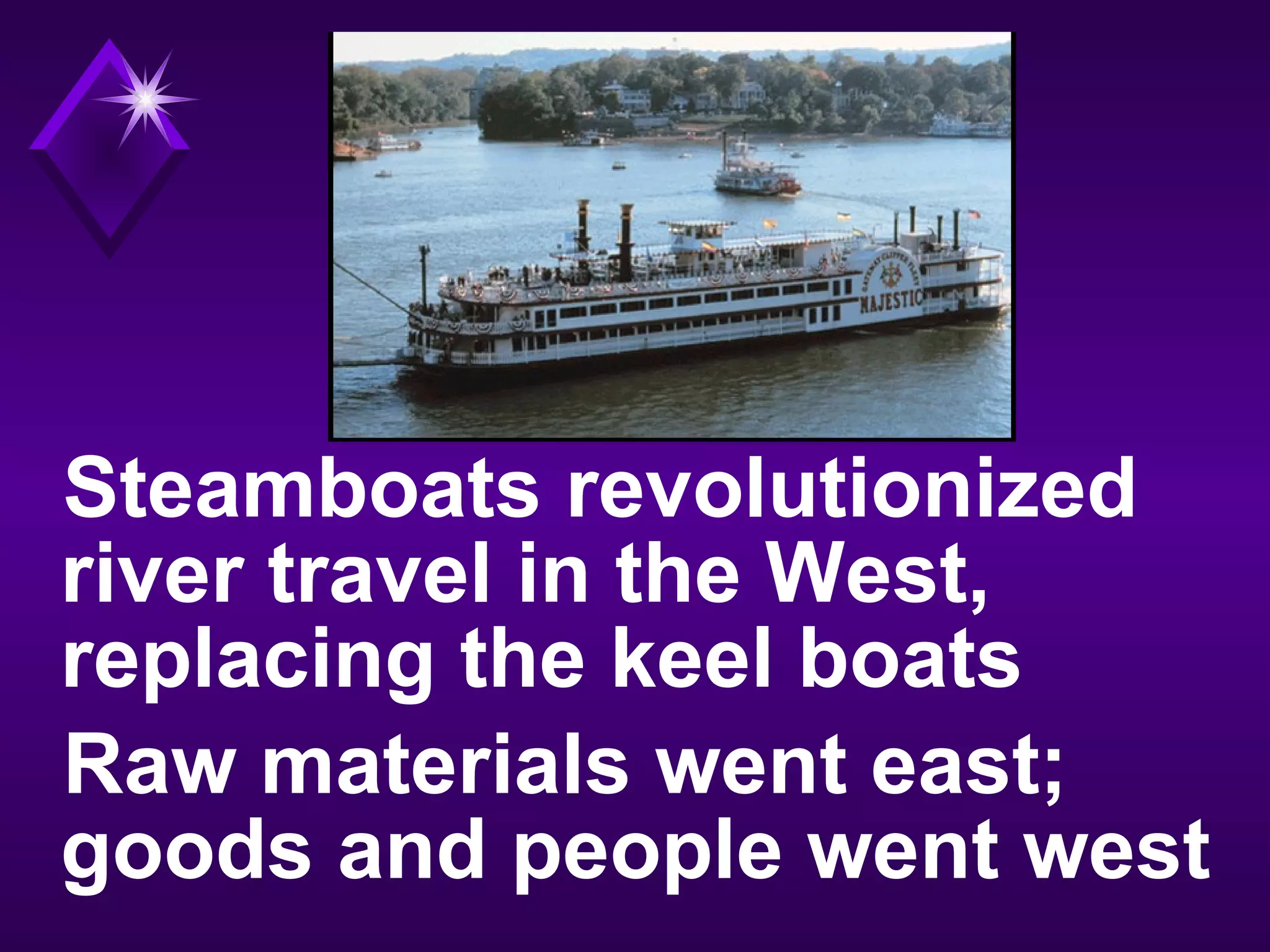
Robert Fulton (1807)
1st
Steamboat The Clermont
runs up the
Hudson
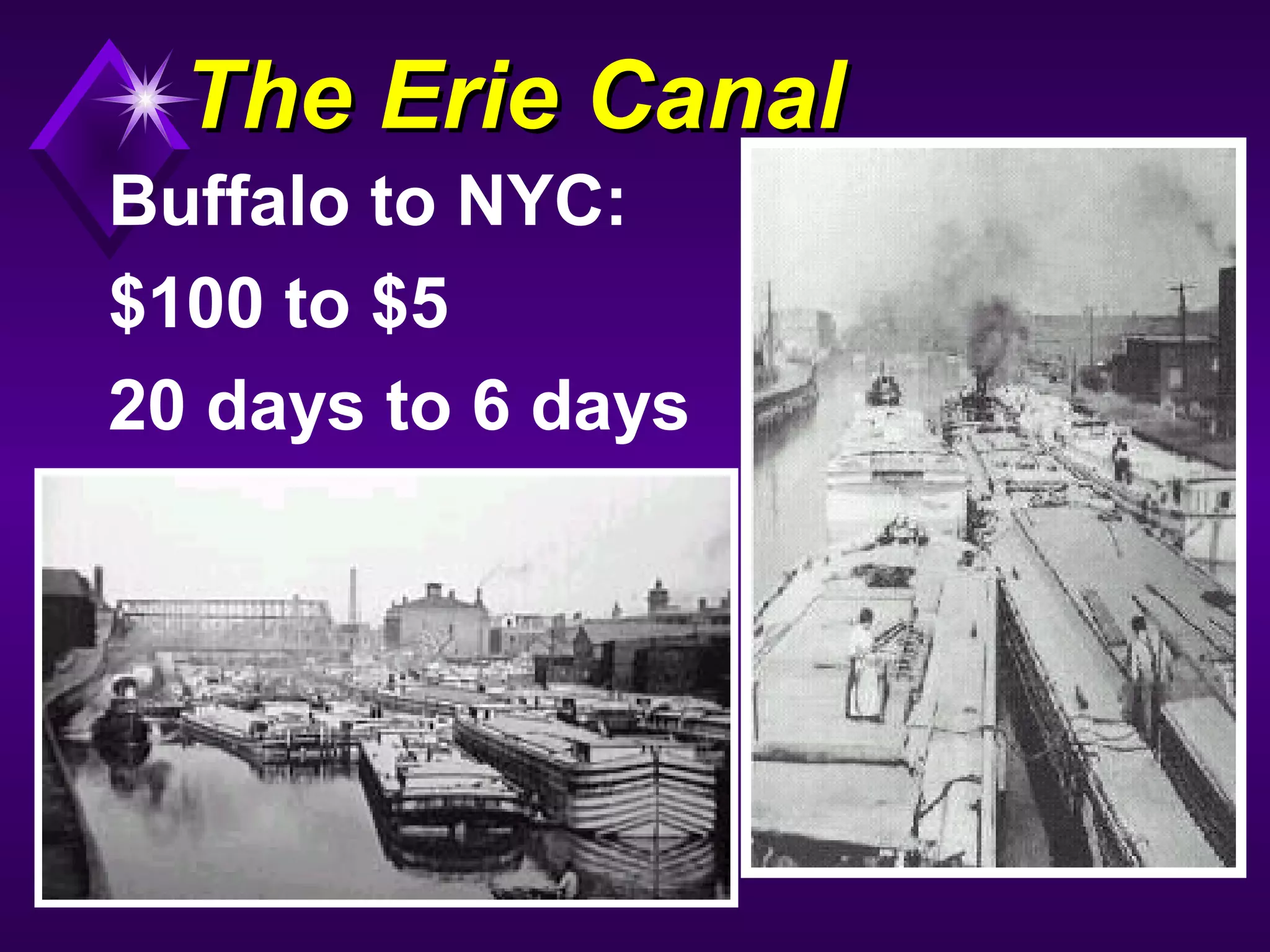
Steamboats revolutionized
river travel in the West,
replacing the keel boats
Raw materials went east;
goods and people went west
CanalsCanals
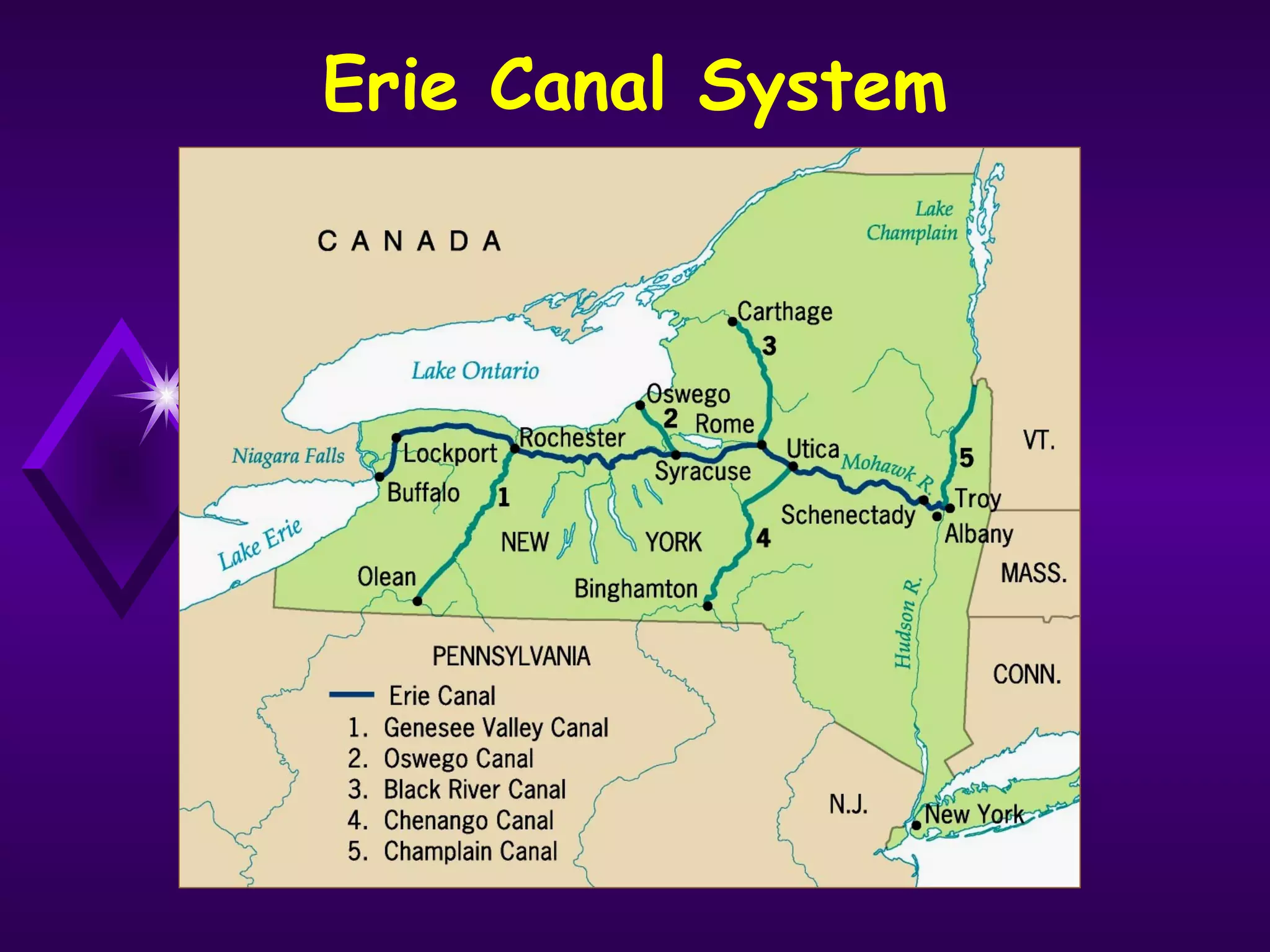
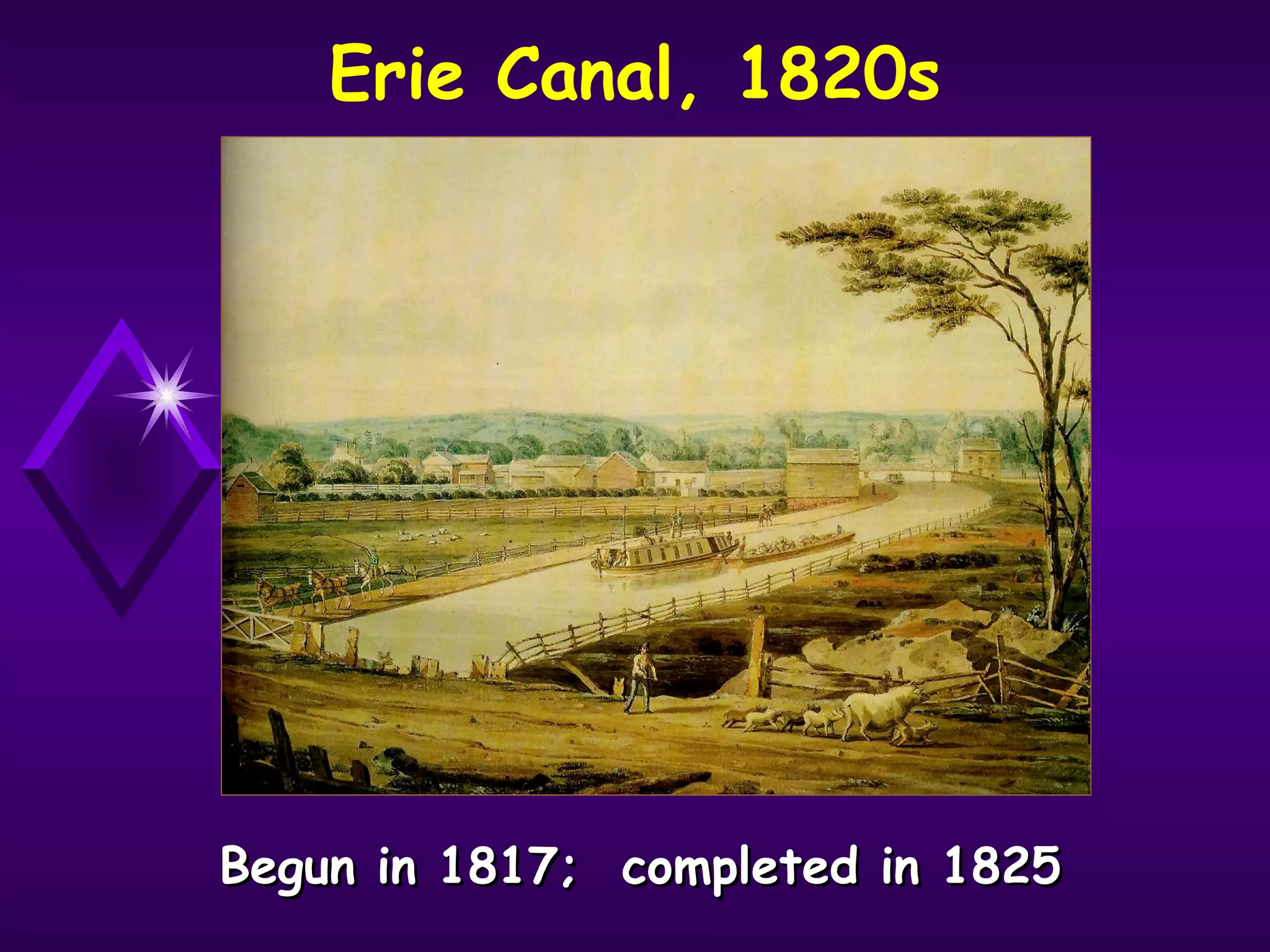
1817-1825: Erie Canal
Governor Dewitt Clinton of
New York
Clinton’s “big ditch” was a
major success
Linked Great Lakes to
Hudson River
The Erie CanalThe Erie Canal
Buffalo to NYC:
$100 to $5
20 days to 6 days
Erie Canal System
Erie Canal, 1820s
Begun in 1817; completed in 1825Begun in 1817; completed in 1825
New York City became
the largest port in
America
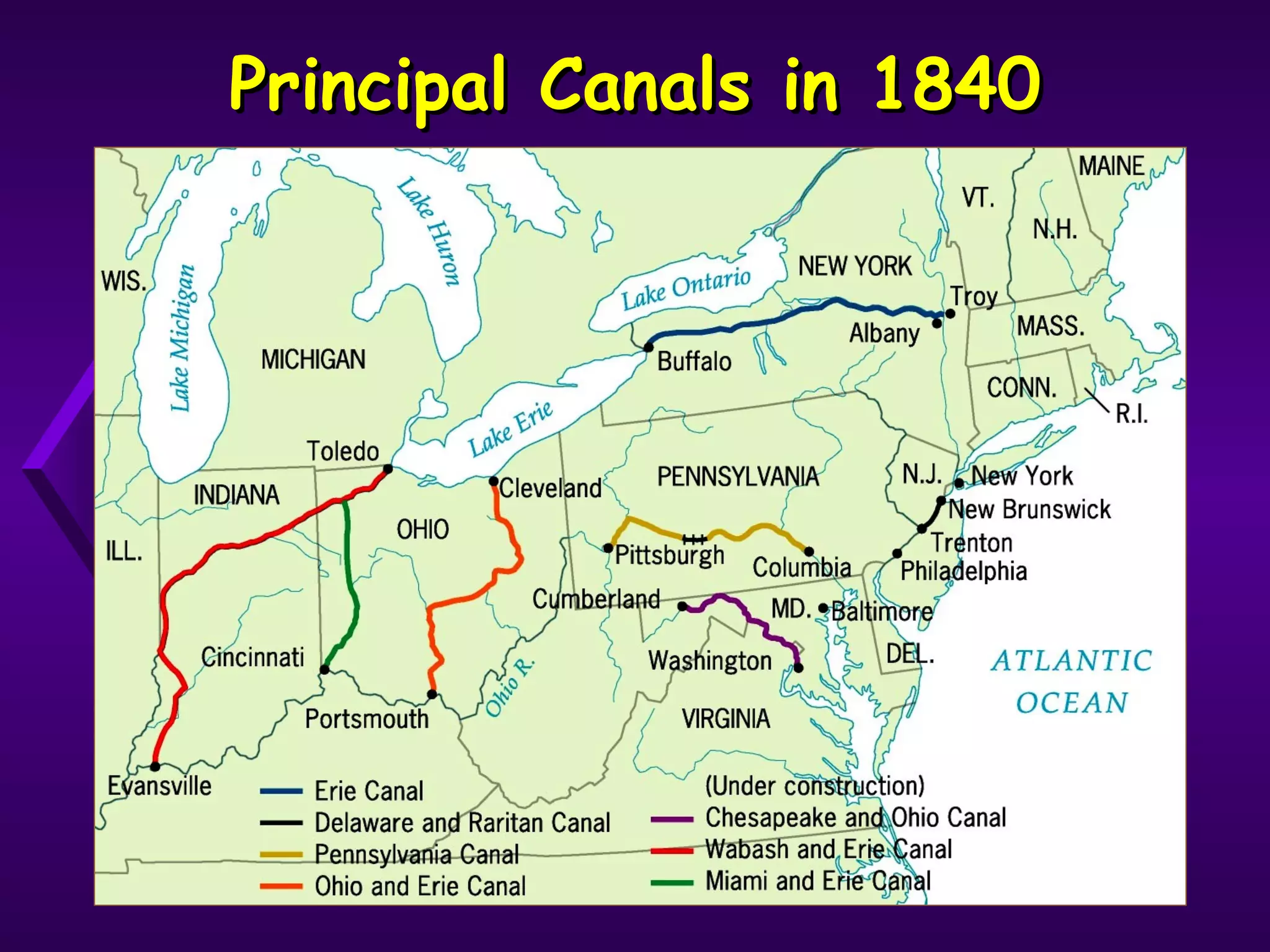
Other states followed
suit & built miles of
canals in the north
Principal Canals in 1840Principal Canals in 1840
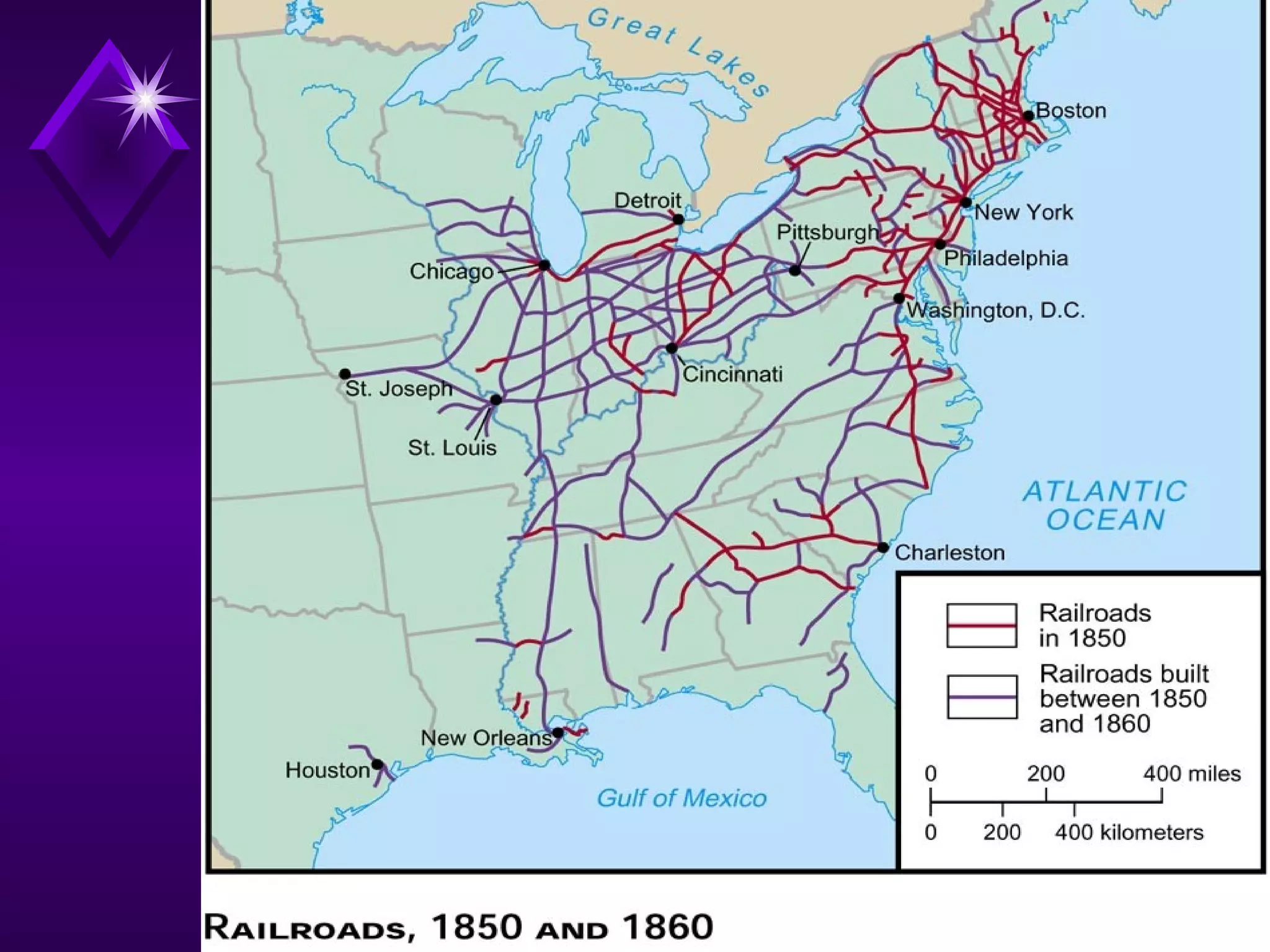
RailroadsRailroads
1828: Baltimore & Ohio
railroad is begun in
Baltimore
“Tom Thumb” (1830)
Locomotive on the B&O
Railroad raced a horse
drawn car & lost
Early railroads were
dangerous & unreliable,
but improved with time
The Pullman Sleeping
“Palace” Car was
invented in 1859
By 1860, the US had
30,000 miles of
railroad track
3/4 in the North
Inland Freight Rates
RegionalRegional
SpecializationSpecialization
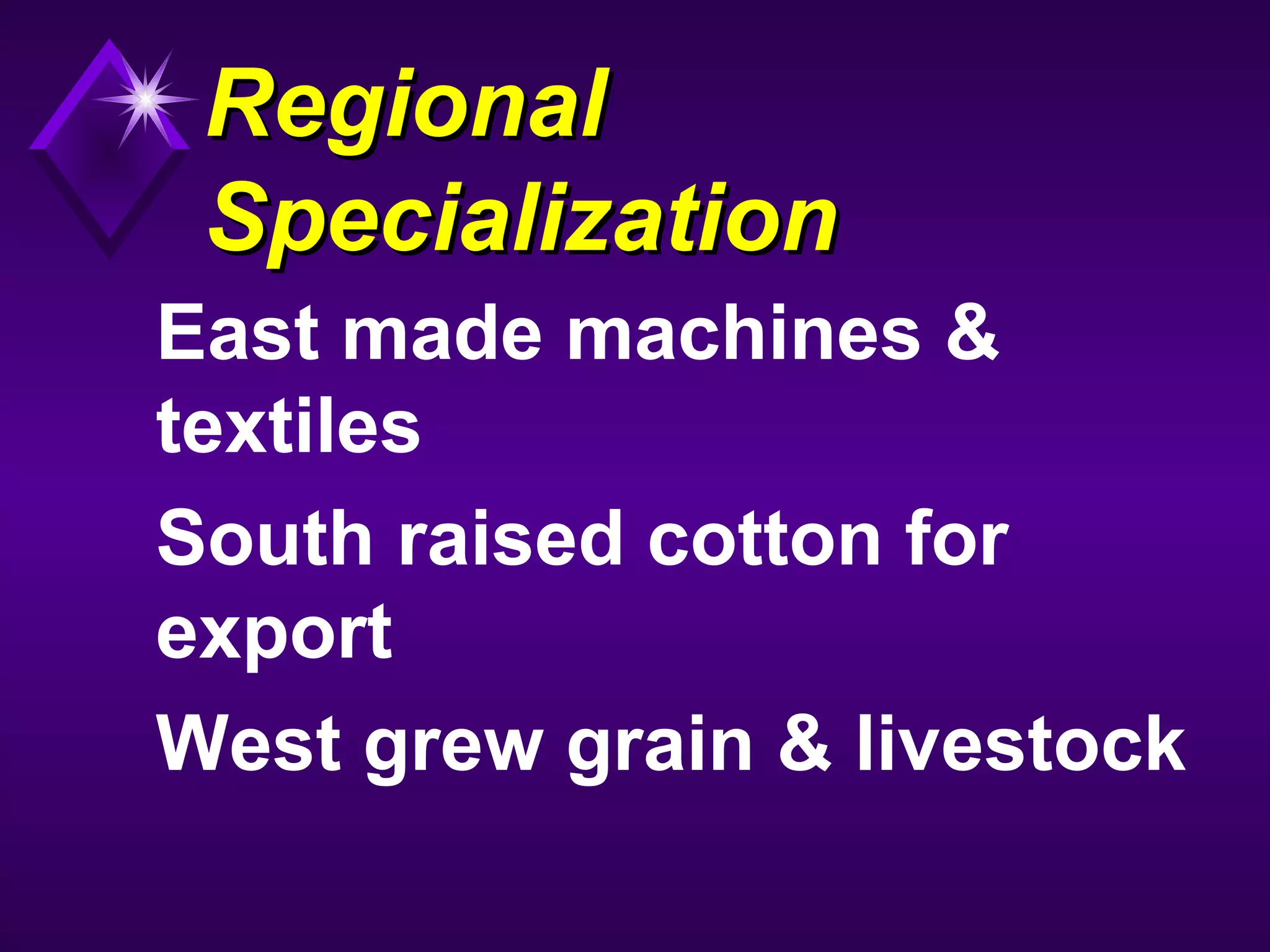
East made machines &
textiles
South raised cotton for
export
West grew grain & livestock
ShippingShipping
Foreign trade = 7%
Import manufactured goods
Export agricultural goods
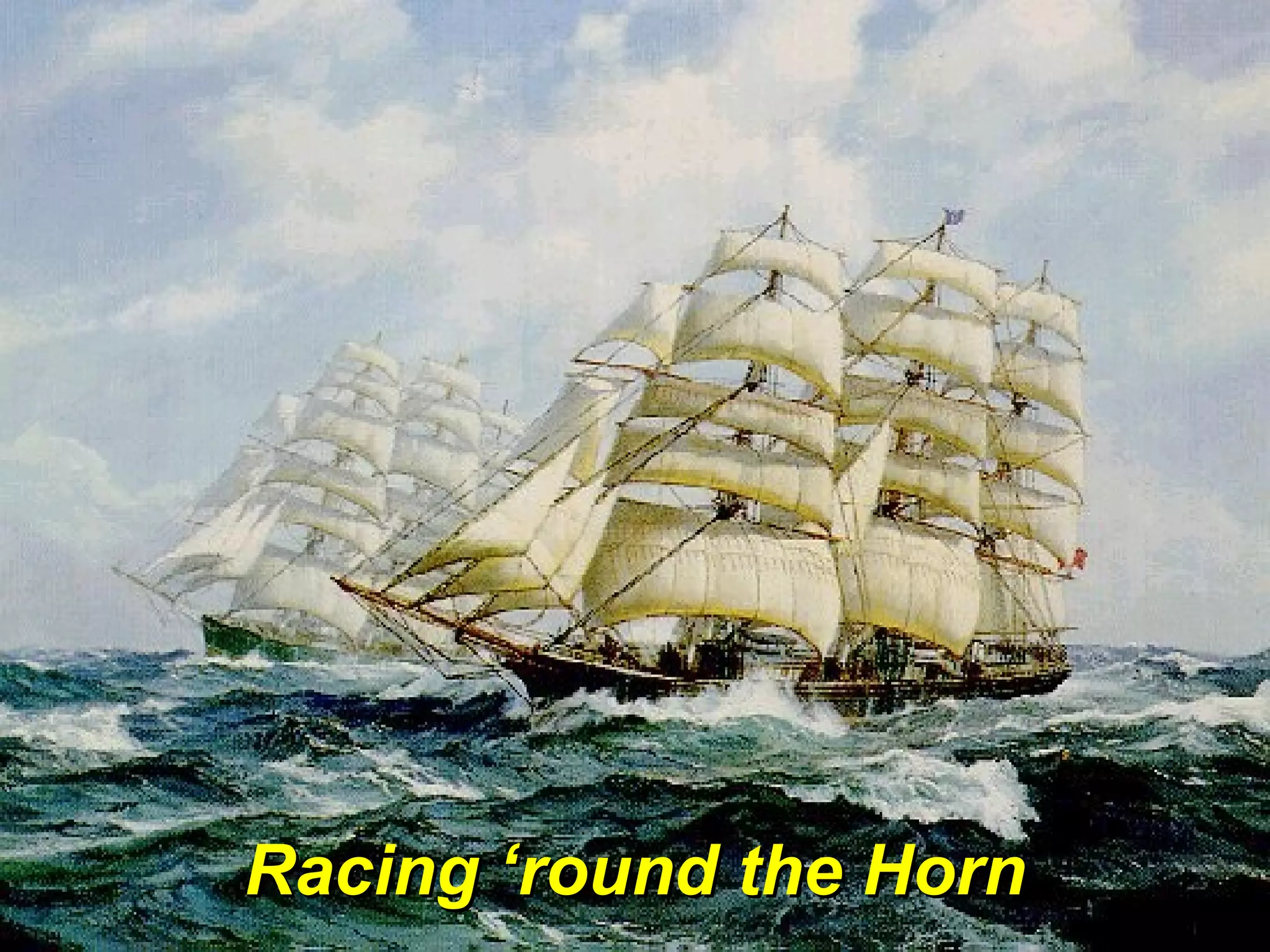
Clipper Ships
Donald McKay’s naval yard
in Boston builds the first
Faster than competitors
Racing ‘round the HornRacing ‘round the Horn
American shipping had
a brief period of glory &
set trans-oceanic speed
records
Britain will regain
dominance with the
tramp steamer ship
CommunicationCommunication
Cyrus Field (1858)
Lays the first transatlantic
cable
It breaks
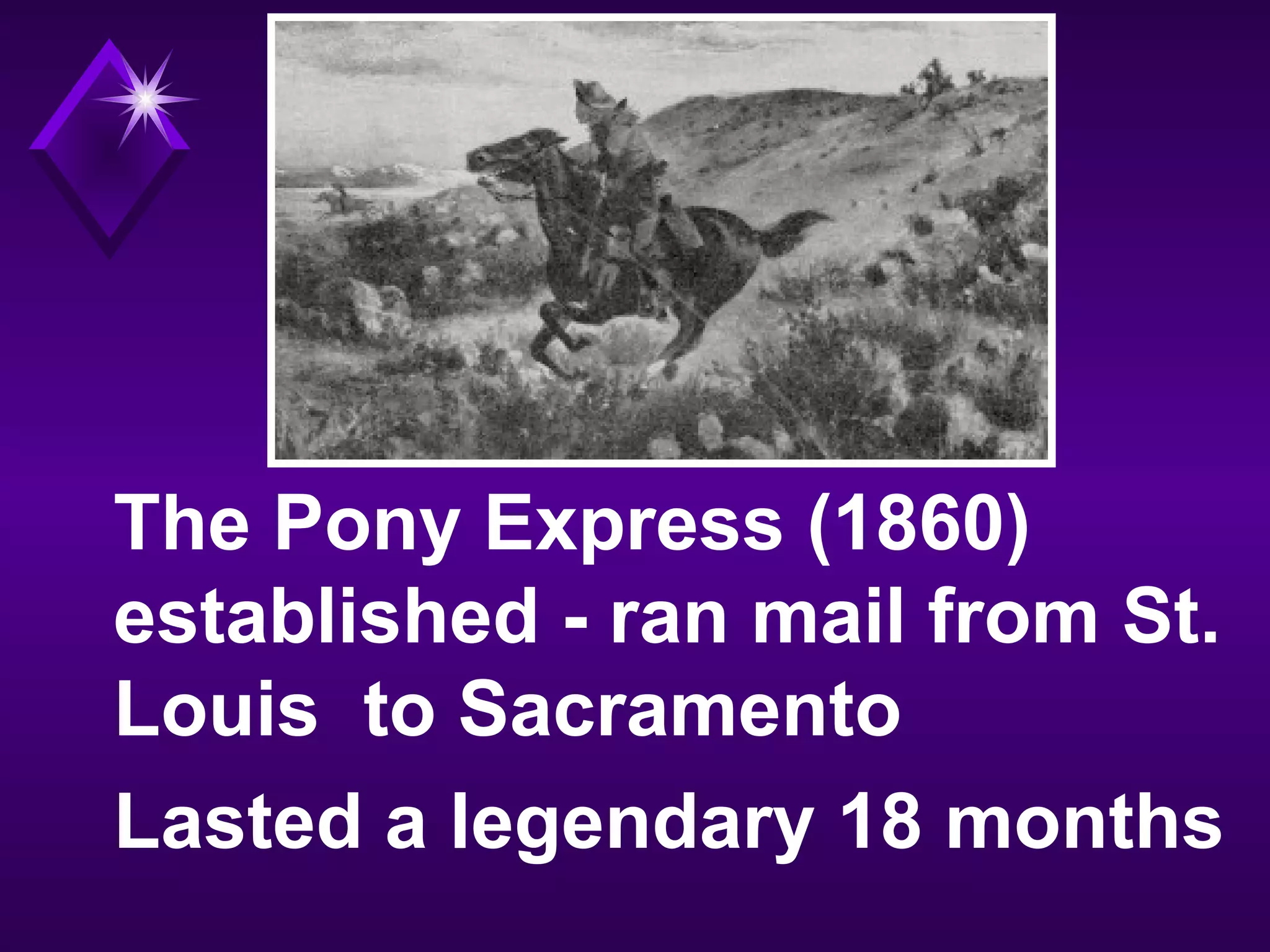
The Pony Express (1860)
established - ran mail from St.
Louis to Sacramento
Lasted a legendary 18 months
1st
transcontinental cable
is laid in 1861
Transcontinental railroad
will follow after the Civil
War
1866 – permanent
transatlantic cable
established linking
Europe with North
America

Lecture 15 a