Prepared by:
      Akhil Sood
 Harsh Chandra
  Preeti Kukreja
Vaibhav Vishnoi
 Yawar Shamshi
OUTLINE
 Definition of Hospital pharmacy
 Functions of Hospital pharmacy
 Objectives of Hospital pharmacy
 Location and layout of Hospital pharmacy
 Personnel and floor space requirements
 Requirement and Abilities required for Hospital
 Pharmacist
DEFINITION
 Department of hospital which deals with
  procurement, storage, compounding, dispensing,
  manufacturing, testing, packaging and distribution of
  drugs.
 It is also concerned with education and research in
  pharmaceutical services.
 Hospital Pharmacy is controlled by a professionally
  competent and a qualified pharmacist.
FUNCTIONS OF HOSPITAL
              PHARMACY
 Provide specifications for the purchase of drugs,
    chemicals, biological etc.
   Proper storing of drugs.
   Manufacturing and distribution of medicaments such
    as transfusion fluids, parenteral products, tablets,
    capsules, ointments, and stock mixtures.
    Dispensing and sterilizing parenteral preparations
    which are manufactured in hospital.
   Dispensing of drugs as per the prescriptions of the
    medical staff of the hospital.
FUNCTIONS OF HOSPITAL
              PHARMACY
 Filling and labelling of all drug containers from which
    medicines are to be administered.
   Management of stores which includes purchase of
    drugs, proper storage conditions, and maintenance of
    records.
   Establishment and maintenance of “Drug Information
    Centre”.
   Providing co-operation in teaching and research
    programmes.
   Discarding the expired drugs and containers worn and
    missing labels.
FUNCTIONS OF HOSPITAL
              PHARMACY
DISPENSING                                          MANUFACTURING

             PURCHASING &
                                       STATISTICS AND
              INVENTORY
                                          REPORTS
               CONTROL


  TEACHING                  RESEARCH
                                                        CONTROL

  OUTDOOR PATIENT                                  •BULK
  INPATIENT                                    •LARGE VOLUME
  MEDICAL, SURGICAL & LABORATORY SUPPLIES
                                                PARENTERALS
  WARD OR FLOOR STOCK
  ALCOHOL                                      •SMALL VOLUME
                                                PARENTERALS
OBJECTIVES OF HOSPITAL
              PHARMACY

 To ensure the availability of right medication, at right
    time, in the right dose at the minimum possible cost.
   To professionalize the functioning of pharmaceutical
    services in a hospital.
   To act as a counseling department for medical staff,
    nurses and for patient.
   To act as a data bank on drug utilization.
   To participate in research projects.
OBJECTIVES OF HOSPITAL
            PHARMACY
 To implement decisions of the pharmacy and
  therapeutics committee.
 To co-ordinate and co-operate with other departments
  of a hospital.
 To plan, organize and implement pharmacy policy
  procedures in keeping with established policies of the
  hospitals.
LOCATION OF HOSPITAL
              PHARMACY
 Located in hospital premises so that patients and staff
  can easily approach it.
 In multi-storeyed building of a hospital, the pharmacy
  should be preferably located on ground floor
  especially the dispensing unit.
 It should be laid in such a way that there is a
  continuous flow of men and materials.
LAYOUT OF HOSPITAL PHARMACY
                                             RAW MATERIAL

 ASEPTIC AREA    MANUFACTURING SECTION          STORES

                                               FINISHED
                                              PRODUCTS

                      PASSAGE


                                DISPENSING
ADMINISTRATIVE
   SECTION
                                OPEN SPACE
FLOW CHARTS FOR
MATERIALS AND MEN
GENERAL FLOW CHART FOR
               OUTPATIENTS
 Rx written by doctor

                          Rx received by pharmacist
                                                                      selection

                            Filling of prescription                   labelling

                                                                      pricing
                            Dispensed to patient


 Receipt of payment                                            Prescription filed

Free Cash Charge                        Regular prescription    Narcotic prescription
                                                file                     file
 Statistics and reports
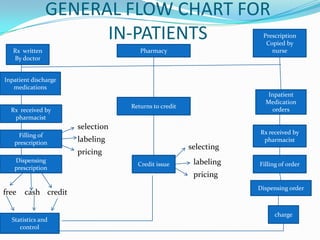
GENERAL FLOW CHART FOR
                      IN-PATIENTS                                  Prescription
                                                                    Copied by
   Rx written                        Pharmacy                         nurse
   By doctor


Inpatient discharge
   medications
                                                                     Inpatient
                                                                    Medication
                                  Returns to credit
  Rx received by                                                      orders
   pharmacist
                      selection
    Filling of                                                    Rx received by
   prescription       labeling                                     pharmacist
                                                      selecting
                      pricing
   Dispensing                                          labeling
                                    Credit issue                  Filling of order
   prescription
                                                       pricing
                                                                  Dispensing order
free   cash credit

                                                                       charge
  Statistics and
     control
Flow charts for materials


                            Medical stores


                  receipt                     issues    Inpatient
 Parenteral                                            department
manufacturing                 Pharmacy


                  receipt      Quality                 Outpatient
Manufacturing                  control        issues
                                                       department
of other dosage
     forms
FACILITIES REQUIRED IN HOSPITAL
            PHARMACY
 In smaller hospitals, with one pharmacist only, one
  room is required for pharmacy, having a combination
  of dispensing, manufacturing, administrative and all
  other sections of complete pharmaceutical service.
 For sterile products there should be a separate room or
  area.
 In large hospitals, with 200 or more beds,
  departmentalization of pharmacy activities is
  required.
 A separate area is required for :-
   Inpatient services and unit dose dispensing
 Outpatient service
 An office for the chief pharmacist
 A compounding room
 Prepacking and labelling room
 A store room
 Sterile products room


 A separate area for drug information services and
 space assigned on various nursing units for unit
 dose drug administration.
FLOOR SPACE REQUIREMENTS
 250 sq. feet is the minimum required area for any sized
    hospital.
   10 sq. feet per bed in 100 beded hospital.
   6 sq. feet per bed in 200 beded hospital.
   Floors of pharmacy should be smooth, easily washable and
    acid resistant.
   In manufacturing sections, drains should be provided,
    walls should be smooth, painted in light colour.
   Wooden cabinets are laminated.
   Fluorescent lamps are placed above priscription counter.
   Counter for Bunsen burner are also required.
Requirements On The Basis Of Bed Strength
              (Area in sq. feet)
    1                            2                         3                  4

Store room              dispensary                     office     Manufacturing of
100 B – 450             100 B – 350                 100 B – 110   compressed tablets
300 B – 1000            300 B – 500                 300 B – 150   And capsules
700 B - 2400            700 B - 800                 700 B - 200    •For tablets
                  5                        6                        700 B - 900
  Manufacturing under aseptic         Parenterals                  •For capsules
  condition for eye drops, eye        300 B – 600                   700 B - 200
  lotions & other preparations        700 B - 600
  for external use
       300 B – 250
       700 B - 250
EQUIPMENTS REQUIRED IN
         HOSPITAL PHARMACY
 Prescription case
 Drug stock cabinets with proper shelves and drawers.
 Sectional drawer cabinets with cupboards bases.
 Work tables and counters for routine dispensing.
 Sink with drain board.
 Cabinet to store mortar and pestles.
 Cabinet for glass utensils, flasks, funnels and beakers.
 Refrigerator of suitable capacity.
 Narcotics safe with individually locked drawers.
 Office desk with telephone connection and file cabinet.
 Dispensing window for nurses and outpatients.
Administrator


                                Head of pharmacy services
                                       (M.Pharm)


  Dispensing         Clinial       Quality             Medical    Manufacturing
   Chemist         Pharmacist      Control              Stores      Chemist
  (D.Pharm)        (B.Pharm)      Pharmacist         Pharmacist    (M.Pharm)
                                  (M.Pharm)           (B.Pharm
                                                         Or
                                                      D.Pharm)
inpatient   outpateint

                                                                         Other
                                                   Manufacturing
                                                                      Manufacturing
                                                     of I.V. fluids
                                                                        Services
                                                 (B.Pharm/M.Pharm
                                                                       (B.Pharm)
PERSONNEL REQUIREMENT IN
        HOSPITAL PHARMACY
 No standard rules regarding the requirement of personnel
    for inpatient pharmacy.
   Number of pharmacists required for a hospital are
    calculated on the basis of workload, and the number of bed
    available.
   For a small hospital minimum 3 pharmacist are required.
    As the number of bed increases, the number of pharmacist
    also increases.
   Pharmacist should possess adequate pharmacy
    qualification and experience.
   If manufacturing drugs is involved in pharmacy, adequate
    number of technicians, assistants, peons etc. required.
Pharmacist requirement on the
     basis of bed strength

Bed strength    No of pharmacist required
Upto 50 beds              3
Upto 100 beds             5
Upto 200 beds             8
Upto 300 beds             10
Upto 500 beds             15
REQUIREMENTS AND ABILITIES
  REQUIRED FOR HOSPITAL
       PHARMACIST
REQUIREMENTS
 Head of hospital pharmacy department should be a
  post graduate in pharmacy preferably in
  pharmaceutics, pharmacology or hospital pharmacy.
 Acts as a co-ordinator for the pharmacy and non-
  pharmacy staff.
 Reports to the administrator and interacts with other
  medical departments.
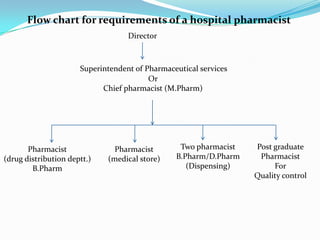
Flow chart for requirements of a hospital pharmacist
                                   Director


                      Superintendent of Pharmaceutical services
                                         Or
                            Chief pharmacist (M.Pharm)


       Pharmacist              Pharmacist        Two pharmacist   Post graduate
(drug distribution deptt.)   (medical store)    B.Pharm/D.Pharm    Pharmacist
        B.Pharm                                    (Dispensing)        For
                                                                  Quality control
ABILITIES REQUIRED
 Technical ability
 Ability to develop a manufacturing section
 Administrative ability
 Ability to control inventory
 Ability to conduct and participate in research
 Ability to conduct teaching programmes
THANK YOU

Chap04

  • 1.
    Prepared by: Akhil Sood Harsh Chandra Preeti Kukreja Vaibhav Vishnoi Yawar Shamshi
  • 2.
    OUTLINE  Definition ofHospital pharmacy  Functions of Hospital pharmacy  Objectives of Hospital pharmacy  Location and layout of Hospital pharmacy  Personnel and floor space requirements  Requirement and Abilities required for Hospital Pharmacist
  • 3.
    DEFINITION  Department ofhospital which deals with procurement, storage, compounding, dispensing, manufacturing, testing, packaging and distribution of drugs.  It is also concerned with education and research in pharmaceutical services.  Hospital Pharmacy is controlled by a professionally competent and a qualified pharmacist.
  • 4.
    FUNCTIONS OF HOSPITAL PHARMACY  Provide specifications for the purchase of drugs, chemicals, biological etc.  Proper storing of drugs.  Manufacturing and distribution of medicaments such as transfusion fluids, parenteral products, tablets, capsules, ointments, and stock mixtures.  Dispensing and sterilizing parenteral preparations which are manufactured in hospital.  Dispensing of drugs as per the prescriptions of the medical staff of the hospital.
  • 5.
    FUNCTIONS OF HOSPITAL PHARMACY  Filling and labelling of all drug containers from which medicines are to be administered.  Management of stores which includes purchase of drugs, proper storage conditions, and maintenance of records.  Establishment and maintenance of “Drug Information Centre”.  Providing co-operation in teaching and research programmes.  Discarding the expired drugs and containers worn and missing labels.
  • 6.
    FUNCTIONS OF HOSPITAL PHARMACY DISPENSING MANUFACTURING PURCHASING & STATISTICS AND INVENTORY REPORTS CONTROL TEACHING RESEARCH CONTROL OUTDOOR PATIENT •BULK INPATIENT •LARGE VOLUME MEDICAL, SURGICAL & LABORATORY SUPPLIES PARENTERALS WARD OR FLOOR STOCK ALCOHOL •SMALL VOLUME PARENTERALS
  • 7.
    OBJECTIVES OF HOSPITAL PHARMACY  To ensure the availability of right medication, at right time, in the right dose at the minimum possible cost.  To professionalize the functioning of pharmaceutical services in a hospital.  To act as a counseling department for medical staff, nurses and for patient.  To act as a data bank on drug utilization.  To participate in research projects.
  • 8.
    OBJECTIVES OF HOSPITAL PHARMACY  To implement decisions of the pharmacy and therapeutics committee.  To co-ordinate and co-operate with other departments of a hospital.  To plan, organize and implement pharmacy policy procedures in keeping with established policies of the hospitals.
  • 9.
    LOCATION OF HOSPITAL PHARMACY  Located in hospital premises so that patients and staff can easily approach it.  In multi-storeyed building of a hospital, the pharmacy should be preferably located on ground floor especially the dispensing unit.  It should be laid in such a way that there is a continuous flow of men and materials.
  • 10.
    LAYOUT OF HOSPITALPHARMACY RAW MATERIAL ASEPTIC AREA MANUFACTURING SECTION STORES FINISHED PRODUCTS PASSAGE DISPENSING ADMINISTRATIVE SECTION OPEN SPACE
  • 11.
  • 12.
    GENERAL FLOW CHARTFOR OUTPATIENTS Rx written by doctor Rx received by pharmacist selection Filling of prescription labelling pricing Dispensed to patient Receipt of payment Prescription filed Free Cash Charge Regular prescription Narcotic prescription file file Statistics and reports
  • 13.
    GENERAL FLOW CHARTFOR IN-PATIENTS Prescription Copied by Rx written Pharmacy nurse By doctor Inpatient discharge medications Inpatient Medication Returns to credit Rx received by orders pharmacist selection Filling of Rx received by prescription labeling pharmacist selecting pricing Dispensing labeling Credit issue Filling of order prescription pricing Dispensing order free cash credit charge Statistics and control
  • 14.
    Flow charts formaterials Medical stores receipt issues Inpatient Parenteral department manufacturing Pharmacy receipt Quality Outpatient Manufacturing control issues department of other dosage forms
  • 15.
    FACILITIES REQUIRED INHOSPITAL PHARMACY  In smaller hospitals, with one pharmacist only, one room is required for pharmacy, having a combination of dispensing, manufacturing, administrative and all other sections of complete pharmaceutical service.  For sterile products there should be a separate room or area.  In large hospitals, with 200 or more beds, departmentalization of pharmacy activities is required.  A separate area is required for :-  Inpatient services and unit dose dispensing
  • 16.
     Outpatient service An office for the chief pharmacist  A compounding room  Prepacking and labelling room  A store room  Sterile products room  A separate area for drug information services and space assigned on various nursing units for unit dose drug administration.
  • 17.
    FLOOR SPACE REQUIREMENTS 250 sq. feet is the minimum required area for any sized hospital.  10 sq. feet per bed in 100 beded hospital.  6 sq. feet per bed in 200 beded hospital.  Floors of pharmacy should be smooth, easily washable and acid resistant.  In manufacturing sections, drains should be provided, walls should be smooth, painted in light colour.  Wooden cabinets are laminated.  Fluorescent lamps are placed above priscription counter.  Counter for Bunsen burner are also required.
  • 18.
    Requirements On TheBasis Of Bed Strength (Area in sq. feet) 1 2 3 4 Store room dispensary office Manufacturing of 100 B – 450 100 B – 350 100 B – 110 compressed tablets 300 B – 1000 300 B – 500 300 B – 150 And capsules 700 B - 2400 700 B - 800 700 B - 200 •For tablets 5 6 700 B - 900 Manufacturing under aseptic Parenterals •For capsules condition for eye drops, eye 300 B – 600 700 B - 200 lotions & other preparations 700 B - 600 for external use 300 B – 250 700 B - 250
  • 19.
    EQUIPMENTS REQUIRED IN HOSPITAL PHARMACY  Prescription case  Drug stock cabinets with proper shelves and drawers.  Sectional drawer cabinets with cupboards bases.  Work tables and counters for routine dispensing.  Sink with drain board.  Cabinet to store mortar and pestles.  Cabinet for glass utensils, flasks, funnels and beakers.  Refrigerator of suitable capacity.  Narcotics safe with individually locked drawers.  Office desk with telephone connection and file cabinet.  Dispensing window for nurses and outpatients.
  • 20.
    Administrator Head of pharmacy services (M.Pharm) Dispensing Clinial Quality Medical Manufacturing Chemist Pharmacist Control Stores Chemist (D.Pharm) (B.Pharm) Pharmacist Pharmacist (M.Pharm) (M.Pharm) (B.Pharm Or D.Pharm) inpatient outpateint Other Manufacturing Manufacturing of I.V. fluids Services (B.Pharm/M.Pharm (B.Pharm)
  • 21.
    PERSONNEL REQUIREMENT IN HOSPITAL PHARMACY  No standard rules regarding the requirement of personnel for inpatient pharmacy.  Number of pharmacists required for a hospital are calculated on the basis of workload, and the number of bed available.  For a small hospital minimum 3 pharmacist are required. As the number of bed increases, the number of pharmacist also increases.  Pharmacist should possess adequate pharmacy qualification and experience.  If manufacturing drugs is involved in pharmacy, adequate number of technicians, assistants, peons etc. required.
  • 22.
    Pharmacist requirement onthe basis of bed strength Bed strength No of pharmacist required Upto 50 beds 3 Upto 100 beds 5 Upto 200 beds 8 Upto 300 beds 10 Upto 500 beds 15
  • 23.
    REQUIREMENTS AND ABILITIES REQUIRED FOR HOSPITAL PHARMACIST
  • 24.
    REQUIREMENTS  Head ofhospital pharmacy department should be a post graduate in pharmacy preferably in pharmaceutics, pharmacology or hospital pharmacy.  Acts as a co-ordinator for the pharmacy and non- pharmacy staff.  Reports to the administrator and interacts with other medical departments.
  • 25.
    Flow chart forrequirements of a hospital pharmacist Director Superintendent of Pharmaceutical services Or Chief pharmacist (M.Pharm) Pharmacist Pharmacist Two pharmacist Post graduate (drug distribution deptt.) (medical store) B.Pharm/D.Pharm Pharmacist B.Pharm (Dispensing) For Quality control
  • 26.
    ABILITIES REQUIRED  Technicalability  Ability to develop a manufacturing section  Administrative ability  Ability to control inventory  Ability to conduct and participate in research  Ability to conduct teaching programmes
  • 27.