
Modern perioperative fluid 
management 
Dr Tuong Phan 
Staff Specialist Anaesthetist, Dept 
Anaes and Pain Medicine 
St Vincent’s Hospital Melbourne
Disclosures: 
Grant funding from ANZCA, and St Vincent’s Research Fund 
RELIEF - Site Investigator St Vincent’s Melbourne
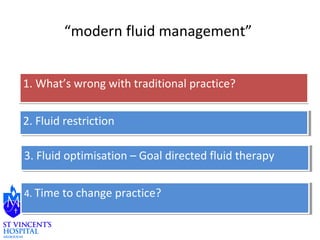
“modern fluid management” 
1. What’s wrong with ttrraaddiittiioonnaall pprraaccttiiccee?? 
22.. FFlluuiidd rreessttrriiccttiioonn 
33.. FFlluuiidd ooppttiimmiissaattiioonn –– GGooaall ddiirreecctteedd fflluuiidd tthheerraappyy 
44.. T Tiimmee ttoo cchhaannggee pprraaccttiiccee??
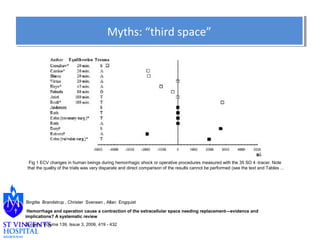
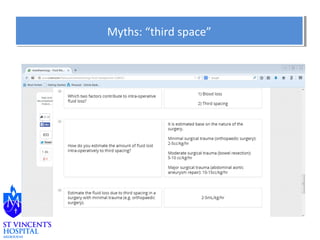
MMyytthhss:: ““tthhiirrdd ssppaaccee”” 
Fig 1 ECV changes in human beings during hemorrhagic shock or operative procedures measured with the 35 SO 4 -tracer. Note 
that the quality of the trials was very disparate and direct comparison of the results cannot be performed (see the text and Tables ... 
Birgitte Brandstrup , Christer Svensen , Allan Engquist 
Hemorrhage and operation cause a contraction of the extracellular space needing replacement—evidence and 
implications? A systematic review 
Surgery, Volume 139, Issue 3, 2006, 419 - 432
MMyytthhss:: ““tthhiirrdd ssppaaccee””
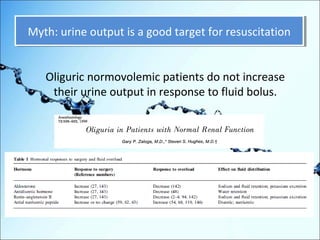
Myth: urine output is a good target Myth: urine output is a good target ffoorr rreessuusscciittaattiioonn 
Oliguric normovolemic patients do not increase 
their urine output in response to fluid bolus.
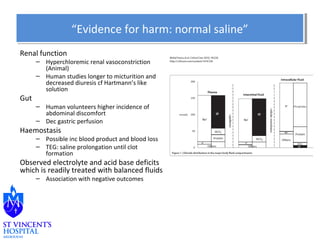
Renal function 
“Evidence “Evidence ffoorr hhaarrmm:: nnoorrmmaall ssaalliinnee”” 
– Hyperchloremic renal vasoconstriction 
(Animal) 
– Human studies longer to micturition and 
decreased diuresis cf Hartmann’s like 
solution 
Gut 
– Human volunteers higher incidence of 
abdominal discomfort 
– Dec gastric perfusion 
Haemostasis 
– Possible inc blood product and blood loss 
– TEG: saline prolongation until clot 
formation 
Observed electrolyte and acid base deficits 
which is readily treated with balanced fluids 
– Association with negative outcomes
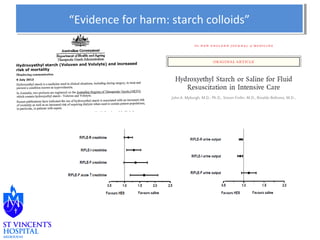
“Evidence for “Evidence for hhaarrmm:: ssttaarrcchh ccoollllooiiddss””
“modern fluid management” 
1. What’s wrong with ttrraaddiittiioonnaall pprraaccttiiccee?? 
22.. FFlluuiidd rreessttrriiccttiioonn 
33.. FFlluuiidd ooppttiimmiissaattiioonn –– GGooaall ddiirreecctteedd fflluuiidd tthheerraappyy 
44.. T Tiimmee ttoo cchhaannggee pprraaccttiiccee??
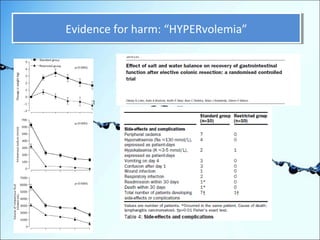
Evidence Evidence ffoorr hhaarrmm:: ““HHYYPPEERRvvoolleemmiiaa””
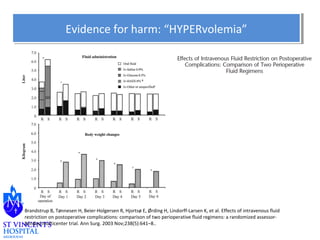
Evidence Evidence ffoorr hhaarrmm:: ““HHYYPPEERRvvoolleemmiiaa”” 
Brandstrup B, Tønnesen H, Beier-Holgersen R, Hjortsø E, Ørding H, Lindorff-Larsen K, et al. Effects of intravenous fluid 
restriction on postoperative complications: comparison of two perioperative fluid regimens: a randomized assessor-blinded 
multicenter trial. Ann Surg. 2003 Nov;238(5):641–8..
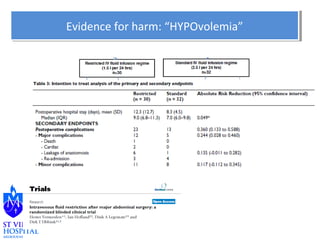
Evidence for Evidence for hhaarrmm:: ““HHYYPPOOvvoolleemmiiaa””
A trial in perioperative fluid therapy
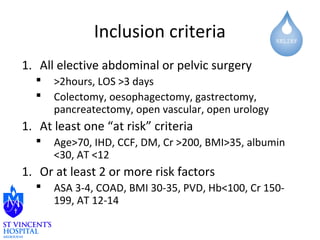
Inclusion criteria 
1. All elective abdominal or pelvic surgery 
 >2hours, LOS >3 days 
 Colectomy, oesophagectomy, gastrectomy, 
pancreatectomy, open vascular, open urology 
1. At least one “at risk” criteria 
 Age>70, IHD, CCF, DM, Cr >200, BMI>35, albumin 
<30, AT <12 
1. Or at least 2 or more risk factors 
 ASA 3-4, COAD, BMI 30-35, PVD, Hb<100, Cr 150- 
199, AT 12-14
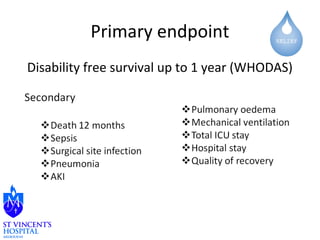
Primary endpoint 
Disability free survival up to 1 year (WHODAS)
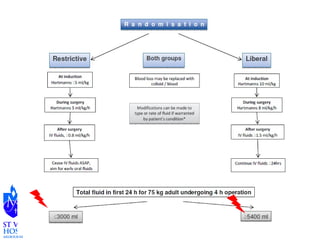
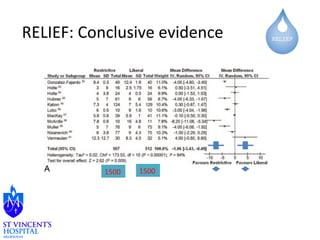
RELIEF: Conclusive evidence 
1500 1500
“modern fluid management” 
1. What’s wrong with ttrraaddiittiioonnaall pprraaccttiiccee?? 
22.. FFlluuiidd rreessttrriiccttiioonn 
33.. FFlluuiidd ooppttiimmiissaattiioonn –– GGooaall ddiirreecctteedd fflluuiidd tthheerraappyy 
44.. T Tiimmee ttoo cchhaannggee pprraaccttiiccee??
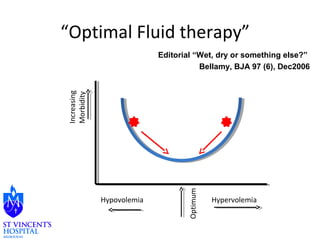
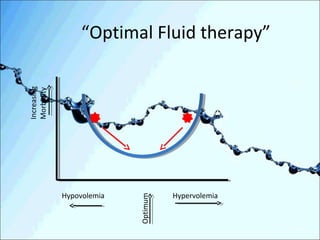
“Optimal Fluid therapy” 
Editorial “Wet, dry or something else?” 
Optimum 
Increasing 
Morbidity 
Bellamy, BJA 97 (6), Dec2006 
Hypovolemia Hypervolemia
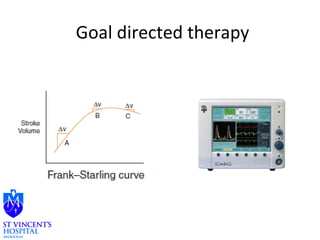
Goal directed therapy
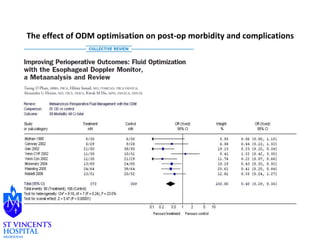
The effect of ODM optimisation on post-op morbidity and complications
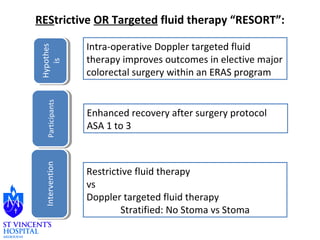
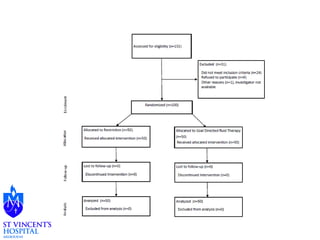
REStrictive OR Targeted fluid therapy “RESORT”: 
IInntteerrvveennttiioonn PPaarrttiicciippaannttss 
Enhanced recovery after surgery protocol 
ASA 1 to 3 
Restrictive fluid therapy 
vs 
Doppler targeted fluid therapy 
Stratified: No Stoma vs Stoma 
Hypothes 
Hypothes 
is 
is 
Intra-operative Doppler targeted fluid 
therapy improves outcomes in elective major 
colorectal surgery within an ERAS program
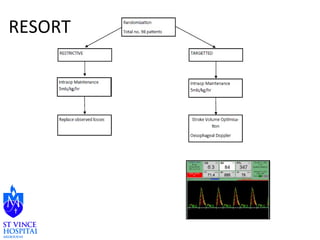
RESORT
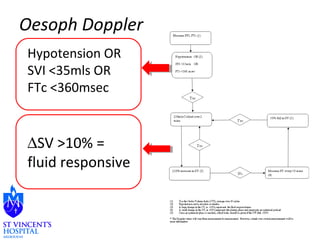
Oesoph Doppler 
Hypotension OR 
SVI <35mls OR 
FTc <360msec 
DSV >10% = 
fluid responsive
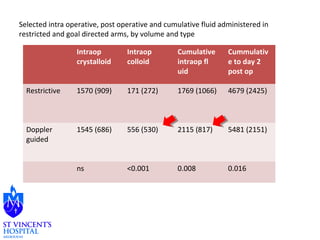
Selected intra operative, post operative and cumulative fluid administered in 
restricted and goal directed arms, by volume and type 
Intraop 
crystalloid 
Intraop 
colloid 
Cumulative 
intraop fl 
uid 
Cummulativ 
e to day 2 
post op 
Restrictive 1570 (909) 171 (272) 1769 (1066) 4679 (2425) 
Doppler 
guided 
1545 (686) 556 (530) 2115 (817) 5481 (2151) 
ns <0.001 0.008 0.016
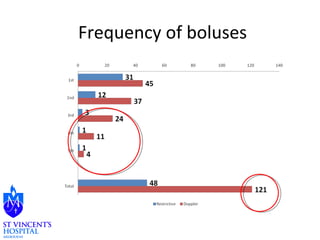
Frequency of boluses
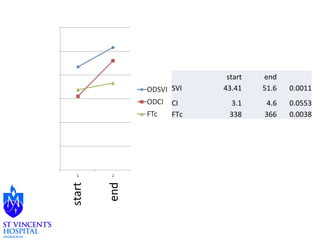
start end 
SVI 43.41 51.6 0.0011 
CI 3.1 4.6 0.0553 
FTc 338 366 0.0038 
start 
end
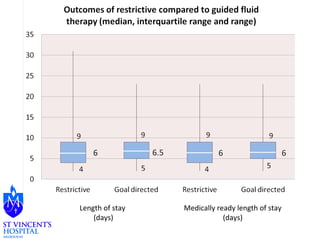
Length of stay 
(days) 
Medically ready length of stay 
(days)
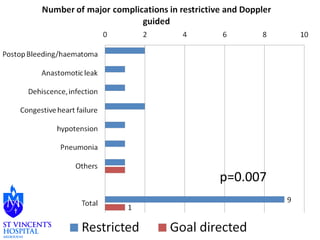
p=0.007
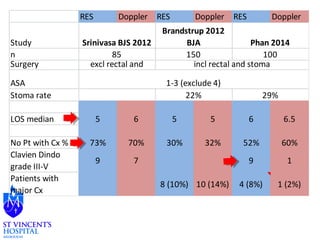
RES Doppler RES Doppler RES Doppler 
Study 
nS 
urgery 
ASA 
Stoma rate 
incl rectal and stoma 
1-3 (exclude 4) 
LOS median 5 6 5 5 6 6.5 
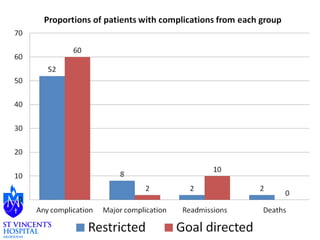
No Pt with Cx % 73% 70% 30% 32% 52% 60% 
Clavien Dindo 
9 7 9 1 
grade III-V 
Patients with 
major Cx 
8 (10%) 10 (14%) 4 (8%) 1 (2%) 
excl rectal and 
22% 29% 
Srinivasa BJS 2012 
Brandstrup 2012 
BJA Phan 2014 
85 150 100
LiDCOrapidTM
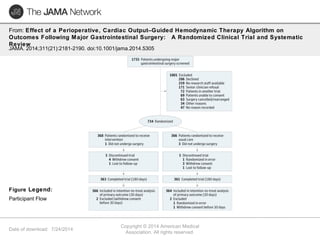
From: Effect of a Perioperative, Cardiac Output–Guided Hemodynamic Therapy Algorithm on 
Outcomes Following Major Gastrointestinal Surgery: A Randomized Clinical Trial and Systematic 
Review 
JAMA. 2014;311(21):2181-2190. doi:10.1001/jama.2014.5305 
Figure Legend: 
Date of download: 7/24/2014 
Copyright © 2014 American Medical 
Association. All rights reserved. 
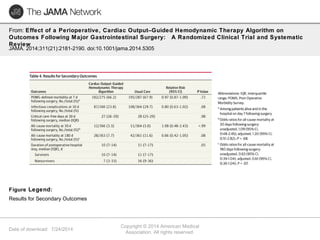
Participant Flow
From: Effect of a Perioperative, Cardiac Output–Guided Hemodynamic Therapy Algorithm on 
Outcomes Following Major Gastrointestinal Surgery: A Randomized Clinical Trial and Systematic 
Review 
JAMA. 2014;311(21):2181-2190. doi:10.1001/jama.2014.5305 
Figure Legend: 
Date of download: 7/24/2014 
Copyright © 2014 American Medical 
Association. All rights reserved. 
Results for Secondary Outcomes
From: Effect of a Perioperative, Cardiac Output–Guided Hemodynamic Therapy Algorithm on 
Outcomes Following Major Gastrointestinal Surgery: A Randomized Clinical Trial and Systematic 
Review 
JAMA. 2014;311(21):2181-2190. doi:10.1001/jama.2014.5305 
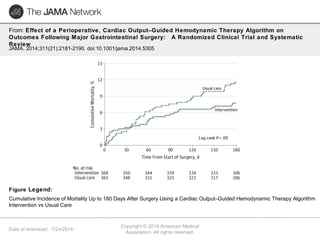
Cumulative Incidence of Mortality Up to 180 Days After Surgery Using a Cardiac Output–Guided Hemodynamic Therapy Algorithm 
Intervention vs Usual Care 
Date of download: 7/24/2014 
Copyright © 2014 American Medical 
Association. All rights reserved. 
Figure Legend:
From: Effect of a Perioperative, Cardiac Output–Guided Hemodynamic Therapy Algorithm on 
Outcomes Following Major Gastrointestinal Surgery: A Randomized Clinical Trial and Systematic 
Review 
JAMA. 2014;311(21):2181-2190. doi:10.1001/jama.2014.5305 
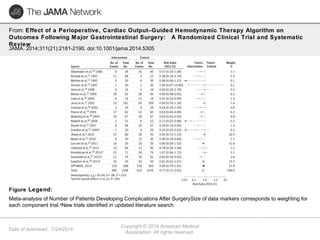
Meta-analysis of Number of Patients Developing Complications After SurgerySize of data markers corresponds to weighting for 
each component trial.aNew trials identified in updated literature search. 
Date of download: 7/24/2014 
Copyright © 2014 American Medical 
Association. All rights reserved. 
Figure Legend:
“Optimal Fluid therapy” 
Increasing 
Morbidity Hypovolemia Hypervolemia 
Optimum
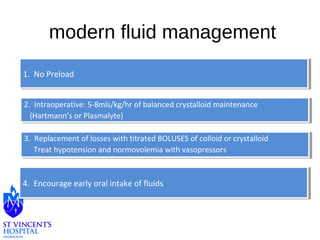
modern fluid management 
11. . N Noo P Prreeloloaadd 
2. Intraoperative: 5-8mls/kg/hr of balanced crystalloid maintenance 
(Hartmann’s or Plasmalyte) 
2. Intraoperative: 5-8mls/kg/hr of balanced crystalloid maintenance 
(Hartmann’s or Plasmalyte) 
3. Replacement of losses with titrated BOLUSES of colloid or crystalloid 
Treat hypotension and normovolemia with vasopressors 
3. Replacement of losses with titrated BOLUSES of colloid or crystalloid 
Treat hypotension and normovolemia with vasopressors 
44. . E Ennccoouurraaggee e eaarrlyly o orraal li ninttaakkee o off f fluluididss
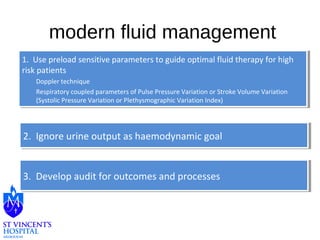
modern fluid management 
1. Use preload sensitive parameters to guide optimal fluid therapy for high 
risk patients 
1. Use preload sensitive parameters to guide optimal fluid therapy for high 
risk patients 
Doppler technique 
Respiratory coupled parameters of Pulse Pressure Variation or Stroke Volume Variation 
(Systolic Pressure Variation or Plethysmographic Variation Index) 
Doppler technique 
Respiratory coupled parameters of Pulse Pressure Variation or Stroke Volume Variation 
(Systolic Pressure Variation or Plethysmographic Variation Index) 
2. Ignore 2. Ignore u urrininee o ouuttppuutt a ass h haaeemmooddyynnaammicic g gooaall 
33.. D Deevveelolopp a auudditit f foorr o ouuttccoommeess a anndd p prroocceesssseess
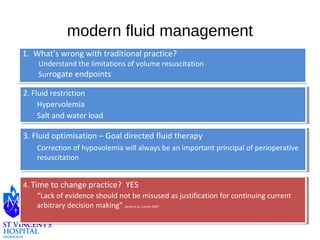
modern fluid management 
1. What’s wrong with traditional practice? 
Understand the limitations of volume resuscitation 
Surrogate endpoints 
2. Fluid restriction 
Hypervolemia 
Salt and water load 
Hypervolemia 
Salt and water load 
3. Fluid optimisation – Goal directed fluid therapy 
Correction of hypovolemia will always be an important principal of perioperative 
resuscitation 
Correction of hypovolemia will always be an important principal of perioperative 
resuscitation 
4. Time to change practice? YES 
“Lack of evidence should not be misused as justification for continuing current 
arbitrary decision making” Jacob et al, Lancet 2007 
“Lack of evidence should not be misused as justification for continuing current 
arbitrary decision making” Jacob et al, Lancet 2007

02 tuong phan

  • 1.
    Modern perioperative fluid management Dr Tuong Phan Staff Specialist Anaesthetist, Dept Anaes and Pain Medicine St Vincent’s Hospital Melbourne
  • 2.
    Disclosures: Grant fundingfrom ANZCA, and St Vincent’s Research Fund RELIEF - Site Investigator St Vincent’s Melbourne
  • 3.
    “modern fluid management” 1. What’s wrong with ttrraaddiittiioonnaall pprraaccttiiccee?? 22.. FFlluuiidd rreessttrriiccttiioonn 33.. FFlluuiidd ooppttiimmiissaattiioonn –– GGooaall ddiirreecctteedd fflluuiidd tthheerraappyy 44.. T Tiimmee ttoo cchhaannggee pprraaccttiiccee??
  • 4.
    MMyytthhss:: ““tthhiirrdd ssppaaccee”” Fig 1 ECV changes in human beings during hemorrhagic shock or operative procedures measured with the 35 SO 4 -tracer. Note that the quality of the trials was very disparate and direct comparison of the results cannot be performed (see the text and Tables ... Birgitte Brandstrup , Christer Svensen , Allan Engquist Hemorrhage and operation cause a contraction of the extracellular space needing replacement—evidence and implications? A systematic review Surgery, Volume 139, Issue 3, 2006, 419 - 432
  • 5.
  • 6.
    Myth: urine outputis a good target Myth: urine output is a good target ffoorr rreessuusscciittaattiioonn Oliguric normovolemic patients do not increase their urine output in response to fluid bolus.
  • 7.
    Renal function “Evidence“Evidence ffoorr hhaarrmm:: nnoorrmmaall ssaalliinnee”” – Hyperchloremic renal vasoconstriction (Animal) – Human studies longer to micturition and decreased diuresis cf Hartmann’s like solution Gut – Human volunteers higher incidence of abdominal discomfort – Dec gastric perfusion Haemostasis – Possible inc blood product and blood loss – TEG: saline prolongation until clot formation Observed electrolyte and acid base deficits which is readily treated with balanced fluids – Association with negative outcomes
  • 8.
    “Evidence for “Evidencefor hhaarrmm:: ssttaarrcchh ccoollllooiiddss””
  • 9.
    “modern fluid management” 1. What’s wrong with ttrraaddiittiioonnaall pprraaccttiiccee?? 22.. FFlluuiidd rreessttrriiccttiioonn 33.. FFlluuiidd ooppttiimmiissaattiioonn –– GGooaall ddiirreecctteedd fflluuiidd tthheerraappyy 44.. T Tiimmee ttoo cchhaannggee pprraaccttiiccee??
  • 10.
    Evidence Evidence ffoorrhhaarrmm:: ““HHYYPPEERRvvoolleemmiiaa””
  • 11.
    Evidence Evidence ffoorrhhaarrmm:: ““HHYYPPEERRvvoolleemmiiaa”” Brandstrup B, Tønnesen H, Beier-Holgersen R, Hjortsø E, Ørding H, Lindorff-Larsen K, et al. Effects of intravenous fluid restriction on postoperative complications: comparison of two perioperative fluid regimens: a randomized assessor-blinded multicenter trial. Ann Surg. 2003 Nov;238(5):641–8..
  • 12.
    Evidence for Evidencefor hhaarrmm:: ““HHYYPPOOvvoolleemmiiaa””
  • 13.
    A trial inperioperative fluid therapy
  • 14.
    Inclusion criteria 1.All elective abdominal or pelvic surgery  >2hours, LOS >3 days  Colectomy, oesophagectomy, gastrectomy, pancreatectomy, open vascular, open urology 1. At least one “at risk” criteria  Age>70, IHD, CCF, DM, Cr >200, BMI>35, albumin <30, AT <12 1. Or at least 2 or more risk factors  ASA 3-4, COAD, BMI 30-35, PVD, Hb<100, Cr 150- 199, AT 12-14
  • 15.
    Primary endpoint Disabilityfree survival up to 1 year (WHODAS)
  • 17.
  • 18.
    “modern fluid management” 1. What’s wrong with ttrraaddiittiioonnaall pprraaccttiiccee?? 22.. FFlluuiidd rreessttrriiccttiioonn 33.. FFlluuiidd ooppttiimmiissaattiioonn –– GGooaall ddiirreecctteedd fflluuiidd tthheerraappyy 44.. T Tiimmee ttoo cchhaannggee pprraaccttiiccee??
  • 19.
    “Optimal Fluid therapy” Editorial “Wet, dry or something else?” Optimum Increasing Morbidity Bellamy, BJA 97 (6), Dec2006 Hypovolemia Hypervolemia
  • 20.
  • 21.
    The effect ofODM optimisation on post-op morbidity and complications
  • 22.
    REStrictive OR Targetedfluid therapy “RESORT”: IInntteerrvveennttiioonn PPaarrttiicciippaannttss Enhanced recovery after surgery protocol ASA 1 to 3 Restrictive fluid therapy vs Doppler targeted fluid therapy Stratified: No Stoma vs Stoma Hypothes Hypothes is is Intra-operative Doppler targeted fluid therapy improves outcomes in elective major colorectal surgery within an ERAS program
  • 23.
  • 24.
    Oesoph Doppler HypotensionOR SVI <35mls OR FTc <360msec DSV >10% = fluid responsive
  • 26.
    Selected intra operative,post operative and cumulative fluid administered in restricted and goal directed arms, by volume and type Intraop crystalloid Intraop colloid Cumulative intraop fl uid Cummulativ e to day 2 post op Restrictive 1570 (909) 171 (272) 1769 (1066) 4679 (2425) Doppler guided 1545 (686) 556 (530) 2115 (817) 5481 (2151) ns <0.001 0.008 0.016
  • 27.
  • 28.
    start end SVI43.41 51.6 0.0011 CI 3.1 4.6 0.0553 FTc 338 366 0.0038 start end
  • 29.
    Length of stay (days) Medically ready length of stay (days)
  • 32.
  • 33.
    RES Doppler RESDoppler RES Doppler Study nS urgery ASA Stoma rate incl rectal and stoma 1-3 (exclude 4) LOS median 5 6 5 5 6 6.5 No Pt with Cx % 73% 70% 30% 32% 52% 60% Clavien Dindo 9 7 9 1 grade III-V Patients with major Cx 8 (10%) 10 (14%) 4 (8%) 1 (2%) excl rectal and 22% 29% Srinivasa BJS 2012 Brandstrup 2012 BJA Phan 2014 85 150 100
  • 34.
  • 36.
    From: Effect ofa Perioperative, Cardiac Output–Guided Hemodynamic Therapy Algorithm on Outcomes Following Major Gastrointestinal Surgery: A Randomized Clinical Trial and Systematic Review JAMA. 2014;311(21):2181-2190. doi:10.1001/jama.2014.5305 Figure Legend: Date of download: 7/24/2014 Copyright © 2014 American Medical Association. All rights reserved. Participant Flow
  • 37.
    From: Effect ofa Perioperative, Cardiac Output–Guided Hemodynamic Therapy Algorithm on Outcomes Following Major Gastrointestinal Surgery: A Randomized Clinical Trial and Systematic Review JAMA. 2014;311(21):2181-2190. doi:10.1001/jama.2014.5305 Figure Legend: Date of download: 7/24/2014 Copyright © 2014 American Medical Association. All rights reserved. Results for Secondary Outcomes
  • 38.
    From: Effect ofa Perioperative, Cardiac Output–Guided Hemodynamic Therapy Algorithm on Outcomes Following Major Gastrointestinal Surgery: A Randomized Clinical Trial and Systematic Review JAMA. 2014;311(21):2181-2190. doi:10.1001/jama.2014.5305 Cumulative Incidence of Mortality Up to 180 Days After Surgery Using a Cardiac Output–Guided Hemodynamic Therapy Algorithm Intervention vs Usual Care Date of download: 7/24/2014 Copyright © 2014 American Medical Association. All rights reserved. Figure Legend:
  • 39.
    From: Effect ofa Perioperative, Cardiac Output–Guided Hemodynamic Therapy Algorithm on Outcomes Following Major Gastrointestinal Surgery: A Randomized Clinical Trial and Systematic Review JAMA. 2014;311(21):2181-2190. doi:10.1001/jama.2014.5305 Meta-analysis of Number of Patients Developing Complications After SurgerySize of data markers corresponds to weighting for each component trial.aNew trials identified in updated literature search. Date of download: 7/24/2014 Copyright © 2014 American Medical Association. All rights reserved. Figure Legend:
  • 40.
    “Optimal Fluid therapy” Increasing Morbidity Hypovolemia Hypervolemia Optimum
  • 41.
    modern fluid management 11. . N Noo P Prreeloloaadd 2. Intraoperative: 5-8mls/kg/hr of balanced crystalloid maintenance (Hartmann’s or Plasmalyte) 2. Intraoperative: 5-8mls/kg/hr of balanced crystalloid maintenance (Hartmann’s or Plasmalyte) 3. Replacement of losses with titrated BOLUSES of colloid or crystalloid Treat hypotension and normovolemia with vasopressors 3. Replacement of losses with titrated BOLUSES of colloid or crystalloid Treat hypotension and normovolemia with vasopressors 44. . E Ennccoouurraaggee e eaarrlyly o orraal li ninttaakkee o off f fluluididss
  • 42.
    modern fluid management 1. Use preload sensitive parameters to guide optimal fluid therapy for high risk patients 1. Use preload sensitive parameters to guide optimal fluid therapy for high risk patients Doppler technique Respiratory coupled parameters of Pulse Pressure Variation or Stroke Volume Variation (Systolic Pressure Variation or Plethysmographic Variation Index) Doppler technique Respiratory coupled parameters of Pulse Pressure Variation or Stroke Volume Variation (Systolic Pressure Variation or Plethysmographic Variation Index) 2. Ignore 2. Ignore u urrininee o ouuttppuutt a ass h haaeemmooddyynnaammicic g gooaall 33.. D Deevveelolopp a auudditit f foorr o ouuttccoommeess a anndd p prroocceesssseess
  • 43.
    modern fluid management 1. What’s wrong with traditional practice? Understand the limitations of volume resuscitation Surrogate endpoints 2. Fluid restriction 2. Fluid restriction Hypervolemia Salt and water load Hypervolemia Salt and water load 3. Fluid optimisation – Goal directed fluid therapy 3. Fluid optimisation – Goal directed fluid therapy Correction of hypovolemia will always be an important principal of perioperative resuscitation Correction of hypovolemia will always be an important principal of perioperative resuscitation 4. Time to change practice? YES 4. Time to change practice? YES “Lack of evidence should not be misused as justification for continuing current arbitrary decision making” Jacob et al, Lancet 2007 “Lack of evidence should not be misused as justification for continuing current arbitrary decision making” Jacob et al, Lancet 2007

Editor's Notes

  • #3 Single campus, public and private 5 surgeon – teaching hospital
  • #7 100 patients in ICU – 18 developed oliguria. 11/18 had clinical eupovolemia that did not respond to fluid bolus. Of note 7/18 had hypovolemia and did respond. ADH played a role in oliguria. Table shows that the response to surgery leads to a number of The question is not is the patient oliguria = bad. But that oliguria and review the patient if they are euvolemic then don’t worry. Oliguria &amp;lt;20mls/hr
  • #8 Younos Bellomo Cochrane – only signficant diff in metaanalysis 700+ patients Electrolyte abnormalities – hyperchloremia, acidosis More platelet transfusion No diff in mortality, n+V, blood t/f, LOS
  • #11 Lobo – reduced complications and hospital stay Brandstrup 172, colorectal fewer cx 33 vs 51 deaths 0 vs 4 Nisanevich 152, elective abdominal patients faster return of gut fun, less cx and shorter los Kabon 253 colorectal – no difference, holte 32 fastrack – higher cx in restrictive group. metaanalsis
  • #14 NHMRC: back to basics Tries to address the heterogeneity of current mix of trials. By being the definitive: 3000 patients. Powered for real patient centre end points. Generalizability will be immense – the results of this study would change practice if it favours a treatment. What it does NOT do is study a fixed fluid regimen compared with an individualized targetted regimen in a randomized manner.
  • #18 Forrest plot of LOS RES vs Lib Total 1000.
  • #20 Contemporary While there are controversies, this concept that fluid therapy matters is important. You can stuff up a patients recovery/complication rate by giving unwanted fluid load or not giving enough. How you give just enough is a matter of contention.
  • #21 Keys to fluid optimisation: Frank Starling relationship Fluid responsive Non-fluid responsive Caveats: do we have a reliable monitor to assess this Does achieving this conceptual haemodynamic target result in improved patient outcomes Despite the caveats, these monitors offer us a greater understanding of where the patient is at compared to std monitoring and if we allow it too, it could influence our decision making to improve patient outcomes.
  • #23 ERAS – contemporary practice. Fluid specific CHO load. Early enteral. Avoid bowel prep. Things that reduce periop morbidity: Education. NG, IDC, drain tubes. Laparascopic, tissue handling. ASA 1 to 3 – this is what I wanted to study. I wanted to say to patients walking up to have colorectal surgery – we have the best recovery planned for you possilbe, within that anaesthesia will give you the best fluid resuscitation there is. Restrictive – no clear evidence base but part and parcel with many eras programs. Doppler – targetted. Not goal directed. No inotropes – inappropriate. Doppler the strongest evidence base. No clear expertise amongst all the department.
  • #25 Amend slightly the algorithm for my institution. Reason bolus. Using absolute, FTc. Clinically relevant. SVO 10% At least it gave a signal for clinicians to agree not to give fluid therapy. Avoid the problem of Challand
  • #27 What is the mean values for fluid administration. Crystalloid – nd Colloid – statistically significant, clinically irrelevant Post op d1 – unexplained difference of 500mls, imed, blinded ward protocols.
  • #28 Boluses are more frequent in Doppler group Whilst the mean is only 1 bag. The difference is that that in 20 patients they had extra 0.5L and in 20% extra 1 L FR persisted longer Shows that SVO was done to my satisfaction – only a proportion of patients are FR and got &amp;gt;500mls of fluid.
  • #29 Successful optimisation of haemodynamic parameters
  • #31 Overall terms Between the two groups Any nd Major nd 30d Readmission nd – hernia repair, vomiting, pain, one wound infection, community acq pneumonia. Death – male 74, asa 2 asthma, rectal resection stoma, good progress d3 – fluid down, idc out, coffee ground vomiting. Rapid deterioration – hypotension, hypovolemia, mof. No signs of AMI, or adverse finding intraop beyond bowel with poor perfusion. Gut looks like the source – but not clearly ischaemic bowel. Cardiogenic shock for want of a better diagnosis.
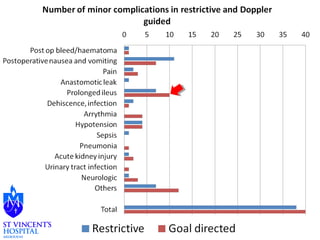
  • #32 Count of complications grade 1 (any deviation from normal postop course without specific treatment or allowed drugs analgesia, antiemetic) to 2 (requiring pharmacological treament, blood tf or tpn). No treatment or ward based treatment. Blood transfusion, ngt, low uo, cr&amp;gt;200 or doubling, clinical with treatment, neurologic – delirium. Hypotension – nd PONV – less in gdt, and ileus favour res. Inconclusive benefit for gdt in gi morbidity.
  • #33 Count of major complications. Of the 4 RES that had cx, 9 major 1 GDT, 1 major Uncertainty – Small numbers. Not in keeping with the minor complications.
  • #34 Contemporary ERAS GDT nd
  • #41 Some studies I suspect start with hypovolemia and as a result tdargetted therapy may have benefitted the patients Some studies are hypervolemia. Compare traditional approach to a new therapeutic idea in a sufficiently high number of patients If the study group is better than the control then the study group is the future If not then nothing changes Problems No easily defined control – heterogeneity of practice. Btw clinicians and hospitals and countries. Not just of fluid practice but periop practice What is restrictive in one group is liberal in another
  • #44 Thinking about the concept and being deliberate will be enough to bring about change.