What is
Corrections?
Chapter 1
History of Corrections
 Continuously rising crime rates through the
70s-90s
 Tough on crime stance
 Continued to rise through 2008
American Corrections Today
 Currently more than 3,200 death row inmates
 140,000 + life sentences
 Prisons and jails= 2.3 million inmates
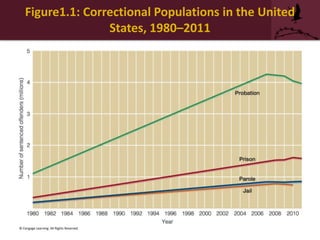
 As of 2011, numbers of inmates have begun to
decrease as well as those on probation
Figure1.1: Correctional Populations in the United
States, 1980–2011
© Cengage Learning. All Rights Reserved.
American Corrections Today
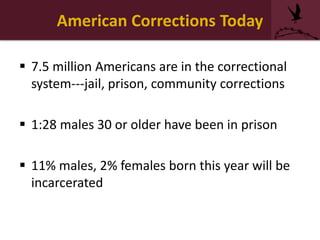
 7.5 million Americans are in the correctional
system---jail, prison, community corrections
 1:28 males 30 or older have been in prison
 11% males, 2% females born this year will be
incarcerated
The Purpose of Corrections
Corrections
Variety of programs, services, facilities, and
organizations responsible for the management
of individuals who have been accused or
convicted of criminal offenses
The Purpose of Corrections
 Social Control
 Helps Define the Limits of Behavior
 Punishment
 Change offenders through corrective action
 Public, private organizations
 State, local, federal governments
 Community and closed settings
A Systems Framework for Studying
Corrections
 System
 Police, prosecutors, courts, corrections
 Goals
 Punishment
 Protection
Discussion Question
Have correctional goals of fair punishment and
community protection been maintained over
the last 10-20 years? Explain.
A Systems Framework for Studying
Corrections
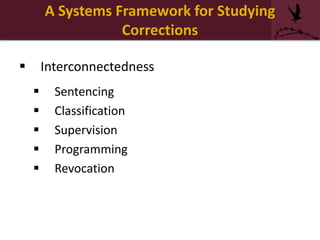
 Interconnectedness
 Sentencing
 Classification
 Supervision
 Programming
 Revocation
A Systems Framework for Studying
Corrections
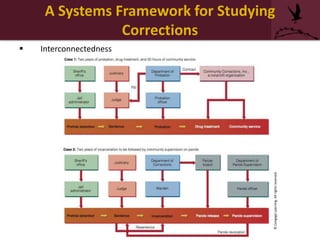
 Interconnectedness
©CengageLearning.Allrightsreserved.
A Systems Framework for Studying
Corrections
 Environment
 Public opinion
 Fiscal constraints
 The law
A Systems Framework for Studying
Corrections
 Feedback
 Learn
 Grow
 Improve
 Trouble obtaining useful feedback
A Systems Framework for Studying
Corrections
 Complexity
 Pretrial drug treatment
 Electronically monitored home confinement
 Work centers
 Private, nonprofit residential treatment
programs
Discussion Question
What if... correctional spending on the state
level was cut to a minimum, allowing only
violent and repeat offenders to be housed in
correctional facilities, and fines and probation
were used for property and less serious
crimes? Would this reduce crime? What other
impacts would this move have on society?
The Corrections System Today
 Federalism
 State Level Corrections
 California
 Florida
 New York
 Texas
The Corrections System Today
 Main Components of Corrections
 Prison
 Jail
 Probation
 Intermediate sanctions
 Parole
The History of Corrections In America
 The Colonial Period (1620-1776)
 “The Great Law”
 The Quaker Code
 The Anglican Code
Discussion Question
What if... the modern penitentiary movement
had failed and banishment, public
punishments, and fines were still the means
for dealing with common criminals? Would
this be a deterrent for violent crimes and
property crimes? Explain.
The History of Corrections In America
 The Arrival of the Penitentiary (1760-1830)
 The Penitentiary Act of 1779
 Four principles
 A secure and sanitary building
 Inspection to ensure that offenders followed the rules
 Abolition of fees charged offenders for their food
 A reformatory regime
The History of Corrections In America
 East State Penitentiary
 The Pennsylvania System
 Five principles
 Prisoners would not be treated vengefully
 Solitary confinement would prevent further
corruption
 In isolation, offenders would reflect on their
transgressions and repent
 Solitary confinement would be punishment
 Solitary confinement would be economical
The History of Corrections In America
 The Arrival of the Penitentiary
 The New York (Auburn) System
 Congregate System
 Isolation at night
 Workshops in the day
The History of Corrections In America
 The Arrival of the Penitentiary
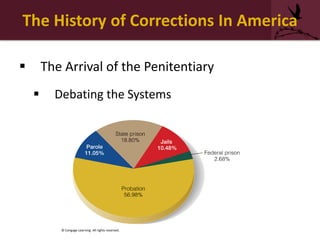
 Debating the Systems
© Cengage Learning. All rights reserved.
Discussion Question
What if… the Pennsylvania style of corrections
had won out in the 1800s and isolation was
still used today? Would this reduce recidivism
if economically possible? What other impacts
might it have on society?
The History of Corrections In America
 The Arrival of the Penitentiary
 Prisons in the South and West
 Lease system
 Anticontract Law of 1887
The History of Corrections In America
 The Reformatory Movement
 Alexander Maconochie—mark system
 Cincinnati, 1870
 National Prison Association: Declaration of Principles
 Elmira Reformatory
 Zebulon Brockway
 Three grade system of classification
 Indeterminate sentence
The History of Corrections In America
 Corrections in the Twentieth Century
 The Progressives
 The Positivist School—social, economic,
biological, psychological factors
 The Medical Model
 Social deficiencies
 Psychological deficiencies
 Biological deficiencies
The History of Corrections In America
 Corrections in the Twentieth Century
 The Community Model
 Civil rights movement
 War on poverty
 Vietnam War
 President’s Commission on Law Enforcement and
Administration of Justice
 Attica
The History of Corrections In America
 Corrections in the Twentieth Century
 The Decline of Rehabilitation
 Public concern about rising crime rates
 Studies challenge treatment programs
 Martinson
 Correctional discretion
The History of Corrections In America
 Corrections in the Twentieth Century
 The Emergence of Crime Control
 Determinate sentencing
 Incarceration
 Risk containment
 Intensive supervision probation
 Mandatory penalties
 Evidence-based corrections
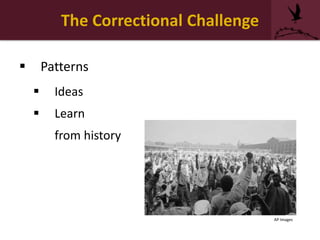
The Correctional Challenge
 Patterns
 Ideas
 Learn
from history
AP Images

Chapter1

  • 1.
  • 2.
    History of Corrections Continuously rising crime rates through the 70s-90s  Tough on crime stance  Continued to rise through 2008
  • 3.
    American Corrections Today Currently more than 3,200 death row inmates  140,000 + life sentences  Prisons and jails= 2.3 million inmates  As of 2011, numbers of inmates have begun to decrease as well as those on probation
  • 4.
    Figure1.1: Correctional Populationsin the United States, 1980–2011 © Cengage Learning. All Rights Reserved.
  • 5.
    American Corrections Today 7.5 million Americans are in the correctional system---jail, prison, community corrections  1:28 males 30 or older have been in prison  11% males, 2% females born this year will be incarcerated
  • 6.
    The Purpose ofCorrections Corrections Variety of programs, services, facilities, and organizations responsible for the management of individuals who have been accused or convicted of criminal offenses
  • 7.
    The Purpose ofCorrections  Social Control  Helps Define the Limits of Behavior  Punishment  Change offenders through corrective action  Public, private organizations  State, local, federal governments  Community and closed settings
  • 8.
    A Systems Frameworkfor Studying Corrections  System  Police, prosecutors, courts, corrections  Goals  Punishment  Protection
  • 9.
    Discussion Question Have correctionalgoals of fair punishment and community protection been maintained over the last 10-20 years? Explain.
  • 10.
    A Systems Frameworkfor Studying Corrections  Interconnectedness  Sentencing  Classification  Supervision  Programming  Revocation
  • 11.
    A Systems Frameworkfor Studying Corrections  Interconnectedness ©CengageLearning.Allrightsreserved.
  • 12.
    A Systems Frameworkfor Studying Corrections  Environment  Public opinion  Fiscal constraints  The law
  • 13.
    A Systems Frameworkfor Studying Corrections  Feedback  Learn  Grow  Improve  Trouble obtaining useful feedback
  • 14.
    A Systems Frameworkfor Studying Corrections  Complexity  Pretrial drug treatment  Electronically monitored home confinement  Work centers  Private, nonprofit residential treatment programs
  • 15.
    Discussion Question What if...correctional spending on the state level was cut to a minimum, allowing only violent and repeat offenders to be housed in correctional facilities, and fines and probation were used for property and less serious crimes? Would this reduce crime? What other impacts would this move have on society?
  • 16.
    The Corrections SystemToday  Federalism  State Level Corrections  California  Florida  New York  Texas
  • 17.
    The Corrections SystemToday  Main Components of Corrections  Prison  Jail  Probation  Intermediate sanctions  Parole
  • 18.
    The History ofCorrections In America  The Colonial Period (1620-1776)  “The Great Law”  The Quaker Code  The Anglican Code
  • 19.
    Discussion Question What if...the modern penitentiary movement had failed and banishment, public punishments, and fines were still the means for dealing with common criminals? Would this be a deterrent for violent crimes and property crimes? Explain.
  • 20.
    The History ofCorrections In America  The Arrival of the Penitentiary (1760-1830)  The Penitentiary Act of 1779  Four principles  A secure and sanitary building  Inspection to ensure that offenders followed the rules  Abolition of fees charged offenders for their food  A reformatory regime
  • 21.
    The History ofCorrections In America  East State Penitentiary  The Pennsylvania System  Five principles  Prisoners would not be treated vengefully  Solitary confinement would prevent further corruption  In isolation, offenders would reflect on their transgressions and repent  Solitary confinement would be punishment  Solitary confinement would be economical
  • 22.
    The History ofCorrections In America  The Arrival of the Penitentiary  The New York (Auburn) System  Congregate System  Isolation at night  Workshops in the day
  • 23.
    The History ofCorrections In America  The Arrival of the Penitentiary  Debating the Systems © Cengage Learning. All rights reserved.
  • 24.
    Discussion Question What if…the Pennsylvania style of corrections had won out in the 1800s and isolation was still used today? Would this reduce recidivism if economically possible? What other impacts might it have on society?
  • 25.
    The History ofCorrections In America  The Arrival of the Penitentiary  Prisons in the South and West  Lease system  Anticontract Law of 1887
  • 26.
    The History ofCorrections In America  The Reformatory Movement  Alexander Maconochie—mark system  Cincinnati, 1870  National Prison Association: Declaration of Principles  Elmira Reformatory  Zebulon Brockway  Three grade system of classification  Indeterminate sentence
  • 27.
    The History ofCorrections In America  Corrections in the Twentieth Century  The Progressives  The Positivist School—social, economic, biological, psychological factors  The Medical Model  Social deficiencies  Psychological deficiencies  Biological deficiencies
  • 28.
    The History ofCorrections In America  Corrections in the Twentieth Century  The Community Model  Civil rights movement  War on poverty  Vietnam War  President’s Commission on Law Enforcement and Administration of Justice  Attica
  • 29.
    The History ofCorrections In America  Corrections in the Twentieth Century  The Decline of Rehabilitation  Public concern about rising crime rates  Studies challenge treatment programs  Martinson  Correctional discretion
  • 30.
    The History ofCorrections In America  Corrections in the Twentieth Century  The Emergence of Crime Control  Determinate sentencing  Incarceration  Risk containment  Intensive supervision probation  Mandatory penalties  Evidence-based corrections
  • 31.
    The Correctional Challenge Patterns  Ideas  Learn from history AP Images

Editor's Notes

  • #5 Source: Bureau of Justice Statistics Correctional Surveys (The Annual Probation and Parole Survey, National Prisoner Statistics, and The Survey of Jails). The Bureau of Justice Statistics is the major source of criminal justice data: bjs.gov.
  • #24 Source: Bureau of Justice Statistics, www.ojp.usdoj.gov/bjs, June 2010.