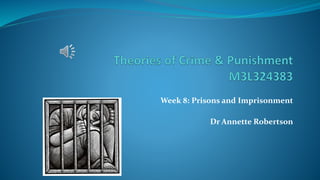
Week 8: Prisons and Imprisonment
Dr Annette Robertson
Learning Outcomes
 How did ‘the prison’ emerge and develop?
 How has the role of the prison changed?
 What patterns and trends are discernible in terms of the extent and
nature of imprisonment?
 What contemporary issues does the use of imprisonment raise?
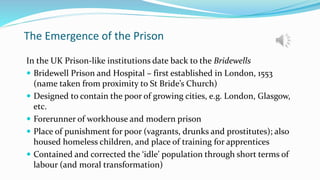
The Emergence of the Prison
In the UK Prison-like institutions date back to the Bridewells
 Bridewell Prison and Hospital – first established in London, 1553
(name taken from proximity to St Bride’s Church)
 Designed to contain the poor of growing cities, e.g. London, Glasgow,
etc.
 Forerunner of workhouse and modern prison
 Place of punishment for poor (vagrants, drunks and prostitutes); also
housed homeless children, and place of training for apprentices
 Contained and corrected the ‘idle’ population through short terms of
labour (and moral transformation)
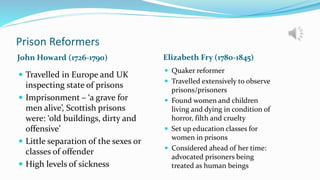
Prison Reformers
John Howard (1726-1790) Elizabeth Fry (1780-1845)
 Travelled in Europe and UK
inspecting state of prisons
 Imprisonment – ‘a grave for
men alive’, Scottish prisons
were: ‘old buildings, dirty and
offensive’
 Little separation of the sexes or
classes of offender
 High levels of sickness
 Quaker reformer
 Travelled extensively to observe
prisons/prisoners
 Found women and children
living and dying in condition of
horror, filth and cruelty
 Set up education classes for
women in prisons
 Considered ahead of her time:
advocated prisoners being
treated as human beings
American Prison Pioneer: Benjamin Rush (1746-1813)
 Opposed to death penalty & cruel, inhumane public punishment
 Promoted prison as rational, enlightened form of punishment
 But, argued that prison should be a ‘world apart’
 Because it is an unknown space it should ‘terrify the imagination’
Rush’s vision for penitentiaries
Let a large house be erected in a remote part of the state. Let the
avenue to this house be rendered difficult and gloomy by mountains
and morasses. Let its doors be of iron; and let the grating, occasioned
by opening and shutting them, be increased by an echo from a
neighbouring mountain, that shall extend and continue a sound that
shall deeply pierce the soul. Let a guard constantly attend at a gate
that shall lead to this place of punishment, to prevent strangers from
entering it. Let all the officers of the house be strictly forbidden to
discover any signs of mirth, or even levity, in the presence of the
criminals. To increase the horror of this abode of discipline and
misery, let it be called by some name that shall import its design. (Rush,
in Sullivan 1998: 339)
Eastern State Penitentiary, USA
Prison Reform in the UK
 1779: Penitentiary Act - reform through work and penance
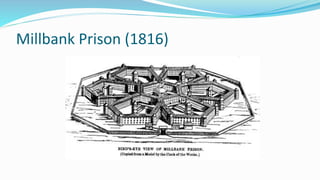
 1816: Millbank, first National Penitentiary in the UK
 Shift toward segregation and isolation of prisoners – total
institutions
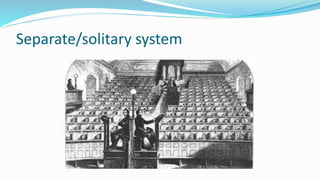
1. ‘Separate system’: isolation all day every day
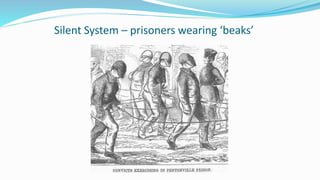
2. ‘Silent system’: isolation at night; silent association with others
during day
 ‘Day after day, with no companion but his thoughts, the convict is compelled to
listen to the reproofs of conscience. He is led to dwell upon past errors, and to
cherish whatever better feelings he may at any time have imbibed. [...] The mind
becomes open to the best impressions and prepared for the reception of those
truths and consolations which Christianity can alone impart.’ (Crawford, in Smith,
2004: 206)
Millbank Prison (1816)
Separate/solitary system
Silent System – prisoners wearing ‘beaks’
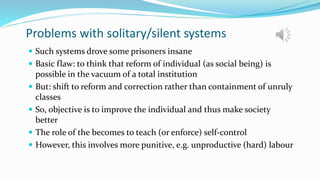
Problems with solitary/silent systems
 Such systems drove some prisoners insane
 Basic flaw: to think that reform of individual (as social being) is
possible in the vacuum of a total institution
 But: shift to reform and correction rather than containment of unruly
classes
 So, objective is to improve the individual and thus make society
better
 The role of the becomes to teach (or enforce) self-control
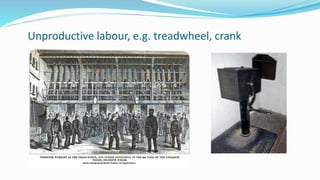
 However, this involves more punitive, e.g. unproductive (hard) labour
Unproductive labour, e.g. treadwheel, crank
Gladstone Report (1895)
 ‘We start from the principle that prison treatment should have as its
primary and concurrent objects deterrence and reformation’
 Unproductive labour abolished
 Productive labour in association encouraged (as privilege)
 Greater provision of books and educational facilities
 Reduced solitary conferment (no reform ethos)
 Juvenile system for aged up to 23
 But …longer sentences for ‘habitual criminals’
 After-care to be provided and contact allowed before release
20th century developments
 1948 Criminal Justice Act: abolition of corporal punishment in
prisons
 Advent of detention centres (short fixed sentences for young
offenders) and attendance centres (for petty offenders) – see
Criminal Justice Act 1982
 More focus on probation, supervision, and control
 Gradual process of de-carceration
Towards the end of the 20th century…
 Rehabilitative scepticism – the ‘nothing works’
argument replaced by claims that ‘prison works’ (see
Garland)
 Decarceration replaced by the phenomenon of ‘mass
imprisonment’ (see last week)
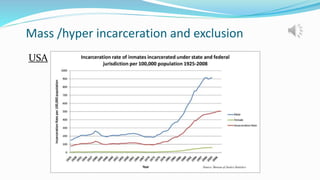
 E.g. in US, between late 20th century and early 21st, the
prison population increased five-fold (96 per 100,000
to 491 per 100,000). As of 2017 stood at 666/100,000.
Mass /hyper incarceration and exclusion
USA
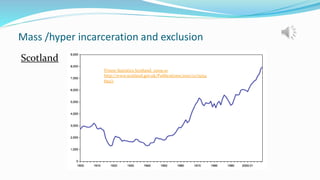
Mass /hyper incarceration and exclusion
Scotland
Prison Statistics Scotland: 2009-10
http://www.scotland.gov.uk/Publications/2010/12/15154
652/1
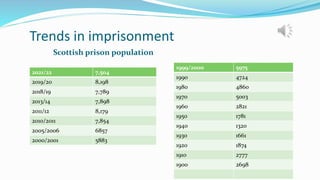
Trends in imprisonment
Scottish prison population
2021/22 7,504
2019/20 8,198
2018/19 7,789
2013/14 7,898
2011/12 8,179
2010/2011 7,854
2005/2006 6857
2000/2001 5883
1999/2000 5975
1990 4724
1980 4860
1970 5003
1960 2821
1950 1781
1940 1320
1930 1661
1920 1874
1910 2777
1900 2698
Prisons and social exclusion
 Rates of imprisonment appear to have a systemic relation to social
deprivation and exclusion
 The greater the levels of deprivation, the greater the levels of
imprisonment
See Social Exclusion Unit (SEU) Report 2002 (in Newburn 2013: 727)
 For American perspective see also Loïc Wacquant’s work on ‘ghettoization’
 ‘What is particularly troubling is the way in which penal exclusion has
been layered on top of economic and racial exclusion, ensuring that
social divisions are deepened and that a criminal underclass is brought
into existence and systematically perpetuated’ (Garland, 2001).
Social Exclusion Union report (2002)
 Prisoners are:
 13 times more likely to have been in care as a child
 20 times more likely to have been a regular truant from school
 13 times more likely to have been unemployed
 2.5 time more likely to have a family member convicted of a criminal offence
 6 times more likely to have been a young father
 80% have the writing skills of an 11-year-old
 65% have the numeracy skills of an 11-year-old
 50% have the reading skills of an 11-year-old
Contemporary issues related to prisons
 Costs (financial and social)
 Overcrowding
 Security (individual/collective, e.g. protests and riots)
 Violence in prisons (including rape/sexual assault)
 Mental health issues (self-harm/suicide)
 Substance abuse (drugs)
 Human rights issues
Final thoughts
 Woolf Report (1991) observes that offenders are sent to prison as
punishment, not for punishment
 ‘People who are detained do not cease to be human beings, no matter
how serious the crime of which they have been accused or convicted. The
court of law or other judicial agency that dealt with their case decreed that
they should be deprived of their liberty, not that they should forfeit
their humanity’ (Coyle, 2002).
What do you think?
 Do we send too many people to prison? Just enough? Not enough?
 What should the aim of prison be, and how might we measure the success
(or otherwise) of imprisonment?
 What are your ideas based on?
 Common sense approaches?
 Experience?
 Evidence?
 Something else?

Week 8 Prisons and Imprisonment BB (2).pptx

  • 1.
    Week 8: Prisonsand Imprisonment Dr Annette Robertson
  • 2.
    Learning Outcomes  Howdid ‘the prison’ emerge and develop?  How has the role of the prison changed?  What patterns and trends are discernible in terms of the extent and nature of imprisonment?  What contemporary issues does the use of imprisonment raise?
  • 3.
    The Emergence ofthe Prison In the UK Prison-like institutions date back to the Bridewells  Bridewell Prison and Hospital – first established in London, 1553 (name taken from proximity to St Bride’s Church)  Designed to contain the poor of growing cities, e.g. London, Glasgow, etc.  Forerunner of workhouse and modern prison  Place of punishment for poor (vagrants, drunks and prostitutes); also housed homeless children, and place of training for apprentices  Contained and corrected the ‘idle’ population through short terms of labour (and moral transformation)
  • 4.
    Prison Reformers John Howard(1726-1790) Elizabeth Fry (1780-1845)  Travelled in Europe and UK inspecting state of prisons  Imprisonment – ‘a grave for men alive’, Scottish prisons were: ‘old buildings, dirty and offensive’  Little separation of the sexes or classes of offender  High levels of sickness  Quaker reformer  Travelled extensively to observe prisons/prisoners  Found women and children living and dying in condition of horror, filth and cruelty  Set up education classes for women in prisons  Considered ahead of her time: advocated prisoners being treated as human beings
  • 5.
    American Prison Pioneer:Benjamin Rush (1746-1813)  Opposed to death penalty & cruel, inhumane public punishment  Promoted prison as rational, enlightened form of punishment  But, argued that prison should be a ‘world apart’  Because it is an unknown space it should ‘terrify the imagination’
  • 6.
    Rush’s vision forpenitentiaries Let a large house be erected in a remote part of the state. Let the avenue to this house be rendered difficult and gloomy by mountains and morasses. Let its doors be of iron; and let the grating, occasioned by opening and shutting them, be increased by an echo from a neighbouring mountain, that shall extend and continue a sound that shall deeply pierce the soul. Let a guard constantly attend at a gate that shall lead to this place of punishment, to prevent strangers from entering it. Let all the officers of the house be strictly forbidden to discover any signs of mirth, or even levity, in the presence of the criminals. To increase the horror of this abode of discipline and misery, let it be called by some name that shall import its design. (Rush, in Sullivan 1998: 339)
  • 7.
  • 8.
    Prison Reform inthe UK  1779: Penitentiary Act - reform through work and penance  1816: Millbank, first National Penitentiary in the UK  Shift toward segregation and isolation of prisoners – total institutions 1. ‘Separate system’: isolation all day every day 2. ‘Silent system’: isolation at night; silent association with others during day  ‘Day after day, with no companion but his thoughts, the convict is compelled to listen to the reproofs of conscience. He is led to dwell upon past errors, and to cherish whatever better feelings he may at any time have imbibed. [...] The mind becomes open to the best impressions and prepared for the reception of those truths and consolations which Christianity can alone impart.’ (Crawford, in Smith, 2004: 206)
  • 9.
  • 10.
  • 11.
    Silent System –prisoners wearing ‘beaks’
  • 12.
    Problems with solitary/silentsystems  Such systems drove some prisoners insane  Basic flaw: to think that reform of individual (as social being) is possible in the vacuum of a total institution  But: shift to reform and correction rather than containment of unruly classes  So, objective is to improve the individual and thus make society better  The role of the becomes to teach (or enforce) self-control  However, this involves more punitive, e.g. unproductive (hard) labour
  • 13.
    Unproductive labour, e.g.treadwheel, crank
  • 14.
    Gladstone Report (1895) ‘We start from the principle that prison treatment should have as its primary and concurrent objects deterrence and reformation’  Unproductive labour abolished  Productive labour in association encouraged (as privilege)  Greater provision of books and educational facilities  Reduced solitary conferment (no reform ethos)  Juvenile system for aged up to 23  But …longer sentences for ‘habitual criminals’  After-care to be provided and contact allowed before release
  • 15.
    20th century developments 1948 Criminal Justice Act: abolition of corporal punishment in prisons  Advent of detention centres (short fixed sentences for young offenders) and attendance centres (for petty offenders) – see Criminal Justice Act 1982  More focus on probation, supervision, and control  Gradual process of de-carceration
  • 16.
    Towards the endof the 20th century…  Rehabilitative scepticism – the ‘nothing works’ argument replaced by claims that ‘prison works’ (see Garland)  Decarceration replaced by the phenomenon of ‘mass imprisonment’ (see last week)  E.g. in US, between late 20th century and early 21st, the prison population increased five-fold (96 per 100,000 to 491 per 100,000). As of 2017 stood at 666/100,000.
  • 17.
    Mass /hyper incarcerationand exclusion USA
  • 18.
    Mass /hyper incarcerationand exclusion Scotland Prison Statistics Scotland: 2009-10 http://www.scotland.gov.uk/Publications/2010/12/15154 652/1
  • 19.
    Trends in imprisonment Scottishprison population 2021/22 7,504 2019/20 8,198 2018/19 7,789 2013/14 7,898 2011/12 8,179 2010/2011 7,854 2005/2006 6857 2000/2001 5883 1999/2000 5975 1990 4724 1980 4860 1970 5003 1960 2821 1950 1781 1940 1320 1930 1661 1920 1874 1910 2777 1900 2698
  • 20.
    Prisons and socialexclusion  Rates of imprisonment appear to have a systemic relation to social deprivation and exclusion  The greater the levels of deprivation, the greater the levels of imprisonment See Social Exclusion Unit (SEU) Report 2002 (in Newburn 2013: 727)  For American perspective see also Loïc Wacquant’s work on ‘ghettoization’  ‘What is particularly troubling is the way in which penal exclusion has been layered on top of economic and racial exclusion, ensuring that social divisions are deepened and that a criminal underclass is brought into existence and systematically perpetuated’ (Garland, 2001).
  • 21.
    Social Exclusion Unionreport (2002)  Prisoners are:  13 times more likely to have been in care as a child  20 times more likely to have been a regular truant from school  13 times more likely to have been unemployed  2.5 time more likely to have a family member convicted of a criminal offence  6 times more likely to have been a young father  80% have the writing skills of an 11-year-old  65% have the numeracy skills of an 11-year-old  50% have the reading skills of an 11-year-old
  • 22.
    Contemporary issues relatedto prisons  Costs (financial and social)  Overcrowding  Security (individual/collective, e.g. protests and riots)  Violence in prisons (including rape/sexual assault)  Mental health issues (self-harm/suicide)  Substance abuse (drugs)  Human rights issues
  • 23.
    Final thoughts  WoolfReport (1991) observes that offenders are sent to prison as punishment, not for punishment  ‘People who are detained do not cease to be human beings, no matter how serious the crime of which they have been accused or convicted. The court of law or other judicial agency that dealt with their case decreed that they should be deprived of their liberty, not that they should forfeit their humanity’ (Coyle, 2002).
  • 24.
    What do youthink?  Do we send too many people to prison? Just enough? Not enough?  What should the aim of prison be, and how might we measure the success (or otherwise) of imprisonment?  What are your ideas based on?  Common sense approaches?  Experience?  Evidence?  Something else?