© 2013 by Pearson Higher Education, Inc
Upper Saddle River, New Jersey 07458 • All Rights Reserved
Crisis Intervention
William Harmening
Roosevelt University
Harmening, Crisis Intervention: The Criminal Justice Response to Chaos, Mayhem, and
Disaster
Chapter 9
THE HOSTAGE CRISIS
© 2013 by Pearson Higher Education, Inc
Upper Saddle River, New Jersey 07458 • All Rights Reserved
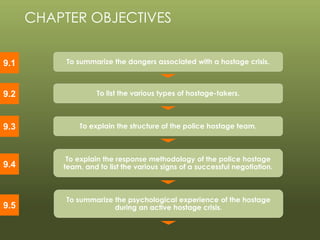
9.1
9.2
9.3
9.4
To summarize the dangers associated with a hostage crisis.
To list the various types of hostage-takers.
To explain the structure of the police hostage team.
To explain the response methodology of the police hostage
team, and to list the various signs of a successful negotiation.
CHAPTER OBJECTIVES
9.5
To summarize the psychological experience of the hostage
during an active hostage crisis.
To summarize the dangers associated
with a hostage crisis.
Learning Objectives
After this lecture, you should be able to complete the following Learning Outcomes
9.1
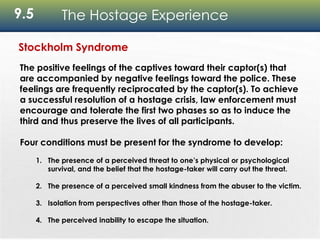
8.1 The Hostage Crisis
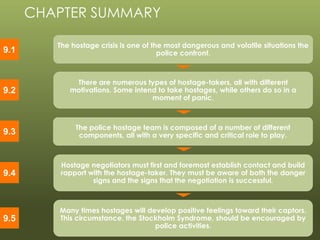
OVERVIEW
One of the most stressful types of police intervention. An
inappropriate police response can lead to the deaths of innocent
people.
It is a crisis that can change on a moment’s notice from calm to
chaotic.
Multiple contingencies must be in place and ready to mobilize in
the event of changing circumstances.
8.1 The Hostage Crisis
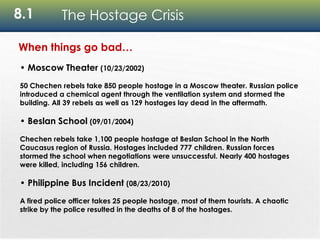
When things go bad…
• Moscow Theater (10/23/2002)
50 Chechen rebels take 850 people hostage in a Moscow theater. Russian police
introduced a chemical agent through the ventilation system and stormed the
building. All 39 rebels as well as 129 hostages lay dead in the aftermath.
• Beslan School (09/01/2004)
Chechen rebels take 1,100 people hostage at Beslan School in the North
Caucasus region of Russia. Hostages included 777 children. Russian forces
stormed the school when negotiations were unsuccessful. Nearly 400 hostages
were killed, including 156 children.
• Philippine Bus Incident (08/23/2010)
A fired police officer takes 25 people hostage, most of them tourists. A chaotic
strike by the police resulted in the deaths of 8 of the hostages.
To list the various types of hostage-
takers.
Learning Objectives
After this lecture, you should be able to complete the following Learning Outcomes
9.2
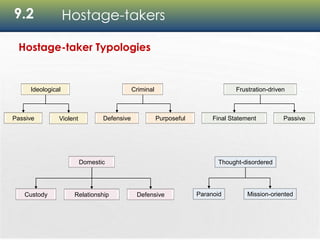
9.2 Hostage-takers
Ideological
Passive Violent
Criminal
Defensive Purposeful
Domestic
Custody Relationship Defensive
Frustration-driven
Final Statement Passive
Thought-disordered
Paranoid Mission-oriented
Hostage-taker Typologies
9.2 Hostage-takers
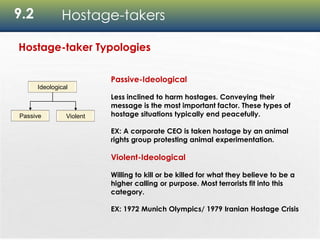
Ideological
Passive Violent
Hostage-taker Typologies
Passive-Ideological
Less inclined to harm hostages. Conveying their
message is the most important factor. These types of
hostage situations typically end peacefully.
EX: A corporate CEO is taken hostage by an animal
rights group protesting animal experimentation.
Violent-Ideological
Willing to kill or be killed for what they believe to be a
higher calling or purpose. Most terrorists fit into this
category.
EX: 1972 Munich Olympics/ 1979 Iranian Hostage Crisis
9.2 Hostage-takers
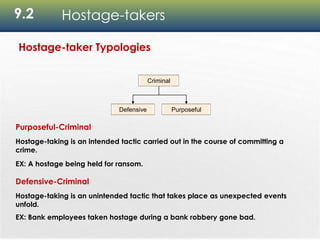
Criminal
Defensive Purposeful
Hostage-taker Typologies
Purposeful-Criminal
Hostage-taking is an intended tactic carried out in the course of committing a
crime.
EX: A hostage being held for ransom.
Defensive-Criminal
Hostage-taking is an unintended tactic that takes place as unexpected events
unfold.
EX: Bank employees taken hostage during a bank robbery gone bad.
9.2 Hostage-takers
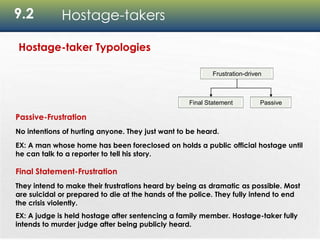
Frustration-driven
Final Statement Passive
Hostage-taker Typologies
Passive-Frustration
No intentions of hurting anyone. They just want to be heard.
EX: A man whose home has been foreclosed on holds a public official hostage until
he can talk to a reporter to tell his story.
Final Statement-Frustration
They intend to make their frustrations heard by being as dramatic as possible. Most
are suicidal or prepared to die at the hands of the police. They fully intend to end
the crisis violently.
EX: A judge is held hostage after sentencing a family member. Hostage-taker fully
intends to murder judge after being publicly heard.
9.2 Hostage-takers
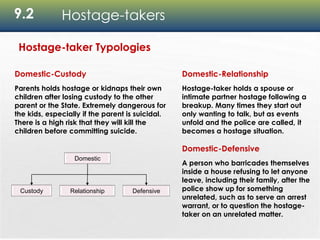
Domestic
Custody Relationship Defensive
Hostage-taker Typologies
Domestic-Custody
Parents holds hostage or kidnaps their own
children after losing custody to the other
parent or the State. Extremely dangerous for
the kids, especially if the parent is suicidal.
There is a high risk that they will kill the
children before committing suicide.
Domestic-Relationship
Hostage-taker holds a spouse or
intimate partner hostage following a
breakup. Many times they start out
only wanting to talk, but as events
unfold and the police are called, it
becomes a hostage situation.
Domestic-Defensive
A person who barricades themselves
inside a house refusing to let anyone
leave, including their family, after the
police show up for something
unrelated, such as to serve an arrest
warrant, or to question the hostage-
taker on an unrelated matter.
9.2 Hostage-takers
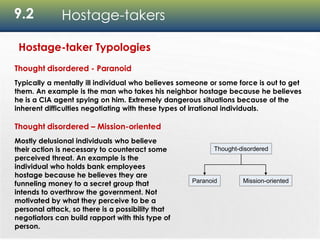
Thought-disordered
Paranoid Mission-oriented
Hostage-taker Typologies
Thought disordered - Paranoid
Typically a mentally ill individual who believes someone or some force is out to get
them. An example is the man who takes his neighbor hostage because he believes
he is a CIA agent spying on him. Extremely dangerous situations because of the
inherent difficulties negotiating with these types of irrational individuals.
Thought disordered – Mission-oriented
Mostly delusional individuals who believe
their action is necessary to counteract some
perceived threat. An example is the
individual who holds bank employees
hostage because he believes they are
funneling money to a secret group that
intends to overthrow the government. Not
motivated by what they perceive to be a
personal attack, so there is a possibility that
negotiators can build rapport with this type of
person.
To explain the structure of the police
hostage team.
Learning Objectives
After this lecture, you should be able to complete the following Learning Outcomes
9.3
9.3 The Hostage Team
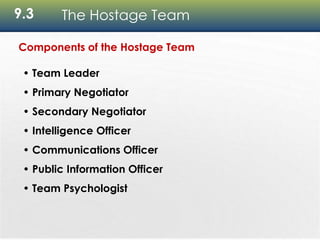
Components of the Hostage Team
• Team Leader
• Primary Negotiator
• Secondary Negotiator
• Intelligence Officer
• Communications Officer
• Public Information Officer
• Team Psychologist
9.3 The Hostage Team
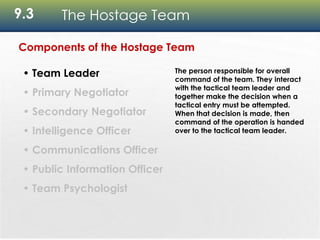
Components of the Hostage Team
• Team Leader
• Primary Negotiator
• Secondary Negotiator
• Intelligence Officer
• Communications Officer
• Public Information Officer
• Team Psychologist
The person responsible for overall
command of the team. They interact
with the tactical team leader and
together make the decision when a
tactical entry must be attempted.
When that decision is made, then
command of the operation is handed
over to the tactical team leader.
9.3 The Hostage Team
Components of the Hostage Team
• Team Leader
• Primary Negotiator
• Secondary Negotiator
• Intelligence Officer
• Communications Officer
• Public Information Officer
• Team Psychologist
The person responsible for making
contact with the hostage-taker and
negotiating the safe release of the
hostages. The negotiator selected by
the team leader to serve as the
primary will depend on the
circumstances of the situation. Only
one negotiator will maintain contact
with the hostage-taker unless
circumstances demand differently.
9.3 The Hostage Team
Components of the Hostage Team
• Team Leader
• Primary Negotiator
• Secondary Negotiator
• Intelligence Officer
• Communications Officer
• Public Information Officer
• Team Psychologist
This person serves as a backup in the
event the primary negotiator is unable
to establish rapport with the hostage-
taker, or is unable to continue the
negotiations for some reason. The
secondary works side by side with the
primary negotiator throughout the
crisis.
9.3 The Hostage Team
Components of the Hostage Team
• Team Leader
• Primary Negotiator
• Secondary Negotiator
• Intelligence Officer
• Communications Officer
• Public Information Officer
• Team Psychologist
This person is responsible for finding
out as much as possible about the
hostage-taker as well as the hostages.
The more the negotiator knows about
the various players, the more power
they have to control the negotiation.
When the hostage-taker makes a
reference to something, it is the job of
the intelligence officer to attempt to
determine what the reference means,
and the weight of its relevance.
9.3 The Hostage Team
Components of the Hostage Team
• Team Leader
• Primary Negotiator
• Secondary Negotiator
• Intelligence Officer
• Communications Officer
• Public Information Officer
• Team Psychologist
The communications officer is
responsible for all vital
communications equipment. They
work to maintain an unobstructed line
of communication between negotiator
and hostage-taker, as well as
between team leader and other
response components, such as the
tactical team.
9.3 The Hostage Team
Components of the Hostage Team
• Team Leader
• Primary Negotiator
• Secondary Negotiator
• Intelligence Officer
• Communications Officer
• Public Information Officer
• Team Psychologist
Responsible for the dissemination of
information about the event to media
outlets both during and after the crisis.
Any release of information during the
crisis must be heavily weighed given
that the hostage-taker(s) may have
access to television, radio, or the
internet.
9.3 The Hostage Team
Components of the Hostage Team
• Team Leader
• Primary Negotiator
• Secondary Negotiator
• Intelligence Officer
• Communications Officer
• Public Information Officer
• Team Psychologist
The team psychologist has multiple
functions. They can assist in
developing behavioral profiles of the
hostage-taker, act as a consultant to
the negotiator, conduct on-scene risk
assessments, and monitor the behavior
and effectiveness of the negotiator.
They also take responsibility for any
critical incident debriefing following
the crisis.
To explain the response methodology
of the police hostage team, and to
list the various signs of a successful
negotiation.
Learning Objectives
After this lecture, you should be able to complete the following Learning Outcomes
9.4
9.4 The Police Response
Building Rapport
The most critical step in the response is for the negotiator to
establish contact with the hostage-taker and build rapport. This
can be accomplished by doing the following:
• Statement of Introduction that conveys confidence the crisis will be resolved
peacefully.
• Address the hostage-taker in a way he/she wishes to be addressed.
• Calm and steady voice modulation.
• Allow the person to vent initially.
• Keep the focus on the hostage-taker and off the hostages.
• Downplay what the hostage-taker has done to that point.
• Compliment the hostage-taker for any positive actions taken.
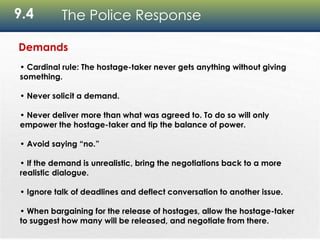
9.4 The Police Response
Demands
• Cardinal rule: The hostage-taker never gets anything without giving
something.
• Never solicit a demand.
• Never deliver more than what was agreed to. To do so will only
empower the hostage-taker and tip the balance of power.
• Avoid saying “no.”
• If the demand is unrealistic, bring the negotiations back to a more
realistic dialogue.
• Ignore talk of deadlines and deflect conversation to another issue.
• When bargaining for the release of hostages, allow the hostage-taker
to suggest how many will be released, and negotiate from there.
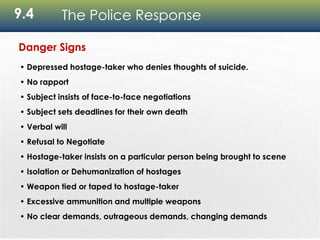
9.4 The Police Response
Danger Signs
• Depressed hostage-taker who denies thoughts of suicide.
• No rapport
• Subject insists of face-to-face negotiations
• Subject sets deadlines for their own death
• Verbal will
• Refusal to Negotiate
• Hostage-taker insists on a particular person being brought to scene
• Isolation or Dehumanization of hostages
• Weapon tied or taped to hostage-taker
• Excessive ammunition and multiple weapons
• No clear demands, outrageous demands, changing demands
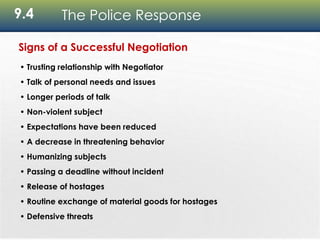
9.4 The Police Response
Signs of a Successful Negotiation
• Trusting relationship with Negotiator
• Talk of personal needs and issues
• Longer periods of talk
• Non-violent subject
• Expectations have been reduced
• A decrease in threatening behavior
• Humanizing subjects
• Passing a deadline without incident
• Release of hostages
• Routine exchange of material goods for hostages
• Defensive threats
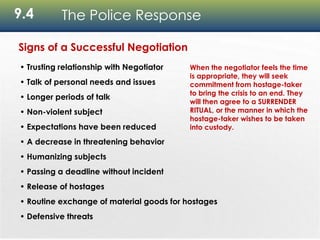
9.4 The Police Response
Signs of a Successful Negotiation
• Trusting relationship with Negotiator
• Talk of personal needs and issues
• Longer periods of talk
• Non-violent subject
• Expectations have been reduced
• A decrease in threatening behavior
• Humanizing subjects
• Passing a deadline without incident
• Release of hostages
• Routine exchange of material goods for hostages
• Defensive threats
When the negotiator feels the time
is appropriate, they will seek
commitment from hostage-taker
to bring the crisis to an end. They
will then agree to a SURRENDER
RITUAL, or the manner in which the
hostage-taker wishes to be taken
into custody.
To summarize the psychological
experience of the hostage during an
active hostage crisis.
Learning Objectives
After this lecture, you should be able to complete the following Learning Outcomes
9.5
9.5 The Hostage Experience
Stockholm Syndrome
The positive feelings of the captives toward their captor(s) that
are accompanied by negative feelings toward the police. These
feelings are frequently reciprocated by the captor(s). To achieve
a successful resolution of a hostage crisis, law enforcement must
encourage and tolerate the first two phases so as to induce the
third and thus preserve the lives of all participants.
Four conditions must be present for the syndrome to develop:
1. The presence of a perceived threat to one’s physical or psychological
survival, and the belief that the hostage-taker will carry out the threat.
2. The presence of a perceived small kindness from the abuser to the victim.
3. Isolation from perspectives other than those of the hostage-taker.
4. The perceived inability to escape the situation.
© 2013 by Pearson Higher Education, Inc
Upper Saddle River, New Jersey 07458 • All Rights Reserved
The hostage crisis is one of the most dangerous and volatile situations the
police confront.
There are numerous types of hostage-takers, all with different
motivations. Some intend to take hostages, while others do so in a
moment of panic.
Hostage negotiators must first and foremost establish contact and build
rapport with the hostage-taker. They must be aware of both the danger
signs and the signs that the negotiation is successful.
CHAPTER SUMMARY
9.1
9.2
9.4
The police hostage team is composed of a number of different
components, all with a very specific and critical role to play.9.3
Many times hostages will develop positive feelings toward their captors.
This circumstance, the Stockholm Syndrome, should be encouraged by
police activities.
9.5
© 2013 by Pearson Higher Education, Inc
Upper Saddle River, New Jersey 07458 • All Rights Reserved
DISCUSSION QUESTIONS
1. Think of a movie you have seen in which a hostage
situation was portrayed. What kind of hostage-taker(s) was
involved, and how effective was the police response?
Some of the more popular hostage movies includes:
The Negotiator
Dog Day Afternoon
John Q
Die Hard
Man on Fire
The Taking of Pelham
2. Discuss some of the personal qualities that may be required
in order for a police officer to be an effective hostage
negotiator.
3. Discuss some of the reasons why you think a hostage might
develop positive feelings toward their captors (i.e.,
Stockholm Syndrome).

Chapter Nine

  • 1.
    © 2013 byPearson Higher Education, Inc Upper Saddle River, New Jersey 07458 • All Rights Reserved Crisis Intervention William Harmening Roosevelt University Harmening, Crisis Intervention: The Criminal Justice Response to Chaos, Mayhem, and Disaster Chapter 9 THE HOSTAGE CRISIS
  • 2.
    © 2013 byPearson Higher Education, Inc Upper Saddle River, New Jersey 07458 • All Rights Reserved 9.1 9.2 9.3 9.4 To summarize the dangers associated with a hostage crisis. To list the various types of hostage-takers. To explain the structure of the police hostage team. To explain the response methodology of the police hostage team, and to list the various signs of a successful negotiation. CHAPTER OBJECTIVES 9.5 To summarize the psychological experience of the hostage during an active hostage crisis.
  • 3.
    To summarize thedangers associated with a hostage crisis. Learning Objectives After this lecture, you should be able to complete the following Learning Outcomes 9.1
  • 4.
    8.1 The HostageCrisis OVERVIEW One of the most stressful types of police intervention. An inappropriate police response can lead to the deaths of innocent people. It is a crisis that can change on a moment’s notice from calm to chaotic. Multiple contingencies must be in place and ready to mobilize in the event of changing circumstances.
  • 5.
    8.1 The HostageCrisis When things go bad… • Moscow Theater (10/23/2002) 50 Chechen rebels take 850 people hostage in a Moscow theater. Russian police introduced a chemical agent through the ventilation system and stormed the building. All 39 rebels as well as 129 hostages lay dead in the aftermath. • Beslan School (09/01/2004) Chechen rebels take 1,100 people hostage at Beslan School in the North Caucasus region of Russia. Hostages included 777 children. Russian forces stormed the school when negotiations were unsuccessful. Nearly 400 hostages were killed, including 156 children. • Philippine Bus Incident (08/23/2010) A fired police officer takes 25 people hostage, most of them tourists. A chaotic strike by the police resulted in the deaths of 8 of the hostages.
  • 6.
    To list thevarious types of hostage- takers. Learning Objectives After this lecture, you should be able to complete the following Learning Outcomes 9.2
  • 7.
    9.2 Hostage-takers Ideological Passive Violent Criminal DefensivePurposeful Domestic Custody Relationship Defensive Frustration-driven Final Statement Passive Thought-disordered Paranoid Mission-oriented Hostage-taker Typologies
  • 8.
    9.2 Hostage-takers Ideological Passive Violent Hostage-takerTypologies Passive-Ideological Less inclined to harm hostages. Conveying their message is the most important factor. These types of hostage situations typically end peacefully. EX: A corporate CEO is taken hostage by an animal rights group protesting animal experimentation. Violent-Ideological Willing to kill or be killed for what they believe to be a higher calling or purpose. Most terrorists fit into this category. EX: 1972 Munich Olympics/ 1979 Iranian Hostage Crisis
  • 9.
    9.2 Hostage-takers Criminal Defensive Purposeful Hostage-takerTypologies Purposeful-Criminal Hostage-taking is an intended tactic carried out in the course of committing a crime. EX: A hostage being held for ransom. Defensive-Criminal Hostage-taking is an unintended tactic that takes place as unexpected events unfold. EX: Bank employees taken hostage during a bank robbery gone bad.
  • 10.
    9.2 Hostage-takers Frustration-driven Final StatementPassive Hostage-taker Typologies Passive-Frustration No intentions of hurting anyone. They just want to be heard. EX: A man whose home has been foreclosed on holds a public official hostage until he can talk to a reporter to tell his story. Final Statement-Frustration They intend to make their frustrations heard by being as dramatic as possible. Most are suicidal or prepared to die at the hands of the police. They fully intend to end the crisis violently. EX: A judge is held hostage after sentencing a family member. Hostage-taker fully intends to murder judge after being publicly heard.
  • 11.
    9.2 Hostage-takers Domestic Custody RelationshipDefensive Hostage-taker Typologies Domestic-Custody Parents holds hostage or kidnaps their own children after losing custody to the other parent or the State. Extremely dangerous for the kids, especially if the parent is suicidal. There is a high risk that they will kill the children before committing suicide. Domestic-Relationship Hostage-taker holds a spouse or intimate partner hostage following a breakup. Many times they start out only wanting to talk, but as events unfold and the police are called, it becomes a hostage situation. Domestic-Defensive A person who barricades themselves inside a house refusing to let anyone leave, including their family, after the police show up for something unrelated, such as to serve an arrest warrant, or to question the hostage- taker on an unrelated matter.
  • 12.
    9.2 Hostage-takers Thought-disordered Paranoid Mission-oriented Hostage-takerTypologies Thought disordered - Paranoid Typically a mentally ill individual who believes someone or some force is out to get them. An example is the man who takes his neighbor hostage because he believes he is a CIA agent spying on him. Extremely dangerous situations because of the inherent difficulties negotiating with these types of irrational individuals. Thought disordered – Mission-oriented Mostly delusional individuals who believe their action is necessary to counteract some perceived threat. An example is the individual who holds bank employees hostage because he believes they are funneling money to a secret group that intends to overthrow the government. Not motivated by what they perceive to be a personal attack, so there is a possibility that negotiators can build rapport with this type of person.
  • 13.
    To explain thestructure of the police hostage team. Learning Objectives After this lecture, you should be able to complete the following Learning Outcomes 9.3
  • 14.
    9.3 The HostageTeam Components of the Hostage Team • Team Leader • Primary Negotiator • Secondary Negotiator • Intelligence Officer • Communications Officer • Public Information Officer • Team Psychologist
  • 15.
    9.3 The HostageTeam Components of the Hostage Team • Team Leader • Primary Negotiator • Secondary Negotiator • Intelligence Officer • Communications Officer • Public Information Officer • Team Psychologist The person responsible for overall command of the team. They interact with the tactical team leader and together make the decision when a tactical entry must be attempted. When that decision is made, then command of the operation is handed over to the tactical team leader.
  • 16.
    9.3 The HostageTeam Components of the Hostage Team • Team Leader • Primary Negotiator • Secondary Negotiator • Intelligence Officer • Communications Officer • Public Information Officer • Team Psychologist The person responsible for making contact with the hostage-taker and negotiating the safe release of the hostages. The negotiator selected by the team leader to serve as the primary will depend on the circumstances of the situation. Only one negotiator will maintain contact with the hostage-taker unless circumstances demand differently.
  • 17.
    9.3 The HostageTeam Components of the Hostage Team • Team Leader • Primary Negotiator • Secondary Negotiator • Intelligence Officer • Communications Officer • Public Information Officer • Team Psychologist This person serves as a backup in the event the primary negotiator is unable to establish rapport with the hostage- taker, or is unable to continue the negotiations for some reason. The secondary works side by side with the primary negotiator throughout the crisis.
  • 18.
    9.3 The HostageTeam Components of the Hostage Team • Team Leader • Primary Negotiator • Secondary Negotiator • Intelligence Officer • Communications Officer • Public Information Officer • Team Psychologist This person is responsible for finding out as much as possible about the hostage-taker as well as the hostages. The more the negotiator knows about the various players, the more power they have to control the negotiation. When the hostage-taker makes a reference to something, it is the job of the intelligence officer to attempt to determine what the reference means, and the weight of its relevance.
  • 19.
    9.3 The HostageTeam Components of the Hostage Team • Team Leader • Primary Negotiator • Secondary Negotiator • Intelligence Officer • Communications Officer • Public Information Officer • Team Psychologist The communications officer is responsible for all vital communications equipment. They work to maintain an unobstructed line of communication between negotiator and hostage-taker, as well as between team leader and other response components, such as the tactical team.
  • 20.
    9.3 The HostageTeam Components of the Hostage Team • Team Leader • Primary Negotiator • Secondary Negotiator • Intelligence Officer • Communications Officer • Public Information Officer • Team Psychologist Responsible for the dissemination of information about the event to media outlets both during and after the crisis. Any release of information during the crisis must be heavily weighed given that the hostage-taker(s) may have access to television, radio, or the internet.
  • 21.
    9.3 The HostageTeam Components of the Hostage Team • Team Leader • Primary Negotiator • Secondary Negotiator • Intelligence Officer • Communications Officer • Public Information Officer • Team Psychologist The team psychologist has multiple functions. They can assist in developing behavioral profiles of the hostage-taker, act as a consultant to the negotiator, conduct on-scene risk assessments, and monitor the behavior and effectiveness of the negotiator. They also take responsibility for any critical incident debriefing following the crisis.
  • 22.
    To explain theresponse methodology of the police hostage team, and to list the various signs of a successful negotiation. Learning Objectives After this lecture, you should be able to complete the following Learning Outcomes 9.4
  • 23.
    9.4 The PoliceResponse Building Rapport The most critical step in the response is for the negotiator to establish contact with the hostage-taker and build rapport. This can be accomplished by doing the following: • Statement of Introduction that conveys confidence the crisis will be resolved peacefully. • Address the hostage-taker in a way he/she wishes to be addressed. • Calm and steady voice modulation. • Allow the person to vent initially. • Keep the focus on the hostage-taker and off the hostages. • Downplay what the hostage-taker has done to that point. • Compliment the hostage-taker for any positive actions taken.
  • 24.
    9.4 The PoliceResponse Demands • Cardinal rule: The hostage-taker never gets anything without giving something. • Never solicit a demand. • Never deliver more than what was agreed to. To do so will only empower the hostage-taker and tip the balance of power. • Avoid saying “no.” • If the demand is unrealistic, bring the negotiations back to a more realistic dialogue. • Ignore talk of deadlines and deflect conversation to another issue. • When bargaining for the release of hostages, allow the hostage-taker to suggest how many will be released, and negotiate from there.
  • 25.
    9.4 The PoliceResponse Danger Signs • Depressed hostage-taker who denies thoughts of suicide. • No rapport • Subject insists of face-to-face negotiations • Subject sets deadlines for their own death • Verbal will • Refusal to Negotiate • Hostage-taker insists on a particular person being brought to scene • Isolation or Dehumanization of hostages • Weapon tied or taped to hostage-taker • Excessive ammunition and multiple weapons • No clear demands, outrageous demands, changing demands
  • 26.
    9.4 The PoliceResponse Signs of a Successful Negotiation • Trusting relationship with Negotiator • Talk of personal needs and issues • Longer periods of talk • Non-violent subject • Expectations have been reduced • A decrease in threatening behavior • Humanizing subjects • Passing a deadline without incident • Release of hostages • Routine exchange of material goods for hostages • Defensive threats
  • 27.
    9.4 The PoliceResponse Signs of a Successful Negotiation • Trusting relationship with Negotiator • Talk of personal needs and issues • Longer periods of talk • Non-violent subject • Expectations have been reduced • A decrease in threatening behavior • Humanizing subjects • Passing a deadline without incident • Release of hostages • Routine exchange of material goods for hostages • Defensive threats When the negotiator feels the time is appropriate, they will seek commitment from hostage-taker to bring the crisis to an end. They will then agree to a SURRENDER RITUAL, or the manner in which the hostage-taker wishes to be taken into custody.
  • 28.
    To summarize thepsychological experience of the hostage during an active hostage crisis. Learning Objectives After this lecture, you should be able to complete the following Learning Outcomes 9.5
  • 29.
    9.5 The HostageExperience Stockholm Syndrome The positive feelings of the captives toward their captor(s) that are accompanied by negative feelings toward the police. These feelings are frequently reciprocated by the captor(s). To achieve a successful resolution of a hostage crisis, law enforcement must encourage and tolerate the first two phases so as to induce the third and thus preserve the lives of all participants. Four conditions must be present for the syndrome to develop: 1. The presence of a perceived threat to one’s physical or psychological survival, and the belief that the hostage-taker will carry out the threat. 2. The presence of a perceived small kindness from the abuser to the victim. 3. Isolation from perspectives other than those of the hostage-taker. 4. The perceived inability to escape the situation.
  • 30.
    © 2013 byPearson Higher Education, Inc Upper Saddle River, New Jersey 07458 • All Rights Reserved The hostage crisis is one of the most dangerous and volatile situations the police confront. There are numerous types of hostage-takers, all with different motivations. Some intend to take hostages, while others do so in a moment of panic. Hostage negotiators must first and foremost establish contact and build rapport with the hostage-taker. They must be aware of both the danger signs and the signs that the negotiation is successful. CHAPTER SUMMARY 9.1 9.2 9.4 The police hostage team is composed of a number of different components, all with a very specific and critical role to play.9.3 Many times hostages will develop positive feelings toward their captors. This circumstance, the Stockholm Syndrome, should be encouraged by police activities. 9.5
  • 31.
    © 2013 byPearson Higher Education, Inc Upper Saddle River, New Jersey 07458 • All Rights Reserved DISCUSSION QUESTIONS 1. Think of a movie you have seen in which a hostage situation was portrayed. What kind of hostage-taker(s) was involved, and how effective was the police response? Some of the more popular hostage movies includes: The Negotiator Dog Day Afternoon John Q Die Hard Man on Fire The Taking of Pelham 2. Discuss some of the personal qualities that may be required in order for a police officer to be an effective hostage negotiator. 3. Discuss some of the reasons why you think a hostage might develop positive feelings toward their captors (i.e., Stockholm Syndrome).