Routine Activities Theory
crime prevention (Cohen and Felson)
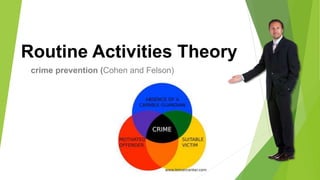
 is a theory of crime events. This differs from a majority of criminological theories,
which focus on explaining why some people commit crimes—that is, the motivation
to commit crime— rather than how criminal events are produced. Although at first
glance this distinction may appear inconsequential, it has important implications for
the research and prevention of crime. Routine activities theory suggests that the
organization of routine activities in society create opportunities for
crime.(Criminology theories).
 routine activity theory is that crime is relatively unaffected by social causes such as
poverty, inequality and unemployment. For instance, after World War II, the
economy of Western countries was booming and the Welfare states were
expanding. Despite this, crime rose significantly during this time. According to
Felson and Cohen, the reason for the increase is that the prosperity of
contemporary society offers more opportunities for crime to occur; there is much
more to steal. (Wikipedia).
 Routine activity theory is one of the main theories of “environmental criminology”.
The theory states that a crime occurs when the following three elements come
together in any given space and time:
An accessible target
 An accessible target can include a person, an object or a place.
The following acronyms have been used to describe accessible
targets:
 VIVA – Value, Inertia, Visibility, Access
 CRAVED – Concealable, Removable, Available, Valuable,
Enjoyable, Disposable,
 Routine activity theory as a crime prevention methodology
focuses on essential elements that make up a crime. This theory
provides a framework within which to prevent crime through
altering at least one of these elements (the offender, the target or
the presence of capable guardians). The most effective crime
prevention strategies will focus on all three of these elements.
Absence of a capable guardian that could
intervene
 A capable guardian has a ‘human element’, that is usually a person who, by
their mere presence, would deter potential offenders from perpetrating a crime.
A capable guardian could also be CCTV, providing that someone is monitoring it
at the other end of the camera at all times.
Some examples of capable guardians are:
 police patrols
 security guards
 door staff
 vigilant staff and co-workers
 friends
 neighbor's,
 Some of the guardians are formal and deliberate, like security guards;
some are informal and inadvertent, such as neighbor's.
 It is also possible for a guardian to be present, but ineffective. For
example, a CCTV camera is not a capable guardian if it is set up
incorrectly or in the wrong place or is not monitored. Staff might be
present in a shop, but may not have sufficient training or awareness to
be an effective deterrent.
A motivated offender
 Routine activity theory looks at crime from an offender’s point
of view. A crime will only be committed if a likely offender
thinks that a target is suitable and a capable guardian is
absent. It is the offender’s assessment of a situation that
determines whether a crime will take place.
Methods
 Routine activities theory has guided research designed to
understand a range of phenomena, including crime trends
over time, distributions of crime across space, and
individual differences in victimization. In addition,
researchers have considered how opportunities for crime
might exist at multiple levels. For example, the
characteristics of one’s neighborhood and the features of
the home might influence the likelihood of burglary
victimization. Researchers have used various research
methods to meet these different needs. The selection of
research reviewed in the following paragraphs illustrates
the different methods researchers have used to test
hypotheses developed from routine activities theory.
4 Methods
 Using Routine Activity to Predict Crime Trends
 Using Routine Activities to Predict the Distribution
of Crime Across Space
 Using Routine Activities to Predict Differences in
Victimization
 Routine Activities and Multilevel Opportunity
Crime triangle
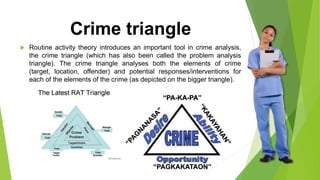
 Routine activity theory introduces an important tool in crime analysis,
the crime triangle (which has also been called the problem analysis
triangle). The crime triangle analyses both the elements of crime
(target, location, offender) and potential responses/interventions for
each of the elements of the crime (as depicted on the bigger triangle).
“PA-KA-PA”
“PAGKAKATAON”
Routine_activity_theory_CRIM_SOC_1 (1).pptx

Routine_activity_theory_CRIM_SOC_1 (1).pptx

  • 1.
    Routine Activities Theory crimeprevention (Cohen and Felson)
  • 2.
     is atheory of crime events. This differs from a majority of criminological theories, which focus on explaining why some people commit crimes—that is, the motivation to commit crime— rather than how criminal events are produced. Although at first glance this distinction may appear inconsequential, it has important implications for the research and prevention of crime. Routine activities theory suggests that the organization of routine activities in society create opportunities for crime.(Criminology theories).  routine activity theory is that crime is relatively unaffected by social causes such as poverty, inequality and unemployment. For instance, after World War II, the economy of Western countries was booming and the Welfare states were expanding. Despite this, crime rose significantly during this time. According to Felson and Cohen, the reason for the increase is that the prosperity of contemporary society offers more opportunities for crime to occur; there is much more to steal. (Wikipedia).  Routine activity theory is one of the main theories of “environmental criminology”. The theory states that a crime occurs when the following three elements come together in any given space and time:
  • 3.
    An accessible target An accessible target can include a person, an object or a place. The following acronyms have been used to describe accessible targets:  VIVA – Value, Inertia, Visibility, Access  CRAVED – Concealable, Removable, Available, Valuable, Enjoyable, Disposable,  Routine activity theory as a crime prevention methodology focuses on essential elements that make up a crime. This theory provides a framework within which to prevent crime through altering at least one of these elements (the offender, the target or the presence of capable guardians). The most effective crime prevention strategies will focus on all three of these elements.
  • 4.
    Absence of acapable guardian that could intervene  A capable guardian has a ‘human element’, that is usually a person who, by their mere presence, would deter potential offenders from perpetrating a crime. A capable guardian could also be CCTV, providing that someone is monitoring it at the other end of the camera at all times. Some examples of capable guardians are:  police patrols  security guards  door staff  vigilant staff and co-workers  friends  neighbor's,
  • 5.
     Some ofthe guardians are formal and deliberate, like security guards; some are informal and inadvertent, such as neighbor's.  It is also possible for a guardian to be present, but ineffective. For example, a CCTV camera is not a capable guardian if it is set up incorrectly or in the wrong place or is not monitored. Staff might be present in a shop, but may not have sufficient training or awareness to be an effective deterrent.
  • 6.
    A motivated offender Routine activity theory looks at crime from an offender’s point of view. A crime will only be committed if a likely offender thinks that a target is suitable and a capable guardian is absent. It is the offender’s assessment of a situation that determines whether a crime will take place.
  • 7.
    Methods  Routine activitiestheory has guided research designed to understand a range of phenomena, including crime trends over time, distributions of crime across space, and individual differences in victimization. In addition, researchers have considered how opportunities for crime might exist at multiple levels. For example, the characteristics of one’s neighborhood and the features of the home might influence the likelihood of burglary victimization. Researchers have used various research methods to meet these different needs. The selection of research reviewed in the following paragraphs illustrates the different methods researchers have used to test hypotheses developed from routine activities theory.
  • 8.
    4 Methods  UsingRoutine Activity to Predict Crime Trends  Using Routine Activities to Predict the Distribution of Crime Across Space  Using Routine Activities to Predict Differences in Victimization  Routine Activities and Multilevel Opportunity
  • 9.
    Crime triangle  Routineactivity theory introduces an important tool in crime analysis, the crime triangle (which has also been called the problem analysis triangle). The crime triangle analyses both the elements of crime (target, location, offender) and potential responses/interventions for each of the elements of the crime (as depicted on the bigger triangle). “PA-KA-PA” “PAGKAKATAON”