5th edition
John V Pavlik & Shawn McIntosh
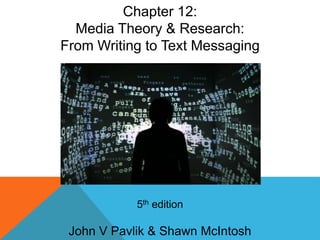
Chapter 12:
Media Theory & Research:
From Writing to Text Messaging
THE ROLE OF THEORY AND RESEARCH
Media theories & research
 Play a foundational role as cognitive
constructs
 Shape public policies toward the media and
media industries
 Help determine audience numbers for
particular shows or networks
MASS SOCIETY, MASS COMMUNICATION
 19th-20th century, Europe & US: Dramatic societal
and political changes from industrialization,
provide the backdrop for early theorizing on the
role of mass communication
 The notion of “the masses:” Elites’ rationale for
why they should continue to rule
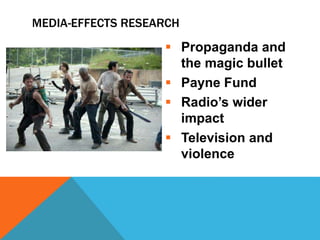
MEDIA-EFFECTS RESEARCH
 Propaganda and
the magic bullet
 Payne Fund
 Radio’s wider
impact
 Television and
violence
MEDIA-EFFECTS RESEARCH
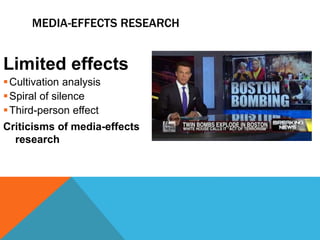
Limited effects
Cultivation analysis
Spiral of silence
Third-person effect
Criticisms of media-effects
research
UNDERSTANDING THE AUDIENCE
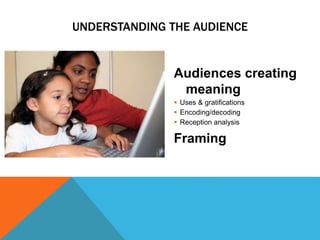
Audiences creating
meaning
 Uses & gratifications
 Encoding/decoding
 Reception analysis
Framing
CULTURAL STUDIES
 Ideology and the
culture industry
 Criticisms of
cultural studies
SOCIO-HISTORICAL FRAMEWORKS
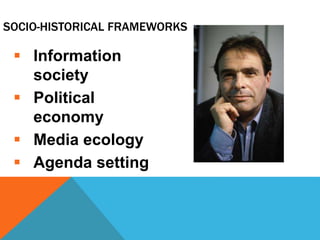
 Information
society
 Political
economy
 Media ecology
 Agenda setting
NEW DIRECTIONS IN MEDIA RESEARCH
 Digital media research:
Business, organizational
science, and library
science
 Digital media scholarship
complicated by rapidly
changing technologies
 Impact of time spent
online
NEW DIRECTIONS IN MEDIA RESEARCH
 Changes in the role of the
audience in an interactive
communication
environment
 Issues surrounding
social-networking sites
 Multiple and popular
facets of the video game
world
MEDIA RESEARCH: WHAT TYPE OF SCIENCE IS IT?
 Positivism
 Epistemology
 Post-positivism
 Social constructionism
 Postmodernism
 Pragmatism
MEDIA RESEARCH: WHAT TYPE OF SCIENCE IS IT?
 Quantitative analysis
 Qualitative analysis
 Qualitative and
quantitative analysis
working together

Chapter 12 - Media Theory & Research

  • 1.
    5th edition John VPavlik & Shawn McIntosh Chapter 12: Media Theory & Research: From Writing to Text Messaging
  • 2.
    THE ROLE OFTHEORY AND RESEARCH Media theories & research  Play a foundational role as cognitive constructs  Shape public policies toward the media and media industries  Help determine audience numbers for particular shows or networks
  • 3.
    MASS SOCIETY, MASSCOMMUNICATION  19th-20th century, Europe & US: Dramatic societal and political changes from industrialization, provide the backdrop for early theorizing on the role of mass communication  The notion of “the masses:” Elites’ rationale for why they should continue to rule
  • 4.
    MEDIA-EFFECTS RESEARCH  Propagandaand the magic bullet  Payne Fund  Radio’s wider impact  Television and violence
  • 5.
    MEDIA-EFFECTS RESEARCH Limited effects Cultivationanalysis Spiral of silence Third-person effect Criticisms of media-effects research
  • 6.
    UNDERSTANDING THE AUDIENCE Audiencescreating meaning  Uses & gratifications  Encoding/decoding  Reception analysis Framing
  • 7.
    CULTURAL STUDIES  Ideologyand the culture industry  Criticisms of cultural studies
  • 8.
    SOCIO-HISTORICAL FRAMEWORKS  Information society Political economy  Media ecology  Agenda setting
  • 9.
    NEW DIRECTIONS INMEDIA RESEARCH  Digital media research: Business, organizational science, and library science  Digital media scholarship complicated by rapidly changing technologies  Impact of time spent online
  • 10.
    NEW DIRECTIONS INMEDIA RESEARCH  Changes in the role of the audience in an interactive communication environment  Issues surrounding social-networking sites  Multiple and popular facets of the video game world
  • 11.
    MEDIA RESEARCH: WHATTYPE OF SCIENCE IS IT?  Positivism  Epistemology  Post-positivism  Social constructionism  Postmodernism  Pragmatism
  • 12.
    MEDIA RESEARCH: WHATTYPE OF SCIENCE IS IT?  Quantitative analysis  Qualitative analysis  Qualitative and quantitative analysis working together