Media Effects,ACultural
andACriticalApproach to
MassCommunication
Culture and Media Effects
Researching the
Effect of Mass
Media on
Individuals and
Society
 Media played key roles in 2016 presidential election
 DonaldTrump gained media attention during the 2016
presidential race.Trump received free air time on all the majorTV
networks. He used social media to access large numbers of
people, especially young voters.
 Media effects research
 Attempts to understand, explain, and predict the effects of mass
media on individuals and society
 Cultural studies
 Focuses on how people make meaning, articulate values,
comprehend reality, and arrange experiences through cultural
symbols
5 functions of
Mass
Communication
inSociety
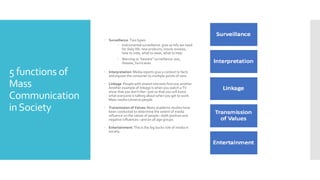
 Surveillance: Two types:
 Instrumental surveillance: give us info we need
for daily life: new products, movie reviews,
how to vote, what to wear, what to hear
 Warning or “beware” surveillance: war,
disease, hurricanes
 Interpretation: Media reports give a context to facts
and expose the consumer to multiple points of view
 Linkage: People with shared interests find one another.
Another example of linkage is when you watch a TV
show that you don’t like—just so that you will know
what everyone is talking about when you get to work.
Mass media connects people.
 Transmission of Values: Many academic studies have
been conducted to determine the extent of media
influence on the values of people—both positive and
negative influences—and on all age groups
 Entertainment: This is the big bucks role of media in
society.
Eras in
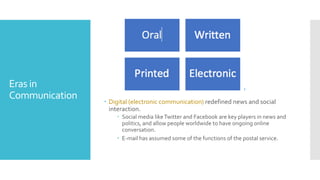
Communication  Digital (electronic communication) redefined news and social
interaction.
 Social media likeTwitter and Facebook are key players in news and
politics, and allow people worldwide to have ongoing online
conversation.
 E-mail has assumed some of the functions of the postal service.
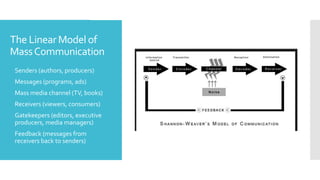
The Linear Model of
MassCommunication
 Senders (authors, producers)
 Messages (programs, ads)
 Mass media channel (TV, books)
 Receivers (viewers, consumers)
 Gatekeepers (editors, executive
producers, media managers)
 Feedback (messages from
receivers back to senders)
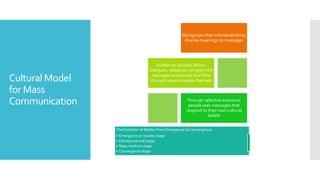
Cultural Model
for Mass
Communication
Recognizes that individuals bring
diverse meanings to messages
Audiences actively affirm,
interpret, refashion, or reject the
messages and stories that flow
through various media channels
Through selective exposure,
people seek messages that
respond to their own cultural
beliefs
The Evolution of Media: From Emergence to Convergence:
• Emergence or novelty stage
• Entrepreneurial stage
• Mass medium stage
• Convergence stage
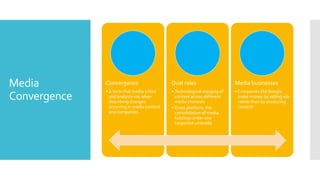
Media
Convergence
Convergence
• A term that media critics
and analysts use when
describing changes
occurring in media content
and companies.
Dual roles
• Technological merging of
content across different
media channels
• Cross platform, the
consolidation of media
holdings under one
corporate umbrella
Media businesses
• Companies like Google
make money by selling ads
rather than by producing
content
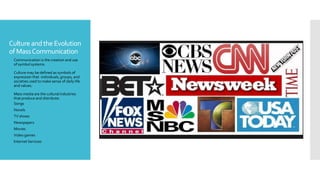
Culture andtheEvolution
ofMassCommunication
 Communication is the creation and use
of symbol systems.
 Culture may be defined as symbols of
expression that individuals, groups, and
societies used to make sense of daily life
and values.
 Mass media are the cultural industries
that produce and distribute:
 Songs
 Novels
 TV shows
 Newspapers
 Movies
 Video games
 Internet Services
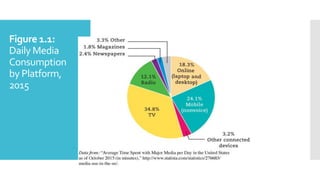
Figure 1.1:
Daily Media
Consumption
by Platform,
2015
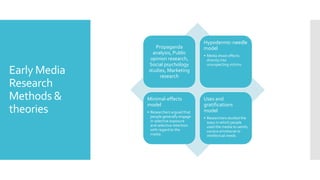
Early Media
Research
Methods &
theories
Propaganda
analysis, Public
opinion research,
Social psychology
studies, Marketing
research
Hypodermic-needle
model
• Media shoot effects
directly into
unsuspecting victims.
Minimal-effects
model
• Researchers argued that
people generally engage
in selective exposure
and selective retention
with regard to the
media.
Uses and
gratifications
model
• Researchers studied the
ways in which people
used the media to satisfy
various emotional or
intellectual needs.
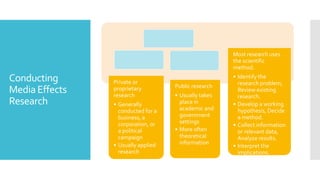
Conducting
Media Effects
Research
Private or
proprietary
research
• Generally
conducted for a
business, a
corporation, or
a political
campaign
• Usually applied
research
Public research
• Usually takes
place in
academic and
government
settings
• More often
theoretical
information
Most research uses
the scientific
method.
• Identify the
research problem,
Review existing
research.
• Develop a working
hypothesis, Decide
a method.
• Collect information
or relevant data,
Analyze results.
• Interpret the
implications.
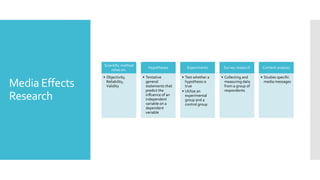
Media Effects
Research
Scientific method
relies on:
• Objectivity,
Reliability,
Validity
Hypotheses
• Tentative
general
statements that
predict the
influence of an
independent
variable on a
dependent
variable
Experiments
• Test whether a
hypothesis is
true
• Utilize an
experimental
group and a
control group
Survey research
• Collecting and
measuring data
from a group of
respondents
Content analysis
• Studies specific
media messages
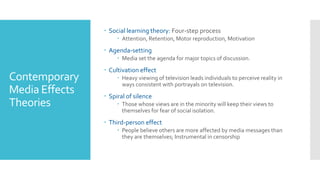
Contemporary
Media Effects
Theories
 Social learning theory: Four-step process
 Attention, Retention, Motor reproduction, Motivation
 Agenda-setting
 Media set the agenda for major topics of discussion.
 Cultivation effect
 Heavy viewing of television leads individuals to perceive reality in
ways consistent with portrayals on television.
 Spiral of silence
 Those whose views are in the minority will keep their views to
themselves for fear of social isolation.
 Third-person effect
 People believe others are more affected by media messages than
they are themselves; Instrumental in censorship
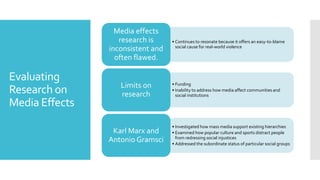
Evaluating
Research on
Media Effects
• Continues to resonate because it offers an easy-to-blame
social cause for real-world violence
Media effects
research is
inconsistent and
often flawed.
• Funding
• Inability to address how media affect communities and
social institutions
Limits on
research
• Investigated how mass media support existing hierarchies
• Examined how popular culture and sports distract people
from redressing social injustices
• Addressed the subordinate status of particular social groups
Karl Marx and
Antonio Gramsci
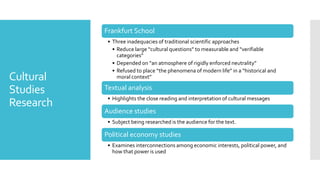
Cultural
Studies
Research
Frankfurt School
• Three inadequacies of traditional scientific approaches
• Reduce large “cultural questions” to measurable and “verifiable
categories”
• Depended on “an atmosphere of rigidly enforced neutrality”
• Refused to place “the phenomena of modern life” in a “historical and
moral context”
Textual analysis
• Highlights the close reading and interpretation of cultural messages
Audience studies
• Subject being researched is the audience for the text.
Political economy studies
• Examines interconnections among economic interests, political power, and
how that power is used
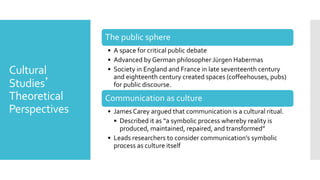
Cultural
Studies’
Theoretical
Perspectives
The public sphere
• A space for critical public debate
• Advanced by German philosopher Jürgen Habermas
• Society in England and France in late seventeenth century
and eighteenth century created spaces (coffeehouses, pubs)
for public discourse.
Communication as culture
• James Carey argued that communication is a cultural ritual.
• Described it as “a symbolic process whereby reality is
produced, maintained, repaired, and transformed”
• Leads researchers to consider communication’s symbolic
process as culture itself
Evaluating
Cultural
Studies
Research
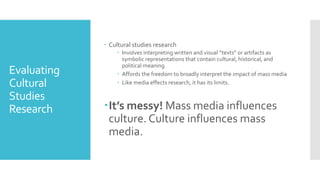
 Cultural studies research
 Involves interpreting written and visual “texts” or artifacts as
symbolic representations that contain cultural, historical, and
political meaning
 Affords the freedom to broadly interpret the impact of mass media
 Like media effects research, it has its limits.
It’s messy! Mass media influences
culture. Culture influences mass
media.
References
 Campbell, Martin, and Fabos. 2014. Media & Culture: Mass
Communication in a Digital Age, chapters 1 and 15. 10th edition.
Boston: Bedford/St. Martin's.

Week 1 lecture notes com 130

  • 1.
  • 2.
    Researching the Effect ofMass Media on Individuals and Society  Media played key roles in 2016 presidential election  DonaldTrump gained media attention during the 2016 presidential race.Trump received free air time on all the majorTV networks. He used social media to access large numbers of people, especially young voters.  Media effects research  Attempts to understand, explain, and predict the effects of mass media on individuals and society  Cultural studies  Focuses on how people make meaning, articulate values, comprehend reality, and arrange experiences through cultural symbols
  • 3.
    5 functions of Mass Communication inSociety Surveillance: Two types:  Instrumental surveillance: give us info we need for daily life: new products, movie reviews, how to vote, what to wear, what to hear  Warning or “beware” surveillance: war, disease, hurricanes  Interpretation: Media reports give a context to facts and expose the consumer to multiple points of view  Linkage: People with shared interests find one another. Another example of linkage is when you watch a TV show that you don’t like—just so that you will know what everyone is talking about when you get to work. Mass media connects people.  Transmission of Values: Many academic studies have been conducted to determine the extent of media influence on the values of people—both positive and negative influences—and on all age groups  Entertainment: This is the big bucks role of media in society.
  • 4.
    Eras in Communication Digital (electronic communication) redefined news and social interaction.  Social media likeTwitter and Facebook are key players in news and politics, and allow people worldwide to have ongoing online conversation.  E-mail has assumed some of the functions of the postal service.
  • 5.
    The Linear Modelof MassCommunication  Senders (authors, producers)  Messages (programs, ads)  Mass media channel (TV, books)  Receivers (viewers, consumers)  Gatekeepers (editors, executive producers, media managers)  Feedback (messages from receivers back to senders)
  • 6.
    Cultural Model for Mass Communication Recognizesthat individuals bring diverse meanings to messages Audiences actively affirm, interpret, refashion, or reject the messages and stories that flow through various media channels Through selective exposure, people seek messages that respond to their own cultural beliefs The Evolution of Media: From Emergence to Convergence: • Emergence or novelty stage • Entrepreneurial stage • Mass medium stage • Convergence stage
  • 7.
    Media Convergence Convergence • A termthat media critics and analysts use when describing changes occurring in media content and companies. Dual roles • Technological merging of content across different media channels • Cross platform, the consolidation of media holdings under one corporate umbrella Media businesses • Companies like Google make money by selling ads rather than by producing content
  • 8.
    Culture andtheEvolution ofMassCommunication  Communicationis the creation and use of symbol systems.  Culture may be defined as symbols of expression that individuals, groups, and societies used to make sense of daily life and values.  Mass media are the cultural industries that produce and distribute:  Songs  Novels  TV shows  Newspapers  Movies  Video games  Internet Services
  • 9.
  • 10.
    Early Media Research Methods & theories Propaganda analysis,Public opinion research, Social psychology studies, Marketing research Hypodermic-needle model • Media shoot effects directly into unsuspecting victims. Minimal-effects model • Researchers argued that people generally engage in selective exposure and selective retention with regard to the media. Uses and gratifications model • Researchers studied the ways in which people used the media to satisfy various emotional or intellectual needs.
  • 11.
    Conducting Media Effects Research Private or proprietary research •Generally conducted for a business, a corporation, or a political campaign • Usually applied research Public research • Usually takes place in academic and government settings • More often theoretical information Most research uses the scientific method. • Identify the research problem, Review existing research. • Develop a working hypothesis, Decide a method. • Collect information or relevant data, Analyze results. • Interpret the implications.
  • 12.
    Media Effects Research Scientific method relieson: • Objectivity, Reliability, Validity Hypotheses • Tentative general statements that predict the influence of an independent variable on a dependent variable Experiments • Test whether a hypothesis is true • Utilize an experimental group and a control group Survey research • Collecting and measuring data from a group of respondents Content analysis • Studies specific media messages
  • 13.
    Contemporary Media Effects Theories  Sociallearning theory: Four-step process  Attention, Retention, Motor reproduction, Motivation  Agenda-setting  Media set the agenda for major topics of discussion.  Cultivation effect  Heavy viewing of television leads individuals to perceive reality in ways consistent with portrayals on television.  Spiral of silence  Those whose views are in the minority will keep their views to themselves for fear of social isolation.  Third-person effect  People believe others are more affected by media messages than they are themselves; Instrumental in censorship
  • 14.
    Evaluating Research on Media Effects •Continues to resonate because it offers an easy-to-blame social cause for real-world violence Media effects research is inconsistent and often flawed. • Funding • Inability to address how media affect communities and social institutions Limits on research • Investigated how mass media support existing hierarchies • Examined how popular culture and sports distract people from redressing social injustices • Addressed the subordinate status of particular social groups Karl Marx and Antonio Gramsci
  • 15.
    Cultural Studies Research Frankfurt School • Threeinadequacies of traditional scientific approaches • Reduce large “cultural questions” to measurable and “verifiable categories” • Depended on “an atmosphere of rigidly enforced neutrality” • Refused to place “the phenomena of modern life” in a “historical and moral context” Textual analysis • Highlights the close reading and interpretation of cultural messages Audience studies • Subject being researched is the audience for the text. Political economy studies • Examines interconnections among economic interests, political power, and how that power is used
  • 16.
    Cultural Studies’ Theoretical Perspectives The public sphere •A space for critical public debate • Advanced by German philosopher Jürgen Habermas • Society in England and France in late seventeenth century and eighteenth century created spaces (coffeehouses, pubs) for public discourse. Communication as culture • James Carey argued that communication is a cultural ritual. • Described it as “a symbolic process whereby reality is produced, maintained, repaired, and transformed” • Leads researchers to consider communication’s symbolic process as culture itself
  • 17.
    Evaluating Cultural Studies Research  Cultural studiesresearch  Involves interpreting written and visual “texts” or artifacts as symbolic representations that contain cultural, historical, and political meaning  Affords the freedom to broadly interpret the impact of mass media  Like media effects research, it has its limits. It’s messy! Mass media influences culture. Culture influences mass media.
  • 18.
    References  Campbell, Martin,and Fabos. 2014. Media & Culture: Mass Communication in a Digital Age, chapters 1 and 15. 10th edition. Boston: Bedford/St. Martin's.