- Media Literacy
- Understanding Today’s Media
Industries
MEDIA IN A
CHANGING WORLD
Presented by: Russel J. Aporbo
MEDIA LITERACY
- The ability to understand and make
productive use of the media.
- This involves understanding the effect
media can have on you and on the society
around you.
- It is the difference between being
victimized by and being in control of
media’s influence.
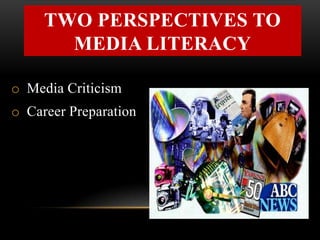
TWO PERSPECTIVES TO
MEDIA LITERACY
o Media Criticism
o Career Preparation
- The analysis used to assess the effects of
media on individuals, on societies and on
cultures.
- It doesn’t necessarily have to be negative,
but it does have to consist of analysis based
on well- reasoned argument.
MEDIA CRITICISM
MEDIA CRITICISM
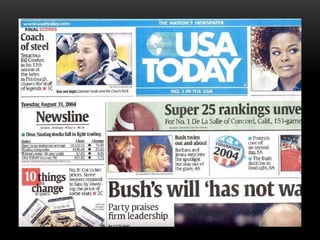
o Primary Grades
- Instruction in media criticism centers on making children
careful consumers of media messages; the goal is to help
them realize that they can react logically to the emotional
messages of the media.
o Secondary Levels
- High school students begin to learn about how the varois
media influence society and how media messages can
contribute to a teenager’s self-image.
MEDIA CRITICISM
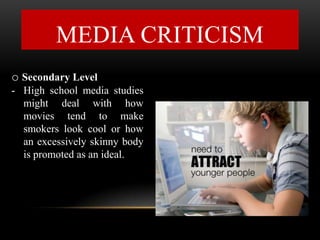
o Secondary Level
- High school media studies
might deal with how
movies tend to make
smokers look cool or how
an excessively skinny body
is promoted as an ideal.
o College Level
- Instruction in media criticism
goes a step further in providing
tools for the in depth analysis of
the messages of mass
communication.
-Examine the relationships among
media, history, current industry
practices, and controversies, as
well as how laws and ethics relate
to the impact of media.
MEDIA CRITICISM
o This provides an overview of
the various industries in mass
communication and suggest
career possibilities by giving
a general blueprint for how
the various industries work.
o Many non-media careers turn
out to have a media
component.
CAREER PREPARATION
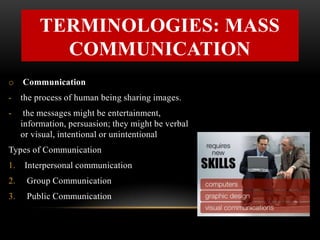
TERMINOLOGIES: MASS
COMMUNICATION
o Communication
- the process of human being sharing images.
- the messages might be entertainment,
information, persuasion; they might be verbal
or visual, intentional or unintentional
Types of Communication
1. Interpersonal communication
2. Group Communication
3. Public Communication
MEDIATED
COMMUNICATION
- This is any type of sharing messages conveyed through an
interposed device or medium, rather than face-to-face.
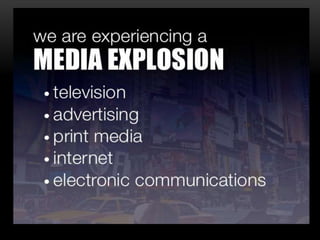
- Media- refers collectively to the
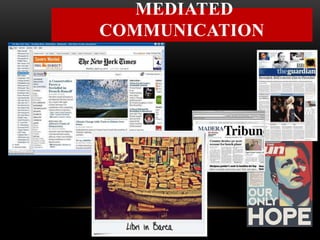
o print media ( books, magazines, and newspapers),
o broadcast media (television and radio)
o digital media/ new media ( internet, cell phones, any
computer based technology)
o entertainment media ( movies, recordings, video games)
MEDIATED
COMMUNICATION
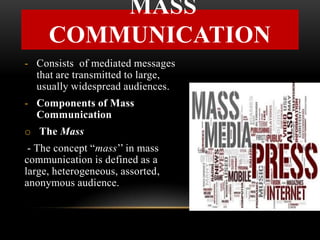
- Consists of mediated messages
that are transmitted to large,
usually widespread audiences.
- Components of Mass
Communication
o The Mass
- The concept “mass’’ in mass
communication is defined as a
large, heterogeneous, assorted,
anonymous audience.
MASS
COMMUNICATION
o The Mass
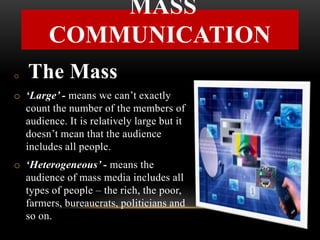
o ‘Large’ - means we can’t exactly
count the number of the members of
audience. It is relatively large but it
doesn’t mean that the audience
includes all people.
o ‘Heterogeneous’ - means the
audience of mass media includes all
types of people – the rich, the poor,
farmers, bureaucrats, politicians and
so on.
MASS
COMMUNICATION
o ‘Assorted’ -means the audience of
mass media is not necessarily
limited to a particular geographical
sector. They may be scattered
everywhere.
o ‘Anonymous’ -means we can’t
specifically identify a reader of a
newspaper of newspaper with his
certain characteristics. Today he
may be reader of a particular
newspaper. Tomorrow, he may
change his media habit. Anybody at
any time may be a member of mass
media audience.
MASS
COMMUNICATION
NATURE OF MASS
COMMUNICATION
o Mass communication experience is public one.
o It is a mediated communication act.
o Mass communication is filtered communication. This filtering
processing is called gatekeeping.
o It is the most complicated form of communication as it
involves complex technology like satellites digital networks,
management structure, marketing chain etc.
o Mass communication can alter the way the society thinks about
events and attitudes.
o Mass communication experience is transient. It means that
once you used a message (for example, a news report or a
film) you may not use it again. The message is meant to be
used once and it is gone.
o Mass communication is most often remains as one-way
communication.
-As receivers, how many of us write letters to editor
(sender)? A very few.
o Unlike other communicators, mass communicators can’t
see their audience.
NATURE OF MASS
COMMUNICATION
What is thedifferencebetween
MassCommunication and
InterpersonalCommunication?
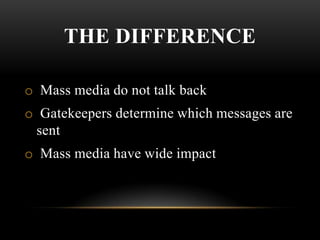
THE DIFFERENCE
o Mass media do not talk back
o Gatekeepers determine which messages are
sent
o Mass media have wide impact
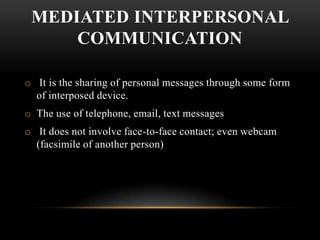
MEDIATED INTERPERSONAL
COMMUNICATION
o It is the sharing of personal messages through some form
of interposed device.
o The use of telephone, email, text messages
o It does not involve face-to-face contact; even webcam
(facsimile of another person)
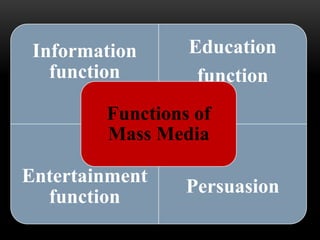
Information
function
Education
function
Entertainment
function
Persuasion
Functions of
Mass Media
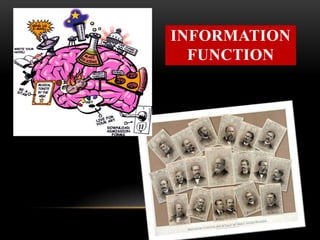
1. Information function
- Mass media carry a lot of information which are essential for our day to day
life. We know exam results, weather forecasts, current affairs, traffic
regulations, last dates, precautions, government policies etc. from mass media.
- The core of media’s information function is performed by the media content
called news.
-The place or time dedicated for news in a mass media is called news hole.
-News is the most consumed item of any media.
-News can be defined as reports on things that people want or need to know.
-Information should be accurate, objective and complete.
-Biased or incomplete reports will keep the audience away from the media.
FUNCTIONS OF MASS
MEDIA
INFORMATION
FUNCTION
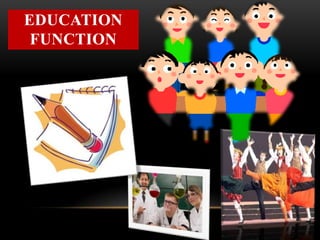
2. Education Function
-Media also perform the functions that educational institutions
do. Media are life-long educators for the society.
-They give us comprehensive knowledge of selected topics.
Non-news content or news-based content like editorials,
articles, columns in newspapers provide us with complete idea
of a subject.
-Health Magazines, IT magazines are also examples for
education through media.
Recently, mass media in participate in our educational system
by publishing educational supplements for school-goers .
FUNCTIONS OF MASS
MEDIA
EDUCATION
FUNCTION
3. Entertainment function
-Irrespective of their type, mass media are wonderful entertainers.
All media have
entertainment content.
- Newspapers publish cartoons, comics, puzzles, special weekend
supplements for amusing people.
- share of magazine content such as short stories, novels, satires
and cartoons are for entertainment. Movies are another big
stock for entertainment.
- Audio-Visual media such as television and radio are also
primarily concentrate on entertainment function through their
programmes based on sports, film, and fashion shows etc.
FUNCTIONS OF MASS
MEDIA
ENTERTAINME
NT FUNCTION
4. Persuasion
-Persuasion means influencing attitudes or opinions. Mass media have many ways to
persuade people.
- Most people form their opinion from information they get from mass media.
-Media have direct and indirect methods for persuasion.
For public opinion formation, mass media use editorials, news analysis and commentaries.
In such cases, the purpose is clear and direct.
The most obvious method of persuasion is advertising. Advertisements are direct methods
to influence purchasing behaviour of the public.
Some media report events hiding their vested interests in news. Such biased, subjective
reports are for persuading people to form favourable attitudes towards them or their
interests.
Opinionated news is an undirected method of persuasion. It’s against the ethics of
responsible journalism. News and opinion should be given separately.
FUNCTIONS OF MASS
MEDIA
PERSUASION
• According to western media scholars like Harold Laswell,
mass media, be print or electronic, have the following
functions:
1. Surveillance of the environment
2. Transmission of heritage
3. Interpretation of information
4. Catalyst for Development
5. Prescription for conduct
FUNCTIONS OF MASS
MEDIA
SURVEILLANCE OF THE
ENVIRONMENT
o Mass media observe the society and its activities and report
them to make people aware of their socio-cultural
environment.
o In other words, we as social animals are always under the
close observations of mass media. Media are our watchdogs.
It always watches who do good things and who do bad
things, and report them to encourage or correct our deeds.
o Considering this watchdog function of mass media, we call
the media as the Fourth Estate of our democratic political
system. The other estates are Legislative, Judiciary and
Executive.
o Mass media are the bridge between our past and present.
o They report day to day affairs which will become history
of tomorrow.
o The best records of modern history are newspapers of
yesteryears. We get our cultural tradition from history and
we follow the best of them.
o In keeping our culture flowing, media play a vital role. It
advises us which part of our culture is good and to be
followed and which is bad and not to be followed.
TRANSMISSION OF HERITAGE
o Mass media provide us with information from every nook
and corner of the world.
o They do not just report facts and figures of the events,
rather they interpret events to make us aware of what
happens, and why, where, when and how it happens.
o Media interpretation may be biased or not. But, it helps
develop our views towards an event or object or
personality.
o Every media report is an analysis and one version of the
fact. There may be another versions and analysis.
INTERPRETATION OF
INFORMATION
• How should we behave in a society?
• What should be our approach towards something important to the
society?
• What is good for social life?
• As a member of a larger social system, we face these questions every
now and then. In most cases, mass media provide us answers.
• During the election time, we are confused of electing a candidate.
• But, news coverage of political policies and leaders of various parties
give us an insight that helps us take decisions.
• This is how media prescribe our political conduct.
• So do the advertising. Which product or service is better? Which is
suitable to our budget? We depend on advertisements before taking
purchase decisions.
PRESCRIPTION OF CONDUCT
Thank You for listening
As advocates for development
and as carriers of development messages. Mass media find out problems faced by
people in
different walks of their life and make the administrators aware of them. Most often,
media report
such events and further campaign to get the grievances redressed. On the other
hand, media
make people aware of their rights, government subsidies, development policies
and the merits
and demerits of adopting or practicing them for better life. Government controlled
media
perform these duties better than the private media do.
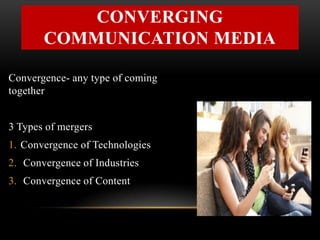
CONVERGING
COMMUNICATION MEDIA
Convergence- any type of coming
together
3 Types of mergers
1. Convergence of Technologies
2. Convergence of Industries
3. Convergence of Content
Media in a changing world

Media in a changing world

  • 1.
    - Media Literacy -Understanding Today’s Media Industries MEDIA IN A CHANGING WORLD Presented by: Russel J. Aporbo
  • 5.
    MEDIA LITERACY - Theability to understand and make productive use of the media. - This involves understanding the effect media can have on you and on the society around you. - It is the difference between being victimized by and being in control of media’s influence.
  • 6.
    TWO PERSPECTIVES TO MEDIALITERACY o Media Criticism o Career Preparation
  • 7.
    - The analysisused to assess the effects of media on individuals, on societies and on cultures. - It doesn’t necessarily have to be negative, but it does have to consist of analysis based on well- reasoned argument. MEDIA CRITICISM
  • 9.
    MEDIA CRITICISM o PrimaryGrades - Instruction in media criticism centers on making children careful consumers of media messages; the goal is to help them realize that they can react logically to the emotional messages of the media. o Secondary Levels - High school students begin to learn about how the varois media influence society and how media messages can contribute to a teenager’s self-image.
  • 10.
    MEDIA CRITICISM o SecondaryLevel - High school media studies might deal with how movies tend to make smokers look cool or how an excessively skinny body is promoted as an ideal.
  • 11.
    o College Level -Instruction in media criticism goes a step further in providing tools for the in depth analysis of the messages of mass communication. -Examine the relationships among media, history, current industry practices, and controversies, as well as how laws and ethics relate to the impact of media. MEDIA CRITICISM
  • 12.
    o This providesan overview of the various industries in mass communication and suggest career possibilities by giving a general blueprint for how the various industries work. o Many non-media careers turn out to have a media component. CAREER PREPARATION
  • 13.
    TERMINOLOGIES: MASS COMMUNICATION o Communication -the process of human being sharing images. - the messages might be entertainment, information, persuasion; they might be verbal or visual, intentional or unintentional Types of Communication 1. Interpersonal communication 2. Group Communication 3. Public Communication
  • 14.
    MEDIATED COMMUNICATION - This isany type of sharing messages conveyed through an interposed device or medium, rather than face-to-face. - Media- refers collectively to the o print media ( books, magazines, and newspapers), o broadcast media (television and radio) o digital media/ new media ( internet, cell phones, any computer based technology) o entertainment media ( movies, recordings, video games)
  • 15.
  • 16.
    - Consists ofmediated messages that are transmitted to large, usually widespread audiences. - Components of Mass Communication o The Mass - The concept “mass’’ in mass communication is defined as a large, heterogeneous, assorted, anonymous audience. MASS COMMUNICATION
  • 17.
    o The Mass o‘Large’ - means we can’t exactly count the number of the members of audience. It is relatively large but it doesn’t mean that the audience includes all people. o ‘Heterogeneous’ - means the audience of mass media includes all types of people – the rich, the poor, farmers, bureaucrats, politicians and so on. MASS COMMUNICATION
  • 18.
    o ‘Assorted’ -meansthe audience of mass media is not necessarily limited to a particular geographical sector. They may be scattered everywhere. o ‘Anonymous’ -means we can’t specifically identify a reader of a newspaper of newspaper with his certain characteristics. Today he may be reader of a particular newspaper. Tomorrow, he may change his media habit. Anybody at any time may be a member of mass media audience. MASS COMMUNICATION
  • 19.
    NATURE OF MASS COMMUNICATION oMass communication experience is public one. o It is a mediated communication act. o Mass communication is filtered communication. This filtering processing is called gatekeeping. o It is the most complicated form of communication as it involves complex technology like satellites digital networks, management structure, marketing chain etc. o Mass communication can alter the way the society thinks about events and attitudes.
  • 20.
    o Mass communicationexperience is transient. It means that once you used a message (for example, a news report or a film) you may not use it again. The message is meant to be used once and it is gone. o Mass communication is most often remains as one-way communication. -As receivers, how many of us write letters to editor (sender)? A very few. o Unlike other communicators, mass communicators can’t see their audience. NATURE OF MASS COMMUNICATION
  • 21.
    What is thedifferencebetween MassCommunicationand InterpersonalCommunication?
  • 22.
    THE DIFFERENCE o Massmedia do not talk back o Gatekeepers determine which messages are sent o Mass media have wide impact
  • 23.
    MEDIATED INTERPERSONAL COMMUNICATION o Itis the sharing of personal messages through some form of interposed device. o The use of telephone, email, text messages o It does not involve face-to-face contact; even webcam (facsimile of another person)
  • 24.
  • 25.
    1. Information function -Mass media carry a lot of information which are essential for our day to day life. We know exam results, weather forecasts, current affairs, traffic regulations, last dates, precautions, government policies etc. from mass media. - The core of media’s information function is performed by the media content called news. -The place or time dedicated for news in a mass media is called news hole. -News is the most consumed item of any media. -News can be defined as reports on things that people want or need to know. -Information should be accurate, objective and complete. -Biased or incomplete reports will keep the audience away from the media. FUNCTIONS OF MASS MEDIA
  • 26.
  • 27.
    2. Education Function -Mediaalso perform the functions that educational institutions do. Media are life-long educators for the society. -They give us comprehensive knowledge of selected topics. Non-news content or news-based content like editorials, articles, columns in newspapers provide us with complete idea of a subject. -Health Magazines, IT magazines are also examples for education through media. Recently, mass media in participate in our educational system by publishing educational supplements for school-goers . FUNCTIONS OF MASS MEDIA
  • 28.
  • 29.
    3. Entertainment function -Irrespectiveof their type, mass media are wonderful entertainers. All media have entertainment content. - Newspapers publish cartoons, comics, puzzles, special weekend supplements for amusing people. - share of magazine content such as short stories, novels, satires and cartoons are for entertainment. Movies are another big stock for entertainment. - Audio-Visual media such as television and radio are also primarily concentrate on entertainment function through their programmes based on sports, film, and fashion shows etc. FUNCTIONS OF MASS MEDIA
  • 30.
  • 32.
    4. Persuasion -Persuasion meansinfluencing attitudes or opinions. Mass media have many ways to persuade people. - Most people form their opinion from information they get from mass media. -Media have direct and indirect methods for persuasion. For public opinion formation, mass media use editorials, news analysis and commentaries. In such cases, the purpose is clear and direct. The most obvious method of persuasion is advertising. Advertisements are direct methods to influence purchasing behaviour of the public. Some media report events hiding their vested interests in news. Such biased, subjective reports are for persuading people to form favourable attitudes towards them or their interests. Opinionated news is an undirected method of persuasion. It’s against the ethics of responsible journalism. News and opinion should be given separately. FUNCTIONS OF MASS MEDIA
  • 33.
  • 34.
    • According towestern media scholars like Harold Laswell, mass media, be print or electronic, have the following functions: 1. Surveillance of the environment 2. Transmission of heritage 3. Interpretation of information 4. Catalyst for Development 5. Prescription for conduct FUNCTIONS OF MASS MEDIA
  • 35.
    SURVEILLANCE OF THE ENVIRONMENT oMass media observe the society and its activities and report them to make people aware of their socio-cultural environment. o In other words, we as social animals are always under the close observations of mass media. Media are our watchdogs. It always watches who do good things and who do bad things, and report them to encourage or correct our deeds. o Considering this watchdog function of mass media, we call the media as the Fourth Estate of our democratic political system. The other estates are Legislative, Judiciary and Executive.
  • 36.
    o Mass mediaare the bridge between our past and present. o They report day to day affairs which will become history of tomorrow. o The best records of modern history are newspapers of yesteryears. We get our cultural tradition from history and we follow the best of them. o In keeping our culture flowing, media play a vital role. It advises us which part of our culture is good and to be followed and which is bad and not to be followed. TRANSMISSION OF HERITAGE
  • 37.
    o Mass mediaprovide us with information from every nook and corner of the world. o They do not just report facts and figures of the events, rather they interpret events to make us aware of what happens, and why, where, when and how it happens. o Media interpretation may be biased or not. But, it helps develop our views towards an event or object or personality. o Every media report is an analysis and one version of the fact. There may be another versions and analysis. INTERPRETATION OF INFORMATION
  • 38.
    • How shouldwe behave in a society? • What should be our approach towards something important to the society? • What is good for social life? • As a member of a larger social system, we face these questions every now and then. In most cases, mass media provide us answers. • During the election time, we are confused of electing a candidate. • But, news coverage of political policies and leaders of various parties give us an insight that helps us take decisions. • This is how media prescribe our political conduct. • So do the advertising. Which product or service is better? Which is suitable to our budget? We depend on advertisements before taking purchase decisions. PRESCRIPTION OF CONDUCT
  • 39.
    Thank You forlistening
  • 41.
    As advocates fordevelopment and as carriers of development messages. Mass media find out problems faced by people in different walks of their life and make the administrators aware of them. Most often, media report such events and further campaign to get the grievances redressed. On the other hand, media make people aware of their rights, government subsidies, development policies and the merits and demerits of adopting or practicing them for better life. Government controlled media perform these duties better than the private media do.
  • 42.
    CONVERGING COMMUNICATION MEDIA Convergence- anytype of coming together 3 Types of mergers 1. Convergence of Technologies 2. Convergence of Industries 3. Convergence of Content