5th edition
John V Pavlik & Shawn McIntosh
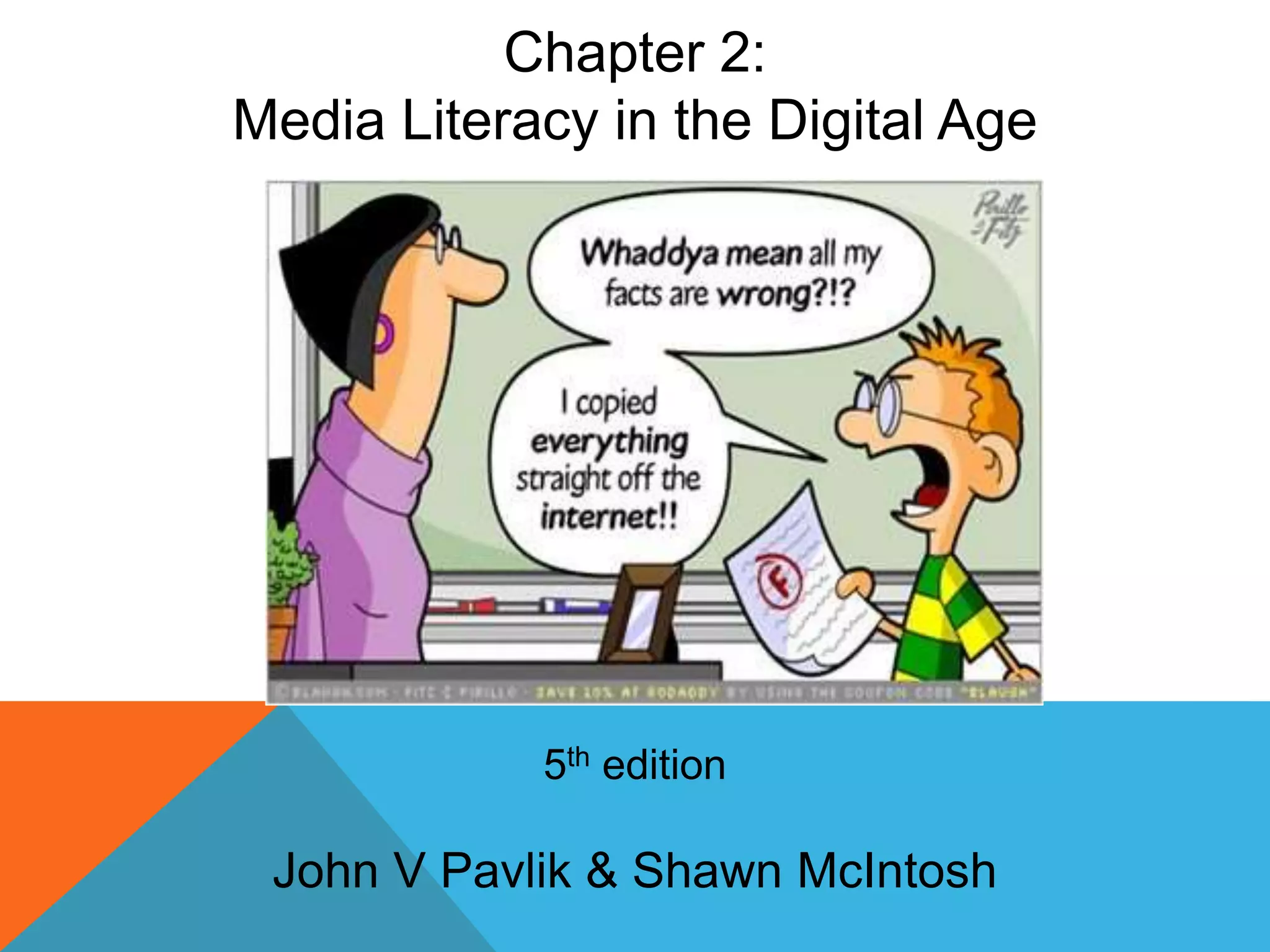
Chapter 2:
Media Literacy in the Digital Age
EDUCATION AND MEDIA
 We learn much from our daily and extensive interactions
with media content
 If media are so pervasive in our lives, why aren’t we
studying them in the same way that we study geography or
biology?
 Educators have recognized a growing need to teach media
literacy skills to school-age children, starting as young as
kindergarten or elementary school and continuing to high
school graduation
WHAT IS MEDIA LITERACY?
The process of critically
analyzing media content
by considering its
particular presentation, its
underlying political or
social messages, and how
media ownership or
regulation may affect the
type of media content we
receive
WHAT MAKES MEDIATED
COMMUNICATION DIFFERENT
 What we see and hear through mediated communication—
the signs, symbols, and words we receive through such
things as books, the Web, television and radio—affect us in
ways that nonmediated communication does not
 Semiotics: The study of signs and symbols
 Framing: Classify, organize, and interpret things into
certain schema, or frameworks
EARLY CONCERNS OF MEDIA EFFECTS
Public concern about the possible
effects of each new medium of mass
communication as it has emerged
MEDIA GRAMMAR
Each medium of mass communication
presents its messages uniquely
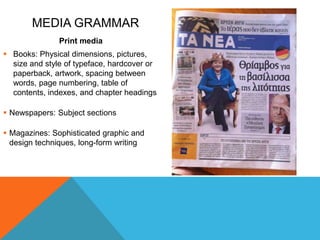
MEDIA GRAMMAR
Print media
 Books: Physical dimensions, pictures,
size and style of typeface, hardcover or
paperback, artwork, spacing between
words, page numbering, table of
contents, indexes, and chapter headings
 Newspapers: Subject sections
 Magazines: Sophisticated graphic and
design techniques, long-form writing
MEDIA GRAMMAR
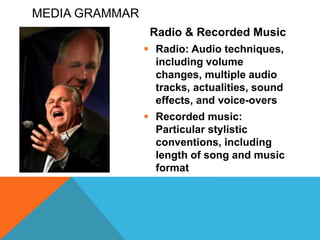
Radio & Recorded Music
 Radio: Audio techniques,
including volume
changes, multiple audio
tracks, actualities, sound
effects, and voice-overs
 Recorded music:
Particular stylistic
conventions, including
length of song and music
format
MEDIA GRAMMAR
Film & Television
Sophisticated media grammar that is
based on editing, camera angles,
lighting, movement, and sound
MEDIA GRAMMAR
Digital media
 Media grammar evolves as
our communication devices
evolve
 Adopted from traditional
media forms and created
new ways for us to interact
with the media
IMPLICATIONS OF COMMERCIAL MEDIA
Economic factors and corporate
decisions often influence what is and is
not covered in the news and what kind of
entertainment is created and shown
IMPLICATIONS OF COMMERCIAL MEDIA
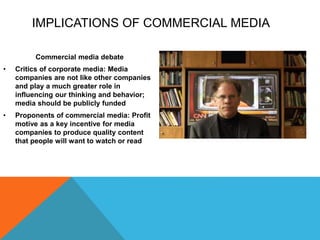
Commercial media debate
• Critics of corporate media: Media
companies are not like other companies
and play a much greater role in
influencing our thinking and behavior;
media should be publicly funded
• Proponents of commercial media: Profit
motive as a key incentive for media
companies to produce quality content
that people will want to watch or read
CONCENTRATION OF MEDIA OWNERSHIP
 Successful media enterprises have acquired,
through purchase or merger, other media
enterprises and have become larger in size and
scope
 Greater concentration of ownership results in less
diversity of media voices, and a poorly served
public; minority voices and non-mainstream views
may be silenced
MEDIA BIAS
Media bias: Favoring one side
or another with greater
and/or more favorable
coverage
Bias occurs across media:
 News: More/less time on particular
stories, language used in
coverage; strive for fair and
balanced
 Entertainment: Propagating
stereotypes and normalizing or
demonizing certain types of
behaviors
DEVELOPING CRITICAL MEDIA LITERACY
SKILLS
Assumption that the public is largely
passive; media literacy skills help us
become better media consumers and
producers as we learn to think critically
about various media.
DEVELOPING CRITICAL MEDIA LITERACY
SKILLS
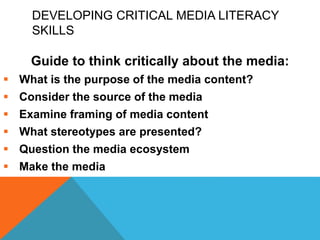
Guide to think critically about the media:
 What is the purpose of the media content?
 Consider the source of the media
 Examine framing of media content
 What stereotypes are presented?
 Question the media ecosystem
 Make the media

Chapter 2 - Media Literacy in the Digital Age

  • 1.
    5th edition John VPavlik & Shawn McIntosh Chapter 2: Media Literacy in the Digital Age
  • 2.
    EDUCATION AND MEDIA We learn much from our daily and extensive interactions with media content  If media are so pervasive in our lives, why aren’t we studying them in the same way that we study geography or biology?  Educators have recognized a growing need to teach media literacy skills to school-age children, starting as young as kindergarten or elementary school and continuing to high school graduation
  • 3.
    WHAT IS MEDIALITERACY? The process of critically analyzing media content by considering its particular presentation, its underlying political or social messages, and how media ownership or regulation may affect the type of media content we receive
  • 4.
    WHAT MAKES MEDIATED COMMUNICATIONDIFFERENT  What we see and hear through mediated communication— the signs, symbols, and words we receive through such things as books, the Web, television and radio—affect us in ways that nonmediated communication does not  Semiotics: The study of signs and symbols  Framing: Classify, organize, and interpret things into certain schema, or frameworks
  • 5.
    EARLY CONCERNS OFMEDIA EFFECTS Public concern about the possible effects of each new medium of mass communication as it has emerged
  • 6.
    MEDIA GRAMMAR Each mediumof mass communication presents its messages uniquely
  • 7.
    MEDIA GRAMMAR Print media Books: Physical dimensions, pictures, size and style of typeface, hardcover or paperback, artwork, spacing between words, page numbering, table of contents, indexes, and chapter headings  Newspapers: Subject sections  Magazines: Sophisticated graphic and design techniques, long-form writing
  • 8.
    MEDIA GRAMMAR Radio &Recorded Music  Radio: Audio techniques, including volume changes, multiple audio tracks, actualities, sound effects, and voice-overs  Recorded music: Particular stylistic conventions, including length of song and music format
  • 9.
    MEDIA GRAMMAR Film &Television Sophisticated media grammar that is based on editing, camera angles, lighting, movement, and sound
  • 10.
    MEDIA GRAMMAR Digital media Media grammar evolves as our communication devices evolve  Adopted from traditional media forms and created new ways for us to interact with the media
  • 11.
    IMPLICATIONS OF COMMERCIALMEDIA Economic factors and corporate decisions often influence what is and is not covered in the news and what kind of entertainment is created and shown
  • 12.
    IMPLICATIONS OF COMMERCIALMEDIA Commercial media debate • Critics of corporate media: Media companies are not like other companies and play a much greater role in influencing our thinking and behavior; media should be publicly funded • Proponents of commercial media: Profit motive as a key incentive for media companies to produce quality content that people will want to watch or read
  • 13.
    CONCENTRATION OF MEDIAOWNERSHIP  Successful media enterprises have acquired, through purchase or merger, other media enterprises and have become larger in size and scope  Greater concentration of ownership results in less diversity of media voices, and a poorly served public; minority voices and non-mainstream views may be silenced
  • 14.
    MEDIA BIAS Media bias:Favoring one side or another with greater and/or more favorable coverage Bias occurs across media:  News: More/less time on particular stories, language used in coverage; strive for fair and balanced  Entertainment: Propagating stereotypes and normalizing or demonizing certain types of behaviors
  • 15.
    DEVELOPING CRITICAL MEDIALITERACY SKILLS Assumption that the public is largely passive; media literacy skills help us become better media consumers and producers as we learn to think critically about various media.
  • 16.
    DEVELOPING CRITICAL MEDIALITERACY SKILLS Guide to think critically about the media:  What is the purpose of the media content?  Consider the source of the media  Examine framing of media content  What stereotypes are presented?  Question the media ecosystem  Make the media