A Presentation
Heart Attack
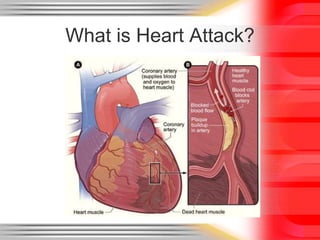
What is Heart Attack?
Heart Attack
• Heart disease is the leading cause of death worldwide.
It is basically from our way of life, smoking, physical
inactivity, stress. They are all related to heart disease.
• More than a million Americans have heart attacks each
year. A heart attack, or myocardial infarction (MI), is
permanent damage to the heart muscle. "Myo" means
muscle, "cardial" refers to the heart, and "infarction"
means death of tissue due to lack of blood supply.
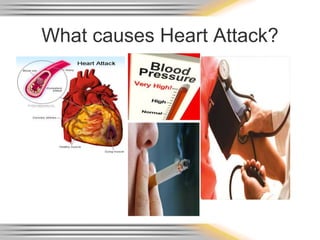
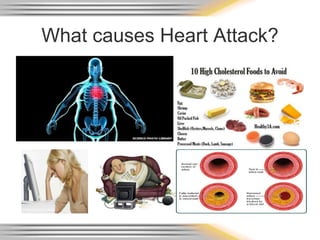
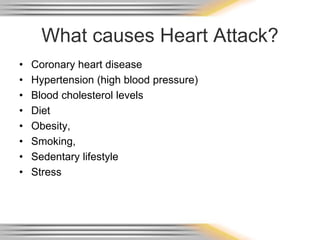
What causes Heart Attack?
• Coronary heart disease
• Hypertension (high blood pressure)
• Blood cholesterol levels
• Diet
• Obesity,
• Smoking,
• Sedentary lifestyle
• Stress
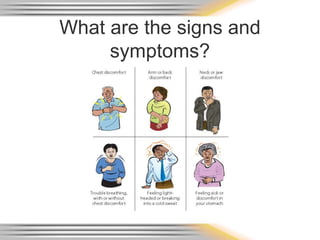
What are the signs and
symptoms?
How is it diagnosed?
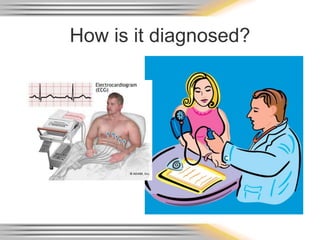
• ECG. The ECG (also known as EKG or electrocardiogram) can tell
how much damage has occurred to your heart muscle and where it
has occurred. In addition, your heart rate and rhythm can be
monitored.
• Blood tests. Blood may be drawn to measure levels of cardiac
enzymes that indicate heart muscle damage. These enzymes are
normally found inside the cells of your heart and are needed for their
function. When your heart muscle cells are injured, their contents --
including the enzymes -- are released into your bloodstream. By
measuring the levels of these enzymes, the doctor can determine
the size of the heart attack and approximately when the heart attack
started. Troponin levels will also be measured. Troponins are
proteins found inside of heart cells that are released when they are
damaged by the lack of blood supply to the heart. Detecting troponin
in the blood may indicate a heart attack.
• Echocardiography. Echocardiography is an imaging
test that can be used during and after a heart attack to
learn how the heart is pumping and what areas are not
pumping normally. The "echo" can also tell if any
structures of the heart (valves, septum, etc.) have been
injured during the heart attack.
• Cardiac catheterization. Cardiac catheterization, also
called cardiac cath, may be used during the first hours of
a heart attack if medications are not relieving the
ischemia or symptoms. The cardiac cath can be used to
directly visualize the blocked artery and help your doctor
determine which procedure is needed to treat the
blockage.
How can we prevent Heart
Attack?
How can we prevent Heart
Attack?
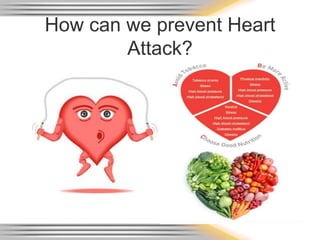
• Don't smoke or use tobacco
• Smoking or using tobacco is one of the most significant
risk factors for developing heart disease. Chemicals in
tobacco can damage your heart and blood vessels,
leading to narrowing of the arteries (atherosclerosis).
• Exercise for 30 minutes on most days of the week
• Physical activity helps you control your weight and can
reduce your chances of developing other conditions that
may put a strain on your heart, such as high blood
pressure, high cholesterol and diabetes. It also reduces
stress, which may be a factor in heart disease.
• High blood pressure
• Persistent high blood pressure can put your arteries and
heart under extra strain, increasing your risk of heart
attack.
• High blood pressure can often be reduced by a healthy
diet, moderating your intake of alcohol, maintaining a
healthy weight, and taking regular exercise.
• Alcohol
• Alcohol is also high in calories, so you will gain weight if
you drink regularly. Being overweight will also increase
your blood pressure.
Presented by:
Alvarez, Mark Ian C.
Chua, Shereen O.
Tenorio, Ginky
Tosino, Ken Christensen P.
THE
END

Heart Attack

  • 1.
  • 2.
  • 3.
    Heart Attack • Heartdisease is the leading cause of death worldwide. It is basically from our way of life, smoking, physical inactivity, stress. They are all related to heart disease. • More than a million Americans have heart attacks each year. A heart attack, or myocardial infarction (MI), is permanent damage to the heart muscle. "Myo" means muscle, "cardial" refers to the heart, and "infarction" means death of tissue due to lack of blood supply.
  • 4.
  • 5.
  • 6.
    What causes HeartAttack? • Coronary heart disease • Hypertension (high blood pressure) • Blood cholesterol levels • Diet • Obesity, • Smoking, • Sedentary lifestyle • Stress
  • 7.
    What are thesigns and symptoms?
  • 8.
    How is itdiagnosed?
  • 9.
    How is itdiagnosed? • ECG. The ECG (also known as EKG or electrocardiogram) can tell how much damage has occurred to your heart muscle and where it has occurred. In addition, your heart rate and rhythm can be monitored. • Blood tests. Blood may be drawn to measure levels of cardiac enzymes that indicate heart muscle damage. These enzymes are normally found inside the cells of your heart and are needed for their function. When your heart muscle cells are injured, their contents -- including the enzymes -- are released into your bloodstream. By measuring the levels of these enzymes, the doctor can determine the size of the heart attack and approximately when the heart attack started. Troponin levels will also be measured. Troponins are proteins found inside of heart cells that are released when they are damaged by the lack of blood supply to the heart. Detecting troponin in the blood may indicate a heart attack.
  • 10.
    • Echocardiography. Echocardiographyis an imaging test that can be used during and after a heart attack to learn how the heart is pumping and what areas are not pumping normally. The "echo" can also tell if any structures of the heart (valves, septum, etc.) have been injured during the heart attack. • Cardiac catheterization. Cardiac catheterization, also called cardiac cath, may be used during the first hours of a heart attack if medications are not relieving the ischemia or symptoms. The cardiac cath can be used to directly visualize the blocked artery and help your doctor determine which procedure is needed to treat the blockage.
  • 11.
    How can weprevent Heart Attack?
  • 12.
    How can weprevent Heart Attack? • Don't smoke or use tobacco • Smoking or using tobacco is one of the most significant risk factors for developing heart disease. Chemicals in tobacco can damage your heart and blood vessels, leading to narrowing of the arteries (atherosclerosis). • Exercise for 30 minutes on most days of the week • Physical activity helps you control your weight and can reduce your chances of developing other conditions that may put a strain on your heart, such as high blood pressure, high cholesterol and diabetes. It also reduces stress, which may be a factor in heart disease.
  • 13.
    • High bloodpressure • Persistent high blood pressure can put your arteries and heart under extra strain, increasing your risk of heart attack. • High blood pressure can often be reduced by a healthy diet, moderating your intake of alcohol, maintaining a healthy weight, and taking regular exercise. • Alcohol • Alcohol is also high in calories, so you will gain weight if you drink regularly. Being overweight will also increase your blood pressure.
  • 14.
    Presented by: Alvarez, MarkIan C. Chua, Shereen O. Tenorio, Ginky Tosino, Ken Christensen P.
  • 15.