This document introduces sequences and series in mathematics. It defines a sequence as a set of numbers written in a particular order, with the n-th term written as un. A series is the sum of terms in a sequence. An arithmetic progression has terms where each new term is obtained by adding a constant difference to the preceding term. The n-th term of an arithmetic progression is a + (n - 1)d, where a is the first term and d is the common difference. A geometric progression multiplies each new term by a constant ratio r to obtain the next term, with the n-th term written as arn-1. Formulas are provided for finding the n-th term, sum of terms,
Introduction to sequences and series, arithmetic progressions (APs) and geometric progressions (GPs). Objectives to differentiate and calculate terms and sums.
Definition of sequences as ordered sets of numbers. Series as sums of sequences, using Sn notation.
Introduction to progressions: arithmetic, geometric, and harmonic. Definition and characteristics discussed.
Definition of arithmetic progression, finding terms, and the sum of an arithmetic series with formulas. Working through examples of AP calculations, finding specific terms, and summing first n terms.
Definition of geometric progression, behavior based on common ratio, and geometric mean.
Finding specific terms in a GP and calculating the sum of a geometric series with examples.
Advanced concept of convergence in geometric series, finding sums to infinity with conditions.
Review questions on finding sums of APs and GPs to test understanding of content.
References for further reading and study materials related to mathematics in economics.
End slide, likely indicating closure of the presentation.
Introduction
Department of Economics
Thisunit introduces sequences and series, and
gives some simple examples of each. It also
explores particular types of sequence known as
arithmetic progressions (APs) and geometric
progressions (GPs), and the corresponding
series.
3.
Objectives
After completing thisunit you should able to:
Find the difference between a sequence and a series;
What is an Arithmetic progression;
find the n-th term of an Arithmetic progression;
find the sum of an Arithmetic series;
What is a Geometric progression;
find the n-th term of a Geometric progression;
find the sum of a Geometric series;
Department of Economics
4.
Department of Economics
Ifa set of values is not a random one but follows some rule so
that it is possible to calculate each term from a knowledge of
the preceding terms, we call this set of values a Sequence.
Sequences
A sequence is a set of numbers written in a particular order. We
sometimes write u₁ for the first term of the sequence, u₂ for the
second term, and so on. We write the n-th term as un.
Example:
2, 8, 32, 128…………
5.
Department of Economics
Series
Asequence of which the terms are connected by plus or minus
signs, so that we are able to calculate a sum for a given number
of terms, is called a series.
A series is a sum of the terms in a sequence. If there are n terms
in the sequence and we evaluate the sum then we often write Sn
for the result, so that Sn = u₁ + u₂ + . . . + u n .
Example: 1 +1 + 1 + 1+……….
2 6 24
6.
Department of Economics
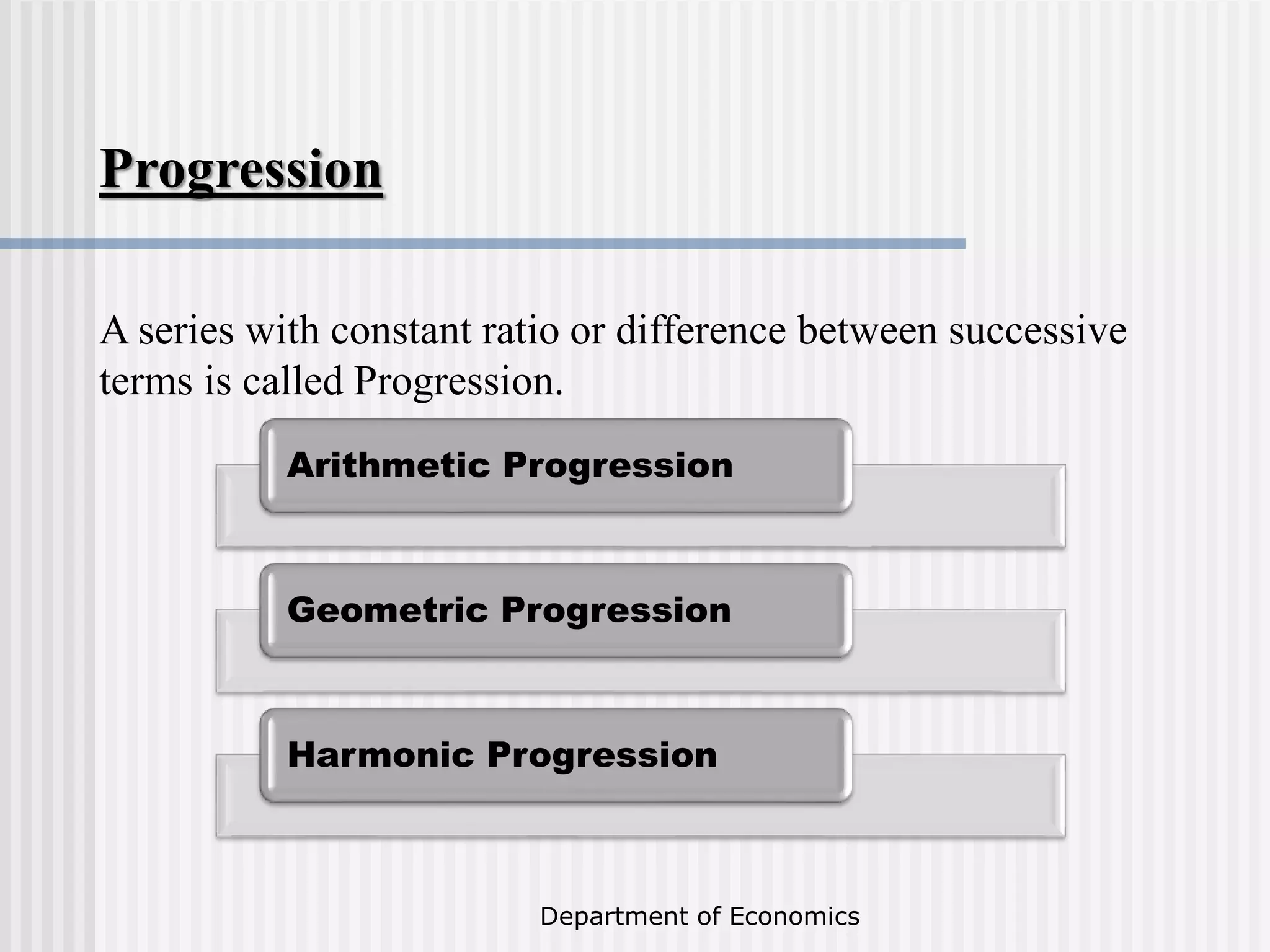
Progression
Aseries with constant ratio or difference between successive
terms is called Progression.
Arithmetic Progression
Geometric Progression
Harmonic Progression
7.
Department of Economics
Arithmeticprogressions
An arithmetic progression, or AP, is a sequence where each
new term after the first is obtained by adding a constant d,
called the common difference, to the preceding term. If the
first term of the sequence is a then the arithmetic progression
is a, a + d, a + 2d, a + 3d, . . . where the nth term is a + (n −
1)d.
ℓ = a + (n − 1)d
a = First term
d = common term
General term in A.P
First term = a
2nd term = a + d
3rd term = a + 2d
nth term = a + (n-1)d
8.
Department of Economics
APof 3 terms :
a-d, a, a+d
Selection of terms in AP
To insert Arithmetic Means between numbers
This means that we have to insert numbers between a and d so that all
these numbers are in A.P. The numbers inserted are termed as arithmetic
means.
If we insert one term arithmetic mean, between a and b ……
x = a + b
2
9.
Department of Economics
(a)Write down the 7th term of the AP with first term 4 and common
difference -1.
Here, a = 4, d = -1 and n = 7
l₇ = a + (n-1)d
= 4 + (7-1)-1
= 4 + (6)-1
= 4 -6 = -2
Example:
(b) If the 7th and 12th terms of an A.P are 20 and 35, find the series.
Here, a = first term
d = common difference
7th term = l₇ = a + (7-1)d =20………..(1) Now, from first equation we have,
a + 6d =20
12th term = l₁₂= a + (12-1)d=35………(2) a + 6x3=20
a +6d =20 a =2 Therefore A.P 2, 5, 8,11..
a +11d=35
d= 3
l₇ = -2
10.
Department of Economics
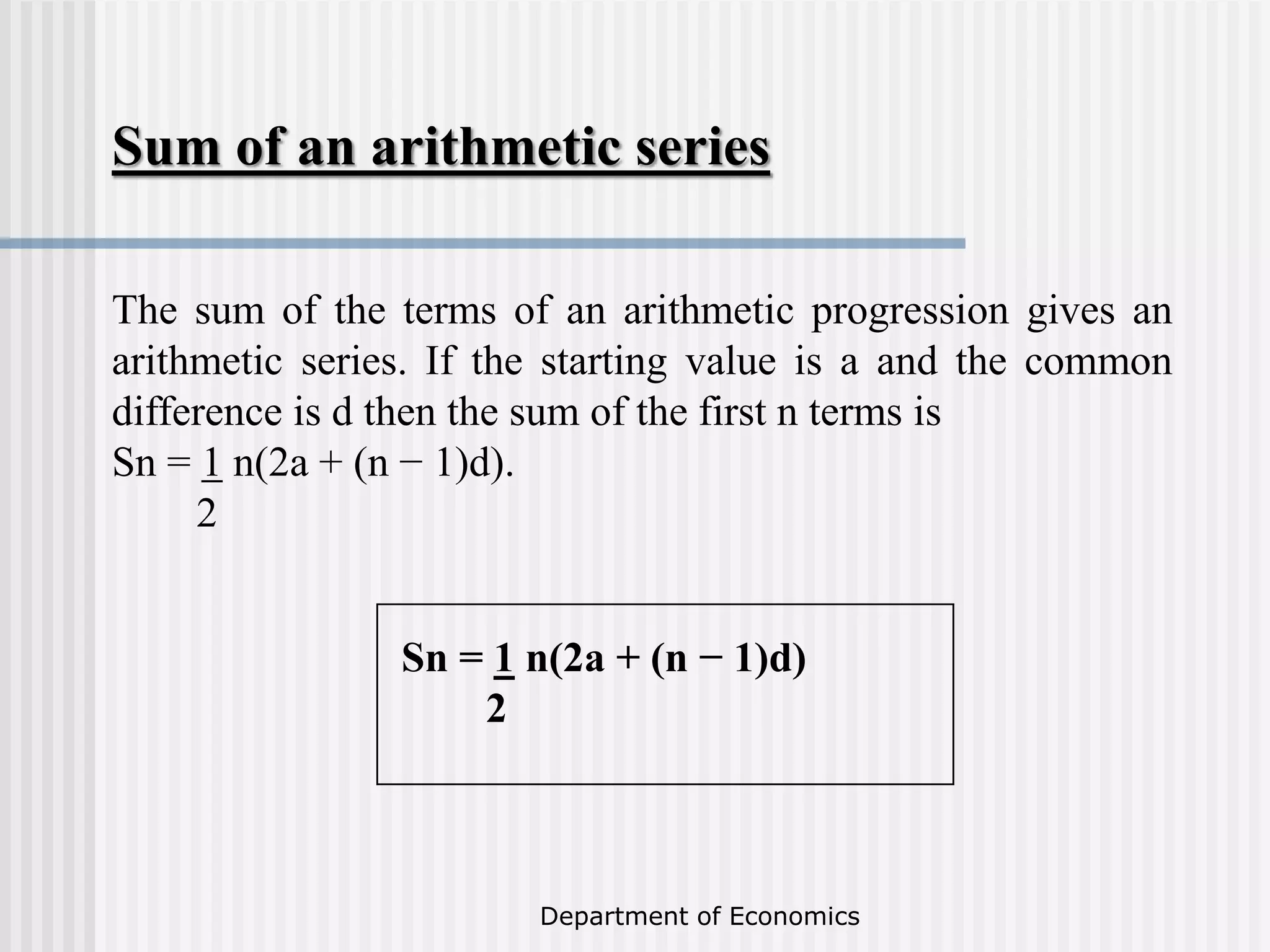
Thesum of the terms of an arithmetic progression gives an
arithmetic series. If the starting value is a and the common
difference is d then the sum of the first n terms is
Sn = 1 n(2a + (n − 1)d).
2
Sum of an arithmetic series
Sn = 1 n(2a + (n − 1)d)
2
11.
Department of Economics
Example
Here,
Thisis an arithmetic progression, and we can write down….
a = 1 , d = 2 , n = 50 .
We now use the formula, so that
Sn = 1 n(2a + (n − 1)d)
2
S₅₀ = 1 × 50 × (2 × 1 + (50 − 1) × 2)
2
= 25 × (2 + 49 × 2)
= 25 × (2 + 98) = 2500 .
Find the sum of the first 50 terms of the sequence 1, 3, 5, 7, 9, .
S₅₀ =2500
12.
Department of Economics
GeometricProgressions
A geometric progression, or GP, is a sequence where each new
term after the first is obtained by multiplying the preceding
term by a constant r, called the common ratio.
If the first term of the sequence is a then the geometric
progression is a, ar, ar² , . . . where the n-th term is arn-1
.
ℓn= arn-1
a = First term
r = common ratio
General term in G.P
First term = a
2nd term = ar
3rd term = ar²
nth term = arn-1
13.
Department of Economics
ElementaryProperties
The behavior of a geometric sequence depends on the value of the common
ratio. If the common ratio is:
• Positive, the terms will all be the same sign as the initial term.
• Negative, the terms will alternate between positive and negative.
• Greater than 1, there will be exponential growth towards positive or
negative infinity (depending on the sign of the initial term).
• 1, the progression is a constant sequence.
• Between −1 and 1 but not zero, there will be exponential decay towards
zero.
• −1, the progression is an alternating sequence
• Less than −1, for the absolute values there is exponential growth towards
(unsigned) infinity, due to the alternating sign.
14.
Department of Economics
AGP of 3 terms :
a/r, a, ar
If all terms in a GP are multiplied or divided by the same number, or are
raised to the same power, then the resulting sequence is still a GP.
Selection of terms in GP
Geometric Mean
If a, b, c are in GP then b² = ac and b is called the GM of a and c.
Conversely, if b²=ac, then a, b, c are in GP.
Sum of infinite terms of a GP:
If -1<r<1, then GP is said to converge, that is to say that sum of infinite
terms of such a GP tends to a constant value.
15.
Department of Economics
Example
(a)Find the 7th term of the series 3,6,12…..
a = 3, n =7 ,r =2
Here, ℓn= arn-1
ℓ₇= ar7-1
= 3x 26
=192
(b) Find the 2nd and 10th terms of the GP with first term 3 and
common ratio 2.
a = 3 ,r =2
Here, ℓ2= ar2-1
ℓ2= ar2-1
= 3x 21
= 6
a = 3, r =2
Here, ℓ10= ar10-1
ℓ10= ar10-1
= 3x 29
= 1536
16.
Department of Economics
Sumof a Geometric series
Suppose that we want to find the sum of the first n terms of a
geometric progression. What we get is Sn = a + ar + ar² + . . . +
arn-1 , and this is called a geometric series.
Example
Find the sum of the geometric series 2 + 6 + 18 + 54 + . . . where there are 6
terms in the series.
For this series, we have
a = 2, r = 3 and n = 6.
So,
S6 = 2(1 − 36 ) = -(1 − 729) = −(−728) = 728
( 1 − 3 )
.
Sn =a(1-rn)
(1-r)
Sn =a(1-rn)
(1-r)
S6 = 728
17.
Department of Economics
Example
Sumof series 3,33,333 upto n terms.
Sn = 3+33+333+…..
= 3 [1+11+111+….]
Sn = 3[9+99+999+…..], by multiplying and dividing by 9
9
Sn = 1[9+99+999+…..],
3
Sn = 1 [(10-1)+(100-1)+(1000-1)+…..]
3
Sn = 1 [(10)+(100)+(1000)…-1-1-1…]
3
Sn =1 [10(10n-1) -n
3 9
Sn =10 [(10n-1) -n
27 3
18.
Department of Economics
Convergenceof geometric series
The sum to infinity of a geometric progression with starting
value a and common ratio r, where −1 < r < 1.
Example:
Find the sum to infinity of the geometric progression 1, 1 , 1 , 1 , . . .
For this geometric progression we have 3 9 27
a = 1 and r = 1
3
As −1 < r < 1 we can use the formula,
so that S∞ = 1 = 3
1 − 1 /3 2
S ∞ = a
(1-r)
S ∞ = 3
2
19.
Unit End Questions
Departmentof Economics
1. Find the sum of the first 23 terms of the AP 4, −3, −10, . . ..
2. An arithmetic series has first term 4 and common difference 1 2 . Find
(i) the sum of the first 20 terms, (ii) the sum of the first 100 terms.
3. Find the sum of the arithmetic series with first term 1, common
difference 3, and last term 100.
4. The sum of the first 20 terms of an arithmetic series is identical to the
sum of the first 22 terms. If the common difference is −2, find the first
term.
5. Find the sum of the first five terms of the GP with first term 3 and
common ratio 2.
6. Find the sum of the first 20 terms of the GP with
first term 3 and common ratio 1.5.
20.
Required Readings
David Huang:Introduction to the use of Mathematics in
Economic Analysis
Mehta, B.C. and Madnani ;Arthashastra me Prarmbhik Ganit
http://www.mathcentre.ac.uk
Department of Economics







![Department of Economics
Example
Sum of series 3,33,333 upto n terms.
Sn = 3+33+333+…..
= 3 [1+11+111+….]
Sn = 3[9+99+999+…..], by multiplying and dividing by 9
9
Sn = 1[9+99+999+…..],
3
Sn = 1 [(10-1)+(100-1)+(1000-1)+…..]
3
Sn = 1 [(10)+(100)+(1000)…-1-1-1…]
3
Sn =1 [10(10n-1) -n
3 9
Sn =10 [(10n-1) -n
27 3](https://image.slidesharecdn.com/arthmeticandgeometricmean-200928152848/75/Arithmetic-and-geometric-mean-17-2048.jpg)