12 
AC Voltage Regulators 
AC voltage regulators have a constant voltage ac supply input and incorporate semiconductor switches 
which vary the rms voltage impressed across the ac load. These regulators generally fall into the 
category of naturally commutating converters since their thyristor switches are naturally commutated by 
the alternating supply. This converter turn-off process is termed line commutation. 
The regulator output current, hence supply current, may be discontinuous or non-sinusoidal and as a 
consequence input power factor correction and harmonic reduction are usually necessary, particularly at 
low output voltage levels (relative to the input ac voltage magnitude). 
A feature of direction conversion of ac to ac is the absence of any intermediate energy stage, such as a 
capacitive dc link or energy storage inductor. Therefore ac to ac converters are potentially more efficient 
but usually involve a larger number of switching devices and output is lost if the input supply is 
temporarily lost. 
There are three basic ac regulator categories, depending on the relationship between the input supply 
frequency fs, which is usually assumed single frequency sinusoidal, possibly multi-phased, and the 
output frequency fo. Without the use of transformers (or boost inductors), the output voltage rms 
magnitude VOrms is less than or equal to the input voltage rms magnitude Vs , Vo rms ≤ Vs . 
BWW 
• output frequency increased, fo > fs, for example, the matrix converter 
• output frequency decreased, fo < fs, for example, the cycloconverter 
• output frequency fundamental = supply frequency, fo = fs, for example, a phase controller 
12.1 Single-phase ac regulator 
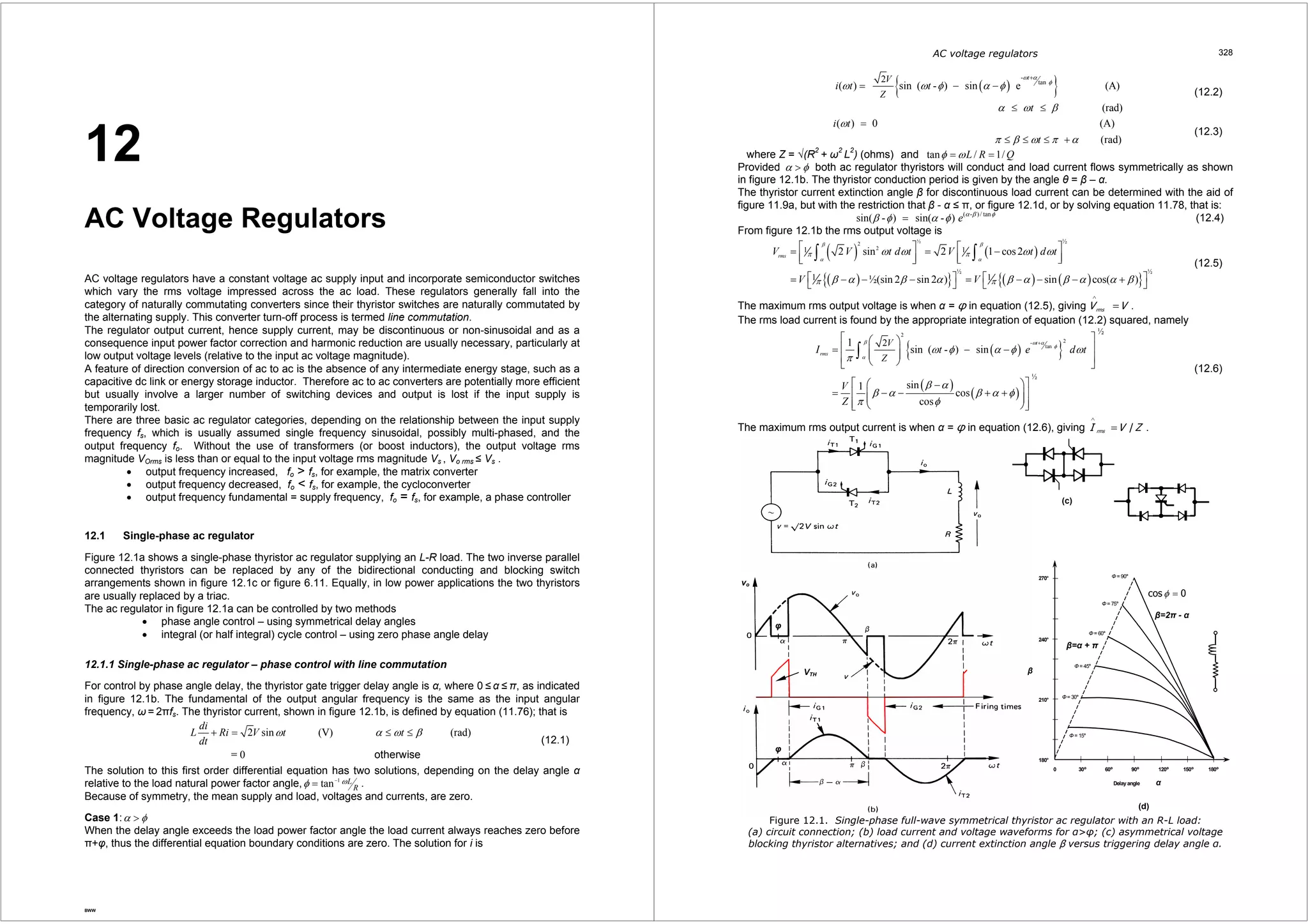
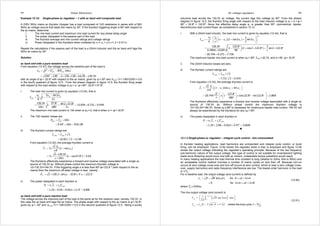
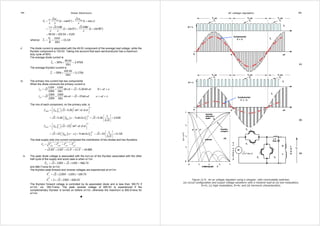
Figure 12.1a shows a single-phase thyristor ac regulator supplying an L-R load. The two inverse parallel 
connected thyristors can be replaced by any of the bidirectional conducting and blocking switch 
arrangements shown in figure 12.1c or figure 6.11. Equally, in low power applications the two thyristors 
are usually replaced by a triac. 
The ac regulator in figure 12.1a can be controlled by two methods 
• phase angle control – using symmetrical delay angles 
• integral (or half integral) cycle control – using zero phase angle delay 
12.1.1 Single-phase ac regulator – phase control with line commutation 
For control by phase angle delay, the thyristor gate trigger delay angle is α, where 0 ≤ α ≤ π, as indicated 
in figure 12.1b. The fundamental of the output angular frequency is the same as the input angular 
frequency, ω = 2πfs. The thyristor current, shown in figure 12.1b, is defined by equation (11.76); that is 
L di Ri V t t 
dt 
2 sin (V) (rad) 
+ = ω α ≤ω ≤ β 
= 0 
otherwise 
(12.1) 
The solution to this first order differential equation has two solutions, depending on the delay angle α 
relative to the load natural power factor angle, φ = tan − 1 ω L 
. 
R 
Because of symmetry, the mean supply and load, voltages and currents, are zero. 
Case 1:α >φ 
When the delay angle exceeds the load power factor angle the load current always reaches zero before 
π+φ, thus the differential equation boundary conditions are zero. The solution for i is 
AC voltage regulators 328 
β β 
=   =  −      
=   − − −   =   − − − +   
rms ∫ ∫ V V t d t V t d t 
ω ω ω ω 
π π 
α α 
V V 
β α β α β α β α α β 
+     
=    − −          
(c) 
= . 
cosφ = 0 
∧ 
= . 
∧ 
0 30° 60° 90° 120° 150° 180° 
Delay angle α 
β ω α 
270° 
240° 
+ 
V t 
Z 
∫ t 
  −  
=   − − + +     
β 
210° 
180° 
Φ = 90° 
Φ = 75° 
Φ = 60° 
Φ = 45° 
Φ = 30° 
Φ = 15° 
(d) 
φ 
φ 
β=α + π 
β=2π - α 
2 sin 2 1 cos2 
1 1 
VTH 
vo 
{ ( ) } - 
2 tan ( ) sin ( - ) sin e (A) 
(rad) 
ω α 
ω = ω φ − α − 
φ φ 
α ≤ ω ≤ 
β 
i t t 
t 
(12.2) 
( ) 0 (A) 
(rad) 
i t 
t 
ω 
π β ω π α 
= 
≤ ≤ ≤ + 
(12.3) 
where Z = √(R2 + ω2 L2) (ohms) and tanφ =ωL / R = 1/Q 
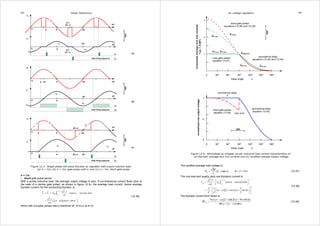
Provided α >φ both ac regulator thyristors will conduct and load current flows symmetrically as shown 
in figure 12.1b. The thyristor conduction period is given by the angle θ = β – α. 
The thyristor current extinction angle β for discontinuous load current can be determined with the aid of 
figure 11.9a, but with the restriction that β - α ≤ π, or figure 12.1d, or by solving equation 11.78, that is: 
sin(β -φ ) = sin(α -φ ) e(α -β ) / tanφ (12.4) 
From figure 12.1b the rms output voltage is 
( ) 2 ½ 
2 
( ) 
{( ) } {( ) ( ) } 
½ 
½ ½ 
1 1 
½(sin 2 sin 2 ) sin cos( ) 
π π 
(12.5) 
The maximum rms output voltage is when α = ϕ in equation (12.5), giving rms V V 
The rms load current is found by the appropriate integration of equation (12.2) squared, namely 
{ ( ) } 
( ) ( ) 
2 
- 2 
tan 
½ 
½ 
1 2 sin ( - ) sin 
1 sin cos 
cos 
φ 
α 
ω φ α φ ω 
π 
β α 
β α β α φ 
π φ 
rms 
V 
Z 
I t e d t 
V 
Z 
(12.6) 
The maximum rms output current is when α = ϕ in equation (12.6), giving / rms I V Z 
Figure 12.1. Single-phase full-wave symmetrical thyristor ac regulator with an R-L load: 
(a) circuit connection; (b) load current and voltage waveforms for α>φ; (c) asymmetrical voltage 
blocking thyristor alternatives; and (d) current extinction angle β versus triggering delay angle α.
329 Power Electronics 
From equation (12.6), the thyristor rms current is given by . = / 2 
Thrms rms I I and is a maximum when α ≤φ , 
that is 
 =  = Th rms rms 
I I V 
. 
2 2 
Z 
(12.7) 
Using the fact that the average voltage across the load inductor is zero, the rectified mean voltage 
(hence current) can be used to determine the thyristor mean current rating. 
β 
o o ∫ V IR V td t 
= = 
1 
α 
=  1 
{ − } 
 
2 sin 
π 
2 cos cos (V) 
π 
ω ω 
α β 
V 
(12.8) 
The mean thyristor current Th ½ o ½ o / I = I = V R , that is 
I V V 
½ o 
2 1 (cos cos ) (A) 
2 = =  π α − β  
Th 
R R 
(12.9) 
The maximum mean thyristor current is for a load α = φ and β = π+φ, that is 
I 2 V cosφ 2 
V π R π 
Z (12.10) 
∧ 
= = Th 
The thyristor forward and reverse voltage blocking ratings are both √2V. 
The load current form factor, using cosφ = R/Z, is 
( ) ( ) 
( ) . 
½ 
1 
sin 
cos cos 
1 
cos 
2 cos cos 
rms 
i load 
o 
I 
FF 
I 
π 
π 
β α 
φ β α β α φ 
φ 
α β 
= 
  −  
  − − + +     = 
 −  
(12.11) 
∧ 
which is a maximum when α = ϕ, giving . / 2 2 i Load FF π 
= . 
FF = FF , which is a maximum when α = ϕ, ½ i Th FF π 
The thyristor current form factor is 2 
i Th i Load 
∧ 
= . 
The load power is 
2 
( cos ) 2 sin 
( ) cos 
( ) 
cos 
o rms P I R 
V 
R 
φ β α β α 
α φ β 
π π φ 
= 
 − −  
=  − + +  
  
(12.12) 
which is a maximum when α = ϕ, giving 
2 2 
∧   = =  
V V 
P o cos 
R 
φ 
Z Z 
  
. 
The supply power factor is 
½ sin 
( ) ( ) 
cos cos 
cos 
P 
o 
rms 
pf 
V I 
β α β α 
α φ β φ 
π π φ 
= 
 − −  
=  − + +  × 
  
(12.13) 
∧ 
= . 
which is a maximum when α = ϕ, giving pf cosφ 
For an inductive L-R load, the fundamental load voltage components (cos and sin respectively) are 
( ) 
( ( ) ( )) 
a V 
1 
b V 
1 
2 cos 2 cos 2 
2 
2 2 sin 2 sin 2 
2 
= − 
α β 
π 
= − − − 
β α β α 
π 
(12.14) 
( ) ( ) ( ) ( ) 
2 cos 1 cos 1 cos 1 cos 1 
α β α β 
1 1 
( ) ( ) ( ) ( ) 
2 sin 1 sin 1 sin 1 sin 1 
1 1 
n 
n 
V n n n n 
a 
n n 
V n n n n 
b 
n n 
π 
α β α β 
π 
 + − + − − −  
=  −  
 + −  
 + − + − − −  
=  −  
 + −  
(12.15) 
for n = 3, 5, 7, .. odd. 
AC voltage regulators 330 
The Fourier component magnitudes and phases are given by 
c = a 2 + b 2 and φ = tan − 1 a n 
b (12.16) 
n n n n 
n 
If α ≤φ , then continuous ac load current flows, and equation (12.14) reduces to a1 = 0 and b1 = √2V, 
when β = α + π and α =φ are substituted. 
The supply apparent power can be grouped into a component at the fundamental frequency plus 
components at the harmonic frequencies. 
S 2 V 22 I V 2 I 2 V 2 I 
2 
= + + + 
1 3 5 
= + + + + − 
= + − 
= + − 
= + 
= + + 
= + + 
V 2 I 2 V 2 I 2 V 2 I 2 V 2 I 2 V 2 I 
2 
1 1 3 5 1 
VI 2 2 VI 2 2 V 2 I 
2 
1 1 
V 2 I 2 V 2 ( I 2 I 
2 
) 
S D 
1 1 
2 2 
1 
2 2 2 
1 
( ) ( ) 
2 2 2 2 
1 1 1 1 
... 
... 
cos sin 
rms 
rms 
P Q D 
S VI φ VI φ D 
(12.17) 
where D is the supply current distortion due to the harmonic currents. 
The current harmonic components are found by dividing the load Fourier voltage components by the 
load impedance at that frequency. Equation (12.16) given the current harmonic angles n φ and 
magnitudes according to 
2 
n 
= = = 
n n 
( ) ( ) 2 2 2 2 
n 
n 
c 
V V 
I 
Z R + ωL R + 
ωL 
(12.18) 
Case 2:α ≤φ (continuous gate pulses) 
Whenα ≤φ , a pure sinusoidal load current flows, and substitution ofα =φ in equation (12.2) results in 
2 (ω ) = V sin (ω -φ ) (A) α ≤ φ (rad) 
i t t (12.19) 
Z 
If a short duration gate trigger pulse is used andα φ , unidirectional load current may result. The device 
to be turned on is reverse-biased by the conducting device. Thus if the gate pulse ceases before the 
previous half-cycle load current has fallen to zero, only one device conducts. It is therefore usual to 
employ a continuous gate pulse, or stream of pulses, from α until π, then for α φ a sine wave output 
current results. 
For both delay angle conditions, equations (12.5) to (12.14) are valid, except the simplification β=α+π is 
used when α ≤φ , which gives the maximum values for those equations. That is, for α ≤φ , substituting 
α =φ 
FF P I R Z pf I V Z 
. 
 
V I I I V 
= = = = = = 
V V I V / 
Z 
rms rms rms 
∧ ∧ ∧ 
2 2 
∧ ∧ 
FF / 2 
P V pf 
2 
Z 
π 2 cosφ / cosφ 2 /π 
= = = = = = = = 
iLoad iLoad 
rms Th rms Th rms 
o o rms Th 
(12.20) 
12.1.1i - Resistive load 
For a purely resistive load, the load voltage and current are related according to 
( ) ( ) ( ) 2 sin , 2 
i ω 
t v ω t V ω t R α ω t π α π ω t π R (12.21) 
0 
 
= = ≤ ≤ + ≤ ≤ o 
 
otherwise 
o 
The equations (12.1) to (12.20) can be simplified if the load is purely resistive. Continuous output 
current only flows for α = 0, sinceφ = tan−1 0 = 0° . Therefore the output equations are derived from the 
discontinuous equations (12.2) to (12.14), with φ = 0. 
The average output voltage and current are zero. The mean half-cycle output voltage, used to determine 
the thyristor mean current rating, is found by integrating the supply voltage over the interval α to π, (β = 
π).
331 Power Electronics 
∫ 
V V t d t 
1 π 2 sin 
ω ω 
2 (1 cos ) (V) 
V V I I 
2 (1 cos ) 2 (A) 
π 
α 
α 
V 
π 
α 
π 
= 
= + 
= = + = 
whence 
o 
o 
o T 
R R 
(12.22) 
∧ 
The average thyristor current is = ½ T o I I , which has a maximum value of I T 2V /πR 
= when α = 0. 
From equation (12.5) the rms output voltage for a delay angle α is 
( )2 
V 1 
∫ 2 V sin 
t d t 
rms 2( ) sin 2 
2 
(V) 
π 
π 
α 
π α α 
π 
ω ω 
− + 
= 
= 
V 
(12.23) 
which has a maximum of lrms V =V when α = 0. 
The rms output current and supply current from = / rms rms I V Ris 
V V I I 
= = − = 
R R 
= 
. 
2 sin2 2 (A) 2 
/ 2 
1 α α 
π 
− 
and 
rms 
rms T rms 
I I 
T rms rms 
(12.24) 
The maximum rms supply current is / rms I =V R at α = 0 when the maximum rms thyristor current is 
  . / 2 / 2 T rms rms I = I =V R . 
Therefore the output power, with Vrms = R Irms, for a resistive load, is 
{ } 2 2 
P I R V V 
2 1 2 α sin2 α 
2 π 
(W) = = rms = − − 
o rms 
R R 
(12.25) 
The input power is ( ) 1 1 cos in out P =VI φ = P . 
The supply power factor λ is defined as the ratio of the real power to the apparent power, that is 
π = λ = o = rms = rms = − + pf P V I V 
2( ) sin 2 
π α α 
2 
S VI V 
(12.26) 
where the apparent power is 
2 sin2 ½ 
1 
V 
S VI 
rms 2 
R 
α α 
π π 
= =  − +    
(12.27) 
and Q = S 2 −P 2 . The fundament reactive power is 
2 
1 
cos 2 1 
2 
V 
Q 
R 
α 
π 
− 
= (12.28) 
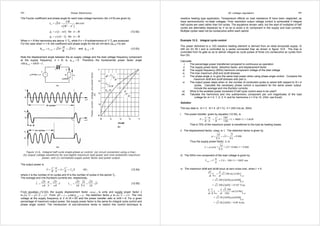
The thyristor current (and voltage for a resistive load) form factor (rms to mean), shown in figure 12.2, is 
( )½ ½sin2 
− + = Th rms 
= 
  i 
Th 1 cos 
Th 
I 
FF 
I 
π π α α 
α 
+ 
(12.29) 
From equation (12.140) , the thyristor current crest factor is 
 ≤ ≤  
  
+ = = 2 
0 ½ 
1 cos 
2 sin 
½ 
1 cos 
I 
I 
T 
T 
π 
α π 
α 
δ 
π α 
π α π 
α 
 
≤ ≤ 
 + 
(12.30) 
The Fourier voltage components for a resistive load (with β = π in equations (12.14) and (12.15)) are 
2 2 
V V 
( ) ( ) 
a cos 2 1 b 
sin 2 
½ 1 1 
α πα α 
= − = − + 
2 
2 cos 1 1 cos 1 1 2 sin 1 sin 1 
π π 
( ) ( ) ( ) ( ) 
    
    
    
(12.31) 
V n + − n − − V n + n 
− 
α α α α 
a b 
= − = − 
1 1 1 1 n n 
n n n n 
+ − + − 
π π 
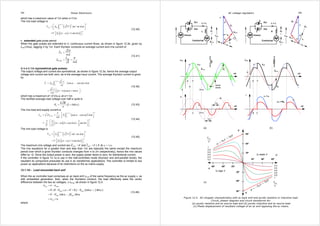
for n = 3, 5, 7, … odd. Figure 12.2 show the relative harmonic rms magnitudes and dependence on α. 
The load current harmonics are found by dividing the voltage components by R, since i(ωt) = v(ωt)/R. 
AC voltage regulators 332 
V = V π − α + 
α 
rms 2 rms 1 rms V =V =V Distortion factor 
V1 rms 
Vn rms 
V3 rms 
V5 rms 
V7 rms 
1 
½ 
0 
2( ) sin2 
π 
2/π 
0 30º 60 º 90 º 120 º 150 º 180 º 
0 π π π π π π 
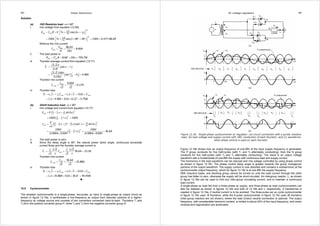
Figure 12.2. Normalised RMS harmonics (voltage and current) for a single-phase full-wave ac 
regulator with a pure resistive load. 
The fundamental supply current is 
( ) ( ) 2 2 ½ 
V 
=  − + − +    (12.32) 
1 cos 2 1 2 2 sin2 
I 
s 2 
R 
α π α α 
π 
If the thyristors are modelled by 
TH o o v =v + i ×r 
Then the thyristor losses are given by 
( ) ( ) 2 2 W TH o Th o Th rms o TH o Th i Th P =v I + r ×I =v I + r ×I ×FF α (12.33) 
12.1.1ii - Pure inductive load 
For a purely inductive load, the load power factor angle isφ = ½π . Since the inductor voltage average is 
zero, current conduction will be symmetrical about π. Thus equations (12.2) to (12.14) apply except they 
can be simplified since β = π – α. These bounds imply that the delay angle should be greater than ½π, 
but less than π. Therefore, if the delay angle is less than ½π, conduction extends into the next half 
cycle, and with short gate pulses, preventing the reverse direction thyristor from conducting, as shown in 
figure 12.3c. The output is then a series of half-wave rectified current pulses as with the case α ≤φ 
considered in 12.3iii. For the purely inductive load case, the equations and waveforms for the half-wave 
controlled rectifier in section 11.3.1ii, apply. Kirchhoff’s voltage law gives 
di 
L 2 V sin 
t 
dt 
= ω (12.34) 
The load current is given by: 
( ) ( ( )) 2 
cos cos 2 
V 
i t t t 
= − ≤ ≤ − (12.35) 
ω α ω α ω π α 
L 
ω 
The current waveform is symmetrical about π. 
delay angle α 
FFi TH/10 
1/FFi TH 
Reciprocal of 
Distortion factor 
thyristor distortion factor FFiTh 
power factor and output voltage (rms) pu 
Power factor 
½π/10
333 Power Electronics 
vo 
α π 
π 
2π 
2π 
β = 
2π - α 
β = 
2π - α 
o 
o 
½π π 
2π 
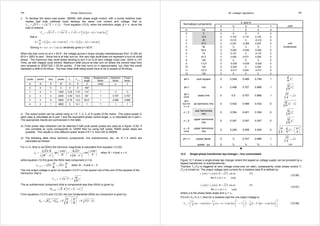
Figure 12.3. Single-phase full-wave thyristor ac regulator with a pure inductor load: 
(a) α  ½π; (b) α  ½π, gate pulse until π; and (c) α  ½π, short gate pulse. 
vo 
io 
α  ½π 
i. short gate pulse period 
With a purely inductive load, the average output voltage is zero. If uni-directional current flows (due to 
the uses of a narrow gate pulse), as shown in figure 12.3c, the average load current, hence average 
thyristor current, for the conducting thyristor, is 
2 
o T ∫ 
II td t 
1 
2 
π − 
α 
V 
L 
α π ω 
( ) 
2 
2 
{cos - cos } 
cos sin 
V 
L 
πω 
α ω ω 
π α α α 
= = 
=  − +  
(12.36) 
which with uni-polar pulses has a maximum of √2 V/ωL at α = 0. 
ωt 
iT1 ωt 
iT2 
iG1 
Gate firing sequence iG2 
vo 
α 
π 
2π 
vo 
io 
o 
o 
ωt 
ωt 
iT1 
iT2 
iG1 
iG2 Gate firing sequence 
vo 
α π 
π 
2π 
2π 
2π- α 
2π- α 
vs 
vo 
io 
o 
o 
ωt 
ωt 
iT1 iT1 
iG1 
iG2 Gate firing sequence 
(a) 
(b) 
(c) 
AC voltage regulators 334 
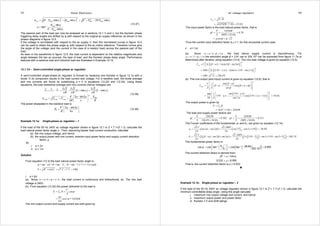
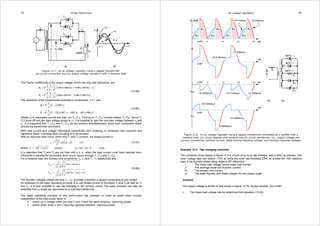
Figure 12.6. Normalised ac-chopper purely inductive load control characteristics of: 
(a) thyristor average and rms currents and (b) rectified average output voltage. 
The rectified average load voltage is 
V 
( ) 2 
V α δ π 
1 cos 0 ½ o 
= + ≤ ≤ (12.37) 
π 
The rms load and supply (and one thyristor) current is 
I 2 V cos - cos 
t d t 
2 ½ 2 
=  − ( ) 
     
rms ∫ 
L 
V 
X 
  (  =   − )( + ) 
+  
½ 
1 
2 
1 2 cos 2 3 sin 2 
2 
π α 
α π α ω ω 
ω 
π α α α 
π 
   
(12.38) 
The thyristor current form factor is 
( )( ) 
½ 2 cos 2 ¾ sin2 
π π − α + α + 
π α 
i T sin cos FF 
( ) 
α π α α 
= 
+ − 
(12.39) 
normalised average and rms currents 
1 pu = I (90º) 
0 30º 60º 90º 120º 150º 180º 
Delay angle α 
ITh rms 
Long gate pulses 
equation (12.41) 
short gate pulses 
equations (12.36) and (12.38) 
ITh ave 
ITh ave ITh rms 
ITh ave ITh rms 
symmetrical delay 
equations (12.42) and (12.44) 
Ireference 
symmetrical delay 
equation (12.45) 
symmetrical delay 
V 
short gate pulses 
equation (12.40) 
1 
½ 
0 
0 30º 60º 90º 120º 150º 180º 
Delay angle α 
normalised rms output voltage 
High dv/dt 
3 
2 
1
335 Power Electronics 
which has a maximum value of ½π when α =½π. 
The rms load voltage is 
( ) 
{( ) } 
2 2 ½ 
 −  =     
=  − +    
V ∫ V 2 
t d t 
rms ½ 
1 
2 
1 
2 sin 
½sin 2 ) 
π α 
α π 
π 
ω ω 
π α α 
V 
(12.40) 
ii. extended gate pulse period 
When the gate pulses are extended to π, continuous current flows, as shown in figure 12.3b, given by 
Irms=V/ωL, lagging V by ½π. Each thyristor conducts an average current and rms current of 
2 
2 
Th 
rms 
Th rms 
V 
I 
L 
I V 
I 
L 
πω 
πω 
= 
= = 
(12.41) 
π ≥ α ≥ ½π (symmetrical gate pulses) 
The output voltage and current are symmetrical, as shown in figure 12.3a, hence the average output 
voltage and current are both zero, as is the average input current. The average thyristor current is given 
by 
− 
V 
L 
I t d t 
( ) 
2 
1 
T 2 
∫ 
2 
2 
{cos - cos } 
cos sin 
π α 
α π ω 
V 
L 
πω 
α ω ω 
π α α α 
= 
=  − +  
(12.42) 
which has a maximum of √2 V/πωL at α = ½π. 
The rectified average load voltage over half a cycle is 
V 
( ) 2 2 
V α 
1 cos o 
= + (12.43) 
π 
The rms load and supply current is 
I I V t d t 
= =  − ( ) 
     
rms Th rms ∫ 
π α ω ω 
L 
ω 
π α α α 
  (  =   − )( + ) 
+  
. 
2 ½ 2 
½ 
2 2 cos - cos 
2 2 cos 2 3 sin 2 
2 
π α 
α 
π 
   
V 
X 
(12.44) 
The rms load voltage is 
( ) 
{( ) } 
2 2 ½ 
 −  =     
=  − +    
V ∫ V 2 
t d t 
rms ½ 
1 
2 
2 sin 
½sin 2 ) 
π α 
α 
π 
π 
ω ω 
π α α 
V 
(12.45) 
The maximum rms voltage and current are l and  / at ½ . rms rms V =V I =V X α = π 
The rms equations for α greater than and less than ½π are basically the same except the maximum 
period over which a given thyristor conducts changes from π to 2π (respectively), hence the rms values 
differ by √2. Since the output power is zero, the supply power factor is zero, for bidirectional current. 
If the controller in figure 12.1a is use in the half-controlled mode (thyristor and anti-parallel diode), the 
resultant dc component precludes its use in ac transformer applications. The controller is limited to low 
power ac applications because of dc restrictions on the ac mains supply. 
12.1.1iii - Load sinusoidal back emf 
When the ac controller load comprises an ac back emf vb ac of the same frequency as the ac supply v, as 
with embedded generation, then, when the thyristors conduct, the load effectively sees the vector 
difference between the two ac voltages, v-vb ac, as shown in figure 12.5. 
= − 
= ∠ − ∠ = + − + 
= − − 
= ∠ 
( ) 
v v v 
R , 
L bac 
V V V j V j 
V V jV 
v 
, 
0 0 cos sin 
b ac b ac 
cos sin 
b ac b ac 
R L 
ψ ψ ψ 
ψ ψ 
ϕ 
(12.46) 
where 
AC voltage regulators 336 
α α 
ωt 
v vo/p 
VL 
(a) (b) 
(c) 
½ ½ ϕ π ψ = + 
Vb leads V 
30º 60º 90º 
½ ½ ϕ π ψ = − + 
90º 
60º 
30º 
b ac V 
V 
1 
0.9 
0.8 
0.6 
0.4 
0.2 
ψ 
0.2 
0.4 
0.6 
0.8 
0.9 
1 
φ 
-30º 
-60º 
-90 º 
-90º -60º -30º 
b ac V 
V 
ψ 
φ 
Vb lags V 
VR β 
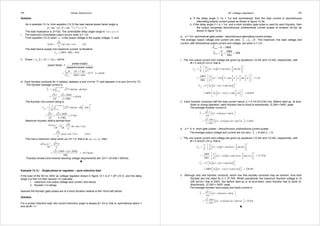
Figure 12.5. AC-chopper characteristics with ac back emf and purely resistive or inductive load. 
Circuit, phasor diagram and circuit waveforms for: 
(a) purely resistive and ac source load and (b) purely inductive and ac source load. 
(c) Phase displacement of resultant voltage of an ac emf opposing the ac mains. 
io 
io 
α 2π-α 
½π 
VL 
iL 
½π 
o 
vo/p 
ωt 
v vo/p 
Vb ac 
α 
β 
ψ 
φ 
2π-α 
VL 
equal 
areas 
o 
ωt 
i io = iR 
vR = RiR 
φ α 
o 
IR 
v 
ωt 
vo/p 
v vo/p 
Vb ac 
VR 
α 
o 
ψ 
φ 
VR 
Vb ac 
R 
Th1 
Th2 
io = iL 
Vbsin(ωt-ψ) 
Vsinωt 
Vb ac ψ 
φ 
io 
v vo/p 
Vb ac 
L 
Th1 
Th2 
io = iL 
Vbsin(ωt-ψ) 
Vsinωt 
ψ 
Vb ac 
VL 
β 
v 
io 
φ 
α α 
VR
337 Power Electronics 
( ) ( ) 2 2 2 2 
v V V V V V VV 
, 
= − + = + − 
R L b ac b ac b ac b ac 
1 
cos sin 2 cos 
sin 
tan 
cos 
b ac 
b ac 
V 
V V 
ψ ψ ψ 
ψ 
ϕ 
ψ 
− 
− 
= 
− 
(12.47) 
The passive part of the load can now be analysed as in sections 12.1.1i and ii, but the thyristor phase 
triggering delay angles are shifted by φ with respect to the original ac supply reference, as shown in the 
phasor diagrams in figure 12.5. 
If the voltage is normalised with respect to the ac supply V, then the normalised curves in figure 12.5 
can be used to obtain the phase angle φ, with respect to the ac mains reference. Therefore curves give 
the angle of the voltage (and the current in the case of a resistor load) across the passive part of the 
load. 
As seen in the waveforms in figure 12.5, the load current is dependent on the relative magnitudes and 
angle between the two ac sources, the type of load, and the thyristor phase delay angle. Performance 
features with a resistive load and inductive load are illustrated in Example 12.1d. 
12.1.1iv - Semi-controlled single-phase ac regulator 
A semi-controlled single-phase ac regulator is formed by replacing one thyristor in figure 12.1a with a 
diode. A dc component results in the load current and voltage. For a resistive load, the diode average 
and rms currents are found by substituting α = 0 in equations (12.22) and (12.24). Using these 
equations, the load resistance average and rms currents (hence voltages) are 
2 2 2 2 2 2 
( ) ( ) 
= − = − + = − 
α α 
R R R 
π π π 
½ 
I I I 
= 2 + 2 
=   =   
1 cos 1 cos 
2 -sin2 
2 
R D T 
α α 
rms 
R rms D rms T rms 
V V 
I I I 
R R 
π 
(12.48) 
The power dissipated in the resistive load is 
V 
2 2 sin2 
P 
 −  =     
R R 
4 
α α 
π 
(12.49) 
Example 12.1a: Single-phase ac regulator – 1 
If the load of the 50 Hz 240V ac voltage regulator shown in figure 12.1 is Z = 7.1+j7.1 Ω, calculate the 
load natural power factor angle,φ . Then, assuming bipolar load current conduction, calculate 
(a) the rms output voltage, and hence 
(b) the output power and rms current, whence input power factor and supply current distortion 
factor, μ 
for 
i. α = π 
ii. α = ⅓π 
Solution 
From equation (12.3) the load natural power factor angle is 
L L R X R 
tan / tan / tan 7.1/ 7.1 ¼ (rad) 
= − = − = − = 
= + = + = Ω 
φ 1 ω 1 1 
π 
Z R L 
( ω 
) 7.1 7.1 10 
2 2 2 2 
i. α = π 
(a) Since α =π / 6 φ =π / 4 , the load current is continuous and bidirectional, ac. The rms load 
voltage is 240V. 
(b) From equation (12.20) the power delivered to the load is 
P I R V 
= = o rms 
2 
2 
2 
240 
10 
cos 
φ 
= cos¼π = 4.07kW 
Ω 
Z 
The rms output current and supply current are both given by 
AC voltage regulators 338 
rms o I = P R 
/ 
4.07kW/ 7.1 23.8A 
= Ω= 
The input power factor is the load natural power factor, that is 
4.07kW 0.70 
240V 23.8A 
o pf P 
= = = 
× 
S 
μ cosφ μ / 2 
= = 
Thus the current input distortion factor is μ = 1, for this sinusoidal current case. 
ii. α = ⅓π 
(a) Since α =π / 3 φ =¼π , the load hence supply current is discontinuous. For 
α =π / 3 φ =¼π the extinction angle β = 3.91 rad or 224.15° can be extracted from figure 11.7a or 
determined after iteration using equation (12.4). The rms load voltage is given by equation (12.5). 
{( ) } 
½ 
{( ) } 
½ 
=  1 
 π 
β − α − ½(sin 2 β − sin 2 α 
) 
  
= ×  1 
 − 1 − × − 2 
 3 3 
 
= × 2.71 
= 
240 π 
3.91 ½(sin 2 3.91 sin ) 
240 π 226.4V 
π π 
rms V V 
(b) The rms output (and input) current is given by equation (12.6), that is 
( ) ( ) 
½ 
  −  
1 sin β α 
cos 
I V 
=   β − α − β + α + φ 
  π  φ 
 
( ) ( ) 
½ 
  − 1 
 
cos 
240 1 sin 3.91 π 
3.91 1 3 cos 3.91 1 
¼ 18.0A 
10 3 cos¼ 
3 
=   − − + +  =    
π π π 
π π 
Orms 
Z 
The output power is given by 
P = I 2 
R 
o rms = 18.02×7.1Ω = 2292W 
The load and supply power factors are 
pf P pf P 
2292W 0.562 2292W 0.531 
= o = = = o 
= = 
226.4V × 18.0A 240V × 
18.0A 
o 
S S 
The Fourier coefficients of the fundamental, a1 and b1, are given by equation (12.14) 
( ) ( ) 
( ( ) ) ( ( ) ) 
a V 
1 
b V 
1 
2 cos 2 α cos 2 β 2 240V cos 2 π 
3 
cos 2 3.91 28.8V 2 2 2 2 sin 2 sin 2 2 240V 2 3.91 3 sin 2 3.91 sin 2 2 2 3 
302.1V = − = − × = − 
π π 
β α β α π π 
= − − + = × − − × − × = 
π π 
The fundamental power factor is 
1 1 ( 1 ( )) 
φ b =  −    = − − =     
cos cos tan cos tan 28.8V 0.995 1 
302.1V 
1 
a 
The current distortion factor is derived from 
pf μ φ 
1 cos 
= × 
= × 
0.531 0.995 
μ 
That is, the current distortion factor is μ = 0.533. 
♣ 
Example 12.1b: Single-phase ac regulator – 2 
If the load of the 50 Hz 240V ac voltage regulator shown in figure 12.1 is Z = 7.1+j7.1 Ω, calculate the 
minimum controllable delay angle. Using this angle calculate 
i. maximum rms output voltage and current, and hence 
ii. maximum output power and power factor 
iii. thyristor I-V and di/dt ratings
339 Power Electronics 
Solution 
As in example 12.1a, from equation (12.3) the load natural power factor angle is 
φ = tan−1ωL / R = tan−1 7.1/ 7.1 =π / 4 
The load impedance is Z=10Ω. The controllable delay angle range is ¼π ≤α ≤π . 
i. The maximum controllable output occurs when α = ¼π. 
From equation (12.2) when α =φ the output voltage is the supply voltage, V, and 
2 ( ) sin ( -¼ ) (A) V 
i ωt = ωt π 
Z 
The load hence supply rms maximum current, is therefore 
240V/10 24A rms I = Ω= 
ii. = 2 = 242 ×7.1Ω = 4090W rms Power I R 
power factor = power output 
apparent power output 
I R 
VI 
2 242 7.1 0.71 ( cos ) 
240V 10A 
rms 
rms 
φ 
× Ω 
= = = = 
× 
iii. Each thyristor conducts for π radians, between α and π+α for T1 and between π+α and 2π+α for T2. 
The thyristor average current is 
( ) 
+ = + 
= 
∫ T I V t dt 
1 
2 2 sin 
2 2 240V 10.8A 
= − 
= = = 
10 
α π φ π 
π α φ ω φ ω 
× 
π π 
× Ω 
V 
Z 
The thyristor rms current rating is 
1 { )}½ ( 2 
2 sin 
2 
2 2 240V 17.0A 
2 210 
 α π φ π 
=   − α φ 
 
∫ Trms I V t dt 
ω φ ω 
π 
+ = + 
= 
× 
= = = 
× Ω 
V 
Z 
Maximum thyristor di/dt is derived from 
( ) 2 t V sin ( -¼ ) 
d i d t dt dt 
ω = ω π 
Z 
2 cos ( -¼ ) (A/s) V 
Z 
= ω ωt π 
This has a maximum value when ωt-¼π = 0, that is at ωt =α =φ , then 
( ) 2 
2 240V 2 50Hz 10.7A/ms 
10 
ω ω 
π 
= 
× × × 
= = 
Ω 
 t V 
Z 
di 
dt 
Thyristor forward and reverse blocking voltage requirements are √2V = √2×240 = 340Vdc. 
♣ 
Example 12.1c: Single-phase ac regulator – pure inductive load 
If the load of the 50 Hz 240V ac voltage regulator shown in figure 12.1 is Z = jX= j10 Ω, and the delay 
angle α is first ¾π then second ¼π calculate 
i. maximum rms output voltage and current, and hence 
ii. thyristor I-V ratings 
Assume the thyristor gate pulses are of a short duration relative to the 10ms half period. 
Solution 
For a purely inductive load, the current extinction angle is always β = 2π-α, that is, symmetrical about π 
and tanΦ→∞. 
AC voltage regulators 340 
a. If the delay angle π α  ½π and symmetrical, then the load current is discontinuous 
alternating polarity current pulses as shown in figure 12.3a. 
b. If the delay angle 0  α  ½π, and a short duration gate pulse is used for each thyristor, then 
the output comprises discontinuous unidirectional current pulses of duration 2π-2α, as 
shown in figure 12.3c. 
a. α = ¾π: symmetrical gate pulses - discontinuous alternating current pulses. 
The average output voltage and current are zero, 0 o o I =v = . The maximum rms load voltage and 
current, with bidirectional output current and voltage, are when α = ½π 
l 
 
240V 
240V 
24A 
= = 
= = = 
10 
V V 
rms 
rms 
V 
I 
X 
Ω 
i. The rms output current and voltage are given by equations (12.44) and (12.45), respectively, with 
Φ = π and β = 2π-α, that is 
  (  =   − )( + ) 
+  
π α α α 
   
I V 
  =   ( − ) 
   Ω  +  +  =      
½ 
½ 
2 2 cos 2 3 sin 2 
2 
π 
240V 2 π ¾ π 2 cos 3 π 3 sin 3 π 
5.1A 
10 π 
2 2 2 
rms 
X 
{( ) } 
=  − +    
π α α 
  (  =   − ) 
+  = 
½ 
½ 
2 
2 
½sin 2 ) 
240V ¾ ½sin 3 ) 54.65V 
2 
π 
π 
π π π 
   
rms V V 
ii. Each thyristor conducts half the load current hence IT = 5.1A/√2=3.6A rms. Before start-up, at shut-down 
or during operation, each thyristor has to block bi-directionally √2 240 = 340V, peak. 
The average thyristor current is 
( ) 
( ) 
2 
=  − +  
2 240V 
10 
cos sin 
=  − +  = 
¾ cos¾ sin¾ 1.64A 
πω 
π 
π α α α 
π π π π 
× Ω 
T 
V 
L 
I 
b. α = ¼ π: short gate pulses – discontinuous unidirectional current pulses. 
The average output voltage and current are not zero, 0 and 0. o o I ≠ v ≠ 
i. The rms output current and voltage are given by equations (12.44) and (12.45), respectively, with 
Φ = π and β = 2π-α, that is 
  (  =   − )( + ) 
+  
π α α α 
   
I V 
 =    ( − )( + ) 
 + Ω  =    
½ 
½ 
1 2 cos 2 3 sin 2 
2 
π 
240V 1 π ¼ π 2 cos½ π 3 sin½ π 
37.75A 
10 π 
2 
rms 
X 
{( ) } 
½ 
{( ) } 
=  1 
 π 
π − α + ½sin 2 α 
) 
  
=  1 
− +  ½ 
  
= 240V ¼ ½sin½ ) 228.8V 
π 
π π π 
rms V V 
ii. Although only one thyristor conducts, which one that actually conducts may be random, thus both 
thyristor are rms rated for IT = 37.75A. Whilst operational, the maximum thyristor voltage is √2 
240 sin¼π, that is 240V. But before start-up or at shut-down, each thyristor has to block bi-directionally, 
√2 240 = 340V, peak. 
The average thyristor (and supply and load) current is 
( ) 
( ) 
2 
=  − +  
2 240V 
10 
cos sin 
=  − +  = 
¼ cos¼ sin¼ 25.6A 
πω 
π 
π α α α 
π π π π 
× Ω 
T 
V 
L 
I 
♣
341 Power Electronics 
Example 12.1d: Single-phase ac regulator – 1 with ac back emf composite load 
A 230V 50Hz mains ac thyristor chopper has a load composed of 10Ω resistance in series with a138V 
50Hz ac voltage source that leads the mains by 30º. If the thyristor triggering angle is 90º with respect to 
the ac mains, determine 
i. The rms load current and maximum rms load current for any phase delay angle 
ii. The power dissipated in the passive part of the load 
iii. The thyristor average and rms current ratings and voltage ratings 
iv. Power dissipated in the thyristors when modelled by vT = vo + ro×iT =1.2 + 0.01×iT 
Repeat the calculations if the passive part of the load is a 20mH inductor and the ac back emf lags the 
50Hz ac mains by 30º. 
Solution 
ac back emf with a pure resistive load 
From equation (12.47), the voltage across the resistive part of the load is 
v = V 2 +V 2 
− 2 VV cos 
ψ 
R bac b ac 230 2 138 2 
2 230 138 cos 30 130.3V 
= + − × × × = 
with an angle of φ = -32.8º with respect to the ac mains, given by ψ = 30º and Vb ac / V = 138V/230V = 0.6 
in the fourth quadrant of figure 12.5. From the phasor diagram in figure 12.5, the thyristor firing angle 
with respect to the load resistor voltage is αR = α - φ = 90º - 32.8º = 57.8º. 
i. The load rms current is given by equation (12.24), that is 
2 sin2 
1 
R R R 
2 
130.3V 57.8 sin2 57.8 1 13.03A 0.732 9.54A 
10 180 2 
rms 
V 
I 
R 
α α 
π 
π 
− 
= − 
° × ° = − + = × = 
Ω ° 
The maximum rms load current is 13A when is αR = 0, that is when α = -φ = 32.8º. 
ii. The 10Ω resistor losses are 
P = I 2 
× Ω 
10 
Ω rms 2 
10 
9.54 10 910.1W 
= × Ω= 
iii. The thyristor current ratings are 
I = I 
T rms rms . 
. 
/ 2 
16.83 / 2 11.9A 
= = 
From equation (12.22), the average thyristor current is 
2 
½ (1 cos ) 
= R 
+ 
T R 
2 130.3V 
× 
½ (1 cos 57.8 ) 4.5A 
= + ° = 
10 
V 
I 
R 
α 
π 
× Ω 
π 
The thyristors effectively experience a forward and reverse voltage associated with a single ac 
source of 130.3V ac. Without phase control the maximum thyristor voltage is 
√2×130.3V=184.3V. If the triggering angle α is less than 90º-φ=122.8 º (with respect to the ac 
mains) then the maximum off-state voltage is less, namely 
l 2 130.3 sin( 32.8 ) if 122.3 T V = × × α − ° α  ° 
iv. The power dissipated in each thyristor is 
P =v I + r I 
2 
T o T o T rms 1.2V 4.5A 0.01 11.92 6.8W 
= × + Ω× = 
ac back emf with a pure reactive load 
The voltage across the inductive part of the load is the same as for the resistive case, namely 130.3V. In 
this case the ac back emf lags the ac mains. The phase angle with respect to the ac mains is φ = 32.8º, 
given by ψ = -30º and Vb ac / V = 138V/230V = 0.6 in the second quadrant of figure 12.5. Being a purely 
AC voltage regulators 342 
inductive load across the 130.3V ac voltage, the current lags this voltage by 90º. From the phasor 
diagram in figure 12.5, the thyristor firing angle with respect to the load inductor voltage is αL = α + φ = 
90º + 32.8º = 122.8º. Since the effective delay angle αL is greater than 90º, symmetrical, bipolar, 
discontinuous load current flows, as considered in section 12.1ii. 
i. With a 20mH load inductor, the load rms current is given by equation (12.44), that is 
½ 2 3 
 =    ( )( ) 
 − 2 + cos2 + sin2 
 
V 
rms L L L 
2 
   
130.3V 122.8 3 
=   2 ° −   ( 2 + cos 2 × 122.8 ° ) 
+ sin2 × 122.8 
° ×  °  
= × = 
L 
2 50Hz 0.02H 90 
20.74A 0.373 7.73A 
I 
X 
π α α α 
π 
π π 
The maximum bipolar rms load current is when αR = 90º, Irms = 20.74, and α = 90 - φ = 32.8º. 
ii. The 20mH inductor losses are zero. 
iii. The thyristor current ratings are 
T rms rms I = I 
/ 2 
. 
7.73 / 2 5.47A 
= = 
. 
From equation (12.42), the average thyristor current is 
I V 
2 ( ) cos sin 
=  − +  
L 
π α α α 
πω 
  °   =   −  × ° + °  =   °   
2 122.8 20.74A 1 cos122.8 sin122.8 2.80A 
180 
L 
T L L L 
π 
π 
The thyristors effectively experience a forward and reverse voltage associated with a single ac 
source of 130.3V ac. Without phase control the maximum thyristor voltage is 
√2×130.3V=184.3V. Since αR ≥ 90º is necessary for continuous bipolar load current, 184.3V will 
always be experienced by the thyristors for any αR  90º. 
iv. The power dissipated in each thyristor is 
P =v I + r I 
2 
T o T o T rms 1.2V 2.8A 0.01 5.472 3.66W 
= × + Ω× = 
♣ 
12.1.2 Single-phase ac regulator – integral cycle control - line commutated 
In thyristor heating applications, load harmonics are unimportant and integral cycle control, or burst 
firing, can be employed. Figure 12.6a shows the regulator when a triac is employed and figure 12.6b 
shows the output voltage indicating the regulator’s operating principle. Because of the low frequency 
sub-harmonic nature of the output voltage, this type of control is not suitable for incandescent lighting 
loads since flickering would occur and with ac motors, undesirable torque pulsations would result. 
In many heating applications the load thermal time constant is long (relative to 20ms, that is 50Hz) and 
an acceptable control method involves a number of mains cycles on and then off. Because turn-on 
occurs at zero voltage cross-over and turn-off occurs at zero current, which is near a zero voltage cross-over, 
supply harmonics and radio frequency interference are low. The lowest order harmonic in the load 
is 1/Tp. 
For a resistive load, the output voltage (and current) is defined by 
2 sin( ) for 0 2 
0 for 2 2 
v = iR = V t ≤ t ≤ 
m 
o o ω ω π 
m t N 
= ≤ ≤ 
π ω π 
(12.50) 
where Tp = 2πN/ω. 
The rms output voltage (and current) is 
( ) 
1 2 sin 
2 
2 
=  2 /    
  
= = = = 
V V N t d t 
0 
V I R V m / 
N V m . 
N 
π 
ω ω 
π 
δ δ 
∫ 
where the duty cycle 
m N 
rms 
rms rms 
(12.51)
343 Power Electronics 
The Fourier coefficient and phase angle for each load voltage harmonic (for n ≠ N) are given by 
δ φ = = = = = = = (12.53) 
pf = 
I rms 
V 
2 
2 sin 
π δ 
π 
φ π δ 
φ π δ 
m 
b c V V 
m (c) 
m 
P 
V 
0 ¼ ½ ¾ 1 
δ = m/N 
/ 
/ 
rms 
rms 
R 
I 
V R 
V V 
2 
R 
1 
¾ 
½ 
¼ 
0 
Power, current, voltage, and power factor 
pu 
( ) 
( ) 
( ) 
2 2 
1 for 
1 for 
n 
n 
n 
N 
c V n 
N n 
n n N 
n n N 
= 
− 
= −  
= −  
(12.52) 
When n  N the harmonics are above 1/ Tp, while if n  N subharmonics of 1/ Tp are produced. 
For the case when n = N, the coefficient and phase angle for the sin πm term (an=N = 0) are 
2 2 and 0 n N n N n N 
N 
Note the displacement angle between the ac supply voltage and the load voltage frequency component 
at the supply frequency, n = N, is 0 n N φ = = . Therefore the fundamental power factor angle 
cos cos 0 1 n N φ = = = . 
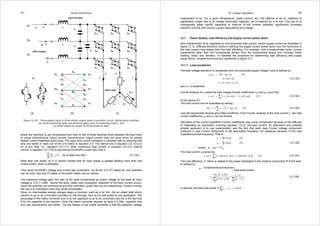
Figure 12.6. Integral half-cycle single-phase ac control: (a) circuit connection using a triac; 
(b) output voltage waveforms for one-eighth maximum load power and nine-sixteenths maximum 
power; and (c) normalised supply power factor and power output. 
The output power is 
2 2 
P = V m =δ × V = 2 R N R I R (W) (12.54) 
rms 
where n is the number of on cycles and N is the number of cycles in the period Tp. 
The average and rms thyristors currents are, respectively, 
I 2 V m 2 V I 2 V m 2 
V 
δ δ 
= = = = 
R N R R N R 
2 2 
rms T T 
π π 
(12.55) 
From equation (12.53), the supply displacement factor cosψ n=N is unity and supply power factor λ 
is l . m/ N = P / P = δ . From cos n N pf λ μ φ μ = = = = , the distortion factor μ is . m/ N = δ . The rms 
voltage at the supply frequency is V m /N = δV and the power transfer ratio is m/N = δ. For a given 
percentage of maximum output power, the supply power factor is the same for integral cycle control and 
phase angle control. The introduction of sub-harmonics tends to restrict this control technique to 
AC voltage regulators 344 
resistive heating type application. Temperature effects on load resistance R have been neglected, as 
have semiconductor on-state voltages. Finer resolution output voltage control is achievable if integral 
half-cycles are used rather than full cycles. The equations remain valid, but the start of multiplies of half 
cycles are alternately displaced by π so as to avoid a dc component in the supply and load currents. 
Multiple cycles need not be consecutive within each period. 
Example 12.2: Integral cycle control 
The power delivered to a 12Ω resistive heating element is derived from an ideal sinusoidal supply √2 
240 sin 2π 50 t and is controlled by a series connected triac as shown in figure 12.6. The triac is 
controlled from its gate so as to deliver integral ac cycle pulses of three (m) consecutive ac cycles from 
four (N). 
Calculate 
i. The percentage power transferred compared to continuous ac operation 
ii. The supply power factor, distortion factor, and displacement factor 
iii. The supply frequency (50Hz) harmonic component voltage of the load voltage 
iv. The triac maximum di/dt and dv/dt stresses 
v. The phase angle α, to give the same load power when using phase angle control. Compare the 
maximum di/dt and dv/dt stresses with part iv. 
vi. The output power steps when m, the number of conducted cycles is varied with respect to N = 4 
cycles. Calculate the necessary phase control α equivalent for the same power output. 
Include the average and rms thyristor currents. 
vii. What is the smallest power increment if half cycle control were to be used? 
viii. Tabulate the harmonics and rms subharmonic component per unit magnitudes of the load 
voltage for m = 0, 1, 2, 3, 4; and for harmonics n = 0 to 12. (Hint: use Excel) 
Solution 
The key data is: m = 3 N = 4 (δ = ¾) V = 240 rms ac, 50Hz 
i. The power transfer, given by equation (12.54), is 
P = V m = V δ R N R 
2 2 2402 = 12Ω ×¾ = 4800×¾ = 3.6kW 
That is 75% of the maximum power is transferred to the load as heating losses. 
ii. The displacement factor, cosψ, is 1. The distortion factor is given by 
μ = m = δ = = 
. 
3 0.866 
4 
N 
Thus the supply power factor, λ, is 
. λ = μ cosψ = m = δ = 0.866×1 = 0.866 
N 
iii. The 50Hz rms component of the load voltage is given by 
V V m V 
50 = = δ = 240×¾ = 180V rms Hz 
N 
iv. The maximum di/dt and dv/dt occur at zero cross over, when t = 0. 
| π 
| 
max 0 
( ) 
( ) 
= 
0 
2 240 sin2 50 
| 
= 2 240 2π50 cos2π50t 
= 
= 2 240 2π50 = 0.107 V/μs 
s = 
t 
t 
dV d t 
dt dt 
d V d t 
dt R dt 
| π 
| 
max 0 
( ) 
( ) 
0 
2 240 sin 2 50 
12 
| 
= 
= 2 20 2π50 cos2π50t 
= 
= 2 20 2π50 = 8.89 A/ms 
= 
Ω 
s 
t 
t
345 Power Electronics 
v. To develop the same load power, 3600W, with phase angle control, with a purely resistive load, 
implies that both methods must develop the same rms current and voltage, that is, 
. = = / = δ rms V RP V mN V . From equation (12.5), when the extinction angle, β = π, since the 
load is resistive 
{( ) } ½ = × = / = δ = 1π π −α +½sin 2α  rms   V R P V mN V V 
that is 
δ = m = 1π {(π −α ) +½sin 2α} = ¾ = 1π {(π −α ) +½sin 2α} 
N 
Solving 0 = ¼π −α +½sin 2α iteratively gives α = 63.9°. 
When the triac turns on at α = 63.9°, the voltage across it drops virtually instantaneously from √2 240 sin 
63.9 = 305V to zero. Since this is at triac turn-on, this very high dv/dt does not represent a turn-on dv/dt 
stress. The maximum triac dv/dt stress tending to turn it on is at zero voltage cross over, which is 107 
V/ms, as with integral cycle control. Maximum di/dt occurs at triac turn on where the current rises from 
zero amperes to 305V/12Ω = 25.4A quickly. If the triac turns on in approximately 1μs, then this would 
represent a di/dt of 25.4A/μs. The triac initial di/dt rating would have to be in excess of 25.4A/μs. 
cycles period duty power I Th Thrms I Delay 
angle 
Displacement 
factor 
Distortion 
factor 
Power 
factor 
m N δ W A A α cosψ μ λ 
0 4 0 0 0 0 180° 
1 4 ¼ 1200 2.25 7.07 114° 1 ½ ½ 
2 4 ½ 2400 4.50 10.0 90° 1 0.707 0.707 
3 4 ¾ 3600 6.75 12.2 63.9° 1 0.866 0.866 
4 4 1 4800 9 14.1 1 1 1 1 
vi. The output power can be varied using m = 0, 1, 2, 3, or 4 cycles of the mains. The output power in 
each case is calculated as in part 1 and the equivalent phase control angle, α, is calculated as in part v. 
The appropriate results are summarised in the table. 
vii. Finer power step resolution can be attained if half cycle power pulses are used as in figure 12.6b. If 
one complete ac cycle corresponds to 1200W then by using half cycles, 600W power steps are 
possible. This results in nine different power levels if N = 4, from 0W to 4800W. 
vii. The following table show harmonic components, rms subharmonics, etc., for N = 4, which are 
calculated as follows. 
For n ≠ 4, (that is not 50Hz) the harmonic magnitude is calculated from equation (12.52). 
2 2 8 2 
V N nm V nm 
π π 
    
c sin sin when N 4 and n 
4 
=   = ×   = ≠ 
( ) ( ) 2 2 2 
n 
N n N 16 n 
4 −   −   
π π 
while equation (12.53) gives the 50Hz load component (n = 4). 
m m 
c V V N n 
4 2 2 when 4 and 4 
n N 4 
= = N = = = = 
The rms output voltage is given by equation (12.51) or the square root of the sum of the squares of the 
harmonics, that is 
= = Σ rms n 
2 
V V mN V c 
1 
/ 
∞ 
= 
n 
The ac subharmonic component (that is components less than 50Hz) is given by 
2 2 2 ½ 
, 1 2 3 2 ac sub V = V c +c +c  
From equations (12.51) and (12.53), the non fundamental (50Hz ac) component is given by 
= − = −   = δ −δ 
( ) 
2 
2 2 
1 ac rms 50 Hz 
m m 
V V V V V 
N N 
  
AC voltage regulators 346 
Normalised components δ and m 
0 ¼ ½ ¾ 1 m/N 
n Hz 0 1 2 3 4 
0 0 0 0 0 0 0 
1 12.5 0 0.120 0.170 0.120 0 
2 25 0 0.212 0 -0.212 0 
3 37.5 0 0.257 -0.364 0.257 0 m/N 
4 50 0 ¼ ½ ¾ 1 fundamental 
5 62.5 0 0.200 -0.283 0.200 0 
6 75 0 0.127 0 -0.127 0 
7 87.5 0 0.055 0.077 0.055 0 
8 100 0 0 0 0 0 
9 112.5 0 -0.028 -0.039 -0.028 0 
10 125 0 -0.030 0 0.030 0 
11 137.5 0 -0.017 0.024 -0.017 0 
12 150 0 0 0 0 0 
12 
all n sum square 0 0.249 0.499 0.749 1 
Σc 
2 
n 1 
all n rms 0 0.499 0.707 0.866 1 
12 
Σc 
2 
n 1 
m 
all n 
check exact rms 0 0.5 0.707 0.866 1 . 4 
= δ 
all n 
but not 
n = 4 
ac harmonic rms 0 0.432 0.499 0.432 0 
12 
Σc 2 −c 
2 
n 4 
1 
n ≤ 3 sub harmonics 
rms 0 0.354 0.401 0.354 0 
3 
Σc 
2 
n 1 
n ≥ 5 upper harmonics 
rms 0 0.247 0.297 0.247 0 
12 
Σc 
2 
n 5 
n ≥ 5 
check 
upper harmonics 
rms 0 0.249 0.298 0.249 0 
3 2 
m m 
c 2 
  
− −  
4 1 4 n 
  
Σ 
m 
pf = λ power factor 0 ½ 0.707 0.866 1 . 4 
= δ 
power pu 0 ¼ ½ ¾ 1 ¼m 
♣ 
12.2 Single-phase transformer tap-changer – line commutated 
Figure 12.7 shows a single-phase tap changer where the tapped ac voltage supply can be provided by a 
tapped transformer or autotransformer. 
Thyristor T3 (T4) is triggered at zero voltage cross-over (or later), subsequently under phase control T1 
(T2) is turned on. The output voltage (and current) for a resistive load R is defined by 
( ) ( ) 2 2 sin (V) 
o o v t i t R V t 
ω ω ω 
= × = 
for ≤ t 
≤ 
ω α 
0 (rad) 
(12.56) 
( ) ( ) 1 2 sin (V) 
o o v t i t R V t 
ω ω ω 
(rad) 
= × = 
for ≤ t 
≤ 
α ω π 
(12.57) 
where α is the phase delay angle and v2  v1. 
If 0 ≤ δ = V2 / V1 ≤ 1, then for a resistive load the rms output voltage is 
½ ½ α ½sin 2α π α ½sin 2α 1 1 1 δ α ½sin 2α π π π 
    =  − + − +  =  − − −  
    rms 
2 2 
V V V 2 1 V 2 
(12.58) 
( ) ( ) ( )( ) 
1
347 Power Electronics 
α 
α 
= δv1 
Figure 12.7. An ac voltage regulator using a tapped transformer: 
(a) circuit connection and (b) output voltage waveform with a resistive load. 
The Fourier coefficients of the output voltage, which has only odd harmonics, are 
δ 
a V n n n 
( ) 
2 
2 
2 1 
cos cos sin sin 1 
1 
2 1 
cos sin sin cos 
1 
n 
n 
n 
b V n n n 
n 
α α α α 
π 
δ 
α α α α 
π 
− 
=  + −  − 
− 
= − 
− 
(12.59) 
The amplitude of the fundamental quadrature components, n = 1, are 
( ) 
2 
( )( ) 
1 
2 2 
1 
1 
1 sin 
1 
1 sin cos sin cos 
a V 
= − 
b V 
δ α 
π 
δ α α α α α 
= − − − 
π 
(12.60) 
Initially v2 is impressed across the load, via T3 (T4). Turning on T1 (T2) reverse-biases T3 (T4), hence T3 
(T4) turns off and the load voltage jumps to v1. It is possible to vary the rms load voltage between v2 and 
v1. It is important that T1 (T2) and T4 (T3) do not conduct simultaneously, since such conduction short-circuits 
the transformer secondary. 
Both load current and voltage information (specifically zero crossing) is necessary with inductive and 
capacitive loads, if winding short circuiting is to be avoided. 
With an inductive load circuit, when only T1 and T2 conduct, the output current is 
i V t 
2 ( ) sin (A) o 
= ω −φ (12.61) 
Z 
where Z = R2 + (ωL)2 (ohms) φ = tan−1ωL / R (rad) 
It is important that T3 and T4 are not fired until α ≥ φ , when the load current must have reached zero. 
Otherwise a transformer secondary short circuit occurs through T1 (T2) and T4 (T3). 
For a resistive load, the thyristor rms currents for T3, T4 and T1, T2 respectively are 
( ) 
= − 
( ) 
I V 
2 
= 1 
− + 
1 2 sin2 
2 
1 sin 2 2 2 
2 
Trms 
Trms 
R 
I V 
R 
α α 
π 
α α π 
π 
(12.62) 
The thyristor voltages ratings are both v1 - v2, provided a thyristor is always conducting at any instant. 
An extension of the basic operating principle is to use phase control on thyristors T3 and T4 as well as T1 
and T2. It is also possible to use tap-changing in the primary circuit. The basic principle can also be 
extended from a single tap secondary to a multi-tap transformer. 
The basic operating principle of any multi-output tap changer, in order to avoid short circuits, 
independent of the load power factor is 
• switch up in voltage when the load V and I have the same direction, delivering power 
• switch down when V and I have the opposite direction, returning power. 
AC voltage regulators 348 
(b) (a) 
VT1 
VD1 
Vo=IoR √2×11sinωt √2×23sinωt 
IT1 IT2 IT1 IT2 
ID1 ID2 ID1 ID2 
o α=90º π 2π 3π 4π ωt 
Figure 12.8. An ac voltage regulator using a tapped transformer connected as a rectifier with a 
resistive load: (a) circuit diagram and symbols and (b) circuit waveforms, viz., output voltage and 
current, transformer primary current, diode reverse blocking voltage, and thyristor blocking voltages. 
Example 12.3: Tap changing converter 
The converter circuit shown in figure 12.8 is a form of ac to dc tap changer, with a 230V ac primary. The 
inner voltage taps can deliver 110V ac while the outer tap develops 230V ac across the 10Ω resistive 
load. If the thyristor phase delay angle is 90º determine 
i. The mean load voltage hence mean load current 
ii. The average diode and thyristor current 
iii. The primary rms current 
iv. The peak thyristor and diode voltage, for any phase angle 
Solution 
The output voltage is similar to that shown in figure 12.7b, except rectified, and α=90º. 
i. The mean load voltage can be determine from equation (12.22) 
Vo 
Io 
ID2 
IT2 
Ip 
Vp 
ωt 
α=90º 
Ip 
√2×23sinωt 
√2×5.26sinωt 
o α=90º π 2π 3π 4π ωt 
VD1 
√2×230sinωt √2×110sinωt √2×340sinωt 
α=90º 
ωt 
VT1 
√2×120sinωt 
√2×230sinωt 
√2×460sinωt
349 Power Electronics 
α 
= + ° + + 
½ 
110 230 2 2 
(1 cos 0 ) (1 cos ) 
2110 2 230 
(1 cos 0 ) (1 cos 90 ) 
49.5V 103.5V 153V 
153 
15.3 
10 
o 
o 
o 
V V 
V 
V V 
V V 
I A 
R 
α 
π π π 
π 
π π π 
= + ° + + ° 
= + = 
= = = 
Ω 
whence 
ii. The diode current is associated with the 49.5V component of the average load voltage, while the 
thyristor component is 103.5V. Taking into account that each semiconductor has a maximum 
duty cycle of 50%: 
The average diode current is 
49.5V 
D 10 I = × = 
50% 2.475A 
Ω 
The average thyristor current is 
103.5V 
50% 5.175A 
T 10 I = × = 
Ω 
iii. The primary rms current has two components 
When the diode conducts the primary current is 
i t t t 
1 
= × = × ≤ ≤ 
i t t t 
2 
110V 110V 
2 sin 2 5.26 sin 0 
230V 10 
230V 230V 
2 sin 2 23sin 
230V 10 
p 
p 
ω ω ω α 
ω ω α ω π 
Ω 
= × = × ≤ ≤ 
Ω 
The rms of each component, on the primary side, is 
( ) 
2 ½ 2 
=  ×    
I 2 5.26 sin 
td t 
= ×   { − } 
    = ×   =   
=  ( × ) 
   
I td t 
= ×   {( − ) + } 
    = ×   =   
0 
½ 
2 ½ 2 
½ 
1 
2 
1 
2 
1 
4 
1 
4 
1 
2 5.26 ½sin2 ) 2 5.26 2.63A 
2 2 
2 23 sin 
1 
2 23 ½sin2 ) 2 23 11.5A 
2 2 
rmsD 
rmsT 
α 
π 
α 
π 
π 
π 
π 
ω ω 
α α 
ω ω 
π α α 
∫ 
∫ 
The total supply side rms current comprised the contribution of two diodes and two thyristors 
I= I 2 + I 2 + I 2 + I 
2 
p rmsD rmsD rmsT rmsT 2.632 2.632 11.52 11.52 16.68A 
= + + + = 
iv. The peak diode voltage is associated with the turn-on of the thyristor associated with the other 
half cycle of the supply and worst case is when α½π. 
l 2 230V 2 110V 466.7V D V = × + × = 
and 466.7×sinα for α½π. 
The thyristor peak forward and reverse voltages are experienced at α=½π: 
F 
l ( ) 
l 
2 230V 110V 169.7V 
2 2 230V 650.5V 
V 
V 
T 
R 
T 
= × − = 
= × × = 
The thyristor forward voltage is controlled by its associated diode and is less than 169.7V if 
α½π, viz. 169.7×sinα. The peak reverse voltage of 650.5V is experienced if the 
complementary thyristor is turned on before α=½π, otherwise the maximum is 650.5×sinα for 
α½π. 
♣ 
AC voltage regulators 350 
T2 on 
T1 
T2 on 
T1 
T4 on 
T3 
0 π ωt 
fo 
T2 on 
T1 
T2 on 
T1 
T4 on 
T3 
Figure 12.9. An ac voltage regulator using a chopper, with commutable switches: 
(a) circuit configuration and output voltage waveform with a resistive load at (b) low modulation, 
δ≈¼; (c) high modulation, δ≈¾; and (d) harmonic characteristics. 
δ = ¾ 
δ = ¼ 
fo 
fs 
fs 
0 π ωt 
Power factor 
phase control, α 
equation 
Power factor 
ac chopper, δ 
fundamental 
4th 3rd 2nd 
0 ¼ ½ ¾ 1 
on-stateduty cycle δ 
1 
¾ 
½ 
¼ 
0 
p e r u n i t 
T3 
L 
L 
O 
A 
D 
R 
T1 
T4 T2 
a 
c 
s 
u 
p 
p 
l 
y 
ac 
2V sinωt 
vo 
L-C 
filter 
(d) 
(c) 
(b) 
(a) 
fundamental 
δ ≈ ¾ 
fundamental 
δ ≈ ¼
351 Power Electronics 
12.3 Single-phase ac chopper regulator – commutable switches 
An ac step-down chopper is shown in figure 12.9a. The switches T1 and T3 (shown as reverse blocking 
IGBTs) impress the ac supply across the load while T2 and T4 provide load current freewheel paths 
when the main switches T1 and T3 are turned off. In order to prevent the supply being shorted, switches 
T1 and T4 can not be on simultaneously when the ac supply is in a positive half cycle, while T2 and T3 
can not both be on during a negative half cycle of the ac supply. Zero voltage information is necessary. 
If the rms supply voltage is V and the on-state duty cycle of T1 and T3 is δ, then rms output voltage Vo is 
o V = δV (12.63) 
When the sinusoidal supply is modulated by a high frequency rectangular-wave carrier ωs (2πfs), which 
is the switching frequency, the ac output is at the same frequency as the supply fo but the fundamental 
magnitude is proportional to the rectangular wave duty cycle δ, as shown in figure 12.9b. Being based 
on a modulation technique, the output harmonics involve the fundamental at the supply frequency fo and 
components related to the high frequency rectangular carrier waveform fs. The output voltage is given by 
{ ( ) ( ) } . 
. 
Σ (12.64) 
δ ω δ ω ω ω ω 
1 
2 
2 sin sin sin sin o o o c o c 
n 
V 
V V t n n t n t 
n 
∀  
  
= +  + − −  
  
The carrier (switching frequency) components can be filtered by using an output L-C filter, as shown in 
figure 12.9a, which has a cut-off frequency of f½ complying with fo  f½  fs. 
12.4 Three-phase ac regulator 
12.4.1 Fully-controlled three-phase ac regulator with wye load and isolated neutral 
The power to a three-phase star or delta-connected load may be controlled by the ac regulator shown in 
figure 12.10a with a star-connected load shown. The circuit is commonly used to soft start three-phase 
induction motors. If a neutral connection is made, load current can flow provided at least one thyristor is 
conducting. At high power levels, neutral connection is to be avoided, because of load triplen currents 
that may flow through the phase inputs and the neutral. With a balanced delta connected load, no triplen 
or even harmonic currents occur. 
If the regulator devices in figure 12.10a, without the neutral connected, were diodes, each would 
conduct for ½π in the order T1 to T6 at ⅓π radians apart. As thyristors, conduction is from α to ½π. 
Purely resistive load 
In the fully controlled ac regulator of figure 12.10a without a neutral connection, at least two devices 
must conduct for power to be delivered to the load. The thyristor trigger sequence is as follows. If 
thyristor T1 is triggered at α, then for a symmetrical three-phase load voltage, the other trigger angles are 
T3 at α + ⅔π and T5 at α + 4π/3. For the antiparallel devices, T4 (which is in antiparallel with T1) is 
triggered at α + π, T6 at α + 5π/3, and finally T2 at α + 7π/3. 
Figure 12.10b shows resistive load, line-to-neutral voltage waveforms (which are symmetrical about zero 
volts) for four different phase delay angles, α. Three distinctive conduction periods, plus a non-conduction 
period, exist. The waveforms in figure 12.10b are useful in determining the required bounds 
of integration. When three regulator thyristors conduct, the voltage (and the current) is of the 
formV 3 sinφ ∧ , while when two devices conduct, the voltage (and the current) is of the form 
∧ 
V 2 sin ( φ − 1 6π 
) 
. 
V ∧ 
is the maximum line voltage,√3 √2V. 
i. 0 ≤ α ≤ ⅓π [mode 3/2] – alternating every π between 2 and 3 conducting thyristors, 
Full output occurs when α = 0, when the load voltage is the supply voltage and each thyristor 
conducts for π. For α ≤ ⅓π, in each half cycle, three alternating devices conduct and one will be 
turned off by natural commutation. The output voltage is continuous. Only for ωt ≤ ⅓π can three 
sequential devices be on simultaneously. 
Examination of the α = ¼π waveform in figure 12.10b shows the voltage waveform is made from 
five sinusoidal segments. The rms load voltage per phase (line to neutral), for a resistive load, is 
  π 1 π α 2 
π 
   + +  
∫ ∫ ( ) 
∫ 
+ 
3 3 3 
d d d 
φ φ φ φ φ 
1 2 1 2 φ + 
π 
1 2 
3 4 3 
∧ + 
α π π α 
=    
∫ ∫ rms 
π π + 
α π 
φ φ φ 
  + ( ) 
+  
   
1 
6 
1 1 
3 3 
2 
3 
1 2 φ − 
1 
π 
1 2 
4 6 
3 
2 2 
3 3 
½ 
1 sin sin sin 
sin sin 
+ 
π πα 
V V 
d d 
3 3 ½ 
2 41 sin 2 π π = =  − α + α  rms rms V I R V (12.65) 
AC voltage regulators 352 
Optional tapped neutral 
½(va-vb) 
ia 
ib 
v 2 V sin 
t 
v 2 V sin 
t 
v 2 V sin 
t 
= 
. 
= − 
. 
= − 
. 
a 
b 
c 
½(va-vc) 
½(va-vc) 
va 
½(va-vc) va 
T1 
T2 
T6 
T1 
T5 
T6 
T6 
T1 
T1 
T2 
T2 
T3 
T5 
T6 
T1 
T6 
T1 
T2 
T1 
T2 
T6 
T1 
T5 
T6 
T6 
T1 
T1 
T2 
(c) 
ZL 
ZL 
ZL 
ic 
a 
b 
c 
L 
O 
A 
D 
( ω 
) 
( ω 2 
π 
) 
3 
( ω 4 
π 
) 
3 
Figure 12.10. Three-phase ac full-wave voltage controller: (a) circuit connection with a star load; 
(b) phase a, line-to-load neutral voltage waveforms for four firing delay angles; and (c) delta load. 
The Fourier coefficients of the fundamental frequency are 
( ) ( ) 1 1 
4 
3 
3 3 
cos 2 1 sin2 2 
a V α b V α π α 
= − = + − (12.66) 
4 4 
π π 
Using the five integration terms as in equation (12.65), not squared, gives the average half-wave 
(half-cycle) load voltage, hence specifies the average thyristor current requirement with a resistive 
load. That is 
∫ 
V I R V t d t 
( ) 
½cycle 
o T 
½cycle 
1 
2 2 sin 
2 
2 
2 1 cos 
o T 
V 
V I R 
π 
α 
ω ω 
π 
α 
π 
= × = 
= × = + 
(12.67) 
The thyristor maximum average current is when α = 0, that is 
2 
T 
V 
I 
πR 
∧ 
= . 
ii. ⅓π ≤ α ≤ ½π [mode 2/2] – two conducting thyristors 
The turning on of one device naturally commutates another conducting device and only two phases 
can be conducting, that is, only two thyristors conduct at any time. Two phases experience half the
353 Power Electronics 
difference of their input phase voltages, while the off thyristor is reverse biased by 3/2 its phase 
voltage, (off with zero current). The line-to-neutral load voltage waveforms for α = ⅓π and ½π, 
which are continuous, are shown in figures 12.10b. 
Examination of the α = ⅓π or α = ½π waveforms in figure 12.10b show the voltage waveform is 
comprised from two segments. The rms load voltage per phase, for a resistive load, is 
{ ( ) ( ) } 1 2 
∧ V V  ∫ π + α d ∫ π + 
α 
= + d 
 rms   3 π 1 2 φ + 1 π φ 3 
1 2 
φ − 
1 
π φ 
4 6 4 
6 
1 
3 
½ 
1 sin sin 
+ 
α πα 
( ) ½ ½ 
V = I R = V 3 3 
3 3 
rms rms  ½ + 9 sin 2 α + 8 π 8 π cos 2 α  = V  ½ + 4 π sin 2 α + π 
6 
 (12.68) 
The Fourier co-efficients of the fundamental frequency are 
3 3 
( ( )) ( 2 
+ ( )) 1 1 
a V cos 2 α cos 2 α π b V π sin2 α sin2 
α π 
= − − = − − (12.69) 
3 3 3 
4 4 
π π 
The non-fundamental harmonic magnitudes are independent of α, and are given by 
3 
( ) ( )6 
sin 1 for 6 1 1,2,3,.. 
V = × V × h ± h = k ± k 
= 
h 1 h 
π 
π 
± 
(12.70) 
Using the same two integration terms, not squared, gives the average half-wave (half-cycle) load 
voltage, hence specifies the average thyristor current with a resistive load. That is 
( ) ( ) ½cycle 
∫ ∫ 
V I R V t d t t d t 
½cycle 
1 2 
3 1 3 1 
= × = + + − 
6 1 6 
3 
1 
2 3 2 sin sin 
2 
3 2 
2 sin 
3 
o T 
o T 
V 
V I R 
π α π α 
α πα 
ω π ω ω π ω 
π 
π 
α 
π 
+ + 
+ 
= × =  +    
  
(12.71) 
iii. ½π ≤ α ≤ π [mode 2/0] – either 2 or no conducting thyristors 
Two devices must be triggered in order to establish load current and only two devices conduct at 
anytime. Line-to-neutral zero voltage periods occur and each device must be retriggered ⅓π after 
the initial trigger pulse. These zero output periods (discontinuous load voltage) which develop for α 
≥ ½π can be seen in figure 12.10b and are due to a previously on device commutating at ωt = π 
then re-conducting at α +⅓π. Except for regulator start up, the second firing pulse is not necessary 
if α ≤ ½π. 
Examination of the α = ¾π waveform in figure 12.10b shows the voltage waveform is made from 
two discontinuous voltage segments. The rms load voltage per phase, for a resistive load, is 
{ ( ) ( ) } 5 7 
=  +    rms ∫ ∫ V V d d 
π π 
1 sin sin 
6 φ + π θ 6 
π φ − 
π φ 
1 1 
6 1 6 
3 
½ 
1 2 1 2 
4 4 
α πα 
∧ 
+ 
( ) ½ ½ 5 3 3 3 3 5 3 3 1 
4 2π 8π sin 2 8π cos 2 4 2π 4π sin 2 3 = =  − α + α + α  =  − α + α + π  rms rms V I R V V (12.72) 
The Fourier co-efficients of the fundamental frequency are 
3 3 
( 1 cos2 ( 1 )) ( 5 2 sin2 
( 1 
)) 1 3 1 
3 3 
a V α π b V π α α π 
= − + − = − − − (12.73) 
4 4 
π π 
Using the same two integration terms, not squared, gives the average half-wave (half-cycle) load 
voltage, hence specifies the average thyristor current with a resistive load. That is 
½cycle 3 2 
V 
( ( )) V I R α π 
o 2 T 1 cos 6 
= × = + + (12.74) 
π 
iv. π ≤ α ≤ π [mode 0] – no conducting thyristors 
The interphase voltage falls to zero at α = π, hence for α ≥ π the output becomes zero. 
In each case the phase current and line to line voltage are related by V = 3 I R and the peak 
Lrms rms voltage is V l = 2 V = 6 V . For a resistive load, load power 3 I 2 R for all load types, and V = I R 
. L rms rms rms Both the line input and load current harmonics occur at 6n±1 times the fundamental. 
Inductive-resistive load 
Once inductance is incorporated into the load, current can only flow if the phase angle is at least equal 
to the load phase angle, given by φ = tan − 1 ω L 
.Due to the possibility of continuation of the load current 
R 
because of the stored inductive load energy, only two thyristor operational modes occur. The initial 
mode at φ ≤ α operates with three then two conducting thyristors mode [3/2], then as the control angle 
increases, operation in a mode [2/0] occurs with either two devices conducting or all three off, until α = 
AC voltage regulators 354 
π. The transitions between 3 and 2 thyristors conducting and between the two modes involves 
solutions to transcendental equations, and the rms output voltage, whence currents, depend on the 
solution to these equations. 
Purely inductive load 
For a purely inductive load the natural ac power factor angle is ½π, where the current lags the voltage 
by ½π. Therefore control for such a load starts from α = ½π, and since the average inductor voltage 
must be zero, conduction is symmetrical about π and ceases at 2π - α. The conduction period is 2(π- α). 
Two distinct conduction periods exist. 
i. ½π ≤ α ≤ ⅔π [mode 3/2] – either 2 or 3 conducting thyristors 
Either two or three phases conduct and five integration terms give the load half cycle average 
voltage, whence average thyristor current, as 
½cycle 2 2 
V 
( ) V α α 
2cos 3 sin 1 3 o 
= − + + (12.75) 
π 
The thyristor maximum average current is when α=½π. 
When only two thyristors conduct, the phase current during the conduction period is given by 
    =  −  +       
( ) 2 3 3 
cos cos 
2 2 6 
V 
i t t 
L 
π 
ω α ω 
ω 
(12.76) 
The load phase rms voltage and current are 
( ) 
½ 
( ( ) ) 
½ 
5 3 3 
2 2 
5 3 6 9 
2 2 
= − + 
α α 
2 
sin2 
7 cos sin2 
V V 
rms 
rms 
V 
I 
= − + − + 
L 
π π 
α α α α 
π π π 
ω 
(12.77) 
The magnitude of the sin term fundamental (a1 = 0) is 
( ) 1 1 1 
5 
3 
3 
V b V π 2 α sin2 
α I ωL 
= = − + = (12.78) 
2 
π 
while the remaining harmonics (ah = 0) are given by 
3 sin( 1) sin( 1) 
h h 
V b V 
α α 
h h 1 1 
h h 
π 
 + −  
= =  +   + −  
(12.79) 
ii. ⅔π ≤ α ≤ π [mode 2/0] – either 2 or no conducting thyristors 
Discontinuous current flows in two phases, in two periods per half cycle and two integration terms 
(reduced to one after time shifting) give the load half cycle average voltage, whence average 
thyristor current, as 
½cycle 2 2 
V 
( ( )) V α π 
o 3 1 cos 6 
= + + (12.80) 
π 
which reduces to zero volts at α = π. 
The average thyristor current is given by 
5 
π α 
1 3 3 2 
∫ 
2 cos cos 
2 2 6 6 
3 2 5 
2 cos 2sin 
α 
2 3 6 6 
T 
V 
I t d t 
L 
V 
L 
π π 
α ω ω 
π ω 
π π 
π α α α 
πω 
− 
     = ×   +  −  +  
     
      =  −   +  −  +  
      
(12.81) 
When two thyristors conduct, the phase current during the conduction period is given by 
      =   +  −  +   
( ) 2 3 
cos cos 
2 6 6 
V 
i t t 
L 
π π 
ω α ω 
ω 
      
(12.82) 
The load phase rms voltage and current are 
( ( )) 
½ 
5 3 3 1 
2 2 3 sin 2 
5 3 6 9 
  =  − +   −   ( + ) + ( + ) 
 
½ 
= − + + 
5 cos sin2 
2 1 1 
6 6 
V V 
2 2 
rms 
rms 
V 
I 
L 
π π α α π 
α α 
α π α π 
ω π π π 
    
(12.83)
355 Power Electronics 
The magnitude of the sin term fundamental (a1 = 0) is 
α α π 
∓ 
V b V h k 
1 
0.75 
0.5 
0.25 
0 
( 5 ( 1 
)) 1 1 3 3 
1 
V b V π α α π I ωL 
= = − − − = (12.84) 
h h 
Equation 
(12.77) 
0 30 60 90 120 150 
delay angle α 
normalised rms voltages, R and L loads 
Equation 
(12.65) 
Equation 
(12.68) 
Equation 
(12.72) 
Equation 
(12.83) 
rms V 
V 
VR VL 
1 
0.75 
0.5 
0.25 
0 
Equation 
(12.75) 
0 30 60 90 120 150 
delay angle α 
normalised ave ½ half cycle voltages, R and L loads 
Equation 
(12.67) 
Equation 
(12.71) 
Equation 
(12.74) 
Equation 
(12.80) 
2√2/π 
V½R 
V½L 
½ 
o V 
V 
1 
0.75 
0.5 
0.25 
0 
0 30 60 90 120 150 
delay angle α 
normalised output current, with L load 
Equation 
(12.77) 
Equation 
(12.83) 
IL 
I ω 
L 
L V 
1 
0.75 
0.5 
0.25 
0 
Equation 
(12.78) 
Equation 
(12.73) 
0 30 60 90 120 150 
delay angle α 
normalised fundamental output voltage R  L load 
Equation 
(12.66) 
Equation 
(12.69) 
Equation 
(12.84) 
1 v 
V 
VRo 
VLo 
(a) (b) 
(c) (d) 
3 
2 sin2 
2 
π 
while the remaining harmonics (ah = 0) are given by 
( ) ( )( 1 ) 
3 3 sin 1 sin 1 
for 6 1 
h h 1 1 
h h 
π 
 ± −  
= = ±  +  =  ±  
∓ 
∓ 
(12.85) 
Various normalised voltage and current characteristics for resistive and inductive equations derived are 
shown in figure 12.11. 
Figure 12.11. Three-phase ac full-wave voltage controller characteristics for purely resistive and 
inductive loads: (a) normalised rms output voltages; (b) normalised half-cycle average voltages; (c) 
normalised output current for a purely inductive load; and (d) fundamental ac output voltage. 
AC voltage regulators 356 
12.4.2 Fully-controlled three-phase ac regulator with wye load and neutral connected 
If the load and supply neutral is connected in the three phase thyristor controller with a wye load as 
shown dashed in figure 12.10a, then (possibly undesirably) neutral current can flow and each of the 
three loads can be controlled independently. Undesirably, the third harmonic and its odd multiples are 
algebraically summed and returned to the supply via the neutral connection. At any instant iN = ia + ib + ic. 
For a resistive balanced load there are three modes of thyristor conduction. 
When 3 thyristors conduct ia + ib + ic =IN = 0, two thyristor conduct ( ) . 
I = I = V R ωt . 
I 
I 
1 
0.75 
0.5 
0.25 
0 
π 
α 
+ =   − −   
V 
= ×  −    
V 
I 
= − (12.87) 
2 2 
π π 
  α 
+ =    − −  +   
3 2 sin 3 2 sin N 
I V R t dt V R t dt 
    ∫ ∫ 
V 
I 
  
= ×  −  
V 
I 
= − (12.89) 
V V 
= − = (12.90) 
0 30 60 90 120 150 180 
delay angle 
rms and average neutral current 
Equation 
(12.86) 
Equation 
(12.87) 
Equation 
(12.88) 
Equation 
(12.89) 
Equation 
(12.91) 
Equation 
(12.92) 
I V t = − R ω − π , and for 
rms 
neutral 
current 
average 
neutral 
current 
rms I 
V 
R 
N I 
V 
R 
43 
2 sin N 
one thyristor . 2 sin 
N T 
Mode [3/2] 0 ≤ α ≤ ⅓π 
Periods of zero neutral current occur when three thyristors conduct and the rms of the discontinuous 
neutral current is given by 
( ) . 
3 
3 
2 
2 4 
3 
3 2 sin N 
I V t dt R 
π 
ω π 
π 
  ∫ 
( ) 
½ 
½ 
3 
sin2 N 
R 
α α 
π 
  
(12.86) 
The average neutral current is 
( ) 3 2 
1 cos N 
R 
α 
π 
At α = 0°, no neutral current flows since the load is seen as a balance load supplied by the three-phase 
ac supply, without an interposing controller. 
Mode [2/1] ⅓π ≤ α ≤ ⅔π 
From α to ⅔π two phase conduct and after ⅔π the neutral current is due to one thyristor conducting. 
The rms neutral current is given by 
( ) . . 
2 
3 3 
2 
3 
2 4 
3 
π 
α 
ω π ω 
π π 
½ 
. 2 3 3 
1 cos N 
R 
α 
π 
  
(12.88) 
Maximum rms neutral current occurs at α = ½π, when IN = V/R. 
The average neutral current is 
( ) 3 2 
3 sin 1 N 
R 
α 
π 
The maximum average neutral current, at α = ½π, is 
 ( ) 3 2 
N 3 1 0.9886 
πR R 
Figure 12.12. Three-phase ac full-wave voltage neutral-connected controller with resistive load, 
normalised rms neutral current and normalised average neutral current.
357 Power Electronics 
Mode [1/0] ⅔π ≤ α ≤ π 
The neutral current is due to only one thyristor conducting. The rms neutral current is given by 
= + (12.92) 
=  − +  = ≤ ≤   rms rms V V IR (12.94) 
1.75 
1.5 
1.25 
1 
0.75 
0.5 
0.25 
0 
Equation 
(12.98) 
0 30 60 90 120 150 180 
delay angle 
= ×  − +    
α α 
rms line current 
Semi-controlled 
rms I 
V 
R 
controlled 
Equation 
(12.95) 
Equation 
(12.96) 
Equation 
(12.97) 
Equation 
(12.99) 
=    . 
 
2 
π 
2 3 2 sin 
N 
I V R t dt 
α 
ω 
π 
  ∫ 
( ) 
½ 
½ 
3 
V 
I 
sin2 N 
R 
π α α 
π 
  
(12.91) 
The average neutral current is 
3 2 
V 
( ) I 
1 cos N 
R 
α 
π 
The neutral current is greater than the line current until the phase delay angle α  67°. The neutral 
current reduces to zero when α = π, since no thyristors conduct. 
The normalised neutral current characteristics are shown plotted in figure 12.12. 
12.4.3 Fully-controlled three-phase ac regulator with delta load 
The load in figure 12.10a can be replaced with the start delta in figure 12.10c. Star and delta load 
equivalence applies in terms of the same line voltage, line current, and thyristor voltages, provided the 
load is linear. A delta connected load can be considered to be three independent single phase ac 
regulators, where the total power (for a balanced load) is three times that of one regulator, that is 
. 1 1 1 1 3 cos 3 cos L Power = ×VI φ = VI φ (12.93) 
For delta-connected loads where each phase end is accessible, the regulator shown in figure 12.13 can 
be employed in order to reduce thyristor current ratings. Each phase forms a separate single-phase ac 
controller as considered in section 12.1 but the phase voltage is the line-to-line voltage, √3V. For a 
resistive load, the phase rms voltage, hence current, given by equations (12.23) and (12.24) are 
increased by √3, viz.: 
½ 3 1 sin 2 3 0 
2 
α π 
π π 
The line current is related to the sum of two phase currents, each phase shifted by 120º. For a resistive 
delta load, three modes of phase angle dependent modes of operation can occur. 
Figure 12.13. A delta connected three-phase ac regulator: (a) circuit configuration and (b) 
normalised line rms current for controlled and semi-controlled resistive loads. 
Mode [3/2] 0 ≤ α ≤ ⅓π 
The line current is given by 
½ . 4 2 
= − α + α (12.95) 
R  3 π 3 
π  3 
1 sin2 LI V 
AC voltage regulators 358 
Mode [2/1] ⅓π ≤ α ≤ ⅔π 
The line current is given by 
( ) 
( ( )) 
½ 
=  − + + +    
=  − + + +    
α α α 
½ 
. 
. 
1 
6 
1 
α α π 
. 1 
6 
3 89 
3 89 
6 
3 
1 3sin2 cos2 
3 
1 2sin 2 
LI V 
R 
V 
R 
π π 
π π 
(12.96) 
Mode [1/0] ⅔π ≤ α ≤ π 
The line current is given by 
= . 2 − 2 α + 1 
α (12.97) 
R  3 3 π 3 
π  3 
sin2 LI V 
The thyristors must be retriggered to ensure the current picks up after α. 
Half-controlled 
When the delta thyristor arrangement in figure 12.13 is half controlled (T2, T4, T6 replaced by diodes) 
there are two mode of thyristor operation, with a resistive load. 
Mode [3/2] 0 ≤ α ≤ ⅔π 
The line current is given by 
½ . 2 1 
= − α + α (12.98) 
R  3 π 3 
π  3 
1 sin2 LI V 
Mode [2/1] ⅔π ≤ α ≤ π 
The line current is given by 
( ( )) ½ 
= . 8 − 1 α − 3 
− α − 1 
π (12.99) 
R  9 2 π 12 
π 6 
 3 
1 2sin 2 LI V 
12.4.4 Half-controlled three-phase ac regulator 
The half-controlled three-phase regulator shown in figure 12.14a requires only a single trigger pulse per 
thyristor and the return path is via a diode. Compared with the fully controlled regulator, the half-controlled 
regulator is simpler and does not give rise to dc components but does produce more line 
harmonics. 
Figure 12.14b shows resistive symmetrical load, line-to-neutral voltage waveforms for four different 
phase delay angles, α. 
Resistive load 
Three distinctive conduction periods exist. 
i. 0 ≤ α ≤ ½π – [mode3/2] 
Before turn-on, one diode and one thyristor conduct in the other two phases. After turn-on two 
thyristors and one diode conduct, and the three-phase ac supply is impressed across the load. The 
output phase voltage is asymmetrical about zero volts, but with an average voltage of zero. 
Examination of the α = ¼π waveform in figure 12.14b shows the voltage waveform is made from 
three segments. The rms load voltage per phase (line to neutral) is 
3 3 ½ 
4 8 1 sin 2 0 ½ rms rms V I R V π π = =  − α + α  ≤α ≤ π (12.100) 
The Fourier co-efficients for the fundamental voltage, for a resistive load are 
( ) ( ) 1 1 
8 
3 
3 3 
cos 2 1 2 sin 
a V α b V π α α 
= − = − + (12.101) 
8 8 
π π 
Using three integration terms, the average half-wave (half-cycle) load voltage, for both halves, 
specifies the average thyristor and diode current requirement with a resistive load. That is 
V 
( ) ½cycle 
V I R I R α α π 
= × = × = +  (12.102) 
1 
3 
2 
2 2 3 cos 0  
2 o T Diode 
π 
The diode and thyristor maximum average current is when α = 0, that is 
2 
T Diode 
V 
I I 
πR 
∧ ∧ 
= = .
359 Power Electronics 
After α = ⅓π, only one thyristor conducts at one instant and the return current is a diode. 
Examination of the α = π and α = π waveforms in figure 12.14b show the voltage waveform is 
made from three segments, although different segments of the supply around ωt=π. 
Using three integration terms, the average half-wave (half-cycle) load voltage, for both halves, 
specifies the average thyristor and diode current requirement with a resistive load. That is 
( ) ½cycle 
V I R I R α α α π 
= × = × = + + (12.103) 
1 
3 
V 
2 
2 2 1 2 cos 3 sin  
2 o T Diode 
π 
Figure 12.14. Three-phase half-wave ac voltage regulator: (a) circuit connection with a star load and 
(b) phase a, line-to-load neutral voltage waveforms for four firing delay angles. 
ii. ½π ≤ α ≤ ⅔π – [mode3/2/0] 
Only one thyristor conducts at one instant and the return current is shared at different intervals by 
one (⅓π ≤ α ≤ ½π) or two (½π ≤ α ≤ ⅔π) diodes. Examination of the α = π and α = π waveforms in 
figure 12.14b show the voltage waveform comprises two segments, although different segments of 
the supply around ωt = π. The rms load voltage per phase (line to neutral) is 
{ } 2 
3 
½ 11 3 
= =  8 − 2π α  ½π ≤α ≤ π rms rms V I R V (12.104) 
AC voltage regulators 360 
a V b V π 2 α V V 1 π 2 
α I R 
= − = − → = + − = (12.105) 
V I R I R α 
= × = × = + + (12.106) 
½ ½ 7 3 3 3 3 7 3 3 
8 4 16 sin 2 16 cos 2 8 4 8 sin 2 3 π 
− + − − + rms rms V I R V V 
= =   =  −  
π π π π π α α α α α 
π α π 
3 3 
- cos sin2 
4 4 
= − 2 =  7 2 
 3  − − − (12.108) 
6 3 
 a V α π b V π α α π 
V I R I R α π 
= × = × = + − (12.109) 
1 
3 3 3 
V 
≤ ≤ 
rms 0.75 
and fundamental phase 0.5 
0.25 
0 
delay angle voltage 
α rms voltage 
90 120 150 180 210 
rms V 
V 
1 V 
V 
fundamental 
voltage 
Equation 
(12.111) 
Equation 
(12.110) 
Equation 
(12.112) 
Equation 
(12.113) 
1 
0.75 
0.5 
0.25 
0 
Equation 
(12.99) 
0 60 120 180 
delay angle α 
rms and average phase voltage 
Equation 
(12.99) 
Equation 
(12.99) 
Equation 
(12.99) 
Equation 
(12.99) 
Equation 
(12.99) 
Equation 
(12.99) 
V 
rms 
voltage 
rms V 
V 
½cycle 
o V 
V 
½ 
average 
voltage 
(a) (b) 
The resistive load fundamental is 
( 11 ) ( ( 11 ) 2 
) . 
1 1 6 1 6 1 
4 4 4 
π π π 
Using two integration terms, the average half-wave (half-cycle) load voltage, for both halves, 
specifies the average thyristor and diode current requirement with a resistive load. That is 
½cycle 2 
2 2 ( 1 3 2 cos 
) 2 o T Diode 
π 
iii. ⅔π ≤ α ≤ 7π/6 – [mode2/0] 
Current flows in only one thyristor and one diode and at 7π/6 zero power is delivered to the load. 
The output is symmetrical about zero. The output voltage waveform shown for α=¾π in figure 
12.14b has one component. 
( ) 
2 7 
3 6 
(12.107) 
with a fundamental given by 
2 ( ) ½ ( ) 
1 1 
π π 
Using one integration term, the average half-wave (half-cycle) load voltage, for both halves, 
specifies the average thyristor and diode current requirement with a resistive load. That is 
( ( )) ½cycle 2 
2 2 3 1 cos 6 2 o T Diode 
π 
Figure 12.15. Three-phase half-wave ac voltage regulator characteristics: (a) rms phase and average 
half cycle voltages for a resistive load and (b) rms and fundamental voltages for an inductive load. 
Purely inductive load 
Two distinctive conduction periods exist. 
i. ½π ≤ α ≤ π – [mode3/2] 
For a purely inductive load (cycle starts at α =½π) 
7 3 3 
4 2 4 sin2 ½ rms rms V I L V π π = ω = − α + α π ≤α ≤ π (12.110) 
56 
while for a purely inductive load the fundamental voltage is (a1 = 0) 
( ) 1 1 1 
7 
3 
3 
b V V π 2 α sin2 
α I ωL 
= = − + = (12.111) 
4 
π 
ii. π ≤ α ≤ 7 
6 π – [mode2/0] 
For a purely inductive load, no mode 3/2/0 exist and rms load voltage for mode2/0 is
361 Power Electronics 
( ( )) . 
π π = ω = − α + α − (12.112) 
7 3 3 
4 2 4 3 sin 2 rms rms V I L V π 
with a fundamental given by (a1 = 0) 
( ) 1 1 1 
= =  7 2 
  − − −  = (12.113) 
3 3 
3 
b V V π 2 α sin2 
α π I ωL 
4 
π 
When α π, the load current is dominated by harmonic currents. 
Normalised semi-controlled inductive and resistive load characteristics are shown in figure 12.15. 
12.4.5 Other thyristor three-phase ac regulators 
i. Delta connected fully controlled regulator 
For star-connected loads where access exists to a neutral that can be opened, the regulator in figure 
12.16a can be used. This circuit produces identical load waveforms to those for the regulator in figure 
12.10 regardless of the type of load, except that mean device current ratings are halved (but the line 
currents are the same). Only one thyristor needs to be conducting for load current, compared with the 
circuit of figure 12.10 where two devices must be triggered. The triggering control is simplified but the 
maximum thyristor blocking voltage is increased by 2/√3, from 3V/√2 to √6V. 
Three output voltage modes can be shown to occur, depending of the delay control angle. 
Mode [2/1] 0 ≤ α ≤ ⅓π 
Mode [1] ⅓π ≤ α ≤ ½π 
Mode [1/0] ½π ≤ α ≤ π 
In figure 12.16a, at α = 0, each thyristor conducts for π, which for a resistive line load, results in a 
maximum thyristor average current rating of 
3 2 3 3 2 
2 2 
= L − L 
= (12.114) 
T 
V V 
R R 
I 
π π 
A half-controlled version is not viable. 
Figure 12.16. Open-star three-phase ac regulators: (a) with six thyristors and (b) with three thyristors. 
ii. Three-thyristor delta connected regulator 
The number of devices and control requirements for the regulator of figure 12.16a can be simplified by 
employing the regulator in figure 12.16b. In figure 12.16b, because of the half-wave configuration, at α = 
-⅓π, each thyristor conducts for ⅔π, which for a resistive line load, results in a maximum thyristor 
average current rating of 
3 2 3 2 
2 3 2 
= L − L 
= (12.115) 
T 
V V 
R R 
I 
π π 
Two thyristors conduct at any time as shown by the six sequential conduction possibilities that complete 
one mains ac cycle in figure 12.17. 
Three output voltage modes can be shown to occur, depending of the delay control angle. 
AC voltage regulators 362 
Mode [2/1] -⅓π ≤ α ≤ π 
Mode [2/1/0] π ≤ α ≤ ⅓π 
Mode [1/0] ⅓π ≤ α ≤ π 
The control angle reference has been moved to the phase voltage crossover, the first instant the device 
becomes forward biased, hence able to conduct. This is ⅓π earlier than conventional three-phase fully 
controlled type circuits. 
Another simplification, at the expense of harmonics, is to connect one phase of the load in figure 12.10a 
directly to the supply, thereby eliminating a pair of line thyristors. 
Table 12.1. Thyristor electrical ratings for four ac controllers 
Circuit Thyristor Thyristor Control delay angle range 
figure voltage .2V rms current pu Resistive load Inductive load 
12.10 3 
2 
. 
1 
6 0 ≤α ≤ π ½ 5 
2 5 
6 π ≤α ≤ π 
12.13 .2 ½ 2 
3 0 ≤α ≤ π ½π ≤α ≤ π 
12.14 3 
2 
. 
1 
6 0 ≤α ≤ π ½ 7 
2 7 
6 π ≤α ≤ π 
12.16a .6 1/√2 5 
6 0 ≤α ≤ π 
12.16b .2 0.766 1 5 
3 6 − π ≤α ≤ π ½ 7 
6 π ≤α ≤ π 
-ib ia -ic ib -ia ic -ib 
ia -ia 
T4 T4 T4 
-ib ib ib 
T2 T2 T2 
T6 T6 
T4 T4 T4 
-ib ib -ib 
T2 T2 T2 
T6 
Figure 12.17. Open-star three-phase ac regulators with three thyristors (figure 12.16b): 
(a) thyristors currents and (b) six line current possibilities during consecutive 60° segments. 
Example 12.4: Star-load three-phase ac regulator – untapped neutral 
A 230V (line to neutral) 50Hz three-phase mains ac thyristor chopper has a symmetrical star load 
composed of 10Ω resistances. If the thyristor triggering delay angle is α = 90º determine 
i. The rms load current and voltage, and maximum rms load current for any phase delay angle 
ii. The power dissipated in the load 
iii. The thyristor average and rms current ratings and voltage ratings 
iv. Power dissipated in the thyristors when modelled by vT = vo + ro×iT =1.2 + 0.01×iT 
Repeat the calculations if each phase load is a 20mH. 
T6 
T6 T6 
ia 
ic 
ia -ia 
-ia 
-ic ic 
-ic -ic ic 
ωt
363 Power Electronics 
Solution 
(a) 10Ω Resistive load - α = 90º 
i. rms voltage from equation (12.68) 
½ 
( ) 
( ) 
= = + 
 α +  
=   × ° + °   
= × rms rms V I R V π 
6 
½ 
3 3 
4 
½ 
3 3 
4 
cos 2 
½ 
π 
230V cos 2 90 30 230V 0.377=86.6V 
π 
+ 
Whence the rms current 
86.6V 
8.66A 
= = = 
10 
rms 
rms 
V 
I 
R 
Ω 
ii. The load power is 
P = I 2 R = 8.66 2 
× 10 Ω= 
750.7W 10 Ωrms iii. Thyristor average current from equation (12.71) 
( ½ 
) 
( ) 
3 2 
sin 
= − 
2 
3 2 230V 
sin 2 ½ 4.48A 2 10 
T 
V 
I 
R 
α 
π 
π 
= − = 
π 
Ω 
Thyristor rms current 
8.66A 
6.12A 
rms 
2 2 
T rms 
I 
I = = = 
iv. Thyristor loss 
1.2 0.01 
P =v I + r i 2 = ×I + ×i 
2 
T o T o T rms T T rms 1.2 4.48A 0.01 6.12 2 
5.75W 
= × + × = 
(b) 20mH Inductive load - α = 90º 
i. rms voltage and current from equation (12.77) 
( sin2 
) 
½ 
( ) 
( ( ) ) 
= − α + 
α 
= − ½ 
= 
= − + − + 
V V 
230V 230V 
7 cos sin2 
230V 230V 
( ) 
½ 
½ 
½ 
½ 
2 
5 3 3 
2 2 
5 3 
2 
5 3 6 9 
2 2 
5 3 
2 
36.6A 
= − = = 
2 50Hz 0.02H 2 50Hz 0.02H 
rms 
rms 
V 
I 
L 
π π 
π 
π π π 
π 
π 
α α α α 
ω 
π 
π π 
× × 
ii. The load power is zero. 
iii. Since the delay angle is 90º, the natural power factor angle, continuous sinusoidal 
current flows and the thyristor average current is 
1 2 2 1 2 2 
36.6A 23.3A 
2 2 T rms I I 
= = = 
π π 
Thyristor rms current 
36.6A 
25.88A 
rms 
2 2 
T rms 
I 
I = = = 
iv. Thyristor loss 
P =v I + r i 2 = 1.2 ×I + 0.01 
×i 
2 
T o T o T rms T T rms 1.2 25.88A 0.01 36.6 2 
44.45W 
= × + × = 
♣ 
12.5 Cycloconverter 
The simplest cycloconverter is a single-phase, two-pulse, ac input to single-phase ac output circuit as 
shown in figure 12.18a. It synthesises a low-frequency ac output from selected portions of a higher-frequency 
ac voltage source and consists of two converters connected back-to-back. Thyristors T1 and 
T2 form the positive converter group P, while T3 and T4 form the negative converter group N. 
AC voltage regulators 364 
Figure 12.18. Single-phase cycloconverter ac regulator: (a) circuit connection with a purely resistive 
load; (b) load voltage and supply current with 180° conduction of each thyristor; and (c) waveforms 
when phase control is used on each thyristor. 
Figure 12.18b shows how an output frequency of one-fifth of the input supply frequency is generated. 
The P group conducts for five half-cycles (with T1 and T2 alternately conducting), then the N group 
conducts for five half-cycles (with T3 and T4 alternately conducting). The result is an output voltage 
waveform with a fundamental of one-fifth the supply with continuous load and supply current. 
The harmonics in the load waveform can be reduced and rms voltage controlled by using phase control 
as shown in figure 12.18c. The phase control delay angle is greater towards the group changeover 
portions of the output waveform. The supply current is now distorted and contains a subharmonic at the 
cycloconverter output frequency, which for figure 12.18c is at one-fifth the supply frequency. 
With inductive loads, one blocking group cannot be turned on until the load current through the other 
group has fallen to zero, otherwise the supply will be short-circuited. An intergroup reactor, L, as shown 
in figure 12.18a can be used to limit any inter-group circulating current, and to maintain a continuous 
load current. 
A single-phase ac load fed from a three-phase ac supply, and three-phase ac load cycloconverters can 
also be realised as shown in figures 12.19a and both of 12.19b and c, respectively. A transformer is 
needed in figure 12.19a, if neutral current is to be avoided. The three-pulse per ac cycle cycloconverter 
in figure 12.19b uses 18 thyristors, while the 6-pulse cycloconverter in figure 12.19c uses 36 thyristors 
(inter-group reactors are not shown), where the load (motor) neutral connection is optional. The output 
frequency, with considerable harmonic content, is limited to about 40% of the input frequency, and motor 
reversal and regeneration are achievable.
365 Power Electronics 
positive 
group 
negative 
group 
intergroup 
reactor L 
single-phase 
ac 
load 
L 
O 
A 
D 
(a) 
+ group - 
IGR 
+ group - 
IGR 
+ group - 
IGR 
A 
B 
C 
Φ1 
N 
Φ3 
3-phase 
load 
Φ2 
(b) 
A 
B 
C 
N 
Three–phase 
ac voltage supply 
Three–phase 
ac voltage supply 
A 
B 
C 
group 3 group 1 group 2 
Φ1 
Φ2 
Φ3 
3-phase 
load 
N 
(c) 
Three–phase 
ac voltage supply 
Figure 12.19. Cycloconverter ac regulator circuits: 
(a) three-phase to single-phase; and three–phase supply to three-phase load (b) 3-pulse without 
neutral connection; and (c) 6-pulse with optional load neutral connection. 
AC voltage regulators 366 
If a common neutral is used, no transformer is necessary. Most cycloconverters are 6-pulse, and the 
neutral connection in figure 12.19c removes the zero sequence component. 
The positive features of the cycloconverter are 
• Natural commutation 
• No intermediate energy storage stage 
• Inherently reversible current and voltage 
The negative features of the cycloconverter are 
• High harmonics on the input and output 
• Requires at least 18 thyristors usually 36 
• High reactive power 
12.6 The matrix converter 
Commutation of the cycloconverter switches is restricted to natural commutation instances dictated by 
the supply voltages. This usually results in the output frequency being significantly less than the supply 
frequency if a reasonable low harmonic output is required. In the matrix converter in figure 12.20c, the 
thyristors in figure 12.19b are replaced with fully controlled, bidirectional switches, like thOSE shown in 
figures 12.20a and b. Rather than eighteen switches and eighteen diodes, nine switches and thirty-six 
diodes can be used if a unidirectional voltage and current switch in a full-bridge configuration is used as 
shown in figure 6.11. These switch configurations allow converter current commutation as and when 
desired, provide certain conditions are fulfilled. These switches allow any one input supply ac voltage 
and current to be directed to any one or more of the output lines. At any instant, only one of the three 
input voltages can be connected to a given output. This flexibility implies a higher quality output voltage 
can be attained, with enough degrees of freedom to ensure the input currents are sinusoidal and with 
unity (or adjustable) power factor. The input L-C filter prevents matrix modulation frequency components 
from being injected into the input three-phase ac supply system. 
The relationship between the output voltages (va, vb, vc) and the input voltages (vA, vB, vC) is determined 
by the states of the nine bidirectional switches (Si,j), according to 
v S S S v 
v S S S v V SV 
v S S S v 
     
 a   Aa Ba Ca   A 
   =    
(V) 
=      
     
b Ab Bb Cb B out in 
c Ac Bc Cc C 
(12.116) 
From Kirchhoff’s voltage law, the number of switches on in each row must be either one or none, 
otherwise at least one input supply is shorted, that is 
3 
Σ ≤ (12.117) 
1 
1 for any 
i 
i j S j 
= 
With the balanced star load shown in figure 12.20c, the load neutral voltage vo is given by 
1 ( ) 
o 3 a b c v = v + v + v (12.118) 
The line-to-neutral and line-to-line voltages are the same as those applicable to svm (space voltage 
modulation, Chapter 14.1.3vii), namely 
v v 
v v 
v v 
   − −    
    = 1 
 − −      6 
   
       − −   
2 1 1 
1 2 1 (V) 
1 1 2 
ao a 
bo b 
co c 
(12.119) 
from which 
v 1 1 1 
v 
v v 
v v 
   − −    
 ab     a 
  =     
         −   
½ 0 1 0 (V) 
bc b 
1 0 1 
ca c 
(12.120) 
Similarly the relationship between the input line currents (iA, iB, iC) and the output currents (ia, ib, ic) is 
determined by the states of the nine bidirectional switches (Si,j), according to 
T i S S S i 
i S S S i I SI 
i S S S i 
      
 A   Aa Ba Ca   a 
   =     
(A) 
=       
      
T 
B Ab Bb Cb b in out 
C Ac Bc Cc c 
(12.121)
367 Power Electronics 
VAN 
VBN 
VCN 
iA 
iB 
3Φ ac supply 
Sij 
input line filter 
SAa SAb SAc 
SBa SBb SBc 
SCa SCb SCc 
SAa 
VAN a b c 
ia ic 
ZL 
o 
3Φ ac load 
ZL ZL 
A 
B 
C 
C 
C 
C 
L 
L 
L 
VBN 
VCN 
Vao 
Vbo 
Vco 
SBb 
SCc 
SAc 
SBa 
SBc 
SCa 
SAc 
SBa 
SBc 
SCa 
(a) (b) (c) 
VOCc 
Figure 12.20. Three-phase input to three-phase output matrix converter circuit: bidirectional switches 
(a) reverse blocking igbts conventional igbts; and (b) switching matrix; and 
(c) three–phase ac supply to three-phase ac load. 
where the switches Sij are constrained such that no two or three switches short between the input lines 
or cause discontinuous output current. Discontinuous output current must not occur since no natural 
default current freewheel paths exist. The input short circuit constraint is complied with by ensuring that 
only one switch in each row of the 3×3 matrix in equation (12.116) (hence row in equation (12.121)) is 
on at any time, viz., equation (12.117), while continuous load current in equation (12.121) (hence 
column in equation (12.116)) is ensured by Kirchhoff’s current law, that is 
3 
Σ ≥ (12.122) 
1 
1 for at least any two 
j 
i jS i 
= 
More than one switch on in a column implies that an input phase is parallel feeding more than one 
output phase, which is allowable. 
Thus given Kirchhoff’s voltage and current law constraints, not all the 512 (29) states for nine switches 
can be used, and only 27 states of the switch matrix can be utilised. 
The maximum voltage gain, the ratio of the peak fundamental ac output voltage to the peak ac input 
voltage is ½√3 = 0.866. Above this level, called over-modulation, distortion of the input current occurs. 
Since the switches are bidirectional and fully controlled, power flow can be bidirectional. Control involves 
the use of a modulation index that varies sinusoidally. 
Since no intermediate energy storage stage is involved, such as a dc link, this so called total silicon 
solution to ac to ac conversion provides no ride-through, thus is not well suited to ups application. The 
advantage of the matrix converter over a dc link approach to ac to ac conversion lies not in the fact that 
a dc link capacitor is not required. Given the matrix converter requires an input L-C filter, capacitor size 
and cost requirements are similar. The key feature of the matrix converter is that the capacitor voltage 
AC voltage regulators 368 
requirement is ac. For a given temperature, ripple current, etc., the lifetime of an ac capacitor is 
significantly longer than a dc voltage electrolytic capacitor, as is required for a dc link. The use of oil 
impregnated paper bipolar capacitors to improve dc-link inverter reliability, significantly increases 
capacitor volume and cost for a given capacitance and voltage. 
12.7 Power Quality: load efficiency and supply current power factor 
One characteristic of ac regulators is non-sinusoidal load current, hence supply current as illustrated in 
figure 12.1b. Difficulty therefore exists in defining the supply current power factor and the harmonics in 
the load current may detract from the load efficiency. For example, with a single-phase motor, current 
components other than the fundamental detract from the fundamental torque and increase motor 
heating, noise, and vibration. To illustrate the procedure for determining load efficiency and supply 
power factor, consider the circuit and waveforms in figure 12.1. 
12.7.1 Load waveforms 
The load voltage waveform is constituted from the sinusoidal supply voltage v and is defined by 
v ( ω t ) 2 V sin ω 
t 
(V) 
o t 
t 
α ω β 
π α ω π β 
= 
≤ ≤ 
+ ≤ ≤ + 
(12.123) 
and vo = 0 elsewhere. 
Fourier analysis of vo yields the load voltage Fourier coefficients van and vbn such that 
( ) { cos sin } (V) o an bn v ωt = Σ v nωt + v nωt (12.124) 
for all values of n. 
The load current can be evaluated by solving 
Ri L di V t 
+ o = 2 sin ω (V) 
(12.125) 
o 
dt 
over the appropriate bounds and initial conditions. From Fourier analysis of the load current io, the load 
current coefficients ian and ibn can be derived. 
Derivation of the current waveform Fourier coefficients may prove complicated because of the difficulty 
of integrating an expression involving equation (12.2), the load current. An alternative and possibly 
simpler approach is to use superposition and the fact that each load Fourier voltage component 
produces a load current component at the associated frequency but displaced because of the load 
impedance at that frequency. That is 
i 
i (12.126) 
-1 
cos (A) 
cos (A) 
tan ω 
φ 
φ 
φ 
= 
= 
where = 
v 
R 
v 
R 
an n 
bn n 
n 
an 
bn 
n L 
R 
The load current io is given by 
( ) { cos( ) sin( )} (A) o an n bn n 
=Σ − + − (12.127) 
i ωt i nωt φ i nωt φ 
n 
∀ 
The load efficiency, η, which is related to the power dissipated in the resistive component R of the load, 
is defined by 
η = fundamental active power 
total active power 
( i 2 R + i 2 R ) 
1 1 i 2 + 
i 
2 
( ) ( 1 1 
i 2 R i 2 R i 2 i 
2 
) 
½ 
½ 
a b a b 
= Σ = 
Σ (12.128) 
+ + an bn an bn 
n n 
∀ ∀ 
Σ × × . 
In general, the total load power is cos n rms n rms n 
n 
v i φ 
∀
369 Power Electronics 
12.7.2 Supply waveforms 
Linear load: 
For sinusoidal single and three phase ac supply voltages feeding a linear load, the load power and 
apparent power are given by 
P = VI cos 
φ 
S = 
VI 
ss ss 
P = 3 VI cos 
φ 
S = 
VI 
LL s LL s 
(12.129) 
and the supply power factor is 
cosφ = P 
S 
(12.130) 
Non-linear loads (e.g. rectification): 
i. The supply distortion factor μ, displacement factor cosψ, and power factor λ give an indication of the 
adverse effects that a non-sinusoidal load current has on the supply as a result of SCR phase control. 
In the circuit of figure 12.1a, the load and supply currents are the same and given by equation (12.2). 
The supply current Fourier coefficients isan and isbn are the same as for the load current Fourier 
coefficients isa and isb respectively, as previously defined. 
The total supply power factor λ can be defined as 
real power total mean input power 
apparent power = total rms input VA 
v i v v i i 
V I v i i 
1 2 2 1 2 2 
1 rms 1 rms 1 2 sa 1 sb 1 2 sa 1 sb 
1 1 
1 2 2 
2 1 1 
= 
cos cos 
λ 
ψ + × + × ψ 
= = 
× + 
rms rms a b 
(12.131) 
The supply voltage is sinusoidal hence supply power is not associated with the harmonic non-fundamental 
currents. 
( ) 
( ) 
v i i 
2 2 
1 1 1 
sa sb 
rms 
v I 
i i i 
2 2 
1 1 1 1 
1 
½ cos 
½ cos 
cos 
ψ 
λ 
ψ 
ψ 
+ 
= 
+ 
sa sb s 
= = × 
I I 
rms rms 
(12.132) 
where cos ψ, termed the displacement power factor, is the fundamental power factor defined as 
( 1 ) 
cos cos tan sa 
1 
1 
1 sb 
i 
ψ i = − − (12.133) 
Equating with equation (12.132), the total supply power factor is defined as 
1 λ = μ cosψ 0 ≥ λ ≥ 1 (12.134) 
The supply current distortion factor μ is the ratio of fundamental rms current to total rms current isrms, that 
is 
( 2 2 ) 
i i i 
i I 
1 1 1 
½ 
μ 
+ 
= = sa sb s 
rms rms 
(12.135) 
ii. (a) The supply fundamental harmonic factor ρF is defined as 
total harmonic (non- fundamental) rms current (or voltage) 
fundamental rms current (or voltage) 
I I I 
2 
i i i i i 
2 2 2 2 2 
1 1 1 1 1 
1 1 1 
ρ 
μ 
= 
= = = − = − 
+ + 
F 
h h rms 
s sa sb sa sb 
(12.136) 
where Ih is the total harmonic (non-fundamental) current (assuming no dc component) 
I = I − 
i 
2 2 
1 
h rms s 
∞ ∞ 
= Σ = Σ + 
1 
2 
I i i 
2 2 2 
nrms san sbn 
n n 
1 1 
≠ ≠ 
(12.137) 
The general relationships between the various current forms can be summarised as 
I I I I I 
I I I or I I 
= 2 + 2 + 2 + 2 
+.... 
rms dc 1 rms 2 rms 3 
rms 
= + + = + 
2 2 2 2 2 
dc 1 
rms H dc ac 
(12.138) 
AC voltage regulators 370 
(b) Alternatively, the supply total rms harmonic factor ρRMS is defined as: 
total harmonic (non- fundamental) rms current (or voltage) 
I i 
i I 
2 
1 2 
2 1 1 
ρ 
μ 
= 
= = − = − 
rms 
RMS 
h s 
rms 
total rms current (or voltage) 
(12.139) 
iii. The supply crest factor δ is defined as the ratio of peak supply current is to the total rms current: 
s / rms δ = i I (12.140) 
iv. The energy conversion factor υ is defined by 
fundamental output power 
fundamental input power 
v v i i 
v i i cos 
cos a b a b 
1 2 2 1 2 2 
2 1 1 2 1 1 1 
1 2 2 
2 sa 1 sb 
1 1 
υ 
φ 
ψ 
= 
+ × + × 
= 
× + × 
(12.141) 
Example 12.5: Power quality - load efficiency 
If a purely resistive load R is fed with a voltage 
V v = V ωt + ωt 
2 
3 
2 sin sin3 o 
what is the fundamental load efficiency? 
Solution 
The load current is given by 
i V t t 
2 sin sin3 o 
= =  ω + ω  
1 
3 
vo 
R 
R 
  
The load efficiency is given by equation (12.128), that is 
2 
2 
V R 
R 
2 2 
2 V R 2 
V R 
R R 
3 
η 
  
  
=   
    
  +   
    
1 0.90 
1 
= = 
1 
9 
+ 
The introduced third harmonic component decreases the load efficiency by 10%. 
♣ 
Example 12.6: Power quality - sinusoidal source and constant current load 
A half-wave rectifier with a load freewheel diode as shown in figure 11.3 has a 10A constant current 
load, Io. If rectifier circuit is supplied from the ac mains with voltage v(ωt) = √2 230×sin 2π50t determine: 
i. the supply apparent power and average load power 
ii. the total supply power factor, λ, hence distortion, μ, and displacement factors 
iii. the average and rms current rating of each diode and diode reverse voltage requirements 
Solution 
The rms supply voltage is 230V, at 50Hz. The supply current is a 10ms, 10A current block occurring 
every 20ms. The rms supply current is therefore 10/√2 = 7.07A.
371 Power Electronics 
i. The supply apparent power is 
rms rms S =V I 
= × = 
230V 7.07A 1626.1VAr 
The average load voltage is that for half wave rectification, viz., 
2 
V 
V 
= = 
103.5V o 
π 
The average load power, which must be equal to the input power from the 50Hz source, is 
103.5V 10A 1035W o in o o P = P =V I = × = 
The fundamental of a square wave, with a dc offset of half the magnitude is 
1 1 2 
1 1 
10A 4.50A 
2 2 rms I I 
π 
∧ 
= = × × = 
which is in phase with the ac supply, that is cosØ50Hz = 1. 
Alternately, the load power, hence input power, which is at the supply voltage frequency of 
50Hz, can be confirmed by 
50Hz cos 
in rms rms P =V I φ 
230V 7.07A 1 1035W 
= × × = 
ii. The power factor is 
1035W 
0.64 
= λ = = = 
1626.1VAr 
in P 
pf 
S 
The current distortion factor is 
I A 
1 4.50 
0.64 
= μ = = = 
7.07 
rms 
rms 
DF 
I A 
which, since the supply is single frequency sinusoidal, confirms that the displacement factor for 
the fundamental current is 
1 50Hz 
50Hz 
0.64 
cos 1 cos 
0.64 
that is 0 
λ 
ψ φ 
μ 
φ 
= = = = 
= ° 
iii. The average and rms current ratings of both the rectifying diode and the freewheel diode are the 
same, viz., 
I I 
10A 10A 
5A 7.07A 
I = = = I = = = 
o o 
D D rms 
2 2 2 2 
In reverse bias, each diode experiences alternate ac supply peak voltages of √2 230V = 325.3V 
♣ 
Example 12.7: Power quality - sinusoidal source and non-linear load 
An unbalanced single-phase rectifier circuit is supplied from the ac mains with voltage v(ωt) = √2 
230×sin 2π50t. The dominant resultant harmonics in the supply current are 
( ) ( 1 ) ( ) ( ) 
i ωt = 10 +15×sin ωt + 6π + 3×sin 2ωt +¼π + 2×sin 4ωt −¼π 
Determine 
i. the fundamental power factor hence power delivered from the supply 
ii. the total supply power factor, hence distortion factor 
iii. the harmonic current and the ac current 
iv. the total harmonic distortion with respect to the fundamental current and the total rms current 
v. the current crest factor. 
Solution 
i. The power from the supply delivered to the load is only at the supply frequency 
AC voltage regulators 372 
= 
= × × = 
50 50 50 50 
1 
6 
cos 
230V 15A cos 2113W 
2 
φ 
π 
Hz s Hz s Hz Hz P V I 
cos 6π = 0.866, leading. 
The fundamental power factor 1 
ii. The total supply power factor is 
pf P V I × 
I 
Hz s Hz s Hz Hz s Hz 
50 50 50 50 50 
50 1 
S V I I 
50 
cos 
cos cos 
φ 
λ φ μ ψ 
= = = = × = 
× 
Hz 
s Hz s s 
The supply rms current Is is 
2 2 2 
      
2 10A 15A 3A 2A 14.8A 
      s I 
= +   +   +   = 
2 2 2 
Hence 
P 
50 
Hz S 
1 
2113W 0.62 
230V 14.8A 
15A 
2 0.866 0.717 0.866 cos 
14.8A 
λ 
μ ψ 
= = = 
× 
= × = × = 
The total supply power factor λ is 0.62 and the current distortion factor μ is 0.717. 
iii. From equation (12.137) the supply harmonic (non 50Hz) current is 
2 2 
1 
2 
2 14.8 15 10.3A 
2 
= − 
  
= −   = 
  
h rms s I I i 
and from equation (12.138) the ac supply current (non-dc) is 
ac rms dc I I I 
= − 
= − = 
2 2 
14.8A2 10A2 10.9A 
iv. From equations (12.136) and (12.139), total harmonic distortions on the supply current are 
total harmonic (non- 50Hz) rms current 
2 2 
1 
1 1 1 1 0.97 
0.717 
ρ 
μ 
= 
I 
i 
= = − = − = 
F 
h 
s 
fundamental rms current 
and 
total harmonic (50Hz) rms current 
total rms current RMS 
1 2 1 0.7172 0.70 
ρ 
μ 
= 
I 
i 
= h 
= − = − = 
rms 
v. The current crest factor is given by equation (12.140), namely δ =  / s rms i I . The maximum supply 
current will be dominated by the dc and 50Hz components thus the maximum will be near ωt+π 
=½π, ωt =π. Iteration around ωt =π gives is =28.85A at ωt =0.83 rad. 
28.85A 1.95 
14.8A 
s 
i 
I 
δ = = = 
rms 
♣
373 Power Electronics 
Reading list 
Bird, B. M., et al., An Introduction to Power Electronics, 
John Wiley  Sons, 1993. 
Dewan, S. B. and Straughen, A., Power Semiconductor Circuits, 
John Wiley  Sons, New York, 1975. 
General Electric Company, SCR Manual, 
6th Edition, 1979. 
Hart, D.W., Introduction to Power Electronics, 
Prentice-Hall, Inc, 1994. 
Rombaut, C., et al., Power Electronic Converters – AC/Ac Conversion, 
North Oxford Academic Publishers, 1987. 
Shepherd, W., Thyristor Control of AC Circuits, 
Granada, 1975. 
Problems 
12.1. Determine the rms load current for the ac regulator in figure 12.14, with a resistive load R. 
Consider the delay angle intervals 0 to ½π, ½π to ⅔π, and ⅔π to 7π /6. 
12.2. The ac regulator in figure 12.14, with a resistive load R has one thyristor replaced by a diode. 
Show that the rms output voltage is 
½ 1 2 ½sin2 
2 rms V π α α 
=  ( − + ) 
  π 
 
while the average output voltage is 
V V α 
= 2 (cos − 
1) 
o 
2 π 
12.3. Plot the load power for a resistive load for the fully controlled and half-controlled three-phase ac 
regulator, for varying phase delay angle, α. Normalise power with respect to l 2V / R. 
12.4. For the tap changer in figure 12.7, with a resistive load, calculate the rms output voltage for a 
phase delay angle α. If v2 = 200 V ac and v1 = 240 V ac, calculate the power delivered to a 10 
ohm resistive load at delay angles of ¼π, ½π, and ¾π. What is the maximum power that can be 
delivered to the load? 
12.5. A. 0.01 H inductance is added in series with the load in problem 12.4. Determine the load 
voltage and current waveforms at a firing delay angle of ½π. Assuming a 50 Hz supply, what is 
the minimum delay angle? 
12.6. The thyristor T2 in the single-phase controller in figure 12.1a is replaced by a diode. The supply 
is 240 V ac, 50 Hz and the load is 10 Ω resistive. For a delay angle of α = 90°, determine the 
i. rms output voltage 
ii. supply power factor 
iii. mean output voltage 
iv. mean input current. 
[207.84 V; 0.866 lagging; 54 V; 5.4 A] 
12.7. The single-phase ac controller in figure 12.6 operating on the 240 V, 50 Hz mains is used to 
control a 10 Ω resistive heating load. If the load is supplied repeatedly for 75 cycles and 
disconnected for 25 cycles, determine the 
i. rms load voltage, 
ii. input power factor, λ, and 
iii. the rms thyristor current. 
AC voltage regulators 374 
12.8. The ac controller in problem 12.3 delivers 2.88 kW. Determine the duty cycle, m/N, and the input 
power factor, λ. 
12.9. A single-phase ac controller with a 240Vac 50Hz voltage source supplies an R-L load of R=40Ω 
and L=50mH. If the thyristor gate delay angle is α = 30°, determine: 
i. an expression for the load current 
ii. the rms load current 
iii. the rms and average current in the thyristors 
iv. the power absorbed by the load 
v. sketch the load, supply and thyristor voltages and currents. 
12.10. A single-phase thyristor ac controller is to delivery 500W to an R-L load of R=25Ω and L=50mH. 
If the ac supply voltage is 240V ac at 50Hz, determine 
i. thyristor rms and average current 
ii. maximum voltages across the thyristors. 
12.11. The thyristor T2 in the single-phase controller in figure 12.1a is replaced by a diode. The supply 
is 240 V ac, 50 Hz and the load is 10 Ω resistive. Determine the 
i. and expression for the rms load voltage in terms of α 
ii. the range of rms voltage across the load resistor.

Chapter 12 1 microelectronics

  • 1.
    12 AC VoltageRegulators AC voltage regulators have a constant voltage ac supply input and incorporate semiconductor switches which vary the rms voltage impressed across the ac load. These regulators generally fall into the category of naturally commutating converters since their thyristor switches are naturally commutated by the alternating supply. This converter turn-off process is termed line commutation. The regulator output current, hence supply current, may be discontinuous or non-sinusoidal and as a consequence input power factor correction and harmonic reduction are usually necessary, particularly at low output voltage levels (relative to the input ac voltage magnitude). A feature of direction conversion of ac to ac is the absence of any intermediate energy stage, such as a capacitive dc link or energy storage inductor. Therefore ac to ac converters are potentially more efficient but usually involve a larger number of switching devices and output is lost if the input supply is temporarily lost. There are three basic ac regulator categories, depending on the relationship between the input supply frequency fs, which is usually assumed single frequency sinusoidal, possibly multi-phased, and the output frequency fo. Without the use of transformers (or boost inductors), the output voltage rms magnitude VOrms is less than or equal to the input voltage rms magnitude Vs , Vo rms ≤ Vs . BWW • output frequency increased, fo > fs, for example, the matrix converter • output frequency decreased, fo < fs, for example, the cycloconverter • output frequency fundamental = supply frequency, fo = fs, for example, a phase controller 12.1 Single-phase ac regulator Figure 12.1a shows a single-phase thyristor ac regulator supplying an L-R load. The two inverse parallel connected thyristors can be replaced by any of the bidirectional conducting and blocking switch arrangements shown in figure 12.1c or figure 6.11. Equally, in low power applications the two thyristors are usually replaced by a triac. The ac regulator in figure 12.1a can be controlled by two methods • phase angle control – using symmetrical delay angles • integral (or half integral) cycle control – using zero phase angle delay 12.1.1 Single-phase ac regulator – phase control with line commutation For control by phase angle delay, the thyristor gate trigger delay angle is α, where 0 ≤ α ≤ π, as indicated in figure 12.1b. The fundamental of the output angular frequency is the same as the input angular frequency, ω = 2πfs. The thyristor current, shown in figure 12.1b, is defined by equation (11.76); that is L di Ri V t t dt 2 sin (V) (rad) + = ω α ≤ω ≤ β = 0 otherwise (12.1) The solution to this first order differential equation has two solutions, depending on the delay angle α relative to the load natural power factor angle, φ = tan − 1 ω L . R Because of symmetry, the mean supply and load, voltages and currents, are zero. Case 1:α >φ When the delay angle exceeds the load power factor angle the load current always reaches zero before π+φ, thus the differential equation boundary conditions are zero. The solution for i is AC voltage regulators 328 β β =   =  −      =   − − −   =   − − − +   rms ∫ ∫ V V t d t V t d t ω ω ω ω π π α α V V β α β α β α β α α β +     =    − −          (c) = . cosφ = 0 ∧ = . ∧ 0 30° 60° 90° 120° 150° 180° Delay angle α β ω α 270° 240° + V t Z ∫ t   −  =   − − + +     β 210° 180° Φ = 90° Φ = 75° Φ = 60° Φ = 45° Φ = 30° Φ = 15° (d) φ φ β=α + π β=2π - α 2 sin 2 1 cos2 1 1 VTH vo { ( ) } - 2 tan ( ) sin ( - ) sin e (A) (rad) ω α ω = ω φ − α − φ φ α ≤ ω ≤ β i t t t (12.2) ( ) 0 (A) (rad) i t t ω π β ω π α = ≤ ≤ ≤ + (12.3) where Z = √(R2 + ω2 L2) (ohms) and tanφ =ωL / R = 1/Q Provided α >φ both ac regulator thyristors will conduct and load current flows symmetrically as shown in figure 12.1b. The thyristor conduction period is given by the angle θ = β – α. The thyristor current extinction angle β for discontinuous load current can be determined with the aid of figure 11.9a, but with the restriction that β - α ≤ π, or figure 12.1d, or by solving equation 11.78, that is: sin(β -φ ) = sin(α -φ ) e(α -β ) / tanφ (12.4) From figure 12.1b the rms output voltage is ( ) 2 ½ 2 ( ) {( ) } {( ) ( ) } ½ ½ ½ 1 1 ½(sin 2 sin 2 ) sin cos( ) π π (12.5) The maximum rms output voltage is when α = ϕ in equation (12.5), giving rms V V The rms load current is found by the appropriate integration of equation (12.2) squared, namely { ( ) } ( ) ( ) 2 - 2 tan ½ ½ 1 2 sin ( - ) sin 1 sin cos cos φ α ω φ α φ ω π β α β α β α φ π φ rms V Z I t e d t V Z (12.6) The maximum rms output current is when α = ϕ in equation (12.6), giving / rms I V Z Figure 12.1. Single-phase full-wave symmetrical thyristor ac regulator with an R-L load: (a) circuit connection; (b) load current and voltage waveforms for α>φ; (c) asymmetrical voltage blocking thyristor alternatives; and (d) current extinction angle β versus triggering delay angle α.
  • 2.
    329 Power Electronics From equation (12.6), the thyristor rms current is given by . = / 2 Thrms rms I I and is a maximum when α ≤φ , that is = = Th rms rms I I V . 2 2 Z (12.7) Using the fact that the average voltage across the load inductor is zero, the rectified mean voltage (hence current) can be used to determine the thyristor mean current rating. β o o ∫ V IR V td t = = 1 α =  1 { − }  2 sin π 2 cos cos (V) π ω ω α β V (12.8) The mean thyristor current Th ½ o ½ o / I = I = V R , that is I V V ½ o 2 1 (cos cos ) (A) 2 = =  π α − β  Th R R (12.9) The maximum mean thyristor current is for a load α = φ and β = π+φ, that is I 2 V cosφ 2 V π R π Z (12.10) ∧ = = Th The thyristor forward and reverse voltage blocking ratings are both √2V. The load current form factor, using cosφ = R/Z, is ( ) ( ) ( ) . ½ 1 sin cos cos 1 cos 2 cos cos rms i load o I FF I π π β α φ β α β α φ φ α β =   −    − − + +     =  −  (12.11) ∧ which is a maximum when α = ϕ, giving . / 2 2 i Load FF π = . FF = FF , which is a maximum when α = ϕ, ½ i Th FF π The thyristor current form factor is 2 i Th i Load ∧ = . The load power is 2 ( cos ) 2 sin ( ) cos ( ) cos o rms P I R V R φ β α β α α φ β π π φ =  − −  =  − + +    (12.12) which is a maximum when α = ϕ, giving 2 2 ∧   = =  V V P o cos R φ Z Z   . The supply power factor is ½ sin ( ) ( ) cos cos cos P o rms pf V I β α β α α φ β φ π π φ =  − −  =  − + +  ×   (12.13) ∧ = . which is a maximum when α = ϕ, giving pf cosφ For an inductive L-R load, the fundamental load voltage components (cos and sin respectively) are ( ) ( ( ) ( )) a V 1 b V 1 2 cos 2 cos 2 2 2 2 sin 2 sin 2 2 = − α β π = − − − β α β α π (12.14) ( ) ( ) ( ) ( ) 2 cos 1 cos 1 cos 1 cos 1 α β α β 1 1 ( ) ( ) ( ) ( ) 2 sin 1 sin 1 sin 1 sin 1 1 1 n n V n n n n a n n V n n n n b n n π α β α β π  + − + − − −  =  −   + −   + − + − − −  =  −   + −  (12.15) for n = 3, 5, 7, .. odd. AC voltage regulators 330 The Fourier component magnitudes and phases are given by c = a 2 + b 2 and φ = tan − 1 a n b (12.16) n n n n n If α ≤φ , then continuous ac load current flows, and equation (12.14) reduces to a1 = 0 and b1 = √2V, when β = α + π and α =φ are substituted. The supply apparent power can be grouped into a component at the fundamental frequency plus components at the harmonic frequencies. S 2 V 22 I V 2 I 2 V 2 I 2 = + + + 1 3 5 = + + + + − = + − = + − = + = + + = + + V 2 I 2 V 2 I 2 V 2 I 2 V 2 I 2 V 2 I 2 1 1 3 5 1 VI 2 2 VI 2 2 V 2 I 2 1 1 V 2 I 2 V 2 ( I 2 I 2 ) S D 1 1 2 2 1 2 2 2 1 ( ) ( ) 2 2 2 2 1 1 1 1 ... ... cos sin rms rms P Q D S VI φ VI φ D (12.17) where D is the supply current distortion due to the harmonic currents. The current harmonic components are found by dividing the load Fourier voltage components by the load impedance at that frequency. Equation (12.16) given the current harmonic angles n φ and magnitudes according to 2 n = = = n n ( ) ( ) 2 2 2 2 n n c V V I Z R + ωL R + ωL (12.18) Case 2:α ≤φ (continuous gate pulses) Whenα ≤φ , a pure sinusoidal load current flows, and substitution ofα =φ in equation (12.2) results in 2 (ω ) = V sin (ω -φ ) (A) α ≤ φ (rad) i t t (12.19) Z If a short duration gate trigger pulse is used andα φ , unidirectional load current may result. The device to be turned on is reverse-biased by the conducting device. Thus if the gate pulse ceases before the previous half-cycle load current has fallen to zero, only one device conducts. It is therefore usual to employ a continuous gate pulse, or stream of pulses, from α until π, then for α φ a sine wave output current results. For both delay angle conditions, equations (12.5) to (12.14) are valid, except the simplification β=α+π is used when α ≤φ , which gives the maximum values for those equations. That is, for α ≤φ , substituting α =φ FF P I R Z pf I V Z . V I I I V = = = = = = V V I V / Z rms rms rms ∧ ∧ ∧ 2 2 ∧ ∧ FF / 2 P V pf 2 Z π 2 cosφ / cosφ 2 /π = = = = = = = = iLoad iLoad rms Th rms Th rms o o rms Th (12.20) 12.1.1i - Resistive load For a purely resistive load, the load voltage and current are related according to ( ) ( ) ( ) 2 sin , 2 i ω t v ω t V ω t R α ω t π α π ω t π R (12.21) 0  = = ≤ ≤ + ≤ ≤ o  otherwise o The equations (12.1) to (12.20) can be simplified if the load is purely resistive. Continuous output current only flows for α = 0, sinceφ = tan−1 0 = 0° . Therefore the output equations are derived from the discontinuous equations (12.2) to (12.14), with φ = 0. The average output voltage and current are zero. The mean half-cycle output voltage, used to determine the thyristor mean current rating, is found by integrating the supply voltage over the interval α to π, (β = π).
  • 3.
    331 Power Electronics ∫ V V t d t 1 π 2 sin ω ω 2 (1 cos ) (V) V V I I 2 (1 cos ) 2 (A) π α α V π α π = = + = = + = whence o o o T R R (12.22) ∧ The average thyristor current is = ½ T o I I , which has a maximum value of I T 2V /πR = when α = 0. From equation (12.5) the rms output voltage for a delay angle α is ( )2 V 1 ∫ 2 V sin t d t rms 2( ) sin 2 2 (V) π π α π α α π ω ω − + = = V (12.23) which has a maximum of lrms V =V when α = 0. The rms output current and supply current from = / rms rms I V Ris V V I I = = − = R R = . 2 sin2 2 (A) 2 / 2 1 α α π − and rms rms T rms I I T rms rms (12.24) The maximum rms supply current is / rms I =V R at α = 0 when the maximum rms thyristor current is . / 2 / 2 T rms rms I = I =V R . Therefore the output power, with Vrms = R Irms, for a resistive load, is { } 2 2 P I R V V 2 1 2 α sin2 α 2 π (W) = = rms = − − o rms R R (12.25) The input power is ( ) 1 1 cos in out P =VI φ = P . The supply power factor λ is defined as the ratio of the real power to the apparent power, that is π = λ = o = rms = rms = − + pf P V I V 2( ) sin 2 π α α 2 S VI V (12.26) where the apparent power is 2 sin2 ½ 1 V S VI rms 2 R α α π π = =  − +    (12.27) and Q = S 2 −P 2 . The fundament reactive power is 2 1 cos 2 1 2 V Q R α π − = (12.28) The thyristor current (and voltage for a resistive load) form factor (rms to mean), shown in figure 12.2, is ( )½ ½sin2 − + = Th rms =   i Th 1 cos Th I FF I π π α α α + (12.29) From equation (12.140) , the thyristor current crest factor is  ≤ ≤   + = = 2 0 ½ 1 cos 2 sin ½ 1 cos I I T T π α π α δ π α π α π α  ≤ ≤  + (12.30) The Fourier voltage components for a resistive load (with β = π in equations (12.14) and (12.15)) are 2 2 V V ( ) ( ) a cos 2 1 b sin 2 ½ 1 1 α πα α = − = − + 2 2 cos 1 1 cos 1 1 2 sin 1 sin 1 π π ( ) ( ) ( ) ( )             (12.31) V n + − n − − V n + n − α α α α a b = − = − 1 1 1 1 n n n n n n + − + − π π for n = 3, 5, 7, … odd. Figure 12.2 show the relative harmonic rms magnitudes and dependence on α. The load current harmonics are found by dividing the voltage components by R, since i(ωt) = v(ωt)/R. AC voltage regulators 332 V = V π − α + α rms 2 rms 1 rms V =V =V Distortion factor V1 rms Vn rms V3 rms V5 rms V7 rms 1 ½ 0 2( ) sin2 π 2/π 0 30º 60 º 90 º 120 º 150 º 180 º 0 π π π π π π Figure 12.2. Normalised RMS harmonics (voltage and current) for a single-phase full-wave ac regulator with a pure resistive load. The fundamental supply current is ( ) ( ) 2 2 ½ V =  − + − +    (12.32) 1 cos 2 1 2 2 sin2 I s 2 R α π α α π If the thyristors are modelled by TH o o v =v + i ×r Then the thyristor losses are given by ( ) ( ) 2 2 W TH o Th o Th rms o TH o Th i Th P =v I + r ×I =v I + r ×I ×FF α (12.33) 12.1.1ii - Pure inductive load For a purely inductive load, the load power factor angle isφ = ½π . Since the inductor voltage average is zero, current conduction will be symmetrical about π. Thus equations (12.2) to (12.14) apply except they can be simplified since β = π – α. These bounds imply that the delay angle should be greater than ½π, but less than π. Therefore, if the delay angle is less than ½π, conduction extends into the next half cycle, and with short gate pulses, preventing the reverse direction thyristor from conducting, as shown in figure 12.3c. The output is then a series of half-wave rectified current pulses as with the case α ≤φ considered in 12.3iii. For the purely inductive load case, the equations and waveforms for the half-wave controlled rectifier in section 11.3.1ii, apply. Kirchhoff’s voltage law gives di L 2 V sin t dt = ω (12.34) The load current is given by: ( ) ( ( )) 2 cos cos 2 V i t t t = − ≤ ≤ − (12.35) ω α ω α ω π α L ω The current waveform is symmetrical about π. delay angle α FFi TH/10 1/FFi TH Reciprocal of Distortion factor thyristor distortion factor FFiTh power factor and output voltage (rms) pu Power factor ½π/10
  • 4.
    333 Power Electronics vo α π π 2π 2π β = 2π - α β = 2π - α o o ½π π 2π Figure 12.3. Single-phase full-wave thyristor ac regulator with a pure inductor load: (a) α ½π; (b) α ½π, gate pulse until π; and (c) α ½π, short gate pulse. vo io α ½π i. short gate pulse period With a purely inductive load, the average output voltage is zero. If uni-directional current flows (due to the uses of a narrow gate pulse), as shown in figure 12.3c, the average load current, hence average thyristor current, for the conducting thyristor, is 2 o T ∫ II td t 1 2 π − α V L α π ω ( ) 2 2 {cos - cos } cos sin V L πω α ω ω π α α α = = =  − +  (12.36) which with uni-polar pulses has a maximum of √2 V/ωL at α = 0. ωt iT1 ωt iT2 iG1 Gate firing sequence iG2 vo α π 2π vo io o o ωt ωt iT1 iT2 iG1 iG2 Gate firing sequence vo α π π 2π 2π 2π- α 2π- α vs vo io o o ωt ωt iT1 iT1 iG1 iG2 Gate firing sequence (a) (b) (c) AC voltage regulators 334 Figure 12.6. Normalised ac-chopper purely inductive load control characteristics of: (a) thyristor average and rms currents and (b) rectified average output voltage. The rectified average load voltage is V ( ) 2 V α δ π 1 cos 0 ½ o = + ≤ ≤ (12.37) π The rms load and supply (and one thyristor) current is I 2 V cos - cos t d t 2 ½ 2 =  − ( )      rms ∫ L V X   (  =   − )( + ) +  ½ 1 2 1 2 cos 2 3 sin 2 2 π α α π α ω ω ω π α α α π    (12.38) The thyristor current form factor is ( )( ) ½ 2 cos 2 ¾ sin2 π π − α + α + π α i T sin cos FF ( ) α π α α = + − (12.39) normalised average and rms currents 1 pu = I (90º) 0 30º 60º 90º 120º 150º 180º Delay angle α ITh rms Long gate pulses equation (12.41) short gate pulses equations (12.36) and (12.38) ITh ave ITh ave ITh rms ITh ave ITh rms symmetrical delay equations (12.42) and (12.44) Ireference symmetrical delay equation (12.45) symmetrical delay V short gate pulses equation (12.40) 1 ½ 0 0 30º 60º 90º 120º 150º 180º Delay angle α normalised rms output voltage High dv/dt 3 2 1
  • 5.
    335 Power Electronics which has a maximum value of ½π when α =½π. The rms load voltage is ( ) {( ) } 2 2 ½  −  =     =  − +    V ∫ V 2 t d t rms ½ 1 2 1 2 sin ½sin 2 ) π α α π π ω ω π α α V (12.40) ii. extended gate pulse period When the gate pulses are extended to π, continuous current flows, as shown in figure 12.3b, given by Irms=V/ωL, lagging V by ½π. Each thyristor conducts an average current and rms current of 2 2 Th rms Th rms V I L I V I L πω πω = = = (12.41) π ≥ α ≥ ½π (symmetrical gate pulses) The output voltage and current are symmetrical, as shown in figure 12.3a, hence the average output voltage and current are both zero, as is the average input current. The average thyristor current is given by − V L I t d t ( ) 2 1 T 2 ∫ 2 2 {cos - cos } cos sin π α α π ω V L πω α ω ω π α α α = =  − +  (12.42) which has a maximum of √2 V/πωL at α = ½π. The rectified average load voltage over half a cycle is V ( ) 2 2 V α 1 cos o = + (12.43) π The rms load and supply current is I I V t d t = =  − ( )      rms Th rms ∫ π α ω ω L ω π α α α   (  =   − )( + ) +  . 2 ½ 2 ½ 2 2 cos - cos 2 2 cos 2 3 sin 2 2 π α α π    V X (12.44) The rms load voltage is ( ) {( ) } 2 2 ½  −  =     =  − +    V ∫ V 2 t d t rms ½ 1 2 2 sin ½sin 2 ) π α α π π ω ω π α α V (12.45) The maximum rms voltage and current are l and / at ½ . rms rms V =V I =V X α = π The rms equations for α greater than and less than ½π are basically the same except the maximum period over which a given thyristor conducts changes from π to 2π (respectively), hence the rms values differ by √2. Since the output power is zero, the supply power factor is zero, for bidirectional current. If the controller in figure 12.1a is use in the half-controlled mode (thyristor and anti-parallel diode), the resultant dc component precludes its use in ac transformer applications. The controller is limited to low power ac applications because of dc restrictions on the ac mains supply. 12.1.1iii - Load sinusoidal back emf When the ac controller load comprises an ac back emf vb ac of the same frequency as the ac supply v, as with embedded generation, then, when the thyristors conduct, the load effectively sees the vector difference between the two ac voltages, v-vb ac, as shown in figure 12.5. = − = ∠ − ∠ = + − + = − − = ∠ ( ) v v v R , L bac V V V j V j V V jV v , 0 0 cos sin b ac b ac cos sin b ac b ac R L ψ ψ ψ ψ ψ ϕ (12.46) where AC voltage regulators 336 α α ωt v vo/p VL (a) (b) (c) ½ ½ ϕ π ψ = + Vb leads V 30º 60º 90º ½ ½ ϕ π ψ = − + 90º 60º 30º b ac V V 1 0.9 0.8 0.6 0.4 0.2 ψ 0.2 0.4 0.6 0.8 0.9 1 φ -30º -60º -90 º -90º -60º -30º b ac V V ψ φ Vb lags V VR β Figure 12.5. AC-chopper characteristics with ac back emf and purely resistive or inductive load. Circuit, phasor diagram and circuit waveforms for: (a) purely resistive and ac source load and (b) purely inductive and ac source load. (c) Phase displacement of resultant voltage of an ac emf opposing the ac mains. io io α 2π-α ½π VL iL ½π o vo/p ωt v vo/p Vb ac α β ψ φ 2π-α VL equal areas o ωt i io = iR vR = RiR φ α o IR v ωt vo/p v vo/p Vb ac VR α o ψ φ VR Vb ac R Th1 Th2 io = iL Vbsin(ωt-ψ) Vsinωt Vb ac ψ φ io v vo/p Vb ac L Th1 Th2 io = iL Vbsin(ωt-ψ) Vsinωt ψ Vb ac VL β v io φ α α VR
  • 6.
    337 Power Electronics ( ) ( ) 2 2 2 2 v V V V V V VV , = − + = + − R L b ac b ac b ac b ac 1 cos sin 2 cos sin tan cos b ac b ac V V V ψ ψ ψ ψ ϕ ψ − − = − (12.47) The passive part of the load can now be analysed as in sections 12.1.1i and ii, but the thyristor phase triggering delay angles are shifted by φ with respect to the original ac supply reference, as shown in the phasor diagrams in figure 12.5. If the voltage is normalised with respect to the ac supply V, then the normalised curves in figure 12.5 can be used to obtain the phase angle φ, with respect to the ac mains reference. Therefore curves give the angle of the voltage (and the current in the case of a resistor load) across the passive part of the load. As seen in the waveforms in figure 12.5, the load current is dependent on the relative magnitudes and angle between the two ac sources, the type of load, and the thyristor phase delay angle. Performance features with a resistive load and inductive load are illustrated in Example 12.1d. 12.1.1iv - Semi-controlled single-phase ac regulator A semi-controlled single-phase ac regulator is formed by replacing one thyristor in figure 12.1a with a diode. A dc component results in the load current and voltage. For a resistive load, the diode average and rms currents are found by substituting α = 0 in equations (12.22) and (12.24). Using these equations, the load resistance average and rms currents (hence voltages) are 2 2 2 2 2 2 ( ) ( ) = − = − + = − α α R R R π π π ½ I I I = 2 + 2 =   =   1 cos 1 cos 2 -sin2 2 R D T α α rms R rms D rms T rms V V I I I R R π (12.48) The power dissipated in the resistive load is V 2 2 sin2 P  −  =     R R 4 α α π (12.49) Example 12.1a: Single-phase ac regulator – 1 If the load of the 50 Hz 240V ac voltage regulator shown in figure 12.1 is Z = 7.1+j7.1 Ω, calculate the load natural power factor angle,φ . Then, assuming bipolar load current conduction, calculate (a) the rms output voltage, and hence (b) the output power and rms current, whence input power factor and supply current distortion factor, μ for i. α = π ii. α = ⅓π Solution From equation (12.3) the load natural power factor angle is L L R X R tan / tan / tan 7.1/ 7.1 ¼ (rad) = − = − = − = = + = + = Ω φ 1 ω 1 1 π Z R L ( ω ) 7.1 7.1 10 2 2 2 2 i. α = π (a) Since α =π / 6 φ =π / 4 , the load current is continuous and bidirectional, ac. The rms load voltage is 240V. (b) From equation (12.20) the power delivered to the load is P I R V = = o rms 2 2 2 240 10 cos φ = cos¼π = 4.07kW Ω Z The rms output current and supply current are both given by AC voltage regulators 338 rms o I = P R / 4.07kW/ 7.1 23.8A = Ω= The input power factor is the load natural power factor, that is 4.07kW 0.70 240V 23.8A o pf P = = = × S μ cosφ μ / 2 = = Thus the current input distortion factor is μ = 1, for this sinusoidal current case. ii. α = ⅓π (a) Since α =π / 3 φ =¼π , the load hence supply current is discontinuous. For α =π / 3 φ =¼π the extinction angle β = 3.91 rad or 224.15° can be extracted from figure 11.7a or determined after iteration using equation (12.4). The rms load voltage is given by equation (12.5). {( ) } ½ {( ) } ½ =  1  π β − α − ½(sin 2 β − sin 2 α )   = ×  1  − 1 − × − 2  3 3  = × 2.71 = 240 π 3.91 ½(sin 2 3.91 sin ) 240 π 226.4V π π rms V V (b) The rms output (and input) current is given by equation (12.6), that is ( ) ( ) ½   −  1 sin β α cos I V =   β − α − β + α + φ   π  φ  ( ) ( ) ½   − 1  cos 240 1 sin 3.91 π 3.91 1 3 cos 3.91 1 ¼ 18.0A 10 3 cos¼ 3 =   − − + +  =    π π π π π Orms Z The output power is given by P = I 2 R o rms = 18.02×7.1Ω = 2292W The load and supply power factors are pf P pf P 2292W 0.562 2292W 0.531 = o = = = o = = 226.4V × 18.0A 240V × 18.0A o S S The Fourier coefficients of the fundamental, a1 and b1, are given by equation (12.14) ( ) ( ) ( ( ) ) ( ( ) ) a V 1 b V 1 2 cos 2 α cos 2 β 2 240V cos 2 π 3 cos 2 3.91 28.8V 2 2 2 2 sin 2 sin 2 2 240V 2 3.91 3 sin 2 3.91 sin 2 2 2 3 302.1V = − = − × = − π π β α β α π π = − − + = × − − × − × = π π The fundamental power factor is 1 1 ( 1 ( )) φ b =  −    = − − =     cos cos tan cos tan 28.8V 0.995 1 302.1V 1 a The current distortion factor is derived from pf μ φ 1 cos = × = × 0.531 0.995 μ That is, the current distortion factor is μ = 0.533. ♣ Example 12.1b: Single-phase ac regulator – 2 If the load of the 50 Hz 240V ac voltage regulator shown in figure 12.1 is Z = 7.1+j7.1 Ω, calculate the minimum controllable delay angle. Using this angle calculate i. maximum rms output voltage and current, and hence ii. maximum output power and power factor iii. thyristor I-V and di/dt ratings
  • 7.
    339 Power Electronics Solution As in example 12.1a, from equation (12.3) the load natural power factor angle is φ = tan−1ωL / R = tan−1 7.1/ 7.1 =π / 4 The load impedance is Z=10Ω. The controllable delay angle range is ¼π ≤α ≤π . i. The maximum controllable output occurs when α = ¼π. From equation (12.2) when α =φ the output voltage is the supply voltage, V, and 2 ( ) sin ( -¼ ) (A) V i ωt = ωt π Z The load hence supply rms maximum current, is therefore 240V/10 24A rms I = Ω= ii. = 2 = 242 ×7.1Ω = 4090W rms Power I R power factor = power output apparent power output I R VI 2 242 7.1 0.71 ( cos ) 240V 10A rms rms φ × Ω = = = = × iii. Each thyristor conducts for π radians, between α and π+α for T1 and between π+α and 2π+α for T2. The thyristor average current is ( ) + = + = ∫ T I V t dt 1 2 2 sin 2 2 240V 10.8A = − = = = 10 α π φ π π α φ ω φ ω × π π × Ω V Z The thyristor rms current rating is 1 { )}½ ( 2 2 sin 2 2 2 240V 17.0A 2 210  α π φ π =   − α φ  ∫ Trms I V t dt ω φ ω π + = + = × = = = × Ω V Z Maximum thyristor di/dt is derived from ( ) 2 t V sin ( -¼ ) d i d t dt dt ω = ω π Z 2 cos ( -¼ ) (A/s) V Z = ω ωt π This has a maximum value when ωt-¼π = 0, that is at ωt =α =φ , then ( ) 2 2 240V 2 50Hz 10.7A/ms 10 ω ω π = × × × = = Ω t V Z di dt Thyristor forward and reverse blocking voltage requirements are √2V = √2×240 = 340Vdc. ♣ Example 12.1c: Single-phase ac regulator – pure inductive load If the load of the 50 Hz 240V ac voltage regulator shown in figure 12.1 is Z = jX= j10 Ω, and the delay angle α is first ¾π then second ¼π calculate i. maximum rms output voltage and current, and hence ii. thyristor I-V ratings Assume the thyristor gate pulses are of a short duration relative to the 10ms half period. Solution For a purely inductive load, the current extinction angle is always β = 2π-α, that is, symmetrical about π and tanΦ→∞. AC voltage regulators 340 a. If the delay angle π α ½π and symmetrical, then the load current is discontinuous alternating polarity current pulses as shown in figure 12.3a. b. If the delay angle 0 α ½π, and a short duration gate pulse is used for each thyristor, then the output comprises discontinuous unidirectional current pulses of duration 2π-2α, as shown in figure 12.3c. a. α = ¾π: symmetrical gate pulses - discontinuous alternating current pulses. The average output voltage and current are zero, 0 o o I =v = . The maximum rms load voltage and current, with bidirectional output current and voltage, are when α = ½π l 240V 240V 24A = = = = = 10 V V rms rms V I X Ω i. The rms output current and voltage are given by equations (12.44) and (12.45), respectively, with Φ = π and β = 2π-α, that is   (  =   − )( + ) +  π α α α    I V   =   ( − )    Ω  +  +  =      ½ ½ 2 2 cos 2 3 sin 2 2 π 240V 2 π ¾ π 2 cos 3 π 3 sin 3 π 5.1A 10 π 2 2 2 rms X {( ) } =  − +    π α α   (  =   − ) +  = ½ ½ 2 2 ½sin 2 ) 240V ¾ ½sin 3 ) 54.65V 2 π π π π π    rms V V ii. Each thyristor conducts half the load current hence IT = 5.1A/√2=3.6A rms. Before start-up, at shut-down or during operation, each thyristor has to block bi-directionally √2 240 = 340V, peak. The average thyristor current is ( ) ( ) 2 =  − +  2 240V 10 cos sin =  − +  = ¾ cos¾ sin¾ 1.64A πω π π α α α π π π π × Ω T V L I b. α = ¼ π: short gate pulses – discontinuous unidirectional current pulses. The average output voltage and current are not zero, 0 and 0. o o I ≠ v ≠ i. The rms output current and voltage are given by equations (12.44) and (12.45), respectively, with Φ = π and β = 2π-α, that is   (  =   − )( + ) +  π α α α    I V  =    ( − )( + )  + Ω  =    ½ ½ 1 2 cos 2 3 sin 2 2 π 240V 1 π ¼ π 2 cos½ π 3 sin½ π 37.75A 10 π 2 rms X {( ) } ½ {( ) } =  1  π π − α + ½sin 2 α )   =  1 − +  ½   = 240V ¼ ½sin½ ) 228.8V π π π π rms V V ii. Although only one thyristor conducts, which one that actually conducts may be random, thus both thyristor are rms rated for IT = 37.75A. Whilst operational, the maximum thyristor voltage is √2 240 sin¼π, that is 240V. But before start-up or at shut-down, each thyristor has to block bi-directionally, √2 240 = 340V, peak. The average thyristor (and supply and load) current is ( ) ( ) 2 =  − +  2 240V 10 cos sin =  − +  = ¼ cos¼ sin¼ 25.6A πω π π α α α π π π π × Ω T V L I ♣
  • 8.
    341 Power Electronics Example 12.1d: Single-phase ac regulator – 1 with ac back emf composite load A 230V 50Hz mains ac thyristor chopper has a load composed of 10Ω resistance in series with a138V 50Hz ac voltage source that leads the mains by 30º. If the thyristor triggering angle is 90º with respect to the ac mains, determine i. The rms load current and maximum rms load current for any phase delay angle ii. The power dissipated in the passive part of the load iii. The thyristor average and rms current ratings and voltage ratings iv. Power dissipated in the thyristors when modelled by vT = vo + ro×iT =1.2 + 0.01×iT Repeat the calculations if the passive part of the load is a 20mH inductor and the ac back emf lags the 50Hz ac mains by 30º. Solution ac back emf with a pure resistive load From equation (12.47), the voltage across the resistive part of the load is v = V 2 +V 2 − 2 VV cos ψ R bac b ac 230 2 138 2 2 230 138 cos 30 130.3V = + − × × × = with an angle of φ = -32.8º with respect to the ac mains, given by ψ = 30º and Vb ac / V = 138V/230V = 0.6 in the fourth quadrant of figure 12.5. From the phasor diagram in figure 12.5, the thyristor firing angle with respect to the load resistor voltage is αR = α - φ = 90º - 32.8º = 57.8º. i. The load rms current is given by equation (12.24), that is 2 sin2 1 R R R 2 130.3V 57.8 sin2 57.8 1 13.03A 0.732 9.54A 10 180 2 rms V I R α α π π − = − ° × ° = − + = × = Ω ° The maximum rms load current is 13A when is αR = 0, that is when α = -φ = 32.8º. ii. The 10Ω resistor losses are P = I 2 × Ω 10 Ω rms 2 10 9.54 10 910.1W = × Ω= iii. The thyristor current ratings are I = I T rms rms . . / 2 16.83 / 2 11.9A = = From equation (12.22), the average thyristor current is 2 ½ (1 cos ) = R + T R 2 130.3V × ½ (1 cos 57.8 ) 4.5A = + ° = 10 V I R α π × Ω π The thyristors effectively experience a forward and reverse voltage associated with a single ac source of 130.3V ac. Without phase control the maximum thyristor voltage is √2×130.3V=184.3V. If the triggering angle α is less than 90º-φ=122.8 º (with respect to the ac mains) then the maximum off-state voltage is less, namely l 2 130.3 sin( 32.8 ) if 122.3 T V = × × α − ° α ° iv. The power dissipated in each thyristor is P =v I + r I 2 T o T o T rms 1.2V 4.5A 0.01 11.92 6.8W = × + Ω× = ac back emf with a pure reactive load The voltage across the inductive part of the load is the same as for the resistive case, namely 130.3V. In this case the ac back emf lags the ac mains. The phase angle with respect to the ac mains is φ = 32.8º, given by ψ = -30º and Vb ac / V = 138V/230V = 0.6 in the second quadrant of figure 12.5. Being a purely AC voltage regulators 342 inductive load across the 130.3V ac voltage, the current lags this voltage by 90º. From the phasor diagram in figure 12.5, the thyristor firing angle with respect to the load inductor voltage is αL = α + φ = 90º + 32.8º = 122.8º. Since the effective delay angle αL is greater than 90º, symmetrical, bipolar, discontinuous load current flows, as considered in section 12.1ii. i. With a 20mH load inductor, the load rms current is given by equation (12.44), that is ½ 2 3  =    ( )( )  − 2 + cos2 + sin2  V rms L L L 2    130.3V 122.8 3 =   2 ° −   ( 2 + cos 2 × 122.8 ° ) + sin2 × 122.8 ° ×  °  = × = L 2 50Hz 0.02H 90 20.74A 0.373 7.73A I X π α α α π π π The maximum bipolar rms load current is when αR = 90º, Irms = 20.74, and α = 90 - φ = 32.8º. ii. The 20mH inductor losses are zero. iii. The thyristor current ratings are T rms rms I = I / 2 . 7.73 / 2 5.47A = = . From equation (12.42), the average thyristor current is I V 2 ( ) cos sin =  − +  L π α α α πω   °   =   −  × ° + °  =   °   2 122.8 20.74A 1 cos122.8 sin122.8 2.80A 180 L T L L L π π The thyristors effectively experience a forward and reverse voltage associated with a single ac source of 130.3V ac. Without phase control the maximum thyristor voltage is √2×130.3V=184.3V. Since αR ≥ 90º is necessary for continuous bipolar load current, 184.3V will always be experienced by the thyristors for any αR 90º. iv. The power dissipated in each thyristor is P =v I + r I 2 T o T o T rms 1.2V 2.8A 0.01 5.472 3.66W = × + Ω× = ♣ 12.1.2 Single-phase ac regulator – integral cycle control - line commutated In thyristor heating applications, load harmonics are unimportant and integral cycle control, or burst firing, can be employed. Figure 12.6a shows the regulator when a triac is employed and figure 12.6b shows the output voltage indicating the regulator’s operating principle. Because of the low frequency sub-harmonic nature of the output voltage, this type of control is not suitable for incandescent lighting loads since flickering would occur and with ac motors, undesirable torque pulsations would result. In many heating applications the load thermal time constant is long (relative to 20ms, that is 50Hz) and an acceptable control method involves a number of mains cycles on and then off. Because turn-on occurs at zero voltage cross-over and turn-off occurs at zero current, which is near a zero voltage cross-over, supply harmonics and radio frequency interference are low. The lowest order harmonic in the load is 1/Tp. For a resistive load, the output voltage (and current) is defined by 2 sin( ) for 0 2 0 for 2 2 v = iR = V t ≤ t ≤ m o o ω ω π m t N = ≤ ≤ π ω π (12.50) where Tp = 2πN/ω. The rms output voltage (and current) is ( ) 1 2 sin 2 2 =  2 /      = = = = V V N t d t 0 V I R V m / N V m . N π ω ω π δ δ ∫ where the duty cycle m N rms rms rms (12.51)
  • 9.
    343 Power Electronics The Fourier coefficient and phase angle for each load voltage harmonic (for n ≠ N) are given by δ φ = = = = = = = (12.53) pf = I rms V 2 2 sin π δ π φ π δ φ π δ m b c V V m (c) m P V 0 ¼ ½ ¾ 1 δ = m/N / / rms rms R I V R V V 2 R 1 ¾ ½ ¼ 0 Power, current, voltage, and power factor pu ( ) ( ) ( ) 2 2 1 for 1 for n n n N c V n N n n n N n n N = − = − = − (12.52) When n N the harmonics are above 1/ Tp, while if n N subharmonics of 1/ Tp are produced. For the case when n = N, the coefficient and phase angle for the sin πm term (an=N = 0) are 2 2 and 0 n N n N n N N Note the displacement angle between the ac supply voltage and the load voltage frequency component at the supply frequency, n = N, is 0 n N φ = = . Therefore the fundamental power factor angle cos cos 0 1 n N φ = = = . Figure 12.6. Integral half-cycle single-phase ac control: (a) circuit connection using a triac; (b) output voltage waveforms for one-eighth maximum load power and nine-sixteenths maximum power; and (c) normalised supply power factor and power output. The output power is 2 2 P = V m =δ × V = 2 R N R I R (W) (12.54) rms where n is the number of on cycles and N is the number of cycles in the period Tp. The average and rms thyristors currents are, respectively, I 2 V m 2 V I 2 V m 2 V δ δ = = = = R N R R N R 2 2 rms T T π π (12.55) From equation (12.53), the supply displacement factor cosψ n=N is unity and supply power factor λ is l . m/ N = P / P = δ . From cos n N pf λ μ φ μ = = = = , the distortion factor μ is . m/ N = δ . The rms voltage at the supply frequency is V m /N = δV and the power transfer ratio is m/N = δ. For a given percentage of maximum output power, the supply power factor is the same for integral cycle control and phase angle control. The introduction of sub-harmonics tends to restrict this control technique to AC voltage regulators 344 resistive heating type application. Temperature effects on load resistance R have been neglected, as have semiconductor on-state voltages. Finer resolution output voltage control is achievable if integral half-cycles are used rather than full cycles. The equations remain valid, but the start of multiplies of half cycles are alternately displaced by π so as to avoid a dc component in the supply and load currents. Multiple cycles need not be consecutive within each period. Example 12.2: Integral cycle control The power delivered to a 12Ω resistive heating element is derived from an ideal sinusoidal supply √2 240 sin 2π 50 t and is controlled by a series connected triac as shown in figure 12.6. The triac is controlled from its gate so as to deliver integral ac cycle pulses of three (m) consecutive ac cycles from four (N). Calculate i. The percentage power transferred compared to continuous ac operation ii. The supply power factor, distortion factor, and displacement factor iii. The supply frequency (50Hz) harmonic component voltage of the load voltage iv. The triac maximum di/dt and dv/dt stresses v. The phase angle α, to give the same load power when using phase angle control. Compare the maximum di/dt and dv/dt stresses with part iv. vi. The output power steps when m, the number of conducted cycles is varied with respect to N = 4 cycles. Calculate the necessary phase control α equivalent for the same power output. Include the average and rms thyristor currents. vii. What is the smallest power increment if half cycle control were to be used? viii. Tabulate the harmonics and rms subharmonic component per unit magnitudes of the load voltage for m = 0, 1, 2, 3, 4; and for harmonics n = 0 to 12. (Hint: use Excel) Solution The key data is: m = 3 N = 4 (δ = ¾) V = 240 rms ac, 50Hz i. The power transfer, given by equation (12.54), is P = V m = V δ R N R 2 2 2402 = 12Ω ×¾ = 4800×¾ = 3.6kW That is 75% of the maximum power is transferred to the load as heating losses. ii. The displacement factor, cosψ, is 1. The distortion factor is given by μ = m = δ = = . 3 0.866 4 N Thus the supply power factor, λ, is . λ = μ cosψ = m = δ = 0.866×1 = 0.866 N iii. The 50Hz rms component of the load voltage is given by V V m V 50 = = δ = 240×¾ = 180V rms Hz N iv. The maximum di/dt and dv/dt occur at zero cross over, when t = 0. | π | max 0 ( ) ( ) = 0 2 240 sin2 50 | = 2 240 2π50 cos2π50t = = 2 240 2π50 = 0.107 V/μs s = t t dV d t dt dt d V d t dt R dt | π | max 0 ( ) ( ) 0 2 240 sin 2 50 12 | = = 2 20 2π50 cos2π50t = = 2 20 2π50 = 8.89 A/ms = Ω s t t
  • 10.
    345 Power Electronics v. To develop the same load power, 3600W, with phase angle control, with a purely resistive load, implies that both methods must develop the same rms current and voltage, that is, . = = / = δ rms V RP V mN V . From equation (12.5), when the extinction angle, β = π, since the load is resistive {( ) } ½ = × = / = δ = 1π π −α +½sin 2α  rms   V R P V mN V V that is δ = m = 1π {(π −α ) +½sin 2α} = ¾ = 1π {(π −α ) +½sin 2α} N Solving 0 = ¼π −α +½sin 2α iteratively gives α = 63.9°. When the triac turns on at α = 63.9°, the voltage across it drops virtually instantaneously from √2 240 sin 63.9 = 305V to zero. Since this is at triac turn-on, this very high dv/dt does not represent a turn-on dv/dt stress. The maximum triac dv/dt stress tending to turn it on is at zero voltage cross over, which is 107 V/ms, as with integral cycle control. Maximum di/dt occurs at triac turn on where the current rises from zero amperes to 305V/12Ω = 25.4A quickly. If the triac turns on in approximately 1μs, then this would represent a di/dt of 25.4A/μs. The triac initial di/dt rating would have to be in excess of 25.4A/μs. cycles period duty power I Th Thrms I Delay angle Displacement factor Distortion factor Power factor m N δ W A A α cosψ μ λ 0 4 0 0 0 0 180° 1 4 ¼ 1200 2.25 7.07 114° 1 ½ ½ 2 4 ½ 2400 4.50 10.0 90° 1 0.707 0.707 3 4 ¾ 3600 6.75 12.2 63.9° 1 0.866 0.866 4 4 1 4800 9 14.1 1 1 1 1 vi. The output power can be varied using m = 0, 1, 2, 3, or 4 cycles of the mains. The output power in each case is calculated as in part 1 and the equivalent phase control angle, α, is calculated as in part v. The appropriate results are summarised in the table. vii. Finer power step resolution can be attained if half cycle power pulses are used as in figure 12.6b. If one complete ac cycle corresponds to 1200W then by using half cycles, 600W power steps are possible. This results in nine different power levels if N = 4, from 0W to 4800W. vii. The following table show harmonic components, rms subharmonics, etc., for N = 4, which are calculated as follows. For n ≠ 4, (that is not 50Hz) the harmonic magnitude is calculated from equation (12.52). 2 2 8 2 V N nm V nm π π     c sin sin when N 4 and n 4 =   = ×   = ≠ ( ) ( ) 2 2 2 n N n N 16 n 4 −   −   π π while equation (12.53) gives the 50Hz load component (n = 4). m m c V V N n 4 2 2 when 4 and 4 n N 4 = = N = = = = The rms output voltage is given by equation (12.51) or the square root of the sum of the squares of the harmonics, that is = = Σ rms n 2 V V mN V c 1 / ∞ = n The ac subharmonic component (that is components less than 50Hz) is given by 2 2 2 ½ , 1 2 3 2 ac sub V = V c +c +c  From equations (12.51) and (12.53), the non fundamental (50Hz ac) component is given by = − = −   = δ −δ ( ) 2 2 2 1 ac rms 50 Hz m m V V V V V N N   AC voltage regulators 346 Normalised components δ and m 0 ¼ ½ ¾ 1 m/N n Hz 0 1 2 3 4 0 0 0 0 0 0 0 1 12.5 0 0.120 0.170 0.120 0 2 25 0 0.212 0 -0.212 0 3 37.5 0 0.257 -0.364 0.257 0 m/N 4 50 0 ¼ ½ ¾ 1 fundamental 5 62.5 0 0.200 -0.283 0.200 0 6 75 0 0.127 0 -0.127 0 7 87.5 0 0.055 0.077 0.055 0 8 100 0 0 0 0 0 9 112.5 0 -0.028 -0.039 -0.028 0 10 125 0 -0.030 0 0.030 0 11 137.5 0 -0.017 0.024 -0.017 0 12 150 0 0 0 0 0 12 all n sum square 0 0.249 0.499 0.749 1 Σc 2 n 1 all n rms 0 0.499 0.707 0.866 1 12 Σc 2 n 1 m all n check exact rms 0 0.5 0.707 0.866 1 . 4 = δ all n but not n = 4 ac harmonic rms 0 0.432 0.499 0.432 0 12 Σc 2 −c 2 n 4 1 n ≤ 3 sub harmonics rms 0 0.354 0.401 0.354 0 3 Σc 2 n 1 n ≥ 5 upper harmonics rms 0 0.247 0.297 0.247 0 12 Σc 2 n 5 n ≥ 5 check upper harmonics rms 0 0.249 0.298 0.249 0 3 2 m m c 2   − −  4 1 4 n   Σ m pf = λ power factor 0 ½ 0.707 0.866 1 . 4 = δ power pu 0 ¼ ½ ¾ 1 ¼m ♣ 12.2 Single-phase transformer tap-changer – line commutated Figure 12.7 shows a single-phase tap changer where the tapped ac voltage supply can be provided by a tapped transformer or autotransformer. Thyristor T3 (T4) is triggered at zero voltage cross-over (or later), subsequently under phase control T1 (T2) is turned on. The output voltage (and current) for a resistive load R is defined by ( ) ( ) 2 2 sin (V) o o v t i t R V t ω ω ω = × = for ≤ t ≤ ω α 0 (rad) (12.56) ( ) ( ) 1 2 sin (V) o o v t i t R V t ω ω ω (rad) = × = for ≤ t ≤ α ω π (12.57) where α is the phase delay angle and v2 v1. If 0 ≤ δ = V2 / V1 ≤ 1, then for a resistive load the rms output voltage is ½ ½ α ½sin 2α π α ½sin 2α 1 1 1 δ α ½sin 2α π π π     =  − + − +  =  − − −      rms 2 2 V V V 2 1 V 2 (12.58) ( ) ( ) ( )( ) 1
  • 11.
    347 Power Electronics α α = δv1 Figure 12.7. An ac voltage regulator using a tapped transformer: (a) circuit connection and (b) output voltage waveform with a resistive load. The Fourier coefficients of the output voltage, which has only odd harmonics, are δ a V n n n ( ) 2 2 2 1 cos cos sin sin 1 1 2 1 cos sin sin cos 1 n n n b V n n n n α α α α π δ α α α α π − =  + −  − − = − − (12.59) The amplitude of the fundamental quadrature components, n = 1, are ( ) 2 ( )( ) 1 2 2 1 1 1 sin 1 1 sin cos sin cos a V = − b V δ α π δ α α α α α = − − − π (12.60) Initially v2 is impressed across the load, via T3 (T4). Turning on T1 (T2) reverse-biases T3 (T4), hence T3 (T4) turns off and the load voltage jumps to v1. It is possible to vary the rms load voltage between v2 and v1. It is important that T1 (T2) and T4 (T3) do not conduct simultaneously, since such conduction short-circuits the transformer secondary. Both load current and voltage information (specifically zero crossing) is necessary with inductive and capacitive loads, if winding short circuiting is to be avoided. With an inductive load circuit, when only T1 and T2 conduct, the output current is i V t 2 ( ) sin (A) o = ω −φ (12.61) Z where Z = R2 + (ωL)2 (ohms) φ = tan−1ωL / R (rad) It is important that T3 and T4 are not fired until α ≥ φ , when the load current must have reached zero. Otherwise a transformer secondary short circuit occurs through T1 (T2) and T4 (T3). For a resistive load, the thyristor rms currents for T3, T4 and T1, T2 respectively are ( ) = − ( ) I V 2 = 1 − + 1 2 sin2 2 1 sin 2 2 2 2 Trms Trms R I V R α α π α α π π (12.62) The thyristor voltages ratings are both v1 - v2, provided a thyristor is always conducting at any instant. An extension of the basic operating principle is to use phase control on thyristors T3 and T4 as well as T1 and T2. It is also possible to use tap-changing in the primary circuit. The basic principle can also be extended from a single tap secondary to a multi-tap transformer. The basic operating principle of any multi-output tap changer, in order to avoid short circuits, independent of the load power factor is • switch up in voltage when the load V and I have the same direction, delivering power • switch down when V and I have the opposite direction, returning power. AC voltage regulators 348 (b) (a) VT1 VD1 Vo=IoR √2×11sinωt √2×23sinωt IT1 IT2 IT1 IT2 ID1 ID2 ID1 ID2 o α=90º π 2π 3π 4π ωt Figure 12.8. An ac voltage regulator using a tapped transformer connected as a rectifier with a resistive load: (a) circuit diagram and symbols and (b) circuit waveforms, viz., output voltage and current, transformer primary current, diode reverse blocking voltage, and thyristor blocking voltages. Example 12.3: Tap changing converter The converter circuit shown in figure 12.8 is a form of ac to dc tap changer, with a 230V ac primary. The inner voltage taps can deliver 110V ac while the outer tap develops 230V ac across the 10Ω resistive load. If the thyristor phase delay angle is 90º determine i. The mean load voltage hence mean load current ii. The average diode and thyristor current iii. The primary rms current iv. The peak thyristor and diode voltage, for any phase angle Solution The output voltage is similar to that shown in figure 12.7b, except rectified, and α=90º. i. The mean load voltage can be determine from equation (12.22) Vo Io ID2 IT2 Ip Vp ωt α=90º Ip √2×23sinωt √2×5.26sinωt o α=90º π 2π 3π 4π ωt VD1 √2×230sinωt √2×110sinωt √2×340sinωt α=90º ωt VT1 √2×120sinωt √2×230sinωt √2×460sinωt
  • 12.
    349 Power Electronics α = + ° + + ½ 110 230 2 2 (1 cos 0 ) (1 cos ) 2110 2 230 (1 cos 0 ) (1 cos 90 ) 49.5V 103.5V 153V 153 15.3 10 o o o V V V V V V V I A R α π π π π π π π = + ° + + ° = + = = = = Ω whence ii. The diode current is associated with the 49.5V component of the average load voltage, while the thyristor component is 103.5V. Taking into account that each semiconductor has a maximum duty cycle of 50%: The average diode current is 49.5V D 10 I = × = 50% 2.475A Ω The average thyristor current is 103.5V 50% 5.175A T 10 I = × = Ω iii. The primary rms current has two components When the diode conducts the primary current is i t t t 1 = × = × ≤ ≤ i t t t 2 110V 110V 2 sin 2 5.26 sin 0 230V 10 230V 230V 2 sin 2 23sin 230V 10 p p ω ω ω α ω ω α ω π Ω = × = × ≤ ≤ Ω The rms of each component, on the primary side, is ( ) 2 ½ 2 =  ×    I 2 5.26 sin td t = ×   { − }     = ×   =   =  ( × )    I td t = ×   {( − ) + }     = ×   =   0 ½ 2 ½ 2 ½ 1 2 1 2 1 4 1 4 1 2 5.26 ½sin2 ) 2 5.26 2.63A 2 2 2 23 sin 1 2 23 ½sin2 ) 2 23 11.5A 2 2 rmsD rmsT α π α π π π π ω ω α α ω ω π α α ∫ ∫ The total supply side rms current comprised the contribution of two diodes and two thyristors I= I 2 + I 2 + I 2 + I 2 p rmsD rmsD rmsT rmsT 2.632 2.632 11.52 11.52 16.68A = + + + = iv. The peak diode voltage is associated with the turn-on of the thyristor associated with the other half cycle of the supply and worst case is when α½π. l 2 230V 2 110V 466.7V D V = × + × = and 466.7×sinα for α½π. The thyristor peak forward and reverse voltages are experienced at α=½π: F l ( ) l 2 230V 110V 169.7V 2 2 230V 650.5V V V T R T = × − = = × × = The thyristor forward voltage is controlled by its associated diode and is less than 169.7V if α½π, viz. 169.7×sinα. The peak reverse voltage of 650.5V is experienced if the complementary thyristor is turned on before α=½π, otherwise the maximum is 650.5×sinα for α½π. ♣ AC voltage regulators 350 T2 on T1 T2 on T1 T4 on T3 0 π ωt fo T2 on T1 T2 on T1 T4 on T3 Figure 12.9. An ac voltage regulator using a chopper, with commutable switches: (a) circuit configuration and output voltage waveform with a resistive load at (b) low modulation, δ≈¼; (c) high modulation, δ≈¾; and (d) harmonic characteristics. δ = ¾ δ = ¼ fo fs fs 0 π ωt Power factor phase control, α equation Power factor ac chopper, δ fundamental 4th 3rd 2nd 0 ¼ ½ ¾ 1 on-stateduty cycle δ 1 ¾ ½ ¼ 0 p e r u n i t T3 L L O A D R T1 T4 T2 a c s u p p l y ac 2V sinωt vo L-C filter (d) (c) (b) (a) fundamental δ ≈ ¾ fundamental δ ≈ ¼
  • 13.
    351 Power Electronics 12.3 Single-phase ac chopper regulator – commutable switches An ac step-down chopper is shown in figure 12.9a. The switches T1 and T3 (shown as reverse blocking IGBTs) impress the ac supply across the load while T2 and T4 provide load current freewheel paths when the main switches T1 and T3 are turned off. In order to prevent the supply being shorted, switches T1 and T4 can not be on simultaneously when the ac supply is in a positive half cycle, while T2 and T3 can not both be on during a negative half cycle of the ac supply. Zero voltage information is necessary. If the rms supply voltage is V and the on-state duty cycle of T1 and T3 is δ, then rms output voltage Vo is o V = δV (12.63) When the sinusoidal supply is modulated by a high frequency rectangular-wave carrier ωs (2πfs), which is the switching frequency, the ac output is at the same frequency as the supply fo but the fundamental magnitude is proportional to the rectangular wave duty cycle δ, as shown in figure 12.9b. Being based on a modulation technique, the output harmonics involve the fundamental at the supply frequency fo and components related to the high frequency rectangular carrier waveform fs. The output voltage is given by { ( ) ( ) } . . Σ (12.64) δ ω δ ω ω ω ω 1 2 2 sin sin sin sin o o o c o c n V V V t n n t n t n ∀   = +  + − −    The carrier (switching frequency) components can be filtered by using an output L-C filter, as shown in figure 12.9a, which has a cut-off frequency of f½ complying with fo f½ fs. 12.4 Three-phase ac regulator 12.4.1 Fully-controlled three-phase ac regulator with wye load and isolated neutral The power to a three-phase star or delta-connected load may be controlled by the ac regulator shown in figure 12.10a with a star-connected load shown. The circuit is commonly used to soft start three-phase induction motors. If a neutral connection is made, load current can flow provided at least one thyristor is conducting. At high power levels, neutral connection is to be avoided, because of load triplen currents that may flow through the phase inputs and the neutral. With a balanced delta connected load, no triplen or even harmonic currents occur. If the regulator devices in figure 12.10a, without the neutral connected, were diodes, each would conduct for ½π in the order T1 to T6 at ⅓π radians apart. As thyristors, conduction is from α to ½π. Purely resistive load In the fully controlled ac regulator of figure 12.10a without a neutral connection, at least two devices must conduct for power to be delivered to the load. The thyristor trigger sequence is as follows. If thyristor T1 is triggered at α, then for a symmetrical three-phase load voltage, the other trigger angles are T3 at α + ⅔π and T5 at α + 4π/3. For the antiparallel devices, T4 (which is in antiparallel with T1) is triggered at α + π, T6 at α + 5π/3, and finally T2 at α + 7π/3. Figure 12.10b shows resistive load, line-to-neutral voltage waveforms (which are symmetrical about zero volts) for four different phase delay angles, α. Three distinctive conduction periods, plus a non-conduction period, exist. The waveforms in figure 12.10b are useful in determining the required bounds of integration. When three regulator thyristors conduct, the voltage (and the current) is of the formV 3 sinφ ∧ , while when two devices conduct, the voltage (and the current) is of the form ∧ V 2 sin ( φ − 1 6π ) . V ∧ is the maximum line voltage,√3 √2V. i. 0 ≤ α ≤ ⅓π [mode 3/2] – alternating every π between 2 and 3 conducting thyristors, Full output occurs when α = 0, when the load voltage is the supply voltage and each thyristor conducts for π. For α ≤ ⅓π, in each half cycle, three alternating devices conduct and one will be turned off by natural commutation. The output voltage is continuous. Only for ωt ≤ ⅓π can three sequential devices be on simultaneously. Examination of the α = ¼π waveform in figure 12.10b shows the voltage waveform is made from five sinusoidal segments. The rms load voltage per phase (line to neutral), for a resistive load, is   π 1 π α 2 π    + +  ∫ ∫ ( ) ∫ + 3 3 3 d d d φ φ φ φ φ 1 2 1 2 φ + π 1 2 3 4 3 ∧ + α π π α =    ∫ ∫ rms π π + α π φ φ φ   + ( ) +     1 6 1 1 3 3 2 3 1 2 φ − 1 π 1 2 4 6 3 2 2 3 3 ½ 1 sin sin sin sin sin + π πα V V d d 3 3 ½ 2 41 sin 2 π π = =  − α + α  rms rms V I R V (12.65) AC voltage regulators 352 Optional tapped neutral ½(va-vb) ia ib v 2 V sin t v 2 V sin t v 2 V sin t = . = − . = − . a b c ½(va-vc) ½(va-vc) va ½(va-vc) va T1 T2 T6 T1 T5 T6 T6 T1 T1 T2 T2 T3 T5 T6 T1 T6 T1 T2 T1 T2 T6 T1 T5 T6 T6 T1 T1 T2 (c) ZL ZL ZL ic a b c L O A D ( ω ) ( ω 2 π ) 3 ( ω 4 π ) 3 Figure 12.10. Three-phase ac full-wave voltage controller: (a) circuit connection with a star load; (b) phase a, line-to-load neutral voltage waveforms for four firing delay angles; and (c) delta load. The Fourier coefficients of the fundamental frequency are ( ) ( ) 1 1 4 3 3 3 cos 2 1 sin2 2 a V α b V α π α = − = + − (12.66) 4 4 π π Using the five integration terms as in equation (12.65), not squared, gives the average half-wave (half-cycle) load voltage, hence specifies the average thyristor current requirement with a resistive load. That is ∫ V I R V t d t ( ) ½cycle o T ½cycle 1 2 2 sin 2 2 2 1 cos o T V V I R π α ω ω π α π = × = = × = + (12.67) The thyristor maximum average current is when α = 0, that is 2 T V I πR ∧ = . ii. ⅓π ≤ α ≤ ½π [mode 2/2] – two conducting thyristors The turning on of one device naturally commutates another conducting device and only two phases can be conducting, that is, only two thyristors conduct at any time. Two phases experience half the
  • 14.
    353 Power Electronics difference of their input phase voltages, while the off thyristor is reverse biased by 3/2 its phase voltage, (off with zero current). The line-to-neutral load voltage waveforms for α = ⅓π and ½π, which are continuous, are shown in figures 12.10b. Examination of the α = ⅓π or α = ½π waveforms in figure 12.10b show the voltage waveform is comprised from two segments. The rms load voltage per phase, for a resistive load, is { ( ) ( ) } 1 2 ∧ V V  ∫ π + α d ∫ π + α = + d  rms   3 π 1 2 φ + 1 π φ 3 1 2 φ − 1 π φ 4 6 4 6 1 3 ½ 1 sin sin + α πα ( ) ½ ½ V = I R = V 3 3 3 3 rms rms  ½ + 9 sin 2 α + 8 π 8 π cos 2 α  = V  ½ + 4 π sin 2 α + π 6  (12.68) The Fourier co-efficients of the fundamental frequency are 3 3 ( ( )) ( 2 + ( )) 1 1 a V cos 2 α cos 2 α π b V π sin2 α sin2 α π = − − = − − (12.69) 3 3 3 4 4 π π The non-fundamental harmonic magnitudes are independent of α, and are given by 3 ( ) ( )6 sin 1 for 6 1 1,2,3,.. V = × V × h ± h = k ± k = h 1 h π π ± (12.70) Using the same two integration terms, not squared, gives the average half-wave (half-cycle) load voltage, hence specifies the average thyristor current with a resistive load. That is ( ) ( ) ½cycle ∫ ∫ V I R V t d t t d t ½cycle 1 2 3 1 3 1 = × = + + − 6 1 6 3 1 2 3 2 sin sin 2 3 2 2 sin 3 o T o T V V I R π α π α α πα ω π ω ω π ω π π α π + + + = × =  +      (12.71) iii. ½π ≤ α ≤ π [mode 2/0] – either 2 or no conducting thyristors Two devices must be triggered in order to establish load current and only two devices conduct at anytime. Line-to-neutral zero voltage periods occur and each device must be retriggered ⅓π after the initial trigger pulse. These zero output periods (discontinuous load voltage) which develop for α ≥ ½π can be seen in figure 12.10b and are due to a previously on device commutating at ωt = π then re-conducting at α +⅓π. Except for regulator start up, the second firing pulse is not necessary if α ≤ ½π. Examination of the α = ¾π waveform in figure 12.10b shows the voltage waveform is made from two discontinuous voltage segments. The rms load voltage per phase, for a resistive load, is { ( ) ( ) } 5 7 =  +    rms ∫ ∫ V V d d π π 1 sin sin 6 φ + π θ 6 π φ − π φ 1 1 6 1 6 3 ½ 1 2 1 2 4 4 α πα ∧ + ( ) ½ ½ 5 3 3 3 3 5 3 3 1 4 2π 8π sin 2 8π cos 2 4 2π 4π sin 2 3 = =  − α + α + α  =  − α + α + π  rms rms V I R V V (12.72) The Fourier co-efficients of the fundamental frequency are 3 3 ( 1 cos2 ( 1 )) ( 5 2 sin2 ( 1 )) 1 3 1 3 3 a V α π b V π α α π = − + − = − − − (12.73) 4 4 π π Using the same two integration terms, not squared, gives the average half-wave (half-cycle) load voltage, hence specifies the average thyristor current with a resistive load. That is ½cycle 3 2 V ( ( )) V I R α π o 2 T 1 cos 6 = × = + + (12.74) π iv. π ≤ α ≤ π [mode 0] – no conducting thyristors The interphase voltage falls to zero at α = π, hence for α ≥ π the output becomes zero. In each case the phase current and line to line voltage are related by V = 3 I R and the peak Lrms rms voltage is V l = 2 V = 6 V . For a resistive load, load power 3 I 2 R for all load types, and V = I R . L rms rms rms Both the line input and load current harmonics occur at 6n±1 times the fundamental. Inductive-resistive load Once inductance is incorporated into the load, current can only flow if the phase angle is at least equal to the load phase angle, given by φ = tan − 1 ω L .Due to the possibility of continuation of the load current R because of the stored inductive load energy, only two thyristor operational modes occur. The initial mode at φ ≤ α operates with three then two conducting thyristors mode [3/2], then as the control angle increases, operation in a mode [2/0] occurs with either two devices conducting or all three off, until α = AC voltage regulators 354 π. The transitions between 3 and 2 thyristors conducting and between the two modes involves solutions to transcendental equations, and the rms output voltage, whence currents, depend on the solution to these equations. Purely inductive load For a purely inductive load the natural ac power factor angle is ½π, where the current lags the voltage by ½π. Therefore control for such a load starts from α = ½π, and since the average inductor voltage must be zero, conduction is symmetrical about π and ceases at 2π - α. The conduction period is 2(π- α). Two distinct conduction periods exist. i. ½π ≤ α ≤ ⅔π [mode 3/2] – either 2 or 3 conducting thyristors Either two or three phases conduct and five integration terms give the load half cycle average voltage, whence average thyristor current, as ½cycle 2 2 V ( ) V α α 2cos 3 sin 1 3 o = − + + (12.75) π The thyristor maximum average current is when α=½π. When only two thyristors conduct, the phase current during the conduction period is given by     =  −  +       ( ) 2 3 3 cos cos 2 2 6 V i t t L π ω α ω ω (12.76) The load phase rms voltage and current are ( ) ½ ( ( ) ) ½ 5 3 3 2 2 5 3 6 9 2 2 = − + α α 2 sin2 7 cos sin2 V V rms rms V I = − + − + L π π α α α α π π π ω (12.77) The magnitude of the sin term fundamental (a1 = 0) is ( ) 1 1 1 5 3 3 V b V π 2 α sin2 α I ωL = = − + = (12.78) 2 π while the remaining harmonics (ah = 0) are given by 3 sin( 1) sin( 1) h h V b V α α h h 1 1 h h π  + −  = =  +   + −  (12.79) ii. ⅔π ≤ α ≤ π [mode 2/0] – either 2 or no conducting thyristors Discontinuous current flows in two phases, in two periods per half cycle and two integration terms (reduced to one after time shifting) give the load half cycle average voltage, whence average thyristor current, as ½cycle 2 2 V ( ( )) V α π o 3 1 cos 6 = + + (12.80) π which reduces to zero volts at α = π. The average thyristor current is given by 5 π α 1 3 3 2 ∫ 2 cos cos 2 2 6 6 3 2 5 2 cos 2sin α 2 3 6 6 T V I t d t L V L π π α ω ω π ω π π π α α α πω −      = ×   +  −  +             =  −   +  −  +        (12.81) When two thyristors conduct, the phase current during the conduction period is given by       =   +  −  +   ( ) 2 3 cos cos 2 6 6 V i t t L π π ω α ω ω       (12.82) The load phase rms voltage and current are ( ( )) ½ 5 3 3 1 2 2 3 sin 2 5 3 6 9   =  − +   −   ( + ) + ( + )  ½ = − + + 5 cos sin2 2 1 1 6 6 V V 2 2 rms rms V I L π π α α π α α α π α π ω π π π     (12.83)
  • 15.
    355 Power Electronics The magnitude of the sin term fundamental (a1 = 0) is α α π ∓ V b V h k 1 0.75 0.5 0.25 0 ( 5 ( 1 )) 1 1 3 3 1 V b V π α α π I ωL = = − − − = (12.84) h h Equation (12.77) 0 30 60 90 120 150 delay angle α normalised rms voltages, R and L loads Equation (12.65) Equation (12.68) Equation (12.72) Equation (12.83) rms V V VR VL 1 0.75 0.5 0.25 0 Equation (12.75) 0 30 60 90 120 150 delay angle α normalised ave ½ half cycle voltages, R and L loads Equation (12.67) Equation (12.71) Equation (12.74) Equation (12.80) 2√2/π V½R V½L ½ o V V 1 0.75 0.5 0.25 0 0 30 60 90 120 150 delay angle α normalised output current, with L load Equation (12.77) Equation (12.83) IL I ω L L V 1 0.75 0.5 0.25 0 Equation (12.78) Equation (12.73) 0 30 60 90 120 150 delay angle α normalised fundamental output voltage R L load Equation (12.66) Equation (12.69) Equation (12.84) 1 v V VRo VLo (a) (b) (c) (d) 3 2 sin2 2 π while the remaining harmonics (ah = 0) are given by ( ) ( )( 1 ) 3 3 sin 1 sin 1 for 6 1 h h 1 1 h h π  ± −  = = ±  +  =  ±  ∓ ∓ (12.85) Various normalised voltage and current characteristics for resistive and inductive equations derived are shown in figure 12.11. Figure 12.11. Three-phase ac full-wave voltage controller characteristics for purely resistive and inductive loads: (a) normalised rms output voltages; (b) normalised half-cycle average voltages; (c) normalised output current for a purely inductive load; and (d) fundamental ac output voltage. AC voltage regulators 356 12.4.2 Fully-controlled three-phase ac regulator with wye load and neutral connected If the load and supply neutral is connected in the three phase thyristor controller with a wye load as shown dashed in figure 12.10a, then (possibly undesirably) neutral current can flow and each of the three loads can be controlled independently. Undesirably, the third harmonic and its odd multiples are algebraically summed and returned to the supply via the neutral connection. At any instant iN = ia + ib + ic. For a resistive balanced load there are three modes of thyristor conduction. When 3 thyristors conduct ia + ib + ic =IN = 0, two thyristor conduct ( ) . I = I = V R ωt . I I 1 0.75 0.5 0.25 0 π α + =   − −   V = ×  −    V I = − (12.87) 2 2 π π   α + =    − −  +   3 2 sin 3 2 sin N I V R t dt V R t dt     ∫ ∫ V I   = ×  −  V I = − (12.89) V V = − = (12.90) 0 30 60 90 120 150 180 delay angle rms and average neutral current Equation (12.86) Equation (12.87) Equation (12.88) Equation (12.89) Equation (12.91) Equation (12.92) I V t = − R ω − π , and for rms neutral current average neutral current rms I V R N I V R 43 2 sin N one thyristor . 2 sin N T Mode [3/2] 0 ≤ α ≤ ⅓π Periods of zero neutral current occur when three thyristors conduct and the rms of the discontinuous neutral current is given by ( ) . 3 3 2 2 4 3 3 2 sin N I V t dt R π ω π π   ∫ ( ) ½ ½ 3 sin2 N R α α π   (12.86) The average neutral current is ( ) 3 2 1 cos N R α π At α = 0°, no neutral current flows since the load is seen as a balance load supplied by the three-phase ac supply, without an interposing controller. Mode [2/1] ⅓π ≤ α ≤ ⅔π From α to ⅔π two phase conduct and after ⅔π the neutral current is due to one thyristor conducting. The rms neutral current is given by ( ) . . 2 3 3 2 3 2 4 3 π α ω π ω π π ½ . 2 3 3 1 cos N R α π   (12.88) Maximum rms neutral current occurs at α = ½π, when IN = V/R. The average neutral current is ( ) 3 2 3 sin 1 N R α π The maximum average neutral current, at α = ½π, is ( ) 3 2 N 3 1 0.9886 πR R Figure 12.12. Three-phase ac full-wave voltage neutral-connected controller with resistive load, normalised rms neutral current and normalised average neutral current.
  • 16.
    357 Power Electronics Mode [1/0] ⅔π ≤ α ≤ π The neutral current is due to only one thyristor conducting. The rms neutral current is given by = + (12.92) =  − +  = ≤ ≤   rms rms V V IR (12.94) 1.75 1.5 1.25 1 0.75 0.5 0.25 0 Equation (12.98) 0 30 60 90 120 150 180 delay angle = ×  − +    α α rms line current Semi-controlled rms I V R controlled Equation (12.95) Equation (12.96) Equation (12.97) Equation (12.99) =    .  2 π 2 3 2 sin N I V R t dt α ω π   ∫ ( ) ½ ½ 3 V I sin2 N R π α α π   (12.91) The average neutral current is 3 2 V ( ) I 1 cos N R α π The neutral current is greater than the line current until the phase delay angle α 67°. The neutral current reduces to zero when α = π, since no thyristors conduct. The normalised neutral current characteristics are shown plotted in figure 12.12. 12.4.3 Fully-controlled three-phase ac regulator with delta load The load in figure 12.10a can be replaced with the start delta in figure 12.10c. Star and delta load equivalence applies in terms of the same line voltage, line current, and thyristor voltages, provided the load is linear. A delta connected load can be considered to be three independent single phase ac regulators, where the total power (for a balanced load) is three times that of one regulator, that is . 1 1 1 1 3 cos 3 cos L Power = ×VI φ = VI φ (12.93) For delta-connected loads where each phase end is accessible, the regulator shown in figure 12.13 can be employed in order to reduce thyristor current ratings. Each phase forms a separate single-phase ac controller as considered in section 12.1 but the phase voltage is the line-to-line voltage, √3V. For a resistive load, the phase rms voltage, hence current, given by equations (12.23) and (12.24) are increased by √3, viz.: ½ 3 1 sin 2 3 0 2 α π π π The line current is related to the sum of two phase currents, each phase shifted by 120º. For a resistive delta load, three modes of phase angle dependent modes of operation can occur. Figure 12.13. A delta connected three-phase ac regulator: (a) circuit configuration and (b) normalised line rms current for controlled and semi-controlled resistive loads. Mode [3/2] 0 ≤ α ≤ ⅓π The line current is given by ½ . 4 2 = − α + α (12.95) R  3 π 3 π  3 1 sin2 LI V AC voltage regulators 358 Mode [2/1] ⅓π ≤ α ≤ ⅔π The line current is given by ( ) ( ( )) ½ =  − + + +    =  − + + +    α α α ½ . . 1 6 1 α α π . 1 6 3 89 3 89 6 3 1 3sin2 cos2 3 1 2sin 2 LI V R V R π π π π (12.96) Mode [1/0] ⅔π ≤ α ≤ π The line current is given by = . 2 − 2 α + 1 α (12.97) R  3 3 π 3 π  3 sin2 LI V The thyristors must be retriggered to ensure the current picks up after α. Half-controlled When the delta thyristor arrangement in figure 12.13 is half controlled (T2, T4, T6 replaced by diodes) there are two mode of thyristor operation, with a resistive load. Mode [3/2] 0 ≤ α ≤ ⅔π The line current is given by ½ . 2 1 = − α + α (12.98) R  3 π 3 π  3 1 sin2 LI V Mode [2/1] ⅔π ≤ α ≤ π The line current is given by ( ( )) ½ = . 8 − 1 α − 3 − α − 1 π (12.99) R  9 2 π 12 π 6  3 1 2sin 2 LI V 12.4.4 Half-controlled three-phase ac regulator The half-controlled three-phase regulator shown in figure 12.14a requires only a single trigger pulse per thyristor and the return path is via a diode. Compared with the fully controlled regulator, the half-controlled regulator is simpler and does not give rise to dc components but does produce more line harmonics. Figure 12.14b shows resistive symmetrical load, line-to-neutral voltage waveforms for four different phase delay angles, α. Resistive load Three distinctive conduction periods exist. i. 0 ≤ α ≤ ½π – [mode3/2] Before turn-on, one diode and one thyristor conduct in the other two phases. After turn-on two thyristors and one diode conduct, and the three-phase ac supply is impressed across the load. The output phase voltage is asymmetrical about zero volts, but with an average voltage of zero. Examination of the α = ¼π waveform in figure 12.14b shows the voltage waveform is made from three segments. The rms load voltage per phase (line to neutral) is 3 3 ½ 4 8 1 sin 2 0 ½ rms rms V I R V π π = =  − α + α  ≤α ≤ π (12.100) The Fourier co-efficients for the fundamental voltage, for a resistive load are ( ) ( ) 1 1 8 3 3 3 cos 2 1 2 sin a V α b V π α α = − = − + (12.101) 8 8 π π Using three integration terms, the average half-wave (half-cycle) load voltage, for both halves, specifies the average thyristor and diode current requirement with a resistive load. That is V ( ) ½cycle V I R I R α α π = × = × = + (12.102) 1 3 2 2 2 3 cos 0 2 o T Diode π The diode and thyristor maximum average current is when α = 0, that is 2 T Diode V I I πR ∧ ∧ = = .
  • 17.
    359 Power Electronics After α = ⅓π, only one thyristor conducts at one instant and the return current is a diode. Examination of the α = π and α = π waveforms in figure 12.14b show the voltage waveform is made from three segments, although different segments of the supply around ωt=π. Using three integration terms, the average half-wave (half-cycle) load voltage, for both halves, specifies the average thyristor and diode current requirement with a resistive load. That is ( ) ½cycle V I R I R α α α π = × = × = + + (12.103) 1 3 V 2 2 2 1 2 cos 3 sin 2 o T Diode π Figure 12.14. Three-phase half-wave ac voltage regulator: (a) circuit connection with a star load and (b) phase a, line-to-load neutral voltage waveforms for four firing delay angles. ii. ½π ≤ α ≤ ⅔π – [mode3/2/0] Only one thyristor conducts at one instant and the return current is shared at different intervals by one (⅓π ≤ α ≤ ½π) or two (½π ≤ α ≤ ⅔π) diodes. Examination of the α = π and α = π waveforms in figure 12.14b show the voltage waveform comprises two segments, although different segments of the supply around ωt = π. The rms load voltage per phase (line to neutral) is { } 2 3 ½ 11 3 = =  8 − 2π α  ½π ≤α ≤ π rms rms V I R V (12.104) AC voltage regulators 360 a V b V π 2 α V V 1 π 2 α I R = − = − → = + − = (12.105) V I R I R α = × = × = + + (12.106) ½ ½ 7 3 3 3 3 7 3 3 8 4 16 sin 2 16 cos 2 8 4 8 sin 2 3 π − + − − + rms rms V I R V V = =   =  −  π π π π π α α α α α π α π 3 3 - cos sin2 4 4 = − 2 =  7 2  3  − − − (12.108) 6 3  a V α π b V π α α π V I R I R α π = × = × = + − (12.109) 1 3 3 3 V ≤ ≤ rms 0.75 and fundamental phase 0.5 0.25 0 delay angle voltage α rms voltage 90 120 150 180 210 rms V V 1 V V fundamental voltage Equation (12.111) Equation (12.110) Equation (12.112) Equation (12.113) 1 0.75 0.5 0.25 0 Equation (12.99) 0 60 120 180 delay angle α rms and average phase voltage Equation (12.99) Equation (12.99) Equation (12.99) Equation (12.99) Equation (12.99) Equation (12.99) V rms voltage rms V V ½cycle o V V ½ average voltage (a) (b) The resistive load fundamental is ( 11 ) ( ( 11 ) 2 ) . 1 1 6 1 6 1 4 4 4 π π π Using two integration terms, the average half-wave (half-cycle) load voltage, for both halves, specifies the average thyristor and diode current requirement with a resistive load. That is ½cycle 2 2 2 ( 1 3 2 cos ) 2 o T Diode π iii. ⅔π ≤ α ≤ 7π/6 – [mode2/0] Current flows in only one thyristor and one diode and at 7π/6 zero power is delivered to the load. The output is symmetrical about zero. The output voltage waveform shown for α=¾π in figure 12.14b has one component. ( ) 2 7 3 6 (12.107) with a fundamental given by 2 ( ) ½ ( ) 1 1 π π Using one integration term, the average half-wave (half-cycle) load voltage, for both halves, specifies the average thyristor and diode current requirement with a resistive load. That is ( ( )) ½cycle 2 2 2 3 1 cos 6 2 o T Diode π Figure 12.15. Three-phase half-wave ac voltage regulator characteristics: (a) rms phase and average half cycle voltages for a resistive load and (b) rms and fundamental voltages for an inductive load. Purely inductive load Two distinctive conduction periods exist. i. ½π ≤ α ≤ π – [mode3/2] For a purely inductive load (cycle starts at α =½π) 7 3 3 4 2 4 sin2 ½ rms rms V I L V π π = ω = − α + α π ≤α ≤ π (12.110) 56 while for a purely inductive load the fundamental voltage is (a1 = 0) ( ) 1 1 1 7 3 3 b V V π 2 α sin2 α I ωL = = − + = (12.111) 4 π ii. π ≤ α ≤ 7 6 π – [mode2/0] For a purely inductive load, no mode 3/2/0 exist and rms load voltage for mode2/0 is
  • 18.
    361 Power Electronics ( ( )) . π π = ω = − α + α − (12.112) 7 3 3 4 2 4 3 sin 2 rms rms V I L V π with a fundamental given by (a1 = 0) ( ) 1 1 1 = =  7 2   − − −  = (12.113) 3 3 3 b V V π 2 α sin2 α π I ωL 4 π When α π, the load current is dominated by harmonic currents. Normalised semi-controlled inductive and resistive load characteristics are shown in figure 12.15. 12.4.5 Other thyristor three-phase ac regulators i. Delta connected fully controlled regulator For star-connected loads where access exists to a neutral that can be opened, the regulator in figure 12.16a can be used. This circuit produces identical load waveforms to those for the regulator in figure 12.10 regardless of the type of load, except that mean device current ratings are halved (but the line currents are the same). Only one thyristor needs to be conducting for load current, compared with the circuit of figure 12.10 where two devices must be triggered. The triggering control is simplified but the maximum thyristor blocking voltage is increased by 2/√3, from 3V/√2 to √6V. Three output voltage modes can be shown to occur, depending of the delay control angle. Mode [2/1] 0 ≤ α ≤ ⅓π Mode [1] ⅓π ≤ α ≤ ½π Mode [1/0] ½π ≤ α ≤ π In figure 12.16a, at α = 0, each thyristor conducts for π, which for a resistive line load, results in a maximum thyristor average current rating of 3 2 3 3 2 2 2 = L − L = (12.114) T V V R R I π π A half-controlled version is not viable. Figure 12.16. Open-star three-phase ac regulators: (a) with six thyristors and (b) with three thyristors. ii. Three-thyristor delta connected regulator The number of devices and control requirements for the regulator of figure 12.16a can be simplified by employing the regulator in figure 12.16b. In figure 12.16b, because of the half-wave configuration, at α = -⅓π, each thyristor conducts for ⅔π, which for a resistive line load, results in a maximum thyristor average current rating of 3 2 3 2 2 3 2 = L − L = (12.115) T V V R R I π π Two thyristors conduct at any time as shown by the six sequential conduction possibilities that complete one mains ac cycle in figure 12.17. Three output voltage modes can be shown to occur, depending of the delay control angle. AC voltage regulators 362 Mode [2/1] -⅓π ≤ α ≤ π Mode [2/1/0] π ≤ α ≤ ⅓π Mode [1/0] ⅓π ≤ α ≤ π The control angle reference has been moved to the phase voltage crossover, the first instant the device becomes forward biased, hence able to conduct. This is ⅓π earlier than conventional three-phase fully controlled type circuits. Another simplification, at the expense of harmonics, is to connect one phase of the load in figure 12.10a directly to the supply, thereby eliminating a pair of line thyristors. Table 12.1. Thyristor electrical ratings for four ac controllers Circuit Thyristor Thyristor Control delay angle range figure voltage .2V rms current pu Resistive load Inductive load 12.10 3 2 . 1 6 0 ≤α ≤ π ½ 5 2 5 6 π ≤α ≤ π 12.13 .2 ½ 2 3 0 ≤α ≤ π ½π ≤α ≤ π 12.14 3 2 . 1 6 0 ≤α ≤ π ½ 7 2 7 6 π ≤α ≤ π 12.16a .6 1/√2 5 6 0 ≤α ≤ π 12.16b .2 0.766 1 5 3 6 − π ≤α ≤ π ½ 7 6 π ≤α ≤ π -ib ia -ic ib -ia ic -ib ia -ia T4 T4 T4 -ib ib ib T2 T2 T2 T6 T6 T4 T4 T4 -ib ib -ib T2 T2 T2 T6 Figure 12.17. Open-star three-phase ac regulators with three thyristors (figure 12.16b): (a) thyristors currents and (b) six line current possibilities during consecutive 60° segments. Example 12.4: Star-load three-phase ac regulator – untapped neutral A 230V (line to neutral) 50Hz three-phase mains ac thyristor chopper has a symmetrical star load composed of 10Ω resistances. If the thyristor triggering delay angle is α = 90º determine i. The rms load current and voltage, and maximum rms load current for any phase delay angle ii. The power dissipated in the load iii. The thyristor average and rms current ratings and voltage ratings iv. Power dissipated in the thyristors when modelled by vT = vo + ro×iT =1.2 + 0.01×iT Repeat the calculations if each phase load is a 20mH. T6 T6 T6 ia ic ia -ia -ia -ic ic -ic -ic ic ωt
  • 19.
    363 Power Electronics Solution (a) 10Ω Resistive load - α = 90º i. rms voltage from equation (12.68) ½ ( ) ( ) = = +  α +  =   × ° + °   = × rms rms V I R V π 6 ½ 3 3 4 ½ 3 3 4 cos 2 ½ π 230V cos 2 90 30 230V 0.377=86.6V π + Whence the rms current 86.6V 8.66A = = = 10 rms rms V I R Ω ii. The load power is P = I 2 R = 8.66 2 × 10 Ω= 750.7W 10 Ωrms iii. Thyristor average current from equation (12.71) ( ½ ) ( ) 3 2 sin = − 2 3 2 230V sin 2 ½ 4.48A 2 10 T V I R α π π = − = π Ω Thyristor rms current 8.66A 6.12A rms 2 2 T rms I I = = = iv. Thyristor loss 1.2 0.01 P =v I + r i 2 = ×I + ×i 2 T o T o T rms T T rms 1.2 4.48A 0.01 6.12 2 5.75W = × + × = (b) 20mH Inductive load - α = 90º i. rms voltage and current from equation (12.77) ( sin2 ) ½ ( ) ( ( ) ) = − α + α = − ½ = = − + − + V V 230V 230V 7 cos sin2 230V 230V ( ) ½ ½ ½ ½ 2 5 3 3 2 2 5 3 2 5 3 6 9 2 2 5 3 2 36.6A = − = = 2 50Hz 0.02H 2 50Hz 0.02H rms rms V I L π π π π π π π π α α α α ω π π π × × ii. The load power is zero. iii. Since the delay angle is 90º, the natural power factor angle, continuous sinusoidal current flows and the thyristor average current is 1 2 2 1 2 2 36.6A 23.3A 2 2 T rms I I = = = π π Thyristor rms current 36.6A 25.88A rms 2 2 T rms I I = = = iv. Thyristor loss P =v I + r i 2 = 1.2 ×I + 0.01 ×i 2 T o T o T rms T T rms 1.2 25.88A 0.01 36.6 2 44.45W = × + × = ♣ 12.5 Cycloconverter The simplest cycloconverter is a single-phase, two-pulse, ac input to single-phase ac output circuit as shown in figure 12.18a. It synthesises a low-frequency ac output from selected portions of a higher-frequency ac voltage source and consists of two converters connected back-to-back. Thyristors T1 and T2 form the positive converter group P, while T3 and T4 form the negative converter group N. AC voltage regulators 364 Figure 12.18. Single-phase cycloconverter ac regulator: (a) circuit connection with a purely resistive load; (b) load voltage and supply current with 180° conduction of each thyristor; and (c) waveforms when phase control is used on each thyristor. Figure 12.18b shows how an output frequency of one-fifth of the input supply frequency is generated. The P group conducts for five half-cycles (with T1 and T2 alternately conducting), then the N group conducts for five half-cycles (with T3 and T4 alternately conducting). The result is an output voltage waveform with a fundamental of one-fifth the supply with continuous load and supply current. The harmonics in the load waveform can be reduced and rms voltage controlled by using phase control as shown in figure 12.18c. The phase control delay angle is greater towards the group changeover portions of the output waveform. The supply current is now distorted and contains a subharmonic at the cycloconverter output frequency, which for figure 12.18c is at one-fifth the supply frequency. With inductive loads, one blocking group cannot be turned on until the load current through the other group has fallen to zero, otherwise the supply will be short-circuited. An intergroup reactor, L, as shown in figure 12.18a can be used to limit any inter-group circulating current, and to maintain a continuous load current. A single-phase ac load fed from a three-phase ac supply, and three-phase ac load cycloconverters can also be realised as shown in figures 12.19a and both of 12.19b and c, respectively. A transformer is needed in figure 12.19a, if neutral current is to be avoided. The three-pulse per ac cycle cycloconverter in figure 12.19b uses 18 thyristors, while the 6-pulse cycloconverter in figure 12.19c uses 36 thyristors (inter-group reactors are not shown), where the load (motor) neutral connection is optional. The output frequency, with considerable harmonic content, is limited to about 40% of the input frequency, and motor reversal and regeneration are achievable.
  • 20.
    365 Power Electronics positive group negative group intergroup reactor L single-phase ac load L O A D (a) + group - IGR + group - IGR + group - IGR A B C Φ1 N Φ3 3-phase load Φ2 (b) A B C N Three–phase ac voltage supply Three–phase ac voltage supply A B C group 3 group 1 group 2 Φ1 Φ2 Φ3 3-phase load N (c) Three–phase ac voltage supply Figure 12.19. Cycloconverter ac regulator circuits: (a) three-phase to single-phase; and three–phase supply to three-phase load (b) 3-pulse without neutral connection; and (c) 6-pulse with optional load neutral connection. AC voltage regulators 366 If a common neutral is used, no transformer is necessary. Most cycloconverters are 6-pulse, and the neutral connection in figure 12.19c removes the zero sequence component. The positive features of the cycloconverter are • Natural commutation • No intermediate energy storage stage • Inherently reversible current and voltage The negative features of the cycloconverter are • High harmonics on the input and output • Requires at least 18 thyristors usually 36 • High reactive power 12.6 The matrix converter Commutation of the cycloconverter switches is restricted to natural commutation instances dictated by the supply voltages. This usually results in the output frequency being significantly less than the supply frequency if a reasonable low harmonic output is required. In the matrix converter in figure 12.20c, the thyristors in figure 12.19b are replaced with fully controlled, bidirectional switches, like thOSE shown in figures 12.20a and b. Rather than eighteen switches and eighteen diodes, nine switches and thirty-six diodes can be used if a unidirectional voltage and current switch in a full-bridge configuration is used as shown in figure 6.11. These switch configurations allow converter current commutation as and when desired, provide certain conditions are fulfilled. These switches allow any one input supply ac voltage and current to be directed to any one or more of the output lines. At any instant, only one of the three input voltages can be connected to a given output. This flexibility implies a higher quality output voltage can be attained, with enough degrees of freedom to ensure the input currents are sinusoidal and with unity (or adjustable) power factor. The input L-C filter prevents matrix modulation frequency components from being injected into the input three-phase ac supply system. The relationship between the output voltages (va, vb, vc) and the input voltages (vA, vB, vC) is determined by the states of the nine bidirectional switches (Si,j), according to v S S S v v S S S v V SV v S S S v       a   Aa Ba Ca   A    =    (V) =           b Ab Bb Cb B out in c Ac Bc Cc C (12.116) From Kirchhoff’s voltage law, the number of switches on in each row must be either one or none, otherwise at least one input supply is shorted, that is 3 Σ ≤ (12.117) 1 1 for any i i j S j = With the balanced star load shown in figure 12.20c, the load neutral voltage vo is given by 1 ( ) o 3 a b c v = v + v + v (12.118) The line-to-neutral and line-to-line voltages are the same as those applicable to svm (space voltage modulation, Chapter 14.1.3vii), namely v v v v v v    − −        = 1  − −      6           − −   2 1 1 1 2 1 (V) 1 1 2 ao a bo b co c (12.119) from which v 1 1 1 v v v v v    − −     ab     a   =              −   ½ 0 1 0 (V) bc b 1 0 1 ca c (12.120) Similarly the relationship between the input line currents (iA, iB, iC) and the output currents (ia, ib, ic) is determined by the states of the nine bidirectional switches (Si,j), according to T i S S S i i S S S i I SI i S S S i        A   Aa Ba Ca   a    =     (A) =             T B Ab Bb Cb b in out C Ac Bc Cc c (12.121)
  • 21.
    367 Power Electronics VAN VBN VCN iA iB 3Φ ac supply Sij input line filter SAa SAb SAc SBa SBb SBc SCa SCb SCc SAa VAN a b c ia ic ZL o 3Φ ac load ZL ZL A B C C C C L L L VBN VCN Vao Vbo Vco SBb SCc SAc SBa SBc SCa SAc SBa SBc SCa (a) (b) (c) VOCc Figure 12.20. Three-phase input to three-phase output matrix converter circuit: bidirectional switches (a) reverse blocking igbts conventional igbts; and (b) switching matrix; and (c) three–phase ac supply to three-phase ac load. where the switches Sij are constrained such that no two or three switches short between the input lines or cause discontinuous output current. Discontinuous output current must not occur since no natural default current freewheel paths exist. The input short circuit constraint is complied with by ensuring that only one switch in each row of the 3×3 matrix in equation (12.116) (hence row in equation (12.121)) is on at any time, viz., equation (12.117), while continuous load current in equation (12.121) (hence column in equation (12.116)) is ensured by Kirchhoff’s current law, that is 3 Σ ≥ (12.122) 1 1 for at least any two j i jS i = More than one switch on in a column implies that an input phase is parallel feeding more than one output phase, which is allowable. Thus given Kirchhoff’s voltage and current law constraints, not all the 512 (29) states for nine switches can be used, and only 27 states of the switch matrix can be utilised. The maximum voltage gain, the ratio of the peak fundamental ac output voltage to the peak ac input voltage is ½√3 = 0.866. Above this level, called over-modulation, distortion of the input current occurs. Since the switches are bidirectional and fully controlled, power flow can be bidirectional. Control involves the use of a modulation index that varies sinusoidally. Since no intermediate energy storage stage is involved, such as a dc link, this so called total silicon solution to ac to ac conversion provides no ride-through, thus is not well suited to ups application. The advantage of the matrix converter over a dc link approach to ac to ac conversion lies not in the fact that a dc link capacitor is not required. Given the matrix converter requires an input L-C filter, capacitor size and cost requirements are similar. The key feature of the matrix converter is that the capacitor voltage AC voltage regulators 368 requirement is ac. For a given temperature, ripple current, etc., the lifetime of an ac capacitor is significantly longer than a dc voltage electrolytic capacitor, as is required for a dc link. The use of oil impregnated paper bipolar capacitors to improve dc-link inverter reliability, significantly increases capacitor volume and cost for a given capacitance and voltage. 12.7 Power Quality: load efficiency and supply current power factor One characteristic of ac regulators is non-sinusoidal load current, hence supply current as illustrated in figure 12.1b. Difficulty therefore exists in defining the supply current power factor and the harmonics in the load current may detract from the load efficiency. For example, with a single-phase motor, current components other than the fundamental detract from the fundamental torque and increase motor heating, noise, and vibration. To illustrate the procedure for determining load efficiency and supply power factor, consider the circuit and waveforms in figure 12.1. 12.7.1 Load waveforms The load voltage waveform is constituted from the sinusoidal supply voltage v and is defined by v ( ω t ) 2 V sin ω t (V) o t t α ω β π α ω π β = ≤ ≤ + ≤ ≤ + (12.123) and vo = 0 elsewhere. Fourier analysis of vo yields the load voltage Fourier coefficients van and vbn such that ( ) { cos sin } (V) o an bn v ωt = Σ v nωt + v nωt (12.124) for all values of n. The load current can be evaluated by solving Ri L di V t + o = 2 sin ω (V) (12.125) o dt over the appropriate bounds and initial conditions. From Fourier analysis of the load current io, the load current coefficients ian and ibn can be derived. Derivation of the current waveform Fourier coefficients may prove complicated because of the difficulty of integrating an expression involving equation (12.2), the load current. An alternative and possibly simpler approach is to use superposition and the fact that each load Fourier voltage component produces a load current component at the associated frequency but displaced because of the load impedance at that frequency. That is i i (12.126) -1 cos (A) cos (A) tan ω φ φ φ = = where = v R v R an n bn n n an bn n L R The load current io is given by ( ) { cos( ) sin( )} (A) o an n bn n =Σ − + − (12.127) i ωt i nωt φ i nωt φ n ∀ The load efficiency, η, which is related to the power dissipated in the resistive component R of the load, is defined by η = fundamental active power total active power ( i 2 R + i 2 R ) 1 1 i 2 + i 2 ( ) ( 1 1 i 2 R i 2 R i 2 i 2 ) ½ ½ a b a b = Σ = Σ (12.128) + + an bn an bn n n ∀ ∀ Σ × × . In general, the total load power is cos n rms n rms n n v i φ ∀
  • 22.
    369 Power Electronics 12.7.2 Supply waveforms Linear load: For sinusoidal single and three phase ac supply voltages feeding a linear load, the load power and apparent power are given by P = VI cos φ S = VI ss ss P = 3 VI cos φ S = VI LL s LL s (12.129) and the supply power factor is cosφ = P S (12.130) Non-linear loads (e.g. rectification): i. The supply distortion factor μ, displacement factor cosψ, and power factor λ give an indication of the adverse effects that a non-sinusoidal load current has on the supply as a result of SCR phase control. In the circuit of figure 12.1a, the load and supply currents are the same and given by equation (12.2). The supply current Fourier coefficients isan and isbn are the same as for the load current Fourier coefficients isa and isb respectively, as previously defined. The total supply power factor λ can be defined as real power total mean input power apparent power = total rms input VA v i v v i i V I v i i 1 2 2 1 2 2 1 rms 1 rms 1 2 sa 1 sb 1 2 sa 1 sb 1 1 1 2 2 2 1 1 = cos cos λ ψ + × + × ψ = = × + rms rms a b (12.131) The supply voltage is sinusoidal hence supply power is not associated with the harmonic non-fundamental currents. ( ) ( ) v i i 2 2 1 1 1 sa sb rms v I i i i 2 2 1 1 1 1 1 ½ cos ½ cos cos ψ λ ψ ψ + = + sa sb s = = × I I rms rms (12.132) where cos ψ, termed the displacement power factor, is the fundamental power factor defined as ( 1 ) cos cos tan sa 1 1 1 sb i ψ i = − − (12.133) Equating with equation (12.132), the total supply power factor is defined as 1 λ = μ cosψ 0 ≥ λ ≥ 1 (12.134) The supply current distortion factor μ is the ratio of fundamental rms current to total rms current isrms, that is ( 2 2 ) i i i i I 1 1 1 ½ μ + = = sa sb s rms rms (12.135) ii. (a) The supply fundamental harmonic factor ρF is defined as total harmonic (non- fundamental) rms current (or voltage) fundamental rms current (or voltage) I I I 2 i i i i i 2 2 2 2 2 1 1 1 1 1 1 1 1 ρ μ = = = = − = − + + F h h rms s sa sb sa sb (12.136) where Ih is the total harmonic (non-fundamental) current (assuming no dc component) I = I − i 2 2 1 h rms s ∞ ∞ = Σ = Σ + 1 2 I i i 2 2 2 nrms san sbn n n 1 1 ≠ ≠ (12.137) The general relationships between the various current forms can be summarised as I I I I I I I I or I I = 2 + 2 + 2 + 2 +.... rms dc 1 rms 2 rms 3 rms = + + = + 2 2 2 2 2 dc 1 rms H dc ac (12.138) AC voltage regulators 370 (b) Alternatively, the supply total rms harmonic factor ρRMS is defined as: total harmonic (non- fundamental) rms current (or voltage) I i i I 2 1 2 2 1 1 ρ μ = = = − = − rms RMS h s rms total rms current (or voltage) (12.139) iii. The supply crest factor δ is defined as the ratio of peak supply current is to the total rms current: s / rms δ = i I (12.140) iv. The energy conversion factor υ is defined by fundamental output power fundamental input power v v i i v i i cos cos a b a b 1 2 2 1 2 2 2 1 1 2 1 1 1 1 2 2 2 sa 1 sb 1 1 υ φ ψ = + × + × = × + × (12.141) Example 12.5: Power quality - load efficiency If a purely resistive load R is fed with a voltage V v = V ωt + ωt 2 3 2 sin sin3 o what is the fundamental load efficiency? Solution The load current is given by i V t t 2 sin sin3 o = =  ω + ω  1 3 vo R R   The load efficiency is given by equation (12.128), that is 2 2 V R R 2 2 2 V R 2 V R R R 3 η     =         +       1 0.90 1 = = 1 9 + The introduced third harmonic component decreases the load efficiency by 10%. ♣ Example 12.6: Power quality - sinusoidal source and constant current load A half-wave rectifier with a load freewheel diode as shown in figure 11.3 has a 10A constant current load, Io. If rectifier circuit is supplied from the ac mains with voltage v(ωt) = √2 230×sin 2π50t determine: i. the supply apparent power and average load power ii. the total supply power factor, λ, hence distortion, μ, and displacement factors iii. the average and rms current rating of each diode and diode reverse voltage requirements Solution The rms supply voltage is 230V, at 50Hz. The supply current is a 10ms, 10A current block occurring every 20ms. The rms supply current is therefore 10/√2 = 7.07A.
  • 23.
    371 Power Electronics i. The supply apparent power is rms rms S =V I = × = 230V 7.07A 1626.1VAr The average load voltage is that for half wave rectification, viz., 2 V V = = 103.5V o π The average load power, which must be equal to the input power from the 50Hz source, is 103.5V 10A 1035W o in o o P = P =V I = × = The fundamental of a square wave, with a dc offset of half the magnitude is 1 1 2 1 1 10A 4.50A 2 2 rms I I π ∧ = = × × = which is in phase with the ac supply, that is cosØ50Hz = 1. Alternately, the load power, hence input power, which is at the supply voltage frequency of 50Hz, can be confirmed by 50Hz cos in rms rms P =V I φ 230V 7.07A 1 1035W = × × = ii. The power factor is 1035W 0.64 = λ = = = 1626.1VAr in P pf S The current distortion factor is I A 1 4.50 0.64 = μ = = = 7.07 rms rms DF I A which, since the supply is single frequency sinusoidal, confirms that the displacement factor for the fundamental current is 1 50Hz 50Hz 0.64 cos 1 cos 0.64 that is 0 λ ψ φ μ φ = = = = = ° iii. The average and rms current ratings of both the rectifying diode and the freewheel diode are the same, viz., I I 10A 10A 5A 7.07A I = = = I = = = o o D D rms 2 2 2 2 In reverse bias, each diode experiences alternate ac supply peak voltages of √2 230V = 325.3V ♣ Example 12.7: Power quality - sinusoidal source and non-linear load An unbalanced single-phase rectifier circuit is supplied from the ac mains with voltage v(ωt) = √2 230×sin 2π50t. The dominant resultant harmonics in the supply current are ( ) ( 1 ) ( ) ( ) i ωt = 10 +15×sin ωt + 6π + 3×sin 2ωt +¼π + 2×sin 4ωt −¼π Determine i. the fundamental power factor hence power delivered from the supply ii. the total supply power factor, hence distortion factor iii. the harmonic current and the ac current iv. the total harmonic distortion with respect to the fundamental current and the total rms current v. the current crest factor. Solution i. The power from the supply delivered to the load is only at the supply frequency AC voltage regulators 372 = = × × = 50 50 50 50 1 6 cos 230V 15A cos 2113W 2 φ π Hz s Hz s Hz Hz P V I cos 6π = 0.866, leading. The fundamental power factor 1 ii. The total supply power factor is pf P V I × I Hz s Hz s Hz Hz s Hz 50 50 50 50 50 50 1 S V I I 50 cos cos cos φ λ φ μ ψ = = = = × = × Hz s Hz s s The supply rms current Is is 2 2 2       2 10A 15A 3A 2A 14.8A       s I = +   +   +   = 2 2 2 Hence P 50 Hz S 1 2113W 0.62 230V 14.8A 15A 2 0.866 0.717 0.866 cos 14.8A λ μ ψ = = = × = × = × = The total supply power factor λ is 0.62 and the current distortion factor μ is 0.717. iii. From equation (12.137) the supply harmonic (non 50Hz) current is 2 2 1 2 2 14.8 15 10.3A 2 = −   = −   =   h rms s I I i and from equation (12.138) the ac supply current (non-dc) is ac rms dc I I I = − = − = 2 2 14.8A2 10A2 10.9A iv. From equations (12.136) and (12.139), total harmonic distortions on the supply current are total harmonic (non- 50Hz) rms current 2 2 1 1 1 1 1 0.97 0.717 ρ μ = I i = = − = − = F h s fundamental rms current and total harmonic (50Hz) rms current total rms current RMS 1 2 1 0.7172 0.70 ρ μ = I i = h = − = − = rms v. The current crest factor is given by equation (12.140), namely δ = / s rms i I . The maximum supply current will be dominated by the dc and 50Hz components thus the maximum will be near ωt+π =½π, ωt =π. Iteration around ωt =π gives is =28.85A at ωt =0.83 rad. 28.85A 1.95 14.8A s i I δ = = = rms ♣
  • 24.
    373 Power Electronics Reading list Bird, B. M., et al., An Introduction to Power Electronics, John Wiley Sons, 1993. Dewan, S. B. and Straughen, A., Power Semiconductor Circuits, John Wiley Sons, New York, 1975. General Electric Company, SCR Manual, 6th Edition, 1979. Hart, D.W., Introduction to Power Electronics, Prentice-Hall, Inc, 1994. Rombaut, C., et al., Power Electronic Converters – AC/Ac Conversion, North Oxford Academic Publishers, 1987. Shepherd, W., Thyristor Control of AC Circuits, Granada, 1975. Problems 12.1. Determine the rms load current for the ac regulator in figure 12.14, with a resistive load R. Consider the delay angle intervals 0 to ½π, ½π to ⅔π, and ⅔π to 7π /6. 12.2. The ac regulator in figure 12.14, with a resistive load R has one thyristor replaced by a diode. Show that the rms output voltage is ½ 1 2 ½sin2 2 rms V π α α =  ( − + )   π  while the average output voltage is V V α = 2 (cos − 1) o 2 π 12.3. Plot the load power for a resistive load for the fully controlled and half-controlled three-phase ac regulator, for varying phase delay angle, α. Normalise power with respect to l 2V / R. 12.4. For the tap changer in figure 12.7, with a resistive load, calculate the rms output voltage for a phase delay angle α. If v2 = 200 V ac and v1 = 240 V ac, calculate the power delivered to a 10 ohm resistive load at delay angles of ¼π, ½π, and ¾π. What is the maximum power that can be delivered to the load? 12.5. A. 0.01 H inductance is added in series with the load in problem 12.4. Determine the load voltage and current waveforms at a firing delay angle of ½π. Assuming a 50 Hz supply, what is the minimum delay angle? 12.6. The thyristor T2 in the single-phase controller in figure 12.1a is replaced by a diode. The supply is 240 V ac, 50 Hz and the load is 10 Ω resistive. For a delay angle of α = 90°, determine the i. rms output voltage ii. supply power factor iii. mean output voltage iv. mean input current. [207.84 V; 0.866 lagging; 54 V; 5.4 A] 12.7. The single-phase ac controller in figure 12.6 operating on the 240 V, 50 Hz mains is used to control a 10 Ω resistive heating load. If the load is supplied repeatedly for 75 cycles and disconnected for 25 cycles, determine the i. rms load voltage, ii. input power factor, λ, and iii. the rms thyristor current. AC voltage regulators 374 12.8. The ac controller in problem 12.3 delivers 2.88 kW. Determine the duty cycle, m/N, and the input power factor, λ. 12.9. A single-phase ac controller with a 240Vac 50Hz voltage source supplies an R-L load of R=40Ω and L=50mH. If the thyristor gate delay angle is α = 30°, determine: i. an expression for the load current ii. the rms load current iii. the rms and average current in the thyristors iv. the power absorbed by the load v. sketch the load, supply and thyristor voltages and currents. 12.10. A single-phase thyristor ac controller is to delivery 500W to an R-L load of R=25Ω and L=50mH. If the ac supply voltage is 240V ac at 50Hz, determine i. thyristor rms and average current ii. maximum voltages across the thyristors. 12.11. The thyristor T2 in the single-phase controller in figure 12.1a is replaced by a diode. The supply is 240 V ac, 50 Hz and the load is 10 Ω resistive. Determine the i. and expression for the rms load voltage in terms of α ii. the range of rms voltage across the load resistor.