PHOTOSYNTHESIS
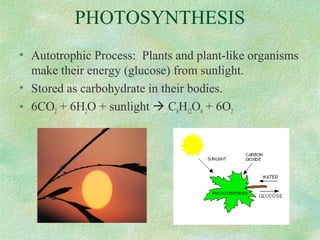
• Autotrophic Process: Plants and plant-like organisms
make their energy (glucose) from sunlight.
• Stored as carbohydrate in their bodies.
• 6CO2 + 6H2O + sunlight  C6H12O6 + 6O2
Why is Photosynthesis important?
Makes organic molecules (glucose) out
of inorganic materials (carbon dioxide
and water).
It begins all food chains/webs. Thus
all life is supported by this process.
It also makes oxygen gas!!
Photosynthesis-starts to ecological food webs!
Plants use sunlight to turn water
and carbon dioxide into glucose.
Glucose is a kind of sugar.
Plants use glucose as food for
energy and as a building block for
growing.
Autotrophs make glucose and
heterotrophs are consumers of it.
Photo-synthesisPhoto-synthesis
meansmeans "putting together with light.""putting together with light."
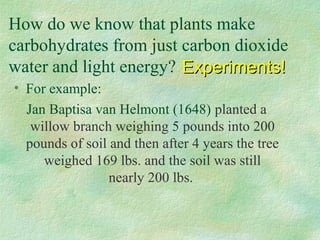
How do we know that plants make
carbohydrates from just carbon dioxide
water and light energy?
• For example:
Jan Baptisa van Helmont (1648) planted a
willow branch weighing 5 pounds into 200
pounds of soil and then after 4 years the tree
weighed 169 lbs. and the soil was still
nearly 200 lbs.
Experiments!Experiments!
Photosynthesis
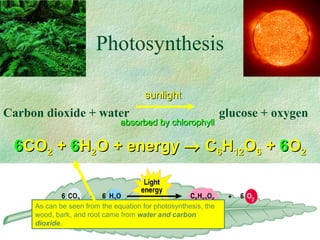
Carbon dioxide + water glucose + oxygen
sunlightsunlight
absorbed by chlorophyllabsorbed by chlorophyll
66COCO22 ++ 66HH22O + energyO + energy →→ CC66HH1212OO66 ++ 66OO22
As can be seen from the equation for photosynthesis, the
wood, bark, and root came from water and carbon
dioxide.
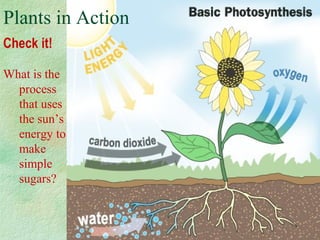
Check it!
Plants in Action
What is the
process
that uses
the sun’s
energy to
make
simple
sugars?
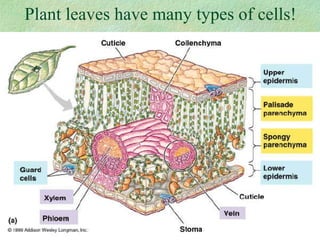
Plant leaves have many types of cells!
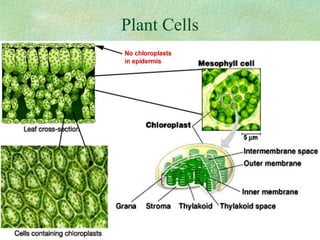
Plant Cells
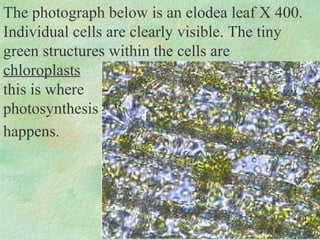
The photograph below is an elodea leaf X 400.
Individual cells are clearly visible. The tiny
green structures within the cells are
chloroplasts
this is where
photosynthesis
happens.
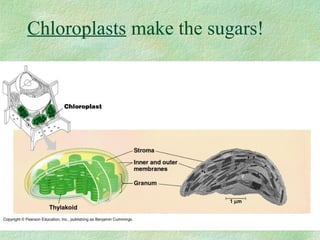
Chloroplasts make the sugars!
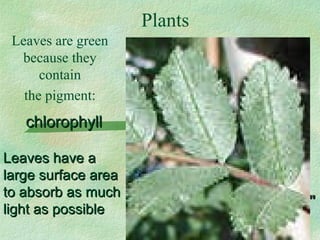
Plants
Leaves are green
because they
contain
the pigment:
chlorophyllchlorophyll
Leaves have aLeaves have a
large surface arealarge surface area
to absorb as muchto absorb as much
light as possiblelight as possible
"Thanks for the Glucose!""Thanks for the Glucose!"
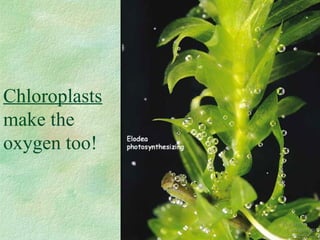
Chloroplasts
make the
oxygen too!
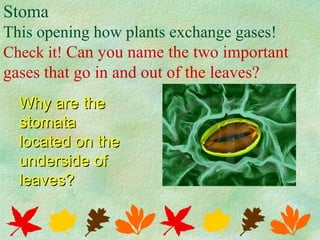
Stoma
This opening how plants exchange gases!
Check it! Can you name the two important
gases that go in and out of the leaves?
Why are theWhy are the
stomatastomata
located on thelocated on the
underside ofunderside of
leaves?leaves?
PHOTOSYNTHESIS
• Absorbing Light Energy to make chemical
energy: glucose!
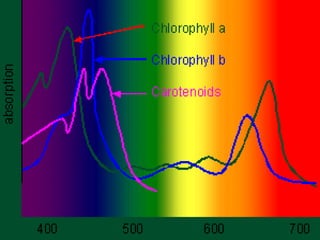
• Pigments: Absorb different colors of white light
(ROY G BIV)
• Main pigment: Chlorophyll a
• Accessory pigments: Chlorophyll b and Carotenoids
• These pigments absorb all wavelengths (light) BUT
green!
PHOTOSYNTHESIS
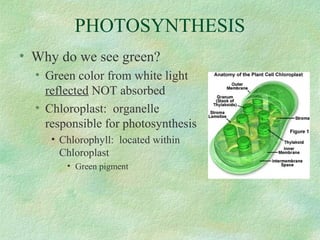
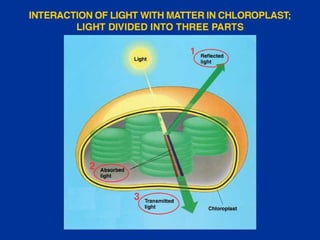
• Why do we see green?
• Green color from white light
reflected NOT absorbed
• Chloroplast: organelle
responsible for photosynthesis
• Chlorophyll: located within
Chloroplast
• Green pigment
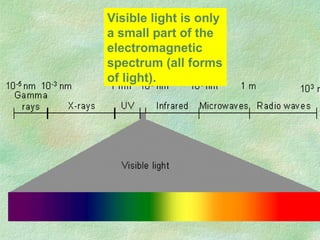
Visible light is only
a small part of the
electromagnetic
spectrum (all forms
of light).
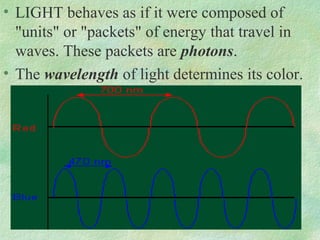
• LIGHT behaves as if it were composed of
"units" or "packets" of energy that travel in
waves. These packets are photons.
• The wavelength of light determines its color.
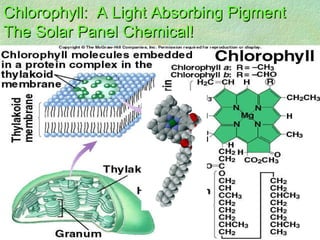
Chlorophyll: A Light Absorbing PigmentChlorophyll: A Light Absorbing Pigment
The Solar Panel Chemical!The Solar Panel Chemical!
Photosynthesis
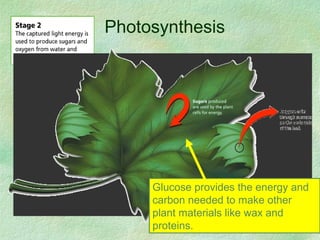
Glucose provides the energy and
carbon needed to make other
plant materials like wax and
proteins.
Oxygen and Sugar!
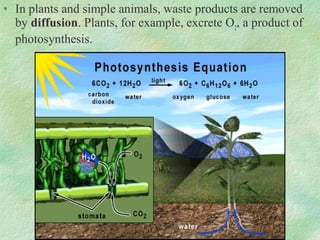
• In plants and simple animals, waste products are removed
by diffusion. Plants, for example, excrete O2
, a product of
photosynthesis.
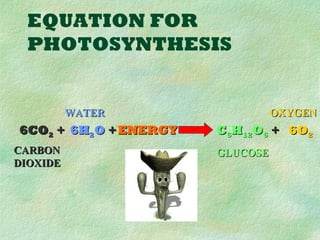
EQUATION FOR
PHOTOSYNTHESIS
6CO6CO22 ++ 6H6H22OO ++ ENERGYENERGY CC66HH1212OO66 ++ 6O6O22
CARBONCARBON
DIOXIDEDIOXIDE
WATERWATER
GLUCOSEGLUCOSE
OXYGENOXYGEN
The end!
PHOTOSYNTHESIS
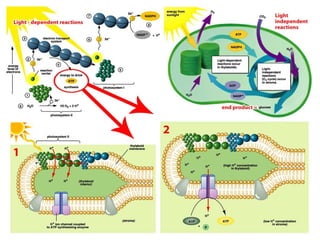
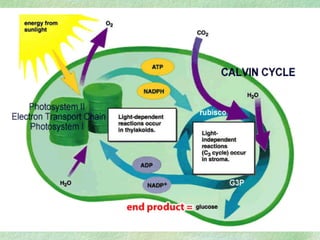
• 2 Phases
• Light-dependent reaction
• Light-independent reaction
• Light-dependent: converts light energy into
chemical energy; produces ATP molecules to
be used to fuel light-independent reaction
• Light-independent: uses ATP produced to
make simple sugars.
PHOTOSYNTHESIS
• Light-dependent reaction (LIGHT Reaction)
• Requires light
• Occurs in chloroplast (in thylakoids)
• Chlorophyll (thylakoid) traps energy from light
• Light excites electron (e-)
• Kicks e- out of chlorophyll to an electron transport chain
• Electron transport chain: series of proteins in thylakoid
membrane
• Bucket brigade
PHOTOSYNTHESIS
• Light-dependent reaction (LIGHT Reaction)
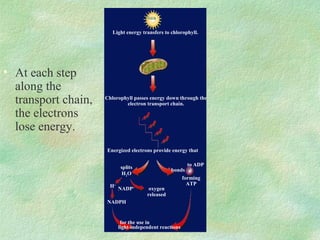
• Energy lost along electron transport chain
• Lost energy used to recharge ATP from ADP
• NADPH produced from e- transport chain
• Stores energy until transfer to stroma
• Plays important role in light-independent reaction
• Total byproducts: ATP, NADP, O2
PHOTOSYNTHESIS
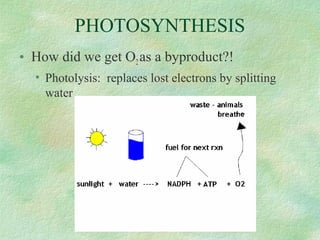
• How did we get O2as a byproduct?!
• Photolysis: replaces lost electrons by splitting
water
Sun
Chlorophyll passes energy down through the
electron transport chain.
for the use in
light-independent reactions
bonds P
to ADP
forming
ATP
oxygen
released
splits
H2O
H+
NADP+
NADPH
Light energy transfers to chlorophyll.
Energized electrons provide energy that
• At each step
along the
transport chain,
the electrons
lose energy.
PHOTOSYNTHESIS
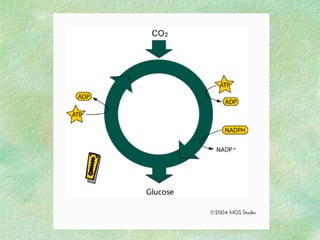
• Light-independent reaction (Dark Reaction)
• Does not require light
• Calvin Cycle
• Occurs in stroma of chloroplast
• Requires CO2
• Uses ATP and NADPH as fuel to run
• Makes glucose sugar from CO2 and Hydrogen
PHOTOSYNTHESIS
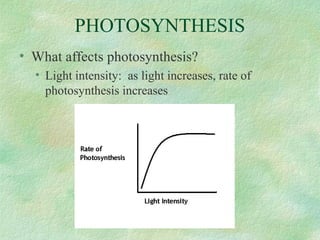
• What affects photosynthesis?
• Light intensity: as light increases, rate of
photosynthesis increases
PHOTOSYNTHESIS
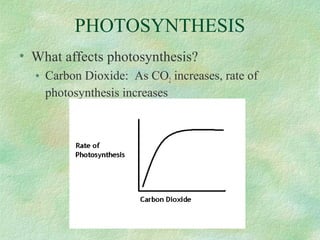
• What affects photosynthesis?
• Carbon Dioxide: As CO2 increases, rate of
photosynthesis increases
PHOTOSYNTHESIS
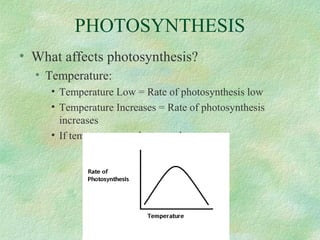
• What affects photosynthesis?
• Temperature:
• Temperature Low = Rate of photosynthesis low
• Temperature Increases = Rate of photosynthesis
increases
• If temperature too hot, rate drops
Check it!
1. The process that uses the sun’s energy to
make simple sugars is _____________.
A. Cellular respiration
B. Glycolysis
C. Photosynthesis
D. Photolysis
Check it!
2. The function accomplished by the light-
dependent reactions is ______________.
A. Energy storage
B. Sugar production
C. Carbon fixation
D. Conversion of sugar
Photosynthesis

Photosynthesis

  • 1.
    PHOTOSYNTHESIS • Autotrophic Process:Plants and plant-like organisms make their energy (glucose) from sunlight. • Stored as carbohydrate in their bodies. • 6CO2 + 6H2O + sunlight  C6H12O6 + 6O2
  • 2.
    Why is Photosynthesisimportant? Makes organic molecules (glucose) out of inorganic materials (carbon dioxide and water). It begins all food chains/webs. Thus all life is supported by this process. It also makes oxygen gas!!
  • 3.
  • 4.
    Plants use sunlightto turn water and carbon dioxide into glucose. Glucose is a kind of sugar. Plants use glucose as food for energy and as a building block for growing. Autotrophs make glucose and heterotrophs are consumers of it. Photo-synthesisPhoto-synthesis meansmeans "putting together with light.""putting together with light."
  • 5.
    How do weknow that plants make carbohydrates from just carbon dioxide water and light energy? • For example: Jan Baptisa van Helmont (1648) planted a willow branch weighing 5 pounds into 200 pounds of soil and then after 4 years the tree weighed 169 lbs. and the soil was still nearly 200 lbs. Experiments!Experiments!
  • 6.
    Photosynthesis Carbon dioxide +water glucose + oxygen sunlightsunlight absorbed by chlorophyllabsorbed by chlorophyll 66COCO22 ++ 66HH22O + energyO + energy →→ CC66HH1212OO66 ++ 66OO22 As can be seen from the equation for photosynthesis, the wood, bark, and root came from water and carbon dioxide.
  • 7.
    Check it! Plants inAction What is the process that uses the sun’s energy to make simple sugars?
  • 8.
    Plant leaves havemany types of cells!
  • 9.
  • 10.
    The photograph belowis an elodea leaf X 400. Individual cells are clearly visible. The tiny green structures within the cells are chloroplasts this is where photosynthesis happens.
  • 11.
  • 12.
    Plants Leaves are green becausethey contain the pigment: chlorophyllchlorophyll Leaves have aLeaves have a large surface arealarge surface area to absorb as muchto absorb as much light as possiblelight as possible "Thanks for the Glucose!""Thanks for the Glucose!"
  • 13.
  • 14.
    Stoma This opening howplants exchange gases! Check it! Can you name the two important gases that go in and out of the leaves? Why are theWhy are the stomatastomata located on thelocated on the underside ofunderside of leaves?leaves?
  • 15.
    PHOTOSYNTHESIS • Absorbing LightEnergy to make chemical energy: glucose! • Pigments: Absorb different colors of white light (ROY G BIV) • Main pigment: Chlorophyll a • Accessory pigments: Chlorophyll b and Carotenoids • These pigments absorb all wavelengths (light) BUT green!
  • 16.
    PHOTOSYNTHESIS • Why dowe see green? • Green color from white light reflected NOT absorbed • Chloroplast: organelle responsible for photosynthesis • Chlorophyll: located within Chloroplast • Green pigment
  • 17.
    Visible light isonly a small part of the electromagnetic spectrum (all forms of light).
  • 18.
    • LIGHT behavesas if it were composed of "units" or "packets" of energy that travel in waves. These packets are photons. • The wavelength of light determines its color.
  • 20.
    Chlorophyll: A LightAbsorbing PigmentChlorophyll: A Light Absorbing Pigment The Solar Panel Chemical!The Solar Panel Chemical!
  • 22.
    Photosynthesis Glucose provides theenergy and carbon needed to make other plant materials like wax and proteins.
  • 23.
  • 24.
    • In plantsand simple animals, waste products are removed by diffusion. Plants, for example, excrete O2 , a product of photosynthesis.
  • 25.
    EQUATION FOR PHOTOSYNTHESIS 6CO6CO22 ++6H6H22OO ++ ENERGYENERGY CC66HH1212OO66 ++ 6O6O22 CARBONCARBON DIOXIDEDIOXIDE WATERWATER GLUCOSEGLUCOSE OXYGENOXYGEN
  • 26.
  • 27.
    PHOTOSYNTHESIS • 2 Phases •Light-dependent reaction • Light-independent reaction • Light-dependent: converts light energy into chemical energy; produces ATP molecules to be used to fuel light-independent reaction • Light-independent: uses ATP produced to make simple sugars.
  • 28.
    PHOTOSYNTHESIS • Light-dependent reaction(LIGHT Reaction) • Requires light • Occurs in chloroplast (in thylakoids) • Chlorophyll (thylakoid) traps energy from light • Light excites electron (e-) • Kicks e- out of chlorophyll to an electron transport chain • Electron transport chain: series of proteins in thylakoid membrane • Bucket brigade
  • 29.
    PHOTOSYNTHESIS • Light-dependent reaction(LIGHT Reaction) • Energy lost along electron transport chain • Lost energy used to recharge ATP from ADP • NADPH produced from e- transport chain • Stores energy until transfer to stroma • Plays important role in light-independent reaction • Total byproducts: ATP, NADP, O2
  • 30.
    PHOTOSYNTHESIS • How didwe get O2as a byproduct?! • Photolysis: replaces lost electrons by splitting water
  • 31.
    Sun Chlorophyll passes energydown through the electron transport chain. for the use in light-independent reactions bonds P to ADP forming ATP oxygen released splits H2O H+ NADP+ NADPH Light energy transfers to chlorophyll. Energized electrons provide energy that • At each step along the transport chain, the electrons lose energy.
  • 32.
    PHOTOSYNTHESIS • Light-independent reaction(Dark Reaction) • Does not require light • Calvin Cycle • Occurs in stroma of chloroplast • Requires CO2 • Uses ATP and NADPH as fuel to run • Makes glucose sugar from CO2 and Hydrogen
  • 34.
    PHOTOSYNTHESIS • What affectsphotosynthesis? • Light intensity: as light increases, rate of photosynthesis increases
  • 35.
    PHOTOSYNTHESIS • What affectsphotosynthesis? • Carbon Dioxide: As CO2 increases, rate of photosynthesis increases
  • 36.
    PHOTOSYNTHESIS • What affectsphotosynthesis? • Temperature: • Temperature Low = Rate of photosynthesis low • Temperature Increases = Rate of photosynthesis increases • If temperature too hot, rate drops
  • 37.
    Check it! 1. Theprocess that uses the sun’s energy to make simple sugars is _____________. A. Cellular respiration B. Glycolysis C. Photosynthesis D. Photolysis
  • 38.
    Check it! 2. Thefunction accomplished by the light- dependent reactions is ______________. A. Energy storage B. Sugar production C. Carbon fixation D. Conversion of sugar