ADDRESSING COMPETITION AND
DRIVING GROWTH
COMPETITIVE STRATEGIES FOR MARKET (MARKET
LEADERS, FOLLOWER AND NICHER)
CHAPTER 12
PREPARED BY:
ANDREAS PRASETIA (55120110096)
LECTURER:
Prof. Dr. Hapzi Ali, Ir, MM, CMA, MPM
PROGRAM STUDI MAGISTER MANAGEMENT
CASE DISCUSSION
1) How can market leaders expand the total market and defend market
share?
2) How should market challengers attack market leaders?
3) How can market followers or niches compete effectively?
4) How should marketers adjust their strategies and tactics for an
economic downturn or recession?
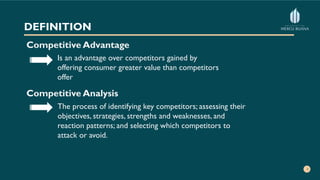
DEFINITION
Competitive Advantage
Is an advantage over competitors gained by
offering consumer greater value than competitors
offer
Competitive Analysis
The process of identifying key competitors; assessing their
objectives, strategies, strengths and weaknesses, and
reaction patterns; and selecting which competitors to
attack or avoid.
STEP IN ANALYZING COMPETITORS
Identifying the
company’s
competitors
Assessing competitor’s
objectives, strategies,
strength and weaknesses,
and reaction patterns
Selecting which
competitors to
attack or avoid
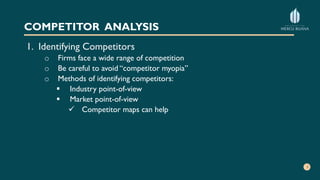
COMPETITOR ANALYSIS
1. Identifying Competitors
o Firms face a wide range of competition
o Be careful to avoid “competitor myopia”
o Methods of identifying competitors:
 Industry point-of-view
 Market point-of-view
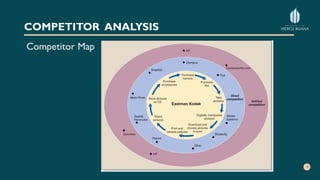
 Competitor maps can help
COMPETITOR ANALYSIS
Competitor Map
COMPETITOR ANALYSIS
2. Assessing Competitors
o Determining competitors’ objectives
o Identifying competitors’ strategies
 Strategic groups
o Assessing competitors’ strengths and weaknesses
 Benchmarking
o Estimating competitors’ reactions
COMPETITOR ANALYSIS
3. Selecting Competitors to attack or avoid
o Strong or weak competitors
 Customer value analysis
o Close or distant competitors
 Most companies compete against close competitors
o “Good” or “Bad” competitors
 The existence of competitors offers several strategic benefits
COMPETITIVE STRATEGY
COMPETITIVE POSITION
1. Market Leader
2. Market Challenger
3. Market Follower
4. Market Nicher
COMPETITIVE STRATEGY
1. Market Leader
o Expanding the total demand
 Finding new users
 Discovering and promoting new product uses
 Encouraging greater product usage
o Protecting market share
 Many considerations
 Continuous innovation
o Expanding market share
 Profitability rises with market share
COMPETITIVE STRATEGY
Expanding total demand: Find new User
Toyota release new product under Corolla Family name “Corolla Cross” this variant is to
response fat market in Indonesia for cross-over type vehicle also to fill the SUV class
betweenToyota Rush and Toyota Fortuner.
COMPETITIVE STRATEGY
Protecting Market Share
Toyota Rush has release they new update model to encounter competition in SUV low
end class, this release new update has successful to bring back their selling rate in the
market.
COMPETITIVE STRATEGY
2. Market Challenger
Is the party that challenge and provide resistance to the
domination of market leader. In other words, its existence is a
threat to market leaders to dominate the market
Characteristic Market Challenger is
• Have market share and a position under the market leader
• Conduct attacks on market leaders, either directly or indirectly
• Enlarge yourself by acquiring a smaller business
COMPETITIVE STRATEGY
3. Market Follower
o Follow the market leader
 Focus is on improving profit instead of market
share
 Many advantages:
 Learn from the market leader’s experience
 Copy or improve on the leader’s offerings
 Strong profitability
COMPETITIVE STRATEGY - MARKET FOLLOWER
THREE QUITE DISTINCT POSTURES FOR MARKET
FOLLOWERS
• Following closely, with as similar a marketing mix and market segmentation
combination as possible
• Following at a distance, so that, although there are obvious similarities, there
are also areas of differentiation between the two
• Following selectively, both in product and market terms, so that the likelihood
of direct competition is minimized
COMPETITIVE STRATEGY - MARKET FOLLOWER
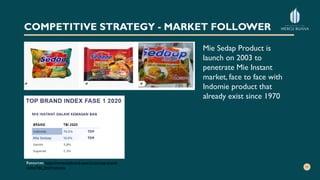
Mie Sedap Product is
launch on 2003 to
penetrate Mie Instant
market, face to face with
Indomie product that
already exist since 1970
Resources: https://www.topbrand-award.com/top-brand-
index/?tbi_find=indomie
COMPETITIVE STRATEGY
4. Market Niche
Unlike some marketing strategies that target a broad range of potential
customers, niche marketing focuses on a specific segment of
consumers that are most likely to connect with your business. (Carter,
Emily. 2020.)
o Serving market niches means targeting sub segments
o Good strategy for small firms with limited resources
o Offers high margins
o Specialization is key
 By market, customer, product, or marketing mix lines
COMPETITIVE STRATEGY - MARKET NICHE
THE ATTRACTIVENESS OF A MARKET NICHE IS
TYPICALLY INFLUENCED BY SEVERAL FACTORS
• It needs to be of sufficient size and purchasing power to be profitable
• There is scope for market growth
• The niche is of little immediate interest to the major competitors
• The firm has the abilities and resources to be able to serve the niche
effectively
• The firm is capable of defending itself against an attack through areas
such as customer loyalty
COMPETITIVE STRATEGY - MARKET NICHE
MARKET NICHE OPERATE
• Specializing geographically
• Specializing by the type of end-user
• Specializing by product or product line
• Specializing on a quality/price spectrum
COMPETITIVE STRATEGY - MARKET NICHE
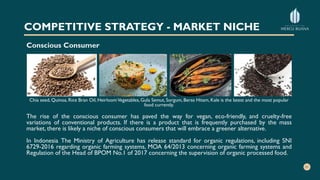
Conscious Consumer
Chia seed, Quinoa, Rice Bran Oil, HeirloomVegetables, Gula Semut, Sorgum, Beras Hitam, Kale is the latest and the most popular
food currently.
The rise of the conscious consumer has paved the way for vegan, eco-friendly, and cruelty-free
variations of conventional products. If there is a product that is frequently purchased by the mass
market, there is likely a niche of conscious consumers that will embrace a greener alternative.
In Indonesia The Ministry of Agriculture has release standard for organic regulations, including SNI
6729-2016 regarding organic farming systems, MOA 64/2013 concerning organic farming systems and
Regulation of the Head of BPOM No.1 of 2017 concerning the supervision of organic processed food.
COMPETITIVE STRATEGY - MARKET NICHE
Traveler
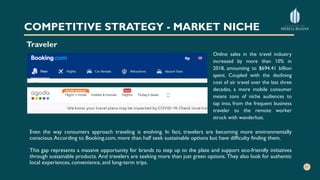
Even the way consumers approach traveling is evolving. In fact, travelers are becoming more environmentally
conscious.According to Booking.com, more than half seek sustainable options but have difficulty finding them.
This gap represents a massive opportunity for brands to step up to the plate and support eco-friendly initiatives
through sustainable products. And travelers are seeking more than just green options. They also look for authentic
local experiences, convenience, and long-term trips.
Online sales in the travel industry
increased by more than 10% in
2018, amounting to $694.41 billion
spent. Coupled with the declining
cost of air travel over the last three
decades, a more mobile consumer
means tons of niche audiences to
tap into, from the frequent business
traveler to the remote worker
struck with wanderlust.
REFERENCE
• Craven David W. and Piercy Nigel F. 2013. Strategic Marketing, 8th edition, McGraw
hill.
• Kotler, Philip and Keller Kevin L. 2016. Marketing Management. 15th Edition Pearson.
• Gurbuz, Esen.2018.Theory of New Product Development and Its Applications.
• Berita Radar.2020.Duel Seru Mie Instan: Indomie VS Mie Sedap.
https://beritaradar.com/2020/05/16/duel-seru-mie-instan-indomie-vs-mie-sedaap/
• Kompas.com.2014.Gagal Kuliah, Jodi Sukses Bisnis Kue Beromzet Ratusan Juta.
https://money.kompas.com/read/2014/07/02/0846210/Gagal.Kuliah.Jodi.Sukses.Bisnis.
Kue.Beromzet.Ratusan.Juta?page=all
THETEAM
Andreas Prasetia, ST, CSCA (NIM: 55120110096)
THANKYOU

Chapter 12 addressing competition and driving growth ppt

  • 1.
    ADDRESSING COMPETITION AND DRIVINGGROWTH COMPETITIVE STRATEGIES FOR MARKET (MARKET LEADERS, FOLLOWER AND NICHER) CHAPTER 12 PREPARED BY: ANDREAS PRASETIA (55120110096) LECTURER: Prof. Dr. Hapzi Ali, Ir, MM, CMA, MPM PROGRAM STUDI MAGISTER MANAGEMENT
  • 2.
    CASE DISCUSSION 1) Howcan market leaders expand the total market and defend market share? 2) How should market challengers attack market leaders? 3) How can market followers or niches compete effectively? 4) How should marketers adjust their strategies and tactics for an economic downturn or recession?
  • 3.
    DEFINITION Competitive Advantage Is anadvantage over competitors gained by offering consumer greater value than competitors offer Competitive Analysis The process of identifying key competitors; assessing their objectives, strategies, strengths and weaknesses, and reaction patterns; and selecting which competitors to attack or avoid.
  • 4.
    STEP IN ANALYZINGCOMPETITORS Identifying the company’s competitors Assessing competitor’s objectives, strategies, strength and weaknesses, and reaction patterns Selecting which competitors to attack or avoid
  • 5.
    COMPETITOR ANALYSIS 1. IdentifyingCompetitors o Firms face a wide range of competition o Be careful to avoid “competitor myopia” o Methods of identifying competitors:  Industry point-of-view  Market point-of-view  Competitor maps can help
  • 6.
  • 7.
    COMPETITOR ANALYSIS 2. AssessingCompetitors o Determining competitors’ objectives o Identifying competitors’ strategies  Strategic groups o Assessing competitors’ strengths and weaknesses  Benchmarking o Estimating competitors’ reactions
  • 8.
    COMPETITOR ANALYSIS 3. SelectingCompetitors to attack or avoid o Strong or weak competitors  Customer value analysis o Close or distant competitors  Most companies compete against close competitors o “Good” or “Bad” competitors  The existence of competitors offers several strategic benefits
  • 9.
    COMPETITIVE STRATEGY COMPETITIVE POSITION 1.Market Leader 2. Market Challenger 3. Market Follower 4. Market Nicher
  • 10.
    COMPETITIVE STRATEGY 1. MarketLeader o Expanding the total demand  Finding new users  Discovering and promoting new product uses  Encouraging greater product usage o Protecting market share  Many considerations  Continuous innovation o Expanding market share  Profitability rises with market share
  • 11.
    COMPETITIVE STRATEGY Expanding totaldemand: Find new User Toyota release new product under Corolla Family name “Corolla Cross” this variant is to response fat market in Indonesia for cross-over type vehicle also to fill the SUV class betweenToyota Rush and Toyota Fortuner.
  • 12.
    COMPETITIVE STRATEGY Protecting MarketShare Toyota Rush has release they new update model to encounter competition in SUV low end class, this release new update has successful to bring back their selling rate in the market.
  • 13.
    COMPETITIVE STRATEGY 2. MarketChallenger Is the party that challenge and provide resistance to the domination of market leader. In other words, its existence is a threat to market leaders to dominate the market Characteristic Market Challenger is • Have market share and a position under the market leader • Conduct attacks on market leaders, either directly or indirectly • Enlarge yourself by acquiring a smaller business
  • 14.
    COMPETITIVE STRATEGY 3. MarketFollower o Follow the market leader  Focus is on improving profit instead of market share  Many advantages:  Learn from the market leader’s experience  Copy or improve on the leader’s offerings  Strong profitability
  • 15.
    COMPETITIVE STRATEGY -MARKET FOLLOWER THREE QUITE DISTINCT POSTURES FOR MARKET FOLLOWERS • Following closely, with as similar a marketing mix and market segmentation combination as possible • Following at a distance, so that, although there are obvious similarities, there are also areas of differentiation between the two • Following selectively, both in product and market terms, so that the likelihood of direct competition is minimized
  • 16.
    COMPETITIVE STRATEGY -MARKET FOLLOWER Mie Sedap Product is launch on 2003 to penetrate Mie Instant market, face to face with Indomie product that already exist since 1970 Resources: https://www.topbrand-award.com/top-brand- index/?tbi_find=indomie
  • 17.
    COMPETITIVE STRATEGY 4. MarketNiche Unlike some marketing strategies that target a broad range of potential customers, niche marketing focuses on a specific segment of consumers that are most likely to connect with your business. (Carter, Emily. 2020.) o Serving market niches means targeting sub segments o Good strategy for small firms with limited resources o Offers high margins o Specialization is key  By market, customer, product, or marketing mix lines
  • 18.
    COMPETITIVE STRATEGY -MARKET NICHE THE ATTRACTIVENESS OF A MARKET NICHE IS TYPICALLY INFLUENCED BY SEVERAL FACTORS • It needs to be of sufficient size and purchasing power to be profitable • There is scope for market growth • The niche is of little immediate interest to the major competitors • The firm has the abilities and resources to be able to serve the niche effectively • The firm is capable of defending itself against an attack through areas such as customer loyalty
  • 19.
    COMPETITIVE STRATEGY -MARKET NICHE MARKET NICHE OPERATE • Specializing geographically • Specializing by the type of end-user • Specializing by product or product line • Specializing on a quality/price spectrum
  • 20.
    COMPETITIVE STRATEGY -MARKET NICHE Conscious Consumer Chia seed, Quinoa, Rice Bran Oil, HeirloomVegetables, Gula Semut, Sorgum, Beras Hitam, Kale is the latest and the most popular food currently. The rise of the conscious consumer has paved the way for vegan, eco-friendly, and cruelty-free variations of conventional products. If there is a product that is frequently purchased by the mass market, there is likely a niche of conscious consumers that will embrace a greener alternative. In Indonesia The Ministry of Agriculture has release standard for organic regulations, including SNI 6729-2016 regarding organic farming systems, MOA 64/2013 concerning organic farming systems and Regulation of the Head of BPOM No.1 of 2017 concerning the supervision of organic processed food.
  • 21.
    COMPETITIVE STRATEGY -MARKET NICHE Traveler Even the way consumers approach traveling is evolving. In fact, travelers are becoming more environmentally conscious.According to Booking.com, more than half seek sustainable options but have difficulty finding them. This gap represents a massive opportunity for brands to step up to the plate and support eco-friendly initiatives through sustainable products. And travelers are seeking more than just green options. They also look for authentic local experiences, convenience, and long-term trips. Online sales in the travel industry increased by more than 10% in 2018, amounting to $694.41 billion spent. Coupled with the declining cost of air travel over the last three decades, a more mobile consumer means tons of niche audiences to tap into, from the frequent business traveler to the remote worker struck with wanderlust.
  • 22.
    REFERENCE • Craven DavidW. and Piercy Nigel F. 2013. Strategic Marketing, 8th edition, McGraw hill. • Kotler, Philip and Keller Kevin L. 2016. Marketing Management. 15th Edition Pearson. • Gurbuz, Esen.2018.Theory of New Product Development and Its Applications. • Berita Radar.2020.Duel Seru Mie Instan: Indomie VS Mie Sedap. https://beritaradar.com/2020/05/16/duel-seru-mie-instan-indomie-vs-mie-sedaap/ • Kompas.com.2014.Gagal Kuliah, Jodi Sukses Bisnis Kue Beromzet Ratusan Juta. https://money.kompas.com/read/2014/07/02/0846210/Gagal.Kuliah.Jodi.Sukses.Bisnis. Kue.Beromzet.Ratusan.Juta?page=all
  • 23.
    THETEAM Andreas Prasetia, ST,CSCA (NIM: 55120110096) THANKYOU