
New Product
Development
and
Product Life-Cycle
Strategies
Submitted By :-
Sonu ChoudharyMs.samreen maam
Submitted By:-
New Product Development
A New Product Development is the entire set
of activities required to bring a new concept
to a state of market readiness.
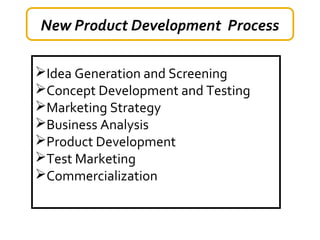
New Product Development Process
Idea Generation and Screening
Concept Development and Testing
Marketing Strategy
Business Analysis
Product Development
Test Marketing
Commercialization
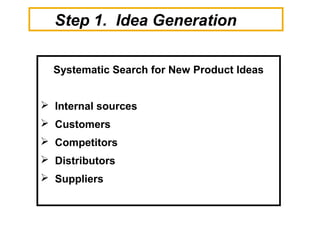
Step 1. Idea Generation
Systematic Search for New Product Ideas
 Internal sources
 Customers
 Competitors
 Distributors
 Suppliers
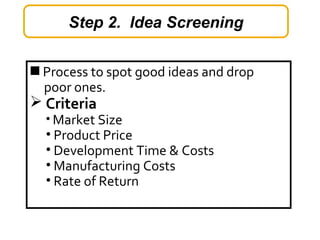
Step 2. Idea Screening
Process to spot good ideas and drop
poor ones.
 Criteria
• Market Size
• Product Price
• Development Time & Costs
• Manufacturing Costs
• Rate of Return
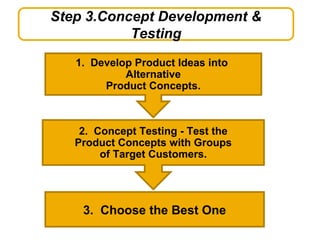
Step 3.Concept Development &
Testing
1. Develop Product Ideas into
Alternative
Product Concepts.
2. Concept Testing - Test the
Product Concepts with Groups
of Target Customers.
3. Choose the Best One
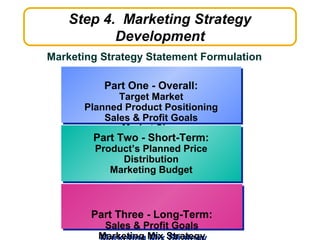
Step 4. Marketing Strategy
Development
Marketing Strategy Statement Formulation
Part One - Overall:
Target Market
Planned Product Positioning
Sales & Profit Goals
Market Share
Part One - Overall:
Target Market
Planned Product Positioning
Sales & Profit Goals
Market Share
Part Two - Short-Term:
Product’s Planned Price
Distribution
Marketing Budget
Part Two - Short-Term:
Product’s Planned Price
Distribution
Marketing Budget
Part Three - Long-Term:
Sales & Profit Goals
Part Three - Long-Term:
Sales & Profit Goals
Marketing Mix Strategy
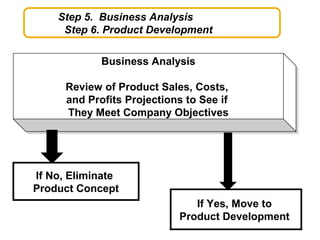
Step 5. Business Analysis
Step 6. Product Development
Business Analysis
Review of Product Sales, Costs,
and Profits Projections to See if
They Meet Company Objectives
Business Analysis
Review of Product Sales, Costs,
and Profits Projections to See if
They Meet Company Objectives
If No, Eliminate
Product Concept
If Yes, Move to
Product Development
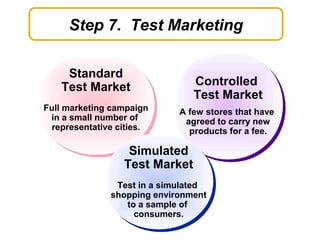
Step 7. Test Marketing
Standard
Test Market
Full marketing campaign
in a small number of
representative cities.
Standard
Test Market
Full marketing campaign
in a small number of
representative cities.
Controlled
Test Market
A few stores that have
agreed to carry new
products for a fee.
Controlled
Test Market
A few stores that have
agreed to carry new
products for a fee.
Simulated
Test Market
Test in a simulated
shopping environment
to a sample of
consumers.
Simulated
Test Market
Test in a simulated
shopping environment
to a sample of
consumers.
Product Life Cycle
The product life cycle describes the
stages a new product goes through in the
marketplace: introduction, growth,
maturity, and decline.
The product life cycle describes the
stages a new product goes through in the
marketplace: introduction, growth,
maturity, and decline.
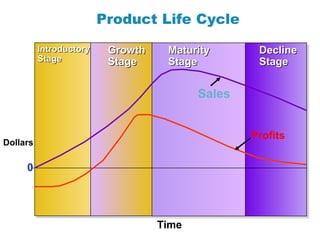
Time
Profits
Sales
IntroductoryIntroductory
StageStage
GrowthGrowth
StageStage
MaturityMaturity
StageStage
DeclineDecline
StageStage
0
Product Life Cycle
Dollars
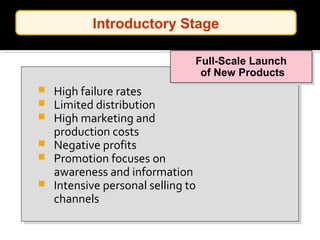
Introductory Stage
 High failure rates
 Limited distribution
 High marketing and
production costs
 Negative profits
 Promotion focuses on
awareness and information
 Intensive personal selling to
channels
Full-Scale Launch
of New Products
Full-Scale Launch
of New Products
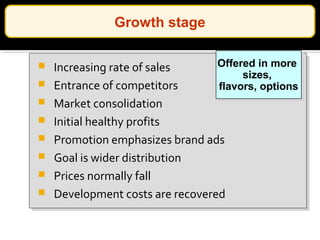
 Increasing rate of sales
 Entrance of competitors
 Market consolidation
 Initial healthy profits
 Promotion emphasizes brand ads
 Goal is wider distribution
 Prices normally fall
 Development costs are recovered
Offered in more
sizes,
flavors, options
Offered in more
sizes,
flavors, options
Growth stage
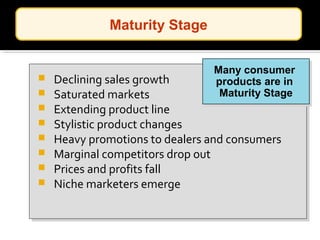
 Declining sales growth
 Saturated markets
 Extending product line
 Stylistic product changes
 Heavy promotions to dealers and consumers
 Marginal competitors drop out
 Prices and profits fall
 Niche marketers emerge
Many consumer
products are in
Maturity Stage
Many consumer
products are in
Maturity Stage
Maturity Stage
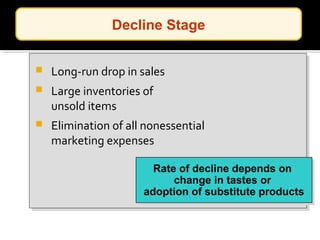
 Long-run drop in sales
 Large inventories of
unsold items
 Elimination of all nonessential
marketing expenses
Rate of decline depends on
change in tastes or
adoption of substitute products
Rate of decline depends on
change in tastes or
adoption of substitute products
Decline Stage
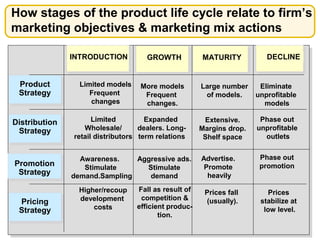
How stages of the product life cycle relate to firm’s
marketing objectives & marketing mix actions
INTRODUCTION GROWTH MATURITY DECLINE
Product
Strategy
Distribution
Strategy
Promotion
Strategy
Pricing
Strategy
Limited models
Frequent
changes
More models
Frequent
changes.
Large number
of models.
Eliminate
unprofitable
models
Limited
Wholesale/
retail distributors
Expanded
dealers. Long-
term relations
Extensive.
Margins drop.
Shelf space
Phase out
unprofitable
outlets
Awareness.
Stimulate
demand.Sampling
Aggressive ads.
Stimulate
demand
Advertise.
Promote
heavily
Phase out
promotion
Higher/recoup
development
costs
Fall as result of
competition &
efficient produc-
tion.
Prices fall
(usually).
Prices
stabilize at
low level.
Thank You

New product development & PLC by Sonu choudhary

  • 1.
    New Product Development and Product Life-Cycle Strategies SubmittedBy :- Sonu ChoudharyMs.samreen maam Submitted By:-
  • 2.
    New Product Development ANew Product Development is the entire set of activities required to bring a new concept to a state of market readiness.
  • 3.
    New Product DevelopmentProcess Idea Generation and Screening Concept Development and Testing Marketing Strategy Business Analysis Product Development Test Marketing Commercialization
  • 4.
    Step 1. IdeaGeneration Systematic Search for New Product Ideas  Internal sources  Customers  Competitors  Distributors  Suppliers
  • 5.
    Step 2. IdeaScreening Process to spot good ideas and drop poor ones.  Criteria • Market Size • Product Price • Development Time & Costs • Manufacturing Costs • Rate of Return
  • 6.
    Step 3.Concept Development& Testing 1. Develop Product Ideas into Alternative Product Concepts. 2. Concept Testing - Test the Product Concepts with Groups of Target Customers. 3. Choose the Best One
  • 7.
    Step 4. MarketingStrategy Development Marketing Strategy Statement Formulation Part One - Overall: Target Market Planned Product Positioning Sales & Profit Goals Market Share Part One - Overall: Target Market Planned Product Positioning Sales & Profit Goals Market Share Part Two - Short-Term: Product’s Planned Price Distribution Marketing Budget Part Two - Short-Term: Product’s Planned Price Distribution Marketing Budget Part Three - Long-Term: Sales & Profit Goals Part Three - Long-Term: Sales & Profit Goals Marketing Mix Strategy
  • 8.
    Step 5. BusinessAnalysis Step 6. Product Development Business Analysis Review of Product Sales, Costs, and Profits Projections to See if They Meet Company Objectives Business Analysis Review of Product Sales, Costs, and Profits Projections to See if They Meet Company Objectives If No, Eliminate Product Concept If Yes, Move to Product Development
  • 9.
    Step 7. TestMarketing Standard Test Market Full marketing campaign in a small number of representative cities. Standard Test Market Full marketing campaign in a small number of representative cities. Controlled Test Market A few stores that have agreed to carry new products for a fee. Controlled Test Market A few stores that have agreed to carry new products for a fee. Simulated Test Market Test in a simulated shopping environment to a sample of consumers. Simulated Test Market Test in a simulated shopping environment to a sample of consumers.
  • 10.
    Product Life Cycle Theproduct life cycle describes the stages a new product goes through in the marketplace: introduction, growth, maturity, and decline. The product life cycle describes the stages a new product goes through in the marketplace: introduction, growth, maturity, and decline.
  • 11.
  • 12.
    Introductory Stage  Highfailure rates  Limited distribution  High marketing and production costs  Negative profits  Promotion focuses on awareness and information  Intensive personal selling to channels Full-Scale Launch of New Products Full-Scale Launch of New Products
  • 13.
     Increasing rateof sales  Entrance of competitors  Market consolidation  Initial healthy profits  Promotion emphasizes brand ads  Goal is wider distribution  Prices normally fall  Development costs are recovered Offered in more sizes, flavors, options Offered in more sizes, flavors, options Growth stage
  • 14.
     Declining salesgrowth  Saturated markets  Extending product line  Stylistic product changes  Heavy promotions to dealers and consumers  Marginal competitors drop out  Prices and profits fall  Niche marketers emerge Many consumer products are in Maturity Stage Many consumer products are in Maturity Stage Maturity Stage
  • 15.
     Long-run dropin sales  Large inventories of unsold items  Elimination of all nonessential marketing expenses Rate of decline depends on change in tastes or adoption of substitute products Rate of decline depends on change in tastes or adoption of substitute products Decline Stage
  • 16.
    How stages ofthe product life cycle relate to firm’s marketing objectives & marketing mix actions INTRODUCTION GROWTH MATURITY DECLINE Product Strategy Distribution Strategy Promotion Strategy Pricing Strategy Limited models Frequent changes More models Frequent changes. Large number of models. Eliminate unprofitable models Limited Wholesale/ retail distributors Expanded dealers. Long- term relations Extensive. Margins drop. Shelf space Phase out unprofitable outlets Awareness. Stimulate demand.Sampling Aggressive ads. Stimulate demand Advertise. Promote heavily Phase out promotion Higher/recoup development costs Fall as result of competition & efficient produc- tion. Prices fall (usually). Prices stabilize at low level.
  • 17.

Editor's Notes

  • #13 Notes: During the introductory stage, sales normally increase slowly. Marketing costs are high due to higher dealer margins required to obtain adequate distribution and the cost of consumer incentives to try a product. Production costs are high. Promotion strategy focuses on developing product awareness and informing consumers about the product’s potential benefits. Intensive personal selling is often required. Promotion of convenience products may require heavy consumer sampling and couponing. Shopping and specialty products demand educational advertising and personal selling to the final consumer.
  • #14 Notes: In the growth stage, sales grow at an increasing rate, many competitors enter the market, and larger companies may acquire small pioneering firms. Profits rise rapidly, peak, and begin declining as competition increases. Aggressive brand advertising and communication of the differences between brands is the preferred promotion strategy. Adequate distribution is a major key to establish a strong market position and product success.
  • #15 On Line: McDonald’s What is McDonald’s doing to successfully compete in the maturity stage? Notes: The maturity stage begins when sales increase at a decreasing rate, and the market approaches saturation. This is normally the longest stage of the PLC. Annual models may appear during the maturity stage for shopping and specialty products. Product lines are lengthened to appeal to additional market segments. Service and repair help manufacturers distinguish their products from others. Heavy promotion is required to maintain market share. For example, consider the competitive “wars” between Coke and Pepsi, Budweiser and Miller, and McDonalds against Burger King and Wendy’s. As prices and profits continue to fall, marginal competitors drop out of the market. Niche marketers that target narrow, well-defined segments of a market emerge.
  • #16 Notes: The rate of decline depends on how rapidly consumer tastes change or substitute products are adopted. A strategy for declining products includes elimination of nonessential marketing expenses, and the eventual product withdrawal as sales decline.