CHAPTER 1
MATERIAL STRUCTURE AND BINARY
ALLOY SYSTEM
 An element is a substance that cannot be broken
down into simpler substances by ordinary chemical
means. An element is a substance consisting of atoms
which all have the same number of protons - i.e. the
same atomic number. Elements are pure substances
(are made from one type of atom only).
 Examples of elements: carbon, aluminum, iron,
copper, gold etc.
Element
 Compounds are substances consisting of two or more
elements chemically combined in definite proportions by
mass to give a material having a definite set of properties
different from that of any of its constituent elements.
 Compounds can only be separated by chemical means.
 Examples of compounds: NaCl, MgO, H2O
 Example 1: Water
Hydrogen is an element. Oxygen is an element.
When hydrogen and oxygen bond they make
the compound water (H2O).
Compound
 Substances that are made from more than one type
of atom combined physically but not chemically are
called mixtures.
 There is no chemical reaction involved in mixtures.
 In a mixture, the properties of the combination are
still the properties of its components.
 Mixtures can be separated by physical means.
Mixture
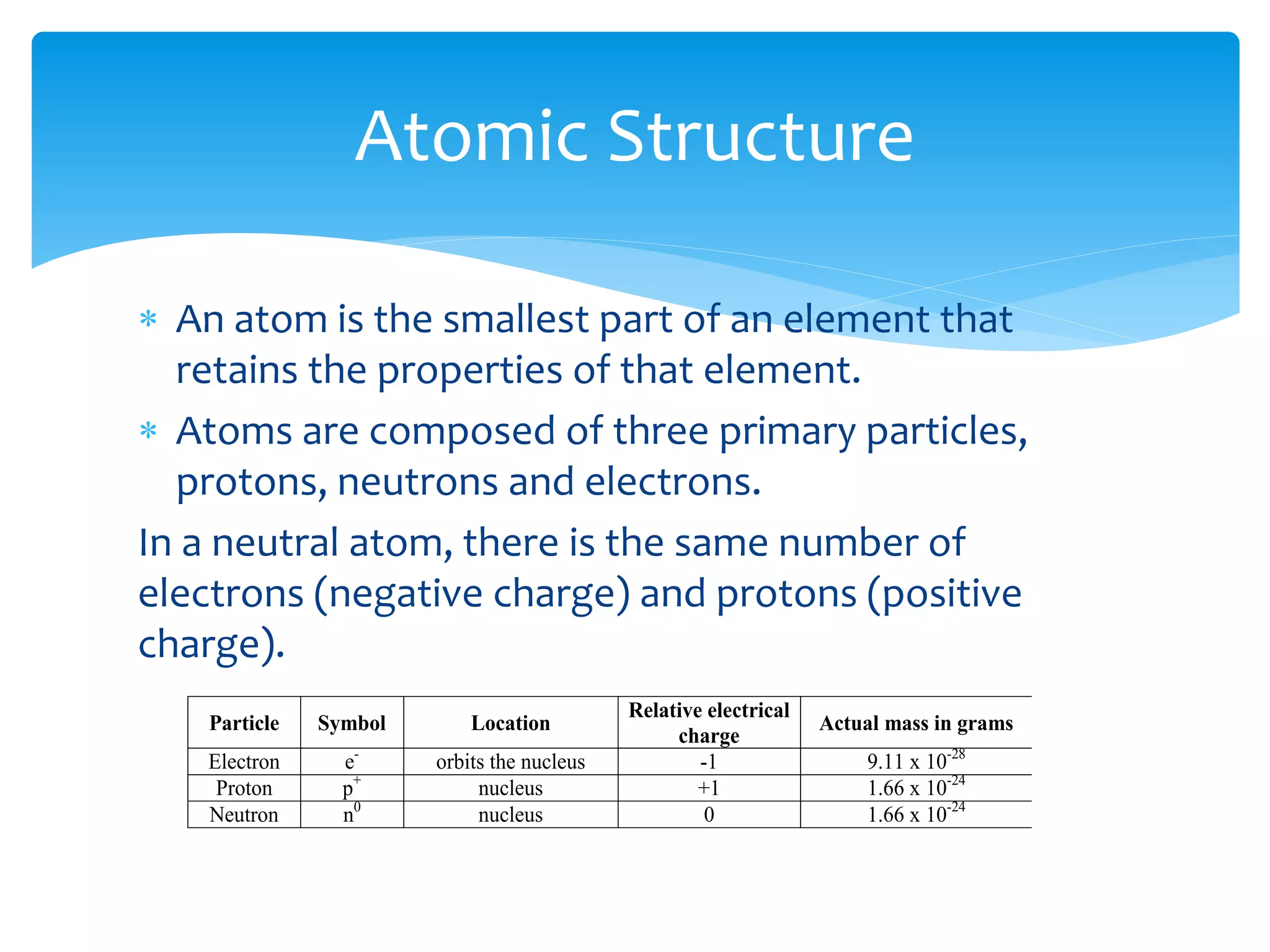
 An atom is the smallest part of an element that
retains the properties of that element.
 Atoms are composed of three primary particles,
protons, neutrons and electrons.
In a neutral atom, there is the same number of
electrons (negative charge) and protons (positive
charge).
Atomic Structure
Particle Symbol Location
Relative electrical
charge
Actual mass in grams
Electron e-
orbits the nucleus -1 9.11 x 10⁻²⁸
Proton p+
nucleus +1 1.66 x 10⁻²⁴
Neutron n0
nucleus 0 1.66 x 10⁻²⁴
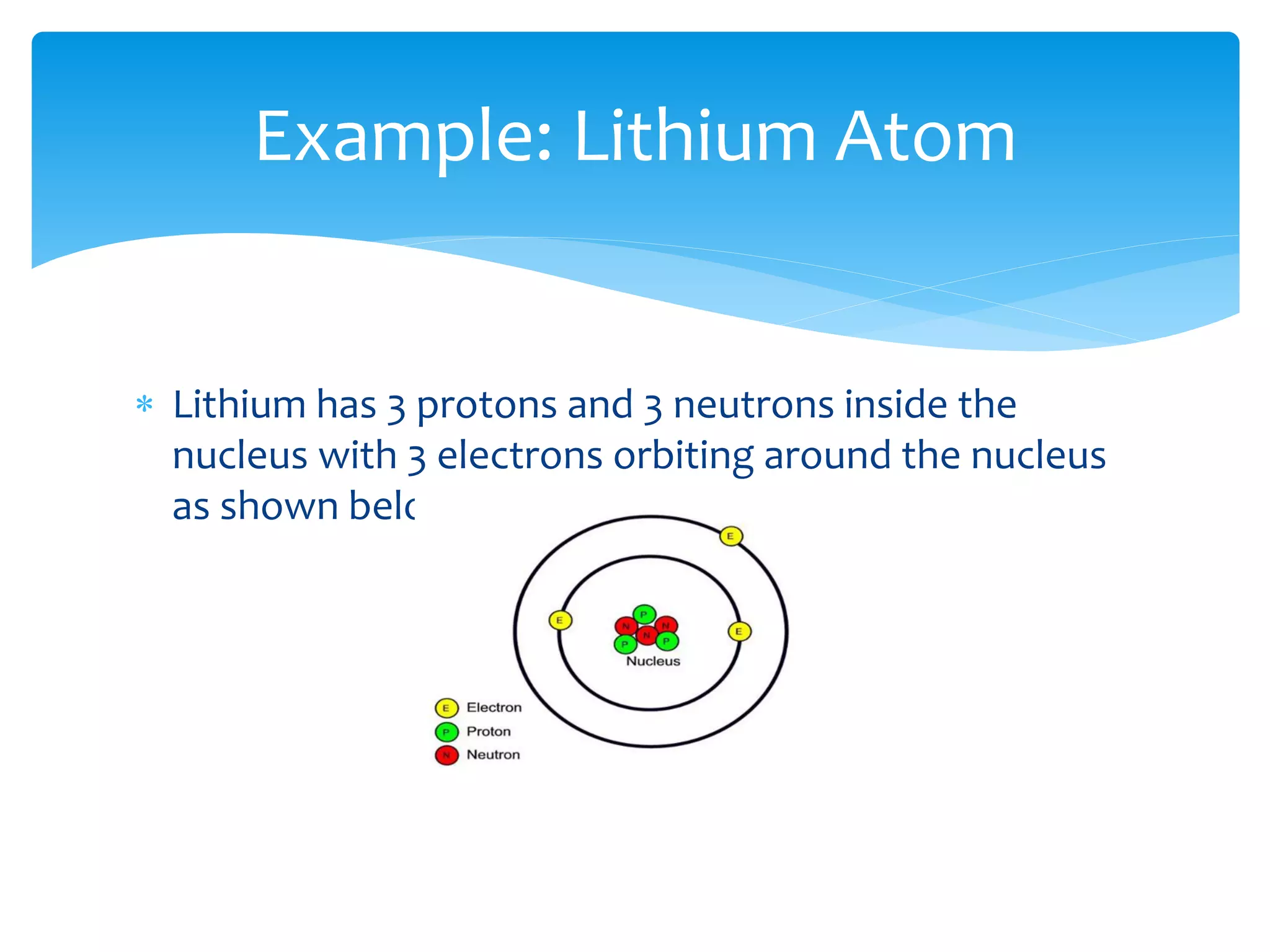
 Lithium has 3 protons and 3 neutrons inside the
nucleus with 3 electrons orbiting around the nucleus
as shown below.
Example: Lithium Atom
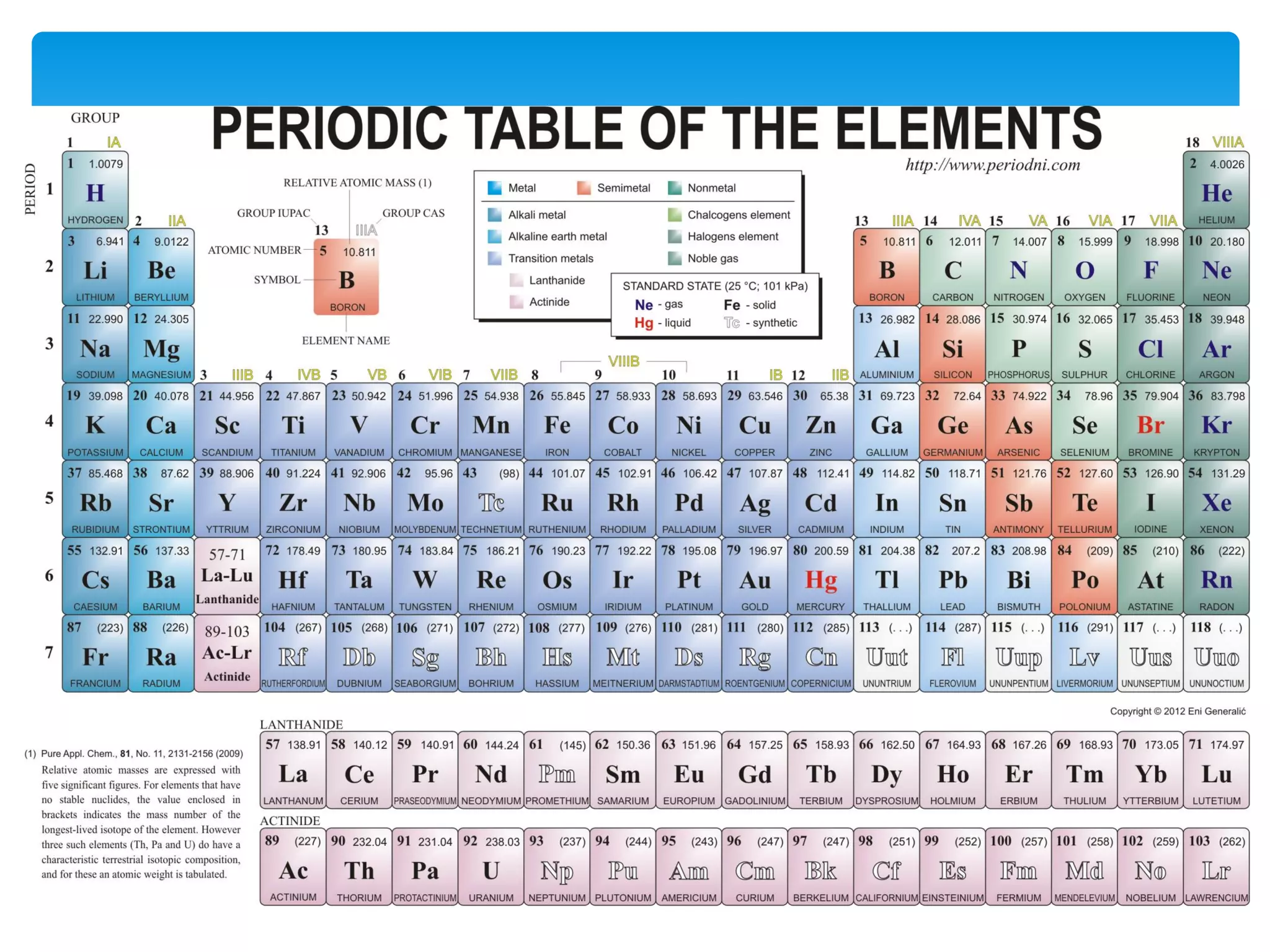
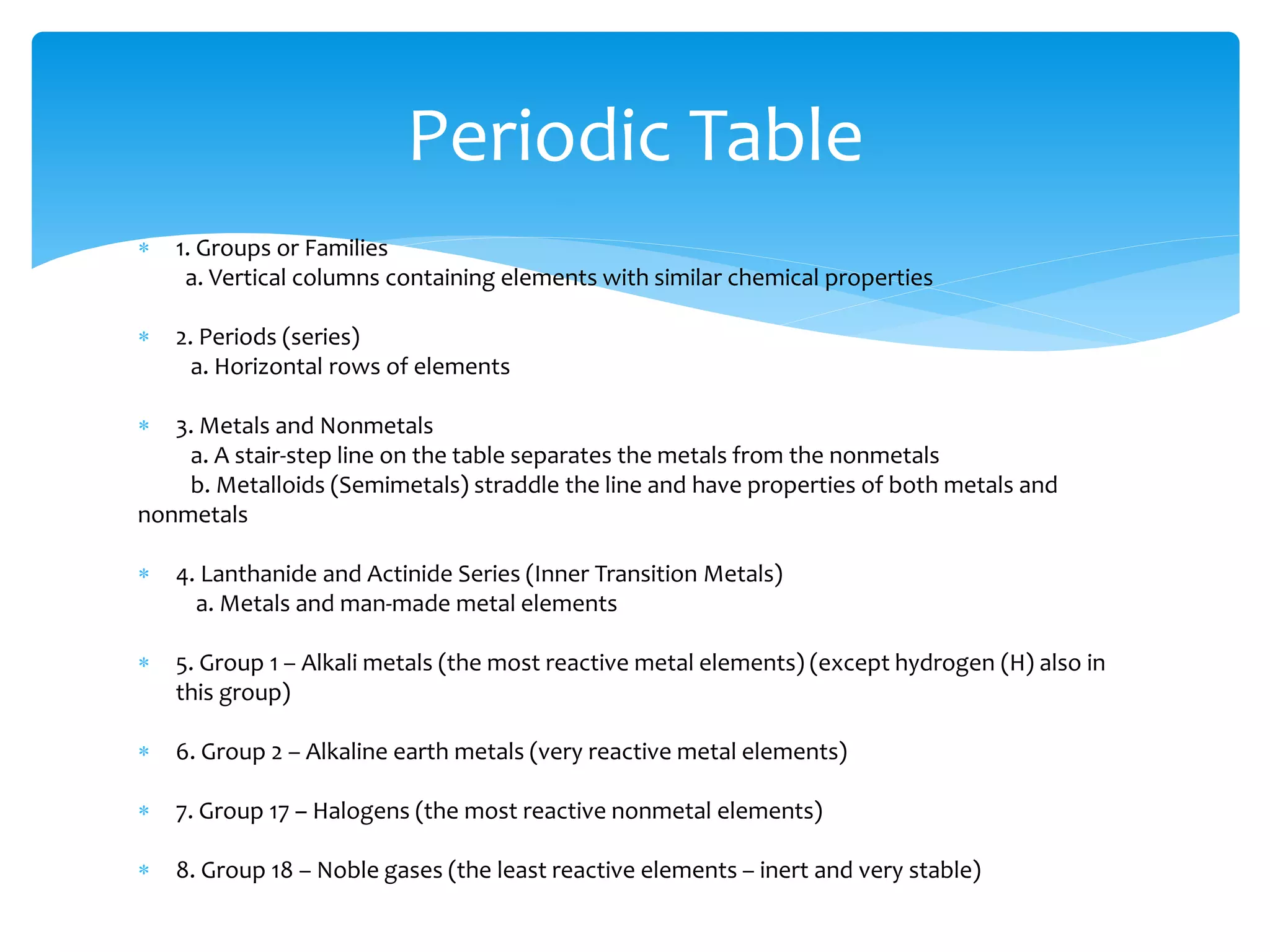
 1. Groups or Families
a. Vertical columns containing elements with similar chemical properties
 2. Periods (series)
a. Horizontal rows of elements
 3. Metals and Nonmetals
a. A stair-step line on the table separates the metals from the nonmetals
b. Metalloids (Semimetals) straddle the line and have properties of both metals and
nonmetals
 4. Lanthanide and Actinide Series (Inner Transition Metals)
a. Metals and man-made metal elements
 5. Group 1 – Alkali metals (the most reactive metal elements) (except hydrogen (H) also in
this group)
 6. Group 2 – Alkaline earth metals (very reactive metal elements)
 7. Group 17 – Halogens (the most reactive nonmetal elements)
 8. Group 18 – Noble gases (the least reactive elements – inert and very stable)
Periodic Table
CRYSTAL STRUCTURES
 Have you ever wondered how atoms assemble into
solid structures?
 How does the density of a material depend on its
structures?
CRYSTAL STRUCTURES
 Solid materials can broadly be classified as crystalline
and non crystalline (amorphous) solids.
 In crystalline solid the arrangement of atoms is in a
periodically repeating manner whereas no such
patterns are found in a non-crystalline solid.
CRYSTAL STRUCTURES
 2 types of crystalline solids:
a) Single crystal : the periodic and repeated
arrangement of atoms is perfect or extends
throughout the entirety of the specimen without
interruption.
b) Polycrystalline solid : a collective aggregate of many
crystals separated by well defined boundaries.
CRYSTAL STRUCTURES
 As a general rule, most metals are crystalline, while
ceramics and polymers may be either crystalline or
non-crystalline.
CRYSTAL STRUCTURES
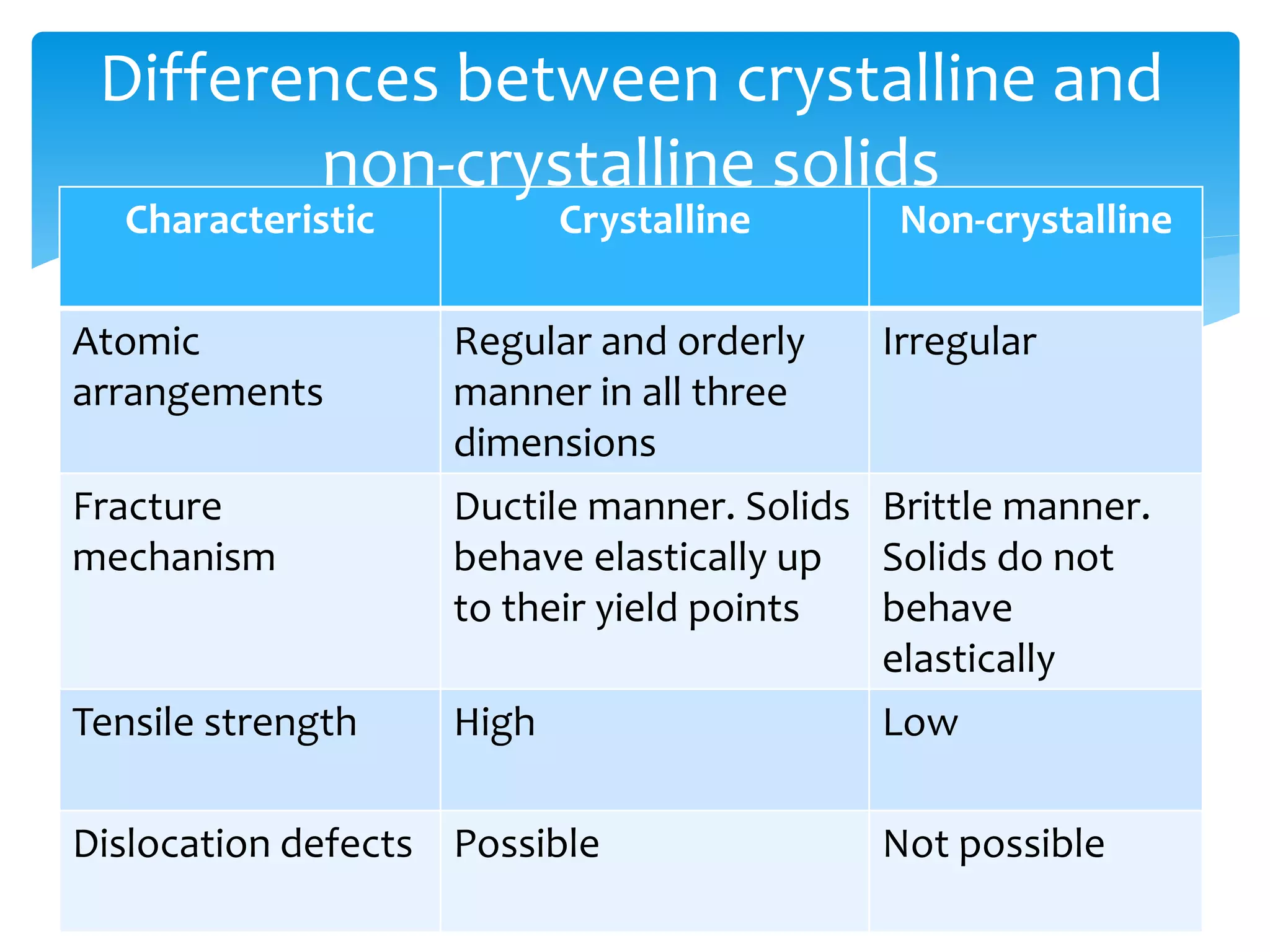
Characteristic Crystalline Non-crystalline
Atomic
arrangements
Regular and orderly
manner in all three
dimensions
Irregular
Fracture
mechanism
Ductile manner. Solids
behave elastically up
to their yield points
Brittle manner.
Solids do not
behave
elastically
Tensile strength High Low
Dislocation defects Possible Not possible
Differences between crystalline and
non-crystalline solids
 A crystalline solid consists of a number of crystals. A
crystal structure can be considered as consisting of
tiny blocks which are repeated in three dimensional
pattern.
 Each of the tiny block (called a unit cell) is actually
made from the arrangement of a small group of
atoms.
Unit cell
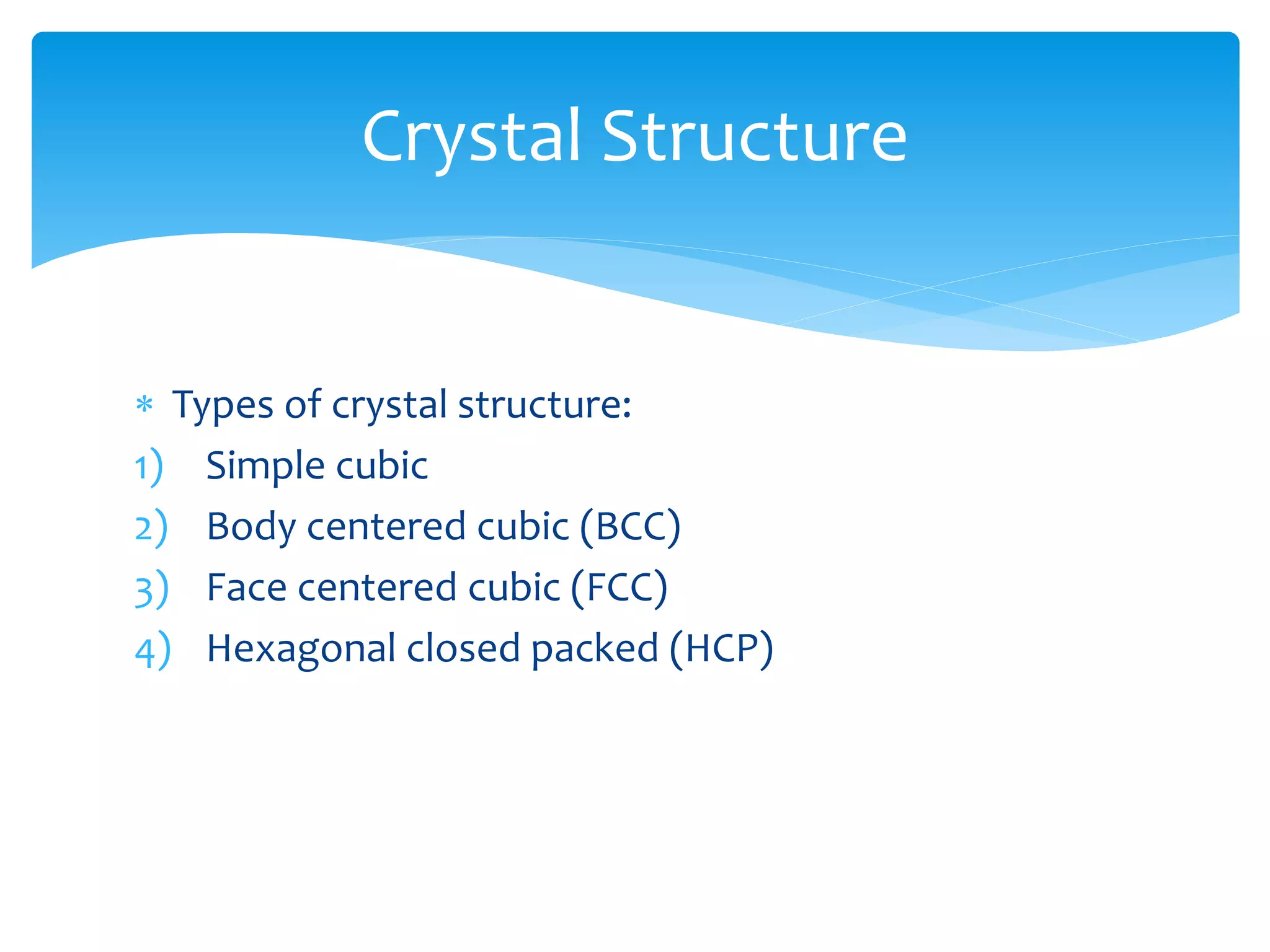
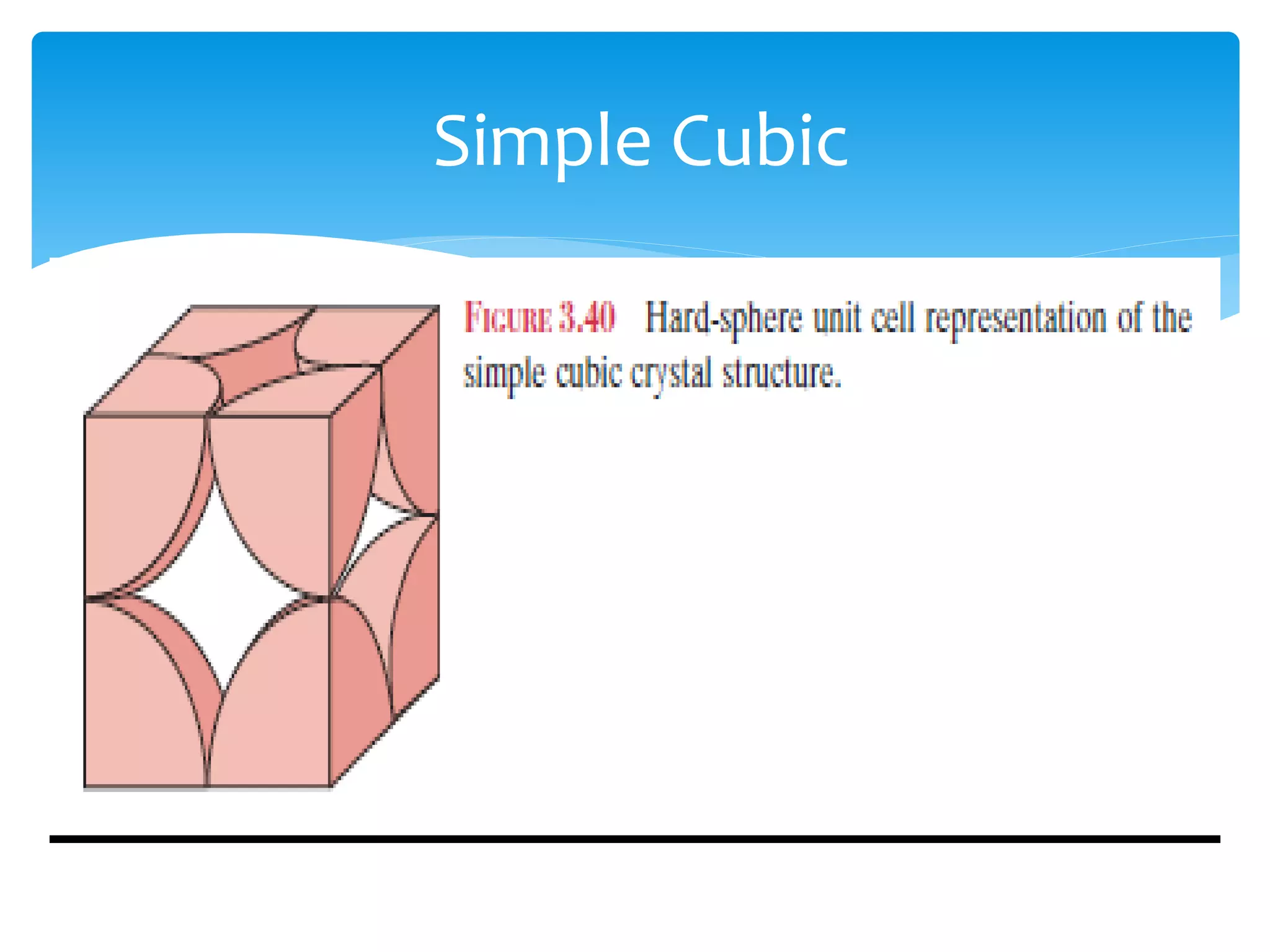
 Types of crystal structure:
1) Simple cubic
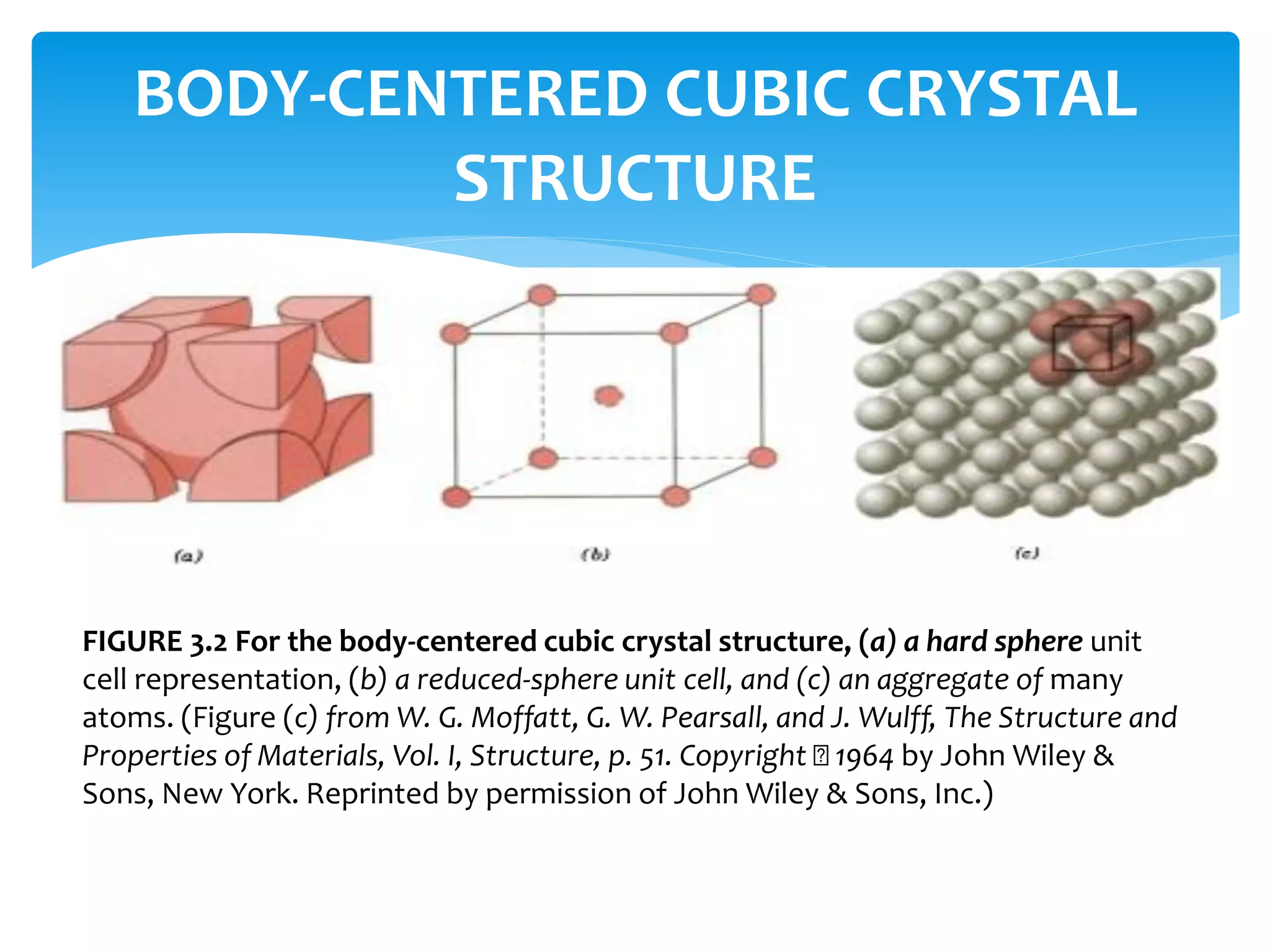
2) Body centered cubic (BCC)
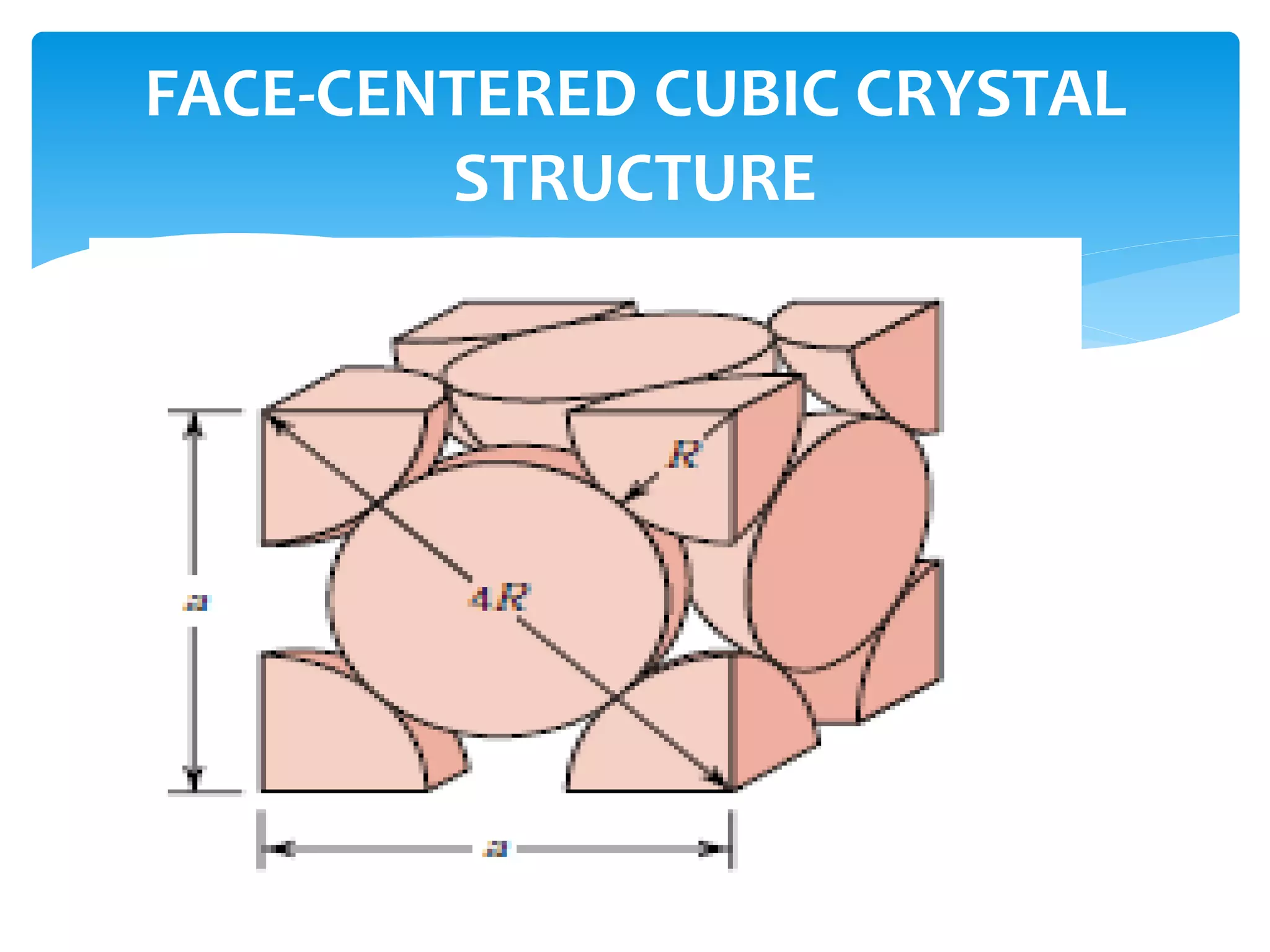
3) Face centered cubic (FCC)
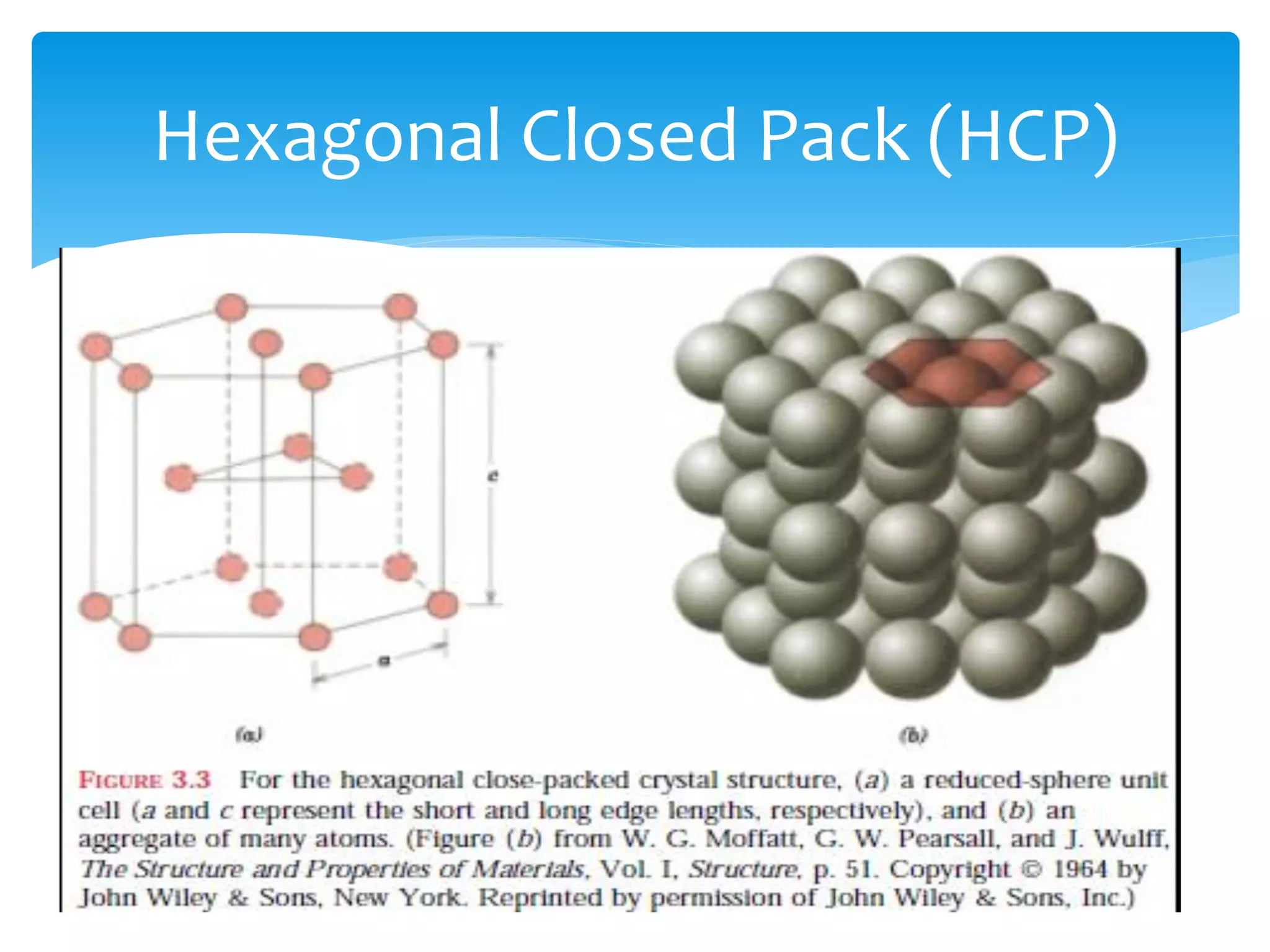
4) Hexagonal closed packed (HCP)
Crystal Structure
Simple Cubic
BODY-CENTERED CUBIC CRYSTAL
STRUCTURE
FIGURE 3.2 For the body-centered cubic crystal structure, (a) a hard sphere unit
cell representation, (b) a reduced-sphere unit cell, and (c) an aggregate of many
atoms. (Figure (c) from W. G. Moffatt, G. W. Pearsall, and J. Wulff, The Structure and
Properties of Materials, Vol. I, Structure, p. 51. Copyright 1964 by John Wiley &
Sons, New York. Reprinted by permission of John Wiley & Sons, Inc.)
FACE-CENTERED CUBIC CRYSTAL
STRUCTURE
Hexagonal Closed Pack (HCP)
a) Crystal : may be defined as a small body having a regular
symmetry form, bound by smooth surfaces which are
acquired under the action of its inter-atomic forces.
b) Space lattice: is composed of unit cells where the unit cells
are stacked together endlessly to form the lattice. Each
cell in the lattice is identical in size, shape and orientation
with each other in the same crystal.
c) Grain : An individual crystal in a polycrystalline metal.
d) Grain Boundary: the boundary separating the two
adjacent grains.
Recystallization terms
 Have you ever wondered why some materials behave
differently from others, for example it is easy to
stretch rubber but it is difficult to stretch metals?
 Why metals are good electrical conductors while
other non-metallic materials are poor conductors?
 This is all due to the bonding of atoms.
Interatomic Bonding
 The bonds are developed between atoms due to
forces of attraction and repulsion which keep nearby
atoms in an equilibrium state.
 The equilibrium means to have its electron
configuration similar to that of inert gases.
Interatomic Bonding
 If the outermost shell is not complete with 8 electrons,
atoms of most of the elements form bonds with one
another to achieve this stable condition of 8 electrons at the
outermost shell.
 This can be achieved:
i) Atoms sharing one or more electrons with other atoms
ii) Atoms gaining one or more electrons with another atom
iii) Atoms losing one or more electrons with another atom
Interatomic Bonding
3 types of primary bonds:
a) Ionic bonding
b) Covalent bonding
c) Metallic bonding
Primary Bonds
 It is always found in compounds that are composed of
both metallic and nonmetallic elements.
 Atoms of a metallic element easily give up their
valence electrons to the nonmetallic atoms.
 The attractive bonding forces are coulombic; that is,
positive and negative ions, by virtue of their net
electrical charge, attract one another.
Ionic bonding
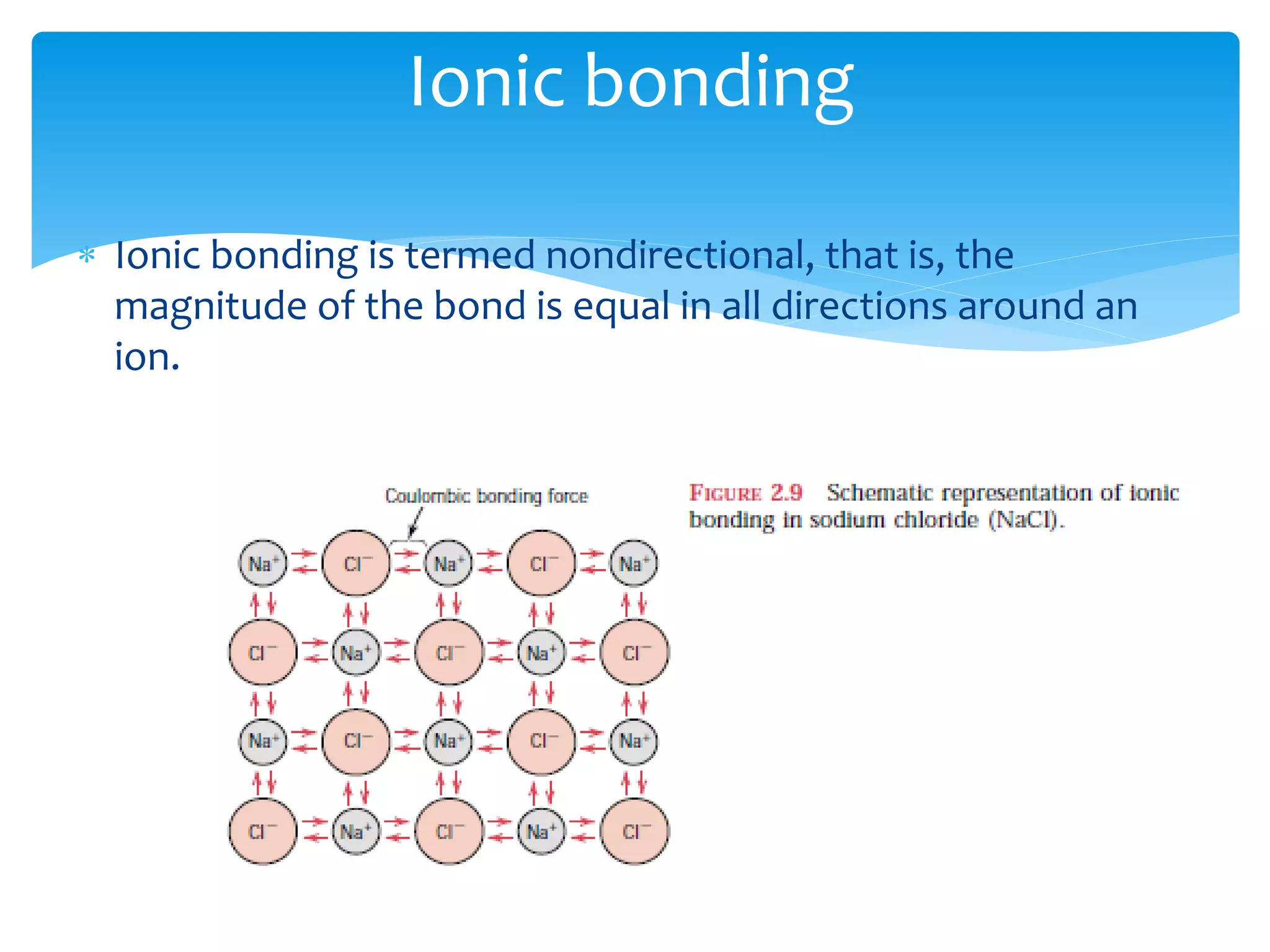
 Ionic bonding is termed nondirectional, that is, the
magnitude of the bond is equal in all directions around an
ion.
Ionic bonding
 In covalent bonding stable electron configurations
are assumed by the sharing of electrons between
adjacent atoms.
 Two atoms that are covalently bonded will each
contribute at least one electron to the bond, and the
shared electrons may be to belong to both atoms.
Covalent Bonding
 Covalent bonding is schematically illustrated in Figure 2.10
for a molecule of methane (CH4). The carbon atom has four
valence electrons, whereas each of the four hydrogen
atoms has a single valence electron.
Covalent Bonding
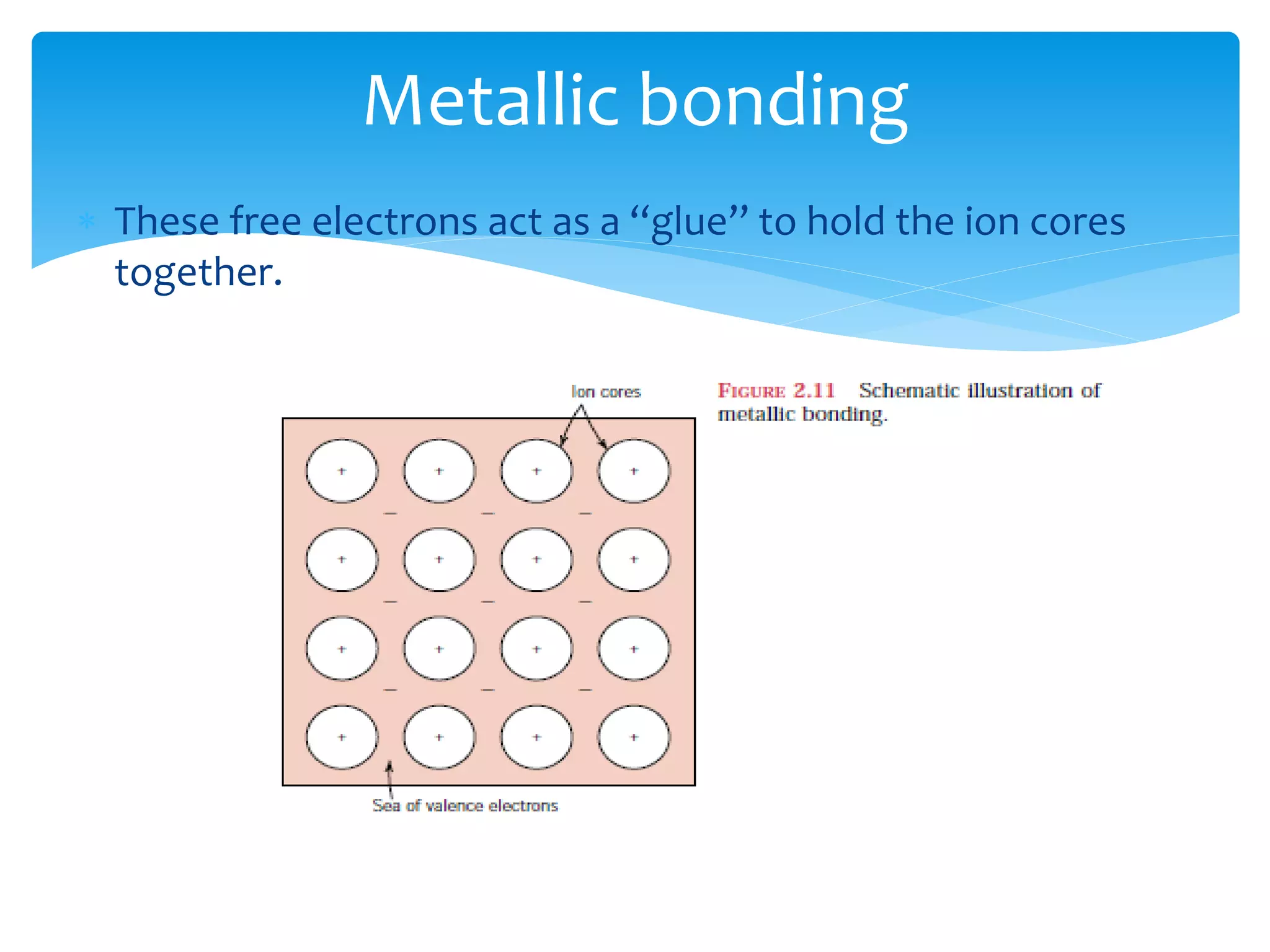
 Metallic bonding, the final primary bonding type, is found in
metals and their alloys.
 Metallic materials have one, two, or at most, three valence
electrons.
 With this model, these valence electrons are not bound to
any particular atom in the solid and are more or less free to
drift throughout the entire metal.
 They may be thought of as belonging to the metal as a
whole, or forming a ‘‘sea of electrons’’ or an ‘‘electron
cloud.’’
 The remaining nonvalence electrons and atomic nuclei form
what are called ion cores, which possess a net positive charge
equal in magnitude to the total valence electron charge per
atom.
Metallic bonding
 These free electrons act as a ‘‘glue’’ to hold the ion cores
together.
Metallic bonding
 Solidification is a phase transition in which a liquid turns
into a solid when its temperature is lowered below its
freezing point.
 The melting point of a solid is the temperature at which it
changes state from solid to liquid.
 When considered as the temperature of the reverse change
from liquid to solid, it is referred to as the freezing point or
crystallization point.
SOLIDIFICATION
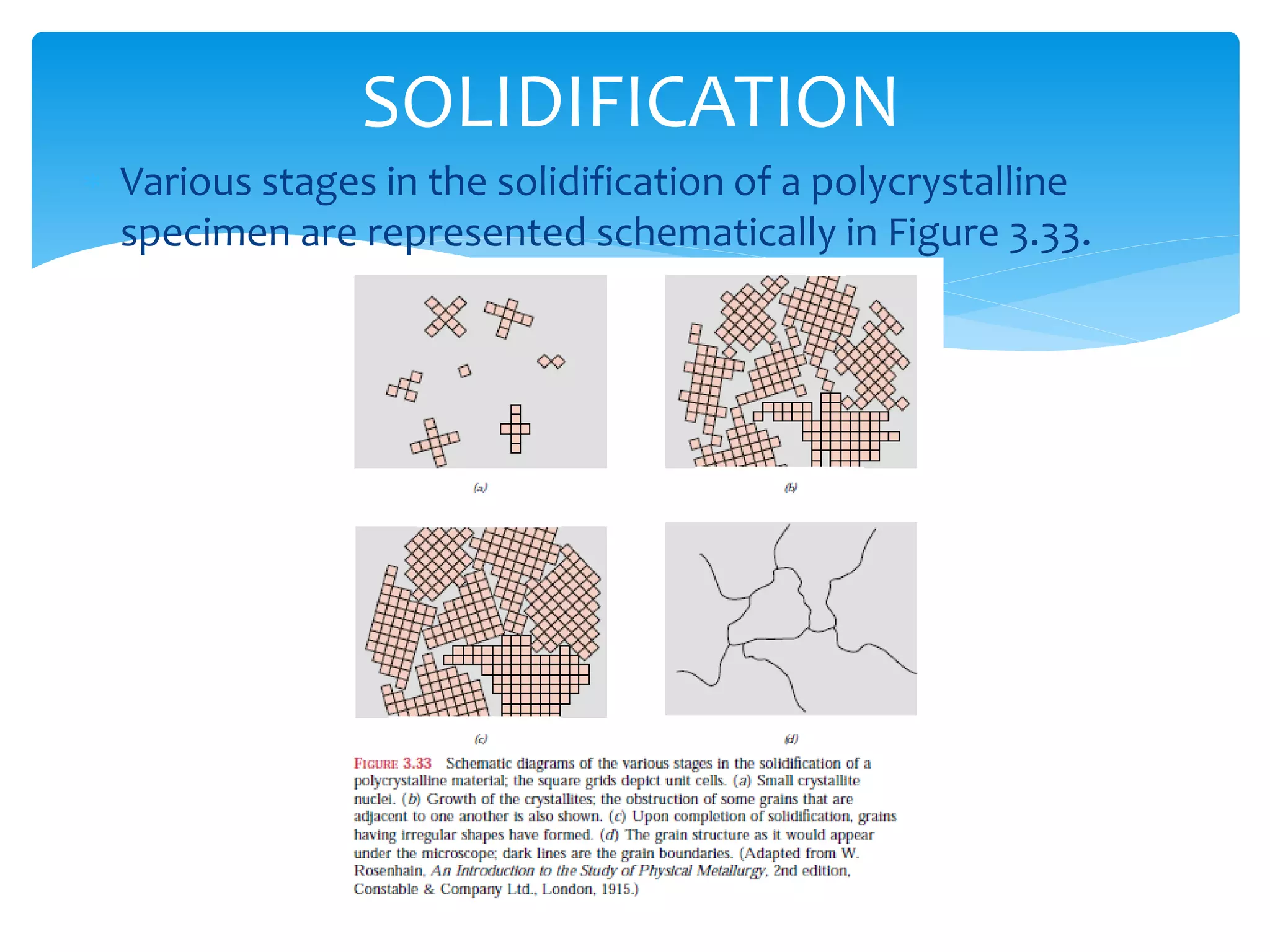
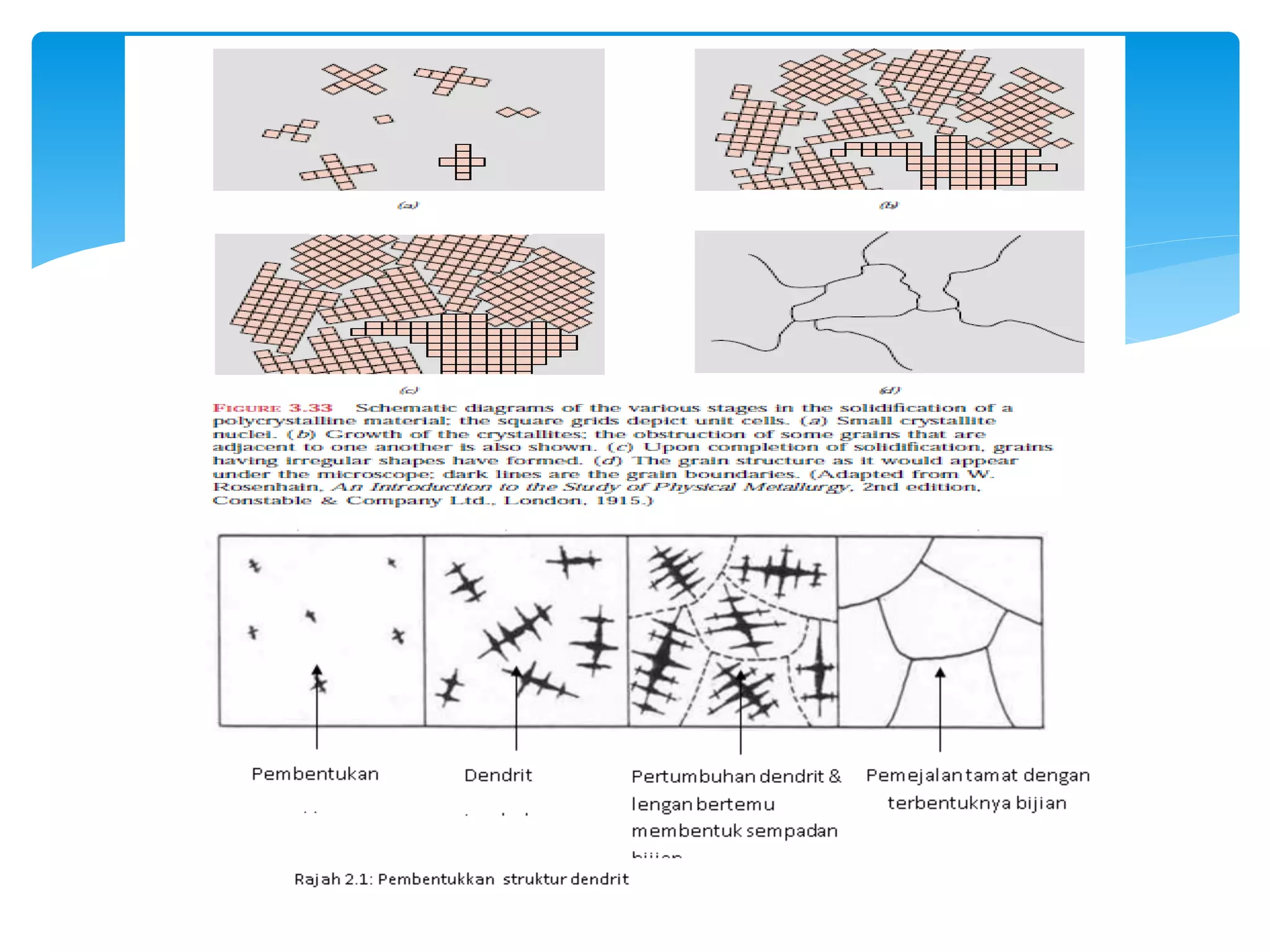
 Various stages in the solidification of a polycrystalline
specimen are represented schematically in Figure 3.33.
SOLIDIFICATION
1) Initially, small crystals or nuclei form at various positions.
These have random crystallographic orientations, as
indicated by the square grids.
2) As the nucleus grows, the spherical morphology becomes
unstable and its shape becomes perturbed. The solid
shape begins to express the preferred growth directions
of the crystal.
3) The small grains grow by the successive addition from the
surrounding liquid of atoms to the structure of each.
Cont.
4) The solid then attempts to minimize the area of those
surfaces with the highest surface energy. The dendrite thus
exhibits a sharper and sharper tip as it grows.
5) As solidification proceeds, an increasing number of atoms
lose their kinetic energy, making the process exothermic.
6)The extremities adjacent grains impinge on one another as
the solidification process approaches completion.
Cont.
7) As indicated in Figure 3.33, the crystallographic orientation
varies from grain to grain. Also, there exists some atomic
mismatch within the region where two grains meet; this
area, called a grain boundary.
Cont.
Cont.
1) Nucleation: The initial stage in a phase
transformation.
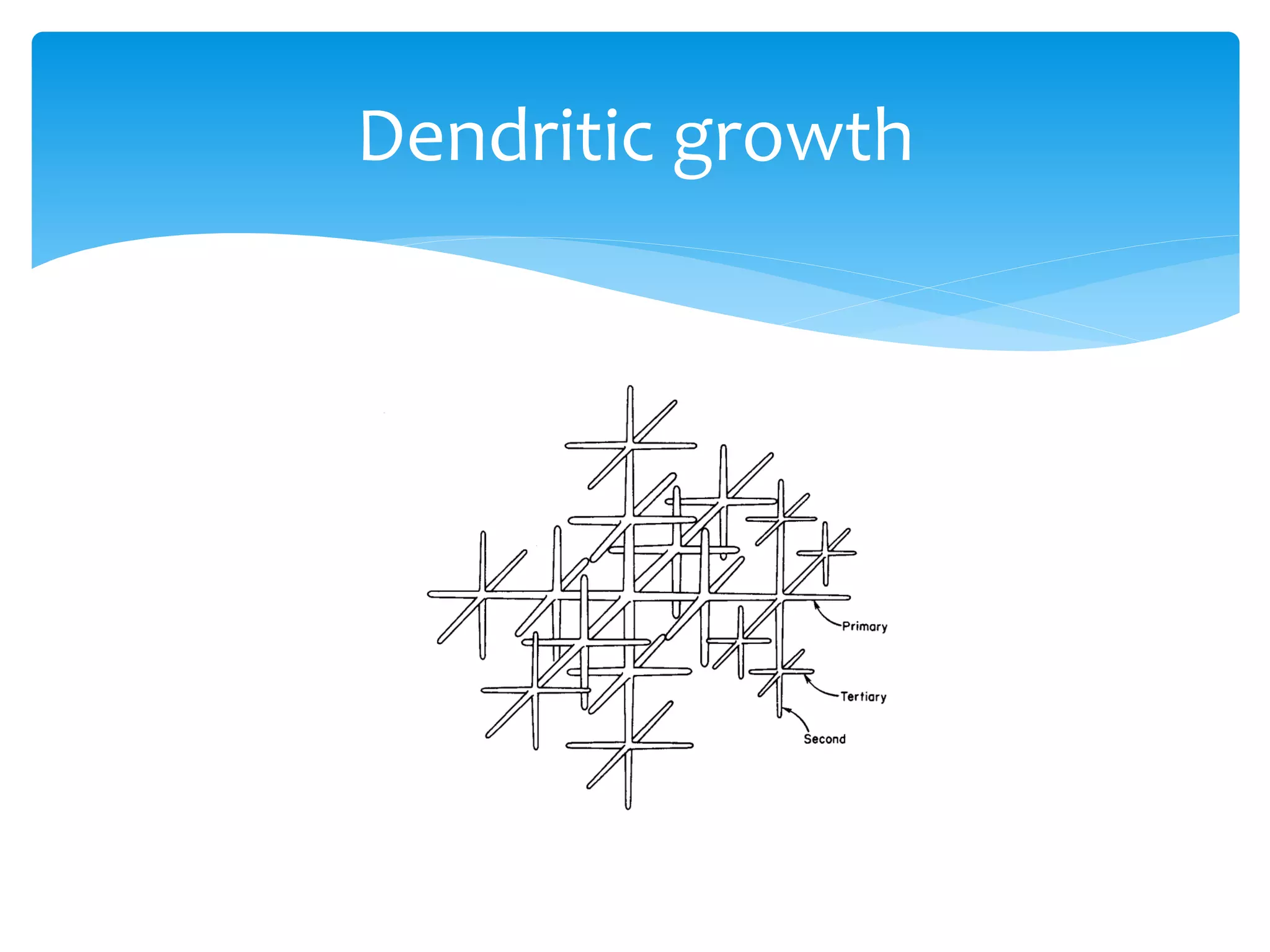
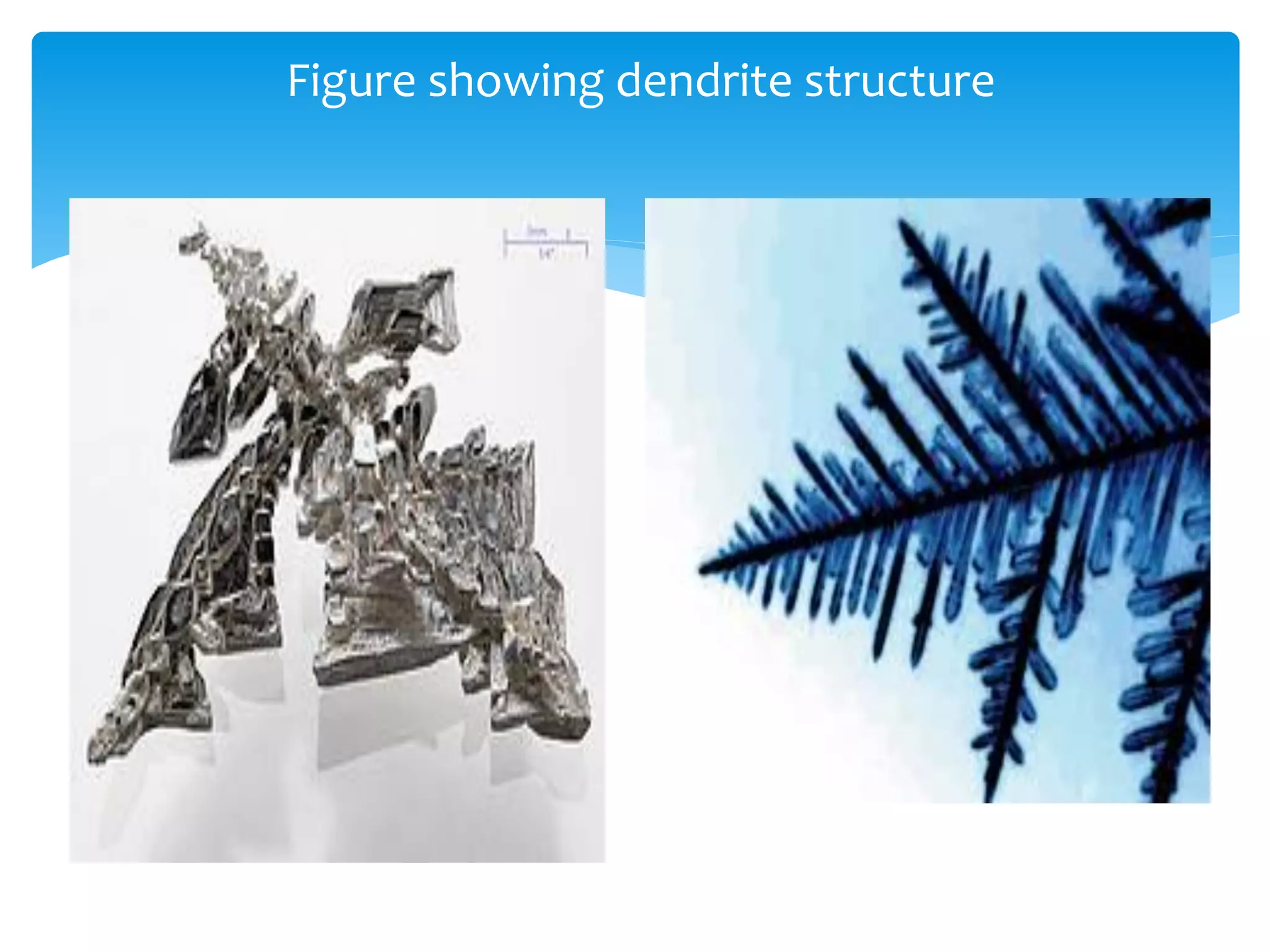
2) Dendrite : is a characteristic tree-like structure of
crystals growing as molten metal freezes.
3) Grain : An individual crystal in polycrystalline metal.
Solidification phases term
Figure showing dendrite structure
Dendritic growth
 1) List the significant differences between ionic,
covalent and metallic bonds
 2) List the common crystal structures in metallic
solids.
 3) What is a unit cell?
Question
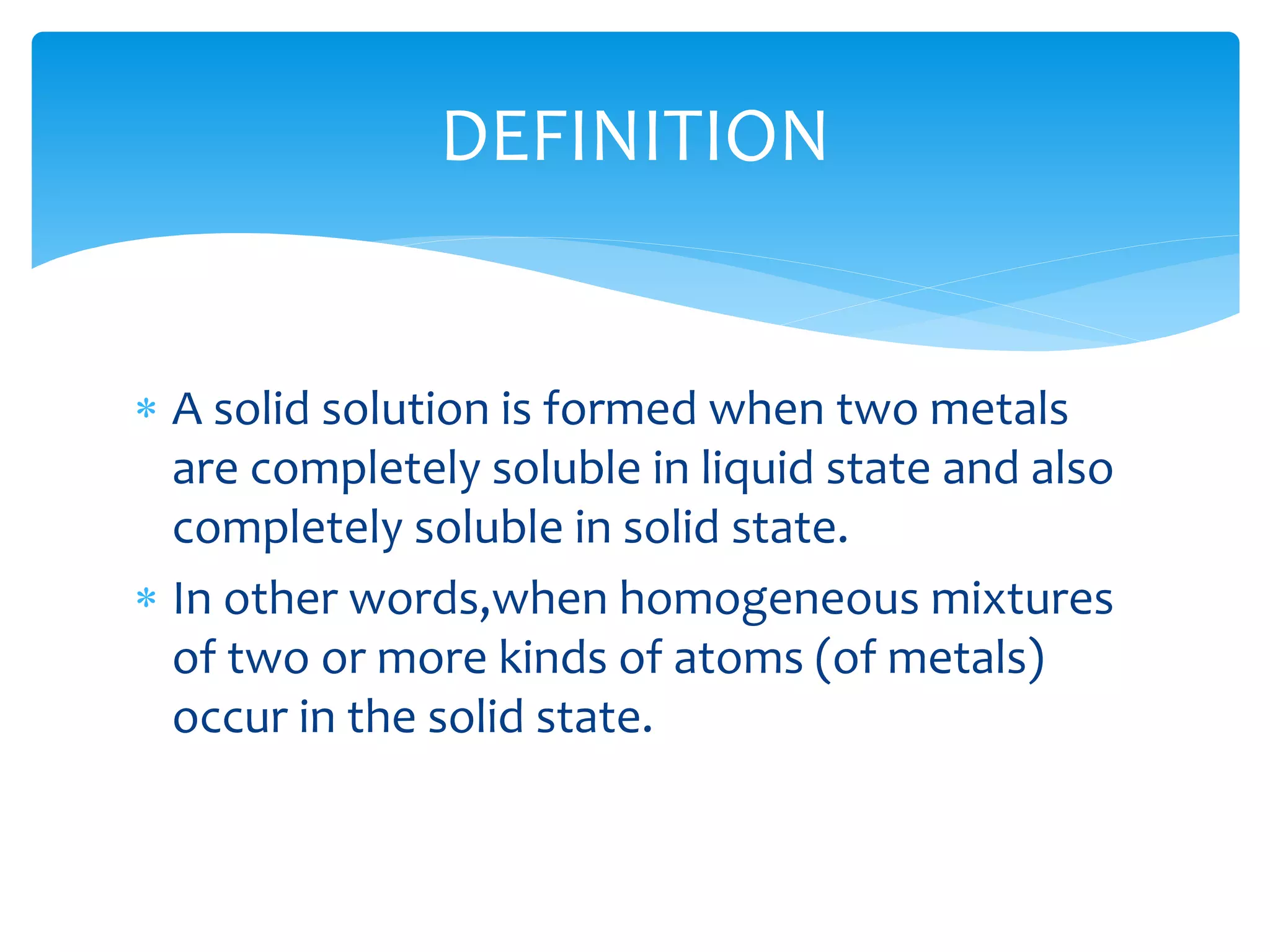
 Pure metal: contain of one type of metal’s atoms
only.
 Pure metals are of low strength and do not possess
the required properties for engineering
application.(seldom used in engineering)
 Metal Alloys : Material that is composed of two or
more elements, the principal one of which is a metal.
 Alloying is done to increase the strength of materials.
Metals and Alloys
SOLID SOLUTIONS
 A solid solution is formed when two metals
are completely soluble in liquid state and also
completely soluble in solid state.
 In other words,when homogeneous mixtures
of two or more kinds of atoms (of metals)
occur in the solid state.
DEFINITION
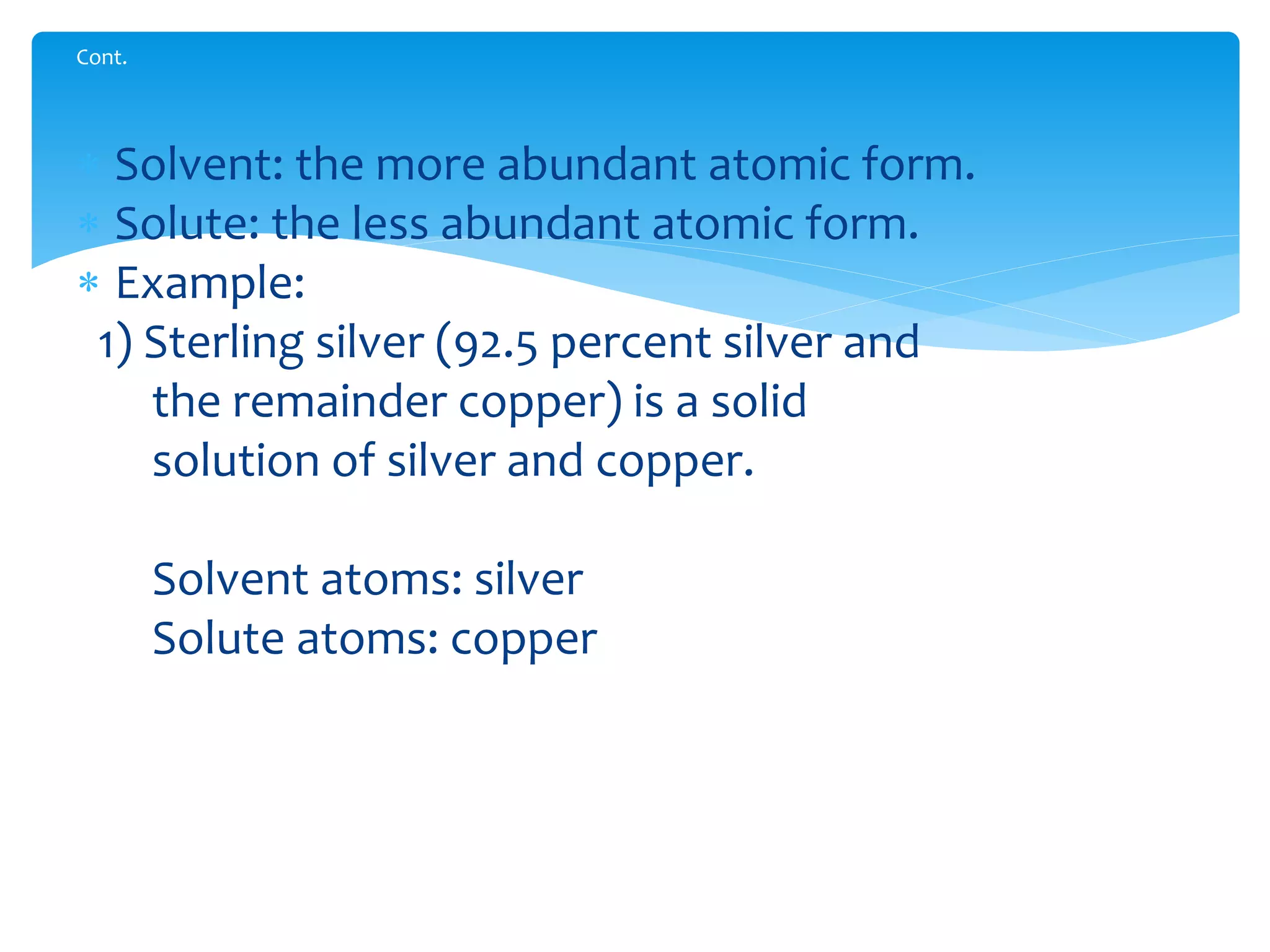
 Solvent: the more abundant atomic form.
 Solute: the less abundant atomic form.
 Example:
1) Sterling silver (92.5 percent silver and
the remainder copper) is a solid
solution of silver and copper.
Solvent atoms: silver
Solute atoms: copper
Cont.
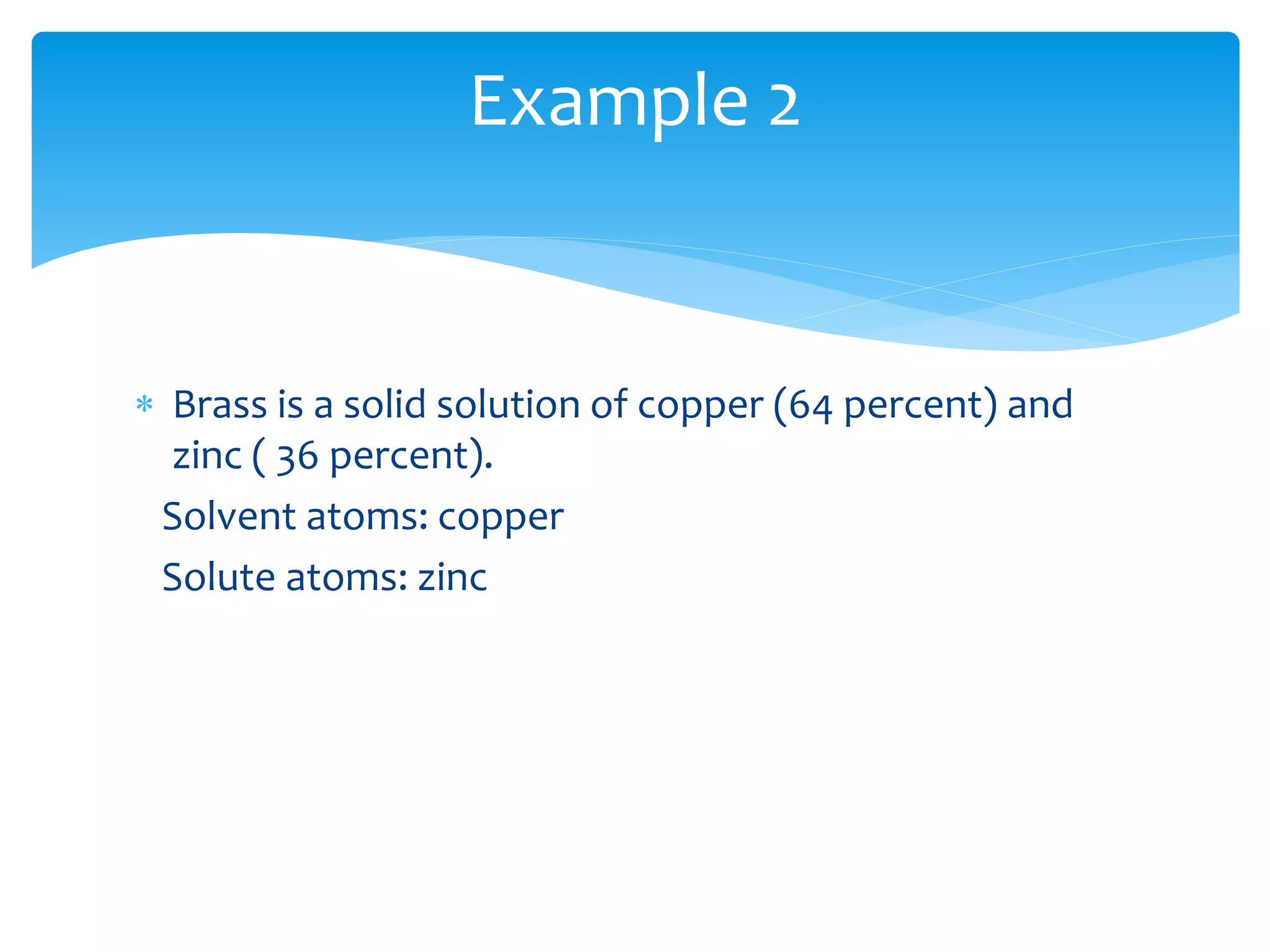
 Brass is a solid solution of copper (64 percent) and
zinc ( 36 percent).
Solvent atoms: copper
Solute atoms: zinc
Example 2
Solid solutions are of two types:
 a) Substitutional solid solutions
 b) Interstitial solid solutions
TYPES OF SOLID SOLUTIONS
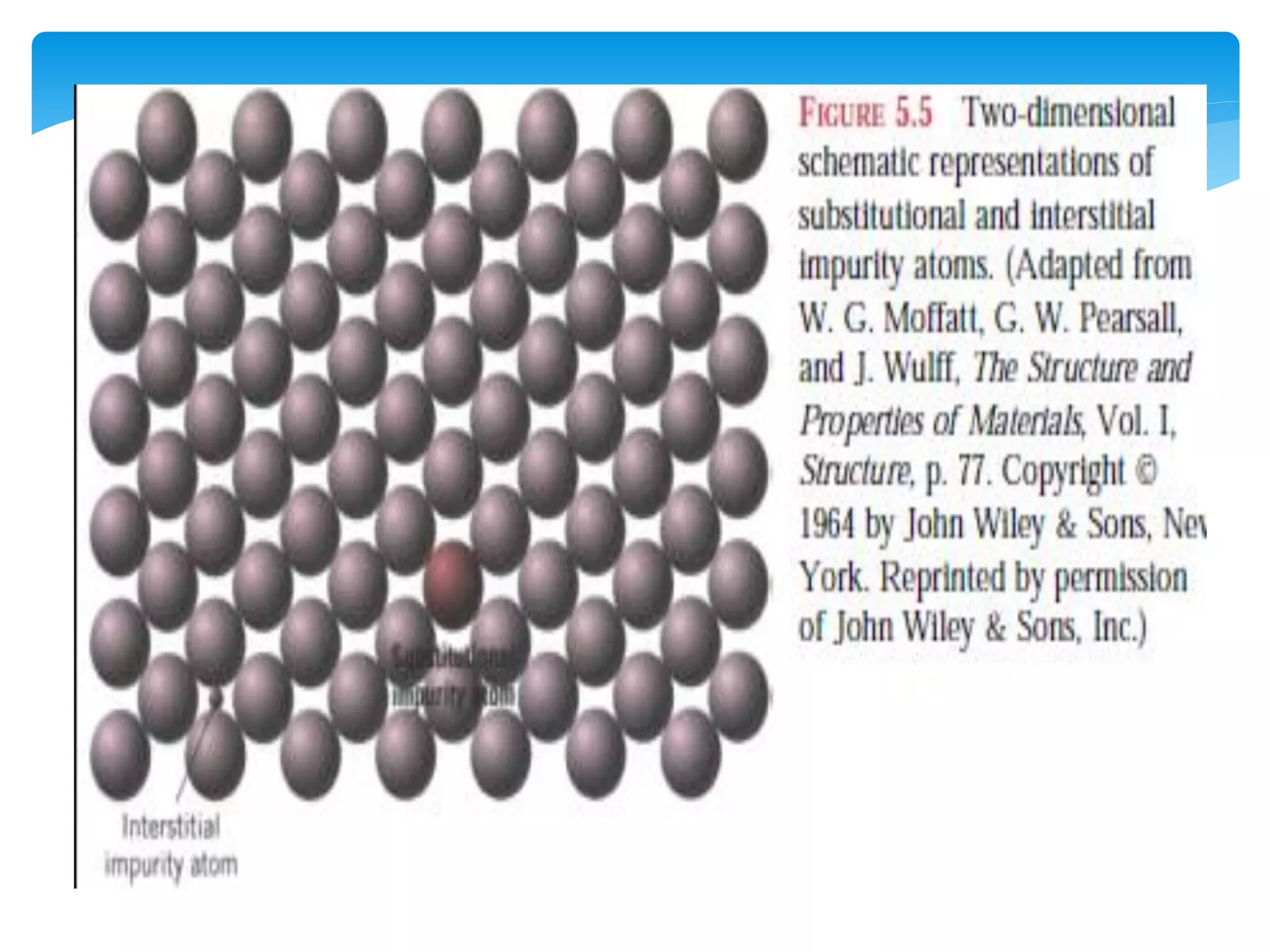
 If the atoms of the solvent or parent metal are
replaced in the crystal lattice by atoms of the solute
metal, then the solid solution is known as
substitutional solid solution.
Substitutional solid solutions
Cont.
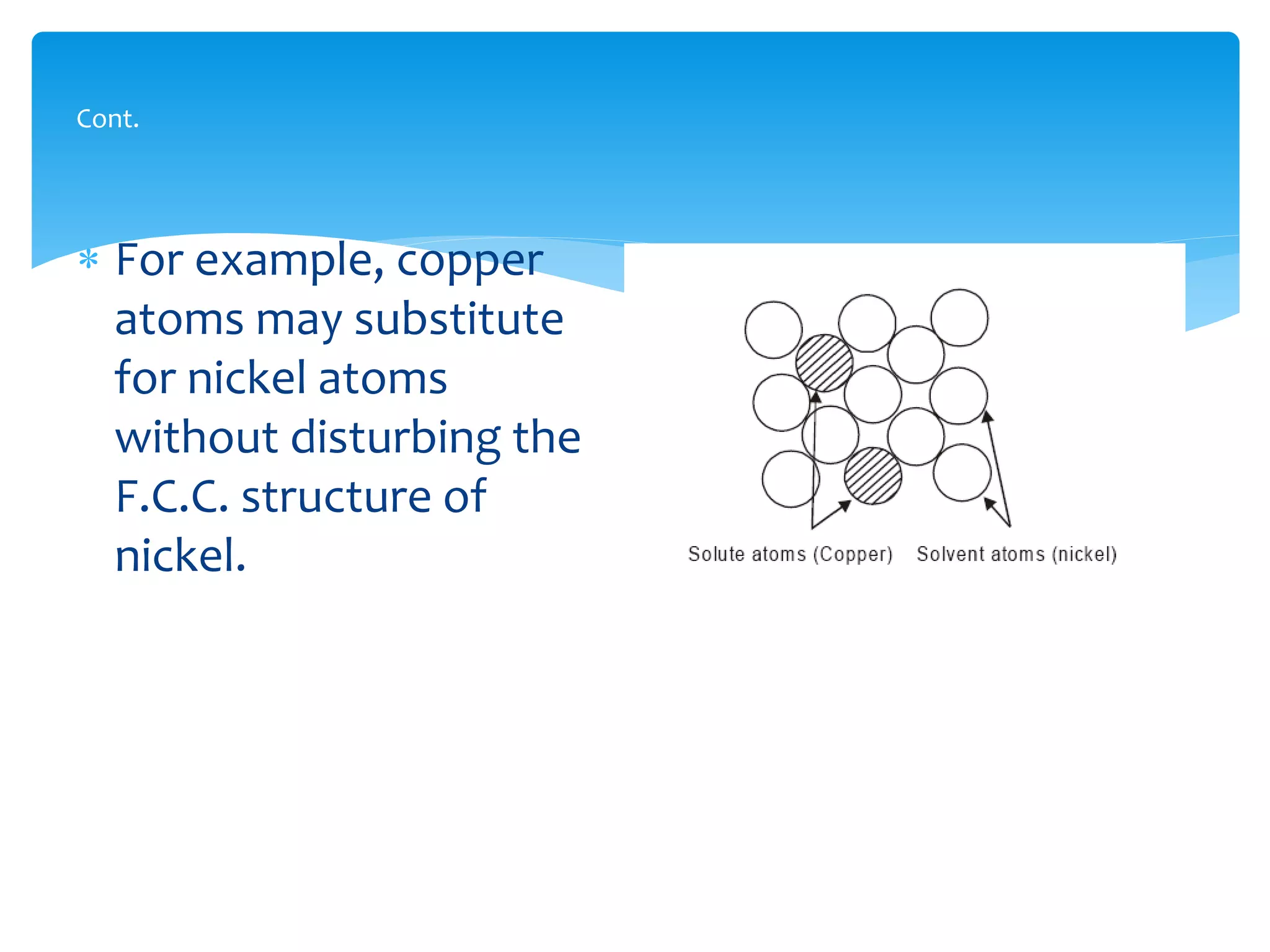
 For example, copper
atoms may substitute
for nickel atoms
without disturbing the
F.C.C. structure of
nickel.
Cont.
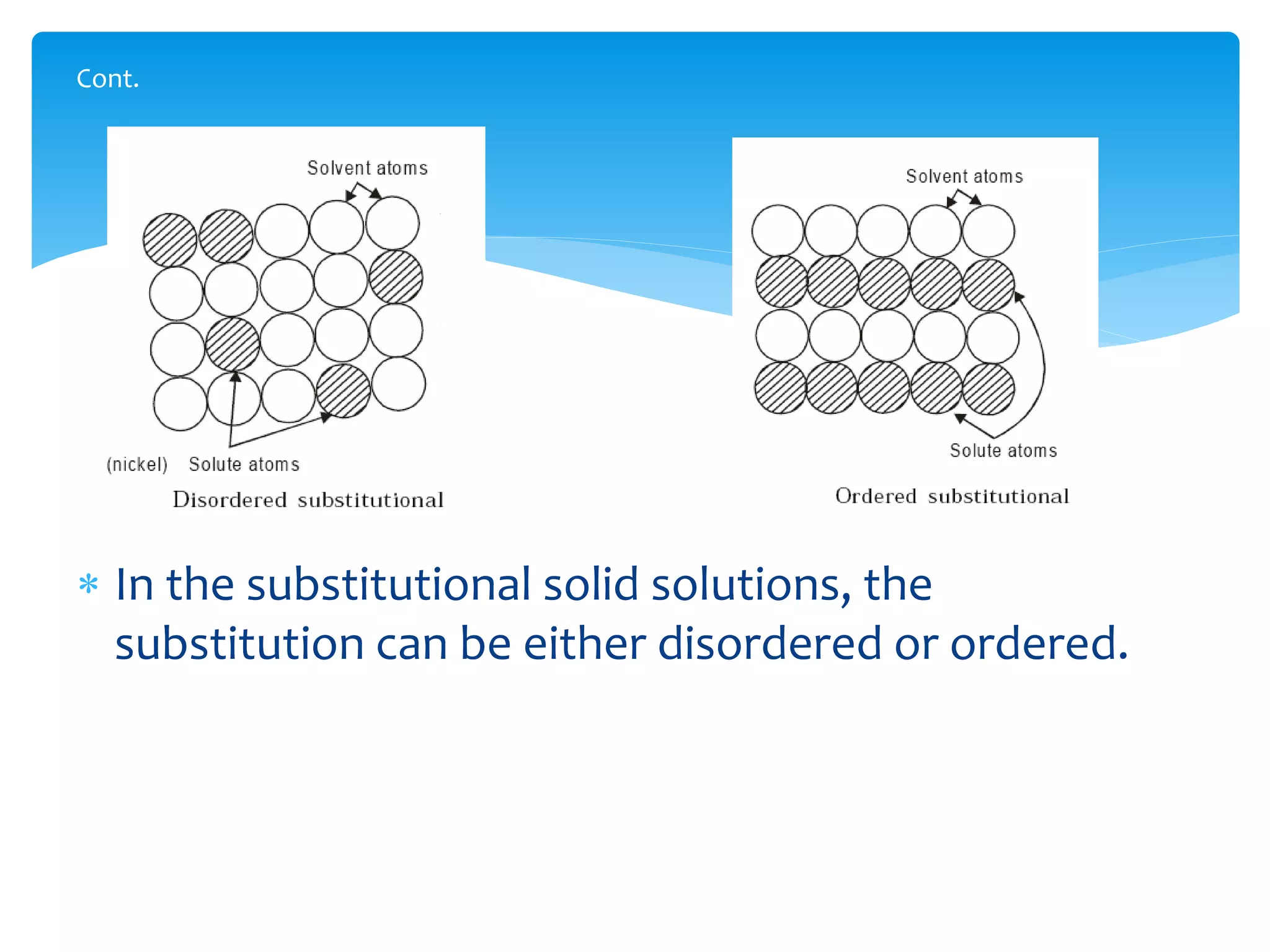
 In the substitutional solid solutions, the
substitution can be either disordered or ordered.
 a) Crystal structure factor: For complete solid
solubility, the two elements should have the same
type of crystal structure i.e., both elements should
have either F.C.C. or B.C.C. or H.C.P. structure.
 (b) Relative size factor: As the size (atomic radii)
difference between two elements increases, the solid
solubility becomes more restricted.
Hume Rothery rules for the formation of substitutional solid
solutions
 (c) Chemical affinity factor: Solid solubility is favoured
when the two metals have lesser chemical affinity. If
the chemical affinity of the two metals is greater,
then greater is the tendency towards compound
formation.
Generally,if the two metals are separated in the
periodic table widely then they possess greater
chemical affinity and are very likely to form some type
of compound instead of solid solution.
Cont.
 (d) Relative valence factor: It is found that a metal of
lower valence tends to dissolve more of a metal of
higher valence than vice versa. For example in
aluminium-nickel alloy system, nickel (lower valance)
dissolves 5 percent aluminium but aluminium (higher
valence) dissolves only 0.04 percent nickel.
Cont.
 In interstitial solid solutions, the solute atom does not
displace a solvent atom, but rather it enters one of
the holes or interstices between the solvent atoms.
Interstitial Solid Solutions
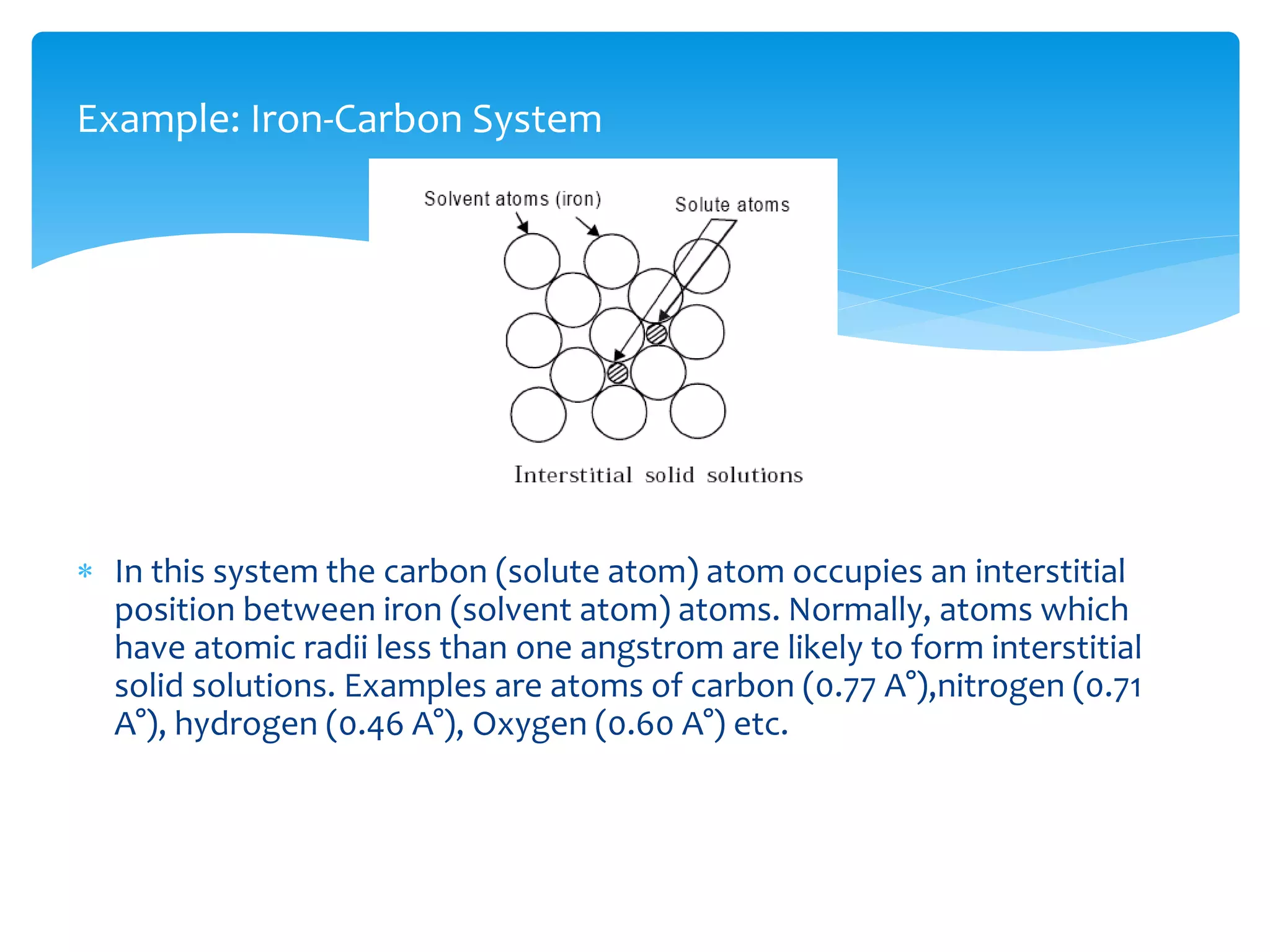
Example: Iron-Carbon System
 In this system the carbon (solute atom) atom occupies an interstitial
position between iron (solvent atom) atoms. Normally, atoms which
have atomic radii less than one angstrom are likely to form interstitial
solid solutions. Examples are atoms of carbon (0.77 A°),nitrogen (0.71
A°), hydrogen (0.46 A°), Oxygen (0.60 A°) etc.
1. Define solid solution and explain the types of solid
solutions.
2. Distinguish between substitutional solid solutions and
interstitial solid solutions.
QUESTIONS
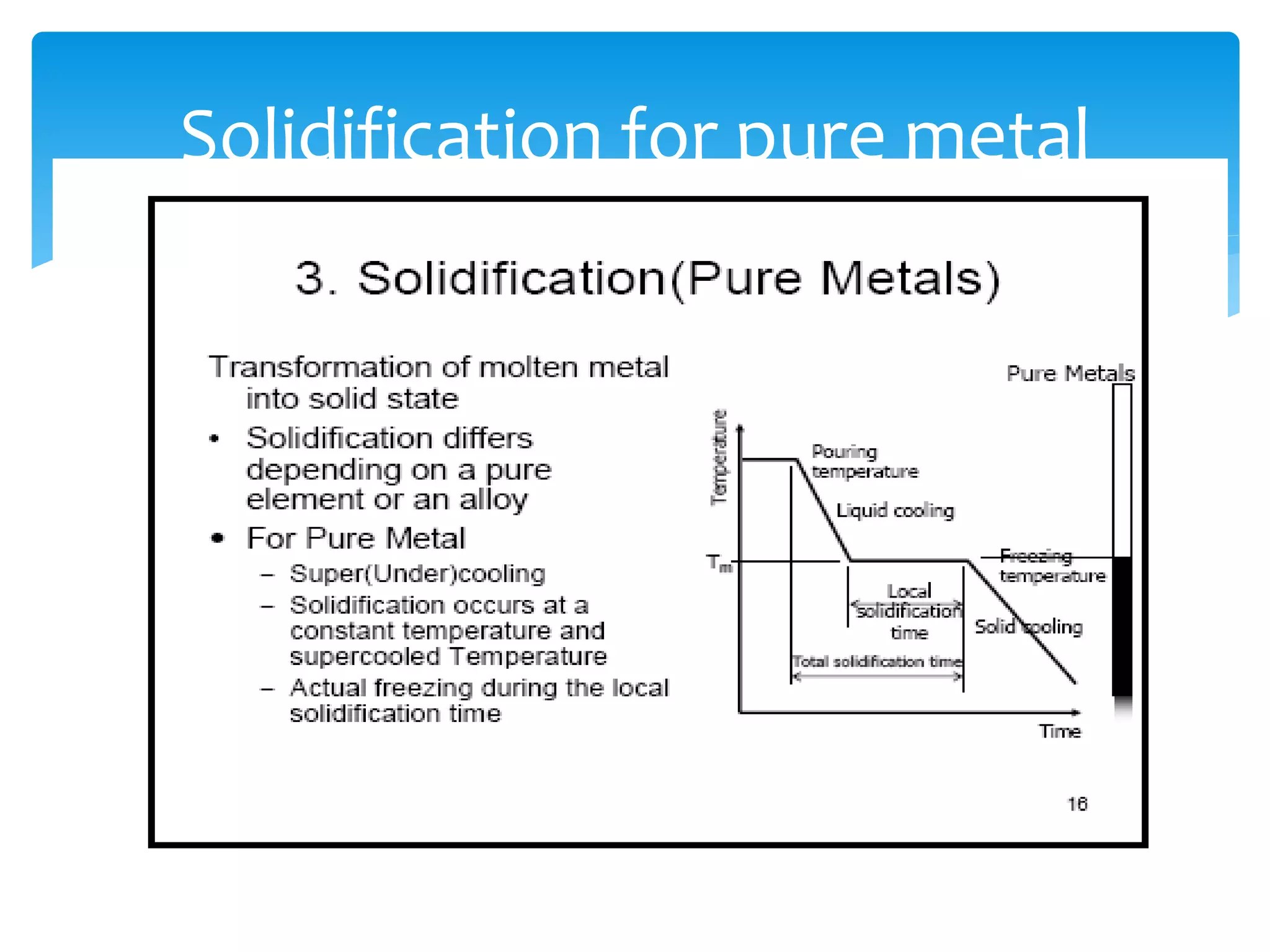
Solidification for pure metal
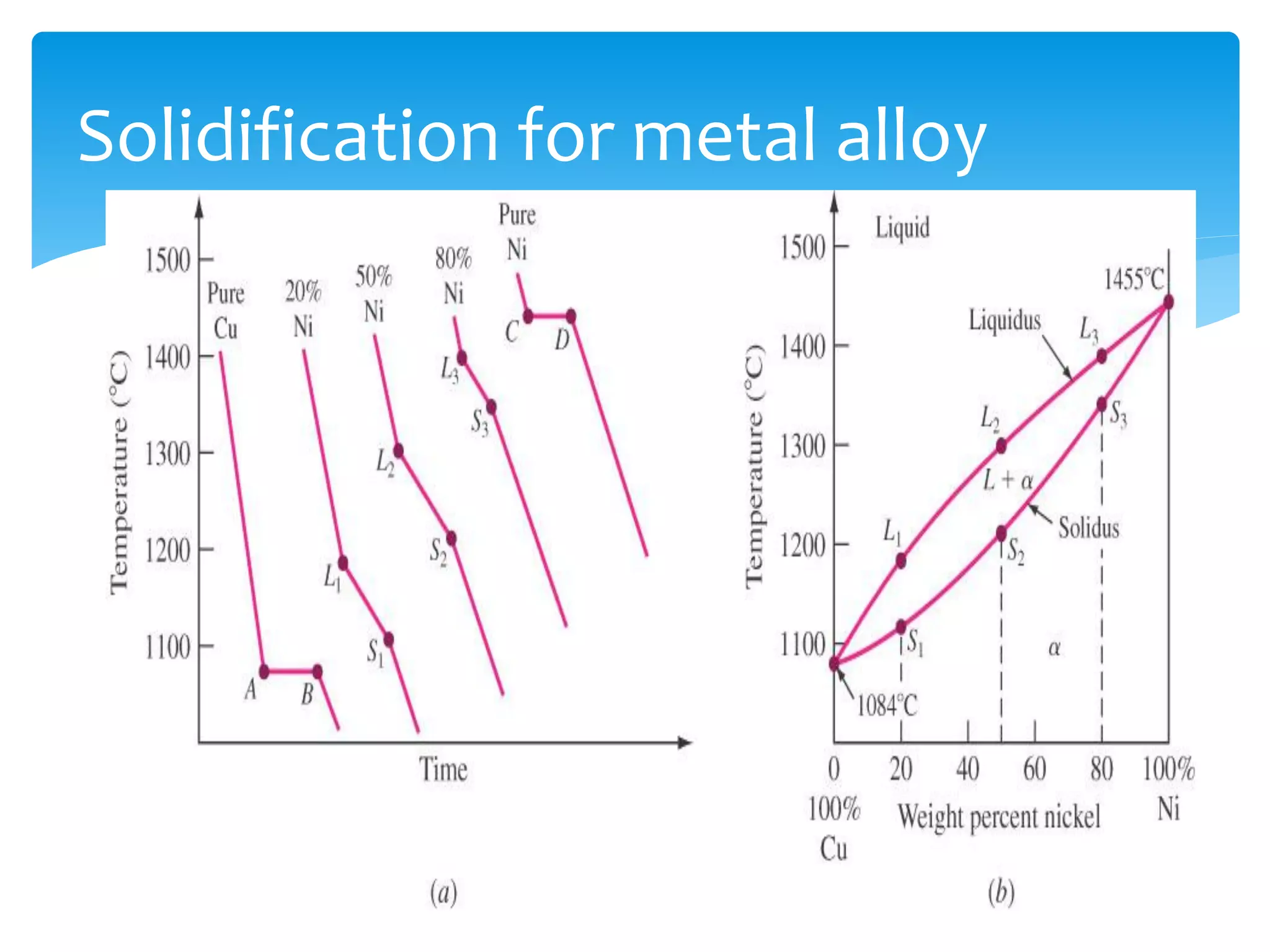
Solidification for metal alloy
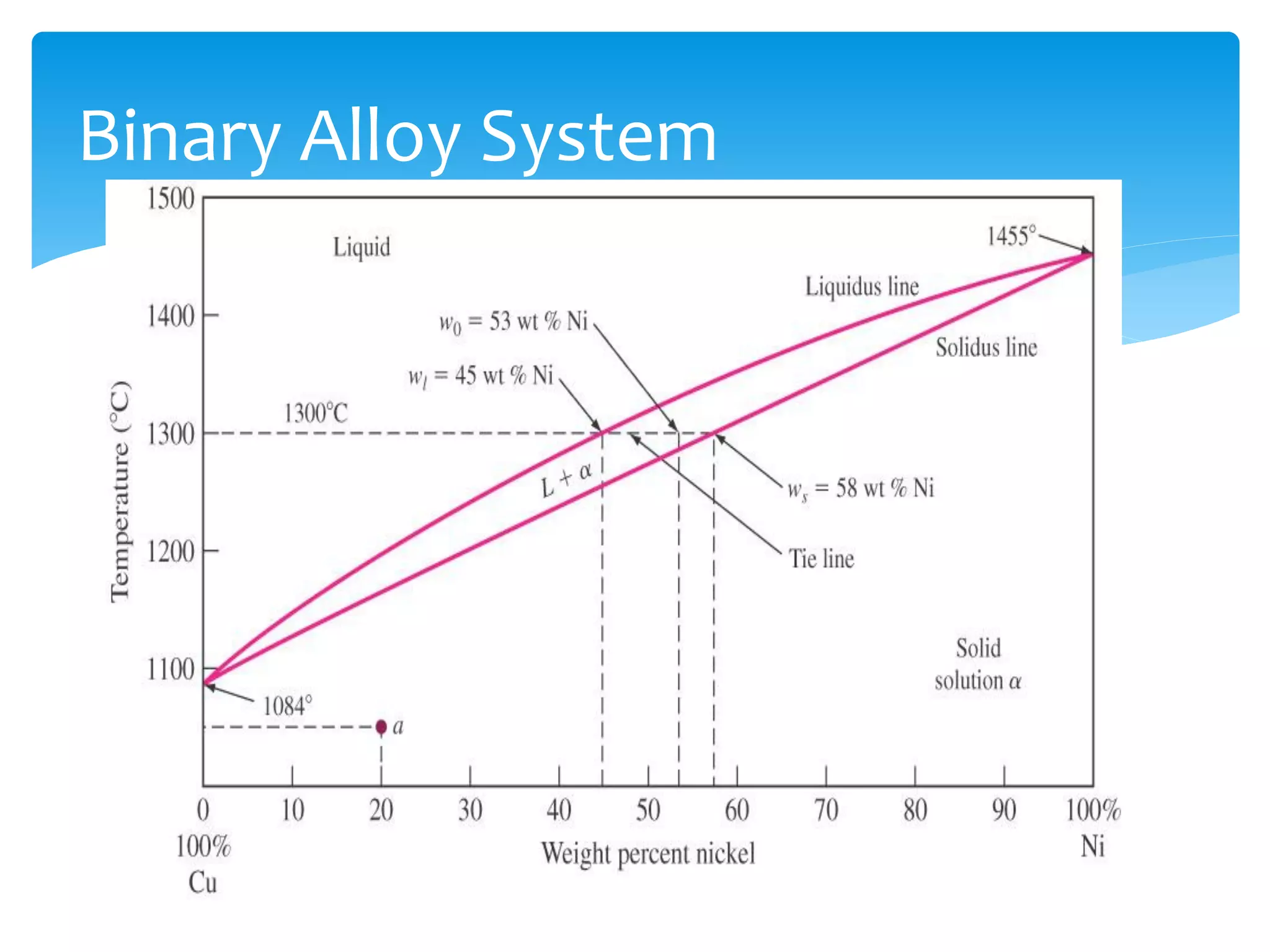
Binary Alloy System
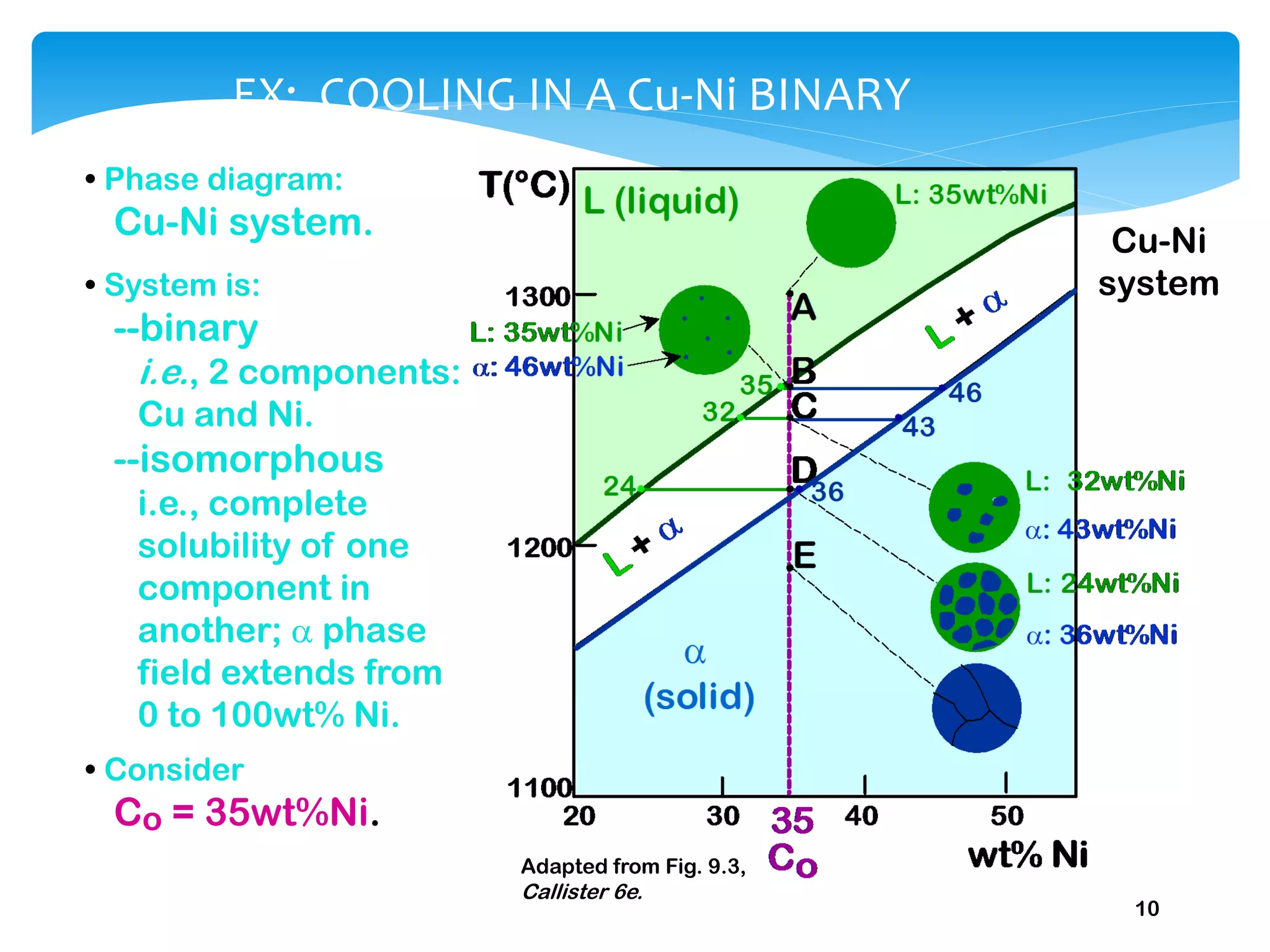
10
• Phase diagram:
Cu-Ni system.
• System is:
--binary
i.e., 2 components:
Cu and Ni.
--isomorphous
i.e., complete
solubility of one
component in
another; a phase
field extends from
0 to 100wt% Ni.
Adapted from Fig. 9.3,
Callister 6e.
• Consider
Co = 35wt%Ni.
Cu-Ni
system
EX: COOLING IN A Cu-Ni BINARY
 Phase: may be defined as a homogeneous portion of system
that has uniform physical and chemical characteristics.
 Composition: the relative content of a particular element or
constituent within an alloy, usually expressed in weight
percent or atom percent.
 Liquidus: Line on the phase diagram that indicates the
temperature above which only liquids are stable.
Equilibrium Phase Diagram Terms
 What is a binary phase diagram and what information
can we obtain from it?
Question

Chapter1 150109004625-conversion-gate01

  • 1.
    CHAPTER 1 MATERIAL STRUCTUREAND BINARY ALLOY SYSTEM
  • 2.
     An elementis a substance that cannot be broken down into simpler substances by ordinary chemical means. An element is a substance consisting of atoms which all have the same number of protons - i.e. the same atomic number. Elements are pure substances (are made from one type of atom only).  Examples of elements: carbon, aluminum, iron, copper, gold etc. Element
  • 3.
     Compounds aresubstances consisting of two or more elements chemically combined in definite proportions by mass to give a material having a definite set of properties different from that of any of its constituent elements.  Compounds can only be separated by chemical means.  Examples of compounds: NaCl, MgO, H2O  Example 1: Water Hydrogen is an element. Oxygen is an element. When hydrogen and oxygen bond they make the compound water (H2O). Compound
  • 4.
     Substances thatare made from more than one type of atom combined physically but not chemically are called mixtures.  There is no chemical reaction involved in mixtures.  In a mixture, the properties of the combination are still the properties of its components.  Mixtures can be separated by physical means. Mixture
  • 5.
     An atomis the smallest part of an element that retains the properties of that element.  Atoms are composed of three primary particles, protons, neutrons and electrons. In a neutral atom, there is the same number of electrons (negative charge) and protons (positive charge). Atomic Structure Particle Symbol Location Relative electrical charge Actual mass in grams Electron e- orbits the nucleus -1 9.11 x 10⁻²⁸ Proton p+ nucleus +1 1.66 x 10⁻²⁴ Neutron n0 nucleus 0 1.66 x 10⁻²⁴
  • 6.
     Lithium has3 protons and 3 neutrons inside the nucleus with 3 electrons orbiting around the nucleus as shown below. Example: Lithium Atom
  • 8.
     1. Groupsor Families a. Vertical columns containing elements with similar chemical properties  2. Periods (series) a. Horizontal rows of elements  3. Metals and Nonmetals a. A stair-step line on the table separates the metals from the nonmetals b. Metalloids (Semimetals) straddle the line and have properties of both metals and nonmetals  4. Lanthanide and Actinide Series (Inner Transition Metals) a. Metals and man-made metal elements  5. Group 1 – Alkali metals (the most reactive metal elements) (except hydrogen (H) also in this group)  6. Group 2 – Alkaline earth metals (very reactive metal elements)  7. Group 17 – Halogens (the most reactive nonmetal elements)  8. Group 18 – Noble gases (the least reactive elements – inert and very stable) Periodic Table
  • 9.
  • 10.
     Have youever wondered how atoms assemble into solid structures?  How does the density of a material depend on its structures? CRYSTAL STRUCTURES
  • 11.
     Solid materialscan broadly be classified as crystalline and non crystalline (amorphous) solids.  In crystalline solid the arrangement of atoms is in a periodically repeating manner whereas no such patterns are found in a non-crystalline solid. CRYSTAL STRUCTURES
  • 12.
     2 typesof crystalline solids: a) Single crystal : the periodic and repeated arrangement of atoms is perfect or extends throughout the entirety of the specimen without interruption. b) Polycrystalline solid : a collective aggregate of many crystals separated by well defined boundaries. CRYSTAL STRUCTURES
  • 13.
     As ageneral rule, most metals are crystalline, while ceramics and polymers may be either crystalline or non-crystalline. CRYSTAL STRUCTURES
  • 14.
    Characteristic Crystalline Non-crystalline Atomic arrangements Regularand orderly manner in all three dimensions Irregular Fracture mechanism Ductile manner. Solids behave elastically up to their yield points Brittle manner. Solids do not behave elastically Tensile strength High Low Dislocation defects Possible Not possible Differences between crystalline and non-crystalline solids
  • 15.
     A crystallinesolid consists of a number of crystals. A crystal structure can be considered as consisting of tiny blocks which are repeated in three dimensional pattern.  Each of the tiny block (called a unit cell) is actually made from the arrangement of a small group of atoms. Unit cell
  • 16.
     Types ofcrystal structure: 1) Simple cubic 2) Body centered cubic (BCC) 3) Face centered cubic (FCC) 4) Hexagonal closed packed (HCP) Crystal Structure
  • 17.
  • 18.
    BODY-CENTERED CUBIC CRYSTAL STRUCTURE FIGURE3.2 For the body-centered cubic crystal structure, (a) a hard sphere unit cell representation, (b) a reduced-sphere unit cell, and (c) an aggregate of many atoms. (Figure (c) from W. G. Moffatt, G. W. Pearsall, and J. Wulff, The Structure and Properties of Materials, Vol. I, Structure, p. 51. Copyright 1964 by John Wiley & Sons, New York. Reprinted by permission of John Wiley & Sons, Inc.)
  • 19.
  • 20.
  • 21.
    a) Crystal :may be defined as a small body having a regular symmetry form, bound by smooth surfaces which are acquired under the action of its inter-atomic forces. b) Space lattice: is composed of unit cells where the unit cells are stacked together endlessly to form the lattice. Each cell in the lattice is identical in size, shape and orientation with each other in the same crystal. c) Grain : An individual crystal in a polycrystalline metal. d) Grain Boundary: the boundary separating the two adjacent grains. Recystallization terms
  • 22.
     Have youever wondered why some materials behave differently from others, for example it is easy to stretch rubber but it is difficult to stretch metals?  Why metals are good electrical conductors while other non-metallic materials are poor conductors?  This is all due to the bonding of atoms. Interatomic Bonding
  • 23.
     The bondsare developed between atoms due to forces of attraction and repulsion which keep nearby atoms in an equilibrium state.  The equilibrium means to have its electron configuration similar to that of inert gases. Interatomic Bonding
  • 24.
     If theoutermost shell is not complete with 8 electrons, atoms of most of the elements form bonds with one another to achieve this stable condition of 8 electrons at the outermost shell.  This can be achieved: i) Atoms sharing one or more electrons with other atoms ii) Atoms gaining one or more electrons with another atom iii) Atoms losing one or more electrons with another atom Interatomic Bonding
  • 25.
    3 types ofprimary bonds: a) Ionic bonding b) Covalent bonding c) Metallic bonding Primary Bonds
  • 26.
     It isalways found in compounds that are composed of both metallic and nonmetallic elements.  Atoms of a metallic element easily give up their valence electrons to the nonmetallic atoms.  The attractive bonding forces are coulombic; that is, positive and negative ions, by virtue of their net electrical charge, attract one another. Ionic bonding
  • 27.
     Ionic bondingis termed nondirectional, that is, the magnitude of the bond is equal in all directions around an ion. Ionic bonding
  • 28.
     In covalentbonding stable electron configurations are assumed by the sharing of electrons between adjacent atoms.  Two atoms that are covalently bonded will each contribute at least one electron to the bond, and the shared electrons may be to belong to both atoms. Covalent Bonding
  • 29.
     Covalent bondingis schematically illustrated in Figure 2.10 for a molecule of methane (CH4). The carbon atom has four valence electrons, whereas each of the four hydrogen atoms has a single valence electron. Covalent Bonding
  • 30.
     Metallic bonding,the final primary bonding type, is found in metals and their alloys.  Metallic materials have one, two, or at most, three valence electrons.  With this model, these valence electrons are not bound to any particular atom in the solid and are more or less free to drift throughout the entire metal.  They may be thought of as belonging to the metal as a whole, or forming a ‘‘sea of electrons’’ or an ‘‘electron cloud.’’  The remaining nonvalence electrons and atomic nuclei form what are called ion cores, which possess a net positive charge equal in magnitude to the total valence electron charge per atom. Metallic bonding
  • 31.
     These freeelectrons act as a ‘‘glue’’ to hold the ion cores together. Metallic bonding
  • 32.
     Solidification isa phase transition in which a liquid turns into a solid when its temperature is lowered below its freezing point.  The melting point of a solid is the temperature at which it changes state from solid to liquid.  When considered as the temperature of the reverse change from liquid to solid, it is referred to as the freezing point or crystallization point. SOLIDIFICATION
  • 33.
     Various stagesin the solidification of a polycrystalline specimen are represented schematically in Figure 3.33. SOLIDIFICATION
  • 34.
    1) Initially, smallcrystals or nuclei form at various positions. These have random crystallographic orientations, as indicated by the square grids. 2) As the nucleus grows, the spherical morphology becomes unstable and its shape becomes perturbed. The solid shape begins to express the preferred growth directions of the crystal. 3) The small grains grow by the successive addition from the surrounding liquid of atoms to the structure of each. Cont.
  • 35.
    4) The solidthen attempts to minimize the area of those surfaces with the highest surface energy. The dendrite thus exhibits a sharper and sharper tip as it grows. 5) As solidification proceeds, an increasing number of atoms lose their kinetic energy, making the process exothermic. 6)The extremities adjacent grains impinge on one another as the solidification process approaches completion. Cont.
  • 36.
    7) As indicatedin Figure 3.33, the crystallographic orientation varies from grain to grain. Also, there exists some atomic mismatch within the region where two grains meet; this area, called a grain boundary. Cont.
  • 37.
  • 38.
    1) Nucleation: Theinitial stage in a phase transformation. 2) Dendrite : is a characteristic tree-like structure of crystals growing as molten metal freezes. 3) Grain : An individual crystal in polycrystalline metal. Solidification phases term
  • 39.
  • 40.
  • 41.
     1) Listthe significant differences between ionic, covalent and metallic bonds  2) List the common crystal structures in metallic solids.  3) What is a unit cell? Question
  • 42.
     Pure metal:contain of one type of metal’s atoms only.  Pure metals are of low strength and do not possess the required properties for engineering application.(seldom used in engineering)  Metal Alloys : Material that is composed of two or more elements, the principal one of which is a metal.  Alloying is done to increase the strength of materials. Metals and Alloys
  • 43.
  • 44.
     A solidsolution is formed when two metals are completely soluble in liquid state and also completely soluble in solid state.  In other words,when homogeneous mixtures of two or more kinds of atoms (of metals) occur in the solid state. DEFINITION
  • 45.
     Solvent: themore abundant atomic form.  Solute: the less abundant atomic form.  Example: 1) Sterling silver (92.5 percent silver and the remainder copper) is a solid solution of silver and copper. Solvent atoms: silver Solute atoms: copper Cont.
  • 46.
     Brass isa solid solution of copper (64 percent) and zinc ( 36 percent). Solvent atoms: copper Solute atoms: zinc Example 2
  • 47.
    Solid solutions areof two types:  a) Substitutional solid solutions  b) Interstitial solid solutions TYPES OF SOLID SOLUTIONS
  • 48.
     If theatoms of the solvent or parent metal are replaced in the crystal lattice by atoms of the solute metal, then the solid solution is known as substitutional solid solution. Substitutional solid solutions
  • 49.
    Cont.  For example,copper atoms may substitute for nickel atoms without disturbing the F.C.C. structure of nickel.
  • 50.
    Cont.  In thesubstitutional solid solutions, the substitution can be either disordered or ordered.
  • 51.
     a) Crystalstructure factor: For complete solid solubility, the two elements should have the same type of crystal structure i.e., both elements should have either F.C.C. or B.C.C. or H.C.P. structure.  (b) Relative size factor: As the size (atomic radii) difference between two elements increases, the solid solubility becomes more restricted. Hume Rothery rules for the formation of substitutional solid solutions
  • 52.
     (c) Chemicalaffinity factor: Solid solubility is favoured when the two metals have lesser chemical affinity. If the chemical affinity of the two metals is greater, then greater is the tendency towards compound formation. Generally,if the two metals are separated in the periodic table widely then they possess greater chemical affinity and are very likely to form some type of compound instead of solid solution. Cont.
  • 53.
     (d) Relativevalence factor: It is found that a metal of lower valence tends to dissolve more of a metal of higher valence than vice versa. For example in aluminium-nickel alloy system, nickel (lower valance) dissolves 5 percent aluminium but aluminium (higher valence) dissolves only 0.04 percent nickel. Cont.
  • 54.
     In interstitialsolid solutions, the solute atom does not displace a solvent atom, but rather it enters one of the holes or interstices between the solvent atoms. Interstitial Solid Solutions
  • 55.
    Example: Iron-Carbon System In this system the carbon (solute atom) atom occupies an interstitial position between iron (solvent atom) atoms. Normally, atoms which have atomic radii less than one angstrom are likely to form interstitial solid solutions. Examples are atoms of carbon (0.77 A°),nitrogen (0.71 A°), hydrogen (0.46 A°), Oxygen (0.60 A°) etc.
  • 57.
    1. Define solidsolution and explain the types of solid solutions. 2. Distinguish between substitutional solid solutions and interstitial solid solutions. QUESTIONS
  • 58.
  • 59.
  • 60.
  • 61.
    10 • Phase diagram: Cu-Nisystem. • System is: --binary i.e., 2 components: Cu and Ni. --isomorphous i.e., complete solubility of one component in another; a phase field extends from 0 to 100wt% Ni. Adapted from Fig. 9.3, Callister 6e. • Consider Co = 35wt%Ni. Cu-Ni system EX: COOLING IN A Cu-Ni BINARY
  • 62.
     Phase: maybe defined as a homogeneous portion of system that has uniform physical and chemical characteristics.  Composition: the relative content of a particular element or constituent within an alloy, usually expressed in weight percent or atom percent.  Liquidus: Line on the phase diagram that indicates the temperature above which only liquids are stable. Equilibrium Phase Diagram Terms
  • 63.
     What isa binary phase diagram and what information can we obtain from it? Question