Presented by:
LOKENDRA PANKAJ
 TYPES OF SOLIDS
 TYPES OF CRYTALLINE SOLIDS
 CRYSTAL LATTICE AND UNIT CELL
 CLOSE PACKING AND EFFICIENCY
 TYPES VOID
 IMPERFECTION IN SOLIDS
 ELECTRICAL AND MEGNATIC PROPERTIES OF SOLIDS
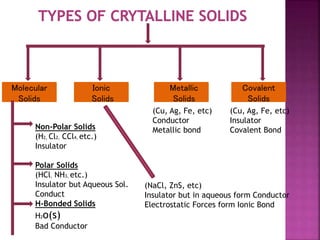
Molecular
Solids
Metallic
Solids
Ionic
Solids
Covalent
Solids
Non-Polar Solids
(H2, Cl2, CCl4, etc.)
Insulator
Polar Solids
(HCl, NH3, etc.)
Insulator but Aqueous Sol.
Conduct
H-Bonded Solids
H2o(s)
Bad Conductor
(NaCl, ZnS, etc)
Insulator but in aqueous form Conductor
Electrostatic Forces form Ionic Bond
(Cu, Ag, Fe, etc)
Conductor
Metallic bond
(Cu, Ag, Fe, etc)
Insulator
Covalent Bond
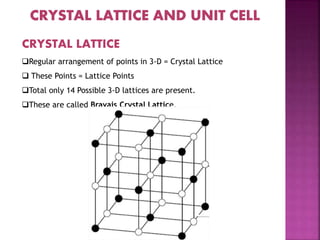
CRYSTAL LATTICE
Regular arrangement of points in 3-D = Crystal Lattice
 These Points = Lattice Points
Total only 14 Possible 3-D lattices are present.
These are called Bravais Crystal Lattice.
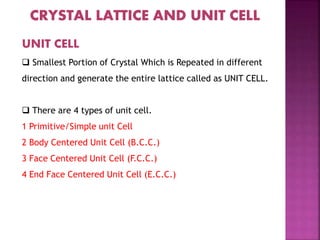
UNIT CELL
 Smallest Portion of Crystal Which is Repeated in different
direction and generate the entire lattice called as UNIT CELL.
 There are 4 types of unit cell.
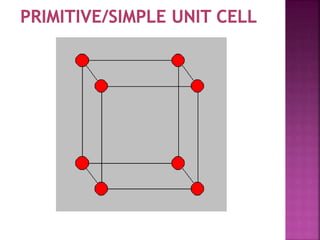
1 Primitive/Simple unit Cell
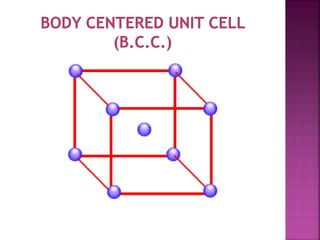
2 Body Centered Unit Cell (B.C.C.)
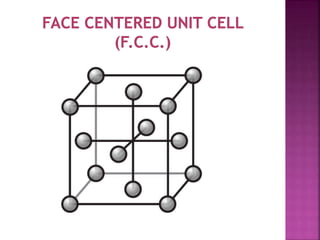
3 Face Centered Unit Cell (F.C.C.)
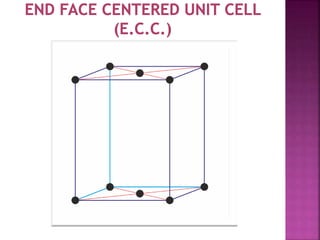
4 End Face Centered Unit Cell (E.C.C.)
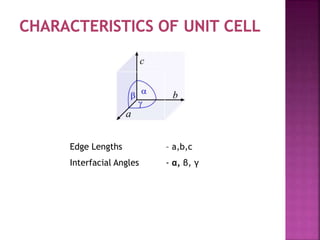
Edge Lengths – a,b,c
Interfacial Angles - α, β, γ
C TOR HMT
Crystal
System
Edge Length Axial Angle Possible Variations Example
CUBIC a=b=c
α=β=γ=90
3(Simple, BCC, FCC) NaCl, KCl
Tetragonal a=b=c α=β=γ=90 2(Simple, BCC)
SnO2,
TiO2
Orthorhombi
c
a=b=c α=β=γ=90
4(Simple, BCC, FCC,
ECC)
Mg, ZnO
Rhombohedr
al
a=b=c α=β=γ=90 1(Simple)
HgS,
CaCO3
Hexagonal a=b=c
α=β=90,
γ=120
1(Simple) Graphite
Monoclinic a=b=c
α=γ=90,
β=90
2(Simple, BCC)
Monoclinic
Sulphur
Triclinic a=b=c α=β=γ=90 1(Simple) K2Cr2O7
Solid State Class 12 Chemistry RBSE or CBSE

Solid State Class 12 Chemistry RBSE or CBSE

  • 1.
  • 2.
     TYPES OFSOLIDS  TYPES OF CRYTALLINE SOLIDS  CRYSTAL LATTICE AND UNIT CELL  CLOSE PACKING AND EFFICIENCY  TYPES VOID  IMPERFECTION IN SOLIDS  ELECTRICAL AND MEGNATIC PROPERTIES OF SOLIDS
  • 3.
    Molecular Solids Metallic Solids Ionic Solids Covalent Solids Non-Polar Solids (H2, Cl2,CCl4, etc.) Insulator Polar Solids (HCl, NH3, etc.) Insulator but Aqueous Sol. Conduct H-Bonded Solids H2o(s) Bad Conductor (NaCl, ZnS, etc) Insulator but in aqueous form Conductor Electrostatic Forces form Ionic Bond (Cu, Ag, Fe, etc) Conductor Metallic bond (Cu, Ag, Fe, etc) Insulator Covalent Bond
  • 4.
    CRYSTAL LATTICE Regular arrangementof points in 3-D = Crystal Lattice  These Points = Lattice Points Total only 14 Possible 3-D lattices are present. These are called Bravais Crystal Lattice.
  • 5.
    UNIT CELL  SmallestPortion of Crystal Which is Repeated in different direction and generate the entire lattice called as UNIT CELL.  There are 4 types of unit cell. 1 Primitive/Simple unit Cell 2 Body Centered Unit Cell (B.C.C.) 3 Face Centered Unit Cell (F.C.C.) 4 End Face Centered Unit Cell (E.C.C.)
  • 10.
    Edge Lengths –a,b,c Interfacial Angles - α, β, γ
  • 11.
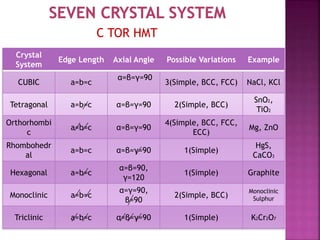
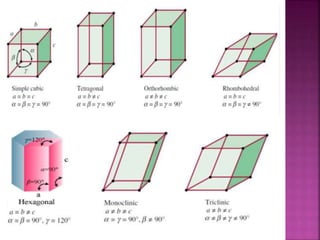
    C TOR HMT Crystal System EdgeLength Axial Angle Possible Variations Example CUBIC a=b=c α=β=γ=90 3(Simple, BCC, FCC) NaCl, KCl Tetragonal a=b=c α=β=γ=90 2(Simple, BCC) SnO2, TiO2 Orthorhombi c a=b=c α=β=γ=90 4(Simple, BCC, FCC, ECC) Mg, ZnO Rhombohedr al a=b=c α=β=γ=90 1(Simple) HgS, CaCO3 Hexagonal a=b=c α=β=90, γ=120 1(Simple) Graphite Monoclinic a=b=c α=γ=90, β=90 2(Simple, BCC) Monoclinic Sulphur Triclinic a=b=c α=β=γ=90 1(Simple) K2Cr2O7