ANATOMICAL POSITION
Prepared: Eric J. Manuevo
PATH-FIT 1
Desired Learning Outcomes:
A. Identify anatomical, reference positions, directional and movement terms;
B. Demonstrate anatomical positions used to reference to the body
C. Distinguish between the commonly used reference positions and recognize
their individual views: and
D. Apply directional and movement terms to their location on the human body
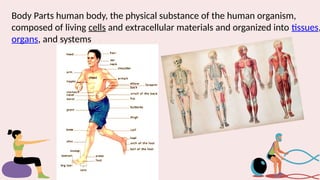
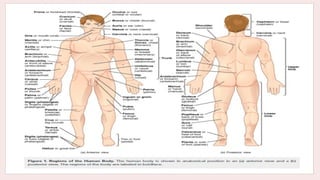
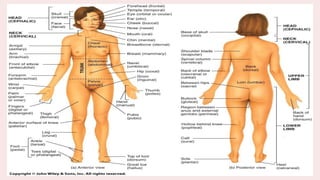
Body Parts human body, the physical substance of the human organism,
composed of living cells and extracellular materials and organized into tissues,
organs, and systems
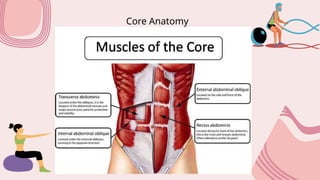
Core Anatomy
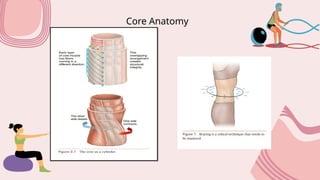
Core Anatomy
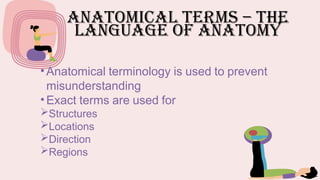
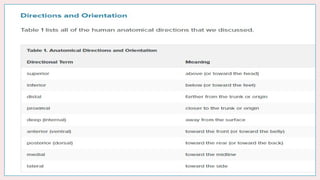
Anatomical Terms – The
Language of Anatomy
• Anatomical terminology is used to prevent
misunderstanding
• Exact terms are used for
Structures
Locations
Direction
Regions
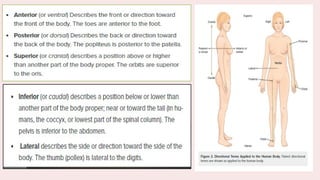
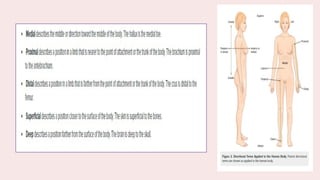
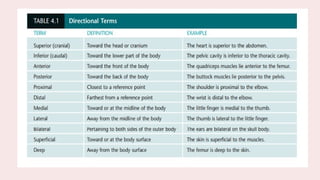
•Terms of position
and direction
describe the position
of one body part
relative to another.
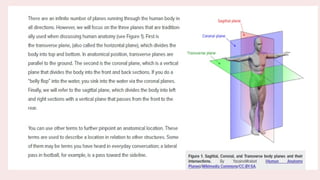
•It usually along one
of the three major
body planes
Four Main
Anatomical Positions of the body
Supine Position- the body is lying flat instead of standing upright,
with the same positioning of the limbs
Four Main
Anatomical Positions of the body
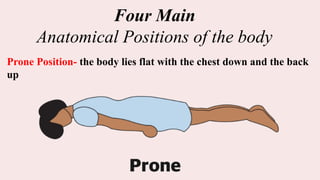
Prone Position- the body lies flat with the chest down and the back
up
Four Main
Anatomical Positions of the body
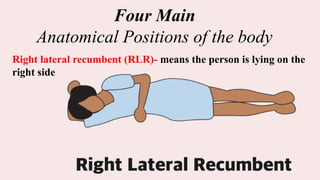
Right lateral recumbent (RLR)- means the person is lying on the
right side
Four Main
Anatomical Positions of the body
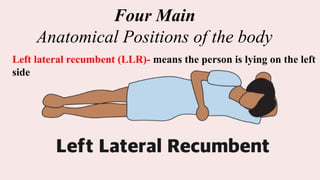
Left lateral recumbent (LLR)- means the person is lying on the left
side
Movements of the Body
Anatomical Positions of the body
Space is an important concept in movement education. Teaching students
about space in terms of movement education involves teaching directions
such as up and down and left and right. However, space is usually taught to
be based in three different planes.
Posture is defined as the relative position of the body and or
the arrangement of its body parts at any moment.
The Sagittal Plane is the imaginary plane that divides the
body into the left and right sides. Movements along this
plane are forward and backward, like bowing to your partner
or shooting a basketball.
The Frontal Plane divides the body into front and back
planes, like the front and back of sandwich. Movements
along the frontal planes are sideways, similar to opening and
closing a door.
The Transverse Plane which involves twisting movements
such as doing a log roll with your body. Also known as
horizontal plane
Medial Plane sagittal plane through the
midline of the body dividing the body or
any of its parts into right and left halves.
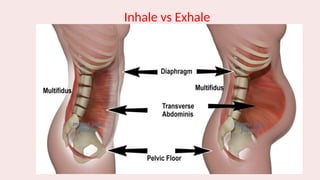
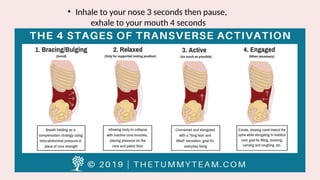
Inhale vs Exhale
• Inhale to your nose 3 seconds then pause,
exhale to your mouth 4 seconds
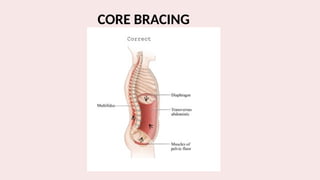
CORE BRACING
Types of Body Movement
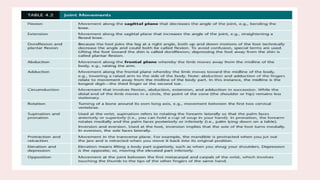
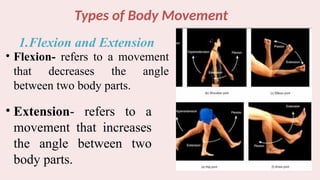
1.Flexion and Extension
• Flexion- refers to a movement
that decreases the angle
between two body parts.
• Extension- refers to a
movement that increases
the angle between two
body parts.
Types of Body Movement
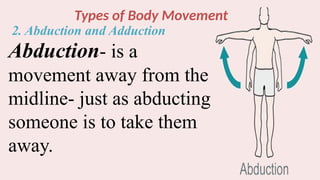
2. Abduction and Adduction
Abduction- is a
movement away from the
midline- just as abducting
someone is to take them
away.
Types of Body Movement
2. Abduction and Adduction
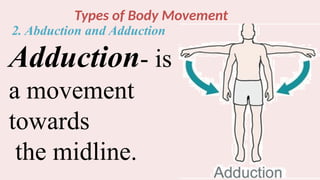
Adduction- is
a movement
towards
the midline.
Types of Body Movement
3. Medial and Lateral
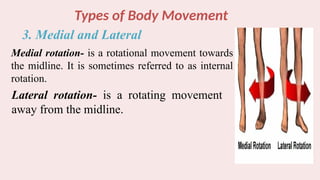
Medial rotation- is a rotational movement towards
the midline. It is sometimes referred to as internal
rotation.
Lateral rotation- is a rotating movement
away from the midline.
Types of Body Movement
4. Elevation and Depression
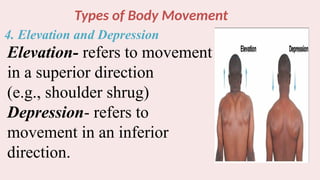
Elevation- refers to movement
in a superior direction
(e.g., shoulder shrug)
Depression- refers to
movement in an inferior
direction.
Types of Body Movement
5. Pronation and Supination
Supination- this is easily confused with medial and
lateral rotation, but the differences is subtle. With
your hand resting on a table in front of you, and
keeping your shoulder and elbow still, turn your
hand onto its back, palm up. This is the supine
position.
Types of Body Movement
5. Pronation and Supination
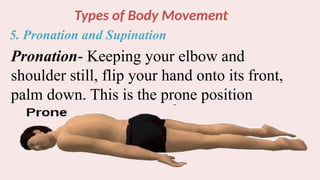
Pronation- Keeping your elbow and
shoulder still, flip your hand onto its front,
palm down. This is the prone position
Types of Body Movement
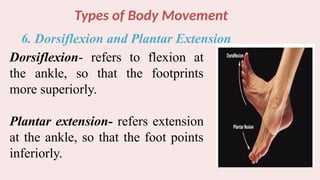
6. Dorsiflexion and Plantar Extension
Dorsiflexion- refers to flexion at
the ankle, so that the footprints
more superiorly.
Plantar extension- refers extension
at the ankle, so that the foot points
inferiorly.
Types of Body Movement
7. Inversion and Eversion
Inversion- involves the movement
of the sole towards the median
plane.
Eversion-involves the movement of
the sole away from the median
plane
Types of Body Movement
8. Opposition and Reposition
Opposition- brings the thumb and
little finger together.
Reposition- is a movement that
moves the thumb away from each
other.
Types of Body Movement
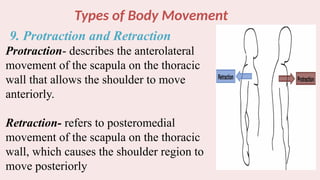
9. Protraction and Retraction
Protraction- describes the anterolateral
movement of the scapula on the thoracic
wall that allows the shoulder to move
anteriorly.
Retraction- refers to posteromedial
movement of the scapula on the thoracic
wall, which causes the shoulder region to
move posteriorly
Types of Body Movement
Ipsilateral – refers to the same body
Contralateral-means opposite side of the body.
Neutral position- refers to the position of the
spine where all the three curves of the spine-
cervical(neck), thoracic(middle) and lumbar
(lower)- are in good alignment.
The Body Shape
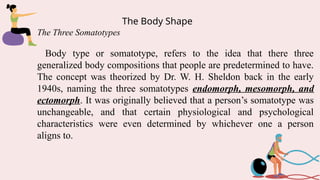
The Three Somatotypes
Body type or somatotype, refers to the idea that there three
generalized body compositions that people are predetermined to have.
The concept was theorized by Dr. W. H. Sheldon back in the early
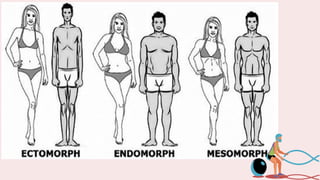
1940s, naming the three somatotypes endomorph, mesomorph, and
ectomorph. It was originally believed that a person’s somatotype was
unchangeable, and that certain physiological and psychological
characteristics were even determined by whichever one a person
aligns to.
Endomorph
Relative predominance of soft
roundness throughout various
regions of the body
Have a more relaxed,
comfortable, and extroverted
personality.
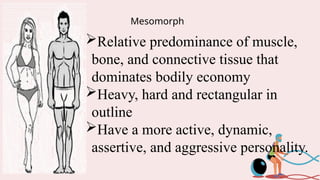
Mesomorph
Relative predominance of muscle,
bone, and connective tissue that
dominates bodily economy
Heavy, hard and rectangular in
outline
Have a more active, dynamic,
assertive, and aggressive personality.
Relative predominance of linearity
and fragility
Greatest skin surface area relative
to body mass causes greater
sensory exposure.
Have a more active, dynamic,
assertive, and aggressive
personality.
Ectomorph
Activities
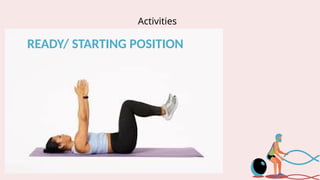
READY/ STARTING POSITION
MOVEMENT CUES OBSERVED NOT OBSERVED
NEUTRAL SPINE TO THE NECK
FEET HIP WIDTH APART
HOLD FOR 10 SECONDS
BRACE POSITION
Activities
Activities
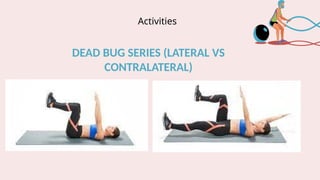
DEAD BUG SERIES (LATERAL VS
CONTRALATERAL)
Activities
DEAD BUG PROGRESSION
Activities
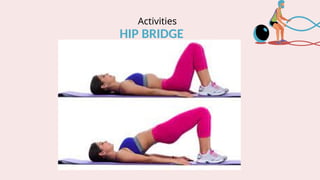
HIP BRIDGE
Activities
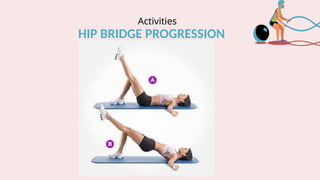
HIP BRIDGE PROGRESSION
Activities
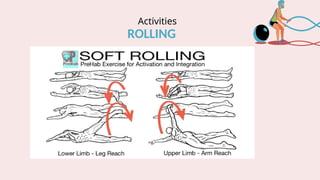
ROLLING
Activities
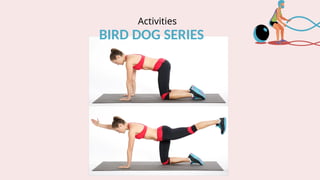
BIRD DOG SERIES
Activities
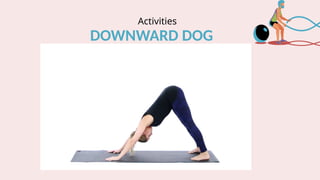
DOWNWARD DOG
Activities
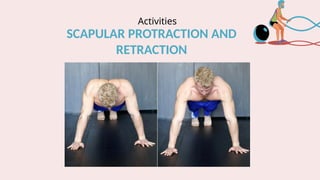
SCAPULAR PROTRACTION AND
RETRACTION
Activities
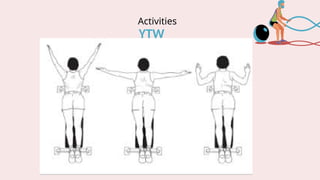
YTW
Activities
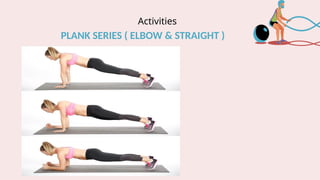
PLANK SERIES ( ELBOW & STRAIGHT )
Activities
SQUAT SERIES
Activities
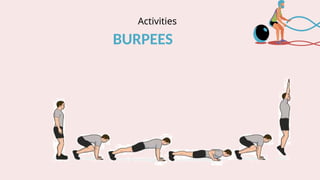
BURPEES
THANK YOU

pathfit1-LESSON 1-ANATOMICAL POSITIONS.pptx

  • 1.
  • 2.
    Desired Learning Outcomes: A.Identify anatomical, reference positions, directional and movement terms; B. Demonstrate anatomical positions used to reference to the body C. Distinguish between the commonly used reference positions and recognize their individual views: and D. Apply directional and movement terms to their location on the human body
  • 3.
    Body Parts humanbody, the physical substance of the human organism, composed of living cells and extracellular materials and organized into tissues, organs, and systems
  • 4.
  • 5.
  • 6.
    Anatomical Terms –The Language of Anatomy • Anatomical terminology is used to prevent misunderstanding • Exact terms are used for Structures Locations Direction Regions
  • 10.
    •Terms of position anddirection describe the position of one body part relative to another. •It usually along one of the three major body planes
  • 19.
    Four Main Anatomical Positionsof the body Supine Position- the body is lying flat instead of standing upright, with the same positioning of the limbs
  • 20.
    Four Main Anatomical Positionsof the body Prone Position- the body lies flat with the chest down and the back up
  • 21.
    Four Main Anatomical Positionsof the body Right lateral recumbent (RLR)- means the person is lying on the right side
  • 22.
    Four Main Anatomical Positionsof the body Left lateral recumbent (LLR)- means the person is lying on the left side
  • 23.
    Movements of theBody Anatomical Positions of the body Space is an important concept in movement education. Teaching students about space in terms of movement education involves teaching directions such as up and down and left and right. However, space is usually taught to be based in three different planes. Posture is defined as the relative position of the body and or the arrangement of its body parts at any moment.
  • 24.
    The Sagittal Planeis the imaginary plane that divides the body into the left and right sides. Movements along this plane are forward and backward, like bowing to your partner or shooting a basketball. The Frontal Plane divides the body into front and back planes, like the front and back of sandwich. Movements along the frontal planes are sideways, similar to opening and closing a door. The Transverse Plane which involves twisting movements such as doing a log roll with your body. Also known as horizontal plane
  • 25.
    Medial Plane sagittalplane through the midline of the body dividing the body or any of its parts into right and left halves.
  • 26.
  • 27.
    • Inhale toyour nose 3 seconds then pause, exhale to your mouth 4 seconds
  • 28.
  • 29.
    Types of BodyMovement 1.Flexion and Extension • Flexion- refers to a movement that decreases the angle between two body parts. • Extension- refers to a movement that increases the angle between two body parts.
  • 30.
    Types of BodyMovement 2. Abduction and Adduction Abduction- is a movement away from the midline- just as abducting someone is to take them away.
  • 31.
    Types of BodyMovement 2. Abduction and Adduction Adduction- is a movement towards the midline.
  • 32.
    Types of BodyMovement 3. Medial and Lateral Medial rotation- is a rotational movement towards the midline. It is sometimes referred to as internal rotation. Lateral rotation- is a rotating movement away from the midline.
  • 33.
    Types of BodyMovement 4. Elevation and Depression Elevation- refers to movement in a superior direction (e.g., shoulder shrug) Depression- refers to movement in an inferior direction.
  • 34.
    Types of BodyMovement 5. Pronation and Supination Supination- this is easily confused with medial and lateral rotation, but the differences is subtle. With your hand resting on a table in front of you, and keeping your shoulder and elbow still, turn your hand onto its back, palm up. This is the supine position.
  • 35.
    Types of BodyMovement 5. Pronation and Supination Pronation- Keeping your elbow and shoulder still, flip your hand onto its front, palm down. This is the prone position
  • 36.
    Types of BodyMovement 6. Dorsiflexion and Plantar Extension Dorsiflexion- refers to flexion at the ankle, so that the footprints more superiorly. Plantar extension- refers extension at the ankle, so that the foot points inferiorly.
  • 37.
    Types of BodyMovement 7. Inversion and Eversion Inversion- involves the movement of the sole towards the median plane. Eversion-involves the movement of the sole away from the median plane
  • 38.
    Types of BodyMovement 8. Opposition and Reposition Opposition- brings the thumb and little finger together. Reposition- is a movement that moves the thumb away from each other.
  • 39.
    Types of BodyMovement 9. Protraction and Retraction Protraction- describes the anterolateral movement of the scapula on the thoracic wall that allows the shoulder to move anteriorly. Retraction- refers to posteromedial movement of the scapula on the thoracic wall, which causes the shoulder region to move posteriorly
  • 40.
    Types of BodyMovement Ipsilateral – refers to the same body Contralateral-means opposite side of the body. Neutral position- refers to the position of the spine where all the three curves of the spine- cervical(neck), thoracic(middle) and lumbar (lower)- are in good alignment.
  • 41.
    The Body Shape TheThree Somatotypes Body type or somatotype, refers to the idea that there three generalized body compositions that people are predetermined to have. The concept was theorized by Dr. W. H. Sheldon back in the early 1940s, naming the three somatotypes endomorph, mesomorph, and ectomorph. It was originally believed that a person’s somatotype was unchangeable, and that certain physiological and psychological characteristics were even determined by whichever one a person aligns to.
  • 42.
    Endomorph Relative predominance ofsoft roundness throughout various regions of the body Have a more relaxed, comfortable, and extroverted personality.
  • 43.
    Mesomorph Relative predominance ofmuscle, bone, and connective tissue that dominates bodily economy Heavy, hard and rectangular in outline Have a more active, dynamic, assertive, and aggressive personality.
  • 44.
    Relative predominance oflinearity and fragility Greatest skin surface area relative to body mass causes greater sensory exposure. Have a more active, dynamic, assertive, and aggressive personality. Ectomorph
  • 46.
  • 47.
    MOVEMENT CUES OBSERVEDNOT OBSERVED NEUTRAL SPINE TO THE NECK FEET HIP WIDTH APART HOLD FOR 10 SECONDS BRACE POSITION Activities
  • 48.
    Activities DEAD BUG SERIES(LATERAL VS CONTRALATERAL)
  • 49.
  • 50.
  • 51.
  • 52.
  • 53.
  • 54.
  • 55.
  • 56.
  • 57.
    Activities PLANK SERIES (ELBOW & STRAIGHT )
  • 58.
  • 59.
  • 60.

Editor's Notes

  • #3 RECTUS ABDOMINIS OBLIQUES PECTORALIS MINOR PECTORALIS MAJOR LATISIMUS DORSI TRAPEZIUS
  • #4 RECTUS ABDOMINIS OBLIQUES PECTORALIS MINOR PECTORALIS MAJOR LATISIMUS DORSI TRAPEZIUS