1
The Study of Human Development
Chapter 1
© 2009 by the McGraw-Hill Companies, Inc
2
Did you know?
⚫ In some societies there is no concept of adolescence
or middle age?
⚫ Within the next 50 years, it has been estimated that
half the US population will be Hispanic, black, or
Asian?
⚫ More than 36 million people still live in poverty?
⚫ According to research, children who have been
exposed to television and computers from an early
age develop differently than children who grew up
without them?
© 2009 by the McGraw-Hill Companies, Inc
3
Human Development
⚫ Human Development: the scientific study of
processes of change and stability throughout
the human life span
⚫ Developmental Scientists: professionals who
study the science of development
– Their work can have a drastic impact on human
lives
⚫ Example: Researchers in Boston found that children
who went to school hungry or lacked essential nutrients
in their diets had poorer grades and more emotional or
behavioral problems © 2009 by the McGraw-Hill Companies, Inc
4
© 2009 by the McGraw-Hill Companies, Inc
Formal Study of
Human Development
⚫ The Scientific Study of How Humans Develop
– Development is systematic (coherent and organized)
– Development is adaptive (it is aimed at dealing with internal
and external conditions of existence)
– Development is life-long (i.e. life-span development)
⚫ Stanford Studies of Gifted Children
5
© 2009 by the McGraw-Hill Companies, Inc
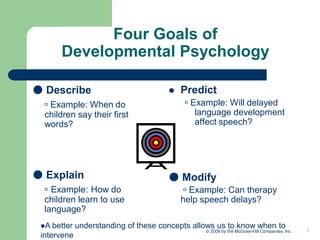
Four Goals of
Developmental Psychology
● Describe
 Example: When do
children say their first
words?
● Explain
 Example: How do
children learn to use
language?
⚫ Predict
 Example: Will delayed
language development
affect speech?
● Modify
 Example: Can therapy
help speech delays?
⚫A better understanding of these concepts allows us to know when to
intervene
6
© 2009 by the McGraw-Hill Companies, Inc
Domains of Development
Change & Stability
⚫ Developmental Scientists study the
following 3 main domains:
– Physical Development
 Body, brain, senses, motor skills, & health
– Cognitive Development
 Learning, memory, moral reasoning, language,
thinking, & creativity
– Psychosocial Development
 Personality, emotional life, & relationships
7
3 Domains
⚫ Although we speak of each of these domains
as if they were separate, they all impact each
other.
⚫ “Our brains work better, our thinking is
sharper, our moods are brighter, and our
vulnerability to disease diminishes if we are
physically fit.”
⚫ For example, a child who develops an ear
infection may have delayed speech.
© 2009 by the McGraw-Hill Companies, Inc
8
© 2009 by the McGraw-Hill Companies, Inc
Periods of the Life Span:
A Social Construction
• Based on subjective perceptions or
assumptions
• Varies among cultures
• Changes over generations
 Adolescence only recently introduced in industrial
societies
 In the past people were considered children until they
left school. Adolescence was developed as a concept
when formal high schools were developed and more
families become financially capable of providing
increased schooling to children
9
© 2009 by the McGraw-Hill Companies, Inc
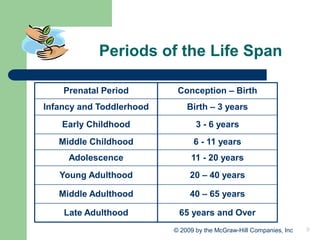
Periods of the Life Span
Prenatal Period Conception – Birth
Infancy and Toddlerhood Birth – 3 years
Early Childhood 3 - 6 years
Middle Childhood 6 - 11 years
Adolescence 11 - 20 years
Young Adulthood 20 – 40 years
Middle Adulthood 40 – 65 years
Late Adulthood 65 years and Over
10
© 2009 by the McGraw-Hill Companies, Inc
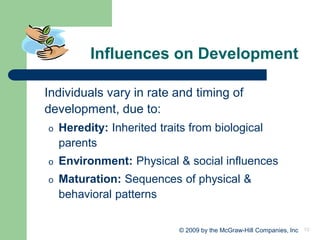
Influences on Development
Individuals vary in rate and timing of
development, due to:
o Heredity: Inherited traits from biological
parents
o Environment: Physical & social influences
o Maturation: Sequences of physical &
behavioral patterns
11
© 2009 by the McGraw-Hill Companies, Inc
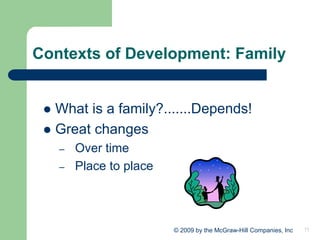
Contexts of Development: Family
⚫ What is a family?.......Depends!
⚫ Great changes
– Over time
– Place to place
12
© 2009 by the McGraw-Hill Companies, Inc
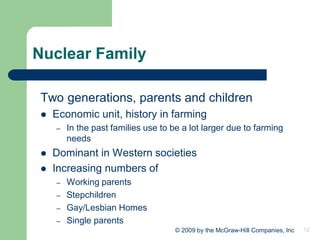
Nuclear Family
Two generations, parents and children
⚫ Economic unit, history in farming
– In the past families use to be a lot larger due to farming
needs
⚫ Dominant in Western societies
⚫ Increasing numbers of
– Working parents
– Stepchildren
– Gay/Lesbian Homes
– Single parents
13
© 2009 by the McGraw-Hill Companies, Inc
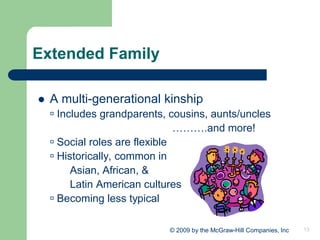
Extended Family
⚫ A multi-generational kinship
 Includes grandparents, cousins, aunts/uncles
……….and more!
 Social roles are flexible
 Historically, common in
Asian, African, &
Latin American cultures
 Becoming less typical
14
© 2009 by the McGraw-Hill Companies, Inc
Contexts of Development:
Socioeconomic Status (SES)
⚫ Includes income, education & occupation
 Poor children more likely to:
 Have emotional & behavior problems
 Not reach cognitive potential
 Have poorer school performance
Why may this be the case?
Do affluent children face issues also?
15
© 2009 by the McGraw-Hill Companies, Inc
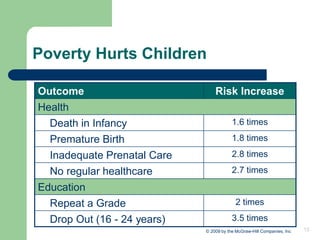
Poverty Hurts Children
Outcome Risk Increase
Health
Death in Infancy 1.6 times
Premature Birth 1.8 times
Inadequate Prenatal Care 2.8 times
No regular healthcare 2.7 times
Education
Repeat a Grade 2 times
Drop Out (16 - 24 years) 3.5 times
16
© 2009 by the McGraw-Hill Companies, Inc
Low SES &
Related Risk Factors
⚫ Poverty-related risks that increase
chance of negative outcomes include:
 Living in neighborhoods with high
unemployment
 Lack of social support
 Social support less likely in high-
unemployment neighborhoods
17
© 2009 by the McGraw-Hill Companies, Inc
Contexts of Development:
Culture
⚫ Culture – A way of life
 Includes:
– Customs
– Traditions
– Artwork
 Learned behavior, passed on to children
18
© 2009 by the McGraw-Hill Companies, Inc
Contexts of Development:
Race & Ethnicity
● Ethnic Group – A shared identity
 United by ancestry, religion, or origin (cultural)
 Contributes to shared attitudes & beliefs
● Race – A socially-constructed term
 Scholars have no real consensus on definition
 Categories ‘fluid’ – shaped by society & politics
● Ethnic Gloss
 Overgeneralization that obscures cultural
differences within a group
 Examples: ‘Black’ or ‘Hispanic’. What can be an issue
with this?
19
© 2009 by the McGraw-Hill Companies, Inc
Contexts of Development:
Historical Context
⚫ Unique time in which people live & grow up
⚫ Experiences tied to time and place:
– Great Depression
– World War II
– The “Sixties”
20
© 2009 by the McGraw-Hill Companies, Inc
Age-Graded
Normative Influences
⚫ Similar for an age group
 Maturational: Fixed in time
 Puberty or menopause
 Social: Timing is flexible
 Marriage or parenthood
21
© 2009 by the McGraw-Hill Companies, Inc
Normative
History-Graded Influences
⚫ Events that shape attitudes of a
historical generation
o Historical Generation: A group that
experiences an event at a formative time
⚫ Ex: WWII children have strong social bond to each other
o Cohort: Group born around the same time
⚫ A historical generation can have many cohorts
22
© 2009 by the McGraw-Hill Companies, Inc
Non-Normative Influences
⚫ Unusual events affecting individual lives
 Typical events at atypical times
 Puberty at age 20
 Marriage in teens
 Atypical events
 Birth defect
 Winning the lottery
23
© 2009 by the McGraw-Hill Companies, Inc
Timing of Influences
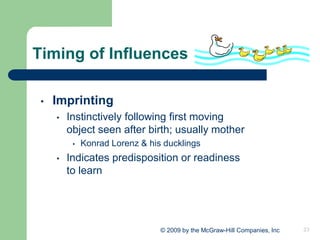
• Imprinting
• Instinctively following first moving
object seen after birth; usually mother
• Konrad Lorenz & his ducklings
• Indicates predisposition or readiness
to learn
24
© 2009 by the McGraw-Hill Companies, Inc
Timing of Influences:
Critical & Sensitive Periods
 Critical Period
 Specific time when an event (or its absence) has
specific impact on development
 Example: Genie
 Sensitive Period
 Developmental timing when child is particularly
responsive to certain experiences.
25
© 2009 by the McGraw-Hill Companies, Inc
Timing of Influences:
Plasticity of Development
 Modifiability of performance
Plasticity lasts through life span,
but has limits
– Example: Limits and progress of
Genie
26
© 2009 by the McGraw-Hill Companies, Inc
Baltes’s Life Span Approach:
6 Key Principles
• Development is lifelong
• Each period of the lifespan is affected by what happened before and will
affect what happens after
• Development is multidimensional
• It is affected by biology, psychology, and social aspects
• Development is multidirectional
• Some abilities increase and others decrease
• Development involves changing resource allocations
• Individuals chose to invest their resources of time, energy, talent, money, and
social support in different ways.
• Development shows plasticity
• Many abilities can be improved even late in life
• Development is influenced by the historical and cultural context
• History and culture influence your development.

Chapter 1 DevPsych.pdf

  • 1.
    1 The Study ofHuman Development Chapter 1 © 2009 by the McGraw-Hill Companies, Inc
  • 2.
    2 Did you know? ⚫In some societies there is no concept of adolescence or middle age? ⚫ Within the next 50 years, it has been estimated that half the US population will be Hispanic, black, or Asian? ⚫ More than 36 million people still live in poverty? ⚫ According to research, children who have been exposed to television and computers from an early age develop differently than children who grew up without them? © 2009 by the McGraw-Hill Companies, Inc
  • 3.
    3 Human Development ⚫ HumanDevelopment: the scientific study of processes of change and stability throughout the human life span ⚫ Developmental Scientists: professionals who study the science of development – Their work can have a drastic impact on human lives ⚫ Example: Researchers in Boston found that children who went to school hungry or lacked essential nutrients in their diets had poorer grades and more emotional or behavioral problems © 2009 by the McGraw-Hill Companies, Inc
  • 4.
    4 © 2009 bythe McGraw-Hill Companies, Inc Formal Study of Human Development ⚫ The Scientific Study of How Humans Develop – Development is systematic (coherent and organized) – Development is adaptive (it is aimed at dealing with internal and external conditions of existence) – Development is life-long (i.e. life-span development) ⚫ Stanford Studies of Gifted Children
  • 5.
    5 © 2009 bythe McGraw-Hill Companies, Inc Four Goals of Developmental Psychology ● Describe  Example: When do children say their first words? ● Explain  Example: How do children learn to use language? ⚫ Predict  Example: Will delayed language development affect speech? ● Modify  Example: Can therapy help speech delays? ⚫A better understanding of these concepts allows us to know when to intervene
  • 6.
    6 © 2009 bythe McGraw-Hill Companies, Inc Domains of Development Change & Stability ⚫ Developmental Scientists study the following 3 main domains: – Physical Development  Body, brain, senses, motor skills, & health – Cognitive Development  Learning, memory, moral reasoning, language, thinking, & creativity – Psychosocial Development  Personality, emotional life, & relationships
  • 7.
    7 3 Domains ⚫ Althoughwe speak of each of these domains as if they were separate, they all impact each other. ⚫ “Our brains work better, our thinking is sharper, our moods are brighter, and our vulnerability to disease diminishes if we are physically fit.” ⚫ For example, a child who develops an ear infection may have delayed speech. © 2009 by the McGraw-Hill Companies, Inc
  • 8.
    8 © 2009 bythe McGraw-Hill Companies, Inc Periods of the Life Span: A Social Construction • Based on subjective perceptions or assumptions • Varies among cultures • Changes over generations  Adolescence only recently introduced in industrial societies  In the past people were considered children until they left school. Adolescence was developed as a concept when formal high schools were developed and more families become financially capable of providing increased schooling to children
  • 9.
    9 © 2009 bythe McGraw-Hill Companies, Inc Periods of the Life Span Prenatal Period Conception – Birth Infancy and Toddlerhood Birth – 3 years Early Childhood 3 - 6 years Middle Childhood 6 - 11 years Adolescence 11 - 20 years Young Adulthood 20 – 40 years Middle Adulthood 40 – 65 years Late Adulthood 65 years and Over
  • 10.
    10 © 2009 bythe McGraw-Hill Companies, Inc Influences on Development Individuals vary in rate and timing of development, due to: o Heredity: Inherited traits from biological parents o Environment: Physical & social influences o Maturation: Sequences of physical & behavioral patterns
  • 11.
    11 © 2009 bythe McGraw-Hill Companies, Inc Contexts of Development: Family ⚫ What is a family?.......Depends! ⚫ Great changes – Over time – Place to place
  • 12.
    12 © 2009 bythe McGraw-Hill Companies, Inc Nuclear Family Two generations, parents and children ⚫ Economic unit, history in farming – In the past families use to be a lot larger due to farming needs ⚫ Dominant in Western societies ⚫ Increasing numbers of – Working parents – Stepchildren – Gay/Lesbian Homes – Single parents
  • 13.
    13 © 2009 bythe McGraw-Hill Companies, Inc Extended Family ⚫ A multi-generational kinship  Includes grandparents, cousins, aunts/uncles ……….and more!  Social roles are flexible  Historically, common in Asian, African, & Latin American cultures  Becoming less typical
  • 14.
    14 © 2009 bythe McGraw-Hill Companies, Inc Contexts of Development: Socioeconomic Status (SES) ⚫ Includes income, education & occupation  Poor children more likely to:  Have emotional & behavior problems  Not reach cognitive potential  Have poorer school performance Why may this be the case? Do affluent children face issues also?
  • 15.
    15 © 2009 bythe McGraw-Hill Companies, Inc Poverty Hurts Children Outcome Risk Increase Health Death in Infancy 1.6 times Premature Birth 1.8 times Inadequate Prenatal Care 2.8 times No regular healthcare 2.7 times Education Repeat a Grade 2 times Drop Out (16 - 24 years) 3.5 times
  • 16.
    16 © 2009 bythe McGraw-Hill Companies, Inc Low SES & Related Risk Factors ⚫ Poverty-related risks that increase chance of negative outcomes include:  Living in neighborhoods with high unemployment  Lack of social support  Social support less likely in high- unemployment neighborhoods
  • 17.
    17 © 2009 bythe McGraw-Hill Companies, Inc Contexts of Development: Culture ⚫ Culture – A way of life  Includes: – Customs – Traditions – Artwork  Learned behavior, passed on to children
  • 18.
    18 © 2009 bythe McGraw-Hill Companies, Inc Contexts of Development: Race & Ethnicity ● Ethnic Group – A shared identity  United by ancestry, religion, or origin (cultural)  Contributes to shared attitudes & beliefs ● Race – A socially-constructed term  Scholars have no real consensus on definition  Categories ‘fluid’ – shaped by society & politics ● Ethnic Gloss  Overgeneralization that obscures cultural differences within a group  Examples: ‘Black’ or ‘Hispanic’. What can be an issue with this?
  • 19.
    19 © 2009 bythe McGraw-Hill Companies, Inc Contexts of Development: Historical Context ⚫ Unique time in which people live & grow up ⚫ Experiences tied to time and place: – Great Depression – World War II – The “Sixties”
  • 20.
    20 © 2009 bythe McGraw-Hill Companies, Inc Age-Graded Normative Influences ⚫ Similar for an age group  Maturational: Fixed in time  Puberty or menopause  Social: Timing is flexible  Marriage or parenthood
  • 21.
    21 © 2009 bythe McGraw-Hill Companies, Inc Normative History-Graded Influences ⚫ Events that shape attitudes of a historical generation o Historical Generation: A group that experiences an event at a formative time ⚫ Ex: WWII children have strong social bond to each other o Cohort: Group born around the same time ⚫ A historical generation can have many cohorts
  • 22.
    22 © 2009 bythe McGraw-Hill Companies, Inc Non-Normative Influences ⚫ Unusual events affecting individual lives  Typical events at atypical times  Puberty at age 20  Marriage in teens  Atypical events  Birth defect  Winning the lottery
  • 23.
    23 © 2009 bythe McGraw-Hill Companies, Inc Timing of Influences • Imprinting • Instinctively following first moving object seen after birth; usually mother • Konrad Lorenz & his ducklings • Indicates predisposition or readiness to learn
  • 24.
    24 © 2009 bythe McGraw-Hill Companies, Inc Timing of Influences: Critical & Sensitive Periods  Critical Period  Specific time when an event (or its absence) has specific impact on development  Example: Genie  Sensitive Period  Developmental timing when child is particularly responsive to certain experiences.
  • 25.
    25 © 2009 bythe McGraw-Hill Companies, Inc Timing of Influences: Plasticity of Development  Modifiability of performance Plasticity lasts through life span, but has limits – Example: Limits and progress of Genie
  • 26.
    26 © 2009 bythe McGraw-Hill Companies, Inc Baltes’s Life Span Approach: 6 Key Principles • Development is lifelong • Each period of the lifespan is affected by what happened before and will affect what happens after • Development is multidimensional • It is affected by biology, psychology, and social aspects • Development is multidirectional • Some abilities increase and others decrease • Development involves changing resource allocations • Individuals chose to invest their resources of time, energy, talent, money, and social support in different ways. • Development shows plasticity • Many abilities can be improved even late in life • Development is influenced by the historical and cultural context • History and culture influence your development.