Arithmetic and
Geometric Sequences
1
All Rights Reserved
Business Mathematics (Fourth Edition)
© Oxford Fajar Sdn. Bhd. (008974-T), 2019 1–3
Learning Outcomes
By the end of this chapter, you should be able to
✔ explain the terms sequence, arithmetic and geometric
sequence
✔ identify arithmetic and geometric sequences
✔ calculate the terms in arithmetic and geometric
sequences
✔ calculate the sum of terms in arithmetic and geometric
sequences
✔ apply the concepts of arithmetic and geometric
sequences to some common problems in daily life
All Rights Reserved
Business Mathematics (Fourth Edition)
© Oxford Fajar Sdn. Bhd. (008974-T), 2019 1–4
1.1 Introduction
 A sequence or progression is a succession of
terms T1, T2, T3, ..., formed according to a
certain fixed rule.
 A series is the indicated sum, T1 + T2 + T3 +...,
of the terms of a sequence.
All Rights Reserved
Business Mathematics (Fourth Edition)
© Oxford Fajar Sdn. Bhd. (008974-T), 2019 1–5
1.2 Arithmetic Sequence
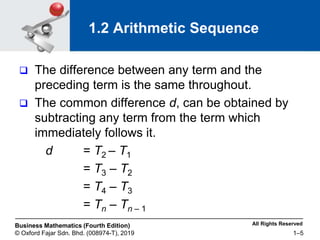
 The difference between any term and the
preceding term is the same throughout.
 The common difference d, can be obtained by
subtracting any term from the term which
immediately follows it.
d = T2 – T1
= T3 – T2
= T4 – T3
= Tn – Tn – 1
All Rights Reserved
Business Mathematics (Fourth Edition)
© Oxford Fajar Sdn. Bhd. (008974-T), 2019 1–6
1.2 Arithmetic Sequence (Cont.)
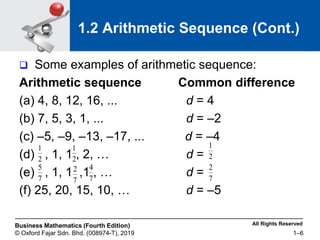
 Some examples of arithmetic sequence:
Arithmetic sequence Common difference
(a) 4, 8, 12, 16, ... d = 4
(b) 7, 5, 3, 1, ... d = –2
(c) –5, –9, –13, –17, ... d = –4
(d) , 1, 1 , 2, … d =
(e) , 1, 1 ,1 , … d =
(f) 25, 20, 15, 10, … d = –5
2
1
2
1
7
5
7
2
7
4
7
2
2
1
All Rights Reserved
Business Mathematics (Fourth Edition)
© Oxford Fajar Sdn. Bhd. (008974-T), 2019 1–7
1.3 nth Term and Sum of
First n Terms of an
Arithmetic Sequence
 Let a = the first term, d = the common
difference, the nth term, Tn is given by
Tn = a + (n – 1)d
The sum of the first n terms, Sn is
Sn = [2a + (n – 1)d] or
Sn = (a + l)
where l = the last term = a + (n – 1)d
2
n
2
n
All Rights Reserved
Business Mathematics (Fourth Edition)
© Oxford Fajar Sdn. Bhd. (008974-T), 2019 1–8
1.3 nth Term and Sum of First n
Terms of an Arithmetic
Sequence (Cont.)
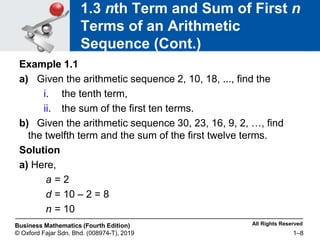
Example 1.1
a) Given the arithmetic sequence 2, 10, 18, ..., find the
i. the tenth term,
ii. the sum of the first ten terms.
b) Given the arithmetic sequence 30, 23, 16, 9, 2, …, find
the twelfth term and the sum of the first twelve terms.
Solution
a) Here,
a = 2
d = 10 – 2 = 8
n = 10
All Rights Reserved
Business Mathematics (Fourth Edition)
© Oxford Fajar Sdn. Bhd. (008974-T), 2019 1–9
1.3 nth Term and Sum of
First n Terms of an
Arithmetic Sequence (Cont.)
i. From Tn = a + (n – 1)d, we get
T10 = 2 + (10 – 1)8
= 74
ii. From Sn = [2a + (n – 1)d], we get
S10 = [2(2) + (10 – 1)8]
= 380
2
n
2
10
All Rights Reserved
Business Mathematics (Fourth Edition)
© Oxford Fajar Sdn. Bhd. (008974-T), 2019 1–10
1.3 nth Term and Sum of First n
Terms of an Arithmetic
Sequence (Cont.)
b) Here, the first term a = 30 and common difference d = –7
The twelfth term is T12 = a + (n – 1)d
= 30 + (12 – 1)(–7)
= –47
The sum of the first twelve terms,
S12 = [2(30) + (12 – 1)(–7)]
= –102
2
12
All Rights Reserved
Business Mathematics (Fourth Edition)
© Oxford Fajar Sdn. Bhd. (008974-T), 2019 1–11
1.3 nth Term and Sum of First n
Terms of an Arithmetic
Sequence (Cont.)
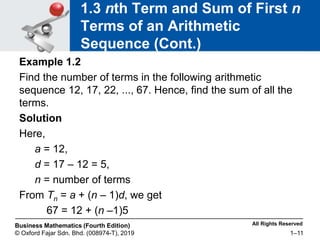
Example 1.2
Find the number of terms in the following arithmetic
sequence 12, 17, 22, ..., 67. Hence, find the sum of all the
terms.
Solution
Here,
a = 12,
d = 17 – 12 = 5,
n = number of terms
From Tn = a + (n – 1)d, we get
67 = 12 + (n –1)5
All Rights Reserved
Business Mathematics (Fourth Edition)
© Oxford Fajar Sdn. Bhd. (008974-T), 2019 1–12
1.3 nth Term and Sum of First n
Terms of an Arithmetic
Sequence (Cont.)
Thus, n = 12
Sum of all the terms = S12
= [2a + (n – 1)d]
= [2(12) + (12 – 1)(5)]
= 474
2
n
2
12
All Rights Reserved
Business Mathematics (Fourth Edition)
© Oxford Fajar Sdn. Bhd. (008974-T), 2019 1–13
1.3 nth Term and Sum of First n
Terms of an Arithmetic
Sequence (Cont.)
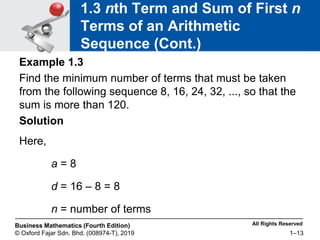
Example 1.3
Find the minimum number of terms that must be taken
from the following sequence 8, 16, 24, 32, ..., so that the
sum is more than 120.
Solution
Here,
a = 8
d = 16 – 8 = 8
n = number of terms
All Rights Reserved
Business Mathematics (Fourth Edition)
© Oxford Fajar Sdn. Bhd. (008974-T), 2019 1–14
1.3 nth Term and Sum of First n
Terms of an Arithmetic
Sequence (Cont.)
From Sn = [2a+ (n – 1)d]
[2(8) + (n – 1)8] > 120
[8 + 8n] > 0
n2 + n – 30 > 0
(n + 6)(n – 5) > 0
n > 5 where n is a positive integer.
Hence, the minimum number of terms is 6.
2
n
2
n
2
n
All Rights Reserved
Business Mathematics (Fourth Edition)
© Oxford Fajar Sdn. Bhd. (008974-T), 2019 1–15
1.3 nth Term and Sum of First n
Terms of an Arithmetic
Sequence (Cont.)
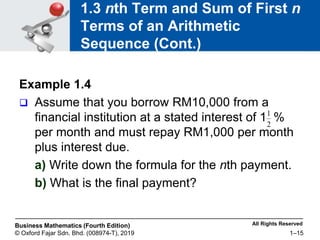
Example 1.4
 Assume that you borrow RM10,000 from a
financial institution at a stated interest of 1 %
per month and must repay RM1,000 per month
plus interest due.
a) Write down the formula for the nth payment.
b) What is the final payment?
2
1
All Rights Reserved
Business Mathematics (Fourth Edition)
© Oxford Fajar Sdn. Bhd. (008974-T), 2019 1–16
1.3 nth Term and Sum of First n
Terms of an Arithmetic
Sequence (Cont.)
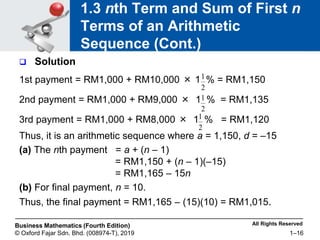
 Solution
1st payment = RM1,000 + RM10,000 × 1 % = RM1,150
2nd payment = RM1,000 + RM9,000 × 1 % = RM1,135
3rd payment = RM1,000 + RM8,000 × 1 % = RM1,120
Thus, it is an arithmetic sequence where a = 1,150, d = –15
(a) The nth payment = a + (n – 1)
= RM1,150 + (n – 1)(–15)
= RM1,165 – 15n
(b) For final payment, n = 10.
Thus, the final payment = RM1,165 – (15)(10) = RM1,015.
2
1
2
1
2
1
All Rights Reserved
Business Mathematics (Fourth Edition)
© Oxford Fajar Sdn. Bhd. (008974-T), 2019 1–17
1.3 nth Term and Sum of First n
Terms of an Arithmetic
Sequence (Cont.)
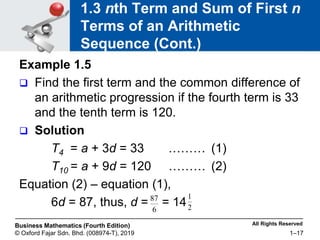
Example 1.5
 Find the first term and the common difference of
an arithmetic progression if the fourth term is 33
and the tenth term is 120.
 Solution
T4 = a + 3d = 33 ……… (1)
T10 = a + 9d = 120 ……… (2)
Equation (2) – equation (1),
6d = 87, thus, d = = 14
6
87
2
1
All Rights Reserved
Business Mathematics (Fourth Edition)
© Oxford Fajar Sdn. Bhd. (008974-T), 2019 1–18
1.3 nth Term and Sum of First n
Terms of an Arithmetic
Sequence (Cont.)
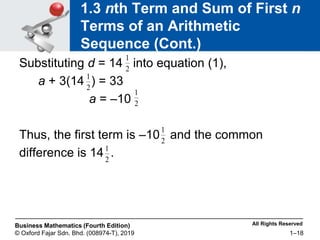
Substituting d = 14 into equation (1),
a + 3(14 ) = 33
a = –10
Thus, the first term is –10 and the common
difference is 14 .
2
1
2
1
2
1
2
1
2
1
All Rights Reserved
Business Mathematics (Fourth Edition)
© Oxford Fajar Sdn. Bhd. (008974-T), 2019 1–19
1.3 nth Term and Sum of First n
Terms of an Arithmetic
Sequence (Cont.)
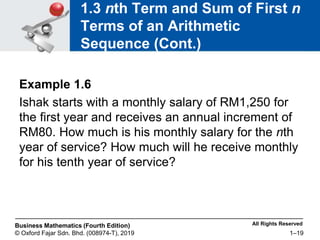
Example 1.6
Ishak starts with a monthly salary of RM1,250 for
the first year and receives an annual increment of
RM80. How much is his monthly salary for the nth
year of service? How much will he receive monthly
for his tenth year of service?
All Rights Reserved
Business Mathematics (Fourth Edition)
© Oxford Fajar Sdn. Bhd. (008974-T), 2019 1–20
1.3 nth Term and Sum of First n
Terms of an Arithmetic
Sequence (Cont.)
Solution
His monthly salaries are as follows.
RM1,250, RM1,330, RM1,410, RM1,490, ...
a =RM1,250 and d = RM80.
The nth term is Tn = a + (n – 1)d
= RM1,250 + (n – 1)80
= RM(80n + 1170).
For the tenth year,
T10 = RM[(80 × 10) + 1,170] = RM1,970
All Rights Reserved
Business Mathematics (Fourth Edition)
© Oxford Fajar Sdn. Bhd. (008974-T), 2019 1–21
1.3 nth Term and Sum of First n
Terms of an Arithmetic
Sequence (Cont.)
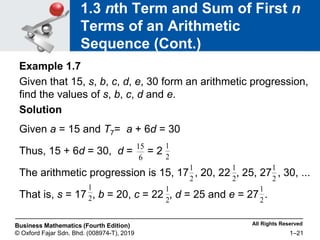
Example 1.7
Given that 15, s, b, c, d, e, 30 form an arithmetic progression,
find the values of s, b, c, d and e.
Solution
Given a = 15 and T7= a + 6d = 30
Thus, 15 + 6d = 30, d = = 2
The arithmetic progression is 15, 17 , 20, 22 , 25, 27 , 30, ...
That is, s = 17 , b = 20, c = 22 , d = 25 and e = 27 .
6
15
2
1
2
1
2
1
2
1
2
1
2
1
2
1
All Rights Reserved
Business Mathematics (Fourth Edition)
© Oxford Fajar Sdn. Bhd. (008974-T), 2019 1–22
1.3 nth Term and Sum of First n
Terms of an Arithmetic
Sequence (Cont.)
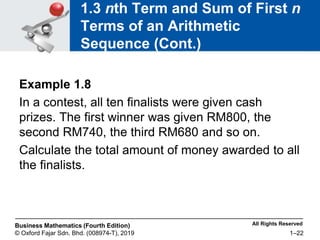
Example 1.8
In a contest, all ten finalists were given cash
prizes. The first winner was given RM800, the
second RM740, the third RM680 and so on.
Calculate the total amount of money awarded to all
the finalists.
All Rights Reserved
Business Mathematics (Fourth Edition)
© Oxford Fajar Sdn. Bhd. (008974-T), 2019 1–23
1.3 nth Term and Sum of First n
Terms of an Arithmetic
Sequence (Cont.)
Solution
The prizes are RM800, RM740, RM680, …
It is an arithmetic progression. The first term a = 800,
common difference d = –60 and n = 10. The total amount
given is
Sn = [2a + (n – 1)d]
S10 = [2 × 800 + (10 – 1)(–60)]
= RM5,300
The total amount is RM5,300.
2
n
2
10
All Rights Reserved
Business Mathematics (Fourth Edition)
© Oxford Fajar Sdn. Bhd. (008974-T), 2019 1–24
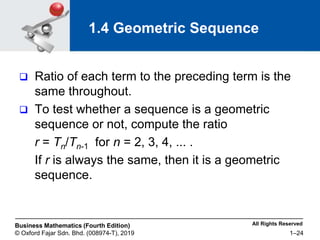
1.4 Geometric Sequence
 Ratio of each term to the preceding term is the
same throughout.
 To test whether a sequence is a geometric
sequence or not, compute the ratio
r = Tn/Tn-1 for n = 2, 3, 4, ... .
If r is always the same, then it is a geometric
sequence.
All Rights Reserved
Business Mathematics (Fourth Edition)
© Oxford Fajar Sdn. Bhd. (008974-T), 2019 1–25
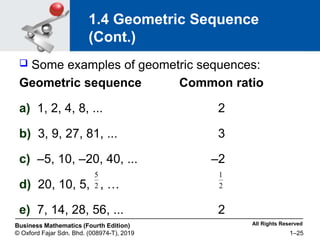
1.4 Geometric Sequence
(Cont.)
 Some examples of geometric sequences:
Geometric sequence Common ratio
a) 1, 2, 4, 8, ... 2
b) 3, 9, 27, 81, ... 3
c) –5, 10, –20, 40, ... –2
d) 20, 10, 5, , …
e) 7, 14, 28, 56, ... 2
2
5
2
1
All Rights Reserved
Business Mathematics (Fourth Edition)
© Oxford Fajar Sdn. Bhd. (008974-T), 2019 1–26
1.5 nth Term and Sum of First n
Terms of a Geometric
Sequence
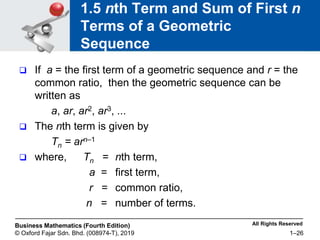
 If a = the first term of a geometric sequence and r = the
common ratio, then the geometric sequence can be
written as
a, ar, ar2, ar3, ...
 The nth term is given by
Tn = arn–1
 where, Tn = nth term,
a = first term,
r = common ratio,
n = number of terms.
All Rights Reserved
Business Mathematics (Fourth Edition)
© Oxford Fajar Sdn. Bhd. (008974-T), 2019 1–27
1.5 nth Term and Sum of First n
Terms of a Geometric
Sequence (Cont.)
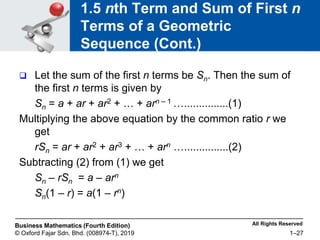
 Let the sum of the first n terms be Sn. Then the sum of
the first n terms is given by
Sn = a + ar + ar2 + … + arn – 1 …...............(1)
Multiplying the above equation by the common ratio r we
get
rSn = ar + ar2 + ar3 + … + arn …...............(2)
Subtracting (2) from (1) we get
Sn – rSn = a – arn
Sn(1 – r) = a(1 – rn)
All Rights Reserved
Business Mathematics (Fourth Edition)
© Oxford Fajar Sdn. Bhd. (008974-T), 2019 1–28
1.5 nth Term and Sum of First n
Terms of a Geometric
Sequence (Cont.)
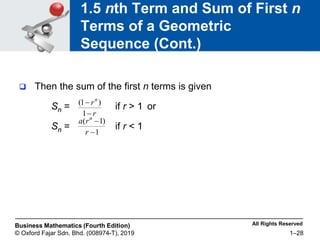
 Then the sum of the first n terms is given
Sn = if r > 1 or
Sn = if r < 1
1
)
1
(


r
r
a n
r
rn


1
)
1
(
All Rights Reserved
Business Mathematics (Fourth Edition)
© Oxford Fajar Sdn. Bhd. (008974-T), 2019 1–29
1.5 nth Term and Sum of First n
Terms of a Geometric
Sequence (Cont.)
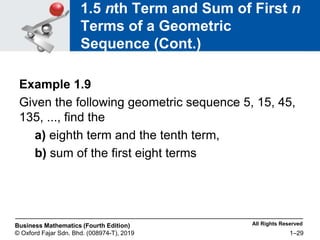
Example 1.9
Given the following geometric sequence 5, 15, 45,
135, ..., find the
a) eighth term and the tenth term,
b) sum of the first eight terms
All Rights Reserved
Business Mathematics (Fourth Edition)
© Oxford Fajar Sdn. Bhd. (008974-T), 2019 1–30
1.5 nth Term and Sum of First n
Terms of a Geometric
Sequence (Cont.)
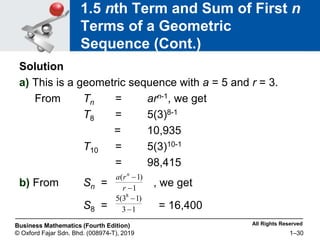
Solution
a) This is a geometric sequence with a = 5 and r = 3.
From Tn = arn-1, we get
T8 = 5(3)8-1
= 10,935
T10 = 5(3)10-1
= 98,415
b) From Sn = , we get
S8 = = 16,400
1
)
1
(


r
r
a n
1
3
)
1
3
(
5 8


All Rights Reserved
Business Mathematics (Fourth Edition)
© Oxford Fajar Sdn. Bhd. (008974-T), 2019 1–31
1.5 nth Term and Sum of First n
Terms of a Geometric
Sequence (Cont.)
Example 1.10
 Find the number of terms in the following sequence 2, 6,
18, ..., 39,366. Calculate the sum of all the terms.
 Solution
This is a geometric sequence with a = 2 and r = 3.
From Tn = arn-1 , we get
39,366 = 2(3)n – 1
lg 19,683 = (n – 1)lg 3
n = 10
Hence, the number of terms is 10.
All Rights Reserved
Business Mathematics (Fourth Edition)
© Oxford Fajar Sdn. Bhd. (008974-T), 2019 1–32
1.5 nth Term and Sum of First n
Terms of a Geometric
Sequence (Cont.)
Sum of all the terms
= S10
=
=
= 5,048
1
3
]
1
3
[
2 10


1
)
1
(


r
r
a n
All Rights Reserved
Business Mathematics (Fourth Edition)
© Oxford Fajar Sdn. Bhd. (008974-T), 2019 1–33
1.5 nth Term and Sum of First n
Terms of a Geometric
Sequence (Cont.)
Example 1.11
Find the minimum number of terms that must be
taken from the sequence 3, 12, 48, 192, ... so that
the sum is more than 300.
Solution
This is a geometric sequence with a = 3 and r = 4.
All Rights Reserved
Business Mathematics (Fourth Edition)
© Oxford Fajar Sdn. Bhd. (008974-T), 2019 1–34
1.5 nth Term and Sum of First n
Terms of a Geometric
Sequence (Cont.)
From Sn = , we get
> 300
4n – 1 > 300
4n > 301
nlog 4 > log301
n > 4.117
Thus, n = 5. Hence, the minimum number of terms is 5.
1
)
1
(


r
r
a n
1
4
)
1
4
(
3


n
All Rights Reserved
Business Mathematics (Fourth Edition)
© Oxford Fajar Sdn. Bhd. (008974-T), 2019 1–35
1.5 Nth Term and Sum of First
n Terms of a Geometric
Sequence (Cont.)
Example 1.12
Maimunah saves RM1,000 in a savings account
that pays 8% compounded annually. Find the
amount in her account at the end of five years.
Solution
Note that the amount in
Year 0 = 1,000
Year 1 = 1,000(1.08)
Year 2 = 1,000(1.08)2 and so on.
All Rights Reserved
Business Mathematics (Fourth Edition)
© Oxford Fajar Sdn. Bhd. (008974-T), 2019 1–36
1.5 nth Term and Sum of First n
Terms of a Geometric
Sequence (Cont.)
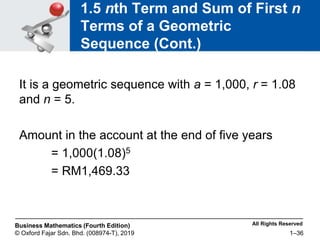
It is a geometric sequence with a = 1,000, r = 1.08
and n = 5.
Amount in the account at the end of five years
= 1,000(1.08)5
= RM1,469.33
All Rights Reserved
Business Mathematics (Fourth Edition)
© Oxford Fajar Sdn. Bhd. (008974-T), 2019 1–37
1.5 nth Term and Sum of First n
Terms of a Geometric
Sequence (Cont.)
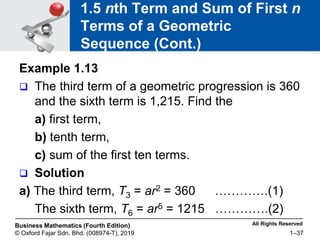
Example 1.13
 The third term of a geometric progression is 360
and the sixth term is 1,215. Find the
a) first term,
b) tenth term,
c) sum of the first ten terms.
 Solution
a) The third term, T3 = ar2 = 360 ………….(1)
The sixth term, T6 = ar5 = 1215 ………….(2)
All Rights Reserved
Business Mathematics (Fourth Edition)
© Oxford Fajar Sdn. Bhd. (008974-T), 2019 1–38
1.5 nth Term and Sum of First n
Terms of a Geometric
Sequence (Cont.)
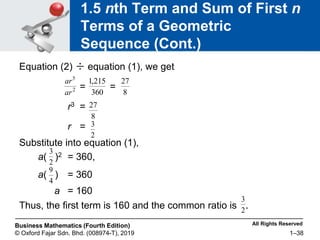
Equation (2) ÷ equation (1), we get
= =
r3 =
r =
Substitute into equation (1),
a( )2 = 360,
a( ) = 360
a = 160
Thus, the first term is 160 and the common ratio is .
2
5
ar
ar
360
215
,
1
8
27
2
3
2
3
2
3
8
27
4
9
All Rights Reserved
Business Mathematics (Fourth Edition)
© Oxford Fajar Sdn. Bhd. (008974-T), 2019 1–39
1.5 nth Term and Sum of First n
Terms of a Geometric
Sequence (Cont.)
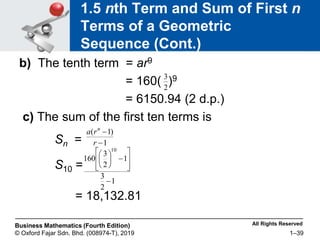
b) The tenth term = ar9
= 160( )9
= 6150.94 (2 d.p.)
c) The sum of the first ten terms is
Sn =
S10 =
= 18,132.81
2
3
1
)
1
(


r
r
a n
1
2
3
1
2
3
160
10
















All Rights Reserved
Business Mathematics (Fourth Edition)
© Oxford Fajar Sdn. Bhd. (008974-T), 2019 1–40
1.5 nth Term and Sum of First n
Terms of a Geometric
Sequence (Cont.)
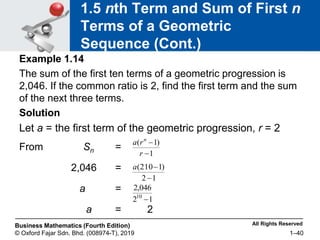
Example 1.14
The sum of the first ten terms of a geometric progression is
2,046. If the common ratio is 2, find the first term and the sum
of the next three terms.
Solution
Let a = the first term of the geometric progression, r = 2
From Sn =
2,046 =
a =
a = 2
1
)
1
(


r
r
a n
1
2
)
1
210
(


a
1
2
046
,
2
10

All Rights Reserved
Business Mathematics (Fourth Edition)
© Oxford Fajar Sdn. Bhd. (008974-T), 2019 1–41
1.5 nth Term and Sum of First n
Terms of a Geometric
Sequence (Cont.)
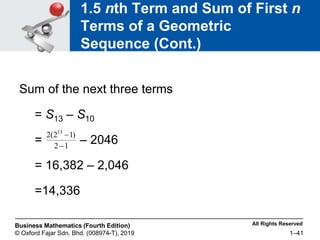
Sum of the next three terms
= S13 – S10
= – 2046
= 16,382 – 2,046
=14,336
1
2
)
1
2
(
2 13



Chapter 1 Arithmetic and Geometric sequences

  • 2.
  • 3.
    All Rights Reserved BusinessMathematics (Fourth Edition) © Oxford Fajar Sdn. Bhd. (008974-T), 2019 1–3 Learning Outcomes By the end of this chapter, you should be able to ✔ explain the terms sequence, arithmetic and geometric sequence ✔ identify arithmetic and geometric sequences ✔ calculate the terms in arithmetic and geometric sequences ✔ calculate the sum of terms in arithmetic and geometric sequences ✔ apply the concepts of arithmetic and geometric sequences to some common problems in daily life
  • 4.
    All Rights Reserved BusinessMathematics (Fourth Edition) © Oxford Fajar Sdn. Bhd. (008974-T), 2019 1–4 1.1 Introduction  A sequence or progression is a succession of terms T1, T2, T3, ..., formed according to a certain fixed rule.  A series is the indicated sum, T1 + T2 + T3 +..., of the terms of a sequence.
  • 5.
    All Rights Reserved BusinessMathematics (Fourth Edition) © Oxford Fajar Sdn. Bhd. (008974-T), 2019 1–5 1.2 Arithmetic Sequence  The difference between any term and the preceding term is the same throughout.  The common difference d, can be obtained by subtracting any term from the term which immediately follows it. d = T2 – T1 = T3 – T2 = T4 – T3 = Tn – Tn – 1
  • 6.
    All Rights Reserved BusinessMathematics (Fourth Edition) © Oxford Fajar Sdn. Bhd. (008974-T), 2019 1–6 1.2 Arithmetic Sequence (Cont.)  Some examples of arithmetic sequence: Arithmetic sequence Common difference (a) 4, 8, 12, 16, ... d = 4 (b) 7, 5, 3, 1, ... d = –2 (c) –5, –9, –13, –17, ... d = –4 (d) , 1, 1 , 2, … d = (e) , 1, 1 ,1 , … d = (f) 25, 20, 15, 10, … d = –5 2 1 2 1 7 5 7 2 7 4 7 2 2 1
  • 7.
    All Rights Reserved BusinessMathematics (Fourth Edition) © Oxford Fajar Sdn. Bhd. (008974-T), 2019 1–7 1.3 nth Term and Sum of First n Terms of an Arithmetic Sequence  Let a = the first term, d = the common difference, the nth term, Tn is given by Tn = a + (n – 1)d The sum of the first n terms, Sn is Sn = [2a + (n – 1)d] or Sn = (a + l) where l = the last term = a + (n – 1)d 2 n 2 n
  • 8.
    All Rights Reserved BusinessMathematics (Fourth Edition) © Oxford Fajar Sdn. Bhd. (008974-T), 2019 1–8 1.3 nth Term and Sum of First n Terms of an Arithmetic Sequence (Cont.) Example 1.1 a) Given the arithmetic sequence 2, 10, 18, ..., find the i. the tenth term, ii. the sum of the first ten terms. b) Given the arithmetic sequence 30, 23, 16, 9, 2, …, find the twelfth term and the sum of the first twelve terms. Solution a) Here, a = 2 d = 10 – 2 = 8 n = 10
  • 9.
    All Rights Reserved BusinessMathematics (Fourth Edition) © Oxford Fajar Sdn. Bhd. (008974-T), 2019 1–9 1.3 nth Term and Sum of First n Terms of an Arithmetic Sequence (Cont.) i. From Tn = a + (n – 1)d, we get T10 = 2 + (10 – 1)8 = 74 ii. From Sn = [2a + (n – 1)d], we get S10 = [2(2) + (10 – 1)8] = 380 2 n 2 10
  • 10.
    All Rights Reserved BusinessMathematics (Fourth Edition) © Oxford Fajar Sdn. Bhd. (008974-T), 2019 1–10 1.3 nth Term and Sum of First n Terms of an Arithmetic Sequence (Cont.) b) Here, the first term a = 30 and common difference d = –7 The twelfth term is T12 = a + (n – 1)d = 30 + (12 – 1)(–7) = –47 The sum of the first twelve terms, S12 = [2(30) + (12 – 1)(–7)] = –102 2 12
  • 11.
    All Rights Reserved BusinessMathematics (Fourth Edition) © Oxford Fajar Sdn. Bhd. (008974-T), 2019 1–11 1.3 nth Term and Sum of First n Terms of an Arithmetic Sequence (Cont.) Example 1.2 Find the number of terms in the following arithmetic sequence 12, 17, 22, ..., 67. Hence, find the sum of all the terms. Solution Here, a = 12, d = 17 – 12 = 5, n = number of terms From Tn = a + (n – 1)d, we get 67 = 12 + (n –1)5
  • 12.
    All Rights Reserved BusinessMathematics (Fourth Edition) © Oxford Fajar Sdn. Bhd. (008974-T), 2019 1–12 1.3 nth Term and Sum of First n Terms of an Arithmetic Sequence (Cont.) Thus, n = 12 Sum of all the terms = S12 = [2a + (n – 1)d] = [2(12) + (12 – 1)(5)] = 474 2 n 2 12
  • 13.
    All Rights Reserved BusinessMathematics (Fourth Edition) © Oxford Fajar Sdn. Bhd. (008974-T), 2019 1–13 1.3 nth Term and Sum of First n Terms of an Arithmetic Sequence (Cont.) Example 1.3 Find the minimum number of terms that must be taken from the following sequence 8, 16, 24, 32, ..., so that the sum is more than 120. Solution Here, a = 8 d = 16 – 8 = 8 n = number of terms
  • 14.
    All Rights Reserved BusinessMathematics (Fourth Edition) © Oxford Fajar Sdn. Bhd. (008974-T), 2019 1–14 1.3 nth Term and Sum of First n Terms of an Arithmetic Sequence (Cont.) From Sn = [2a+ (n – 1)d] [2(8) + (n – 1)8] > 120 [8 + 8n] > 0 n2 + n – 30 > 0 (n + 6)(n – 5) > 0 n > 5 where n is a positive integer. Hence, the minimum number of terms is 6. 2 n 2 n 2 n
  • 15.
    All Rights Reserved BusinessMathematics (Fourth Edition) © Oxford Fajar Sdn. Bhd. (008974-T), 2019 1–15 1.3 nth Term and Sum of First n Terms of an Arithmetic Sequence (Cont.) Example 1.4  Assume that you borrow RM10,000 from a financial institution at a stated interest of 1 % per month and must repay RM1,000 per month plus interest due. a) Write down the formula for the nth payment. b) What is the final payment? 2 1
  • 16.
    All Rights Reserved BusinessMathematics (Fourth Edition) © Oxford Fajar Sdn. Bhd. (008974-T), 2019 1–16 1.3 nth Term and Sum of First n Terms of an Arithmetic Sequence (Cont.)  Solution 1st payment = RM1,000 + RM10,000 × 1 % = RM1,150 2nd payment = RM1,000 + RM9,000 × 1 % = RM1,135 3rd payment = RM1,000 + RM8,000 × 1 % = RM1,120 Thus, it is an arithmetic sequence where a = 1,150, d = –15 (a) The nth payment = a + (n – 1) = RM1,150 + (n – 1)(–15) = RM1,165 – 15n (b) For final payment, n = 10. Thus, the final payment = RM1,165 – (15)(10) = RM1,015. 2 1 2 1 2 1
  • 17.
    All Rights Reserved BusinessMathematics (Fourth Edition) © Oxford Fajar Sdn. Bhd. (008974-T), 2019 1–17 1.3 nth Term and Sum of First n Terms of an Arithmetic Sequence (Cont.) Example 1.5  Find the first term and the common difference of an arithmetic progression if the fourth term is 33 and the tenth term is 120.  Solution T4 = a + 3d = 33 ……… (1) T10 = a + 9d = 120 ……… (2) Equation (2) – equation (1), 6d = 87, thus, d = = 14 6 87 2 1
  • 18.
    All Rights Reserved BusinessMathematics (Fourth Edition) © Oxford Fajar Sdn. Bhd. (008974-T), 2019 1–18 1.3 nth Term and Sum of First n Terms of an Arithmetic Sequence (Cont.) Substituting d = 14 into equation (1), a + 3(14 ) = 33 a = –10 Thus, the first term is –10 and the common difference is 14 . 2 1 2 1 2 1 2 1 2 1
  • 19.
    All Rights Reserved BusinessMathematics (Fourth Edition) © Oxford Fajar Sdn. Bhd. (008974-T), 2019 1–19 1.3 nth Term and Sum of First n Terms of an Arithmetic Sequence (Cont.) Example 1.6 Ishak starts with a monthly salary of RM1,250 for the first year and receives an annual increment of RM80. How much is his monthly salary for the nth year of service? How much will he receive monthly for his tenth year of service?
  • 20.
    All Rights Reserved BusinessMathematics (Fourth Edition) © Oxford Fajar Sdn. Bhd. (008974-T), 2019 1–20 1.3 nth Term and Sum of First n Terms of an Arithmetic Sequence (Cont.) Solution His monthly salaries are as follows. RM1,250, RM1,330, RM1,410, RM1,490, ... a =RM1,250 and d = RM80. The nth term is Tn = a + (n – 1)d = RM1,250 + (n – 1)80 = RM(80n + 1170). For the tenth year, T10 = RM[(80 × 10) + 1,170] = RM1,970
  • 21.
    All Rights Reserved BusinessMathematics (Fourth Edition) © Oxford Fajar Sdn. Bhd. (008974-T), 2019 1–21 1.3 nth Term and Sum of First n Terms of an Arithmetic Sequence (Cont.) Example 1.7 Given that 15, s, b, c, d, e, 30 form an arithmetic progression, find the values of s, b, c, d and e. Solution Given a = 15 and T7= a + 6d = 30 Thus, 15 + 6d = 30, d = = 2 The arithmetic progression is 15, 17 , 20, 22 , 25, 27 , 30, ... That is, s = 17 , b = 20, c = 22 , d = 25 and e = 27 . 6 15 2 1 2 1 2 1 2 1 2 1 2 1 2 1
  • 22.
    All Rights Reserved BusinessMathematics (Fourth Edition) © Oxford Fajar Sdn. Bhd. (008974-T), 2019 1–22 1.3 nth Term and Sum of First n Terms of an Arithmetic Sequence (Cont.) Example 1.8 In a contest, all ten finalists were given cash prizes. The first winner was given RM800, the second RM740, the third RM680 and so on. Calculate the total amount of money awarded to all the finalists.
  • 23.
    All Rights Reserved BusinessMathematics (Fourth Edition) © Oxford Fajar Sdn. Bhd. (008974-T), 2019 1–23 1.3 nth Term and Sum of First n Terms of an Arithmetic Sequence (Cont.) Solution The prizes are RM800, RM740, RM680, … It is an arithmetic progression. The first term a = 800, common difference d = –60 and n = 10. The total amount given is Sn = [2a + (n – 1)d] S10 = [2 × 800 + (10 – 1)(–60)] = RM5,300 The total amount is RM5,300. 2 n 2 10
  • 24.
    All Rights Reserved BusinessMathematics (Fourth Edition) © Oxford Fajar Sdn. Bhd. (008974-T), 2019 1–24 1.4 Geometric Sequence  Ratio of each term to the preceding term is the same throughout.  To test whether a sequence is a geometric sequence or not, compute the ratio r = Tn/Tn-1 for n = 2, 3, 4, ... . If r is always the same, then it is a geometric sequence.
  • 25.
    All Rights Reserved BusinessMathematics (Fourth Edition) © Oxford Fajar Sdn. Bhd. (008974-T), 2019 1–25 1.4 Geometric Sequence (Cont.)  Some examples of geometric sequences: Geometric sequence Common ratio a) 1, 2, 4, 8, ... 2 b) 3, 9, 27, 81, ... 3 c) –5, 10, –20, 40, ... –2 d) 20, 10, 5, , … e) 7, 14, 28, 56, ... 2 2 5 2 1
  • 26.
    All Rights Reserved BusinessMathematics (Fourth Edition) © Oxford Fajar Sdn. Bhd. (008974-T), 2019 1–26 1.5 nth Term and Sum of First n Terms of a Geometric Sequence  If a = the first term of a geometric sequence and r = the common ratio, then the geometric sequence can be written as a, ar, ar2, ar3, ...  The nth term is given by Tn = arn–1  where, Tn = nth term, a = first term, r = common ratio, n = number of terms.
  • 27.
    All Rights Reserved BusinessMathematics (Fourth Edition) © Oxford Fajar Sdn. Bhd. (008974-T), 2019 1–27 1.5 nth Term and Sum of First n Terms of a Geometric Sequence (Cont.)  Let the sum of the first n terms be Sn. Then the sum of the first n terms is given by Sn = a + ar + ar2 + … + arn – 1 …...............(1) Multiplying the above equation by the common ratio r we get rSn = ar + ar2 + ar3 + … + arn …...............(2) Subtracting (2) from (1) we get Sn – rSn = a – arn Sn(1 – r) = a(1 – rn)
  • 28.
    All Rights Reserved BusinessMathematics (Fourth Edition) © Oxford Fajar Sdn. Bhd. (008974-T), 2019 1–28 1.5 nth Term and Sum of First n Terms of a Geometric Sequence (Cont.)  Then the sum of the first n terms is given Sn = if r > 1 or Sn = if r < 1 1 ) 1 (   r r a n r rn   1 ) 1 (
  • 29.
    All Rights Reserved BusinessMathematics (Fourth Edition) © Oxford Fajar Sdn. Bhd. (008974-T), 2019 1–29 1.5 nth Term and Sum of First n Terms of a Geometric Sequence (Cont.) Example 1.9 Given the following geometric sequence 5, 15, 45, 135, ..., find the a) eighth term and the tenth term, b) sum of the first eight terms
  • 30.
    All Rights Reserved BusinessMathematics (Fourth Edition) © Oxford Fajar Sdn. Bhd. (008974-T), 2019 1–30 1.5 nth Term and Sum of First n Terms of a Geometric Sequence (Cont.) Solution a) This is a geometric sequence with a = 5 and r = 3. From Tn = arn-1, we get T8 = 5(3)8-1 = 10,935 T10 = 5(3)10-1 = 98,415 b) From Sn = , we get S8 = = 16,400 1 ) 1 (   r r a n 1 3 ) 1 3 ( 5 8  
  • 31.
    All Rights Reserved BusinessMathematics (Fourth Edition) © Oxford Fajar Sdn. Bhd. (008974-T), 2019 1–31 1.5 nth Term and Sum of First n Terms of a Geometric Sequence (Cont.) Example 1.10  Find the number of terms in the following sequence 2, 6, 18, ..., 39,366. Calculate the sum of all the terms.  Solution This is a geometric sequence with a = 2 and r = 3. From Tn = arn-1 , we get 39,366 = 2(3)n – 1 lg 19,683 = (n – 1)lg 3 n = 10 Hence, the number of terms is 10.
  • 32.
    All Rights Reserved BusinessMathematics (Fourth Edition) © Oxford Fajar Sdn. Bhd. (008974-T), 2019 1–32 1.5 nth Term and Sum of First n Terms of a Geometric Sequence (Cont.) Sum of all the terms = S10 = = = 5,048 1 3 ] 1 3 [ 2 10   1 ) 1 (   r r a n
  • 33.
    All Rights Reserved BusinessMathematics (Fourth Edition) © Oxford Fajar Sdn. Bhd. (008974-T), 2019 1–33 1.5 nth Term and Sum of First n Terms of a Geometric Sequence (Cont.) Example 1.11 Find the minimum number of terms that must be taken from the sequence 3, 12, 48, 192, ... so that the sum is more than 300. Solution This is a geometric sequence with a = 3 and r = 4.
  • 34.
    All Rights Reserved BusinessMathematics (Fourth Edition) © Oxford Fajar Sdn. Bhd. (008974-T), 2019 1–34 1.5 nth Term and Sum of First n Terms of a Geometric Sequence (Cont.) From Sn = , we get > 300 4n – 1 > 300 4n > 301 nlog 4 > log301 n > 4.117 Thus, n = 5. Hence, the minimum number of terms is 5. 1 ) 1 (   r r a n 1 4 ) 1 4 ( 3   n
  • 35.
    All Rights Reserved BusinessMathematics (Fourth Edition) © Oxford Fajar Sdn. Bhd. (008974-T), 2019 1–35 1.5 Nth Term and Sum of First n Terms of a Geometric Sequence (Cont.) Example 1.12 Maimunah saves RM1,000 in a savings account that pays 8% compounded annually. Find the amount in her account at the end of five years. Solution Note that the amount in Year 0 = 1,000 Year 1 = 1,000(1.08) Year 2 = 1,000(1.08)2 and so on.
  • 36.
    All Rights Reserved BusinessMathematics (Fourth Edition) © Oxford Fajar Sdn. Bhd. (008974-T), 2019 1–36 1.5 nth Term and Sum of First n Terms of a Geometric Sequence (Cont.) It is a geometric sequence with a = 1,000, r = 1.08 and n = 5. Amount in the account at the end of five years = 1,000(1.08)5 = RM1,469.33
  • 37.
    All Rights Reserved BusinessMathematics (Fourth Edition) © Oxford Fajar Sdn. Bhd. (008974-T), 2019 1–37 1.5 nth Term and Sum of First n Terms of a Geometric Sequence (Cont.) Example 1.13  The third term of a geometric progression is 360 and the sixth term is 1,215. Find the a) first term, b) tenth term, c) sum of the first ten terms.  Solution a) The third term, T3 = ar2 = 360 ………….(1) The sixth term, T6 = ar5 = 1215 ………….(2)
  • 38.
    All Rights Reserved BusinessMathematics (Fourth Edition) © Oxford Fajar Sdn. Bhd. (008974-T), 2019 1–38 1.5 nth Term and Sum of First n Terms of a Geometric Sequence (Cont.) Equation (2) ÷ equation (1), we get = = r3 = r = Substitute into equation (1), a( )2 = 360, a( ) = 360 a = 160 Thus, the first term is 160 and the common ratio is . 2 5 ar ar 360 215 , 1 8 27 2 3 2 3 2 3 8 27 4 9
  • 39.
    All Rights Reserved BusinessMathematics (Fourth Edition) © Oxford Fajar Sdn. Bhd. (008974-T), 2019 1–39 1.5 nth Term and Sum of First n Terms of a Geometric Sequence (Cont.) b) The tenth term = ar9 = 160( )9 = 6150.94 (2 d.p.) c) The sum of the first ten terms is Sn = S10 = = 18,132.81 2 3 1 ) 1 (   r r a n 1 2 3 1 2 3 160 10                
  • 40.
    All Rights Reserved BusinessMathematics (Fourth Edition) © Oxford Fajar Sdn. Bhd. (008974-T), 2019 1–40 1.5 nth Term and Sum of First n Terms of a Geometric Sequence (Cont.) Example 1.14 The sum of the first ten terms of a geometric progression is 2,046. If the common ratio is 2, find the first term and the sum of the next three terms. Solution Let a = the first term of the geometric progression, r = 2 From Sn = 2,046 = a = a = 2 1 ) 1 (   r r a n 1 2 ) 1 210 (   a 1 2 046 , 2 10 
  • 41.
    All Rights Reserved BusinessMathematics (Fourth Edition) © Oxford Fajar Sdn. Bhd. (008974-T), 2019 1–41 1.5 nth Term and Sum of First n Terms of a Geometric Sequence (Cont.) Sum of the next three terms = S13 – S10 = – 2046 = 16,382 – 2,046 =14,336 1 2 ) 1 2 ( 2 13  