



Research Methodology 
Chapter 4 
Nagendra Amatya 
Associate Professor 
Science and Humanities Department 
Central Campus Pulchowk 
nbamatya@ioe.edu.np
Selection of Research Problem 
• Topic of Research 
• Consumer of research 
• Component of research problem 
• Conditions conductive for formation of research 
problem 
• Research resources and research problem 
• Organizational and individual research 
• Determinants of individual research 
• Approaches of starting points 
• Research proposal writing
Finding your Research Problem Area 
Step 1: Use your assets to identify problem areas 
• Your own academic, professional and personal experiences are valuable assets 
in your research. Make sure you make the best of them. 
• On the basis of what you already know about your subject, and your 
understanding of the nature of research, examine your field of interest and 
identify two or three problem areas that might be researchable. 
• Problem areas might be found by detecting systems or organizations that do 
not seem to perform satisfactorily, either theoretically or practically. 
• When you have selected the problem areas, explore the issues involved by 
devising a number of questions that highlight the nature of the problem or 
reveal different aspects of it. This will help to lead you to more specific research 
problems that could be the basis of your own research project.
Step 2: Be alert 
Keep your eyes and ears open for interesting 
research topics. At the end of virtually all 
research papers and reports, and even books, 
there is a section that outlines the need for 
further research, often quite precisely defined. 
These could provide you with a good lead to 
your own research problem.
Step 3: Choose a research problem 
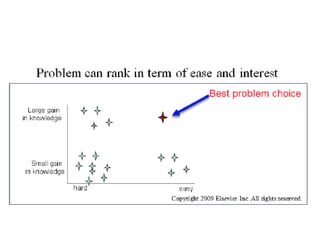
• Consider what further information you might need to 
obtain to clarify and delineate the problem areas. Do not 
try to be too specific at first. It is a good idea to make a list 
of your key interests in your subject, so that you can look at 
problems that contain some or all of your interests. 
• Choosing a research problem to tackle for your project is a 
crucial step that will affect your life for months or even 
years. Make sure that you are sufficiently fascinated in the 
issues to motivate you through to the end. Keep the project 
manageable, however interesting and important the 
subject is. Do this by limiting it to aspects within your own 
expertise. Leave the other specialist areas for further 
research by others.
Step 3 cont… 
As a guide to your investigations you may 
find it useful to answer the following 
questions in each of your research problems: 
 Has anyone else done research into the same or similar 
problems? 
 Can you imagine how a methodical and scientific approach 
could be 
adopted to research into these particular problems? 
What issues would need to be explored? 
 How important do you think that research into these 
problems is? 
 Do you think it might be possible to narrow them down 
(delineate them) so as to make them a practical subject for 
your thesis? If so, can you suggest some simple examples?
Step 4: Break down the problem 
• In order to see what might be involved in 
tackling a research problem, break down the 
problem into practical components, i.e. sub-problems 
or sub-questions. Work out what 
you will actually need to do to answer these. 
Can you manage to do it in the time allotted? 
If not, narrow the scope of the problem.
Step 5: Choose your research strategy 
The three types of research strategy 
exploration, testing out and problem-solving 
are related to the research objectives listed in 
step 1. Where does your research fit into these? 
A strategy is a plan. Relate this also to your 
mapping out of your individual research process, 
and perhaps add a time and place element to 
get a framework of what you will actually do.
Step 6: Map your journey 
• From your understanding of the research process, 
can you map out a network or a chart that will 
describe your own journey through the process? 
• The examples given are very general; you can 
make yours more specific to your project. Look 
out for two essential aspects: the characteristic 
broadening and narrowing of the subject area as 
you distil your research down to the essential 
elements; and the presence of reiterative 
feedback loops – periodic checking back to 
theory and evidence.
Step 7: Consult 
• Consult as many relevant people as possible 
to discuss your ideas – tutors, experts, fellow 
students. Mere verbal discussion about ideas 
is difficult to pin down. 
• In order to communicate your latest ideas as 
clearly as possible, write them down. This 
gives the people you consult something 
concrete to comment on. Keep developing 
your ideas by redrafting your proposals in 
response to your discussions.
Step 8: Discuss 
Prepare a set of notes so that you can discuss 
these issues with your tutor or supervisor; it is 
best to give it to him/her to read before your 
discussion. This is an exploratory exercise, so do 
not try to formulate your detailed research 
problem at this stage. This will come later. 
Having studied this chapter of the book, at least 
you will know what sort of problems you are 
looking for!
Chapter 4
Chapter 4
Chapter 4

Chapter 4

  • 1.
    Research Methodology Chapter4 Nagendra Amatya Associate Professor Science and Humanities Department Central Campus Pulchowk nbamatya@ioe.edu.np
  • 2.
    Selection of ResearchProblem • Topic of Research • Consumer of research • Component of research problem • Conditions conductive for formation of research problem • Research resources and research problem • Organizational and individual research • Determinants of individual research • Approaches of starting points • Research proposal writing
  • 3.
    Finding your ResearchProblem Area Step 1: Use your assets to identify problem areas • Your own academic, professional and personal experiences are valuable assets in your research. Make sure you make the best of them. • On the basis of what you already know about your subject, and your understanding of the nature of research, examine your field of interest and identify two or three problem areas that might be researchable. • Problem areas might be found by detecting systems or organizations that do not seem to perform satisfactorily, either theoretically or practically. • When you have selected the problem areas, explore the issues involved by devising a number of questions that highlight the nature of the problem or reveal different aspects of it. This will help to lead you to more specific research problems that could be the basis of your own research project.
  • 4.
    Step 2: Bealert Keep your eyes and ears open for interesting research topics. At the end of virtually all research papers and reports, and even books, there is a section that outlines the need for further research, often quite precisely defined. These could provide you with a good lead to your own research problem.
  • 5.
    Step 3: Choosea research problem • Consider what further information you might need to obtain to clarify and delineate the problem areas. Do not try to be too specific at first. It is a good idea to make a list of your key interests in your subject, so that you can look at problems that contain some or all of your interests. • Choosing a research problem to tackle for your project is a crucial step that will affect your life for months or even years. Make sure that you are sufficiently fascinated in the issues to motivate you through to the end. Keep the project manageable, however interesting and important the subject is. Do this by limiting it to aspects within your own expertise. Leave the other specialist areas for further research by others.
  • 6.
    Step 3 cont… As a guide to your investigations you may find it useful to answer the following questions in each of your research problems:  Has anyone else done research into the same or similar problems?  Can you imagine how a methodical and scientific approach could be adopted to research into these particular problems? What issues would need to be explored?  How important do you think that research into these problems is?  Do you think it might be possible to narrow them down (delineate them) so as to make them a practical subject for your thesis? If so, can you suggest some simple examples?
  • 7.
    Step 4: Breakdown the problem • In order to see what might be involved in tackling a research problem, break down the problem into practical components, i.e. sub-problems or sub-questions. Work out what you will actually need to do to answer these. Can you manage to do it in the time allotted? If not, narrow the scope of the problem.
  • 8.
    Step 5: Chooseyour research strategy The three types of research strategy exploration, testing out and problem-solving are related to the research objectives listed in step 1. Where does your research fit into these? A strategy is a plan. Relate this also to your mapping out of your individual research process, and perhaps add a time and place element to get a framework of what you will actually do.
  • 9.
    Step 6: Mapyour journey • From your understanding of the research process, can you map out a network or a chart that will describe your own journey through the process? • The examples given are very general; you can make yours more specific to your project. Look out for two essential aspects: the characteristic broadening and narrowing of the subject area as you distil your research down to the essential elements; and the presence of reiterative feedback loops – periodic checking back to theory and evidence.
  • 10.
    Step 7: Consult • Consult as many relevant people as possible to discuss your ideas – tutors, experts, fellow students. Mere verbal discussion about ideas is difficult to pin down. • In order to communicate your latest ideas as clearly as possible, write them down. This gives the people you consult something concrete to comment on. Keep developing your ideas by redrafting your proposals in response to your discussions.
  • 11.
    Step 8: Discuss Prepare a set of notes so that you can discuss these issues with your tutor or supervisor; it is best to give it to him/her to read before your discussion. This is an exploratory exercise, so do not try to formulate your detailed research problem at this stage. This will come later. Having studied this chapter of the book, at least you will know what sort of problems you are looking for!