Transportation Fires and Related Safety Issues   Chapter 9
Objectives Examine fire behavior and safety-related problems in transportation vehicles encountered by firefighters Describe fire problems and safety issues experienced with transportation vehicles and explain actions that may be taken to resolve the issues
Objectives (cont’d.) Examine and describe special fire behavior problems one might encounter with each of the classifications of transportation vehicles Explain the importance of fire preplanning and familiarization procedures for each of the categories of transportation vehicles
Introduction This chapter discusses fires and related emergencies occurring in transportation vehicles  U.S. Fire Administration in 2003 funded study by National Fire Protection Research Foundation into transportation-related deaths and injuries  Categories include passenger car fires, truck and recreational vehicle fires, rail transportation vehicle fires, marine vehicle fires, and aircraft fires
Passenger Vehicle Fires Vehicles can be brought to a stop rapidly and evacuated almost immediately Growth in use of combustible plastics, increasing the fire danger without concern for fire safety 2000 study showed annually that passenger road vehicles were responsible for almost 60% of fire-related fatalities occurring in transportation vehicles
Front Bumpers Designed to absorb 5 mph crash test without damage Can explode or react during the operation of an extrication tool
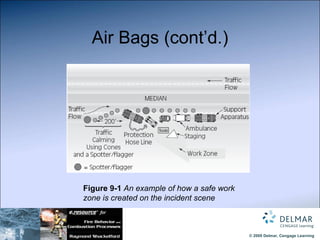
Air Bags SRS   must be considered when cutting through undeployed inflators SIC   is one of latest innovations offered by the auto industry for side impact and rollover protection Policies and procedures in place to establish safe work areas while on the roads or highways Attack vehicle fire targeting passenger compartment first
Air Bags (cont’d.) Figure 9-1  An example of how a safe work zone is created on the incident scene
Hybrid Passenger Vehicles May contain hydrogen fueling systems, CNG, or LPG in pressurized tanks May require a fire attack at a distance as the pressurized tanks holding these gases may explode Need to become familiar with new power and fueling systems Be sure battery is disconnected while operations are being conducted so an ignition of leaking flammable liquids does not occur
Strategy and Tactics in Passenger Vehicles Always respond with sufficient resources to ensure ready availability Examine situation with decision-making process Start attack from downwind side and upslope Use caution to prevent leaking flammable fuels from spreading into other areas of the vehicle
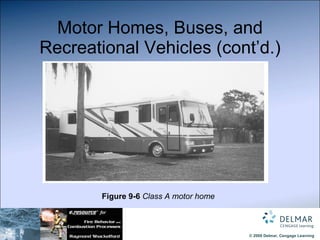
Motor Homes, Buses, and Recreational Vehicles Ranges from small pop-up tent trailer to large bus like vehicle Class A: designed and built as mobile homes Class B: converted from a basic van bought from vehicle manufacturer Class C: use cab portion and motor from the vehicle manufacturer with the addition of body Same risks as residential properties Seat belt use is rarer
Motor Homes, Buses, and Recreational Vehicles (cont’d.) Figure 9-6  Class A motor home
Fire Tactics and Strategy in Motor Homes, Buses, and Recreational Vehicles Wide variety of configurations Most buses powered by diesel engines, but many being powered w/ natural gas or methane No need for concern with leaking fuel that may trap passengers when using methane Not much difference between firefighting methods as compared to recreational vehicles and trucks
Trucks Designed to carry some type of cargo Varies in size, shape, and hazard Many have sleeping compartments  Could be exposed to fire from inside the compartment (smoking) or from the cab or cargo area
Challenges Encountered in Truck Fires Proceed with caution until cargo identified Limited in ways to approach fire during extinguishment of the interior cargo space Saddle tanks are vulnerable and may be hidden Prior knowledge of trucks and design is desired Cribbing should be set in place before rescue work begins
Truck Brake Fires Brakes may become overheated Occurs when traveling in mountainous areas  Occurs when descending long, steep declining grade Can crack if cooled too quickly Apply fog spray in short bursts to slowly cool the heated drums
Fire Tactics and Strategy in Trucks Check for hazardous materials placards  Do not take for granted that the warning placards will be posted or will be correct Bill of lading   will indicate the amount and type of cargo or freight being transported
Fires in Railed Equipment Can be some of the most dangerous problems a department may encounter Carry large amounts of people or cargo Cargo may be hazardous High life hazards may be involved
Railcar Construction and Placards Regulated by DOT and enforced by FRA Specialized business with special procedures, regulations, and equipment Preplanning should be involved Specialized drills and seminars can be arranged with rail officials
Locomotives Power producers for trains Small chance of fire in diesel engine itself Most of the hazard is electricity being generated Large size and weight is additional hazard Have a consist or way bill identifying hazardous cargo onboard
Boxcars Looks like a box with attached wheels Carry variety of commodities, which may or may not be hazardous and will have varied levels of combustibility Often made of wood Compressor is electric and powered by diesel generator attached to the boxcar Fuel is carried in small fuel tank attached to car
Flatcars Not enclosed, so no weather protection Designed and configured in different sizes depending upon the type of cargo Some made of wood Main fire concern is the wooden car and the cargo
Intermodal Equipment Flatcars with intermodal container attached Could be transported to variety of transports without unloading cargo Hazards are related to cargo itself
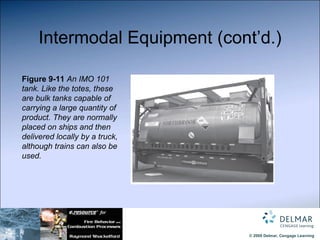
Intermodal Equipment (cont’d.) Figure 9-11  An IMO 101 tank. Like the totes, these are bulk tanks capable of carrying a large quantity of product. They are normally placed on ships and then delivered locally by a truck, although trains can also be used.
Gondola Cars Designed with flat bottoms and four walls May have cover Can be wood, but most are steel Main fire concern is cargo itself
Hopper Cars Generally constructed using metal with sides and ends that are fixed Transport dry bulk materials Main fire hazard is cargo itself
Passenger Railcars Railcars designed to carry people or provide specific services for passengers, such as riding, sleeping, dining, and luggage storage May carry several hundred people Older ones have combustible interiors Equipped by systems such as heat and air that complicate fire hazard situations
Tank Railcars A tank mounted on a railroad frame with wheels designed to transport a variety of liquid products, having tank capacities ranging from a few hundred gallons to as much as 45,000 gallons  Product and type determine fire procedures
Electric Locomotives Powered with electricity from a third rail or overhead wire carrying between 25,000 and 50,000 volts Need to make sure no one touches or crosses over the powered third rail or wire as electrocution can occur
Subway Rail Vehicles Fire problems can be numerous Possibility of serious loss of life Poor lighting, intense heat, and dense smoke along with the feeling of confinement Reaching the heart of these fires is challenging In some cases, they are extremely difficult to extinguish Breathing apparatus is always needed
Fire Tactics and Strategy in Railed Transportation Equipment Offer unique fire behavioral and other safety related problems Regulated by fire and safety requirements Different configuration of vehicles/cargo-carrying units Identify hazard first Approach downwind w/ sufficient water supplies Wear full protective equipment
Aircraft Issues differ because of speed at which these fires develop and the intensity of heat generated No safe escape route when in flight Regulated by FAA Air bill identifies hazardous materials being shipped by air
Aircraft Fuel Identified by their ease of ignition Primary fuel used is identified as Jet A fuel AFFF is particularly suited for application to fires in aircraft fuel spills Need to make sure the aircraft is electrically grounded
Hydraulic Systems and Fluids Equipped with hydraulic systems and hydraulic fluids that are operated under pressure Always approach with extreme caution A fluid under pressure will spray as a mist Ignition source can ignite the mist
Oxygen Systems Automatically put into action if cabin pressure drops Can increase the flammability of materials in the passenger compartment Need to understand the operation of these systems and know how to shut them down
Electrical Systems Most have special electrical generating units working at 24 volts Some have hydraulically powered systems to provide backup for the aircraft control systems Drills at airports can assist firefighters to know what to expect
Anti-Icing Fluids Used to keep ice off the wings and the moving parts of the wings and tail portion of the airship Not as great a hazard as other aircraft fuels Alcohol will burn with an almost invisible blue flame May require greater amounts of water to dilute the fuel
Pressurized Cylinders Aircraft have a number of different ones All have been known to explosively disintegrate during aircraft fire fighting operations
Tire, Rim, and Wheel Assemblies Usually filled with nitrogen Protects the tire from the tremendous amounts of heat generated during takeoffs and landings Tires can explode with the force of a bomb when overpressurized, overheated, or damaged during a crash impact
Escape Slides Automatically deployed and inflated within a number of seconds from the time the exit opens in the emergency mode Prepare to assist passengers as they exit  Move them quickly away from the aircraft body and wing areas
Military Aircraft Be aware that explosives are used to eject the pilot seat and canopy in certain military aircraft Preplanning tour of military base recommended Wide variety of armaments located in and on the aircraft Transportation of hazardous chemicals possible
Crash Scene Security Attract the public and media attention Establish an area surrounding the crash to allow the performance of emergency operations and to protect the scene for evidence Inner security perimeter: first responders and medical units and investigative work Second zone extends from inner zone to a minimum distance of at least 300 ft
Regulations for Aircraft FAA provides one set of basic regulations that are adhered to worldwide Three types of fire scenarios After an air crash Fire occurring in flight Fire occurring in flight that remains undetected for some time
Aircraft Engines (On the Ground) Generally not serious Fire attack can be made directly by ground units Dependant on whether it is in a piston-driven engine or a turbine engine If contained within nacelle,   extinguish fire by using the onboard extinguishing system If this fails, fire will need to be extinguished using hose lines with fog nozzles
Jet (Turbine) Powered Aircraft Engine Fires Best controlled if engine can be kept turning over Never stand within 25 ft of the front or the side, or directly to the rear of the engine outlets Stand clear of the turbine or rotation area Either use engine’s built in extinguishment system, dry chemicals, or foam or water spray
Wheel Fires Never park to the side of the aircraft or in line with the wheel’s axle Smoke does not necessarily mean fire Do not use water for cooling Use dry chemical extinguisher and water only when dry chemicals not available Use fire apparatus as a shield when water used
Strategy and Tactics in Aircraft Would essentially be trapped in an aluminum tube surrounded by flammable fuel Quick departure and rapid extinguishment needed If fire cannot be extinguished, escape route to be provided by confinement of the fire using an RIV Can discharge foam for cooling and smothering
Boats Fire threat on boats in any jurisdiction with bodies of water Getting water to boat may be a problem depending on boat’s location Fires in cabin should be attacked with foam or water spray Will probably be glowing materials in combustible furnishings inside the boat
Ship Fires Regulations established by USCG Safety of Life at Sea: international treaty containing minimum standards of fire and related safety issues for ships on international voyages International Maritime Organization (IMO):  agency of the United Nations dealing with maritime issues and responsible for maintaining the SOLAS treaty
Fires in the Hold of a Ship Greatly influenced by the conductivity of the steel construction Smoke and heat generation is a problem Determine location, find out what is burning, and determine the extent of the fire Possibility of capsizing should be considered
Tanker Ships Tanks or cargo area contains flammable liquids Contain either CO2 or steam extinguishing system May not be possible to close all openings and foam will be the only effective agent available Water can be used sparingly
Fire Tactics and Strategy on Boats and Ships Have many of the same hazards that complicate fire fighting activities as other classifications of transportation vehicles Need to obtain the cargo manifest to determine the nature and problems presented by the cargo, and the type and condition of the onboard fire fighting system Fire preplanning and close coordination with the harbormaster is recommended
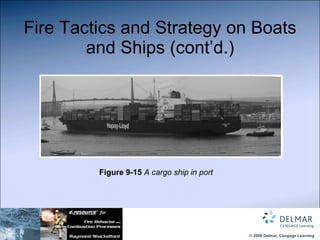
Fire Tactics and Strategy on Boats and Ships (cont’d.) Figure 9-15  A cargo ship in port
Summary Fires and the related safety issues in transportation vehicles represent a big problem for firefighters in the United States Each category of transportation fires presents specific fire and safety-related problems Found in the propulsion or power system, the fuel, electrical and hydraulic systems, and cargo areas Pre-plan and review the design and specifications of transportation vehicles

Chapter 09

  • 1.
    Transportation Fires andRelated Safety Issues Chapter 9
  • 2.
    Objectives Examine firebehavior and safety-related problems in transportation vehicles encountered by firefighters Describe fire problems and safety issues experienced with transportation vehicles and explain actions that may be taken to resolve the issues
  • 3.
    Objectives (cont’d.) Examineand describe special fire behavior problems one might encounter with each of the classifications of transportation vehicles Explain the importance of fire preplanning and familiarization procedures for each of the categories of transportation vehicles
  • 4.
    Introduction This chapterdiscusses fires and related emergencies occurring in transportation vehicles U.S. Fire Administration in 2003 funded study by National Fire Protection Research Foundation into transportation-related deaths and injuries Categories include passenger car fires, truck and recreational vehicle fires, rail transportation vehicle fires, marine vehicle fires, and aircraft fires
  • 5.
    Passenger Vehicle FiresVehicles can be brought to a stop rapidly and evacuated almost immediately Growth in use of combustible plastics, increasing the fire danger without concern for fire safety 2000 study showed annually that passenger road vehicles were responsible for almost 60% of fire-related fatalities occurring in transportation vehicles
  • 6.
    Front Bumpers Designedto absorb 5 mph crash test without damage Can explode or react during the operation of an extrication tool
  • 7.
    Air Bags SRS must be considered when cutting through undeployed inflators SIC is one of latest innovations offered by the auto industry for side impact and rollover protection Policies and procedures in place to establish safe work areas while on the roads or highways Attack vehicle fire targeting passenger compartment first
  • 8.
    Air Bags (cont’d.)Figure 9-1 An example of how a safe work zone is created on the incident scene
  • 9.
    Hybrid Passenger VehiclesMay contain hydrogen fueling systems, CNG, or LPG in pressurized tanks May require a fire attack at a distance as the pressurized tanks holding these gases may explode Need to become familiar with new power and fueling systems Be sure battery is disconnected while operations are being conducted so an ignition of leaking flammable liquids does not occur
  • 10.
    Strategy and Tacticsin Passenger Vehicles Always respond with sufficient resources to ensure ready availability Examine situation with decision-making process Start attack from downwind side and upslope Use caution to prevent leaking flammable fuels from spreading into other areas of the vehicle
  • 11.
    Motor Homes, Buses,and Recreational Vehicles Ranges from small pop-up tent trailer to large bus like vehicle Class A: designed and built as mobile homes Class B: converted from a basic van bought from vehicle manufacturer Class C: use cab portion and motor from the vehicle manufacturer with the addition of body Same risks as residential properties Seat belt use is rarer
  • 12.
    Motor Homes, Buses,and Recreational Vehicles (cont’d.) Figure 9-6 Class A motor home
  • 13.
    Fire Tactics andStrategy in Motor Homes, Buses, and Recreational Vehicles Wide variety of configurations Most buses powered by diesel engines, but many being powered w/ natural gas or methane No need for concern with leaking fuel that may trap passengers when using methane Not much difference between firefighting methods as compared to recreational vehicles and trucks
  • 14.
    Trucks Designed tocarry some type of cargo Varies in size, shape, and hazard Many have sleeping compartments Could be exposed to fire from inside the compartment (smoking) or from the cab or cargo area
  • 15.
    Challenges Encountered inTruck Fires Proceed with caution until cargo identified Limited in ways to approach fire during extinguishment of the interior cargo space Saddle tanks are vulnerable and may be hidden Prior knowledge of trucks and design is desired Cribbing should be set in place before rescue work begins
  • 16.
    Truck Brake FiresBrakes may become overheated Occurs when traveling in mountainous areas Occurs when descending long, steep declining grade Can crack if cooled too quickly Apply fog spray in short bursts to slowly cool the heated drums
  • 17.
    Fire Tactics andStrategy in Trucks Check for hazardous materials placards Do not take for granted that the warning placards will be posted or will be correct Bill of lading will indicate the amount and type of cargo or freight being transported
  • 18.
    Fires in RailedEquipment Can be some of the most dangerous problems a department may encounter Carry large amounts of people or cargo Cargo may be hazardous High life hazards may be involved
  • 19.
    Railcar Construction andPlacards Regulated by DOT and enforced by FRA Specialized business with special procedures, regulations, and equipment Preplanning should be involved Specialized drills and seminars can be arranged with rail officials
  • 20.
    Locomotives Power producersfor trains Small chance of fire in diesel engine itself Most of the hazard is electricity being generated Large size and weight is additional hazard Have a consist or way bill identifying hazardous cargo onboard
  • 21.
    Boxcars Looks likea box with attached wheels Carry variety of commodities, which may or may not be hazardous and will have varied levels of combustibility Often made of wood Compressor is electric and powered by diesel generator attached to the boxcar Fuel is carried in small fuel tank attached to car
  • 22.
    Flatcars Not enclosed,so no weather protection Designed and configured in different sizes depending upon the type of cargo Some made of wood Main fire concern is the wooden car and the cargo
  • 23.
    Intermodal Equipment Flatcarswith intermodal container attached Could be transported to variety of transports without unloading cargo Hazards are related to cargo itself
  • 24.
    Intermodal Equipment (cont’d.)Figure 9-11 An IMO 101 tank. Like the totes, these are bulk tanks capable of carrying a large quantity of product. They are normally placed on ships and then delivered locally by a truck, although trains can also be used.
  • 25.
    Gondola Cars Designedwith flat bottoms and four walls May have cover Can be wood, but most are steel Main fire concern is cargo itself
  • 26.
    Hopper Cars Generallyconstructed using metal with sides and ends that are fixed Transport dry bulk materials Main fire hazard is cargo itself
  • 27.
    Passenger Railcars Railcarsdesigned to carry people or provide specific services for passengers, such as riding, sleeping, dining, and luggage storage May carry several hundred people Older ones have combustible interiors Equipped by systems such as heat and air that complicate fire hazard situations
  • 28.
    Tank Railcars Atank mounted on a railroad frame with wheels designed to transport a variety of liquid products, having tank capacities ranging from a few hundred gallons to as much as 45,000 gallons Product and type determine fire procedures
  • 29.
    Electric Locomotives Poweredwith electricity from a third rail or overhead wire carrying between 25,000 and 50,000 volts Need to make sure no one touches or crosses over the powered third rail or wire as electrocution can occur
  • 30.
    Subway Rail VehiclesFire problems can be numerous Possibility of serious loss of life Poor lighting, intense heat, and dense smoke along with the feeling of confinement Reaching the heart of these fires is challenging In some cases, they are extremely difficult to extinguish Breathing apparatus is always needed
  • 31.
    Fire Tactics andStrategy in Railed Transportation Equipment Offer unique fire behavioral and other safety related problems Regulated by fire and safety requirements Different configuration of vehicles/cargo-carrying units Identify hazard first Approach downwind w/ sufficient water supplies Wear full protective equipment
  • 32.
    Aircraft Issues differbecause of speed at which these fires develop and the intensity of heat generated No safe escape route when in flight Regulated by FAA Air bill identifies hazardous materials being shipped by air
  • 33.
    Aircraft Fuel Identifiedby their ease of ignition Primary fuel used is identified as Jet A fuel AFFF is particularly suited for application to fires in aircraft fuel spills Need to make sure the aircraft is electrically grounded
  • 34.
    Hydraulic Systems andFluids Equipped with hydraulic systems and hydraulic fluids that are operated under pressure Always approach with extreme caution A fluid under pressure will spray as a mist Ignition source can ignite the mist
  • 35.
    Oxygen Systems Automaticallyput into action if cabin pressure drops Can increase the flammability of materials in the passenger compartment Need to understand the operation of these systems and know how to shut them down
  • 36.
    Electrical Systems Mosthave special electrical generating units working at 24 volts Some have hydraulically powered systems to provide backup for the aircraft control systems Drills at airports can assist firefighters to know what to expect
  • 37.
    Anti-Icing Fluids Usedto keep ice off the wings and the moving parts of the wings and tail portion of the airship Not as great a hazard as other aircraft fuels Alcohol will burn with an almost invisible blue flame May require greater amounts of water to dilute the fuel
  • 38.
    Pressurized Cylinders Aircrafthave a number of different ones All have been known to explosively disintegrate during aircraft fire fighting operations
  • 39.
    Tire, Rim, andWheel Assemblies Usually filled with nitrogen Protects the tire from the tremendous amounts of heat generated during takeoffs and landings Tires can explode with the force of a bomb when overpressurized, overheated, or damaged during a crash impact
  • 40.
    Escape Slides Automaticallydeployed and inflated within a number of seconds from the time the exit opens in the emergency mode Prepare to assist passengers as they exit Move them quickly away from the aircraft body and wing areas
  • 41.
    Military Aircraft Beaware that explosives are used to eject the pilot seat and canopy in certain military aircraft Preplanning tour of military base recommended Wide variety of armaments located in and on the aircraft Transportation of hazardous chemicals possible
  • 42.
    Crash Scene SecurityAttract the public and media attention Establish an area surrounding the crash to allow the performance of emergency operations and to protect the scene for evidence Inner security perimeter: first responders and medical units and investigative work Second zone extends from inner zone to a minimum distance of at least 300 ft
  • 43.
    Regulations for AircraftFAA provides one set of basic regulations that are adhered to worldwide Three types of fire scenarios After an air crash Fire occurring in flight Fire occurring in flight that remains undetected for some time
  • 44.
    Aircraft Engines (Onthe Ground) Generally not serious Fire attack can be made directly by ground units Dependant on whether it is in a piston-driven engine or a turbine engine If contained within nacelle, extinguish fire by using the onboard extinguishing system If this fails, fire will need to be extinguished using hose lines with fog nozzles
  • 45.
    Jet (Turbine) PoweredAircraft Engine Fires Best controlled if engine can be kept turning over Never stand within 25 ft of the front or the side, or directly to the rear of the engine outlets Stand clear of the turbine or rotation area Either use engine’s built in extinguishment system, dry chemicals, or foam or water spray
  • 46.
    Wheel Fires Neverpark to the side of the aircraft or in line with the wheel’s axle Smoke does not necessarily mean fire Do not use water for cooling Use dry chemical extinguisher and water only when dry chemicals not available Use fire apparatus as a shield when water used
  • 47.
    Strategy and Tacticsin Aircraft Would essentially be trapped in an aluminum tube surrounded by flammable fuel Quick departure and rapid extinguishment needed If fire cannot be extinguished, escape route to be provided by confinement of the fire using an RIV Can discharge foam for cooling and smothering
  • 48.
    Boats Fire threaton boats in any jurisdiction with bodies of water Getting water to boat may be a problem depending on boat’s location Fires in cabin should be attacked with foam or water spray Will probably be glowing materials in combustible furnishings inside the boat
  • 49.
    Ship Fires Regulationsestablished by USCG Safety of Life at Sea: international treaty containing minimum standards of fire and related safety issues for ships on international voyages International Maritime Organization (IMO): agency of the United Nations dealing with maritime issues and responsible for maintaining the SOLAS treaty
  • 50.
    Fires in theHold of a Ship Greatly influenced by the conductivity of the steel construction Smoke and heat generation is a problem Determine location, find out what is burning, and determine the extent of the fire Possibility of capsizing should be considered
  • 51.
    Tanker Ships Tanksor cargo area contains flammable liquids Contain either CO2 or steam extinguishing system May not be possible to close all openings and foam will be the only effective agent available Water can be used sparingly
  • 52.
    Fire Tactics andStrategy on Boats and Ships Have many of the same hazards that complicate fire fighting activities as other classifications of transportation vehicles Need to obtain the cargo manifest to determine the nature and problems presented by the cargo, and the type and condition of the onboard fire fighting system Fire preplanning and close coordination with the harbormaster is recommended
  • 53.
    Fire Tactics andStrategy on Boats and Ships (cont’d.) Figure 9-15 A cargo ship in port
  • 54.
    Summary Fires andthe related safety issues in transportation vehicles represent a big problem for firefighters in the United States Each category of transportation fires presents specific fire and safety-related problems Found in the propulsion or power system, the fuel, electrical and hydraulic systems, and cargo areas Pre-plan and review the design and specifications of transportation vehicles