Managing Front
Office
SQA I HOT 333
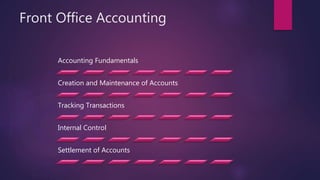
Front Office Accounting
Accounting Fundamentals
Creation and Maintenance of Accounts
Tracking Transactions
Internal Control
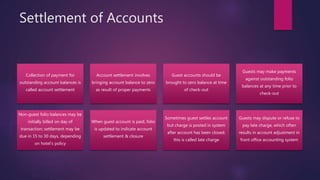
Settlement of Accounts
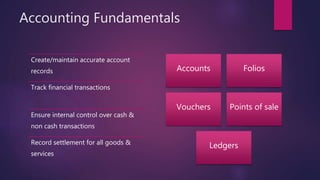
Accounting Fundamentals
Create/maintain accurate account
records
Track financial transactions
Ensure internal control over cash &
non cash transactions
Record settlement for all goods &
services
Accounts Folios
Vouchers Points of sale
Ledgers
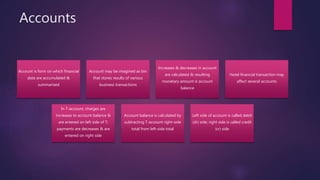
Accounts
Account is form on which financial
data are accumulated &
summarized
Account may be imagined as bin
that stores results of various
business transactions
Increases & decreases in account
are calculated & resulting
monetary amount is account
balance
Hotel financial transaction may
affect several accounts
In T-account, charges are
increases to account balance &
are entered on left side of T;
payments are decreases & are
entered on right side
Account balance is calculated by
subtracting T-account right-side
total from left-side total
Left side of account is called debit
(dr) side; right side is called credit
(cr) side
Guest Accounts
Guest account is record of financial transactions that occur between guest & hotel
Guest accounts are created when guests guarantee their reservations or when they
register at front desk
During occupancy front office is responsible for & records all transactions affecting
guest account
Front office usually seeks payment for any outstanding guest balance during the
settlement stage of guest cycle
Non-Guest Accounts
Non-guest accounts are created to track deferred transactions
Hotel may extend charge privileges to local businesses/agencies called House or City Ledger
Hotel may offer in-house charge privileges to groups sponsoring meetings at hotel Master Account
Non-guest account may also be created when guest fails to settle account at departure
Responsibility for account settlement then shifts from front office to back office accounting division
Folios
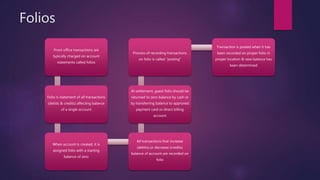
Front office transactions are
typically charged on account
statements called folios
Folio is statement of all transactions
(debits & credits) affecting balance
of a single account
When account is created, it is
assigned folio with a starting
balance of zero
All transactions that increase
(debits) or decrease (credits)
balance of account are recorded on
folio
At settlement, guest folio should be
returned to zero balance by cash or
by transferring balance to approved
payment card or direct billing
account
Process of recording transactions
on folio is called “posting”
Transaction is posted when it has
been recorded on proper folio in
proper location & new balance has
been determined
Types of Folios
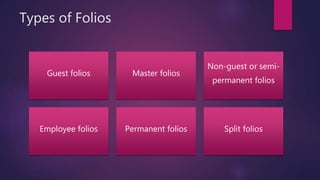
Guest folios Master folios
Non-guest or semi-
permanent folios
Employee folios Permanent folios Split folios
Vouchers
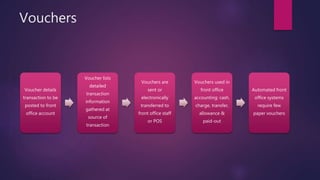
Voucher details
transaction to be
posted to front
office account
Voucher lists
detailed
transaction
information
gathered at
source of
transaction
Vouchers are
sent or
electronically
transferred to
front office staff
or POS
Vouchers used in
front office
accounting: cash,
charge, transfer,
allowance &
paid-out
Automated front
office systems
require few
paper vouchers
Points of Sale
Physical locations at which goods or services are purchased
Hotel department or area that collects revenues is point of sale
Large hotels typically support many points of sale: restaurants, dry cleaning, valet, telephone, spas & retail shops
Hotels offer guest-operated devices function as self-service points of sale (in-room movie systems, Internet-access devices etc.
Volume of goods & services purchased at scattered points of sale within hotel requires complex internal accounting system
Automated point-of-sale (POS) system enables remote terminals at point of purchase to communicate directly with front office system
Automated POS systems significantly reduce amount of time needed to post charges to guest folios, minimize number of times transactional data must be handled, & virtually eliminate
after-departure (late) charges
POS information includes transaction no, charge amount, name outlet, room no, name of guest, description of charge
Ledgers
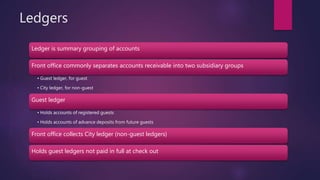
Ledger is summary grouping of accounts
Front office commonly separates accounts receivable into two subsidiary groups
• Guest ledger, for guest
• City ledger, for non-guest
Guest ledger
• Holds accounts of registered guests
• Holds accounts of advance deposits from future guests
Front office collects City ledger (non-guest ledgers)
Holds guest ledgers not paid in full at check out
Creation & Maintenance of Accounts
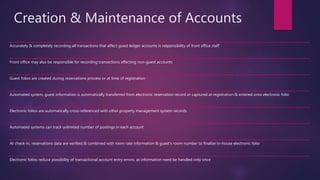
Accurately & completely recording all transactions that affect guest ledger accounts is responsibility of front office staff
Front office may also be responsible for recording transactions affecting non-guest accounts
Guest folios are created during reservations process or at time of registration
Automated system, guest information is automatically transferred from electronic reservation record or captured at registration & entered onto electronic folio
Electronic folios are automatically cross-referenced with other property management system records
Automated systems can track unlimited number of postings in each account
At check-in, reservations data are verified & combined with room rate information & guest’s room number to finalize in-house electronic folio
Electronic folios reduce possibility of transactional account entry errors, as information need be handled only once
Automated Recordkeeping Systems
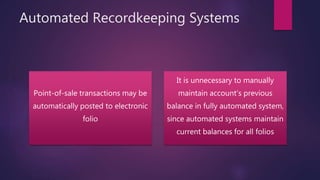
Point-of-sale transactions may be
automatically posted to electronic
folio
It is unnecessary to manually
maintain account’s previous
balance in fully automated system,
since automated systems maintain
current balances for all folios
Charge Privileges
To establish charge privileges, guest may
be required to present payment card or
direct billing authorization at
registration; automated system will allow
credit to be established when reservation
record is created
Typically, hotel obtains number &
expiration date of guest’s payment card
& electronically requests amount
guarantee from card company
Once line of credit has been approved,
guests can make charge purchases at
hotel points of sale
Guests who use cash to pay for
accommodations are typically not
extended charge privileges; these guests
are called paid-in- advance or PIA guests
In automated front office system, PIA
accounts are usually set to “no-post”
status
In addition to guests, local businesses or
residents may apply to hotel for charge
privileges
Credit Monitoring
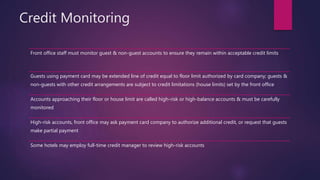
Front office staff must monitor guest & non-guest accounts to ensure they remain within acceptable credit limits
Guests using payment card may be extended line of credit equal to floor limit authorized by card company; guests &
non-guests with other credit arrangements are subject to credit limitations (house limits) set by the front office
Accounts approaching their floor or house limit are called high-risk or high-balance accounts & must be carefully
monitored
High-risk accounts, front office may ask payment card company to authorize additional credit, or request that guests
make partial payment
Some hotels may employ full-time credit manager to review high-risk accounts
Account Maintenance
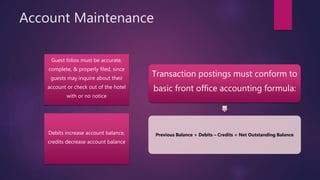
Guest folios must be accurate,
complete, & properly filed, since
guests may inquire about their
account or check out of the hotel
with or no notice
Debits increase account balance,
credits decrease account balance
Transaction postings must conform to
basic front office accounting formula:
Previous Balance + Debits – Credits = Net Outstanding Balance
Tracking Transactions
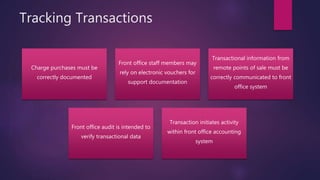
Charge purchases must be
correctly documented
Front office staff members may
rely on electronic vouchers for
support documentation
Transactional information from
remote points of sale must be
correctly communicated to front
office system
Front office audit is intended to
verify transactional data
Transaction initiates activity
within front office accounting
system
Types of Front Office Transactions
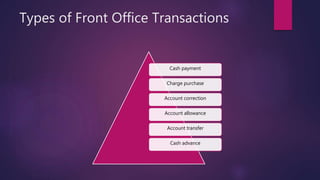
Cash payment
Charge purchase
Account correction
Account allowance
Account transfer
Cash advance
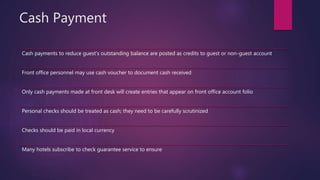
Cash Payment
Cash payments to reduce guest’s outstanding balance are posted as credits to guest or non-guest account
Front office personnel may use cash voucher to document cash received
Only cash payments made at front desk will create entries that appear on front office account folio
Personal checks should be treated as cash; they need to be carefully scrutinized
Checks should be paid in local currency
Many hotels subscribe to check guarantee service to ensure
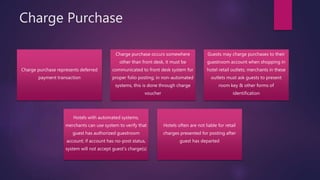
Charge Purchase
Charge purchase represents deferred
payment transaction
Charge purchase occurs somewhere
other than front desk, it must be
communicated to front desk system for
proper folio posting; in non-automated
systems, this is done through charge
voucher
Guests may charge purchases to their
guestroom account when shopping in
hotel retail outlets; merchants in these
outlets must ask guests to present
room key & other forms of
identification
Hotels with automated systems,
merchants can use system to verify that
guest has authorized guestroom
account; if account has no-post status,
system will not accept guest’s charge(s)
Hotels often are not liable for retail
charges presented for posting after
guest has departed
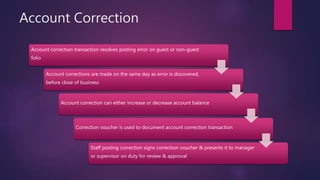
Account Correction
Account correction transaction resolves posting error on guest or non-guest
folio
Account corrections are made on the same day as error is discovered,
before close of business
Account correction can either increase or decrease account balance
Correction voucher is used to document account correction transaction
Staff posting correction signs correction voucher & presents it to manager
or supervisor on duty for review & approval
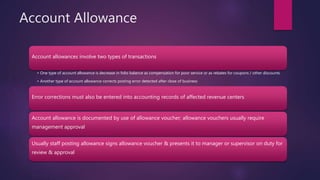
Account Allowance
Account allowances involve two types of transactions
• One type of account allowance is decrease in folio balance as compensation for poor service or as rebates for coupons / other discounts
• Another type of account allowance corrects posting error detected after close of business
Error corrections must also be entered into accounting records of affected revenue centers
Account allowance is documented by use of allowance voucher; allowance vouchers usually require
management approval
Usually staff posting allowance signs allowance voucher & presents it to manager or supervisor on duty for
review & approval
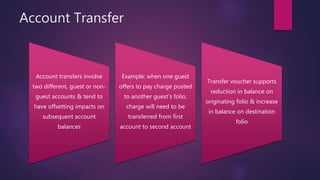
Account Transfer
Account transfers involve
two different, guest or non-
guest accounts & tend to
have offsetting impacts on
subsequent account
balances
Example: when one guest
offers to pay charge posted
to another guest’s folio,
charge will need to be
transferred from first
account to second account
Transfer voucher supports
reduction in balance on
originating folio & increase
in balance on destination
folio
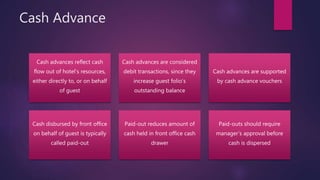
Cash Advance
Cash advances reflect cash
flow out of hotel’s resources,
either directly to, or on behalf
of guest
Cash advances are considered
debit transactions, since they
increase guest folio’s
outstanding balance
Cash advances are supported
by cash advance vouchers
Cash disbursed by front office
on behalf of guest is typically
called paid-out
Paid-out reduces amount of
cash held in front office cash
drawer
Paid-outs should require
manager’s approval before
cash is dispersed
Internal Control Functions
Track transaction documents
Verify account entries & balances
Identify vulnerabilities in accounting system
Cash Banks
Cash bank is amount of cash assigned to a cashier to handle various transactions
that occur during work shift
Hotel may issue cash banks with specific amount of money to each cashier
Bank limit is starting amount bank should have when it is issued start of shift
Cashiers typically sign for their banks at beginning of their shifts & are only
people with access to their particular bank
At end of shift, cashier deposits all cash, checks, & other negotiable
instruments into & hotel safe or other designated location
Net Cash Receipts, Overages,
Shortages, and Due Backs
Net cash receipts are amount of cash, checks, & other negotiable items in cashier’s drawer, minus amount of initial cash
bank, plus any paid-outs
Overage occurs when, after initial bank is removed, total of cash, checks, gift certificates, & paid-outs is greater than
net cash receipts
Shortage occurs when total of contents of the cash drawer is less than net cash receipts
Due back occurs when cashier pays out more than he or she receives; in other words, there is not enough cash in drawer
to restore initial bank
Audit Controls
Publicly held lodging companies are required to have both
their front & back office accounting records audited yearly by
independent certified public accountant
Hotel companies with multiple properties often employ
internal auditors who make unannounced visits to individual
properties to review accounting procedures & records
Settlement of Accounts
Collection of payment for
outstanding account balances is
called account settlement
Account settlement involves
bringing account balance to zero
as result of proper payments
Guest accounts should be
brought to zero balance at time
of check-out
Guests may make payments
against outstanding folio
balances at any time prior to
check-out
Non-guest folio balances may be
initially billed on day of
transaction; settlement may be
due in 15 to 30 days, depending
on hotel’s policy
When guest account is paid, folio
is updated to indicate account
settlement & closure
Sometimes guest settles account
but charge is posted in system
after account has been closed;
this is called late charge
Guests may dispute or refuse to
pay late charge, which often
results in account adjustment in
front office accounting system
?
Any Questions

Chapter 08 Managing Front Office Operations HOT 333

  • 1.
  • 2.
    Front Office Accounting AccountingFundamentals Creation and Maintenance of Accounts Tracking Transactions Internal Control Settlement of Accounts
  • 3.
    Accounting Fundamentals Create/maintain accurateaccount records Track financial transactions Ensure internal control over cash & non cash transactions Record settlement for all goods & services Accounts Folios Vouchers Points of sale Ledgers
  • 4.
    Accounts Account is formon which financial data are accumulated & summarized Account may be imagined as bin that stores results of various business transactions Increases & decreases in account are calculated & resulting monetary amount is account balance Hotel financial transaction may affect several accounts In T-account, charges are increases to account balance & are entered on left side of T; payments are decreases & are entered on right side Account balance is calculated by subtracting T-account right-side total from left-side total Left side of account is called debit (dr) side; right side is called credit (cr) side
  • 5.
    Guest Accounts Guest accountis record of financial transactions that occur between guest & hotel Guest accounts are created when guests guarantee their reservations or when they register at front desk During occupancy front office is responsible for & records all transactions affecting guest account Front office usually seeks payment for any outstanding guest balance during the settlement stage of guest cycle
  • 6.
    Non-Guest Accounts Non-guest accountsare created to track deferred transactions Hotel may extend charge privileges to local businesses/agencies called House or City Ledger Hotel may offer in-house charge privileges to groups sponsoring meetings at hotel Master Account Non-guest account may also be created when guest fails to settle account at departure Responsibility for account settlement then shifts from front office to back office accounting division
  • 7.
    Folios Front office transactionsare typically charged on account statements called folios Folio is statement of all transactions (debits & credits) affecting balance of a single account When account is created, it is assigned folio with a starting balance of zero All transactions that increase (debits) or decrease (credits) balance of account are recorded on folio At settlement, guest folio should be returned to zero balance by cash or by transferring balance to approved payment card or direct billing account Process of recording transactions on folio is called “posting” Transaction is posted when it has been recorded on proper folio in proper location & new balance has been determined
  • 8.
    Types of Folios Guestfolios Master folios Non-guest or semi- permanent folios Employee folios Permanent folios Split folios
  • 9.
    Vouchers Voucher details transaction tobe posted to front office account Voucher lists detailed transaction information gathered at source of transaction Vouchers are sent or electronically transferred to front office staff or POS Vouchers used in front office accounting: cash, charge, transfer, allowance & paid-out Automated front office systems require few paper vouchers
  • 10.
    Points of Sale Physicallocations at which goods or services are purchased Hotel department or area that collects revenues is point of sale Large hotels typically support many points of sale: restaurants, dry cleaning, valet, telephone, spas & retail shops Hotels offer guest-operated devices function as self-service points of sale (in-room movie systems, Internet-access devices etc. Volume of goods & services purchased at scattered points of sale within hotel requires complex internal accounting system Automated point-of-sale (POS) system enables remote terminals at point of purchase to communicate directly with front office system Automated POS systems significantly reduce amount of time needed to post charges to guest folios, minimize number of times transactional data must be handled, & virtually eliminate after-departure (late) charges POS information includes transaction no, charge amount, name outlet, room no, name of guest, description of charge
  • 11.
    Ledgers Ledger is summarygrouping of accounts Front office commonly separates accounts receivable into two subsidiary groups • Guest ledger, for guest • City ledger, for non-guest Guest ledger • Holds accounts of registered guests • Holds accounts of advance deposits from future guests Front office collects City ledger (non-guest ledgers) Holds guest ledgers not paid in full at check out
  • 12.
    Creation & Maintenanceof Accounts Accurately & completely recording all transactions that affect guest ledger accounts is responsibility of front office staff Front office may also be responsible for recording transactions affecting non-guest accounts Guest folios are created during reservations process or at time of registration Automated system, guest information is automatically transferred from electronic reservation record or captured at registration & entered onto electronic folio Electronic folios are automatically cross-referenced with other property management system records Automated systems can track unlimited number of postings in each account At check-in, reservations data are verified & combined with room rate information & guest’s room number to finalize in-house electronic folio Electronic folios reduce possibility of transactional account entry errors, as information need be handled only once
  • 13.
    Automated Recordkeeping Systems Point-of-saletransactions may be automatically posted to electronic folio It is unnecessary to manually maintain account’s previous balance in fully automated system, since automated systems maintain current balances for all folios
  • 14.
    Charge Privileges To establishcharge privileges, guest may be required to present payment card or direct billing authorization at registration; automated system will allow credit to be established when reservation record is created Typically, hotel obtains number & expiration date of guest’s payment card & electronically requests amount guarantee from card company Once line of credit has been approved, guests can make charge purchases at hotel points of sale Guests who use cash to pay for accommodations are typically not extended charge privileges; these guests are called paid-in- advance or PIA guests In automated front office system, PIA accounts are usually set to “no-post” status In addition to guests, local businesses or residents may apply to hotel for charge privileges
  • 15.
    Credit Monitoring Front officestaff must monitor guest & non-guest accounts to ensure they remain within acceptable credit limits Guests using payment card may be extended line of credit equal to floor limit authorized by card company; guests & non-guests with other credit arrangements are subject to credit limitations (house limits) set by the front office Accounts approaching their floor or house limit are called high-risk or high-balance accounts & must be carefully monitored High-risk accounts, front office may ask payment card company to authorize additional credit, or request that guests make partial payment Some hotels may employ full-time credit manager to review high-risk accounts
  • 16.
    Account Maintenance Guest foliosmust be accurate, complete, & properly filed, since guests may inquire about their account or check out of the hotel with or no notice Debits increase account balance, credits decrease account balance Transaction postings must conform to basic front office accounting formula: Previous Balance + Debits – Credits = Net Outstanding Balance
  • 17.
    Tracking Transactions Charge purchasesmust be correctly documented Front office staff members may rely on electronic vouchers for support documentation Transactional information from remote points of sale must be correctly communicated to front office system Front office audit is intended to verify transactional data Transaction initiates activity within front office accounting system
  • 18.
    Types of FrontOffice Transactions Cash payment Charge purchase Account correction Account allowance Account transfer Cash advance
  • 19.
    Cash Payment Cash paymentsto reduce guest’s outstanding balance are posted as credits to guest or non-guest account Front office personnel may use cash voucher to document cash received Only cash payments made at front desk will create entries that appear on front office account folio Personal checks should be treated as cash; they need to be carefully scrutinized Checks should be paid in local currency Many hotels subscribe to check guarantee service to ensure
  • 20.
    Charge Purchase Charge purchaserepresents deferred payment transaction Charge purchase occurs somewhere other than front desk, it must be communicated to front desk system for proper folio posting; in non-automated systems, this is done through charge voucher Guests may charge purchases to their guestroom account when shopping in hotel retail outlets; merchants in these outlets must ask guests to present room key & other forms of identification Hotels with automated systems, merchants can use system to verify that guest has authorized guestroom account; if account has no-post status, system will not accept guest’s charge(s) Hotels often are not liable for retail charges presented for posting after guest has departed
  • 21.
    Account Correction Account correctiontransaction resolves posting error on guest or non-guest folio Account corrections are made on the same day as error is discovered, before close of business Account correction can either increase or decrease account balance Correction voucher is used to document account correction transaction Staff posting correction signs correction voucher & presents it to manager or supervisor on duty for review & approval
  • 22.
    Account Allowance Account allowancesinvolve two types of transactions • One type of account allowance is decrease in folio balance as compensation for poor service or as rebates for coupons / other discounts • Another type of account allowance corrects posting error detected after close of business Error corrections must also be entered into accounting records of affected revenue centers Account allowance is documented by use of allowance voucher; allowance vouchers usually require management approval Usually staff posting allowance signs allowance voucher & presents it to manager or supervisor on duty for review & approval
  • 23.
    Account Transfer Account transfersinvolve two different, guest or non- guest accounts & tend to have offsetting impacts on subsequent account balances Example: when one guest offers to pay charge posted to another guest’s folio, charge will need to be transferred from first account to second account Transfer voucher supports reduction in balance on originating folio & increase in balance on destination folio
  • 24.
    Cash Advance Cash advancesreflect cash flow out of hotel’s resources, either directly to, or on behalf of guest Cash advances are considered debit transactions, since they increase guest folio’s outstanding balance Cash advances are supported by cash advance vouchers Cash disbursed by front office on behalf of guest is typically called paid-out Paid-out reduces amount of cash held in front office cash drawer Paid-outs should require manager’s approval before cash is dispersed
  • 25.
    Internal Control Functions Tracktransaction documents Verify account entries & balances Identify vulnerabilities in accounting system
  • 26.
    Cash Banks Cash bankis amount of cash assigned to a cashier to handle various transactions that occur during work shift Hotel may issue cash banks with specific amount of money to each cashier Bank limit is starting amount bank should have when it is issued start of shift Cashiers typically sign for their banks at beginning of their shifts & are only people with access to their particular bank At end of shift, cashier deposits all cash, checks, & other negotiable instruments into & hotel safe or other designated location
  • 27.
    Net Cash Receipts,Overages, Shortages, and Due Backs Net cash receipts are amount of cash, checks, & other negotiable items in cashier’s drawer, minus amount of initial cash bank, plus any paid-outs Overage occurs when, after initial bank is removed, total of cash, checks, gift certificates, & paid-outs is greater than net cash receipts Shortage occurs when total of contents of the cash drawer is less than net cash receipts Due back occurs when cashier pays out more than he or she receives; in other words, there is not enough cash in drawer to restore initial bank
  • 28.
    Audit Controls Publicly heldlodging companies are required to have both their front & back office accounting records audited yearly by independent certified public accountant Hotel companies with multiple properties often employ internal auditors who make unannounced visits to individual properties to review accounting procedures & records
  • 29.
    Settlement of Accounts Collectionof payment for outstanding account balances is called account settlement Account settlement involves bringing account balance to zero as result of proper payments Guest accounts should be brought to zero balance at time of check-out Guests may make payments against outstanding folio balances at any time prior to check-out Non-guest folio balances may be initially billed on day of transaction; settlement may be due in 15 to 30 days, depending on hotel’s policy When guest account is paid, folio is updated to indicate account settlement & closure Sometimes guest settles account but charge is posted in system after account has been closed; this is called late charge Guests may dispute or refuse to pay late charge, which often results in account adjustment in front office accounting system
  • 30.