Managing Front
Office
SQA I HOT 333
Reservations
Reservations and Sales
Types of Reservations
Reservation Inquiries
Group Reservations
Reservation Availability
Reservation Records
Reservation Confirmation/ Cancellation
Reservation Reports
Other Reservation Considerations
Who is the Revenue Manager?
Implement revenue
management strategies &
processes, in order to optimize
& maximize its revenues
At some point, revenue
management started out as
being in charge of reservations
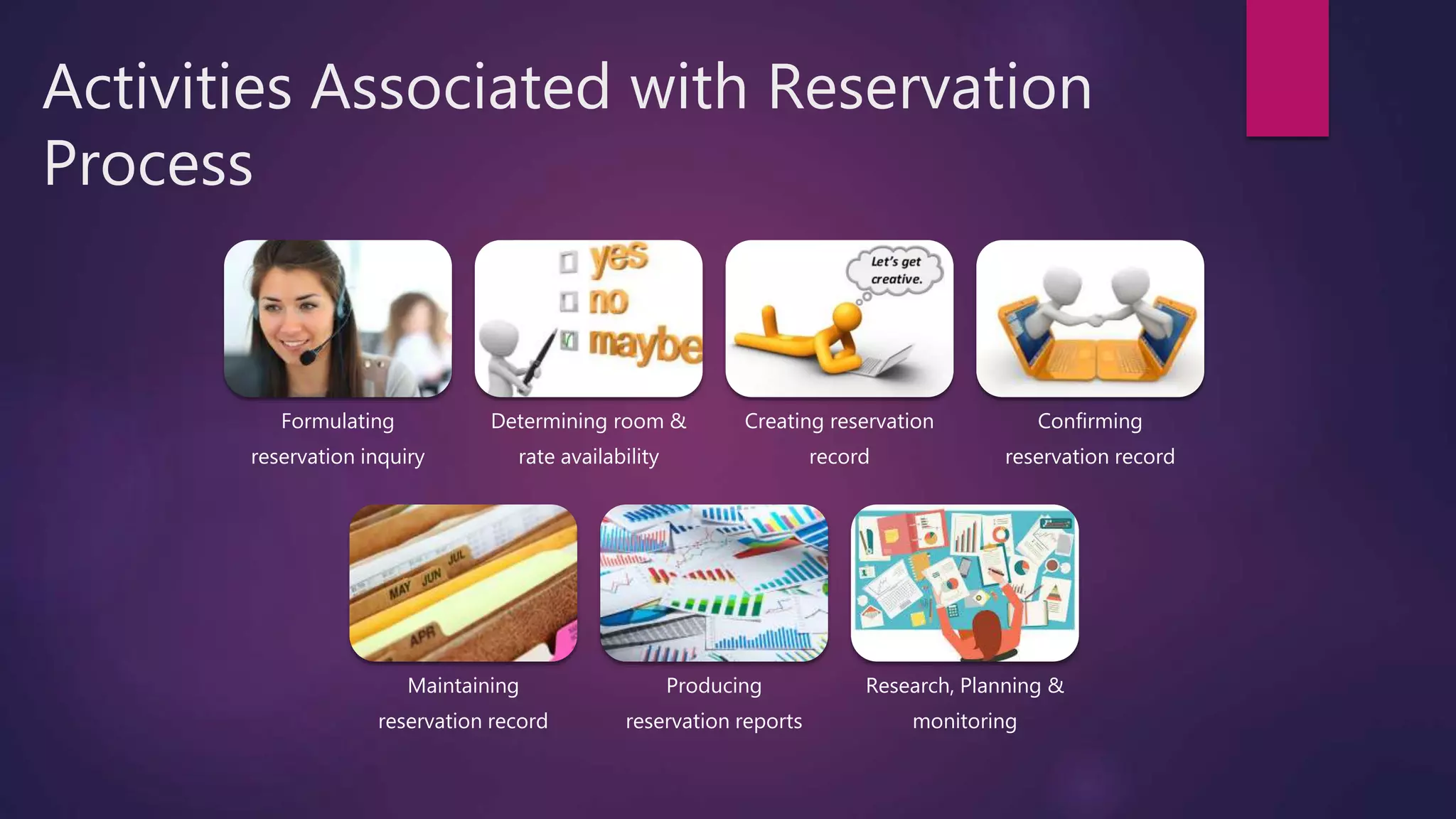
Activities Associated with Reservation
Process
Formulating
reservation inquiry
Determining room &
rate availability
Creating reservation
record
Confirming
reservation record
Maintaining
reservation record
Producing
reservation reports
Research, Planning &
monitoring
Reservations and Sales
Prior to front office automation, reservations agents focused on basic room availability; they could not
reserve specific types of rooms
Automation provides accurate & current room & rate information
Due to automation, much of responsibility for room sales, revenue projections, & profitability analyses has
shifted to reservations department
Reservations agents are now salespeople
Many reservations are now made online; hotels need websites that are designed to make it easy for guests
to make reservations
Role of the Sales Department
Primary source of group
reservations, typically from
corporations & trade
associations
Go after social, military,
educational, religious &
fraternal groups (SMERF),
business traveler, TA market
Sales must familiarize
distribution channels with
hotel’s characteristics &
surrounding areas
Sales managers are often
given financial or other
incentives to meet or exceed
sales goals
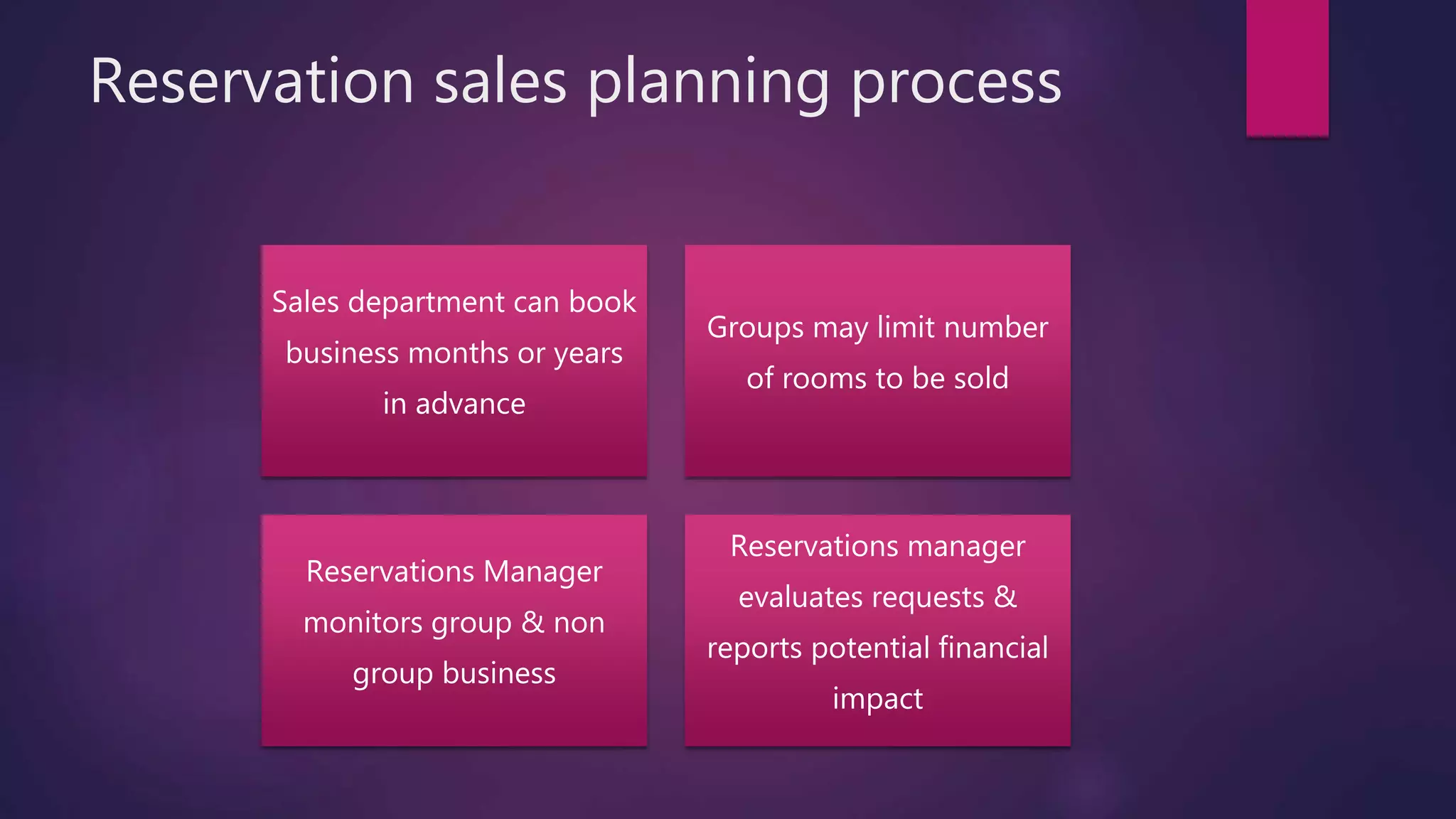
Reservation sales planning process
Sales department can book
business months or years
in advance
Groups may limit number
of rooms to be sold
Reservations Manager
monitors group & non
group business
Reservations manager
evaluates requests &
reports potential financial
impact
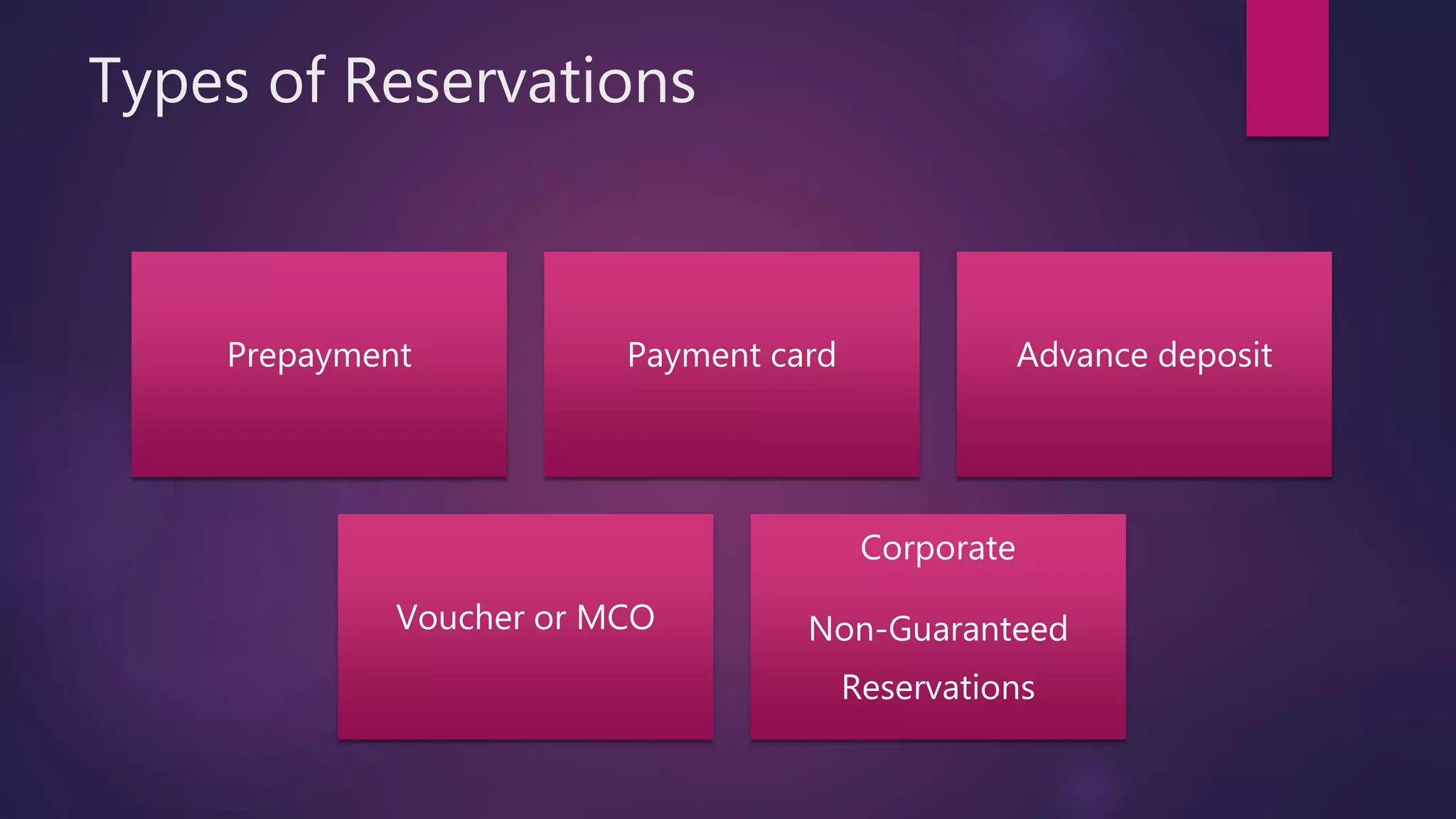
Types of Reservations
Prepayment Payment card Advance deposit
Voucher or MCO
Corporate
Non-Guaranteed
Reservations
Guaranteed Reservations—
Prepayment
Requires payment in full be received prior to guest’s day of arrival
Generally most desirable form of guaranteed reservation for hotel
Commonly used at resort hotels
Guaranteed Reservations—Payment
Card
Common form of guaranteed reservation
Properly canceled before stated cancellation hour, hotel charges one
night’s room rate plus tax
Resort hotels may charge for more since typical length of stay is longer
Guaranteed Reservations—Advance
Deposit
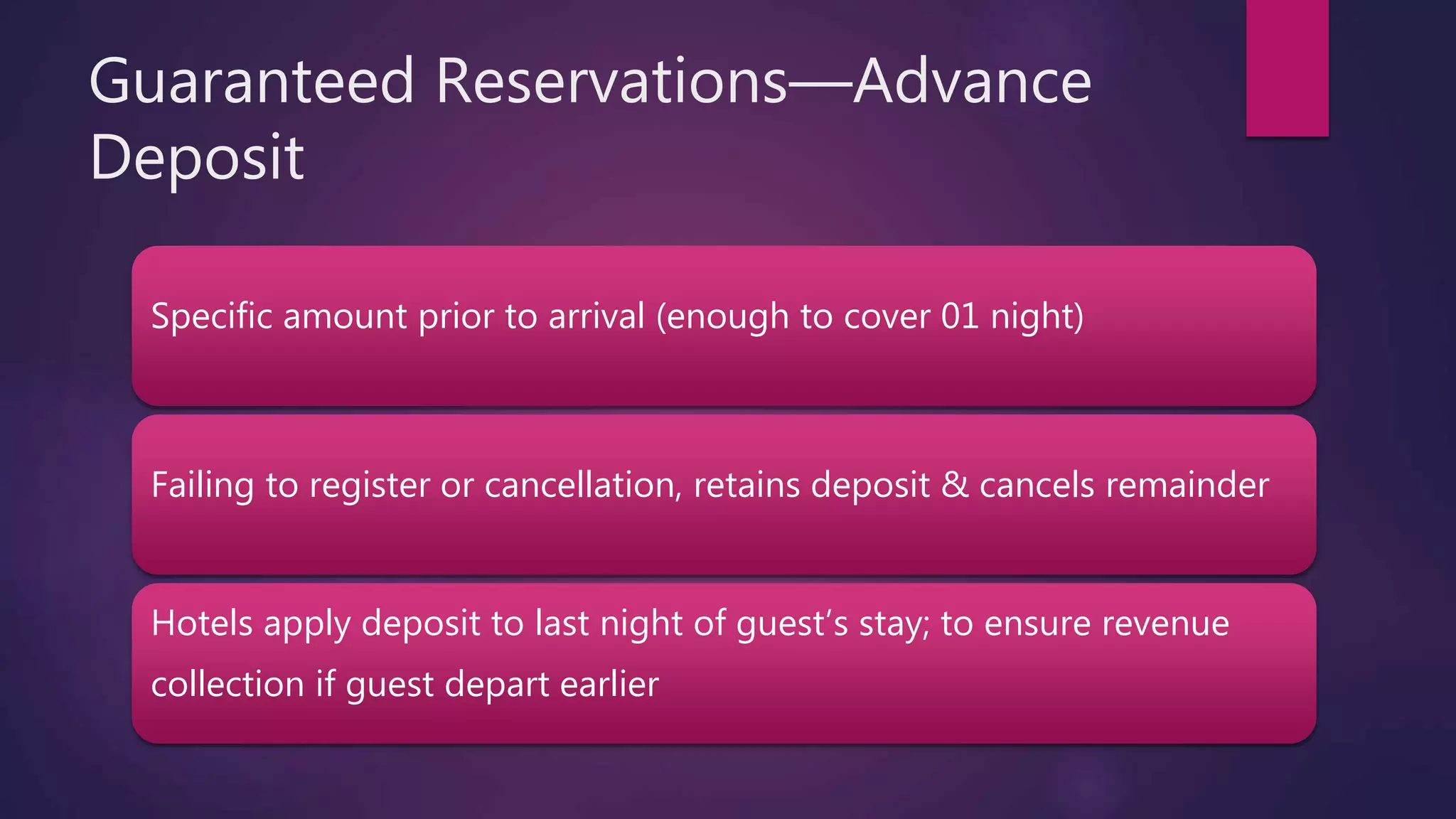
Specific amount prior to arrival (enough to cover 01 night)
Failing to register or cancellation, retains deposit & cancels remainder
Hotels apply deposit to last night of guest’s stay; to ensure revenue
collection if guest depart earlier
Guaranteed Reservations—Voucher or
MCO
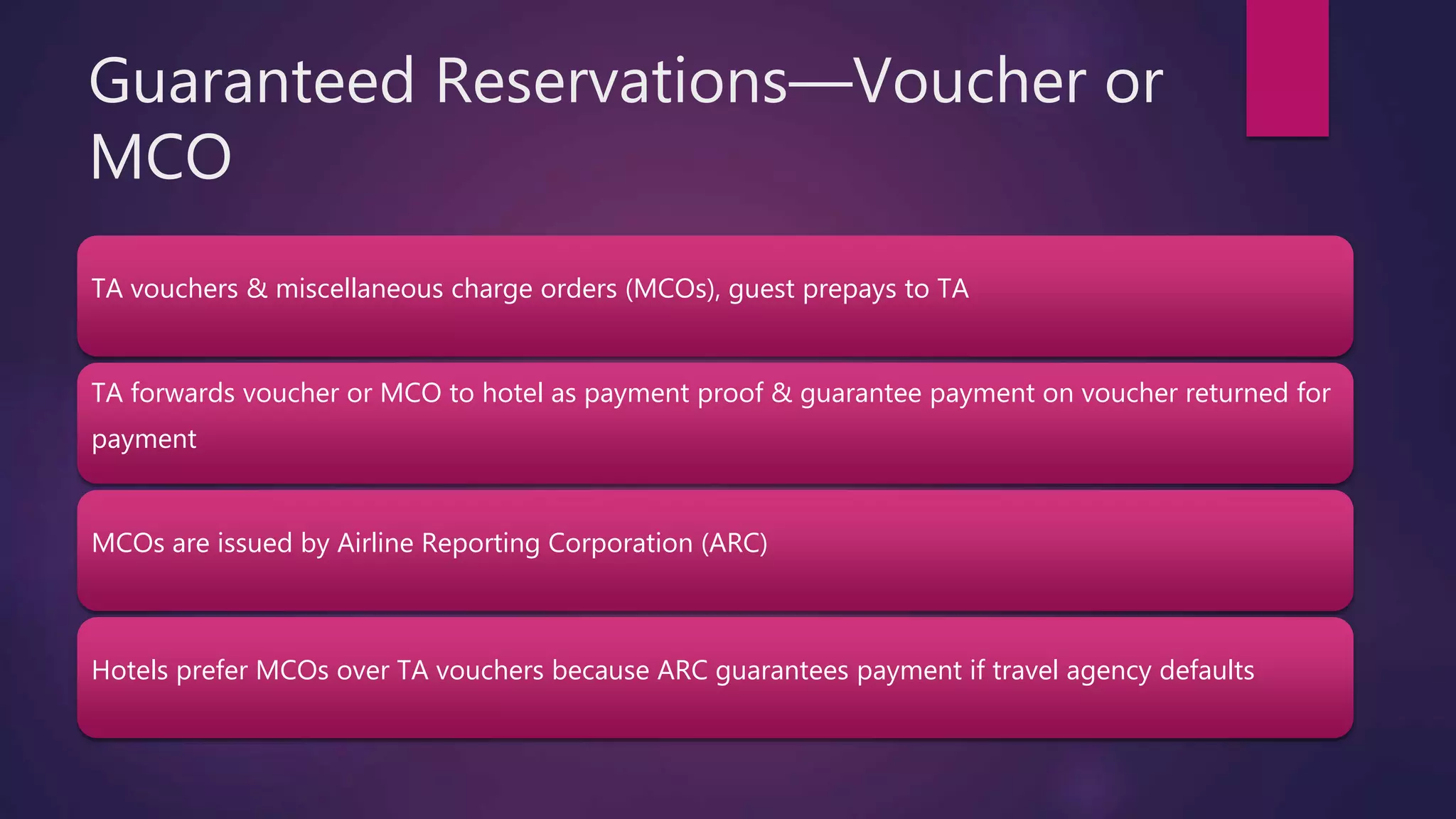
TA vouchers & miscellaneous charge orders (MCOs), guest prepays to TA
TA forwards voucher or MCO to hotel as payment proof & guarantee payment on voucher returned for
payment
MCOs are issued by Airline Reporting Corporation (ARC)
Hotels prefer MCOs over TA vouchers because ARC guarantees payment if travel agency defaults
Guaranteed Reservations—Corporate
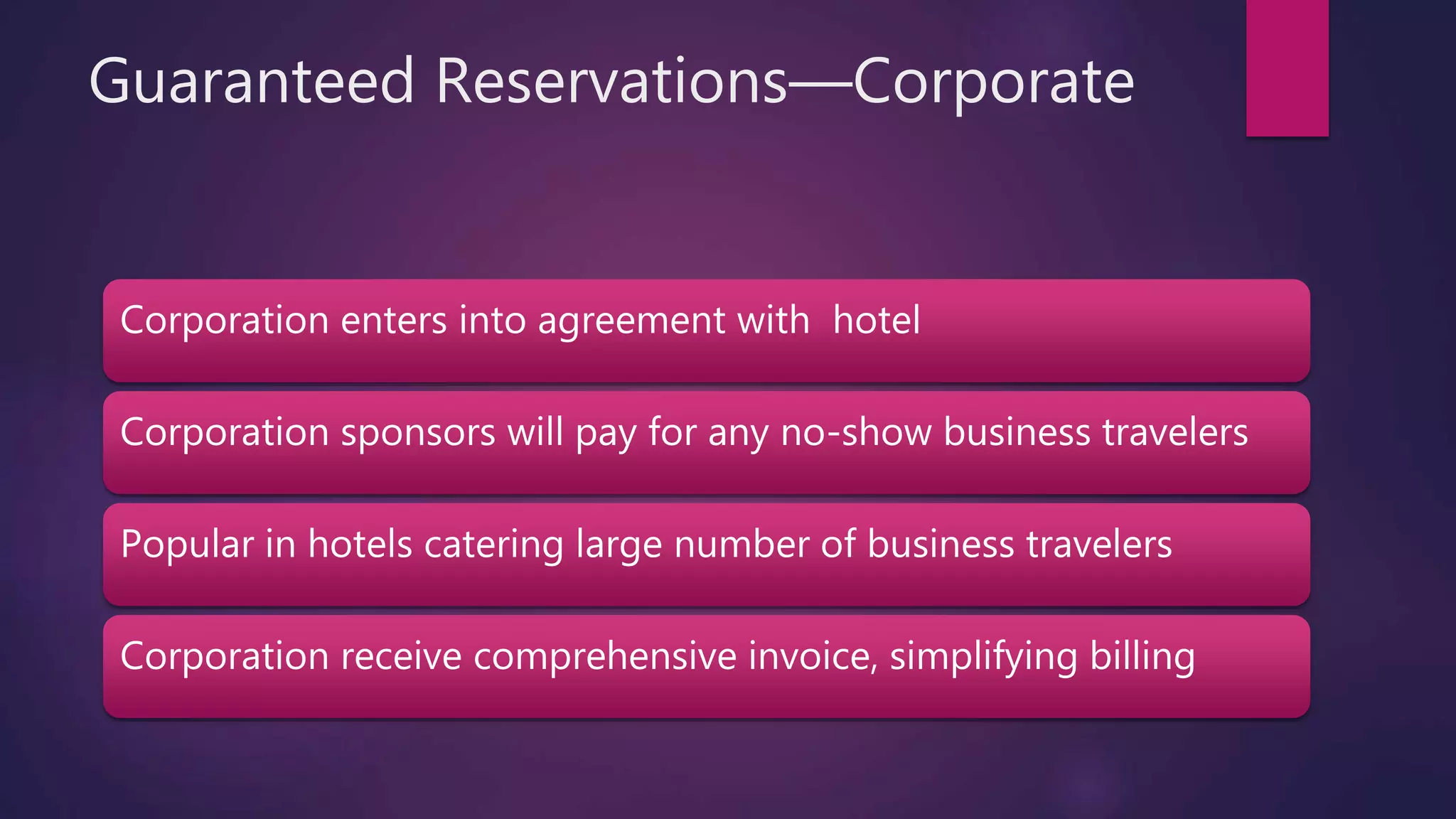
Corporation enters into agreement with hotel
Corporation sponsors will pay for any no-show business travelers
Popular in hotels catering large number of business travelers
Corporation receive comprehensive invoice, simplifying billing
Non-Guaranteed Reservations
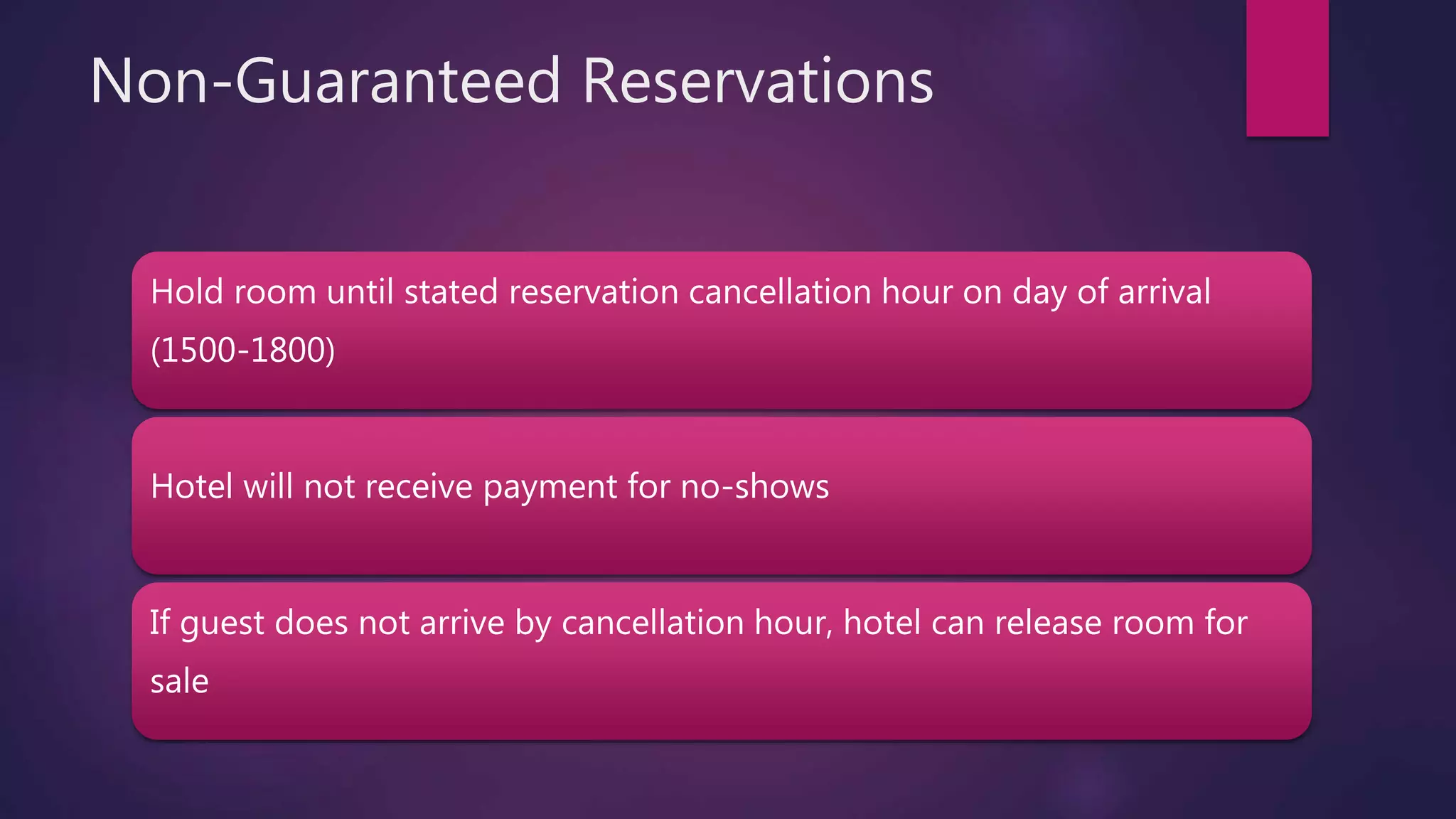
Hold room until stated reservation cancellation hour on day of arrival
(1500-1800)
Hotel will not receive payment for no-shows
If guest does not arrive by cancellation hour, hotel can release room for
sale
Reservation Inquiries
Handled by reservations agent or website
Information collected
• Guest’s name, address, e-mail address, telephone number; company or
travel agency name, date of arrival & departure
• Type & number of rooms requested; room rate; number of people in
party, method of payment or guarantee; or any special requests
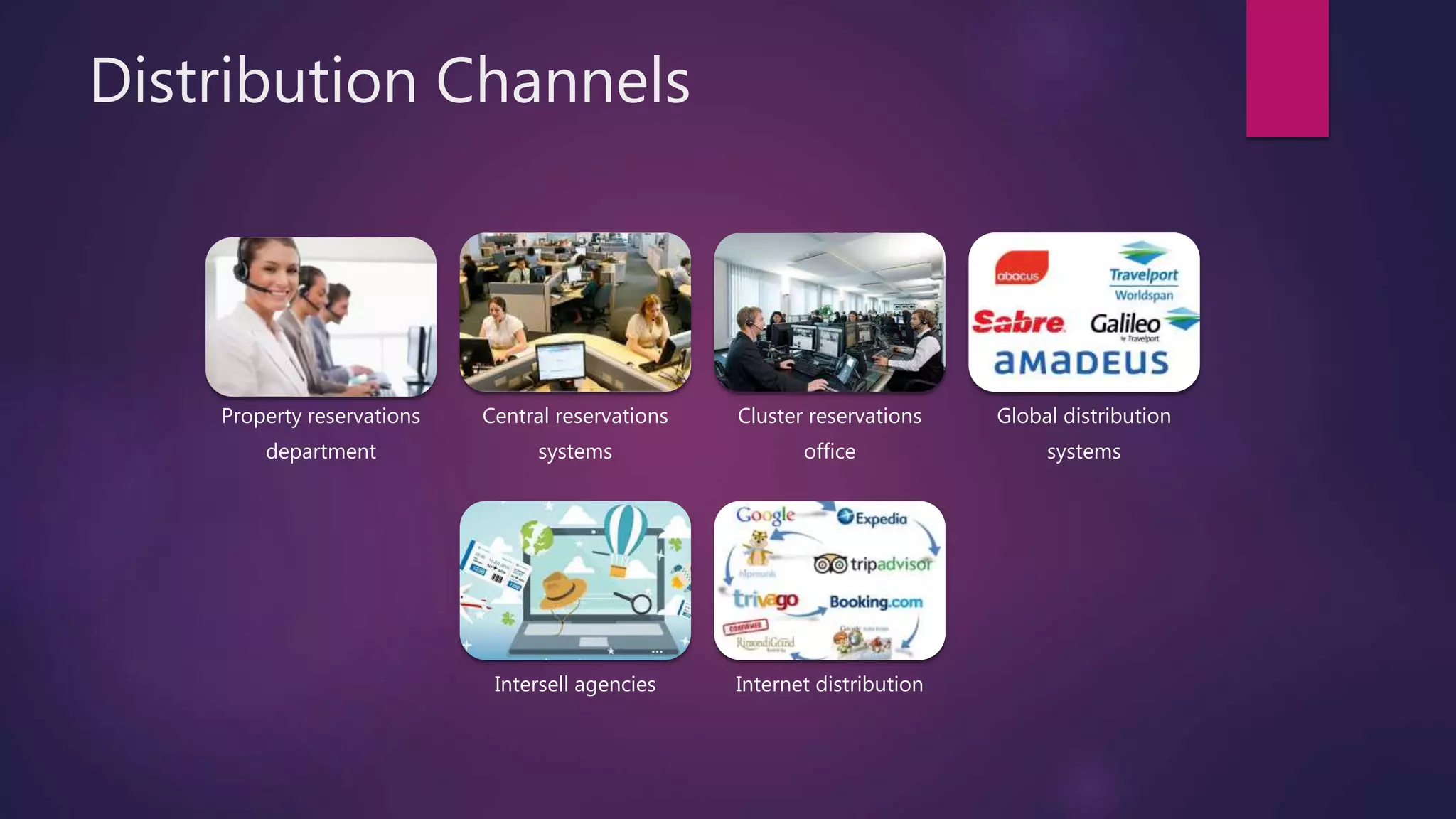
Distribution Channels
Property reservations
department
Central reservations
systems
Cluster reservations
office
Global distribution
systems
Intersell agencies Internet distribution
Property Reservations Department
Handles direct requests for rooms, monitors any communication
links with central reservations systems & intersell agencies,
maintains updated room availability information
Direct requests can reach department in several ways:
telephone, mail, property website, property-to-property, faxes,
text messaging
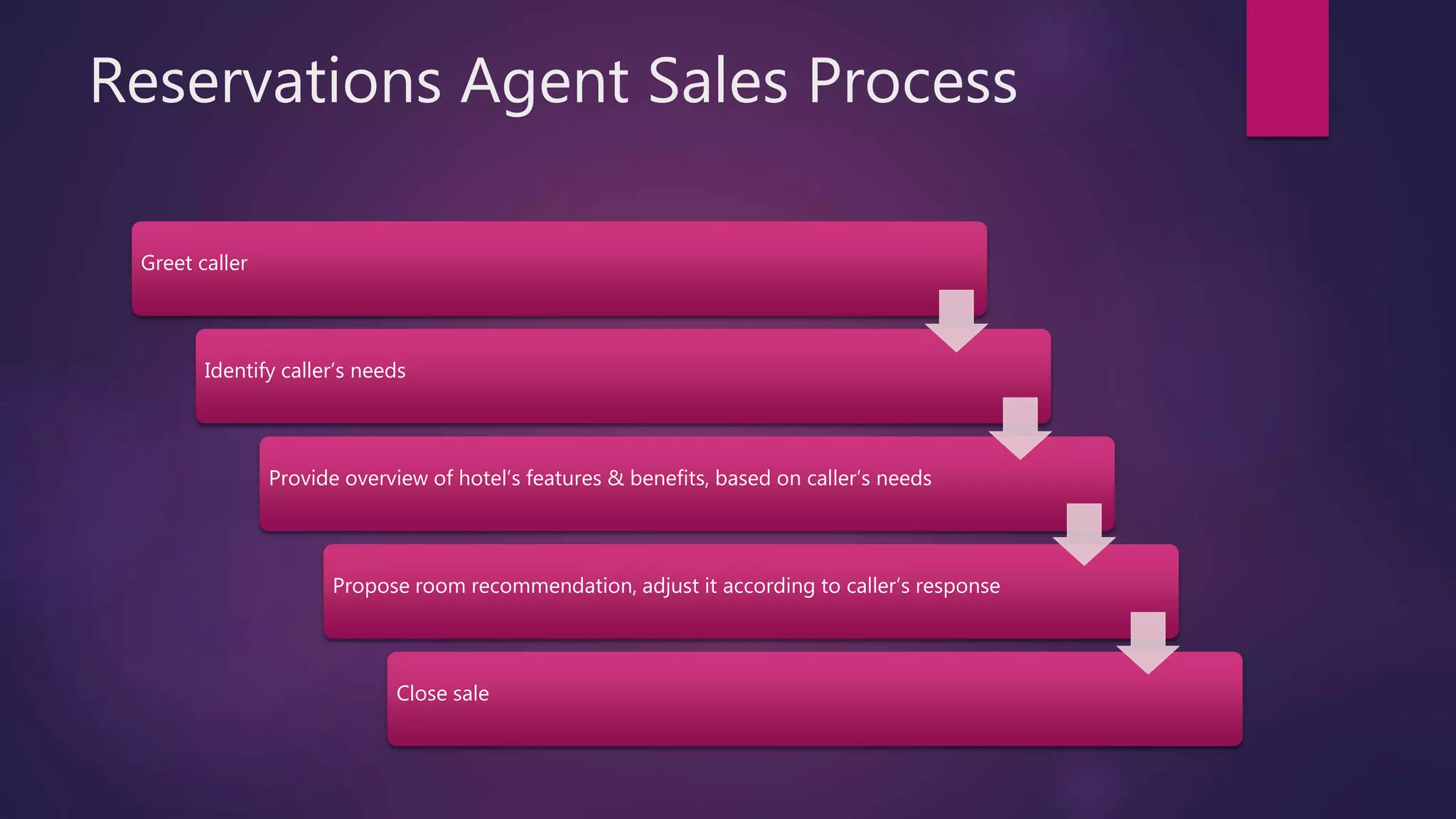
Reservations Agent Sales Process
Greet caller
Identify caller’s needs
Provide overview of hotel’s features & benefits, based on caller’s needs
Propose room recommendation, adjust it according to caller’s response
Close sale
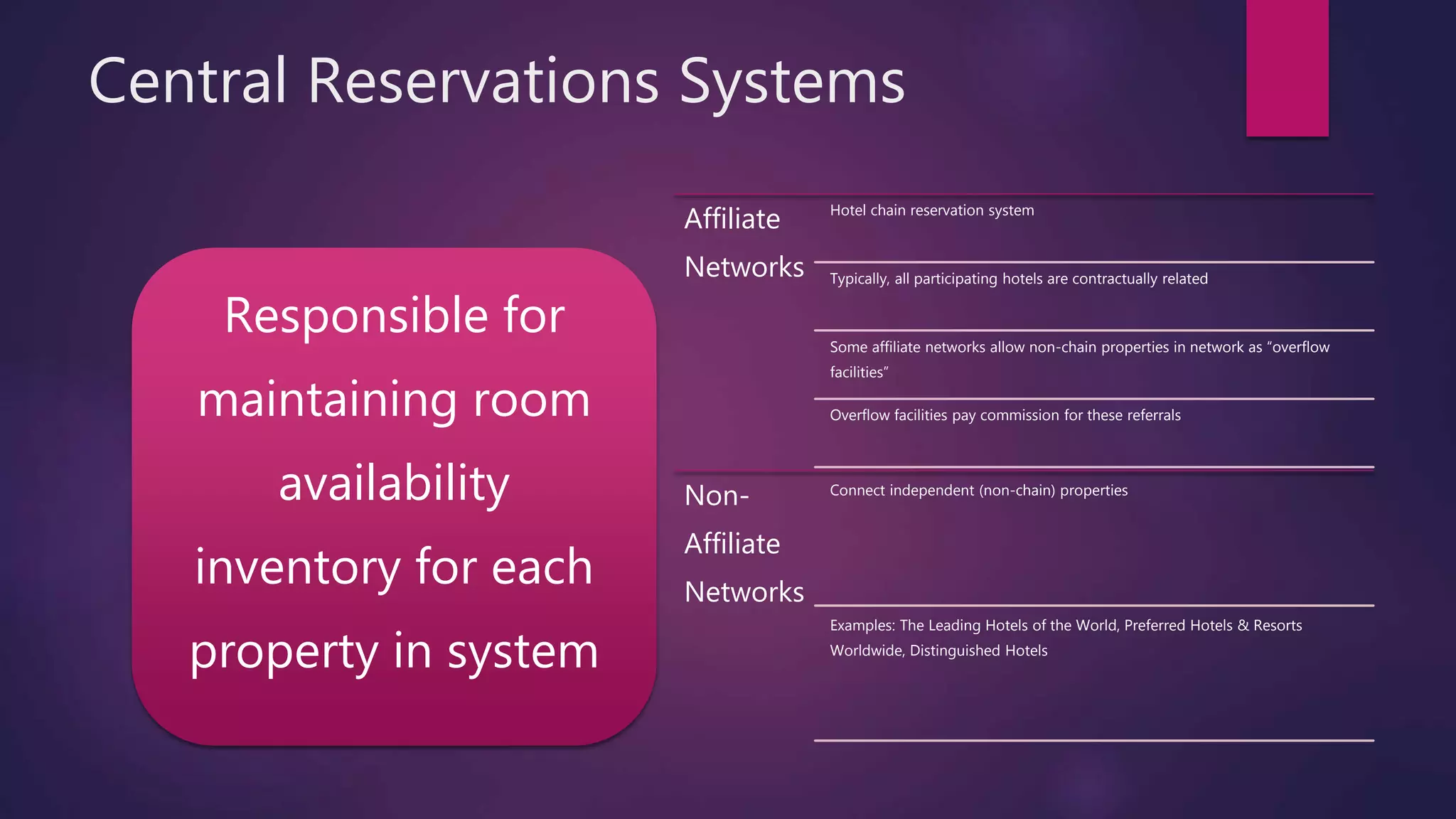
Central Reservations Systems
Responsible for
maintaining room
availability
inventory for each
property in system
Affiliate
Networks
Hotel chain reservation system
Typically, all participating hotels are contractually related
Some affiliate networks allow non-chain properties in network as “overflow
facilities”
Overflow facilities pay commission for these referrals
Non-
Affiliate
Networks
Connect independent (non-chain) properties
Examples: The Leading Hotels of the World, Preferred Hotels & Resorts
Worldwide, Distinguished Hotels
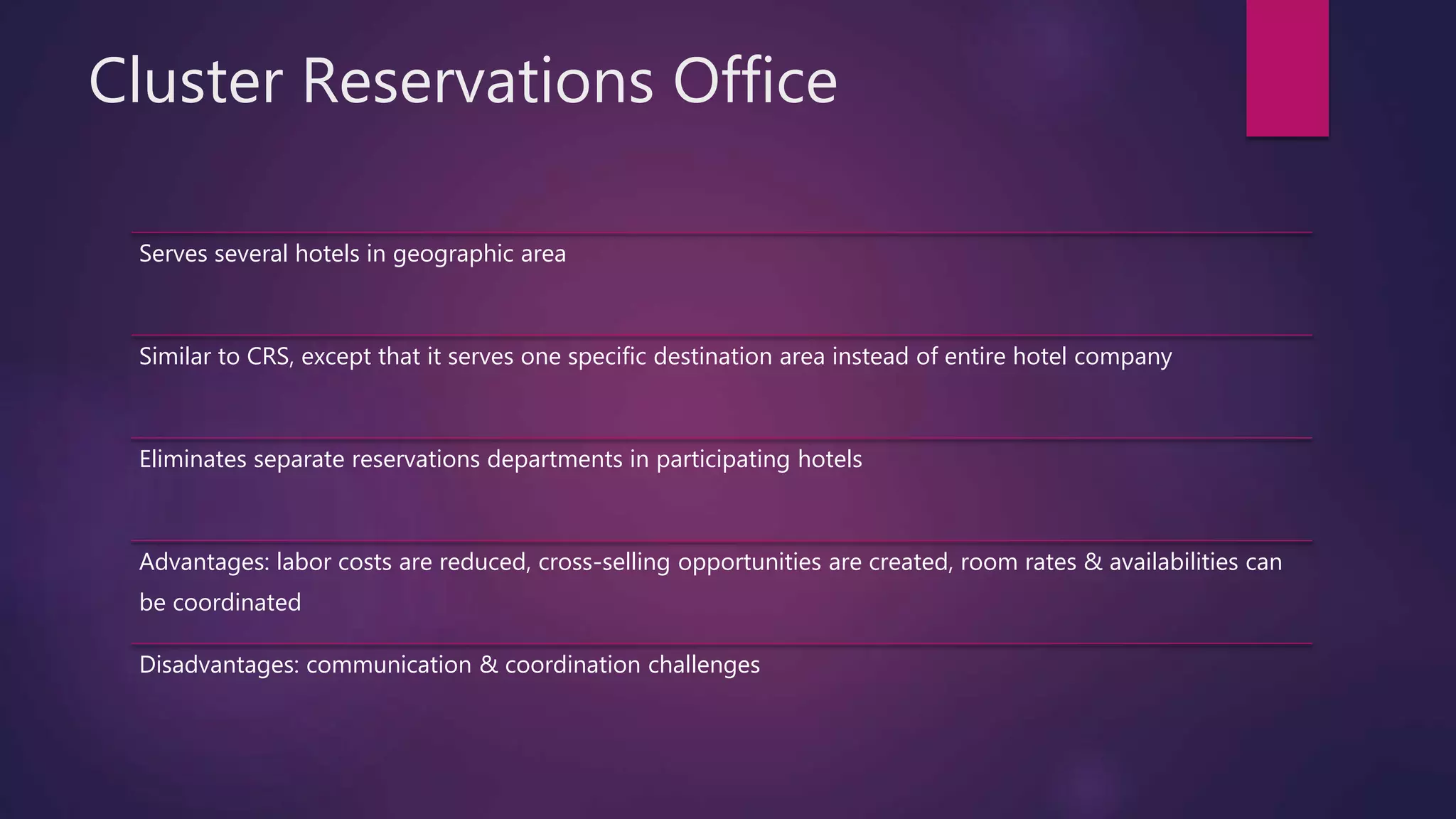
Cluster Reservations Office
Serves several hotels in geographic area
Similar to CRS, except that it serves one specific destination area instead of entire hotel company
Eliminates separate reservations departments in participating hotels
Advantages: labor costs are reduced, cross-selling opportunities are created, room rates & availabilities can
be coordinated
Disadvantages: communication & coordination challenges
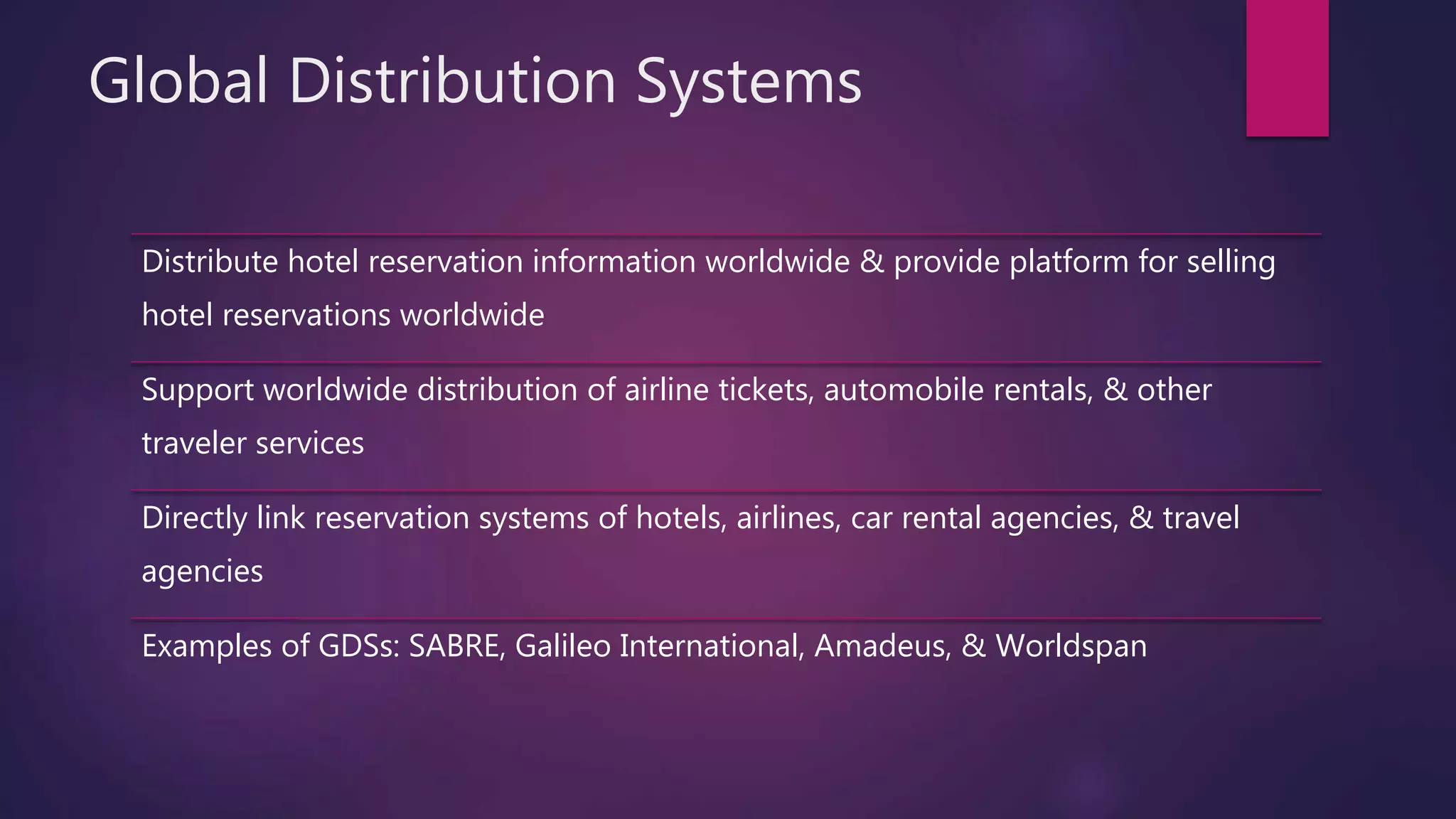
Global Distribution Systems
Distribute hotel reservation information worldwide & provide platform for selling
hotel reservations worldwide
Support worldwide distribution of airline tickets, automobile rentals, & other
traveler services
Directly link reservation systems of hotels, airlines, car rental agencies, & travel
agencies
Examples of GDSs: SABRE, Galileo International, Amadeus, & Worldspan
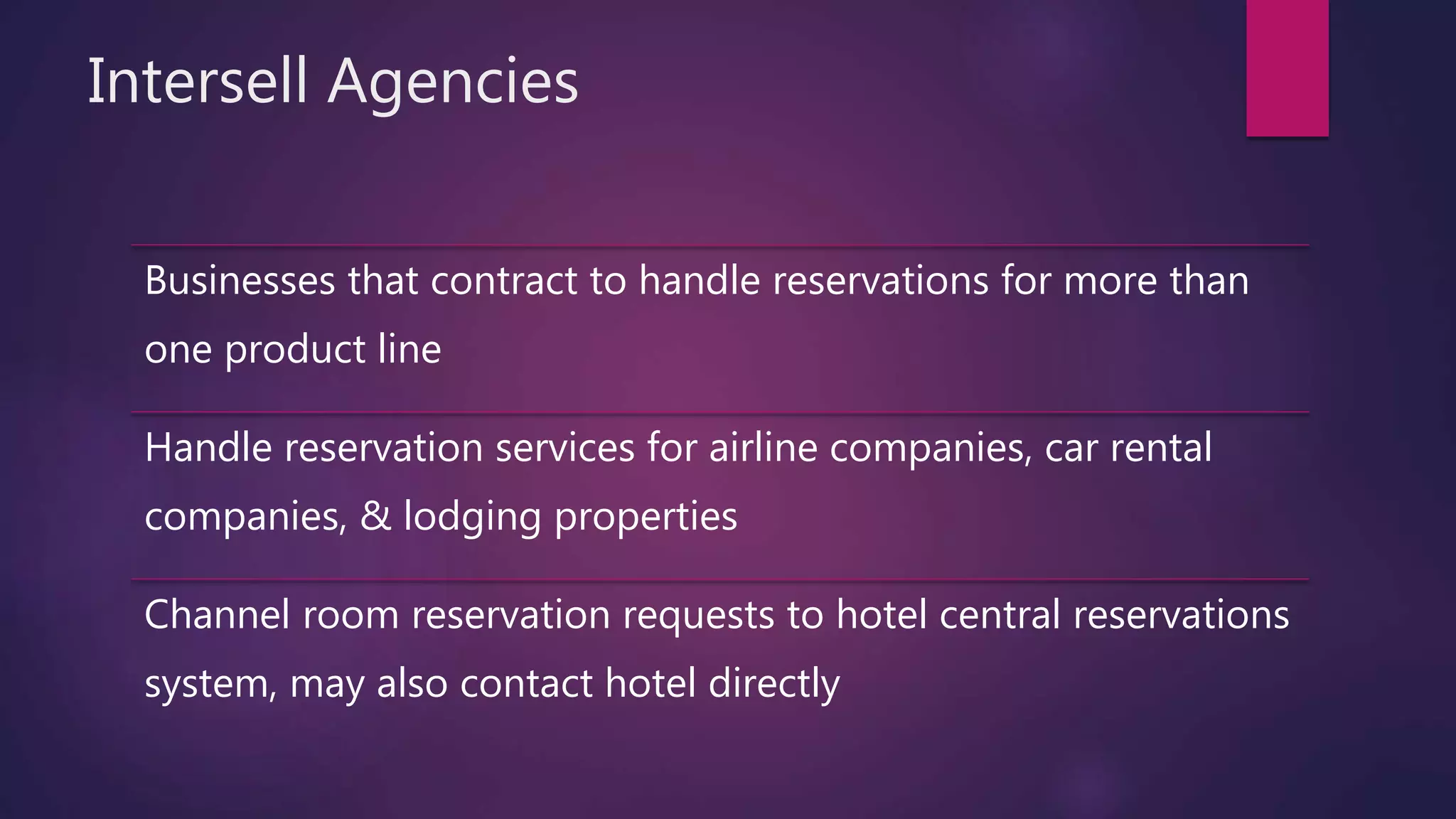
Intersell Agencies
Businesses that contract to handle reservations for more than
one product line
Handle reservation services for airline companies, car rental
companies, & lodging properties
Channel room reservation requests to hotel central reservations
system, may also contact hotel directly
Internet Distribution Systems
IDSs enable travelers from many different market segments to use desktop &
mobile devices to reserve hotel rooms, book flights, select rental cars
Examples include Expedia, Hotels.com, Orbitz, Hotwire, Priceline, Travelocity
Individual hotel websites commonly feature user-friendly & secure procedures for
making & paying for reservations
Hotel websites also feature marketing tools such as links to hotel products &
services, & photographs & virtual tours of property
Distribution Channel Revenues
Revenues vary widely, depending on hotel (supplier) & agent (seller) relationship
CRS charge affiliate properties either fixed rate per room /per night, or transaction fee
based on reservation activity or both
GDS systems & IDS receive revenues from hotels through commissions, by charging
transaction fees or transmission fees by selling hotel
Hotels sell rooms via distribution channels, goal is to offset associated commissions & other
fees with increase in occupancy & overall room revenue
Group Reservations
Involve variety of contacts: guests, meeting planners, convention, visitors bureaus, tour operators, travel agents
Involve intermediary agents & require special handling
Group’s representative deals with hotel’s sales or reservations department
Agreed-upon number of rooms, called block, is set aside for group’s members
Group members may be given special reservation identification code or reservation web address to use to reserve
their rooms within group’s assigned block
Un booked rooms in group block may be released to hotel’s available rooms inventory at predetermined date i.e.
cut-off date
Creating a Group Block
Contract created specifying number of rooms, rates, arrival & departure dates, special considerations (suites,
comp rooms, group vs. individual billing arrangements, etc.), early arrival & late departure dates, & cut-off
date
Reservations manager should make sure availability before confirming block
If group will absorb rooms from transient business, reservations manager should notify sales or GM of this
non-group displacements
Reservations manager should check group’s history with hotel (if available) before finalizing the block; it may
be possible to reduce room block, based on group’s history (termed a “wash down” or a “wash”)
Creating a Group Block
Reservations manager must monitor room availability in block as reservations
come in & adjust room block as needed
“Definite group” has signed sales contract; “Tentative group” contract sent,
but not signed & returned
Reservations manager make sure group is not allowed to remain in “tentative”
status for too long, jeopardizing business
Some groups allow attendees to make reservations directly with hotel, others
do not; reservations agents must honor arrangements
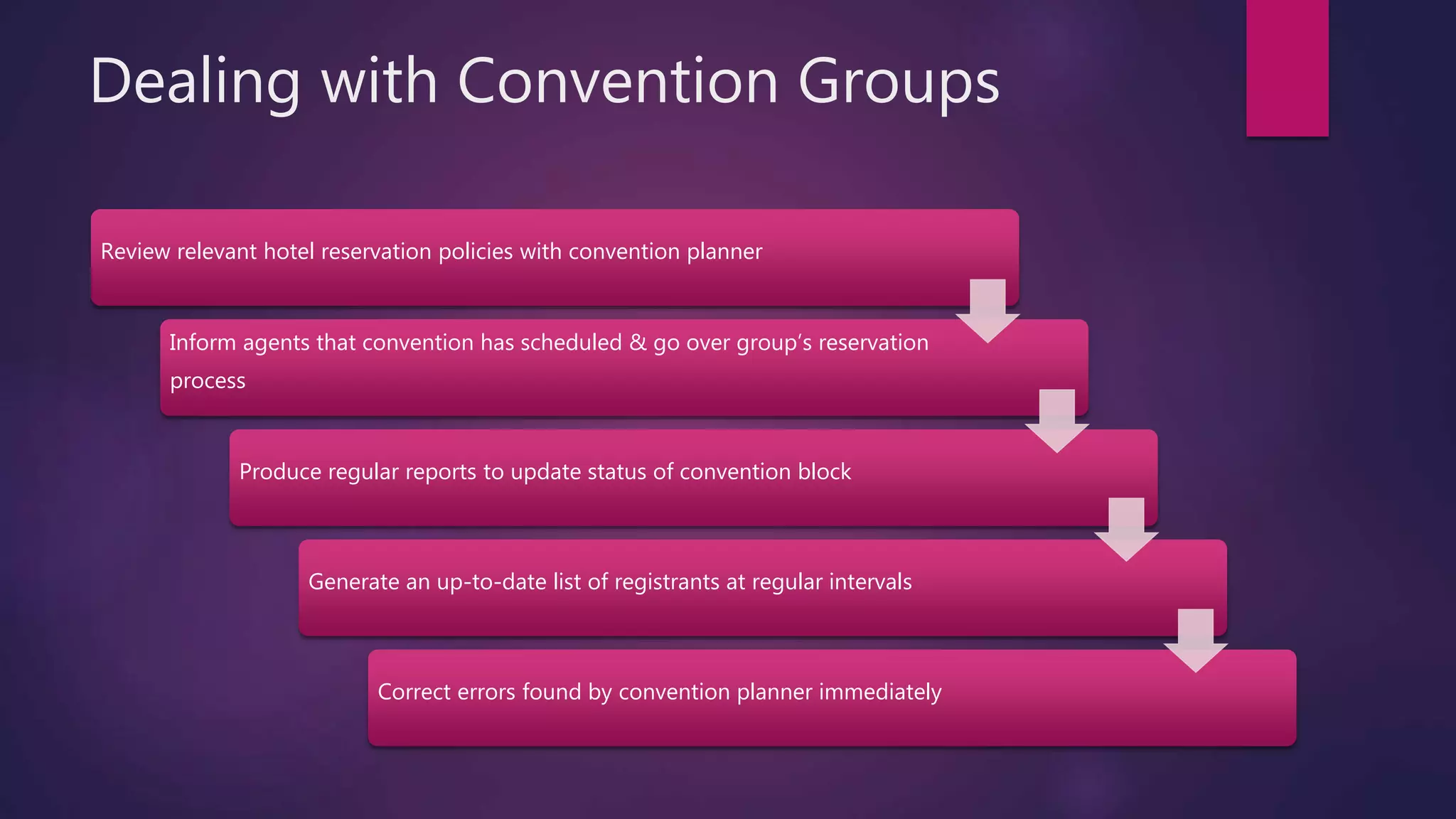
Dealing with Convention Groups
Review relevant hotel reservation policies with convention planner
Inform agents that convention has scheduled & go over group’s reservation
process
Produce regular reports to update status of convention block
Generate an up-to-date list of registrants at regular intervals
Correct errors found by convention planner immediately
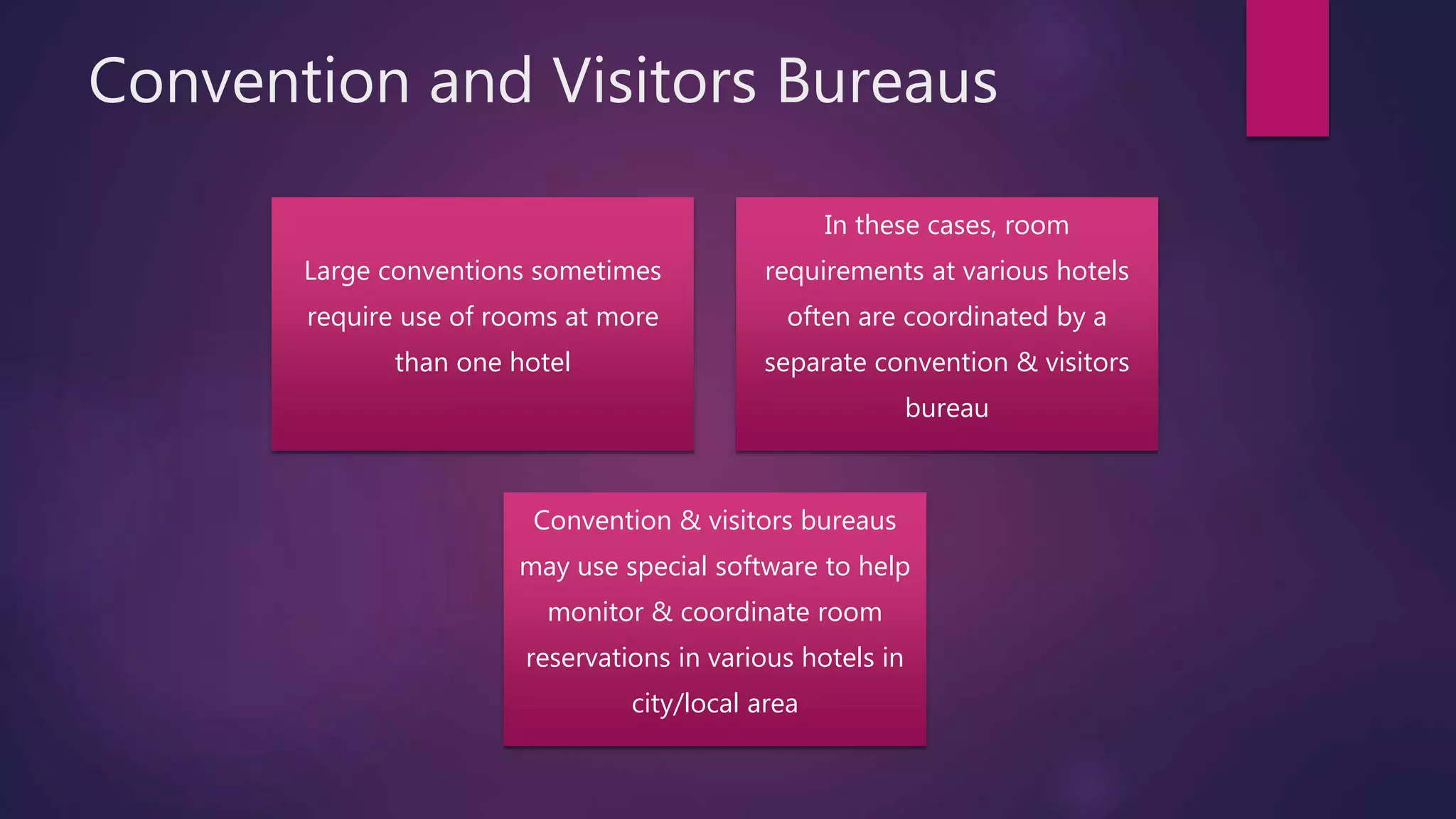
Convention and Visitors Bureaus
Large conventions sometimes
require use of rooms at more
than one hotel
In these cases, room
requirements at various hotels
often are coordinated by a
separate convention & visitors
bureau
Convention & visitors bureaus
may use special software to help
monitor & coordinate room
reservations in various hotels in
city/local area
Dealing with Tour Groups
Specify no & types of rooms in group block, including rooms for drivers & guides
On or before cut-off date, tour operator supply guarantee on number of rooms, or rooming list if available
Specify date tour operator will provide rooming list, if differ from cut-off date
Monitor advance required & their due date
Services & amenities will be provided as part of group package
Contact details of tour operator include on reservation record
Special arrangements (early arrival, baggage handling, registration, check-out procedures)
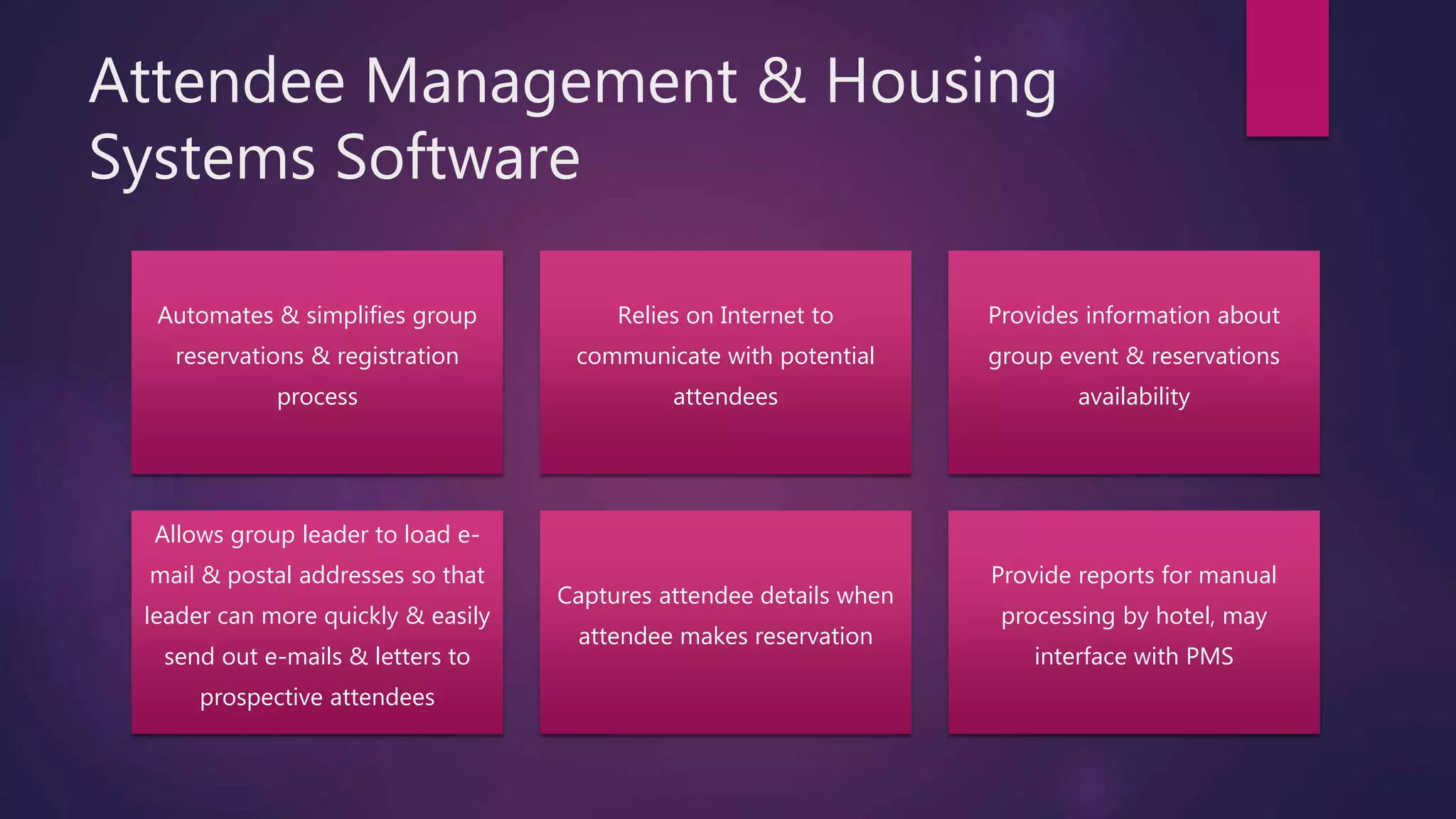
Attendee Management & Housing
Systems Software
Automates & simplifies group
reservations & registration
process
Relies on Internet to
communicate with potential
attendees
Provides information about
group event & reservations
availability
Allows group leader to load e-
mail & postal addresses so that
leader can more quickly & easily
send out e-mails & letters to
prospective attendees
Captures attendee details when
attendee makes reservation
Provide reports for manual
processing by hotel, may
interface with PMS
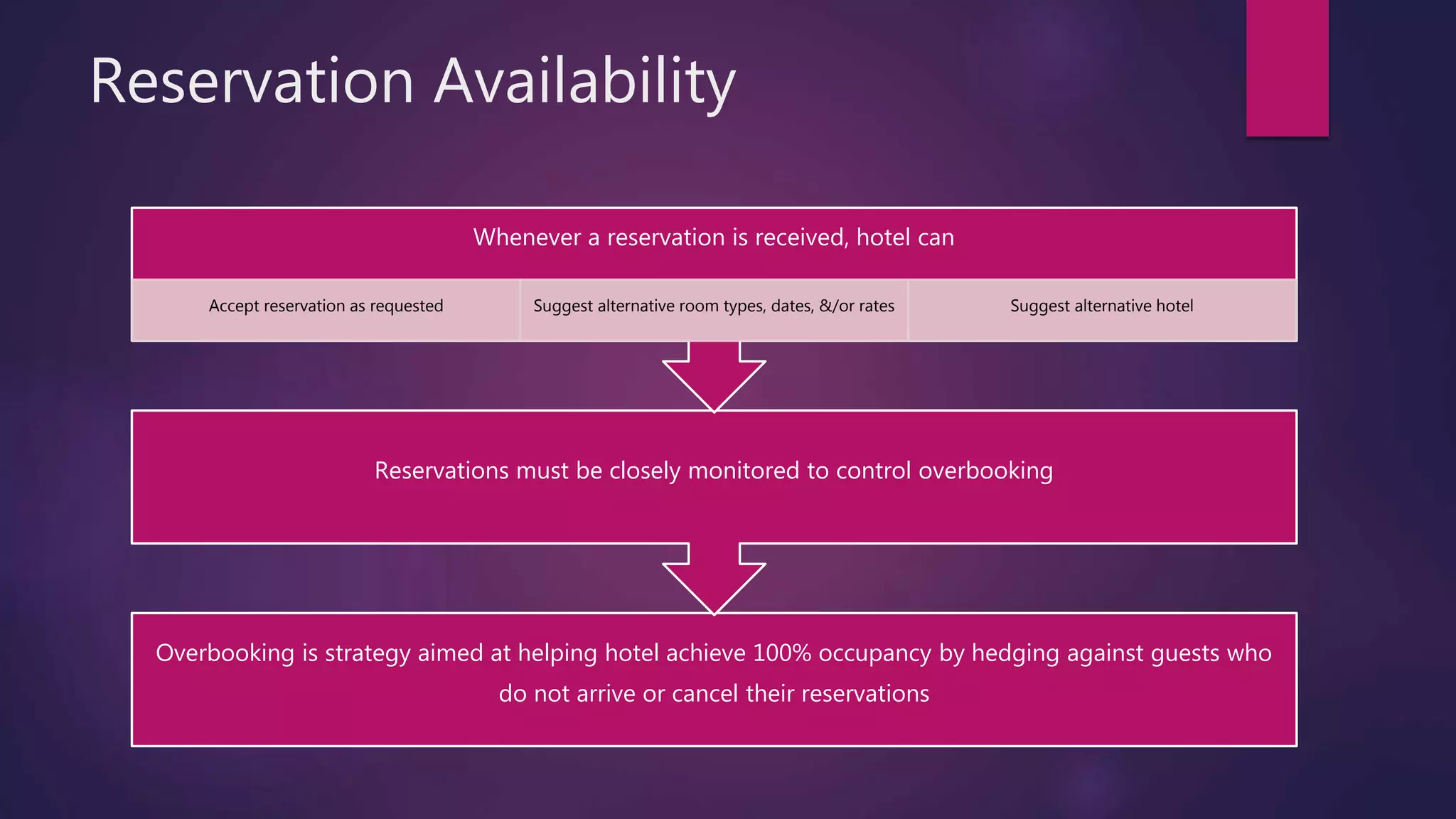
Reservation Availability
Overbooking is strategy aimed at helping hotel achieve 100% occupancy by hedging against guests who
do not arrive or cancel their reservations
Reservations must be closely monitored to control overbooking
Whenever a reservation is received, hotel can
Accept reservation as requested Suggest alternative room types, dates, &/or rates Suggest alternative hotel
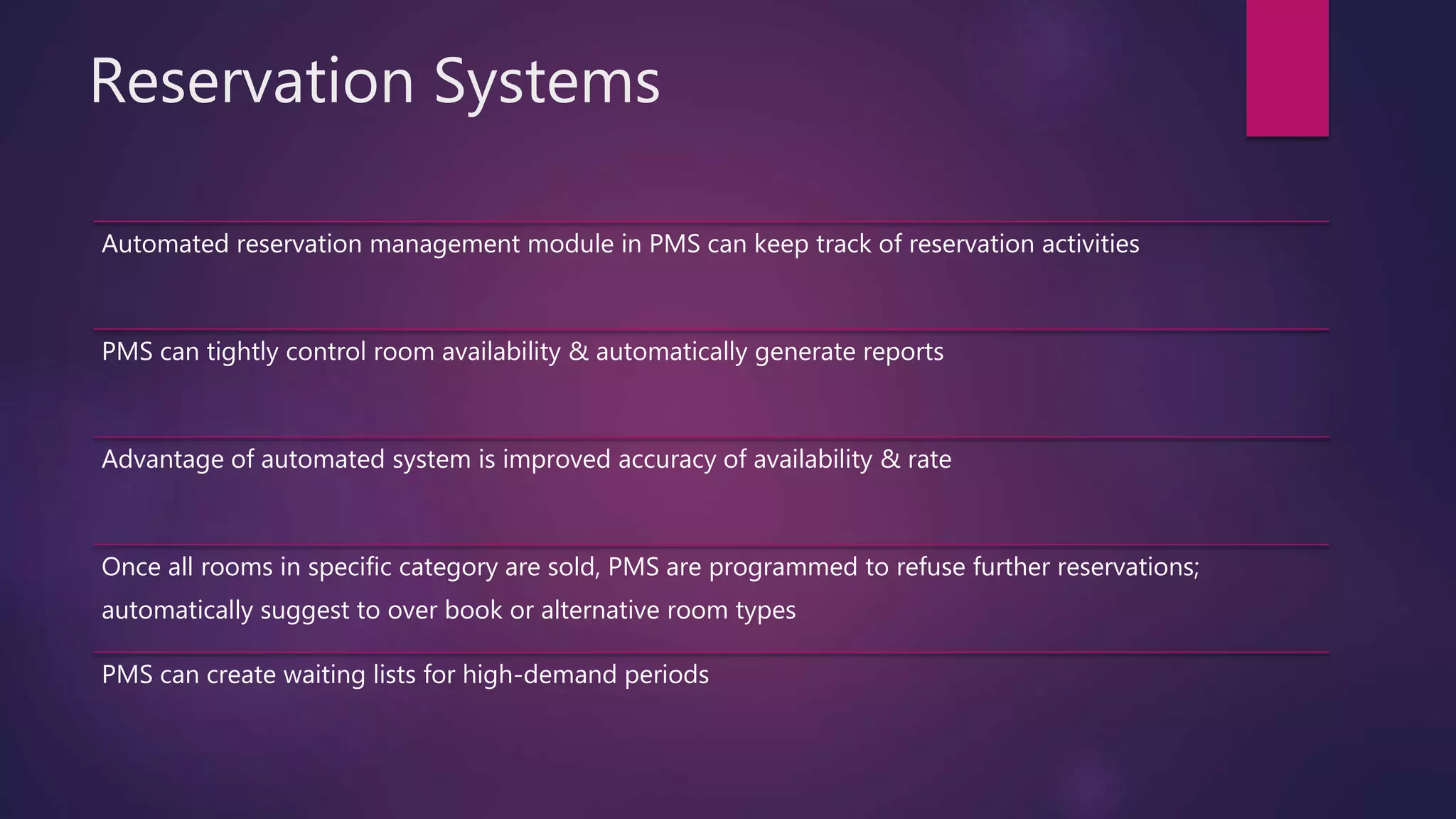
Reservation Systems
Automated reservation management module in PMS can keep track of reservation activities
PMS can tightly control room availability & automatically generate reports
Advantage of automated system is improved accuracy of availability & rate
Once all rooms in specific category are sold, PMS are programmed to refuse further reservations;
automatically suggest to over book or alternative room types
PMS can create waiting lists for high-demand periods
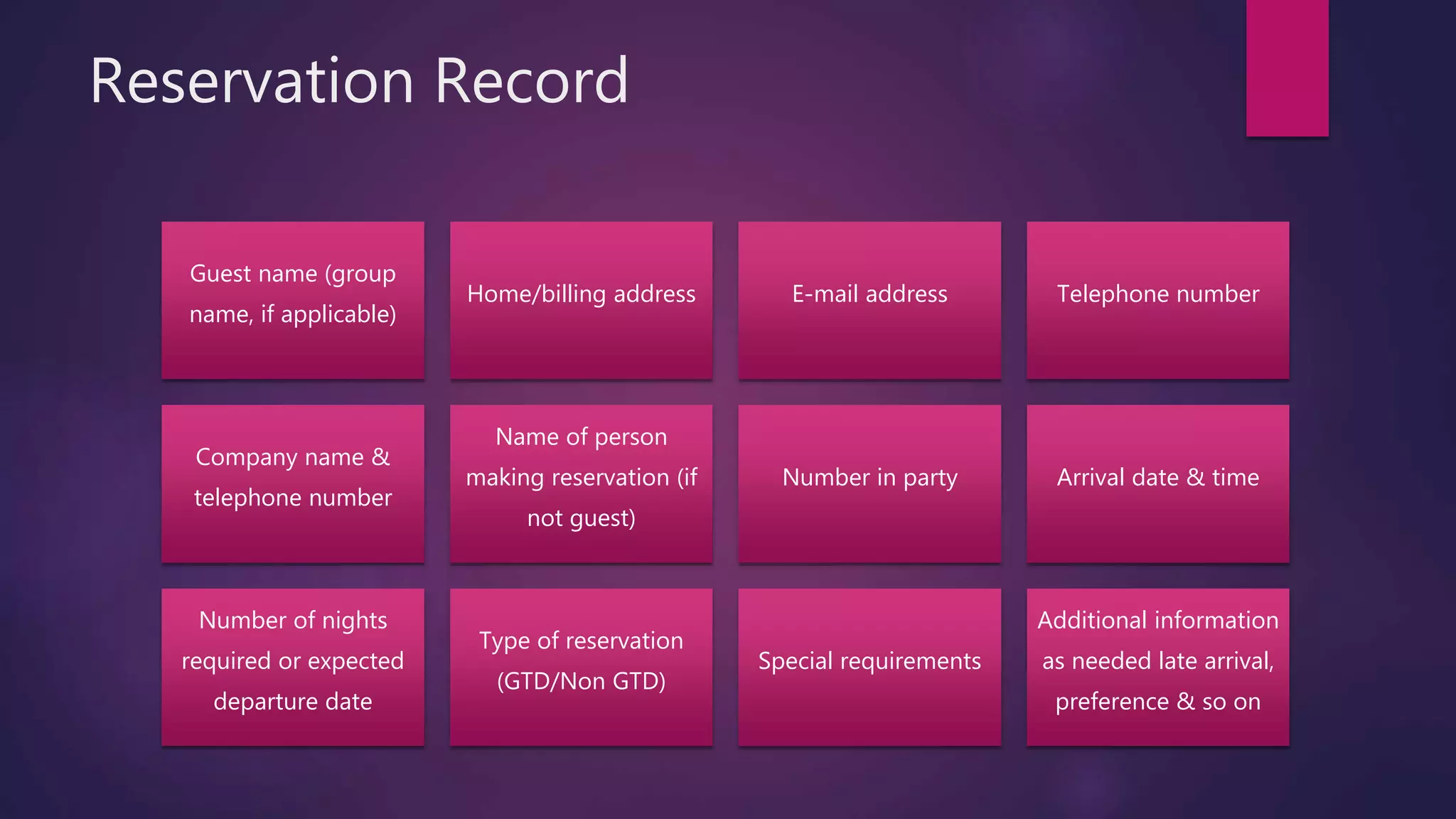
Reservation Record
Guest name (group
name, if applicable)
Home/billing address E-mail address Telephone number
Company name &
telephone number
Name of person
making reservation (if
not guest)
Number in party Arrival date & time
Number of nights
required or expected
departure date
Type of reservation
(GTD/Non GTD)
Special requirements
Additional information
as needed late arrival,
preference & so on
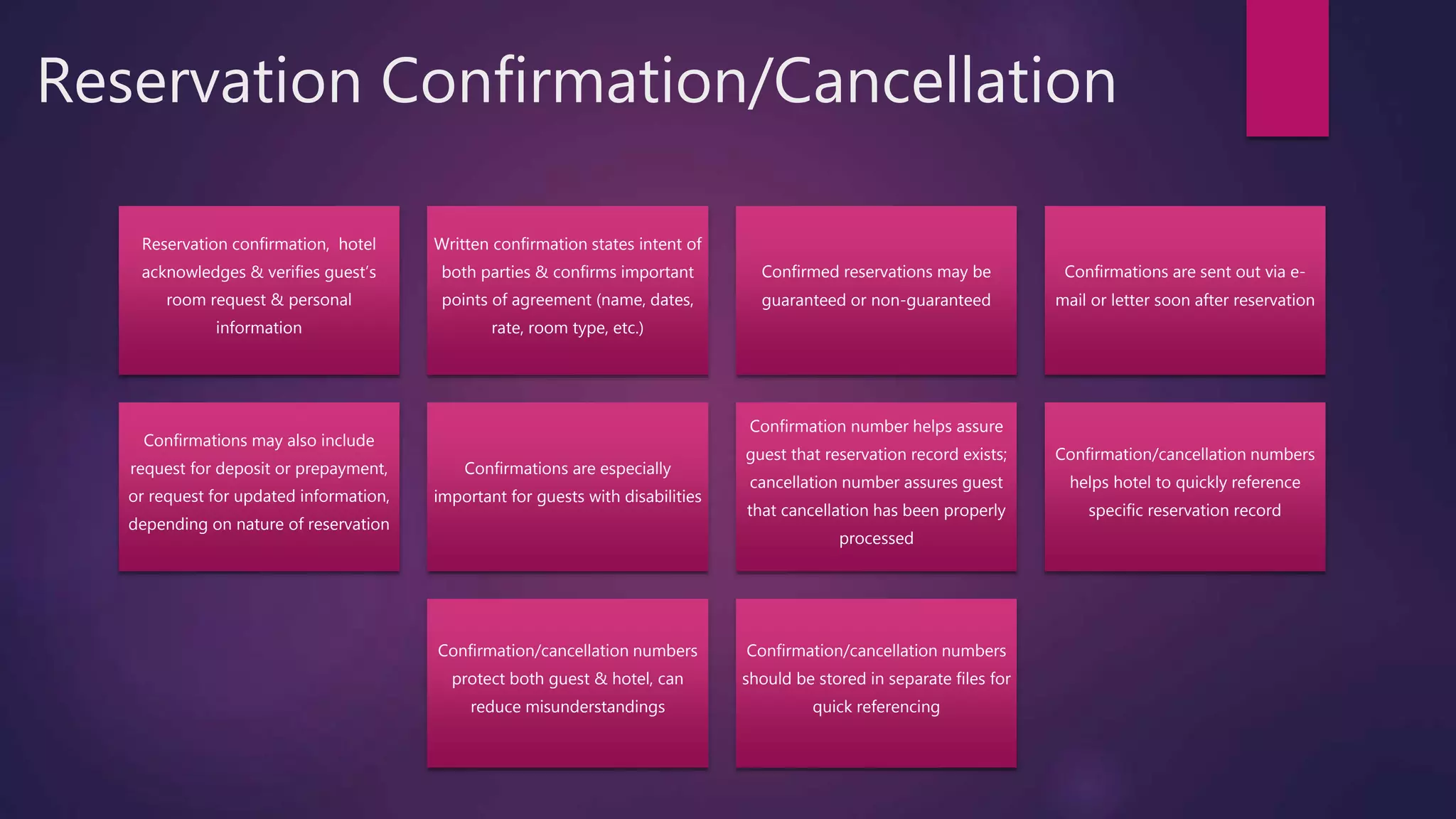
Reservation Confirmation/Cancellation
Reservation confirmation, hotel
acknowledges & verifies guest’s
room request & personal
information
Written confirmation states intent of
both parties & confirms important
points of agreement (name, dates,
rate, room type, etc.)
Confirmed reservations may be
guaranteed or non-guaranteed
Confirmations are sent out via e-
mail or letter soon after reservation
Confirmations may also include
request for deposit or prepayment,
or request for updated information,
depending on nature of reservation
Confirmations are especially
important for guests with disabilities
Confirmation number helps assure
guest that reservation record exists;
cancellation number assures guest
that cancellation has been properly
processed
Confirmation/cancellation numbers
helps hotel to quickly reference
specific reservation record
Confirmation/cancellation numbers
protect both guest & hotel, can
reduce misunderstandings
Confirmation/cancellation numbers
should be stored in separate files for
quick referencing
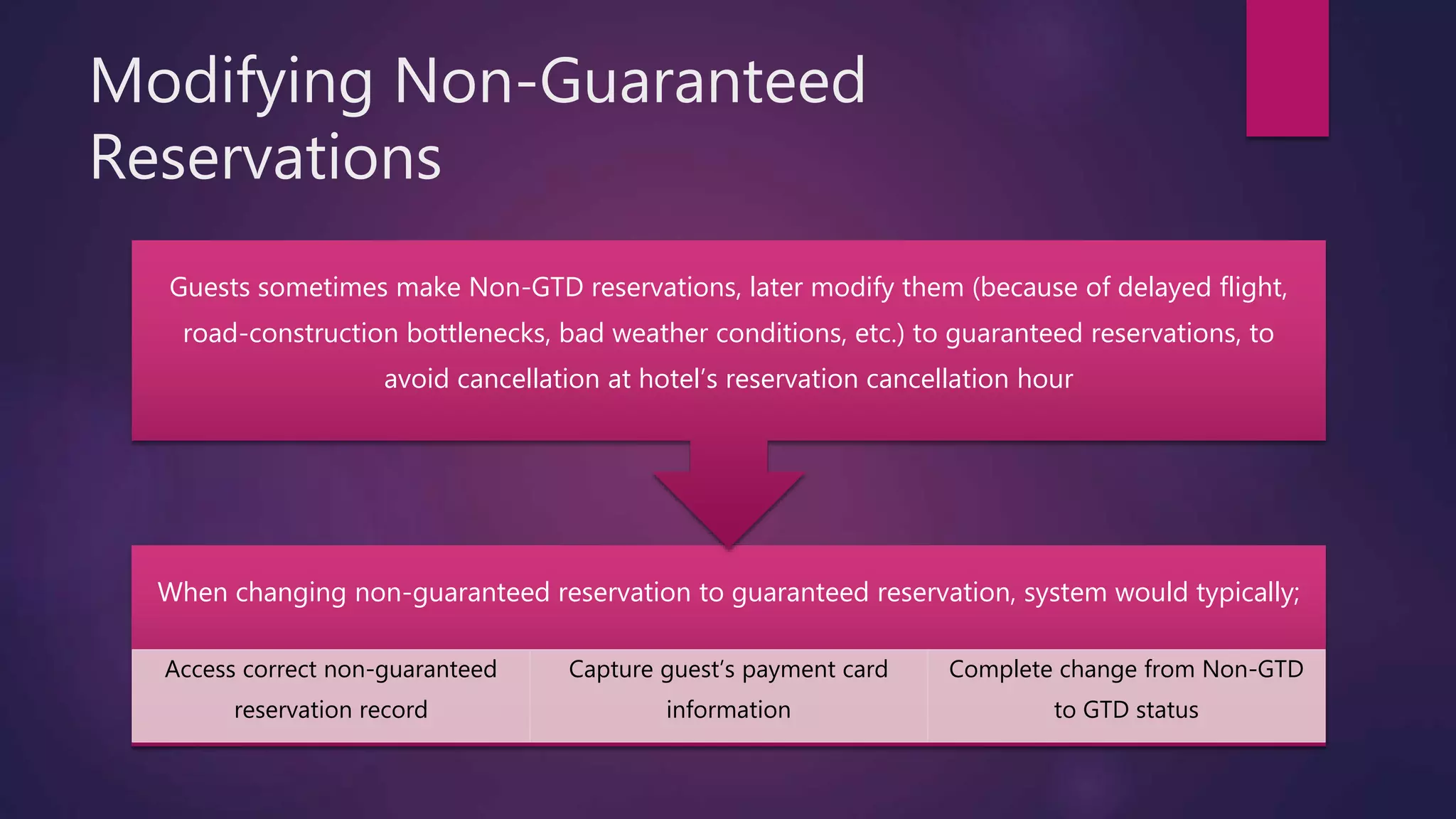
Modifying Non-Guaranteed
Reservations
When changing non-guaranteed reservation to guaranteed reservation, system would typically;
Access correct non-guaranteed
reservation record
Capture guest’s payment card
information
Complete change from Non-GTD
to GTD status
Guests sometimes make Non-GTD reservations, later modify them (because of delayed flight,
road-construction bottlenecks, bad weather conditions, etc.) to guaranteed reservations, to
avoid cancellation at hotel’s reservation cancellation hour
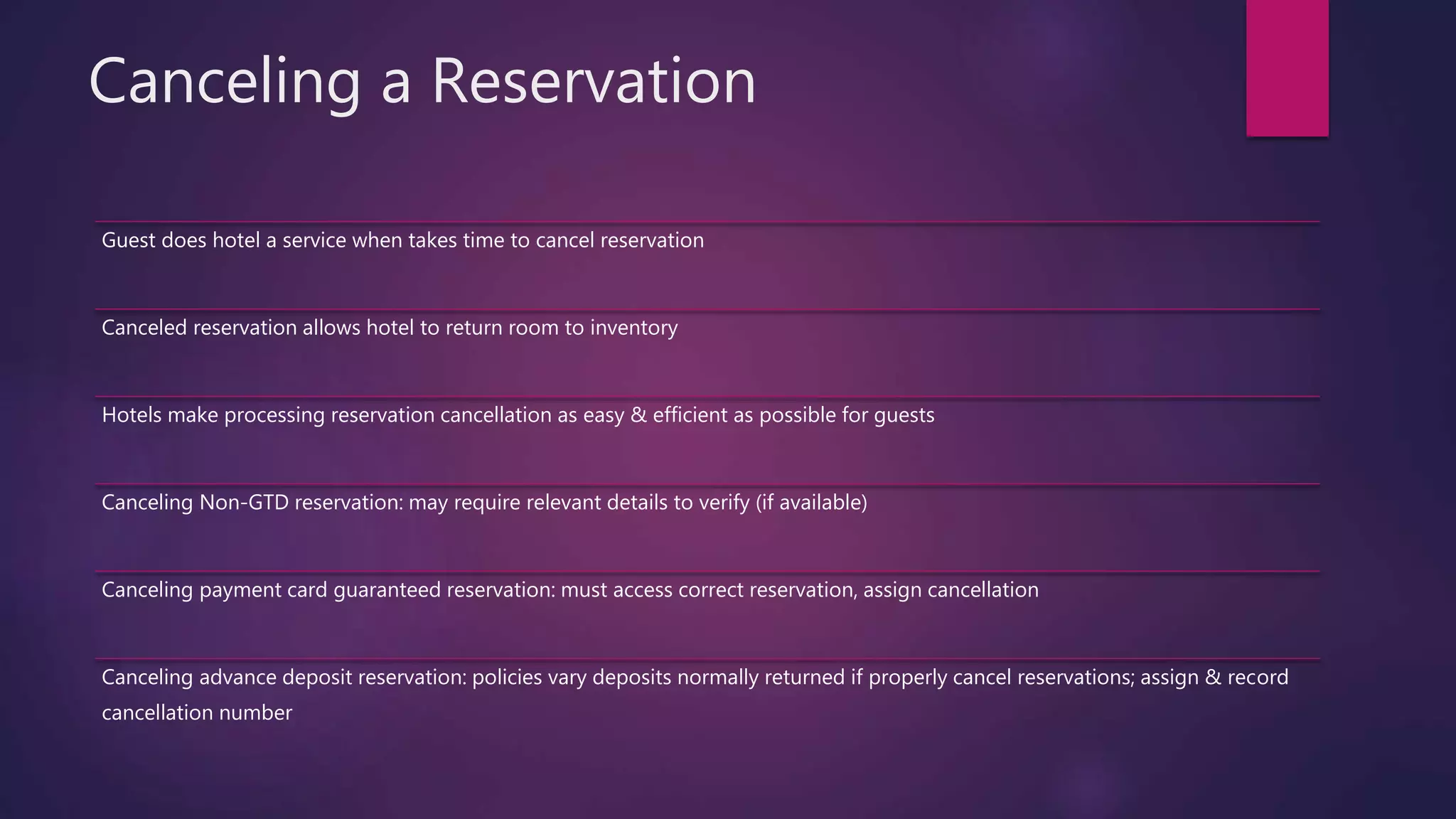
Canceling a Reservation
Guest does hotel a service when takes time to cancel reservation
Canceled reservation allows hotel to return room to inventory
Hotels make processing reservation cancellation as easy & efficient as possible for guests
Canceling Non-GTD reservation: may require relevant details to verify (if available)
Canceling payment card guaranteed reservation: must access correct reservation, assign cancellation
Canceling advance deposit reservation: policies vary deposits normally returned if properly cancel reservations; assign & record
cancellation number
Typical Reservation Reports
Reservation transactions report
Commission agent report
Regrets & denials report
Revenue forecast report
Expected arrival & departure lists
Expected Arrival & Departure Lists
Indicate number & names
of guests expected to
arrive, depart, or stay over
Generated according to
pre-determined schedule
or on demand
Displayed or printed in
reservations department or
via any connected device
Facilitates guest
registration & check-out
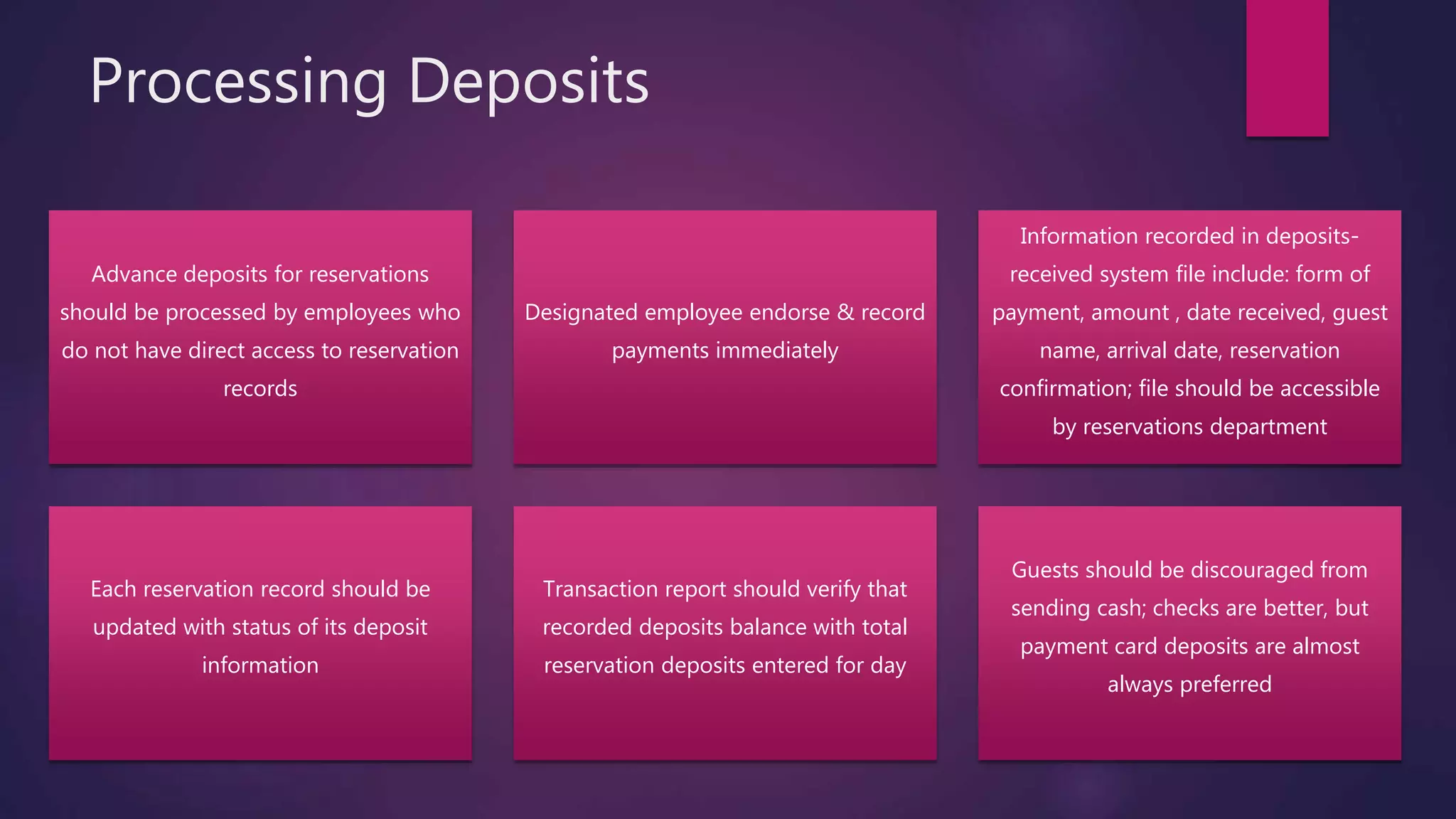
Processing Deposits
Advance deposits for reservations
should be processed by employees who
do not have direct access to reservation
records
Designated employee endorse & record
payments immediately
Information recorded in deposits-
received system file include: form of
payment, amount , date received, guest
name, arrival date, reservation
confirmation; file should be accessible
by reservations department
Each reservation record should be
updated with status of its deposit
information
Transaction report should verify that
recorded deposits balance with total
reservation deposits entered for day
Guests should be discouraged from
sending cash; checks are better, but
payment card deposits are almost
always preferred
Reservations Histories
Include statistics on all aspects of
reservations process: number of
guests, occupied rooms, reservations
organized by distribution channel, no-
shows, walk-ins, overstays, under stays
Helpful in tracking individual groups &
their booking patterns
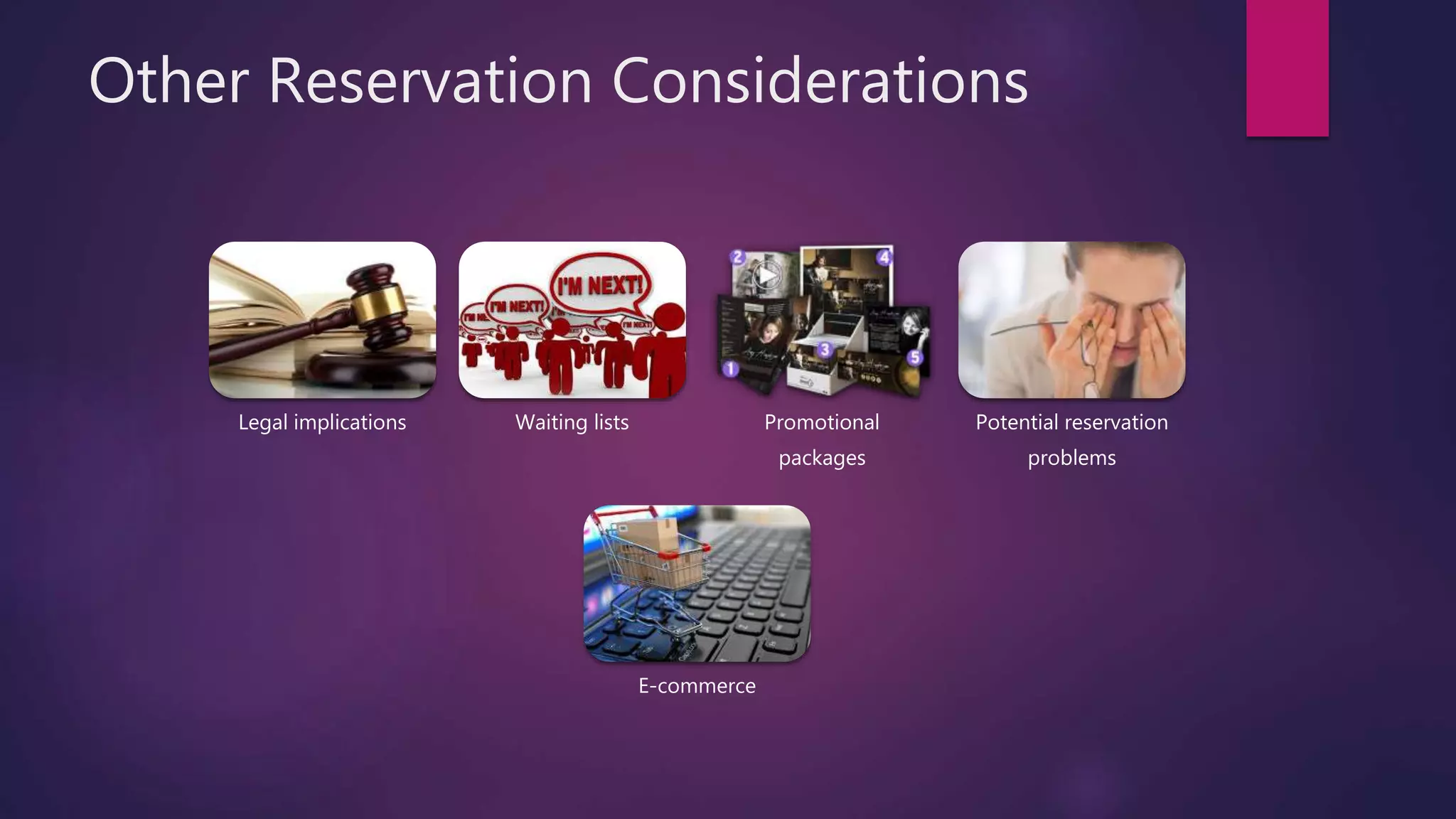
Other Reservation Considerations
Legal implications Waiting lists Promotional
packages
Potential reservation
problems
E-commerce
Legal Implications
Reservation agreement between hotel & guest begins at time of guest contact
Agreement may be oral or written
Confirming reservation by stating guest will be accommodated on particular date may
constitute contract binding hotel
If confirmation is response to reservation request from prospective guest, it may bind both
hotel & guest to fulfill reservation
Waiting Lists
Advise guest that no
rooms are currently
available for requested
date(s)
Offer to take guest’s name,
telephone number, e-mail
address
Agree to notify prospective
guest immediately if room
becomes available
Help guest find alternative
dates or accommodations
if no rooms become
available
Promotional Packages
Include guestroom plus other
features, such as meals, golf,
tennis, sports lessons, limousine
service, sight-seeing or other
activities in or near property
Properties provide guests with
discount for purchasing
promotional package
Guests consider promotional
package, bargain & convenience
Reservations personnel & website
content must be very informative
about all packages property offers
Potential Reservation Problems
Errors in the reservation
record
Misunderstandings due to
industry jargon
Miscommunication with
central reservations systems
Online reservation failures
E-Commerce
E-commerce is online commerce via Internet
E-commerce extends reach of hotels far beyond traditional distribution channels of hotel reservations office, call center, & GDS
Allows hotels access to multiple distribution channels
Gives hotels direct access to consumers
Guests can search for hotels & make reservations online
Hotels assign manager to oversee online content & transactions (Revenue /E-Commerce Manager)
E-commerce must be carefully monitored, to be sure that hotel information & pricing are properly presented
Single image inventory: all online distribution channels draw from same room availability, pricing, rate rules, services, amenities information
E-Commerce Site Categories
Merchant model Wholesaler model Opaque sites Transparent sites
Merchant Model
Also called “markup model”
Online intermediary negotiates discount for rooms, it will sell on its site (for example, 20 to 30 percent off the hotel’s lowest published room rate)
Discounted rate is called “net rate” & represents amount intermediary will pay hotel for every room it sells at agreed-upon discount
Intermediary marks up net rate to achieve room rate it will charge guests; this is termed “gross rate”
Gross rate minus net rate represents profit intermediary makes on selling room on its site
Merchant-model sites tend to rank hotels based on their discounts, from highest discounts to lowest
Examples of merchant-model sites include Hotels.com & Travelocity
Wholesaler Model
Hotel sets selling price for rooms it will give to the online wholesaler; receives agreed
commission (% of price) for selling rooms
Online sellers using wholesaler model typically earn less than sellers using merchant model
Hotels favor wholesaler model, because they maintain control over rooms’ final price to
guests; online sellers tend to favor merchant model, because they can earn more from per
room sale
Opaque Sites
Hotel rooms are marketed by online sellers by price &/or rating category; there is no reference
to hotel brand or property specifics
Brand of hotel & features are hidden from buyer until transaction is completed
Hotel rooms are treated as commodity
Examples of opaque sites include Priceline and Hotwire
Transparent Sites
Hotel rooms are marketed
by online sellers by price
&/or rating category;
however, unlike with
opaque sites, transparent
sites reveal identify of
hotels before purchase
Transparency allows buyers
to select preferred brand or
property among competing
hotels
Examples of transparent
sites include Expedia,
Hotels.com, Travelocity
E-Commerce Trends
Hotels exercise caution in selecting e-
commerce sites to partner & have
developed distinct strategies for each
Most hotel branded websites offer best
rate guarantee
Hotel websites become sophisticated in
services they offer to groups, making it
easier to process group room
reservations & meetings
More hotels & other online travel
service providers are offering affinity or
loyalty club points
More hotels are offering dynamic
package pricing, which allows online
shoppers to select from a menu of hotel
products & services & create their own
custom package at special price
Online booking sites can create “virtual”
hotel brands by grouping proprietary
set of preferred hotels at destination site
(for example, Expedia’s Bargain Hotels)
?
Any Questions

Chapter 04 Managing Front Office Operations HOT 333

  • 1.
  • 2.
    Reservations Reservations and Sales Typesof Reservations Reservation Inquiries Group Reservations Reservation Availability Reservation Records Reservation Confirmation/ Cancellation Reservation Reports Other Reservation Considerations
  • 3.
    Who is theRevenue Manager? Implement revenue management strategies & processes, in order to optimize & maximize its revenues At some point, revenue management started out as being in charge of reservations
  • 4.
    Activities Associated withReservation Process Formulating reservation inquiry Determining room & rate availability Creating reservation record Confirming reservation record Maintaining reservation record Producing reservation reports Research, Planning & monitoring
  • 5.
    Reservations and Sales Priorto front office automation, reservations agents focused on basic room availability; they could not reserve specific types of rooms Automation provides accurate & current room & rate information Due to automation, much of responsibility for room sales, revenue projections, & profitability analyses has shifted to reservations department Reservations agents are now salespeople Many reservations are now made online; hotels need websites that are designed to make it easy for guests to make reservations
  • 6.
    Role of theSales Department Primary source of group reservations, typically from corporations & trade associations Go after social, military, educational, religious & fraternal groups (SMERF), business traveler, TA market Sales must familiarize distribution channels with hotel’s characteristics & surrounding areas Sales managers are often given financial or other incentives to meet or exceed sales goals
  • 7.
    Reservation sales planningprocess Sales department can book business months or years in advance Groups may limit number of rooms to be sold Reservations Manager monitors group & non group business Reservations manager evaluates requests & reports potential financial impact
  • 8.
    Types of Reservations PrepaymentPayment card Advance deposit Voucher or MCO Corporate Non-Guaranteed Reservations
  • 9.
    Guaranteed Reservations— Prepayment Requires paymentin full be received prior to guest’s day of arrival Generally most desirable form of guaranteed reservation for hotel Commonly used at resort hotels
  • 10.
    Guaranteed Reservations—Payment Card Common formof guaranteed reservation Properly canceled before stated cancellation hour, hotel charges one night’s room rate plus tax Resort hotels may charge for more since typical length of stay is longer
  • 11.
    Guaranteed Reservations—Advance Deposit Specific amountprior to arrival (enough to cover 01 night) Failing to register or cancellation, retains deposit & cancels remainder Hotels apply deposit to last night of guest’s stay; to ensure revenue collection if guest depart earlier
  • 12.
    Guaranteed Reservations—Voucher or MCO TAvouchers & miscellaneous charge orders (MCOs), guest prepays to TA TA forwards voucher or MCO to hotel as payment proof & guarantee payment on voucher returned for payment MCOs are issued by Airline Reporting Corporation (ARC) Hotels prefer MCOs over TA vouchers because ARC guarantees payment if travel agency defaults
  • 13.
    Guaranteed Reservations—Corporate Corporation entersinto agreement with hotel Corporation sponsors will pay for any no-show business travelers Popular in hotels catering large number of business travelers Corporation receive comprehensive invoice, simplifying billing
  • 14.
    Non-Guaranteed Reservations Hold roomuntil stated reservation cancellation hour on day of arrival (1500-1800) Hotel will not receive payment for no-shows If guest does not arrive by cancellation hour, hotel can release room for sale
  • 15.
    Reservation Inquiries Handled byreservations agent or website Information collected • Guest’s name, address, e-mail address, telephone number; company or travel agency name, date of arrival & departure • Type & number of rooms requested; room rate; number of people in party, method of payment or guarantee; or any special requests
  • 16.
    Distribution Channels Property reservations department Centralreservations systems Cluster reservations office Global distribution systems Intersell agencies Internet distribution
  • 17.
    Property Reservations Department Handlesdirect requests for rooms, monitors any communication links with central reservations systems & intersell agencies, maintains updated room availability information Direct requests can reach department in several ways: telephone, mail, property website, property-to-property, faxes, text messaging
  • 18.
    Reservations Agent SalesProcess Greet caller Identify caller’s needs Provide overview of hotel’s features & benefits, based on caller’s needs Propose room recommendation, adjust it according to caller’s response Close sale
  • 19.
    Central Reservations Systems Responsiblefor maintaining room availability inventory for each property in system Affiliate Networks Hotel chain reservation system Typically, all participating hotels are contractually related Some affiliate networks allow non-chain properties in network as “overflow facilities” Overflow facilities pay commission for these referrals Non- Affiliate Networks Connect independent (non-chain) properties Examples: The Leading Hotels of the World, Preferred Hotels & Resorts Worldwide, Distinguished Hotels
  • 20.
    Cluster Reservations Office Servesseveral hotels in geographic area Similar to CRS, except that it serves one specific destination area instead of entire hotel company Eliminates separate reservations departments in participating hotels Advantages: labor costs are reduced, cross-selling opportunities are created, room rates & availabilities can be coordinated Disadvantages: communication & coordination challenges
  • 21.
    Global Distribution Systems Distributehotel reservation information worldwide & provide platform for selling hotel reservations worldwide Support worldwide distribution of airline tickets, automobile rentals, & other traveler services Directly link reservation systems of hotels, airlines, car rental agencies, & travel agencies Examples of GDSs: SABRE, Galileo International, Amadeus, & Worldspan
  • 22.
    Intersell Agencies Businesses thatcontract to handle reservations for more than one product line Handle reservation services for airline companies, car rental companies, & lodging properties Channel room reservation requests to hotel central reservations system, may also contact hotel directly
  • 23.
    Internet Distribution Systems IDSsenable travelers from many different market segments to use desktop & mobile devices to reserve hotel rooms, book flights, select rental cars Examples include Expedia, Hotels.com, Orbitz, Hotwire, Priceline, Travelocity Individual hotel websites commonly feature user-friendly & secure procedures for making & paying for reservations Hotel websites also feature marketing tools such as links to hotel products & services, & photographs & virtual tours of property
  • 24.
    Distribution Channel Revenues Revenuesvary widely, depending on hotel (supplier) & agent (seller) relationship CRS charge affiliate properties either fixed rate per room /per night, or transaction fee based on reservation activity or both GDS systems & IDS receive revenues from hotels through commissions, by charging transaction fees or transmission fees by selling hotel Hotels sell rooms via distribution channels, goal is to offset associated commissions & other fees with increase in occupancy & overall room revenue
  • 25.
    Group Reservations Involve varietyof contacts: guests, meeting planners, convention, visitors bureaus, tour operators, travel agents Involve intermediary agents & require special handling Group’s representative deals with hotel’s sales or reservations department Agreed-upon number of rooms, called block, is set aside for group’s members Group members may be given special reservation identification code or reservation web address to use to reserve their rooms within group’s assigned block Un booked rooms in group block may be released to hotel’s available rooms inventory at predetermined date i.e. cut-off date
  • 26.
    Creating a GroupBlock Contract created specifying number of rooms, rates, arrival & departure dates, special considerations (suites, comp rooms, group vs. individual billing arrangements, etc.), early arrival & late departure dates, & cut-off date Reservations manager should make sure availability before confirming block If group will absorb rooms from transient business, reservations manager should notify sales or GM of this non-group displacements Reservations manager should check group’s history with hotel (if available) before finalizing the block; it may be possible to reduce room block, based on group’s history (termed a “wash down” or a “wash”)
  • 27.
    Creating a GroupBlock Reservations manager must monitor room availability in block as reservations come in & adjust room block as needed “Definite group” has signed sales contract; “Tentative group” contract sent, but not signed & returned Reservations manager make sure group is not allowed to remain in “tentative” status for too long, jeopardizing business Some groups allow attendees to make reservations directly with hotel, others do not; reservations agents must honor arrangements
  • 28.
    Dealing with ConventionGroups Review relevant hotel reservation policies with convention planner Inform agents that convention has scheduled & go over group’s reservation process Produce regular reports to update status of convention block Generate an up-to-date list of registrants at regular intervals Correct errors found by convention planner immediately
  • 29.
    Convention and VisitorsBureaus Large conventions sometimes require use of rooms at more than one hotel In these cases, room requirements at various hotels often are coordinated by a separate convention & visitors bureau Convention & visitors bureaus may use special software to help monitor & coordinate room reservations in various hotels in city/local area
  • 30.
    Dealing with TourGroups Specify no & types of rooms in group block, including rooms for drivers & guides On or before cut-off date, tour operator supply guarantee on number of rooms, or rooming list if available Specify date tour operator will provide rooming list, if differ from cut-off date Monitor advance required & their due date Services & amenities will be provided as part of group package Contact details of tour operator include on reservation record Special arrangements (early arrival, baggage handling, registration, check-out procedures)
  • 31.
    Attendee Management &Housing Systems Software Automates & simplifies group reservations & registration process Relies on Internet to communicate with potential attendees Provides information about group event & reservations availability Allows group leader to load e- mail & postal addresses so that leader can more quickly & easily send out e-mails & letters to prospective attendees Captures attendee details when attendee makes reservation Provide reports for manual processing by hotel, may interface with PMS
  • 32.
    Reservation Availability Overbooking isstrategy aimed at helping hotel achieve 100% occupancy by hedging against guests who do not arrive or cancel their reservations Reservations must be closely monitored to control overbooking Whenever a reservation is received, hotel can Accept reservation as requested Suggest alternative room types, dates, &/or rates Suggest alternative hotel
  • 33.
    Reservation Systems Automated reservationmanagement module in PMS can keep track of reservation activities PMS can tightly control room availability & automatically generate reports Advantage of automated system is improved accuracy of availability & rate Once all rooms in specific category are sold, PMS are programmed to refuse further reservations; automatically suggest to over book or alternative room types PMS can create waiting lists for high-demand periods
  • 34.
    Reservation Record Guest name(group name, if applicable) Home/billing address E-mail address Telephone number Company name & telephone number Name of person making reservation (if not guest) Number in party Arrival date & time Number of nights required or expected departure date Type of reservation (GTD/Non GTD) Special requirements Additional information as needed late arrival, preference & so on
  • 35.
    Reservation Confirmation/Cancellation Reservation confirmation,hotel acknowledges & verifies guest’s room request & personal information Written confirmation states intent of both parties & confirms important points of agreement (name, dates, rate, room type, etc.) Confirmed reservations may be guaranteed or non-guaranteed Confirmations are sent out via e- mail or letter soon after reservation Confirmations may also include request for deposit or prepayment, or request for updated information, depending on nature of reservation Confirmations are especially important for guests with disabilities Confirmation number helps assure guest that reservation record exists; cancellation number assures guest that cancellation has been properly processed Confirmation/cancellation numbers helps hotel to quickly reference specific reservation record Confirmation/cancellation numbers protect both guest & hotel, can reduce misunderstandings Confirmation/cancellation numbers should be stored in separate files for quick referencing
  • 36.
    Modifying Non-Guaranteed Reservations When changingnon-guaranteed reservation to guaranteed reservation, system would typically; Access correct non-guaranteed reservation record Capture guest’s payment card information Complete change from Non-GTD to GTD status Guests sometimes make Non-GTD reservations, later modify them (because of delayed flight, road-construction bottlenecks, bad weather conditions, etc.) to guaranteed reservations, to avoid cancellation at hotel’s reservation cancellation hour
  • 37.
    Canceling a Reservation Guestdoes hotel a service when takes time to cancel reservation Canceled reservation allows hotel to return room to inventory Hotels make processing reservation cancellation as easy & efficient as possible for guests Canceling Non-GTD reservation: may require relevant details to verify (if available) Canceling payment card guaranteed reservation: must access correct reservation, assign cancellation Canceling advance deposit reservation: policies vary deposits normally returned if properly cancel reservations; assign & record cancellation number
  • 38.
    Typical Reservation Reports Reservationtransactions report Commission agent report Regrets & denials report Revenue forecast report Expected arrival & departure lists
  • 39.
    Expected Arrival &Departure Lists Indicate number & names of guests expected to arrive, depart, or stay over Generated according to pre-determined schedule or on demand Displayed or printed in reservations department or via any connected device Facilitates guest registration & check-out
  • 40.
    Processing Deposits Advance depositsfor reservations should be processed by employees who do not have direct access to reservation records Designated employee endorse & record payments immediately Information recorded in deposits- received system file include: form of payment, amount , date received, guest name, arrival date, reservation confirmation; file should be accessible by reservations department Each reservation record should be updated with status of its deposit information Transaction report should verify that recorded deposits balance with total reservation deposits entered for day Guests should be discouraged from sending cash; checks are better, but payment card deposits are almost always preferred
  • 41.
    Reservations Histories Include statisticson all aspects of reservations process: number of guests, occupied rooms, reservations organized by distribution channel, no- shows, walk-ins, overstays, under stays Helpful in tracking individual groups & their booking patterns
  • 42.
    Other Reservation Considerations Legalimplications Waiting lists Promotional packages Potential reservation problems E-commerce
  • 43.
    Legal Implications Reservation agreementbetween hotel & guest begins at time of guest contact Agreement may be oral or written Confirming reservation by stating guest will be accommodated on particular date may constitute contract binding hotel If confirmation is response to reservation request from prospective guest, it may bind both hotel & guest to fulfill reservation
  • 44.
    Waiting Lists Advise guestthat no rooms are currently available for requested date(s) Offer to take guest’s name, telephone number, e-mail address Agree to notify prospective guest immediately if room becomes available Help guest find alternative dates or accommodations if no rooms become available
  • 45.
    Promotional Packages Include guestroomplus other features, such as meals, golf, tennis, sports lessons, limousine service, sight-seeing or other activities in or near property Properties provide guests with discount for purchasing promotional package Guests consider promotional package, bargain & convenience Reservations personnel & website content must be very informative about all packages property offers
  • 46.
    Potential Reservation Problems Errorsin the reservation record Misunderstandings due to industry jargon Miscommunication with central reservations systems Online reservation failures
  • 47.
    E-Commerce E-commerce is onlinecommerce via Internet E-commerce extends reach of hotels far beyond traditional distribution channels of hotel reservations office, call center, & GDS Allows hotels access to multiple distribution channels Gives hotels direct access to consumers Guests can search for hotels & make reservations online Hotels assign manager to oversee online content & transactions (Revenue /E-Commerce Manager) E-commerce must be carefully monitored, to be sure that hotel information & pricing are properly presented Single image inventory: all online distribution channels draw from same room availability, pricing, rate rules, services, amenities information
  • 48.
    E-Commerce Site Categories Merchantmodel Wholesaler model Opaque sites Transparent sites
  • 49.
    Merchant Model Also called“markup model” Online intermediary negotiates discount for rooms, it will sell on its site (for example, 20 to 30 percent off the hotel’s lowest published room rate) Discounted rate is called “net rate” & represents amount intermediary will pay hotel for every room it sells at agreed-upon discount Intermediary marks up net rate to achieve room rate it will charge guests; this is termed “gross rate” Gross rate minus net rate represents profit intermediary makes on selling room on its site Merchant-model sites tend to rank hotels based on their discounts, from highest discounts to lowest Examples of merchant-model sites include Hotels.com & Travelocity
  • 50.
    Wholesaler Model Hotel setsselling price for rooms it will give to the online wholesaler; receives agreed commission (% of price) for selling rooms Online sellers using wholesaler model typically earn less than sellers using merchant model Hotels favor wholesaler model, because they maintain control over rooms’ final price to guests; online sellers tend to favor merchant model, because they can earn more from per room sale
  • 51.
    Opaque Sites Hotel roomsare marketed by online sellers by price &/or rating category; there is no reference to hotel brand or property specifics Brand of hotel & features are hidden from buyer until transaction is completed Hotel rooms are treated as commodity Examples of opaque sites include Priceline and Hotwire
  • 52.
    Transparent Sites Hotel roomsare marketed by online sellers by price &/or rating category; however, unlike with opaque sites, transparent sites reveal identify of hotels before purchase Transparency allows buyers to select preferred brand or property among competing hotels Examples of transparent sites include Expedia, Hotels.com, Travelocity
  • 53.
    E-Commerce Trends Hotels exercisecaution in selecting e- commerce sites to partner & have developed distinct strategies for each Most hotel branded websites offer best rate guarantee Hotel websites become sophisticated in services they offer to groups, making it easier to process group room reservations & meetings More hotels & other online travel service providers are offering affinity or loyalty club points More hotels are offering dynamic package pricing, which allows online shoppers to select from a menu of hotel products & services & create their own custom package at special price Online booking sites can create “virtual” hotel brands by grouping proprietary set of preferred hotels at destination site (for example, Expedia’s Bargain Hotels)
  • 54.