













Welcome to a
new learning
session!
Knowledge is Money.
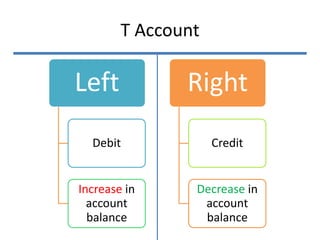
T Account
Left
Debit
Increase in
account
balance
Right
Credit
Decrease in
account
balance
Fundamentals of
Hotel Front Office
Accounting
Imagine a world without order, where
everything was a mess and no one knew
where anything was! Where money and
resources were being thrown about in all
directions, without knowing or caring!
How much was spent, how much was left,
or even where it went to!
This wouldn’t be very sustainable, not to
mention, comfortable?
Now imagine if this was in a hotel
environment; how could you even
accommodate guests!?
Hotel staff wouldn’t get their salaries,
guests wouldn’t get what they paid for,
no improvements would take place, and
money would just disappear!
That doesn’t sound too good, does it?
Accounting is organizing financial
transactions data.
Definition: Accounting
It is a systematic process of identifying,
recording, measuring, classifying, verifying,
summarizing, interpreting and
communicating financial information.
It reveals profit or loss for a given period, and
the value and nature of a firm's assets,
liabilities and owners' equity.
Read more:
http://www.businessdictionary.com/
definition/accounting.html
What is a guest account in hotels?
• A guest account is a financial statement that
accumulates and summarizes transactions, in a
well organized manner; of a single guest/ group/
local resident/ agency; in the hotel.
• It records advances, charges and settlements.
• An account of the hotel guest has four stages;
a. Created
b. Increased
c. Settled
d. Closed
What is Account posting?
• Writing/ recording data of a transaction in a
specific folio assigned to an account, and
calculating the resultant outstanding balance; is
called posting.
• There are three systems of maintaining accounts.
a) Manual: with pen on paper
b) Semi-automatic: with posting machine, on paper
c) Automatic: recorded electronically and
internally in a PMS, i.e. Computerized system
Scattered POS Transactions
• Every outlet within the hotel, selling either goods
or services, is called a point-of-sale.
• Transactions at each POS may be settled (paid) by
the guest, there itself. In that case the transaction
would never reach Front Office.
• Only if the guest has made a credit arrangement
with the hotel; either at the time of reservation, or
registration; may be allowed to charge his account
with credit purchases.
• All charge transactions of the guests are handled by
Front office, by posting charges in the respective
guest folios. Constant up-date of financial events.
Scattered POS Charges pose a
challenge!
• Even transactions such as in-room movie and
vending devices, long distance calls from the
room could be a source of the charge
transactions. They might be easily missed!
• These charge transactions must be
documented; and signature of the guest and
staff handling the transaction, must be
marked on this document, for physical
verification by Night Auditor, to avoid disputes
later on at the time of payment and
settlement.
Accounting: Purpose
• Accounting provides information to the
Company on following.
– Resources (money, capital, manpower etc.) available
to a firm.
– The means employed to finance those resources.
– The results e.g. Return on investment; achieved
through their use.
So, all managers need to become good in accounts.
Accounting: Practice and Body of
Knowledge
Concerned primarily with:
-Methods for recording transactions,
-Keeping financial records,
-Performing internal audits
(inspections/checks),
-Analyzing and reporting financial
information to the management, and
-Advising on taxation matters.
What Hotel Accountants Do?
• Producing an accurate set of month-end
accounts
• Comparing profit to previous periods and
forecasts (estimates)
• Preparing budgets and business plan
• Financial statement and balance sheet
production
• Cash flow statements
• Payroll control
Sounds Complicated?!
It is not.
Unique Things about Hotel Guest:
Charge Privilege: For convenience of guest as well
as the hotel, hotels provide a facility of “buy
now, pay later”. It is called charge privilege.
Unexpected Check-Outs: Guests can decide to
leave any day, any time they wish to. Hotels do
not force them to honour the agreement in
reservation contract, because they want guests
to keep coming back.
Hence, hotels have to keep their guest accounts
accurate, and up-to-date, to handle sudden
departures.
Who is entitled to Charge privilege?
• The convenience of buying on credit, that is
charge privilege, is possible only if the guest has
made an advance credit arrangement.
• Usually they provide a credit card number and its
expiration date, against which the hotel requests,
by sending data electronically, to the credit card
company; to guarantee the payment of a certain
amount.
• After getting the approval, the hotel allows
charge privilege to the guest.
• The amount approved is called “line of credit.”
Charge Privilege & House Limit
Hotels cannot afford to give unlimited credit to any
guest because it will be too risky.
Every guest is permitted a maximum credit
purchase limit , known as House Limit.
Every account is checked and totalled every day to
find out if an account has crossed that limit.
Accounts near their House Limit, are called High
Balance Account.
Charge privilege is not allowed to Scanty baggage
and Walk-in guest.
They are on APC (All payments in Cash) basis.
House limit is set by the hotel.
Floor limit is set by the credit card
company.
House limit and Floor limit are not the same.
Guests who ask to pay all their bills
in cash, are also marked as APC.
Such guests are not permitted to
charge hotel services, or products.
The major Functions of Front
Office Accounting
Creation & maintenance of guest & non-
guest accounts, timely, & accurately.
Tracking financial transactions (buy & Pay)
of customers.
Monitoring the credit limit of guest.
Preparing a high balance account report.
providing an efficient Management
Information System (MIS).
Maintaining effective control over cash &
credit transaction.
Types Of Accounts
Guest Accounts
Non-guest accounts
Guest Account
 A guest account is the record of
financial transactions between a
resident guest & hotel. The front office
creates, an individual folio (a/c) for
each guest. On the basis of guest folio,
the final bill is prepared, and
presented to the guest for payment.
NON-GUEST ACCOUNTS
• A non-guest account is the record of
the financial transactions, that take
place between a non-resident guest,
agency or meeting sponsoring
organizations, & the hotel. This is also
known as house account or city
account.
• Non-Resident guests use services like
restaurant, bar, salon, spa, swimming
pool, club, conference and banquets
etc.
Transactions Guest Charges?!
• Guest charges (credit purchase)can include:
–Guest room charges
–Taxes
–telephone charges
–Food and beverage
–Charges for other product & services. For
example, cabs, babysitter, laundry,
shopping, salon, spa, hospitality suite etc.
Classifying transactions
1. Cash; paid to hotel; credit entry; cash voucher
2. Charge; purchase by visitor; debit; charge/
account receivable voucher
3. Correction; error; Dr/ Cr; correction voucher
4. Allowance; error, compensation; Dr/ Cr;
allowance voucher
5. Transfer; room to another room; credit 1st &
debit 2nd; transfer voucher
6. Advance; paid to guest or on her behalf; debit;
Visitors Paid-out voucher, VPO
Generally Accepted Accounting
Principles (G. A. A. P. s):
Standards and procedures, that have been
adopted, by those responsible for preparing
business financial statements, for the purpose
of ensuring standard, and uniformity across all
businesses and geographic locations.
This helps in buying and selling of businesses, if
and when needed.
Nothing happens in an accounting
system, until transaction occurs!
General Accounting Terms: Basic
• Assets: Items owned by a business including
cash on hand, money in checking or other
accounts, money owed to the business
(accounts receivable), inventories, property,
equipment, and furnishings.
• Liabilities: Debts owed by a business (accounts
payable).
• Owner’s Equity: Assets Liabilities
Uniform System of Accounts for
the Lodging Industry (USALI):
• A standard set of accounting procedures, used
to record a hotel’s financial transactions and
condition.
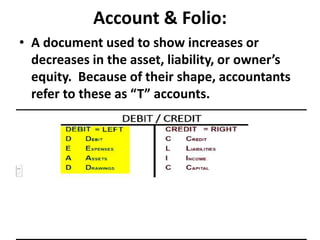
Account & Folio:
• A document used to show increases or
decreases in the asset, liability, or owner’s
equity. Because of their shape, accountants
refer to these as “T” accounts.
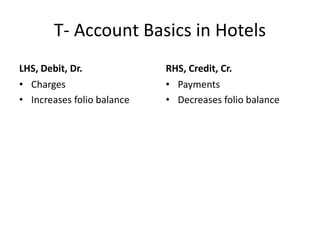
T- Account Basics in Hotels
LHS, Debit, Dr.
• Charges
• Increases folio balance
RHS, Credit, Cr.
• Payments
• Decreases folio balance
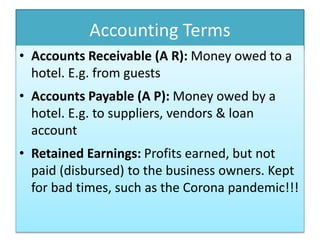
Accounting Terms
• Accounts Receivable (A R): Money owed to a
hotel. E.g. from guests
• Accounts Payable (A P): Money owed by a
hotel. E.g. to suppliers, vendors & loan
account
• Retained Earnings: Profits earned, but not
paid (disbursed) to the business owners. Kept
for bad times, such as the Corona pandemic!!!
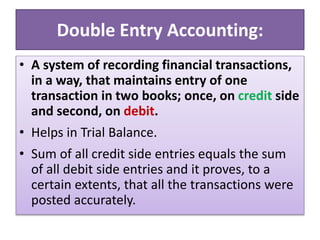
Double Entry Accounting:
• A system of recording financial transactions,
in a way, that maintains entry of one
transaction in two books; once, on credit side
and second, on debit.
• Helps in Trial Balance.
• Sum of all credit side entries equals the sum
of all debit side entries and it proves, to a
certain extents, that all the transactions were
posted accurately.
Accounting for Guest Charges
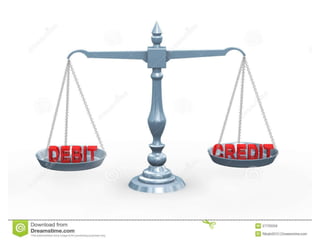
• Debit: An accounting transaction that records
a change on the left side of a “T” account.
• Entries on debit side increase the a/c balance.
• Credit: An accounting transaction that records
a change on the right side of a “T” account.
• Entries on credit side decrease the a/c
balance.
Vouchers
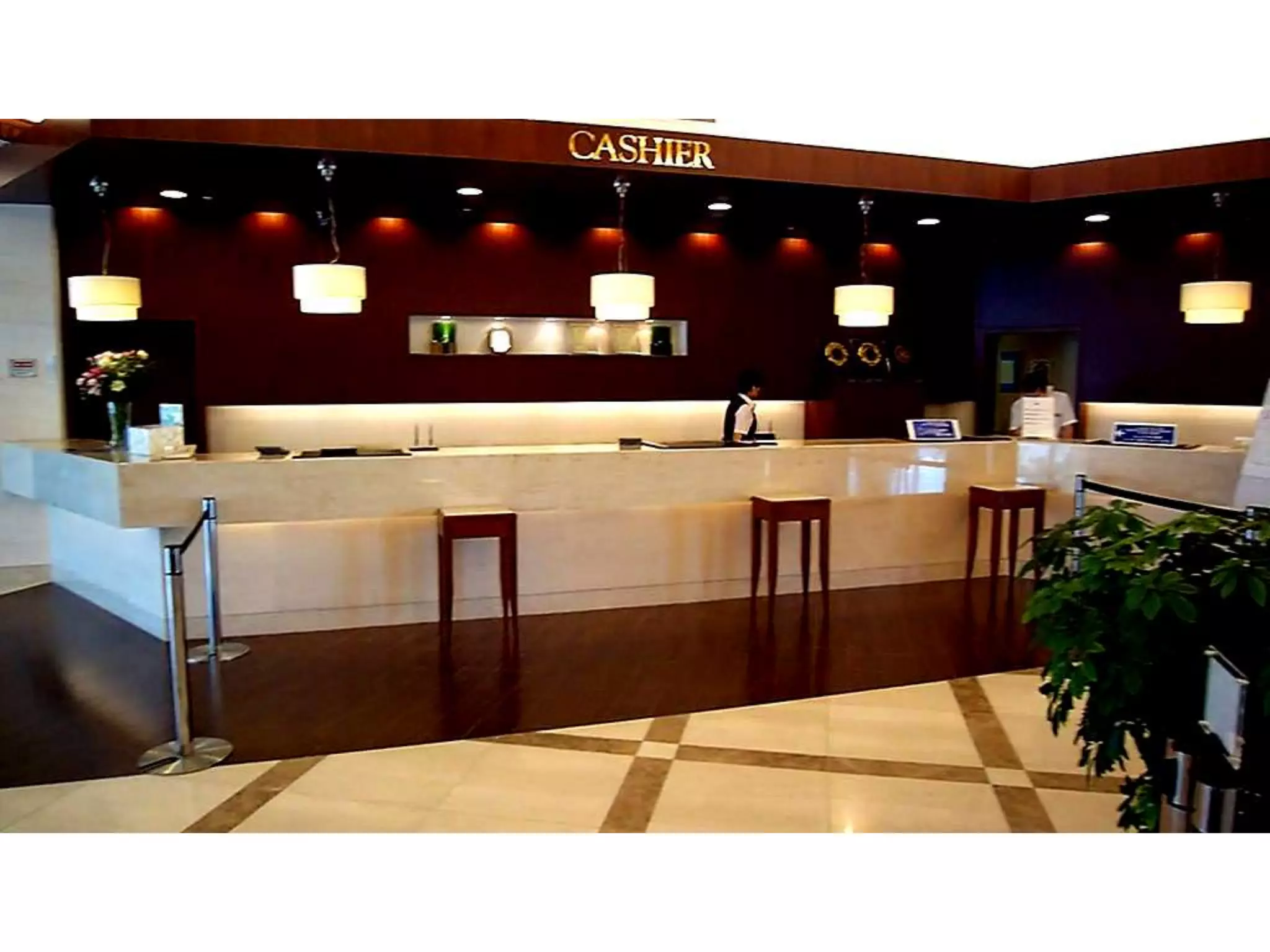
The front desk cashier is required to present
supporting documents as a proof, for all the
financial transaction, buy or pay, recorded in
the guest folio.
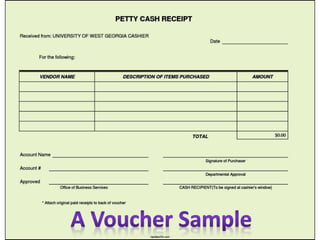
Voucher is a written document, that serves to
confirm, or witness (vouch) for a transaction.
Commonly, a voucher is a paper document,
that shows goods have been bought, or
services have been given, authorizes payment,
and indicates the ledger account(s), in which
these transactions will be recorded.
Vouchers act as an “Audit Trail”!
• Vouchers, in physical form are attached to the
related Folio.
• They help the Night Auditor and Financial
Controller to establish a chain of documentation
for any charge transaction, from source to
destination.
• In non-automated systems, related documents
are cross-referenced with numbers of each other.
For example, KOT number imprinted on F&B
check and F&B check number imprinted on the
KOT.
• More on this in the chapter on Night Audit.
Electronic Vouchers
• In fully automated systems, the accounting
activity is within the PMS, the computerized
system.
• The vouchers are created electronically and the
charges are posted only once.
• After posting the charge data once, it can be
transferred to multiple departments, systems
with the click of a button. Copy & paste
functionality!
• This saves the labour of duplication, time taken in
physical transfers; and ensures minimum errors in
posting.
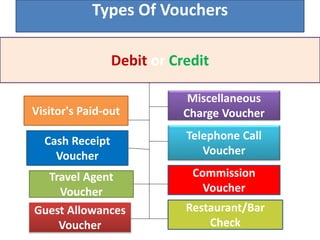
Types Of Vouchers
Debit or Credit
Miscellaneous
Charge VoucherVisitor's Paid-out
Telephone Call
Voucher
Cash Receipt
Voucher
Travel Agent
Voucher
Commission
Voucher
Guest Allowances
Voucher
Restaurant/Bar
Check
Vouchers
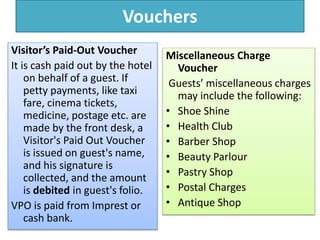
Visitor’s Paid-Out Voucher
It is cash paid out by the hotel
on behalf of a guest. If
petty payments, like taxi
fare, cinema tickets,
medicine, postage etc. are
made by the front desk, a
Visitor's Paid Out Voucher
is issued on guest's name,
and his signature is
collected, and the amount
is debited in guest's folio.
VPO is paid from Imprest or
cash bank.
Miscellaneous Charge
Voucher
Guests’ miscellaneous charges
may include the following:
• Shoe Shine
• Health Club
• Barber Shop
• Beauty Parlour
• Pastry Shop
• Postal Charges
• Antique Shop
Cash Banks
• A cash bank is an amount of cash given to a
cashier, before the shift begins, in order to
tender exact change, in every transaction.
• Only one person, who signs for it, has access to
the cash bank, and is solely responsible for it.
At the end of the shift the cash bank amount is
separated, and the remaining cash is put in an
envelope, and deposited with chief cashier.
Cash Bank: Shortage & Overage
• Monetary differences between the money
placed in Front Office cash envelope, and
cashier’s net cash receipt, is noted on the
envelope as overages (more), shortages or
due backs.
• Net cash receipt is the amount of cash,
cheques and other negotiable instruments in
the cashier’s drawer, minus, the initial cash
bank, plus, the paid-outs.
Cash Bank: Due Back
Due Back occurs when a cashier pays out more
than the amount received as cash bank, and
there is not enough cash in the drawer to
restore the initial bank. (Due Backs are also
known as Due Bank).
When VPO is settled later, Due Back money is
recovered and returned.
Recording Overages, Shortages & Due-
backs
• Before dropping the envelope with cash,
negotiable instruments and cash sheet into the
FO vault, the cashier notes it down on the
envelope that carries cash, credit card vouchers
etc.
• This helps to adjust due-back amount the next
day.
• The dropping of envelope must be witnessed by
one more employee and the two sign the
document to verify the act of submitting money
and money equivalent.
Vouchers
Cash Receipt Voucher
A written document, that
is produced by a
company, each time it
receives money for
goods, or services.
Telephone Call Voucher
In automated hotels, call
from rooms are directly
billed into account.
If a call is made through
Operator, then a bill is
raised on telephone
voucher.
Vouchers
Travel Agent Voucher
Voucher detailing the
accommodation,
transport, food &
entertainment to be
provided to the bearer
(guest).
The payment may be
direct by guest, or sent
to the agent.
Commission Voucher
Travel agents, tour
operators, taxi drivers
etc., who provide
business to the hotel,
are paid a commission
(10% of room rate)
through this voucher
Vouchers
Guest Allowances
A rebate or deduction
from an invoice (bill), to give a
compensation to the guest,
for poor service or mistake.
Excess advance deposit
refund, at check-out, is also
an allowance.
Restaurant/Bar Check
Restaurant and bar check
will have the details of
charges of food, or drinks,
ordered by the guest.
When the check is
presented, the guest signs
for confirmation that he
had agreed to pay.
If unpaid, but signed by the
guest, the restaurant
check becomes the
voucher.
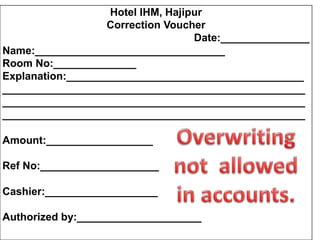
Hotel IHM, Hajipur
Correction Voucher
Date:_______________
Name:________________________________
Room No:______________
Explanation:________________________________________
___________________________________________________
___________________________________________________
___________________________________________________
Amount:__________________
Ref No:____________________
Cashier:___________________
Authorized by:_____________________
Comparison between Correction &
Allowance voucher
Correction Voucher
• Made before the end of the
“business day”, i.e. Night
audit
• Correction can both
increase and decrease the
balance of an account.
• Mostly mathematical errors
are rectified.
• Mostly, approval of senior
officers is not need.
Allowance Voucher
• Made after the end of the
“business day”
• Allowance can both increase
and decrease the balance of
an account.
• Apart from mathematical
errors, even compensation
for poor service is recorded
with the help of allowance
voucher.
• Must be approved by the
authorized official
Folios
• The front desk cashier transfers (writes)
the financial transactions, that are
recorded in the vouchers, to individual or
the group accounts folio. Posting, in
technical terms!
• A folio is a written record of a guest’s
accounts, & is created at the time of
reservation or registration.
Folio
• A folio will have a unique number to identify it
and to account for all valid folios during audit.
• Folios may also be colour coded to indicate the
posting principle applicable. It also helps in
sorting them easily.
• In electronic folios, created in PMS, often the
reservation number becomes the folio number.
• After registration, room number and registration
number is added to the folio number for accurate
identification, storing and processing of
transactions.
Storing & Sorting Folios
• Folios are stored sequentially, that is, room
number-wise, in deep, open containers or boxes.
• The storage box for Folios is called by different
names in different locations and hotels.
• For example,
a) Folio Tray
b) Posting Tray
c) Folio Well
d) Folio Bucket
In the chapter on Night Audit , you will come across
“Bucket Ledger!”
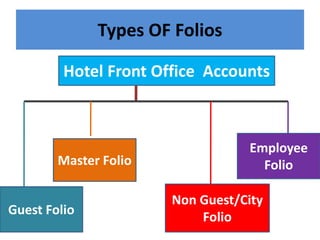
Types OF Folios
Hotel Front Office Accounts
Guest Folio
Master Folio
Non Guest/City
Folio
Employee
Folio
Guest Folio
These are accounts of individual person, of guest
rooms, and are also called, bill folio.
The folio can be of two styles;
Paper folio & Electronic folio.
Paper folio can only contain a limited number of
transactions and new folio pages, must be added
once the previous one is totally filled up with
data.
Electronic folio are generated by the fully
computerized PMS. It does not need to have new
page/ folio attachments.
Paper Folio & Electronic Folio;
Comparison
• Paper folio will have two separate columns for Dr
& Cr entries.
• Electronic folio will have a single column for both
types of entries.
• The credit entries in electronic folio is either
shown in parentheses, that is, between two small
brackets or they carry a minus sign on them,
indicating that it will decrease the balance of that
account.
• For example, (Rs. 2000) or, Rs. -2000.
Non Guest or City Folio
They are also called semi-permanent folio, and
are the account of non-guest business, or
agencies, with hotel charge purchase
privileges (buy now, pay later).
Master Folio
These are accounts of more than one person, or
guestrooms, and are usually maintained for
groups.
Employee Folio
They are the accounts of various employees
with charge purchase privilege, and not
always handled by front office. Some accounts
are directly handled by Accounts department.
For example, City folio, Credit card payment
etc.
Split Folio & Incidental Folio
Company sponsored guests, at times, request for a
split folio, one to record expenses to be paid by
the company, and the other, to be paid by the
guest personally, and directly.
The personal expenses, like cigarette or drinks, spa,
laundry etc. are recorded in Incidental Folio.
The part containing Room charges and taxes is
called A Account and the other part containing
incidental charges like F&B, Spa etc are called B
Account.
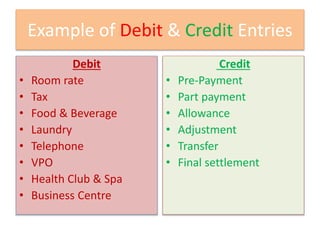
Example of Debit & Credit Entries
Debit
• Room rate
• Tax
• Food & Beverage
• Laundry
• Telephone
• VPO
• Health Club & Spa
• Business Centre
Credit
• Pre-Payment
• Part payment
• Allowance
• Adjustment
• Transfer
• Final settlement
Ledger
A ledger is a collection of the same
type of accounts. The front office
ledger has a collection of folios.
There are normally two ledgers .
 Guest Ledger
City Ledger
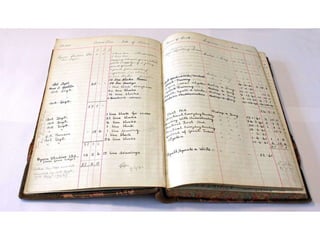
Guest Ledger
A guest ledger, also called transient, Front Office or
Rooms ledger; contains the details, of all the
financial transactions, between all resident guests
& a hotel, including charge purchases & the
payment received from the guest.
In a manual system , the financial transaction are
recorded in a tabular ledger, or tab ledger, which
is of two types:
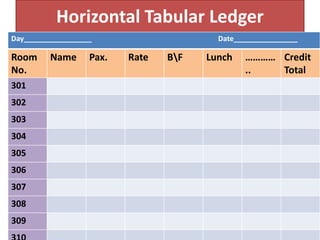
• Horizontal Tabular Ledger
• Vertical Tabular Ledger
Visitor’s Tabular Ledger
Visitor’s tabular ledger is a ledger, meant for
keeping the records, of all registered guests, in
a loose leaf form. (1 leaf or sheet per day)
It serves the purpose of a day book (sales book)
on one hand, and registered guest’s personal
account on the other. It is maintained for
keeping the record of all the transactions,
relating to the sale of goods and services, to
registered guests in a systematically analysed
form.
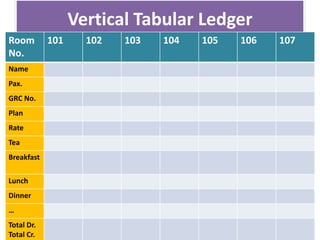
Vertical Tabular Ledger
Room
No.
101 102 103 104 105 106 107
Name
Pax.
GRC No.
Plan
Rate
Tea
Breakfast
Lunch
Dinner
…
Total Dr.
Total Cr.
Horizontal Tabular Ledger
Day_________________ Date________________
Room
No.
Name Pax. Rate BF Lunch …………
..
Credit
Total
301
302
303
304
305
306
307
308
309
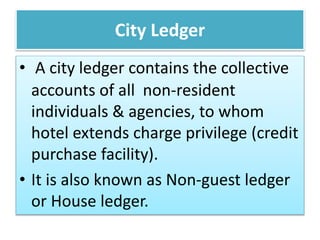
City Ledger
• A city ledger contains the collective
accounts of all non-resident
individuals & agencies, to whom
hotel extends charge privilege (credit
purchase facility).
• It is also known as Non-guest ledger
or House ledger.
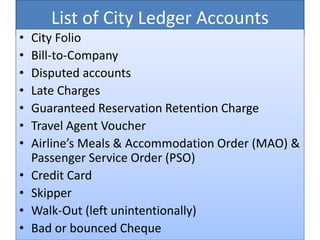
List of City Ledger Accounts
• City Folio
• Bill-to-Company
• Disputed accounts
• Late Charges
• Guaranteed Reservation Retention Charge
• Travel Agent Voucher
• Airline’s Meals & Accommodation Order (MAO) &
Passenger Service Order (PSO)
• Credit Card
• Skipper
• Walk-Out (left unintentionally)
• Bad or bounced Cheque
Ledger for Credit Monitoring
• Front Office managers may review the ledger
several times on a single day to discover
guests who are close to their House Limit or
Floor Limit.
• House Limit is the internal restriction imposed
upon a guest to prevent complications arising
out of guest overspending, and expressing
inability to pay at the settlement stage.
In many hotels, with bigger volume of
credit transactions, the hotel may
appoint a full time Credit Manager, to
ensure that payments are received on
time.
No Post Status
• In computerized accounting systems, it is possible
to prevent any further posting of charges into an
account that has, or is about to, exceed the
imposed credit limit.
• The function is activated by the command, “stop
charge posting” and cancelled by the command,
“release stop posting”.
• In manual systems, a no charge privilege list, in
paper form, has to be circulated to all POS and
cancellation of the restriction again
communicated through some paper document.
Isn’t always reliable!
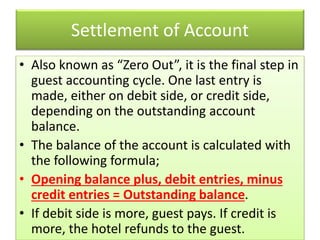
Accounting Cycle
3. Settlement of Account
Immediate Payment Deferred Payment
2. Maintenance of Account
Posting Charges Night Audit
1. Creation of Account
At Reservation At Check-In
Settlement of Account
• Also known as “Zero Out”, it is the final step in
guest accounting cycle. One last entry is
made, either on debit side, or credit side,
depending on the outstanding account
balance.
• The balance of the account is calculated with
the following formula;
• Opening balance plus, debit entries, minus
credit entries = Outstanding balance.
• If debit side is more, guest pays. If credit is
more, the hotel refunds to the guest.
Trial Balance
Accounting: The aggregate of all debit and
credit balances at the end of an
accounting period that;
(1) shows if the general ledger is in balance
(total debits equal total credits), before
making closing entries,
(2) serves as a worksheet, for making
closing entries, and
(3) provides the basis for making draft
financial statements. (Income or loss)
Aging Schedule or, Account Aging
• Aging schedule is a table, that shows a summarized
breakup of accounts receivable, into different time
brackets. It is an important tool, used in working capital
management, to project pattern of collections, and
estimate doubtful debts.
It is called aging schedule because it ranks accounts
receivable, according to their age i.e. into slabs such as;
not yet due, 30 days;
• due, >30 days, <60 days;
• overdue, >60 days, <90 days;
• Delinquent, >90 days;
• Bad debt, >1 year; etc.
As an account gets older, the possibility of collecting
payment becomes more doubtful.
Selling is not so easy, getting the
payments on time, is even more
difficult!
• As a future manager, you need to remember
this truth, which my businessman cousin
shared with me when we were discussing the
creative ways of improving sales!
Front Office & Audit Function
• As all the folios and vouchers of all types are
stored at the Front office, it is natural that the
responsibility of auditing them lies with FO.
• In chain hotels, surprise audit inspections are
carried out to verify the integrity (honesty) of the
accounting activities in the hotel.
• In a hotel the daily audit is done in the slack
period, when work pressure is less, which is often
during night time in most types of hotels.
Compilation & Presentation
Praveen Jha
Senior Faculty
IHM Hajipur
Vaishali, Bihar

Front Office Accounting (Updated, August 2020)

  • 2.
    Welcome to a newlearning session! Knowledge is Money.
  • 3.
  • 4.
    Fundamentals of Hotel FrontOffice Accounting
  • 7.
    Imagine a worldwithout order, where everything was a mess and no one knew where anything was! Where money and resources were being thrown about in all directions, without knowing or caring! How much was spent, how much was left, or even where it went to! This wouldn’t be very sustainable, not to mention, comfortable?
  • 10.
    Now imagine ifthis was in a hotel environment; how could you even accommodate guests!? Hotel staff wouldn’t get their salaries, guests wouldn’t get what they paid for, no improvements would take place, and money would just disappear! That doesn’t sound too good, does it?
  • 13.
    Accounting is organizingfinancial transactions data.
  • 14.
    Definition: Accounting It isa systematic process of identifying, recording, measuring, classifying, verifying, summarizing, interpreting and communicating financial information. It reveals profit or loss for a given period, and the value and nature of a firm's assets, liabilities and owners' equity. Read more: http://www.businessdictionary.com/ definition/accounting.html
  • 15.
    What is aguest account in hotels? • A guest account is a financial statement that accumulates and summarizes transactions, in a well organized manner; of a single guest/ group/ local resident/ agency; in the hotel. • It records advances, charges and settlements. • An account of the hotel guest has four stages; a. Created b. Increased c. Settled d. Closed
  • 16.
    What is Accountposting? • Writing/ recording data of a transaction in a specific folio assigned to an account, and calculating the resultant outstanding balance; is called posting. • There are three systems of maintaining accounts. a) Manual: with pen on paper b) Semi-automatic: with posting machine, on paper c) Automatic: recorded electronically and internally in a PMS, i.e. Computerized system
  • 17.
    Scattered POS Transactions •Every outlet within the hotel, selling either goods or services, is called a point-of-sale. • Transactions at each POS may be settled (paid) by the guest, there itself. In that case the transaction would never reach Front Office. • Only if the guest has made a credit arrangement with the hotel; either at the time of reservation, or registration; may be allowed to charge his account with credit purchases. • All charge transactions of the guests are handled by Front office, by posting charges in the respective guest folios. Constant up-date of financial events.
  • 18.
    Scattered POS Chargespose a challenge! • Even transactions such as in-room movie and vending devices, long distance calls from the room could be a source of the charge transactions. They might be easily missed! • These charge transactions must be documented; and signature of the guest and staff handling the transaction, must be marked on this document, for physical verification by Night Auditor, to avoid disputes later on at the time of payment and settlement.
  • 20.
    Accounting: Purpose • Accountingprovides information to the Company on following. – Resources (money, capital, manpower etc.) available to a firm. – The means employed to finance those resources. – The results e.g. Return on investment; achieved through their use. So, all managers need to become good in accounts.
  • 22.
    Accounting: Practice andBody of Knowledge Concerned primarily with: -Methods for recording transactions, -Keeping financial records, -Performing internal audits (inspections/checks), -Analyzing and reporting financial information to the management, and -Advising on taxation matters.
  • 24.
    What Hotel AccountantsDo? • Producing an accurate set of month-end accounts • Comparing profit to previous periods and forecasts (estimates) • Preparing budgets and business plan • Financial statement and balance sheet production • Cash flow statements • Payroll control
  • 25.
  • 27.
    Unique Things aboutHotel Guest: Charge Privilege: For convenience of guest as well as the hotel, hotels provide a facility of “buy now, pay later”. It is called charge privilege. Unexpected Check-Outs: Guests can decide to leave any day, any time they wish to. Hotels do not force them to honour the agreement in reservation contract, because they want guests to keep coming back. Hence, hotels have to keep their guest accounts accurate, and up-to-date, to handle sudden departures.
  • 28.
    Who is entitledto Charge privilege? • The convenience of buying on credit, that is charge privilege, is possible only if the guest has made an advance credit arrangement. • Usually they provide a credit card number and its expiration date, against which the hotel requests, by sending data electronically, to the credit card company; to guarantee the payment of a certain amount. • After getting the approval, the hotel allows charge privilege to the guest. • The amount approved is called “line of credit.”
  • 29.
    Charge Privilege &House Limit Hotels cannot afford to give unlimited credit to any guest because it will be too risky. Every guest is permitted a maximum credit purchase limit , known as House Limit. Every account is checked and totalled every day to find out if an account has crossed that limit. Accounts near their House Limit, are called High Balance Account. Charge privilege is not allowed to Scanty baggage and Walk-in guest. They are on APC (All payments in Cash) basis.
  • 30.
    House limit isset by the hotel. Floor limit is set by the credit card company. House limit and Floor limit are not the same.
  • 31.
    Guests who askto pay all their bills in cash, are also marked as APC. Such guests are not permitted to charge hotel services, or products.
  • 32.
    The major Functionsof Front Office Accounting Creation & maintenance of guest & non- guest accounts, timely, & accurately. Tracking financial transactions (buy & Pay) of customers. Monitoring the credit limit of guest. Preparing a high balance account report. providing an efficient Management Information System (MIS). Maintaining effective control over cash & credit transaction.
  • 33.
    Types Of Accounts GuestAccounts Non-guest accounts
  • 34.
    Guest Account  Aguest account is the record of financial transactions between a resident guest & hotel. The front office creates, an individual folio (a/c) for each guest. On the basis of guest folio, the final bill is prepared, and presented to the guest for payment.
  • 36.
    NON-GUEST ACCOUNTS • Anon-guest account is the record of the financial transactions, that take place between a non-resident guest, agency or meeting sponsoring organizations, & the hotel. This is also known as house account or city account. • Non-Resident guests use services like restaurant, bar, salon, spa, swimming pool, club, conference and banquets etc.
  • 38.
    Transactions Guest Charges?! •Guest charges (credit purchase)can include: –Guest room charges –Taxes –telephone charges –Food and beverage –Charges for other product & services. For example, cabs, babysitter, laundry, shopping, salon, spa, hospitality suite etc.
  • 39.
    Classifying transactions 1. Cash;paid to hotel; credit entry; cash voucher 2. Charge; purchase by visitor; debit; charge/ account receivable voucher 3. Correction; error; Dr/ Cr; correction voucher 4. Allowance; error, compensation; Dr/ Cr; allowance voucher 5. Transfer; room to another room; credit 1st & debit 2nd; transfer voucher 6. Advance; paid to guest or on her behalf; debit; Visitors Paid-out voucher, VPO
  • 40.
    Generally Accepted Accounting Principles(G. A. A. P. s): Standards and procedures, that have been adopted, by those responsible for preparing business financial statements, for the purpose of ensuring standard, and uniformity across all businesses and geographic locations. This helps in buying and selling of businesses, if and when needed.
  • 41.
    Nothing happens inan accounting system, until transaction occurs!
  • 42.
    General Accounting Terms:Basic • Assets: Items owned by a business including cash on hand, money in checking or other accounts, money owed to the business (accounts receivable), inventories, property, equipment, and furnishings. • Liabilities: Debts owed by a business (accounts payable). • Owner’s Equity: Assets Liabilities
  • 43.
    Uniform System ofAccounts for the Lodging Industry (USALI): • A standard set of accounting procedures, used to record a hotel’s financial transactions and condition.
  • 44.
    Account & Folio: •A document used to show increases or decreases in the asset, liability, or owner’s equity. Because of their shape, accountants refer to these as “T” accounts.
  • 45.
    T- Account Basicsin Hotels LHS, Debit, Dr. • Charges • Increases folio balance RHS, Credit, Cr. • Payments • Decreases folio balance
  • 47.
    Accounting Terms • AccountsReceivable (A R): Money owed to a hotel. E.g. from guests • Accounts Payable (A P): Money owed by a hotel. E.g. to suppliers, vendors & loan account • Retained Earnings: Profits earned, but not paid (disbursed) to the business owners. Kept for bad times, such as the Corona pandemic!!!
  • 48.
    Double Entry Accounting: •A system of recording financial transactions, in a way, that maintains entry of one transaction in two books; once, on credit side and second, on debit. • Helps in Trial Balance. • Sum of all credit side entries equals the sum of all debit side entries and it proves, to a certain extents, that all the transactions were posted accurately.
  • 49.
    Accounting for GuestCharges • Debit: An accounting transaction that records a change on the left side of a “T” account. • Entries on debit side increase the a/c balance. • Credit: An accounting transaction that records a change on the right side of a “T” account. • Entries on credit side decrease the a/c balance.
  • 50.
    Vouchers The front deskcashier is required to present supporting documents as a proof, for all the financial transaction, buy or pay, recorded in the guest folio. Voucher is a written document, that serves to confirm, or witness (vouch) for a transaction. Commonly, a voucher is a paper document, that shows goods have been bought, or services have been given, authorizes payment, and indicates the ledger account(s), in which these transactions will be recorded.
  • 51.
    Vouchers act asan “Audit Trail”! • Vouchers, in physical form are attached to the related Folio. • They help the Night Auditor and Financial Controller to establish a chain of documentation for any charge transaction, from source to destination. • In non-automated systems, related documents are cross-referenced with numbers of each other. For example, KOT number imprinted on F&B check and F&B check number imprinted on the KOT. • More on this in the chapter on Night Audit.
  • 52.
    Electronic Vouchers • Infully automated systems, the accounting activity is within the PMS, the computerized system. • The vouchers are created electronically and the charges are posted only once. • After posting the charge data once, it can be transferred to multiple departments, systems with the click of a button. Copy & paste functionality! • This saves the labour of duplication, time taken in physical transfers; and ensures minimum errors in posting.
  • 54.
    Types Of Vouchers Debitor Credit Miscellaneous Charge VoucherVisitor's Paid-out Telephone Call Voucher Cash Receipt Voucher Travel Agent Voucher Commission Voucher Guest Allowances Voucher Restaurant/Bar Check
  • 55.
    Vouchers Visitor’s Paid-Out Voucher Itis cash paid out by the hotel on behalf of a guest. If petty payments, like taxi fare, cinema tickets, medicine, postage etc. are made by the front desk, a Visitor's Paid Out Voucher is issued on guest's name, and his signature is collected, and the amount is debited in guest's folio. VPO is paid from Imprest or cash bank. Miscellaneous Charge Voucher Guests’ miscellaneous charges may include the following: • Shoe Shine • Health Club • Barber Shop • Beauty Parlour • Pastry Shop • Postal Charges • Antique Shop
  • 56.
    Cash Banks • Acash bank is an amount of cash given to a cashier, before the shift begins, in order to tender exact change, in every transaction. • Only one person, who signs for it, has access to the cash bank, and is solely responsible for it. At the end of the shift the cash bank amount is separated, and the remaining cash is put in an envelope, and deposited with chief cashier.
  • 57.
    Cash Bank: Shortage& Overage • Monetary differences between the money placed in Front Office cash envelope, and cashier’s net cash receipt, is noted on the envelope as overages (more), shortages or due backs. • Net cash receipt is the amount of cash, cheques and other negotiable instruments in the cashier’s drawer, minus, the initial cash bank, plus, the paid-outs.
  • 58.
    Cash Bank: DueBack Due Back occurs when a cashier pays out more than the amount received as cash bank, and there is not enough cash in the drawer to restore the initial bank. (Due Backs are also known as Due Bank). When VPO is settled later, Due Back money is recovered and returned.
  • 59.
    Recording Overages, Shortages& Due- backs • Before dropping the envelope with cash, negotiable instruments and cash sheet into the FO vault, the cashier notes it down on the envelope that carries cash, credit card vouchers etc. • This helps to adjust due-back amount the next day. • The dropping of envelope must be witnessed by one more employee and the two sign the document to verify the act of submitting money and money equivalent.
  • 60.
    Vouchers Cash Receipt Voucher Awritten document, that is produced by a company, each time it receives money for goods, or services. Telephone Call Voucher In automated hotels, call from rooms are directly billed into account. If a call is made through Operator, then a bill is raised on telephone voucher.
  • 61.
    Vouchers Travel Agent Voucher Voucherdetailing the accommodation, transport, food & entertainment to be provided to the bearer (guest). The payment may be direct by guest, or sent to the agent. Commission Voucher Travel agents, tour operators, taxi drivers etc., who provide business to the hotel, are paid a commission (10% of room rate) through this voucher
  • 62.
    Vouchers Guest Allowances A rebateor deduction from an invoice (bill), to give a compensation to the guest, for poor service or mistake. Excess advance deposit refund, at check-out, is also an allowance. Restaurant/Bar Check Restaurant and bar check will have the details of charges of food, or drinks, ordered by the guest. When the check is presented, the guest signs for confirmation that he had agreed to pay. If unpaid, but signed by the guest, the restaurant check becomes the voucher.
  • 63.
    Hotel IHM, Hajipur CorrectionVoucher Date:_______________ Name:________________________________ Room No:______________ Explanation:________________________________________ ___________________________________________________ ___________________________________________________ ___________________________________________________ Amount:__________________ Ref No:____________________ Cashier:___________________ Authorized by:_____________________
  • 64.
    Comparison between Correction& Allowance voucher Correction Voucher • Made before the end of the “business day”, i.e. Night audit • Correction can both increase and decrease the balance of an account. • Mostly mathematical errors are rectified. • Mostly, approval of senior officers is not need. Allowance Voucher • Made after the end of the “business day” • Allowance can both increase and decrease the balance of an account. • Apart from mathematical errors, even compensation for poor service is recorded with the help of allowance voucher. • Must be approved by the authorized official
  • 65.
    Folios • The frontdesk cashier transfers (writes) the financial transactions, that are recorded in the vouchers, to individual or the group accounts folio. Posting, in technical terms! • A folio is a written record of a guest’s accounts, & is created at the time of reservation or registration.
  • 66.
    Folio • A foliowill have a unique number to identify it and to account for all valid folios during audit. • Folios may also be colour coded to indicate the posting principle applicable. It also helps in sorting them easily. • In electronic folios, created in PMS, often the reservation number becomes the folio number. • After registration, room number and registration number is added to the folio number for accurate identification, storing and processing of transactions.
  • 67.
    Storing & SortingFolios • Folios are stored sequentially, that is, room number-wise, in deep, open containers or boxes. • The storage box for Folios is called by different names in different locations and hotels. • For example, a) Folio Tray b) Posting Tray c) Folio Well d) Folio Bucket In the chapter on Night Audit , you will come across “Bucket Ledger!”
  • 68.
    Types OF Folios HotelFront Office Accounts Guest Folio Master Folio Non Guest/City Folio Employee Folio
  • 69.
    Guest Folio These areaccounts of individual person, of guest rooms, and are also called, bill folio. The folio can be of two styles; Paper folio & Electronic folio. Paper folio can only contain a limited number of transactions and new folio pages, must be added once the previous one is totally filled up with data. Electronic folio are generated by the fully computerized PMS. It does not need to have new page/ folio attachments.
  • 70.
    Paper Folio &Electronic Folio; Comparison • Paper folio will have two separate columns for Dr & Cr entries. • Electronic folio will have a single column for both types of entries. • The credit entries in electronic folio is either shown in parentheses, that is, between two small brackets or they carry a minus sign on them, indicating that it will decrease the balance of that account. • For example, (Rs. 2000) or, Rs. -2000.
  • 71.
    Non Guest orCity Folio They are also called semi-permanent folio, and are the account of non-guest business, or agencies, with hotel charge purchase privileges (buy now, pay later).
  • 72.
    Master Folio These areaccounts of more than one person, or guestrooms, and are usually maintained for groups.
  • 73.
    Employee Folio They arethe accounts of various employees with charge purchase privilege, and not always handled by front office. Some accounts are directly handled by Accounts department. For example, City folio, Credit card payment etc.
  • 74.
    Split Folio &Incidental Folio Company sponsored guests, at times, request for a split folio, one to record expenses to be paid by the company, and the other, to be paid by the guest personally, and directly. The personal expenses, like cigarette or drinks, spa, laundry etc. are recorded in Incidental Folio. The part containing Room charges and taxes is called A Account and the other part containing incidental charges like F&B, Spa etc are called B Account.
  • 75.
    Example of Debit& Credit Entries Debit • Room rate • Tax • Food & Beverage • Laundry • Telephone • VPO • Health Club & Spa • Business Centre Credit • Pre-Payment • Part payment • Allowance • Adjustment • Transfer • Final settlement
  • 76.
    Ledger A ledger isa collection of the same type of accounts. The front office ledger has a collection of folios. There are normally two ledgers .  Guest Ledger City Ledger
  • 79.
    Guest Ledger A guestledger, also called transient, Front Office or Rooms ledger; contains the details, of all the financial transactions, between all resident guests & a hotel, including charge purchases & the payment received from the guest. In a manual system , the financial transaction are recorded in a tabular ledger, or tab ledger, which is of two types: • Horizontal Tabular Ledger • Vertical Tabular Ledger
  • 80.
    Visitor’s Tabular Ledger Visitor’stabular ledger is a ledger, meant for keeping the records, of all registered guests, in a loose leaf form. (1 leaf or sheet per day) It serves the purpose of a day book (sales book) on one hand, and registered guest’s personal account on the other. It is maintained for keeping the record of all the transactions, relating to the sale of goods and services, to registered guests in a systematically analysed form.
  • 81.
    Vertical Tabular Ledger Room No. 101102 103 104 105 106 107 Name Pax. GRC No. Plan Rate Tea Breakfast Lunch Dinner … Total Dr. Total Cr.
  • 82.
    Horizontal Tabular Ledger Day_________________Date________________ Room No. Name Pax. Rate BF Lunch ………… .. Credit Total 301 302 303 304 305 306 307 308 309
  • 83.
    City Ledger • Acity ledger contains the collective accounts of all non-resident individuals & agencies, to whom hotel extends charge privilege (credit purchase facility). • It is also known as Non-guest ledger or House ledger.
  • 84.
    List of CityLedger Accounts • City Folio • Bill-to-Company • Disputed accounts • Late Charges • Guaranteed Reservation Retention Charge • Travel Agent Voucher • Airline’s Meals & Accommodation Order (MAO) & Passenger Service Order (PSO) • Credit Card • Skipper • Walk-Out (left unintentionally) • Bad or bounced Cheque
  • 85.
    Ledger for CreditMonitoring • Front Office managers may review the ledger several times on a single day to discover guests who are close to their House Limit or Floor Limit. • House Limit is the internal restriction imposed upon a guest to prevent complications arising out of guest overspending, and expressing inability to pay at the settlement stage.
  • 86.
    In many hotels,with bigger volume of credit transactions, the hotel may appoint a full time Credit Manager, to ensure that payments are received on time.
  • 87.
    No Post Status •In computerized accounting systems, it is possible to prevent any further posting of charges into an account that has, or is about to, exceed the imposed credit limit. • The function is activated by the command, “stop charge posting” and cancelled by the command, “release stop posting”. • In manual systems, a no charge privilege list, in paper form, has to be circulated to all POS and cancellation of the restriction again communicated through some paper document. Isn’t always reliable!
  • 88.
    Accounting Cycle 3. Settlementof Account Immediate Payment Deferred Payment 2. Maintenance of Account Posting Charges Night Audit 1. Creation of Account At Reservation At Check-In
  • 89.
    Settlement of Account •Also known as “Zero Out”, it is the final step in guest accounting cycle. One last entry is made, either on debit side, or credit side, depending on the outstanding account balance. • The balance of the account is calculated with the following formula; • Opening balance plus, debit entries, minus credit entries = Outstanding balance. • If debit side is more, guest pays. If credit is more, the hotel refunds to the guest.
  • 90.
    Trial Balance Accounting: Theaggregate of all debit and credit balances at the end of an accounting period that; (1) shows if the general ledger is in balance (total debits equal total credits), before making closing entries, (2) serves as a worksheet, for making closing entries, and (3) provides the basis for making draft financial statements. (Income or loss)
  • 91.
    Aging Schedule or,Account Aging • Aging schedule is a table, that shows a summarized breakup of accounts receivable, into different time brackets. It is an important tool, used in working capital management, to project pattern of collections, and estimate doubtful debts. It is called aging schedule because it ranks accounts receivable, according to their age i.e. into slabs such as; not yet due, 30 days; • due, >30 days, <60 days; • overdue, >60 days, <90 days; • Delinquent, >90 days; • Bad debt, >1 year; etc. As an account gets older, the possibility of collecting payment becomes more doubtful.
  • 92.
    Selling is notso easy, getting the payments on time, is even more difficult! • As a future manager, you need to remember this truth, which my businessman cousin shared with me when we were discussing the creative ways of improving sales!
  • 93.
    Front Office &Audit Function • As all the folios and vouchers of all types are stored at the Front office, it is natural that the responsibility of auditing them lies with FO. • In chain hotels, surprise audit inspections are carried out to verify the integrity (honesty) of the accounting activities in the hotel. • In a hotel the daily audit is done in the slack period, when work pressure is less, which is often during night time in most types of hotels.
  • 94.
    Compilation & Presentation PraveenJha Senior Faculty IHM Hajipur Vaishali, Bihar