FRONT OFFICE
ACCOUNTING
The Major Functions of Front
Office Accounting
 Creation & maintenance of guest & non-
guest accounts, timely, & accurately.
 Tracking financial transactions (buy &
Pay) of customers.
 Monitoring the credit limit of guest.
Preparing a high balance account report.
 providing an efficient Management
Information System (MIS).
 Maintaining effective control over cash &
credit transaction.
Types Of Accounts
 Guest Accounts
 Non-guest accounts
Guest Account
 A guest account is the record of
financial transactions between a
resident guest & hotel. The front
office creates, an individual folio
(a/c) for each guest.
 On the basis of guest folio, the final
bill is prepared, and presented to the
guest for payment.
NON-GUEST ACCOUNTS
 A non-guest account is the record of
the financial transactions, that take
place between a non-resident guest &
the hotel. This is also known as city
account.
 Non-Resident guests use services like
restaurant, bar, salon, spa, swimming
pool, club etc.
Vouchers
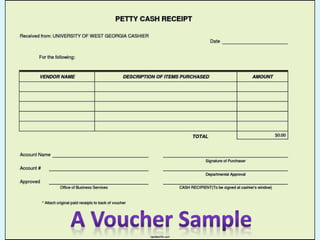
 Voucher is a written instrument, that
serves to confirm, or witness (vouch) for
a transaction. Commonly, a voucher is a
document, that shows goods have been
bought, or services have been given,
authorizes payment, and indicates the
ledger account(s), in which these
transactions will be recorded.
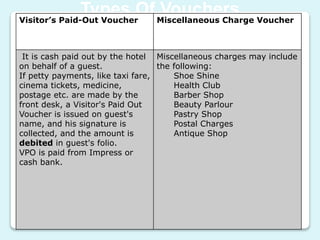
Types Of VouchersVisitor’s Paid-Out Voucher Miscellaneous Charge Voucher
It is cash paid out by the hotel
on behalf of a guest.
If petty payments, like taxi fare,
cinema tickets, medicine,
postage etc. are made by the
front desk, a Visitor's Paid Out
Voucher is issued on guest's
name, and his signature is
collected, and the amount is
debited in guest's folio.
VPO is paid from Impress or
cash bank.
Miscellaneous charges may include
the following:
Shoe Shine
Health Club
Barber Shop
Beauty Parlour
Pastry Shop
Postal Charges
Antique Shop
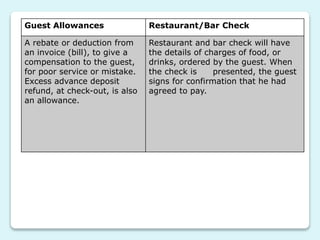
Guest Allowances Restaurant/Bar Check
A rebate or deduction from
an invoice (bill), to give a
compensation to the guest,
for poor service or mistake.
Excess advance deposit
refund, at check-out, is also
an allowance.
Restaurant and bar check will have
the details of charges of food, or
drinks, ordered by the guest. When
the check is presented, the guest
signs for confirmation that he had
agreed to pay.
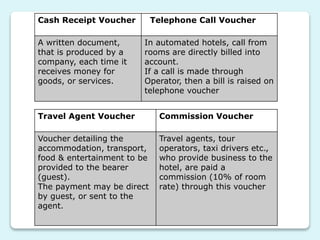
Cash Receipt Voucher TTelephone Call Voucher
A written document,
that is produced by a
company, each time it
receives money for
goods, or services.
In automated hotels, call from
rooms are directly billed into
account.
If a call is made through
Operator, then a bill is raised on
telephone voucher
Travel Agent Voucher Commission Voucher
Voucher detailing the
accommodation, transport,
food & entertainment to be
provided to the bearer
(guest).
The payment may be direct
by guest, or sent to the
agent.
Travel agents, tour
operators, taxi drivers etc.,
who provide business to the
hotel, are paid a
commission (10% of room
rate) through this voucher
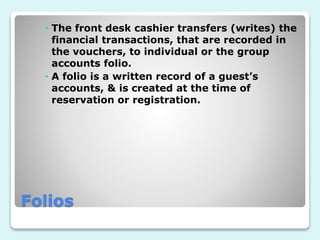
Folios
 The front desk cashier transfers (writes) the
financial transactions, that are recorded in
the vouchers, to individual or the group
accounts folio.
 A folio is a written record of a guest’s
accounts, & is created at the time of
reservation or registration.
 Guest Folio
These are accounts of individual person, of guest rooms, and
are also called, bill folio.
 Non Guest or City Folio
They are also called semi-permanent folio, and are the account
of non-guest business, or agencies, with hotel charge purchase
privileges (buy now, pay later).
 Master Folio
These are accounts of more than one person, or guestrooms,
and are usually maintained for groups.
 Employee Folio
They are the accounts of various employees with
charge purchase privilege, and not always
handled by front office. Some accounts are
directly handled by Accounts department. For
example, City folio, Credit card payment etc.
 Split Folio
Company sponsored guests, at times, request for
a split folio, one to record expenses to be paid by
the company, and the other, to be paid by the
guest personally and directly.The personal
expenses, like cigarette or drinks, are recorded
in Incidental Folio.
LEDGR
A ledger is a collection of the same type of
accounts. The front office ledger has a collection
of folios. There are normally two ledgers .
 Guest Ledger
 City Ledger
GUEST LEDGER
 A guest ledger contains the details, of all the
financial transactions, between all resident guests & a
hotel, including charge purchases & the payment
received from the guest. In a manual system , the
financial transaction are recorded in a tabular ledger, or
tab ledger, which is of two types:
 Horizontal Tabular Ledger
 Vertical Tabular Ledger
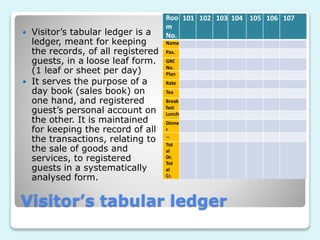
Visitor’s tabular ledger
 Visitor’s tabular ledger is a
ledger, meant for keeping
the records, of all registered
guests, in a loose leaf form.
(1 leaf or sheet per day)
 It serves the purpose of a
day book (sales book) on
one hand, and registered
guest’s personal account on
the other. It is maintained
for keeping the record of all
the transactions, relating to
the sale of goods and
services, to registered
guests in a systematically
analysed form.
Roo
m
No.
101 102 103 104 105 106 107
Name
Pax.
GRC
No.
Plan
Rate
Tea
Break
fast
Lunch
Dinne
r
…
Tot
al
Dr.
Tot
al
Cr.
City Ledger
A City Ledger contains the collective accounts of all
non-resident individuals & agencies, to whom hotel
extends charge privilege (credit purchase facility).It is
also known as Non-guest ledger.
 City Folio
 Bill-to-Company
 Disputed
 Late Charges
 Guaranteed Reservation Retention Charge
 Travel Agent Voucher
 Airline’s Meals & Accommodation Order & Passenger
Service Order
 Credit Card
 Skipper
 Walk-Out (left unintentionally)
 Bad or bounced Cheque
Cash Banks
◦ A cash bank is an amount of cash given to
a cashier, before the shift begins, in order
to tender exact change, in every
transaction.
◦ Only one person, who signs for it, has access
to the cash bank, and is solely responsible for
it. At the end of the shift the cash bank amount
is separated, and the remaining cash is put in
an envelope, and deposited with chief cashier.
Cash Bank: Shortage/ Overage &
Due Back
Cash Bank: Shortage & Overage
 Monetary differences between the money placed in
Front Office cash envelope, and cashier’s net cash
receipt, is noted on the envelope as overages (more),
shortages or due backs. Net cash receipt is the amount
of cash, cheques and other negotiable instruments in
the cashier’s drawer, minus, the initial cash bank, plus,
the paid-outs.
Due Back
 ccurs when a cashier pays out more than the amount received
as cash bank, and there is not enough cash in the drawer to
restore the initial bank. (Due Backs are also known as Due
Bank).When VPO is settled later, Due Back money is recovered
and returned.
Thanks and
regards
BHAVVESH JOSHI
ASSISTANT PROFESSOR
BHIKAJI CAMA COLLEGE OF HOTEL
MANAGEMENT
SWAMI VIVEKANAND SUBHARTI
UNIVERSITY

Front office accounting

  • 1.
  • 2.
    The Major Functionsof Front Office Accounting  Creation & maintenance of guest & non- guest accounts, timely, & accurately.  Tracking financial transactions (buy & Pay) of customers.  Monitoring the credit limit of guest. Preparing a high balance account report.  providing an efficient Management Information System (MIS).  Maintaining effective control over cash & credit transaction.
  • 3.
    Types Of Accounts Guest Accounts  Non-guest accounts
  • 4.
    Guest Account  Aguest account is the record of financial transactions between a resident guest & hotel. The front office creates, an individual folio (a/c) for each guest.  On the basis of guest folio, the final bill is prepared, and presented to the guest for payment.
  • 5.
    NON-GUEST ACCOUNTS  Anon-guest account is the record of the financial transactions, that take place between a non-resident guest & the hotel. This is also known as city account.  Non-Resident guests use services like restaurant, bar, salon, spa, swimming pool, club etc.
  • 6.
    Vouchers  Voucher isa written instrument, that serves to confirm, or witness (vouch) for a transaction. Commonly, a voucher is a document, that shows goods have been bought, or services have been given, authorizes payment, and indicates the ledger account(s), in which these transactions will be recorded.
  • 8.
    Types Of VouchersVisitor’sPaid-Out Voucher Miscellaneous Charge Voucher It is cash paid out by the hotel on behalf of a guest. If petty payments, like taxi fare, cinema tickets, medicine, postage etc. are made by the front desk, a Visitor's Paid Out Voucher is issued on guest's name, and his signature is collected, and the amount is debited in guest's folio. VPO is paid from Impress or cash bank. Miscellaneous charges may include the following: Shoe Shine Health Club Barber Shop Beauty Parlour Pastry Shop Postal Charges Antique Shop
  • 9.
    Guest Allowances Restaurant/BarCheck A rebate or deduction from an invoice (bill), to give a compensation to the guest, for poor service or mistake. Excess advance deposit refund, at check-out, is also an allowance. Restaurant and bar check will have the details of charges of food, or drinks, ordered by the guest. When the check is presented, the guest signs for confirmation that he had agreed to pay.
  • 10.
    Cash Receipt VoucherTTelephone Call Voucher A written document, that is produced by a company, each time it receives money for goods, or services. In automated hotels, call from rooms are directly billed into account. If a call is made through Operator, then a bill is raised on telephone voucher Travel Agent Voucher Commission Voucher Voucher detailing the accommodation, transport, food & entertainment to be provided to the bearer (guest). The payment may be direct by guest, or sent to the agent. Travel agents, tour operators, taxi drivers etc., who provide business to the hotel, are paid a commission (10% of room rate) through this voucher
  • 11.
    Folios  The frontdesk cashier transfers (writes) the financial transactions, that are recorded in the vouchers, to individual or the group accounts folio.  A folio is a written record of a guest’s accounts, & is created at the time of reservation or registration.
  • 12.
     Guest Folio Theseare accounts of individual person, of guest rooms, and are also called, bill folio.  Non Guest or City Folio They are also called semi-permanent folio, and are the account of non-guest business, or agencies, with hotel charge purchase privileges (buy now, pay later).  Master Folio These are accounts of more than one person, or guestrooms, and are usually maintained for groups.
  • 13.
     Employee Folio Theyare the accounts of various employees with charge purchase privilege, and not always handled by front office. Some accounts are directly handled by Accounts department. For example, City folio, Credit card payment etc.  Split Folio Company sponsored guests, at times, request for a split folio, one to record expenses to be paid by the company, and the other, to be paid by the guest personally and directly.The personal expenses, like cigarette or drinks, are recorded in Incidental Folio.
  • 14.
    LEDGR A ledger isa collection of the same type of accounts. The front office ledger has a collection of folios. There are normally two ledgers .  Guest Ledger  City Ledger
  • 15.
    GUEST LEDGER  Aguest ledger contains the details, of all the financial transactions, between all resident guests & a hotel, including charge purchases & the payment received from the guest. In a manual system , the financial transaction are recorded in a tabular ledger, or tab ledger, which is of two types:  Horizontal Tabular Ledger  Vertical Tabular Ledger
  • 16.
    Visitor’s tabular ledger Visitor’s tabular ledger is a ledger, meant for keeping the records, of all registered guests, in a loose leaf form. (1 leaf or sheet per day)  It serves the purpose of a day book (sales book) on one hand, and registered guest’s personal account on the other. It is maintained for keeping the record of all the transactions, relating to the sale of goods and services, to registered guests in a systematically analysed form. Roo m No. 101 102 103 104 105 106 107 Name Pax. GRC No. Plan Rate Tea Break fast Lunch Dinne r … Tot al Dr. Tot al Cr.
  • 17.
    City Ledger A CityLedger contains the collective accounts of all non-resident individuals & agencies, to whom hotel extends charge privilege (credit purchase facility).It is also known as Non-guest ledger.  City Folio  Bill-to-Company  Disputed  Late Charges  Guaranteed Reservation Retention Charge  Travel Agent Voucher  Airline’s Meals & Accommodation Order & Passenger Service Order  Credit Card  Skipper  Walk-Out (left unintentionally)  Bad or bounced Cheque
  • 18.
    Cash Banks ◦ Acash bank is an amount of cash given to a cashier, before the shift begins, in order to tender exact change, in every transaction. ◦ Only one person, who signs for it, has access to the cash bank, and is solely responsible for it. At the end of the shift the cash bank amount is separated, and the remaining cash is put in an envelope, and deposited with chief cashier.
  • 19.
    Cash Bank: Shortage/Overage & Due Back Cash Bank: Shortage & Overage  Monetary differences between the money placed in Front Office cash envelope, and cashier’s net cash receipt, is noted on the envelope as overages (more), shortages or due backs. Net cash receipt is the amount of cash, cheques and other negotiable instruments in the cashier’s drawer, minus, the initial cash bank, plus, the paid-outs. Due Back  ccurs when a cashier pays out more than the amount received as cash bank, and there is not enough cash in the drawer to restore the initial bank. (Due Backs are also known as Due Bank).When VPO is settled later, Due Back money is recovered and returned.
  • 20.
    Thanks and regards BHAVVESH JOSHI ASSISTANTPROFESSOR BHIKAJI CAMA COLLEGE OF HOTEL MANAGEMENT SWAMI VIVEKANAND SUBHARTI UNIVERSITY