TEEXChapter 4 — Safety and Aircraft Hazards
Chapter 4 Lesson GoalAfter completing this lesson, the student shall be able to recognize safety and aircraft hazards and explain appropriate actions to take to avoid those hazards.
Objectives	1.	Discuss personal protective equipment.	2.	Recognize the importance of firefighter safety.	3.	Explain hazards associated with aircraft rescue and fire fighting.(Continued)
Objectives	4.	Describe hazards associated with aircraft cargo.	5. Discuss military aircraft hazards.	6.	Discuss the occurrence of terrorist incidents at airports.
Personal Protective Clothing and EquipmentProtective clothing Provides various types of protectionMust fit properlyProtective equipment  Serves various functionsMust be used properly
Personal Protective ClothingWear full protective clothing ensemble and SCBA during operationsProximity suits — may be worn depending upon fire conditions
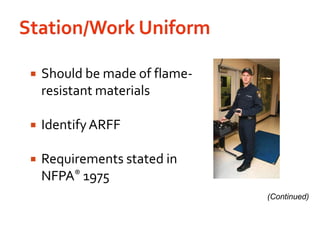
Station/Work UniformShould be made of flame-resistant materialsIdentify ARFFRequirements stated in NFPA® 1975(Continued)
Station/Work UniformIntended for use under full protective clothingNot intended to be used by themselves as protective clothing
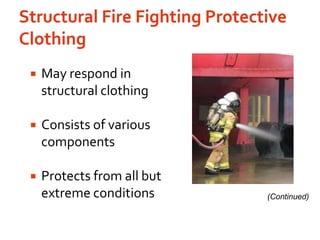
Structural Fire Fighting Protective ClothingMay respond in structural clothingConsists of various componentsProtects from all but extreme conditions(Continued)
Structural Fire Fighting Protective ClothingLimited in some applicationsProximity suits — recommended for aircraft fire fighting by NFPA®1500Has both positive characteristics and limited abilitiesRequirements stated in NFPA® 1971
Chemical Protective ClothingAircraft accidents may contain hazardous materialsNot all ARFF firefighters specialize in haz-mat operationsRequirements stated in NFPA® 472
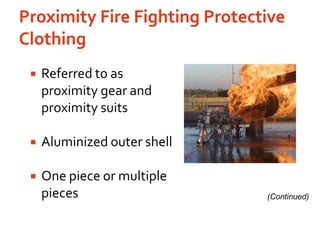
Proximity Fire Fighting Protective ClothingReferred to as proximity gear and proximity suitsAluminized outer shellOne piece or multiple pieces(Continued)
Proximity Fire Fighting Protective ClothingHas unique characteristics Don’t confuse with fire entry suitsMust wear SCBA with both proximity clothing and fire entry suitsRequirements stated in NFPA® 1971
Self-contained Breathing Apparatus (SCBA)Respiratory protection standards require protectionRespiratory protection program and fire departmentsAdoptMaintain(Continued)
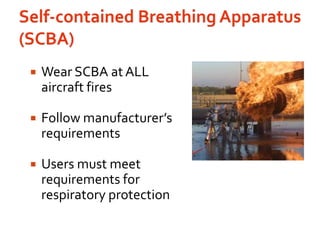
Self-contained Breathing Apparatus (SCBA)Wear SCBA at ALL aircraft firesFollow manufacturer’s requirementsUsers must meet requirements for respiratory protection
Personal Alert Safety Systems (PASS)Must wear a PASS device in hazardous atmospheresStandards are found in NFPA®1982Alarm sounds when wearer is incapacitated(Continued)
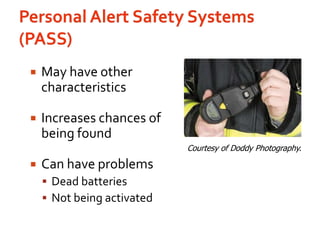
Personal Alert Safety Systems (PASS)May have other characteristicsIncreases chances of being foundCan have problemsDead batteriesNot being activatedCourtesy of Doddy Photography.
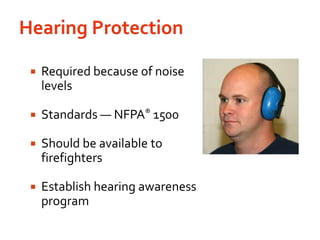
Hearing ProtectionRequired because of noise levelsStandards — NFPA®1500Should be available to firefightersEstablish hearing awareness program
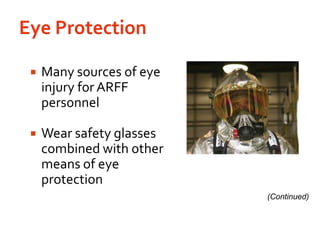
Eye ProtectionMany sources of eye injury for ARFF personnelWear safety glasses combined with other means of eye protection(Continued)
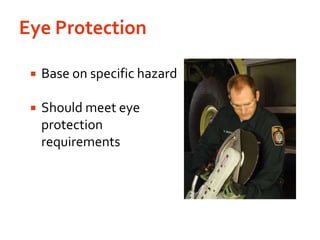
Eye ProtectionBase on specific hazardShould meet eye protection requirements
Firefighter SafetyAccidents — number ONE cause of injuriesPractice safety at all times
Fire Station SafetyPractice good housekeepingKeep floors and walking surfaces clean, dry, and clear of clutterEnsure exit areas are lighted and free of obstructionsStore all hazardous materials properly(Continued)
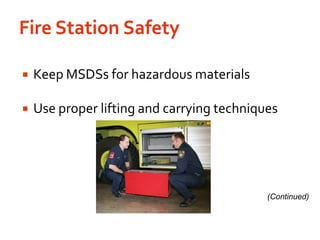
Fire Station SafetyKeep MSDSs for hazardous materialsUse proper lifting and carrying techniques(Continued)
Fire Station SafetyFollow and post tool and equipment safety rulesPlace portable heaters out of travel routes/away from combustiblesUse only portable heaters that deactivate if knocked over
Emergency ResponseBe properly dressed and buckled prior to departingDo NOT attempt to don protective clothing enrouteSecure loose items in cab(Continued)
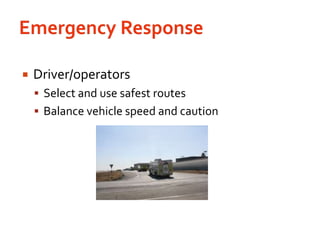
Emergency ResponseDriver/operators Select and use safest routesBalance vehicle speed and caution
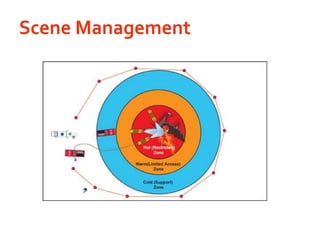
Scene ManagementSecure scene perimeter and limit entryEstablish operating zonesHot zoneWarm zoneCold zoneSmaller incidents — cordoned area(Continued)
Scene Management
Personnel AccountabilitySystem of accountability must track all personnelTwo-in/two-out policyAll interior fire fighting operationsRequired by both OSHA and NFPA®Become familiar with aircraft
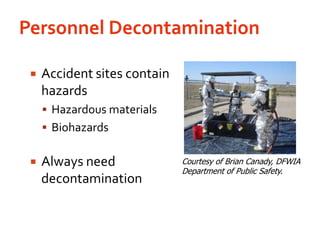
Personnel DecontaminationAccident sites contain hazardsHazardous materialsBiohazardsAlways need decontaminationCourtesy of Brian Canady, DFWIA Department of Public Safety.
Critical Incident Stress Management (CISM)Aircraft incidents can be more stressfulHazardous conditionsLarge number of injuries/fatalitiesAHJ teams assist in debriefingKnow when to ask for help
Critical Incident Stress Debriefing (CISD)Peer-group or professional interaction immediately after incidentShould begin as soon as fires extinguished at major fatality incidentsParticipation should NOT be optional(Continued)
Critical Incident Stress Debriefing (CISD)Process should sometimes start before firefighters enter sceneDefusing — done at end of shifts of major operationsParticipate in a full debriefing within 72 hours
Aircraft Fire Fighting HazardsAccidents should be treated as potential hazardous materials incidentsMilitary incidents involve hazardous materialsEnormous quantities of fuel(Continued)
Aircraft Fire Fighting HazardsUse proper PPE and decontaminateOther hazards in accidentsAgricultural sprayingMaintenance facilitiesHazardous cargo
Hazardous Conditions at the Emergency SceneWreckage of the aircraftConfined space hazardsHeat stressFuel hazards
Hazardous Aircraft Components and Materials Jet fuelLanding gearEnergized electrical linesHydraulic and pneumatic linesOxygen systems(Continued)
Hazardous Aircraft Components and Materials Composite fibersBiohazardsPitot tubesAir bags
Engine Hazards Reciprocating engine hazards — can restart if propeller is moved(Continued)
Engine Hazards WARNING! Even if a propeller has stopped, do not move it under any conditions. Piston engines that have recently stopped can sometimes cycle, violently rotate, or restart if the propeller is moved.(Continued)
Engine Hazards Jet engine hazards — pose serious threat to personnelView slides
Helicopter Hazards Approach with cautionRotors present greatest hazardPilot must signal safe for approachNever approach from rear(Continued)
Helicopter Hazards Approach and leave helicopterIn a crouched positionIn view of pilotCarry all equipment and toolsHorizontallyBelow the waist(Continued)
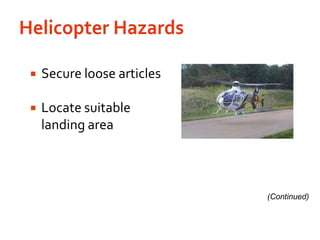
Helicopter Hazards Secure loose articlesLocate suitable landing area(Continued)
Helicopter Hazards WARNING! Firefighters should wear eye protection, hearing protection, coat or jacket, bright colored or reflective clothes, and helmets ANY TIME they are around helicopters with running engines, regardless of circumstances.
Ballistic Recovery Systems (BRS) Used in general aviation aircraft, ultra-lights, and experimental aircraftDesigned to rapidly deploy a parachute that stabilizes aircraftSave lives but also present hazard to ARFF personnel(Continued)
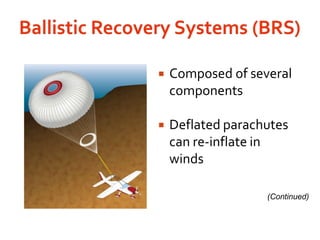
Ballistic Recovery Systems (BRS) Composed of several componentsDeflated parachutes can re-inflate in winds(Continued)
Ballistic Recovery Systems (BRS) WARNING! Ballistic recovery parachutes can be fired vertically or horizontally and are not always readily visible on the aircraft or location from where they are fired. Do not use ordinary bolt cutters or side cutters to cut the activation housing.
Air Cargo TransportTransport of cargoLarge companiesCommercial flightsCargoOften harmlessAlso frequently classified as hazardous or dangerous(Continued)
Air Cargo TransportAny aircraft crash could be considered to involve dangerous goodsUse proper procedures to protect from effects of dangerous goods
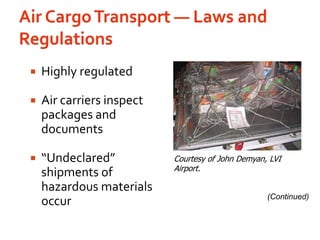
Air Cargo Transport — Laws and RegulationsHighly regulatedAir carriers inspect packages and documents“Undeclared” shipments of hazardous materials occurCourtesy of John Demyan, LVI Airport.(Continued)
Air Cargo Transport — Laws and RegulationsHazardous materials may be involved in any crashCFR Title 14 Part 139 requires training
Classification of Dangerous GoodsClass 1 — ExplosivesClass 2 — GasesClass 3 — Flammable liquidsClass 4 — Flammable solidsClass 5 — Oxidizing substances(Continued)
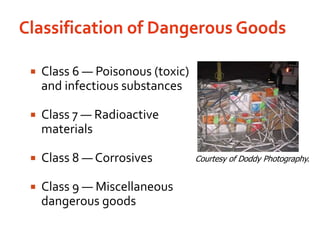
Classification of Dangerous GoodsClass 6 — Poisonous (toxic) and infectious substancesClass 7 — Radioactive materialsClass 8 — CorrosivesClass 9 — Miscellaneous dangerous goodsCourtesy of Doddy Photography.
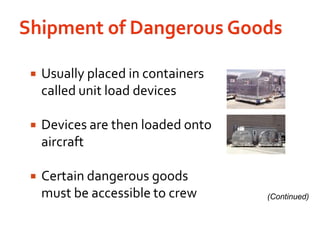
Shipment of Dangerous GoodsUsually placed in containers called unit load devicesDevices are then loaded onto aircraftCertain dangerous goods must be accessible to crew(Continued)
Shipment of Dangerous GoodsUndeclared dangerous cargo may be encountered in various forms
Product IdentificationMay be difficult in air transport situationsSeveral means of identifying dangerous goodsDocumentation varies with carrier(Continued)
Product IdentificationShipper responsible for identificationFederal law requires “pilot in command” be provided with shipping papers
VerificationMultiple sourcesErrors can be criticalUse at least three sources
Information GatheringProduct must be researched to determine hazardsHelps develop mitigation planConsult at least three sources
Personal Protective EquipmentBe familiar with PPE usedAHJ ensures NFPA® 1500 complianceSelect PPE based on several factorsSOPsNature of incidentResources available(Continued)
Personal Protective EquipmentPersonnel should NOT be assigned tasks for which they	Do not have adequate trainingDo not have adequate PPEARFF role may be limited in situations involving unknown materials
Dangerous Goods OperationsFirst responsibility of units responding to dangerous goods incidentsIsolate the sceneDeny entry(Continued)
Dangerous Goods OperationsPersonnel should Secure the areaEstablish control zonesExclude nonessential personnel(Continued)
Dangerous Goods OperationsARFF personnel trained as technicians or specialists on hazmat operations should NOT be engaged inRescuesBody recoveries
Lavatory Waste SpillsWaste tanks have a wide range of capacitySpills may occur in various areasAircraft rampEnroute to disposal
Agricultural ApplicationChemicals range from relatively innocuous fertilizers to highly toxic pesticidesApplied with fixed-wing or rotary-wing aircraft(Continued)
Agricultural ApplicationUsually have support vehiclesMust be applied at low altitudesOften fly close to obstructionsCrash sites difficult to reachNo indication of what is being carried(Continued)
Agricultural ApplicationPerform work upwindWear proper protectionDecontaminate victims, personnel, and equipmentContain runoff(Continued)
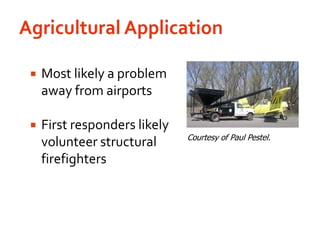
Agricultural ApplicationMost likely a problem away from airportsFirst responders likely volunteer structural firefightersCourtesy of Paul Pestel.
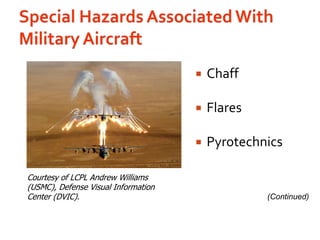
Special Hazards Associated With Military AircraftChaffFlaresPyrotechnicsCourtesy of LCPL Andrew Williams (USMC), Defense Visual Information Center (DVIC).(Continued)
Special Hazards Associated With Military AircraftJet assisted take-off (JATO) systemsIncreased fuel capacityComposite wings and body
Emergency Ejection SystemsAccidentally activating ejection seats and canopies may be extremely dangerousPersonnel must know how to safely secure or avoidNEVER jettison indoors
Ejection SeatsRocket- or gas-poweredFired in different mannersCrew members fire seatsOpening a hatch could cause seat to fire(Continued)
Ejection SeatsCivilian ARFF personnel should not attempt to disarm systemMilitary personnel must be contacted to disarm systems(Continued)
Ejection SeatsWARNING! Safetying an ejection system is a hazardous operation. Rescue personnel should not attempt to safety an ejection system if they do not have the proper training and equipment necessary for the specific model of aircraft.
CanopiesCanopy — encloses the cockpitDesigned to protect the pilot and crewThree main typesClamshellSlidingHinged(Continued)
CanopiesClamshell and sliding — most commonSliding — easier to operate during rescuesActuated in various ways(Continued)
CanopiesSome are disintegrated with explosives built into the shell or along frameMost have an external means of jettisoningShould be jettisoned only if absolutely necessary
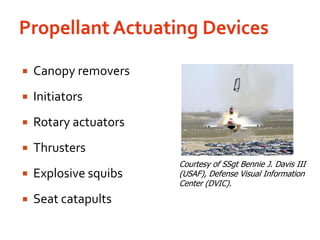
Propellant Actuating DevicesCanopy removersInitiatorsRotary actuatorsThrustersExplosive squibsSeat catapultsCourtesy of SSgt Bennie J. Davis III (USAF), Defense Visual Information Center (DVIC).
Other Emergency SystemsEmergency power unit (EPU)Fire protection/detection systemsEmergency doors/hatches
Military Weapons and Weapon SystemsCarry a broad range of weapons and explosivesUnless external may not know if weapons are on boardPrimary effort in a fire Quick knockdown of fireCooling of munitions(Continued)
Military Weapons and Weapon SystemsIn a fire, weapon or explosive may detonate within 45 seconds to 4 or 5 minutes(Continued)
Military Weapons and Weapon SystemsWARNING! Do not attempt to fight a fire in which a weapon is involved if it is not possible to extinguish the fire quickly. Because of the likelihood of detonation, all firefighters should withdraw at least 2,000 feet (600 m). If a rescue is in progress, continue to apply water in copious amounts until rescue is complete.
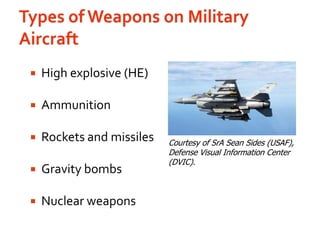
Types of Weapons on Military AircraftHigh explosive (HE)AmmunitionRockets and missilesGravity bombsNuclear weaponsCourtesy of SrA Sean Sides (USAF), Defense Visual Information Center (DVIC).
Terrorist IncidentsAirports are prime targets for terrorist acts involving CBRNE weapons of mass destructionNeed to be trained and prepared to respond
Indications of Terrorist IncidentExplosions that disperse liquids, mists, vapors, or gasExplosions that only destroy a package or bomb deviceUnscheduled and unusual dissemination of aerosol sprays(Continued)
Indications of Terrorist IncidentAbandoned spray devices or unexplained odorsMass casualties without obvious cause or trauma(Continued)
Indications of Terrorist IncidentDefinite pattern of casualties and common symptoms Civilian panic in a high-profile target area
Signs and Symptoms of AgentsNuclear and biological agents — appear hours to days after incidentChemical agents — rapid onset of symptoms in minutes or hours; easily observed indicators
Types of Chemical AgentsBlister agentsBlood agentsChoking agentsNerve agents
ARFF ResponsibilitiesProvide detailed report on conditionsFollow procedures outlined in local emergency response plans
SummaryTo be able to perform their jobs safely, airport firefighters should be trained in the types and uses of personal protective equipment. (Continued)
SummaryFirefighters should be thoroughly familiar with firefighter safety while at the fire station, responding to, and at the scene of an emergency.(Continued)
SummaryARFF personnel should be well versed in the general hazards associated with ARFF and the specific hazards aircraft pose to the airport firefighters.(Continued)
SummaryARFF personnel should have working knowledge of military aircraft hazards. Finally, airport firefighters should be able to identify and respond to terrorist incidents.
Review Questions	1.	When does wicking occur?	2.	Who should be allowed into the hot zone?	3.	When should critical incident stress debriefing (CISD) begin?	4.	How might the instability of wreckage affect normally ordinary tasks? (Continued)
Review Questions	5.	When is it acceptable to approach a helicopter from the rear?	6.	What is the purpose of a ballistic recovery system (BRS)?	7.	What are unit load devices?(Continued)
Review Questions	 8.	What is the first responsibility of units responding to dangerous goods incidents?	9.	How do flares work on military aircraft as countermeasures to heat seeking missiles?	10.	What are explosive squibs?

Chapter 04

  • 1.
    TEEXChapter 4 —Safety and Aircraft Hazards
  • 2.
    Chapter 4 LessonGoalAfter completing this lesson, the student shall be able to recognize safety and aircraft hazards and explain appropriate actions to take to avoid those hazards.
  • 3.
    Objectives 1. Discuss personal protectiveequipment. 2. Recognize the importance of firefighter safety. 3. Explain hazards associated with aircraft rescue and fire fighting.(Continued)
  • 4.
    Objectives 4. Describe hazards associatedwith aircraft cargo. 5. Discuss military aircraft hazards. 6. Discuss the occurrence of terrorist incidents at airports.
  • 5.
    Personal Protective Clothingand EquipmentProtective clothing Provides various types of protectionMust fit properlyProtective equipment Serves various functionsMust be used properly
  • 6.
    Personal Protective ClothingWearfull protective clothing ensemble and SCBA during operationsProximity suits — may be worn depending upon fire conditions
  • 7.
    Station/Work UniformShould bemade of flame-resistant materialsIdentify ARFFRequirements stated in NFPA® 1975(Continued)
  • 8.
    Station/Work UniformIntended foruse under full protective clothingNot intended to be used by themselves as protective clothing
  • 9.
    Structural Fire FightingProtective ClothingMay respond in structural clothingConsists of various componentsProtects from all but extreme conditions(Continued)
  • 10.
    Structural Fire FightingProtective ClothingLimited in some applicationsProximity suits — recommended for aircraft fire fighting by NFPA®1500Has both positive characteristics and limited abilitiesRequirements stated in NFPA® 1971
  • 11.
    Chemical Protective ClothingAircraftaccidents may contain hazardous materialsNot all ARFF firefighters specialize in haz-mat operationsRequirements stated in NFPA® 472
  • 12.
    Proximity Fire FightingProtective ClothingReferred to as proximity gear and proximity suitsAluminized outer shellOne piece or multiple pieces(Continued)
  • 13.
    Proximity Fire FightingProtective ClothingHas unique characteristics Don’t confuse with fire entry suitsMust wear SCBA with both proximity clothing and fire entry suitsRequirements stated in NFPA® 1971
  • 14.
    Self-contained Breathing Apparatus(SCBA)Respiratory protection standards require protectionRespiratory protection program and fire departmentsAdoptMaintain(Continued)
  • 15.
    Self-contained Breathing Apparatus(SCBA)Wear SCBA at ALL aircraft firesFollow manufacturer’s requirementsUsers must meet requirements for respiratory protection
  • 16.
    Personal Alert SafetySystems (PASS)Must wear a PASS device in hazardous atmospheresStandards are found in NFPA®1982Alarm sounds when wearer is incapacitated(Continued)
  • 17.
    Personal Alert SafetySystems (PASS)May have other characteristicsIncreases chances of being foundCan have problemsDead batteriesNot being activatedCourtesy of Doddy Photography.
  • 18.
    Hearing ProtectionRequired becauseof noise levelsStandards — NFPA®1500Should be available to firefightersEstablish hearing awareness program
  • 19.
    Eye ProtectionMany sourcesof eye injury for ARFF personnelWear safety glasses combined with other means of eye protection(Continued)
  • 20.
    Eye ProtectionBase onspecific hazardShould meet eye protection requirements
  • 21.
    Firefighter SafetyAccidents —number ONE cause of injuriesPractice safety at all times
  • 22.
    Fire Station SafetyPracticegood housekeepingKeep floors and walking surfaces clean, dry, and clear of clutterEnsure exit areas are lighted and free of obstructionsStore all hazardous materials properly(Continued)
  • 23.
    Fire Station SafetyKeepMSDSs for hazardous materialsUse proper lifting and carrying techniques(Continued)
  • 24.
    Fire Station SafetyFollowand post tool and equipment safety rulesPlace portable heaters out of travel routes/away from combustiblesUse only portable heaters that deactivate if knocked over
  • 25.
    Emergency ResponseBe properlydressed and buckled prior to departingDo NOT attempt to don protective clothing enrouteSecure loose items in cab(Continued)
  • 26.
    Emergency ResponseDriver/operators Selectand use safest routesBalance vehicle speed and caution
  • 27.
    Scene ManagementSecure sceneperimeter and limit entryEstablish operating zonesHot zoneWarm zoneCold zoneSmaller incidents — cordoned area(Continued)
  • 28.
  • 29.
    Personnel AccountabilitySystem ofaccountability must track all personnelTwo-in/two-out policyAll interior fire fighting operationsRequired by both OSHA and NFPA®Become familiar with aircraft
  • 30.
    Personnel DecontaminationAccident sitescontain hazardsHazardous materialsBiohazardsAlways need decontaminationCourtesy of Brian Canady, DFWIA Department of Public Safety.
  • 31.
    Critical Incident StressManagement (CISM)Aircraft incidents can be more stressfulHazardous conditionsLarge number of injuries/fatalitiesAHJ teams assist in debriefingKnow when to ask for help
  • 32.
    Critical Incident StressDebriefing (CISD)Peer-group or professional interaction immediately after incidentShould begin as soon as fires extinguished at major fatality incidentsParticipation should NOT be optional(Continued)
  • 33.
    Critical Incident StressDebriefing (CISD)Process should sometimes start before firefighters enter sceneDefusing — done at end of shifts of major operationsParticipate in a full debriefing within 72 hours
  • 34.
    Aircraft Fire FightingHazardsAccidents should be treated as potential hazardous materials incidentsMilitary incidents involve hazardous materialsEnormous quantities of fuel(Continued)
  • 35.
    Aircraft Fire FightingHazardsUse proper PPE and decontaminateOther hazards in accidentsAgricultural sprayingMaintenance facilitiesHazardous cargo
  • 36.
    Hazardous Conditions atthe Emergency SceneWreckage of the aircraftConfined space hazardsHeat stressFuel hazards
  • 37.
    Hazardous Aircraft Componentsand Materials Jet fuelLanding gearEnergized electrical linesHydraulic and pneumatic linesOxygen systems(Continued)
  • 38.
    Hazardous Aircraft Componentsand Materials Composite fibersBiohazardsPitot tubesAir bags
  • 39.
    Engine Hazards Reciprocatingengine hazards — can restart if propeller is moved(Continued)
  • 40.
    Engine Hazards WARNING!Even if a propeller has stopped, do not move it under any conditions. Piston engines that have recently stopped can sometimes cycle, violently rotate, or restart if the propeller is moved.(Continued)
  • 41.
    Engine Hazards Jetengine hazards — pose serious threat to personnelView slides
  • 42.
    Helicopter Hazards Approachwith cautionRotors present greatest hazardPilot must signal safe for approachNever approach from rear(Continued)
  • 43.
    Helicopter Hazards Approachand leave helicopterIn a crouched positionIn view of pilotCarry all equipment and toolsHorizontallyBelow the waist(Continued)
  • 44.
    Helicopter Hazards Secureloose articlesLocate suitable landing area(Continued)
  • 45.
    Helicopter Hazards WARNING!Firefighters should wear eye protection, hearing protection, coat or jacket, bright colored or reflective clothes, and helmets ANY TIME they are around helicopters with running engines, regardless of circumstances.
  • 46.
    Ballistic Recovery Systems(BRS) Used in general aviation aircraft, ultra-lights, and experimental aircraftDesigned to rapidly deploy a parachute that stabilizes aircraftSave lives but also present hazard to ARFF personnel(Continued)
  • 47.
    Ballistic Recovery Systems(BRS) Composed of several componentsDeflated parachutes can re-inflate in winds(Continued)
  • 48.
    Ballistic Recovery Systems(BRS) WARNING! Ballistic recovery parachutes can be fired vertically or horizontally and are not always readily visible on the aircraft or location from where they are fired. Do not use ordinary bolt cutters or side cutters to cut the activation housing.
  • 49.
    Air Cargo TransportTransportof cargoLarge companiesCommercial flightsCargoOften harmlessAlso frequently classified as hazardous or dangerous(Continued)
  • 50.
    Air Cargo TransportAnyaircraft crash could be considered to involve dangerous goodsUse proper procedures to protect from effects of dangerous goods
  • 51.
    Air Cargo Transport— Laws and RegulationsHighly regulatedAir carriers inspect packages and documents“Undeclared” shipments of hazardous materials occurCourtesy of John Demyan, LVI Airport.(Continued)
  • 52.
    Air Cargo Transport— Laws and RegulationsHazardous materials may be involved in any crashCFR Title 14 Part 139 requires training
  • 53.
    Classification of DangerousGoodsClass 1 — ExplosivesClass 2 — GasesClass 3 — Flammable liquidsClass 4 — Flammable solidsClass 5 — Oxidizing substances(Continued)
  • 54.
    Classification of DangerousGoodsClass 6 — Poisonous (toxic) and infectious substancesClass 7 — Radioactive materialsClass 8 — CorrosivesClass 9 — Miscellaneous dangerous goodsCourtesy of Doddy Photography.
  • 55.
    Shipment of DangerousGoodsUsually placed in containers called unit load devicesDevices are then loaded onto aircraftCertain dangerous goods must be accessible to crew(Continued)
  • 56.
    Shipment of DangerousGoodsUndeclared dangerous cargo may be encountered in various forms
  • 57.
    Product IdentificationMay bedifficult in air transport situationsSeveral means of identifying dangerous goodsDocumentation varies with carrier(Continued)
  • 58.
    Product IdentificationShipper responsiblefor identificationFederal law requires “pilot in command” be provided with shipping papers
  • 59.
    VerificationMultiple sourcesErrors canbe criticalUse at least three sources
  • 60.
    Information GatheringProduct mustbe researched to determine hazardsHelps develop mitigation planConsult at least three sources
  • 61.
    Personal Protective EquipmentBefamiliar with PPE usedAHJ ensures NFPA® 1500 complianceSelect PPE based on several factorsSOPsNature of incidentResources available(Continued)
  • 62.
    Personal Protective EquipmentPersonnelshould NOT be assigned tasks for which they Do not have adequate trainingDo not have adequate PPEARFF role may be limited in situations involving unknown materials
  • 63.
    Dangerous Goods OperationsFirstresponsibility of units responding to dangerous goods incidentsIsolate the sceneDeny entry(Continued)
  • 64.
    Dangerous Goods OperationsPersonnelshould Secure the areaEstablish control zonesExclude nonessential personnel(Continued)
  • 65.
    Dangerous Goods OperationsARFFpersonnel trained as technicians or specialists on hazmat operations should NOT be engaged inRescuesBody recoveries
  • 66.
    Lavatory Waste SpillsWastetanks have a wide range of capacitySpills may occur in various areasAircraft rampEnroute to disposal
  • 67.
    Agricultural ApplicationChemicals rangefrom relatively innocuous fertilizers to highly toxic pesticidesApplied with fixed-wing or rotary-wing aircraft(Continued)
  • 68.
    Agricultural ApplicationUsually havesupport vehiclesMust be applied at low altitudesOften fly close to obstructionsCrash sites difficult to reachNo indication of what is being carried(Continued)
  • 69.
    Agricultural ApplicationPerform workupwindWear proper protectionDecontaminate victims, personnel, and equipmentContain runoff(Continued)
  • 70.
    Agricultural ApplicationMost likelya problem away from airportsFirst responders likely volunteer structural firefightersCourtesy of Paul Pestel.
  • 71.
    Special Hazards AssociatedWith Military AircraftChaffFlaresPyrotechnicsCourtesy of LCPL Andrew Williams (USMC), Defense Visual Information Center (DVIC).(Continued)
  • 72.
    Special Hazards AssociatedWith Military AircraftJet assisted take-off (JATO) systemsIncreased fuel capacityComposite wings and body
  • 73.
    Emergency Ejection SystemsAccidentallyactivating ejection seats and canopies may be extremely dangerousPersonnel must know how to safely secure or avoidNEVER jettison indoors
  • 74.
    Ejection SeatsRocket- orgas-poweredFired in different mannersCrew members fire seatsOpening a hatch could cause seat to fire(Continued)
  • 75.
    Ejection SeatsCivilian ARFFpersonnel should not attempt to disarm systemMilitary personnel must be contacted to disarm systems(Continued)
  • 76.
    Ejection SeatsWARNING! Safetyingan ejection system is a hazardous operation. Rescue personnel should not attempt to safety an ejection system if they do not have the proper training and equipment necessary for the specific model of aircraft.
  • 77.
    CanopiesCanopy — enclosesthe cockpitDesigned to protect the pilot and crewThree main typesClamshellSlidingHinged(Continued)
  • 78.
    CanopiesClamshell and sliding— most commonSliding — easier to operate during rescuesActuated in various ways(Continued)
  • 79.
    CanopiesSome are disintegratedwith explosives built into the shell or along frameMost have an external means of jettisoningShould be jettisoned only if absolutely necessary
  • 80.
    Propellant Actuating DevicesCanopyremoversInitiatorsRotary actuatorsThrustersExplosive squibsSeat catapultsCourtesy of SSgt Bennie J. Davis III (USAF), Defense Visual Information Center (DVIC).
  • 81.
    Other Emergency SystemsEmergencypower unit (EPU)Fire protection/detection systemsEmergency doors/hatches
  • 82.
    Military Weapons andWeapon SystemsCarry a broad range of weapons and explosivesUnless external may not know if weapons are on boardPrimary effort in a fire Quick knockdown of fireCooling of munitions(Continued)
  • 83.
    Military Weapons andWeapon SystemsIn a fire, weapon or explosive may detonate within 45 seconds to 4 or 5 minutes(Continued)
  • 84.
    Military Weapons andWeapon SystemsWARNING! Do not attempt to fight a fire in which a weapon is involved if it is not possible to extinguish the fire quickly. Because of the likelihood of detonation, all firefighters should withdraw at least 2,000 feet (600 m). If a rescue is in progress, continue to apply water in copious amounts until rescue is complete.
  • 85.
    Types of Weaponson Military AircraftHigh explosive (HE)AmmunitionRockets and missilesGravity bombsNuclear weaponsCourtesy of SrA Sean Sides (USAF), Defense Visual Information Center (DVIC).
  • 86.
    Terrorist IncidentsAirports areprime targets for terrorist acts involving CBRNE weapons of mass destructionNeed to be trained and prepared to respond
  • 87.
    Indications of TerroristIncidentExplosions that disperse liquids, mists, vapors, or gasExplosions that only destroy a package or bomb deviceUnscheduled and unusual dissemination of aerosol sprays(Continued)
  • 88.
    Indications of TerroristIncidentAbandoned spray devices or unexplained odorsMass casualties without obvious cause or trauma(Continued)
  • 89.
    Indications of TerroristIncidentDefinite pattern of casualties and common symptoms Civilian panic in a high-profile target area
  • 90.
    Signs and Symptomsof AgentsNuclear and biological agents — appear hours to days after incidentChemical agents — rapid onset of symptoms in minutes or hours; easily observed indicators
  • 91.
    Types of ChemicalAgentsBlister agentsBlood agentsChoking agentsNerve agents
  • 92.
    ARFF ResponsibilitiesProvide detailedreport on conditionsFollow procedures outlined in local emergency response plans
  • 93.
    SummaryTo be ableto perform their jobs safely, airport firefighters should be trained in the types and uses of personal protective equipment. (Continued)
  • 94.
    SummaryFirefighters should bethoroughly familiar with firefighter safety while at the fire station, responding to, and at the scene of an emergency.(Continued)
  • 95.
    SummaryARFF personnel shouldbe well versed in the general hazards associated with ARFF and the specific hazards aircraft pose to the airport firefighters.(Continued)
  • 96.
    SummaryARFF personnel shouldhave working knowledge of military aircraft hazards. Finally, airport firefighters should be able to identify and respond to terrorist incidents.
  • 97.
    Review Questions 1. When doeswicking occur? 2. Who should be allowed into the hot zone? 3. When should critical incident stress debriefing (CISD) begin? 4. How might the instability of wreckage affect normally ordinary tasks? (Continued)
  • 98.
    Review Questions 5. When isit acceptable to approach a helicopter from the rear? 6. What is the purpose of a ballistic recovery system (BRS)? 7. What are unit load devices?(Continued)
  • 99.
    Review Questions 8. Whatis the first responsibility of units responding to dangerous goods incidents? 9. How do flares work on military aircraft as countermeasures to heat seeking missiles? 10. What are explosive squibs?