Aircraft Rescue and Fire
Fighting,
5th
Edition
Chapter 5 — Fire and Rescue
Communications
ARFF
5–2
Chapter 5 Lesson Goal
• After completing this lesson, the student
shall be able to recall basic information
about fire and rescue communications
including systems, procedures,
terminology, and signals used in
aviation.
ARFF
5–3
Objectives
1. Describe basic airport
communication systems.
2. Discuss pilot/ARFF Command
communications.
3. Describe proper radio and
telephone communication
procedures.
(Continued)
ARFF
5–4
Objectives
4. Identify International Civil
Aviation Organization (ICAO)
Phonetic Alphabet designations.
5. Identify words and phrases unique
to the airport environment.
(Continued)
ARFF
5–5
Objectives
6. Discuss the use of computers
in airport and ARFF communications.
7. Describe light, hand, and other
signals used in aircraft accident
operations.
ARFF
5–6
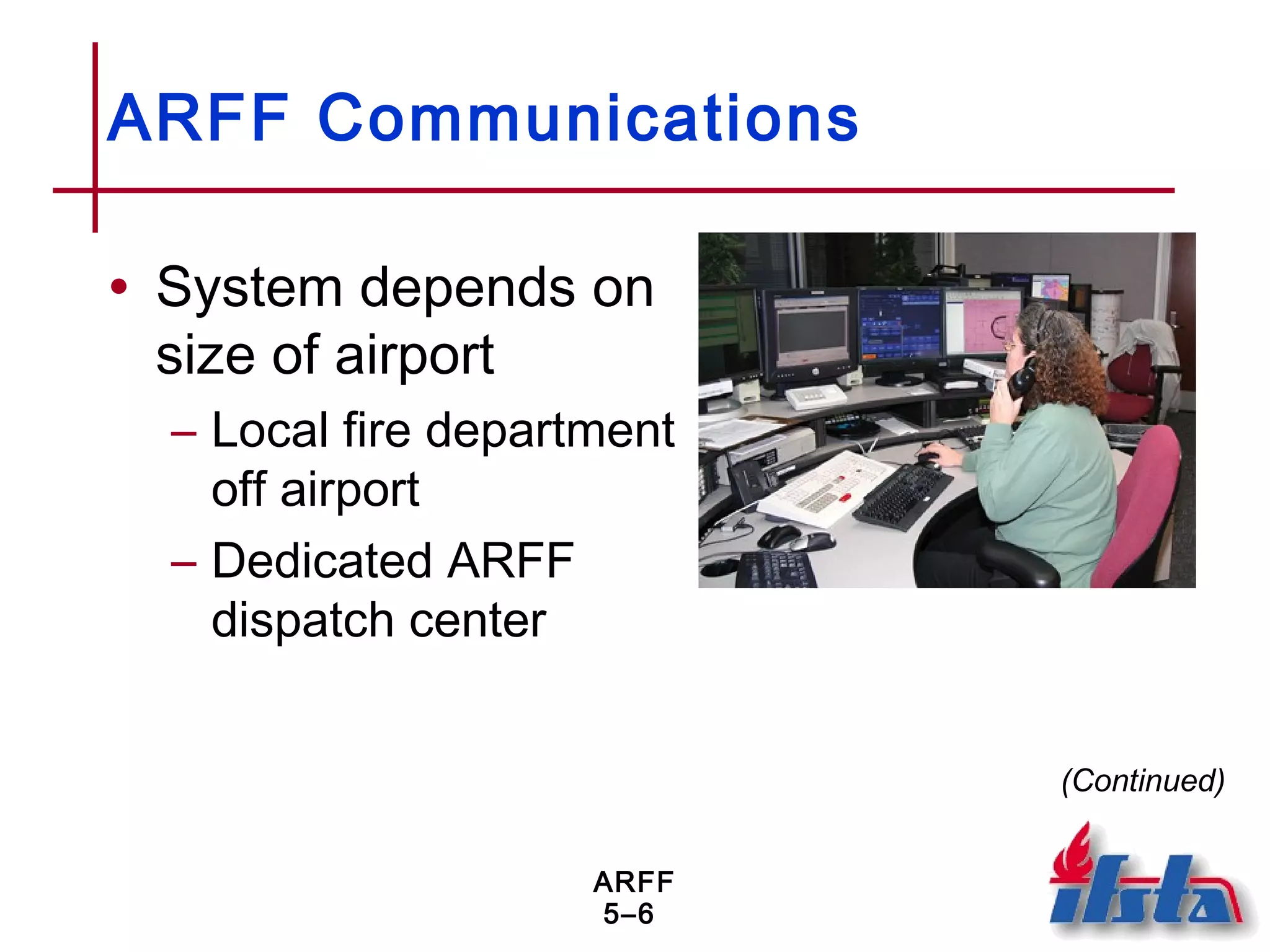
ARFF Communications
• System depends on
size of airport
– Local fire department
off airport
– Dedicated ARFF
dispatch center
(Continued)
ARFF
5–7
ARFF Communications
• Communication system components
– Audible alarms
– Direct-line telephones
– Radios
(Continued)
ARFF
5–8
ARFF Communications
• ATC personnel provide information
– Make and model of aircraft
– Name of air carrier
– Response category
– Emergency situation
– Number on board
– Amount of fuel
ARFF
5–9
NOTAM
• Information issued by airport operator
or ATC personnel
• Addresses important information
– Runways
– Taxiways
– Essential services
• Post NOTAMs
ARFF
5–10
Audible Alarms and Direct-line
Telephones
• Audible alarms alert individuals
– Airport or facility occupants
– Regular ARFF personnel
– Auxiliary ARFF personnel
– Essential support services
(Continued)
ARFF
5–11
Audible Alarms and Direct-line
Telephones
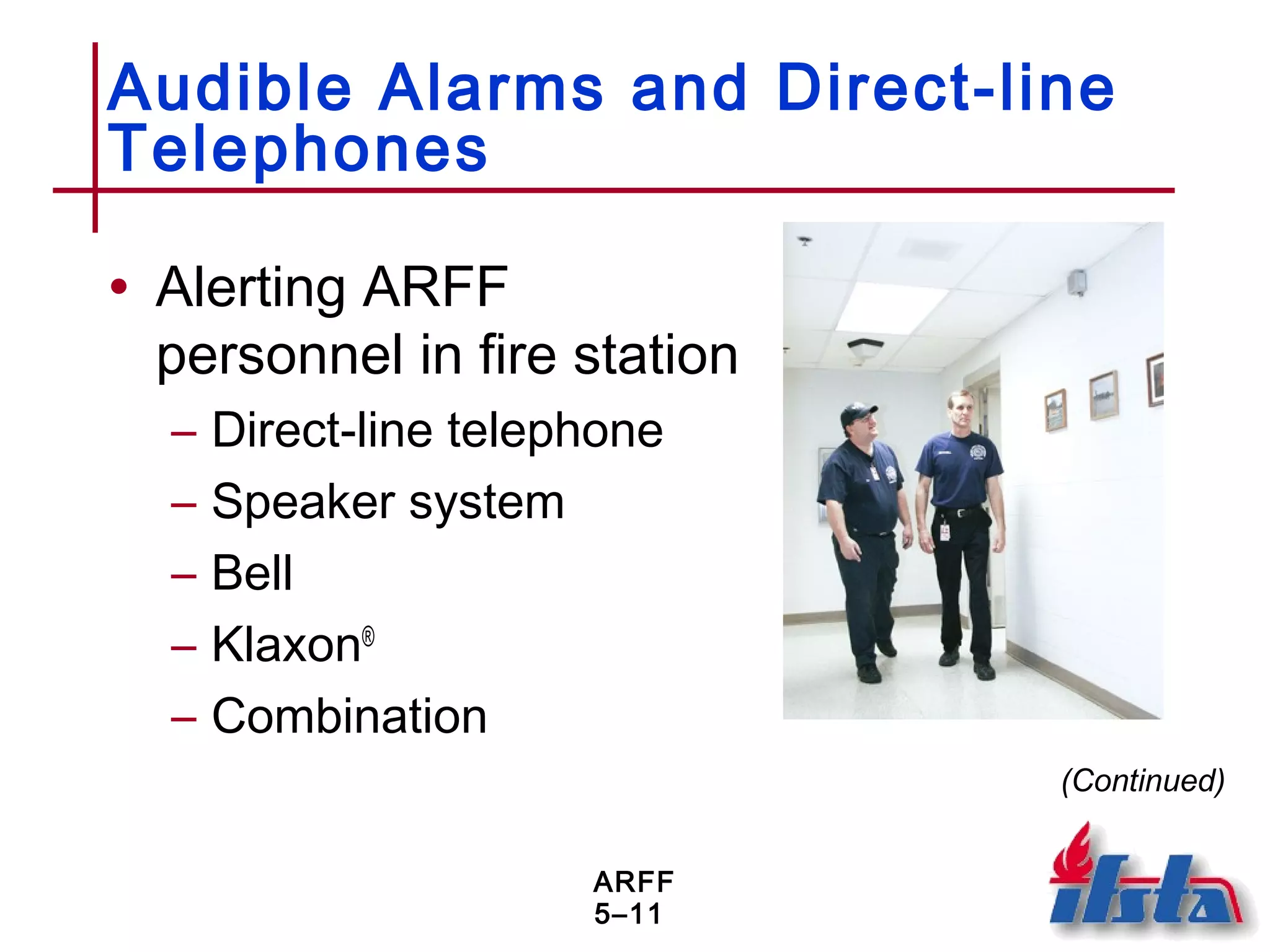
• Alerting ARFF
personnel in fire station
– Direct-line telephone
– Speaker system
– Bell
– Klaxon®
– Combination
(Continued)
ARFF
5–12
Audible Alarms and Direct-line
Telephones
• Alerting auxiliary/off-duty ARFF
personnel
– Pagers
– Tone-activated radio receivers
– Cell phones
– Siren/horn
(Continued)
ARFF
5–13
Audible Alarms and Direct-line
Telephones
• Direct-line communications systems
– Between control tower and multiple
emergency agencies
– Primary means of notification
– Test lines regularly
ARFF
5–14
Radio Systems
• Two-way radios — most efficient means
of communication
– One or more channels
– Multi-scanning capability
• Use clear text language or common
terminology
(Continued)
ARFF
5–15
Radio Systems
• Comply with FCC and AHJ
• Test systems regularly
• Do not transmit false, misleading, or
inappropriate information
• Computer-monitored systems record
and time-stamp communications
(Continued)
ARFF
5–16
Radio Systems
• Communications/dispatch center
ensures proper operation
– Clearing the air
– Maintaining discipline
– Determining priority
ARFF
5–17
Aviation Radio Frequencies
• Ground control
• Local control or air traffic control
• FSS
• UNICOM
• CTAF
• ATIS
ARFF
5–18
ARFF and Radio Frequencies
• Uncontrolled airports — SOPs
established for movement
• Monitor appropriate frequencies
• Communicate with ground control
– Give specific information
– Finish with “Over”
ARFF
5–19
Cockpit and ARFF Command
Communications
• Use a discreet frequency
• IC
– Provide information to crew
– Advise on conditions outside of aircraft
• Crew may provide information to IC
(Continued)
ARFF
5–20
Cockpit and ARFF Command
Communications
• Pilot
– Should initiate communication
– Responsible for aircraft and occupants
ARFF
5–21
Interphone System
• Uses of interphone system
– ARFF personnel to communicate with crew
members
– Airport personnel during routine operations
ARFF
5–22
Radio/Telephone Guidelines
• Speak directly into microphone
• Speak distinctly, calmly, and clearly
• Pronounce each word carefully
• Use a conversational tone/moderate
speed
(Continued)
ARFF
5–23
Radio/Telephone Guidelines
• Speak as loudly as ordinary
conversation
• Speak in a low-pitched voice
ARFF
5–24
Phonetic Alphabet
• Critical information is spelled out with
words
• Reduces confusion
• ICAO phonetic alphabet is used
ARFF
5–25
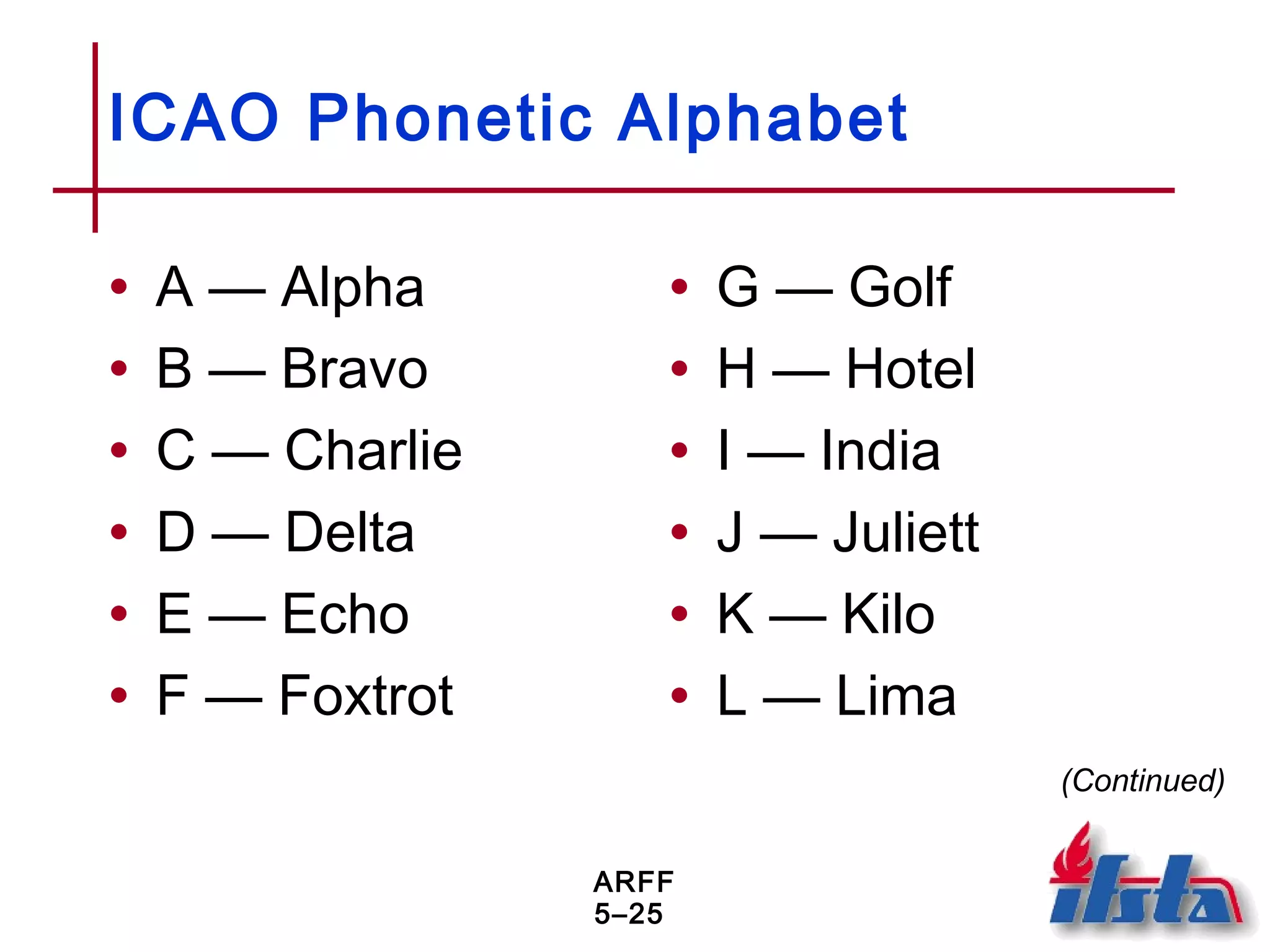
ICAO Phonetic Alphabet
• A — Alpha
• B — Bravo
• C — Charlie
• D — Delta
• E — Echo
• F — Foxtrot
• G — Golf
• H — Hotel
• I — India
• J — Juliett
• K — Kilo
• L — Lima
(Continued)
ARFF
5–26
ICAO Phonetic Alphabet
• M — Mike
• N — November
• O — Oscar
• P — Papa
• Q — Quebec
• R — Romeo
• S — Sierra
• T — Tango
• U — Uniform
• V — Victor
• W — Whiskey
• X — X-ray
• Y — Yankee
• Z — Zulu
ARFF
5–27
Number Designations
• 1 — Wun
• 2 — Too
• 3 — Tree
• 4 — Fow-er
• 5 — Five
• 6 — Sicks
• 7 — Sev-en
• 8 — Ait
• 9 — Nin-er
• 0 — Zero
ARFF
5–28
Common Terms and Phrases
• Air Traffic
Control (ATC)
• Base leg
• Base to final
• Blind (dead)
spot
• Downwind leg
• ETA
• Final approach
• Flameout
• Fuel on board
• Gear down
• Go around
(Continued)
ARFF
5–29
Common Terms and Phrases
• Hold your
position
• Hung gear
• Jet blast
• Low approach
• Make a 90,
180, or 360
• Minimum fuel
• Missed approach
• Overhead
approach
• Prop or rotor wash
• Wind direction and
velocity
ARFF
5–30
Computers
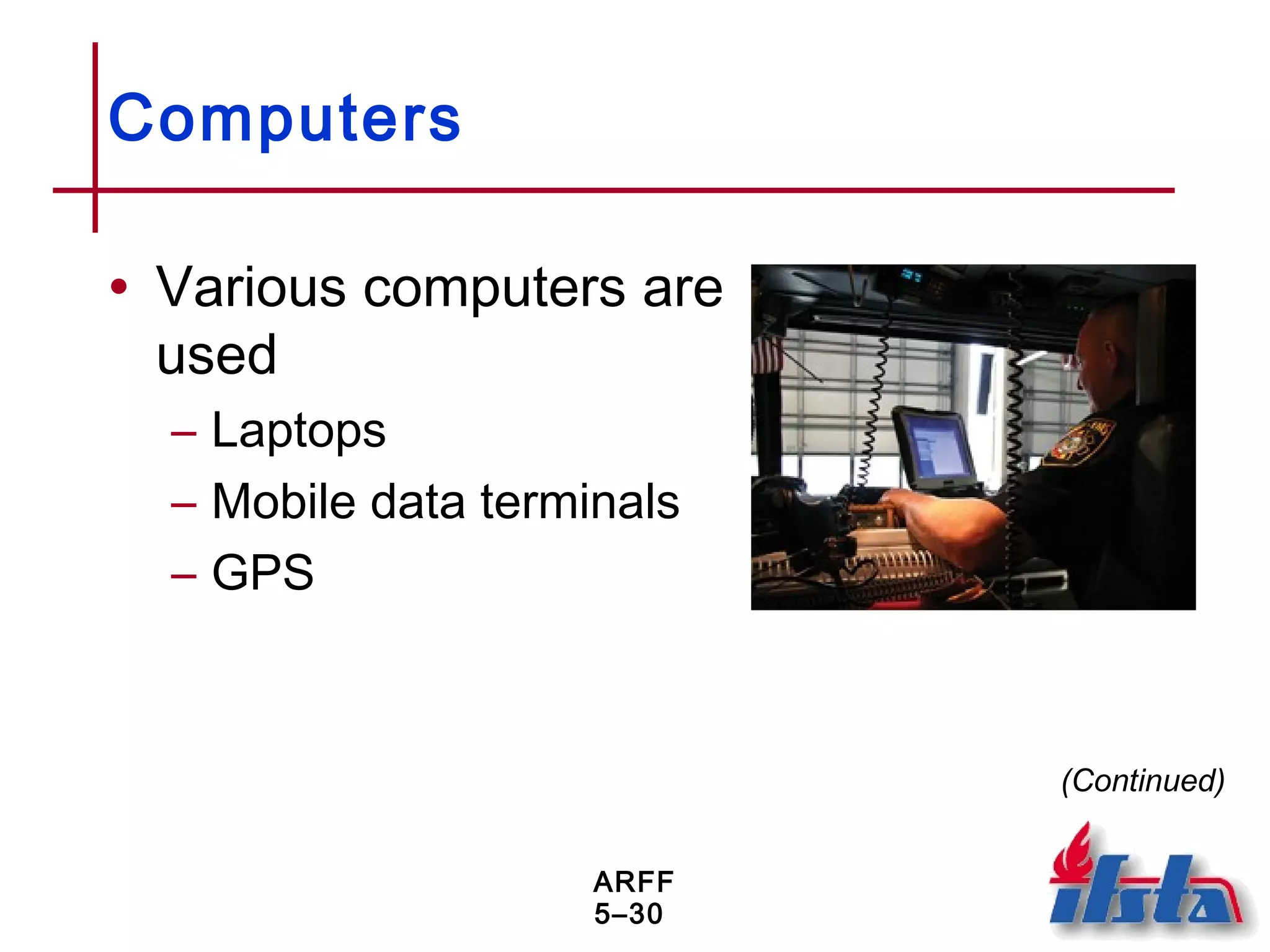
• Various computers are
used
– Laptops
– Mobile data terminals
– GPS
(Continued)
ARFF
5–31
Computers
• Use will expand
– Information tool
– Communications system
– Fire scene management
(Continued)
ARFF
5–32
Computers
• Computers can provide
– Data on airport layouts
– Prefire plans of buildings
– Diagrams on aircraft
– Dangerous goods information
– Ability to provide status and location
– On-screen messaging
ARFF
5–33
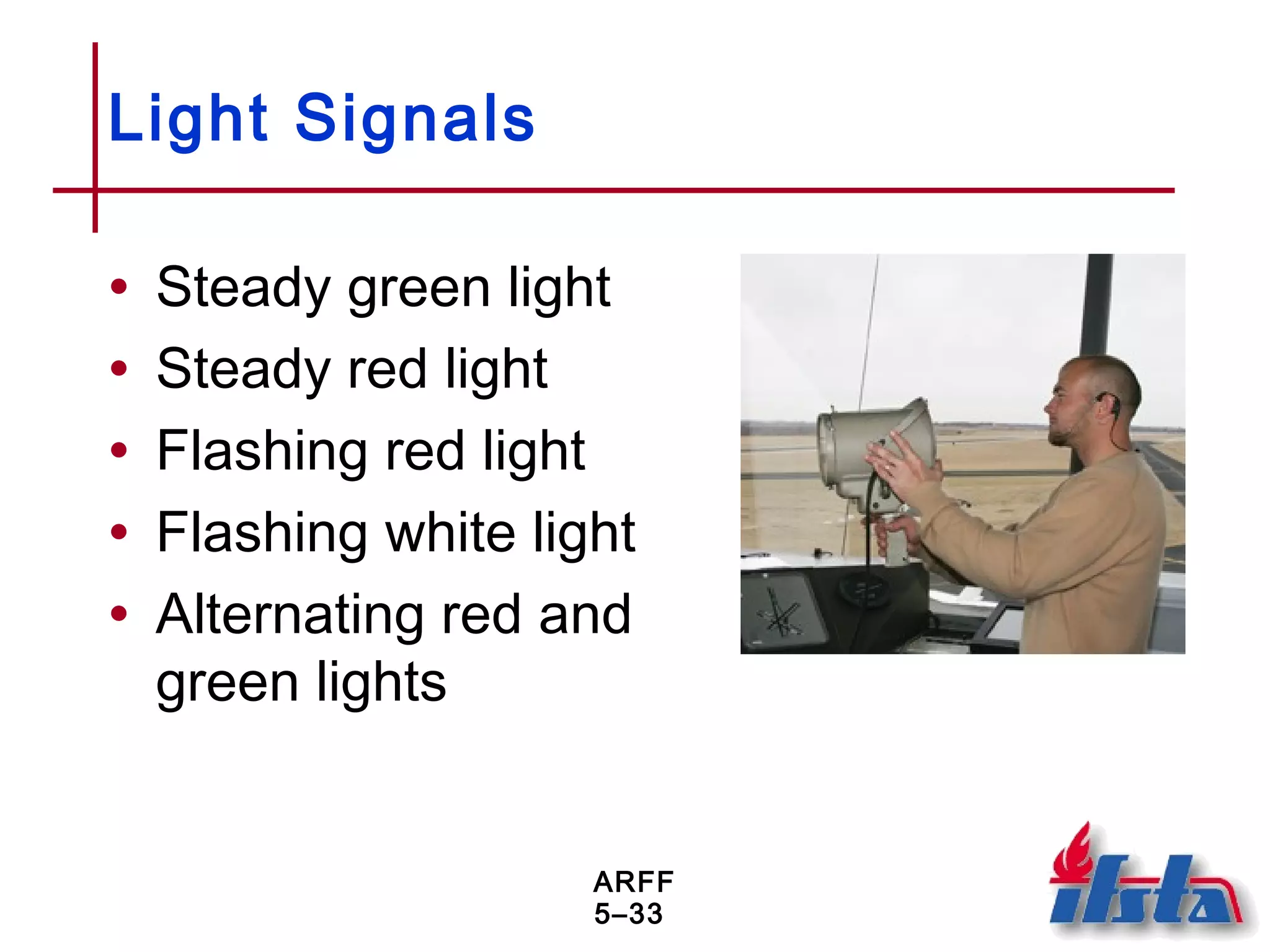
Light Signals
• Steady green light
• Steady red light
• Flashing red light
• Flashing white light
• Alternating red and
green lights
ARFF
5–34
Hand Signals
• Recommended evacuation
• Recommended stop
• Emergency contained
ARFF
5–35
Other Signals
• Back out or retreat
• Apparatus is running out of agent
• Open or close handline
• Change handline nozzle/stream pattern
• Advance with handline
• Back out with handline
ARFF
5–36
Summary
• Communications are vital during any
emergency. Airport firefighters must be
thoroughly trained and proficient in the
usage of the communications systems
and procedures found at their particular
airfield
(Continued)
ARFF
5–37
Summary
• This chapter covered NOTAMs, audible
alarms and direct-line telephones, radio
systems and aviation frequencies. It
also covered radio/telephone
guidelines, computers in ARFF, and
signals used in ARFF.
ARFF
5–38
Review Questions
1. Who may handle aircraft rescue
and fire fighting communications?
2. How might airport auxiliary
firefighters be notified of a situation?
3. What is the most efficient
means for communicating with
personnel during emergency scene
operations? (Continued)
ARFF
5–39
Review Questions
4. What is the Automated
Terminal Information Service (ATIS)?
5. How does an interphone
system work?
6. What guidelines should be
followed for proper radio/telephone
use? (Continued)
ARFF
5–40
Review Questions
7. Why is use of the phonetic
alphabet necessary?
8. What does the phrase ”hold
your position” mean?
(Continued)
ARFF
5–41
Review Questions
9. What is a mobile data terminal
(MDT)?
10. When using light signals, what
does a flashing red light mean?

Chapter 05 Fire and Rescue Communications

  • 1.
    Aircraft Rescue andFire Fighting, 5th Edition Chapter 5 — Fire and Rescue Communications
  • 2.
    ARFF 5–2 Chapter 5 LessonGoal • After completing this lesson, the student shall be able to recall basic information about fire and rescue communications including systems, procedures, terminology, and signals used in aviation.
  • 3.
    ARFF 5–3 Objectives 1. Describe basicairport communication systems. 2. Discuss pilot/ARFF Command communications. 3. Describe proper radio and telephone communication procedures. (Continued)
  • 4.
    ARFF 5–4 Objectives 4. Identify InternationalCivil Aviation Organization (ICAO) Phonetic Alphabet designations. 5. Identify words and phrases unique to the airport environment. (Continued)
  • 5.
    ARFF 5–5 Objectives 6. Discuss theuse of computers in airport and ARFF communications. 7. Describe light, hand, and other signals used in aircraft accident operations.
  • 6.
    ARFF 5–6 ARFF Communications • Systemdepends on size of airport – Local fire department off airport – Dedicated ARFF dispatch center (Continued)
  • 7.
    ARFF 5–7 ARFF Communications • Communicationsystem components – Audible alarms – Direct-line telephones – Radios (Continued)
  • 8.
    ARFF 5–8 ARFF Communications • ATCpersonnel provide information – Make and model of aircraft – Name of air carrier – Response category – Emergency situation – Number on board – Amount of fuel
  • 9.
    ARFF 5–9 NOTAM • Information issuedby airport operator or ATC personnel • Addresses important information – Runways – Taxiways – Essential services • Post NOTAMs
  • 10.
    ARFF 5–10 Audible Alarms andDirect-line Telephones • Audible alarms alert individuals – Airport or facility occupants – Regular ARFF personnel – Auxiliary ARFF personnel – Essential support services (Continued)
  • 11.
    ARFF 5–11 Audible Alarms andDirect-line Telephones • Alerting ARFF personnel in fire station – Direct-line telephone – Speaker system – Bell – Klaxon® – Combination (Continued)
  • 12.
    ARFF 5–12 Audible Alarms andDirect-line Telephones • Alerting auxiliary/off-duty ARFF personnel – Pagers – Tone-activated radio receivers – Cell phones – Siren/horn (Continued)
  • 13.
    ARFF 5–13 Audible Alarms andDirect-line Telephones • Direct-line communications systems – Between control tower and multiple emergency agencies – Primary means of notification – Test lines regularly
  • 14.
    ARFF 5–14 Radio Systems • Two-wayradios — most efficient means of communication – One or more channels – Multi-scanning capability • Use clear text language or common terminology (Continued)
  • 15.
    ARFF 5–15 Radio Systems • Complywith FCC and AHJ • Test systems regularly • Do not transmit false, misleading, or inappropriate information • Computer-monitored systems record and time-stamp communications (Continued)
  • 16.
    ARFF 5–16 Radio Systems • Communications/dispatchcenter ensures proper operation – Clearing the air – Maintaining discipline – Determining priority
  • 17.
    ARFF 5–17 Aviation Radio Frequencies •Ground control • Local control or air traffic control • FSS • UNICOM • CTAF • ATIS
  • 18.
    ARFF 5–18 ARFF and RadioFrequencies • Uncontrolled airports — SOPs established for movement • Monitor appropriate frequencies • Communicate with ground control – Give specific information – Finish with “Over”
  • 19.
    ARFF 5–19 Cockpit and ARFFCommand Communications • Use a discreet frequency • IC – Provide information to crew – Advise on conditions outside of aircraft • Crew may provide information to IC (Continued)
  • 20.
    ARFF 5–20 Cockpit and ARFFCommand Communications • Pilot – Should initiate communication – Responsible for aircraft and occupants
  • 21.
    ARFF 5–21 Interphone System • Usesof interphone system – ARFF personnel to communicate with crew members – Airport personnel during routine operations
  • 22.
    ARFF 5–22 Radio/Telephone Guidelines • Speakdirectly into microphone • Speak distinctly, calmly, and clearly • Pronounce each word carefully • Use a conversational tone/moderate speed (Continued)
  • 23.
    ARFF 5–23 Radio/Telephone Guidelines • Speakas loudly as ordinary conversation • Speak in a low-pitched voice
  • 24.
    ARFF 5–24 Phonetic Alphabet • Criticalinformation is spelled out with words • Reduces confusion • ICAO phonetic alphabet is used
  • 25.
    ARFF 5–25 ICAO Phonetic Alphabet •A — Alpha • B — Bravo • C — Charlie • D — Delta • E — Echo • F — Foxtrot • G — Golf • H — Hotel • I — India • J — Juliett • K — Kilo • L — Lima (Continued)
  • 26.
    ARFF 5–26 ICAO Phonetic Alphabet •M — Mike • N — November • O — Oscar • P — Papa • Q — Quebec • R — Romeo • S — Sierra • T — Tango • U — Uniform • V — Victor • W — Whiskey • X — X-ray • Y — Yankee • Z — Zulu
  • 27.
    ARFF 5–27 Number Designations • 1— Wun • 2 — Too • 3 — Tree • 4 — Fow-er • 5 — Five • 6 — Sicks • 7 — Sev-en • 8 — Ait • 9 — Nin-er • 0 — Zero
  • 28.
    ARFF 5–28 Common Terms andPhrases • Air Traffic Control (ATC) • Base leg • Base to final • Blind (dead) spot • Downwind leg • ETA • Final approach • Flameout • Fuel on board • Gear down • Go around (Continued)
  • 29.
    ARFF 5–29 Common Terms andPhrases • Hold your position • Hung gear • Jet blast • Low approach • Make a 90, 180, or 360 • Minimum fuel • Missed approach • Overhead approach • Prop or rotor wash • Wind direction and velocity
  • 30.
    ARFF 5–30 Computers • Various computersare used – Laptops – Mobile data terminals – GPS (Continued)
  • 31.
    ARFF 5–31 Computers • Use willexpand – Information tool – Communications system – Fire scene management (Continued)
  • 32.
    ARFF 5–32 Computers • Computers canprovide – Data on airport layouts – Prefire plans of buildings – Diagrams on aircraft – Dangerous goods information – Ability to provide status and location – On-screen messaging
  • 33.
    ARFF 5–33 Light Signals • Steadygreen light • Steady red light • Flashing red light • Flashing white light • Alternating red and green lights
  • 34.
    ARFF 5–34 Hand Signals • Recommendedevacuation • Recommended stop • Emergency contained
  • 35.
    ARFF 5–35 Other Signals • Backout or retreat • Apparatus is running out of agent • Open or close handline • Change handline nozzle/stream pattern • Advance with handline • Back out with handline
  • 36.
    ARFF 5–36 Summary • Communications arevital during any emergency. Airport firefighters must be thoroughly trained and proficient in the usage of the communications systems and procedures found at their particular airfield (Continued)
  • 37.
    ARFF 5–37 Summary • This chaptercovered NOTAMs, audible alarms and direct-line telephones, radio systems and aviation frequencies. It also covered radio/telephone guidelines, computers in ARFF, and signals used in ARFF.
  • 38.
    ARFF 5–38 Review Questions 1. Whomay handle aircraft rescue and fire fighting communications? 2. How might airport auxiliary firefighters be notified of a situation? 3. What is the most efficient means for communicating with personnel during emergency scene operations? (Continued)
  • 39.
    ARFF 5–39 Review Questions 4. Whatis the Automated Terminal Information Service (ATIS)? 5. How does an interphone system work? 6. What guidelines should be followed for proper radio/telephone use? (Continued)
  • 40.
    ARFF 5–40 Review Questions 7. Whyis use of the phonetic alphabet necessary? 8. What does the phrase ”hold your position” mean? (Continued)
  • 41.
    ARFF 5–41 Review Questions 9. Whatis a mobile data terminal (MDT)? 10. When using light signals, what does a flashing red light mean?