Aircraft Rescue and Fire
Fighting
6th Edition
Chapter 3 — Aircraft
Familiarization
Identify types of aircraft.
Learning Objective 1
3–2
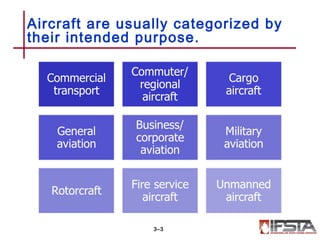
Aircraft are usually categorized by
their intended purpose.
3–3
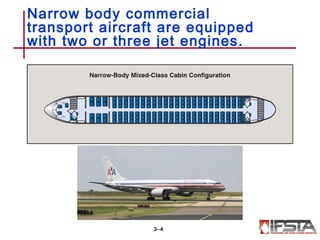
Narrow body commercial
transport aircraft are equipped
with two or three jet engines.
3–4
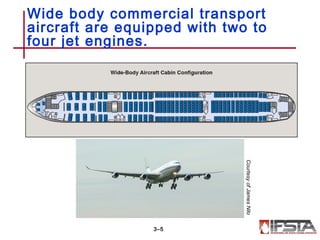
Wide body commercial transport
aircraft are equipped with two to
four jet engines.
3–5
CourtesyofJamesNilo
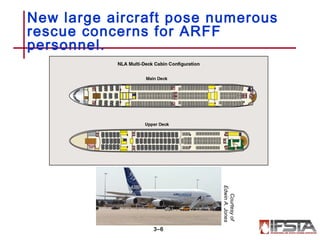
New large aircraft pose numerous
rescue concerns for ARFF
personnel.
3–6 Courtesyof
EdwinA.Jones
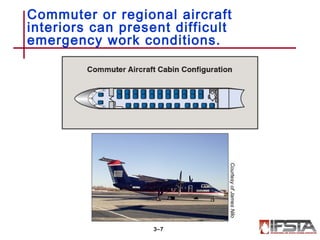
Commuter or regional aircraft
interiors can present difficult
emergency work conditions.
3–7 CourtesyofJamesNilo
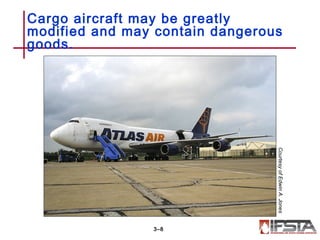
Cargo aircraft may be greatly
modified and may contain dangerous
goods.
3–8
CourtesyofEdwinA.Jones
3–9
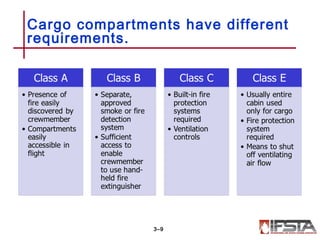
Cargo compartments have different
requirements.
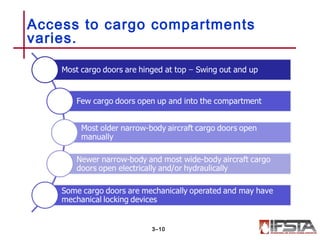
Access to cargo compartments
varies.
3–10
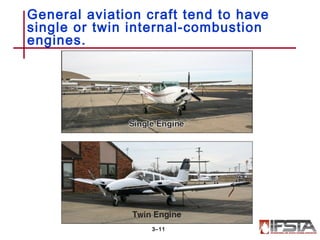
General aviation craft tend to have
single or twin internal-combustion
engines.
3–11
NOTE
ARFF personnel should be aware that
light piston twins have a heating system
that burns the AVGAS in the nose
compartment to provide cabin heat.
These heating systems have a history
of fire problems which have sometimes
been fatal.
3–12
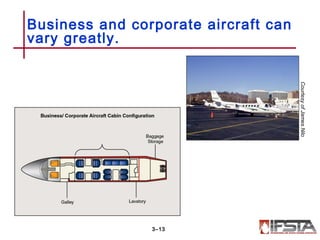
Business and corporate aircraft can
vary greatly.
3–13
CourtesyofJamesNilo
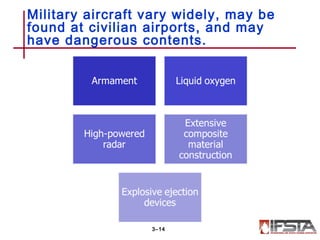
Military aircraft vary widely, may be
found at civilian airports, and may
have dangerous contents.
3–14
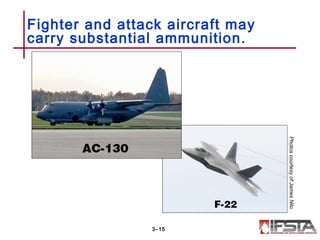
Fighter and attack aircraft may
carry substantial ammunition.
3–15
PhotoscourtesyofJamesNilo
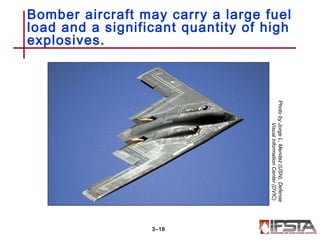
Bomber aircraft may carry a large fuel
load and a significant quantity of high
explosives.
3–16
PhotobyJorgeL.Mendez(USN),Defense
VisualInformationCenter(DVIC)
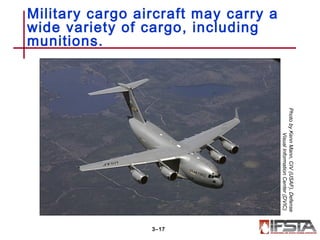
Military cargo aircraft may carry a
wide variety of cargo, including
munitions.
3–17
PhotobyKennMann,CIV(USAF),Defense
VisualInformationCenter(DVIC)
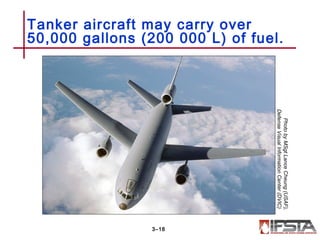
Tanker aircraft may carry over
50,000 gallons (200 000 L) of fuel.
3–18
PhotobyMSgtLanceCheung(USAF),
DefenseVisualInformationCenter(DVIC)
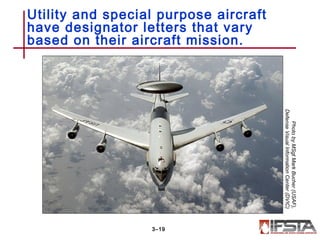
Utility and special purpose aircraft
have designator letters that vary
based on their aircraft mission.
3–19
PhotobyMSgtMarkBucher(USAF),
DefenseVisualInformationCenter(DVIC)
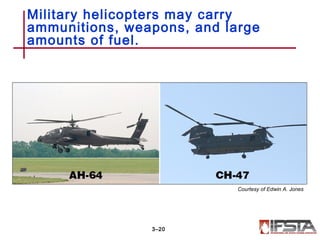
Military helicopters may carry
ammunitions, weapons, and large
amounts of fuel.
3–20
Courtesy of Edwin A. Jones
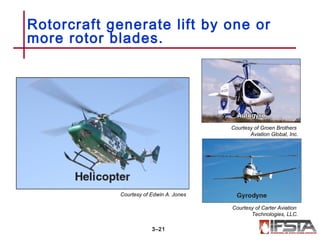
Rotorcraft generate lift by one or
more rotor blades.
3–21
Courtesy of Edwin A. Jones
Courtesy of Groen Brothers
Aviation Global, Inc.
Courtesy of Carter Aviation
Technologies, LLC.
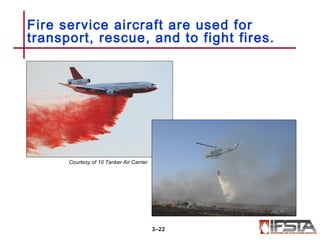
Fire service aircraft are used for
transport, rescue, and to fight fires.
3–22
Courtesy of 10 Tanker Air Carrier
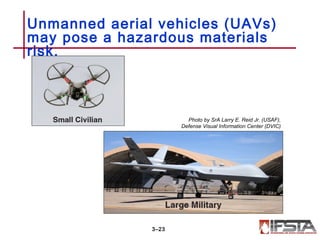
Unmanned aerial vehicles (UAVs)
may pose a hazardous materials
risk.
3–23
Photo by SrA Larry E. Reid Jr. (USAF),
Defense Visual Information Center (DVIC)
REVIEW QUESTION
What are the major categories of
aircraft?
3–24
Describe the major components of
fixed-wing and rotary-wing aircraft.
3–25
Learning Objective 2
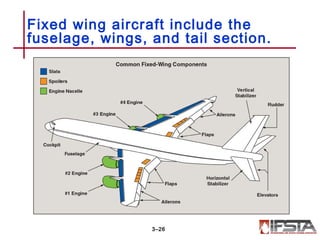
Fixed wing aircraft include the
fuselage, wings, and tail section.
3–26
WARNING
Personnel should ensure that aircraft is
properly grounded before coming in
contact with the aircraft in order to
prevent being shocked.
3–27
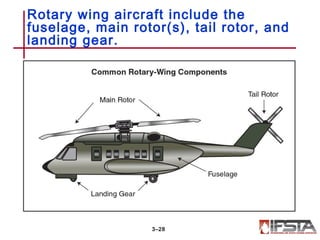
Rotary wing aircraft include the
fuselage, main rotor(s), tail rotor, and
landing gear.
3–28
REVIEW QUESTION
How do fixed-wing and rotary-wing
aircraft components differ?
3–29
Identify types of and hazards
associated with various aircraft
engines.
Learning Objective 3
3–30
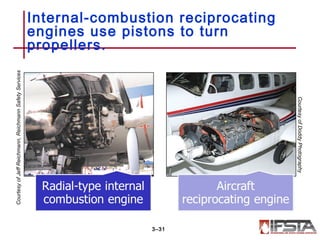
Internal-combustion reciprocating
engines use pistons to turn
propellers.
3–31
CourtesyofDoddyPhotography
CourtesyofJeffReichmann,ReichmannSafetyServices
Internal-combustion reciprocating
engines use aviation gasoline
(AVGAS).
3–32
WARNING
Disconnecting the battery does not
prevent the magneto from functioning,
so personnel must exercise caution
when working in the area of the
propeller. A safety zone should be
established around the engine, keeping
all personnel clear of the engine.
3–33
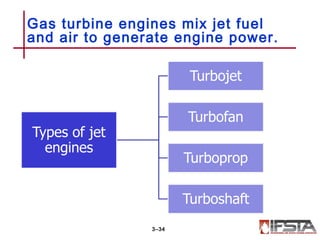
Gas turbine engines mix jet fuel
and air to generate engine power.
3–34
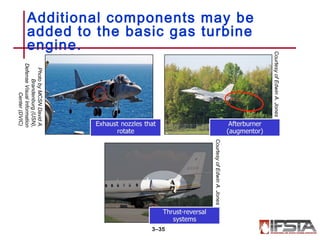
Additional components may be
added to the basic gas turbine
engine.
3–35
CourtesyofEdwinA.Jones
PhotobyMCSNDavidA.
Brandenburg(USN),
DefenseVisualInformation
Center(DVIC)
REVIEW QUESTION
What types of engines are used to
power aircraft?
3–36
Explain aircraft construction,
structural materials, and hazards as
they relate to ARFF training operations.
Learning Objective 4
3–37
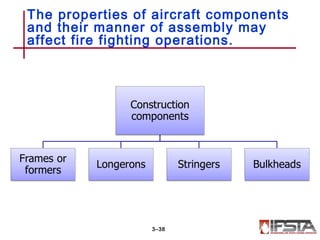
The properties of aircraft components
and their manner of assembly may
affect fire fighting operations.
3–38
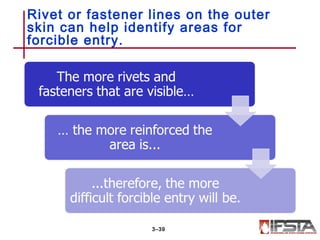
Rivet or fastener lines on the outer
skin can help identify areas for
forcible entry.
3–39
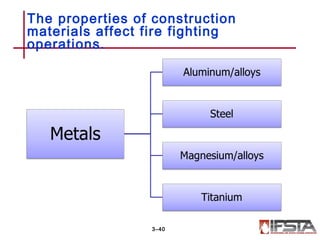
The properties of construction
materials affect fire fighting
operations.
3–40
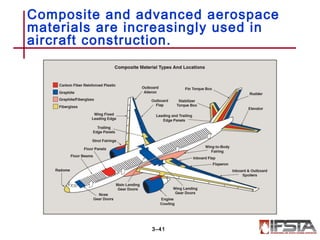
Composite and advanced aerospace
materials are increasingly used in
aircraft construction.
3–41
Plastic and wood are two additional
materials used in aircraft construction.
3–42
REVIEW QUESTION
What materials are commonly used
in the construction of aircraft?
3–43
Describe potential aircraft system
hazards that firefighters may encounter.
Learning Objective 5
3–44
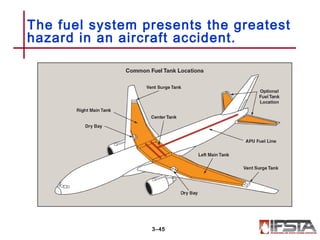
The fuel system presents the greatest
hazard in an aircraft accident.
3–45
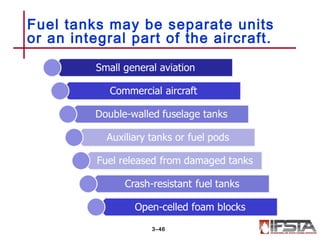
Fuel tanks may be separate units
or an integral part of the aircraft.
3–46
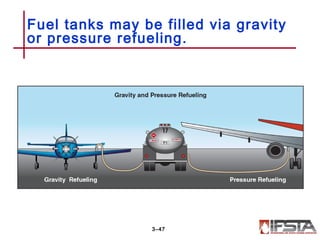
Fuel tanks may be filled via gravity
or pressure refueling.
3–47
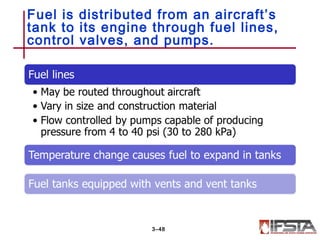
Fuel is distributed from an aircraft’s
tank to its engine through fuel lines,
control valves, and pumps.
3–48
NOTE
Military aircraft fuel tanks are normally
full in the winter months then the
aircrafts are stored in heated hangars.
The expanding fuel leaks onto the
hangar floor and causes additional
hazards to ARFF personnel.
3–49
ARFF personnel must be aware of
hazards associated with aircraft
fuel.
3–50
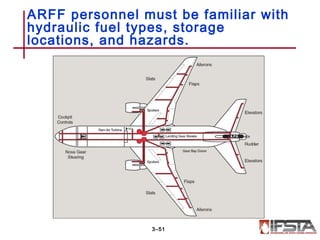
ARFF personnel must be familiar with
hydraulic fuel types, storage
locations, and hazards.
3–51
WARNING
When dealing with aircraft emergencies
around operating aircraft, keep
personnel aware and clear of areas
containing hydraulically and
pneumatically operated parts.
Personnel can be easily injured or have
body parts severed if caught or pinched
between moving surfaces.
3–52
CAUTION
Personnel also must guard against
hydraulic fluid contacting skin, eyes,
and protective clothing because this
type of fluid can cause severe skin and
eye irritation as well as erode protective
clothing surfaces.
3–53
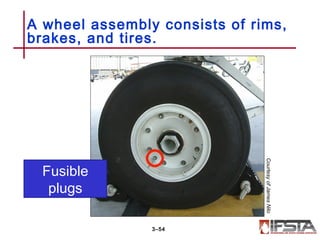
A wheel assembly consists of rims,
brakes, and tires.
3–54
Fusible
plugs
CourtesyofJamesNilo
WARNING
When dealing with a landing gear emergency
such as a hot brake or gear fire, always
approach the landing gear either forward or aft
at a 45 degree angle of the gear assembly. If
heated beyond limits, landing gear assemblies
and tires may explode, sending debris and
pieces out from the sides of the assembly.
These pieces can travel with enough velocity
to puncture aircraft wing fuel cells, and could
be fatal to nearby personnel.
3–55
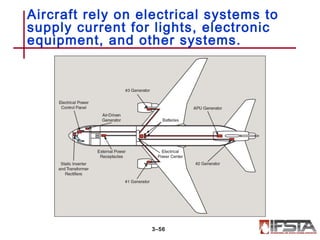
Aircraft rely on electrical systems to
supply current for lights, electronic
equipment, and other systems.
3–56
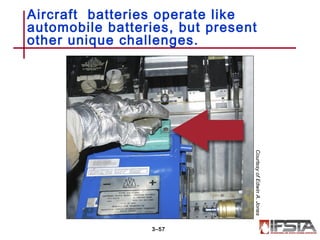
Aircraft batteries operate like
automobile batteries, but present
other unique challenges.
3–57
CourtesyofEdwinA.Jones
CAUTION
The electrolyte used in nickel-cadmium
batteries is a strong alkaline solution of
potassium hydroxide, which is caustic and
corrosive. The electrolyte used in lead-acid
batteries is sulfuric acid and distilled water.
Serious burns will result if either electrolyte
contacts the skin. Check the Safety Data
Sheet (SDS) for specific hazards
associated with each type of battery.
3–58
CAUTION
Some aircraft batteries produce highly
flammable hydrogen gas during
charging. This gas can present a
serious fire and explosion hazards to
ARFF personnel.
3–59
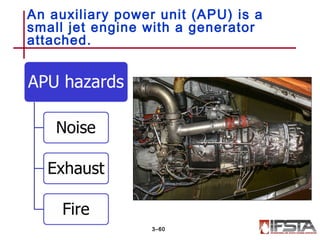
An auxiliary power unit (APU) is a
small jet engine with a generator
attached.
3–60
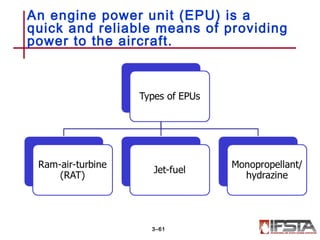
An engine power unit (EPU) is a
quick and reliable means of providing
power to the aircraft.
3–61
WARNING
Wear full personal protective equipment
(PPE) at all times when dealing with
hydrazine emergencies as it may be
absorbed through the skin. Even short
exposures may have serious effects on
the nervous and respiratory systems.
3–62
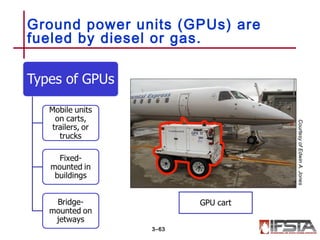
Ground power units (GPUs) are
fueled by diesel or gas.
3–63
CourtesyofEdwinA.Jones
WARNING
Disconnecting the GPU from the aircraft
prior to the power being shut off can
cause electrocution or arcing. Arcing
could provide an ignition source for
flammable vapors that have collected in
the area.
3–64
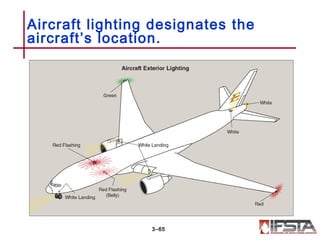
Aircraft lighting designates the
aircraft’s location.
3–65
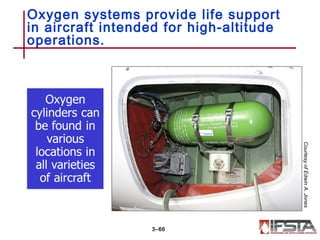
Oxygen systems provide life support
in aircraft intended for high-altitude
operations.
3–66
CourtesyofEdwinA.Jones
WARNING
High concentrations of compressed
gaseous oxygen will accelerate
combustion.
3–67
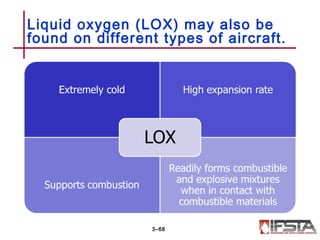
Liquid oxygen (LOX) may also be
found on different types of aircraft.
3–68
WARNING
Do not disturb asphalt onto which LOX
has been spilled because it is
explosively unstable and extremely
shock-sensitive. Until LOX has
dissipated, merely walking on the spill
or dropping something onto it may
cause a violent reaction.
3–69
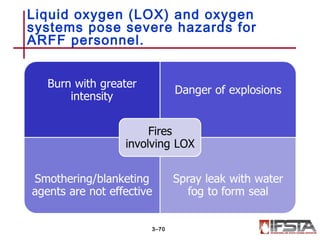
Liquid oxygen (LOX) and oxygen
systems pose severe hazards for
ARFF personnel.
3–70
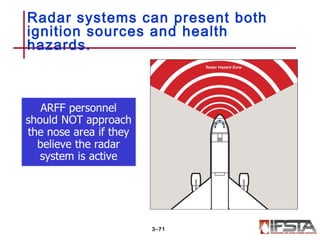
Radar systems can present both
ignition sources and health
hazards.
3–71
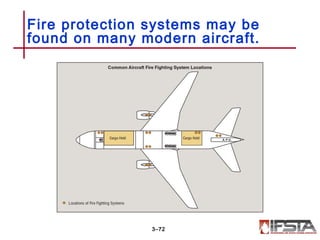
Fire protection systems may be
found on many modern aircraft.
3–72
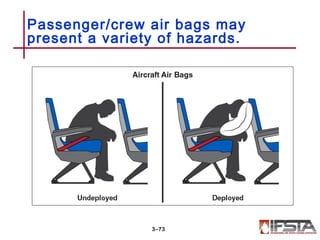
Passenger/crew air bags may
present a variety of hazards.
3–73
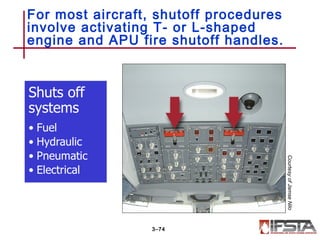
For most aircraft, shutoff procedures
involve activating T- or L-shaped
engine and APU fire shutoff handles.
3–74
CourtesyofJamseNilo
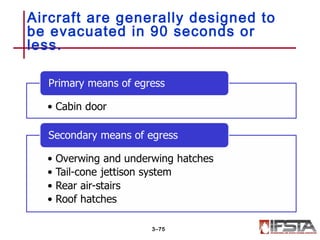
Aircraft are generally designed to
be evacuated in 90 seconds or
less.
3–75
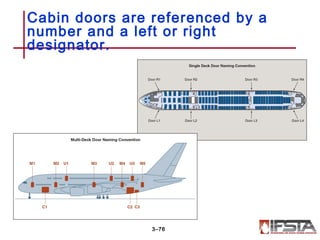
Cabin doors are referenced by a
number and a left or right
designator.
3–76
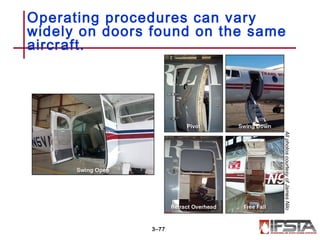
Operating procedures can vary
widely on doors found on the same
aircraft.
3–77
AllphotoscourtesyofJamesNilo
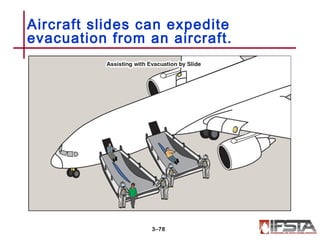
Aircraft slides can expedite
evacuation from an aircraft.
3–78
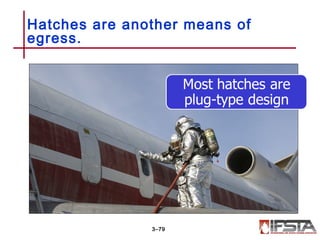
Hatches are another means of
egress.
3–79
WARNING
Over-wing exit doors may open with
considerable force and may injure
ARFF personnel.
3–80
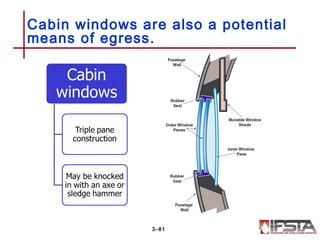
Cabin windows are also a potential
means of egress.
3–81
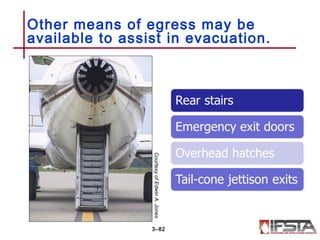
Other means of egress may be
available to assist in evacuation.
3–82
CourtesyofEdwinA.Jones
WARNING
Firefighters must use caution when
walking under a tail cone as it may be
jettisoned while they are underneath it.
3–83
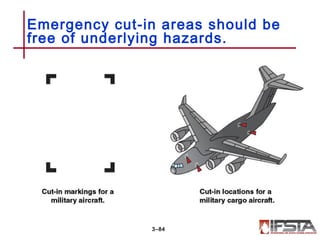
Emergency cut-in areas should be
free of underlying hazards.
3–84
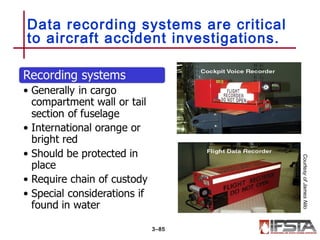
Data recording systems are critical
to aircraft accident investigations.
3–85
CourtesyofJamesNilo
Some aircraft contain other
systems and components.
3–86
WARNING
Pitot tubes are heated to prevent ice
from forming on them during flight. As a
result, ARFF personnel should not
touch pitot tubes because they can get
hot enough to cause burns.
3–87
REVIEW QUESTION
What are some of the hazards
presented by aircraft systems during
an emergency?
3–88
• Airport firefighters’ safety is linked to
the level of training and familiarization
with the types of aircraft that may be
encountered during ARFF operations.
Summary
3–89
(Cont.)
• ARFF personnel must be thoroughly
familiar with various types of civilian
and military aircraft and able to
recognize the unique features and
components of fixed-wing and rotary-
wing aircraft.
Summary
3–90
(Cont.)
• Airport firefighters must be familiar with
the types and applications of different
engines used to power aircraft in order
to safely function around aircraft in
both normal and emergency
conditions.
Summary
3–91
(Cont.)
• ARFF personnel should be trained to
recognize the materials used in
manufacture of aircraft so that they
understand how the materials behave
during aircraft crashes and fires.
• Airport firefighters must also identify
and deal with the numerous fuel,
power, and safety systems used
aboard aircraft.
Summary
3–92

ACO-2 Aircraft Familiarization

  • 1.
    Aircraft Rescue andFire Fighting 6th Edition Chapter 3 — Aircraft Familiarization
  • 2.
    Identify types ofaircraft. Learning Objective 1 3–2
  • 3.
    Aircraft are usuallycategorized by their intended purpose. 3–3
  • 4.
    Narrow body commercial transportaircraft are equipped with two or three jet engines. 3–4
  • 5.
    Wide body commercialtransport aircraft are equipped with two to four jet engines. 3–5 CourtesyofJamesNilo
  • 6.
    New large aircraftpose numerous rescue concerns for ARFF personnel. 3–6 Courtesyof EdwinA.Jones
  • 7.
    Commuter or regionalaircraft interiors can present difficult emergency work conditions. 3–7 CourtesyofJamesNilo
  • 8.
    Cargo aircraft maybe greatly modified and may contain dangerous goods. 3–8 CourtesyofEdwinA.Jones
  • 9.
    3–9 Cargo compartments havedifferent requirements.
  • 10.
    Access to cargocompartments varies. 3–10
  • 11.
    General aviation crafttend to have single or twin internal-combustion engines. 3–11
  • 12.
    NOTE ARFF personnel shouldbe aware that light piston twins have a heating system that burns the AVGAS in the nose compartment to provide cabin heat. These heating systems have a history of fire problems which have sometimes been fatal. 3–12
  • 13.
    Business and corporateaircraft can vary greatly. 3–13 CourtesyofJamesNilo
  • 14.
    Military aircraft varywidely, may be found at civilian airports, and may have dangerous contents. 3–14
  • 15.
    Fighter and attackaircraft may carry substantial ammunition. 3–15 PhotoscourtesyofJamesNilo
  • 16.
    Bomber aircraft maycarry a large fuel load and a significant quantity of high explosives. 3–16 PhotobyJorgeL.Mendez(USN),Defense VisualInformationCenter(DVIC)
  • 17.
    Military cargo aircraftmay carry a wide variety of cargo, including munitions. 3–17 PhotobyKennMann,CIV(USAF),Defense VisualInformationCenter(DVIC)
  • 18.
    Tanker aircraft maycarry over 50,000 gallons (200 000 L) of fuel. 3–18 PhotobyMSgtLanceCheung(USAF), DefenseVisualInformationCenter(DVIC)
  • 19.
    Utility and specialpurpose aircraft have designator letters that vary based on their aircraft mission. 3–19 PhotobyMSgtMarkBucher(USAF), DefenseVisualInformationCenter(DVIC)
  • 20.
    Military helicopters maycarry ammunitions, weapons, and large amounts of fuel. 3–20 Courtesy of Edwin A. Jones
  • 21.
    Rotorcraft generate liftby one or more rotor blades. 3–21 Courtesy of Edwin A. Jones Courtesy of Groen Brothers Aviation Global, Inc. Courtesy of Carter Aviation Technologies, LLC.
  • 22.
    Fire service aircraftare used for transport, rescue, and to fight fires. 3–22 Courtesy of 10 Tanker Air Carrier
  • 23.
    Unmanned aerial vehicles(UAVs) may pose a hazardous materials risk. 3–23 Photo by SrA Larry E. Reid Jr. (USAF), Defense Visual Information Center (DVIC)
  • 24.
    REVIEW QUESTION What arethe major categories of aircraft? 3–24
  • 25.
    Describe the majorcomponents of fixed-wing and rotary-wing aircraft. 3–25 Learning Objective 2
  • 26.
    Fixed wing aircraftinclude the fuselage, wings, and tail section. 3–26
  • 27.
    WARNING Personnel should ensurethat aircraft is properly grounded before coming in contact with the aircraft in order to prevent being shocked. 3–27
  • 28.
    Rotary wing aircraftinclude the fuselage, main rotor(s), tail rotor, and landing gear. 3–28
  • 29.
    REVIEW QUESTION How dofixed-wing and rotary-wing aircraft components differ? 3–29
  • 30.
    Identify types ofand hazards associated with various aircraft engines. Learning Objective 3 3–30
  • 31.
    Internal-combustion reciprocating engines usepistons to turn propellers. 3–31 CourtesyofDoddyPhotography CourtesyofJeffReichmann,ReichmannSafetyServices
  • 32.
    Internal-combustion reciprocating engines useaviation gasoline (AVGAS). 3–32
  • 33.
    WARNING Disconnecting the batterydoes not prevent the magneto from functioning, so personnel must exercise caution when working in the area of the propeller. A safety zone should be established around the engine, keeping all personnel clear of the engine. 3–33
  • 34.
    Gas turbine enginesmix jet fuel and air to generate engine power. 3–34
  • 35.
    Additional components maybe added to the basic gas turbine engine. 3–35 CourtesyofEdwinA.Jones CourtesyofEdwinA.Jones PhotobyMCSNDavidA. Brandenburg(USN), DefenseVisualInformation Center(DVIC)
  • 36.
    REVIEW QUESTION What typesof engines are used to power aircraft? 3–36
  • 37.
    Explain aircraft construction, structuralmaterials, and hazards as they relate to ARFF training operations. Learning Objective 4 3–37
  • 38.
    The properties ofaircraft components and their manner of assembly may affect fire fighting operations. 3–38
  • 39.
    Rivet or fastenerlines on the outer skin can help identify areas for forcible entry. 3–39
  • 40.
    The properties ofconstruction materials affect fire fighting operations. 3–40
  • 41.
    Composite and advancedaerospace materials are increasingly used in aircraft construction. 3–41
  • 42.
    Plastic and woodare two additional materials used in aircraft construction. 3–42
  • 43.
    REVIEW QUESTION What materialsare commonly used in the construction of aircraft? 3–43
  • 44.
    Describe potential aircraftsystem hazards that firefighters may encounter. Learning Objective 5 3–44
  • 45.
    The fuel systempresents the greatest hazard in an aircraft accident. 3–45
  • 46.
    Fuel tanks maybe separate units or an integral part of the aircraft. 3–46
  • 47.
    Fuel tanks maybe filled via gravity or pressure refueling. 3–47
  • 48.
    Fuel is distributedfrom an aircraft’s tank to its engine through fuel lines, control valves, and pumps. 3–48
  • 49.
    NOTE Military aircraft fueltanks are normally full in the winter months then the aircrafts are stored in heated hangars. The expanding fuel leaks onto the hangar floor and causes additional hazards to ARFF personnel. 3–49
  • 50.
    ARFF personnel mustbe aware of hazards associated with aircraft fuel. 3–50
  • 51.
    ARFF personnel mustbe familiar with hydraulic fuel types, storage locations, and hazards. 3–51
  • 52.
    WARNING When dealing withaircraft emergencies around operating aircraft, keep personnel aware and clear of areas containing hydraulically and pneumatically operated parts. Personnel can be easily injured or have body parts severed if caught or pinched between moving surfaces. 3–52
  • 53.
    CAUTION Personnel also mustguard against hydraulic fluid contacting skin, eyes, and protective clothing because this type of fluid can cause severe skin and eye irritation as well as erode protective clothing surfaces. 3–53
  • 54.
    A wheel assemblyconsists of rims, brakes, and tires. 3–54 Fusible plugs CourtesyofJamesNilo
  • 55.
    WARNING When dealing witha landing gear emergency such as a hot brake or gear fire, always approach the landing gear either forward or aft at a 45 degree angle of the gear assembly. If heated beyond limits, landing gear assemblies and tires may explode, sending debris and pieces out from the sides of the assembly. These pieces can travel with enough velocity to puncture aircraft wing fuel cells, and could be fatal to nearby personnel. 3–55
  • 56.
    Aircraft rely onelectrical systems to supply current for lights, electronic equipment, and other systems. 3–56
  • 57.
    Aircraft batteries operatelike automobile batteries, but present other unique challenges. 3–57 CourtesyofEdwinA.Jones
  • 58.
    CAUTION The electrolyte usedin nickel-cadmium batteries is a strong alkaline solution of potassium hydroxide, which is caustic and corrosive. The electrolyte used in lead-acid batteries is sulfuric acid and distilled water. Serious burns will result if either electrolyte contacts the skin. Check the Safety Data Sheet (SDS) for specific hazards associated with each type of battery. 3–58
  • 59.
    CAUTION Some aircraft batteriesproduce highly flammable hydrogen gas during charging. This gas can present a serious fire and explosion hazards to ARFF personnel. 3–59
  • 60.
    An auxiliary powerunit (APU) is a small jet engine with a generator attached. 3–60
  • 61.
    An engine powerunit (EPU) is a quick and reliable means of providing power to the aircraft. 3–61
  • 62.
    WARNING Wear full personalprotective equipment (PPE) at all times when dealing with hydrazine emergencies as it may be absorbed through the skin. Even short exposures may have serious effects on the nervous and respiratory systems. 3–62
  • 63.
    Ground power units(GPUs) are fueled by diesel or gas. 3–63 CourtesyofEdwinA.Jones
  • 64.
    WARNING Disconnecting the GPUfrom the aircraft prior to the power being shut off can cause electrocution or arcing. Arcing could provide an ignition source for flammable vapors that have collected in the area. 3–64
  • 65.
    Aircraft lighting designatesthe aircraft’s location. 3–65
  • 66.
    Oxygen systems providelife support in aircraft intended for high-altitude operations. 3–66 CourtesyofEdwinA.Jones
  • 67.
    WARNING High concentrations ofcompressed gaseous oxygen will accelerate combustion. 3–67
  • 68.
    Liquid oxygen (LOX)may also be found on different types of aircraft. 3–68
  • 69.
    WARNING Do not disturbasphalt onto which LOX has been spilled because it is explosively unstable and extremely shock-sensitive. Until LOX has dissipated, merely walking on the spill or dropping something onto it may cause a violent reaction. 3–69
  • 70.
    Liquid oxygen (LOX)and oxygen systems pose severe hazards for ARFF personnel. 3–70
  • 71.
    Radar systems canpresent both ignition sources and health hazards. 3–71
  • 72.
    Fire protection systemsmay be found on many modern aircraft. 3–72
  • 73.
    Passenger/crew air bagsmay present a variety of hazards. 3–73
  • 74.
    For most aircraft,shutoff procedures involve activating T- or L-shaped engine and APU fire shutoff handles. 3–74 CourtesyofJamseNilo
  • 75.
    Aircraft are generallydesigned to be evacuated in 90 seconds or less. 3–75
  • 76.
    Cabin doors arereferenced by a number and a left or right designator. 3–76
  • 77.
    Operating procedures canvary widely on doors found on the same aircraft. 3–77 AllphotoscourtesyofJamesNilo
  • 78.
    Aircraft slides canexpedite evacuation from an aircraft. 3–78
  • 79.
    Hatches are anothermeans of egress. 3–79
  • 80.
    WARNING Over-wing exit doorsmay open with considerable force and may injure ARFF personnel. 3–80
  • 81.
    Cabin windows arealso a potential means of egress. 3–81
  • 82.
    Other means ofegress may be available to assist in evacuation. 3–82 CourtesyofEdwinA.Jones
  • 83.
    WARNING Firefighters must usecaution when walking under a tail cone as it may be jettisoned while they are underneath it. 3–83
  • 84.
    Emergency cut-in areasshould be free of underlying hazards. 3–84
  • 85.
    Data recording systemsare critical to aircraft accident investigations. 3–85 CourtesyofJamesNilo
  • 86.
    Some aircraft containother systems and components. 3–86
  • 87.
    WARNING Pitot tubes areheated to prevent ice from forming on them during flight. As a result, ARFF personnel should not touch pitot tubes because they can get hot enough to cause burns. 3–87
  • 88.
    REVIEW QUESTION What aresome of the hazards presented by aircraft systems during an emergency? 3–88
  • 89.
    • Airport firefighters’safety is linked to the level of training and familiarization with the types of aircraft that may be encountered during ARFF operations. Summary 3–89 (Cont.)
  • 90.
    • ARFF personnelmust be thoroughly familiar with various types of civilian and military aircraft and able to recognize the unique features and components of fixed-wing and rotary- wing aircraft. Summary 3–90 (Cont.)
  • 91.
    • Airport firefightersmust be familiar with the types and applications of different engines used to power aircraft in order to safely function around aircraft in both normal and emergency conditions. Summary 3–91 (Cont.)
  • 92.
    • ARFF personnelshould be trained to recognize the materials used in manufacture of aircraft so that they understand how the materials behave during aircraft crashes and fires. • Airport firefighters must also identify and deal with the numerous fuel, power, and safety systems used aboard aircraft. Summary 3–92