Systems Analysis and Design
8th Edition

Chapter 4
Requirements Modeling
Phase Description
• Systems analysis is the second of five phases
  in the systems development life cycle (SDLC)
• Will use requirements modeling, data and
  process modeling, and object modeling
  techniques to represent the new system
• Will consider various development strategies
  for the new system, and plan for the transition
  to systems design tasks

                                                2
Chapter Objectives
• Describe systems analysis phase activities and
  the end product of the systems analysis phase
• Explain joint application development
  (JAD), rapid application development
  (RAD), and agile methods
• Understand how systems analysts use a
  functional decomposition diagram (FDD)


                                                   3
Chapter Objectives
• Describe the Unified Modeling Language
  (UML) and explain use case diagrams and
  sequence diagrams
• List and describe system
  requirements, including
  outputs, inputs, processes, performance, and
  controls
• Explain the concept of scalability

                                                 4
Chapter Objectives
• Use fact-finding techniques, including
  interviews, documentation
  review, observation, questionnaires, sampling,
   and research
• Define total cost of ownership (TCO)
• Conduct a successful interview
• Develop effective documentation methods to
  use during systems development

                                               5
Introduction
• This chapter describes requirements modeling
  techniques and team-based methods that
  systems analysts use to visualize and
  document new systems
• The chapter then discusses system
  requirements and fact-finding
  techniques, which include
  interviewing, documentation
  review, observation, surveys and
  questionnaires, sampling, and research
                                             6
Systems Analysis Phase Overview
• The overall objective of the systems analysis
  phase is to understand the proposed
  project, ensure that it will support business
  requirements, and build a solid foundation for
  system development
• You use models and other documentation
  tools to visualize and describe the proposed
  system

                                                   7
Systems Analysis Phase Overview
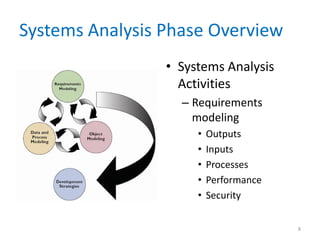
                 • Systems Analysis
                   Activities
                   – Requirements
                     modeling
                      •   Outputs
                      •   Inputs
                      •   Processes
                      •   Performance
                      •   Security


                                        8
Systems Analysis Phase Overview
• Systems Analysis Activities
  – Data and process modeling
  – Object Modeling
  – Development Strategies
     • System requirements document


                                      9
Systems Analysis Phase Overview
• Systems Analysis Skills
  – Analytical skills
  – Interpersonal skills
• Team-Oriented Methods and Techniques
  – Joint application development (JAD)
  – Rapid application development (RAD)
  – Agile methods


                                          10
Joint Application Development
• User Involvement
  – Users have a vital stake in an information system
    and they should participate fully
  – Successful systems must be user-oriented, and
    users need to be involved
  – One popular strategy for user involvement is a JAD
    team approach


                                                     11
Joint Application Development
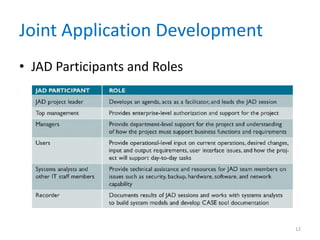
• JAD Participants and Roles


                                12
Joint Application Development
• JAD Advantages and Disadvantages
  – More expensive and can be cumbersome if the
    group is too large relative to the size of the project
  – Allows key users to participate effectively
  – When properly used, JAD can result in a more
    accurate statement of system requirements, a
    better understanding of common goals, and a
    stronger commitment to the success of the new
    system

                                                         13
Rapid Application Development
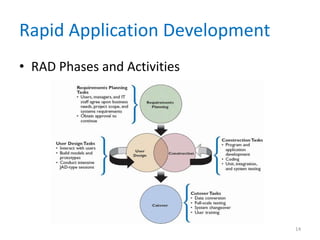
• RAD Phases and Activities


                                14
Rapid Application Development
• RAD Objectives
  – To cut development time and expense by involving
    the users in every phase of systems development
  – Successful RAD team must have IT
    resources, skills, and management support
  – Helps a development team design a system that
    requires a highly interactive or complex user
    interface


                                                   15
Rapid Application Development
• RAD Advantages and Disadvantages
  – Systems can be developed more quickly with
    significant cost savings
  – RAD stresses the mechanics of the system itself
    and does not emphasize the company’s strategic
    business needs
  – Might allow less time to develop
    quality, consistency, and design standards


                                                      16
Agile Methods
• Attempt to develop a system incrementally
• Agilian modeling toolset includes support for
  many modeling tools
• Some agile developers prefer not to use CASE
  tools at all, and rely instead on whiteboard
  displays and arrangements of movable sticky
  notes


                                                  17
Agile Methods
• Scrum is a rugby term
• Pigs include the product owner, the
  facilitator, and the development team; while
  the chickens include users, other
  stakeholders, and managers
• Scrum sessions have specific guidelines that
  emphasize time blocks, interaction, and team-
  based activities that result in deliverable
  software

                                              18
Agile Methods
• Agile Method Advantages and Disadvantages
  – Are very flexible and efficient in dealing with
    change
  – Frequent deliverables constantly validate the
    project and reduce risk
  – Team members need a high level of technical and
    interpersonal skills
  – May be subject to significant change in scope


                                                      19
Modeling Tools and Techniques
•   CASE Tools
•   Functional Decomposition Diagrams
•   Data Flow Diagrams
•   Unified Modeling Language


                                        20
System Requirements Checklist
• Outputs
  – The Web site must report online volume statistics
    every four hours, and hourly during peak periods
  – The inventory system must produce a daily report
    showing the part number, description, quantity on
    hand, quantity allocated, quantity available, and
    unit cost of all sorted by part number


                                                    21
System Requirements Checklist
• Inputs
  – Manufacturing employees must swipe their ID
    cards into online data collection terminals that
    record labor costs and calculate production
    efficiency
  – The department head must enter overtime hours
    on a separate screen


                                                       22
System Requirements Checklist
• Processes
  – The student records system must calculate the
    GPA at the end of each semester
  – As the final step in year-end processing, the
    payroll system must update employee
    salaries, bonuses, and benefits and produce tax
    data required by the IRS


                                                      23
System Requirements Checklist
• Performance
  – The system must support 25 users online
    simultaneously
  – Response time must not exceed four seconds


                                                 24
System Requirements Checklist
• Controls
  – The system must provide logon security at the
    operating system level and at the application level
  – An employee record must be added, changed, or
    deleted only by a member of the human resources
    department


                                                     25
Future Growth, Costs, and Benefits
• Scalability
  – A scalable system offers a better return on the
    initial investment
  – To evaluate scalability, you need information
    about projected future volume for all
    outputs, inputs, and processes


                                                      26
Future Growth, Costs, and Benefits
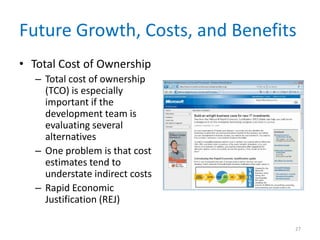
• Total Cost of Ownership
   – Total cost of ownership
     (TCO) is especially
     important if the
     development team is
     evaluating several
     alternatives
   – One problem is that cost
     estimates tend to
     understate indirect costs
   – Rapid Economic
     Justification (REJ)

                                 27
Fact-Finding
• Fact-Finding Overview
  – First, you must identify the information you need
  – Develop a fact-finding plan
• Who, What, Where, When, How, and Why?
  – Difference between asking what is being done and
    what could or should be done


                                                        28
Fact-Finding
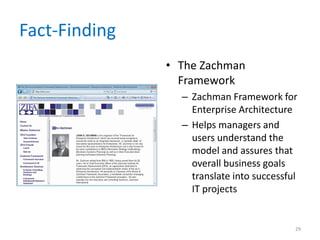
               • The Zachman
                 Framework
                 – Zachman Framework for
                   Enterprise Architecture
                 – Helps managers and
                   users understand the
                   model and assures that
                   overall business goals
                   translate into successful
                   IT projects


                                           29
Interviews
• Step 1: Determine the
  People to Interview
   – Informal structures
• Step 2: Establish
  Objectives for the
  Interview
   – Determine the general
     areas to be discussed
   – List the facts you want to
     gather

                                  30
Interviews
• Step 3: Develop Interview Questions
  – Creating a standard list of interview questions
    helps to keep you on track and avoid unnecessary
    tangents
  – Avoid leading questions
  – Open-ended questions
  – Closed-ended questions
  – Range-of-response questions


                                                   31
Interviews
• Step 4: Prepare for the Interview
  – Careful preparation is essential because an
    interview is an important meeting and not just a
    casual chat
  – Limit the interview to no more than one hour
  – Send a list of topics
  – Ask the interviewee to have samples available


                                                       32
Interviews
• Step 5: Conduct the Interview
  – Develop a specific plan for the meeting
  – Begin by introducing yourself, describing the
    project, and explaining your interview objectives
  – Engaged listening
  – Allow the person enough time to think about the
    question
  – After an interview, you should summarize the
    session and seek a confirmation

                                                        33
Interviews
• Step 6: Document the Interview
  – Note taking should be kept to a minimum
  – After conducting the interview, you must record
    the information quickly
  – After the interview, send memo to the interviewee
    expressing your appreciation
  – Note date, time, location, purpose of the
    interview, and the main points you discussed so
    the interviewee has a written summary and can
    offer additions or corrections

                                                   34
Interviews
• Step 7: Evaluate the Interview
  – In addition to recording the facts obtained in an
    interview, try to identify any possible biases
• Unsuccessful Interviews
  – No matter how well you prepare for
    interviews, some are not successful


                                                        35
Other Fact-Finding Techniques
• Document Review
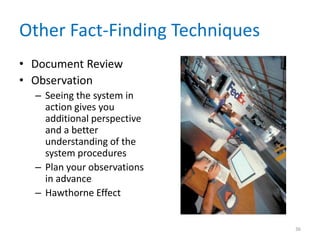
• Observation
  – Seeing the system in
    action gives you
    additional perspective
    and a better
    understanding of the
    system procedures
  – Plan your observations
    in advance
  – Hawthorne Effect


                                36
Other Fact-Finding Techniques
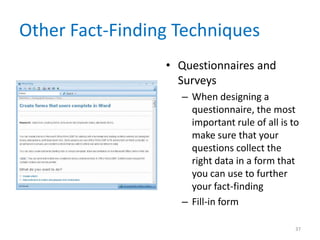
                 • Questionnaires and
                   Surveys
                   – When designing a
                     questionnaire, the most
                     important rule of all is to
                     make sure that your
                     questions collect the
                     right data in a form that
                     you can use to further
                     your fact-finding
                   – Fill-in form

                                               37
Other Fact-Finding Techniques
• Sampling
  – Systematic sample
  – Stratified sample
  – Random sample
  – Main objective of a sample is to ensure that it
    represents the overall population accurately


                                                      38
Other Fact-Finding Techniques
• Research
  – Can include the
    Internet, IT
    magazines, and books to
    obtain background
    information, technical
    material, and news
    about industry trends
    and developments
  – Site visit


                                39
Other Fact-Finding Techniques
• Interviews versus Questionnaires
  – Interview is more familiar and personal
  – Questionnaire gives many people the opportunity
    to provide input and suggestions
  – Brainstorming
  – Structured brainstorming
  – Unstructured brainstorming


                                                  40
Documentation
• The Need for Recording the Facts
  – Record information as soon as you obtain it
  – Use the simplest recording method
  – Record your findings in such a way that they can
    be understood by someone else
  – Organize your documentation so related material
    is located easily


                                                       41
Documentation
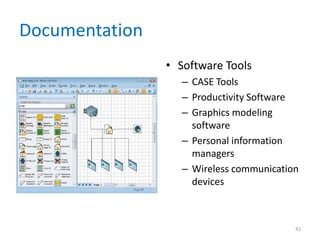
                • Software Tools
                  – CASE Tools
                  – Productivity Software
                  – Graphics modeling
                    software
                  – Personal information
                    managers
                  – Wireless communication
                    devices


                                         42
Preview of Logical Modeling
• At the conclusion of requirements
  modeling, systems developers should have a
  clear understanding of business processes and
  system requirements
• The next step is to construct a logical model of
  the system
• IT professionals have differing views about
  systems development methodologies, and no
  universally accepted approach exists

                                                 43
Chapter Summary
• The systems analysis phase includes three
  activities: requirements modeling, data and
  process modeling, and consideration of
  development strategies
• The main objective is to understand the
  proposed project, ensure that it will support
  business requirements, and build a solid
  foundation for the systems design phase

                                                  44
Chapter Summary
• The fact-finding process includes
  interviewing, document
  review, observation, questionnaires, sampling, an
  d research
• Systems analysts should carefully record and
  document factual information as it is
  collected, and various software tools can help an
  analyst visualize and describe an information
  system

                                                  45
• Chapter 4 complete

Chapter 04

  • 1.
    Systems Analysis andDesign 8th Edition Chapter 4 Requirements Modeling
  • 2.
    Phase Description • Systemsanalysis is the second of five phases in the systems development life cycle (SDLC) • Will use requirements modeling, data and process modeling, and object modeling techniques to represent the new system • Will consider various development strategies for the new system, and plan for the transition to systems design tasks 2
  • 3.
    Chapter Objectives • Describesystems analysis phase activities and the end product of the systems analysis phase • Explain joint application development (JAD), rapid application development (RAD), and agile methods • Understand how systems analysts use a functional decomposition diagram (FDD) 3
  • 4.
    Chapter Objectives • Describethe Unified Modeling Language (UML) and explain use case diagrams and sequence diagrams • List and describe system requirements, including outputs, inputs, processes, performance, and controls • Explain the concept of scalability 4
  • 5.
    Chapter Objectives • Usefact-finding techniques, including interviews, documentation review, observation, questionnaires, sampling, and research • Define total cost of ownership (TCO) • Conduct a successful interview • Develop effective documentation methods to use during systems development 5
  • 6.
    Introduction • This chapterdescribes requirements modeling techniques and team-based methods that systems analysts use to visualize and document new systems • The chapter then discusses system requirements and fact-finding techniques, which include interviewing, documentation review, observation, surveys and questionnaires, sampling, and research 6
  • 7.
    Systems Analysis PhaseOverview • The overall objective of the systems analysis phase is to understand the proposed project, ensure that it will support business requirements, and build a solid foundation for system development • You use models and other documentation tools to visualize and describe the proposed system 7
  • 8.
    Systems Analysis PhaseOverview • Systems Analysis Activities – Requirements modeling • Outputs • Inputs • Processes • Performance • Security 8
  • 9.
    Systems Analysis PhaseOverview • Systems Analysis Activities – Data and process modeling – Object Modeling – Development Strategies • System requirements document 9
  • 10.
    Systems Analysis PhaseOverview • Systems Analysis Skills – Analytical skills – Interpersonal skills • Team-Oriented Methods and Techniques – Joint application development (JAD) – Rapid application development (RAD) – Agile methods 10
  • 11.
    Joint Application Development •User Involvement – Users have a vital stake in an information system and they should participate fully – Successful systems must be user-oriented, and users need to be involved – One popular strategy for user involvement is a JAD team approach 11
  • 12.
    Joint Application Development •JAD Participants and Roles 12
  • 13.
    Joint Application Development •JAD Advantages and Disadvantages – More expensive and can be cumbersome if the group is too large relative to the size of the project – Allows key users to participate effectively – When properly used, JAD can result in a more accurate statement of system requirements, a better understanding of common goals, and a stronger commitment to the success of the new system 13
  • 14.
    Rapid Application Development •RAD Phases and Activities 14
  • 15.
    Rapid Application Development •RAD Objectives – To cut development time and expense by involving the users in every phase of systems development – Successful RAD team must have IT resources, skills, and management support – Helps a development team design a system that requires a highly interactive or complex user interface 15
  • 16.
    Rapid Application Development •RAD Advantages and Disadvantages – Systems can be developed more quickly with significant cost savings – RAD stresses the mechanics of the system itself and does not emphasize the company’s strategic business needs – Might allow less time to develop quality, consistency, and design standards 16
  • 17.
    Agile Methods • Attemptto develop a system incrementally • Agilian modeling toolset includes support for many modeling tools • Some agile developers prefer not to use CASE tools at all, and rely instead on whiteboard displays and arrangements of movable sticky notes 17
  • 18.
    Agile Methods • Scrumis a rugby term • Pigs include the product owner, the facilitator, and the development team; while the chickens include users, other stakeholders, and managers • Scrum sessions have specific guidelines that emphasize time blocks, interaction, and team- based activities that result in deliverable software 18
  • 19.
    Agile Methods • AgileMethod Advantages and Disadvantages – Are very flexible and efficient in dealing with change – Frequent deliverables constantly validate the project and reduce risk – Team members need a high level of technical and interpersonal skills – May be subject to significant change in scope 19
  • 20.
    Modeling Tools andTechniques • CASE Tools • Functional Decomposition Diagrams • Data Flow Diagrams • Unified Modeling Language 20
  • 21.
    System Requirements Checklist •Outputs – The Web site must report online volume statistics every four hours, and hourly during peak periods – The inventory system must produce a daily report showing the part number, description, quantity on hand, quantity allocated, quantity available, and unit cost of all sorted by part number 21
  • 22.
    System Requirements Checklist •Inputs – Manufacturing employees must swipe their ID cards into online data collection terminals that record labor costs and calculate production efficiency – The department head must enter overtime hours on a separate screen 22
  • 23.
    System Requirements Checklist •Processes – The student records system must calculate the GPA at the end of each semester – As the final step in year-end processing, the payroll system must update employee salaries, bonuses, and benefits and produce tax data required by the IRS 23
  • 24.
    System Requirements Checklist •Performance – The system must support 25 users online simultaneously – Response time must not exceed four seconds 24
  • 25.
    System Requirements Checklist •Controls – The system must provide logon security at the operating system level and at the application level – An employee record must be added, changed, or deleted only by a member of the human resources department 25
  • 26.
    Future Growth, Costs,and Benefits • Scalability – A scalable system offers a better return on the initial investment – To evaluate scalability, you need information about projected future volume for all outputs, inputs, and processes 26
  • 27.
    Future Growth, Costs,and Benefits • Total Cost of Ownership – Total cost of ownership (TCO) is especially important if the development team is evaluating several alternatives – One problem is that cost estimates tend to understate indirect costs – Rapid Economic Justification (REJ) 27
  • 28.
    Fact-Finding • Fact-Finding Overview – First, you must identify the information you need – Develop a fact-finding plan • Who, What, Where, When, How, and Why? – Difference between asking what is being done and what could or should be done 28
  • 29.
    Fact-Finding • The Zachman Framework – Zachman Framework for Enterprise Architecture – Helps managers and users understand the model and assures that overall business goals translate into successful IT projects 29
  • 30.
    Interviews • Step 1:Determine the People to Interview – Informal structures • Step 2: Establish Objectives for the Interview – Determine the general areas to be discussed – List the facts you want to gather 30
  • 31.
    Interviews • Step 3:Develop Interview Questions – Creating a standard list of interview questions helps to keep you on track and avoid unnecessary tangents – Avoid leading questions – Open-ended questions – Closed-ended questions – Range-of-response questions 31
  • 32.
    Interviews • Step 4:Prepare for the Interview – Careful preparation is essential because an interview is an important meeting and not just a casual chat – Limit the interview to no more than one hour – Send a list of topics – Ask the interviewee to have samples available 32
  • 33.
    Interviews • Step 5:Conduct the Interview – Develop a specific plan for the meeting – Begin by introducing yourself, describing the project, and explaining your interview objectives – Engaged listening – Allow the person enough time to think about the question – After an interview, you should summarize the session and seek a confirmation 33
  • 34.
    Interviews • Step 6:Document the Interview – Note taking should be kept to a minimum – After conducting the interview, you must record the information quickly – After the interview, send memo to the interviewee expressing your appreciation – Note date, time, location, purpose of the interview, and the main points you discussed so the interviewee has a written summary and can offer additions or corrections 34
  • 35.
    Interviews • Step 7:Evaluate the Interview – In addition to recording the facts obtained in an interview, try to identify any possible biases • Unsuccessful Interviews – No matter how well you prepare for interviews, some are not successful 35
  • 36.
    Other Fact-Finding Techniques •Document Review • Observation – Seeing the system in action gives you additional perspective and a better understanding of the system procedures – Plan your observations in advance – Hawthorne Effect 36
  • 37.
    Other Fact-Finding Techniques • Questionnaires and Surveys – When designing a questionnaire, the most important rule of all is to make sure that your questions collect the right data in a form that you can use to further your fact-finding – Fill-in form 37
  • 38.
    Other Fact-Finding Techniques •Sampling – Systematic sample – Stratified sample – Random sample – Main objective of a sample is to ensure that it represents the overall population accurately 38
  • 39.
    Other Fact-Finding Techniques •Research – Can include the Internet, IT magazines, and books to obtain background information, technical material, and news about industry trends and developments – Site visit 39
  • 40.
    Other Fact-Finding Techniques •Interviews versus Questionnaires – Interview is more familiar and personal – Questionnaire gives many people the opportunity to provide input and suggestions – Brainstorming – Structured brainstorming – Unstructured brainstorming 40
  • 41.
    Documentation • The Needfor Recording the Facts – Record information as soon as you obtain it – Use the simplest recording method – Record your findings in such a way that they can be understood by someone else – Organize your documentation so related material is located easily 41
  • 42.
    Documentation • Software Tools – CASE Tools – Productivity Software – Graphics modeling software – Personal information managers – Wireless communication devices 42
  • 43.
    Preview of LogicalModeling • At the conclusion of requirements modeling, systems developers should have a clear understanding of business processes and system requirements • The next step is to construct a logical model of the system • IT professionals have differing views about systems development methodologies, and no universally accepted approach exists 43
  • 44.
    Chapter Summary • Thesystems analysis phase includes three activities: requirements modeling, data and process modeling, and consideration of development strategies • The main objective is to understand the proposed project, ensure that it will support business requirements, and build a solid foundation for the systems design phase 44
  • 45.
    Chapter Summary • Thefact-finding process includes interviewing, document review, observation, questionnaires, sampling, an d research • Systems analysts should carefully record and document factual information as it is collected, and various software tools can help an analyst visualize and describe an information system 45 • Chapter 4 complete