Systems Analysis and Design
8th Edition

Chapter 2
Analyzing the Business Case
Chapter Objectives
• Explain the concept of a business case and
  how a business case affects an IT project
• Describe the strategic planning process and
  why it is important to the IT team
• Conduct a SWOT analysis and describe the
  four factors involved


                                                2
Chapter Objectives
• Explain the purpose of a mission statement
• Describe the SDLC, and explain how it serves
  as a framework for systems development and
  business modeling
• List the reasons for information systems
  projects and the factors that affect such
  projects


                                                 3
Chapter Objectives
• Explain the initial review of systems requests
  and the role of the systems review committee
• Define operational feasibility, technical
  feasibility, economic feasibility, and schedule
  feasibility
• Describe the steps in a preliminary
  investigation and the end product of an
  investigation

                                                    4
Introduction
• The term business case refers to the reasons,
  or justification, for a proposal
• A strong business case suggests that the
  company should pursue the alternative, above
  other options, because it would be in the
  firm’s best interest to do so
• Systems development typically starts with a
  systems request, followed by a preliminary
  investigation, which includes a feasibility study

                                                  5
Strategic Planning – A Framework for
IT Systems Development
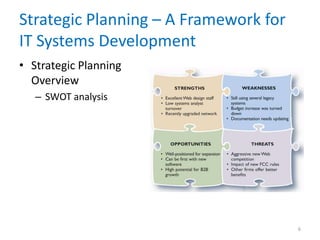
• Strategic Planning
  Overview
   – SWOT analysis


                                       6
Strategic Planning – A Framework for
IT Systems Development
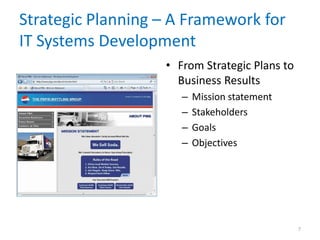
                   • From Strategic Plans to
                     Business Results
                      –   Mission statement
                      –   Stakeholders
                      –   Goals
                      –   Objectives


                                               7
Strategic Planning – A Framework for
IT Systems Development
• A CASE Tool Example
  – You are a systems analyst
  – You research the Visible Analyst CASE tool
  – Planning statements can include assumptions,
    goals, objectives, and critical success factors, and
    many other types of statements


                                                           8
Strategic Planning – A Framework for
IT Systems Development
• The Role of the IT Department in Project
  Evaluation
  – Management leadership and information
    technology are linked closely, and remarkable
    changes have occurred in both areas
  – Today, systems development is much more team
    oriented
  – Although team-oriented development is the norm,
    some companies see the role of the IT department
    as a gatekeeper

                                                   9
Strategic Planning – A Framework for
IT Systems Development
• The Future
  – If you could look into the future, here is what you
    might see: new industries, products, and services
    emerging from amazing advances in information
    technology, customers who expect world-class IT
    support, a surge in Internet-based commerce, and
    a global business environment that is dynamic and
    incredibly challenging


                                                      10
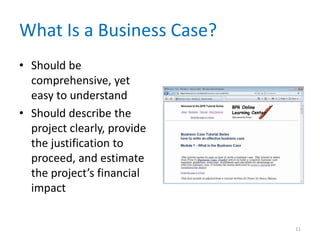
What Is a Business Case?
• Should be
  comprehensive, yet
  easy to understand
• Should describe the
  project clearly, provide
  the justification to
  proceed, and estimate
  the project’s financial
  impact


                             11
Information Systems Projects
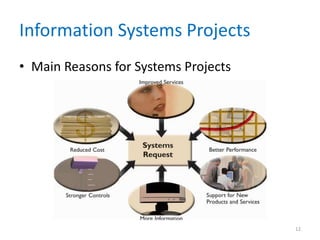
• Main Reasons for Systems Projects


                                      12
Information Systems Projects
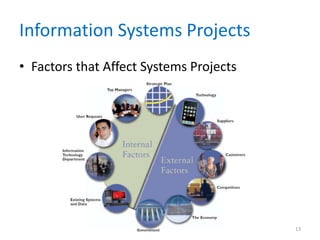
• Factors that Affect Systems Projects


                                         13
Information Systems Projects
• Project Management
  – If the project is approved, it can be planned,
    scheduled, monitored and controlled, and
    reported upon
  – Individual analysts or IT staff members often
    handle small projects, but companies usually
    designate a project manager to coordinate the
    overall effort for complex projects


                                                     14
Evaluation of Systems Requests
• Systems review committee or a computer
  resources committee evaluate systems
  requests
• Systems Requests Forms
  – A properly designed form streamlines the request
    process and ensures consistency
  – Occasionally a situation will arise that requires an
    immediate response


                                                       15
Evaluation of Systems Requests
• Systems Review Committees
  – Most large companies use a systems review
    committee to evaluate systems requests
  – Many smaller companies rely on one person to
    evaluate systems requests instead of a committee
  – The goal is to evaluate the requests and set
    priorities


                                                   16
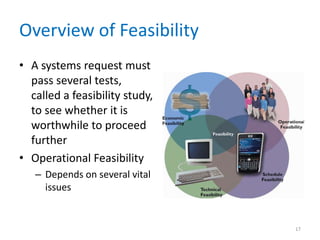
Overview of Feasibility
• A systems request must
  pass several tests,
  called a feasibility study,
  to see whether it is
  worthwhile to proceed
  further
• Operational Feasibility
   – Depends on several vital
     issues


                                17
Overview of Feasibility
• Technical Feasibility
• Economic Feasibility
  – Total cost of ownership (TCO)
  – Tangible benefits
  – Intangible benefits
• Schedule Feasibility


                                    18
Evaluating Feasibility
• The first step in evaluating feasibility is to
  identify and weed out systems requests that
  are not feasible
• Even if the request is feasible, it might not be
  necessary
• Feasibility analysis is an ongoing task that
  must be performed throughout the systems
  development process

                                                     19
Setting Priorities
• Factors that Affect Priority
  – Will the proposed system reduce costs? Where?
    When? How? How much?
  – Will the system increase revenue for the
    company? Where? When? How? How much?


                                                    20
Setting Priorities
• Factors that Affect Priority
  – Will the systems project result in more
    information or produce better results? How? Are
    the results measurable?
  – Will the system serve customers better?
  – Will the system serve the organization better?


                                                      21
Setting Priorities
• Factors that Affect Priority
  – Can the project be implemented in a reasonable
    time period? How long will the results last?
  – Are the necessary financial, human, and technical
    resources available?
  – Whenever possible, the analyst should evaluate a
    proposed project based on tangible costs and
    benefits that represent actual (or approximate)
    dollar values

                                                        22
Setting Priorities
• Discretionary and Nondiscretionary Projects
  – Projects where management has a choice in
    implementing them are called discretionary
    projects
  – Projects where no choice exists are called
    nondiscretionary projects


                                                 23
Preliminary Investigation Overview
• Preliminary investigation
• Interaction with Managers and Users
  – Let people know about the investigation and
    explain your role
  – Employee attitudes and reactions are important
    and must be considered
  – Be careful in your use of the word problem
  – Question users about additional capability they
    would like to have
                                                      24
Preliminary Investigation Overview
• Planning the Preliminary Investigation
  – During a preliminary investigation, a systems
    analyst typically follows a series of steps
  – The exact procedure depends on the nature of the
    request, the size of the project, and the degree of
    urgency


                                                      25
Preliminary Investigation Overview
• Step 1: Understand the Problem or
  Opportunity
  – A popular technique for investigating causes and
    effects is called a fishbone diagram, or Ishikawa
    diagram
  – Pareto chart


                                                        26
Preliminary Investigation Overview
• Step 2: Define the Project Scope and
  Constraints
  – Project scope
  – Project creep
  – Constraint


                                         27
Preliminary Investigation Overview
• Step 2: Define the Project Scope and
  Constraints
  – Present versus future
  – Internal versus external
  – Mandatory versus desirable
  – Regardless of the type, all constraints should be
    identified as early as possible to avoid future
    problems and surprises


                                                        28
Preliminary Investigation Overview
• Step 3: Perform Fact-Finding
  – Fact-finding involves various techniques
  – Depending on what information is needed to
    investigate the systems request, fact-finding might
    consume several hours, days, or weeks
  – Analyze Organization Charts
     • Obtain organization charts to understand how the
       department functions and identify individuals you
       might want to interview


                                                           29
Preliminary Investigation Overview
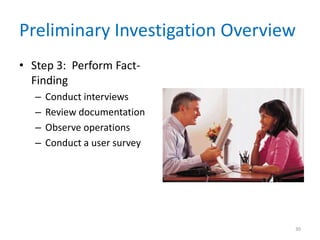
• Step 3: Perform Fact-
  Finding
   –   Conduct interviews
   –   Review documentation
   –   Observe operations
   –   Conduct a user survey


                                 30
Preliminary Investigation Overview
• Step 4: Analyze Project Usability, Cost,
  Benefit, and Schedule Data
  – Before you can evaluate feasibility, you must
    analyze this data carefully
  – What information must you obtain, and how will
    you gather and analyze the information?
  – What sources of information will you use, and
    what difficulties will you encounter in obtaining
    information?

                                                        31
Preliminary Investigation Overview
• Step 4: Analyze Project Usability, Cost, Benefit,
  and Schedule Data
  – Will you conduct interviews? How many people
    will you interview, and how much time will you
    need to meet with the people and summarize
    their responses?
  – Will you conduct a survey? Who will be involved?
    How much time will it take people to complete it?
    How much time will it take to prepare it and
    tabulate the results?

                                                    32
Preliminary Investigation Overview
• Step 4: Analyze Project Usability, Cost, Benefit,
  and Schedule Data
  – How much will it cost to analyze the information
    gathered and to prepare a report with findings
    and recommendations?


                                                       33
Preliminary Investigation Overview
• Step 5: Evaluate Feasibility
  – Start by reviewing the answers to the questions
    you asked
  – Operational feasibility
  – Technical feasibility
  – Economic feasibility
  – Schedule feasibility


                                                      34
Preliminary Investigation Overview
• Step 6: Present Results and
  Recommendations to Management
  – The final task in the preliminary investigation is to
    prepare a report to management
  – The format of the preliminary investigation report
    varies from one company to another


                                                        35
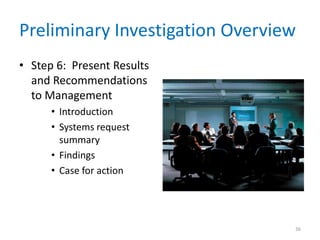
Preliminary Investigation Overview
• Step 6: Present Results
  and Recommendations
  to Management
      • Introduction
      • Systems request
        summary
      • Findings
      • Case for action


                                 36
Preliminary Investigation Overview
• Step 6: Present Results and
  Recommendations to Management
    •   Project Roles
    •   Time & cost estimates
    •   Expected benefits
    •   Appendix


                                  37
Chapter Summary
• Strategic planning allows a company to examine
  its purpose, vision, and values and develops a
  mission statement, which leads to goals,
  objectives, day-to-day operations, and business
  results that affect company stakeholders
• Systems projects are initiated to improve
  performance, provide more information, reduce
  costs, strengthen controls, or provide better
  service

                                                    38
Chapter Summary
• Various internal and external factors affect
  systems projects, such as user requests, top
  management directives, existing systems, the IT
  department, software and hardware vendors,
  technology, customers, competitors, the
  economy, and government
• During the preliminary investigation, the analyst
  evaluates the systems request and determines
  whether the project is feasible from an operation,
  technical, economic, and schedule standpoint

                                                   39
Chapter Summary
• Analysts evaluate systems requests on the basis
  of their expected costs and benefits, both
  tangible and intangible
• The steps in the preliminary investigation are to
  understand the problem or opportunity; define
  the project scope and constraints; perform fact-
  finding; analyze project usability, cost, benefit,
  and schedule data; evaluate feasibility; and
  present results and recommendations to
  management

                                                       40
Chapter Summary
• The last task in a preliminary investigation is to
  prepare a report to management
• The report must include an estimate of time,
  staffing requirements, costs, benefits, and
  expected results for the next phase of the
  SDLC

• Chapter 2 complete

                                                   41

Chapter 02

  • 1.
    Systems Analysis andDesign 8th Edition Chapter 2 Analyzing the Business Case
  • 2.
    Chapter Objectives • Explainthe concept of a business case and how a business case affects an IT project • Describe the strategic planning process and why it is important to the IT team • Conduct a SWOT analysis and describe the four factors involved 2
  • 3.
    Chapter Objectives • Explainthe purpose of a mission statement • Describe the SDLC, and explain how it serves as a framework for systems development and business modeling • List the reasons for information systems projects and the factors that affect such projects 3
  • 4.
    Chapter Objectives • Explainthe initial review of systems requests and the role of the systems review committee • Define operational feasibility, technical feasibility, economic feasibility, and schedule feasibility • Describe the steps in a preliminary investigation and the end product of an investigation 4
  • 5.
    Introduction • The termbusiness case refers to the reasons, or justification, for a proposal • A strong business case suggests that the company should pursue the alternative, above other options, because it would be in the firm’s best interest to do so • Systems development typically starts with a systems request, followed by a preliminary investigation, which includes a feasibility study 5
  • 6.
    Strategic Planning –A Framework for IT Systems Development • Strategic Planning Overview – SWOT analysis 6
  • 7.
    Strategic Planning –A Framework for IT Systems Development • From Strategic Plans to Business Results – Mission statement – Stakeholders – Goals – Objectives 7
  • 8.
    Strategic Planning –A Framework for IT Systems Development • A CASE Tool Example – You are a systems analyst – You research the Visible Analyst CASE tool – Planning statements can include assumptions, goals, objectives, and critical success factors, and many other types of statements 8
  • 9.
    Strategic Planning –A Framework for IT Systems Development • The Role of the IT Department in Project Evaluation – Management leadership and information technology are linked closely, and remarkable changes have occurred in both areas – Today, systems development is much more team oriented – Although team-oriented development is the norm, some companies see the role of the IT department as a gatekeeper 9
  • 10.
    Strategic Planning –A Framework for IT Systems Development • The Future – If you could look into the future, here is what you might see: new industries, products, and services emerging from amazing advances in information technology, customers who expect world-class IT support, a surge in Internet-based commerce, and a global business environment that is dynamic and incredibly challenging 10
  • 11.
    What Is aBusiness Case? • Should be comprehensive, yet easy to understand • Should describe the project clearly, provide the justification to proceed, and estimate the project’s financial impact 11
  • 12.
    Information Systems Projects •Main Reasons for Systems Projects 12
  • 13.
    Information Systems Projects •Factors that Affect Systems Projects 13
  • 14.
    Information Systems Projects •Project Management – If the project is approved, it can be planned, scheduled, monitored and controlled, and reported upon – Individual analysts or IT staff members often handle small projects, but companies usually designate a project manager to coordinate the overall effort for complex projects 14
  • 15.
    Evaluation of SystemsRequests • Systems review committee or a computer resources committee evaluate systems requests • Systems Requests Forms – A properly designed form streamlines the request process and ensures consistency – Occasionally a situation will arise that requires an immediate response 15
  • 16.
    Evaluation of SystemsRequests • Systems Review Committees – Most large companies use a systems review committee to evaluate systems requests – Many smaller companies rely on one person to evaluate systems requests instead of a committee – The goal is to evaluate the requests and set priorities 16
  • 17.
    Overview of Feasibility •A systems request must pass several tests, called a feasibility study, to see whether it is worthwhile to proceed further • Operational Feasibility – Depends on several vital issues 17
  • 18.
    Overview of Feasibility •Technical Feasibility • Economic Feasibility – Total cost of ownership (TCO) – Tangible benefits – Intangible benefits • Schedule Feasibility 18
  • 19.
    Evaluating Feasibility • Thefirst step in evaluating feasibility is to identify and weed out systems requests that are not feasible • Even if the request is feasible, it might not be necessary • Feasibility analysis is an ongoing task that must be performed throughout the systems development process 19
  • 20.
    Setting Priorities • Factorsthat Affect Priority – Will the proposed system reduce costs? Where? When? How? How much? – Will the system increase revenue for the company? Where? When? How? How much? 20
  • 21.
    Setting Priorities • Factorsthat Affect Priority – Will the systems project result in more information or produce better results? How? Are the results measurable? – Will the system serve customers better? – Will the system serve the organization better? 21
  • 22.
    Setting Priorities • Factorsthat Affect Priority – Can the project be implemented in a reasonable time period? How long will the results last? – Are the necessary financial, human, and technical resources available? – Whenever possible, the analyst should evaluate a proposed project based on tangible costs and benefits that represent actual (or approximate) dollar values 22
  • 23.
    Setting Priorities • Discretionaryand Nondiscretionary Projects – Projects where management has a choice in implementing them are called discretionary projects – Projects where no choice exists are called nondiscretionary projects 23
  • 24.
    Preliminary Investigation Overview •Preliminary investigation • Interaction with Managers and Users – Let people know about the investigation and explain your role – Employee attitudes and reactions are important and must be considered – Be careful in your use of the word problem – Question users about additional capability they would like to have 24
  • 25.
    Preliminary Investigation Overview •Planning the Preliminary Investigation – During a preliminary investigation, a systems analyst typically follows a series of steps – The exact procedure depends on the nature of the request, the size of the project, and the degree of urgency 25
  • 26.
    Preliminary Investigation Overview •Step 1: Understand the Problem or Opportunity – A popular technique for investigating causes and effects is called a fishbone diagram, or Ishikawa diagram – Pareto chart 26
  • 27.
    Preliminary Investigation Overview •Step 2: Define the Project Scope and Constraints – Project scope – Project creep – Constraint 27
  • 28.
    Preliminary Investigation Overview •Step 2: Define the Project Scope and Constraints – Present versus future – Internal versus external – Mandatory versus desirable – Regardless of the type, all constraints should be identified as early as possible to avoid future problems and surprises 28
  • 29.
    Preliminary Investigation Overview •Step 3: Perform Fact-Finding – Fact-finding involves various techniques – Depending on what information is needed to investigate the systems request, fact-finding might consume several hours, days, or weeks – Analyze Organization Charts • Obtain organization charts to understand how the department functions and identify individuals you might want to interview 29
  • 30.
    Preliminary Investigation Overview •Step 3: Perform Fact- Finding – Conduct interviews – Review documentation – Observe operations – Conduct a user survey 30
  • 31.
    Preliminary Investigation Overview •Step 4: Analyze Project Usability, Cost, Benefit, and Schedule Data – Before you can evaluate feasibility, you must analyze this data carefully – What information must you obtain, and how will you gather and analyze the information? – What sources of information will you use, and what difficulties will you encounter in obtaining information? 31
  • 32.
    Preliminary Investigation Overview •Step 4: Analyze Project Usability, Cost, Benefit, and Schedule Data – Will you conduct interviews? How many people will you interview, and how much time will you need to meet with the people and summarize their responses? – Will you conduct a survey? Who will be involved? How much time will it take people to complete it? How much time will it take to prepare it and tabulate the results? 32
  • 33.
    Preliminary Investigation Overview •Step 4: Analyze Project Usability, Cost, Benefit, and Schedule Data – How much will it cost to analyze the information gathered and to prepare a report with findings and recommendations? 33
  • 34.
    Preliminary Investigation Overview •Step 5: Evaluate Feasibility – Start by reviewing the answers to the questions you asked – Operational feasibility – Technical feasibility – Economic feasibility – Schedule feasibility 34
  • 35.
    Preliminary Investigation Overview •Step 6: Present Results and Recommendations to Management – The final task in the preliminary investigation is to prepare a report to management – The format of the preliminary investigation report varies from one company to another 35
  • 36.
    Preliminary Investigation Overview •Step 6: Present Results and Recommendations to Management • Introduction • Systems request summary • Findings • Case for action 36
  • 37.
    Preliminary Investigation Overview •Step 6: Present Results and Recommendations to Management • Project Roles • Time & cost estimates • Expected benefits • Appendix 37
  • 38.
    Chapter Summary • Strategicplanning allows a company to examine its purpose, vision, and values and develops a mission statement, which leads to goals, objectives, day-to-day operations, and business results that affect company stakeholders • Systems projects are initiated to improve performance, provide more information, reduce costs, strengthen controls, or provide better service 38
  • 39.
    Chapter Summary • Variousinternal and external factors affect systems projects, such as user requests, top management directives, existing systems, the IT department, software and hardware vendors, technology, customers, competitors, the economy, and government • During the preliminary investigation, the analyst evaluates the systems request and determines whether the project is feasible from an operation, technical, economic, and schedule standpoint 39
  • 40.
    Chapter Summary • Analystsevaluate systems requests on the basis of their expected costs and benefits, both tangible and intangible • The steps in the preliminary investigation are to understand the problem or opportunity; define the project scope and constraints; perform fact- finding; analyze project usability, cost, benefit, and schedule data; evaluate feasibility; and present results and recommendations to management 40
  • 41.
    Chapter Summary • Thelast task in a preliminary investigation is to prepare a report to management • The report must include an estimate of time, staffing requirements, costs, benefits, and expected results for the next phase of the SDLC • Chapter 2 complete 41