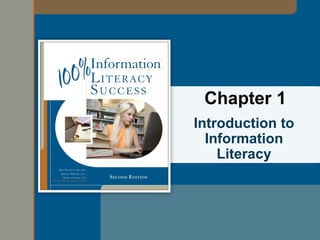
Chapter 1
Introduction to
  Information
    Literacy
Chapter Topics
      • Information Literacy in the 21st Century
      • Components of Information Literacy in the 21st
        Century
      • Why Is Information Literacy Important?
      • Steps in Effective Research


Copyright 2012 Wadsworth © Cengage Learning. All rights reserved.   1|2
The Big Picture
      This chapter lays the foundation for understanding
      the many aspects of information literacy. It
      provides a context for applying the information
      presented in subsequent chapters.


Copyright 2012 Wadsworth © Cengage Learning. All rights reserved.   1|3
Learning Objectives
      • Define information literacy.
      • List the specific skills required for an individual
        to be an information-literate student or
        professional in the 21st century.
      • Explain the importance of knowing how to
        locate, access, retrieve, evaluate, use, and
        effectively communicate information in school
        and in the workplace.


Copyright 2012 Wadsworth © Cengage Learning. All rights reserved.   1|4
Learning Objectives (cont’d)
      • Explain the challenges facing an individual who
        does not possess information skills in school
        and in the workplace.


Copyright 2012 Wadsworth © Cengage Learning. All rights reserved.   1|5
Case In Point Questions
      • How well do you think you could determine the
        kind and extent of information you might be
        asked to find so you are able to accomplish a
        professional task?
      • How efficient would you be at finding the
        information in a library or on the Internet?
      • How would you know that the information that
        you find is credible?


Copyright 2012 Wadsworth © Cengage Learning. All rights reserved.   1|6
Case in Point Questions (cont’d)
      • How skilled are you at pulling significant points
        from a large body of information and organizing
        them into a one- to two- page summary for
        review by professionals in your field?
      • How effectively could you make a presentation
        that would both engage and teach your
        colleagues?


Copyright 2012 Wadsworth © Cengage Learning. All rights reserved.   1|7
Information Literacy in the 21st
                      Century: An Overview


          Information literacy for the 21st century is defined as “the
           adoption of appropriate information behavior to identify,
           through whatever channel or medium, information well
        fitted to information needs, leading to wise and ethical use
                           of information in society.”
                                                                    -S. Webber (2010)


Copyright 2012 Wadsworth © Cengage Learning. All rights reserved.                  1|8
Information Literacy in the 21st
                      Century: An Overview
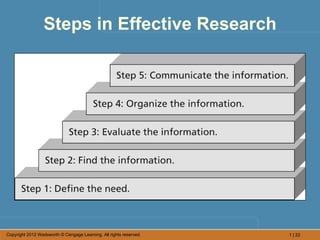
      • Define: Define the need, problem, or question.
      • Find: Locate, access, and retrieve the information from a
        variety of print, electronic, and human information
        sources.
      • Evaluate: Evaluate the credibility, currency, reliability,
        validity, and appropriateness of the information retrieved.


Copyright 2012 Wadsworth © Cengage Learning. All rights reserved.   1|9
Information Literacy in the 21st
                      Century: An Overview
      • Organize: Organize the information so that it can be
        used to meet the information need, solve the problem, or
        answer the question.
      • Communicate: Communicate the information legally
        and ethically using a variety of channels and to a range
        of audiences.


Copyright 2012 Wadsworth © Cengage Learning. All rights reserved.   1 | 10
Critical Thinking


Copyright 2012 Wadsworth © Cengage Learning. All rights reserved.   1 | 11
Creative Thinking
      The process of
      • Actively exploring possibilities
      • Generating alternatives
      • Keeping an open mind toward change
      • Combining ideas to create something new
      • Viewing old concepts in new ways


Copyright 2012 Wadsworth © Cengage Learning. All rights reserved.   1 | 12
Problem Solving


Copyright 2012 Wadsworth © Cengage Learning. All rights reserved.   1 | 13
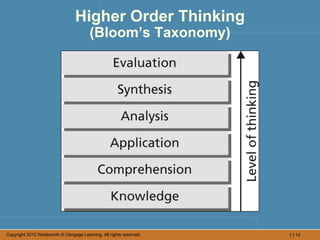
Higher Order Thinking
                                        (Bloom’s Taxonomy)


Copyright 2012 Wadsworth © Cengage Learning. All rights reserved.   1 | 14
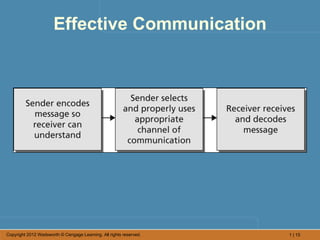
Effective Communication


Copyright 2012 Wadsworth © Cengage Learning. All rights reserved.   1 | 15
Organization
      • Understanding and using file management
        systems
      • Using time management techniques
      • Breaking complex tasks into manageable
        objectives
      • Using graphic organizers


Copyright 2012 Wadsworth © Cengage Learning. All rights reserved.   1 | 16
Computer Literacy
      •     Hardware
      •     Software
      •     Internet
      •     Multimedia
      •     File Management
      •     Security


Copyright 2012 Wadsworth © Cengage Learning. All rights reserved.   1 | 17
Library Literacy
      •     Books and periodicals
      •     Databases and directories
      •     Catalogs and indexes
      •     Media resources
      •     Reference materials


Copyright 2012 Wadsworth © Cengage Learning. All rights reserved.   1 | 18
Media Literacy
      •     Audio resources
      •     Visual resources
      •     Graphic resources
      •     Web-based resources
      •     Interactive resources
      •     Other formats


Copyright 2012 Wadsworth © Cengage Learning. All rights reserved.   1 | 19
Technology Literacy
      • Ability to use basic computer software programs
             –   Word-processing
             –   Spreadsheets
             –   Presentation Tools
             –   Databases
      • Ability to use the Internet
      • Ability to use supporting tools
             – Search engines
             – File management systems
             – Etc.


Copyright 2012 Wadsworth © Cengage Learning. All rights reserved.   1 | 20
Why is information literacy important?


             So what if you lack these skills?


Copyright 2012 Wadsworth © Cengage Learning. All rights reserved.   1 | 21
Steps in Effective Research


Copyright 2012 Wadsworth © Cengage Learning. All rights reserved.   1 | 22
Chapter Summary
      • Information Literacy in the 21st Century
      • Components of Information Literacy in the 21st
        Century
      • Why is Information Literacy Important?
      • Steps in Effective Research


Copyright 2012 Wadsworth © Cengage Learning. All rights reserved.   1 | 23

Chapter1

  • 1.
    Chapter 1 Introduction to Information Literacy
  • 2.
    Chapter Topics • Information Literacy in the 21st Century • Components of Information Literacy in the 21st Century • Why Is Information Literacy Important? • Steps in Effective Research Copyright 2012 Wadsworth © Cengage Learning. All rights reserved. 1|2
  • 3.
    The Big Picture This chapter lays the foundation for understanding the many aspects of information literacy. It provides a context for applying the information presented in subsequent chapters. Copyright 2012 Wadsworth © Cengage Learning. All rights reserved. 1|3
  • 4.
    Learning Objectives • Define information literacy. • List the specific skills required for an individual to be an information-literate student or professional in the 21st century. • Explain the importance of knowing how to locate, access, retrieve, evaluate, use, and effectively communicate information in school and in the workplace. Copyright 2012 Wadsworth © Cengage Learning. All rights reserved. 1|4
  • 5.
    Learning Objectives (cont’d) • Explain the challenges facing an individual who does not possess information skills in school and in the workplace. Copyright 2012 Wadsworth © Cengage Learning. All rights reserved. 1|5
  • 6.
    Case In PointQuestions • How well do you think you could determine the kind and extent of information you might be asked to find so you are able to accomplish a professional task? • How efficient would you be at finding the information in a library or on the Internet? • How would you know that the information that you find is credible? Copyright 2012 Wadsworth © Cengage Learning. All rights reserved. 1|6
  • 7.
    Case in PointQuestions (cont’d) • How skilled are you at pulling significant points from a large body of information and organizing them into a one- to two- page summary for review by professionals in your field? • How effectively could you make a presentation that would both engage and teach your colleagues? Copyright 2012 Wadsworth © Cengage Learning. All rights reserved. 1|7
  • 8.
    Information Literacy inthe 21st Century: An Overview Information literacy for the 21st century is defined as “the adoption of appropriate information behavior to identify, through whatever channel or medium, information well fitted to information needs, leading to wise and ethical use of information in society.” -S. Webber (2010) Copyright 2012 Wadsworth © Cengage Learning. All rights reserved. 1|8
  • 9.
    Information Literacy inthe 21st Century: An Overview • Define: Define the need, problem, or question. • Find: Locate, access, and retrieve the information from a variety of print, electronic, and human information sources. • Evaluate: Evaluate the credibility, currency, reliability, validity, and appropriateness of the information retrieved. Copyright 2012 Wadsworth © Cengage Learning. All rights reserved. 1|9
  • 10.
    Information Literacy inthe 21st Century: An Overview • Organize: Organize the information so that it can be used to meet the information need, solve the problem, or answer the question. • Communicate: Communicate the information legally and ethically using a variety of channels and to a range of audiences. Copyright 2012 Wadsworth © Cengage Learning. All rights reserved. 1 | 10
  • 11.
    Critical Thinking Copyright 2012Wadsworth © Cengage Learning. All rights reserved. 1 | 11
  • 12.
    Creative Thinking The process of • Actively exploring possibilities • Generating alternatives • Keeping an open mind toward change • Combining ideas to create something new • Viewing old concepts in new ways Copyright 2012 Wadsworth © Cengage Learning. All rights reserved. 1 | 12
  • 13.
    Problem Solving Copyright 2012Wadsworth © Cengage Learning. All rights reserved. 1 | 13
  • 14.
    Higher Order Thinking (Bloom’s Taxonomy) Copyright 2012 Wadsworth © Cengage Learning. All rights reserved. 1 | 14
  • 15.
    Effective Communication Copyright 2012Wadsworth © Cengage Learning. All rights reserved. 1 | 15
  • 16.
    Organization • Understanding and using file management systems • Using time management techniques • Breaking complex tasks into manageable objectives • Using graphic organizers Copyright 2012 Wadsworth © Cengage Learning. All rights reserved. 1 | 16
  • 17.
    Computer Literacy • Hardware • Software • Internet • Multimedia • File Management • Security Copyright 2012 Wadsworth © Cengage Learning. All rights reserved. 1 | 17
  • 18.
    Library Literacy • Books and periodicals • Databases and directories • Catalogs and indexes • Media resources • Reference materials Copyright 2012 Wadsworth © Cengage Learning. All rights reserved. 1 | 18
  • 19.
    Media Literacy • Audio resources • Visual resources • Graphic resources • Web-based resources • Interactive resources • Other formats Copyright 2012 Wadsworth © Cengage Learning. All rights reserved. 1 | 19
  • 20.
    Technology Literacy • Ability to use basic computer software programs – Word-processing – Spreadsheets – Presentation Tools – Databases • Ability to use the Internet • Ability to use supporting tools – Search engines – File management systems – Etc. Copyright 2012 Wadsworth © Cengage Learning. All rights reserved. 1 | 20
  • 21.
    Why is informationliteracy important? So what if you lack these skills? Copyright 2012 Wadsworth © Cengage Learning. All rights reserved. 1 | 21
  • 22.
    Steps in EffectiveResearch Copyright 2012 Wadsworth © Cengage Learning. All rights reserved. 1 | 22
  • 23.
    Chapter Summary • Information Literacy in the 21st Century • Components of Information Literacy in the 21st Century • Why is Information Literacy Important? • Steps in Effective Research Copyright 2012 Wadsworth © Cengage Learning. All rights reserved. 1 | 23