 Explain the terminologies
used in describing colours.
In This Chapter, you’ll learn on:
 Explain the terminologies used in describing colours:
 • Hue, Saturation, Value
 • Luminance
 • Tints, Tones and Shades
 Explain what is Additive Colour
 Explain what is Subtractive Colour
 Terminologies Used In Describing Colours
 Hue
 Hue is the name of a colour that is red, green, blue
or orange etc, and is often used interchangeably
with the word 'colour'. Since there can be many
names used to refer to one colour (e.g. some call
purple as violet), the 12 hues colour wheel has
become a common standard of reference.

 Value
 Value is the range of lightness and darkness within a
hue. Shade and tone are different aspects of value.
 Terminologies Used In Describing Colours
 Saturation
 This refers to the brightness or dullness of colour, that
is bright red or dull red. Chroma and intensity are
synonyms for saturation.
 Luminance
 Luminance refers to a measure to describe the
perceived brightness of a color. You can lighten or
darken a color by adjusting its lightness value. Each
hue naturally has an individual luminance value. For
example, the luminance value of white is 100%.
Lighter colours have higher luminance values while
darker ones will have lower luminance values.
 Terminologies Used In Describing Colours
 Tints, Tones and Shades
 A tint is a diluted, pale or delicate variation of a
colour. It is a mixture of a color with white, which
increases lightness. A shade of a colour refers to the
degree to which a colour is mixed with black, which
decreases lightness.A tone is created by adding
both white and black to a colour.
 Additive Colours

Additive colour theory
 Additive colour mixing (involved light colours) is the
mixing of projected beams of colored light to form
other colours. Additive colour theory had been
developed to explain and describe how coloured
light is formed.

 Additive Colours
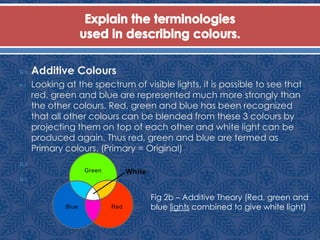
 Looking at the spectrum of visible lights, it is possible to see that
red, green and blue are represented much more strongly than
the other colours. Red, green and blue has been recognized
that all other colours can be blended from these 3 colours by
projecting them on top of each other and white light can be
produced again. Thus red, green and blue are termed as
Primary colours. (Primary = Original)


Green
RedBlue
White
Fig 2b – Additive Theory (Red, green and
blue lights combined to give white light)
 Additive colour mixing
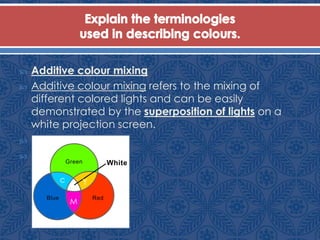
 Additive colour mixing refers to the mixing of
different colored lights and can be easily
demonstrated by the superposition of lights on a
white projection screen.


Green
RedBlue
White
c
M
Y
 Additive theory applies to transmitted light and
relates to adding red, green, and blue (RGB)
together which forms white. The absence of colour is
black.
 Red (R) + Blue (B) + Green (G) = White
 Blue (B) + Red (R) + Green (G) = White
 Green (G) + Red (R) + Blue (B) = White
 When green and blue light are superimposed, it
forms Cyan.
 Green (G) + Blue (B) = Cyan (C)
 When blue and red light are overlapped, it forms
Magenta.
 Red (R) + Blue (B) = Magenta (M)
 When green and red light are overlapped, it forms
Yellow.
 Green (G) + Red (R) = Yellow (Y)
 This system is called “additive” because all three primaries “add
up” to form white light. Examples where additive colour theory
is used are a) Overhead projector
 Subtractive colour theory
 There are two ways of producing a colour, the
additive process and the subtractive one.
Subtractive colour theory uses paints, dyes, inks, and
natural colorants to create color by absorbing some
wavelengths of light and reflecting or transmitting
others.

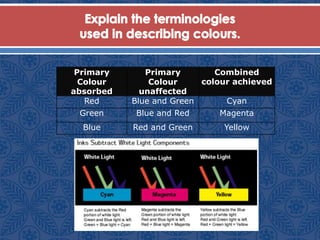
 Since white light is made up of red, green and blue
light, the inks subtract out that particular portion or
color of light. Whatever light that is left is recognized
by the eye as a particular hue.
 Subtractive colour theory
 Cyan ------------- which is white minus red. When
white light (RGB light rays) hits onto an object, red
light is absorbed reflecting green and blue light.
Green and blue light combines to give cyan.
 White light (RGB) – Red (R) = Cyan (C)
 Magenta -------- which is white minus green, and
 White light (RGB) – Green (G) = Magenta (M)
 Yellow ----------- which is white minus blue.
 White light (RGB) – Blue (B) = Yellow (Y)
Primary
Colour
absorbed
Primary
Colour
unaffected
Combined
colour achieved
Red Blue and Green Cyan
Green Blue and Red Magenta
Blue Red and Green Yellow

Chap44

  • 1.
     Explain theterminologies used in describing colours.
  • 2.
    In This Chapter,you’ll learn on:  Explain the terminologies used in describing colours:  • Hue, Saturation, Value  • Luminance  • Tints, Tones and Shades  Explain what is Additive Colour  Explain what is Subtractive Colour
  • 3.
     Terminologies UsedIn Describing Colours  Hue  Hue is the name of a colour that is red, green, blue or orange etc, and is often used interchangeably with the word 'colour'. Since there can be many names used to refer to one colour (e.g. some call purple as violet), the 12 hues colour wheel has become a common standard of reference.   Value  Value is the range of lightness and darkness within a hue. Shade and tone are different aspects of value.
  • 4.
     Terminologies UsedIn Describing Colours  Saturation  This refers to the brightness or dullness of colour, that is bright red or dull red. Chroma and intensity are synonyms for saturation.  Luminance  Luminance refers to a measure to describe the perceived brightness of a color. You can lighten or darken a color by adjusting its lightness value. Each hue naturally has an individual luminance value. For example, the luminance value of white is 100%. Lighter colours have higher luminance values while darker ones will have lower luminance values.
  • 5.
     Terminologies UsedIn Describing Colours  Tints, Tones and Shades  A tint is a diluted, pale or delicate variation of a colour. It is a mixture of a color with white, which increases lightness. A shade of a colour refers to the degree to which a colour is mixed with black, which decreases lightness.A tone is created by adding both white and black to a colour.
  • 6.
     Additive Colours  Additivecolour theory  Additive colour mixing (involved light colours) is the mixing of projected beams of colored light to form other colours. Additive colour theory had been developed to explain and describe how coloured light is formed. 
  • 7.
     Additive Colours Looking at the spectrum of visible lights, it is possible to see that red, green and blue are represented much more strongly than the other colours. Red, green and blue has been recognized that all other colours can be blended from these 3 colours by projecting them on top of each other and white light can be produced again. Thus red, green and blue are termed as Primary colours. (Primary = Original)   Green RedBlue White Fig 2b – Additive Theory (Red, green and blue lights combined to give white light)
  • 8.
     Additive colourmixing  Additive colour mixing refers to the mixing of different colored lights and can be easily demonstrated by the superposition of lights on a white projection screen.   Green RedBlue White c M Y
  • 9.
     Additive theoryapplies to transmitted light and relates to adding red, green, and blue (RGB) together which forms white. The absence of colour is black.  Red (R) + Blue (B) + Green (G) = White  Blue (B) + Red (R) + Green (G) = White  Green (G) + Red (R) + Blue (B) = White
  • 10.
     When greenand blue light are superimposed, it forms Cyan.  Green (G) + Blue (B) = Cyan (C)  When blue and red light are overlapped, it forms Magenta.  Red (R) + Blue (B) = Magenta (M)  When green and red light are overlapped, it forms Yellow.  Green (G) + Red (R) = Yellow (Y)  This system is called “additive” because all three primaries “add up” to form white light. Examples where additive colour theory is used are a) Overhead projector
  • 11.
     Subtractive colourtheory  There are two ways of producing a colour, the additive process and the subtractive one. Subtractive colour theory uses paints, dyes, inks, and natural colorants to create color by absorbing some wavelengths of light and reflecting or transmitting others.   Since white light is made up of red, green and blue light, the inks subtract out that particular portion or color of light. Whatever light that is left is recognized by the eye as a particular hue.
  • 12.
     Subtractive colourtheory  Cyan ------------- which is white minus red. When white light (RGB light rays) hits onto an object, red light is absorbed reflecting green and blue light. Green and blue light combines to give cyan.  White light (RGB) – Red (R) = Cyan (C)  Magenta -------- which is white minus green, and  White light (RGB) – Green (G) = Magenta (M)  Yellow ----------- which is white minus blue.  White light (RGB) – Blue (B) = Yellow (Y)
  • 13.
    Primary Colour absorbed Primary Colour unaffected Combined colour achieved Red Blueand Green Cyan Green Blue and Red Magenta Blue Red and Green Yellow