Framework for Family
     Communication
                        COM 3013


           Tami Davis
Framework for Family
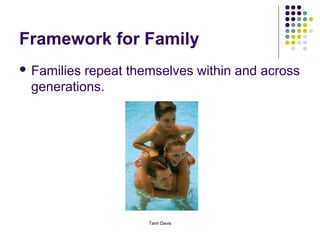
 Familiesrepeat themselves within and across
 generations.


                    Tami Davis
Framework for Family
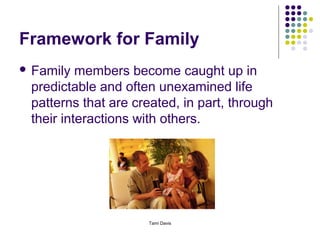
 Family  members become caught up in
 predictable and often unexamined life
 patterns that are created, in part, through
 their interactions with others.


                     Tami Davis
Framework for Family
Within  the framework of shared
 cultural communication patterns,
 each family has the capacity to
 develop its own communication
 codes based on the experiences of
 individual members as well as
 collective family experience.
               Tami Davis
Framework for Family
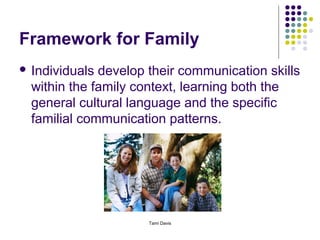
 Individuals develop their communication skills
  within the family context, learning both the
  general cultural language and the specific
  familial communication patterns.


                      Tami Davis
Framework for Family
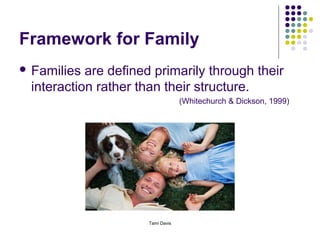
 Families are defined primarily through their
 interaction rather than their structure.
                                  (Whitechurch & Dickson, 1999)


                     Tami Davis
The communication process
 Communication  may be viewed as a
 symbolic, transactional process of
 creating and sharing meanings.

 Words
      or verbal behavior are the most
 commonly used symbols.


                  Tami Davis
The communication process
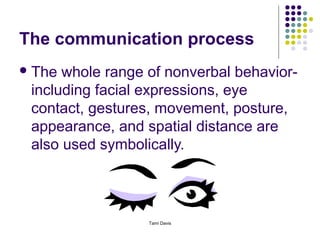
 The whole range of nonverbal behavior-
 including facial expressions, eye
 contact, gestures, movement, posture,
 appearance, and spatial distance are
 also used symbolically.


                  Tami Davis
The communication process

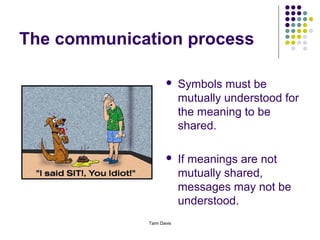
                         Symbols must be
                          mutually understood for
                          the meaning to be
                          shared.

                         If meanings are not
                          mutually shared,
                          messages may not be
                          understood.
             Tami Davis
The communication process
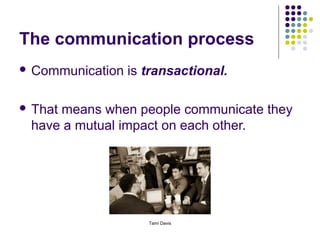
 Communication   is transactional.

 That
     means when people communicate they
 have a mutual impact on each other.


                     Tami Davis
The communication process
   The transactional view of communication and a
    systems perspective of the family complement each
    other, because both focus on relationships.


                         Tami Davis
The communication process
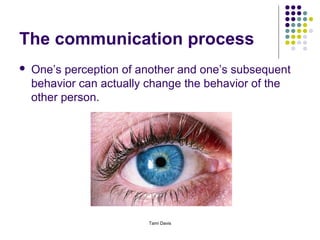
   One’s perception of another and one’s subsequent
    behavior can actually change the behavior of the
    other person.


                         Tami Davis
The communication process
        In relationships, each person

    1.    Creates a context for the other
    2.    Simultaneously creates and interprets messages
          and therefore,
    3.    Simultaneously affects and is affected by the
          other


                            Tami Davis
The communication process
 Communication    is continually changing.

 Communication    is not: static.

 Communication    develops over time.

 Relationships, no matter how committed,
  change continuously, and communication
  both affects and reflects these changes.
                       Tami Davis
The communication process
 Aseach day passes, family members subtly
 renegotiate their relationships.

 Over time families change as they pass
 through stages of growth; members are born,
 age, leave, and die, and their communication
 patterns impact and reflect these
 developments.

                    Tami Davis
The communication process
 Communication    serves to create a families
 social reality.

 Successful
          communication depends on the
 members shared reality, or sets of meanings
                                   (Bochner & Eisenberg, 1987).


                      Tami Davis
Meanings and Messages
                        Meanings
   Visions of the nature of social and physical reality
    as well as values, beliefs, and attitudes.

   Communication involves the negotiation of shared
    meanings.

   Without shared meanings, confusion and
    misunderstanding is likely to occur.

                           Tami Davis
Meanings and Messages
   A primary task for families is “meaning making,” or
    “co creation of meanings.”

   Communication is central to the process of creating
    a family’s social reality.

   The meaning-making tasks of family members serve
    to create a relational or worldview that characterizes
    the family system.

                           Tami Davis
Development of Meanings
 Yourviews of the world result from your
 perceptual filter systems.

 Someone’s   view of reality will be affected by
 sibling position and family history with its
 myths, party lines, and traditions across
 generations
                                         (Lerner,1989).


                      Tami Davis
The Filter System
 Thefirst set of filters includes: human
 sensory systems- sight, hearing, touch, taste,
 and smell.

 Another filter is the social system or the way
 a person uses language, a person’s accepted
 ways of viewing things, family’s cultural and
 class status, and all the socially agreed upon
 conventions.
                     Tami Davis
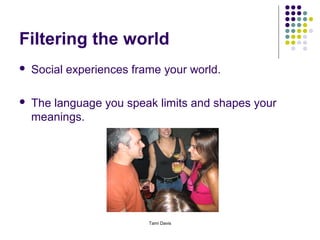
Filtering the world
   Social experiences frame your world.

   The language you speak limits and shapes your
    meanings.


                          Tami Davis
Development of Meanings
 Overallculture affects perceptions and
 meaning, but the immediate groups to which
 one belongs exert a strong influence on the
 individual’s perceptual set.

 Thefamily group provides contextual
 meaning and influences the way meaning is
 given to sensory data.

                    Tami Davis
Development of Meanings
 Although  physical and social systems provide
  the basic general filters, specific constraints
  and experiences influence an individual’s
  meanings.

 Individualconstraints are the interpretations
  you create for your meanings based on your
  own personal histories.

                      Tami Davis
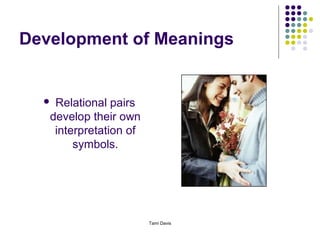
Development of Meanings


   Relational pairs
   develop their own
    interpretation of
        symbols.


                        Tami Davis
Metacommunication
 Metacommunication occurs when people
 communicate about their communication.

 When verbal and nonverbal instructions are
 given about how their messages are to be
 understood.


                    Tami Davis
Metacommunication
 Servesan important function within families
 because it allows members to state their
 needs, clarify confusion, and plan new and
 more constructive ways of relating to one
 another.


                     Tami Davis
Dialectal Tensions
 Most  long-term, intimate relationships are
 built on a history of struggle, as well as
 pleasure, and a continued interplay between
 opposing tendencies.


                    Tami Davis
Dialectal Tensions
 Dialecticimplies opposition, polarity, and
  interconnection.

 Relational  dialectics refers to the “both/and”
  quality of relationships or the need for
  partners to simultaneously experience
  independence and connection or openness
  and privacy.

                       Tami Davis
Dialectal Tensions
   Dialectal tensions are managed through
    communication.

   Possible interactional dialectal tensions:
       Autonomy-connection
       Openness-closeness
       Predictability-novelty
       Independent-freedom to be independent
       Affection-instrumentality
       Judgment-acceptance
       Expressiveness-protectiveness
                              Tami Davis
Dialectal Tensions
 The ways in which people exchange
 messages influence the form and content of
 their relationships.

 Communication  among family members
 shapes the structure of the family system and
 provides a family with its own set of
 meanings.

                    Tami Davis
Communication Patterns &
Family Functions
 Each family's unique message system
 provides the means of dealing with the major
 functions that give shape to family life.

 Communication     provides form and content to
 a family’s life.


                       Tami Davis
Primary Functions
     Circumplex Model of Marital and
             Family Systems

 Two central dimensions of family behavior at
 the core of the model:

    Family cohesion
    Family adaptability
                           Tami Davis
Cohesion
   Every family attempts to deal with the extent to
    which closeness is encouraged or discouraged.


                       Cohesion
   The emotional bonding that family members have
    toward each other.
   Includes: emotional bonding, boundaries, coalitions,
    time space, friends, decision-making, interests, and
    recreation.

                           Tami Davis
Cohesion
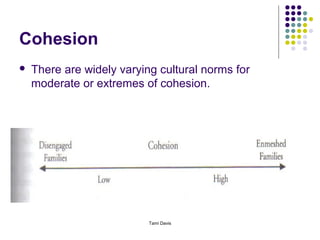
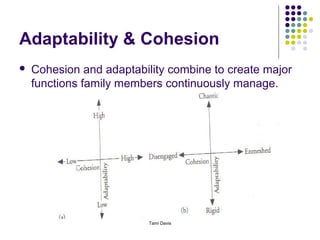
Levels of cohesion:

     Disengaged- family members maintain extreme
      separateness and little family belonging or loyalty.

     Separated- Family members experience
      emotional independence with some joint
      involvement and belonging.


                           Tami Davis
Cohesion
Levels of cohesion (continued):
     Connected- Family members strive for emotional
      closeness, loyalty, and joint involvement with
      some individuality.

     Enmeshed- Family members experience extreme
      closeness, loyalty, and almost no individuality.


                          Tami Davis
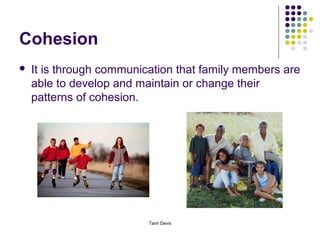
Cohesion
   It is through communication that family members are
    able to develop and maintain or change their
    patterns of cohesion.


                          Tami Davis
Cohesion
   There are widely varying cultural norms for
    moderate or extremes of cohesion.


                           Tami Davis
Adaptability
                 Flexibility
 The amount of change in a family’s
 leadership, role relationships, and relations
 by rules.

               Family Flexibility
 Also referred to as Adaptability
 How family systems manage stability and
  change
                     Tami Davis
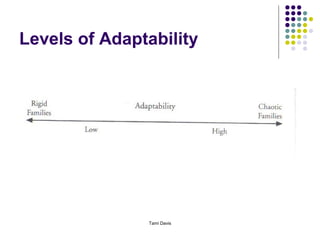
Levels of Adaptability
                    Rigid
 Family members operate under autocratic
  decision-making styles and strict roles and
  rules

                   Structured
 Family members experience authoritarian
  and some equalitarian leadership and stable
  roles and rules.
                      Tami Davis
Levels of Adaptability
                   Flexible
 Family members experience negotiation and
  decision making and easily changed rules
  and roles.

                    Chaotic
 Family members have nonexistent
  leadership, confused decision making, and
  varied rules and roles.
                     Tami Davis
Levels of Adaptability


               Tami Davis
Adaptability
 Familysystems constantly restructure
 themselves as they pass through predictable
 developmental stages.

 Family systems must adapt both structurally
 and functionally to the demands of other
 social institutions and the needs of their own
 members.

                     Tami Davis
Adaptability
 Through  communication, families make it
 clear to their members how much adaptation
 is allowed while regulating the adaptive
 behaviors of their members and the system
 as a whole.


                   Tami Davis
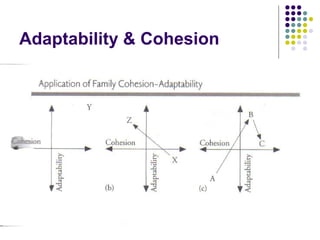
Adaptability & Cohesion
   Cohesion and adaptability combine to create major
    functions family members continuously manage.


                          Tami Davis
Adaptability & Cohesion


              Tami Davis
Dialectal Interplay
 Cohesion and adaptability may be viewed as
 both family functions and dialectal tensions.

 Most families struggle over time with the
 issues of closeness and distance between
 members and between the family system and
 outside persons or groups.


                     Tami Davis
Supporting Functions
 Inconjunction with cohesion and adaptability
  supporting family functions include:
      Establishing a satisfactory congruence of images
      Evolving modes of interaction into central family
       themes
      Establishing boundaries of the families world of
       experience
      Dealing with significant biosocial issues like
       gender, age, power, and roles

                           Tami Davis
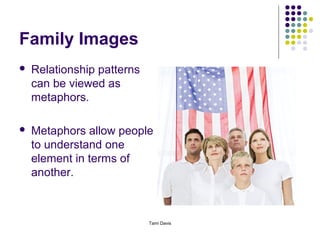
Family Images
   Relationship patterns
    can be viewed as
    metaphors.

   Metaphors allow people
    to understand one
    element in terms of
    another.


                            Tami Davis
Root Metaphors
 Root metaphors assume a connection
  between a way of talking about the world and
  a major analogy or metaphor

 If
   you had to create a mental image or
  metaphor for your family, what would it be?


                      Tami Davis
Family Images & Metaphors
 My family is like a Navy fleet. In the center are my
 parents, both upon the carrier. My mother is the
 executive officer (XO). The XO is the bad guy who
 runs The ship, keeps things in order, and intercepts
 messes before they reach the commanding officer.
 My father is the commanding office (CO). He
 decides the direction the family heads but is more
 concerned with navigating than maintaining
 everyday life on board. My siblings and I are the
 small ships in the group. We can go off but must
 return to refuel. I am the cruiser and have more
 responsibilities and provide services, such as
 information.
                        Tami Davis
Family Images & Metaphors
 Jan and Stephanie are both destroyers, who are
 freer to range around, Michael is the airplane who
 sits on top of the mother ship. He has a short range
 and en-durance away from the carrier. The
 destroyers like to intimidate him but would never
 really fire on him. We all know our places and
 positions and defend each other from any threat We
 are close, but not too close. We all follow orders
 from the CO but spend much of our lives interacting
 more easily with the XO.

                        Tami Davis
Family Images & Metaphors
A   less complex example:

 My family is a team, with my dad as a player-
 coach. We all work together for the survival of
 our team, and we all contribute. Each one of
 us has strengths and weaknesses, yet there
 is always that force driving us to achieve
 more to-gether. As the player-coach, my dad
 has the responsibility of overseeing our
 performances.
                     Tami Davis
Family Images
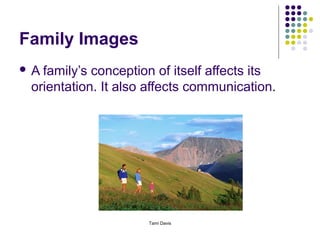
A family’s conception of itself affects its
 orientation. It also affects communication.


                     Tami Davis
Family Images
 Females  often report female metaphors for
 their family-of-origin that emphasize
 team/group, nature, and healing/nourishment.

 Male metaphors often emphasize nature,
 particularly animals and foundational things
 such as brick walls or concrete structures.


                     Tami Davis
Family Images
 The   family metaphor acts as a perceptual
 filter, an indicator of a family’s collective
 identity, and serves as an impetus for future
 thought and action.


                     Tami Davis
Family Themes
 Each   family shares themes or takes positions
  in relationship to the outer world.

                      Theme
 A pattern of feelings, motives, fantasies, and
  conventionalized understandings grouped
  around a particular locus of concern.


                      Tami Davis
Family Themes
 Themes   represent a fundamental view of
 reality and a way of dealing with this view.

 Themes  may represent a family’s attempt to
 deal with dialectal tensions by “taking a
 stand.”


                      Tami Davis
Family Themes
 Themes   relate directly to family actions.

 Living according to a theme necessitates the
  development of various patterns of behavior,
  which affect how members interact with the
  outside world, how they interact with each
  other and how they develop personally.


                       Tami Davis
Family Themes
 Family  themes may be complex and subtle,
  involving worldviews that are not immediately
  obvious.

 Itis important to identify a family’s main
  theme(s) in order to fully understand the
  meanings and communication behavior of its
  members.

                     Tami Davis
Activity: Family Themes
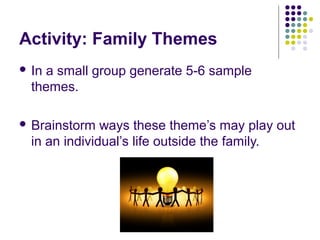
 Ina small group generate 5-6 sample
  themes.

 Brainstorm   ways these theme’s may play out
  in an individual’s life outside the family.
Boundaries
 Families   create boundaries.

 Allfamilies establish some boundaries as
  they restrict their members from encountering
  certain physical and psychological forces.

 Family boundaries regulate access to people,
  places, ideas, and values.
                       Tami Davis
Boundaries
 Some family boundaries are highly
 permeable, or flexible, and allow movement
 across them.

 These open boundaries allow resources such
 as information or energy to enter.

 Others  resist movement and are rigid and
 inflexible.
                     Tami Davis
Boundaries
 External
         boundaries distinguish family
  members from the rest of the world.

 Internalboundaries help keep family
  members appropriately placed in relationship
  to each other.


                     Tami Davis
Boundaries
 Families
        are not always able to control their
 own boundaries.

 Familyboundaries will vary according to the
 personalities of the members, the types of
 experiences members are exposed, and the
 freedom each member has to create his or
 her own identity.

                    Tami Davis
Boundaries
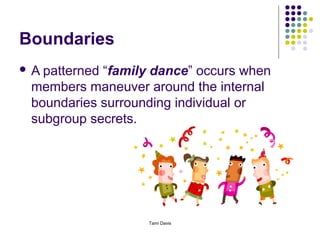
A patterned “family dance” occurs when
 members maneuver around the internal
 boundaries surrounding individual or
 subgroup secrets.


                   Tami Davis
Boundaries
 Mostfamilies experience boundaries
 between generations which establish
 subsystems of generational hierarchy.

 Generationsestablish their boundaries based
 on behaviors appropriate for that subsystem.


                    Tami Davis
Boundaries
 Conflict
        can arise if boundaries are too
  permeable.

 Internal boundary inclusion may differ across
  cultural groups.

 Testingor forcing boundaries may involve
  deep, emotional conflicts.
                      Tami Davis
Boundaries
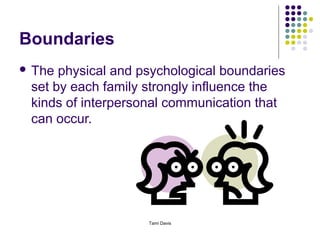
 The physical and psychological boundaries
 set by each family strongly influence the
 kinds of interpersonal communication that
 can occur.


                    Tami Davis
Biosocial Issues
 Male and female identity
 Authority and power

 Shaping and influencing children

 Children’s rights


                     Tami Davis
Journal
 Discuss the role of family patterns in family
 relationships and how you believe they are
 formed and to what extent they can be
 changed.

 Tryto come up with 2-3 examples of what
 you have witnessed as family interaction
 patterns.

Chap+2 +framework+for+family+communication

  • 1.
    Framework for Family Communication COM 3013 Tami Davis
  • 2.
    Framework for Family Familiesrepeat themselves within and across generations. Tami Davis
  • 3.
    Framework for Family Family members become caught up in predictable and often unexamined life patterns that are created, in part, through their interactions with others. Tami Davis
  • 4.
    Framework for Family Within the framework of shared cultural communication patterns, each family has the capacity to develop its own communication codes based on the experiences of individual members as well as collective family experience. Tami Davis
  • 5.
    Framework for Family Individuals develop their communication skills within the family context, learning both the general cultural language and the specific familial communication patterns. Tami Davis
  • 6.
    Framework for Family Families are defined primarily through their interaction rather than their structure. (Whitechurch & Dickson, 1999) Tami Davis
  • 7.
    The communication process Communication may be viewed as a symbolic, transactional process of creating and sharing meanings.  Words or verbal behavior are the most commonly used symbols. Tami Davis
  • 8.
    The communication process The whole range of nonverbal behavior- including facial expressions, eye contact, gestures, movement, posture, appearance, and spatial distance are also used symbolically. Tami Davis
  • 9.
    The communication process  Symbols must be mutually understood for the meaning to be shared.  If meanings are not mutually shared, messages may not be understood. Tami Davis
  • 10.
    The communication process Communication is transactional.  That means when people communicate they have a mutual impact on each other. Tami Davis
  • 11.
    The communication process  The transactional view of communication and a systems perspective of the family complement each other, because both focus on relationships. Tami Davis
  • 12.
    The communication process  One’s perception of another and one’s subsequent behavior can actually change the behavior of the other person. Tami Davis
  • 13.
    The communication process  In relationships, each person 1. Creates a context for the other 2. Simultaneously creates and interprets messages and therefore, 3. Simultaneously affects and is affected by the other Tami Davis
  • 14.
    The communication process Communication is continually changing.  Communication is not: static.  Communication develops over time.  Relationships, no matter how committed, change continuously, and communication both affects and reflects these changes. Tami Davis
  • 15.
    The communication process Aseach day passes, family members subtly renegotiate their relationships.  Over time families change as they pass through stages of growth; members are born, age, leave, and die, and their communication patterns impact and reflect these developments. Tami Davis
  • 16.
    The communication process Communication serves to create a families social reality.  Successful communication depends on the members shared reality, or sets of meanings (Bochner & Eisenberg, 1987). Tami Davis
  • 17.
    Meanings and Messages Meanings  Visions of the nature of social and physical reality as well as values, beliefs, and attitudes.  Communication involves the negotiation of shared meanings.  Without shared meanings, confusion and misunderstanding is likely to occur. Tami Davis
  • 18.
    Meanings and Messages  A primary task for families is “meaning making,” or “co creation of meanings.”  Communication is central to the process of creating a family’s social reality.  The meaning-making tasks of family members serve to create a relational or worldview that characterizes the family system. Tami Davis
  • 19.
    Development of Meanings Yourviews of the world result from your perceptual filter systems.  Someone’s view of reality will be affected by sibling position and family history with its myths, party lines, and traditions across generations (Lerner,1989). Tami Davis
  • 20.
    The Filter System Thefirst set of filters includes: human sensory systems- sight, hearing, touch, taste, and smell.  Another filter is the social system or the way a person uses language, a person’s accepted ways of viewing things, family’s cultural and class status, and all the socially agreed upon conventions. Tami Davis
  • 21.
    Filtering the world  Social experiences frame your world.  The language you speak limits and shapes your meanings. Tami Davis
  • 22.
    Development of Meanings Overallculture affects perceptions and meaning, but the immediate groups to which one belongs exert a strong influence on the individual’s perceptual set.  Thefamily group provides contextual meaning and influences the way meaning is given to sensory data. Tami Davis
  • 23.
    Development of Meanings Although physical and social systems provide the basic general filters, specific constraints and experiences influence an individual’s meanings.  Individualconstraints are the interpretations you create for your meanings based on your own personal histories. Tami Davis
  • 24.
    Development of Meanings  Relational pairs develop their own interpretation of symbols. Tami Davis
  • 25.
    Metacommunication  Metacommunication occurswhen people communicate about their communication.  When verbal and nonverbal instructions are given about how their messages are to be understood. Tami Davis
  • 26.
    Metacommunication  Servesan importantfunction within families because it allows members to state their needs, clarify confusion, and plan new and more constructive ways of relating to one another. Tami Davis
  • 27.
    Dialectal Tensions  Most long-term, intimate relationships are built on a history of struggle, as well as pleasure, and a continued interplay between opposing tendencies. Tami Davis
  • 28.
    Dialectal Tensions  Dialecticimpliesopposition, polarity, and interconnection.  Relational dialectics refers to the “both/and” quality of relationships or the need for partners to simultaneously experience independence and connection or openness and privacy. Tami Davis
  • 29.
    Dialectal Tensions  Dialectal tensions are managed through communication.  Possible interactional dialectal tensions:  Autonomy-connection  Openness-closeness  Predictability-novelty  Independent-freedom to be independent  Affection-instrumentality  Judgment-acceptance  Expressiveness-protectiveness Tami Davis
  • 30.
    Dialectal Tensions  Theways in which people exchange messages influence the form and content of their relationships.  Communication among family members shapes the structure of the family system and provides a family with its own set of meanings. Tami Davis
  • 31.
    Communication Patterns & FamilyFunctions  Each family's unique message system provides the means of dealing with the major functions that give shape to family life.  Communication provides form and content to a family’s life. Tami Davis
  • 32.
    Primary Functions Circumplex Model of Marital and Family Systems  Two central dimensions of family behavior at the core of the model:  Family cohesion  Family adaptability Tami Davis
  • 33.
    Cohesion  Every family attempts to deal with the extent to which closeness is encouraged or discouraged. Cohesion  The emotional bonding that family members have toward each other.  Includes: emotional bonding, boundaries, coalitions, time space, friends, decision-making, interests, and recreation. Tami Davis
  • 34.
    Cohesion Levels of cohesion:  Disengaged- family members maintain extreme separateness and little family belonging or loyalty.  Separated- Family members experience emotional independence with some joint involvement and belonging. Tami Davis
  • 35.
    Cohesion Levels of cohesion(continued):  Connected- Family members strive for emotional closeness, loyalty, and joint involvement with some individuality.  Enmeshed- Family members experience extreme closeness, loyalty, and almost no individuality. Tami Davis
  • 36.
    Cohesion  It is through communication that family members are able to develop and maintain or change their patterns of cohesion. Tami Davis
  • 37.
    Cohesion  There are widely varying cultural norms for moderate or extremes of cohesion. Tami Davis
  • 38.
    Adaptability Flexibility  The amount of change in a family’s leadership, role relationships, and relations by rules. Family Flexibility  Also referred to as Adaptability  How family systems manage stability and change Tami Davis
  • 39.
    Levels of Adaptability Rigid  Family members operate under autocratic decision-making styles and strict roles and rules Structured  Family members experience authoritarian and some equalitarian leadership and stable roles and rules. Tami Davis
  • 40.
    Levels of Adaptability Flexible  Family members experience negotiation and decision making and easily changed rules and roles. Chaotic  Family members have nonexistent leadership, confused decision making, and varied rules and roles. Tami Davis
  • 41.
  • 42.
    Adaptability  Familysystems constantlyrestructure themselves as they pass through predictable developmental stages.  Family systems must adapt both structurally and functionally to the demands of other social institutions and the needs of their own members. Tami Davis
  • 43.
    Adaptability  Through communication, families make it clear to their members how much adaptation is allowed while regulating the adaptive behaviors of their members and the system as a whole. Tami Davis
  • 44.
    Adaptability & Cohesion  Cohesion and adaptability combine to create major functions family members continuously manage. Tami Davis
  • 45.
  • 46.
    Dialectal Interplay  Cohesionand adaptability may be viewed as both family functions and dialectal tensions.  Most families struggle over time with the issues of closeness and distance between members and between the family system and outside persons or groups. Tami Davis
  • 47.
    Supporting Functions  Inconjunctionwith cohesion and adaptability supporting family functions include:  Establishing a satisfactory congruence of images  Evolving modes of interaction into central family themes  Establishing boundaries of the families world of experience  Dealing with significant biosocial issues like gender, age, power, and roles Tami Davis
  • 48.
    Family Images  Relationship patterns can be viewed as metaphors.  Metaphors allow people to understand one element in terms of another. Tami Davis
  • 49.
    Root Metaphors  Rootmetaphors assume a connection between a way of talking about the world and a major analogy or metaphor  If you had to create a mental image or metaphor for your family, what would it be? Tami Davis
  • 50.
    Family Images &Metaphors My family is like a Navy fleet. In the center are my parents, both upon the carrier. My mother is the executive officer (XO). The XO is the bad guy who runs The ship, keeps things in order, and intercepts messes before they reach the commanding officer. My father is the commanding office (CO). He decides the direction the family heads but is more concerned with navigating than maintaining everyday life on board. My siblings and I are the small ships in the group. We can go off but must return to refuel. I am the cruiser and have more responsibilities and provide services, such as information. Tami Davis
  • 51.
    Family Images &Metaphors Jan and Stephanie are both destroyers, who are freer to range around, Michael is the airplane who sits on top of the mother ship. He has a short range and en-durance away from the carrier. The destroyers like to intimidate him but would never really fire on him. We all know our places and positions and defend each other from any threat We are close, but not too close. We all follow orders from the CO but spend much of our lives interacting more easily with the XO. Tami Davis
  • 52.
    Family Images &Metaphors A less complex example:  My family is a team, with my dad as a player- coach. We all work together for the survival of our team, and we all contribute. Each one of us has strengths and weaknesses, yet there is always that force driving us to achieve more to-gether. As the player-coach, my dad has the responsibility of overseeing our performances. Tami Davis
  • 53.
    Family Images A family’sconception of itself affects its orientation. It also affects communication. Tami Davis
  • 54.
    Family Images  Females often report female metaphors for their family-of-origin that emphasize team/group, nature, and healing/nourishment.  Male metaphors often emphasize nature, particularly animals and foundational things such as brick walls or concrete structures. Tami Davis
  • 55.
    Family Images  The family metaphor acts as a perceptual filter, an indicator of a family’s collective identity, and serves as an impetus for future thought and action. Tami Davis
  • 56.
    Family Themes  Each family shares themes or takes positions in relationship to the outer world. Theme  A pattern of feelings, motives, fantasies, and conventionalized understandings grouped around a particular locus of concern. Tami Davis
  • 57.
    Family Themes  Themes represent a fundamental view of reality and a way of dealing with this view.  Themes may represent a family’s attempt to deal with dialectal tensions by “taking a stand.” Tami Davis
  • 58.
    Family Themes  Themes relate directly to family actions.  Living according to a theme necessitates the development of various patterns of behavior, which affect how members interact with the outside world, how they interact with each other and how they develop personally. Tami Davis
  • 59.
    Family Themes  Family themes may be complex and subtle, involving worldviews that are not immediately obvious.  Itis important to identify a family’s main theme(s) in order to fully understand the meanings and communication behavior of its members. Tami Davis
  • 60.
    Activity: Family Themes Ina small group generate 5-6 sample themes.  Brainstorm ways these theme’s may play out in an individual’s life outside the family.
  • 61.
    Boundaries  Families create boundaries.  Allfamilies establish some boundaries as they restrict their members from encountering certain physical and psychological forces.  Family boundaries regulate access to people, places, ideas, and values. Tami Davis
  • 62.
    Boundaries  Some familyboundaries are highly permeable, or flexible, and allow movement across them.  These open boundaries allow resources such as information or energy to enter.  Others resist movement and are rigid and inflexible. Tami Davis
  • 63.
    Boundaries  External boundaries distinguish family members from the rest of the world.  Internalboundaries help keep family members appropriately placed in relationship to each other. Tami Davis
  • 64.
    Boundaries  Families are not always able to control their own boundaries.  Familyboundaries will vary according to the personalities of the members, the types of experiences members are exposed, and the freedom each member has to create his or her own identity. Tami Davis
  • 65.
    Boundaries A patterned “familydance” occurs when members maneuver around the internal boundaries surrounding individual or subgroup secrets. Tami Davis
  • 66.
    Boundaries  Mostfamilies experienceboundaries between generations which establish subsystems of generational hierarchy.  Generationsestablish their boundaries based on behaviors appropriate for that subsystem. Tami Davis
  • 67.
    Boundaries  Conflict can arise if boundaries are too permeable.  Internal boundary inclusion may differ across cultural groups.  Testingor forcing boundaries may involve deep, emotional conflicts. Tami Davis
  • 68.
    Boundaries  The physicaland psychological boundaries set by each family strongly influence the kinds of interpersonal communication that can occur. Tami Davis
  • 69.
    Biosocial Issues  Maleand female identity  Authority and power  Shaping and influencing children  Children’s rights Tami Davis
  • 70.
    Journal  Discuss therole of family patterns in family relationships and how you believe they are formed and to what extent they can be changed.  Tryto come up with 2-3 examples of what you have witnessed as family interaction patterns.