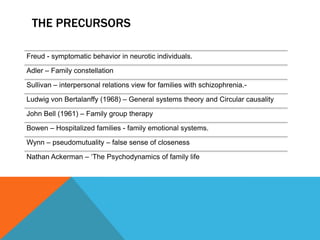



THE PRECURSORS
Freud - symptomatic behavior in neurotic individuals.
Adler – Family constellation
Sullivan – interpersonal relations view for families with schizophrenia.-
Ludwig von Bertalanffy (1968) – General systems theory and Circular causality
John Bell (1961) – Family group therapy
Bowen – Hospitalized families - family emotional systems.
Wynn – pseudomutuality – false sense of closeness
Nathan Ackerman – ‘The Psychodynamics of family life
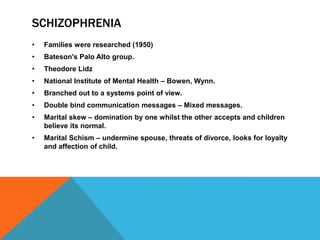
SCHIZOPHRENIA
• Families were researched (1950)
• Bateson's Palo Alto group.
• Theodore Lidz
• National Institute of Mental Health – Bowen, Wynn.
• Branched out to a systems point of view.
• Double bind communication messages – Mixed messages.
• Marital skew – domination by one whilst the other accepts and children
believe its normal.
• Marital Schism – undermine spouse, threats of divorce, looks for loyalty
and affection of child.
CURRENT CONCEPTS
Combined into 8 view points
Object Relations Family Therapy
• Psychodynamic view
• Relationships with „objects‟
• Bring introjects into relationships
• Disturbs the family relations
• Gain insight
EXPERIENTIAL FAMILY THERAPY
Whitaker – Symbolic experiential family therapy
Brings symbols and fantasies so we can grow
Emotion focused couples therapy – change negative interactions
focusing on emotional connection
Transgenerational Family Therapy
• Each family member is tied in some way. Individual problems arise and
are maintained
• Marries someone similar and the trend continues
• Can result in schizophrenia
STRUCTURAL FAMILY THERAPY
• SALVADOR MINUCHIN
• RULES, ROLES, ALIGNMENTS, COALITIONS, BOUNDARIES, SUB
SYSTEMS.
• CHANGE PATTERNS TO UNFREEZE.
• STRATEGIC FAMILY THERAPY
• JAY HALEY – PARADOXICAL INTERVENTIONS
• SYSTEMIC FAMILY THERAPY – DIRTY GAMES AND POWER
STRUGGLES
• BOSCOLLO AND CECHING – CIRCULAR QUESTIONING
C.B.T
Cognitive Behavior Family Therapy
Behavior – Reinforcement
Cognitive – dysfunctional beliefs
Learned schemas
Social Constructionist Family Therapy
Challenge systems thinking
Limited lens
Reality is mediated through language and are socially determined through our
relationships
offer new alternatives
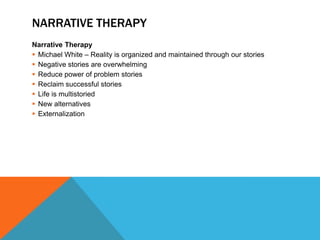
NARRATIVE THERAPY
Narrative Therapy
 Michael White – Reality is organized and maintained through our stories
 Negative stories are overwhelming
 Reduce power of problem stories
 Reclaim successful stories
 Life is multistoried
 New alternatives
 Externalization
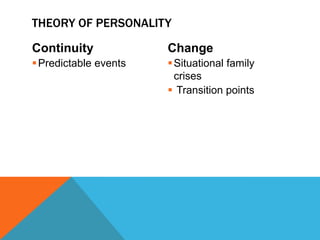
Continuity
Predictable events
Change
Situational family
crises
 Transition points
THEORY OF PERSONALITY
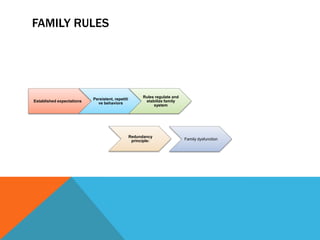
FAMILY RULES
Established expectations
Persistent, repetiti
ve behaviors
Rules regulate and
stabilize family
system
Redundancy
principle: Family dysfunction
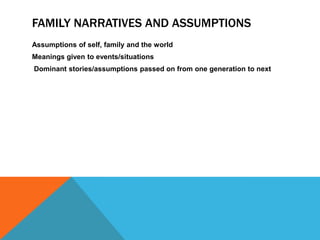
FAMILY NARRATIVES AND ASSUMPTIONS
Assumptions of self, family and the world
Meanings given to events/situations
Dominant stories/assumptions passed on from one generation to next
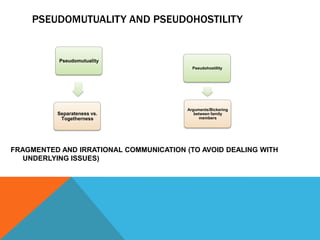
Pseudomutuality
Separateness vs.
Togetherness
Pseudohostility
Arguments/Bickering
between family
members
PSEUDOMUTUALITY AND PSEUDOHOSTILITY
FRAGMENTED AND IRRATIONAL COMMUNICATION (TO AVOID DEALING WITH
UNDERLYING ISSUES)
MYSTIFICATION
Masking the main problem
To distort one‟s experience by denying what he/she believes is happening
Contradicts one person‟s perception
SCAPEGOATING
Avoid dealing with main issue
Blaming an identified individual for everything that goes wrong
The identified person carries on the role.
ANASTASIA
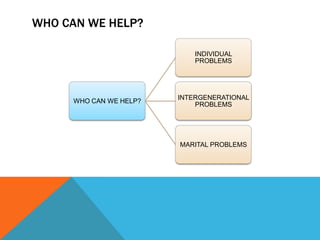
WHO CAN WE HELP?
WHO CAN WE HELP?
INDIVIDUAL
PROBLEMS
INTERGENERATIONAL
PROBLEMS
MARITAL PROBLEMS
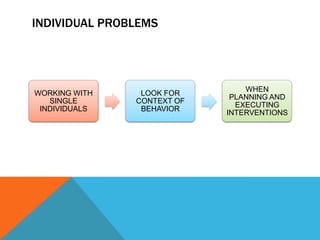
INDIVIDUAL PROBLEMS
WORKING WITH
SINGLE
INDIVIDUALS
LOOK FOR
CONTEXT OF
BEHAVIOR
WHEN
PLANNING AND
EXECUTING
INTERVENTIONS
WHAT ARE INDIVIDUAL PROBLEMS?
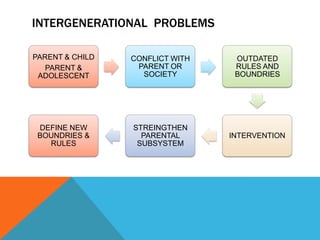
INTERGENERATIONAL PROBLEMS
PARENT & CHILD
PARENT &
ADOLESCENT
CONFLICT WITH
PARENT OR
SOCIETY
OUTDATED
RULES AND
BOUNDRIES
INTERVENTION
STREINGTHEN
PARENTAL
SUBSYSTEM
DEFINE NEW
BOUNDRIES &
RULES
WHAT ARE INTERGENERATIONAL PROBLEMS?
DELEQUINCY AND AT RISK YOUTH
CHILDREN TO FOREIGN BORN PARENTS
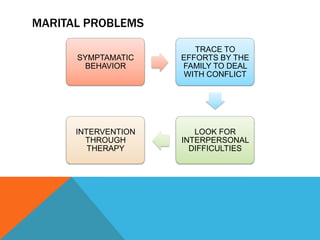
MARITAL PROBLEMS
SYMPTAMATIC
BEHAVIOR
TRACE TO
EFFORTS BY THE
FAMILY TO DEAL
WITH CONFLICT
LOOK FOR
INTERPERSONAL
DIFFICULTIES
INTERVENTION
THROUGH
THERAPY
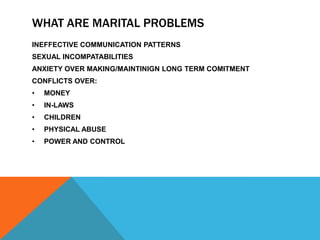
WHAT ARE MARITAL PROBLEMS
INEFFECTIVE COMMUNICATION PATTERNS
SEXUAL INCOMPATABILITIES
ANXIETY OVER MAKING/MAINTINIGN LONG TERM COMITMENT
CONFLICTS OVER:
• MONEY
• IN-LAWS
• CHILDREN
• PHYSICAL ABUSE
• POWER AND CONTROL
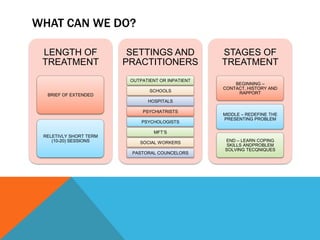
WHAT CAN WE DO?
LENGTH OF
TREATMENT
BRIEF OF EXTENDED
RELETIVLY SHORT TERM
(10-20) SESSIONS
SETTINGS AND
PRACTITIONERS
OUTPATIENT OR INPATIENT
SCHOOLS
HOSPITALS
PSYCHIATRISTS
PSYCHOLOGISTS
MFT’S
SOCIAL WORKERS
PASTORAL COUNCELORS
STAGES OF
TREATMENT
BEGINNING –
CONTACT, HISTORY AND
RAPPORT
MIDDLE – REDEFINE THE
PRESENTING PROBLEM
END – LEARN COPING
SKILLS ANDPROBLEM
SOLVING TECQNIQUES
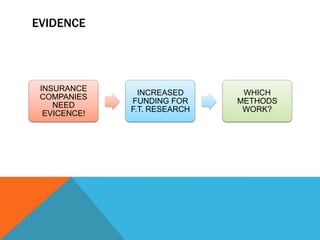
EVIDENCE
INSURANCE
COMPANIES
NEED
EVICENCE!
INCREASED
FUNDING FOR
F.T. RESEARCH
WHICH
METHODS
WORK?
WHICH METHODS WORK?
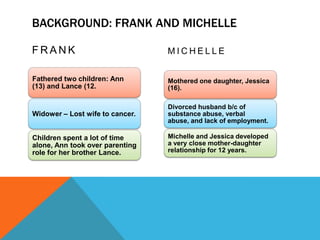
BACKGROUND: FRANK AND MICHELLE
F R A N K
Fathered two children: Ann
(13) and Lance (12.
Widower – Lost wife to cancer.
Children spent a lot of time
alone, Ann took over parenting
role for her brother Lance.
M I C H E L L E
Mothered one daughter, Jessica
(16).
Divorced husband b/c of
substance abuse, verbal
abuse, and lack of employment.
Michelle and Jessica developed
a very close mother-daughter
relationship for 12 years.
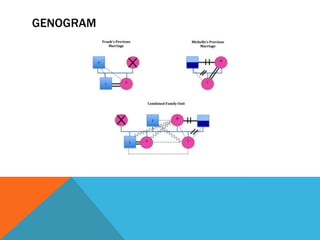
GENOGRAM
PROBLEM
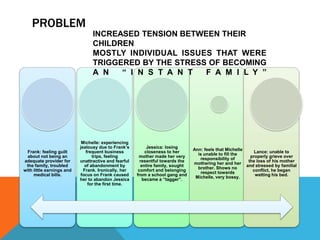
Frank: feeling guilt
about not being an
adequate provider for
the family, troubled
with little earnings and
medical bills.
Michelle: experiencing
jealousy due to Frank‟s
frequent business
trips, feeling
unattractive and fearful
of abandonment by
Frank. Ironically, her
focus on Frank caused
her to abandon Jessica
for the first time.
Jessica: losing
closeness to her
mother made her very
resentful towards the
entire family, sought
comfort and belonging
from a school gang and
became a “tagger”.
Ann: feels that Michelle
is unable to fill the
responsibility of
mothering her and her
brother. Shows no
respect towards
Michelle, very bossy.
Lance: unable to
properly grieve over
the loss of his mother
and stressed by familial
conflict, he began
wetting his bed.
INCREASED TENSION BETWEEN THEIR
CHILDREN
MOSTLY INDIVIDUAL ISSUES THAT WERE
TRIGGERED BY THE STRESS OF BECOMING
A N “ I N S T A N T F A M I L Y ”
TREATMENT
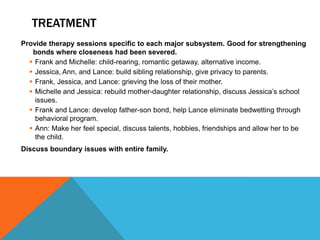
Provide therapy sessions specific to each major subsystem. Good for strengthening
bonds where closeness had been severed.
 Frank and Michelle: child-rearing, romantic getaway, alternative income.
 Jessica, Ann, and Lance: build sibling relationship, give privacy to parents.
 Frank, Jessica, and Lance: grieving the loss of their mother.
 Michelle and Jessica: rebuild mother-daughter relationship, discuss Jessica’s school
issues.
 Frank and Lance: develop father-son bond, help Lance eliminate bedwetting through
behavioral program.
 Ann: Make her feel special, discuss talents, hobbies, friendships and allow her to be
the child.
Discuss boundary issues with entire family.
FOLLOW-UP
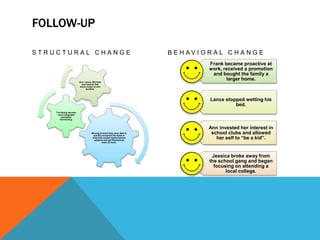
S T R U C T U R A L C H A N G E
Moving forward they were able to
quickly recognize the dyad or
triad that caused dysfunctional
patterns and get themselves
back on track.
The family became
more integrated
and better
functioning.
Ann, Lance, Michelle
and Jessica feel
much closer to one
another.
B E H A V I O R A L C H A N G E
Frank became proactive at
work, received a promotion
and bought the family a
larger home.
Lance stopped wetting his
bed.
Ann invested her interest in
school clubs and allowed
her self to “be a kid”.
Jessica broke away from
the school gang and began
focusing on attending a
local college.

Family Therapy

  • 3.
    THE PRECURSORS Freud -symptomatic behavior in neurotic individuals. Adler – Family constellation Sullivan – interpersonal relations view for families with schizophrenia.- Ludwig von Bertalanffy (1968) – General systems theory and Circular causality John Bell (1961) – Family group therapy Bowen – Hospitalized families - family emotional systems. Wynn – pseudomutuality – false sense of closeness Nathan Ackerman – ‘The Psychodynamics of family life
  • 4.
    SCHIZOPHRENIA • Families wereresearched (1950) • Bateson's Palo Alto group. • Theodore Lidz • National Institute of Mental Health – Bowen, Wynn. • Branched out to a systems point of view. • Double bind communication messages – Mixed messages. • Marital skew – domination by one whilst the other accepts and children believe its normal. • Marital Schism – undermine spouse, threats of divorce, looks for loyalty and affection of child.
  • 5.
    CURRENT CONCEPTS Combined into8 view points Object Relations Family Therapy • Psychodynamic view • Relationships with „objects‟ • Bring introjects into relationships • Disturbs the family relations • Gain insight
  • 6.
    EXPERIENTIAL FAMILY THERAPY Whitaker– Symbolic experiential family therapy Brings symbols and fantasies so we can grow Emotion focused couples therapy – change negative interactions focusing on emotional connection Transgenerational Family Therapy • Each family member is tied in some way. Individual problems arise and are maintained • Marries someone similar and the trend continues • Can result in schizophrenia
  • 7.
    STRUCTURAL FAMILY THERAPY •SALVADOR MINUCHIN • RULES, ROLES, ALIGNMENTS, COALITIONS, BOUNDARIES, SUB SYSTEMS. • CHANGE PATTERNS TO UNFREEZE. • STRATEGIC FAMILY THERAPY • JAY HALEY – PARADOXICAL INTERVENTIONS • SYSTEMIC FAMILY THERAPY – DIRTY GAMES AND POWER STRUGGLES • BOSCOLLO AND CECHING – CIRCULAR QUESTIONING
  • 8.
    C.B.T Cognitive Behavior FamilyTherapy Behavior – Reinforcement Cognitive – dysfunctional beliefs Learned schemas Social Constructionist Family Therapy Challenge systems thinking Limited lens Reality is mediated through language and are socially determined through our relationships offer new alternatives
  • 9.
    NARRATIVE THERAPY Narrative Therapy Michael White – Reality is organized and maintained through our stories  Negative stories are overwhelming  Reduce power of problem stories  Reclaim successful stories  Life is multistoried  New alternatives  Externalization
  • 11.
  • 12.
    FAMILY RULES Established expectations Persistent,repetiti ve behaviors Rules regulate and stabilize family system Redundancy principle: Family dysfunction
  • 13.
    FAMILY NARRATIVES ANDASSUMPTIONS Assumptions of self, family and the world Meanings given to events/situations Dominant stories/assumptions passed on from one generation to next
  • 14.
    Pseudomutuality Separateness vs. Togetherness Pseudohostility Arguments/Bickering between family members PSEUDOMUTUALITYAND PSEUDOHOSTILITY FRAGMENTED AND IRRATIONAL COMMUNICATION (TO AVOID DEALING WITH UNDERLYING ISSUES)
  • 15.
    MYSTIFICATION Masking the mainproblem To distort one‟s experience by denying what he/she believes is happening Contradicts one person‟s perception
  • 16.
    SCAPEGOATING Avoid dealing withmain issue Blaming an identified individual for everything that goes wrong The identified person carries on the role.
  • 17.
  • 19.
    WHO CAN WEHELP? WHO CAN WE HELP? INDIVIDUAL PROBLEMS INTERGENERATIONAL PROBLEMS MARITAL PROBLEMS
  • 20.
    INDIVIDUAL PROBLEMS WORKING WITH SINGLE INDIVIDUALS LOOKFOR CONTEXT OF BEHAVIOR WHEN PLANNING AND EXECUTING INTERVENTIONS
  • 21.
  • 22.
    INTERGENERATIONAL PROBLEMS PARENT &CHILD PARENT & ADOLESCENT CONFLICT WITH PARENT OR SOCIETY OUTDATED RULES AND BOUNDRIES INTERVENTION STREINGTHEN PARENTAL SUBSYSTEM DEFINE NEW BOUNDRIES & RULES
  • 23.
    WHAT ARE INTERGENERATIONALPROBLEMS? DELEQUINCY AND AT RISK YOUTH CHILDREN TO FOREIGN BORN PARENTS
  • 24.
    MARITAL PROBLEMS SYMPTAMATIC BEHAVIOR TRACE TO EFFORTSBY THE FAMILY TO DEAL WITH CONFLICT LOOK FOR INTERPERSONAL DIFFICULTIES INTERVENTION THROUGH THERAPY
  • 25.
    WHAT ARE MARITALPROBLEMS INEFFECTIVE COMMUNICATION PATTERNS SEXUAL INCOMPATABILITIES ANXIETY OVER MAKING/MAINTINIGN LONG TERM COMITMENT CONFLICTS OVER: • MONEY • IN-LAWS • CHILDREN • PHYSICAL ABUSE • POWER AND CONTROL
  • 26.
    WHAT CAN WEDO? LENGTH OF TREATMENT BRIEF OF EXTENDED RELETIVLY SHORT TERM (10-20) SESSIONS SETTINGS AND PRACTITIONERS OUTPATIENT OR INPATIENT SCHOOLS HOSPITALS PSYCHIATRISTS PSYCHOLOGISTS MFT’S SOCIAL WORKERS PASTORAL COUNCELORS STAGES OF TREATMENT BEGINNING – CONTACT, HISTORY AND RAPPORT MIDDLE – REDEFINE THE PRESENTING PROBLEM END – LEARN COPING SKILLS ANDPROBLEM SOLVING TECQNIQUES
  • 27.
  • 28.
  • 30.
    BACKGROUND: FRANK ANDMICHELLE F R A N K Fathered two children: Ann (13) and Lance (12. Widower – Lost wife to cancer. Children spent a lot of time alone, Ann took over parenting role for her brother Lance. M I C H E L L E Mothered one daughter, Jessica (16). Divorced husband b/c of substance abuse, verbal abuse, and lack of employment. Michelle and Jessica developed a very close mother-daughter relationship for 12 years.
  • 31.
  • 32.
    PROBLEM Frank: feeling guilt aboutnot being an adequate provider for the family, troubled with little earnings and medical bills. Michelle: experiencing jealousy due to Frank‟s frequent business trips, feeling unattractive and fearful of abandonment by Frank. Ironically, her focus on Frank caused her to abandon Jessica for the first time. Jessica: losing closeness to her mother made her very resentful towards the entire family, sought comfort and belonging from a school gang and became a “tagger”. Ann: feels that Michelle is unable to fill the responsibility of mothering her and her brother. Shows no respect towards Michelle, very bossy. Lance: unable to properly grieve over the loss of his mother and stressed by familial conflict, he began wetting his bed. INCREASED TENSION BETWEEN THEIR CHILDREN MOSTLY INDIVIDUAL ISSUES THAT WERE TRIGGERED BY THE STRESS OF BECOMING A N “ I N S T A N T F A M I L Y ”
  • 33.
    TREATMENT Provide therapy sessionsspecific to each major subsystem. Good for strengthening bonds where closeness had been severed.  Frank and Michelle: child-rearing, romantic getaway, alternative income.  Jessica, Ann, and Lance: build sibling relationship, give privacy to parents.  Frank, Jessica, and Lance: grieving the loss of their mother.  Michelle and Jessica: rebuild mother-daughter relationship, discuss Jessica’s school issues.  Frank and Lance: develop father-son bond, help Lance eliminate bedwetting through behavioral program.  Ann: Make her feel special, discuss talents, hobbies, friendships and allow her to be the child. Discuss boundary issues with entire family.
  • 34.
    FOLLOW-UP S T RU C T U R A L C H A N G E Moving forward they were able to quickly recognize the dyad or triad that caused dysfunctional patterns and get themselves back on track. The family became more integrated and better functioning. Ann, Lance, Michelle and Jessica feel much closer to one another. B E H A V I O R A L C H A N G E Frank became proactive at work, received a promotion and bought the family a larger home. Lance stopped wetting his bed. Ann invested her interest in school clubs and allowed her self to “be a kid”. Jessica broke away from the school gang and began focusing on attending a local college.